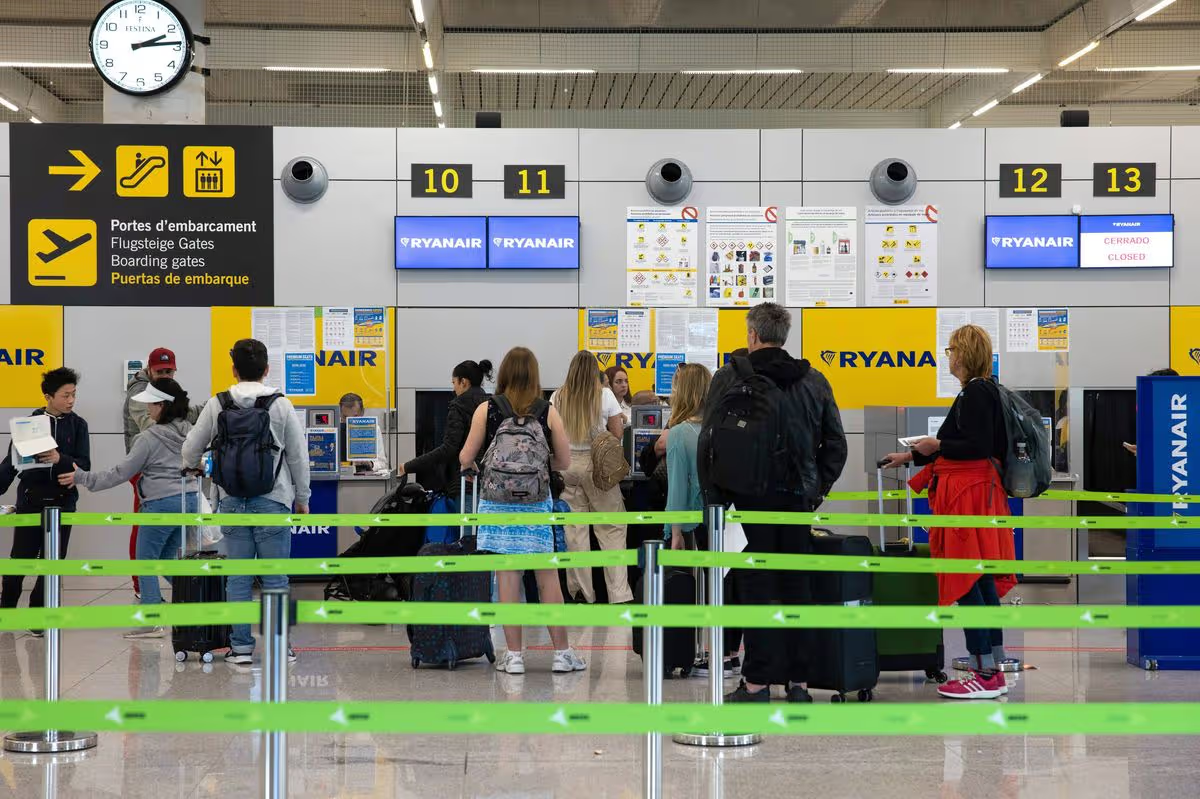
Many passengers are facing waits of up to three hours at Spanish airports due to the new controls

(Image: Bloomberg, Bloomberg via Getty Images)
Travellers in Spain are experiencing significant delays at airports. And experts are warning that one particular group is bearing the brunt of new border controls, according to a Spanish travel organisation.
There have been widespread reports of waiting times of up to three hours. New regulations have been introduced, with some passengers in particular facing very long waits.
Spanish media reports indicate waiting times of up to three hours at Palma airport alone, with similar delays reported in France, Greece, Italy and beyond. Travel group Aviba is now calling for urgent measures to prevent chaos this coming summer.
Pedro Fiol, president of the travel association, is demanding immediate action to avert disruption this summer, and has revealed he has been pushing for such measures for months, according to Ultimata Hora. The new system has only just been introduced, having fully launched on April 10, following a trial period that began late last year.
The EU’s new Entry/Exit System (EES) initially began operations on 12 October 2025, with a phased rollout across 29 European countries. Now it is fully in place.
The system replaces passport stamping with digitally recorded entries, exits or refusals of entry of non-EU nationals arriving for short stays. Travellers’ facial images, fingerprints and personal data from the travel document will also be recorded.
Mr Fiol said: “The implementation of the new European Border and Security System (EES) is already beginning to be felt at the Balearic airports, especially at Son Sant Joan, the main gateway to Mallorca, where we are still operating with a hybrid model. At certain times, it is causing some slowdowns in the controls, particularly for non-EU passengers.”
He warned that “we are facing a structural change in how borders are managed across Europe: biometric registration is replacing manual passport stamping, and this means more time for the passenger’s first contact with their destination.” In his view, so far “the experience has been inconsistent: some days the operation runs relatively smoothly, while others, according to agencies and tour operators, can take more than two hours from the moment the plane lands until the traveller collects their luggage, and even nearly three hours in some specific cases.”
Ultima Hora reports that the National Police have acknowledged the delays, though they say they have seen no evidence of prolonged hold-ups. Sources close to the security forces have told Spanish media that additional staff have been deployed during peak hours in a bid to ease any difficulties that may occur during periods of heavy passenger congestion at checkpoints.
Travellers passing through airports in countries including France, Germany, Belgium, Italy, Spain and Greece are facing waits of several hours at border controls, according to the Airports Council International (ACI). Olivier Jankovec, the director of the ACI European division, told the Financial Times: “This situation, in the coming weeks and certainly over the peak summer months, is going to be simply unmanageable.
“We are seeing those queueing times now, at peak times, when traffic is just starting to build up.” A spokesperson for the European Commission told the Guardian: “What we can see from the first days of full operation is that the system is working very well. In the overwhelming majority of member states there are no issues.”
The commission said that the average registration of a passenger was 70 seconds, although the ACI has claimed that it can take up to five minutes. The spokesperson said there were a “few member states where technical issues have been detected” but that they “are being addressed”.
They said: “It is up to member states to ensure the proper implementation of the EES on the ground.” Luke Fitzpatrick, from independent travel agency Perfect Getaways, told the BBC this week that travellers should plan ahead to make border checks as smooth as possible.
“It’s about being as prepared as you can be,” Fitzpatrick told BBC Radio Merseyside. “There is a lot of uncertainty at the moment as people are getting used to the new system.”
While he said the advice was to arrive at the airport “at least three hours early”, he said it could be more difficult for people booked on a package holiday. “If you’re on a shared transfer back, everyone’s coming together at the same time,” he said.
EES changes and the impact on transfer and pick-ups
Pedro Fiol told Ultima Hora that “this situation is forcing a restructuring of transfer and pick-up operations at destinations to better co-ordinate exact times, avoid additional downtime, and guarantee the smoothest possible service.” Given this situation, he says that “travel agencies are concerned that if resources are not properly allocated at airports with such high tourist pressure as those in the Balearic Islands, significant queues and a negative first experience for visitors are possible.”
What do Brit tourists need to do with EES rules?
The govuk website states that “if you are travelling to a country in the Schengen area for a short stay using a UK passport, you may be required to register your biometric details, such as fingerprints and a photo, when you arrive. You do not need to take any action before you arrive at the border, and there is no cost for EES registration.
“EES registration is replacing the current system of manually stamping passports when visitors arrive in the EU. EES may take each passenger extra time to complete so be prepared to wait longer than usual at the border.”
The countries in the Schengen area are: Austria, Belgium, Bulgaria, Croatia, Czechia, Denmark, Estonia, Finland, France, Germany, Greece, Hungary, Iceland, Italy, Latvia, Liechtenstein, Lithuania, Luxembourg, Malta, Netherlands, Norway, Poland, Portugal, Romania, Slovakia, Slovenia, Spain, Sweden, and Switzerland.