Stay informed and up-to-date with the latest news from around the world. Our comprehensive news coverage brings you the most relevant and impactful stories in politics, business, technology, entertainment, and more.
Zack Polanski calls for internal rule reforms to give party leaders greater control over policy after Zionism vote.
Published On 11 Oct 202611 Oct 2026
Zack Polanski, the leader of the United Kingdom’s Green Party, has proposed a potential overhaul of his party’s democratic mechanisms, calling for the leader to have larger control over strategic direction.
The appeal came in an article published in The Guardian on Sunday after party members passed a motion declaring that Zionism is racism at their annual conference on October 4 in a divisive vote.
Recommended Stories
list of 4 itemsend of list
Polanski also failed to grab a parliamentary seat in the wake of the row with Israel in a by-election.
The Labour Party won the election for the parliamentary seat vacated by former leader Keir Starmer in Holborn and St Pancras on Friday, fending off a strong challenge from the left-wing Green Party in a boost for British Prime Minister Andy Burnham.
“Our party democracy must now evolve to meet that – creating wider engagement for members, giving leaders more responsibility to set the party’s strategic direction, and making our processes as robust and accessible as possible,” he wrote.
“Above all, that unity must be deployed in the service of changing this country for the better,” the Green Party leader added.
Criticism over vote on motion
Polanski also replied to the criticisms of him for not participating in the vote on the motion on Zionism.
“I have been asked why I was not present for the vote. The answer is that my priority was fighting a hugely consequential by-election for our party,” he said, adding that he put all his “energy into the race in Holborn and St Pancras”.
He admitted that some members feel “let down” by his decision not to make an appearance there.
The Green Party’s motion, which called for “Palestinian liberation, the right of return, Boycott, Divestment and Sanctions (BDS), and a full arms embargo against Israel” was criticised by Jewish groups, other parties and most Green Party MPs.
After conceding defeat in the fiercely contested by-election, Polanski answered his critics, saying he would stay on as leader.
He was barred from entering Israel after his party backed a motion to define Zionism as racism.
The UH-60 Black Hawk has been the rugged workhorse of U.S. Army aviation for nearly 50 years, with around 4,000 examples currently in service with 36 nations worldwide. Many of these helicopters, and new aircraft coming off the line, are set to fly as far out as 2070, and Sikorsky is curating a suite of upgrades to keep them valuable assets for the future fight. A new “digital backbone” is designed to underpin swift technological insertions such as launched effects, with related initiatives including the provision of more power to lug greater payloads, and the fully-autonomous U-Hawk cargo drone variant.
“As part of an overall “Black Hawk 2070” modernization effort we’re developing a number of complementary capabilities, including our U-Hawk uncrewed cargo variant, which we plan to fly later this year,” Jason Wrigley, Sikorsky’s director of business development for Black Hawk, told TWZ at the company’s Stratford plant in Connecticut.
Sikorsky plans to fly its U-Hawk uncrewed cargo version of the Black Hawk this year. Sikorsky
“A new digital backbone for the Black Hawk is at an advanced design phase in our labs and it’s designed to provide interfaces throughout the aircraft that will provide power, data, a network, cooling and most importantly, open architecture interfaces that enable the easy integration of new equipment, such as sensors. We see this as a core building block for the next generation of Black Hawk, along with new engines and other airframe improvements designed to futureproof the platform.”
The new digital backbone is designed to work in concert with a modern, software-driven strategy that meets the Army’s Modular Open Systems Approach and the desire to add technologies cheaper, faster, and more easily. Wrigley says that as customers identify new capabilities and needs for their Black Hawks, the digital backbone will be sufficiently efficient to permit customization even on a mission-by-mission basis. Sikorsky is also introducing a new modular nose to the H-60, which is reconfigurable with sufficient volume to support even more sensors and electronics.
“There’s a big focus on open architecture and that ability to quickly plug-and-play,” says Wrigley. “The new modular nose will change the look of the Black Hawk up front to provide even more space for equipment that will work directly with the new digital architecture.”
The new modular nose will give the Black Hawk more than twice the internal volume of the original nose section and it’s designed to provide space for internal electronics and an integrated mount for external sensor pods. It is designed to provide sufficient space to accommodate electronics that enable roles such as search and rescue, drone control, and flying in degraded environments, and it will also house some of the equipment required as the Black Hawk’s autonomous capabilities expand.
Sikorsky plans to introduce a new modular nose to the UH-60M. Sikorsky
Joshua Powers spent 22 years as an Army Aviation officer flying the Black Hawk, and he’s well qualified for his new role with Sikorsky handling business development for rapid capabilities insertions. “Army units know the Black Hawk inside out; how to fly it, maintain it, and use it to maximum effect. The upgrades we are developing will bring new capabilities faster, without time-consuming and complex changes to sustainment, training, and operations, plus we are adding more range, more payload, and more power to meet the demands of the Indo-Pacific region.”
“I find it amazing to pair new technology with a rugged platform like the Black Hawk. These new innovations are needed to meet the needs of the new complex battlefield. The fight I fought in Iraq is very different from the current operating environment and what future warriors are going to go up against, and what we’re asking them to do is very different from what came before.”
Bringing autonomous co-pilots to the Black Hawk
Autonomy is a central pillar of Sikorsky’s strategy for the future Black Hawk. The company’s MATRIX autonomy software is now being matured on a UH-60M variant, and while it’s not necessarily designed to completely replace pilots, MATRIX will assume some of their workload, making flying safer and simpler as mission sets grow increasingly complex and dangerous. “Pilots that are controlling collaborative drones, for example, need to be able to focus on the drone mission, and autonomy will help lighten their cognitive load,” explains Wrigley.
“The standard Black Hawk crew operates with two pilots. Adding our MATRIX autonomy system gives the operator options – a single pilot could fly without an unbearable workload and still fulfil a mission commander role, for example. The Army could then operate the Black Hawk with no pilots at all when that’s the appropriate option.”
The U.S. Army received its first UH-60MX Optionally Piloted Vehicle (OPV) on March 20, 2026. Sikorsky
“We delivered the first UH-60MX to the Army earlier this year,” says Wrigley. The delivery marked the first full authority fly-by-wire and optionally-piloted UH-60 in the Army fleet. “They are using it for testing and soldier feedback to develop tactics, techniques and procedures for the autonomous Black Hawk. We have since received a contract to deliver three more MX aircraft to the Army.”
MATRIX autonomy kits have now been installed on all three U.S. Army Black Hawk models; the UH-60A, UH-60L and UH-60M. Sikorsky plans to incorporate autonomy options into all Black Hawks as they are built, plus the MATRIX system will be able to be retrofitted to existing examples.
Powers is well aware of the benefits autonomy will provide from complex combat operations to more mundane day-to-day missions. “Flying at night and seeing the tracer fire coming up at you, things like that, I honestly feel that’s not the big threat. It’s when you’re going to land and there’s just a big dust cloud. When you’re tired, you aren’t as focused. Having MATRIX, whether that’s with one, two, or no pilots, it’s about that reduced workload on the mission. Pilots won’t be as fatigued, plus they have the safety net of a fully autonomous aircraft that can, if needed, land in all of those difficult environments. It will give commanders more operational flexibility and the ability to mitigate risk in less-than-ideal conditions dictated by the enemy or weather.”
The first UH-60MX during testing alongside Sikorsky’s UH-60A Optionally Piloted Black Hawk. Sikorsky
“The Black Hawk operation isn’t just about pilots, it’s also that integrated four-person crew. As a pilot, you’re relying on your senses and also on the guys in the back to watch out and tell you where you’re going. MATRIX is just going to help that team effort and put you in a better position to bring the crew back safely. It integrates all the systems and sensors and uses altitude, airspeed, radar altimeter, drift indications, and puts the fly-by-wire technology to where it can make rapid adjustments and changes based on what it’s seeing with the sensors.”
The volume of testing, the maturity, and the confidence in MATRIX helped Sikorsky to develop the S-70UAS, or U-Hawk, which was unveiled in 2025. The U-Hawk project essentially removes the cockpit and its associated equipment from a Black Hawk and replaces the front end with cargo doors to provide a huge internal space as a supply drone.
“We acquired a used UH-60L Black Hawk as the template for our initial U-Hawk. We added the clamshell doors and that was the actual aircraft that we showed at AUSA last year,” says Wrigley. “Since then we’ve been adding the fly-by-wire and integrating the MATRIX autonomy. It’s currently in our innovations hangar in Bridgeport, Connecticut, getting the final work done and it will make its first flight as a U-Hawk later this year.”
The first U-Hawk is based on a modified UH-60L. Sikorsky
Sikorsky sees the U-Hawk as a natural evolution for the Black Hawk in contested logistics missions, when cargo needs to be moved but the threat is sufficiently high that it drives a need for uncrewed platforms to tackle the mission.
“We’re spending a lot of time on the U-Hawk and its roles. As well as being an uncrewed cargo helicopter, it can also be a truck that can carry a large volume of launched effects,” explains Wrigley. “There are Black Hawk models on the market right now that are being divested, and we see those as being an ideal option for conversion to U-Hawk configuration to affordably introduce this capability to the market.”
Drone dispenser
The integration of small drones dubbed ‘launched effects’ into rotary-wing operations is a major initiative from the Army as a new means to collect intelligence for commanders on the battlefield, relay communications, jam and distract enemy emitters, and act as loitering munitions. These mini air-launched drones can be carried and fired from stub-wing-mounted launchers, with other concepts seeing larger volumes of them carried inside the cabin as a “mega-pack,” with Sikorsky seeing both as being highly-applicable to both the Black Hawk and the U-Hawk.
This is exactly the kind of capability that the digital backbone in the Black Hawk is intended to open the door to; installing plug-and-play drone command kits, which could enable the Black Hawk to act as a “drone mothership” to launch, task, and command swarms of multi-mission launched effects.
A Launched Effect-Medium Range is fired from a UH-60M Black Hawk during Project Convergence-Capstone 6, in July 2026. U.S. Army
The Army tested its latest operational concepts for launched effects during the Project Convergence Capstone 6 demonstration event this summer. This annual exercise is designed to develop concepts and tactics as well as gather soldier feedback, as it works to transition new systems into service. The latest exercise built on previous launched effects testing on the Black Hawk, when a UH-60M deployed Anduril’s Altius-700 launched effects that then operated as an autonomous hunter-killer team to locate targets, share data on those targets, and then strike them, without the need for the Black Hawk to expose itself to threats.
“As a young Black Hawk pilot, the OH-58 Kiowa Warrior was the primary scout platform, but it was limited by range and its ability to be detected,” explains Joshua Powers. “Today, we launch small drones that can remain unseen and they can give us real-time feedback. Launched effects make our lift assets more capable.”
“We see the Black Hawk as the aircraft capable of carrying, deploying and then acting as an airborne mission command node for launched effects,” adds Jason Wrigley. “In the operational environment of the future, it’s really about the mass of those launched effects. This isn’t about carrying one or two of them, this is about carrying and controlling a large number of them.”
A “quiver” of launched effects inside the U-Hawk shown at the AUSA 2026 trade event. Jamie Hunter
“We’ve tested them on the stub-wings, but we are also exploring what we call “quiver” – that large number of launched effects inside the cabin in that “mega-pack.” This creates additional opportunities for mass that we think is going to be really critical. We’ve done a lot of operational analysis in concert with the Army on what the right mix of launched effects might be to extend the standoff range of the aircraft to improve survivability – which is of course what it’s all about – but the right mix will ultimately come down to the mission. We have seen a lot of testing over the past few years, so we do believe this is a capability that can be introduced operationally soon on the Black Hawk.”
More power for more missions
To support the increased lift that might be needed for a missionized Black Hawk lugging large payloads, including an arsenal of launched effects, Sikorsky is well along in development of a new engine that is designed to create over 1,000 pounds of increased payload capacity and increased range for the Black Hawk. The T901 Improved Turbine Engine (ITE) from GE Aerospace provides 50 percent more horsepower over the existing T700 engines in the UH-60M.
“One of the key building blocks of the future of the Black Hawk are the twin ITEs as we look to expand the mission capability and the utility of this aircraft for decades to come,” explains Wrigley. Sikorsky began initial testing of the first UH-60M with ITE in January 2025. “We are actively in the test program right now at our test facility in West Palm Beach, Florida. The twin ITEs in each Black Hawk and that additional power translates into some pretty significant operational opportunities. Since our first flight with ITE in May 2025 we’ve flown the aircraft with the new engine for over 50 hours and up to 17,000 ft above sea level.”
A UH-60M fitted with twin GE Aerospace T901 Improved Turbine Engines (ITE). Sikorsky
Sikorsky is accompanying the addition of the new engines with a significant expansion of the fuel tank to increase capacity and range. This is being done without impinging on cabin volume and thus retaining the important ability to transport 11 combat troops, while increasing range by around 100 nautical miles. “The T901 also improves fuel efficiency and eases maintenance – so overall we are really improving the payload capacity of the aircraft. We’ll be getting to the milestone C production decision on ITE within the next couple of years, and at that point it will become a core element of the Black Hawk program going forward,” Wrigley explains.
Inside Sikorsky’s “Black Hawk 2070” Plan With Drones, Autonomy, And The Pilotless U-Hawk.
Building Black Hawks
Touring the Black Hawk production line in Stratford, Connecticut, it’s a hive of activity. Many of the major components for each helicopter are manufactured here. The long final assembly line sees teams of workers busily constructing UH-60M and HH-60M medevac Black Hawks for both domestic and foreign military sales customers, along with new HH-60W Combat Rescue Helicopters for the U.S. Air Force and MH-60R Seahawks.
“We’re designing all of these upgrades with the intent that they will all be available off the production line in new build aircraft, as well as in kit form for upgrades to existing assets in the field,” notes Wrigley. “Here in Stratford in what we call the “back shop” we build all the rotor blades, gearboxes, and many other components that go into each aircraft. We are already thinking ahead and we’ve invested significantly into additive manufacturing, with 11 parts on the Black Hawk today that are additively manufactured. It’s a great place to start, but there’s a long way to go and we’re working on qualifying more challenging components and load-bearing parts.”
A brand new UH-60M in pre-delivery testing. Sikorsky
Cohesively, the digital backbone, larger fuel tank, new engines, and the new modular nose will all be introduced on the production floor in the coming years to pave the way for that increased payload capacity to carry fully-equipped combat troops, supplies, and all the new kit needed for the future fight and the Black Hawk’s role as a multi-mission forward battlefield node. The autonomous U-Hawk and the optionally piloted flexibility afforded by MATRIX – all of these pieces of the future Black Hawk are presently coming together under an overarching effort.
“The future Black Hawk will be that complement to the future long-range MV-75 Cheyenne II,” says Powers. “These won’t be a one-for-one replacement for every Black Hawk currently in the fleet – the MV-75 has a specific purpose and function that the Black Hawk isn’t designed to do. What the Black Hawk can do with these new upgrades is shape the battlefield and with its autonomy be out there flying missions into contested environments.”
U.S. Army UH-60 Black Hawks assigned to 4th Ranger Training Battalion. U.S. Army
“Those homeland missions are equally necessary. I recall talking about this in flight school when choosing an aircraft to fly, how it’s one thing to be deployed on combat missions, but it’s also about being back in the homeland on disaster relief when you need the Black Hawk to go out and save lives, those kinds of missions the Army National Guard does – it really underlines the importance and versatility of the Black Hawk.”
Over the past 50 years and looking ahead to the next 50, continuing the proven legacy of the Black Hawk will mean constant evolution to meet new missions and needs. Sikorsky’s task is for all of these new elements to meld into a future Black Hawk that’s ready to roll off this production line soon, that still also provides the same dependable, rugged capability for the Army at home or overseas, well into the future.
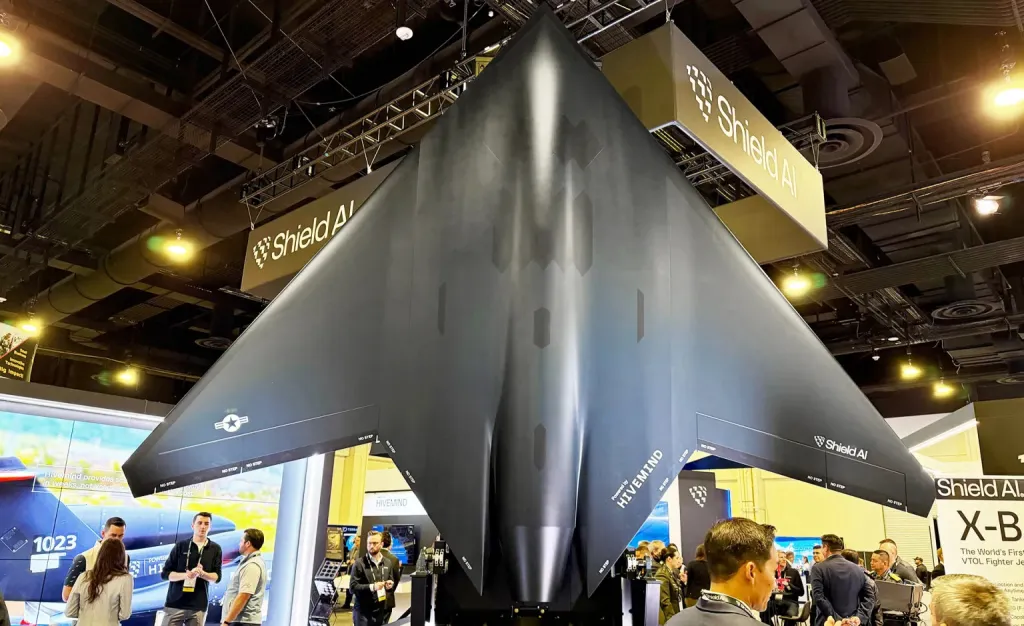
Shield AI says it is on track to roll out the first prototypes of its X-BAT jet-powered stealth ‘fighter’ drone by the end of this month. Flight testing of this uncrewed aircraft, which is designed to take off and land vertically from a tail-sitting position, is still scheduled to kick off before the end of the year. X-BAT’s core concept was already highly ambitious, but an extremely aggressive timeline to reach some degree of operational capability through the U.S. Navy’s Runway Independent Maritime Expeditionary Strike (RIMES) program has now been disclosed.
TWZ got an update on X-BAT, which we were first to report on in-depth last year, in an interview yesterday with Shield AI’s Armor Harris, Senior Vice President and General Manager of the company’s aircraft division. This came ahead of today’s announcement that the company has received an additional $150 million in funding from the Office of the Under Secretary of War for Acquisition and Sustainment through its Defense Exportability Features program via the Navy. This is on top of the $50 million investment the Navy, in cooperation with the Pentagon’s Defense Innovation Unit, made in X-BAT’s development earlier this year as part of the RIMES effort. Shield AI has committed an equivalent amount of internal funding, for a combined total of $400 million.
Jamie Hunter
“In broad strokes, the last year has been a bunch of collaborative risk reduction with the Navy. So, wind tunnel testing, engine testing, thermal testing, all kinds of stuff to basically take the major risks in the program, [and] burn them down, so we can move confidently into the production design,” Shield AI’s Harris told us. “The last culmination of the risk reduction is the flight testing of the two full-scale prototypes. The first one of those will be done at the end of October.”
“That’s a full-scale vehicle,” he continued. “It’s got the outer mold line, it’s got the F110 engine, the full propulsion path, everything in it.”
To date, Shield AI has only shown models of the X-BAT publicly. A new one displayed at the Navy League’s Sea-Air-Space 2026 exposition in April revealed major changes to the core design. This included a complete reworking of the planform from a ‘cranked kite’ type arrangement to one with a distinctly different arrowhead-shaped profile featuring a straight leading edge with a more dramatic sweep.
The video below includes clips showing the original X-BAT design and the current one.
X-BAT is on the way.
The aforementioned “propulsion path,” testing of which has already been conducted on the ground, primarily consists of the General Electric F110 paired with an Axisymmetric Vectoring Exhaust Nozzle (AVEN). The nozzle was originally developed in the 1990s for an experimental thrust-vectoring F-16 fighter. Shield AI is using the original AVEN, which had been in storage for decades, to support development of X-BAT. The nozzle will provide pitch and yaw control, with roll control for the drone coming from bleed air routed through thrusters in the drone’s wings.
No runway, no problem.
Shield AI and @GE_Aerospace just cleared a critical path to vertical flight, completing engine light-off testing of the Axisymmetric Vectoring Exhaust Nozzle (AVEN) for X-BAT.
Shield AI has previously said that the roughly fighter-sized X-BAT will have a maximum range of 2,000 nautical miles and a service ceiling of around 50,000 feet. The company has also said in the past it is targeting an effective combat radius roughly twice that of the F-35, or around 1,340 nautical miles, but also that it could be closer to 1,000 nautical miles. Space has been made within the X-BAT design for a potential in-flight refueling capability, but there is no active work yet to integrate that feature.
In terms of payload, X-BAT’s design includes internal weapons bays roughly the same size as those on the F-35, as well as two external hardpoints under the wings. Those hardpoints are plumbed, meaning that range-extending drop tanks, or even buddy refueling stores to allow the drone to act as a tanker, could be carried. Baked-in modularity and open-architecture mission systems are intended to make it easier to fit various sensors, data links, and other capabilities down the line.
A rendering highlighting X-BAT’s stores carrying capabilities. Two AGM-154 Joint Stand-Off Weapon (JSOW) glide bombs are depicted here in the internal bays. The silhouette of an AGM-158C Long Range Anti-Ship Missile (LRASM) cruise missile is shown under the wing. Shield AI
“X-BAT’s really designed to be a multi-role capability, and, if you look out at the 10-20 year time horizon, it’s hard to predict what the future fight is going to look like,” Shield AI’s Harris noted. “We fundamentally believe that multi-role capabilities are critically important. And, so, X-BAT, the reason why it’s sized to where it is is [sic] to be able to carry serious strike weapons internally and externally, in addition to being able to do air-to-air [combat], electronic warfare, and other mission sets.
“You could think of it as like X-35 versus F-35,” he also said yesterday when asked about any expectations now for further changes between the initial pair of prototypes and the final production design.
Lockheed Martin’s X-35 demonstrators are, in very broad strokes, similar to, but distinct from any of the resulting variants of the Joint Strike Fighter. Shield AI has notably already talked in the past about integrating more low-observable (stealthy) attributes to the exhaust end of the design down the line.
A side-by-side look at an X-35 demonstrator, at left, and a production F-35A, at right. USAF
“Then we’ll get into flight testing around the end of this year,” Harris added. “We’ll be doing vertical takeoff and landing testing with that [the initial prototypes] to actually prove out and develop the VTOL [vertical takeoff and landing] technology for X-BAT.”
Shield AI’s X-Forge 2 facility at the Newton City-County Airport in Kansas is set to be the main flight testing hub for X-BAT, as well as the focal point for sustainment of the drones. A production facility, X-Forge 3, is also being built in Des Moines, Washington. The company’s original site, X-Forge 1, is in Frisco, Texas.
A rendering of the X-Forge 2 facility. Shield AI
In terms of the actual flight test campaign, “you remember the X-BAT system has the air vehicle and the launch and recovery vehicle, which is the trailer that it launches and lands from,” Harris said. “Basically, the way the testing works is, we start with the vehicle horizontal, sitting on that launch and recovery vehicle, running the engine. Then we bring it up vertical, run the engine vertically, run the vehicle vertically.”
“Then we have one of the biggest cranes in the world that’s getting set up at our test site in Kansas right now, and we hang the vehicle suspended from that crane and do a bunch of testing while it’s hanging from the crane in free flight,” he continued. “Then we take the crane away, and then we do the actual untethered flights.”
Shield AI’s goal is to fly a fully missionized X-BAT in 2028 and start series production the following year.
A rendering of the X-Forge 3 production facility being built in Des Moines, Washington. Shield AI
On top of that, “the way that the [RIMES] program has been structured is getting to an early operational capability in 2029 is the end goal,” Shield AI’s Harris said.
When asked if this meant that RIMES is aiming “to eventually arrive at not just a demonstration of capability, but a real operationalized capability,” he said that was “correct.”
We will come back to this more later on, but suffice it to say up front, the prospect of X-BAT reaching an operational level of maturity within three years is extraordinarily ambitious, to say the least.
In the meantime, Shield AI has already been testing the mechanisms to “latch and unlatch” X-BAT to the launch and recovery system using an unpowered “battleship” test article, according to Harris. The design of the launch and recovery system has also evolved, and it is now self-propelled, at least to a degree, rather than just being a towed trailer.
“The launch and recovery vehicle is actually critical to the operation of the X-BAT weapon system because it enables survivability on the ground. So when you’re operating in a land-based environment, it enables basically shoot-and-scoot tactics,” Harris also noted. “Enemy transporter-erector-launchers [for missiles] are like pretty hard to find because they’re constantly moving around. Just like X-BAT, when it’s mated onto the launch and recovery vehicle, [it] is always moving around, makes it hard to track, hard to find, hard to destroy.”
A rendering of an X-BAT on a launch and recovery trailer in the fully erected position. Shield AI
The plan now is to “build the one-to-one launch and recovery vehicles to air vehicles. So the air vehicle is always on the trailer. It never comes off of it,” he continued. “Even maintenance to the air vehicle is done while it’s sitting on that launch and recovery vehicle.”
“In fact, we’re actually planning on building more than one-to-one of the launch and recovery vehicles, so that way you can preposition them around different islands, different places in the theater, and have multiple places the aircraft can lily pad from,” he added. “But you’re never putting multiple aircraft onto one launcher and launching them or something like that.”
“When you typically operate a jet, there’s a whole bunch of ground carts and stuff that you bring, like the ground power cart, the ground cooling cart, the air start cart, etc,” Harris further elaborated. “So we’ve moved a lot of those systems onto [the] launch and recovery vehicles, so you don’t have all these separate carts, which is pretty critical when you’re trying to do expeditionary operations.”
“The model for land-based operations is kind of a hub-and-spoke type model. So the squadrons are based at air bases. All the fuel and the weapons are generally based at the air bases, as well. But then you can distribute the aircraft all over the airfield,” he continued. “So, you think about what the enemy’s doing, they’re targeting the runways, they’re targeting the tarmacs, but you can disperse the aircraft around the perimeter of the airfield. You can launch them from the golf course. You can launch them from empty space in the taxiway, etc.”
A graphic highlighting various options for deploying X-BATs on land and at sea. Shield AI
Harris said that another “spoke” could be X-BATs operating from forward arming and refueling points (FARP). All of this is part of larger concepts of operations for the drone that Shield has been envisioning, and that are not at all limited to deployments at locations on land. Harris noted during the interview that the self-propelled nature of the current launch and recovery system would also help with moving the drones around on virtually any ship with sufficient deck space. This is where the RIMES program, which is separate and distinct from the U.S. Navy’s carrier-based Collaborative Combat Aircraft (CCA) drone ambitions, really comes in.
“I’ll say the fundamental value proposition of RIMES is that if you have a carrier-based CCA, you’re fundamentally constrained by the square footage of the deck of the aircraft carrier,” Harris explained. “So if you are taking an F-18 or an F-35 off, you better be replacing it with better capability per square foot of deck space than the thing that you’re taking off.”
“So, F/A-XX [the Navy’s sixth-generation carrier-based fighter, now to be built by Boeing] is a huge leap in capability, right? Which is why that program makes a lot of sense,” he continued. “The challenge with CCA is: Does it really make sense to take a manned aircraft off of an aircraft carrier and replace it with an unmanned aircraft?”
Shield AI’s argument here is that X-BAT disrupts this core equation by opening the door to a CCA-like capability, or even something more capable, that can be employed in a ship-based mode without sacrificing any crewed aircraft capacity on an aircraft carrier. Shield AI envisions dozens of X-BATs being employed from amphibious assault ships, as well as other kinds of amphibious warfare ships, including expeditionary sea base type vessels, as seen at the top of this story.
A rendering depicting X-BAT drones on the deck of the US Navy’s future America class amphibious assault ship USS Bougainville. Shield AI
“So when you think about the number of carrier air wings that the Navy has to deploy, deploying X-BAT across all these other ships basically significantly increases the number of carrier air wings,” Harris said.
As already mentioned, the current structure of the RIMES includes a target for an early operational capability in 2029, according to Harris. “We have a program defined to get there, and there’s basically milestone-based payments along the way, so as Shield performs and hits milestones, then the Navy kicks in additional funding,” he added.
“I don’t want to get ahead of the Navy, and give you a specific number, but like hundreds to low thousands,” he also said when asked if there was even a very rough planning figure for the eventual size of the RIMES drone fleet.
Many questions remain about X-BAT, which still has to demonstrate the viability of its vertical takeoff and landing capability, which underpins everything else. As we noted in our original in-depth report on this design, the core concept here is not new, and there have been many unsuccessful attempts to operationalize it in the past. There has been skepticism that Shield AI’s effort will succeed where others have failed. The company is of the view that groundwork has now been more firmly laid, including through its own work with its much smaller internal combustion-engine-powered V-BAT tail-sitting VTOL drone, to truly realize a design of this kind.
V-BAT: Deep Recce-Strike for GPS and Comms Denied Battlefields
The performance and capabilities that Shield AI expects from X-BAT once it is flying at all are also ambitious. A high degree of autonomy is also part of the full planned package, which will leverage the company’s already extensive work in this domain with its Hivemind software.
Shield AI flies Hivemind AI Pilot on 6th Aircraft
There are also questions about the Navy’s exact plans for RIMES, as well as its broader future drone fleets. Just this year, the service has issued several contracting notices pointing to rapidly evolving views about future carrier-based strike drones and other uncrewed aircraft. New requirements that Naval Air Systems Command (NAVAIR) released in August ostensibly for future CCA-type drones notably pointed more toward something that sounded very much like an advanced uncrewed combat air vehicle (UCAV), as you can read more about here.
Whether the 2029 operational timeframe the Navy is said to be aiming for under RIMES is firm, or even realistic in any way, remains to be seen. The actual definition of what constitutes an “early operational capability” could be very flexible, as well. It is also worth noting here that Shield AI is not the only company currently conducting work under RIMES. Whether the Navy might be planning to acquire more than one design through this program is unclear. We have reached out to the service for more information.
Other services could be interested in any operational capability produced through the RIMES effort, too. TWZ regularly highlights how runway-independent drones would be particularly well-suited to the U.S. Marine Corps’ new expeditionary and distributed concepts of operations. That service is already in the process of acquiring MQ-58B Valkyrie drones from Kratos that will be able to operate from conventional runways. They will also be capable of runway-independent launches, though they will still have to land conventionally. The baseline Valkyrie design lands via parachute.
A rendering of a landing gear-equipped version of the Valkyrie in line with what the Marines are now acquiring. Kratos
In general, runway independence is of growing interest elsewhere across the U.S. military as threats to large, established bases continue to expand in scale and scope. The proliferation of various tiers of weaponized drones is a particularly significant factor in this, asTWZ just examined in detail this week in the context of the recent withdrawal of B-1 bombers from RAF Fairford in the United Kingdom. Ever more capable cruise, ballistic, and hypersonic missiles are also part of the full threat picture.
The conflict with Iran has also underscored the limits of what can be gained survivability-wise by dispersing traditional fixed-wing aircraft, especially within an existing airbase. As highlighted earlier, X-BAT could be dispersed very differently to nearly anywhere within a facility that can handle the thrust from the F110 engine in hover.
As it stands now, we are set to get our first view of a full-sized X-BAT prototype within the next few weeks as Shield AI continues to gear up for the start of actual flight testing before the end of the year.
Finance officials from around the world will gather in Bangkok this week under the shadow of a widening war in the Middle East, the biggest-ever energy supply shock and rising interest rates that together pose daunting risks to already-sluggish global economic growth.
The US-Israel war on Iran, now in its eighth month, and its inflationary impact are slated to dominate the agenda and sideline conversations during the annual meetings of the International Monetary Fund (IMF) and World Bank, held outside Washington for the first time in three years.
Recommended Stories
list of 4 itemsend of list
IMF Managing Director Kristalina Georgieva told Reuters News Agency that 18,000 people were registered to attend the meetings, 4,000 more than the last off-site meetings held in Morocco in October 2023.
Notably absent will be United States Treasury Secretary Scott Bessent, who dispatched two senior officials in his stead while he handles some “domestic engagements”, a US official said. Federal Reserve Board Chairman Kevin Warsh will attend and is slated to participate in a public event with Georgieva on October 16.
Several other finance ministers were also staying home due to domestic budget and election duties, but most central bankers would attend, Georgieva said.
Bessent’s decision to skip the high-profile gathering and a meeting of the Group of 20 (G20) major economies, which the US leads this year, may frustrate counterparts amid rising tensions over the Iran war, Ukraine’s battle against Russia’s invasion, and the US move to impose sanctions on the International Criminal Court.
Fossil energy reserve release
The Group of Seven (G7) countries have agreed to release 100 million barrels of diesel and crude oil from emergency reserves under pressure from US President Donald Trump, who is keen to see lower petrol prices before November elections that could see his Republican Party lose control of Congress.
Trump on Friday announced a deal with Russia that would provide even more diesel to global markets and a temporary waiver of US sanctions designed to deprive Moscow of revenues for its war on Ukraine. The move drew swift criticism from Ukrainian President Volodymyr Zelenskyy.
More than one billion barrels of oil have been released, mainly from onshore commercial inventories, since the start of the war on February 28. But industry executives say the amount of oil in storage that is accessible to the global market is running low, making the market more fragile and fuelling pressure on prices.
The IMF has signalled little change in its forecast for three percent global growth in 2026, and may edge its forecast for next year slightly higher. But some countries will see downgrades, including Ukraine, now in its fifth year of war against Russia’s invasion, and Gulf countries hit by Iranian strikes and sharply reduced energy exports.
IMF research released on Tuesday showed that sharp spikes in food and energy prices are an increasingly common source of crises that drive inflation expectations higher for longer, worsen poverty and threaten economic stability.
One headache for policymakers is the growing public debt burden that is sapping growth and adding inflationary pressures. The IMF says public debt is at the highest level since World War II and will exceed 100 percent of gross domestic product (GDP) before 2030.
Advanced economies, led by the US, have the highest debt-to-GDP ratios, but emerging markets and low-income countries are particularly vulnerable, given a perfect storm of challenges: capital outflows in search of higher US rates, weather extremes triggered by the El Nino climate phenomenon, and a lack of investment in artificial intelligence (AI), which has mitigated negative supply shocks in the US and other rich countries.
Developing countries are particularly vulnerable given high public debt levels that will have to be renegotiated at higher interest rates. Together, they face $400bn in debt payments to external creditors in 2026, and interest payments already exceed 10 percent of revenue on average.
Many lower-income countries are worried about new IMF recommendations for loan programmes that call for fewer but deeper reforms as a condition for approving lending, a change that many fear will lead to painful austerity measures.
Burnham was mayor of Manchester from 2017 until earlier this year and his tenure took place during a sustained period of success for City.
As mayor, he championed investment from the Gulf as a way of growing Manchester’s economy, a strategy which was initially pursued by the city’s leaders before Burnham became the inaugural elected mayor of the Greater Manchester Combined Authority.
“I don’t think I misspoke,” said Burnham of his past comments on Man City’s owners.
“What I would say is my mind hadn’t been on all of the issues. My mind had been on Labour Party conference and I was doing interviews in relation to it.
“And also, I didn’t link those two things. You know, the questions linked those two things. What I would say is they’re very separate.
“The football issues are different from the investment issues. People will try and conflate those two things, but they shouldn’t, in my view.
“The football issues, the findings of the independent commission are serious, as I said in the interview.”
The entire process involving the charges against Manchester City is independent of the Premier League.
An independent commission held a 42-day hearing in 2024 which led to the verdict announced last month, with City also guilty of all charges except one relating to non-cooperation with the Premier League investigation.
The commission’s report said that “a number of important club witnesses gave false evidence in key respects and that some knowingly gave untrue and dishonest evidence”.
A separate independent appeal board will hear City’s appeal. The club continues to deny any wrongdoing.
Australia’s modern Test side remain a fascinating one to unpick.
Viewed by many in England as there for the taking in last winter’s Ashes despite a 4-1 win, they are also labelled too old by many observers at home.
The victims of recent shock defeats by West Indies and Bangladesh, they are still unbeaten in their past nine Test series.
But while their struggling batting line-up was bailed out by Matt Renshaw across the first two days of the first Test in Durban, they took control over South Africa on day three in an all-too familiar way.
Nine years after they first appeared together as Australia’s bowling quartet, Mitchell Starc, Josh Hazlewood, Pat Cummins and Nathan Lyon produced their latest relentless performance to dismiss South Africa for 284. There was even some magic from Steve Smith thrown in too.
Cummins took three wickets, Starc, Hazlewood and Lyon two apiece, in doing so brushing off any doubts about their effectiveness at the start of a run of Tests against the world Test champions, in-form New Zealand, India and England.
Authorities urge villagers to move to safer places after a river bursts its banks in the central part of the country.
Published On 11 Oct 202611 Oct 2026
Flash floods have hit central Nepal, sweeping away houses and leaving at least five people missing, according to officials, weeks after devastating flooding in the country that killed hundreds.
A landslide in Chumnubri village in Gorkha district, about 100km (62 miles) west of Kathmandu, blocked the Budhi Gandaki River on Saturday, leading to downstream flooding, authorities said.
Recommended Stories
list of 4 itemsend of list
Two women and three men were unaccounted for, and there are no reports of casualties, said the National Disaster Risk Reduction and Management Authority (NDRRMA).
According to the agency, at least 82 people, including nine foreigners, have been rescued from the affected areas.
The flood swept away about a dozen houses and two suspension bridges and damaged a hydroelectric project camp, carrying some of the construction equipment away, authorities said.
A muddy torrent washed away a highway bridge connecting Gorkha with the neighbouring Dhading district, said NDRRMA Chief Executive Dharam Raj Uprety.
Evacuation order
The Budhi Gandaki is a tributary of the Trishuli River, downstream from another tributary where a glacier collapse caused a catastrophic flood in August that killed 1,457 people, with thousands still missing.
“We have asked villagers living along the riverbanks downstream to evacuate and remain safe,” said Dharmendra Kumar Mishra, Gorkha district’s most senior bureaucrat.
National disaster authorities alerted people living along the river in the Gorkha, Tanahun, Chitwan, East Nawalparasi and West Nawalparasi districts about the flood.
“Please help ensure that people in at-risk areas are moved to safe locations in time and assist search and rescue operations as needed,” the NDRRMA said in a social media post.
Officials said army and police rescue personnel had reached the area and were also monitoring the situation from a helicopter.
“The flood looked similar… It was very scary, and it still feels like a nightmare for us,” said local official Laxmi Gurung of Chumnubri rural municipality.
“Our house is gone, we have no electricity… but there have been no casualties.”
Heavy rainfall in late September also triggered floods and landslides, killing at least 21 people, according to the disaster agency.
The United States is stepping up its campaign to sell Portugal the F-35. Speaking in Lisbon today, Secretary of State Marco Rubio said the United States would make Portugal a “very competitive” offer to replace its F-16 fleet. The development adds a high-level political push to an increasingly intense competition over the Portuguese Air Force’s next fighter.
Portuguese Foreign Minister Paulo Rangel said after meeting Rubio that Lisbon is seriously considering the American proposal, while emphasizing that other options remain under consideration.
U.S. Secretary of State Marco Rubio disembarks from a plane upon arrival at Lisbon Airport during a three-country European tour, in Lisbon on October 8, 2026. Photo by Mark Schiefelbein / POOL / AFP
“The Portuguese state will always decide in accordance with the national interest,” Rangel said at a news conference after the meeting. “There is one point that is also clear: we are seriously considering the F-35 proposal, just as we are considering others.”
Portugal currently operates 25 modernized F-16AM/BMs, including 21 single-seat F-16AMs and four two-seat F-16BMs, from Monte Real Air Base, or BA5. The Portuguese Air Force, known as the Força Aérea Portuguesa (FAP), has not yet formally launched a replacement competition, but the aging fleet is increasingly becoming the focus of attention in Lisbon.
A Portuguese Air Force F-16 participating in NATO Exercise Ramstein Flag 24 flies over the west coast of Greece in 2024. U.S. Air Force photo by Tech. Sgt. Emili Koonce
Portugal acquired a total of 45 F-16A/B Block 15 aircraft through the Peace Atlantis I and II programs.
The first 20 aircraft were delivered beginning in 1994. These were new-build F-16A/B Block 15OCU aircraft, comprising 17 single-seat F-16As and three two-seat F-16Bs, and were used to equip Esquadra 201 “Falcões.”
A second batch followed in 1999, when Portugal received 25 former U.S. Air Force Block 15OCU aircraft. Twenty-one were F-16As and four were F-16Bs, with several intended as attrition replacements or spares. These aircraft had accumulated roughly 3,000 flight hours and underwent an extensive modernization program to bring them to the F-16AM/BM configuration. This means the aircraft are broadly comparable to the U.S. Air Force’s F-16C/D Block 50/52 fleet.
Esquadra 301 “Jaguares” finally became operational with its upgraded aircraft in 2005, while Esquadra 201 did not receive its upgraded F-16s until 2011.
A Portuguese F-16 in special markings associated with the Esquadra 301 “Jaguares.” U.S. Air Force photo by Staff Sgt. Jason Allred
Since then, the Portuguese Vipers have continued to receive incremental improvements. Their configuration has progressed through several mission-software standards, while the aircraft have been equipped with night-vision goggles, Joint Helmet-Mounted Cueing Systems (JHMCS), and advanced targeting and weapons capabilities.
Portuguese Air Force F-16s line up for takeoff. Portuguese Air Force
Twelve former Portuguese F-16s were transferred to Romania under a deal signed in 2013, with deliveries taking place in 2016 and 2017. Romania subsequently ordered five additional aircraft in 2019.
Structurally, the Portuguese F-16s could potentially remain in service into the mid-2040s. But maintaining their relevance against increasingly sophisticated air forces would require continued investment in avionics, sensors, communications, and self-protection systems.
The F-16AM/BM fleet continues to rely on the old AN/APG-66(V)2 pulse-Doppler radar. Replacing it with an active electronically scanned array (AESA) radar such as Northrop Grumman’s APG-83 would substantially improve detection and tracking performance, but would come at considerable cost.
A U.S. Air Force F-16C receives radar modification upgrades in conjuction with the U.S. Air Force Service Life Extension Program, which includes the APG-83 Scalable Agile Beam Radar. U.S. Air Force photo by Airman 1st Class Erin Stanley
Portugal faces a choice between continuing to invest in increasingly tired fourth-generation airframes or moving directly into the fifth generation.
Since the end of the Cold War, Portugal has become much more engaged in out-of-area operations and missions in support of NATO.
In the process, the Portuguese F-16 fleet has accumulated an impressive operational record.
The fighters have repeatedly deployed on NATO air-policing missions, including rotations to the Baltic States, Iceland, Romania, and Poland.
Armed with live missiles, Portuguese Air Force F-16s participate in the NATO Baltic Air Policing Mission in Lithuanian airspace near Siauliai, on May 23, 2023. Photo by PETRAS MALUKAS/AFP via Getty Images
The F-35A would give Portugal a fifth-generation fighter built around low observability, sensor fusion, advanced electronic warfare, and networked operations.
More than 900 F-35s are already in service or on order across Europe, according to previous comments by U.S. Ambassador to Portugal John Arrigo. Washington has repeatedly argued that joining that community would provide Portugal with a substantial interoperability advantage.
A U.S. Air Force F-35A assigned to the 493rd Fighter Squadron taxis on the runway after arriving for the Beja International Airshow in Portugal, in May 2024. U.S. Air Force photo by Senior Airman Renee Nicole S.N. Finona
Airbus has said it intends to submit an unsolicited Eurofighter proposal to Portugal in late October or early November. That package is expected to encompass not just the aircraft, but financing, industrial participation and broader military cooperation.
Selecting the American stealth fighter deepens Lisbon’s military relationship with Washington at a time when European governments are wrestling with fundamental questions about their dependence on U.S. military capabilities.
Across the continent, uncertainty over Washington’s stance on NATO is encouraging European allies to examine ways of reducing their reliance on American military technology, even as those same countries continue to increase defense spending and purchase U.S. equipment.
Procurement of the UH-60 Black Hawk underscores the reliance of the Portuguese Air Force on U.S.-made hardware for many of its needs. Portuguese Air Force
If Washington can combine the F-35’s capability advantages with an attractive acquisition and sustainment package, Portugal could find itself facing a difficult choice between the strategic benefits of joining Europe’s growing F-35 fleet and the industrial and political advantages of selecting a European fighter.
The final decision on the replacement of the F-16 will also determine what combat jet spearheads the Portuguese Air Force for the next several decades.
Hebron, occupied West Bank – Badr al-Tamimi, 60, lives in Hebron’s Old City, where Israeli checkpoints, iron gates and road closures turn the simplest tasks into a dispiriting daily ordeal for Palestinian residents.
The situation goes beyond mere restrictions on movement. Israel has created a ghost town in parts of Hebron, where residents feel they are being driven out. This is most pronounced in an area known as H2, where Israel has complete control and Palestinians are subject to the dictates of the military.
Recommended Stories
list of 3 itemsend of list
A few days ago, Israeli authorities installed three iron gates across a 200-metre (656-foot) stretch of Hebron’s Old City – amounting to just 0.2 dunams (200 square metres) – as part of Israel’s apparent attempts to restrict Palestinians’ freedom to move around the city.
Hebron Mayor Yousef al-Jabari told Al Jazeera that one gate was erected on al-Zahid Road, the only route accessible to vehicles reaching the Old City entrance. A second was placed at the start of al-Shalala Street, which leads to shops connecting to the Bab al-Zawiya area in the city centre. A third towers over another section of al-Shalala Street, a thoroughfare used by pedestrians to access the shopping area.
They are part of a wider web of travel restrictions across the occupied West Bank, but Hebron, which has a strong settler presence, has suffered more than most Palestinian cities.
Approximately 40 percent of the 89 checkpoints in the West Bank and 11 percent of all 925 movement obstacles are located in the H2 area of Hebron, which is under tight Israeli control, according to the United Nations Office for the Coordination of Humanitarian Affairs (OCHA).
About 7,000 Palestinians in an area of Hebron where hundreds of settlers live are affected by the latest travel restrictions. Since October 2023, when the genocidal war on Gaza began, only Palestinians with specific identification numbers could enter this area. Checkpoints at the entrance to this zone are generally only open from 7am to 8pm.
Badr al-Tamimi is forced to move between iron gates to reach other parts of the Old City where he lived his whole life [Sari Jaradat/Al Jazeera]
Al-Tamimi, who lives in the al-Sheikh neighbourhood adjacent to the city’s famed Ibrahimi Mosque, owns a shop in the Old City.
Palestinians can be kept waiting for hours at the checkpoints, and the mood of a soldier manning one can decide the commute time of a Palestinian. Worshippers attempting to enter the Ibrahimi Mosque can be held up for hours by soldiers.
“They might allow a limited number of people to enter while others are forced to wait, whereas resident movement comes to a halt during incursions, Jewish holidays, and the associated security measures,” he added.
Repeated closures have paralysed economic activity in Hebron, making it increasingly difficult for shops and companies to do business.
“Our presence in the Old City is a matter of steadfastness, not the availability of the elements needed for economic life,” al-Tamimi said.
Even after Israel’s occupation of the city in 1967, Hebron was once a bustling city with lively shops and markets. Residents could move more freely between neighbourhoods, which helped with economic life in the city.
From that point, the Old City’s geography changed, becoming isolated from its surroundings, al-Tamimi said.
He points to Shuhada Street, once a vital artery for transport and commerce in the city before road closures and restrictions transformed the area’s reality.
“They committed the crime, yet they continue to punish us for it,” he said.
In 1997, the Hebron Protocol was signed between the Palestine Liberation Organization (PLO) and Israel, dividing the city into two zones: H1, which was under relative Palestinian jurisdiction, and H2 – an area which includes the Old City, the Ibrahimi Mosque, and illegal settlements – remained under Israeli security control.
Issa Amro, coordinator of the Youth Against Settlements group, said Israeli prohibitions intensified with the outbreak of the second Intifada in 2000 when Hebron became a centre of the uprising.
During this period, vast areas of the city were sealed off, shops were forced to close, and residents often remained confined to their homes or neighbourhoods.
Since Israel’s genocidal war on Gaza began on October 7, 2023, the number of checkpoints has risen to 32, while other obstacles impeding Palestinian movement now exceed 130.
Israel installed new iron gates in Hebron’s Old City to restrict the movement of Palestinians [Sari Jaradat/Al Jazeera]
The “closed zones”, designated by Israeli authorities as areas of military activity with restricted access to Palestinians, have expanded around the Ibrahimi Mosque and the illegal settlements that lie in the heart of the city.
“The movement restrictions are effectively holding residents as hostages,” Amro said.
Mayor al-Jabari said approximately 10,000 Palestinians in the Old City and the surrounding closed zones are affected by these measures.
Some parts of Hebron are inaccessible to vehicles, and Palestinian residents are subject to curfews two or three days a week, usually over the weekend.
He believes these restrictions are aimed at hindering Palestinians’ ability to return home and stifle life in parts of Hebron.
Meanwhile, Israeli authorities have helped settlers expand in the area, imposing a new suffocating reality for Palestinians in the city.
Al-Jabari said Israel’s current government could be doing this to curry favour with settlers ahead of this month’s election.
Control of Hebron, its Old City, and the Ibrahimi Mosque is a key issue for settlers, and politicians in this group occupy key posts in the Israeli government.
This has coincided with a concerted effort by Israeli authorities to cement the settler presence in and around the city.
“The seizure of buildings and land, along with the installation of gates, is a continuation of Israeli policies that have been in place for decades,” al-Jabari said.
“These include the closure of Shuhada Street and the shutting down of over 500 shops, as well as the establishment of settlement outposts and military positions within the Old City.”
He has seen more restrictions on Palestinians’ freedom of movement over the past month, measures that will undoubtedly appease settlers.
Hebron municipality has responded to this by filing lawsuits in Israeli courts, despite its scepticism about the impartiality of the judiciary.
With these measures continuing, life for Palestinians is getting worse, making work, life and education a daily struggle.
Israel cites the security situation as a pretext for erecting more checkpoints and iron gates in Hebron, but there are no such restrictions on settlers.
Since 2015, Israel has limited the number of Palestinian residents of closed zones who can pass through these checkpoints. Students and teachers frequently have their bags searched by Israeli soldiers or are detained.
Ayat al-Jabari, a 40-year-old science teacher, worked for a year at Qurtuba School, located near the closed Shuhada Street, before transferring to her current position at Al-Fayha School, near the Ibrahimi Mosque.
Although reaching Qurtuba School from her home should have been a five-minute journey, it often took an hour.
On her unsettling morning route through a nearby cemetery, often in darkness during the winter months, settlers and soldiers often appear in the graveyard to block the path of Palestinians or abuse them.
“Every day, I was forced to take a long route and walk through a cemetery to avoid passing the checkpoint, as I don’t hold a [special identification card] number. Even those who do hold numbers are sometimes forced to take this path to escape the soldiers’ moods,” she said.
After moving to Al-Fayha School, al-Jabari hoped her commute would improve, but the situation is no better than before.
“Whenever Jewish holidays arrive, these schools are closed because all the students live in areas subjected to a total lockdown, to the point where residents are even forbidden from opening their front doors,” she said.
Both Russia and Ukraine have stepped up attacks on infrastructure in recent months as the war between them continues into its fifth year following Russia’s full-scale invasion.
Kyiv said it is targeting places that help the revenue streams for Moscow’s war machine, and that the latest attacks could force Russia to divert its resources to repair the damage at Yandex.
Writing on Telegram, the company confirmed that its data centre in Vladimir was damaged and that operations had been “completely suspended,” although they were working to restore connectivity.
The other strikes against Yandex facilities were on Thursday in Sasovo and Friday in in Kaluga, south-west of Moscow, causing operations to be suspended.
The tech company – which also runs a food-ordering and taxi app used by tens of millions of people – said its data centres were critical for the normal operation of its services, and that it was “very difficult to predict” when they would be back online.
Meanwhile, Russian strikes on Ukraine have also continued through the weekend.
The State Emergency Service of Ukraine said six people were injured in Russian attacks overnight on four districts in its south-eastern Dnipropetrovsk region.
On Saturday, at least 20 people including four children were killed in Russian attacks on Zaporizhzhia, local officials confirmed.
At least 109 migrants including 15 children have died and dozens more are still missing after a boat sank off the coast of Djibouti, the International Organization for Migration (IOM) has said.
The boat was travelling from Djibouti to Yemen with 350 people on board, when it capsized near the port town of Obock on Thursday night. Around 80 people were rescued, the IOM said.
IOM’s Djibouti mission chief Alexandre Coissac called the tragedy a “stark reminder” of the dangers migrants face while seeking a new life elsewhere.
Tens of thousands of migrants from the Horn of Africa make the perilous journey each year hoping to reach Gulf countries for safety and work, according to the UN agency.
In a statement on Friday, the organisation said 52 men, 42 women, nine girls and six boys were among the bodies recovered.
“This is a devastating loss of life,” Coissac said.
“Our thoughts are with the survivors and the families who have lost loved ones or remain without news of their relatives,” he added.
Local authorities are also arranging burials for those who have died, while the survivors – all Ethiopian nationals – have medical care readily available to them.
Yemen remains engulfed in a devastating civil war which has lasted more than a decade. Despite this conflict – and growing instability across the wider region – migrants still cross the Bab el-Mandeb Strait to Yemen driven by poverty, insecurity and the growing impacts of climate change.
Since 10 September, the IOM said its Displacement Tracking Matrix has observed more than 20,000 “movements” from Ethiopia to Djibouti.
Pope Leo XIV has announced he will be operated “in the coming days” after a lump was found on his lung during a medical check up.
“The doctors found an early, well-localised nodule on my lung,” he told the public during his weekly Sunday prayers in St Peter’s Square in Rome.
The 71-year-old pontiff said his medical team “believe it would be right to intervene” and he had agreed to the operation.
Pope Leo reassured pilgrims that the mass was “well-contained” and caught “at an early stage”.
He concluded his Angelus prayer by thanking everyone for their “spiritual closeness” and said he entrusted himself to their prayers.
Holy See Press Office spokesperson Matteo Bruni told the media that “the operation is scheduled for the first days of next week”.
Bruni added that the Pope is expected to take about a week to recover.
Pope Leo, born Robert Francis Provost, succeeded Pope Francis in 2025. He is the 267th occupant of the throne of St Peter – and the first American.
He was ordained in 1982 and spent years as a missionary in Peru, where he is remembered as a figure who worked with marginalised communities and helped build bridges.
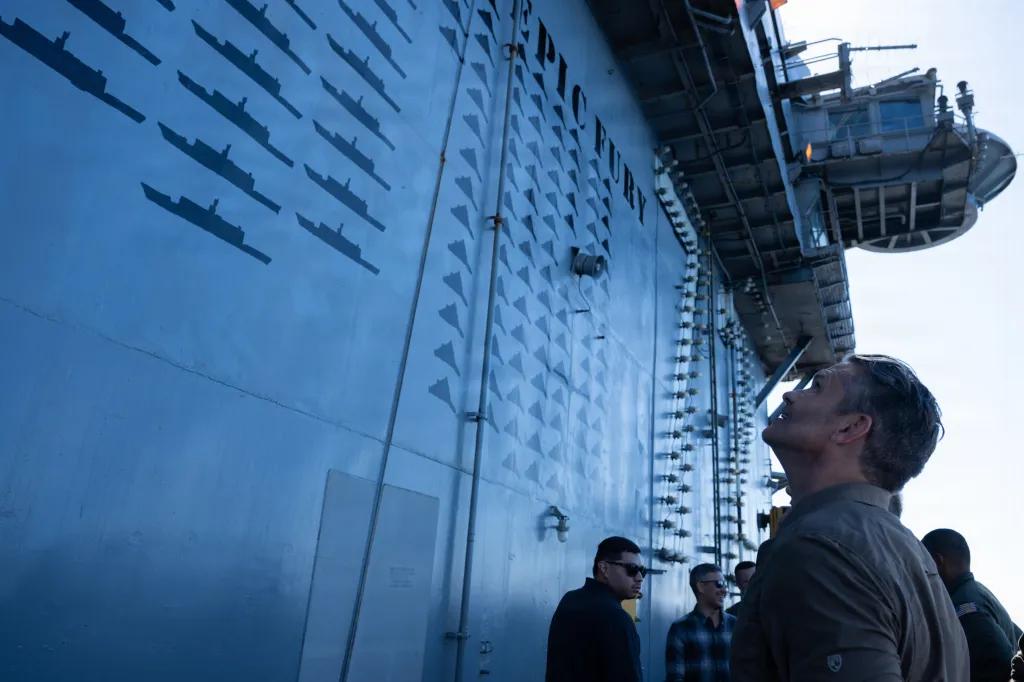
Standing on the deck of the aircraft carrier USS Abraham Lincoln, Secretary Pete Hegseth looked up at the flattop’s superstructure and got a good indication of many of the targets the Lincoln Carrier Strike Group (CSG) destroyed during its six-month fight with Iran. In a photograph shared by the Pentagon’s image distribution site, Hegseth is seen examining a wall of so-called kill marks stenciled onto the superstructure.
By our count from the image and a video taken during Hegseth’s visit, both of which you can see below, there are 103 one-way attack (OWA) drone kill marks and 34 ship kill marks. These represent the number of each the CSG took out. It is unclear whether there are other kill marks we can’t see.
Though they resemble Shahed-136s, which are the most notorious of Iranian OWA drones, these silhouettes would represent all types shot down, and Iran has many. The same holds true for the ships. The photograph shows stencils of frigates or corvettes but these would be a generic symbol for surface craft kills.
Secretary of War Pete Hegseth visits U.S. Navy Sailors aboard the USS Abraham Lincoln (CVN-72) near San Diego, Calif., Oct. 7, 2026. (DoW photo by U.S. Air Force Staff Sgt. Madelyn Keech) Staff Sgt. Madelyn Keech
On board to welcome the ship and its crew as it headed back to its home port of San Diego after a tumultuous and historic deployment, Hegseth extolled the strike group’s accomplishments. Reading from the Presidential Unit Citation awarded to the strike group for its work during Epic Fury, Hegseth noted that it shot down 77 one-way unmanned attack drones and sank 64 Iranian vessels between the start of Epic Fury on Feb. 28 until it departed the region on Aug. 22.
The Lincoln CSG also conducted 3,693 combat sorties, delivered 1.37 million pounds of ordnance, launched 450 Tomahawk Land Attack Cruise Missiles (TLAMs), destroyed 21 anti-ship cruise missiles and defended against four fast-attack craft and explosive-carrying wooden sailing vessels.
It is unclear at the moment why there are at least 26 more drone kill marks stenciled onto the Lincoln than the number of drones shot down listed in the unit citation and why there are 30 fewer ship kill marks than the tally noted in the citation. The Pentagon referred us to the Navy, and we are waiting for a response from the service.
Kill marks on aircraft embarked aboard Lincoln indicate that the carrier strike group also destroyed several Iranian submarines and other weapons. These were not listed in the unit citation or in any kill marks stenciled onto the Lincoln that we could see.
An image provided to TWZ by aviation photographer Jeff Rojas, who goes by the handle @jro_photography on Instagram, shows a submarine kill mark on one of the F/A-18F Super Hornets of the U.S. Navy’s Strike Fighter Squadron 41 (VFA-41), the “Black Aces.” That is one of the aviation squadrons embarked on the Lincoln during Epic Fury.
A close-up look at the broken submarine and other kill marks on one of VFA-41’s Super Hornets. (Jeff Rojas) Jeffrey Rojas
In total, VFA-41 alone launched 421 missiles and bombs during its time supporting Operation Epic Fury. You can find the details in our story about the squadron here.
In addition, an image published by The Aviationist showed “an extraordinary array of target markings on a VMFA-314 F-35C, apparently representing an oil tanker, three submarines, a surface combatant, a Shahed-type drone, an artillery piece, and several ground-based launchers.”
Marine F-35C Also Sports Three Submarine Kill Markings After Operation Epic Fury
An exclusive image obtained by The Aviationist reveals an extraordinary array of target markings on a VMFA-314 F-35C, apparently representing an oil tanker, three submarines, a surface combatant, a…
It should also be noted that some of the drone kill marks seen on the Lincoln could have been the result of shootdowns by the carrier’s escorts. The Arleigh Burke class guided missile destroyers USS Frank E. Petersen Jr, USS Spruance andUSS Michael Murphy all serve as critical air defense platforms for the carrier strike group. Those vessels were also the ones launching the TLAMs, as well as potential submarine involvement.
Arleigh Burke class guided-missile destroyer USS Frank E. Petersen, Jr. (DDG 121) transits the Arabian Sea, June 27, 2026. (U.S. Navy photo) U.S. Central Command Public Affa
Late Thursday morning local time, Lincoln finally returned home. The carrier departed San Diego on Nov. 21, 2025, and an arrival closed out a total deployment of 321 days, by our count. That’s just shy of the 326-day record USS Gerald R. Ford set in May, representing the second-longest deployment in the modern carrier era.
In addition to racking up successes against Iran, the marathon deployment drew scrutiny over the grueling conditions sailors and Marines experienced aboard. In August, crew families described supply shortages and difficult living arrangements, as TWZreported at the time. The accounts led to widespread media coverage, which Acting Secretary of the Navy Hung Cao called dishonest while also acknowledging that “a small number of mental health cases were treated with no loss of life, meal plans were adjusted when fresh resupply was unavailable, without a single meal being missed, calls home were limited when the operational threat was too high.” At least eight personnel across the strike group attempted suicide during the cruise, Cao wrote in a letter sent to Sen. Kirsten Gillibrand that was obtained by CNN.
The kill mark stencils weren’t the only symbols of Lincoln’s deployment. On Wednesday, Hegseth used symbology to push back against concerns raised about the long journey.
“There were a few folks in the media who tried to turn the USS Abraham Lincoln into some sort of a symbol,” Hegseth said. “A symbol of dysfunction, or a symbol of low morale, or a symbol of a failed mission. And what I look out right here or when I talk to your leadership, and I haven’t had a chance to talk to a number of you, I know it’s the exact opposite.”
UPDATE: 5:59 PM Eastern –
After the Lincoln pulled into its home port, new images emerged. The following picture shows additional kill marks, including 10 of submarines.
Sailors aboard the USS Abraham Lincoln look on as the ship docks at its homeport at Naval Air Station North Island on return from a historic 10-month deployment on Oct. 8, 2026 in Coronado, California. (Photo by Mario Tama/Getty Images) Mario Tama
A court in Indian capital Delhi has released the top leaders of the Gen Z-led Cockroach Janta Party (CJP) as the city sees more protests for a second day with thousands of security personnel deployed and roads barricaded.
Abhijeet Dipke – who began the movement in May after India’s Chief Justice likened some jobless young people to “cockroaches” – and other leaders were arrested on arrival in Delhi on Saturday to lead protests seeking electoral reforms.
In his first comments after his release, Dipke said “the CJP will neither back down nor be intimidated”.
On Saturday, media reports said, 7,000 demonstrators were detained and released late at night.
The CJP – which is not registered as a political party in India – is seeking electoral reforms just months before crucial state elections.
It has also demanded the resignation of Chief Election Commissioner (CEC) Gyanesh Kumar over allegations of manipulating voters’ lists – which the Election Commission has denied.
On Sunday morning, the CJP lawyer Ratna Singh said she had been informed by the police that Dipke and two other senior CJP leaders – Saurav Das and Ashutosh Ranka – would be produced before the magistrate by the police seeking their remand “to maintain public peace”.
She subsequently posted on X that the three had been set free by the court “on the condition that they will not engage in breach of peace for one year” – she later deleted the post about the condition and it’s not clear what that means and whether the CJP leaders can take part in protests.
After his release, Dipke posted on X, external, saying: “Modi, as PM, is an embarrassment to India.”
In another post, external, he said he was going to his village to attend his grandmother’s funeral who died around the time of his arrest yesterday.
“Heading back to my village to be with my family during this moment of grief,” he posted, adding that Das and Ranka would address a press conference in Delhi.
“The CJP will neither back down nor be intimidated,” he added.
Saturday saw dramatic scenes as police officials boarded the flight to detain Dipke, Das and Ranka as their plane landed.
Elon Musk’s latest comments come days before Mukesh Ambani’s low-cost Reliance Jio’s parent launches India’s largest-ever initial public offering.
Published On 11 Oct 202611 Oct 2026
Billionaire entrepreneur Elon Musk has said he would price his Starlink satellite internet service affordably in India to take on Mukesh Ambani’s low-cost Reliance Jio, escalating his attacks on the rival tycoon days before Jio’s parent launches the country’s largest-ever initial public offering (IPO).
Jio Platforms, which owns the telecom arm, is targeting a valuation of $106bn in the offering. Much like SpaceX-owned Starlink, Jio’s satellite venture is also awaiting final security clearance to launch.
Cheap data is the playbook that built Jio in India, and the one Musk has used in markets like Kenya to unsettle local telecom players. SpaceX now plans to enter the mobile carrier market itself, starting in the United States.
Musk did not specify prices for India, where mobile data costs about rupees 7.74 ($0.08) per gigabyte, among the lowest in the world.
“Obviously, if Starlink is too expensive in India, no one will buy it, so SpaceX will need to make pricing affordable,” he said in a post on his social media platform X on Saturday.
“The reality is that competition would greatly benefit the average citizen in India by giving them more choices, as it always does. Ambani’s profits will be lower, but he is not going out of business,” Musk added.
‘Prime Minister Ambani’
Musk’s remarks were the latest in a series of X posts in which he accused Prime Minister Narendra Modi’s government and Ambani of stalling Starlink’s entry into one of the world’s biggest internet markets to favour market leader Jio.
The posts have marked a sharp turn for Musk, who has long enjoyed a warm public rapport with Modi.
India’s government has denied any bias in its approval process, noting that the three satellite ventures seeking to launch, including Starlink’s and Jio’s, are all awaiting final security clearance.
Late on Friday, Musk taunted Ambani directly, addressing him as “Prime Minister Ambani” and asking whether he would “consider allowing Starlink to compete”.
Flash flooding in Nepal has swept away buildings along the Budhi Gandaki river on Sunday. Terrified onlookers in Gorkha district filmed from higher ground, after a landslide triggered downstream flooding that also swept away a bridge and homes.
As Israel entered the final month before its October 27 election, Prime Minister Benjamin Netanyahu had a chilling warning to share.
Israel’s enemies, he said on September 29, were plotting an attack on the country before the vote. Without providing any evidence, he then quickly referred to continuing attacks by Israeli troops in the Gaza Strip, where he said they had killed more than 100 “terrorists” in recent weeks.
That link drawn by Netanyahu – between the genocidal war on Gaza that began after the Hamas-led October 7, 2023 attacks, the upcoming elections, and Israel’s national security – was not coincidental, say analysts.
Netanyahu’s insistence that he alone can secure Israelis from a range of threats they face from across the country’s borders, they say, lies at the heart of his re-election campaign, even as his alleged failures during the attack three years ago and in securing the quick release of captives have offered his opponents ammunition.
When a Flydubai flight packed with Israeli passengers on their way from Dubai to Tel Aviv a day after his recent warning nearly crashed after a co-pilot attacked his pilot with an axe in the cockpit, Netanyahu was quick to seize on the incident to argue that he is still man for the country’s top job.
Polls suggest that he faces a stiff test in what is the first general vote since the 2023 attacks, which led to the killing of 1,139 people in Israel and triggered the genocidal war on the Gaza Strip, where Israeli have attacks have since killed more than 74,000 Palestinians.
Three years later, the war has become inseparable from the domestic debate over Israel’s direction while also accelerating a political shift to the right – with once-fringe positions on Palestinians now very much the mainstream view.
Few embody this transformation more than Israel’s far-right financial Minister Bezalel Smotrich, sanctioned by a number of Western countries and known for his incendiary and racist language and policies towards Palestinians.
In one of his characteristically inflammatory statements, Smotrich told Israeli outlet Ynet late last month that the Israeli army should “go to war” in the occupied West Bank and “do there what we did in Gaza”.
Less than two weeks later, Smotrich’s electoral ally Moshe Feiglin added fuel to the fire.
“The enemy is Gaza, not Hamas”, he told the Jerusalem Post, calling for the annexation of the besieged territory after the election. “The baby that will be born tomorrow in Gaza will do exactly the same,” he said, in reference to the 2023 attacks.
Palestinian political analyst Ahmed Najar said these are not “stray comments” from marginal figures but an electoral message from power-seeking politicians aimed at portraying Palestinians as “not a people with rights, but a demographic and security problem to be expelled, conquered or destroyed”.
He added: “The frightening reality is that the coming election risks becoming a competition not over whether Palestinian life should be protected, but over who can promise to erase it most aggressively.”
‘This is madness’
Following October 7, the younger generation in particular slid rightwards, said Ahron Bregman, an Israeli security analyst and senior teaching fellow at King’s College London.
He said the forces driving Israel to the right had been gathering for decades.
“The trend toward the right began after the Yom Kippur War in 1973, but it has intensified dramatically since October 7,” Bregman told Al Jazeera, referring to the bloody 19-day October War, or the 1973 Arab-Israeli War – a conflict between Israel and a coalition of Arab states led by Egypt and Syria.
More recently, the far right has been emboldened through electoral politics as part of Netanyahu’s government since 2022 – the most right-wing government in Israeli history.
Another outspoken cabinet member alongside Smotrich is Minister of National Security Itamar Ben-Gvir, a far-right provocateur who has previously been convicted of inciting racism and of supporting a terrorist organisation.
“Netanyahu’s greatest mistake – among many – was bringing figures like Ben-Gvir and Smotrich into his coalition,” said Bergman. “By doing so, he legitimised them as influential forces in Israeli politics.”
Ben-Gvir has been so cemented into Israel’s political system, he has hopes pinned on becoming the next Israeli defence minister, the analyst pointed out.
“This is madness. But that’s contemporary Israel,” said Bergman.
Attendees listen and applaud during an election campaign meeting on October 5, 2026 in Tel Aviv, Israel [Erik Marmor/Getty Images]
Analysts also pointed out that several parties running, including ones that are currently in power and a number that are challenging the current coalition, all advocate for the expulsion of Palestinians from Gaza, as one of the examples of the shift to the right.
Omar Baddar, director of Palthink for Strategic Studies, said the messaging from across the Israeli political and military spectrum in the lead-up to the election shows that there is “a consensus” to continue the attacks on Gaza, where nearly 1,500 have been killed since a “ceasefire” last year.
“They’re using the threats to get more votes,” he said, pointing out to what he described as the radicalisation of the society.
With the election approaching, added Baddar, Israeli leaders are seeking to undo one another: “Who[ever]’s more radical is more likely to get more votes.”
As Ehab Jabareen, a Palestinian political analyst and researcher from inside Israel, writes, “what it means to be ‘right-wing’ in Israel today is above all to take a harder line on Palestinian national claims, security and territorial control.”
He adds: “On security and the Palestinians, a large part of Jewish Israeli politics already works from assumptions that would have been treated as right-wing a generation ago: Deep suspicion of a sovereign Palestinian state, a high tolerance for prolonged military control, and a stronger insistence on Jewish sovereignty as the starting point rather than one value among others.”
Observers and rights groups say the disparity is even evident in the electoral process. A prominent politician and Palestinian citizen of Israel, Sami Abu Shehadeh, has been forced to withdraw from the election over his remarks about the Gaza war, while Israeli far-right leaders have remained untouched despite their violent rhetoric against Palestinians.
Netanyahu’s security credentials endure
Recent polling indicates that the events of October 7 are top of mind for Israelis, who also have questions about who was responsible for the security failures of that day.
Just last month, reports surfaced indicating that Netanyahu had received two separate warnings about an imminent Hamas attack in 2023, from Egypt’s intelligence chief, Abbas Kamel, and United Arab Emirates President Sheikh Mohamed bin Zayed Al Nahyan.
Netanyahu’s two main rivals in the race for prime minister have cited the alleged warnings to call the prime minister “unfit” to remain at the helm of the country.
But Netanyahu has denied suggestions that he had been forewarned about the attack, and the reports do not appear to have had a significant effect on opinion polls.
While October 7 represents a profound rupture in Israelis’ sense of security, public trust in the Netanyahu government had already been badly shaken by its controversial judicial overhaul, introduced when the prime minister’s current coalition first came to power, said Mairav Zonszein, an Israel-Palestine analyst at the International Crisis Group based in Tel Aviv.
Despite these breaches of trust, the Israeli leader retains support.
“Israelis in general still see Netanyahu as kind of the guy on security. And more to the point, they don’t really see an alternative,” Zonszein told Al Jazeera.
A June survey by Mitvim – the Israeli Institute for Regional Foreign Policies found that the Israeli public supports its government’s military and security solutions, and rejects resolving the Palestinian issue and ending the Israeli occupation of Palestinian territory. This is the case even while it has been concerned about international isolation and the decline of Israel’s international standing since the beginning of the genocidal war on Gaza, the survey reported.
Yet Israelis are also increasingly war-weary, even as they back the use of more force. Its troops – stretched between six fronts of war in the last few years – are bearing the brunt of this fatigue in Israeli society.
Israel’s Ministry of Defence said on Tuesday that nearly 30,000 soldiers and security personnel are facing psychological trauma since the war.
The ministry said its rehabilitation department’s budget has increased by 88 percent over the past three years to 10 billion shekels ($3.3m), with the majority supporting treatment for mental health conditions and post-traumatic stress disorder.
As Israel expands, the two-state solution fades
Still, Israel in recent months has been more and more vocal about its expansionist vision, with officials brazenly stating the goal of “Greater Israel”. The claim for the conquest is based on a biblical verse (Genesis 15:18-21).
For decades, Israel has ignored international law in its continuous occupation of Palestinian and Syrian land, and has shown little respect for its neighbours’ sovereignty, occupying more land in Syria, as well as in Lebanon in more recent years.
According to Najar, the political economist, the “complete dehumanisation” of Palestinians as evidenced during the campaign reveal that Gaza “is being presented to Israeli voters not as a catastrophe or a crime for which there must be accountability, but as a blueprint to be repeated elsewhere”.
In southern Lebanon, where Israel has been carrying out near daily attacks and and has occupied large swathes of land, residents have told Al Jazeera they expect little to change even if Netanyahu is defeated in the election.
Netanyahu’s main political challenger, Gadi Eisenkot – head of the Yashar party and former army chief of staff – is the father of the so-called Dahiyeh Doctrine, and is just as hawkish about expansion. That doctrine, since Israel’s war with the Lebanese group Hezbollah in 2006, calls for the use of huge force, even against civilian infrastructure, as a deterrent against enemies and was deployed in Israel’s recent wars, particularly in Beirut’s southern suburbs.
If it were up to Eisenkot, the Lebanon front of war would have never scaled down: He has accused Netanyahu of bowing to US pressure to halt operations in Beirut, and has insisted that the military should be able to attack Hezbollah anywhere in Lebanon.
For Israelis still reeling from the events of October 7, Eisenkot could fill the security void many are feeling, said Zonszein.
“They really … see the world as kind of very hostile towards them, the world not understanding what they went through on October 7, and [therefore why] the need to have these security buffer zones in Lebanon, in Syria, and Gaza,” she said.
A two-state solution to the Israel-Palestine conflict is therefore out of the question, said the analysts – and has not even made a blip of an appearance in campaigning before the election.
The idea first emerged during the Oslo Accords more than 30 years ago, which set out a negotiating process aimed at resolving the Israeli-Palestinian conflict, predicated on the belief that the creation of a Palestinian state alongside Israel was imperative to forge peace.
But since the Oslo process began in 1993, the number of Israeli settlers in the West Bank has ballooned from about 260,000 to more than 700,000, embedded deep inside West Bank areas that would be needed for a contiguous Palestinian state.
“The concept of a two-state solution is currently irrelevant and likely will remain so for another decade or two, if not longer,” said Bergman. “It is unlikely to become a reality in the foreseeable future, as no Israeli leader can propose it to the Israeli public after the events of October 7.”
The only way it could regain prominence is if there is substantial international pressure, including severe sanctions on Israel, and a non-violent intifada, or an uprising by Palestinians, he said.
The outright rejection of Palestinian statehood has simply become much more “acceptable”, said Zonszein.
“There’s several parties who advocate these views, whereas there isn’t a single Jewish Zionist Party that puts the need for a two-state solution or a Palestinian political process at the forefront,” she said.
Taken all together, Israel’s election appears less a demand for change than a further entrenchment of the jingoism that surged after October 7, 2023.
“[There’s] more and more movement towards more military force, more need for pushing the borders … out of a lot of fear that another October 7 could happen,” said Zonszein.
Department of Justice says it’s investigating whether the White House press pool’s decision violated antitrust laws.
Published On 11 Oct 202611 Oct 2026
The United States Department of Justice has opened an investigation into television networks’ decision to halt coverage of President Donald Trump last month.
A spokesperson said on Saturday that the department was investigating whether the networks violated federal antitrust laws by their boycott, which followed a White House decision to pull the credentials of reporters from three news organisations, including CNN.
Recommended Stories
list of 4 itemsend of list
The networks under investigation are ABC, CBS, CNN, NBC and Fox News, said Emily Convington, the Justice Department spokesperson.
“Group boycotts among commercial competitors can violate the Sherman Act,” she said of the antitrust legislation.
“The Antitrust Division is simply investigating to determine whether these news organizations have violated the antitrust laws.”
The investigation is the latest in a series of clashes between the Trump administration and major news organisations. Trump has repeatedly called the mainstream media “fake news” and frequently clashes with reporters during encounters with the press.
The action also puts legal and potentially financial pressure on the media to continue coverage of the president even when they disagree with how the White House handles them.
The networks did not immediately comment on the announcement.
The Justice Department’s move came after the television pool of five broadcasters last month ceased presidential coverage after the administration barred CNN, MS NOW and Politico from the White House.
The White House said on September 19 that covering the president was a “privilege – not a right”. The outlets sued the administration, alleging the exclusions violated the First Amendment and that the White House was retaliating over their coverage.
CNN is one of the five news organisations – along with ABC, CBS, Fox News and NBC – that make up the primary White House television pool.
They share the costs of covering the president, take turns organising coverage, and share the footage with outlets around the country.
All of the five television networks that cover the White House, including Fox News, suspended coverage in solidarity and refused to provide replacement coverage.
The White House reinstated the credentials on September 24 after US District Judge Timothy Kelly ruled that the ban was likely unconstitutional and ordered the administration to “immediately return, reinstate, and restore” their access.
However, disputes over access to specific presidential events and pool assignments continued.
Jose Zamora, the Committee to Protect Journalists’ Americas director, on Saturday criticised the administration’s decision to investigate.
“The government should not use antitrust investigations to intimidate news outlets defending press access,” Zamora said on X. “The public’s right to know depends on that access.”
Just over two years after the U.S. Air Force retired the last of its KC-10A Extender aerial refueling tankers, four of those aircraft may be bound for a new career in North Africa for a mysterious end user.
The Air Force Life Cycle Management Center (AFLCMC) put out a contracting notice yesterday “solely for information and planning purposes” with the express intent “to identify potential industry sources that possess the capability, expertise, and facilities to execute the regeneration, one-time flight clearance, depot-level return to service, worldwide ferry delivery, in-country Contractor Logistics Support (CLS), and operational/maintenance training for up to four (4) KC-10 Extender aircraft.”
The KC-10s could be “transferred via Excess Defense Articles (EDA) to a partner nation in North Africa,” the notice adds, without naming the country in question.
Retired KC-10 tankers seen at the boneyard at Davis-Monthan Air Force Base in Arizona in 2025. US Military
The Air Force operated KC-10s between 1981 and 2024. TWZ has reached out to the U.S. Air Force, as well as the U.S. State Department, for more information. The State Department directed us to contact the Pentagon.
The EDA program allows for materiel deemed extraneous to U.S. military needs to be transferred to allies and partners either at a reduced cost or as a grant. The foreign nation in question has to pay for those assets to be delivered, as well as refurbishment, if applicable.
It is important to note here that the Extender, as designed, is capable of refueling receivers using either the boom or the probe-and-drogue method. Tankers equipped for the probe-and-drogue method are, by far, more common internationally. We will come back to this later on.
A KC-10 seen refueling F-16 fighters via the boom. USAFA KC-10 refuels a US Navy F/A-18 Hornet via the probe-and-drogue method. USN
While we don’t know what the North African country might be in line now to receive the quartet of KC-10s, Egypt and Morocco would seem to be the most likely candidates based on their current and planned aircraft inventories. They are also both major U.S. allies.
The Egyptian Air Force currently does not operate any dedicated aerial refueling tankers. The country is in the process of acquiring two new C-130J-30 Hercules aircraft for use as airlifters, as well as tankers, using the probe-and-drogue method. It does already fly C-130s, but none explicitly configured for aerial refueling duties. Egypt also has a very diverse array of fighters that includes U.S.-made F-16 Vipers that can only be refueled in mid-air via boom.
A US Air Force KC-10 refuels an Egyptian F-16 during an exercise in 2023. USAF/Staff Sgt. Emily Farnsworth
A Moroccan F-16 seen linking up with a US Air Force KC-135 tanker during an exercise. USAF
As mentioned, the KC-10 was designed to connect with receivers via probe-and-drogue, as well as boom, and could be used to refuel other tactical jets in Egyptian or Moroccan service. As an aside, fighters belonging to both regularly receive foreign tanker support during exercises, as already seen earlier in this story. Just last month, Chinese YY-20 tankers (also sometimes referred to as Y-20Us) notably did just this in an exercise in Egypt.
Footage released by Egypt’s official authorities from the “Eagles of Civilization 2026” joint air exercise shows Egyptian **MiG-29M/M2s and Rafale fighters receiving aerial refueling from a Chinese Y-20 tanker aircraft. pic.twitter.com/pvxkpsDHxG
Whichever country may be in line to receive the four KC-10s, there is a question about the current state of those aircraft. Earlier in this story, we talked about the Extender’s capabilities as designed.
McDonnell Douglas (since absorbed into Boeing) delivered a total of 60 KC-10s to the U.S. Air Force between 1979 and 1987. The Extender was derived from the three-engine DC-10 airliner, the last of which was produced in 1989. The Air Force lost one of its KC-10s in an accident in 1987.
Of the remaining 59 KC-10s, 10 were put up for auction in a non-flyable state last year. For reasons that remain unclear, a single engine had been removed from under one of the wings of each of those aircraft. These Extenders were also among the first to be retired, and their booms had been stripped to be used as spares for the examples that remained in service until 2024. Private aerial refueling contractor Omega Air looks to have subsequently won those auctions. Omega also operates two ex-Dutch KDC-10 tankers, which are broadly similar to the KC-10, as well as another DC-10 converted into a probe-and-drogue-only tanker. The company has several Boeing 707-based tankers, as well.
One of Omega Air’s KDC-10s refuels US Air Force F-16s. USAF
The condition of the remaining 49 Extenders is unclear. Congress included a provision in the annual defense policy bill, or National Defense Authorization Act (NDAA), for the 2026 Fiscal Year that required the Air Force to preserve remaining retired KC-10s, but only stipulated they be maintained “in the same storage condition” they were in as of September 30, 2025. The bill, which was signed into law in December 2025, also made clear that the Air Force could still “dispose” of the aircraft in accordance with existing property management statutes.
Regenerating military aircraft, especially larger ones, back to service can be costly, complex, and time-consuming, even when they are kept in storage in a highly maintained state. In this particular case, acquiring KC-10s via the EDA program, with a very low up-front purchase price, could still be attractive to the right buyer, especially compared to the cost of acquiring new-production tankers.
Personnel at the boneyard at Davis-Monthan Air Force Base apply a protective coating to a KC-10. USAF
For a country like Egypt or Morocco that has never operated a boom-equipped tanker, second-hand Extenders could be a valuable entry point to future aerial refueling capabilities, as well. In general, organic aerial refueling capability is an important force multiplier for any air arm.
There is a possibility that KC-10s could be regenerated not as tankers, but as cargo aircraft, though this seems less likely to be the case. Cargo carrying was also an important duty for the Extenders while in U.S. Air Force service, and they still could operate in this role even when returned to service as tankers.
Though the aging KC-10s were getting increasingly more difficult to operate and maintain, the Air Force’s decision to retire them was still controversial. The Extender was a highly flexible tanker that could carry more fuel than the KC-46s that supplanted them. Clearly, there are others still interested in operating them.
It should be stressed that the AFLCMC contracting notice does not present the transfer of the four KC-10s as a done deal. At the same time, it has revealed that one of America’s partners in North Africa could breathe new life into four of these retired tankers.
A man has died after being attacked by a tiger at Yorkshire Wildlife Park, police have confirmed.
South Yorkshire Police said it had been called at 13:35 BST to reports of a man entering the tiger enclosure at the attraction near Doncaster. The tiger then attacked the man and he died at the scene, the force said.
His family had been informed and were being supported by officers, it added.
A park spokesperson said: “We are deeply saddened by today’s tragic incident. Our thoughts and heartfelt sympathies are with the family and loved ones of the person who has lost their life.”
They added: “We are working closely with the police and relevant authorities and would ask that the privacy of those affected is respected at this extremely difficult time. The park will remain closed tomorrow.”
Police said the tiger was uninjured, remained in the enclosure following the incident and there had been no wider risk to the public.
The park was evacuated and officers remain at the scene.
The force added: “We are aware of videos circulating online and we would encourage people not to share this footage.”
Earlier, in a statement posted on its website, the park said its emergency response procedures had been “immediately activated” and it was “working closely with the authorities to ascertain exactly what happened”.
Caracas, September 6th, 2016 (venezuelanalysis.com) – The Bolivarian National Intelligence Service (Sebin) confirmed on Monday during an interview on state news channel Venezuela de Televisión (VTV) that authorities arrested several individuals identified as snipers set to carry out plans unexecuted during the opposition’s September 1st mobilizations.
For many, last week’s mobilizations were marked with great potential for bloodshed and guarimba violence as the political opposition has been insistent on a recall referendum happening this year despite protocols that would make anything earlier than January 2017 an unconstitutional process.
According to Sebin authorities, these individuals prepared to carry out selective assassinations on September 1st during the mobilizations. Since the targeted assassinations did not occur last week, Sebin authorities believe the individuals were ready to execute their plans Wednesday September 7th.
Sebin Director, Gustavo González López, said, “They [those arrested] had already made plans for September 7th, which indicate there are still intentions to carry out a coup.”
In total, five people were arrested in association with these plans. They include: Giovanni Vásquez, Joel José Méndez Semprún, Enrique Gerónimo González Ramírez and Manuel Alejandro González.
Additionally, Venezuelan officials reiterated that they issued arrest warrants for opposition leaders Lestor Toledo and Yorman Barillas, who are allegedly among the plan’s masterminds.
Both Toledo and Barillas are said to be in Maicao, La Guajira, Colombia. As such, the Ministry of Domestic Affairs has requested that the Colombian government repatriate them to Venezuela. González López said that the plans were designed during three meetings with former Colombian President Álavaro Uribe as well as other members of Venezuela’s National Assembly.
Uribe is notorious for founding paramilitary groups in Colombia and supporting their operations throughout the region. Venezuelan authorities have regularly linked Uribe to key opposition figures as well as ongoing attempts to destabilize Venezuelan society and overthrow the Bolivarian government.
Venezuelan authorities say that the preparative meetings took place in Maicao, as well as Mara and Maracaibo in Zulia state.
The Venezuelan military likewise detained four individuals in Páez municipality, Apure state where they found ammunition and 35 mm grenades, among other objects. Three men and one woman were detained, referred to in Venezuelan media as “guerillas”, part of a military operation of 20 soldiers under the orders of General Hermes Hernández Marcano by the Arauca River.
More details surrounding their case, including the individual’s’ identities have not yet been released.