Discover the latest happenings and stay in the know with our up-to-date today news coverage. From breaking stories and current events to trending topics and insightful analysis, we bring you the most relevant and captivating news of the day.
Relief for global markets comes after Trump says Iranian officials are keen on a deal.
Published On 14 Apr 202614 Apr 2026
Asia’s main stock markets have surged, and oil prices have declined amid renewed hopes for ceasefire talks between the United States and Iran.
The relief for global markets on Tuesday came after US President Donald Trump said overnight that Iranian officials had reached out to his administration and expressed their openness to a deal.
Recommended Stories
list of 4 itemsend of list
“We’ve been called by the other side, and they would like to make a deal very badly,” Trump said in remarks at the White House.
Japan’s benchmark Nikkei 225 rose as much as 2.5 percent on Tuesday, while South Korea’s KOSPI gained about 3.7 percent.
Singapore’s Straits Times Index climbed about 0.6 percent.
In Hong Kong, the Hang Seng Index was up about 0.4 percent in the early afternoon, while the SSE Composite Index in Shanghai was about 0.5 percent higher.
The rally in Asia followed gains on Wall Street, with the benchmark S&P 500 finishing up 1 percent overnight.
Brent crude, the benchmark for global oil prices, dipped nearly 1.5 percent, falling below $98 a barrel.
The positive turn for markets came despite the US following through on its threat to impose a naval blockade on Iranian ports, a move that analysts warn is likely to exacerbate the energy shortage that is roiling the global economy.
Brent had surged above $103 per barrel after Trump on Sunday threatened to impose a blockade on the Strait of Hormuz, a conduit for about one-fifth of global oil and natural gas supplies.
The US military later clarified that the blockade would only apply to vessels entering and exiting Iranian ports, in an apparent scaling back of Trump’s threat to fully close the waterway.
Iran has effectively halted shipping through the strait since the start of the war on February 28, throwing the global energy market into a tailspin.
Only 21 vessels transited the strait on Sunday, according to maritime intelligence provider Windward, compared with roughly 130 daily transits before the start of the conflict.
Slow-moving Sinlaku is weakening as it heads towards Guam, but it will still dangerous conditions to the region.
Published On 14 Apr 202614 Apr 2026
Super Typhoon Sinlaku is closing in on the remote Mariana Islands in the northern Pacific Ocean, where the massive storm system is due to bring destructive winds and heavy rains.
Sinlaku, which formed on April 9, is the strongest storm of 2026, so far, and saw sustained winds of 278 km/hour (173 mph) on Monday, according to The Associated Press (AP) news agency.
Recommended Stories
list of 4 itemsend of list
The super storm was approximately 68 nautical miles (126km) southeast of the island of Saipan in the Northern Mariana Islands at about midday on Tuesday local time (02:00 GMT), and is moving at a slow pace of about 14 km/hour (9 mph), according to the US Joint Typhoon Warning System.
While Sinlaku appears to be weakening and could pass by the Northern Mariana Islands with the strength of a Category 4 or Category 5 storm, it still remains extremely dangerous, according to Guam’s Office of Civil Defence, with warnings of widespread rain and flooding along with destructive winds that could cause power outages.
It appears Guam will avoid a direct hit from Sinlaku, the Civil Defence Office said, although the island will still encounter high winds of up to 64 to 80 km/hour (40 to 50 mph) and gusts of up to 105 km/hour (65 mph)
“Guam remains under both a tropical storm warning and a typhoon watch. While the threat of typhoon-force winds has significantly diminished for Guam, this remains a serious weather event,” the office said, warning that storm conditions will continue into Wednesday.
This satellite image provided by the National Oceanographic and Atmospheric Administration (NOAA) shows super typhoon Sinlakua in the Pacific Ocean, Monday [NOAA via AP]
The office also warned the island’s 170,000 residents to stay out of the water, as dangerous sea conditions are expected to last until Thursday.
Before turning towards Guam and the Northern Marianas, the storm left significant damage to the outer islands and atolls of Chuuk in the Federated States of Micronesia, said Landon Aydlett, a meteorologist with the weather service in Guam, told the AP.
As the Mariana Islands prepare for the impact of Sinlaku, Australia this week pledged $1.75 million in assistance to Papua New Guinea and the Solomon Islands in the wake of the recent Tropical Cyclone Maila.
The storm ripped through the region over the weekend with the strength of a Category 5 storm, triggering floods and landslides that killed at least 11 people, according to the Australian Broadcasting Corporation.
Papua New Guinea’s Prime Minister James Marape said in a statement that authorities are still assessing the damage.
“Reports are still coming in and are scattered, but we will make sure we reach every place, every island, and every community that has been affected,” he said.
A super typhoon is a name given to the strongest tropical cyclones that develop in the northwestern Pacific Ocean, where Earth’s most intense storms usually form.
Latest attack brings death toll from US strikes on vessels in the Pacific and Caribbean to at least 170 since September.
Published On 14 Apr 202614 Apr 2026
The United States military has carried out another attack on a vessel in the eastern Pacific, killing two people, in the latest deadly strike by US forces on boats that Washington alleges have links to Latin American drug trafficking cartels.
US Southern Command (SOUTHCOM), which is responsible for Washington’s military operations in Latin America and the Caribbean, confirmed the attack in a post on social media late on Monday, claiming to have killed two “male narco-terrorists”, without providing any evidence.
Recommended Stories
list of 4 itemsend of list
SOUTHCOM claimed that, based on intelligence reports, the boat was “transiting along known narco-trafficking routes in the Eastern Pacific” and was targeted with “a lethal kinetic strike” on the orders of US Commander General Francis L Donovan.
A grainy video clip released with the statement shows a stationary boat with outboard engines and what appear to be floats from fishing nets nearby. The boat comes under attack from the air and explodes into flames.
The attack marked the second day in a row that SOUTHCOM announced a deadly strike on boats in the Pacific. On Sunday, the US military said it blew up two boats in the eastern Pacific a day earlier, killing five people and leaving one survivor. It was not immediately clear what happened to the person who survived the attack, though SOUTHCOM said the US coastguard was notified.
With the attack on Monday, the US military has now killed at least 170 people in dozens of strikes on vessels in the eastern Pacific and Caribbean Ocean since September.
International law experts, human rights groups and regional governments have accused the administration of US President Donald Trump of carrying out extrajudicial killings in international waters, which have likely targeted civilians, often fishing crews, who do not pose an immediate threat to the US.
The Trump administration claims that such attacks are part of its war on drug trafficking cartels in Latin America, but has provided no solid evidence that any of the vessels targeted since last year have been involved in drug trafficking.
A 20-year-old Texan faces potential life imprisonment after an arson attack on Sam Altman’s San Francisco residence.
Published On 14 Apr 202614 Apr 2026
Authorities in the United States have charged a 20-year-old Texas man with attempted murder and arson after he allegedly threw a Molotov cocktail at the home of OpenAI CEO Sam Altman.
Daniel Moreno-Gama faces two counts of attempted murder and nine other charges following last week’s arson attack on Altman’s residence in San Francisco, District Attorney of San Francisco Brooke Jenkins said on Monday.
Recommended Stories
list of 4 itemsend of list
“We interpret this behaviour for just what it is: An attempt on Mr Altman’s life and an extreme danger to those around him and those who work for his company,” Jenkins said at a news conference.
“As the DA, my office will prosecute this case to the fullest extent of the law.”
Moreno-Gama is also separately facing federal charges of attempted damage and destruction of property by means of explosives, and possession of an unregistered firearm.
Moreno-Gama faces the possibility of life in prison under the charges.
San Francisco District Attorney Brooke Jenkins speaks during a news conference on Monday in San Francisco [Jeff Chiu/AP]
Moreno-Gama, from Houston, Texas, was captured on a security camera hurling an incendiary device at Altman’s home shortly after 3:30am local time on Friday, according to an FBI affidavit.
The suspect then travelled to OpenAI’s San Francisco headquarters, where he struck the building’s glass doors with a chair and stated his intention to “burn it down and kill anyone inside”, according to the affidavit filed in US District Court for the Northern District of California.
After arresting Moreno-Gama at the scene, police recovered incendiary devices, a container of kerosene, a lighter, and a document espousing opposition to artificial intelligence and tech executives, including Altman, according to the affidavit.
The document recovered at the scene stated that Moreno-Gama had killed or attempted to kill Altman, and that he “must lead by example and show that I am fully sincere in my message”, according to the filing.
Altman, whose company’s release of ChatGPT in 2022 marked a watershed in the rollout of AI, has become a lightning rod for heated discussion about the potential risks and benefits of the rapidly advancing technology.
In a blog post after Friday’s arson attack, Altman said that while much criticism of the tech industry was driven by sincere concerns about the “incredibly high stakes” of AI, it was time to turn down the heat of the public debate.
“While we have that debate, we should de-escalate the rhetoric and tactics and try to have fewer explosions in fewer homes, figuratively and literally,” Altman said.
In her news conference, Jenkins criticised what she described as “incendiary rhetoric” about the potential impact of AI on society.
“In no way should we be at the point where a man could have lost his life over differences of opinion and concerns,” she said.
Naim Qassem says planned talks in Washington, DC, are a ploy to pressure Hezbollah into laying down its weapons.
Published On 13 Apr 202613 Apr 2026
Hezbollah leader Naim Qassem has rejected an upcoming meeting between the Lebanese government and Israel in the United States, calling such efforts “futile” as Israeli forces intensify their attacks on Lebanon.
In a televised speech on Monday, Qassem called on the government to take “a historic and heroic stance” by not attending the planned talks.
The Lebanese and Israeli ambassadors to the US are scheduled to meet in Washington, DC, on Tuesday to discuss holding direct negotiations between the two countries.
Qassem said the talks are a ploy to pressure Hezbollah into laying down its weapons.
“Israel clearly states that the goal of these negotiations is to disarm Hezbollah, as [Israeli Prime Minister Benjamin] Netanyahu repeatedly states. So, how can you go to negotiations whose objective is already clear?” Qassem said.
“We will not rest, stop or surrender. Instead, we will let the battlefield speak for itself,” he added.
Israel intensified its war on Lebanon in early March following a salvo of rockets launched by Hezbollah. A ceasefire between Israel and the Iran-backed group had ostensibly been in effect since November 2024, but Israel continued carrying out near-daily deadly attacks.
Hezbollah said its March 2 attack was retaliation for the US and Israel’s killing of Iran’s Supreme Leader Ayatollah Ali Khamenei two days earlier, on the first day of the US-Israel war on Iran.
Since then, Israel’s bombardment of Lebanon and a ground invasion in the south have killed at least 2,055 people, including 165 children and 87 medical workers. More than 6,500 others have been wounded, while some 1.2 million have been forced from their homes.
Lebanese authorities insist the priority is to secure a ceasefire, but Israel has said it wants to open formal peace negotiations with Lebanon. It has placed Hezbollah’s disarmament as a priority, with no mention of a ceasefire or withdrawal of its forces from southern Lebanon.
“We want the dismantling of Hezbollah’s weapons, and we want a real peace agreement that will last for generations,” Netanyahu said on Saturday.
Qassem said the planned talks “require a Lebanese consensus to shift our approach from non-negotiation to direct negotiations”, calling them a “free concession” to Israel and the US.
His speech came after hundreds of people in the capital, Beirut, protested on Friday and Saturday against the planned talks. Demonstrators accused Lebanese Prime Minister Nawaf Salam of betraying the Lebanese people by holding direct talks with Israel, while it continues its bombing campaign and expands its invasion.
The Israeli military on Monday said its forces had completely surrounded the key southern town of Bint Jbeil, while Hezbollah continued to claim attacks against Israeli forces there.
Qassem said that northern Israeli localities “will not be safe, even if the Israelis were to enter any area of Lebanon”. He also accused Beirut of “backstabbing” his group by declaring Hezbollah’s military activities illegal at the start of the war.
“Israel and the US clearly said they want to strengthen the Lebanese army to disarm and fight Hezbollah … but the army cannot do that,” Qassem added.
It is a public holiday in Sri Lanka and in India, it is a public holiday in many regions.
The Tamil year starts on April 14th in the Gregorian calendar. It is similar to the Vernal Equinox which is usually celebrated on or around March 21st. The date differs due to the position of the Tamil region in the northern hemisphere and some ancient and impressive astronomical observations involving the orbits of Jupiter and Saturn.
Though not purely a religious festival, Puthandu does hold special significance to Hindus as it is said to be the day that the Hindu god of creation, Lord Brahma, started creation.
Tamil New Year’s Day is celebrated on the first day of Chithirai – the first month in the Tamil Calendar and is also known as Varusha Pirappu.
Weekly insights and analysis on the latest developments in military technology, strategy, and foreign policy.
As it prepares for a potential future fight in the Pacific, the Marines tell us they are watching the progress of a wing-in-ground effect (WIG) drone concept that recently had its first test flight as a scale model. Being pitched as “the first ever Unmanned Surface and Aerial Vehicle (USA-V),” the Regent Squire is designed to conduct ISR, logistics, and combat search and rescue (CSAR) tasks in contested areas, the company states. It is also being eyed for counter-narcotics operations and anti-submarine warfare operations.
The WIG drone uses a hydrofoil to get airborne and then cruise in the air at an altitude of about one wingspan above the water. These ground-effect flights are designed to take advantage of the cushion of thick air above the earth’s surface, providing a sweet spot of increased lift and reduced drag. In theory, this should provide the Squire with high-efficiency and relevant speed, all without needing to operate from a traditional runway.
The Regent Squire. (Regent) (Amory Ross)The Regent Squire. (Regent) Regent Squire’s sub-scale demonstrator readying for its test flight. (Regent/screen capture)
Such over-the-water logistics, ISR and CSAR capabilities would be particularly valuable in a future conflict in the Pacific. A high-end fight with China would see U.S. forces greatly dispersed, including to more remote locations without well-established infrastructure, to reduce their own vulnerability to attack. Existing traditional airlift and sealift assets would be heavily tasked in general to support those distributed operations. In some circumstances, they could also be highly vulnerable to enemy attack.
The eight-engined USV-A recently had a test flight in Narragansett Bay, Rhode Island, according to the company. A video of the event shows a Squire scale model going through its three stages of flight, from floating to hydrofoiling through the water to taking to the air. In the video, the company states that the Squire was traveling at speeds of up to 40 knots. As it gained altitude, Squire’s two hydrofoils retracted. Two support boats were in pursuit as it became airborne for an unspecified distance.
Squire Seaglider Drone Flight Demonstration
According to the company, the Squire has a planned operational 50-pound payload with a range of up to 100 nautical miles at a top speed of about 80 knots.
“The internally mounted payload bay of the Squire model measures 14 inches in length, 12 inches in height, and 14 inches in width, providing a total internal payload volume of 2,400 cubic inches for logistics, ISR equipment, or mission-specific cargo,” the company told us. “We’re designing the payload interfaces so that a two-person crew with minimal specialized training can execute a reconfiguration as realities change and mission requirements adapt.”
The company claimed this USV-A concept “combines the speed and maneuverability of an aerial vehicle with the persistent presence and endurance of an unmanned surface vessel.”
Potential Squire use cases. (Regent graphic)
Since the U.S. Coast Guard – the U.S. regulator for this type of vessel – cleared Squire for testing last year, the company said it “has been validating systems, controls, and operational envelopes step by step. Moving forward, Regent will continue to expand Squire performance, autonomy, and operational capabilities for mission-ready maritime operations.”
The Squire concept is one of several WIG craft that the U.S. military is considering to solve the problems of delivering troops and cargo quickly over vast bodies of water, while limiting their vulnerability to enemy weapon systems, the Marines told us.
The U.S. Marine Corps Warfighting Lab (MCWL) recently received additional funds “to continue our investigation into Hydrofoiling Wing-In-Ground (WIG) capabilities,” MCWL project manager Matthew Koch told us Monday morning. Last year, we reported on MCWL’s interest in another Regent WIG offering, a crewed variant called Viceroy, designed to carry 12 passengers or 3,500 pounds of cargo.
The Regent Viceroy seaglider. (Regent) REGENTScreenshot
The U.S. military’s largest WIG program hit some serious headwinds before the Defense Advanced Research Projects Agency (DARPA) killed it last year. This was the Liberty Lifter X-plane program. Its core goal was to produce a huge flying transport design that employs the WIG effect principle. You can read more about that program in our story here.
Announcing REGENT Defense
“Some 70% of programs don’t meet their metrics,” Stephen Winchell, director of DARPA, said at the U.S. Chamber of Commerce’s Global Aerospace Summit. “The idea there was to be able to move cargo quickly and securely across a vast theater with a lot of logistical challenges, and honestly, the manufacturing and a lot of the other parts of the program that needed to come together — we ended up finding out that it was harder than we thought.”
DARPA also stated that “instead of building a demonstrator aircraft, DARPA is working with industry and DOD stakeholders to accelerate transition of what we’ve learned to encourage rapid fielding of platforms leveraging the technologies developed at DARPA,” regarding the Liberty Lifter’s cancellation.
Aurora Flight Sciences Liberty Lifter concept. (Aurora Flight Sciences)
As we previously explained, the WIG principle is not new, but, as with Liberty Lifter, military applications have not seen much success. The Soviet Union remains the most notable operator of military WIG designs, known in Russian as ekranoplans – a term now widely used as a catch-all for WIG designs – but even their service was limited. Efforts to revive military ekranoplans in Russia in recent years have so far not produced any operational types.
The video below shows the only Project 903 Lun class ekranoplan, a cruise missile-armed design, that the Soviet Union ever completed being moved in the Caspian Sea in 2020 as part of a plan to put it on display.
Буксировка ракетного экраноплана «Лунь» в Дербент
Last year, we got our first full look at China’s WIG craft, loosely similar in scale to what we have seen of their new amphibious flying boat, the AG600, which is intended to perform resupply, search and rescue, and other missions, especially over the South China Sea. Though we noted that this WIG aircraft appears ideally suited for similar applications in the littorals, the status of its testing and whether it will ever be fielded remains unclear.
The Chinese ekranoplan seen on a pier along the Bohai Sea in China. (Via X)
The Squire still has a long way to go before becoming an official program of record. The company is planning to demonstrate it at Silent Swarm 26, a two-week showcase for new and emerging technologies and conduct a full size test later this summer, Koch told us. He added that he will offer more insights into MCWL’s interests pending the outcome of those events.
“If the technology proves out in Silent Swarm this July and full-size flight in early August, I will have a statement on how the Marines intend to use it in the Pacific,” he explained.
There also appears to be interest in Regent’s WIG efforts from the Pentagon. In February, War Secretary Pete Hegseth visited the company’s headquarters as part of his efforts to spur technological innovation.
“We want capabilities that are driving what we are fielding and not the way it’s always been done,” Hegseth said during the encounter. “If you are able to show that you can fill a gap quickly with something that wasn’t already otherwise envisioned, you’re talking to the right kind of commander there who is going to say, ‘Okay, I am going to use that here.’”
REGENT Briefs Secretary of War on Seaglider Defense Capabilities
We have reached out to the Pentagon to gauge Hegseth’s current interest in the Squire project and see if there was any follow up activity from that meeting.
While still in the nascent phases, the WIG concept continues to draw interest from the U.S. military, though it has only invested a small amount of money in these projects. Given the challenges presented by a potential conflict with China, we will continue to monitor the progress of these efforts and provide updates when warranted.
Weekly insights and analysis on the latest developments in military technology, strategy, and foreign policy.
A new Ukrainian surface-to-air missile appears to have made its first public appearance. The weapon has been widely identified as an apparent example of the Koral (also sometimes spelled Coral). The development of the missile has been known about for some time, as part of a broader effort to field homegrown ground-based air defense systems, something that the head of Ukraine’s Brave1 defense tech incubator has discussed with TWZin the past.
Володимир Зеленський привітав працівників оборонно-промислового комплексу з професійним днем
While not specifically identified, the missile in question was included as part of an exhibition of Ukrainian-developed missiles, drones, missile-drone hybrids, and other uncrewed platforms, which were presented recently by Ukrainian President Volodymyr Zelensky.
The capabilities of Ukraine’s defense industry mean millions of FPV drones per year, our deep strikes, our interceptors, and millions of shells. Ukraine has its own long-range missile weapons. Not just in development, but a real force already at work. Flamingo and Ruta, Peklo and… pic.twitter.com/6LCeIpIuuZ
— Volodymyr Zelenskyy / Володимир Зеленський (@ZelenskyyUa) April 13, 2026
While we cannot completely rule out that the new missile is something different, it certainly has some of the hallmarks of previous artist’s concepts and mockups of the Koral that we have seen in the past. We also cannot rule out the possibility that some features are added for counter-intelligence purposes.
Based on the external appearance of the missile, it looks to be a test round, or even a production weapon, rather than a mockup, but again, we cannot be entirely certain of this, either.
The apparent Koral missile is seen on the far left in this line-up of missiles, rockets, and drones. Ukrainian Ministry of Defense/screencap
What we do know is that Ukraine has an active domestic air defense missile development program.
As long ago as 2021, before Russia’s full-scale invasion of Ukraine, the Ukrainian Luch design bureau presented the Koral missile, intended to arm medium-range air defense systems.
A model of the Koral missile was presented during the Weapons and Security-2021 XVII International Specialized Exhibition in Kyiv in 2021. Pavlo Bahmut/ Ukrinform/Future Publishing via Getty Images Pavlo_Bagmut
Luch initially stated that the Koral would have a range of 30 to 50 kilometers (18 to 31 miles). By 2023, this had apparently been revised to 100 kilometers (62 miles), which would push it into the long-range class, albeit at the lower end of it.
Other specifications previously mentioned by Luch include a weight of 300 kilograms (661 pounds) with a 25-kilogram (55-pound) warhead, and a speed of 3,600 kilometers per hour (2,237 miles per hour).
Earlier concept art showing the Koral missile. Luch
“Koral should work against ballistic [missile] targets. Of course, not all classes, but it must work on ballistic targets,” Oleh Korostelev, the head of the Luch design bureau, said at the time.
Korostelev added that the missile would be equipped with an Onyx active radar-homing seeker from the Ukrainian company Radionix. He also said that development of the new missile was “70 percent complete.”
In late 2023, the Ukrainian Ministry of Defense identified air defense, including the continued development of the Koral surface-to-air missile, as one of its main priorities for 2024.
At that point, then-Deputy Defense Minister Ivan Havryliuk outlined the requirement for mobile surface-to-air missile systems with a range of more than a hundred kilometers. This was assumed to include the Koral.
Another angle of what could be Ukraine’s Koral SAM.
Last month, it was reported that Ukraine had signed an agreement to cooperate with Spain on air defense capabilities, including missiles. Intriguingly, both Luch and Radionix were said to be involved in this effort, which teamed them with Spain’s Sener Group, which makes components for IRIS-T missiles. As well as being air-launched, the IRIS-T is used in short-range air defense systems and has also been supplied to Ukraine for use in that mode.
Other details about the Koral missile remain a closely guarded secret.
It is said to make extensive use of various pre-existing subsystems, some of which are already proven, likely including the motor, inertial navigation system, and the radio and/or laser proximity fuze.
It is expected that the Koral will use a gas-dynamic control system, with conventional control surfaces allied with thrust-vectoring vanes in the exhaust nozzle, to ensure ‘endgame’ maneuverability. This is necessary for intercepting highly agile targets and those at extreme altitudes. However, while the original Koral mockup had Patriot PAC-3-style thrusters mounted at the forward end of the body to achieve extreme precision during the terminal phase of interception, these have disappeared from the latest version, which also features revised guidance fins with greater surface area.
The apparent Koral missile (left) next to an artillery rocket. Ukrainian Ministry of Defense/screencap
Even before the full-scale invasion, Ukraine had a need for a missile in this class.
For medium- and long-range surface-to-air missiles, Ukraine relied primarily on the Soviet-era S-300P (SA-10 Grumble), smaller numbers of the S-300V1 (SA-12 Gladiator/Giant) with an anti-ballistic missile capability, and the Buk-M1 (SA-11 Gadfly) mobile medium-range system. Of these, only a handful of surplus S-300Ps have been donated to Kyiv since the full-scale invasion. You can read about all these Soviet-era missiles here.
And another S-300V engagement, released as part of the same video.
From what I have seen, these are the third and fourth Ukrainian S-300V engagement videos released since the start of the war. pic.twitter.com/wPHnYbCQKP
Ukraine has also received more capable Western surface-to-air missiles in this class, most prominently the U.S.-made Patriot, as well as the Franco-Italian SAMP/T. However, these are once again available only in limited numbers, and their respective effectors are notably expensive.
At one time, the Koral was also proposed as the main air defense weapon for the Ukrainian Navy’s two future Ada class corvettes being built in Turkey. However, the Ukrainian Ministry of Defense chose an MBDA alternative, and the future of those vessels remains questionable.
Regardless, Ukraine has an even greater demand for ground-based air defense systems than it did in the first weeks of the full-scale invasion, when we first looked at this issue in depth.
Since then, Russia has only stepped up its barrages of missile and drone attacks on Ukrainian cities and critical infrastructure, putting an enormous burden on the available ground-based air defenses.
To help make up the shortfall, Ukraine, with U.S. support, embarked on the ‘FrankenSAM’ program, in which it leveraged existing capabilities within the Ukrainian Armed Forces arsenal to help rapidly provide badly needed additional air defenses.
A photo of the Buk/Sea Sparrow FrankenSAM and one of its crew. Operational Command East
Other efforts have combined the R-73 with Western-developed launchers and sensors, like the containerized Gravehawk system, which the United Kingdom and Denmark developed for Ukraine.
Ukraine has also fielded modified 9K33 Osa (SA-8 Gecko) wheeled air defense vehicles armed with R-73 missiles instead of their usual 9M33 interceptors. This is notable for being a domestic initiative combining a Soviet-era surface-to-air missile vehicle with Soviet-era air-to-air missiles.
The Koral missile differs, however, in that it should provide a much greater range than most of the currently fielded FrankenSAMs, as well as an anti-ballistic missile capability. If all goes to plan, this will provide a replacement for longer-ranged Soviet-era systems, as well as a supplement to the costly Patriot and SAMP/T, the reliable supply of which cannot be guaranteed, certainly not in the numbers Ukraine requires.
German and Ukrainian soldiers stand in front of Patriot air defense systems during the visit of Ukrainian President Zelensky to a military training area in Germany. Photo by Jens Büttner/picture alliance via Getty Images picture alliance
For now, the Koral program remains very much shrouded in secrecy. We don’t yet know if the missile has been tested, let alone whether it’s in series production. We also have no idea about what kind of launchers it will be compatible with. Based on the FrankenSAM concept, it is conceivable that it might find its way onto existing S-300 series or even Patriot launchers.
S-300P transporter-erector-launchers during a military parade marking Ukrainian Independence Day in Kyiv, August 24, 2018. Photo by Maxym Marusenko/NurPhoto via Getty Images NurPhoto
Speaking in 2025, Andriy Hyrtseniuk, the head of Ukraine’s Brave1 defense tech incubator, told TWZ that “multiple” homegrown missiles of different classes had already been tested on firing ranges and “in some cases on the battlefield.”
At the very least, the apparent inclusion of the Koral in the recent public exhibition underscores the fact that Ukraine is still badly in need of additional air defenses. The recent conflict in the Middle East makes it even harder for Kyiv’s Western allies to keep up the already modest deliveries of more capable air defense systems. Clearly, Ukraine needs a surface-to-air missile in the class of the Koral, and one that’s available in sufficient numbers to help offset the challenge of repeated Russian attacks.
Shipping costs have increased by more than 10 percent in the past month due to the US-Israel war on Iran.
Published On 13 Apr 202613 Apr 2026
Shipping and oil costs have continued to surge a month after United States President Donald Trump issued a waiver for the Jones Act, a maritime law that bars foreign-flagged vessels from transporting goods between US ports.
The 60-day waiver came into effect on March 18, as the movement of energy supplies through the Strait of Hormuz, a strategic waterway that carries roughly 20 percent of the world’s oil and liquefied natural gas supply, was choked off on account of the US-Israel war on Iran.
Recommended Stories
list of 4 itemsend of list
Under the Jones Act, goods shipped between US ports must be carried on vessels that are US-built, US-flagged and mostly US-owned, limiting the number of tankers available for domestic shipments.
The Trump administration argued that the temporary waiver of the law would lower energy costs. As the waiver approaches the 30-day mark, it has had little impact on oil prices.
“It is estimated that it’s going to be about 3 cents on the East Coast and it might go up on the Gulf Coast, but these changes are so small that they’re overshadowed by the spikes in oil prices, and the oil prices keep going up,” Usha Haley, a professor of management at the Wichita State University, told Al Jazeera.
“It is minuscule, a drop in the bucket compared to the rise in oil prices.”
Oil prices have continued to rise amid the ongoing conflict, which is disrupting transit through the Strait of Hormuz.
Brent crude futures rose 4 percent on the day amid a US blockade of Iranian ports, reaching $98.91 after hitting $101.03 earlier in the day. US West Texas Intermediate (WTI) crude rose $2.53, or 2.6 percent, to $99.10.
The US Navy imposed a blockade of Iranian ports on Monday to prevent the movement of oil to and from Iran after talks between US and Iranian negotiators failed to reach an agreement.
The strain is also hitting consumers at the petrol pump in the US. The American Automobile Association reports that the average price of gas is $4.125 per gallon (3.78 litres), compared with $3.63 at this time last month.
Meanwhile, shippers have adapted their routes, with more than 34,000 ships diverting from the strait over the past month.
The Containerized Freight Index, the benchmark for shipping container costs, jumped more than 10 percent over the last month, and is up more than 35 percent from this time last year, amid pressure on the market to find alternative shipping strategies.
In March, Maersk and Hapag-Lloyd suspended vessel routes through the strait, a waterway connecting the Gulf of Oman and the Gulf.
Also in March, within days of the start of the US-Israel war on Iran, several major vessel insurers cancelled war risk coverage for ships travelling through the waterway, including Norwegian insurers Gard and Skuld, as well as the United Kingdom’s NorthStandard, dissuading ship owners from going through the Gulf.
Since then, even though maritime insurance has become available – at 10 times the price as before the war on Iran – fuel prices are expected to normalise only once traffic through the strait goes back to pre-war levels, experts have said.
Weekly insights and analysis on the latest developments in military technology, strategy, and foreign policy.
A pair of Avenger class mine-hunters homeported in Japan have been tracked sailing westward out of the Pacific Ocean in recent days. This comes as President Trump and other officials say an operation is taking shape to clear Iranian mines from the Strait of Hormuz, which will be essential to fully reopening that critical waterway. The United States has also now announced a blockade of all of Iran’s ports.
Until last year, the Navy had four Avenger class ships forward-deployed in the Middle East for exactly this mission. A trio of Independence class Littoral Combat Ship (LCS) configured for minesweeping duties subsequently took their place. However, those ships were redeployed from Bahrain ahead of the latest conflict with Iran, and two of them then emerged unexpectedly in Southeast Asia last month. While getting them out of the Persian Gulf was a prudent security measure, it remains unclear why the decision was made to send them literally to the other side of the globe amid the obvious threat of Iran mining the highly strategic Strait of Hormuz. One of them, the USS Tulsa, was also recently spotted sailing west after weeks in port in Singapore.
The Avenger class USS Chief and USS Pioneer were spotted arriving in Singapore on April 8, and they were seen leaving heading west on April 10. This represents half of the Avenger class ships still in Navy inventory, all of which are forward-deployed in Sasebo, Japan.
USS Chief (MCM-14) and USS Pioneer (MCM-9) Avenger-class mine countermeasures ships leaving Singapore – April 10, 2026 SRC: INST- yplanesonly pic.twitter.com/49unSU9nuf
USS Chief (MCM-14) and USS Pioneer (MCM-9) Avenger-class mine countermeasures ships coming into Singapore – April 8, 2026 SRC: INST- yplanesonly pic.twitter.com/TTxElngGLu
Online ship tracking site MarineTraffic subsequently showed both Avenger class ships heading northwest through the Strait of Malacca. There are unconfirmed reports that Chief and Pioneer arrived at Ao Makham port in Phuket, Thailand, earlier today. Their final destination is unknown, but USNINews had reported over the weekend that they had been “dispatched toward U.S. Central Command.”
A stock picture of USS Pioneer, in front, and USS Chief, behind, sailing together in 2020. USN
USS Tulsa was also tracked sailing northwest in the Strait of Malacca on April 3, which we will come back to in a moment.
USN TRACKING: Pushing MCM Capabilities West Checking in on the US Navy’s LCS footprint using recent imagery and AIS data.
🇸🇬Sembawang: Only the USS Santa Barbara (LCS-32) remains pierside in Singapore. 🇲🇾Reviewing historical AIS, her sister ship, USS Tulsa (LCS-16), went dark on… pic.twitter.com/hiIROvC0QO
“U.S. Central Command (CENTCOM) forces began setting conditions for clearing mines in the Strait of Hormuz,” the command had said in a press release on April 11. The Arleigh Burke class destroyers “USS Frank E. Peterson (DDG 121) and USS Michael Murphy (DDG 112) transited the Strait of Hormuz and operated in the Arabian Gulf as part of a broader mission to ensure the strait is fully clear of sea mines previously laid by Iran’s Islamic Revolutionary Guards Corps.”
US Central Command (CENTCOM) released this picture after announcing that the USS Frank E. Peterson and USS Michael Murphy had sailed through the Strait of Hormuz on April 11. CENTCOM Sgt. 1st Class Michael Hunnisett
Questions have been raised about the exact purpose of sending USS Frank E. Peterson and USS Michael Murphy through the Strait, and whether either ship actually made a full transit. Michael Murphy was tracked online sailing on the Persian Gulf side, at least briefly. Neither of the destroyers are outfitted for mine clearance missions, though they do have powerful sonars that might be able to help spot mines.
If the move not being coordinated with Iran is true, it’d be the geopolitical equivalent of trying to sneak someone in/out the back of a hostage standoff when the hostage-taker is distracted talking to a negotiator.
“Additional U.S. forces, including underwater drones, will join the clearance effort in the coming days,” CENTCOM’s release over the weekend added, but did not further elaborate.
“We’re also bringing in more traditional minesweepers” as part of efforts to clear the Strait of Hormuz, President Trump told Fox News yesterday. He also said several times this weekend that mine-clearing operations were already underway in some form.
U.S. President Donald J. Trump has told Fox News that the UK and a number of other nations are set to send minesweepers to aid in securing the Strait of Hormuz, following his announcement that the U.S. will blockade the strait and interdict all vessels that pay a toll to Iran for… pic.twitter.com/oizgfMqLse
U.S. President Donald J. Trump said earlier that the U.S. is now in the process of clearing the Strait of Hormuz of mines, following reports that U.S. naval vessels transited the strait this morning. According to President Trump, during Operation Epic Fury, 28 Iranian mine laying… pic.twitter.com/fQGHDAmOES
CENTCOM declined to comment when we reached out today for more details about the planned force package for the mine clearance mission. TWZ has also reached out to the Navy’s main headquarters in the Pacific for more information about the movement of the Avenger class ships.
Before the latest conflict with Iran broke out in February, the Navy had three Independence class LCSs outfitted for mine countermeasures missions – Tulsa and Santa Barbara, along with the USS Canberra – forward-deployed in Bahrain. The arrival of those ships last year was tied to the long-planned decommissioning of four Avenger class vessels that had been homeported in that Middle Eastern country for decades beforehand. It is unclear how many LCSs the Navy otherwise has that are currently configured for minessweeping missions.
The Independence class Littoral Combat Ship (LCS) USS Canberra, in the foreground, sails together with the heavy lift ship M/V Seaway Hawk on January 20, 2026. The latter ship is seen here carrying four decomimssioned Avenger class mine-hunters back to the United States. USN
As noted, Tulsa and Santa Barbara subsequently emerged in Southeast Asia, first in Malaysia and then in Singapore, last month. USS Canberra‘s location remains uncertain, but it was reported to be sailing in the Indian Ocean as of March 19.
It should also be stated that the Independence class LCS is a much more modern ship than the Avenger class. When configured for the minesweeping mission, the LCSs also bring new standoff mine countermeasures capabilities, including Common Unmanned Surface Vehicle (CUSV) drone boats and helicopter-borne systems. Still, questions continue to be raised about whether the Independence class vessels are adequate replacements for the older, but purpose-built Avengers. You can read more about this here.
CUSV®
Airborne Laser Mine Detection System (ALMDS) Video
It is possible that the USS Chief and the USS Pioneer are in Southeast Asia now for exercises or other reasons. Japan-based Avenger class ships have traveled to Thailand, specifically, as well as other countries across the Pacific, to train with allied and partner forces in the past.
USS Pioneer is seen in the background during a controlled mine detonation as part of the Cooperation Afloat Readiness and Training (CARAT) exercise in Thailand in 2019. USN
That being said, the movements of Chief and Pioneer in the region, as well as Tusla‘s departure from Singapore, did come right around CENTCOM’s explicit statement that more U.S. forces were heading to the Middle East to help with mine-clearing efforts. Furthermore, as already mentioned, the quartet of Avenger class ships in Japan, as well as LCSs that have been in Singapore recently, represent the bulk of vessels specifically outfitted for minesweeping duties that the Navy has available anywhere globally. Any mine-clearing operation in and around the Strait of Hormuz will include other naval vessels, as well.
As an aside, the Navy’s Lewis. B. Puller class Expeditionary Sea Base (ESB) ship USS John L. Canley, which is homeported in the U.S. Pacific territory of Saipan, was also spotted heading west past Singapore on March 23. That ship was subsequently tracked sailing in the Indian Ocean, raising questions about whether it might be headed to the Middle East, as well. None of the Navy’s three other ESBs has been observed heading toward that region recently.
USNS John L Canley and USNS Alan Shepherd passing Singapore just now heading to the Middle East
John L Canley is at Expeditionary Transfer Dock, seemingly carrying an Osprey and 3 Seahawk helicopters on top and then the Alan Shepherd is a dry Cargo vessel
— Singapore Ship Spotting (@sgshipspotting) March 23, 2026
A crisis scenario in and around the Persian Gulf, especially one involving Iran mining the Strait of Hormuz or otherwise threatening that critical waterway, was central to the Navy’s decision to acquire the ESBs in the first place. From the start, a key mission for the sea base ships has been serving, in part, as launch platforms for MH-53E Sea Dragon mine-hunting helicopters. At the same time, the Navy MH-53E fleet has dwindled in recent years to a single squadron, and the type is set to be completely retired by the end of 2027. Canley was seen with an apparent load of V-22 Osprey tiltrotors and MH-60 Seahawk helicopters on its deck as it passed by Singapore last month.
The USNS (now USS) Lewis. B. Puller with four MH-53E Sea Dragon helicopters on its deck. USN
There has been talk in the past about ESBs acting as motherships for Avenger class mine-hunters. Canley be used to launch and recover uncrewed surface vessels (USV) and uncrewed underwater vehicles (UUV) as part of minesweeping and other operations, as well. In the context of the current blockade of Iranian ports, the ship could have a separate role as a valuable platform for staging visit, board, search, and seizure (VBSS) operations and otherwise supporting the current blockade of Iranian ports.
When it comes to the mission to clear Iranian naval mines, additional warships, as well as aircraft, will be needed just to provide critical force protection. This was already underscored by CENTCOM sending the two Arleigh Burke class destroyers through the Strait of Hormuz over the weekend. In February, before the war with Iran erupted, TWZ also called attention to the importance of force protection in these operations after A-10 Warthog ground attack aircraft conducted an exercise with the USS Santa Barbara in the Persian Gulf. A-10s have been prowling the Strait of Hormuz as part of operations against Iran.
An A-10 flies past the USS Canberra in the Persian Gulf during an exercise in 2026 before the war with Iran erupted. USN
How many naval mines Iran has actually laid, and of what types, is murky. In March, CBS News reported Iranian forces had seeded a number of Maham 3 and Maham 7 mines in and around the Strait of Hormuz. The Maham 3 is a so-called “influence mine,” designed to be triggered by the acoustic and/or magnetic signatures of a passing vessel, and that is moored in place. The Maham 7 is also an influence mine, but that sits on the seabed, and is therefore intended to be employed in shallower waters where it can still be set off by a ship sailing above. Naval analyst H. I. Sutton has more details on these and other Iranian naval mines here. Last Friday, The New York Times reported that Iran had lost track of the disposition of at least some of the mines it had laid, and that this was hampering efforts to reopen the Strait, citing unnamed U.S. officials.
Sweeping for naval mines is a slow-going and complex affair, in general, that carries significant risks even in benign environments. The dangers in case of the Strait of Hormuz are magnified now by the U.S. blockade of Iranian ports and the potential for the full resumption of hostilities with the regime in Tehran. U.S. and Iranian officials met this weekend in Pakistan following the announcement of a ceasefire last week. However, those talks ended after a day without any substantive progress toward a diplomatic resolution of the current conflict.
More about the mission to clear Iranian naval mines, including whether Japan-based Avenger class ships will take part and if the LCSs will finally return from the Pacific Theater, should become clearer in the coming days.
Weekly insights and analysis on the latest developments in military technology, strategy, and foreign policy.
The U.S. military has said it will start enforcing a blockade of all Iranian Gulf ports and coastal areas today. The move follows on from U.S. President Donald Trump’s earlier promise to close off the Strait of Hormuz, the strategic shipping route that Iran has already effectively shut to the vast majority of maritime traffic in response to U.S.-Israeli strikes. It comes after negotiators from both sides failed to reach a deal to end the war, which began on February 28 but is currently under a two-week truce.
U.S. Central Command (CENTCOM) said it would start the blockade at 10:00 a.m. ET, effectively taking control of all maritime traffic linked to Iran.
“The blockade will be enforced impartially against vessels of all nations entering or departing Iranian ports and coastal areas, including all Iranian ports on the Arabian Gulf and Gulf of Oman,” CENTCOM said. “CENTCOM forces will not impede freedom of navigation for vessels transiting the Strait of Hormuz to and from non-Iranian ports.”
Reutersreports that the U.S. military sent the following message to seafarers providing more details of the blockade:
“Any vessel entering or departing the blockaded area without authorization is subject to interception, diversion, and capture,” the note reportedly said. “The blockade will not impede neutral transit passage through the Strait of Hormuz to or from non-Iranian destinations.”
We have reached out to CENTCOM for more details about how this will be enforced and what assets will be involved. In the meantime, The Wall Street Journalreports that “more than 15 U.S. warships” are currently involved in the operation.
Meanwhile, the U.K. Maritime Trade Operations (UKMTO) center has issued the following guidelines to ships:
The restrictions encompass the entirety of the Iranian coastline, including ports and energy infrastructure.
Transit passage through the Strait of Hormuz to or from non-Iranian destinations is not reported to be impeded by these measures; however, vessels may encounter military presence, directed communications, or right-of-visit procedures during passage.
Neutral vessels currently within Iranian ports have been granted a limited grace period to depart.
In a lengthy post on his Truth Social platform, Trump said Sunday that the U.S. Navy was going to start “BLOCKADING any and all Ships trying to enter, or leave, the Strait of Hormuz.”
US President Donald Trump says that the US is going to start “BLOCKADING any and all Ships trying to enter, or leave, the Strait of Hormuz” as Islamabad talks fail. https://t.co/GCmLstdLKR
“I have also instructed our Navy to seek and interdict every vessel in International Waters that has paid a toll to Iran. No one who pays an illegal toll will have safe passage on the high seas,” Trump said.
“Any Iranian who fires at us, or at peaceful vessels, will be BLOWN TO HELL!” he continued.
In a statement today, maritime data and intelligence company Lloyd’s List Intelligence said “all traffic” through the strait had indeed stopped after Trump announced the blockade. It added that two vessels that were leaving the strait turned around after the post.
There has been some movement of vessels through the strait since the ceasefire was announced, but this has been extremely limited, and these ships are still exposed to risk.
Trump:
34 Ships went through the Strait of Hormuz yesterday, which is by far the highest number since this foolish closure began. pic.twitter.com/Wf2chAqHdS
Referencing Iranian mines in these waters, Trump told Fox News Sunday that “it won’t take long to clean out the strait” and that “numerous countries are going to be helping us,” adding that the United Kingdom and other nations were sending minesweepers. At this stage, we are still awaiting confirmation of non-U.S. military participation in the blockade.
Trump:
NATO countries say they want to come, and they want to help with the strait, and it won’t take long to clean it out.
Last week, the Iranian Ports and Maritime Organization published a graphic instructing ships to follow designated entry and exit routes to transit the strait. The organization warned that ships ran the risk of hitting mines outside of these routes. A spokesperson from Lloyd’s List told the BBC: “We know Iran is essentially still in control of the strait, and the assumption is that ship owners will still need to seek permission from the IRGC… and how that’s going to work is still not clear.”
Infographic with a map showing the two alternative maritime routes imposed on ships by Iran, which has warned of sea mines on the usual route through the Strait of Hormuz. Graphic by Valentina BRESCHI and Sylvie HUSSON / AFP VALENTINA BRESCHI; SYLVIE HUSSON
While Trump said the U.S. military would cooperate with other countries to halt maritime traffic through the strait, NATO allies said on Monday they would not take part in the blockade, Reutersreports. Instead, those countries have reportedly indicated they would only consider involvement after the fighting ends.
NATO allies refuse to join Trump’s Strait of Hormuz blockade
(Reuters) – The United States’ NATO allies said on Monday they would not get involved in President Donald Trump’s plan to blockade the Strait of Hormuz, further ratcheting up tensions within the increasingly fragile…
One country that stands behind the blockade is Israel. Benjamin Netanyahu, Israel’s prime minister, said on Monday that he supports Trump’s decision to impose a naval blockade on Iran and that Tel Aviv is coordinating with Washington on the situation.
“Iran violated the rules [of the peace talks in Pakistan], President Trump decided to impose a naval blockade,” Netanyahu said at a cabinet meeting, according to a video statement released by his office.
Netanyahu:
Since Iran violated the rules, Trump decided to impose a blockade, a naval siege, and we of course support this firm position. pic.twitter.com/BhpoAOdDp6
In response, Iran’s Islamic Revolutionary Guard Corps (IRGC) warned that “approaching military vessels to the Strait of Hormuz is considered a violation of the ceasefire.”
An Iranian Armed Forces spokesperson said on Monday that restricting vessels in international waters was illegal and “amounts to piracy.”
Iran would decisively implement a “permanent mechanism” to control the Strait of Hormuz, the spokesman added.
“Security in the Persian Gulf and the Sea of Oman is either for everyone or for NO ONE,” the military said, according to the state broadcaster IRIB. “NO PORT in the region will be safe.”
While unclear at this point if related or not, the Ambrey maritime security firm told TWZ that a merchant vessel had sighted an explosion and a fire in the Fateh Oil Field, approximately 45 nautical miles northwest of the port of Jebel Ali, in the United Arab Emirates.
“Video footage and still imagery showed that the fire extended above the horizon to a significant altitude, Ambrey said. “The vessel did not report hearing any distress calls. At the time of writing, no casualties, damage to merchant vessels, or damage to port infrastructure had been reported,” the security firm added.
Iran’s parliamentary speaker, Mohammad Bagher Ghalibaf, took to X with a message to the United States yesterday, posting a map showing gas prices in Washington, DC, and the words: “Enjoy the current pump figures. With the so-called ‘blockade’, soon you’ll be nostalgic for $4–$5 gas.”
Enjoy the current pump figures. With the so-called ‘blockade’, Soon you’ll be nostalgic for $4–$5 gas.
— محمدباقر قالیباف | MB Ghalibaf (@mb_ghalibaf) April 12, 2026
Earlier, Ghalibaf said Trump’s new threats would not affect the Iranian nation: “If you fight, we will fight … We will not bow to any threats.”
Iran’s speaker Mohammad Bagher Ghalibaf, responds to Trump: If you fight, we fight, and if you come with reason, we deal with reason. We will not succumb to any threat. Let them test our will once again so we can give them an even greater lesson.
Trump claims that the U.S. military has already “obliterated” 158 Iranian ships. “Iran’s navy is laying [sic] at the bottom of the sea,” he wrote on his social media platform Truth Social.
Trump:
Iran’s Navy is laying at the bottom of the sea, completely obliterated – 158 ships.
What we have not hit are their small number of, what they call, “fast attack ships,” because we did not consider them much of a threat.
The Wall Street Journal previously warned that, while the United States and Israel have wiped out much of Iran’s conventional navy, the fleet of the Islamic Revolutionary Guard Corps, which Tehran relies on to exert control over the Strait of Hormuz, remains largely intact.
The paramilitary IRGC maintains a large fleet of smaller, more agile vessels built to dominate the strategic waterway using missiles, mines, and otherwise to harass commercial shipping.
Farzin Nadimi, an Iran-focused senior fellow with the Washington Institute, a U.S.-based think tank, told the WSJ that more than 60 percent of the IRGC’s fast-attack craft and speedboat fleet remains intact and that it continues to pose a threat.
Reflecting on Iran’s “fast attack ships,” Trump said they are not considered “much of a threat” to the blockade. He threatened to take down these ships using the same “system of kill” used against “drug dealers on boats,” a reference to U.S. military operations in the Caribbean.
“Warning: If any of these ships come anywhere close to our BLOCKADE, they will be immediately ELIMINATED, using the same system of kill that we use against the drug dealers on boats at Sea.” – President Donald J. Trump 🇺🇸 pic.twitter.com/Gj9nFCfG8T
Since the conflict began on February 28, the strait’s geography has enabled Iran to use it as a strategic lever, restricting access through the narrow passage and driving up oil prices as a result. Tehran has also been demanding large payments from some vessels for safe passage.
By enforcing the blockade, Trump could deprive the Iranian government of a key source of income, though it also runs the risk of pushing global oil and gas prices even higher.
This also ties in with reports that Trump and his advisers have received warnings from officials and corporate leaders about the potential hit on the U.S. economy from a prolonged war.
NEW: Inside the meetings + calls where President Trump and his team were given clear indicators that the economy (possible rise in prices) could take a hit if the war in Iran is prolonged.
Treasury Secretary Bessent and the president discussed various measures the Treasury could…
On the other hand, there remains a question about just how significant an effect on Iran a blockade of this kind will have.
According to Lars Jensen, the chief executive of analysts Vespucci Maritime, in the near term, the blockade of the strait will only halt “a very tiny trickle of vessels.” Meanwhile, any other ships paying tolls to Iran already face sanctions for funding the regime.
While the blockade is calculated to help pressure Iran into making a deal on American terms, Trump has said he is unconcerned about whether Tehran returns to negotiations. “I don’t care if they come back or not,” he said on Sunday. “If they don’t come back, I’m fine.”
China is becoming an increasing factor in the crisis in the Middle East. With each passing day, Beijing’s energy situation becomes more of a problem, with impacts from the strangulation of oil out of the Strait becoming more pronounced. Iran is a key supplier of oil to China.
In a statement yesterday, before the blockade came into force, the Chinese defense minister, Adm. Dong Jun, said that his country was “monitoring the situation in the Middle East. Our ships are moving in and out of the waters of the Strait of Hormuz,” he added. “We have trade and energy agreements with Iran. We will respect and honor them and expect others to not meddle in our affairs. Iran controls the Strait of Hormuz, and it is open for us.”
CHINA BACKS IRAN
“We are commited for peace & stability in the world. We are monitoring the situation in the middle east. Our ships are moving in and out of the waters of Strait of Hormuz. We have trade & energy agreements with Iran. We will respect & honour them and expect… pic.twitter.com/7tgWQOo9Ib
CENTCOM declined to respond to our questions about the current rules of engagement or what would happen should a Chinese vessel try to pass through the strait.
According to TheWall Street Journal, citing officials and people familiar with the situation, Trump and his advisers are looking at resuming limited military strikes in Iran in addition to the blockade of the strait. The same officials reportedly said that a full-fledged bombing campaign is considered less likely, “given the prospect of further destabilizing the region and the president’s aversion to prolonged military conflicts.”
BREAKING: President Trump is looking at resuming limited military strikes in Iran, according to officials and people familiar with the situation. -WSJ
President Trump’s remarks on Iran during an impromptu White House press appearance on Monday appeared to dampen expectations for a swift diplomatic resolution to the conflict.
“They will never have a nuclear weapon,” Trump told reporters shortly after accepting a DoorDash delivery of McDonald’s, staged to highlight his tax policy eliminating levies on tips.
“If they don’t agree, there’s no deal. There’ll never be a deal. Iran will not have a nuclear weapon, and we’re going to get the dust back. We’ll get it back, either we’ll get it back from them, or we’ll take it.”
.@POTUS: “Iran will not have a nuclear weapon… If they don’t agree, there’s no deal. There’ll never be a deal. Iran will not have a nuclear weapon and we’re going to get the dust back — either we’ll get it back from them or we’ll take it.” pic.twitter.com/SNani9M8hT
A U.S. official said “there is continued engagement between the U.S. and Iran and forward motion on trying to get an agreement,” multiple outlets reported.
CNN’s coverage of the ongoing U.S.-Iran conflict included a direct quote from the official, while a Reutersalert similarly referred to continued engagement, also attributing the information to an official.
UPDATE: 3:23 PM EDT –
AEI estimates Epic Fury costs between $25 and $35 billion.
As of the April 8th ceasefire, AEI’s Elaine McCusker estimates the cost of the war in Iran to be between $25 and $35 billion.
The United States asked that Iran agree to a 20-year moratorium on uranium enrichment during talks in Pakistan this weekend, Axiosreported Monday.
Citing a source familiar with the situation as well as a U.S. official, Axios said that Iran responded with a proposed “single-digit” timeframe.
☢️🇺🇸🇮🇷The U.S. asked Iran to accept a 20-year moratorium on uranium enrichment during negotiations in Islamabad over the weekend, according the a U.S. official and a source with knowledge. My story on @axioshttps://t.co/rZZfAy72bc
Bloombergreports that it is unclear where Trump got the figure of 34 ships passing through the strait yesterday, saying that it has a smaller figure.
Bloomberg: “It was not clear where the president got that exact figure, as it appears to be higher than the number tracked by Bloomberg” pic.twitter.com/RWp0KkjJEi
Trump says Iran wants to make a deal and that he will not come to any agreement that allows Tehran to have a nuclear weapon.
He said that Iran had “called this morning” and that “they’d like to work a deal.”
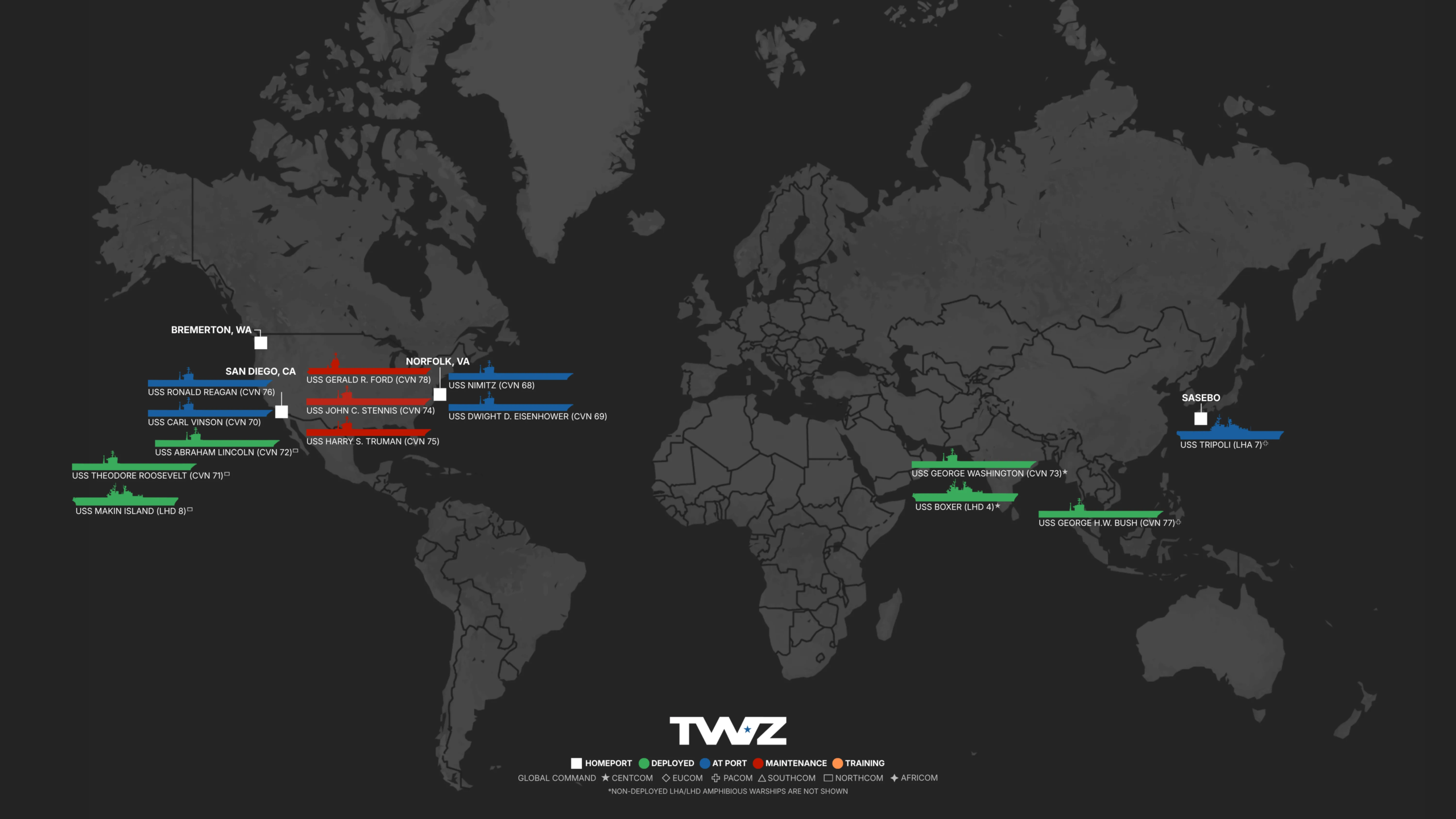
The aircraft carrier USS George H.W. Bush has reportedly passed through the Strait of Gibraltar and is expected to arrive in the eastern Mediterranean before the end of the week. The carrier will take the place of the USS Gerald R. Ford, which suffered a fire while underway in the Middle East, and is now being repaired at Souda Bay in Crete. You can keep up to date on these movements using TWZ’sweekly carrier tracker monitoring America’s flattop fleet, including deployed Carrier Strike Groups and Amphibious Ready Groups, using publicly available open-source information.
Carrier Tracker As of April 12, 2026
Trump orders U.S. Navy to blockade Strait of Hormuz as a third carrier strike group steams towards the CENTCOM area of responsibility.https://t.co/fxxOfsHfkE
U.K. Prime Minister Keir Starmer on Monday reaffirmed that Britain will not take part in any blockade of the Strait of Hormuz.
Speaking to the BBC, Starmer said the government’s priority is ensuring the strait is fully reopened.
“All the time the strait is shut or not free for navigation in the way it should be, that means oil and gas is not getting to market, that means the price is going up, and everybody listening to this is facing higher energy bills,” Starmer said. “I don’t want that to happen. I want their energy bills to be stabilized and lower.”
The ongoing closure of the Strait of Hormuz is deeply damaging. Getting global shipping moving is vital to ease cost of living pressures.
The UK has convened more than 40 nations who share our aim to restore freedom of navigation.
After the Islamabad talks, it is clear that the Iranian nuclear issue remains the top sticking point. In a cabinet meeting today, Israel’s prime minister, Benjamin Netanyahu, said he had spoken to U.S. Vice President JD Vance about the negotiations. “The explosion came from the American side, which could not tolerate Iran’s blatant violation of the agreement to enter the negotiations,” Netanyahu said. “The agreement was that they would cease fire, and the Iranians would immediately open the gates. They did not do that. The Americans could not accept that. He also made it clear to me that the main issue on the agenda for President Trump and the United States is the removal of all enriched material, and ensuring that there is no more enrichment in the coming years, and that could be in decades, no enrichment within Iran.”
Netanyahu at a cabinet meeting: “I spoke yesterday with Vice President J.D. Vance. He called me from his plane on his way back from Islamabad. He reported to me in detail, as this administration does every day, about the development of the negotiations. In this case, the…
Again, on the nuclear issue, Kremlin spokesman Dmitry Peskov told reporters on Monday that Russia is ready to take in Iran’s highly enriched uranium as part of a future peace deal with the United States.
Russia is ready to take in Iran’s enriched uranium as part of a future peace deal with the United States, the Kremlin says
Israel’s military announced on Monday that it has started what it described as targeted ground operations in the Bint Jbeil area of southern Lebanon.
Although Iran and Pakistan claim that the temporary ceasefire brokered by Pakistan last week also covers Lebanon, Netanyahu stated that there is “no ceasefire in Lebanon” and that Israel will continue to strike Hezbollah “with full force.”
The Israeli military has nearly completed capturing the Hezbollah stronghold of Bint Jbeil in southern Lebanon, killing more than 100 members of the terror group in the area in the process, according to the IDF.
— Emanuel (Mannie) Fabian (@manniefabian) April 13, 2026
David Ignatius, an associate editor and columnist for The Washington Post, has provided his prediction on what might happen after the failure to reach a deal in Islamabad over the weekend. Ignatius writes:
“After talking Sunday with people close to the negotiations, my sense is that the Islamabad impasse won’t necessarily mean a return to war. The blockade is a pressure tactic, to be sure, but not primarily a military one. Trump has no appetite for further armed conflict. He knows that the upsides are limited and the ‘tail risk,’ as financial traders like to say, is large. His aim instead is to put a severely battered Iran into an economic vise to see if its leaders will set a different course in a big, comprehensive deal.”
David Ignatius: “After talking Sunday with people close to the negotiations, my sense is that the Islamabad impasse won’t necessarily mean a return to war. The blockade is a pressure tactic, to be sure, but not primarily a military one. Trump has no appetite for further armed…
Meanwhile, citing a regional source and a U.S. official, Axiosreports that Pakistani, Egyptian, and Turkish mediators will continue talks with the United States and Iran in the coming days, “in an effort to bridge the remaining gaps and reach a deal to end the war.”
Pakistani Prime Minister Shehbaz Sharif also indicated on Monday that efforts are still being made to resolve the conflict.
ISLAMABAD, April 13 (Reuters) – Full efforts are still being made to resolve the conflict between the U.S. and Iran, Pakistani Prime Minister Shehbaz Sharif said on Monday, a day after talks between the two sides, held in Islamabad, ended without agreement.
Trump launched a sharp attack on Pope Leo XIV over the weekend, calling him “weak on crime and terrible for foreign policy” and accusing him of harming the Catholic Church. “Leo should get his act together as Pope,” he wrote on Truth Social. The criticism came after Leo condemned the “delusion of omnipotence” as driving the U.S.-Israel war in Iran and urged political leaders to halt the fighting and pursue negotiations.
“Pope Leo is WEAK on Crime,” begins a Sunday evening message from the President.
UK Prime Minister Kier Starmer has announced talks to be held this week and co-hosted with France, aiming at a diplomatic end to the war on Iran and securing safe passage in the Gulf shipping afterwards.
What does Donald Trump’s naval blockade of Iranian ports look like and can it achieve what the US president wants? It is hard to know when the planning appears to have been done on the fly, according to war studies lecturer Samir Puri.
Who: Atletico Madrid vs Barcelona What: Champions League quarterfinal, second leg Where: Metropolitano Stadium, Madrid, Spain When: Tuesday at 9pm (19:00 GMT) How to follow: We’ll have all the build-up on Al Jazeera Sport from 16:00 GMT in advance of our live text commentary stream.
Spanish football clubs Atletico Madrid and Barcelona will meet for the third time in 10 days but, crucially, with a UEFA Champions League (UCL) semifinal berth on the line.
Atletico may be far behind their Catalan opponents in the La Liga title race, but they go into Tuesday’s fixture as strong favourites, thanks to a first-leg victory against 10-man Barcelona at Camp Nou, and a strong home form in Europe this season.
Barcelona, the reigning La Liga champions, will have it all to do if they are to keep alive their dream of clinching their sixth UCL trophy, and first since the 2014–2015 season.
Here is all to know before the knockout tie:
What happened in the first leg at Camp Nou?
Julian Alvarez and Alexander Sorloth scored in each half as Atletico earned a precious 2-0 lead in a tense first-leg clash.
The La Liga leaders were on top in the first half before Pau Cubarsi was sent off for bringing down Atletico’s Giuliano Simeone, who was through on goal.
Alvarez whipped home the free kick at the stroke of halftime, and Sorloth doubled their advantage in the 70th minute to give Atletico a strong chance of reaching the semifinals.
Julian Alvarez, centre, opened the scoring against Barcelona in Atletico’s first-leg 2-0 win last week [Nacho Doce/Reuters]
How did Barcelona perform in La Liga on the weekend?
Barcelona thrashed crosstown rivals Espanyol 4-1 on Saturday, taking a major step towards retaining their La Liga title as they moved nine points clear of rivals Real Madrid, who are second.
Ferran Torres struck twice, assisted by Lamine Yamal both times, first with a header from a corner in the 10th minute before doubling the lead in the 25th, racing clear from another Yamal pass.
Espanyol pulled one back in the 56th minute when Pol Lozano fired in a rebound from just inside the box. But Yamal restored control in the 87th on a quick counter, with Marcus Rashford adding a fourth from Frenkie de Jong’s cross.
Barca moved to 79 points with seven games left.
How did Atletico perform in La Liga on the weekend?
Coach Diego Simeone rotated heavily for his team’s visit to face Sevilla to keep players fresh, as Atletico fell to a 2-1 defeat.
Akor Adams sent the hosts ahead from the penalty spot, and after 20-year-old Atletico reserve defender Javier Bonar levelled, Nemanja Gudelj struck again for Sevilla before the interval.
Atletico are fourth in the league standings with 57 points, four points behind third-placed Villarreal.
Have Atletico ever won the UEFA Champions League trophy?
Diego Simeone’s side have never won the competition.
They reached the final in 2014 and 2016, but were beaten by city rivals Real on both occasions.
How did Barcelona reach the UCL quarterfinals?
Barcelona stormed into the quarterfinals with an emphatic 8-3 aggregate win over Newcastle United.
Much of the work was done in their second-leg tie, in which Barca thrashed the Premier League side 7-2 at Camp Nou, as five different players scored.
Lamine Yamal, left, scored in both legs against Newcastle United in the UCL quarters [Scott Heppell/Reuters]
How did Atletico Madrid reach the UCL quarterfinals?
Atletico Madrid withstood a rousing Tottenham Hotspur fightback to advance 7-5 on aggregate despite a 3-2 second-leg loss in North London.
Simeone’s side, who scored four times in the opening 22 minutes in the 5-2 first-leg home romp, wobbled under a home onslaught, but goals by Julian Alvarez and David Hancko ultimately gave them breathing space.
Have Atletico and Barcelona played each other in the knockout stages?
The two teams have met twice in the Champions League knockout stages, both times at the quarterfinal stage, with Atletico going through in 2014 and 2016 on their run to the final each season. Atletico played the second leg at home on those occasions, too.
What have the managers said?
Diego Simeone: “We know the opponent we are going to face, and we are aware of how strong they are, but we are also aware of what our objective is – to advance.”
Hansi Flick: “We have the quality. We have the players who can change this. But, of course, we have to fight. We have to focus on the magic.”
After a first-leg defeat at home, the pressure is on Hansi Flick and Barcelona as they travel to face Atletico Madrid [Pablo Morano/Reuters]
Barcelona vs Atletico Madrid: Head-to-head
The two clubs have faced each other on 251 occasions. Barcelona have won 115 of those games, Atletico have won 79, and 57 ended as draws.
Last 10 encounters:
April 8: Barcelona 0-2 Atletico (Champions League quarterfinal, first leg)
April 4: Atletico 1-2 Barcelona (La Liga)
March 3: Barcelona 3-0 Atletico (Copa del Rey semifinal)
February 12 : Atletico 4-0 Barcelona (Copa del Rey semifinal)
December 2 : Barcelona 3-1 Atletico (La Liga)
April 2, 2025: Atletico 0-1 Barcelona (Copa del Rey semifinal)
March 16, 2025: Atletico 2-4 Barcelona (La Liga)
February 25, 2025: Barcelona 4-4 Atletico (Copa del Rey semifinal)
December 21, 2024: Barcelona 1-2 Atletico (La Liga)
April 17, 2024: Atletico 0-3 Barcelona (La Liga)
Atletico’s team news
Marc Pubill is suspended after picking up three yellow cards, while Jose Gimenez, Pablo Barrios, and David Hancko are doubtful due to injuries.
Defender Cubarsi is suspended after his red card in the first leg and will be replaced by Ronald Araujo, who featured in the backline against Espanyol at the weekend.
Marc Bernal, Raphinha, and Andreas Christensen are all out injured.
Predicted starting XI:
Joan Garcia (goalkeeper); Kounde, Araujo, Martin, Cancelo; Eric Garcia, Pedri; Yamal, Fermin, Rashford; Lewandowski
Britain has publicly distanced itself from Washington’s escalating strategy against Iran, with Prime Minister Keir Starmer making clear that the UK will not support any blockade in the Gulf.
Speaking after the United States announced sweeping restrictions on Iranian shipping, Starmer emphasized that Britain’s priority is not enforcement but de-escalation. He stressed the importance of keeping vital trade routes open rather than contributing to further disruption.
What Starmer Said
Starmer’s message was direct. The UK will not be drawn into the conflict and will not support a blockade of the Strait of Hormuz.
Instead, Britain is focused on ensuring the strait remains open. While confirming the presence of British minesweepers in the region, he made clear their role is defensive and aimed at maintaining safe passage, not enforcing restrictions.
Contrast with Washington
The stance puts London at odds with the approach taken by Donald Trump.
The U.S., through United States Central Command, has announced a broad blockade targeting Iranian maritime traffic. Trump has gone further, warning that vessels linked to Iranian payments could be intercepted and threatening force against any resistance.
While Washington frames the move as pressure on Tehran, Britain is signaling concern about the wider consequences.
Why the Strait Matters
The Strait of Hormuz remains one of the most critical energy routes in the world. A significant share of global oil supply passes through it, meaning even partial disruption can send shockwaves through markets.
For the UK, keeping this route open is not just a regional issue but a global economic priority.
Implications: Cracks in Western Unity
Britain’s refusal highlights a growing divide among Western allies on how to handle the Iran crisis.
The U.S. is pursuing a strategy of maximum pressure, while the UK is prioritizing stability and the prevention of further escalation. This divergence could complicate coordinated action and weaken the overall Western response.
Analysis: A Strategic Balancing Act
Starmer’s position reflects a careful calculation. Supporting the blockade risks entangling Britain in a wider conflict and worsening global economic strain. Opposing it, however, creates visible distance from a key ally.
By focusing on keeping the strait open, the UK is attempting to balance security concerns with economic stability, while avoiding direct confrontation.
Britain’s stance sends a clear signal. Even close allies are not fully aligned on how far to go against Iran.
As tensions rise, that lack of unity could shape the next phase of the crisis just as much as the actions taken in the Gulf itself.
Islamabad, Pakistan – More than 12 hours of face-to-face negotiations between the United States and Iran ended without agreement in Islamabad on Sunday, leaving a fragile two-week ceasefire as the only barrier between diplomacy and a return to war.
Pakistan, which spent weeks positioning itself as a mediator and succeeded in bringing both sides into the same room, emerged with its role intact. But officials acknowledge the harder phase now begins — getting American and Iranian negotiators back into talks before their differences explode into full-fledged war again.
Recommended Stories
list of 4 itemsend of list
“Pakistan has been and will continue to play its role to facilitate engagements and dialogue between the Islamic Republic of Iran and the United States of America in the days to come,” Pakistan’s Deputy Prime Minister and Foreign Minister Ishaq Dar said in a statement after the conclusion of the talks.
The talks, the highest-level direct engagement between Washington and Tehran since the 1979 Islamic Revolution, faltered over differences surrounding Iran’s nuclear programme.
“The simple fact is that we need to see an affirmative commitment that they will not seek a nuclear weapon, and they will not seek the tools that would enable them to quickly achieve a nuclear weapon,” said US Vice President JD Vance, who led the American delegation alongside special envoy Steve Witkoff and US President Donald Trump’s son-in-law Jared Kushner.
However, Vance left a narrow opening for the resumption of talks.
“We leave here with a very simple proposal, a method of understanding that is our final and best offer. We’ll see if the Iranians accept it,” Vance said, tapping the podium for emphasis, before ending his brief remarks, which lasted for less than five minutes.
Pakistani and Iranian sources confirmed that the Iranian delegation met senior Pakistani officials later on Sunday before departing for Tehran, though details of those discussions remain unclear.
What is clear is that Pakistan isn’t giving up yet.
Washington’s red lines
US officials said that Iran had entered negotiations misreading its leverage, believing it held advantages that, in Washington’s assessment, it did not.
US Vice President JD Vance speaks during a news conference after meeting with representatives from Pakistan and Iran, on Sunday, April 12, 2026, in Islamabad, Pakistan [Jacquelyn Martin/Pool via Reuters]
According to these officials, Vance spent much of his time during the talks correcting what they described as Iranian misperceptions about the US position — asserting that no deal would be possible without a full commitment on the nuclear issue.
Officials also suggested that Trump’s subsequent announcement of a blockade in the Strait of Hormuz was not an impulsive reaction, but a pre-planned step aimed at removing the waterway as an Iranian bargaining tool and forcing the nuclear issue back to the centre of any future talks.
But the US officials, speaking on background, also acknowledged that the gulf in the positions between Washington and Tehran that they failed to bridge extended to issues beyond Iran’s nuclear programme.
In essence, they said, the two sides failed to agree on six key points: ending all uranium enrichment; dismantling major enrichment facilities; removing Iran’s stockpile of highly enriched uranium; accepting a broader regional security framework involving US allies; ending funding for groups Washington designates as “terrorist” organisations, including Hamas, Hezbollah and the Houthis; and fully reopening the Strait of Hormuz without tolls.
Hours after the talks ended, Trump acknowledged partial progress, but underscored the central impasse.
“The meeting went well, most points were agreed to, but the only point that really mattered, NUCLEAR, was not,” he wrote on Truth Social.
“Effective immediately, the United States Navy, the Finest in the World, will begin the process of BLOCKADING any and all Ships trying to enter, or leave, the Strait of Hormuz,” Trump said. “Iran will not be allowed to profit off this Illegal Act of EXTORTION.”
Iran has effectively controlled access to the Strait of Hormuz, through which roughly 20 percent of global oil supplies pass, since the US-Israeli attacks began on February 28.
Iran’s Islamic Revolutionary Guard Corps (IRGC) has imposed what analysts describe as a de facto toll system, requiring vessels to secure clearance codes and transit under escort through a controlled corridor.
The disruption has pushed oil prices above $100 per barrel at times, unsettling global markets and placing sustained pressure on energy-importing countries across Asia and Europe.
Tehran has framed its control of the strait as both a security measure and a key negotiating lever, one it has shown little willingness to relinquish without a broader settlement.
Tehran’s point of view
Iran’s account of the breakdown differed sharply.
In a post on X early on April 13, after returning to Tehran, Iran’s Foreign Minister Abbas Araghchi said his country had engaged in “good faith”, only to face shifting demands.
Iranian Parliament Speaker Mohammad Bagher Ghalibaf, left, meets with Pakistani Prime Minister Shehbaz Sharif, right, in Islamabad on April 11, 2026 [Handout/Prime Minister’s Office via Reuters]
“When just inches away from an Islamabad MoU, we encountered maximalism, shifting goalposts, and blockade,” he wrote. “Zero lessons learned. Good will begets good will. Enmity begets enmity.”
The reference to an “Islamabad MoU”, a memorandum of understanding, was the clearest public signal yet that the two sides had come closer to a formal agreement than either government had previously acknowledged.
Iran’s Parliament Speaker Mohammad Bagher Ghalibaf, who led the country’s delegation, said his team had proposed “forward-looking initiatives”, but failed to secure trust.
“Due to the experiences of the two previous wars, we have no trust in the opposing side,” he wrote on Sunday.
Foreign Ministry spokesperson Esmaeil Baghaei also pointed to partial progress but unresolved differences.
“On some issues we actually reached mutual understanding, but there was a gap over two or three important issues and ultimately the talks didn’t result in an agreement,” he said.
Tehran’s key demands, including an end to Israeli strikes on Lebanon, the release of $6bn in frozen assets, guarantees on its nuclear programme and the right to charge vessels transiting the Strait of Hormuz, remained unmet.
Iran’s ambassador to Pakistan, Reza Amiri Moghadam, however, offered a more measured view — suggesting that Tehran was not closing the window on talks.
“The Islamabad Talks is not an event but a process,” he wrote in his message on X on Sunday. “The Islamabad Talks laid the foundation for a diplomatic process that, if trust and will are strengthened, can create a sustainable framework for the interests of all parties.”
Pakistan’s balancing act
For Pakistan, analysts say, the outcome represents a setback but not a failure.
Officials were careful to describe the talks as “an important opening step in a continuing diplomatic process”, stressing that issues of such complexity cannot be resolved in a single round.
The emphasis, they said, was on keeping the channel open.
Muhammad Obaidullah, a former Pakistan Navy commodore who has served in Iran as a diplomat, said expectations of a breakthrough were always unrealistic.
“The mere fact of bringing both parties face to face is a significant diplomatic achievement in itself,” he told Al Jazeera. “The diplomacy is not dead.”
Ishtiaq Ahmad, professor emeritus of international relations at Quaid-i-Azam University in Islamabad, went further.
“The talks did not collapse; they concluded without agreement but with a defined US offer on the table and the channel still intact,” he said.
“Pakistan’s role was to move the crisis from escalation to structured engagement, which it achieved. The absence of convergence reflects structural differences between the US and Iran, not a failure of mediation.”
Both Trump and Iranian officials have praised Pakistan’s Prime Minister Shehbaz Sharif and Chief of Army Staff Field Marshal Asim Munir for their efforts to secure the ceasefire, and for hosting the talks in Islamabad. That, say analysts, suggests that they remain open to further Pakistan-brokered negotiations.
Sahar Baloch, a Germany-based scholar of Iran, said that trust remains Pakistan’s most valuable asset.
“The real test of credibility is not preventing breakdowns, but remaining relevant after them,” she said.
A man walks past a billboard announcing peace negotiations as delegations from the United States and Iran hold high-level talks in Islamabad, Pakistan, April 11, 2026 [Asim Hafeez/Reuters]
Fragile ceasefire
The immediate threat to Pakistan’s role comes from the evolving situation in the Strait of Hormuz and in Lebanon.
Iran has already warned that continued Israeli strikes on Lebanon could render negotiations meaningless. Iran’s President Masoud Pezeshkian has framed such attacks as a direct challenge to the ceasefire.
Trump’s blockade announcement now adds pressure from a second front.
Ahmad, a former Pakistan chair at Oxford University, warned that a collapse of the truce would sharply narrow diplomatic options.
“If the ceasefire collapses, the immediate consequence is the loss of the diplomatic window,” he said. “A second round becomes far more difficult because both sides would return to negotiating under active escalation, where positions tend to harden rather than converge.”
Obaidullah drew a historical parallel with the US naval quarantine of Cuba during the 1962 missile crisis. What if China were to use its own ships to import Iranian oil? Would the US attack them?
“The world will again be watching who blinks first,” Obaidullah said. “However, it may turn into a far greater conflict if neither side does.”
The Cuban Missile Crisis of October 1962 brought the US and the Soviet Union to the brink of nuclear war, after Washington discovered Moscow had installed nuclear missiles on Cuban soil, within striking distance of the American mainland.
The US blocked the Soviets from providing more equipment to Cuba, and eventually, a diplomatic settlement was reached, with the Soviets agreeing to withdraw the missiles in exchange for a US pledge not to invade Cuba.
Baloch, the Berlin-based scholar, agreed that the situation remains volatile.
“The ceasefire risks becoming more symbolic than substantive,” she said. “But paradoxically, escalation can sometimes force a return to talks, even if under more urgent and less favourable conditions.”
What is the road ahead?
Pakistan’s room for manoeuvring is also shaped by its economic fragility.
The disruption in the Strait of Hormuz has driven up energy prices, compounding pressures on an economy already under strain before the conflict.
Ahmad said this creates both urgency and limits.
“Economic exposure, especially to energy shocks and external financing, creates urgency for Pakistan to prevent a prolonged conflict,” he said.
“But it also reinforces a constraint: Pakistan cannot afford escalation with either side. Its leverage is not coercive; it is positional. It comes from being the only channel acceptable to both sides, not from the ability to impose outcomes,” Ahmad said.
Eight days remain until the end of the initial two-week truce, a window Pakistani officials said privately represents a genuine opportunity for further technical and political alignment, if both sides choose to use it.
Ahmad suggested that any breakthrough would depend on creating a sequence of steps acceptable to both sides.
“The US is asking for early nuclear commitments; Iran is asking for guarantees and relief first,” he said.
Pakistan’s role, he added, would be to help “structure this sequencing, keep both sides engaged, and prevent breakdown at each stage”.
Islamabad won’t be the one drafting a deal itself, he emphasised, noting, “At this point, maintaining the channel is as important as the substance of the deal itself.”
The Philippines has raised alarm after discovering cyanide on Chinese vessels operating near a disputed atoll in the South China Sea, intensifying tensions in an already volatile region.
Officials say laboratory tests confirmed the presence of the toxic substance in materials seized during naval operations at Second Thomas Shoal, known in the Philippines as Ayungin Shoal.
The area is a longstanding flashpoint between Philippines and China, with both sides asserting competing claims.
Why the Allegation Matters
Philippine authorities are framing the discovery as more than an environmental violation. According to security officials, the use of cyanide could damage marine ecosystems, kill fish stocks, and weaken the reef structure beneath a grounded Philippine naval vessel stationed at the shoal.
That ship plays a critical role in maintaining Manila’s territorial claim, meaning any environmental damage could also have strategic consequences.
Officials have gone as far as calling it an act of sabotage.
Rising Tensions at Sea
The accusation comes against a backdrop of repeated confrontations in the area. Manila has previously accused Beijing of interfering with resupply missions to its troops stationed on the grounded vessel, including a violent 2024 incident that injured a Filipino sailor.
China has consistently denied such allegations, instead accusing the Philippines of encroaching on its territory.
Despite recent diplomatic talks aimed at reducing friction, incidents at sea continue to test fragile understandings between the two sides.
The Bigger Dispute
The South China Sea remains one of the world’s most contested regions. China claims nearly the entire waterway, overlapping with claims from several Southeast Asian nations.
A 2016 international tribunal ruling rejected Beijing’s sweeping claims under international law, but China does not recognize the decision.
With more than $3 trillion in global trade passing through these waters each year, even localized tensions carry global significance.
Implications: Environment Meets Geopolitics
This incident adds a new dimension to the dispute by linking environmental harm with strategic rivalry.
If proven, the use of cyanide could:
Escalate diplomatic tensions between Manila and Beijing
Draw wider international attention to environmental practices in contested waters
Further complicate already fragile cooperation efforts in the region
It also underscores how control over maritime territory is not just about military presence, but also about sustaining the ecosystems that support it.
Analysis: A Dangerous New Phase
The allegation signals a shift in how disputes in the South China Sea are unfolding. Beyond naval standoffs and legal arguments, there is now a growing risk of indirect tactics that target resources and infrastructure.
Whether intentional or not, the incident deepens mistrust and makes de-escalation more difficult.
The cyanide discovery is more than an environmental concern. It is a geopolitical flashpoint that could further inflame one of the world’s most sensitive maritime disputes.
As tensions persist, even seemingly small incidents have the potential to ripple far beyond the waters where they occur.
A French court has found cement company Lafarge guilty of financing armed groups during the Syrian war. Prosecutors said the company paid millions of dollars to ISIL and the al Qaeda-affiliated Nusra Front between 2013 and 2014 to keep its factory operating.
Weekly insights and analysis on the latest developments in military technology, strategy, and foreign policy.
Here’s TWZ’s weekly carrier tracker monitoring America’s flattop fleet, including deployed Carrier Strike Groups (CSG) and Amphibious Ready Groups (ARG), using publicly available open-source information.
President Trump declared this morning on Truth Social that the U.S. Navy “will begin the process of BLOCKADING any and all Ships trying to enter, or leave, the Strait of Hormuz,” which follows U.S. Central Command’s announcement yesterday that U.S. forces executed a mine clearance mission and asserted navigational rights and freedoms in the Strait. “Additional U.S. forces, including underwater drones, will join the clearance effort in the coming days,” the release concluded. It isn’t clear exactly what the destroyers did near the Strait or the details of their attempted transit.
Additional warships have arrived in Europe and the Middle East over the last week, and more are en route, as the U.S. takes advantage of the ceasefire to rearm, resupply, and reposition key assets across theaters. The first elements of the George H.W. Bush CSG transited the Strait of Gibraltar in early April, and the flagship with at least three escorts is expected to follow in the near term. The Gerald R. Ford CSG is on station in the eastern Mediterranean Sea, most recently conducting operations southwest of Cyprus, satellite imagery shows. The Boxer ARG, embarked with the 11th Marine Expeditionary Unit (MEU), departed Pearl Harbor and is transiting the Pacific Ocean westbound toward the Middle East, where the Tripoli ARG-31st MEU is currently operating.
For the latest on the status of the ceasefire and negotiations, follow our rolling coverage here and be sure to check TWZ.com daily for live updates.
Note: Positions are general approximations.Non-deployed LHA/LHD amphibious warships are not shown.
Contact the author: ian.ellis-jones@teamrecurrent.io
Many people resorting to eating leaves and animal feed to survive in North Darfur and South Kordofan states.
Millions of people in Sudan are surviving on just one meal a day, as the country’s food crisis deepens and threatens to spread, according to a report published by a group of nongovernmental organisations (NGOs).
“Sudan’s war between the Sudanese army and the paramilitary Rapid Support Forces, which enters its third year on Wednesday, has caused widespread hunger and displaced millions of people amid one of the world’s largest humanitarian crises,” a report by Action Against Hunger, CARE International, International Rescue Committee, Mercy Corps, and the Norwegian Refugee Council said on Monday.
Recommended Stories
list of 4 itemsend of list
“Nearly three years of conflict, marked by violence, displacement and siege tactics, have systematically eroded Sudan’s food system – field by field, road by road, market by market – producing mass hunger,” it added.
The report highlighted that millions of families can only access one meal a day in the two states worst hit by the conflict – North Darfur and South Kordofan.
“Often, they miss meals for entire days,” the report said, adding that many people have resorted to eating leaves and animal feed to survive.
The NGOs said communal kitchens set up to collectively prepare and share meals are struggling to stretch the scarce food available as resources dwindle.
It added that the crisis is being compounded by a worsening economic crisis and climate change.
Government denies famine
In April 2023, a war erupted between the Sudanese army and the paramilitary Rapid Support Forces (RSF), unleashing a wave of violence that has led to one of the world’s worst man-made humanitarian crises, with more than 12 million forced from their homes, and more than 33 million people in need of humanitarian aid.
More than 40,000 people have been killed over the past three years, according to the United Nations. Aid groups say the actual death toll could be many times higher.
Some 61.7 percent of Sudan’s population – 28.9 million people – is facing acute food shortages, according to the 2026 Humanitarian Needs and Response Plan.
Sudanese refugees line up to receive food rations in Adre Chad [File: Zohra Bensemra/Reuters]
The army-aligned Sudanese government denies the existence of famine, while the RSF denies responsibility for such conditions in areas under its control.
The UN has reported widespread atrocities and waves of ethnically charged violence. In November, the global hunger monitor confirmed, for the first time, famine conditions in el-Fasher and Kadugli.
In February, the UN-backed Integrated Food Security Phase Classification found that famine thresholds for acute malnutrition have been surpassed in Um Baru, where the rate of acutely malnourished children aged below five years was nearly double the famine threshold, and Kernoi.
The report, based on interviews with farmers, traders, and humanitarian actors in Sudan, details how the war in Sudan is driving communities towards famine conditions – due to disruptions to farming as well as the use of starvation as a weapon of war – including deliberate destruction of farms and markets.
Women and girls have been disproportionately affected, as they face a high risk of rape and harassment when going to the fields, visiting markets, or collecting water, the report said.
Female-headed households are three times more likely to experience food shortages than male-headed households, it added.
Iran’s military has called US blockade plans in the Strait of Hormuz an “act of piracy”, warning that the ports in the Gulf and Seas of Oman are “either for everyone or for no one”. Al Jazeera’s Tohid Asadi is in Tehran.