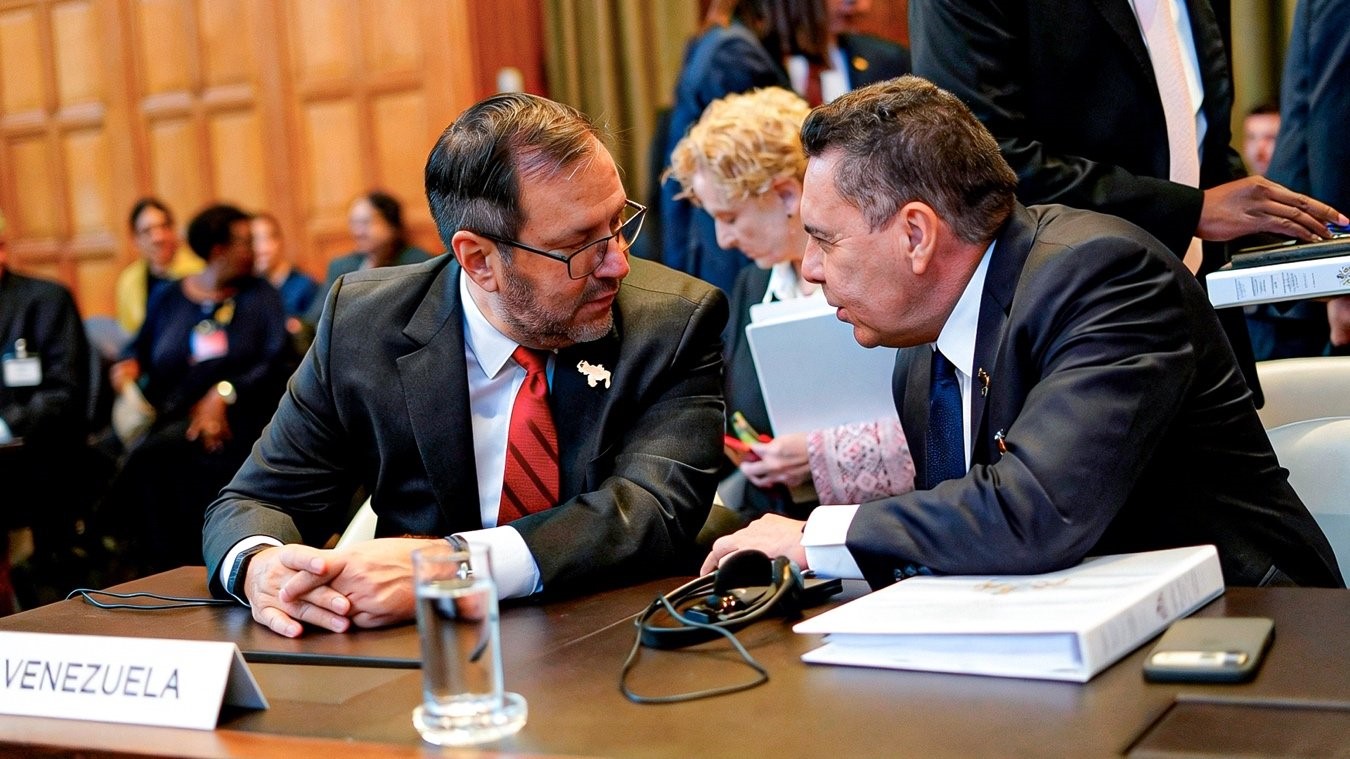
Foreign Minister Yván Gil (left) and former UN Ambassador Samuel Moncada (right) reiterated Venezuela’s longstanding position on the Essequibo dispute. (Archive)
Caracas, May 8, 2026 (venezuelanalysis.com) – The Venezuelan government reasserted its sovereignty claim over the Essequibo Strip during an International Court of Justice (ICJ) hearing aimed at resolving the long-standing territorial dispute with Guyana.
Venezuelan representative Samuel Moncada, defended the country’s “inalienable right” over the 160,000 square kilometer resource-rich territory during his intervention on Wednesday.
The ICJ is holding a week of hearings in The Hague between the two South American nations over the controversy, which in recent years has raised fears of a possible military confrontation. Venezuela has repeatedly stated that it does not recognize the court’s jurisdiction over the matter. However, Guyana unilaterally brought the dispute before the ICJ in 2018.
In this context, Moncada argued that the only valid legal instrument governing the dispute is the 1966 Geneva Agreement, which calls for a practical and mutually satisfactory solution between Caracas and Georgetown.
“Venezuela is here today because it cannot remain silent in the face of a process in which Guyana seeks to use the Court to unilaterally redefine the nature of the controversy,” Moncada said. He added that Venezuelans rejected the ICJ’s jurisdiction over the issue in the December 2023 referendum.
For his part, Guyanese Foreign Minister Hugh Hilton Todd told the judges that the case has “existential importance for Guyana” because it affects more than 70 percent of the country’s territory.
“For Guyanese people, the very idea that our country could be dismembered is a true tragedy because we would lose the vast majority of our land and population. Guyana would cease to be Guyana without them,” Todd argued during Guyana’s hearing session on Monday.
Moncada responded by saying that Guyana’s position implied that decades of mediation efforts by United Nations officials and Good Offices processes were attempts to “dismember” Guyanese territory, when in reality they sought the negotiated settlement that Guyana is now attempting to avoid.
The Guyanese government intends to have the ICJ uphold an 1899 arbitration ruling that awarded the Essequibo to the United Kingdom. However, in 1962 Venezuela filed a complaint before the United Nations seeking to nullify the award after evidence emerged suggesting that the decision had been reached fraudulently.
As a result, in 1966, while Guyana was negotiating its independence from the United Kingdom, the parties signed the Geneva Agreement, establishing that the Essequibo region would remain administered by Guyana while its sovereignty claim by Venezuela remained unresolved until a mutually agreed settlement could be reached.
The accord effectively superseded the Paris ruling and established a four-year framework to resolve the dispute in a “practical, peaceful and satisfactory” manner for both sides. Although no final resolution has been achieved, the agreement is still considered to be in force.
Tensions between the two countries escalated significantly in 2015 after ExxonMobil discovered massive offshore oil reserves in the disputed area, giving Guyana access to one of the world’s highest per capita oil reserves. Though the Essequibo is under Guyanese administration, Venezuela includes the territory in its official map and recently established administrative structures for its eventual 24th state.
The court at The Hague is scheduled to hold four hearings in total, during which both countries will present their legal arguments.
Guyana presented its first round of arguments on Monday, May 4, while Venezuela did so on Wednesday, May 6. Guyana’s second round took place on Friday, May 8, and Venezuela is scheduled to respond again on Monday, May 11.
Although the hearings will conclude that day, a final ruling could take months or even years. While ICJ rulings are legally binding, the court has no direct mechanism to enforce compliance.
According to Venezuelan Foreign Minister Yván Gil, regardless of the judicial proceedings, “the inevitable outcome will be Guyana’s return to the negotiating table to definitively resolve the territorial controversy under the framework of the 1966 agreement.”
Edited by Ricardo Vaz in Caracas.