News

Trump Moves to Reclaim Ceasefire as Thai–Cambodian Clashes Escalate

Border fighting between Thailand and Cambodia has entered its fifth day, marking one of the most violent flare-ups since July. Heavy artillery and rocket exchanges along the 817-km frontier have killed at least 20 people, wounded over 200, and displaced hundreds of thousands.
The clashes come despite a ceasefire earlier this year that U.S. President Donald Trump personally brokered. With the violence worsening, Thailand’s caretaker Prime Minister Anutin Charnvirakul confirmed he will speak with Trump late Friday in an effort to restore calm.

WHY IT MATTERS

The renewed fighting threatens regional stability in mainland Southeast Asia and risks escalating into a broader conflict if not contained. Trump is positioning himself once again as a mediator, eager to revive a fragile ceasefire he sees as a diplomatic accomplishment.
For Thailand and Cambodia both navigating domestic political turbulence U.S. involvement may be one of the few external pressures capable of stopping the conflict quickly.

Trump is doubling down on his role as peace-broker, publicly highlighting past successes and pledging to get the ceasefire “back on track.”
Thailand and Cambodia’s militaries are locked in multi-point battles along the border, with commanders facing pressure to halt the humanitarian crisis unfolding.
Civilians on both sides remain the most vulnerable, with tens of thousands displaced and local communities facing days of bombardment.

WHAT’S NEXT

The scheduled call between Trump and Prime Minister Anutin will be the latest attempt to restart diplomacy. Trump also plans separate calls with Cambodian leadership.
Whether these interventions can end the fighting as they did in July remains uncertain. Much will depend on whether both sides are willing to recommit to a ceasefire and allow international monitoring to stabilise the border.

With information from Reuters.

Source link

Kilmar Abrego Garcia freed from US immigration detention, returns home | Migration News

The Department of Homeland Security has pledged to appeal the latest ruling, slamming it as ‘naked judicial activism’.

Kilmar Abrego Garcia, whose case has become a flashpoint in the Trump administration’s immigration crackdown in the United States, has been freed from detention on a judge’s order and returned to his home, according to reports.

Abrego Garcia was due to check in with US immigration officials on Friday, The Associated Press news agency reported, a day after returning to his home following his release from an immigration processing centre in the latest twist in a convoluted case of deportation and detention targeting the Maryland man.

Recommended Stories

list of 4 itemsend of list

In a ruling on Thursday, US District Judge Paula Xinis in Maryland ordered Immigration and Customs Enforcement to let Abrego Garcia go immediately, writing that federal authorities had detained him again after his return to the US without any legal basis.

The face of Trump’s hardline immigration policies

Abrego Garcia has an American wife and children and has lived in Maryland for years, under protected legal status since 2019, when a judge ruled he should not be deported because he could be harmed in his home country by a gang that targeted his family. He originally moved to the US without documentation as a teenager.

He then became the highest-profile case among more than 200 people sent to the notorious El Salvador’s CECOT mega-prison as part of President Donald Trump’s crackdown on refugees, migrants and asylum seekers in the US.

He was wrongfully deported by the Trump administration to El Salvador in March. A court later ordered his return to the US, where he was detained again, as immigration officials sought to deport him to a series of African countries instead of El Salvador.

‘Judicial activism’

The Department of Homeland Security slammed Thursday’s ruling and said it would appeal, labelling the decision as “naked judicial activism” by a judge appointed during President Barack Obama’s administration.

“This order lacks any valid legal basis, and we will continue to fight this tooth and nail in the courts,” said Tricia McLaughlin, the department’s assistant secretary.

Abrego Garcia’s lawyer, Simon Sandoval-Moshenberg, said he expected his client’s ordeal was far from over, and he was preparing to defend him against further deportation efforts.

“The government still has plenty of tools in their toolbox,” Sandoval-Moshenberg said.

“We’re going to be there to fight to make sure there is a fair trial.”

The lawyer said the judge’s ruling had made it clear that the government could not detain a person indefinitely without legal authority, adding that Abrego Garcia had already “endured more than anyone should ever have to”.

Abrego Garcia has filed a federal lawsuit claiming the Trump administration is illegally using the deportation process to punish him due to the attention his case received.

Since his return, federal authorities have also filed charges against Abrego Garcia for alleged human smuggling related to a 2022 traffic stop.

He has pleaded not guilty and filed a motion to dismiss the charges, claiming the prosecution is vindictive.

In her ruling on Thursday, Judge Xinis said Trump lawyers “affirmatively misled” the court, including falsely claiming that Costa Rica had rescinded an offer to accept Abrego Garcia.

Abrego Garcia has said he was willing to resettle there in the event he was deported from the US.

In a separate proceeding, Abrego Garcia has also petitioned to reopen his immigration case to seek asylum in the US.

Source link

Verdict in Hong Kong media tycoon Jimmy Lai’s trial due next week | Freedom of the Press News

The 156-day trial, the most high-profile use of Beijing’s draconian national security law, is set to come to a close.

Hong Kong’s High Court is set to hand down a verdict in the case of pro-democracy campaigner and media mogul Jimmy Lai next week, bringing an end to his lengthy national security trial.

Lai’s verdict will be delivered by a three-judge panel in a hearing that begins at 10am local time (02:00 GMT) on Monday, according to a court diary notice seen on Friday.

Recommended Stories

list of 3 itemsend of list

Founder of the now-shuttered pro-democracy Apple Daily newspaper, Lai, 78, is charged with foreign collusion under Hong Kong’s national security law, which Beijing imposed following huge and sometimes violent pro-democracy protests in 2019.

He previously pleaded not guilty to two counts of conspiring to collude with foreign forces, as well as a third count of sedition under a colonial-era law.

Authorities accuse Lai, who has been detained since December 2020, of using the Apple Daily to conspire with six former executives and others to produce seditious publications between April 2019 and June 2021.

He is accused of using his publication to conspire with paralegal Chan Tsz-wah, activist Andy Li, and others to invite foreign countries – including the United States, Britain and Japan – to impose sanctions, blockades and other hostile measures against Hong Kong and China.

Prosecutors also accuse Lai of stoking hatred against authorities in Beijing and Hong Kong through writing and publishing more than 150 critical op-eds in the outlet.

He faces life imprisonment if convicted.

Lai has been held in solitary confinement for more than 1,800 days, with his family saying they fear for his wellbeing and his health is deteriorating as he suffers from diabetes, high blood pressure, as well as heart palpitations that require medication.

In August, the court postponed closing arguments in his 156-day trial – which began in December 2023 – citing a “medical issue” involving the 78-year-old’s heart.

Authorities say Lai has received proper treatment and medical care during his detention.

Trump to do ‘everything I can to save him’

Hong Kong was handed back to China in 1997 after more than 150 years under British colonial rule.

As part of the “one country, two systems” approach, Hong Kong officially operates a separate judicial system based on Common Law traditions, meaning Lai has greater legal protections than he would in mainland China.

But Hong Kong has experienced significant democratic backsliding in recent years, which accelerated following mass pro-democracy protests in 2019-20, which resulted in a harsh crackdown on dissent in the territory by Beijing.

In 2020, Chinese authorities introduced a draconian national security law to crush the protest movement, establishing secession, subversion, terrorism, and collusion with foreign organisations as crimes carrying hefty punishments.

Lai’s trial represents the most high-profile use of that law, with critics condemning his trial as politically motivated.

The Chinese and Hong Kong governments insist Lai is being given a fair trial and have said the legal process must be allowed to reach its conclusion.

But his case has drawn international scrutiny, including from US President Donald Trump, who has repeatedly promised to “save” Lai. In August, Trump promised to do “everything I can to save him”.

“His name has already entered the circle of things that we’re talking about, and we’ll see what we can do,” Trump told Fox News Radio.

Trump also reportedly raised Lai’s case during a meeting with Chinese leader Xi Jinping when the pair met in South Korea in October.

Source link

EU disburses 6th Ukraine Facility aid tranche to Kyiv

Dec. 12 (UPI) — European Union member states have approved nearly $2.7 billion in funding for Ukraine as part of a plan to bolster the war-besieged nation’s recovery, reconstruction and modernization.

The disbursement of the funds was approved Thursday by the European Council, the 27-member block’s top political steering body, to boost Ukraine’s macro-financial stability and support the functioning of its public administration, the council said in a statement.

“I am grateful to the EU for the steadfast support,” Sergii Marchenko, Ukraine’s minister of finance, said in a statement.

“The [Ukraine-EU] partnership ensures our financial stability today and lays the foundation for Ukraine’s shared future in the EU.”

According to Ukraine’s Ministry of Finance, $2.4 billion of the funds will be provided as loans, with the remainder in grants.

It is the sixth regular disbursement of funds from the Ukraine Facility, the EU’s main framework for sustaining Ukraine’s economy, governance and reconstruction amid its defense against Russia’s invasion.

Ukrainian Prime Minister Yulia Svyrydenko said in a statement that this disbursement is “essential” for Ukraine to maintain its “financial resilience” during the war, which began with Russia’s invasion on Feb. 24, 2022.

“We are grateful to our European partners for their consistent support and for continuing the program,” she said.

The council agreed to release the funds as Ukraine successfully completed the eight steps required for the disbursement as well as an outstanding step from the fourth disbursement, according to the council.

The reforms were implemented before the end of the third quarter in the areas of public finance management, the judiciary, the business environment, the banking sector, environmental protection and others, according to the finance ministry.

“The government of Ukraine is working to further improve compliance with Ukraine Facility conditions in the upcoming reporting period,” Svyrydenko added.

The announcement comes a little over a month after the EU approved the fifth disbursement in early November.

“This quick consecutive provision of funds mirrors Ukraine’s speed and commitment to implement reforms aligned with the country’s EU accession goals,” the council said.

The Ukraine Facility entered into force March 1, 2024, to provide Ukraine with up to more than $58 billion in grants and loans through 2027.

To date, Ukraine has received more than $28.6 billion under the program, with $9.7 billion having been received this year alone, according to the Ministry of Finance.

“This is stable and predictable financial support that enables us to maintain budget liquidity and ensure social payments,” Marchenko added in a separate statement.

“Thanks to this support, Ukraine remains on the path of reforms and is moving closer to EU membership.”

The Ukraine Facility is closely linked to advancing the so-called Ukraine Plan that outlines Kyiv’s strategy not only for recovery, reconstruction and modernization but also for implementing reforms to achieve its goal of becoming the 28th member of the EU.

The announcement coincided with the EU and Ukraine agreeing on a 10-point plan on implementing reforms to ensure Kyiv aligns with the bloc and eventually becoming a member.

The EU is Ukraine’s largest backer during its war against Russia, giving it about $80.2 billion since the war began, of which $30.9 billion was given this year.

Source link

US sanctions family of Venezuela’s Maduro, 6 oil tankers in new crackdown | Nicolas Maduro News

The Trump administration has imposed new sanctions on Venezuela, targeting three nephews of President Nicolas Maduro’s wife, Cilia Flores, as well as six crude oil tankers and shipping companies linked to them, as Washington steps up pressure on Caracas.

Two of the sanctioned nephews were previously convicted in the United States on drug trafficking charges before being released as part of a prisoner exchange.

Recommended Stories

list of 3 itemsend of list

The US is also targeting Venezuela’s oil sector by sanctioning a Panamanian businessman, Ramon Carretero Napolitano, whom it says facilitates the shipment of petroleum products on behalf of the Venezuelan government, along with several shipping companies.

The US Treasury Department said on Thursday that the measures include sanctions on six crude oil tankers it said have “engaged in deceptive and unsafe shipping practices and continue to provide financial resources that fuel Maduro’s corrupt narco-terrorist regime”.

Four of the tankers, including the 2002-built H Constance and the 2003-built Lattafa, are Panama-flagged, with the other two flagged by the Cook Islands and Hong Kong.

The vessels are supertankers that recently loaded crude in Venezuela, according to internal shipping documents from state oil company PDVSA.

‘An act of piracy’

In comments on Thursday night, Trump also repeated his threat to soon begin strikes on suspected narcotics shipments making their way via land from Venezuela to the US.

His remarks followed the US seizure of an oil tanker off Venezuela’s coast.

White House Press Secretary Karoline Leavitt said the US would take the tanker to a US port.

“The vessel will go to a US port, and the United States does intend to seize the oil,” Leavitt said during a news briefing. “However, there is a legal process for the seizure of that oil, and that legal process will be followed.”

Maduro condemned the seizure, calling it “an act of piracy against a merchant, commercial, civil and private vessel,” adding that “the ship was private, civilian and was carrying 1.9 million barrels of oil that they bought from Venezuela”.

He said the incident had “unmasked” Washington, arguing that the true motive behind the action was the seizure of Venezuelan oil.

“It is the oil they want to steal, and Venezuela will protect its oil,” Maduro added.

Maduro’s condemnation came as US officials emphasised that the latest sanctions also targeted figures close to the Venezuelan leader.

Nicolas Maduro
Venezuela’s President Nicolas Maduro holds a sword which belonged to Ezequiel Zamora, a Venezuelan soldier [FILE: Leonardo Fernandez Viloria/Reuters]

Maduro’s relatives targeted

Franqui Flores and Efrain Antonio Campo Flores, nephews of Venezuelan first lady Cilia Flores, were also sanctioned. The two became known as the “narco nephews” after their arrest in Haiti in 2015 during a US Drug Enforcement Administration sting.

They were convicted in 2016 on charges of attempting to carry out a multimillion-dollar cocaine deal and sentenced to 18 years in prison, before being released in a 2022 prisoner swap with Venezuela.

A third nephew, Carlos Erik Malpica Flores, was also targeted. US authorities allege he was involved in a corruption scheme at the state oil company.

Maduro and his government have denied links to criminal activity, saying the US is seeking regime change to gain control of Venezuela’s vast oil reserves.

Beyond the individuals targeted, the US is also preparing to intercept additional ships transporting Venezuelan oil, the Reuters news agency reported, citing sources.

Asked whether the Trump administration planned further ship seizures, White House spokesperson Leavitt told reporters she would not speak about future actions but said the US would continue executing the president’s sanctions policies.

“We’re not going to stand by and watch sanctioned vessels sail the seas with black market oil, the proceeds of which will fuel narcoterrorism of rogue and illegitimate regimes around the world,” she said on Thursday.

Wednesday’s seizure was the first of a Venezuelan oil cargo amid US sanctions that have been in force since 2019. The move sent oil prices higher and sharply escalated tensions between Washington and Caracas.

White House Press Secretary Karoline Leavitt
White House Press Secretary Karoline Leavitt holds a news briefing [Jonathan Ernst/Reuters]

Source link

Thailand-Cambodia fighting enters 5th day, Thai PM confirms Trump call | Border Disputes News

Fighting between Cambodia and Thailand has entered its fifth day, with Cambodia accusing the Thai military of continued shelling and Thailand’s caretaker Prime Minister Anutin Charnvirakul confirming that he is scheduled to speak with United States President Donald Trump.

Thai forces allegedly carried out new attacks in three Cambodian provinces in the early hours of Friday morning, according to Cambodian news outlet The Khmer Times.

Recommended Stories

list of 3 itemsend of list

The newspaper reported that Thai forces opened fire in the Ta Moan, Ta Kra Bei and Thmar Daun areas of Cambodia’s Oddar Meanchey province.

It also reported Thai shelling in the Phnom Khaing and An Ses areas of the country’s Preah Vihear province, as well as the areas of Prey Chan Village and Boeung Trakuan in nearby Banteay Meanchey province.

No new casualties were reported following the renewed fighting.

At least 20 people have been killed across both countries, with nearly 200 more wounded, since fighting resumed on Monday.

An estimated 600,000 people have also been displaced on both sides of the Thai-Cambodia border since the breakdown of a peace agreement brokered by Trump in October.

Displaced people carry boxes with drinking water distributed at a temporary camp in Cambodia's Oddar Meanchey province on December 11, 2025, amid clashes along the Cambodia-Thailand border. Renewed fighting raged at the border of Cambodia and Thailand on December 11, with combat heard near centuries-old temples, ahead of an expected phone call from US President Donald Trump to the two nations' leaders. (Photo by TANG CHHIN Sothy / AFP)
Displaced people carry boxes with drinking water distributed at a temporary camp in Cambodia’s Oddar Meanchey province on December 11, 2025 [Tang Chhin Sothy/AFP]

In a Facebook post, Cambodia’s Ministry of Defence also rejected as “fake news” a claim from the Thai military that it was using foreign mercenaries to operate suicide drones in its attacks on targets in Thailand.

“The Ministry of National Defence of Cambodia would like to reject propaganda disseminated on the Thai 2nd Army Area Facebook page, which accused Cambodia of using foreigners to help launch FPV [first person view] drones in the Cambodian-Thai border conflict,” the ministry said.

Separately, the ministry also rejected accusations from Thai media outlets alleging that it was preparing to launch Chinese-made PHL-03 missiles in the border dispute.

The PHL-03 is a truck-mounted multiple rocket launcher that can fire guided and unguided rockets with a range of 70km to 130km (43.5 miles to 81 miles), according to a US military database, while Cambodia’s BM-21 Soviet-designed multi-rocket launchers have a range of just 15km to 40km (9.3 miles to 25 miles).

“Cambodia demands the Thai side to deliberately stop spreading false news in order to divert attention to its violations of international law by painting Cambodia as a pretext to use more violent weapons on Cambodia,” the Defence Ministry said.

The Southeast Asian neighbours accuse one another of reigniting the conflict that centres around a centuries-old border dispute along their 800-kilometre (500-mile) frontier, where both sides claim ownership over a smattering of historic temples.

The continued fighting involving artillery, fighter jets, tanks and drones comes as Thailand’s caretaker Prime Minister Anutin confirmed he was scheduled to speak with President Trump at 21:20 local time (14:20 GMT) on Friday.

Trump promised on Wednesday to reach out to the leaders of both countries, saying he thinks he “can get them to stop fighting”.

White House Press Secretary Karoline Leavitt said on Thursday that Trump had yet to call the Thai and Cambodian leadership, but added that “the administration is obviously tracking this at the highest levels and is very much engaged”.

Thailand’s top diplomat Sihasak Phuangketkeow spoke with US counterpart Marco Rubio on Friday ahead of the planned call between Trump and Anutin, Thailand’s foreign ministry said.

Sihasak told Rubio that Thailand was committed to a peaceful resolution, but said sustainable peace must be backed up by actions and genuine commitment, the ministry said in a statement, adding that Rubio confirmed US readiness to constructively promote peace.

Anutin also said his decision to dissolve parliament on Thursday – earlier than expected – would not affect the management of the ongoing border conflict.

The move comes following a breakdown in relations between Anutin’s Thai Pride Party and the opposition People’s Party, the largest bloc in the Thai legislature.

Government spokesperson Siripong Angkasakulkiat said a legislative impasse had paralysed the government’s agenda, meaning Anutin’s party “can’t go forward in parliament”.

Thailand’s King Maha Vajiralongkorn endorsed the dissolution, the country’s official Royal Gazette announced on Friday, making way for early elections.

The national polls must now be held within 45 to 60 days in Thailand.

Source link

Gaza’s displaced face storm disaster with almost nothing | Israel-Palestine conflict News

In the large displacement camps of Gaza, rows upon rows of makeshift tents blanket debris, empty lots and what remains of flattened neighbourhoods. With Storm Byron descending upon the enclave, a sense of terror has seized a population already exhausted from two years of Israel’s genocidal war with its unrelenting bombardment, starvation and chaos.

For the 1.5 million Palestinians living under plastic sheets and tattered tarps, the storm means something more than just bad weather. It’s another danger piled on top of the current battle for survival.

Recommended Stories

list of 4 itemsend of list

For several days, meteorologists have warned that heavy rainfall and strong winds could hit the strip today, tomorrow and over the weekend, risking flash flooding and significant wind damage. What is certain, though, is that Gaza is not facing this storm with ready infrastructure, stocked shelters or functioning drainage systems.

It faces it with tents propped up with pieces of scrap metal, paths that become mud rivers after only one night of rain and families who have nothing left to protect.

Solidarity a survival strategy

In the camps of Gaza City, the scenes of vulnerability are everywhere. Most tents are constructed from aid tarpaulins, pieces of plastic salvaged from rubble and blankets tied to recycled wooden poles. Many sag visibly in the middle; others are erected inadequately, so much so that they quiver and flap violently under the slightest breeze.

“When the wind starts, we all hold the poles to keep the tent from falling,” said Hani Ziara, a father sheltering in western Gaza City after his home was destroyed months ago.

His tent was flooded last night in the heavy rain, and his children had to stay outside in the cold. Hani wonders painfully what else he can do to protect his children from the rain and strong winds.

A Palestinian father taking shelter in a tent in Gaza City.
Hani Zaira, a Palestinian father taking shelter in a destroyed building in Gaza City [Hani Mahmoud/Al Jazeera]

In many camps, the ground was already soft from previous rainfall. Wet sand and mud stick to shoes, blankets and cooking pots as people shuffle through. Trenches dug by volunteers to divert water often collapse within hours. With nowhere else to go, families who live in low-lying areas are preparing for the worst: that floodwaters will be pushed directly into their tents.

Stocking up on food, storing clean water and securing shelter are the most basic steps when people prepare for a storm, but that is considered a luxury for the displaced of Gaza.

Most families receive scant water deliveries, going sometimes days without enough to cook or wash. Food supplies are equally strained, and while irregular aid distributions provide basics like rice or canned beans, the quantities seldom last more than a few days. Preparing for a storm by cooking ahead, gathering dry goods or storing fuel is simply not possible.

Mervit, a Palestinian mother of 5 children displaced near the Gaza Sea Port.
Mervit, a mother of five children displaced near the Gaza port [Hani Mahmoud/Al Jazeera]

“We could not sleep last night. Our tent was flooded with rainwater. Everything we had was flushed out by water. We want to prepare, but how?” asked Mervit, a mother of five children displaced near the Gaza port. She added, “We barely have enough food for tonight. We can’t save what we don’t have.”

Despite poverty, solidarity has become Gaza’s strongest survival strategy. Neighbours, with whatever they have, help secure the tents. Young men go through the rubble and scavenge for metal and wood remains to serve as temporary posts. The women organise collective cooking so that hot meals can be distributed to families in need, particularly those with young children or elderly family members, whenever possible.

These unofficial networks become more active the closer a storm gets. Volunteers trudge from tent to tent, helping families raise sleeping areas off the ground, patch holes in canopies with plastic sheets, and dig drainage channels. Crowds try to move those who are in precarious, extremely exposed areas to other locations, sharing information about safer places.

‘We are exhausted’

Beyond physical danger, the psychological impact is deep. After months of displacement, loss and deprivation, another crisis – this time, not war, but forces of nature – feels overwhelming.

“Our tents were destroyed. We are exhausted,” said Wissam Naser. “We have no strength left. Every day there is a new fear: hunger, cold, disease, now the storm.”

Wissam Naser, a displaced Palestinian sheltering in a tent in Gaza City.
Wissam Naser, a displaced Palestinian sheltering in a tent in Gaza City [Hani Mahmoud/Al Jazeera]

Many residents describe the feeling of being sandwiched between the sky and the ground, exposed on both ends and unable to protect their families from either.

As clouds mass along Gaza’s shore, families prepare to take a hit. Some weigh down tent walls against the wind with rocks and sandbags. Others push children’s blankets to the driest corner, hoping a roof will last. Most don’t have a plan. They just wait.

The storm will not be another single-night affair for the displaced in Gaza. It would be a further reminder of how fragile life has become, how survival depends not on preparedness but rather on endurance.

They wait because they have no alternative. They prepare with what little they have. They pray that this time, the winds will be merciful.

Source link

Trump signs executive order limiting states ability to regulate AI

An illustration picture shows the introduction page of ChatGPT, an interactive AI chatbot model trained and developed by OpenAI, on its website in Beijing, China, in 2023. President Donald Trump signed an executive order Thursday limiting the ability of American states to regulate AI. File Photo ChatGPT. EPA-EFE/WU HAO

Dec. 11 (UPI) — President Donald Trump signed an executive order Thursday night that limits states’ ability to regulate artificial intelligence companies.

The order is designed “to sustain and enhance the United States’ global AI dominance through a minimally burdensome national policy framework for AI,” according to a release on the White House website.

“To win, United States AI companies must be free to innovate without cumbersome regulation,” the order says. “But excessive State regulation thwarts this imperative.”

Trump has been a strong proponent of U.S. leadership in AI development, and said at the executive order signing ceremony Thursday night that AI companies “want to be in the United States, and they want to do it here, and we have big investment coming. But if they had to get 50 different approvals from 50 different states, you could forget it.”

The order instructs Attorney General Pam Bondi to establish an “AI Litigation Task Force” within 30 days whose “sole responsibility shall be to challenge State AI laws” that don’t align with the Trump administration’s minimal approach to regulation.

It could also revise existing state laws, and directs Commerce Secretary Howard Lutnick to identify state laws that “require AI models to alter their truthful outputs,” which aligns with Trump’s efforts to prevent what he describes as “woke AI.”

Trump has also used federal funding as an incentive to encourage states with such laws not to enforce them. Under terms of the executive order, federal AI law would preempt state regulations. State AI laws designed to protect children would not be affected.

The executive order comes after congress voted in July and November against creating a similar policy.

Critics of the plan created by the executive order call it an attempt to block meaningful regulation on AI and say congress is not equipped to replace state-specific laws with a single, nationwide standard.

Tech companies have been supportive of efforts to limit the power of states to regulate AI. The executive order marks a victory for tech companies like Google and OpenAI, which have launched campaigns through a super PAC, and have as much as $100 million to spend in an effort to shape the outcome of next year’s midterm elections.

The order is also seen as a move to thwart Democrat-led states such as California and New York from exerting state laws over AI development

Source link

British backpacker jailed for 4 years over fatal drunk e-scooter crash

A British backpacker who struck and killed a man while riding an e-scooter drunk has been jailed for four years in Australia.

Alicia Kemp, 25 – from Redditch, Worcestershire – was driving at speeds of 20 to 25km/h (12 to 15mph) when she hit 51-year-old Thanh Phan from behind on a Perth sidewalk in May.

She had been drinking with a friend all afternoon, the court heard, and had an alcohol level more than three times the legal limit.

Phan, a father-of-two, hit his head on the pavement and died in hospital from a brain bleed two days later.

A friend of Kemp, who was a passenger on the scooter, was also hurt in the crash – sustaining a fractured skull and broken nose – but her injuries were not life-threatening.

Kemp, who was in Australia on a working holiday visa, pleaded guilty to dangerous driving causing death in the Perth Magistrates Court in August.

Her sentence will be backdated to 1 June, and she’ll be eligible for parole after serving two years of her sentence. Her driver’s licence was also disqualified for two years.

Source link

Magnitude 6.7 earthquake hits Japan’s northeast, tsunami warning issued | Earthquakes News

DEVELOPING STORY,

A tsunami warning has been issued following a strong quake off northeast coast of Japan.

An earthquake with a preliminary magnitude of 6.7 has hit Japan’s northeastern region, prompting a tsunami advisory from the Japan Meteorological Agency (JMA).

The earthquake struck on Friday off the coast of Aomori Prefecture at 11:44am local time (02:44 GMT) at a depth of 20km (12.4 miles), according to the JMA.

Recommended Stories

list of 4 itemsend of list

The United States Geological Survey (USGS) also said that the quake measured 6.7.

Japan’s Nuclear Regulation Authority said there were no immediate signs of abnormalities at the region’s nuclear facilities.

National broadcaster NHK said that the level of shaking from the quake was less than a bigger magnitude 7.5 earthquake that hit in the same region on Monday and tore apart roads, smashed windows and triggered tsunami waves of up to 70 centimetres (2.3ft).

Following Monday’s quake, which injured at least 50 people, the JMA issued a rare special advisory warning to residents across a wide area, from Hokkaido in the north to Chiba, east of Tokyo, to be on alert for an increased possibility of a powerful earthquake hitting again within a week.

The northeast region is haunted by the memory of a massive magnitude 9.0 undersea quake in 2011, which triggered a tsunami that left about 18,500 people dead or missing.

The JMA issued its first special advisory in 2024 for the southern half of Japan’s Pacific coast warning of a possible “megaquake” along the Nankai Trough.

The government has said that a quake in the Nankai Trough and subsequent tsunami could kill as many as 298,000 people and cause up to $2 trillion in damages.

Amid fears of a “megaquake”, NHK reported on Thursday that people in the northeast of Japan were stocking up on disaster-related goods such as torches, water storage tanks and support poles to prevent furniture toppling over due to tremors.

One shop in Hokkaido’s Hakodate City reported sales of bottled water and disaster kits tripling following Monday’s quake.

“We decided to prepare, so I bought disaster kits for everyone,” a male customer in his 30s told NHK while visiting a shop with his family.

Japan sits on top of four major tectonic plates along the western edge of the Pacific “Ring of Fire” and is one of the world’s most seismically active countries.

A vehicle rests on the edge of a collapsed road in Tohoku town in Aomori Prefecture on December 9, 2025, following a 7.5 magnitude earthquake off northern Japan. A big quake off northern Japan left at least 30 injured, authorities said on December 9, damaging roads and leaving thousands without power in freezing temperatures. (Photo by JIJI Press / AFP) / Japan OUT / JAPAN OUT / JAPAN OUT
A vehicle rests on the edge of a collapsed road in the town of Tohoku in Aomori Prefecture, on December 9, 2025, following a magnitude 7.5 earthquake off the coast of northern Japan [JIJI Press/AFP]

Source link

Combat Rescue Aircraft, Tankers Arrive In Caribbean As U.S. Military Buildup Accelerates

The Pentagon is continuing to rapidly add military capabilities to Operation Southern Spear, a mission that began as a counter-narcotics effort but is increasingly aimed at Venezuelan dictator Nicolas Maduro. Images emerged online today of Combat Search and Rescue (CSAR) aircraft having arrived in Puerto Rico. In addition, KC-135 Stratotanker aerial refuelers are now flying missions out of the Dominican Republic. We also found that KC-46 Pegasus tankers have been flying sorties out of the U.S. Virgin Islands for months, with a major ramp-up in activity in recent weeks. This is all on top of yesterday’s arrival of EA-18G Growler electronic attack jets in Puerto Rico and the news we broke today that USAF F-35As are being sent to the Caribbean, as well.

Clearly, the Pentagon is moving into a posture in the region that is much better equipped for tactical air combat operations over hostile territory than it was just days ago.

Despite all this movement, White House spokesperson Karoline Leavitt told reporters Thursday afternoon that U.S. President Donald Trump does not want to see a protracted conflict in Venezuela.

“A prolonged war is something the president is not interested in,” she said, adding that Trump wants to “see the end of illegal drugs trafficked into the United States.”

On Thursday, Reuters published photos showing HC-130J Combat King II combat search and rescue (CSAR) planes and HH-60W Jolly Green Giant II CSAR helicopters on the ramp at Roosevelt Roads, the former U.S. Navy facility in Puerto Rico. These aircraft are stationed at Moody Air Force Base in Georgia, though the helicopters reportedly arrived from deployment to Kadena Air Base in Japan.

A Reuters image from today (11 Dec) shows 3x USAF HC-130Js from Moody AFB on the ramp at Roosevelt Roads in Puerto Rico.

Credit: Ricardo Arduengo/Reuters. pic.twitter.com/oAV7VEp9yn

— LatAmMilMovements (@LatAmMilMVMTs) December 11, 2025

The deployment of dedicated CSAR aircraft to the region is a sign that the Trump administration could be about to drastically increase its pressure on Maduro and go after the cartels inland with strikes. The aircraft are needed for rapid rescues of any aircrews that are lost during military operations, specifically over contested territory. While the Marine aviation force from USS Iwo Jima and its escorts are also capable of this mission, as are helicopters from the USS Gerald R. Ford, to varying degrees, the unique capabilities and the highly specialized crews the HC-130J and HH-60W bring to the table are prized. This is especially true now that USAF tactical airpower in the form of F-35As is about to arrive in-theater.

A U.S. Air Force HH-60W Jolly Green II helicopter from the 563rd Rescue Group flies ahead of the Liberation Day celebration during exercise Resolute Force Pacific in Rota, Northern Mariana Islands, July 20, 2025. REFORPAC is part of the first-in-a-generation Department-Level Exercise series, employing more than 400 Joint and coalition aircraft and more than 12,000 members at more than 50 locations across 3,000 miles. (U.S. Air Force photo by Senior Airman Andrew Garavito)
A U.S. Air Force HH-60W Jolly Green II (U.S. Air Force photo by Senior Airman Andrew Garavito) Senior Airman Andrew Garavito

The Stratotankers arrived in the Dominican Republic sometime around Sunday or Monday, according to the @LatAmMilMovements X account, an open-source tracker who has been closely following these deployments. They are now taking up a good portion of an entire runway at the airport.

A Sentinel-2 pass from today (10 Dec) shows a total of six USAF KC-135s at Aeropuerto Internacional Las Américas (SDQ/MDSD) in the Dominican Republic.

From here, the tankers will continue to support E-3G and RC-135 missions in the Caribbean.

Work w/ @MikeRomeoAv. pic.twitter.com/tzJ8PNhqdD

— LatAmMilMovements (@LatAmMilMVMTs) December 10, 2025

Forward deploying the tankers reduces the amount of time needed to fly to the region and thus increases time on station and sortie rates. The presence of these jets in the Dominican Republic also represents a widening of the mission’s footprint, a U.S. official told us. The bulk of U.S. land-based operations are run out of Puerto Rico, and Roosevelt Roads in particular.

Noted parked up at Santo Domingo Airport ( SDQ ) in the Dominican Republic today, 6 Boeing KC135 refueling aircraft of the United States Air Force pic.twitter.com/U4bnLhhFIQ

— Michael Kelly (@Michaelkelly707) December 11, 2025

“This is an expansion of Southern Spear,” the U.S. official said of the Stratotanker presence in the Dominican Republic. “This is about capabilities and location. In case of any service support needed, you want to have that in a strategic area. The Dominican Republic is not too close, not too far and they have the capabilities to support a number of aircraft.”

The Dominican Republic is strategically located in the northern Caribbean. (Google Earth)

The Dominican Republic presence, however, was not the first tankers operating forward in the region. They have been operating out of the U.S. Virgin Islands for months.

A U.S. Air Force airfield manager assigned to the 6th Expeditionary Air Refueling Squadron marshals a KC-46A Pegasus on the flight line in Frederiksted, St. Croix, Oct. 29, 2025. U.S. military forces are deployed to the Caribbean in support of the U.S. Southern Command mission, Department of War-directed operations, and the president’s priorities to disrupt illicit drug trafficking and protect the homeland. (U.S. Air Force photo)
A U.S. Air Force airfield manager assigned to the 6th Expeditionary Air Refueling Squadron marshals a KC-46A Pegasus on the flight line in Frederiksted, St. Croix, Oct. 29, 2025. (U.S. Air Force photo) Senior Airman Katelynn Jackson

The KC-46s have been in the U.S. Virgin Islands since the middle of September, according to archived satellite imagery. This presence has grown steadily with now between five and six tankers being seen on the ramp there at any given time. The low-resolution satellite photo below was taken Dec. 9 and obtained by The War Zone via Planet Labs.

Four or five KC-46 Pegasus aerial refueling tankers in the U.S. Virgin Islands in a satellite image taken Dec. 9. (PHOTO © 2025 PLANET LABS INC. ALL RIGHTS RESERVED. REPRINTED BY PERMISSION)

As the relatively sudden surge of assets to the Caribbean continues, the world waits to see what the Trump administration plans to do with all of it.

Contact the author: howard@thewarzone.com

Howard is a Senior Staff Writer for The War Zone, and a former Senior Managing Editor for Military Times. Prior to this, he covered military affairs for the Tampa Bay Times as a Senior Writer. Howard’s work has appeared in various publications including Yahoo News, RealClearDefense, and Air Force Times.


Tyler’s passion is the study of military technology, strategy, and foreign policy and he has fostered a dominant voice on those topics in the defense media space. He was the creator of the hugely popular defense site Foxtrot Alpha before developing The War Zone.


Source link

Trump says he’s he pardoned election denier Tina Peters; Colorado says it’s invalid

Dec. 11 (UPI) — President Donald Trump on Thursday said he granted “a full Pardon” to election denier Tina Peters who was convicted for helping outsiders illegally breach voting machine security, though Colorado officials say he has no power to do so for state crimes.

Peters, a 70-year-old former Mesa County, Colo., clerk, is serving a nine-year prison sentence. She was convicted in August 2024 of attempting to influence a public servant and criminal impersonation for aiding an unauthorized person in copying voting-machine hard-drive data during a 2021 software update.

That data, including sensitive election-system information, was later leaked online by election-fraud conspiracy theorists who claimed it proved Trump’s Big Lie that the 2020 election had been stolen from him.

While maintaining the unfounded claim that the 2020 election was stolen, Trump has been a vocal supporter of the effort to secure Peters’ release, describing Peters as a pro-democracy activist.

“Tina is sitting in a Colorado prison for the ‘crime’ of demanding Honest Elections,” Trump said Thursday evening in a post to his Truth Social account.

“Today I am granting Tina a full Pardon for her attempts to expose Voter Fraud in the Rigged 2020 Presidential Election!”

Colorado state officials have been adamant amid Trump’s demands for Peters’ release that he does not have the authority to pardon her, as she was convicted on state charges.

“Tina Peters was convicted by a jury of her peers, prosecuted by a Republican District Attorney and found guilty of violating Colorado state laws, including criminal impersonation,” Colorado Gov. Jared Polis said in a statement Thursday in response to Trump’s announcement.

“No President has jurisdiction over state law nor the power to pardon a person for state convictions,” Polis continued. “This is a matter for the courts to decide, and we will abide by court orders.”

Trump has feuded with Polis, a Democrat, over Peters’ incarceration, calling the governor a “SLEAZEBAG” earlier this month on Truth Social for refusing “to allow an elderly woman, Tina Peters, who was unfairly convicted of what the Democrats do, cheating on Elections, out of jail!”

Trump’s declaration of Peters’ pardon came hours after her lawyer, Peter Ticktin, announced he had formally asked Trump to pardon his client, whom he called “a necessary witness in exposing election misconduct.”

“Tina Peters is rightfully in Colorado state prison,” Sen. Michael Bennet, D-Colo., said in a statement on X on Thursday.

“Trump’s corrupt and political attempts at a pardon won’t work here. Once again, if you can’t do the time, don’t do the crime.”

Since returning to the White House, Trump has used his powers to issue pardons to many of those connected to the effort to overturn the 2020 election who were convicted on federal charges, including the more than 1,500 people who stormed Congress on Jan. 6, 2021.

Source link

A Gathering Storm: The Escalating U.S.-Venezuela Military Confrontation

For the first time since the termination of the Cold War, a major military crisis is heating up in the Caribbean. Since early September 2025, United States aerial combat drones have been patrolling and targeting the suspected smuggler boats in the international waters of the Caribbean Sea. These strikes were initially portrayed as kinetic measures to choke off the drug trade through the Caribbean Sea. According to US officials, by 04 December, 22 strikes have been conducted and 87 narco-terrorists have been killed. However, it’s worthy to note that the majority of cocaine production is centered in Colombia, Peru, Bolivia, and Mexico and enters into the United States through an inland or Pacific route—not through the Caribbean Sea. Out of 22 strikes, only 10 have been conducted in the Pacific waters.

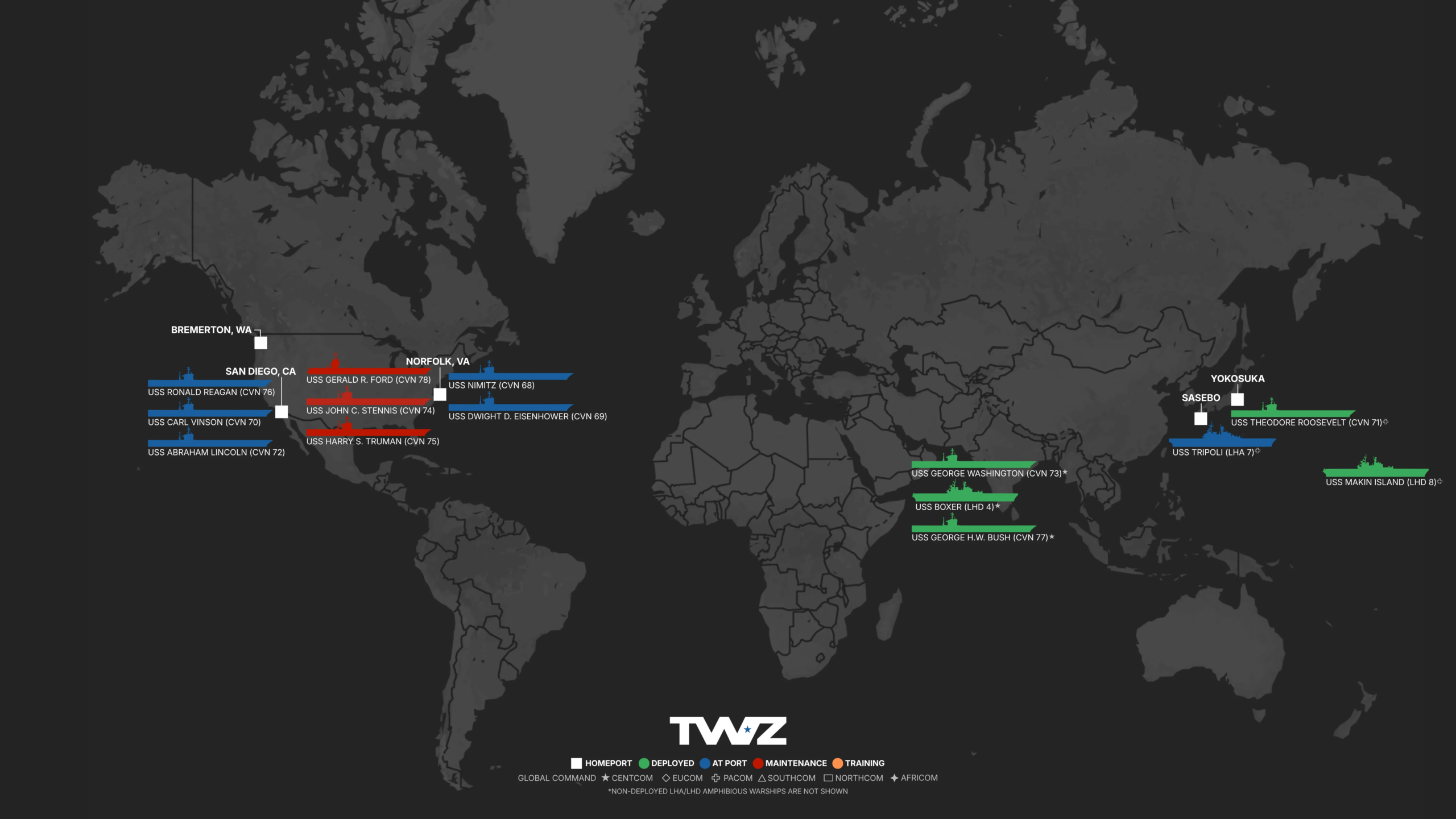
Washington’s political ambitions eventually became evident in October once it forward deployed a naval flotilla at the strike range to Venezuela. Currently, eight US Navy vessels are operating in the Caribbean Sea. The USS Gerald Ford aircraft carrier, with its vast combat aviation wing comprising F-35C Lightning IIs, F/A-18 E/F Super Hornets, and a variety of support fixed- and rotary-wing aircraft, is currently stationed in the US Virgin Islands. Other forward-deployed naval vessels include the MV Ocean Trader command vessel and the USS Iwo Jima amphibious assault ship with over 4,000 marines. These ships are supported by two Ticonderoga-class cruisers, two Arleigh Burke-class destroyers, and the USS Newport News, a Los Angeles-class nuclear attack submarine (SSN), each equipped with Tomahawk cruise missiles. The presence of this naval flotilla suggests that the USN has mustered enough capability to not only launch aerial and cruise missile strikes but also conduct amphibious operations at the Venezuelan coast. In parallel, Venezuelan airspace has been declared ‘closed’ by the Trump administration. Such assertive measures are not meant for anti-narcotic operations but perhaps for regime change either through coercive diplomacy or through direct military action. Whatever the case may be, it’s evident that for the first time in decades, the United States is apparently preparing for a direct military conflict in its own hemisphere.

Understanding how this crisis escalated requires looking back at the recent history of bilateral tensions. The fractures began to appear in US-Venezuela relations from 1999, when Hugo Chávez came to rule on a wave of anti-American populism and nationalized the country’s oil industry. Within three years, mutual relations collapsed so abruptly that first Washington imposed sanctions and then briefly removed Chávez from power through a CIA-backed coup. Chávez regained the rule in a matter of a few days. This move, however, further intensified anti-American sentiments in the Venezuelan public. Chávez made subversion of Washington a political identity; his successor Nicolás Maduro turned it into state doctrine. In 2019, Washington even declared Juan Guaidó, the opposition leader of Venezuela, as the country’s ‘legitimate president.’ Besides the open political signaling of the White House, the CIA also attempted another coup to topple the Maduro regime but again failed to achieve the requisite results.

Maduro successfully exploited continuous intervention by the United States to augment its political narrative at the public level and managed to earn a third consecutive term in 2025. However, the results of elections were regarded as dubious and were generally dismissed as fraudulent, further degrading relations with the West.

For Venezuela, oil has attracted more trouble than prosperity. The country has more than 300 billion barrels of proven oil reserves—more than Saudi Arabia (267 billion barrels)—yet it produces less than 10 percent of its 1990s highest productivity rate. The Venezuelan crude oil is ultra-heavy (8-12° API) and has very high sulfur content. Such dense oil is not only very challenging to refine—both economically and technologically—but also very hard to transfer and cannot be pumped through pipelines without imported diluents. In a nutshell, despite possessing the largest proven oil reserves, Venezuela cannot refine and export its black gold without significant foreign assistance. The current oil infrastructure, developed during the Cold War, is gradually crumbling. Pipelines are either blocked or leaking, and refineries are now operating below 15 percent capacity. Approximately 58 billion USD worth of investment is required to repair and revive the current infrastructure. Being a struggling economy, Venezuela simply does not have the financial capacity to do so. Meanwhile, the majority of technical expertise has been eroded due to brain drain. For example, PDVSA once employed more than 40,000 engineers but now has a total strength of only 12,000 with a large portion of untrained manpower. Currently, while Gulf nations are earning huge revenue from oil exports, Venezuela stands isolated as an oil superpower that cannot even power itself.

The aforementioned factors have imparted grave consequences on the Venezuelan economy. Its national GDP has shrunk from about 300 billion USD to a mere 110 billion USD approximately. More than half of the population is living in poverty, and unemployment has crippled public development. Roughly 28 percent of the total population is in need of humanitarian assistance. These financial woes have compelled common Venezuelan citizens to seek refuge outside the country. Currently, nearly 8 million locals have left the country and are living as refugees in neighboring countries, including Columbia, Peru, Brazil, and even the United States.

To survive internal implosion, Caracas has sought external assistance from Washington’s strategic competitors, including Russia, China, and even Iran. Both Russia and Venezuela are signatories of the 10-year Strategic Partnership Treaty, which was ratified in Oct-Nov 2025 with the overarching objective of combating unilateral coercive measures. Russia has provided military assistance and technical support for the training of troops and maintenance of military equipment, which is predominantly of Soviet origin. China has repeatedly provided diplomatic support and financial loans to support Venezuela’s energy infrastructure. Both Russia and China have vetoed resolutions at the UN Security Council for imposing stringent sanctions against Venezuela. With Iran, Venezuela also shares a strong relation, which was formalized by a 20-year agreement in 2022. Their domains of cooperation include trade, repairing of energy infrastructure, modernization of the defense force, and technology sharing for refinement of crude oil. For the United States, these collaborations are meant to develop a foothold in Latin America by Russia, China, and Iran—something Washington considers intolerable.

When the Trump administration returned in 2025, within weeks, it scrapped Chevron’s license, eliminating Venezuela’s last stable revenue stream. The most significant escalation came on July 25, 2025, when the US Treasury designated Venezuela’s military leadership—the Cartel de los Soles—as a global terrorist organization. No foreign military in American history had ever received such a label. Simultaneously, the reward for the arrest of President Nicolás Maduro has been doubled to 50 million USD by the Trump administration on federal charges of narcoterrorism and conspiracy to import cocaine. And now, with a fully equipped US naval strike force sailing in the Caribbean Sea, the situation is getting increasingly volatile. The Venezuelan military simply does not possess the capability to defend against such a strike force.

If hostilities break out, then instead of placing boots on the ground, the United States is likely to conduct targeted strikes at key assets, impose and sustain a naval blockade, and eventually undermine the Venezuelan military’s and nation’s loyalty to Maduro through coercive diplomacy. The current crisis illustrates that although the Trump administration claims to have taken numerous initiatives to end conflicts and promote trade & collaboration in the Eastern Hemisphere, it will show little to no tolerance for the growing influence of Moscow and Beijing in the Western Hemisphere. Under the Monroe Doctrine, the United States seeks to sustain its control in the Western Hemisphere, including Latin America. For Trump, an example can be crafted out of Venezuela to demonstrate the potential consequences of deepening collaboration with Moscow and Beijing in Washington’s backyard.

Source link

Russia-Ukraine war: List of key events, day 1,387 | Russia-Ukraine war News

These are the key developments from day 1,387 of Russia’s war on Ukraine.

Here’s where things stand on Friday, December 12:

Fighting

  • Russian President Vladimir Putin thanked the Russian army after its forces reportedly took control of the town of Siversk in eastern Ukraine. Ukraine’s military responded, saying it remained in control of the town.
  • News agencies were unable to verify the battlefield claims around Siversk, a longstanding target in Russia’s drive to capture all of Ukraine’s Donetsk region.
  • Moscow’s forces have also taken control of the village of Lyman in Ukraine’s eastern Kharkiv region, Russian state news agencies reported, citing the Ministry of Defence.
  • Russia said Ukraine launched a major aerial attack with at least 287 drones downed over a number of regions inside the country, including Moscow. Russia’s Defence Ministry said at least 40 drones were shot down over the Moscow region, home to more than 22 million people.
  • Ukrainian drones hit two chemical plants in Russia’s Novgorod and Smolensk regions, the commander of Kyiv’s drone forces said. Ukrainian drones also struck Russia’s Filanovsky oil platform in the Caspian Sea for the first time, halting production at the facility owned by Lukoil, according to a Ukraine Security Service official.
  • Russia’s Ministry of Foreign Affairs has called on Britain to disclose what British soldier George Hooley, who was recently killed in Ukraine, was doing in the country.
  • Russia’s Foreign Ministry spokeswoman Maria Zakharova accused London of helping Kyiv carry out “acts of terrorism” on Russia, but provided no evidence for her assertion. Britain’s Ministry of Defence said Hooley died while observing Ukrainian forces test a new defensive capability away from the front line with Russian forces.

Peace deal

  • Ukraine has presented the United States with a revised 20-point framework to end its war with Russia, Ukrainian President Volodymyr Zelenskyy said, adding that the issue of ceding territory to Russia remains a major sticking point in negotiations.
  • Zelenskyy said, as a compromise, the US is offering to create a “free economic zone” in Ukraine-controlled parts of the eastern Donbas, which Russia has demanded Ukraine cede.
  • “They see it as Ukrainian troops withdrawing from the Donetsk region, and the compromise is supposedly that Russian troops will not enter this part of Donetsk region. They do not know who will govern this territory,” Zelenskyy said, adding that Russia is referring to it as a “demilitarised zone”.
  • Zelenskyy also said that Ukrainians should vote on any territorial concessions in a referendum and that he had discussed security guarantees for Ukraine in a video call with top US officials, including Secretary of State Marco Rubio, Secretary of Defense Pete Hegseth and White House special envoy Steve Witkoff.
  • Speaking at a meeting of the “coalition of the willing” – a group of 34 nations led by Britain and France that have pledged support for Ukraine against Russian aggression – Zelenskyy said that holding elections in Ukraine during wartime would require a ceasefire.
  • US President Donald Trump said the US will send a representative to participate in talks in Europe on Ukraine this weekend if there is a good chance of making progress on a ceasefire deal.
  • “We’ll be attending the meeting on Saturday in Europe if we think there’s a good chance. And we don’t want to waste a lot of time if we think it’s negative,” Trump said.
  • Earlier, White House Press Secretary Karoline Leavitt told reporters that Trump had grown weary of multiple meetings that never reached an agreement on ending the war in Ukraine.

Regional security

  • NATO chief Mark Rutte urged allies to step up defence efforts to prevent a war waged in Europe by Russia, which could be “on the scale of war our grandparents and great-grandparents endured”.
  • In a speech in Berlin, Rutte said too many allies of the military alliance did not feel the urgency of Russia’s threat in Europe and that they must rapidly increase defence spending and production to prevent war.

Sanctions

  • Russian and Belarusian youth athletes should compete in international events without access restrictions, the International Olympic Committee said, marking a first step in easing sanctions imposed following Russia’s 2022 invasion of Ukraine.
  • European Union governments have started a process to freeze Russian central bank assets immobilised in Europe for the long term to avoid votes every six months on rolling over the freeze, a move that would pave the way to use the money to provide a loan to Ukraine.
  • Belgium’s Deputy Prime Minister Vincent Van Peteghem said Russian frozen assets will have to be used for Ukraine at some point, adding that Brussels “would not take any reckless compromises” before it agreed to any deal on the issue.
  • Brussels has opposed an unprecedented plan to use Russian funds frozen in the EU – primarily in Belgian banking institutions – to fund a loan to Ukraine, saying it places the country at outsized risk of future legal action from Moscow.
  • Russia’s Foreign Ministry reiterated that the EU’s “manipulations” with Moscow’s frozen assets would not go unanswered.
  • Germany’s top fiscal court has ruled that authorities cannot, for now, sell or use an oil tanker and its cargo seized off the Baltic Sea coast, siding with the vessel’s owners in two separate cases.
  • The Panama-flagged Eventin was found drifting off Germany’s coast in January after departing Russia with about 100,000 metric tonnes of oil worth about 40 million euros ($47m). German authorities suspect the vessel is part of a “shadow fleet” used by Russia to skirt EU sanctions

Economy

  • Russia’s revenues from exports of crude oil and refined products fell again in November, the International Energy Agency said, touching their lowest level since its 2022 invasion of Ukraine.

Source link

Indiana’s state Senate votes down redistricting bill despite Trump pressure | Donald Trump News

The midwestern state of Indiana has dealt a setback to United States President Donald Trump’s redistricting push ahead of the pivotal 2026 midterm elections, voting down legislation to redraw its congressional map.

Late on Thursday afternoon, Indiana’s state Senate voted 31 to 19 to reject the proposed congressional districts, despite a strong Republican majority in the chamber.

Recommended Stories

list of 3 itemsend of list

Of the state Senate’s 50 seats, 39 are held by Republicans, and the state has voted consistently Republican in every presidential race since 1968, save for a single flip for Democrat Barack Obama in 2008.

The vote is likely to reinforce the sentiment that the Republican Party is fracturing under Trump’s leadership, as his poll numbers slump during the first year of his second term.

Trump was confronted with the results of the Indiana vote at an Oval Office signing ceremony shortly after it happened.

“Just a few moments ago, the Senate there rejected the congressional map to redistrict in that state,” one reporter said. “What’s your reaction?”

Trump responded by touting his successes in pushing other Republican-led states.

“ We won every other state. That’s the only state,” the president said, before referencing his three presidential bids. “It’s funny because I won Indiana all three times by a landslide, and I wasn’t working on it very hard.”

Trump then proceeded to denounce the Indiana Senate president, Rodric Bray, and threatened to support a primary challenge against the Indiana leader.

“He’ll probably lose his next primary, whenever that is. I hope he does,” Trump said.

“It’s, I think, in two years, but I’m sure he’ll go down. He’ll go down. I’ll certainly support anybody that wants to go against it.”

Fractures in the caucus

Currently, Indiana sends nine Congress members to the US House of Representatives, one for each of its nine districts. Two of those seats are currently occupied by Democrats.

Republican leaders in the state, however, had proposed a new map of congressional districts that sought to disempower Democratic voters in the state, clearing the way for conservative candidates to claim all nine seats in next year’s midterm races.

The proposed map was part of a nationwide effort by the Trump administration to defend Republican control in the US Congress.

Already, the partisan map had passed the lower chamber of Indiana’s legislature. On December 5, Indiana’s House of Representatives voted 57 to 41 to send the House Bill 1032 to the state Senate.

The bill had the backing of Indiana’s Republican Governor Mike Braun, who encouraged the state senators to emulate their colleagues in the lower chamber.

But even before the bill arrived in the state Senate, there were cracks in the Republican caucus. Twelve Republicans in the state House broke ranks to vote against the map.

And certain Republican state Senators likewise expressed reticence.

Some Republicans, like Indiana state Senator Greg Walker, had a history of opposing redistricting efforts. He was quoted in the Indiana Capital Chronicle as saying, “I cannot, myself, support the bill for which there must be a legal injunction in order for it to be found constitutional.”

Partisan redistricting has long been a controversial practice in US politics, with opponents calling the practice undemocratic and discriminatory.

Critics also pointed out that the Indiana proposal would force some voters in urban centres like Indianapolis to commute more than 200 kilometres for in-person voting.

Walker joined a total of 21 Republican state Senators, including Bray, in voting against the redistricting bill on Thursday.

A nationwide campaign

But the Trump administration had invested significant time and effort into swaying the vote.

In October, Vice President JD Vance travelled to the Hoosier State to try to convince wary Republicans. US House Speaker Mike Johnson reportedly made personal phone calls to state leaders. And a day before the critical state Senate vote, Trump took to social media with a mixture of cajoling and pressure.

“I love the State of Indiana, and have won it, including Primaries, six times, all by MASSIVE Majorities,” Trump began in a winding, 414-word post.

“Importantly, it now has a chance to make a difference in Washington, D.C., in regard to the number of House seats we have that are necessary to hold the Majority against the Radical Left Democrats. Every other State has done Redistricting, willingly, openly, and easily.”

Currently, the US House of Representatives holds a narrow 220-member Republican majority, out of a total of 435 seats.

All of those seats, however, will be up for grabs in the 2026 midterm elections, and Democrats are hoping to flip the chamber to their control.

Starting in June, reports began to emerge that Trump was petitioning the state legislature in the right-wing stronghold of Texas to redistrict, in an effort to help conservative candidates sweep up five extra congressional seats.

Texas Republicans complied, and in August, the state legislature embraced a new redistricted map, overcoming a walkout from state Democrats.

Republicans in other states, including Missouri and North Carolina, have followed suit, passing new maps that seek to increase right-wing gains in the midterm races.

But Democrats have fired back. In November, California voters passed a referendum to suspend their independent districting commission and adopt a Democrat-leaning map created by state lawmakers.

Indiana, however, appeared poised to buck the redistricting trend. In Wednesday’s lengthy post, Trump warned that the state could put Republican power “at risk” if it failed to pass a new map.

He also called Bray and other Republican splinter votes “SUCKERS” for the Democrats.

“Rod Bray and his friends won’t be in Politics for long, and I will do everything within my power to make sure that they will not hurt the Republican Party, and our Country, again,” Trump wrote.

“One of my favorite States, Indiana, will be the only State in the Union to turn the Republican Party down!”

In the wake of Thursday’s defeat, Trump and his allies doubled down on their threats to remove the 21 Republican state senators who voted against the bill from office.

“I am very disappointed that a small group of misguided State Senators have partnered with Democrats to reject this opportunity,” Governor Braun wrote on social media, calling it a decision to “reject the leadership of President Trump”.

“Ultimately, decisions like this carry political consequences. I will be working with the President to challenge these people who do not represent the best interests of Hoosiers.”

Source link

Kilmar Abrego Garcia released from ICE custody

1 of 2 | Kilmar Abrego Garcia pictured in August before his check in at the ICE Field Office in Baltimore Md., Immigration Customs Enforcement officials sought to deport Abrego Garcia to Africa where he has no connection, despite his ongoing protection from removal to El Salvador. He was released Thursday from an ICE detention center after a federal judge’s ruling. File Photo by Shawn Thew/UPI

Dec. 11 (UPI) — Kilmar Abrego Garcia, a wrongfully deported Salvadoran immigrant, was released from Immigration and Customs Enforcement detention Thursday following a federal judge’s order.

Garcia is facing U.S. charges by the Trump administration. His attorneys confirmed that he had been released by Thursday afternoon.

Immigration Customs Enforcement officials sought to deport Abrego Garcia to an African nation where he has no connection, despite his ongoing protection from removal to El Salvador.

U.S. District Judge Paula Xinis said that the Trump administration lacked the legal authority to continue holding Abrego Garcia in an ICE detention facility.

“Because Abrego Garcia has been held in ICE detention to effectuate third-country removal absent a lawful removal order, his requested relief is proper,” according to U.S. District Judge Paula Xinis.

The judge mandated his “immediate” release.

“Separately, respondents’ conduct over the past months belie that his detention has been for the basic purpose of effectuating removal, lending further support that Abrego Garcia should be held no longer,” Xinis added.

The order cleared ICE to release Abrego Garcia, but he still must comply with pretrial conditions in an ongoing human smuggling case.

“This is naked judicial activism by an Obama-appointed judge,” a U.S. Department of Homeland Security spokesperson wrote on social media.

DHS claimed the order “lacks any valid legal basis and we will continue to fight this tooth and nail in the courts.”

Abrego Garcia is a Salvadoran national who illegally entered the U.S. almost 15 years ago and drew nationwide attention after his wrongful March deportation to El Salvador’s notorious megaprison despite a protective order.

He has accused the White House of vindictive prosecution.

It ignited controversy amid U.S. President Donald Trump‘s hardline immigration enforcement push.

The administration labeled him an MS-13 gang member, which he has denied.

“The history of Abrego Garcia’s case is as well known as it is extraordinary,” said Xinis.

With a standing order that prevents deportation to El Salvador, Trump administration officials pivoted to proposing an African destination.

“This evidently remained an inconvenient truth for respondents,” Xinis wrote.

“But more to the point, respondents’ persistent refusal to acknowledge Costa Rica as a viable removal option, their threats to send Abrego Garcia to African countries that never agreed to take him, and their misrepresentation to the court that Liberia is now the only country available to Abrego Garcia, all reflect that whatever purpose was behind his detention, it was not for the ‘basic purpose’ of timely third-country removal,” the judge wrote.

President Donald Trump makes remarks during a roundtable meeting with high-tech business executives in the Roosevelt Room of the White House on Wednesday. The president announced that the United States has seized an oil tanker near Venezuela and a revealed a new special corporate immigration gold card focused on keeping students in the United States. Photo by Aaron Schwartz/UPI | License Photo

Source link

Judge rules Trump unlawfully ended FEMA disaster prevention programme | Donald Trump News

Twenty states had challenged the end of the programme, meant to make localities more resilient to natural disasters.

A federal judge has said the administration of United States President Donald Trump acted unlawfully in ending a programme aimed at helping communities become more resilient to natural disasters.

The Trump administration had targeted the Building Resilient Infrastructure and Communities (BRIC) programme as part of a wider effort to overhaul the Federal Emergency Management Agency (FEMA).

Recommended Stories

list of 3 itemsend of list

But on Thursday, US District Judge Richard Stearns ruled that the administration lacked the authority to end the grant programme. The decision came in response to a lawsuit filed by 20 states, the majority led by Democrats.

Stearns said the administration’s action amounted to an “unlawful executive encroachment on the prerogative of Congress to appropriate funds for a specific and compelling purpose”.

“The BRIC program is designed to protect against natural disasters and save lives,” Stearns wrote, adding that the “imminence of disasters is not deterred by bureaucratic obstruction”.

Stearns had previously blocked FEMA from diverting more than $4bn allocated to BRIC to other purposes.

Massachusetts Attorney General Andrea Joy Campbell was among the plaintiffs praising the decision.

“Today’s court order will undoubtedly save lives by preventing the federal government from terminating funding that helps communities prepare for and mitigate the impacts of natural disasters,” she said in a statement.

BRIC is the largest resiliency programme offered by FEMA, designed to reduce disaster-related risks and bolster efforts to recover quickly.

The programme is emblematic of efforts under FEMA to take preventive measures to prepare for natural disasters, as climate change fuels more extreme weather across the country.

According to the lawsuit, FEMA approved about $4.5bn in grants for nearly 2,000 projects, primarily in coastal states, over the last four years.

Upon taking office for his second term, Trump initially pledged to do away with FEMA, with the agency sitting at the crossroads of the president’s climate change denialism and his pledge to end federal waste.

Trump has since softened on his position amid pushback from both Republican and Democratic state lawmakers. He has said he plans to reform the agency instead.

In November, acting FEMA head David Richardson stepped down from his post. That came amid internal pushback over Richardson’s lack of experience and cuts to the agency.

In a letter in August, nearly 200 FEMA staffers warned the cuts risked compounding future disasters to a devastating degree.

Upon taking on the role in May, Richardson threatened he would “run right over” anyone who resisted changes to the agency.

Source link

Powerball prize climbs to $2 billion after 40 winnerless drawings

Dec. 11 (UPI) — The Powerball jackpot has jumped to $1 billion after no one stepped forward with the winning ticket in Wednesday night’s drawing.

It’s the second time the prize has climbed to a billion dollars this year, and the seventh biggest prize in the history of the game, Powerball said.

Powerball said the jackpot is worth an estimated $461.3 million in cash value. Winners have a choice between annual payments worth an estimated $1 billion, or receiving a lump sum cash prize.

The largest ever prize in the game’s history, $2.04 billion, was claimed on Nov. 7, 2002.

Since two tickets in Missouri and Texas split the $1.787 billion dollar prize on Sept. 6, there have been 40 consecutive drawings with no winner.

The next Powerball drawing is scheduled for Saturday.

The odds of winning are one in 292. 2 million, according to Powerball. Tickets are $2 each.

Source link

Could an end to the Ukraine war be near? | Russia-Ukraine war

Diplomatic efforts intensify with Trump impatient for a deal.

European leaders have sent new peace proposals for the war in Ukraine to US President Donald Trump.

Loss of territory to Russia and use of frozen Russian assets in Ukraine remain areas of disagreement.

But could the war be nearing an end?

Presenter: Folly Bah Thibault

Guests:

Peter Zalmayev – Director of Eurasia Democracy Initiative

Chris Weafer – CEO of Macro-Advisory, a strategic consultancy focused on Russia and Eurasia

Steven Erlanger – Chief diplomatic correspondent for Europe at The New York Times

Source link

Baby dies of exposure in flooded tent as Storm Byron batters Gaza | Weather News

Displaced Palestinians in dire need of tents, blankets, warm clothing in harsh winter climate.

A baby girl whose family was displaced by Israel’s genocidal war against the Palestinian people in Gaza has died of exposure to the winter cold as Storm Byron lashed the enclave amid Israel’s continued restrictions on essential winter supplies.

Eight-month-old Rahaf Abu Jazar was reported dead on Thursday after her family’s tent in Khan Younis took in water as heavy rainfall flooded tent camps across the enclave overnight, according to the Reuters news agency.

Recommended Stories

list of 3 itemsend of list

Her mother, Hejar Abu Jazar, fed the baby before they went to sleep. “When we woke up, we found the rain over her and the wind on her, and the girl died of cold suddenly,” she told Reuters.

With hundreds of thousands of Palestinian families now sheltering in flimsy tents, Gaza’s civil defence agency struggled to cope, receiving more than 2,500 phone calls over a 24-hour period.

The agency reported that three buildings collapsed in Gaza City due to the storm.

Meanwhile, tents and other winter supplies remain blocked at the border as Israel continues to restrict the flow of aid into the enclave.

The Norwegian Refugee Council (NRC) said only 15,600 tents had been brought into Gaza since the ceasefire came into effect in October.

Those tents have gone to help approximately 88,000 Palestinians, according to NRC. This is in a territory where 1.29 million people are in need of shelter.

Israeli rights group B’Tselem said more than 6,500 trucks are currently waiting to be allowed by Israel into Gaza with essential winter supplies, including tents, blankets, warm clothing and hygiene materials.

Jonathan Crickx, chief of communication at UNICEF Palestine, said the scale of the disaster was “huge”, warning of a looming health disaster as children wandered the camps barefoot.

“What we’re scared of is that there is very poor hygiene, and all that pouring rain could enable the appearance of waterborne diseases like acute diarrhoea,” he said.

Reporting from Gaza City, Al Jazeera’s Hani Mahmoud said many families were leaving the seaport area as the winds picked up on Thursday. “They’re trying to get deeper inside Gaza City, to shelter in any of the remaining intact buildings – at least for the night,” he said.

As twilight descended, Mahmoud said many families faced a difficult night ahead. “Along with every other struggle that people have been going through for the past two years, there’s another battle now with the forces of nature,” he said.

Farhan Haq, spokesperson for United Nations chief Antonio Guterres, warned that more children could die of hypothermia. “That’s why we need to make sure that we can get warm clothing, tents and tarps and shelters [into Gaza],” he said.

The UN’s humanitarian office processed more than 160 flooding alerts since Thursday morning as Storm Byron barrelled through the enclave, said Haq.


Source link

Super flu’ wave hits hospitals in England with no peak yet

Nick TriggleHealth correspondent

Getty Images A&E departmentGetty Images

The number of patients in hospital in England with influenza has risen by more than 50% in the past week, with NHS bosses warning there is no sign of “super flu” peaking yet.

In the week up to Sunday there were 2,660 flu cases a day on average in hospital – and NHS England said the numbers had continued rising this week.

NHS England said it was the equivalent of having three hospitals full of flu patients, with some reporting nearly one in 10 beds occupied by patients with the virus.

Officials said the numbers had continued rising this week with fears it may top 5,000 by the weekend.

Increases are also being reported across the UK.

In Scotland, the number of confirmed cases rose by nearly a quarter in the last week, while the number of people admitted to hospital for flu went up 15%.

The picture was similar in Wales and Northern Ireland, with children and young people particularly affected, according to health officials there.

Some schools have had to bring back Covid-like measures to prevent the spread of the virus. One site in Caerphilly had to close temporarily while some schools in Aberdeenshire reduced their hours.

Children and young people aged five to 14 also had the highest positivity rates for flu in England.

But in terms of who is most affected or sickest, hospital admission rates for flu in England are highest among people over 75 and children under five.

Writing in the Times, Health Secretary Wes Streeting said: “This winter, our NHS faces a challenge unlike any it has seen since the pandemic.”

He said the number of people admitted to hospital with flu “could triple by the peak of the pressures – and the NHS doesn’t know when the peak will hit”.

NHS England medical director Prof Meghana Pandit said: “This unprecedented wave of super flu is leaving the NHS facing a worst-case scenario for this time of year – with staff being pushed to the limit to keep providing the best possible care for patients.”

The numbers in hospital with flu is at its highest level at this time of year since records began – although they only date back to 2021 and so do not capture the two worst flu seasons of the past 15 years which were seen in 2014-15 and 2017-18.

Chart showing flu rates in hospital

Flu rates began rising a month earlier than normal this year driven by a mutated strain of the virus. The dominant strain is H3N2, but it has some genetic changes this year.

It means the general public has not encountered this exact version of flu before, which means there is maybe less immunity.

NHS England said the number of patients in hospital with the vomiting bug norovirus was also on the rise, with more than 350 beds occupied by people with that virus.

Chart showing hospitals with most flu cases

It comes ahead of a strike by resident doctors, the new name for junior doctors, which is due to start next week.

There are hopes it may be called off after a fresh offer from Health Secretary Wes Streeting prompted the British Medical Association to agree to poll their members to see if they were willing to call off the five-day walkout that is due to begin on Wednesday. The results of that poll will be be announced on Monday.

Prime Minister Sir Keir Starmer accused the BMA of being “irresponsible” and said it should accept the offer on the table, adding the offer can only go forward if they stop strike action “particularly in the run-up to Christmas, particularly when we’ve got a problem with flu.”

Daniel Elkeles, of NHS Providers, which represents hospitals, said: “The NHS is in the thick of a storm come early. Flu is hitting hard and other winter bugs are surging.

“Now more than ever, the NHS needs all hands on deck.

“We have to hope that BMA resident doctors will step back from next week’s strike, take up the government’s sensible offer and end their damaging dispute.”

Data from the UK Health Security Agency (UKHSA), which takes into account levels of infection in the community as well as hospitals, shows infection rates are continuing to rise, but not as sharply as they were in the previous week.

But officials stressed it was too early to take that as a sign that flu could be peaking.

They said the virus was unpredictable and a lull could be followed by another surge.

Dr Conall Watson, an infectious diseases expert at the UKHSA, urged people who are eligible for a free flu vaccine on the NHS, which includes the over 65s, those with certain health conditions and pregnant women, to still come forward if they had not yet got one.

“There is still plenty of flu vaccine available to protect those who need it – what’s running out is time to be protected ahead of Christmas.

“If you are eligible this is the last chance to get protected as we head into Christmas – so make an appointment with the NHS today.”

It can take up to two weeks following vaccination to develop the fullest protection from the jab, Dr Watson added.

Dr Vicky Price, president of the Society for Acute Medicine, said winter viruses were placing further strain on an “already buckling system”.

She said patients were facing long waits in A&E as hospital staff were being overloaded with patients.

But she accused NHS England and the government of using it as a “convenient scapegoat” for the “predictable breakdown” in NHS capacity caused by workforce shortages.

“The situation in emergency departments has become so dire that what was once considered a critical incident is now seen as normal and routine. What is happening is not an isolated emergency, but the culmination of systemic failure.”

Source link

Trump diehard supporter Mike Lindell announces run for Minnesota governor

Dec. 11 (UPI) — Mike Lindell, creator of the MyPillow and a noted conspiracy theorist, has announced he is running for governor of Minnesota.

Lindell is a longtime friend and supporter of President Donald Trump and is known for saying that voting machines in the United States are rigged and can flip elections.

Though he’s lost lawsuits for his election denials, he is still saying that the 2020 election was stolen.

He enters a crowded field of Republicans vying for Gov. Tim Walz’s office, including speaker of the Minnesota House of Representatives Lisa Demuth, former state senator and 2022 Republican nominee for governor Scott Jensen, lawyer Chris Madel and state Rep. Kristin Robbins.

Walz’s campaign is already attacking Lindell for his ties to Trump, labeling him “the far-right CEO, election denier, and Donald Trump’s top ally in Minnesota.”

“Mike Lindell is selling conspiracies, MAGA extremism, and pillows. He has no business holding the highest office in our state,” Walz’s campaign said in a fundraising email last week.

Lindell announced his campaign on Thursday, with an eight-minute video filmed on the factory floor of his MyPillow company. He claimed that the President Joe Biden administration “targeted my banks, they targeted my suppliers, they even took my phone.”

He said he wants to stop the “rampant fraud” in Walz’s administration, stop rising property taxes and “the crime that threatens you and your family.” He also wants to change the state’s voting system so that voters submit paper ballots that are then hand-counted.

The fraud Lindell references comes from an investigation of dozens of people who allegedly stole from the state’s program to feed children during the COVID-19 pandemic. Several Somali immigrants allegedly created small companies that billed state agencies for millions in social services that never went to the intended people. Walz has said that anyone who stole from the government will be prosecuted.

Trump has responded by ending deportation protections for all Minnesota Somalis.

Lindell told the Minneapolis Star Tribune that he told Trump he was thinking of running for governor back in August, but he wouldn’t say what Trump’s response was.

But Trump didn’t back him in his bid for chair of the Republican National Committee in 2023. He only got four votes in that election.

Trump’s former personal lawyer Rudy Giuliani now works for Lindell on his media network, LindellTV, and he’s been giving Lindell political advice.

“He’s been part of many campaigns,” Lindell told the Star Tribune. “He knows what he’s doing.”

LindellTV now has credentials to cover the White House and the Pentagon, The New York Times reported.

Lindell calls his story “the American Dream on steroids,” touting his rise from crack cocaine addiction to successful business owner. He considers himself the frontrunner in the field of candidates and said, “I believe I will stand on my own merit,” Lindell said.

President Donald Trump stands with Saudi Arabia’s Crown Prince Mohammed bin Salman during a black tie dinner at the White House in Washington, on November 18, 2025. Photo by Anna Rose Layden/UPI | License Photo

Source link