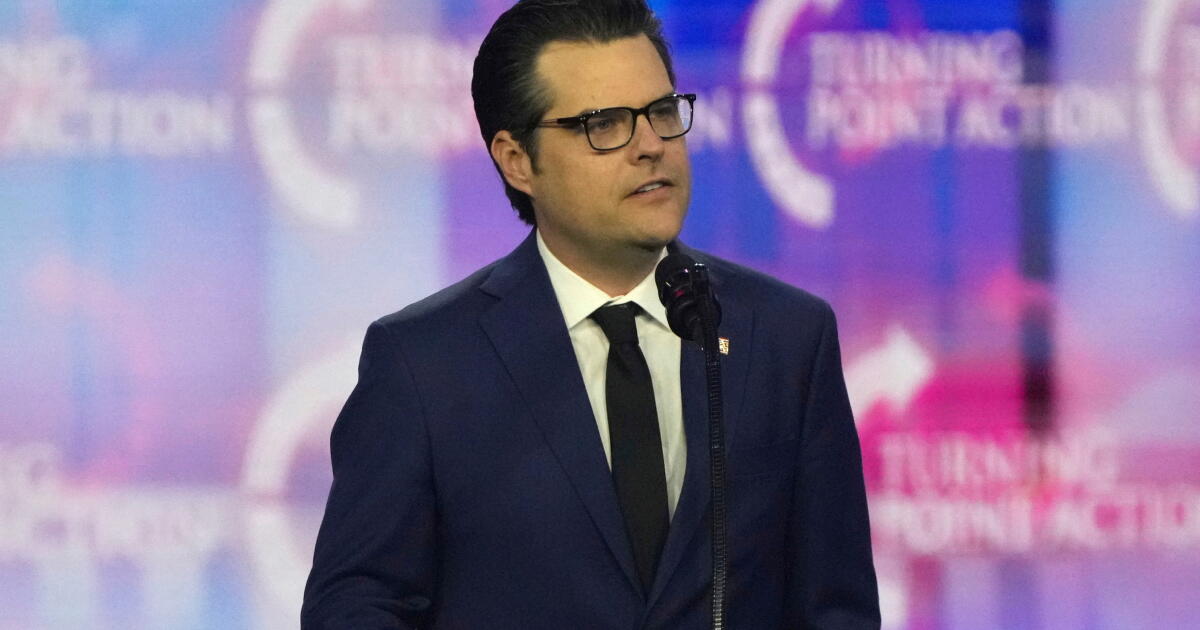
Two women filed a lawsuit Thursday against former U.S. Rep. Matt Gaetz, saying they were sexually exploited by him and other men in violation of a federal anti-trafficking law.
The lawsuit, filed in federal court in Orlando, Fla., comes nearly two years after the House Ethics Committee said the Florida Republican had regularly paid for sex, including once with a 17-year-old girl, purchased and used illicit drugs, and violated state laws while a member of Congress.
Gaetz had left office when the report was released and denied wrongdoing. But the report helped to tank his nomination to become attorney general in President Trump’s second administration.
Two women said they were in their early 20s in 2017 when they met Gaetz through Joel Greenberg, who was a tax official in Seminole County and is now in prison for a raft of crimes, including a sex crime.
Gaetz provided drugs and paid the women for sex, out-of-state travel, lodging and other expenses, according to the lawsuit.
“Much of the conduct alleged against me is false,” Gaetz said in response.
“The lawsuit relies almost exclusively on a Congressional Committee report that didn’t allow me to confront my accusers. Now I will finally have that chance,” he said in a statement.
Gaetz also appeared to mock the women on the social platform X, sharing a 2018 social media photo of the backs of three women in bathing suits looking at the ocean in the Bahamas.
“I’m shocked nobody responded to their repeated cries for help, posted to instagram,” he said Thursday.
The lawsuit also names Greenberg, another man and businesses tied to Greenberg’s family.
“Every part of this venture ran on an exploitative power imbalance,” the women’s attorney, Spencer Kuvin, said in the lawsuit. “On one side stood a sitting congressman, an elected tax collector, and a former state legislator, men with public office, private homes, and money to spend. On the other stood young financially vulnerable women in their early twenties.”
Gaetz hosts a political talk show on One America News Network. He was recently appointed to the board of Triumph Gulf Coast, which oversees how Florida spends money recovered for damage from the 2010 Deepwater Horizon oil spill.
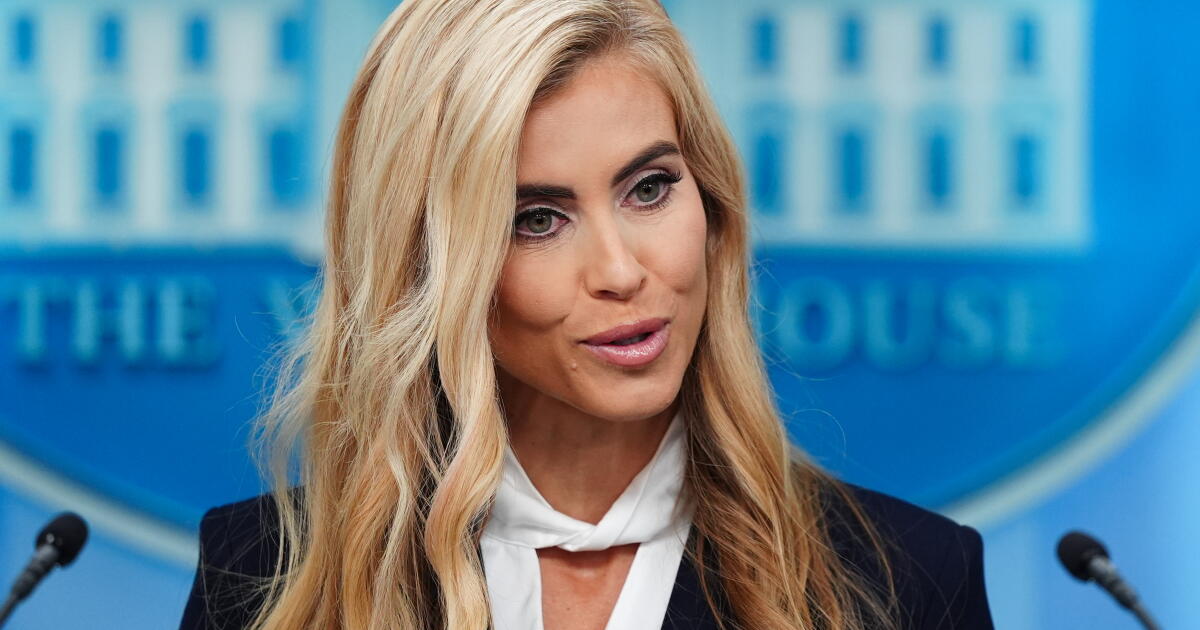
WASHINGTON — New White House press secretary Katie Zacharia defended her legal background and justified her truncated inaugural briefing as she navigates a rocky first week as the president’s chief spokeswoman.
Zacharia sat down for an interview Thursday with the conservative Human Events outlet. In it, she said she did not have time to get fully prepared ahead of her first briefing on Tuesday and that it was always the plan to keep it short because President Trump would field questions from journalists later that morning.
“It was absolutely my goal to keep it short, considering he is his own best spokesperson, and he would love — and does love — gaggling with the media as he goes to Marine One,” Zacharia said. “So I wanted to give ample deference and not barge into his time.”
The initial briefing materials were given to Zacharia on Monday evening, then completed on Tuesday at 8 a.m., less than two hours before she would appear before the White House press corps. She had been up since 3 a.m. preparing, Zacharia said.
“I never had a full briefing beforehand, and I went out and I effectuated the briefing,” she said.
As for her legal background, Zacharia said she was preparing to take the bar exam in California at a time that she had just gotten married and was readying a move to China to join her new husband, who had been working in private equity in Beijing.
“I was obviously incredibly distracted and overwhelmed and excited for finally being married to someone who I’d been long distance from for at least a year,” Zacharia said.
She said the results of the bar exam, which she did not pass, were “somewhat inconsequential” because she would not need to be a barred attorney while living in China.
Zacharia, who has been under scrutiny for calling herself a “lawyer,” said she consulted several legal experts to ensure that title was accurate when offering legal analysis.
“It’s unfortunate that people dub this as some kind of conspiracy or want to put me in a camp. The truth is, I was very careful how I executed this, and I never came across as someone who was an attorney-at-law.”
She will not weigh in on legal matters in her White House capacity, Zacharia said.
She also divulged details of how she went about securing the White House press secretary job. Zacharia stressed that she did not want to be seen as lobbying for the position, left vacant when Karoline Leavitt announced she would depart the administration to spend more time with her family.
Zacharia, who was a communications advisor for the company that runs Truth Social, said she closely monitored the president’s social media posts to determine what was top of mind for him, then would go on air to talk about those topics.
“My philosophy is, I’m on TV enough where if he sees me and he likes me, then I will be recruited for the job. I do not believe that lobbying for that job would have been successful, and I wanted to work for it. I wanted to audition for it.”
Then on Oct. 7, as Zacharia was preparing to take one of her children to a pumpkin patch, she received a phone call from Trump about the press secretary position.
She promptly flew out the next day from her home in California to Washington, met with the president about the job on Friday and formally accepted the position later that day.
The Trump administration on Thursday sued California over its handling of voter fraud claims, asking a federal court to immediately bar the state from counting ballots from about 20,000 voters statewide — many in Los Angeles County — whom the administration alleges are “likely noncitizens.”
The lawsuit is highly unusual, particularly given that California voters have already begun voting in the Nov. 3 midterms via mail ballots, experts said.
It’s also highly inappropriate and based on questionable federal data that have proved wildly inaccurate in other states, state officials said.
“This is a sad, desperate attempt by Trump to use his politicized Justice Department to try to suppress California voters just three weeks before Election Day,” Gov. Gavin Newsom wrote on X. “Courts have made clear the federal government has no role in running state elections. We will defend free and fair elections in the Golden State and call out every authoritarian attempt to undermine our democracy.”
U.S. Atty. Gen. Todd Blanche, in his own statement, defended the lawsuit.
“State-facilitated voter fraud is unacceptable in the United States of America,” he said. “If found responsible in a court of law, the State of California will have seriously undermined confidence in our electoral system and violated laws that protect our nation’s representative system of government.”
The lawsuit states that “as part of an investigation into unlawful voting,” U.S. Citizenship and Immigration Services conducted a “multiagency and multilevel review” of state voter and federal citizenship data and determined with “high confidence” that around 20,000 “likely noncitizens” are registered to vote in the state.
It then forwarded those names to Homeland Security Investigations, which conducted its own investigation and concluded the same, the lawsuit says.
“This means that, consistent with state law, nearly 20,000 noncitizens in California have been sent a vote-by-mail ballot to participate in the federal election (or will receive one), with many addresses listed in Los Angeles County,” the lawsuit alleges.
The lawsuit comes two days after Acting Deputy Atty. Gen. Trent McCotter wrote to California Secretary of State Shirley Weber and Dean Logan, head of the L.A. County Registrar-Recorder/County Clerk’s office, giving them 48 hours to set aside the same ballots in order to investigate those voters’ citizenship status.
McCotter had said the Trump administration would be forced to file for emergency relief in the courts if Weber and Logan did not comply.
The lawsuit comes about three months after Homeland Security Secretary Markwayne Mullin wrote his own letter to Weber, alleging that there may be more than 190,000 noncitizens registered to vote in California.
The lawsuit makes no mention of that prior estimate, or why Homeland Security’s initial estimate was so much larger than its current estimate. It does say that USCIS identifying with “high confidence” that a voter is a likely noncitizen “means that the match between voter information on the voting roll and USCIS’ internal records is strong and consistent based on multiple identifiers that support a strong identity link.”
It also said, “The Federal Government notified California months ago that numerous noncitizens may be registered to vote in California. Despite knowing that California must send vote-by-mail ballots to every registered voter, the State made no serious attempt to work with the Federal Government to determine whether noncitizens are registered to vote.”
The Department of Homeland Security did not immediately respond to a request for more information as to how the 190,000 figure dropped to 20,000.
In a letter back to McCotter, Weber noted both figures and accused the Trump administration of pushing forward to disenfranchise voters at the last minute before the midterms based on shoddy data work and no certainty that those voters are ineligible.
“Nowhere has the federal government clarified the basis for suspecting — not even confirming with any level of certainty — the listed individuals are non-citizens. And as one court recently noted, the federal government’s citizenship records are ‘known to be unreliable,’” Weber wrote, referring to a case brought against the Justice Department by the organization Common Cause. “To give just one example, in a similar incident in the State of Nevada, DHS initially alleged that Nevada’s voter roll included nearly 16,000 potential non-citizens. However, after working with the State of Nevada, DHS officials failed to establish that a single non-citizen was on the voter rolls.”
Weber called it “remarkable” that the Justice Department would demand that her office “review and confirm the citizenship status of each of the approximately 20,000 individuals on the list on the eve of an election and within a mere 48 hours” despite providing no clear evidence that those individuals are wrongly registered.
“This is an emergency of the DOJ’s creation,” Weber wrote. “California’s election administration will continue to be governed by applicable federal and state law, not by unsubstantiated claims and outrageous demands.”
First Assistant U.S. Atty. Bill Essayli, the lead federal prosecutor in Los Angeles, posted about the lawsuit on X, noting the 48-window given to Weber and Logan had lapsed and writing, “Time is up for California.”
“This is not political or controversial,” he wrote. “We will not allow California to dilute the votes of American citizens.”
The Trump administration’s lawsuit says that while the U.S. “actively investigates and prosecutes incidents of unlawful voting,” it “is not practicable or feasible for the United States to investigate before the 2026 election concludes thousands, let alone tens of thousands, of individuals that two federal investigative offices identified on the California voter roster as likely being sent vote-by-mail ballots.”
Because of that, it argues, “California is thus knowingly imposing an obstacle on the United States’ ability to enforce [federal election law] by facilitating unlawful voting rather than working with the Federal Government to prevent it,” and the state is therefore legally barred from sending mail ballots to the 20,000 voters Homeland Security has flagged.
It asks the federal court in the Central District of California to declare the state’s actions — including providing and counting ballots for those 20,000 people — to be barred by law and in violation of the Supremacy Clause, and to issue an injunction barring the state from counting those ballots in federal elections “until those individuals’ citizenship status can be verified.”
The Trump administration’s attempts to use immigration data to reach conclusions about California voter rolls and intervene in California’s election is already being challenged in a separate federal case in the district of Washington, D.C., brought by attorneys with the UCLA Voting Rights Project on behalf of the Coalition for Humane Immigrant Rights, or CHIRLA, and a California voter named Pedro Trujillo.
The UCLA attorneys filed their own emergency petition Thursday to preclude the Justice Department from moving forward with such actions against California, citing the letters McCotter sent to Weber and Logan.
A judge in that case ordered the parties to meet and file a status report with the court by Friday as to when each side would be able to brief the court on the issue.
Times staff writer Brittny Mejia contributed to this report.
WASHINGTON — FBI employees fired for their roles in the investigation of President Trump’s retention of classified documents at his Florida estate sued on Thursday to get their jobs back, calling their terminations unlawful acts of “political retribution.”
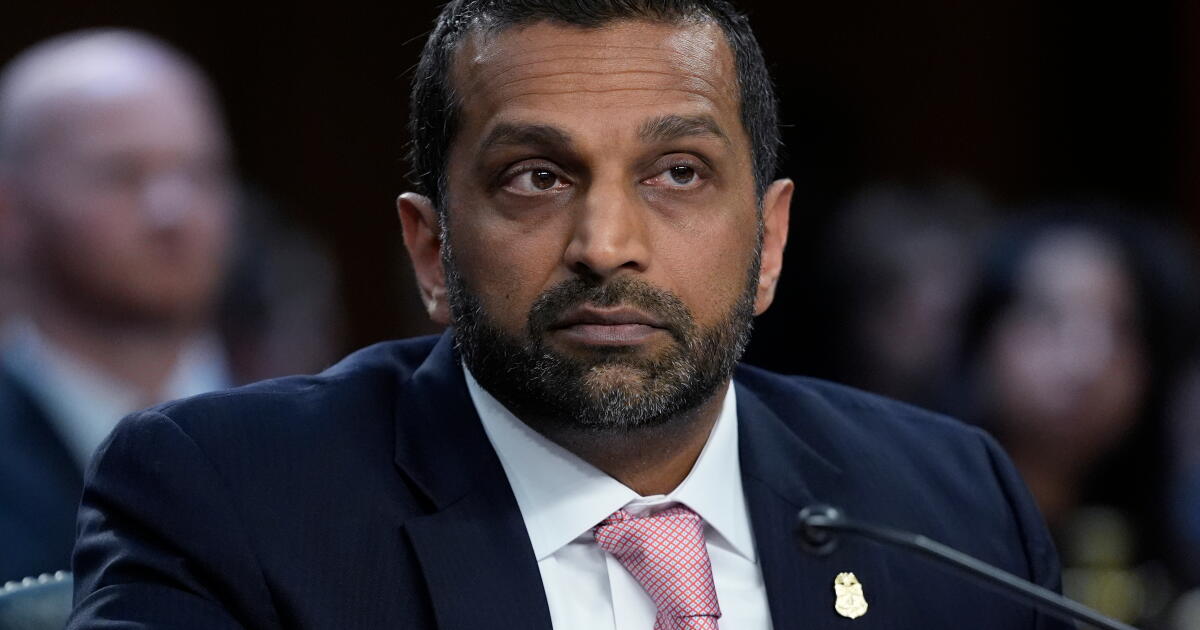
The complaint adds to the growing list of legal challenges to the mass terminations under FBI Director Kash Patel of agents who participated in investigations of the Republican president or are seen as opposed to Trump administration interests.
The suit was filed in federal court in Washington on behalf of nine agents, intelligence analysts and staff operations specialists who were fired in February after dismissals of agents who had worked on the investigation into Trump’s efforts to overturn his 2020 presidential election loss to Democrat Joe Biden.
Patel has said in congressional testimony that employees he has fired had “weaponized” the FBI. But the agents deny that claim in the lawsuit, noting that between them they had more than a century of distinguished and apolitical FBI service that involved responding to the Boston Marathon bombing, hostage recoveries and the investigation into the 2024 assassination attempt of Trump in Butler, Pa.
Their firings, the lawsuit says, create an “immeasurable loss” to “America’s national security.”
“In return for their service, they were fired because they did their jobs, as they always did to follow the facts and law without bias or favor. To this administration, this is an offense. To the rest of us, it is heroic,” said a statement from their attorneys, Margaret Donovan, Abbe Lowell and Rebecca Tinio.
“This lawsuit will prove their unlawful dismissal and hold the administration accountable for this blatant attack on the rule of law,” the statement added.
The Mar-a-Lago investigation produced criminal charges against Trump
The suit lays out a detailed recitation of the allegations against Trump, describing how he improperly stored dozens of classified documents at his Mar-a-Lago estate in Palm Beach, Fla., that he took with him after leaving the White House, showed them off to people not authorized to see them and obstructed FBI efforts to get them back.
The investigation resulted in a dramatic 2022 FBI search of Mar-a-Lago that recovered classified records and later produced an indictment in federal court in Florida charging Trump with dozens of felony counts.
Trump denied wrongdoing, and the case was dismissed in 2024 by a Trump-appointed judge, Aileen Cannon, who ruled that the special counsel who filed the charges, Jack Smith, had been illegally appointed by the Biden administration Justice Department.
The nine fired FBI employees did not volunteer for the investigation but were rather assigned to it as part of their work on specialized counterintelligence and counterespionage squads, according to the lawsuit, which says they were nonetheless terminated because of baseless perceptions that the performance of their law enforcement duties had run “afoul of the political and personal loyalty to Trump that Defendants demanded.”
“By casting Plaintiffs’ work on the Plasmic Echo investigation as ‘politically weaponized,’ Defendants incorrectly presumed to know the personal political convictions of Plaintiffs and took unlawful action based on that presumption,” the lawsuit says, using the FBI code name for the classified documents investigation. “Worse still, Defendants incorrectly concluded that those personal political convictions affected or drove their work.”
The lawsuit seeks, among other remedies, reinstatement to the FBI, an awarding of back pay and a court order declaring that the firings were unlawful.
The suit says the firings were the culmination of a retribution campaign
Lawyers for the fired employees suggest their clients’ “fate was sealed” well before the February terminations, casting the ousters as the culmination of a long-running retribution campaign that kicked into gear once Trump returned to the White House in 2025.
The lawsuit notes how Patel, in his capacity as a conservative podcaster before becoming Trump’s FBI director, had derided the FBI’s Mar-a-Lago search as “unlawful” and had accused the agents who had participated in it as being “corrupt government gangsters.”
Days after Trump was inaugurated, a top Justice Department official demanded that the FBI turn over a list of bureau employees who had participated in Trump-related investigations, an order that the then-director, Brian Driscoll, resisted and that was seen within the workforce as a potential prelude to mass firings.
Over the following year, the FBI and the Justice Department fired waves of employees involved in investigations of Trump, without hearings or proper notice that the plaintiffs’ lawyers say are required by law.
The lawsuit says that the Mar-a-Lago agents and analysts were fired in February after Patel disclosed to Reuters that the FBI, as part of the investigation, had subpoenaed his toll records, which show the date, time and length of a phone call but not the content of the communications.
“The Plaintiffs were unlawfully terminated not for any cause or any legitimate reason, but only to satisfy the President’s personal vendetta,” the lawsuit states. “The firings did not follow any internal investigation or disciplinary process within the FBI, and Plaintiffs were not given any notice, a hearing, or an opportunity to appeal.”
NEW YORK — Lawyers for the BBC say President Trump is trying to delay sitting for a deposition in the defamation case he brought against the British broadcaster until January 2027.
In a filing this week, they asked a Florida court to compel the president to appear in the $10 billion case after they say he canceled an agreed-upon date this week, citing “matters of national importance.”
“Two months of discovery remaining, the BBC still has not been able to depose, and does not even have a schedule to depose, the most central figure in this case: Plaintiff himself,” attorney Charles D. Tobin wrote in the filing. “Those delays have flouted the cooperative spirit of discovery and precluded the BBC from obtaining the evidence necessary to robustly litigate its defense.”
Trump, who has a history of avoiding depositions, filed the lawsuit against the BBC last December, seeking $10 billion in damages as he accused the British broadcaster of defamation as well as deceptive and unfair trade practices related to a documentary, “Trump: A Second Chance.”
Britain’s publicly funded national broadcaster admitted filmmakers spliced together quotes from different sections of the speech Trump delivered to his supporters on Jan. 6, 2021, before the storming of the U.S. Capitol, to make it seem like he was directly urging violence.
The 33-page lawsuit accused the BBC of broadcasting a “false, defamatory, deceptive, disparaging, inflammatory, and malicious depiction of President Trump,” calling it “a brazen attempt to interfere in and influence” the 2024 U.S. presidential election.
The broadcaster apologized to Trump over the edit and the head of the BBC and the British broadcaster’s top news executive both resigned. But the broadcaster has denied Trump’s claims that it defamed him.
In the filing this week, BBC lawyers said that they first requested dates for the deposition in July, and followed up repeatedly. Both sides, they said, eventually agreed on Oct. 16.
However, after weeks of silence, they wrote, “Plaintiff’s counsel responded on September 28, 2026, indicating that ‘the President is no longer available for his deposition on October 16 due to other matters of national importance’ and that counsel would ‘endeavor to provide you with a replacement date by the end of this week.’ He did not.”
Instead, they said, they were told last week that Trump “has no availability whatsoever for a deposition” before discovery is set to close on Dec. 18. and were told that Trump would instead make himself available the second or third week of January.
In a statement in response to the filing, a spokesperson for Trump’s legal team did not address the reasons for Trump’s delay, but repeated its allegations against the BBC and said the president was holding the broadcaster “accountable for its defamation and reckless election interference just as he has held other fake news mainstream media responsible for their wrongdoing.”
Trump voluntarily dropped a $500 million lawsuit he filed against his former lawyer and fixer Michael Cohen in 2023, days before he was set to give a deposition in that suit.
California sued the Trump administration for the 100th time in under two years Thursday, challenging the practice of U.S. Immigration and Customs Enforcement agents arresting people for civil immigration violations at or near state courthouses.
California Atty. Gen. Rob Bonta said such arrests have long been barred because they are unconstitutional and deeply disruptive to the rule of law and the rights of victims, witnesses, defendants and other parties to court proceedings.
“We’ve seen serious criminal charges dropped and entire cases jeopardized because victims and witnesses are too scared to come to the courthouse to testify,” Bonta said. “Our justice system cannot function this way.”
Bonta said his office having to take the Trump administration to court 100 times in less than two years, often alongside other Democrat-led states, was a “sobering milestone” and a reflection not of political interference on California’s part — as the president and his supporters have cast it — but of Trump’s nearly unbridled lawlessness.
“It’s very troubling when the most powerful person on the planet and the president of our country is the one trampling over the Constitution, breaking the law so blatantly and brazenly, so consistently, so frequently,” Bonta said.
Independent legal experts said several factors have driven the wave of lawsuits.
Presidents of both parties have increasingly flexed their executive power, and state attorneys general have increasingly sued in response. During Trump’s first term in office, California — under the leadership of then-attorney general and current gubernatorial candidate Xavier Becerra — sued the Trump administration more than 120 times over four years. Texas Atty. Gen. Ken Paxton — now a Republican candidate for Senate — sued the Biden administration just over 100 times in four years.
Trump in this term quickly began implementing an array of policies leftover from his first term or outlined in the Project 2025 policy blueprint, many of which Bonta and other Democratic attorneys general were prepared to sue over, experts said.
Trump was also able to appoint a host of loyalists with the help of the Republican-controlled Congress, who helped advance policies that less loyal agency heads would have balked at, and which were sure to draw additional legal challenges, experts said.
Daniel Farber, a professor at UC Berkeley Law School and author of “Contested Ground: How to Understand the Limits on Presidential Power,” said California’s raft of lawsuits is a result of the current Trump administration “doing more aggressive things right off the starting block” — but also repeatedly targeting California specifically.
The White House did not immediately respond to a request for comment Thursday. However, it has consistently derided Bonta’s litigation against the administration as baseless and misguided.
When Bonta claimed in August that his lawsuits had saved California more than $200 billion, namely by reversing Trump cuts to federal funding meant for the state, White House spokesperson Abigail Jackson said Bonta should stop “filing frivolous lawsuits” and “focus on addressing problems in his own state.”
ICE, which also did not immediately respond to a request for comment, has defended its arrests near courthouses as a “common sense” approach to apprehending offenders at times and locations where authorities know they will be.
The 100th case
Bonta’s lawsuit argues that such arrests are arbitrary and capricious given the chilling effect they have on justice in the state. They violate the Immigration and Nationality Act as intended by Congress, and interfere with California’s rights under the 10th Amendment to execute its “core sovereign judicial and police functions,” Bonta’s office said.
His arguments echo those made by other state officials in the past. During Trump’s first term, for example, then-California Supreme Court Chief Justice Tani G. Cantil-Sakauye called the arrests “disruptive, shortsighted, and counterproductive.”
Arrests at or near courthouses began to rise again after Trump took office in January 2025. An ICE memo, issued in May 2025, said agents could conduct “civil immigration enforcement actions in or near courthouses when they have credible information that leads them to believe the targeted alien(s) is or will be present at a specific location.”
Incidents quickly began cropping up. In June 2025, ICE agents arrested two women outside a Los Angeles courthouse after a hearing in a local criminal case. The same unfolded across the state.
Alejandro Barraza, a criminal defense and immigration attorney, said he has witnessed the impact firsthand.
In October 2025, a client was arrested driving home from a hearing at the Riverside Hall of Justice. In December, another client was arrested leaving the Rancho Cucamonga courthouse. And a third client chose to plead guilty in his criminal case rather than go to jury trial, despite Barraza’s advice that the case was worth fighting, for fear of being arrested by ICE.
“The victims are losing. Our clients are losing their rights to due process. Everyone is losing,” Barraza said.
In June, U.S. District Judge P. Casey Pitts in San Francisco struck down ICE’s expanded courthouse arrest policies nationwide. Although the lawsuit focused on immigration courthouses, the ruling also covered state criminal courthouses, restoring earlier restrictions that barred civil immigration arrests in or near courthouses except in limited circumstances. The Trump administration is appealing the ruling.
Since then, California court officials have tracked arrests by federal agents and reported them to the Judicial Council of California. Thirty people were taken into custody in June, 29 in July, 19 in August and 14 in September.
State legislators have tried to push back. Last month, Gov. Gavin Newsom signed a law strengthening California’s protections against civil arrests for people traveling to, attending or leaving courthouses for lawful purposes. The measure extends those protections to public ways within 1,000 feet of court facilities, while preserving an exception for arrests made under a valid judicial warrant.
Bonta said his lawsuit is necessary despite the new California law, in part because the Trump administration thinks that “no state law applies to them,” and courts have in some cases agreed — including the U.S. 9th Circuit Court of Appeals, which this week blocked a state law that would have required federal immigration agents to display identification while working in the state.
The wider legal battle
Bonta’s office has had substantial success in halting some of the Trump administration’s biggest policy moves — including its plans to end birthright citizenship for the U.S.-born children of immigrants, its worldwide tariffs, its deployment of National Guard troops in Los Angeles and other U.S. cities, and its withholding of billions of dollars in federal funding allocated to the state by Congress.
Michael McConnell, director of the Constitutional Law Center at Stanford Law School, said many of California’s lawsuits have been “legally meritorious,” as there is a “whole lot of legal error” coming out of the Trump administration — with a “lot of the overreach” having been “facilitated by the lack of internal checks” from loyal Trump agency heads.
However, he also said that as a California taxpayer, he doesn’t “appreciate having government using my tax dollars for what essentially are in many cases ideological lawsuits, even if meritorious,” because private litigants can and often do bring lawsuits of their own. He said he felt the same way about many of the lawsuits brought against the Biden administration by Republican states.
Bonta said he is proud of his team for challenging the Trump administration every time they believed it had broken the law and harmed California, despite Trump’s intentional effort to make that difficult.
“It was a shock and awe. It was flood the zone. It was trying to overwhelm with speed and volume, and we kept pace every time,” he said.
What happens next, he said, will depend on Trump. If he keeps breaking the law in ways that hurt the state or its residents, he’ll keep getting sued by California.
WASHINGTON — Federal authorities are investigating letters with “suspicious substances” that have been mailed to congressional and election offices nationwide and are urging recipients to treat the mailings as “potentially hazardous.”
The investigation by the FBI, U.S. Postal Inspection Service and U.S. Capitol Police was first disclosed in a message from the Senate Sergeant at Arms obtained Thursday by The Associated Press. The notice, sent to Senate offices, said that law enforcement officials were working to intercept any additional letters, but “it is possible that some letters may reach their destinations.”
In Congress, the threat appeared limited to the Senate, though the House was monitoring the situation, according to a person familiar with the matter who was not authorized to discuss the investigation publicly.
An FBI statement said the bureau and the Postal Inspection Service were “investigating a series of suspicious mailings sent to various addresses nationwide, including Secretary of State offices and their related election offices.”
“Some of the letters contained an unknown substance and we are working closely with our law enforcement partners to respond to each incident,” the statement read. “We are also working with our partners to identify the individual or individuals responsible for the letters.”
Mailed packages containing a powdery substance led to the evacuation this week of election offices in at least two states, Louisiana and Oklahoma. The Ohio secretary of state said the Postal Service intercepted a package containing a white powder intended for its office and noted that similar mailings had been sent to election officials in multiple states.
News of the letters comes just three weeks before Election Day and is reminiscent of a similar threat in 2023, when election offices in six states received mailings that contained a white powder. In some cases, the incidents disrupted work around local elections.
Some of those letters contained threats and traces of the powerful opioid fentanyl, leading some election offices to stock up on the overdose reversal medication naloxone.
The National Association of Secretaries of State and the National Association of State Election Directors issued a joint statement condemning what they said were threats against election staff.
“Those who administer our elections should never fear for their safety while carrying out their essential duties,” they said in their statement.
Deputy Postal Inspector Brendan Donahue told reporters Thursday that “any threat or attack on election officials is unacceptable” and that “we are also working with our partners on identifying the individual or individuals responsible for the letters.”
Mascaro and Cappelletti write for the Associated Press.
President Trump has recently developed a renewed appreciation for the importance of elections. Unfortunately for Venezuelans, he seems to have discovered it in Ukraine. Last week, he called for Volodymyr Zelensky to face voters, apparently unconvinced that an ongoing Russian invasion and martial law constitute sufficient reasons to postpone an election. In Venezuela, where his administration removed Nicolás Maduro nine months ago, elections would apparently be premature.
There are legitimate reasons to prepare carefully for elections, particularly given the condition of Venezuela’s electoral institutions. But nine months into the transition, the more interesting question is no longer simply why Delcy Rodríguez and Washington might prefer to postpone them. It is whether other actors, including some of those who have spent years demanding political change, are developing reasons to prefer the current arrangement as well.
Results amid uncertainty
Every additional month gives the ruling elite more time to influence the terms under which its own future will be decided. Cooperation in the oil industry is advancing, economic relations are being restored, and American companies have opportunities that were largely unavailable before Maduro’s removal. An election would introduce uncertainty into a relationship that has become increasingly useful to the Trump administration. That does not mean Washington has abandoned the idea of elections, but it does mean that postponing them carries fewer immediate costs than it otherwise might.
The calculation is not limited to governments and foreign investors. Venezuelan businesses are also beginning to see opportunities in the new environment. The prospect of renewed oil production, investment in electricity infrastructure, fewer financial restrictions, and improved international connections offers reasons to invest in a country that many had spent years trying to leave.
What happens if Venezuelans begin to associate the present arrangement with the prospect of economic recovery?
For a sector of Venezuelan society, the appeal may be even simpler. After years of economic collapse, shortages, political confrontation, and mass emigration, the possibility of a more normal life matters enormously. People want reliable electricity, decent wages, functioning businesses, and the ability to travel, save, and plan for the future.
What happens if Venezuelans begin to associate the present arrangement with the prospect of economic recovery? A Venezuelan can continue supporting María Corina Machado while becoming increasingly reluctant to jeopardize the economic opportunities that Washington’s accommodation with Delcy appears to offer. And those opportunities do not even have to materialize fully for the calculation to change. Businesses make investments based on expectations, families make plans around the possibility of better incomes, and people who have spent years waiting for conditions to improve may be understandably hesitant to embrace another period of uncertainty. Their political preferences may remain exactly where they were, even as their willingness to bear the costs of political change begins to diminish.
The model of a tolerable status quo
This creates a peculiar possibility for Venezuela’s transition. The government could become more difficult to dislodge without becoming more popular. Economic normalization could make the existing arrangement increasingly tolerable to people who would still vote to replace it if given the opportunity. And the longer elections are postponed, the more time those expectations have to develop into economic interests that depend, or appear to depend, on the continuation of the status quo. Supporting political change and accepting the practical benefits of the present arrangement are not mutually exclusive.
This distinction matters because Delcy does not need to become popular for her government to become easier to live with. Nor does chavismo need to recover the support it enjoyed under Hugo Chávez. It may be enough that Venezuelans who would prefer a different government become increasingly reluctant to risk the improvements they are beginning to anticipate.
For traditional opposition parties, parliamentary, regional, and municipal elections offer opportunities that a presidential contest does not.
That creates a problem for the opposition. Machado may retain considerable popular support, but popular support does not automatically translate into pressure for an election. People can agree about who they want to govern them while disagreeing about how urgently the question needs to be settled, particularly when the alternative appears to involve another period of uncertainty.
The negotiating opposition may have reasons of its own to be comfortable with a slower timetable. For traditional opposition parties, parliamentary, regional, and municipal elections offer opportunities that a presidential contest does not. These are elections in which established party organizations, local networks, and political machinery matter considerably more than the popularity of any single national leader. Holding them before a presidential election could allow those parties to rebuild their institutional presence and strengthen their negotiating position within the opposition, including in relation to Machado. That does not mean they necessarily oppose her becoming president, or that they are deliberately working to postpone an election. But the order in which elections are held could have significant consequences for the balance of power within the opposition itself.
A frozen trip to democracy
There is, of course, another possibility. Economic recovery could strengthen civil society, give independent businesses more room to operate, and make a democratic transition easier. The return of investment and international connections need not come at the expense of political freedom.
The trouble is that nothing about economic normalization guarantees democratization, particularly when the institutions that determine whether elections take place remain under the control of the existing government.
Today’s Venezuelan authorities have taken a different approach. Elections are something to be held after the necessary reforms, agreements, and guarantees have been secured. Some of those conditions are reasonable, but without a deadline there is little to prevent the process from continuing indefinitely. The government can always identify another problem to resolve, Washington can always find another reason to prioritize stability, and some businesses and private sector leaders can always argue that the country needs more time to consolidate its recovery.
The danger is not necessarily that Delcy Rodríguez herself intends to remain interim president forever. It is that an arrangement nobody originally expected to last may become sufficiently useful, or simply tolerable, that ending it stops being an urgent priority.
Venezuelans do not have to choose between economic recovery and democracy. But unless elections become a concrete part of the political process, they may find themselves enjoying some of the benefits of a transition without ever reaching its intended destination.
WASHINGTON — President Trump said Thursday that the Pentagon will not livestream the firing squad execution of Fort Hood shooter Nidal Malik Hasan, after the announcement faced bipartisan criticism and Vice President JD Vance said he wouldn’t watch it.
Trump said on social media that publicly airing the execution “might have been a strong deterrent for the World to witness how America deals with Terrorists and SCUM like Hasan.”
But, he continued, “any very good and well meaning people would rather not watch him die, through streaming, or through any other visual device.”
The Pentagon has said Hasan’s execution is scheduled for Dec. 3. Trump said the execution can be viewed in person by immediate families of the victims, “if they so choose.”
The announcement earlier this month from Defense Secretary Pete Hegseth that Hasan’s execution would be public — and subsequent confirmation from the Pentagon that it would be livestreamed — prompted significant blowback from both Republicans and Democrats, with many pointing out that the images could be used to fuel radicalization.
When asked how the public execution comported with his Christian faith earlier this month, Vance said “I don’t know that that’s actually going to happen.”
“So whatever the controversy is about the method of the execution, I hope that people don’t forget that this is a guy who brutally murdered a lot of innocent people,” Vance said.
But he continued: “Now, that said, I mean, look, if it’s ultimately livestreamed, I’m not going to be watching it.”
Hasan, an Army psychiatrist who held the rank of major, walked into a medical building on Nov. 5, 2009, where soldiers were waiting in long lines to receive immunizations and medical clearance for deployment. He shouted “Allahu akbar” — Arabic for “God is great!” — and opened fire with a laser-sighted handgun. He also shot at the backs of soldiers fleeing toward the parking lot.
Hasan said it was an effort to stop them from going to Afghanistan and killing his fellow Muslims. A military judge barred him from presenting that as a defense during his 2013 trial. Hasan was left paralyzed from the waist down after being shot in the back by law enforcement, and he now uses a wheelchair.
Hasan could seek a lengthy delay of his execution, though given his behavior at trial, he may not want to.
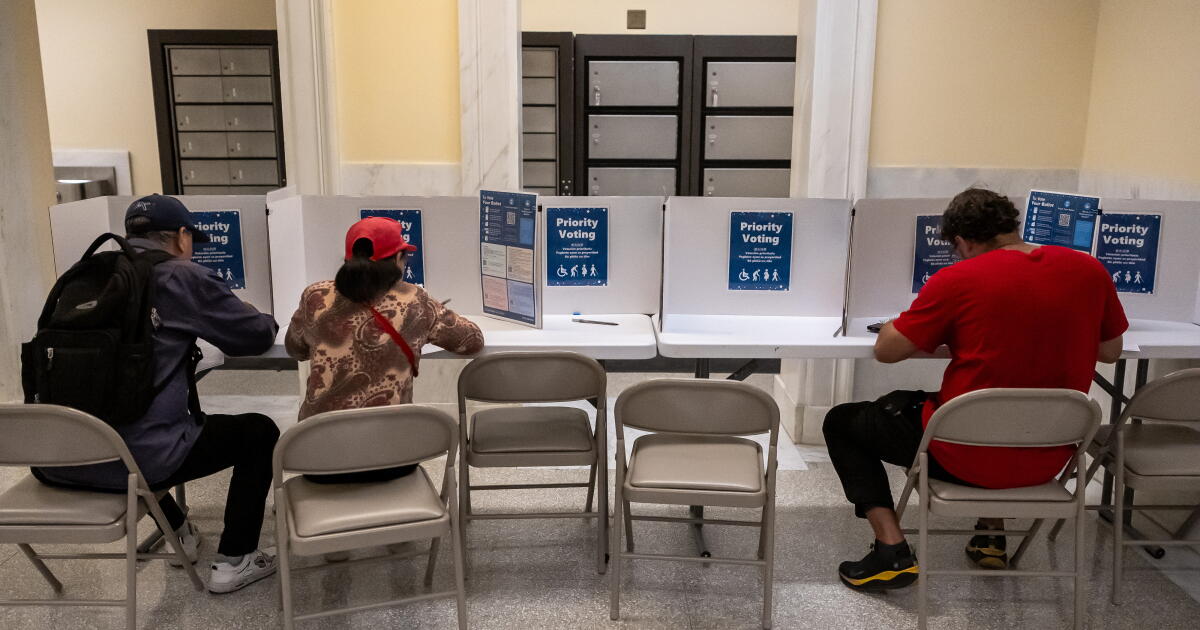
Los Angeles County voters are concerned about a host of voter fraud issues that could disrupt the Nov. 3 general election, even though they have a high degree of confidence in local elections officials, according to a new poll funded by the nonprofit California Community Foundation.
Nearly three-quarters of respondents expressed concern that false rumors and misleading information online could confuse voters or make them believe that their vote won’t count, the poll found. Other top concerns included politicians interfering with the election and mail-in ballots getting lost, stolen or delayed.
Still, most of the voters surveyed expressed confidence in the county’s handling of election proceedings, with 68% saying L.A. County does an excellent or good job at running elections and counting ballots.
Once presented with information about how the county handles elections, that number rose to 72%. Around three-quarters of respondents also believe that the upcoming election will be fair, secure and accurate, the poll found.
The online poll was conducted from Sept. 30 to Oct. 6 by Tulchin Research, a San Francisco-based public opinion firm. It surveyed 500 voters in L.A. County considered likely to cast ballots in the Nov. 3 election and has a margin of error of 4.4%.
“Voters feel good about the local officials running their elections. So, reinforcing the fact that that is who’s in charge of the election and how the process works is reassuring to folks,” said Ben Tulchin, the polling company’s president. “It … reduces their anxiety about some of the outside criticism that California, L.A. County faces.”
The poll was funded by the California Community Foundation, which awards millions of dollars in grants to local charitable groups, to support the “A Count You Can Trust Coalition,” an initiative aimed at enhancing trust in local elections.
Recent polling has suggested that potential federal interference in the Nov. 3 election is a top concern statewide for California voters. The local poll was administered to shed light on how L.A. County voters feel, said former Los Angeles Mayor Antonio Villaraigosa, who co-chairs the A Count You Can Trust group with Miguel Santana, who leads the California Community Foundation.
“This is the epicenter of the California vote,” Villaraigosa said. “The concern is not as great as it is statewide. Here in L.A. County, people seem to trust the vote to a greater degree.”
A recent poll by the UC Berkeley Institute of Governmental Studies, co-sponsored by The Times, found that 61% of California voters identified interference by the Trump administration as a “major concern.” President Trump has fueled doubts over election integrity, spreading unverified claims of widespread voter fraud in blue states such as California.
Young voters and Latino voters expressed the lowest levels of confidence in how the county runs elections, the new poll found. The findings suggest those demographics need “a lot more reassurance” that elections are safe and that their votes matter, Tulchin said.
“It’s not surprising at all, and it means we’ve got work to do,” Villaraigosa said. “We got a lot of work to do to communicate to those people and to make it clear that, in fact, this vote can be trusted.”
Villaraigosa said he plans to focus his efforts on social media engagement and creating video content with poll workers to speak on how vote-counting works in the county.
The poll also asked respondents whether “things in Los Angeles County are going in the right direction or do you feel things have gotten pretty seriously off on the wrong track?” Most — 62% — said wrong track, and 26% said right direction.
Among voter concerns in the upcoming election, 18% listed the economy, the cost of living and inflation as their biggest worry, followed by election integrity, fraud and interference at 17% of respondents. Concerns about Republicans and Trump “winning or retaining power” came in third, with 16% of respondents saying that is their biggest concern.
Homelessness and immigration, two issues that have been prominent the L.A. mayoral race between incumbent Karen Bass and Councilmember Nithya Raman, ranked low in the list of concerns for the surveyed voters. Tulchin noted that the focus of the survey was on election integrity, which could have had an effect on what issues were top of mind of respondents.
The survey findings indicate that L.A. County voters seem to trust the county more than voters statewide. Still, just over 30% of surveyed voters have a fair or poor view of how the county runs elections, Villaraigosa said.
“They’re concerned, but what we found in this poll is that there are a number of people who, while concerned, do trust this county,” he said.
With three weeks left to go until election day and polls showing her on the brink of losing, Los Angeles Mayor Karen Bass has begun to channel the Sun King himself, Louis XIV:
L’État, c’est moi.
Gaslighting voters by insisting the political establishment that has left Los Angeles a mess and that she personifies is worth keeping in office for four more years is her only hope for victory. It’s a wild strategy that reached a crescendo during Tuesday night’s debate, as Bass kept bringing up the fact that L.A.’s ancien régime just doesn’t like her democratic socialist opponent, Nithya Raman.
“Your colleagues have a very difficult time working with you,” Bass snapped at one point, later claiming that Raman’s constituents don’t care for her even though the council member won reelection two years ago. The mayor twice bragged that immigrant rights groups support her; twice referenced Imelda Padilla, the moderate San Fernando Valley council member whose internet dragging of Raman has been out of the Burn Book from “Mean Girls”; and described her opponent as “not ready for prime time.”
Well, the way the mayor’s term has gone in the last couple of years, if it was a prime-time TV show, it might be called “Breaking Bad 2.” And it wouldn’t exactly be a hit.
If it were, two-thirds of Angelenos wouldn’t have decided to vote for anyone but Bass in the primary.
Bass arguably won the debate Tuesday night, but it felt like the technical “victory” — and that’s probably the wrong word — of a politician who is simply more polished. The mayor really needed a knockout punch, and that she did not achieve.
Instead, she in effect told voters that the last four years of disasters, inefficiencies and ineptitude are still a better option than taking a chance on the City Hall equivalent of the classroom dork.
Yet people are so angry at Bass and what she represents that a democratic socialist has a great shot at becoming L.A.’s next mayor — an unthinkable prospect even last year, with no one to blame but the ruling class that has left this great city hobbled, cynical and at the point of giving up.
So the establishment doesn’t like Raman: So what? And: Boo-hoo.
Casting Raman as a political leper while asserting that Bass represents stability and good times ahead isn’t the winning strategy that Bass and Raman’s critics think it is. It’s really just a sad coda for Bass.
She’s been a good soldier for L.A., someone who has participated in nearly every progressive movement to pass through Southern California since volunteering for Robert F. Kennedy’s presidential campaign as a teenager nearly 60 years ago. Even as Bass embarked on a 22-year political career that has seen stops in Sacramento, Washington and City Hall, the native Angeleno always successfully depicted herself as a political outsider.
Because she was:a Black woman in a realm not meant for people like her. She was someone who co-founded a pioneering nonprofit in the crucible of a changing South L.A. in the 1990s and always seemed to land on the right side of history until becoming mayor in 2022.
Sadly, Bass didn’t turn out to be the visionary L.A. desperately needed.
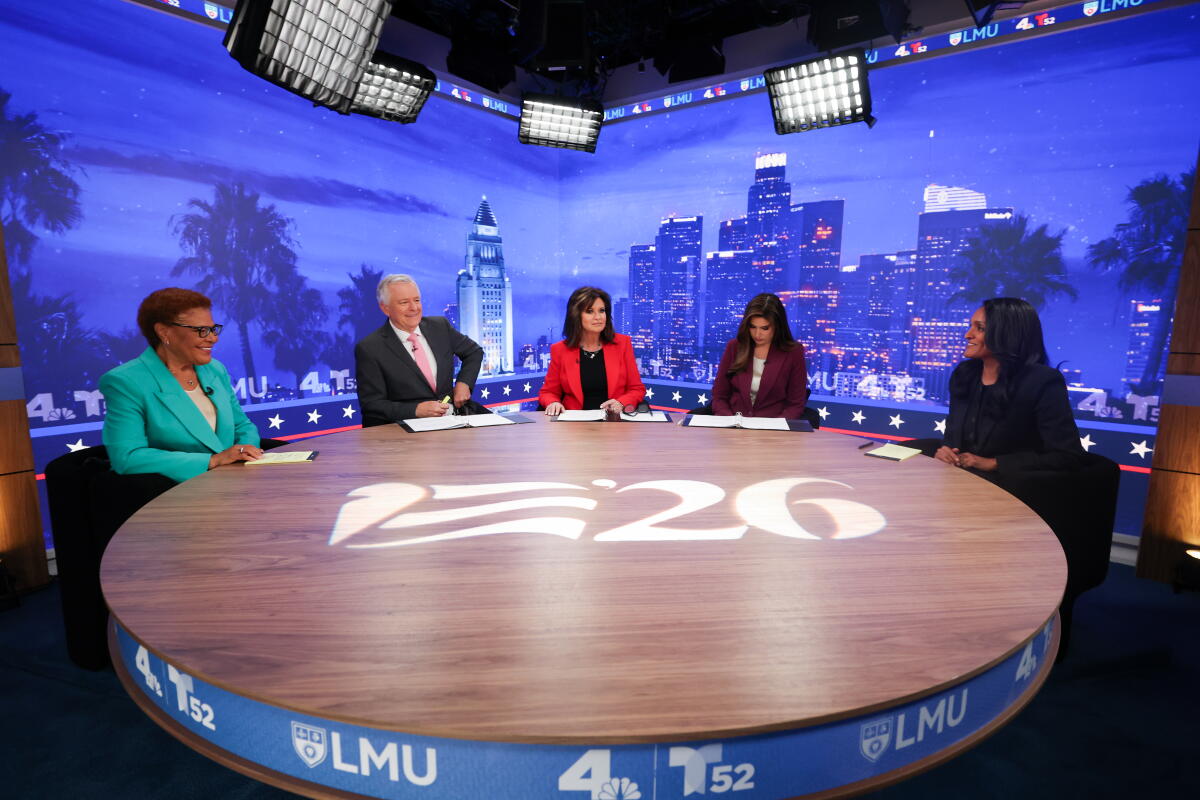
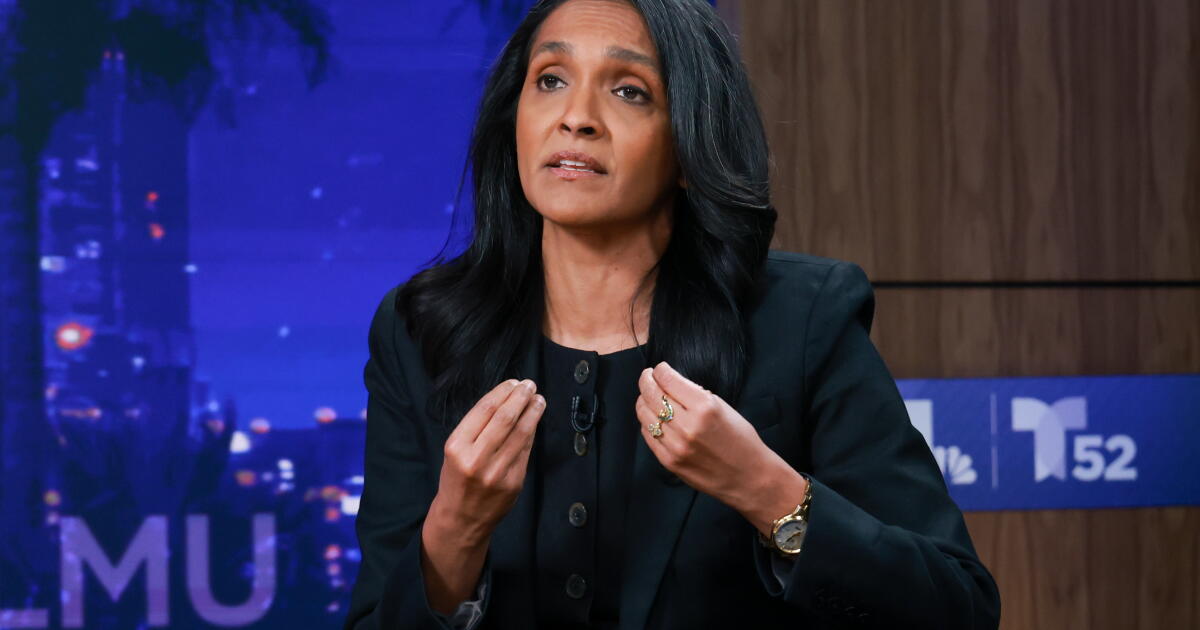
Mayor Karen Bass, left, sits for Tuesday’s debate with Councilmember Nithya Raman, right. Between them are NBC4 reporter Conan Nolan, NBC4 News anchor Colleen Williams and Telemundo 52 anchor Alejandra Ortiz.
(Eric Thayer / Los Angeles Times)
Like so many baby boomers, Bass eventually became The Man without realizing it. Today, she not only stands as the figurehead of the city’s liberal potentates, but she’s also calling on them to rally around one of their own — and they have responded in kind. Democratic politicians, bureaucrats and labor leaders, once rabble-rousers like Bass who nowadays seem to exist mostly to keep their sinecure, have labored mightily to convince unbelieving voters that Bass deserves another shot.
That’s always been the marvel of L.A.’s political establishment. It can take someone like Bass, once considered so radical that her days visiting communist Cuba in the 1970s torpedoed her chances of becoming then-presidential candidate Joe Biden’s running mate in 2020, and transform her into an anodyne incumbent. It can make democratic socialists like Councilmembers Eunisses Hernandez, Ysabel Jurado and Hugo Soto-Martínez — people who explicitly ran to take on a sclerotic City Hall — full-throated Bass supporters who have refused to support one of their own in Raman.
Raman was also becoming part of L.A.’s political chosen ones, to the point she initially endorsed Bass. But she now embraces her turn as the machine’s biggest sellout — whether it’s a true change of heart or a chameleonic self-serving measure, as critics maintain, remains to be seen. It was Raman who said at the end of the debate, “When the mayor is confronted with issues, she blames the system. With your support, we can actually change the system” — catnip to enough Angelenos that Raman seems to be at the cusp of victory and a monumental upset.
After the debate, NBC reporter Robert Kovacic interviewed elected officials to let them hype up Bass or Raman. The latter’s proxy was City Controller Kenneth Mejia, another person loathed by L.A.’s political know-it-alls because he keeps bucking the establishment. Mejia gushed about how Raman “destroyed” Bass with the enthusiasm of a Swiftie.
Bass’ supporters were Councilmember Monica Rodriguez and Assemblymember Rick Chavez Zbur, both of whom gravely parroted their candidate’s warnings about just how dangerous a Raman mayoralty would be. Chavez Zbur reduced Raman’s not-bad performance to a “host of complaints” — ironic, because most of Bass’ night was spent bashing Raman instead of offering much of anything positive.
Rodriguez, meanwhile, told Kovacic that voters shouldn’t choose Raman because “we can’t afford that level of indecisive leadership.”
I rolled my eyes when Rodriguez — whose office declined a chance for her to sit down with me to talk up why Latinos should support Bass — said that.
She’s part of the fabled eastern San Fernando Valley Latino political machine, another group of former gatecrashers who assumed the trappings and stylings of the old guard once they assumed power. Rodriguez long blasted Bass with the same venom she reserved for Raman until the latter mounted her challenge — but now that Rodriguez’s power is under threat, she’s all of a sudden decided to become Bass’ ride-or-die?
Moves like that remind me of another French monarch, Louis XV. “After me, the deluge,” he is supposed to have said, a warning of what would happen once his reign ended.
If Bass’ vow to rule the same as before represents a decisive leader, more and more Angelenos seem to be saying, give us the Raman flood.
Besides, nobody ever said, nor ever put on a campaign sticker, “The establishment? It’s cool!”
The U.S. Department of Justice has ratcheted up its pressure campaign on California election officials to ferret out alleged voter fraud ahead of the Nov. 3 midterm election, demanding that officials statewide prove the U.S. citizenship of thousands of voters flagged by the federal government as potential noncitizens, or withhold or set aside their ballots.
Acting Deputy Atty. Gen. Trent McCotter made the demand — which experts called highly questionable at a time when votes are already being cast — in letters to state election officials Tuesday, including Secretary of State Shirley Weber and Dean Logan, head of the L.A. County Registrar-Recorder/County Clerk’s office.
The letters, reviewed by The Times, call on the state officials to respond to the Justice Department within 48 hours.
McCotter wrote that the Justice Department had provided Logan’s office with a “password-protected thumb drive with a list of names the Federal Government believes are likely noncitizens who were sent a vote-by-mail ballot” for the Nov. 3 election.
“We request that you review the list within 48 hours to determine whether any citizens are listed. For individuals whom you cannot independently confirm citizenship status, we request that you immediately instruct the appropriate elections officials to segregate — not cancel — those individuals’ vote-by-mail ballots until their citizenship status can be determined,” McCotter wrote to both Weber and Logan.
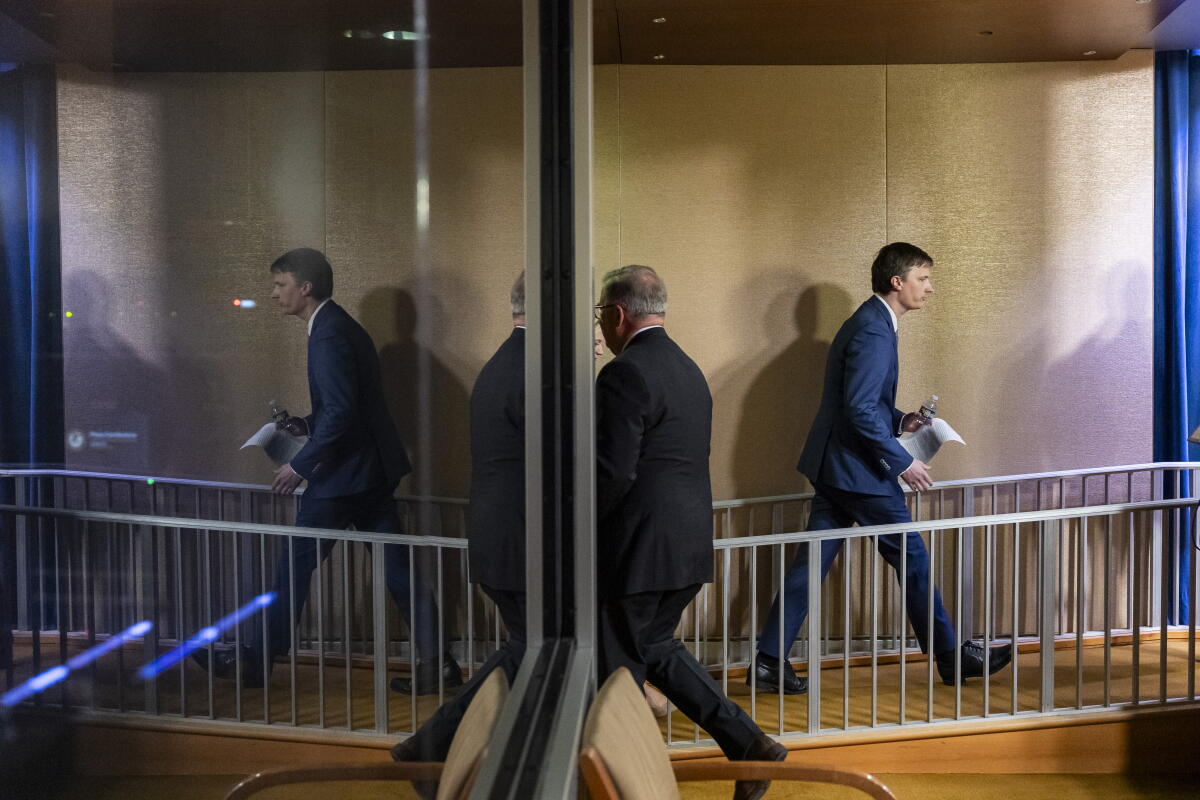
The demand letter came from U.S. Acting Deputy Atty. Gen. Trent McCotter, shown entering a news conference in September 2026 in Washington.
(Finn Gomez / Getty Images)
Voters on the federal list who haven’t already been sent a ballot should not be sent one until their citizenship is verified, while ballots already returned by voters on the list should not be counted until their citizenship is verified, McCotter wrote.
Weber’s office in a statement late Wednesday criticized the Justice Department for telling it to obtain a list of an unknown number of voters it hadn’t been given directly from Logan’s office, investigate all of those voters and “take action” all within 48 hours, based on inaccurate federal data that has led to U.S. citizens being purged from rolls in other states, and under threat of litigation despite the Justice Department providing no legal authority for the demand.
Weber said the Justice Department’s “relentless efforts to unlawfully gain access to states’ protected voter data and purge voter rolls serve only to cause chaos and fuel public distrust in our elections,” and that California already has “robust state law requirements” to ensure only U.S. citizens vote.
Logan said his office was reviewing the Justice Department letter in coordination with Weber and California Atty. Gen. Rob Bonta, but had not accessed the USB drive because state officials “do not consider the device a secure medium” and accessing its contents “would conflict with established data privacy and information security protocols.”
He said that maintaining accurate voter records is a fundamental responsibility of his office, but also that federal and state laws “are clear on how voter eligibility is established — and any action to remove a voter from eligibility must be based on verifiable information, not assertions of unconfirmed data matching.”
Weber previously questioned the basis for a claim by Homeland Security Secretary Markwayne Mullin in July that there may be more than 190,000 noncitizen voters on California rolls, and rebuffed Trump administration offers to work with her office to purge state rolls of such ineligible voters ahead of November without additional information on how it reached its conclusions.
Similar Trump administration lists have been shown in other states to be substantially inaccurate, and to include many voters who are indeed citizens. Election experts say that makes the demand on California — where ballots have already been mailed out — even more concerning.
“One must question why the DOJ would violate its own rules about investigating elections close to election day, and over a week after they knew the state had already mailed ballots out, particularly when their past claims have been full of errors,” said David Becker, executive director of the nonpartisan Center for Election Innovation & Research.
Becker noted the Trump administration alleged that there were nearly 16,000 noncitizens registered in Nevada, later reduced that number to 185 after additional scrutiny, and then determined all of them were in fact citizens.
A Justice Department spokesperson, in a statement to The Times, defended the agency’s demands to California — saying it “should not be controversial, as the criminal statute is clear: only American citizens may vote in federal elections. It is a federal crime for noncitizens to vote in U.S. elections, and the DOJ is asking California to ensure that is not occurring.”
The spokesperson said the agency could not provide the exact number of voters whose citizenship is being questioned, but that it is in the thousands.
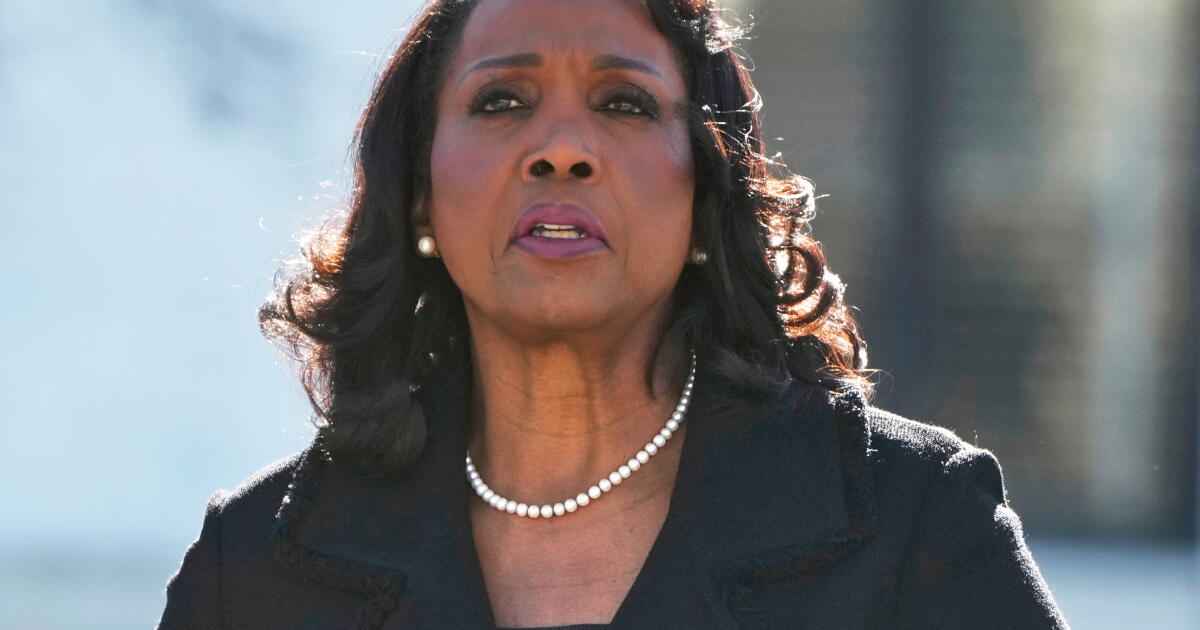
California Secretary of State Shirley N. Weber speaks during the state Democratic Party convention in Anaheim on May 31, 2025.
(Damian Dovarganes / Associated Press)
McCotter wrote that if Weber cannot implement his demands for how to segregate ballots and verify voter citizenship for those on the federal list, the Justice Department “will have no choice but to seek emergency relief” — an apparent reference to seeking court intervention.
McCotter copied on the letters First Assistant U.S. Atty. Bill Essayli, the lead federal prosecutor in Los Angeles whose office previously sent Logan’s office a series of grand jury subpoenas for individual voter records as part of a criminal investigation into illegal voting.
Essayli’s office referred questions to the Justice Department. Bonta’s office referred questions to Weber and Logan.
Rick Hasen, director of the Safeguarding Democracy Project at UCLA School of Law, said that he is “not aware of anything like this ever happening this close to an election,” and that it may in fact be illegal under the National Voter Registration Act, which “prevents systematic purges of voters 90 days before the election.”
He said that the question of whether that preclusion against purges applies to the removal of noncitizens is an issue that is currently before the U.S. Supreme Court, in an Arizona case the high court will hear in December, but that the Justice Department’s actions strike him as “legally questionable.”
Hasen said the “whole point of that 90-day rule is to prevent the inadvertent disenfranchisement of eligible voters by mistake in the rush before the election,” and that risk is increased by the inaccuracies of similar lists presented by the Trump administration in other states. “So if there is an attempt to go to court — if DOJ tries to sue over this — they might have a hard time getting a judge to agree that this is something that the registrar must do or even can do.”
The fact that election officials are already busy receiving and preprocessing ballots would only bolster the state’s position in such a case, Hasen said.
“It’s obviously not a convenient time,” he said. “And given the fact that the lists have proven to be wildly inaccurate, at least in other states, it might be sending the registrar on a wild goose chase, when they have more relevant things to do in the election.”
But that “chaos” may be the point, Hasen said. “This is potentially another example of DOJ just making the work of state and local election administrators — which is already quite difficult and stressful — even harder,” he said.
Attorneys with the UCLA Voting Rights Project filed a lawsuit last month on behalf of the Coalition for Humane Immigrant Rights, or CHIRLA, and a California voter named Pedro Trujillo, in which they challenged the Trump administration’s use of unproven federal databases to allege registered California voters are not citizens.
On Wednesday, they told the Justice Department that they would be seeking emergency relief from such practices, given McCotter’s letters.
“The federal government’s attempt to pressure California election officials into acting on lists that may misidentify eligible voters is an alarming abuse of power as election season gets underway. This puts our communities and our fundamental rights at risk,” said Carl Bergquist, a CHIRLA attorney.
The Justice Department in recent weeks has announced scattered arrests of alleged noncitizen voters around the country, and Trump administration officials — including Essayli — have pointed to such arrests as proof that noncitizens are voting illegally.
Such voting does happen, Hasen said, but after months of the administration aggressively searching for such voters, the relatively small number of arrests “belies the contention that it’s widespread” or criminal, with many of the few cases identified the result of “administrative error or misunderstanding” rather than an intent to illegally cast ballots.
In his letters to Weber and Logan, McCotter wrote that allowing “noncitizens to vote cancels citizen votes,” and that ferreting out illegal noncitizen voters is a joint responsibility of state and federal officials.
“States are responsible for voter registration, and the Federal Government is responsible for maintaining immigration records to enable verification of citizenship,” he wrote. “Working together, we can more effectively protect against voter dilution and promote election integrity.”
WASHINGTON — Federal Reserve governor Lisa Cook’s lawyers say that a committee set up by the White House last week to investigate an accusation against her is “demonstrably biased,” though they did not close the door on the possibility that she would appear before the panel.
Lawyer Abbe Lowell also said in a letter Tuesday that Cook would not be able to participate in a hearing Nov. 5 because she “will be executing her official duties as Governor at financial and monetary policy meetings in Europe.”
The earliest that Cook could appear before a “committee of inquiry” that the White House set up last Friday would be after the Fed’s policy meeting Dec. 8-9, the letter said. The letter was sent to William Scharf, a counsel to President Trump.
Lowell’s comments are the latest turn in the Trump administration’s extended efforts to fire Cook from her position as one of seven members of the Fed’s board of governors. Trump has accused Cook of committing mortgage fraud in 2021, before she joined the board, a claim she has denied. No criminal charges have been filed.
No president has fired a Fed governor before, a reflection of the Fed’s traditional independence from politics. Yet Trump, who has repeatedly demanded that the central bank lower its key interest rate, has taken numerous steps that economists say have threatened that independence. The Justice Department earlier this year sought to investigate then-Chair Jerome Powell over brief testimony he had given about an extensive building renovation, though a judge threw out subpoenas in the case and it was later dropped.
Cook was appointed by former President Biden and is the first Black woman on the Fed’s board.
Trump first tried to fire Cook in August 2025, but the Supreme Court ruled earlier this year she could remain in her position while litigation continued. The court also suggested, in a footnote to the ruling, that Trump could try again to fire her if the administration provided her adequate notice and an opportunity to respond. The committee of inquiry announced by the White House last Friday is an effort to meet those conditions.
Under the law governing the Fed, the president can only fire a Fed governor “for cause,” but the Supreme Court didn’t address whether Cook’s actions met that standard. The committee of inquiry will ultimately recommend whether there is cause to fire Cook, a White House memo last week said.
Lowell also said in the Tuesday letter that “we have significant concerns regarding the objectivity and fitness of the committee for its assigned purpose.”
One of its three members, Kevin Hassett, a top economic adviser to Trump, has already said the president has “cause” to fire Cook, the letter noted. The other two members — Labor Secretary Keith Sonderling and chair of the Equal Employment Opportunity Commission Andrea Rich — are also Trump appointees.
“A hearing with demonstrably biased members, unspecified additional allegations, and an unclear schedule for the disclosure of any additional evidence – with no explanation for why it was not previously produced – is not a process that respects the appearance or history of independence,” Lowell’s letter said.
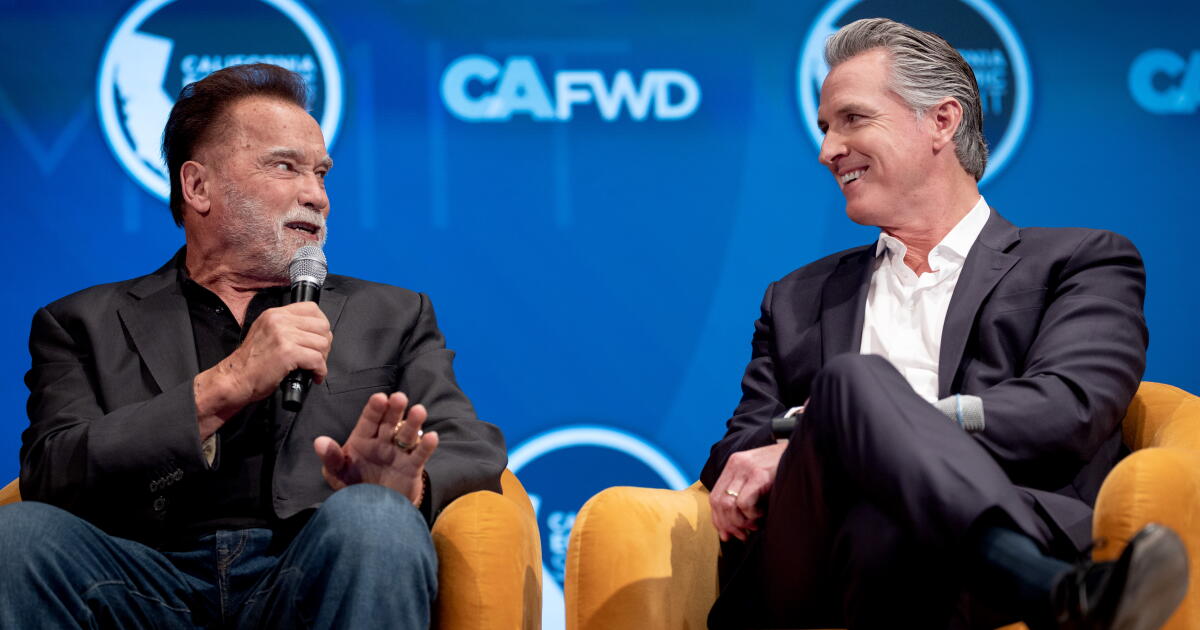
Former Gov. Arnold Schwarzenegger, a Republican, celebrated the 20-year anniversary of landmark climate legislation he signed while in office alongside Democrats including Gov. Gavin Newsom on Wednesday.
“California is the perfect example of what can be done when people work together and when we don’t look at this as a Republican or as a Democratic issue,” Schwarzenegger said at an economic conference in Long Beach, noting that Assembly Bill 32, the Global Warming Solutions Act had significantly reduced greenhouse gas emissions while creating more than a half a million clean-energy jobs.
“This is the message that is so important for the world,” he said, because the state’s policies have become a model for other states and nations.
Newsom noted that the state had met “audacious” goals for reducing greenhouse gas emissions, touting 39,000 megawatts of clean energy that have been installed in the last seven years, 23,000 megawatts of battery storage created, and that no flex alert has been issued in the state in four years.
“So we’re not in the goal-setting business; we’re in the how business,” he said.
He added that the clean energy transition is “the most critical national security issue in the United States of America,” with economic and supply chain leadership at stake as China surpasses the U.S. in electric vehicles, clean-energy manufacturing and the deployment of renewables.
The state already met the climate change legislation’s ambitious target — returning emissions to 1990 levels by 2020 — four years ahead of schedule. However, recent analyses indicate California is not on track to meet its future targets of cutting emissions 40% by 2030 and 85% by 2045.
The event as well as a luncheon the prior day in Santa Monica were rare displays of bipartisan unity at a time of heightened political polarization in the United States. Schwarzenegger and Newsom piled praise upon each other during the Wednesday afternoon discussion, hugging at the end.
At the luncheon, former Gov. Gray Davis, whom Schwarzenegger ousted from office in the 2003 recall election, as well as billionaire hedge-fund founder turned environmental warrior Tom Steyer, who unsuccessfully ran for governor this year, were among the Democrats in attendance, as well as former state Assembly Speaker Fabien Nunez and former state Sen. Fran Pavley, who were both pivotal in the passage of the climate-change legislation.
In addition to remarks highlighting the foundation of some of the nation’s bedrock environmental policies, such as former GOP President Richard Nixon creating the Environmental Protection Agency and signing the Endangered Species Act, there were moments of levity.
Schwarzenegger said he told fellow Republicans “f— you” when they balked at him naming Susan Kennedy, a Democrat, as his chief of staff, he said Tuesday.
During a breakout session at the Wednesday conference, he referenced his former wife, Maria Shriver, a scion of the Kennedy family, as he described his desire to hear from people on both sides of the aisle.
“So I had Democrats in my administration, and of course the Republican Party went nuts,” he said. “I didn’t care because, to me, I thought I wanted to hear what the Democrats were thinking. Plus, I was sleeping with one every night anyway.”
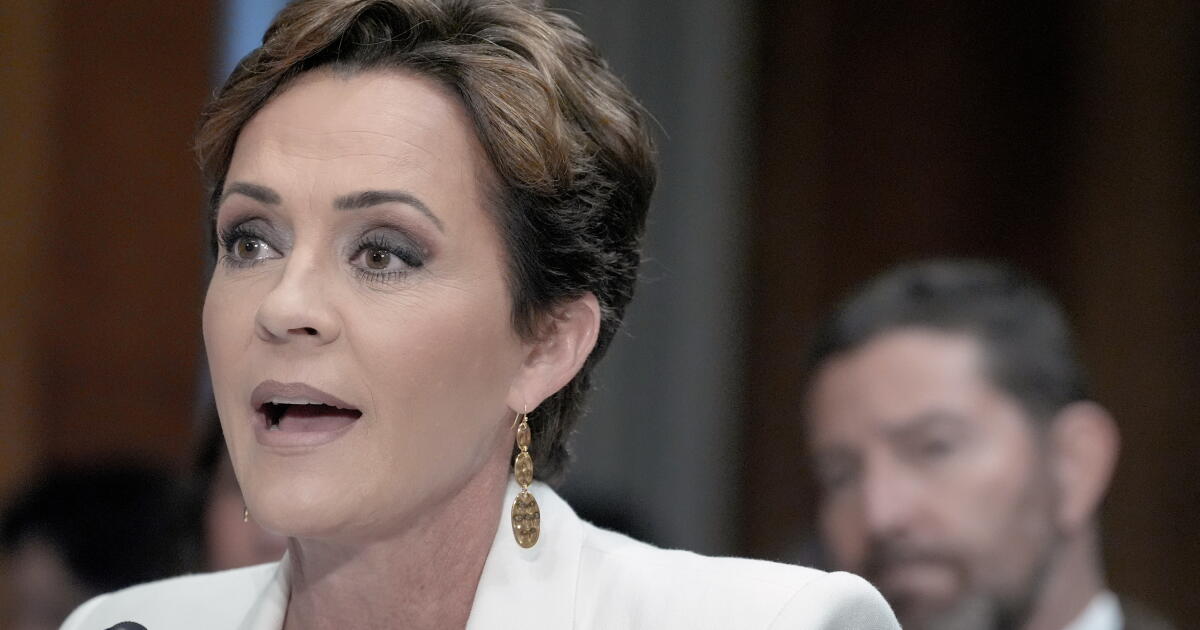
PHOENIX — The U.S. Supreme Court has refused to toss out $122,000 in legal costs that lawyers for former Arizona gubernatorial candidate Kari Lake were ordered to pay for false and misleading statements they made in a lawsuit that sought to require a hand-count of all ballots in the 2022 midterm elections.
The nation’s highest court on Tuesday denied a request from Andrew D. Parker, an attorney who represented Lake in the lawsuit, to review a lower-court decision over the legal costs arising from the unsuccessful litigation.
The lawsuit by Lake and state lawmaker Mark Finchem sought to ban electronic tabulation devices. It was dismissed by a judge who found Lake and Finchem lacked standing to sue and that their lawsuit was filed too close to the election.
In 2022, Lake lost the governor’s race to Democrat Katie Hobbs and Finchem was defeated in the secretary of state’s race by Democrat Andrian Fontes. Both Republicans had promoted the narrative that the 2020 election was marred by fraud.
Maricopa County had sought sanctions against Lake, Finchem and their lawyers, alleging they broke a court rule by making unfounded allegations and by not conducting the necessary research before filing the lawsuit.
U.S. District Judge John Tuchi later concluded the lawsuit’s claims lacked an adequate basis in fact, that the standard inquiry attorneys must make before pressing litigation hadn’t been done and that the lawyers acted recklessly in seeking a court order based on frivolous claims.
The requirement to pay the legal fees applies to the lawyers who pressed the lawsuit, not to Lake and Finchem.
The 9th Circuit Court of Appeals rejected appeals over the lawsuit’s dismissal and the awarding of the legal fees.
The Associated Press left phone and email messages Tuesday for Parker, whose firm is based in Minneapolis.
Earlier this year, Parker asked the Supreme Court to throw out the requirement to pay Maricopa County’s legal fees in the case, arguing such sanctions would deter attorneys from bringing aggressive or novel legal claims.
Maricopa County said lawyers for Lake and Finchem had disregarded a letter that identified false allegations they had made in their lawsuit and relied on some of those claims in a later court filing. The county’s attorneys said those who brought the lawsuit failed to present evidence to support their allegations and falsely alleged that Arizona didn’t use paper ballots and that its electronic voting systems hadn’t been subjected to expert analysis.
In the Los Angeles mayoral debate Tuesday night, I was reminded of two things.
First, as I’ve said before, it’s no surprise that roughly one-third of likely voters remain undecided with less than three weeks to go until election day.
Second, there is one key difference between the two candidates: We know who Mayor Karen Bass is, but we don’t yet know who Councilmember Nithya Raman is, even though she’s been leading in most polls.
Those two points are connected. I think a majority of voters want a change at City Hall because of the marginal progress on homelessness, the erosion of basic services and the bad decisions before and after the Palisades disaster, among a host of other issues.
But they’re not sure what they’d be getting in Raman.
Why not?
If you haven’t already seen the story a few days ago by The Times’ longtime City Hall reporting ace, Dave Zahniser, you need to check it out right here.
The headline neatly sums it up:
“L.A. mayoral candidate Nithya Raman has strong opinions. But they often change.”
Raman has flip-flopped so many times, it’s as if she’s having a political identity crisis, which is not a great selling point for a candidate.
She endorsed Bass, an ally, for reelection and then abruptly and surprisingly announced that she was running against her.
She rose to power as a darling of the Democratic Socialists of America and vowed to defund the police, only to later support an LAPD budget increase.
She embraced the so-called mansion tax, then said it needed an overhaul.
She supported and helped fund Bass’ signature homelessness initiative, Inside Safe, and now has turned against it.
“That’s the real wild card,” said Sara Sadhwani, assistant professor of politics at Pomona College. “She has flip-flopped so extensively on policy that it’s unclear which version of her values we would get.”
Look, it’s not uncommon for a candidate of the left, or the right, to move toward the center to broaden support. And there’s nothing wrong with learning on the job and evolving. It’s all too rare, in fact.
The problem for Raman is that in somersaulting around on core issues, she’s alienating some of the people she would need as allies in order to be an effective mayor.
They might come around, because in the city’s shared system of power, there are times when the City Council and mayor need to paddle in the same direction in order to get anywhere. But among the 15 City Council members, 13 have endorsed Bass, and that support includes even the DSA wing of the council.
I like the idea of a rebel as L.A. mayor, but the job is hard enough with City Council allies. Without them, Raman could be cooked. And it’s not as if she’d have an easy time winning support for much of anything from the powerful public employee unions and traditional business interests, which are for the most part aligned with Bass, for better and for worse.
Both candidates had their moments in the debate, although I gave the edge to Bass. During The Times’ live chat, I said I think L.A. really needs a leadership change, and I think Raman did not prove that she’s the answer.
It’s probably the second-most important political job in the state, in one of the great cities of the world, and along with the ducking and punching, I wanted more love, more poetry, more unbridled passion and a contagious sense of possibility.
And please, all you Spencer Pratt toadies, don’t send me your whiny little notes about how he was the guy all along. Identifying some of the obvious problems is easy enough. (I do it all the time.) Having a plan is another matter, and that’s why I never ran for mayor, and why Pratt faded out of the picture.
So what next, as the final three weeks of the campaign play out?
If I were Raman, who is 45, I’d go heavy on touting the work she’s done on eviction protections and capping rent hikes, because nailing down younger voters could give her the keys to the throne. On homelessness, she knows the issue better than most, has detailed what’s wrong with the Bass program, has made headway in her own district, and has laid out a plan to speed up progress and efficiency citywide.
But her best argument is that City Hall and the entrenched political establishment need a major shake-up, because the machine is now a jalopy.
“We cannot afford another four years of decline, of mismanagement, of excuses,” Raman said in the debate.
As for Bass, 73, you can’t count her out just yet because she’s a fighter, and she’s better at campaigning than at being mayor. She also is likely to benefit from the fact that older voters — who are most likely to go to the polls — favor her by a huge margin.
“You are not ready for prime time,” Bass told her former ally during the debate, and Bass also hammered Raman for taking “different positions on different days of the week.”
In 2005, Mayor Jim Hahn became the first L.A. mayor to lose a reelection bid in more than three decades, falling to Antonio Villaraigosa. It was a rout, at 58% for Villaraigosa to 41% for Hahn.
I don’t see a rout this time.
The question for Los Angeles is this:
Have you had enough of the mayor you know, and are you ready to roll the dice on someone you don’t?
The 9th Circuit Court of Appeals nixed a trailblazing California law on Wednesday, permanently barring the state’s efforts to force federal immigration agents to display identification while on duty.
“As before, we conclude … the No Vigilantes Act attempts to directly regulate the United States in its performance of governmental functions,” Judge Mark J. Bennett wrote for the panel. “No set of circumstances exist under which the Act would be valid.”
The U.S. Justice Department first sued to block the ID requirement alongside a related law attempting to ban masks for federal agents and local police in the fall of 2025.
The joint case hit Los Angeles federal court at the beginning of this year amid a surge of immigration enforcement in Minneapolis that led to the shootings of civilians Renee Good and Alex Pretti by U.S. Immigration and Customs Enforcement agents.
By then, more than a dozen other states were pursuing similar statutes in an effort to rein in what many saw as lawlessness in President Trump’s sprawling deportation force.
Judge Christina A. Snyder ultimately blocked California’s law prohibiting the use of masks by law enforcement, on the grounds that it unfairly carved out an exception for state peace officers, but allowed the ID requirement for ICE agents and others to go forward, agreeing with the state that it was more akin to a speed limit on the highway than a direct regulation of the federal government.
“If a state law directly regulates the governmental conduct of the United States without congressional authorization, it is void irrespective of whether the regulated activities are essential to federal functions or operations, and irrespective of the degree to which the state law interferes with such functions or operations,” Bennett wrote.
The decision comes as ICE is quietly shedding many of the 12,000 new recruits it hired last year. Although public outrage over Trump’s militarized mass deportation efforts has diminished somewhat since the winter, it remains a potent election issue.
A Reuters/Ipsos poll from September showed more than 40% of Americans strongly disapprove of the president’s handling of immigration. Meanwhile, the share who fret over unauthorized immigration is nearly identical to the proportion who worry about the unchecked spread of measles — anxieties that pale in comparison with stress over the cost of living, the proliferation of data centers and the war with Iran, data show.
NEW YORK — The new White House press secretary is facing mounting questions about her background and resume as she transitions into her role as the public face of the Trump administration.
Katie Zacharia has long described herself as a lawyer as she has worked to establish herself as a commentator for conservative outlets such as Fox News and Newsmax. But so far, she and the White House have offered no evidence that she passed the bar exam in any state or in China, where she worked for a large law firm years ago.
The questions add to the confusion surrounding President Trump’s decision to hire Zacharia, who had worked for his social media company for only a few months when he announced her appointment and whose debut at the podium on Tuesday has been widely panned.
Afterward, the president was asked by reporters where Zacharia had passed the bar exam, following a report by the independent outlet Popular Information that she did not appear to be licensed in any state.
Trump stepped aside to allow Zacharia to answer.
“When I moved to China,” she responded over the sound of Marine One whirring in the background. It is unclear what she had intended to say or whether she had finished the sentence.
Asked what credentials she held, the White House passed along a statement from Zacharia, who received a bachelor of arts degree from Pepperdine University in 2007 and received her law degree from Pepperdine Caruso School of Law in 2011, according to the school and her LinkedIn bio.
“I practiced international transaction law, with all the appropriate credentials,” it read.
Steven Cheung, the White House communications director, added that Zacharia was “uniquely qualified and whip smart to help inform the American people about all the great things President Trump and his Administration have been doing, and she will do an incredible job as press secretary.”
A resume under scrutiny
According to her LinkedIn profile, Zacharia has been the senior communications advisor at the Trump Media & Technology Group since June and spent two months as deputy assistant secretary for public affairs at the Department of Homeland Security this year.
From 2011 to 2013, it says, she served as an associate on the International Practice Team at the Zhong Lun Law Firm in Beijing. She also worked as the manager of fundraising and communications for Compassion for Migrant Children, which assists the children of migrant workers, from 2012 to 2013.
More recently, it says she served as general counsel for Fix California, a group started by Trump administration official Richard Grenell.
Neither the firm nor the two groups responded to questions about her tenure and background.
Zacharia has long called herself a lawyer. On Instagram, she describes herself as the White House press secretary, “Wife, Mom, & Lawyer” (with three heart emojis after “Mom”).
And her official author page at the California Globe, where she wrote occasional commentary, says that, in addition to being a “regular commentator on Fox News, Newsmax,” she has “extensive experience in political advocacy, international corporate law, and non-profit work, including time as outside counsel for the World Bank and IFC in Beijing.”
A June 2026 news release from NovaRed Mining Inc. announcing her appointment to the company’s advisory board, which was first reported by Popular Information, said her “professional experience includes work related to international legal and financial transactions, including matters involving organizations associated with the World Bank Group and the International Finance Corporation during her tenure with Zhong Lun Law Firm in Beijing.”
In announcing her hire on his social media site, Trump described Zacharia as “a distinguished Graduate of Pepperdine University, and the Pepperdine Caruso School of Law, an attorney, and a frequent Commentator on outlets, including Fox News and Newsmax.”
“She has an unblemished record of support, and has been a loyal and brilliant supporter, right from the beginning. She is, likewise, a devoted fan and member of MAGA!” he added.
‘No record’ found
Zacharia is not listed as a member of the state bar in California, where she currently resides, according to a public database.
Rick Coca, a spokesperson for the State Bar of California, a regulatory agency that oversees state licensing, said in a statement that it has “no record of Kate Sharon Zacharia or Kate Sharon Black” or any version of her married or maiden names “having been licensed to practice law in California.”
Popular Information said the same was the case in all 50 states it had queried, plus Washington.
In response, the watchdog group Campaign for Accountability filed a complaint Wednesday with the State Bar of California asking it to investigate whether Zacharia misrepresented herself as a lawyer in violation of California law.
“In California, calling yourself a lawyer without a license isn’t puffery; it’s a crime. The State Bar should investigate whether Ms. Zacharia has misled the public about her credentials and hold her accountable if she has,” said the watchdog group’s executive director, Michelle Kuppersmith, in a statement.
The State Bar said it could not confirm whether the agency had received the complaint or was conducting an investigation, citing confidentiality laws.
When a county judge put the brakes on what would be the largest data center in California, ruling the whole project needed extensive environmental review, Kristian Salgado was relieved.
The community organizer lives in Imperial County, where the nearly one-million-square-foot facility was proposed. The rural county near the Mexico border struggles with bad air pollution and has one the state’s highest rates of asthma hospitalization for kids, according to the National Institute of Environmental Health Sciences. One of Salgado’s nephews lives right next to the site and struggles with the respiratory disease.
“It just seemed very unusual that a project of this scale, with that many backup generators could be permitted without requiring any further [analysis] of what that would mean for residents,” she said.
Now, Salgado and others who share her concern believe Proposition 45 on the November ballot could roll back their wins. The initiative changes the California Environmental Quality Act, or CEQA, a law intended to inform decision makers and the public about a project’s possible environmental impacts — and mitigate them to the extent possible.
Supporters say Prop 45 will speed up environmental review for essential housing, transportation, water, health, education and other projects, cutting costly delays and passing the savings on to consumers. Opponents say it not only weakens environmental protections for many developments, but will cover potentially polluting ones — including data centers. The Yes on 45 campaign forcefully rejects the data center claim, but independent legal experts are divided.
At the heart of the debate is the definition of one of the categories covered by Prop 45: “broadband internet access projects” or “mass-market retail service … that provides the capability to transmit data to, and receive data from, all or substantially all internet endpoints.”
Dan Dunmoyer, president and chief executive of the California Building Industry Assn., which supports the proposition, was adamant: “We specifically excluded data centers” when crafting the measure.
Yet the proposition expressly names certain excluded projects: nuclear energy, high-speed rail, jails and Delta conveyance facilities. Data centers aren’t among them.
Dunmoyer maintains that even if they’re not explicitly listed, data centers just don’t fit the measure’s definition.
In a Daily Journal op-ed, Rachelle Chong, a former Federal Communications Commission member, similarly argues that the definition refers to internet access bought from a provider like AT&T or Comcast. “A conventional data center ordinarily performs an entirely different function,” she wrote, arguing data centers aren’t in play.
But land use attorneys Matthew McKerley and Richard Frank, in another op-ed, say many modern data centers fit the bill because they house equipment used to transmit consumer data to and from the internet.
They also highlight conspicuous campaign finance contributions, including $250,000 from Prologis, which developed two data centers in San Jose.
Ethan Elkind, director of the climate program at UC Berkeley Law, said data centers will argue they fit the definition — and then it will be up to the courts to decide.
“Anyone telling you that it’s definitely not going to be data centers, they cannot read the future,” he said. “The way they’ve written the language, they can’t provide 100% assurance.”
Eric Biber, a UC Berkeley law school professor with expertise in environmental law, pointed to language in the measure requiring it to be interpreted broadly “to afford the fullest possible weight to the interest of, and the approval and realization of, essential projects.” In a blog post, he called it “a thumb on the scale” that could lead courts to conclude that projects should be covered when their eligibility is in doubt.
But Ryan Thomason and J. Scott Miller, partners at the law firm Mitchell Chadwick with CEQA expertise, think it’s likely courts would rule otherwise. In an article, they note that the definition used in the measure hews closely to another section of California law, which distinguishes providing internet services from offering content, services and applications online. “Courts generally interpret identical language in related statutes to have the same meaning,” they write.
Dunmoyer, of the California Building Industry Ass., stressed that the measure doesn’t overthrow local zoning rules.
Opponents are “making it sound like in your backyard will be a data center,” he said. “Well, that doesn’t happen at all by this initiative. That has to happen by a county board of supervisors voting to put a data center in your backyard. And if they decide to do that, this initiative does nothing to expedite that CEQA review.”
But what if local officials run afoul of their constituents? In the case of the Imperial Valley Data Center Campus, the roughly 75 acres of unincorporated land where it would go had already been zoned for data centers. As a result, county officials said they had the power to move forward with the facility for artificial intelligence computing infrastructure without city approval.
They granted the project an exemption from the state environmental review.
Then came the backlash. Residents spoke out at public meetings, rallied on the streets, circulated a petition and formed a community organization. The city of Imperial and the Sierra Club sued. In the wake of the outrage, the county walked back its decision, declaring a moratorium on data centers. (The developer sued the county over the ban, and the county recently rescinded it following a court order.)
If Prop 45 passes — and data centers are covered by it — Eric Biber, of UC Berkeley Law, told The Times that such a moratorium wouldn’t be possible. That’s because the measure prevents state and local officials from changing the rules for a project once its application is submitted, he said. So if a community didn’t have a moratorium in place and its zoning laws allow a data center, “They’re done,” said. Existing bans aren’t expected to be affected.
Attorneys for the No on Prop 45 campaign argue that it could have real-world impacts for the Imperial Valley facility, saying the developer could claim the new rules apply. For instance, the measure would prevent courts from overturning approvals of qualifying projects because of CEQA violations. Courts would only be able to halt the affected portion of the project while the issue is fixed.
Sebastian Rucci, principal developer of the Imperial Valley data center, said he will fight for his project to move forward and that there’s an environmentally sound way to do it. He said he’s willing to negotiate and mitigate where necessary — but will not go through the CEQA process. If push comes to shove, he said he’ll move the project elsewhere. California could “get in the game” or be left in the dust, he said.
Imperial Valley Computer Manufacturing, the company behind the project, says it will create at least 100 permanent jobs and generate $28.7 million in annual property tax revenue.
CEQA requirements “are not about the environment,” Rucci said. “They may be for some, but they’re not for many. For many, they are about killing things.”
WASHINGTON — Federal authorities investigating Minnesota Rep. Ilhan Omar seized the Democratic lawmaker’s phone and have issued more than a dozen grand jury subpoenas, including to some of her relatives, according to a person briefed on the probe.
The subpoenas were issued for a grand jury collecting evidence in Minnesota as federal authorities probe potential fraud in Omar’s immigration paperwork, said the person, who spoke on the condition of anonymity because they were not authorized to discuss an ongoing investigation. The investigation led to federal agents searching Omar’s Washington, D.C. home on Monday just weeks before the November midterms, in which Omar is seeking reelection.
The scope of the investigation into Omar is unclear, though Homeland Security Secretary Markwayne Mullin has suggested that authorities were examining potential crimes related to her family’s immigration paperwork.
On Tuesday, Washington D.C. U.S Attorney Jeanine Pirro said in a Fox News interview that “there are several investigations going on” related to Omar and that her office is also probing issues concerning the lawmaker’s financial disclosures.
“If there was a crime that was committed, it will be prosecuted,” Pirro said.
The search of Omar’s home so close to next month’s midterm contests that will determine control of the House and the Senate was swiftly condemned by Democrats, who accused the administration of targeting the Democrat for political purposes. Omar, in a statement on X, called the search an “attempt to target political enemies and weaponize federal law enforcement.”
“For 10 years, Trump has targeted me with baseless lies and smear campaigns. This is just the latest escalation in his campaign of political intimidation,” she said. “I will not be silenced.”
A phone message seeking comment was left Wednesday with a representative for Omar.
Though the Republican focus on Omar’s background dates back years, the search notably took place three weeks before the November midterms, in which Omar is seeking reelection. The Justice Department has historically sought to avoid public investigative actions involving a candidate within 60 days of a primary or general election.
Omar, who was first elected to the House in 2018, represents Minnesota’s 5th District, including Minneapolis. She is part of The Squad of progressive lawmakers who are a vibrant political force on the left wing of Congress but have also endured repeated attacks from President Trump, dating back to his first term. She was one of the first two Muslim-American women in the House and the first African refugee to be elected to Congress.
WASHINGTON — Federal immigration officials need to ensure that body cameras worn by officers are uniformly activated when needed, a government report released Wednesday said, following a series of contentious shootings and aggressive arrests by ICE officers.
The agency rejected the recommendation, saying that using cameras that automatically activate when an officer pulls their weapon or activates a car siren could risk privacy concerns.
ICE has come under intense scrutiny after numerous incidents where officers have opened fire during enforcement operations and the agency has claimed they were under threat but officers weren’t wearing body cameras. Critics say the cameras could help hold officers accountable and promote transparency at a time when the agency is operating at a high tempo across the country and increasingly accused of excessive use of force. The report by the Government Accountability Office covers the period from February 2025 until September of this year. The report, conducted at the request of Democratic members of Congress, delves into policies governing the use of body-worn cameras by ICE and U.S. Customs and Border Protection and details improvements both agencies can make to improve their programs. But it did not go into any of the high-profile ICE-involved shootings that have focused attention on the agency’s body-worn camera usage, such as the shooting deaths of Renee Good in Minneapolis or Lorenzo Salgado Araujo in Houston.
A fatal shooting exposed gaps in ICE’s camera rollout
Former Homeland Security Secretary Kristi Noem announced in February that every Homeland Security officer on the ground in Minneapolis would be issued body-worn cameras. Noem, who was later fired by Trump, said officers across the country would receive them as funds became available.
The department later received $20 million from Congress to finish the ICE body-camera rollout plan. But then came a shooting in July of Salgado Araujo, when Immigration and Customs Enforcement officers shot and killed the Mexican man who lived in the U.S. for more than 35 years. Those officers were not wearing body cameras, raising questions about why the agency still hadn’t gotten the cameras out to officers in the field. Homeland Security said after Salgado Araujo’s death that body cameras had been deployed to more than half of ICE field offices and that the remainder would get them in the next 60 days. In the GAO report, DHS said all ICE offices had received the body-worn cameras as of Aug. 5 and that officers were being trained on their use.
In a statement Wednesday, DHS said that while they’d purchased devices for all ICE officers across the country, the required training was still ongoing and that they expected to be finished “soon.”
The report recommended ICE take additional steps such as “automated camera activation” that it said would be particularly helpful in situations where “unexpected and unplanned incidents, unrelated to sensitive operations, result in use of force by or against personnel.” The report said this would improve transparency and public trust. But DHS disagreed, saying that cameras that automatically activate could result in “the unauthorized recording of sensitive interactions with informants or victims.” The agency said the body-worn cameras are required to be turned on at the beginning of pre-planned enforcement activities.
Confusion over camera rules kept one ICE office from using them
The report also said some of the officers they talked to at both ICE and CBP were confused as to when they should activate the cameras. For example, some officers told the GAO they didn’t know whether to activate the cameras during vehicle searches or when transporting detainees. The report noted that at one ICE office, staff was so uncertain about when they were supposed to use the cameras that they hadn’t begun using them even after they’d been trained.
The report also found that neither agency had updated the plans that oversee their body-worn camera programs even as their staff had grown significantly.
WASHINGTON — The Supreme Court sided with Republicans Wednesday and gave political parties and their fundraising committees lower rates for broadcast campaign ads.
Over two dissents, the justices granted a fast-track appeal from the Trump administration and the National Republican Congressional Committee and upheld the use of the GOP-friendly rule in the midterm election.
In a brief order, the court said the issue should be left to the Federal Communications Commission.
The outcome has given Republican candidates an advertising edge in the final weeks of the campaign.
Federal law says a “legally qualified candidate” running for election is entitled to a “lower unit charge” for campaign ads in the 60 days prior to an election.
However, on March 30, the FCC, under Republican control, announced that broadcasters must extend the lower rates to political parties and their joint fundraising committees.
The FCC notice did not explain the basis for this change, and it refused to hold a commission hearing to debate the issue.
But the change was seen as benefiting Republicans.
Democratic candidates have raised more money from direct but limited contributions from individuals, while Republicans have raised far more through party committees that are funded by wealthy donors.
The non-partisan Campaign Legal Center said the FCC’s rule change was “contrary to the text and purpose of the federal statute and would effectively grant super PACs an advertising discount.”
Anna Gomez, the lone Democrat on the FCC, issued a statement objecting to the change.
“The American public should not have sweeping election-year rule changes forced on them in the dark, on the eve of the election, without a single opportunity for public input,” she said.
Democratic Senate candidates Sherrod Brown of Ohio, Jon Ossoff of Georgia and Roy Cooper from North Carolina objected to the FCC rule change in April and and asked for a review.
When no action was taken, they filed suit in federal court. They argued the FCC had no authority to change the law that gave only candidates, not fundraising committees, the benefit of the lower ad rates.
Since then, the two sides have gone back and forth in the courts, with both accusing the other of seeking a late change in the rules.
The U.S. 4th Circuit Court of Appeals in Virginia ruled for the Democrats in a pair of 2-1 decisions.
“Suffice to say that any ‘chaos’ is the FCC’s fault, not ours,” Judge Robert B. King, a Clinton appointee, said on Oct. 7. It “has endeavored to create from whole cloth a new rule entirely outside the purview of judicial review.”
But the Supreme Court stepped in twice to overturn the 4th Circuit and rule for the Republicans.
In a Sept. 4 order, the court said in an unsigned order the 4th Circuit intervened too soon. The law “makes clear that an aggrieved party must wait for the Commission to resolve its application for review by order before filing a petition for judicial review.”
Only Justice Ketanji Brown Jackson dissented.
In September, the FCC did nothing other than to ask for public comments on its March rule change.
Frustrated with the delay, the 4th Circuit issued a second order requiring the FCC to act by Oct. 9.
Last week, in response to an appeal from Solicitor Gen. D. John Sauer, Chief Justice John G. Roberts put the 4th Circuit order on hold.
On Wednesday, the full court said the 4th Circuit Court should have left the issue to the FCC.
“Our system of separation of powers does not allow the judiciary to meddle in the workings of a coordinate branch of the government in this manner,” the court said an unsigned opinion.
In dissent, Jackson and Justice Sonia Sotomayor voted to deny the administration’s appeal.