Iranians burn Trump, Netanyahu effigies at warship victim rally
Iranians in Tehran burned effigies of Israeli PM Netanyahu and US President Trump.
Source link
Stay informed and up-to-date with the latest news from around the world. Our comprehensive news coverage brings you the most relevant and impactful stories in politics, business, technology, entertainment, and more.
Iranians in Tehran burned effigies of Israeli PM Netanyahu and US President Trump.
Source link
Washington, DC – Tulsi Gabbard, the director of US National Intelligence, said that the United States intelligence community had assessed that Iran was not rebuilding its nuclear enrichment capabilities following US and Israeli attacks last year.
The revelation on Wednesday appeared to undercut one of President Donald Trump’s key justifications for joining Israel in launching the latest war against Iran.
list of 3 itemsend of list
Trump and his top officials have repeatedly cited Iran’s nuclear ambitions as one of the main reasons for abandoning ongoing diplomatic talks in favour of military action.
“As a result of Operation Midnight Hammer,” Gabbard said in written testimony to the Senate intelligence committee, referencing the June 2025 US strikes on Iran’s nuclear facilities, “Iran’s nuclear enrichment program was obliterated”.
“There have been no efforts since then to try to rebuild their enrichment capability,” Gabbard said in the written testimony.
Notably, Gabbard did not read that portion of her testimony, which was provided to members of the committee, during her publicly televised oral testimony. When pressed on why she omitted the portion, Gabbard said simply that she did not have enough time. She did not deny the assessment.
“You chose to omit the parts that contradict Trump,” Senator Mark Warner, a Democrat, responded.
Trump has repeatedly said the June 2025 attacks, which came at the end of a 12-day war between Israel and Iran, had “obliterated” Iran’s nuclear capacity, even as he warned that Iran’s alleged nuclear ambitions presented an immediate threat to the US.
Tehran has for years denied it is seeking a nuclear weapon. Nuclear and arms monitors have maintained that even if Tehran were seeking a nuclear weapon, it did not represent a short- or medium-term threat.
The foreign minister of Oman, who had mediated the latest round of US-Iran indirect nuclear talks ahead of the war, has refuted Trump officials’ claims that the most recent negotiations were not yielding any progress.
The Guardian newspaper also reported this week that the United Kingdom’s national security adviser, Jonathan Powell, had attended the final session of talks and assessed that the Iranian position did not justify an immediate rush to war, citing sources familiar with the situation.
The administration has not settled on any single justification for launching the war, also pointing to Iran’s ballistic capabilities, its potential threat to Israel and US forces in the Middle East, and the totality of the Iranian government’s actions since the 1979 Islamic Revolution.
The concept of an “imminent threat” is significant in determining the legality of Trump’s decision to strike a sovereign country under international law.
It is also significant for US domestic law, under which presidents can commit the military only in instances of immediate self-defence. Only Congress can officially declare war or authorise extended military campaigns.
The White House said earlier this week that Iran’s ballistic missile capacity was “functionally destroyed”, with the Iranian navy “effectively destroyed” and the US and Israel dominating the country’s airspace.
Experts have assessed that Iran still maintains the military capacity to inflict significant damage in the region, and it has continued to wield its military influence over the Strait of Hormuz.
Gabbard, meanwhile, offered a more sober assessment than the White House, saying that despite the killings of Iranian supreme leader Ayatollah Ali Khamenei, top military officials, and most recently the head of the Supreme National Security Council, Ali Larijani and the intelligence minister, Esmail Khatib, “the regime in Iran appears to be intact but largely degraded by Operation Epic Fury”.
“Even so, Iran and its proxies remain capable of and continue to attack US and allied interests in the Middle East. If a hostile regime survives, it will seek to begin a years-long effort to rebuild its missiles and UAV [drone] forces,” she said.
Gabbard also listed Iran, alongside Russia, China, North Korea and Pakistan, as among the countries “researching and developing an array of novel, advanced, or traditional missile delivery systems, with nuclear and conventional payloads, that put our homeland within range”.
The Washington, DC-based Arms Control Association has said that US intelligence as of 2025 had said it may take Iran until 2035 or longer to develop a missile capable of hitting the US, if it did indeed seek to do so.
Gabbard spoke a day after a top official in her agency, Joe Kent, the director of the US National Counterterrorism Center, resigned in opposition to Trump’s war with Iran.
In his resignation, Kent said that Iran “posed no imminent threat” to the US and that Trump’s decision to enter the war went against his “America First” pledges.
Kent is the first high-profile member of the Trump administration to step down in response to the war.
Gabbard herself had previously been a vocal opponent to indefinite military engagement in the Middle East and war with Iran. A former member of the US House of Representatives from Hawaii, she left the Democratic Party and supported Trump, in part, due to his anti-war vows.
However, in a post on X on Tuesday, Gabbard defended Trump’s decision to go to war.
“As our Commander in Chief, he is responsible for determining what is and is not an imminent threat, and whether or not to take action he deems necessary to protect the safety and security of our troops, the American people and our country,” she said.
She said her agency’s role was to funnel US intelligence to Trump.
“After carefully reviewing all the information before him, President Trump concluded that the terrorist Islamist regime in Iran posed an imminent threat and he took action based on that conclusion,” she said.
In its ruling to award Morocco the title, Caf also “partially upheld” an appeal against an incident involving ball boys in the final, and reduced the Moroccan FA’s fine for the incident.
In torrential rain, Senegal goalkeeper Edouard Mendy regularly dried his gloves, but the ball boys repeatedly tried to discard his towel.
At one point Senegal reserve goalkeeper Yehvann Diouf was tackled to the ground by three ball boys and dragged around on the floor when he tried to intervene.
A fine for fans shining lasers at players on the pitch was also reduced by Caf.
Caf’s former head of disciplinary, Raymond Hack, questioned the decisions made by African football’s governing body and suggested there is a perception of “political interference” as “the president of the Moroccan Football Association [Fouzi Lekjaa] is the first vice-president of Caf”.
“The circus continues,” Hack told BBC World Service.
“A lot will depend on the referee’s written report, but the fact that the referee allowed the game to continue and they went into extra time gives the impression that he was satisfied that the game will continue.
“He is the only person who can call an end to the game. Not the authorities, not the governing bodies, only the referee.
“Otherwise you’re going to have situation worldwide where every time someone disagrees with a decision, they’re going to go on appeal or take it to court or something ridiculous like that.
“The game should be won on the field of play not in a boardroom.”
Hack, a lawyer and a member of Fifa’s disciplinary committee, said the Morocco players should have informed the referee they were playing under protest if they intended to challenge the result.
He also said it could take six months for Cas to rule on Senegal’s appeal.
Moroccan journalist Jalal Bounar told Newsday that Caf’s decision had been welcomed “with great excitement and joy across the country”.
“Morocco appealed the decision to the confederation of African football because they believed that Senegal had broken the rules during the match, and that’s why Moroccans went out to celebrate,” he said.
“If they give it to Senegal, it won’t be the end of the world. We will accept because we are satisfied that we reached the final.”
However, north African journalist Maher Mezahi said such a sentiment is not matched across the continent.
“It does seem like the rest of Africa feels outraged by this because it seems like, once again, the Confederation of African Football has almost disgraced the sport,” he told BBC Radio 5 Live.
Mezahi cited Caf’s decision to ban Togo from two Africa Cup of Nations for quitting the 2010 competition following a gun attack on their team bus in Angola two days before the tournament.
Referring back to Caf’s decision on the 2025 final, he said: “They have, unfortunately, come up with a habit of releasing decisions like this – whether it’s the disciplinary committee or the appeals board – that eventually do get shot down at the Court of Arbitration for Sport, but it makes the entire thing look very amateurish.”
Follow the build-up, analysis and live text commentary of the game as Liverpool host the Turkish champions at Anfield.
The war has reignited a debate within the Iranian diaspora about what role the US should play in Iran’s future.
This question is more than a distant geopolitical issue for Iranians in Los Angeles.
Many residents explained that their family histories had been shaped by US involvement in the region, whether it was through US support for Iran’s fallen monarchy or through the US decision to back Iraq’s invasion of Iran in 1980.
Aida Ashouri, a human rights lawyer who is running to be Los Angeles city attorney, was among those publicly condemning the latest US campaign in Iran at the city hall protest on February 28.
“This is a US imperialist war, and we have to make that clear,” she said. “Call a spade a spade. This war is not to liberate the women of Iran or the people of Iran.”
Ashouri was born during the Iran-Iraq war in the 1980s. Her hometown, Isfahan, was also bombed in June last year during the US and Israel’s 12-day war with Iran.
For Ashouri, it was telling that the US and Israel once again launched the first strike in the current conflict. For many legal experts, that made the conflict an unprovoked war of aggression, in violation of international law.
“A war implies two sides are actively engaged, but Iran has done nothing to be involved,” Ashouri said.
“This is a unilateral military invasion, an aggression of the United States and Israel. They are the ones with the power to end it by stopping the bombing.”
She and other protesters drew parallels between the current Iran war and the US-led wars in Iraq and Afghanistan, launched in 2003 and 2001, respectively.
“I lived through the shadow of the war on terror, all the propaganda talking points,” said Shany Ebadi, an Iranian American antiwar organiser with the ANSWER Coalition. “What the Trump administration is saying reminds me a lot of the Iraq war.”
As someone who follows the news closely, Ebadi remembers feeling alarm when the first strikes were launched in February.
“When I got the breaking news notification of the initial attack, my whole body felt paralysed. I felt anger and frustration,” she said.
She and Ashouri both said they fear the military operation in Iran could spark a regional war that might further destabilise not just Iran, but the entire Middle East.
“I fear that war will repeat the disasters seen in Palestine, Iraq, Libya, and Afghanistan,” Ashouri said, listing countries targeted in the US’s “war on terror” over the past two and a half decades.
The question of whether bombs can pave the way to freedom in Iran is a simple one for Ashouri and her fellow antiwar activists. The answer, they say, is simply no.
This time of year – close to the spring equinox – day length increases and the Sun moves higher in the sky. You might notice the Sun feeling stronger. With largely clear skies forecast, UV levels will rise to medium across England, Wales and eastern Scotland on Wednesday. Cloudier conditions will keep UV levels low elsewhere.
It is easy to get caught out in the spring months because, although temperatures aren’t as high as later in the summer, ultraviolet (UV) levels in late March are actually just as strong as they are in September.
Whilst exposure to small amounts of UV radiation is essential to produce vitamin D, the World Health Organization warns “overexposure may result in acute and chronic health effects on the skin, eye and immune system”.
Advice from the NHS, external is to “strike a balance between protecting yourself from the Sun and getting enough vitamin D from sunlight”. This includes spending time in the shade between 11am and 3pm, and covering up with suitable clothing and sunglasses.
Keep an eye on the UV forecast on the BBC Weather app or website.
Khan Younis, Gaza Strip – Historic landmarks often withstand centuries of volatile change, but when rockets and missiles fall, even the most enduring stones become fragile.
For generations of families in Gaza’s southern city of Khan Younis, the Grain Market was the first stop when they went shopping.
list of 3 itemsend of list
Reaching it meant walking past the historic Barquq Castle, a centuries-old structure dating back to 1387 and the very foundation of Khan Younis.
But for residents, the castle was more than an old monument; it was a familiar landmark marking the entrance to one of the city’s liveliest commercial spaces.
The aromatic scent of spices and dried herbs would accompany any walk towards the Grain Market.
But that was before Israel’s genocidal war on Gaza began. Israeli attacks inflicted heavy damage on the Grain Market and the Barquq Castle. The market has now been reduced to shattered alleys, with dust and heavy silence filling the air.
Sitting in his store along a row of damaged old shops, 60-year-old Nahed Barbakh, one of the city’s oldest and most well-known traders of staple food supplies, spent decades watching customers stream through the market. Now, only a handful pass by his shop.
“I’ve been in this spot for decades, day in and day out, watching people bring life to this place,” Nahed said. “Look at it now – it’s empty. These days, there shouldn’t even be space to walk because of the crowds preparing for Eid.”
He paused before gesturing towards the nearby castle.
“We always felt the weight of history here because we are so close to Barquq Castle. Now that history and life itself have been struck by the occupation.”
But Israeli fire did not take into account the market’s historic status. The Grain Market, long considered the economic heart of Khan Younis, was also among the first sites of destruction during the second month of Israel’s genocidal war on Gaza. More than two years of Israeli bombardment and repeated waves of displacement have left the market unrecognisable.
“The occupation killed many of our friends who worked here,” Nahed said quietly. “Those who survived have been financially broken. That’s why you see most of these shops are still closed.”
He pointed to some shelves behind him.
“My shop used to be fully stocked with goods at its high capacity. We even had extra warehouses to supply what people needed, especially during the busiest seasons.”
Before he could finish his sentence, a deafening blast interrupted him — the sound of an Israeli tank fire.
“And this is the biggest reason people are afraid to return,” Nahed said abruptly. “The yellow line is only a few hundred metres away from this street. At any moment, bullets can reach here.”
The yellow line is the name given to the demarcation line behind which Israeli forces withdrew as part of the first phase of October’s ceasefire agreement. It effectively divides Gaza into two, and Palestinians have repeatedly been shot for approaching it.
The yellow line has divided Khan Younis, dramatically reshaping the city’s geography. Israel has repeatedly shifted the line, moving it deeper into Gaza.
The Grain Market, once firmly at the centre of urban life, now sits close to the yellow line.
What used to be the city’s commercial heart has effectively turned into its edge, where people hesitate to walk, leaving the revival of daily commerce life a distant prospect.

The Grain Market traces its origins to the late 14th century, when the Mamluk ruler Younis al-Nawruzi established Khan Younis in 1387 as a strategic stop along the trade route linking Egypt and the Levant.
Built as an extension of the Barquq Castle, which functioned as a caravanserai for travelling merchants, the market became a central commercial hub where traders and travellers exchanged goods, moving between Africa, the Levant and beyond.
The Grain Market occupies roughly 2,400sq metres (25,830sq feet). Its single-floor shops line a central street running east to west, intersected by narrow alleys branching towards smaller courtyards. The buildings preserve elements of their original construction, including sandstone walls and traditional binding materials that have survived centuries of repairs and modifications.
Over time, the market evolved into the primary commercial centre of Khan Younis, adapting to modern commerce while retaining its historic character.
But today, many of its shops stand damaged or shuttered.
According to Gaza’s Ministry of Tourism and Antiquities, the market is now among more than 200 heritage sites damaged in attacks by Israeli forces across the Gaza Strip since October 2023.
At the southern end of the Grain Market, where rows of vegetable stalls once overflowed with fresh produce, only one makeshift stand has opened.
Om Saed al-Farra, a local, stepped cautiously towards the stall, inspecting the small piles of vegetables laid out on a wooden crate. The expression on her face reflected more than surprise; it was disbelief at what the market had become.
“The market is deplorable now,” she said. “There used to be many stalls here and many choices for people.”
She gestured towards the empty stretch of the market’s vegetable section, once one of its busiest corners.
“These days were once filled with extensive joyful preparations for Eid, when families crowded the market to shop for food and essentials,” al-Farra said. “Now the market feels unusually gloomy, its stalls largely empty and its familiar vibrance gone. Everything is limited. Even if you have money, there are hardly any places left here for us to buy from.”

Although parts of the market’s infrastructure remain physically standing, many traders have not returned.
According to Khan Younis Mayor Alaa el-Din al-Batta, the Grain Market was once one of the city’s most vital economic lifelines.
“Just as it once connected continents, even under blockade, it continued to connect people across Gaza,” al-Batta said. “It holds a deep place in the memory of our residents. But once again, the occupation has brought destruction, targeting both our history and a critical lifeline for the people.”
For nearly two decades, Israel has controlled Gaza’s land crossings, airspace and coastline under a strict blockade. Since the genocide began in October 2023, restrictions have tightened further, pushing businesses and trade to collapse.
In a narrow western alley where scattered stones cover the ground, two cloaks hung outside a small shop. Inside, 57-year-old tailor Mohammad Abdul Ghafour leaned over his sewing machine, carefully stitching a torn shirt.
His shop was the only one open in the grey alley.
“I’ve been here since childhood,” Abdul Ghafour said. “My father opened this shop in 1956, and I grew up learning the profession right here in the market.”
Israel’s bombardment not only destroyed the place where he worked; it also killed dozens of his family members.
“On December 7, 2023, Israel committed a horrific massacre against my family,” he said. “I lost my father, my brothers, and more than 30 relatives.”
Burying his family members was only the beginning of the long, painful separation from the market and his shop.
“We were forced into displacement more than 12 times. I had many chances to leave as two of my children live in Europe,” Abdul Ghafour said. “But all I could think about was returning to my shop.”
When Israeli forces withdrew to the yellow line, he came back alone.
“I cleaned the street by myself. And if I had to do it again, I would. Whoever loves his land never abandons it,” he said. “I charge my batteries for my machine and come every day. My return encouraged some residents to come back too. But people still need shelter, water, and basic services before more families return.”
Resident Mohammad Shahwan stood in Nahed’s shop checking a list of items he hoped to buy.
“We left the crowded al-Mawasi as soon as we could to return to our damaged home,” he said, referring to the stretch of coastal Khan Younis that thousands of Palestinians have been forcibly displaced to. “But the number of residents here is still very small because of the destruction and lack of services.”
Still, Mohammad Shahwan said he was relieved to find the shop open at all.
“For the first time in two years, we’ll make traditional Eid biscuits,” he said, holding the list of ingredients. “The last two Eids were dark for my family after we lost my 17-year-old son, Salama. He and his aunt were killed by an Israeli strike.”
He could have bought the now-expensive supplies elsewhere, he said, but returning to the Grain Market carried its own meaning. “I wanted to buy them from here, just like we always did.”

According to Mayor al-Batta, restoring the historic market will require a major reconstruction effort.
“The Grain Market needs a comprehensive restoration process to function again,” he said. “So far, our work has only been limited to clearing rubble and delivering limited water supplies for returning residents.”
The rebuilding process will require specialised materials and expert restoration work to preserve what is left of the historic structure. Municipal workers have already collected leftover stones from the ruins in the hope that they can one day be used in rebuilding parts of the market.
But reconstruction remains impossible under current conditions.
“More than five months have passed since the ceasefire began, yet not a single bag of cement has entered Gaza,” al-Batta said.
“We want to restore our historic identity and revive life for our people. But neither can happen while Israeli restrictions and violations continue.”
The TWZ Newsletter
Weekly insights and analysis on the latest developments in military technology, strategy, and foreign policy.
A group of at least five carrier-capable U.S. Navy E-2D Advanced Hawkeye airborne early warning and control planes arrived overnight in the Azores after crossing much of the Atlantic. The Azores is a common stopover point for U.S. military aircraft heading to the Middle East. The move is somewhat rare for the E-2 community, but it’s extremely logical, and likely highly urgent, considering what is going on in the Middle East.
In many respects, the E-2D is the most sensitive airborne ‘look-down’ radar platform in U.S. military service today. As far as we know, the only E-2Ds in the Middle East right now are supporting air wing operations of the USS Gerald R. Ford and USS Abraham Lincoln. Rushing more of them to the Persian Gulf for land-based operations to help spot low-flying Iranian kamikaze drones wreaking havoc on Arab Gulf States would make total sense.
We have seen a similar request accepted by the Royal Australian Air Force, which is sending one of its highly capable E-7 Wedgetail airborne early warning and control aircraft to the region for essentially the same purpose. Australia’s commitment is separate from current U.S.-Israeli operations. Both the E-2D and the E-7 aircraft can also spot low-flying cruise missiles, short-range ballistic missiles, and even maritime threats, making them ideal for the littoral operations against everything Iran is throwing at U.S. allies in the region. The Hawkeye and Wedgetail also offer additional battle management and networking capabilities, which U.S. forces engaged in operations against Iran are currently relying heavily on a strained fleet of aging E-3 Sentry jets to provide.

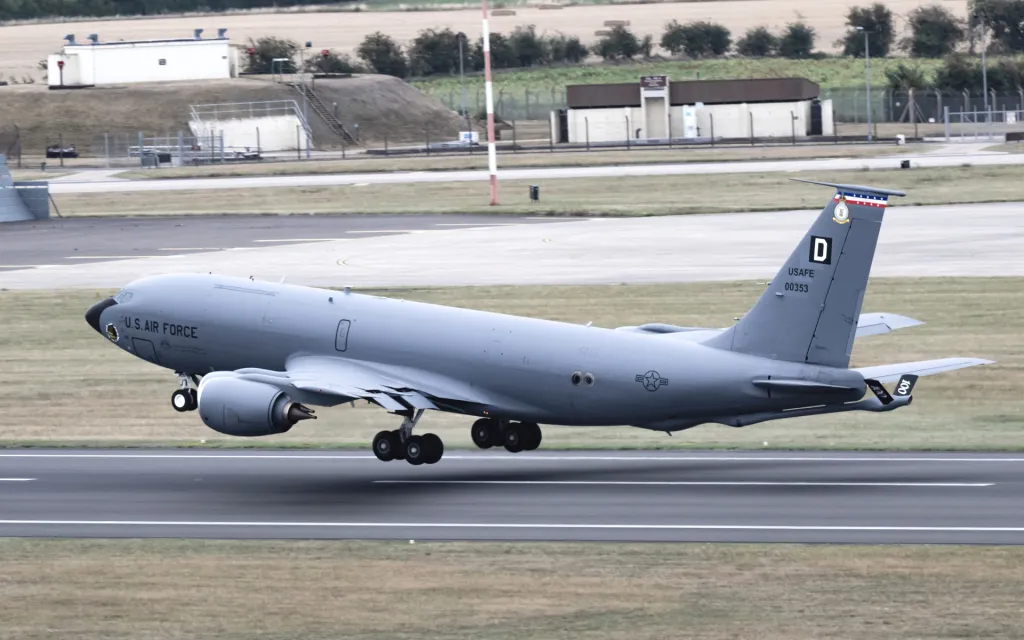
Pictures above and below show E-2Ds at Lajes on the island of Terceira in the Azores, a Portuguese archipelago, last night. Online flight tracking data had also shown the Hawkeyes heading there. We can also see that the Hawkeyes are upgraded versions capable of being refueled in flight, via a probe prominently mounted above the cockpit. In line with this, a pair of U.S. Air Force KC-46 Pegasus tankers had been tracked accompanying the Navy aircraft to Lajes, as well.

Previous tracking data shows the E-2Ds flew first from Norfolk, Virginia, to Bangor, Maine, last Friday. The Hawkeyes then departed Bangor yesterday, heading east across the Atlantic.
Markings visible in the pictures from Lajes show that at least some of the E-2Ds that touched down there are assigned to Carrier Airborne Early Warning Squadron 121 (VAW-121) based at Naval Air Station Norfolk (NAS Norfolk). There had been indications earlier that the contingent included Hawkeyes from VAW-126, also based at NAS Norfolk, but this appears to be unconfirmed at this time. VAW-121 and VAW-126 are assigned to Carrier Air Wing 17 (CVW-17) and CVW-1, respectively. CVW-17 was notably most recently attached to the supercarrier USS Nimitz, which had been scheduled to be put into mothballs in May, but is now slated to remain in service at least until March 2027.

It remains to be seen where exactly the E-2Ds head to now, but, as noted, U.S. military aircraft regularly pass through the Azores while transiting to the Middle East. Lajes was heavily utilized during the massive build-up of American airpower ahead of the start of U.S.-Israeli strikes on February 28. The American component of this campaign has been dubbed Operation Epic Fury.
The conflict has taken on a regional character, with Iranian missiles and drones having now fallen on a dozen countries across the Middle East and the Eastern Mediterranean. There is also a distinct maritime dimension to the fighting, with Iran choking off the highly strategic Strait of Hormuz with attacks on commercial vessels, and discussions now about how to reopen that critical waterway.
A deployment of E-2Ds could help provide much-needed additional eyes in the sky, as well as other capabilities, to help protect against Iranian retaliatory attacks, as well as support strikes on targets in and around Iran and/or any efforts to establish sea control in the region. In particular, the Hawkeyes are America’s best available tool for spotting low-flying, low-signature targets, such as kamikaze drones and cruise missiles, as well as small targets at sea like explosive-laden drone boats. The E-2D is also well-suited to performing these missions in littoral areas like the Persian Gulf, the Gulf of Oman, and the Strait of Hormuz in between. Hawkeyes performed similar missions in and around the Red Sea between late 2023 and early 2025.

As noted in the opening of this post, there is already an especially pronounced demand for additional assets, and more capable ones, to spot and track low-flying Iranian kamikaze drones and cruise missiles. This was already evidenced by the Australian government’s announcement last week that it was sending one of its E-7A Wedgetail airborne early warning and control aircraft to the region to help with defensive operations, something we will come back to later on.
In addition, from what is known now, U.S. forces taking part in operations over and around Iran are receiving airborne early and warning control support from U.S. Air Force E-3 Sentry AWACS (Airborne Warning and Control System) aircraft forward-deployed at Prince Sultan Air Base in Saudi Arabia. As noted, Navy Hawkeyes have also already been flying missions as part of Operation Epic Fury from the decks of carriers in the region.


Before the current conflict erupted, TWZ explored in detail the challenges and limitations that the aging E-3s face, including struggles just to keep the aircraft operational at all. On top of that, the total size of the Sentry fleet has dramatically shrunk in recent years, creating additional strain on the remaining jets, nearly 40 percent of which are now on the Arabian Peninsula. Based on available readiness data, this represents an even higher percentage of E-3s available for real-world mission tasking anywhere globally.
Just in terms of their radars, the E-2Ds with their active electronically scanned array (AESA) AN/APY-9s offer a major boost in capability over the older E-3s and their older passive electronically scanned array (PESA) types. In general, AESAs can scan faster, see farther, and produce more precise and otherwise higher fidelity tracks, even when it comes to smaller objects and/or stealthy ones with reduced radar signatures, than older types of arrays. The APY-9, specifically, also benefits from “space-time adaptive processing” functionality that “suppresses clutter, jamming, and other sources of electromagnetic interference, focusing on the target,” according to the manufacturer Lockheed Martin.
As such, with the added benefit of being able to look down from a high perch, the E-2D offers a particularly powerful tool for spotting and tracking smaller, lower, and slower-flying threats, such as Iranian kamikaze drones and cruise missiles. This capability was optimized for overwater and littoral operations to protect the carrier strike group. In addition, the APY-9 has a surface search mode that can be used for maritime surveillance, which, as already mentioned, is also very relevant in the context of the current conflict. Overall, these talents would fit in perfectly with what’s happening in the Persian Gulf and the Gulf of Oman.
Unlike older E-2s, Hawkeyes with aerial refueling capability can also fly out to operating areas further away from wherever they are based and stay on station much longer.

In Navy service, the E-2D is far more than just its radar, too. The aircraft have an extensive communications and networking suite that is tied in directly to the service’s Cooperative Engagement Capability (CEC) and Naval Integrated Fire Control-Counter-Air (NIFC-CA) architectures.
CEC – Cooperative Engagement Capability
As part of these Navy-specific networks, the Hawkeyes are deeply integrated in ‘kill webs’ that include an array of air and sea assets in the service’s inventory. For many years now, the Navy has used the example of E-2s enabling ships to fire long-range SM-6 surface-to-air interceptors at targets beyond the reach of their organic radars and other sensors to explain the benefits of these networked capabilities. CEC and NIFC-CA also just allow commanders to have a more detailed and complete picture of the battlespace around them, including friendly assets and threats, and offer a valuable boost in general situational awareness.

It should also be noted that while Navy E-2s more often operate as part of carrier air wings, the service’s Hawkeyes flying from bases on land is not new. Between 1995 and 2017, the service even had an explicitly land-based E-2 unit, VAW-77, which supported counter-drug operations in the Caribbean from bases in the United States and in Latin America. The majority of non-U.S. E-2 operators, past and present, have also operated their Hawkeyes as land-based aircraft. At the same time, since it was primarily designed around carrier operations, the Hawkeye also has the ability to fly from shorter runways and with a smaller logistics footprint compared to many other airborne early warning and control platforms.
TWZ actually already covered much of this in detail back in 2024 after U.S. Central Command (CENTCOM) released the video below, showing a Navy E-2D refueling from a U.S. Air Force HC-130J combat search and rescue aircraft somewhere in the region. At that time, we also explored how Hawkeyes could bring similar benefits to expeditionary and distributed operations elsewhere in the world, especially an island-hopping campaign in the Pacific, as you can read more about here.
It is also interesting to consider all of this now in the context of the Pentagon’s attempt last year to cancel the U.S. Air Force’s acquisition of new E-7s to replace a portion of its E-3s, and to fill interim capability gaps with additional E-2Ds instead. Questions about the Wedgetail’s survivability in a future high-end fight, such as one against China, as well as delays and cost overruns, were cited as key factors. Congress has since compelled the Air Force to proceed with the E-7A program as planned. Last Thursday, Boeing received two contract modifications, together valued at just over $2.4 billion, for an unspecified number of developmental Wedgetails, as well as materials related to the MESA sensor system.
There do continue to be some lingering questions about the future of the Air Force’s E-7 program. The service had resisted seeking any kind of direct replacement for the E-3 for years. The Air Force’s stated long-term goal remains to push most, if not all, of its airborne target warning sensor layer tasks into space, but this is still years away, at least, from becoming a reality.

As TWZ has explained in the past, while the E-2D is in many respects the most capable airborne early warning and control aircraft currently in U.S. inventory, the Wedgetail is arguably the most capable such aircraft anywhere globally at present. The jet-powered, Boeing 737-based, aerial refueling-capable Wedgetail with its large AESA Multi-role Electronically Scanned Array (MESA) sensor, can fly higher, faster, and further than the turboprop Hawkeye.
Northrop Grumman MESA Radar – Boeing E-7 AEWC
The E-7 is also just bigger and can accommodate a larger crew, making it even more adaptable to expanded mission needs, such as battle management and acting as a networking node using its own expansive communications and data-sharing suite. Any survivability concerns that apply to the E-7 would apply just as much to the E-2, as well. As noted earlier, the benefits of the E-7, including in the current context of operations against Iran, are underscored by Australia’s decision to send one of its Wedgetails to the Middle East. That aircraft is explicitly being deployed to help defend the United Arab Emirates and other countries in the region that have been subjected to Iranian drone and missile attacks.

The group of Navy E-2Ds now heading east across the Atlantic only further calls into question the Pentagon’s puzzling move to axe the E-7 program, as well as the Air Force’s previous dragging of its feet in settling on any plan to replace the aging E-3s. That additional Hawkeyes only appear to be headed to the Middle East now is also another sign that the scale and scope of Iranian retaliation on Gulf Arab States was somehow not expected, despite repeated threats from the regime in Tehran in the lead-up and supporting intelligence assessments to the current conflict. For many years, U.S. intelligence thought it was likely Iran would lash out at U.S. allies in the region, especially those housing U.S. military capabilities. It was a glaring likelihood we have discussed for years in our own reporting.
Regardless, additional Hawkeyes would provide a massive and very much-needed boost in aerial surveillance capability and capacity, as well as other benefits, to help defend against Iranian retaliatory attacks and otherwise support still-expanding U.S. operations against that country.
Special thanks to user @Azorean_Lion on X for sharing the pictures of the E-2D Hawkeyes at Lajes with us.
Contact the author: joe@twz.com
As United States President Donald Trump tries to build a coalition of navies willing to open the Strait of Hormuz, some countries are negotiating safe passage directly with Iran, underscoring a new de facto reality, analysts say: Regardless of military results, Tehran is calling the shots on who gets to use the world’s most important energy waterway.
After US-Israeli strikes on Iran began on February 28 and killed Supreme Leader Ali Khamenei, the Iranian military leadership responded by focusing on its most potent form of leverage – Iran’s geography. The country controls the northern shore of the Strait of Hormuz, through which 20 percent of global crude oil and natural gas supplies pass. It is 33km (20 miles) wide at its narrowest point, so any naval force that wants to cross it becomes easy prey for Iranian attacks coming from the mainland.
list of 3 itemsend of list
Considering insurance companies’ low appetite for risk, it took relatively few attacks on vessels in the strait – or just the threat of them – to undermine market confidence and send insurance premiums shooting up, causing a near paralysis in maritime traffic. About 20 vessels have been attacked since the start of the war.

“Iran has effectively proven that it dictates the terms of passage through the strait. They have now shown they are the gatekeeper of this important chokepoint. This will elevate the status of Iran in the geography of the Gulf,” said Andreas Krieg, an associate professor in Security Studies at King’s College London and a fellow at King’s Institute of Middle Eastern Studies. This will be the new reality for the foreseeable future, he added.
Meanwhile, crude prices have risen above $100 a barrel, more than 20 percent higher than pre-war prices, forcing countries to make the biggest releases of emergency reserves in history. Gas prices have risen by more than 40 percent since the war began.
Trump initially floated the idea of ordering the US Navy to escort vessels through the waterway. He then appealed to some countries to send warships and warned NATO members they would face “a very bad” future if these allies failed to help in opening the strait. But the appeal was either turned down or received noncommittal responses. Japan said it had no plans to deploy naval vessels. Australia ruled out sending ships. The United Kingdom said it would not be drawn into the wider war. Germany sent a clear message: “This is not our war”.
Others decided to take action – but not of the kind that Trump asked for. On Saturday, two India-flagged gas tankers passed through the strait after days of negotiations between New Delhi and Tehran, including a phone call between Indian Prime Minister Narendra Modi and Iranian President Masoud Pezeshkian. Ships from Pakistan, Turkiye and China also have transited through the Strait of Hormuz. The Financial Times has reported that Italy and France have also reached out to Iran for deals although Italian authorities have rejected making such an overture.
Meanwhile, Windward, a maritime intelligence tracking group, said that while traffic in the strait on Tuesday remained 97 percent below average, a growing number of ships have been passing through Iran’s territorial waters, suggesting that Tehran is allowing “permission-based transit”.
There is a precedent for US naval forces to escort convoys through the strait dating back to the Iran-Iraq War in the 1980s. But today’s scenario is different, experts said. Back then, the US, while it was backing Iraqi leader Saddam Hussein, was not a direct party to the conflict. Iran was still in a post-revolutionary process of consolidating power, and its Islamic Revolutionary Guard Corps was nowhere near as organised as it is today.
Today, Iran has drones that its factories are capable of producing on a large scale and has been using them. Iranian forces could also use small boats to assault tankers, deploy mines and engage in other guerrilla-style tactics. While there are conflicting reports on whether Iran has placed mines in the strait, experts said it would be a counterproductive move for Tehran because it would disrupt the passage for any ships – Iranian vessels included – and it would take away from Tehran the power to choose who may pass.
Iranian officials are aware of their geographic advantage. “This is up to our military to decide,” Iranian Foreign Minister Abbas Araghchi said on Sunday, referring to who will be allowed to use the strait.
Pro-government figures increasingly frame the Strait of Hormuz as a strategic bargaining tool beyond the war itself, suggesting the waterway could be used to extract compensation, sanctions relief or broader economic concessions after the war, Hamidreza Azizi, an expert on Iran and visiting fellow with the German Institute for International and Security Affairs, commented on X.
Recent attacks seem to suggest that Iran wants to increase its pressure on the energy market.
On Tuesday, a drone attack caused a fire at the port of Fujairah, the United Arab Emirates’s only crude export terminal. It is located outside the eastern entrance of the Strait of Hormuz, allowing its exports to circumvent it. The Iran-backed Houthis in Yemen could also further squeeze oil prices by disrupting the Bab al-Mandeb strait. That would force the US to operate across multiple maritime theatres. So far, the Houthis have not carried out such attacks, but this month, they said they were ready to strike at any moment.
Still, the US is focused on applying maximum pressure on Tehran and forcing it to open the Strait of Hormuz. The US Central Command, the US military’s combat command responsible for operations in the Middle East, said early on Wednesday that its forces had used 2,270kg (5,000lb) bunker-busting munitions against antiship missile sites along Iran’s coastline near the Strait of Hormuz.
Trump has also ordered amphibious ships carrying thousands of US Marines to move to the Middle East, and some experts believe the US might try to seize Kharg Island, a tiny piece of land in the northern Gulf where 90 percent of Iranian crude oil is exported from. The US has already bombed what it said were military sites on the island.
Such an operation, however, might do little to force Iran into opening the Strait of Hormuz, Krieg said. The island is 500km 310 miles) from the strait, and should the US take control of it, it would expose US Marines to Iranian fire. Should Iran see its key terminal being seized, it could also opt to mine the strait outright, having fewer reasons to allow some vessels to pass through.
“The issue with the Strait of Hormuz is really not a military one. … It’s a market issue, and confidence cannot be restored by the military. Confidence can be restored through diplomacy only,” Krieg said.
A left-footed winger cutting in from the right flank? It just feels natural at Bayern Munich.
It was an Arjen Robben trademark – now it’s Michael Olise’s.
Bayern go into the second leg of their last-16 tie with Atalanta in the Champions League on Wednesday holding a 6-1 advantage.
That’s thanks to a dazzling performance from the 24-year-old in the first leg, when he scored twice and laid on an assist.
The display was in keeping with Olise’s remarkable form since he joined from Crystal Palace in the summer of 2024 – no one in Europe’s top five leagues has more than his 23 assists in all competitions this season, no winger can top his 38 goal involvements.
It’s no wonder he’s now being talked about as one of the best players on the planet.
“It’s nice to hear but there’s half of the season still to play, so I’m focused on the team and on team titles now,” said the typically relaxed Frenchman on a potential Ballon d’Or after his masterclass in Bergamo.
He may have a laid-back attitude and a languid playing style, but behind the calm exterior there is a steely determination.
“I don’t want to compare the players because they’re not the same but [he has] the mentality of [former Manchester City player] Kevin de Bruyne when I played with him,” said Bayern boss Vincent Kompany after the Atalanta game.
“I was lucky to watch him come through as a young player and become a superstar. I saw the whole process and it is that obsession with detail that Michael has.”
For years, Beirut’s southern suburb has been spoken about as though it were a world apart: A Hezbollah bastion, a target, a warning, or a battlefield. But in Arabic, the word “dahiyeh” simply means “the suburb”.
The word itself is ordinary. What makes it extraordinary in Lebanon is its history.
list of 4 itemsend of list
When the Lebanese speak of Dahiyeh, they do not mean any suburb of their capital city. They mean southern Beirut in particular – a dense belt of neighbourhoods that grew from villages, fields, informal housing and municipal edges into a major extension of the city.
Dahiyeh – in size nearly as big as municipal Beirut – has been shaped by migration and displacement in the past 50 years. While many moved there in search of work or housing, most of the others were pushed there by wars, political unrest, evictions and a general sense of being neglected by the Lebanese state.

The social geography of Lebanon, which gained independence from French colonisers in 1943, began to be transformed in 1948 when Israel’s establishment saw the expulsion of more than 700,000 Palestinians from their land in what is commonly referred to as the Nakba. After Israel’s further occupation of Palestinian lands in 1967 and the expulsion of Palestinian fighters from Jordan in 1970, southern Lebanon and parts of Beirut became increasingly bound up with the Palestinian national movement.
Dahiyeh’s growth, however, accelerated after 1975, when the Lebanese civil war broke out. People displaced from other parts of Beirut moved south. The subsequent Israeli attacks and invasions in 1978 and 1982 drove more people to the edge of the capital. In that sense, Dahiyeh was not just a destination for “migrants”. It was also a refuge for the uprooted, the poor, and those repeatedly forced to start over.
Studies by scholars such as Mona Harb, professor of urban studies and politics at the American University of Beirut (AUB), show how a common noun – Dahiyeh – gradually evolved into a distinct political space: A stigmatised periphery marked in the Lebanese imagination as Beirut’s “belt of misery” that hardened into a territory with its own social and political significance. Today, it is part of Greater Beirut, woven into the capital geographically, economically and socially, even if the country’s politics may have treated the area as an outlier.
Harb’s work explicitly frames the southern suburb as a politically produced urban territory rather than just a space outside Beirut. To understand how that happened, one has to begin with the making of modern Lebanon.
Under the French Mandate, and later through the political order consolidated at independence in 1943, power in Lebanon was distributed through a sectarian system that heavily favoured the established elites, especially the Maronite Christians, who dominated the presidency and other key positions. The system not only created inequality, but also formalised and reproduced it.
Rural Lebanon, especially the south and the Bekaa Valley, remained underdeveloped and politically neglected for decades. Among those most affected were Lebanon’s Shia community, who were disproportionately concentrated in the poorer agricultural regions and had less access to state investments, infrastructure and patronage than the more privileged urban and mountainous centres. Scholars say it was not simply a temporary developmental gap, but a long history of marginalisation that defined the country’s politics.

Israeli attacks on Palestinian positions inside Lebanon repeatedly hit the surrounding Lebanese communities as well, mainly in the south. For the Shia in southern Lebanon, these attacks sharpened a bitter awareness: They were living on the front lines of a bitter regional conflict, while they were also being denied equal economic rights and meaningful political inclusion in Lebanon itself.
Out of that reality emerged a new form of Shia political mobilisation centred not only on identity, but also on deprivation, dignity and state neglect. That mobilisation found its earliest expression in Harakat al-Mahroumin, the Movement of the Deprived, founded by Imam Musa al-Sadr in the 1970s. Al-Sadr became a towering figure of modern Lebanese Shia politics because he gave social, religious and political forms to grievances building up for decades. That movement later grew an armed wing: Amal.
Al-Sadr’s mysterious disappearance during a 1978 trip to Libya remains unresolved and politically contested to this day. What is not contested is his historical importance. He helped turn the Shia of Lebanon from a neglected rural underclass into an organised political constituency demanding equal rights, representation, and a defining national presence.
The 1982 Israeli invasion of Lebanon changed the Shia political landscape yet again. Israel’s siege of Beirut, the departure of Palestinian icon Yasser Arafat and his Palestine Liberation Organization forces, and Syria’s desire to dominate Lebanon all intensified divisions within Lebanese society.
Amal, which meanwhile had grown closer to Damascus to get weapons, money and political backing, remained a major force. But new Islamist movements emerged from within and around it, shaped by the Israeli occupation, disillusionment with older leaderships, and increasing support from Iran’s Islamic Revolutionary Guard Corps, especially in the Bekaa region.
Over time, these currents crystallised into Hezbollah. The split within the Shia movement was less theological and more about political strategy, defined by questions over aligning more closely with Syria, solidarity with the Palestinians, and general resistance against the Israeli occupation. Differences between Amal and Hezbollah over these questions turned violent in the 1980s, an intra-Shia fighting that Lebanese often recall as “a war among brothers”.
As Hezbollah grew stronger, Dahiyeh became much more than a residential belt. It turned into an urban heartland of a social and political force. Hezbollah built institutions there: Offices, schools, clinics, welfare networks and media infrastructure. Amal also had a presence, but the common shorthand that reduces Dahiyeh to a “Hezbollah stronghold” always conceals more than it reveals.
Today, Dahiyeh hosts a Shia majority, but also has a small minority of Palestinians and other Lebanese communities, including Christians. It bleeds physically into what is known as Greater Beirut, including its Christian and mixed areas. So when the suburb is bombed, it is not some isolated military island that is hit, but a deeply inhabited part of urban Beirut.
That is precisely why Dahiyeh is so central to the Israeli military’s thinking. During the 2006 war, large sections of the southern suburb, especially Haret Hreik, were devastated by Israel. The destruction became so emblematic that Israeli military strategists came up with what came to be known as the Dahiyeh Doctrine: Use of overwhelming force and large-scale destruction of areas associated with an armed group, with the aim of generating deterrence and putting pressure on residents supporting the group. Rights activists and legal scholars say the doctrine violates international humanitarian law, as civilian neighbourhoods and infrastructure do not become legitimate targets simply because an armed group is embedded among the population.
That Israeli pattern, however, has intensified since October 2023, when a genocidal war on Gaza and attacks on Lebanon began. Meanwhile, the killing of Hezbollah leader Hassan Nasrallah in an Israeli strike in late 2024 eroded Dahiyeh’s resistance. That erosion is more visible in the ongoing Israeli attacks on Beirut and southern Lebanon, where more than a million people have registered as displaced since March 2. The old formula – that Dahiyeh was the principal red line and that any strikes there could be deterred by Hezbollah’s threats of retaliatory strikes on several Israeli cities – no longer holds.
Once again, Dahiyeh has become a focal point of the war, with repeated bombardment sending plumes of smoke over a place that many outsiders still describe as a world apart, but which is in fact woven into Beirut’s daily life. Built over decades by the poor, the migrants and the repeatedly uprooted – and shaped by the politics of marginalisation against those whom al‑Sadr once named “the deprived” – Dahiyeh has long served as both a refuge and a front line. Today, it is again being made to carry the costs of a conflict larger than itself.
Umar Muhammad Mustapha had just stepped out of the mosque when he heard someone say an explosion had gone off in the Maiduguri Monday Market area on the evening of March 16. He panicked and asked when. “Just a moment ago,” someone replied, “while we were praying.”
Immediately, Umar began dialling his nephew’s number as he rushed toward the scene without first returning home. “The phone kept ringing, but he did not answer. A few moments later, it prompted ‘switched off’,” he recalled.
That was when the panic deepened.
“I began dialling those whose shops were close to ours.”
Umar sells gabgab at the market. His nephew, Muhammad Ibrahim, makes the local incense while he sells it. The 27-year-old has been with Umar since he was nine.
As he moved through the city that Monday evening, his thoughts raced ahead of him. “I began to imagine the condition in which I would meet him,” Umar said. “Is he alright? Is he alive? Is he dead? Is he injured? And how bad his injuries might be.”
They both work at the market, but that day, Umar stayed at home.
That night, at around 7 p.m., three explosions simultaneously rocked parts of Maiduguri, the Borno State capital in northeastern Nigeria, including the Monday Market, the Post Office area along Ahmadu Bello Way, and the entrance of the University of Maiduguri Teaching Hospital (UMTH).
As he hailed a tricycle to rush to the market, Umar was restless. “I felt as though the keke was not going fast enough and kept urging the driver to go faster,” he said.
Before he reached the market, Umar’s phone rang, and Muhammad’s name was displayed. But when he answered, a different voice spoke. “Come to the emergency ward of General [State Specialist Hospital],” the person said.
In that moment, uncertainty gave way to reality. “An explosion occurred; he was affected,” the person continued. “He was brought to the hospital. You are the last person he talked to, so we are reaching out.”

The blasts at the market and the Post Office were especially devastating. The two locations sit minutes apart. Traders had closed for the day and were heading home when the first explosion tore through the Elkanemi junction, near the market.

In the immediate aftermath of the first blast, many people scattered and ran towards the Post Office area. Muhammad was among them. At the time Umar was trying to reach him, he had already escaped the market blast. In the confusion, he could not hear his phone. As he ran towards the Post Office area, another explosion went off.
It caught him, and he sustained injuries to his chest and legs.
When HumAngle visited the hospital on Tuesday, March 17, Muhammad could not speak, only nodding when spoken to. Umar said he was scheduled for surgery later in the evening.

Other survivors also carry similar stories.
Mohammed Babagana Bukar had just bought a pair of shoes for Eid al-Fitr, which is in a few days, with money he earned as a porter at the market. When the blast happened, the 15-year-old said, “We panicked and began running towards the Post Office when another one went off, close to where the flyover is being constructed.”
He was brought to the hospital by a stranger. “He carried me as I could not walk.”
Fantami Modu didn’t escape the first blast that rocked the market; he was injured.
“It affected my leg,” the 40-year-old said. “We were brought to the hospital by the police.” Fantami sells clothing materials and earns about ₦7,000 daily. It is what he uses to feed his family.
Get our in-depth, creative coverage of conflict and development delivered to you every weekend.
Subscribe now to our newsletter!
Now, he cannot work. Beside him, his brother, Babagana, said they are contributing to support the household until he recovers.
According to the Borno State Police Command, 23 people were killed, and 108 were injured in the multiple bomb blasts. No terror group has claimed responsibility for the attacks, but the Nigerian Army said they were “carried out by suspected Boko Haram terrorist suicide bombers”.
“Preliminary information further indicates that the terrorists may have deployed multiple suicide bombers into Maiduguri with the intention of carrying out coordinated suicide bombings at crowded locations,” Lieutenant Colonel Sani Uba, Media Information Officer of the Joint Task Force North East Operation Hadin Kai, said in a statement.
At the State Specialist Hospital, where victims were first rushed to, HumAngle counted 13 survivors on admission. The hospital is less than two kilometres from the scenes. Of these 13, 11 were males and two females, with varying degrees of injuries to the arm, leg, and chest.
Nurses at the hospital said at least 40 people were brought to the emergency ward that night, with many later referred to the UMTH. Only 14 survivors were eventually admitted, but one died on arrival.

UMTH was also targeted that night. An explosion that went off at the hospital’s entrance. Although no civilian casualties were recorded, sources said that a suspected suicide bomber, who tried to enter the hospital on a bicycle before he was stopped by security operatives, died in the incident.
For some residents, the events revived familiar anxieties.
“We had just broken our fast and were waiting for a tricycle to return home when we heard the explosion close to the Monday Market,” Sulaiman Muhammad, a resident, recounted. “Less than 20 minutes after, we heard another one from the Post Office area. In panic, we scattered.”
He did not go to the scene. “It is dangerous,” he said. “I remember in one explosion like this inside the market at the peak of the [Boko Haram] insurgency, another explosion went off immediately people gathered to help victims.”

Now, those memories are resurfacing. “People are in panic,” he said. “We had begun to experience relative calm until the past few days.”
Sulaiman has sold shoes at the market for more than 20 years. He believes the attacks will affect business. “As you can see, no one is out [to sell],” he said.
These incidents are part of a broader pattern of escalating violence.
The explosions came barely 24 hours after terrorists attacked a military base in Kofa, a community close to Ajilari on the outskirts of Maiduguri, on March 16. Joint security operatives repelled the attack, leaving many terrorists dead.
However, before then, there had been attacks by terror groups across Borno State, including assaults on rural military bases and resettled communities like Ngoshe and Dalwa. Also, on Dec. 25, 2025, a suicide bomber detonated at a mosque in the Gamboru Market area of Maiduguri. Five people were killed, and 35 others were injured.
Taken together, these incidents point to what observers describe as a violent resurgence. HumAngle has reported that the terror groups operating in the region have undergone several technological shifts that have aided their expanded attacks and operations, including the use of artificial intelligence and drones.
For Umar, the incident has narrowed into something smaller, more personal.
Muhammad, he said, loves to read.
“He would read verses from the Qur’an after his morning prayer. And after breakfast, he would head to the market. And by evening, he would return home. He would read in the evening too, before going to bed.”
When asked what he hopes for, Umar paused.
“I would have hoped for more security or for more vigilance,” he said. “But what would an empty hope solve? Authorities know what to do. They would act properly if they intend to.”
Wave of Israeli air attacks launched as ground offensive widens in south where Hezbollah are fighting Israeli forces.
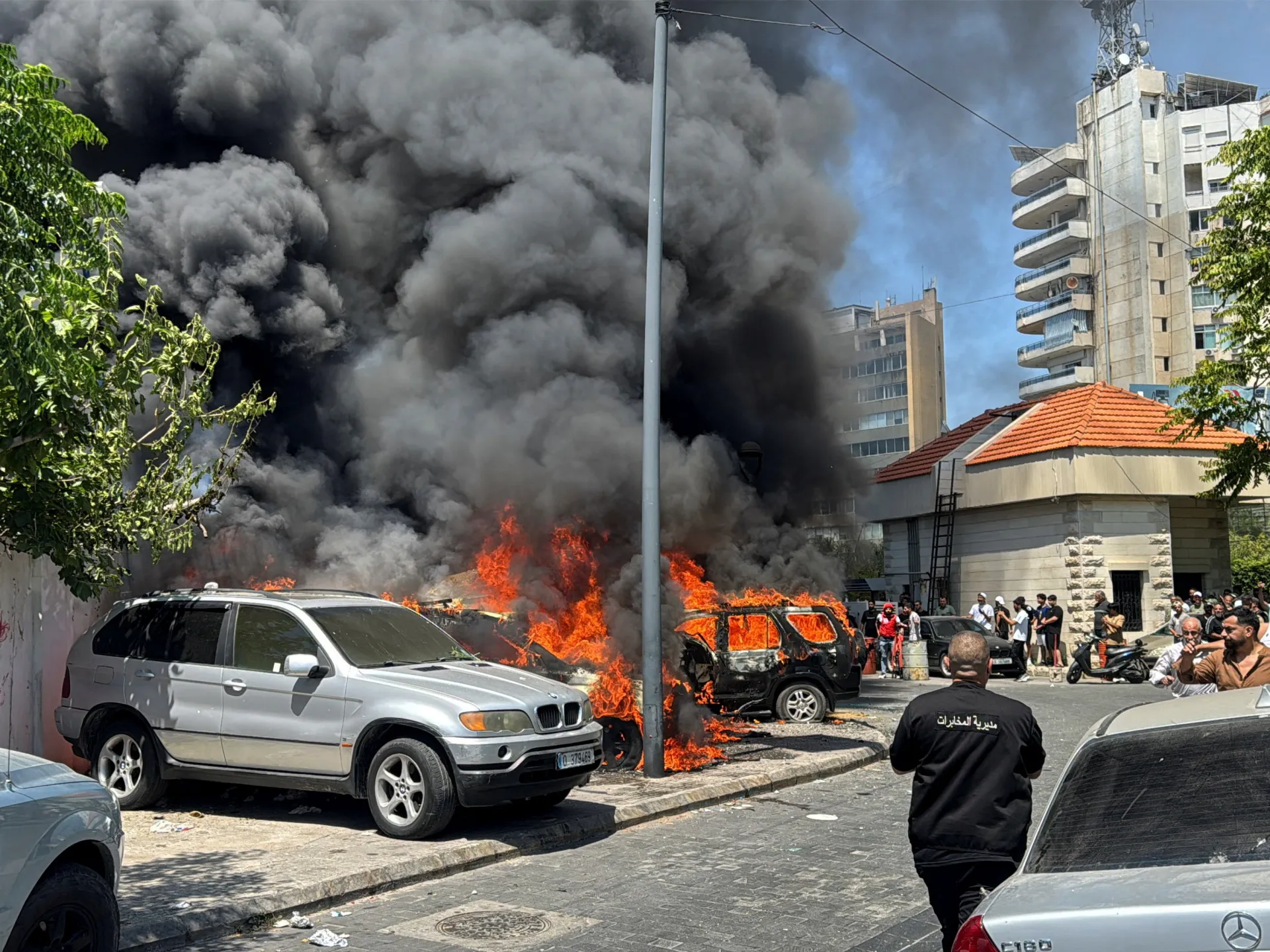
Israel has attacked a building in Bashoura, a neighbourhood in the heart of Beirut, Lebanon’s National News Agency (NNA) reported, with a blast and smoke rising over the area shortly after Israel issued an evacuation threat for the site.
The attack was part of a deadly wave of Israeli strikes across Lebanon that killed at least 20 people and wounded 24 on Wednesday, according to the country’s Ministry of Public Health, with raids stretching from the capital through southern and eastern parts of the country, a devastating front in the wider United States-Israel war against Iran embroiling the region.
list of 2 itemsend of list
At least six people were killed in the air strikes in Beirut, with dozens injured.
Al Jazeera’s correspondent in Beirut, Zeina Khodr, reported that intense Israeli attacks hit multiple regions across Lebanon, including central Beirut, overnight.
Speaking from in front of a 15-storey building struck in one of the attacks, Khodr said its lower floors had been targeted a week earlier. In the early hours, however, the structure was completely demolished, with the Israeli army claiming Hezbollah had stored cash there.
“You can see the widespread damage across this whole neighbourhood,” Khodr said.
Israel’s military said it had launched what it described as limited ground operations in southern Lebanon, issuing evacuation threats for residents of four towns near the Zahrani River and the Tyre area, warning them to head north immediately.
Lebanon’s NNA also reported strikes on Tyre and the nearby area of Al-Burj Al-Shamali in the pre-dawn hours.
At least four people were killed in an Israeli attack that targeted four houses in the town of Sahmar in eastern Lebanon’s Bekaa Valley.
The intensifying assault has now killed at least 912 people in Lebanon, including 111 children, and wounded more than 2,200 since Israel launched its offensive on March 2, according to Lebanese Health Ministry figures.
More than one million people have been forced from their homes. The United Nations warned on Tuesday that Israeli attacks on residential buildings and civilian infrastructure may constitute war crimes under international humanitarian law.
A spokesperson for the UN human rights office said that deliberately targeting civilians or civilian objects “amounts to a war crime”, adding that Israel’s sweeping displacement orders for southern Lebanon may themselves violate international law.
Khodr said that Hezbollah’s secretary general, Naim Qassem, last night laid down conditions for the war to end, including Israel stopping attacks, displaced people being permitted to return to their homes, those detained over the last two years by Israel being released and the Israeli army withdrawing.
Across southern Lebanon, Khodr said Hezbollah was “still present in the area, trying to repel the Israeli army’s advance”, adding that Hezbollah’s aim was not just territorial control of the region, but preventing Israel from gaining new positions in the country.
The conflict was ignited on February 28 when US and Israeli forces assassinated Iranian Supreme Leader Ali Khamenei in Tehran, prompting Hezbollah to launch rockets into northern Israel on March 2.
Israel has since killed more than 2,000 people across Iran and Lebanon in its attacks.
German Chancellor Friedrich Merz, a staunch Israeli ally, added his voice to growing international concern, warning that Israel’s ground offensive in Lebanon was an “error” that risked worsening what he described as an already dire humanitarian situation.
Qatar, UAE, Kuwait and Saudi Arabia report new blasts, interceptions, with war edging to 3-week mark.
Iran has fired missiles and drones at several Gulf Arab nations, which have sought to intercept them, in a now-daily fallout from the United States-Israel war launched on Iran nearly three weeks ago that has engulfed the Middle East with deaths, destruction, assassinations, and an energy crisis spreading far beyond the region.
Early Tuesday, Qatar’s Ministry of Defence said its armed forces intercepted a missile attack against the country.
list of 4 itemsend of list
The Kuwait National Guard said it shot down an unmanned aircraft at dawn. The statement came hours after the Kuwaiti army said it was intercepting hostile missile and drone attacks.
The UAE, Saudi Arabia and Bahrain have also reported intercepting missiles and drones in recent hours.
Saudi Arabia’s Ministry of Defense reported the interception and destruction of a drone in the Eastern Region.
Earlier Tuesday, the UAE Ministry of Defence said the country’s air defences were “currently responding to incoming missile and drone threats from Iran”. The announcement came four hours after another reported attack from Iran. Later, a loud bang was heard in Dubai as authorities said air defences were dealing with a missile threat.
Al Jazeera’s Zein Basravi, reporting from Dubai, said, “The UAE has been the hardest hit by Iran’s retaliation. For instance, there have been 3000 different projectiles – missiles and drones – fired at GCC countries by Iran in terms of its retaliation. More than half, well over half, have targeted places in the UAE. Overnight was no different … Multiple explosions heard throughout the city.
“That glow of defensive weapons and interceptions in the night skies, something that has become all too familiar, not just in Dubai, but in cities across the GCC. Once again seen over the skies here.
“Dubai’s media office confirming that they were the result of air defence interception operations,” he added.
There have been several deaths in the Gulf nations, where an economic effect is also being acutely felt since the war began.
The economies of the Gulf are suffering some of the worst damage.
Iran has launched continuous attacks on Gulf states since the onset of the conflict on February 28, arguing that it is attacking military bases used by the US for the war. Gulf nations have rejected Tehran’s claims, insisting the attacks on them are unjustified.
The Iranian strikes have upended energy production and inflicted major disruption to tourism and travel, putting the region at risk of some of the most severe economic harm since the 1990-1991 Gulf War.
After nearly three weeks of war, the economic effect on the region has already been substantial.
Middle Eastern oil producers’ daily output declined from 21 million barrels to 14 million barrels after a little more than a week of conflict as they deal with the closure of the Strait of Hormuz, according to Rystad Energy.
The national power grid comes back on after Cuba’s 10 million people were plunged into darkness overnight.
Published On 18 Mar 202618 Mar 2026
Cuba has reconnected its power grid and brought online its largest oil-fired power plant, energy officials said, putting an end to a nationwide blackout that lasted more than 29 hours amid a United States move to choke off the island’s fuel supply.
After the country’s 10 million people had been plunged into darkness overnight, the Caribbean island’s national power grid had fully come back online by 6:11pm (22:11 GMT) on Tuesday. However, officials said power shortages may continue because not enough electricity is being generated.
list of 4 itemsend of list
In addition to cutting off oil sales to Cuba, US President Donald Trump has escalated his rhetoric against the Communist-run island, saying on Monday he could do anything he wanted with the country.
A US State Department official blamed the Cuban government for the grid collapse, calling blackouts a “symptom of the failing regime’s incompetence”.
Cuban President Miguel Diaz-Canel fired back at Washington, criticising its “almost daily public threats against Cuba”.
“They intend to and announce plans to take over the country, its resources, its properties, and even the very economy they seek to suffocate in order to force us to surrender,” Diaz-Canel wrote on social media on Tuesday night, shortly after power returned nationwide.
Cuba has yet to say what caused Monday’s nationwide grid failure, the first such collapse since the US cut off the island’s oil supply from Venezuela and threatened to slap tariffs on countries that ship fuel to the nation.
By midday on Tuesday, grid workers successfully fired up the Antonio Guiteras power plant, a decades-old behemoth that underpins the country’s power grid.
Electricity generation, hampered by dire fuel shortages and antiquated power plants, is still far below what is necessary to meet demand, providing scarce relief for Cubans already exhausted from months of blackouts.
Most Cubans, including those in the capital, Havana, were seeing 16 or more hours of blackout daily even before the latest grid collapse.
“It affects every aspect of our lives,” said Havana resident Carlos Montes de Oca, noting that the outages had thrown simple necessities such as food and water supply into disarray. “All we can do is sit, wait, read a book… otherwise the stress gets to you.”
Much of Cuba was overcast through the afternoon on Monday as a cold front neared the island, casting shadows on the solar parks that account for a third or more of daytime generation.
Cuba has received only two small vessels carrying oil imports this year, according to LSEG ship tracking data seen by Reuters on Monday. On Tuesday, a Hong Kong-flagged tanker that could be carrying fuel to Cuba resumed navigation after suspending its course weeks ago in the Atlantic Ocean, the data showed.
Cuba and the US have opened talks aimed at defusing the crisis, among the most acute since 1959, when Fidel Castro forced a US ally from power on the island.
Neither side has provided details of the ongoing negotiations, although Trump has portrayed Cuba as desperate to make a deal.
Cubans, no strangers to hardship, saw little choice but to stay calm.
“We still don’t have power at my house,” said Havana resident Juana Perez. “But we’ll take it in stride, as we Cubans always do.”
The US defence secretary designated the AI company a ‘supply chain risk’ after it refused to remove guardrails on its technology.
Published On 18 Mar 202618 Mar 2026
The administration of United States President Donald Trump has said in a court filing that the Pentagon’s blacklisting of Anthropic was justified and lawful, opposing the artificial intelligence company’s high-stakes lawsuit challenging the decision.
The administration made its comments in a court filing on Tuesday.
list of 3 itemsend of list
Defense Secretary Pete Hegseth designated Anthropic, the maker of popular AI assistant Claude, a national security supply chain risk on March 3 after the company refused to remove guardrails against its technology being used for autonomous weapons and domestic surveillance.
The Trump administration’s filing says Anthropic is unlikely to succeed in its claims that the US government’s action violated speech protections under the US Constitution’s First Amendment, asserting that the dispute stems from contract negotiations and national security concerns, not retaliation.
“It was only when Anthropic refused to release the restrictions on the use of its products — which refusal is conduct, not protected speech — that the President directed all federal agencies to terminate their business relationships with Anthropic,” the administration’s legal filing said. The filing, from the US Justice Department, said that “no one has purported to restrict Anthropic’s expressive activity”.
Anthropic’s lawsuit in California federal court asks a judge to block the Pentagon’s decision while the case plays out. Some legal experts say the company appears to have a strong case that the government overreached.
In a statement, Anthropic said it was reviewing the government’s filing. The company said that “seeking judicial review does not change our longstanding commitment to harnessing AI to protect our national security, but this is a necessary step to protect our business, our customers, and our partners.”
The White House did not immediately respond to a request for comment.
Trump has backed Hegseth’s move, which excludes Anthropic from a limited set of military contracts. But it could damage the company’s reputation and cause billions of dollars in losses this year, according to its executives.
The designation came after months of negotiations between the Pentagon and Anthropic reached an impasse, prompting Trump and Hegseth to denounce the company and accuse it of endangering American lives with its use restrictions.
Anthropic has disputed those claims and said AI is not yet safe enough to be used in autonomous weapons. The company said it opposes domestic surveillance as a matter of principle.
In its March 9 lawsuit, Anthropic said that the “unprecedented and unlawful” designation violated its free speech and due process rights, while running afoul of a law requiring federal agencies to follow specific procedures when making decisions.
The Pentagon separately designated Anthropic a supply chain risk under a different law that could expand the order to the entire government.
Anthropic is challenging that move in a second lawsuit in a Washington, DC, appeals court.