
Belgium

‘Most important spa town in Europe’ is a ‘hidden gem’ which ‘most people skip’

Situated in the south west of Germany, on the border of the iconic Black Forest mountain range, the city has jointly been designated a UNESCO World Heritage Site

If you’re thinking about a trip to Europe, but want something a bit off the beaten track, one “hidden gem” with historic spas, Roman ruins, and incredible museums could be just the ticket. Situated in the south west of Germany, on the border of the iconic Black Forest mountain range, the city has, along with Bath in Somerset and nine other locations, jointly been designated a UNESCO World Heritage Site as one of ‘The Great Spa Towns of Europe’.

Travel influencer Katherine McQueen, who has 685,000 followers on Instagram, where she is known as vineyardsandvoyages, posted a look into everything the city has to offer. She said: “This is one of Europe’s most elegant hidden gems… and most people skip it.”

Describing the city as “polished, romantic, and completely different from the bigger stops most travellers add to their itineraries”, she hailed its “pastel streets, grand architecture, thermal baths, elegant cafés, beautiful gardens, and old-world glamour around every corner”. But it was the history which she hailed as its most important element.

“People have been coming here for the thermal waters since Roman times, and wellness is still one of the biggest reasons to visit today,” she said. “You can soak in mineral-rich baths, wander through historic spa buildings, and experience a side of Germany that feels slow, refined, and deeply relaxing.”

Katherine also praised the city’s glittering casino, food – including, of course, the iconic Black Forest gateau – and location, calling it “one of the most unexpectedly charming places I’ve visited in Germany”.

The city in question is Baden-Baden, located around 15 miles east of the French border, and 42 miles west of Stuttgart.

In the post Katherine explained more about what the city has to offer. “Some of the bathhouses here feel more like palaces than spas, with mineral pools, grand domes, and centuries of wellness history,” she said. “But it’s not just a spa town. It’s also filled with elegant architecture, gardens, colonnades, and beautiful places to wander.”

She added: “The whole city has this refined, romantic atmosphere. Long covered walkways, grand buildings, art, gardens, and peaceful corners everywhere.”

Concluding, she said: “It has that rare mix of history, wellness, food, architecture, and nature, all in one very walkable little city. Everywhere you look, there are details that make it feel grand without feeling overwhelming. This town rewards slow wandering. Hidden side streets, stairways, dreamy corners, and beautiful views around every turn.”

The city’s official tourism website says: “Baden-Baden was founded 2,000 years ago to do people good. Thermal water at temperatures of up to 68 degrees gushes out of the earth from 12 thermal springs in Baden-Baden. Even today, our spa town at the foot of the Black Forest is the perfect place to enjoy spa tradition – whether in the Caracalla Spa or in the historic Friedrichsbad Spa.”

Content cannot be displayed without consent

How can I get to Baden-Baden?

By air: Direct flights to Baden-Baden are available from London Stansted Airport. Indirect flights are also available from most other UK airports.

By train: You can take the Eurostar to Paris or Brussels, with various connecting routes available.

By car: You can drive by taking the Eurostar and then heading south east through France, or east into Belgium before crossing, into Germany. Once arriving in France, the route is between 400 and 450 miles, taking between six and seven hours.

Source link

NATO chief says Europeans have ‘gotten the message’ from Trump on defence | European Union News

The US president has accused some NATO countries of not doing enough to support the US-Israel war on Iran.

NATO Secretary-General Mark Rutte says European leaders have “gotten the message” after United States President Donald Trump announced plans to withdraw 5,000 soldiers from Germany.

Trump has grown increasingly frustrated with NATO allies, accusing them of not doing enough to support the US-Israel war on Iran. Speaking on Monday, Rutte acknowledged “disappointment from the US side”.

Recommended Stories

list of 3 itemsend of list

“European leaders have gotten the message. They heard the message loud and clear,” Rutte said before a European Political Community meeting in Armenia.

“Europeans are stepping up, a bigger role for Europe and a stronger NATO,” he added.

The Pentagon announced the troop withdrawal from Germany on Friday, days after German Chancellor Friedrich Merz said Iran was humiliating the US during the negotiations aimed at ending the war.

The European Union’s top diplomat, Kaja Kallas, called the announcement’s timing a “surprise”.

“I think it shows that we have to really strengthen the European pillar in NATO, and we have to really do more,” Kallas said while stressing that “American troops are not in Europe only for protecting European interests but also American interests.”

Over the weekend, NATO spokesperson Allison Hart said officials in the 32-nation military alliance “are working with the US to understand the details of their decision on force posture in Germany”.

‘Dangerous military intervention’

European criticism of the war on Iran has mounted in recent weeks as the conflict sends shockwaves through the global economy due to the continued disruption to shipping in the Strait of Hormuz.

Last week, Merz compared the war to previous military quagmires, such as the US invasions of Iraq and Afghanistan.

“It is, at the moment, a pretty tangled situation,” he said. “And it is costing us a great deal of money. This conflict, this war against Iran, has a direct impact on our economic output.”

Spain has refused to let the US launch attacks on Iran from its airspace or military bases. Prime Minister Pedro Sanchez has condemned the war as “unjustified” and a “dangerous military intervention” outside the realm of international law.

In response, Trump called Spain “terrible” and threatened to end all trade ties.

Despite this, Rutte said “more and more” European nations were now pre-positioning assets such as minehunters and minesweepers close to the Gulf to be ready for the “next phase” in the war.

He provided no details, and European nations have previously insisted they would not help to police the Strait of Hormuz until the war is over.

Increased defence spending

Many European countries have committed to ramping up defence spending in the face of fears over Trump’s commitment to NATO and Russia’s assault on Ukraine – a push underscored by several leaders in the Armenian capital.

“Europeans are taking their destiny into their own hands, increasing their defence and security spending, and building their own common solutions,” French President Emmanuel Macron said.

“We have to step up our military capabilities to be able to defend and protect ourselves,” European Commission President Ursula von der Leyen told reporters.

Source link

Watch terrified Katie Price scream as she spends the night in ‘haunted’ house on ghosthunting trip in Belgium

KATIE Price was left screaming in terror as she took a trip to a haunted house in Belgium for a ghosthunting experience this week.

The mum-of-five documented her spooky trip by filming the whole thing, with fans watching as she spoke to ‘ghosts’.

Katie Price was left terrified as she took a trip to a haunted house this weekend in Belgium Credit: Katie Price/YouTube/Backgrid
The former glamour model filmed herself as she spoke to ‘ghosts’ at the secluded cabin Credit: Katie Price/YouTube/Backgrid

Katie drove from her home in the UK to Brussels with pal and cameraman Ben Algar as she headed to the European city to undergo more surgical procedures on her boobs and filler in her lips.

However, the she and Ben, who was behind the wheel due to Katie’s recent driving ban, decided to reside at a “haunted” Airbnb cabin during the trip.

Filming herself as they arrived for a new YouTube vlog, a terrified Katie is seen checking the cabin for ghosts.

Staring over at a lightbulb, she says: “If there’s any ghosts in here and you want us to go, that light I’m pointing at now, turn it off if you don’t want us to stay.”

SUPER STACE

Joe Swash brands himself a ‘proud husband’ in gushing message to Stacey Solomon


KITCHEN NIGHTMARE

Matt Tebbutt slams BBC over MasterChef: The Professionals axe

She was seen screaming as a flickering light seemingly confirmed her suspicions about paranormal activity Credit: Instagram/Katie Price/BackGrid
Katie was joined by close pal and cameraman Ben for the trip

As nothing happened, she said: “Well, at least it didn’t turn off.”

But just seconds later, the light seemingly flickered off, with Katie then screaming.

“What is going on?” said the worried star.

With her hands on her face, she said: “Noo. What are we doing?”

Whilst Katie was convinced the light was proof that ghosts were present, fans in the comment section of the video had other theories.

“I think its a motion sensor bulb lol,” laughed one.

Another agreed: “Katie is a sensor light, when you step forward it came on then went off when ye stepped back”.

Katie’s trip abroad with Ben comes after we revealed him as the “second man” in her life, alongside husband Lee Andrews.

Sources credit Ben as a ‘stable influence’ in the ex-glamour model’s life, in what has been another whirlwind few months for the star, following her driving suspension and surprise Dubai wedding to Lee Andrews in late January.

“The second man in Katie’s life is Ben, who has been by her side for years,” a source tells The Sun. “But he’s really stepped up recently amid her latest drama.

“He is probably the only stable man she’s ever had in her life outside of her family.

“They’re incredibly close friends and Ben has always quietly guided Katie, not only in her career but in her private life

“The whole family love him- he’s a really great friend to Katie and the entire Price gang. They all think he’s a legend.”

Source link

UK tourists face travel disruption on May 12 as new strike action confirmed

One airline is reducing its service that day by 60 per cent

UK holidaymakers are preparing for fresh travel disruption after the announcement of strike action. Media reports today confirm that Brussels Airlines is reducing its service by 60% on May 12. A spokesperson for the carrier confirmed the news on Tuesday.

Disruption that day is a possibility for Brits and others heading there, given that the airline flies regularly to and from London Heathrow, although details of flight cancellations have not yet been disclosed. It also has services to and from Manchester Airport and Edinburgh Airport.

The move follows Brussels Airport’s warning of expected disruption on that date due to nationwide industrial action. Numerous security workers and service providers will be downing tools.

Airlines have been requested to cap the number of departing passenger flights on the day in order to maintain safety and prevent excessive waiting times. The news site 7sur7 reports that the FGTB, CSC, and CGSLB unions are organising another major mobilisation in the streets of Brussels.

It marks the latest wave of strike action to hit the country. No passenger flights took off from Brussels Airport during the previous national demonstration, although commentators say disruptions are expected to be less severe on May 12, according to local media reports. “Just under half of the scheduled departures will be able to operate,” Zaventem Airport estimated.

In addition, strike action is also planned separately in the aviation sector. The Mirror reported on Tuesday that notice was lodged this week that could see strikes involving pilots.

The joint union front (CNE/ACV Puls, CSC Transcom, CGSLB/ACLVB, and Setca/BBTK) has filed a national strike notice for the entire Belgian aviation sector. Approximately 1.3 million Brits visit Belgium annually – suggesting hundreds if not thousands of UK travellers could be impacted on that single day alone. Brussels Airlines is cancelling roughly 60% of its flights that day, Le Soir reported.

Bosses say the long-haul network will bear the brunt, as these flights carry many connecting passengers. For shorter routes, the airline is giving priority to flights with the greatest number of direct passengers. “Further cancellations cannot be ruled out. Passengers whose flights are cancelled can either rebook or request a refund. We continue to monitor the situation closely; further cancellations cannot be ruled out,” says Brussels Airlines.

“Brussels Airlines is not involved in the labour dispute between the unions and the Belgian federal Government. Yet, the consequences always fall on our passengers, our colleagues, and our company. In the current geopolitical context (particularly with high fuel prices, editor’s note), such actions are irresponsible.”

“In collaboration with all relevant partners, Brussels Airport is working to ensure that as many flights as possible can depart that day,” the national airport said in a statement.

The airport, however, anticipates only minimal disruption to incoming flights. Passengers due to land at Brussels Airport that day are still urged to check the latest status of their flight directly with their airline.

The unions announced the fresh mass action at the start of the month. The demonstration forms part of a series of union actions they have been carrying out for over a year in opposition to the federal government’s reforms to policies including pensions.

The most recent national demonstration took place on 12 March. Between 80,000 people (according to the police) and more than 100,000 (according to the unions) took to the streets of Brussels. Not a single passenger flight departed from Zaventem Airport on that occasion.

Your rights as an airline passenger

According to the government’s gov.uk website, your airline, travel agent or tour operator is obliged to give you “clear and easy-to-understand information on the conditions of your travel at the point of booking.” Travellers are urged to check these carefully.

The website says: “Airlines and travel agents selling flight tickets must make clear the full price for all mandatory charges, such as taxes, at the time of booking. They should make clear any additional costs for optional extras. For example, for luggage allowance or seat selection.

“If you have booked a package that includes a flight (such as flight and accommodation or flight and car hire) you may also have both package and ATOL protection. Take your ATOL Certificate with you.”

Source link

Spain airport delays update as one group hit with longest waits over April ‘change’

Many passengers are facing waits of up to three hours at Spanish airports due to the new controls

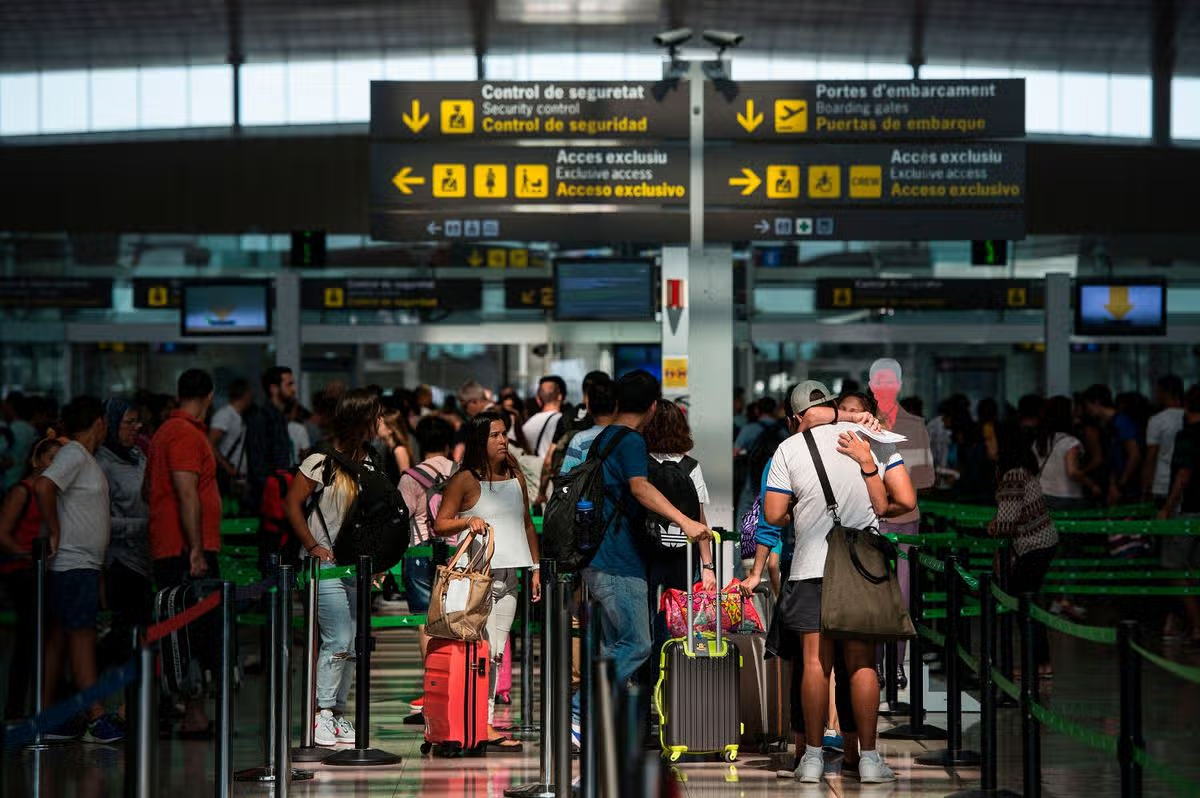
Travellers in Spain are experiencing significant delays at airports. And experts are warning that one particular group is bearing the brunt of new border controls, according to a Spanish travel organisation.

There have been widespread reports of waiting times of up to three hours. New regulations have been introduced, with some passengers in particular facing very long waits.

Spanish media reports indicate waiting times of up to three hours at Palma airport alone, with similar delays reported in France, Greece, Italy and beyond. Travel group Aviba is now calling for urgent measures to prevent chaos this coming summer.

Pedro Fiol, president of the travel association, is demanding immediate action to avert disruption this summer, and has revealed he has been pushing for such measures for months, according to Ultimata Hora. The new system has only just been introduced, having fully launched on April 10, following a trial period that began late last year.

The EU’s new Entry/Exit System (EES) initially began operations on 12 October 2025, with a phased rollout across 29 European countries. Now it is fully in place.

The system replaces passport stamping with digitally recorded entries, exits or refusals of entry of non-EU nationals arriving for short stays. Travellers’ facial images, fingerprints and personal data from the travel document will also be recorded.

Mr Fiol said: “The implementation of the new European Border and Security System (EES) is already beginning to be felt at the Balearic airports, especially at Son Sant Joan, the main gateway to Mallorca, where we are still operating with a hybrid model. At certain times, it is causing some slowdowns in the controls, particularly for non-EU passengers.”

He warned that “we are facing a structural change in how borders are managed across Europe: biometric registration is replacing manual passport stamping, and this means more time for the passenger’s first contact with their destination.” In his view, so far “the experience has been inconsistent: some days the operation runs relatively smoothly, while others, according to agencies and tour operators, can take more than two hours from the moment the plane lands until the traveller collects their luggage, and even nearly three hours in some specific cases.”

Ultima Hora reports that the National Police have acknowledged the delays, though they say they have seen no evidence of prolonged hold-ups. Sources close to the security forces have told Spanish media that additional staff have been deployed during peak hours in a bid to ease any difficulties that may occur during periods of heavy passenger congestion at checkpoints.

Travellers passing through airports in countries including France, Germany, Belgium, Italy, Spain and Greece are facing waits of several hours at border controls, according to the Airports Council International (ACI). Olivier Jankovec, the director of the ACI European division, told the Financial Times: “This situation, in the coming weeks and certainly over the peak summer months, is going to be simply unmanageable.

“We are seeing those queueing times now, at peak times, when traffic is just starting to build up.” A spokesperson for the European Commission told the Guardian: “What we can see from the first days of full operation is that the system is working very well. In the overwhelming majority of member states there are no issues.”

The commission said that the average registration of a passenger was 70 seconds, although the ACI has claimed that it can take up to five minutes. The spokesperson said there were a “few member states where technical issues have been detected” but that they “are being addressed”.

They said: “It is up to member states to ensure the proper implementation of the EES on the ground.” Luke Fitzpatrick, from independent travel agency Perfect Getaways, told the BBC this week that travellers should plan ahead to make border checks as smooth as possible.

“It’s about being as prepared as you can be,” Fitzpatrick told BBC Radio Merseyside. “There is a lot of uncertainty at the moment as people are getting used to the new system.”

While he said the advice was to arrive at the airport “at least three hours early”, he said it could be more difficult for people booked on a package holiday. “If you’re on a shared transfer back, everyone’s coming together at the same time,” he said.

EES changes and the impact on transfer and pick-ups

Pedro Fiol told Ultima Hora that “this situation is forcing a restructuring of transfer and pick-up operations at destinations to better co-ordinate exact times, avoid additional downtime, and guarantee the smoothest possible service.” Given this situation, he says that “travel agencies are concerned that if resources are not properly allocated at airports with such high tourist pressure as those in the Balearic Islands, significant queues and a negative first experience for visitors are possible.”

What do Brit tourists need to do with EES rules?

The govuk website states that “if you are travelling to a country in the Schengen area for a short stay using a UK passport, you may be required to register your biometric details, such as fingerprints and a photo, when you arrive. You do not need to take any action before you arrive at the border, and there is no cost for EES registration.

“EES registration is replacing the current system of manually stamping passports when visitors arrive in the EU. EES may take each passenger extra time to complete so be prepared to wait longer than usual at the border.”

The countries in the Schengen area are: Austria, Belgium, Bulgaria, Croatia, Czechia, Denmark, Estonia, Finland, France, Germany, Greece, Hungary, Iceland, Italy, Latvia, Liechtenstein, Lithuania, Luxembourg, Malta, Netherlands, Norway, Poland, Portugal, Romania, Slovakia, Slovenia, Spain, Sweden, and Switzerland.

Source link