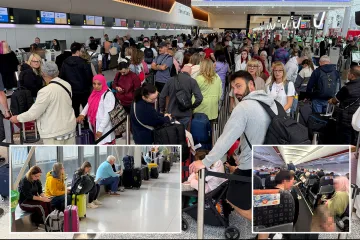
delays

Passport holders urged to change 1 phone setting or ‘risk delays at airport’

Passport holders have been urged to change a key phone setting before they arrive at airports to travel. Failing to do so could see them facing delays in queues

We all love jetting off abroad at this time of year, but sometimes making simple mistakes at the airport can lead to risking delays in queues. While many people worry about their clothing, and what they have packed in their cases, something they should actually be paying more attention to is their mobile phones.

Little you may know, using a certain setting can actually lead to people spending more time in queues at security, and delaying their travel journey. Nobody wants to have to face lengthy queues when they start their holiday so an expert has shared some key travel tips to help passport holders out.

It’s not the only advice of its kind to be shared recently either. Previously, tourists were also advised to take passport action before travelling to reduce the risk of problems at the airport.

You may not realise, but a dim screen is one of the most common reasons boarding passes fail to scan at the gate. Experts say a few simple phone tweaks before you leave home can save serious stress on travel day, and the changes take seconds to complete.

According to William Thackray, IT expert at AGT Computer Services, a dim screen is one of the most frequent and easily avoidable causes of delay at airport security and boarding gates.

He said: “Scanners need a clear, bright image to read a barcode or QR code reliably. In bright airport lighting, a screen that’s sitting at its default brightness – or that’s been dimmed to save battery – can cause a failed scan.

“It sounds trivial, but it holds up the queue and it’s completely avoidable.”

What you need to do

Before you leave the house, drag your screen brightness to maximum. On an iPhone, swipe down from the top right corner to access the Control Centre and pull the brightness slider to the top. For Android, swipe down from the top of the screen and do the same.

While you’re at it, William recommends a few other quick changes that can make the whole airport experience smoother. To begin, he said it’s a good idea to screenshot your boarding pass.

Don’t rely on an app that needs a signal or a Wi-Fi connection to load. A screenshot lives on your phone and opens instantly.

He said it’s also a good idea to turn off auto-lock. If your screen goes dark mid-queue, you’ll be unlocking your phone and re-opening your boarding pass with a line of people behind you.

Go to Settings > Display and bump your screen timeout up to at least two to three minutes before you travel. This could make a big difference.

You should also make sure your phone is fully charged. It sounds obvious, but some airports – especially when travelling to the US – can ask you to power up your device at security.

A dead phone can mean real delays, or worse, having your device taken for additional screening. William added: “None of these things take more than a minute to sort before you leave the house.

“But, on a busy travel day, that one minute of prep can be the difference between breezing through and being that person holding everyone up.”

Source link

Holidaymakers urged to leave these popular items at home or risk airport delays

A skincare expert has shared which beauty products are likely to cause problems at airport security due to hand luggage liquid rules – and how to avoid any hold-ups

With summer getaways fast approaching, countless holidaymakers are gearing up to travel overseas. As skincare continues to surge in popularity, many will be packing their creams and serums – yet skincare specialists are cautioning that transporting these products can prove more complicated than anticipated.

Experts at Landys Chemist have outlined the key ways skincare items can cause issues at airport security.

Skincare specialist Rhysa Phommachanh explained: “Many travellers are now packing full skincare routines in their hand luggage, but it can be confusing knowing which products are allowed. As a general rule, if a product can be spread, rubbed, or sprayed, it will usually fall under airport liquid restrictions.”

For instance, numerous skincare products nowadays appear as jellies, balms and sticks.

All of these are classified as liquids by airport security, as are sheet masks and eye patches.

Failing to adhere to airport security regulations could result in travel disruptions or having your belongings seized.

To conserve luggage space, travellers sometimes transfer larger items into smaller containers to meet requirements.

Nevertheless, these unidentified containers can prompt queries at security and trigger manual inspections, which can prove time-consuming.

It’s also probable that any pressurised containers such as facial mists, setting sprays or spray sunscreens will require manual examination and slow down security lines.

It is crucial to familiarise yourself with the regulations at each airport you pass through, as updated liquid rules are gradually being introduced across the country.

Restrictions may vary from one airport to another, so ensure you are fully aware of the specific guidelines before you board your flight.

When it comes to skincare, a minimalist approach often yields the best results.

As reported by the Express, Rhysa said: “A more simplified approach tends to work best for long-haul travel.

“Basic essentials such as lip balm, a lightweight moisturiser, or a facial mist are usually more than enough to maintain hydration without overwhelming the skin barrier.”

Source link

EU country suspends border system which has caused 4-hour delays

The country has chosen to abandon the new biometric security measures over concerns about queue chaos and flights taking off without passengers

Greece has suspended EU fingerprint and facial scans for British holidaymakers. The country has chosen to abandon the new biometric security measures over concerns about queue chaos sweeping across the continent. Queues have been hitting the country with four hours reported in many destinations, including Greece.

All travellers from the UK and other non-EU countries are supposed to be photographed and fingerprinted at EU airports and border crossings under the new entry and exit system (EES) introduced by Brussels.

Holidaymakers have been cautioned that the new security measure, which is now fully operational, could trigger airport delays of up to four hours. Eleni Skarveli, director of the Greek National Tourism Organisation in the UK, stressed that the decision would “ensure a smoother and more efficient arrival experience in Greece” and would “significantly reduce waiting times” while alleviating congestion at airports.

The EES is intended to replace manual passport stamping and better monitor the 90-day visa-free limit, but its introduction has caused havoc at some of Europe’s busiest airports.

A statement on the website of the Greek Embassy and posts on official social media channels said: “Update for British passport holders travelling to Greece. “In the framework of the implementation of the Entry/Exit System, as of 10 April 2026, British passport holders are exempt from biometric registration at Greek border crossing points.”

There was no further detail of how long the exemption would last, and FCDO travel advice for Greece has not been updated.

Luke Petherbridge, director of public affairs at travel trade organisation Abta, said: “While for many the travel experience remains smooth, we’re disappointed and frustrated to see some passengers being caught up in delays due to EES.

“Abta has been warning destinations and the (European) Commission for some time about the need for proactive steps to be taken to avoid delays, including the full use of contingency measures to stand down biometric checks at busier times, and adequate staffing especially at peak times.”

A total of 122 passengers were reportedly unable to board the flight from Milan Linate to Manchester on Sunday because of delays at passport desks caused by the ramp up of the EU’s Entry Exist System (EES).The 11am departure was held for 59 minutes before departing with the majority of seats empty.

One of the affected easyJet passengers, Kiera, 17, from Oldham, Greater Manchester, said she and her boyfriend arrived at Milan Linate airport at 7.30am on Sunday. She told the BBC: “We got to Border Control and it was a massive queue of people. I wasn’t feeling great anyway because I think I’d got food poisoning.

READ MORE: Full list of airports as easyJet warns of ‘longer queues’READ MORE: Major airline cancels hundreds of flights as ‘last resort’ over Iran fuel crisis

“At about 10.50am they brought some water over for people, and when we got to the front of the queue someone asked us if we were going to Manchester, and told us our flight had just gone.”

Vicky Chapman, 26, from Wirral, Merseyside, was booked on the flight with her family, including her five-year-old son.

She told the Liverpool Echo they arrived at the airport “with more than enough time” but were “refused entry through passport control”.

She continued: “We were then told that we are a ‘no show’ on our flight because we did not get to the gate on time, even though passport control had issues and they would not let us through.

“We were passed from pillar to post for three hours and no-one helped us. “It was so hot in the airport, people were vomiting, people were almost passing out.

“We’re being told that Tuesday is the earliest we can get back, and that we have to fly to Gatwick. We’ve had to pay out of pocket for an Airbnb.”

An easyJet spokesman said: “Due to delays in EES processing by border authorities, some passengers departing from Milan Linate on Sunday experienced very long waiting times at passport control.

“We held flight EJU5420 from Milan to Manchester for nearly an hour to give passengers extra time but it had to then depart due to crew reaching their safety regulated operating hours.

“Customers who missed the flight have been offered a free flight transfer.

“We continue to urge border authorities to ensure they make full and effective use of the permitted flexibilities, for as long as needed while EES is implemented, to avoid these unacceptable border delays for our customers.

“While this is outside of our control, we are sorry for any inconvenience caused.”

Of the 156 passengers reportedly booked on the return flight to Manchester, just 34 made it on board – leaving a staggering 122 stranded in Italy. EasyJet subsequently issued an apology over the incident.

At three of the UK’s “juxtaposed” border controls in Dover, Folkestone and London St Pancras, the pricey EES kiosks remain unconnected to the French police aux frontières IT system. These issues are not expected to be resolved until September, according to the Independent.

Greece is heavily dependent on British tourism, particularly at its bustling island hotspots such as Corfu, Crete and Rhodes, which can welcome upwards of 2,000 UK passengers daily during peak season.

The decision by Athens is widely regarded as a move to offer reassurance to British holidaymakers, and could encourage other Mediterranean nations to follow its lead. Greece is yet to confirm an end date. for its EES exemption for British travellers.

Holidaymakers are already considering switching their summer holiday plans this year, according to travel industry experts.

“Because of the war in the Middle East, Europe is seeing a big increase in interest as a holiday destination this year,” an ABTA spokesman said.

ABTA added that Greece was anticipated to be the fifth most-visited destination by Britons this summer, trailing behind Spain, France, Italy and the USA.

The spokesman said: “I think it’s too early to say what this change might mean for the number of people visiting, particularly as decisions on where to go are based on a number of factors.”

It’s thought travellers now weighing up a continental break may pivot towards Greece to sidestep potential headaches caused by the new scheme. “Greece for me this summer then, was thinking of Tenerife, but no way I’m putting up with those queues and chaos,” one man posted on X.

Another person added: “I work in the travel industry, already had customers worried about this new system believe me, Greece will benefit from this stand!” While a third chimed in: “Perfect – off to the Greek islands this summer – common sense prevails!”

Source link

South Korea opposition leader delays return from U.S.

Jang Dong-hyeok (L), chief of the main opposition People Power Party, speaks during a meeting of the party’s Supreme Council at the National Assembly in Seoul, 02 February 2026. Photo by YONHAP / EPA

April 17 (Asia Today) — Jang Dong-hyuk, leader of South Korea’s main opposition People Power Party, has delayed his return from a U.S. visit by three days at the request of U.S. officials, party aides said Thursday.

Park Jun-tae, Jang’s chief of staff, told reporters at the National Assembly that Jang had originally planned to return later in the day but would now arrive early Sunday.

“While heading to the airport for departure procedures, special circumstances arose, leading to an extension of his schedule,” Park said.

The delay was made at the request of officials from the U.S. Department of State, Park added. He said speculation about possible meetings with Vice President JD Vance or Secretary of State Marco Rubio remained unconfirmed.

Some members of Jang’s delegation have already returned to South Korea, while others remain in the United States.

Jang departed for Washington on April 11 and was initially scheduled to return Friday via Incheon International Airport.

During the visit, he met with U.S. lawmakers including Bill Hagerty and delivered a speech at the International Republican Institute, where he emphasized the U.S.-South Korea alliance.

He also criticized the South Korean government’s policy toward North Korea, arguing it prioritizes dialogue over deterrence and risks weakening trust in the alliance. Jang called for “peace through strength” to counter North Korea’s nuclear threat.

— Reported by Asia Today; translated by UPI

© Asia Today. Unauthorized reproduction or redistribution prohibited.

Original Korean report: https://www.asiatoday.co.kr/kn/view.php?key=20260417010005446

Source link

Florida Gov. Ron DeSantis delays special session to redraw districts

Florida Gov. Ron DeSantis makes remarks at the Kennedy Space Center in Florida on January 8, 2025. On Wednesday, he delayed plans for the state legislature to hold a special session to redraw the state’s congressional districts. File Photo by Joe Marino/UPI | License Photo

April 16 (UPI) — Florida Gov. Ron DeSantis has delayed a special session he called for the state legislature to work on redrawing the state’s U.S. congressional districts.

The session was scheduled to take place next week, but DeSantis said Wednesday it would now happen on April 28 to give the governor’s office more time to work on its proposal, The New York Times reported.

He also called legislators back to work to vote on a bill to give parents more freedom to opt out of giving their children school-mandated vaccines and one to protect minors from artificial intelligence, Politico reported. DeSantis called on lawmakers to return to Tallahassee from April 28 to May 1.

DeSantis issued a proclamation in January calling for the special session to reconsider the state’s congressional map.

“Every Florida resident deserves to be represented fairly and constitutionally,” he said at the time.

DeSantis said the redistricting would better ensure that race was not a predominant factor in determining congressional districts. He referenced a Supreme Court case in which Louisiana lawmakers were accused of creating a congressional district comprising mostly racial minorities.

Florida has 28 seats in the U.S. House, gaining one in 2022 after the 2020 census. Republicans hold 20 seats and Democrats have 8.

First lady Melania Trump speaks during a House Ways and Means Committee roundtable discussion on protecting children in America’s foster care system in the Longworth House Office Building near the U.S. Capitol on Wednesday. The bipartisan group of lawmakers are looking to address challenges children in foster care face, including barriers to education and educational advocacy, housing, employment opportunities, financial independence, and technology. Photo by Bonnie Cash/UPI | License Photo

Source link

Spain airport delays update as one group hit with longest waits over April ‘change’

Many passengers are facing waits of up to three hours at Spanish airports due to the new controls

Travellers in Spain are experiencing significant delays at airports. And experts are warning that one particular group is bearing the brunt of new border controls, according to a Spanish travel organisation.

There have been widespread reports of waiting times of up to three hours. New regulations have been introduced, with some passengers in particular facing very long waits.

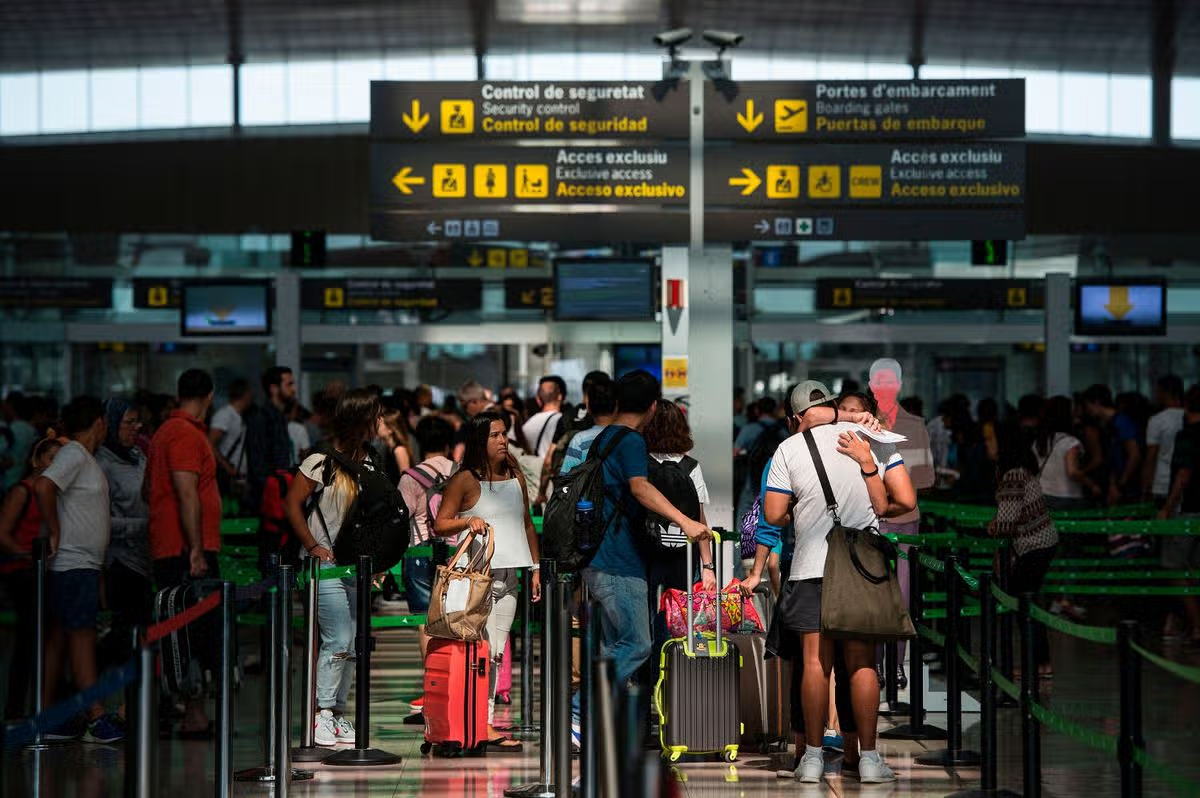
Spanish media reports indicate waiting times of up to three hours at Palma airport alone, with similar delays reported in France, Greece, Italy and beyond. Travel group Aviba is now calling for urgent measures to prevent chaos this coming summer.

Pedro Fiol, president of the travel association, is demanding immediate action to avert disruption this summer, and has revealed he has been pushing for such measures for months, according to Ultimata Hora. The new system has only just been introduced, having fully launched on April 10, following a trial period that began late last year.

The EU’s new Entry/Exit System (EES) initially began operations on 12 October 2025, with a phased rollout across 29 European countries. Now it is fully in place.

The system replaces passport stamping with digitally recorded entries, exits or refusals of entry of non-EU nationals arriving for short stays. Travellers’ facial images, fingerprints and personal data from the travel document will also be recorded.

Mr Fiol said: “The implementation of the new European Border and Security System (EES) is already beginning to be felt at the Balearic airports, especially at Son Sant Joan, the main gateway to Mallorca, where we are still operating with a hybrid model. At certain times, it is causing some slowdowns in the controls, particularly for non-EU passengers.”

He warned that “we are facing a structural change in how borders are managed across Europe: biometric registration is replacing manual passport stamping, and this means more time for the passenger’s first contact with their destination.” In his view, so far “the experience has been inconsistent: some days the operation runs relatively smoothly, while others, according to agencies and tour operators, can take more than two hours from the moment the plane lands until the traveller collects their luggage, and even nearly three hours in some specific cases.”

Ultima Hora reports that the National Police have acknowledged the delays, though they say they have seen no evidence of prolonged hold-ups. Sources close to the security forces have told Spanish media that additional staff have been deployed during peak hours in a bid to ease any difficulties that may occur during periods of heavy passenger congestion at checkpoints.

Travellers passing through airports in countries including France, Germany, Belgium, Italy, Spain and Greece are facing waits of several hours at border controls, according to the Airports Council International (ACI). Olivier Jankovec, the director of the ACI European division, told the Financial Times: “This situation, in the coming weeks and certainly over the peak summer months, is going to be simply unmanageable.

“We are seeing those queueing times now, at peak times, when traffic is just starting to build up.” A spokesperson for the European Commission told the Guardian: “What we can see from the first days of full operation is that the system is working very well. In the overwhelming majority of member states there are no issues.”

The commission said that the average registration of a passenger was 70 seconds, although the ACI has claimed that it can take up to five minutes. The spokesperson said there were a “few member states where technical issues have been detected” but that they “are being addressed”.

They said: “It is up to member states to ensure the proper implementation of the EES on the ground.” Luke Fitzpatrick, from independent travel agency Perfect Getaways, told the BBC this week that travellers should plan ahead to make border checks as smooth as possible.

“It’s about being as prepared as you can be,” Fitzpatrick told BBC Radio Merseyside. “There is a lot of uncertainty at the moment as people are getting used to the new system.”

While he said the advice was to arrive at the airport “at least three hours early”, he said it could be more difficult for people booked on a package holiday. “If you’re on a shared transfer back, everyone’s coming together at the same time,” he said.

EES changes and the impact on transfer and pick-ups

Pedro Fiol told Ultima Hora that “this situation is forcing a restructuring of transfer and pick-up operations at destinations to better co-ordinate exact times, avoid additional downtime, and guarantee the smoothest possible service.” Given this situation, he says that “travel agencies are concerned that if resources are not properly allocated at airports with such high tourist pressure as those in the Balearic Islands, significant queues and a negative first experience for visitors are possible.”

What do Brit tourists need to do with EES rules?

The govuk website states that “if you are travelling to a country in the Schengen area for a short stay using a UK passport, you may be required to register your biometric details, such as fingerprints and a photo, when you arrive. You do not need to take any action before you arrive at the border, and there is no cost for EES registration.

“EES registration is replacing the current system of manually stamping passports when visitors arrive in the EU. EES may take each passenger extra time to complete so be prepared to wait longer than usual at the border.”

The countries in the Schengen area are: Austria, Belgium, Bulgaria, Croatia, Czechia, Denmark, Estonia, Finland, France, Germany, Greece, Hungary, Iceland, Italy, Latvia, Liechtenstein, Lithuania, Luxembourg, Malta, Netherlands, Norway, Poland, Portugal, Romania, Slovakia, Slovenia, Spain, Sweden, and Switzerland.

Source link

Brand new £42m train station is finally confirmed after decades of delays

A NEW multi-million pound train station has finally been approved – 24 years after it was first proposed.

Construction of the East London station has been plagued by delays since plans were initially drawn up in 2002.

The c2c logo on the side of a blue train.
It has taken 24 years for the Beam Park Railway station to be confirmedCredit: Alamy

It took until just last week for the Housing Secretary officially to announce ‘a new Beam Park rail station could be accommodated within the existing rail network’.

The station will be built along the c2c line, running between Dagenham Dock and Rainham.

From there, the train will take just 20 minutes to reach London Fenchurch Street.

Developers have already committed a staggering £42 million to the project, but if delays continue, costs are expected to rise.

SPLASH OUT

Mega £500m waterpark gets underway & will be UK’s ‘biggest paid-for attraction’


STEAM AHEAD

Three new railway stations open in UK city – with the first trains in 80 years

This comes as part of an ongoing redevelopment in the area – where 20,000 new homes are expected to be built by 2030.

So far, more than 1,100 homes have been completed and a further 1,200 are under construction.

Beam Park residents officially moved into the area five years ago, but have had to rely on local buses for transport.

The Greater London Authority, London Borough of Havering, and Transport for London said they will partner together to make the station a reality.

Ray Morgon, Havering Council Leader, added: “We have always said that we would do all we can to ensure Beam Park Station is built. 

“The station is much needed for Beam Park and neighbouring Dagenham, which will enable housing and business growth in this key area.”

A c2c train stopped at a station platform.
The proposed railway station will run between Dagenham Dock and RainhamCredit: Alamy

Source link

Missed paychecks and airport delays: Pressure mounts on Congress to end the funding shutdown

Pressure is mounting on Congress to end the funding shutdown that has resulted in travel disruptions, missed paychecks and even warnings of airport closures, but lawmakers have yet to resolve the underlying issue of reining in President Trump’s immigration enforcement operations.

Senators intend to vote Thursday on a Republican proposal that would fund the Transportation Security Administration and much of the Department of Homeland Security, except the enforcement and removal operations conducted by U.S. Immigration and Customs Enforcement. That plan is expected to fail.

Democrats argue it does not go far enough at putting guardrails on officers from ICE, Customs and Border Protection and other federal agencies who are engaged in the immigration sweeps, particularly after the deaths of two Americans protesting the actions in Minneapolis.

Trump, who has largely left the issue to Congress to resolve, threatened to send the National Guard to airports, in addition his deployment of ICE agents who are now checking travelers IDs — a development drawing concerns.

“They need to end this shutdown immediately or we’ll have to take drastic measures,” Trump said Thursday during a Cabinet meeting at the White House.

With Congress set to leave town by week’s end for its own spring break recess, calls are intensifying for an end to the 41-day stalemate that’s put the livelihoods of TSA officers at risk as they provide airport security without pay.

Multiple airports are experiencing greater than 40% callout rates of TSA workers and more than 480 of its nearly 50,000 transportation security officers have now quit during the shutdown. Nationwide, nearly 11% of TSA workers — more than 3,200 on a single day — missed work.

Trump stays out of the fray

The Republican president initially signed off on the plan the GOP senators brought to him late Monday. By Tuesday, he said he would not be happy with any deal.

Trump did not directly address the status of negotiations late Wednesday evening during an annual fundraising dinner for the House Republicans’ campaign committee as Speaker Mike Johnson, R-La., works to keep majority control of the chamber in the November elections.

But Trump criticized Democrats for refusing to settle their demands on immigration changes. On Thursday, he revived his campaign for senators to end the filibuster as a way to overpower opposition to GOP policies, something most Republican senators do not want to do.

The GOP’s big tax cuts bill that Trump signed into law last year funneled billions to DHS, including $75 billion for ICE operations, ensuring the money is flowing for his immigration and deportation agenda even with the funding shutdown. ICE and other immigration officers are still being paid.

The situation is partly of Trump’s making, a strategy the president put in place last fall when he cut a deal with Democrats to end a previous federal shutdown. At that time, Trump agreed to fund the federal government, except for DHS, which was then put on temporary funding that has expired.

A stopgap measure

The Republican offer added one new restraint on immigration officers, funding the use of body cameras that had previously been agreed to. It excluded other policies that Democrats have demanded, such as that federal agents wear identification, remove their face masks and refrain from conducting raids around schools, churches or other sensitive places.

Senate Democratic leader Chuck Schumer of New York said they needed to see real changes. “We’ve been talking about ICE reforms from day one,” he said.

Democrats had been in several days of talks with the White House, including with border czar Tom Homan, that appeared to be making progress toward a deal. The White House presented its own offer with several items Democrats had been demanding, including officer IDs and training.

But those negotiations broke down over the weekend.

Republicans say Democrats are putting the country at risk. They say the Trump administration has already made strides to meet Democrats’ demands and has shown a new approach to its immigration operations, swearing in Oklahoma Sen. Markwayne Mullin as the new homeland security secretary to replace Kristi Noem.

But conservative Republicans also panned the proposal, demanding full funding for immigration operations and skeptical of the promise from GOP leaders that they would address Trump’s proof-of-citizenship voting bill in a subsequent legislative package.

Senate Majority Leader John Thune, R-S.D., said late Wednesday that if Democrats put a “more realistic offer on the table, we’ll be back in business.”

Asked if Congress would consider a stopgap measure to temporarily fund the department, Thune said: “We’ll see.”

Airport lines grow as TSA workers endure hardships

Passengers are facing more four-hour waits to clear security at George Bush Intercontinental Airport in Houston.

The airport’s website said Thursday morning that travelers should expect to wait two hours, 30 minutes in the security line at one of its open terminals and four hours at the other.

Lines and wait times are expected to grow Thursday and Friday because of “significantly higher passenger traffic,” according to an update on the airport’s website.

“This is a dire situation,” the acting TSA administrator, Ha Nguyen McNeill, testified at a House hearing Wednesday.

She described the multiple hardships facing unpaid TSA workers — piling up bills and eviction notices, even plasma donations to make ends meet — and warned of potential airport closures if more employees refuse to come to work.

“At this point, we have to look at all options on the table,” she said. “And that does require us to, at some point, make very difficult choices as to which airports we might try to keep open and which ones we might have to shut down as our callout rates increase.”

She cited the growing financial strain on the TSA workforce.

“Some are sleeping in their cars, selling their blood and plasma, and taking on second jobs to make ends meet,” she said.

McNeil also said TSA officers working at the nation’s airports have experienced a more than 500% increase in the frequency of assaults since the shutdown began.

“This is unacceptable, and it will not be tolerated,” McNeill said.

Mascaro and Freking write for the Associated Press. AP writers Rebecca Santana and Ben Finley in Washington; Wyatte Grantham-Philips in New York; Rio Yamat in Las Vegas; Russ Bynum in Savannah, Ga., and Gabriela Aoun Angueira in San Diego contributed to this report.

Source link

Trump delays trip to China to focus on Iran

President Donald Trump and China’s President Xi Jinping arrive at a state dinner at the Great Hall of the People in Beijing in 2017. Trump announced Tuesday that he is delaying his planned trip to visit Xi. File Photo Thomas Peter/EPA

March 17 (UPI) — President Donald Trump told reporters Tuesday that he has delayed his trip to China for “five or six weeks” to focus on the war against Iran.

Trump told the Financial Times Sunday that he would postpone the trip if Chinese President Xi Jinping wouldn’t help secure the Strait of Hormuz.

“It’s only appropriate that people who are the beneficiaries of the Strait will help to make sure that nothing bad happens there,” Trump said. He said that 90% of China’s oil comes from the Middle East.

“We’re resetting the meeting, and it looks like it’ll take place in about five weeks,” Trump said. “We’re working with China. They were fine with it.”

The trip was scheduled for March 31 to April 2 and focused on trade.

Treasury Secretary Scott Bessent said Monday that “we will see whether the visit takes place as scheduled,” adding that if the trip were delayed, “it wouldn’t be delayed because the president’s demanded that China police the Straits of Hormuz,” NBC News reported.

After Bessent’s comments, White House press secretary Karoline Leavitt told Fox News that the president’s “utmost responsibility right now as commander in chief is to ensure the continued success of Operation Epic Fury, as he’s doing 24/7 here at the White House and here at home.”

Official Chinese customs data show that in 2025, China got less than half of its oil from the Middle East. Russia supplied just under one-fifth of China’s oil, and sanctioned Iranian oil accounted for 11.5 %.

President Donald Trump meets with Taoiseach of Ireland Micheal Martin in the Oval Office of the White House on Tuesday. They will both attend a Friends of Ireland luncheon on Capitol Hill for St. Patrick’s Day. Photo by Yuri Gripas/UPI | License Photo

Source link

Players Championship: Fatal shooting near TPC Sawgrass delays fan entry

A fatal shooting near TPC Sawgrass meant spectators were delayed entering the course before day three of the Players Championship.

St Johns County Sheriff’s Office said two people were shot and killed at 22:30 local time on Friday, less than a mile from the course in Florida.

The suspect, who has been named as Christian Barrios, fled on to the course before being arrested in Nassau County at about 08:00 on Saturday after a car chase, according to police.

Sheriff Robert Hardwick said Barrios “made contact” with employees at TPC Sawgrass during his attempted escape.

“He picked up – we believe it was a radio that belonged to the PGA Tour, not one of our radios and we know he dropped it after that. Our canines used it as a scent when they came in there,” Hardwick said.

Gates at Sawgrass were due to open for fans at 07:30 but entry was delayed until 09:00, with the PGA citing “operational considerations” as the reason for their decision.

Third-round play at the PGA Tour’s flagship event began on time.

Sweden’s Ludvig Aberg led the tournament after two rounds having shot a nine-under-par 63 on Friday.

Source link

Moon project delays among barrage of challenges for NASA

March 12 (UPI) — The recent, new delay in NASA’s moon landing program represents the latest in a string of technical, budgetary, workforce and public perception challenges that plague the space agency, a UPI analysis shows.

When flight officials pulled the Artemis II Space Launch System and Orion spacecraft off the launch pad at Kennedy Space Center on Feb. 25 after a recurrence of helium flow problems and pushed the launch back to April at the earliest, it served as another reminder of the space agency’s current assortment of formidable problems.

Those issues include a moon program whose timeline keeps slipping; recurring technical failures and cost overruns with its flagship SLS rocket; a commercial lander — SpaceX’s Starship — that has yet to demonstrate reliability; the effective grounding of the Vulcan Centaur rocket made by United Launch Alliance; the departures of thousands of NASA workers and turnover in its top leadership positions.

The agency announced March 3 it had identified the latest problem with Artemis II as a faulty helium seal in the SLS upper stage, and that it is repairing the assembly, as well as making other fixes to the spacecraft.

But meanwhile, the lag time since the last crewed U.S. spaceflight has now stretched to three full years. This lengthy drought has prompted outside analysts and NASA officials to worry about how public support for the space program is being affected.

“When missions occur every few years, it is easy for people to lose interest,” said Burt Dicht, a leader of the National Space Society, who added he backs a newly announced NASA effort to increase the frequency of launches.

The latest delay has prompted a fresh look at some of the major challenges facing the space agency’s moon effort, as well as more general problems.

Headwinds with partners, personnel issues

One of the more pressing issues with the Artemis program is its dependence on SpaceX’s Starship Human Landing System, or HLS, as the initial human lander that will put the first U.S. astronauts on the lunar surface.

Elon Musk’s company signed a contract with NASA in 2021 to provide the lander, but struggled in 2025 to perfect the mammoth Starship V3 rocket necessary for a key element of the HLS mission, according to a report issued by NASA’s Aerospace Safety Advisory Panel and released last month.

The Starship V3 incorporates upgraded Raptor engines to provide it with the required performance for low-Earth orbit flight and on-orbit operations, and its development is deemed crucial for transferring fuel to an orbiting tanker.

How it performs will “ultimately determine the number of refueling missions required for the HLS mission,” which is now pegged at roughly 12 fueling flights, the report’s authors wrote.

“The development and test progress necessary for a version of Starship that has not yet flown in time to support a human lunar landing mission within the next few years appears daunting and, to the panel, probably not achievable,” they wrote.

SpaceX announced Feb. 26 that the first Starship V3 had left its build site at Boca Chica, Texas, and had begun prelaunch testing.

In 2023, NASA selected Blue Origin, owned by Amazon founder Jeff Bezos, to develop a second human landing system to compete with the HLS. Its Blue Moon Mark 2, to be launched aboard a New Glenn rocket, is to be tested twice and then carry a crew to the moon in late 2028.

New critical report

But NASA’s Office of Inspector General, in a report issued Tuesday, looked at both programs to carry astronauts to the moon and advised that the agency faces significant technical and programmatic risks that threaten mission timelines and crew safety.

The report said NASA is not fully adhering to “test like you fly” principles, particularly for uncrewed demonstration missions, and has not yet ensured that SpaceX’s Starship lander will meet manual control requirements for astronauts.

The inspector general also noted gaps in hazard‑mitigation planning and insufficient testing of critical systems, especially given the complexity of both SpaceX’s and Blue Origin’s lander architectures.

The report also warned that NASA the capability to rescue astronauts in the event of a life‑threatening emergency during lunar surface operations, echoing limitations from the Apollo era.

And it concluded that SpaceX and Blue Origin face technical challenges likely to cause additional delays, with SpaceX’s schedule slipping beyond its earlier 2027 target and even the revised 2028 goal remaining uncertain.

The report recommends stronger risk‑management practices, more realistic scheduling and more rigorous testing to ensure crew safety and mission success.

Meanwhile, NASA’s larger operations also could be affected by problems encountered in the new Vulcan Centaur rockets made by United Launch Alliance.

Vulcan launches halted

The U.S. Space Force last week temporarily halted all national security launches using the rocket after the same booster malfunction occurred twice, according to comments made by Col. Eric Zarybnisky at a meeting last month in Colorado.

The Vulcan Centaur program was established by ULA to reduce costs and eliminate reliance on the current workhorse Atlas V Russian-supplied RD-180 engine and is primarily meant to meet U.S. military needs.

But the program benefits NASA as well, giving it greater flexibility and transport capability for launching of payloads, the space agency said.

NASA also continues to struggle with an exodus of workers, including thousands of crucial senior staff, which some analysts believe is impacting its moon and Mars exploration goals due to a loss of expertise.

Nearly 4,000 agency employees last year chose to accept “deferred resignations” as part of the Trump administration’s efforts to slash the federal workforce — a move that reduced NASA’s employee roster by more than 20% to some 14,000, NASA spokesperson Cheryl Warner told NPR in June.

Still, even amid all of those issues, the agency was able to dodge the biggest potential bullet of them all — a proposed 24% reduction in its budget issued by the White House, which would have been the biggest cut in agency history.

That threat all but evaporated when Congress agreed on a $24.4 billion NASA spending bill in January, representing a mere 1.7% budget reduction.

The NASA administrator’s job itself remained unfilled throughout 2025, as President Donald Trump withdrew his nomination of Isaacman. Trump ultimately changed course, and Isaacman was confirmed by the Senate on Dec. 17.

Major changes for the Artemis program

Of all the difficulties faced by NASA, the technical problems and cost overruns of the Artemis program itself have emerged as perhaps the most high-profile.

The Feb. 25 postponement was the second recent delay for Artemis II, which is to send four astronauts on a “slingshot” fly-by around the moon. Last month, NASA pushed back the launch to March after engineers discovered what they called a significant hydrogen leak during a wet dress rehearsal.

NASA said Thursday it plans to roll the Artemis II Space Launch System rocket and Orion capsule back out to the launchpad next week, aiming for a launch in April.

The rollout wis to begin March 19, with an eye at launching as early as the evening of April 1, NASA officials said during a press briefing.

The original target date for landing astronauts on the moon — 55 years after the United States first did it — was 2024. When that was announced in 2019, many observers thought the target date was too optimistic.

The effort’s total cost after NASA recently added nine new elements now exceeds $20 billion, the Government Accountability Office reported last summer. Three of those elements have racked up a total of $7 billion in cost overruns.

NASA has made efforts to get a handle on the overruns through its Moon to Mars Program Office, the GAO said, but warned that each new delay to mission dates can create a cascading effect of increased costs across multiple programs that function independently of each other.

Clear warnings

And in its report from last month, the NASA safety panel sounded clear warnings about the “ambitious timeline” for developing the Human Landing System, given its “intricate operational design” and :complex concept of operations,” as well as other serious safety concerns surrounding the Artemis program.

Taken together, the issues posed a “high safety risk,” the panel concluded, which “casts doubt on the current Artemis III timeline and the feasibility of the Artemis III mission goals.”

In the wake of the latest issues, Isaacman announced a major revamp of Artemis under which the expected moon landing was pushed back from Artemis III in 2027 to Artemis IV in 2028.

“We have to rebuild core competencies,” he told reporters Feb. 27, blaming the repeated delays on too-infrequent launch schedules (known as the “launch cadence”), which he said causes “muscle memory” to “atrophy.”

“This is just not the right pathway forward,” he asserted, while revealing that a moon landing with Artemis III in 2027 has been deemed too ambitious and will instead now be attempted with Artemis IV in 2028.

Artemis III will instead now serve as a mission to perform tests on connecting with lunar landers in low-Earth orbit, as well as to test equipment that will go on Artemis IV.

Meanwhile, to bump up the launch cadence to once every 10 months rather than every three years, Isaacman announced a standardization of the SLS rocket fleet to “essentially near ‘Block-1’ configuration.”

The idea, he said, is to reduce the complexity of the massive rocket and to “accelerate manufacturing, pull in the hardware and increase launch rate, which obviously has a direct safety consideration to it, as well. You get into a good rhythm launching with greater frequency, you get that muscle memory.”

To do that, he added, “we need to rebuild and strengthen the workforce here at NASA. … We have to rebuild core competencies. The ability to turn around our launch pads and launch with frequency greater than every three years is imperative,” he said, pointing to the histories of the Mercury, Gemini, Apollo and Space Shuttle programs, when “the average launch cadence was closer to three months.”

The decision to simplify and standardize the SLS starting with Artemis IV also means the agency will no longer need to use the $1.5 billion Mobile Launcher 2 at Kennedy Space Center, which is still under construction and has faced its own cost overruns and delays.

Experts’ reactions

Experts who have been closely following the development of Artemis expressed a range of opinions about whether the latest moves are the right ones for the moon program and the U.S. space program generally.

Kenny Evans, a fellow in science, technology and innovation policy at Rice University’s Baker Institute for Public Policy in Houston, told UPI the glitches and the resulting negative perceptions of the program are indeed tied to the drawn-out launch cadence.

“The extended periods between SLS launches have given NASA fewer chances to test out hardware — and less cover for when things go wrong,” he said. “That has long been a valid criticism of the SLS program and a source of bad press — for example, the fueling issues in prior wet dress rehearsals.

“Working out kinks, as visible and expensive as they are, should be seen as net positives rather than programmatic failures,” he said.

“Frankly I’m relieved to see the timeline revamp,” Evans added. “The Artemis schedule Isaacman inherited had absolutely no chance of meeting its prior targets, and I’ve been impressed by his willingness to address the hard truths about the program.

“In terms of safety, making Artemis III a system test will provide NASA a much needed opportunity to remove as much risk as possible before attempting a lunar landing for Artemis IV,” he said while noting he is “particularly enthusiastic” about the NASA leader’s stated commitment to strengthening its workforce, “especially in light of cuts to agency staff.”

Meanwhile, the National Space Society’s Dicht, said his interactions with students, engineers, long-time space advocates and the public have shown him there is “real enthusiasm for progress in the space program,” but that new momentum is needed.

“I believe NASA Administrator Isaacman’s proposals to improve launch cadence, strengthen the workforce and standardize the SLS are positive steps that can help stabilize the Artemis program and move it toward a sustained return to the moon,” Dicht said.

“Whether it is SLS or any other rocket, these are extraordinarily complex machines,” he said. “Increasing the cadence of launches and ensuring the workforce is well-trained and consistently engaged helps build the operational experience, or ‘muscle memory,’ that improves reliability and the likelihood of mission success.”

While there is steady and palpable excitement over humankind’s first return to the moon since 1972 among committed enthusiasts, “there remains a segment of the public, including some social media influencers, who interpret technical issues as a sign that the program is failing,” he said.

“When missions occur every few years it is easy for people to lose interest,” Dicht said. “If the program can move toward a more regular rhythm, possibly two flights per year, it will attract attention and reinforce the sense that progress is being made.”

Similar to Apollo 9

Spaceflight historian and science author Amy Shira Teitel, creator of The Vintage Space YouTube channel, said the revamp “doesn’t particularly surprise me,” noting the decision to change Artemis III’s moon landing mission into a test flight is reminiscent of Apollo 9 in March 1969.

In that mission, a three-astronaut crew carried out vital tests while in low-Earth orbit to prepare for the historic Apollo 11 moon landing four months later.

“The plan to land Artemis III while still not having the lander ready or even chosen, from what I could tell, seemed like trouble waiting to happen, so the idea of going back to Apollo 9 and testing the hardware/mission in Earth orbit seems both safe and like it should have been the first step before going to the moon,” she told UPI in emailed comments.

The author of Breaking the Chains of Gravity: The Story of Spaceflight before NASA has questioned the overall purpose, cost and broader implications of the moon-to-Mars effort, contending it lacks a compelling justification other than “going for the sake of going” while the highly successful and popular International Space Station is scheduled to be scrapped in 2030.

All of the Artemis changes, Teitel said, are “emphasizing how hard it is, and how insane it is to be looking at canceling the ISS without a replacement and just focusing on the moon-to-Mars pipeline without any kind of long-term infrastructure or planning.

“And the endless issues with SLS — why are we adding more launches?” she asked. “We know this system is flawed. It feels like retrofitting a mission into the hardware to justify the … launch cost.”

NASA’s Space Launch System rocket emerges on Saturday morning from the Vehicle Assembly Building to start its journey to Launch Complex 39B at the Kennedy Space Center in Florida. Photo by Joe Marino/UPI | License Photo

Source link