Kylian Mbappe and Yan Diomande score stunners as Real beat Leipzig to make it three from three in Champions League.
Published On 21 Oct 202621 Oct 2026
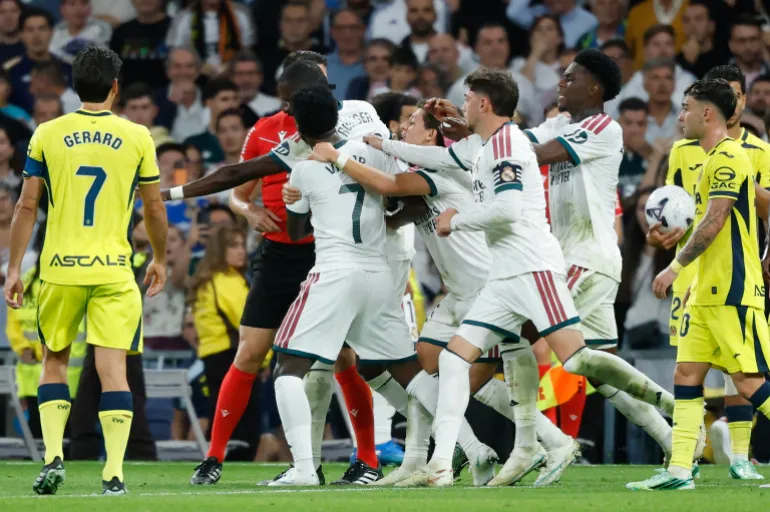
Real Madrid claimed a third Champions League victory in as many games, thrashing RB Leipzig 4-1 on Wednesday, with Kylian Mbappe and Yan Diomande among the goalscorers for Jose Mourinho’s side.
Bernardo Silva opened the scoring for Madrid from close range late in a tight first half, with Arda Guler doubling the advantage of the record 15-time European champions soon after the interval.
Recommended Stories
list of 4 itemsend of list
Mbappe bent home a third before Tidiam Gomis pulled one back for the German side, and Diomande rammed a volley into the top corner late on to cap Madrid’s triumph.
Their fourth consecutive win across all competitions will boost Madrid’s morale ahead of Sunday’s La Liga Clasico against bitter rivals Barcelona.
Without a major trophy in two seasons and after a shaky domestic start, Madrid can at least boast a perfect record in Europe, unlike Barca after their defeat at Paris Saint-Germain on Tuesday.
Mourinho started Vinicius, serving a four-match ban in La Liga, on the left flank and benched former Leipzig winger Diomande, despite his improving form.
The coach also brought Bernardo Silva and Eduardo Camavinga into midfield and put midfielder Federico Valverde at right-back again, as he did in Sunday’s win at Sevilla.
Visitors Leipzig created the first big chance, with Madrid stopper Thibaut Courtois getting down low to make a superb save from Romulo Cardoso.
Vinicius, who improved on a poor showing at Roma last week without breaking out of his rut, drew a full-stretch save from Leipzig’s Maarten Vandevoordt.
Madrid carved out an advantage in the final stages of a low-key first half when Valverde cut the ball back for Guler, whose shot Vandevoordt saved. However, the goalkeeper could not clear it, and Silva darted in to prod over the line.
It was the former Manchester City midfielder’s first goal for the club after joining this summer.
Vandevoordt saved well from Valverde’s fierce effort before Guler put Madrid two goals ahead in the 52nd minute.
Jude Bellingham crossed to the back post and Mbappe nodded the ball across goal, with Guler able to hold off a defender and turn home.
Mbappe lashed a shot into the side netting after Bellingham teed it up, as Madrid looked to put the game out of sight.
Mourinho sent on Diomande for Vinicius with 20 minutes remaining, and the Brazilian looked disappointed on the bench, knowing he cannot play again until November 4, when Madrid visit AEK Athens.
Madrid’s record 140 million-euro ($157m) signing, Diomande, pulled the ball back to Mbappe on the edge of the box for Madrid’s third, and the French forward bent it home.
Leipzig quickly grabbed a consolation goal at the other end as Dean Huijsen switched off, with Gomis firing past Courtois.
Diomande ended proceedings with a bang, rattling an emphatic volley from Brahim Diaz’s cross into the top corner for his third goal in his last four appearances.
ONE UK airport which closed in 2022 is taking another step closer to welcoming passengers back.
Doncaster Sheffield Airport closed after becoming “commercially unviable” and has been left empty since, but it has now announced it’s set to come under public ownership.
Doncaster Sheffield Airport is set to reopen to passengers in 2028Credit: AlamyNow, it’s been announced that the airport will come under public ownershipCredit: Alamy
South Yorkshire Mayor Oliver Coppard called the deal a “major milestone” towards reopening the airport.
According to reports, South Yorkshire Mayoral Combined Authority (SYMCA) will buy the airport becoming the freehold owner and landlord to the City of Doncaster Council lease.
Sign up for the Travel newsletter
Thank you!
Oliver Coppard said that the airport being bought by SYMCA would also “provide long-term control, certainty and flexibility” and attract private investment too.
Before it closed, the regional airport acted as a gateway to Europe for those living in the north of England.
It had airlines like TUI and Wizz Air and flew to the likes of Spain and Portugal.
When it reopens, it’s possible certain routes could be reinstated, as well as longer ones too.
The airport is home to one of the longest runways in Europe, measuring 2,893 metres, which means it could host big jets for long-haul journeys.
As of yet, no airlines have been confirmed for when the airport reopens.
Designs for the revamped terminal have been revealedCredit: City Of Doncaster / Mayor Ros Jones
Christian Foster, Director of FlyDoncaster – the company set up to manage the airport – told Sun Travel: “It does feel like the world has changed post-Covid, whereas people were focused on two weeks in Spain or Greece, nowadays we’re seeing a lot of people keen to take city breaks.”
“We’d love to fly to places like Croatia, and other destinations that are a bit more quirky like Azerbaijan.
“We’re keen to look at emerging places to visit as well, like India.“
Another plan for the airport is that when it opens, it will have local businesses rather than chains like Costa or Starbucks.
There would be a mixture of restaurants, bars and shops as well as seating.
Student protests in France are into their second month, escalating into demonstrations across Europe.
What began in September in France with pupils protesting against overcrowded classrooms and teacher shortages has grown into wider anger at the cost of living and planned cuts to public services.
Recommended Stories
list of 3 itemsend of list
Protesters in Albania, Belgium, Greece, Italy, Portugal and Spain have also taken to the streets over the lack of affordable housing, rising costs and failing public services – with many young people saying they no longer expect to be better off than their parents.
Facing their anger are leaders such as French President Emmanuel Macron, Italy’s Prime Minister Giorgia Meloni, Spain’s PM Pedro Sanchez and Portugal’s PM Luis Montenegro. Sanchez belongs to the left, Meloni to the right and Macron and Montenegro are conservative-leaning centrists. But while their politics vary, they all face mounting unrest because of soaring costs of living.
Are they out of touch with the experiences and sentiments of youth in their countries? Al Jazeera visualises how prices, wages, housing and education have changed in France, Italy, Spain and Portugal over the past 26 years, from when Macron, Meloni, Sanchez and Montenegro were in their 20s, much like many of the protesters angry with them.
How much more expensive is it compared to 2000?
The prices paid for everyday items such as food, energy, transport and bills have risen by between 59 and 78 percent since 2000 in France, Italy, Spain and Portugal, according to Eurostat – the European Union’s statistics agency. Its harmonised index of consumer prices (HICP) is the EU’s official measure of how much everyday goods and services cost.
Spain recorded the steepest increase at 78 percent, followed by Portugal at 71 percent, 68 percent in Italy and France at 59 percent.
That means goods and services that cost 100 euros ($112) in 2000 now cost about 178 euros ($200) in Spain, 171 euros ($192) in Portugal, 168 euros ($188) in Italy and 159 euros ($178) in France.
Prices rose by about 2 percent a year on average, but jumped in 2022, when annual inflation hit 8.7 percent in Italy, 8.3 percent in Spain, 8.1 percent in Portugal and 5.9 percent in France, the highest rate in all four countries since at least 2000.
The surge was driven mainly by energy costs, which soared after Russia’s invasion of Ukraine in February 2022. By October that year, eight months into the war, energy prices across the eurozone were almost 42 percent higher than a year earlier, and food prices were also rising sharply, according to Eurostat.
Between 2021 and 2023, prices increased by 12 to 15 per cent in the four countries. Wages failed to keep up, and because prices do not fall back once inflation eases, many households are still feeling the squeeze today.
(Al Jazeera)
How have salaries changed?
Once inflation is taken into account, the average full-time wage in Italy fell by almost 5 per cent between 2000 and 2025. Over the same period, real wages rose by 7 per cent in Spain, 11 per cent in France and 20 per cent in Portugal, according to OECD wage data adjusted with Eurostat’s price index.
In Spain most new jobs were in tourism and services, and were often seasonal and poorly paid, Jaime Velazquez, a journalist in Madrid, told Al Jazeera’s Inside Story.
Julius Fintelmann, cofounder and editor-in-chief of The European Correspondent, said ageing societies were squeezing out opportunities for younger workers, adding that the pay gap between older and younger workers has been widening across high-income economies for decades, so the promise that each generation would be better off than the last no longer holds.
How has the cost of housing changed?
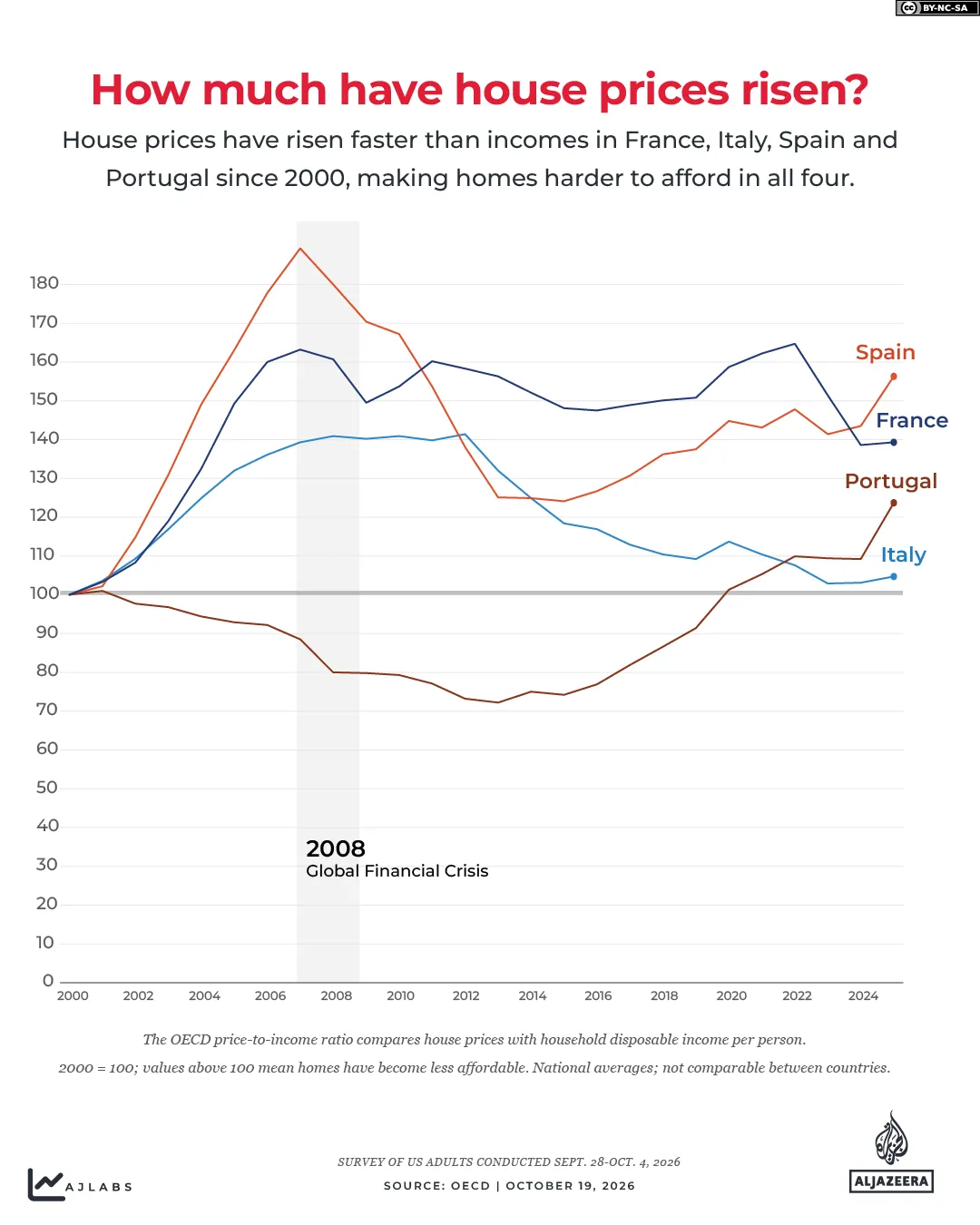
Housing has become harder to afford in all four countries since 2000, according to the OECD’s price-to-income ratio. It provides a broad picture of how house prices have changed relative to incomes over time. When prices rise faster than incomes, the ratio goes up, suggesting homes are becoming less affordable on average.
However, it doesn’t show which households or regions are hit hardest, does not account for mortgage and borrowing costs, and says nothing about the quality of the homes people are paying for.
Spain has seen the biggest change. Its price-to-income ratio is 56 per cent higher than in 2000, even after falling sharply following the 2008 financial crisis.
In France, the ratio is 39 per cent higher than in 2000, though it has eased slightly since peaking in 2022.
Italy is the exception where house prices have broadly kept pace with incomes, leaving the ratio just 5 per cent higher than in 2000.
Portugal has seen the sharpest change in recent years. Its price-to-income ratio fell steadily for 15 years after 2000, meaning homes became more affordable. But since 2015 the ratio has risen by 67 per cent.
The OECD publishes the price-to-income ratio with 2015 as its reference year. To compare it with the wage and price data in this article, which started in 2000, Al Jazeera has reset the figures so that 2000 = 100.
How has state expenditure on education changed?
Education has been at the heart of the unrest in France, where protests began because of overcrowded classrooms and teacher shortages. While in Belgium and Albania, demonstrators have rallied against the rising cost of education and access to universities.
According to the latest data from Eurostat, France’s public spending on education amounts to 5.1 per cent of its gross domestic product (GDP) compared to 5.6 per cent in 2000.
Italy spent 4.4 per cent of its GDP on education compared to 4 per cent in 2024, Spain spent 4.1 per cent in 2000 and the same in 2024. Portugal spent 4.8 per cent in 2000 and 4.3 per cent in 2024.
Eight areas in Spain remain under lockdown as Storm Adam continues to wreak havoc
Eight Spanish areas are still in lockdown(Image: MEDITERRANEAN via Getty Images)
Eight areas in Spain remain under lockdown after restrictions were lifted for some 137 municipalities earlier on Monday, October 19.
Large swathes of the country were ordered to stay indoors as Storm Adam wreaked catastrophic havoc across eastern Spain. Initially, the emergency lockdown covered 78 municipalities in Valencia province and 67 in Alicante. However, according to the Olive Press: “Restrictions have ended for 137 of 145 municipalities, but eight towns in La Safor and La Marina Alta remain under lockdown.
“Please be aware that the following areas are still confined: Bellreguard, Daimús, Oliva, Xàbia, Pego, Miramar, Piles, and Els Poblets. Stay safe and always check local guidelines before travelling through these areas.”
Content cannot be displayed without consent
Two fatalities have been confirmed, with a third potential victim of the storm discovered on Monday afternoon when Military Emergency Unit (UME) personnel uncovered the body of an elderly woman in her flood-ravaged home in Oliva, Valencia province. Authorities are yet to officially confirm whether the death was a direct result of drowning or natural causes.
According to the Majorca Daily Bulletin, rainfall totals surpassed 600 litres per square metre, rivers burst their banks and residents were left stranded on rooftops. Helicopters were deployed to rescue those trapped as torrential downpours swept through eastern Spain on Monday, triggering devastating floods that claimed at least two lives and prompted authorities to issue shelter-in-place orders for more than 800,000 residents.
Real Madrid beat Sevilla 4-1 a day after Barcelona thrashed Real Betis 5-2, as the Spanish giants prepare for El Clasico.
Published On 19 Oct 202619 Oct 2026
Kylian Mbappe scored twice as Real Madrid closed the gap on La Liga leaders Barcelona to six points with a 4-1 win over Sevilla at the Santiago Bernabeu, a week before the rivals meet.
Despite the absence of suspended Vinicius Jr, Real produced the fluid attacking football the team had been lacking of late, with Arda Guler again orchestrating their best work on Sunday.
After a stale opening, the Turkish international sparked the match into life.
Sevilla appealed for a red card following an incident involving Guler and Peque Fernandez, but Guler responded minutes later by collecting Yan Diomande’s pass and arrowing a shot into the top corner.
Arda Guler scored his second goal of the La Liga season for Real Madrid [Oscar Del Pozo/AFP]
Mbappe scored an equally impressive second in the 37th minute, turning brilliantly to burst through on goal before calmly beating Odysseas Vlachodimos.
Fede Valverde, restored to right back by coach Jose Mourinho, made a crucial block to deny Felix Correia just before the hour as Sevilla threatened to work their way back into the contest.
Diomande then exploited the space created by Sevilla’s more adventurous approach, evading his marker before sending Mbappe in behind the defence. Andres Castrin brought down the French forward, who got to his feet to convert the resulting penalty and effectively settle the contest.
Substitute Manu Bueno reduced Sevilla’s arrears with a composed finish 10 minutes from time after Mbappe cheaply surrendered possession deep inside his own half.
Diomande restored Real’s three-goal advantage two minutes later, capping a fine display with a thunderous strike.
Eder Militao received a warm ovation when he came on in the 85th minute for his first appearance since undergoing hamstring surgery in April.
Mourinho will take encouragement from one of the most complete performances of his second spell at Real as they prepare for next Sunday’s pivotal meeting with Barcelona.
Real, who have won three straight games in all competitions following the international break, climbed to third on 21 points, one behind Atletico Madrid, while Sevilla are sixth on 14.
Lamine Yamal has begun the season in superb form for Barcelona [Jorge Guerrero/AFP]
Earlier on Saturday, Barcelona beat Real Betis 5-2 to make it nine wins from nine and stretch their blistering league tally to 39 goals.
Lamine Yamal lit the fuse with a dazzling opener before Rodri, Gabriel Jesus, Eric Garcia and substitute Dani Olmo joined the party, while Valentin Gomez and Ez Abde replied for Betis, who played much of the second half with 10 men after Facundo Bernal was sent off for head-butting Lamine.
Barca moved to 27 points, five above Atletico, who won 1-0 at Espanyol, while third-placed Betis have 19 and Real Madrid sit fourth on 18 before welcoming Sevilla on Sunday.
Elsewhere, Osasuna withstood second-half pressure from Racing Santander to win 2-0 in Jagoba Arrasate’s first game back as manager.
Two flying saves from Ionut Radu denied Alaves a point in a 2-1 defeat to Celta Vigo, while Real Sociedad won 5-2 at Malaga.
Netflix publicly reported box office results for the first time in its history this weekend as it released its queer drama “La Bola Negra” in U.S. theaters.
The Spanish-language film opened in limited release — just four theaters in Los Angeles and New York — and brought in $277,500 on a reported production budget of $15 million to $17 million. That averaged out to about $69,375 per screen, the second-highest per-screen average for a non-English language film.
Netflix acquired the U.S. rights to the film at Cannes, reportedly for about $5 million.
The Los Gatos-based streaming giant plans to expand the number of locations in the coming weeks to as many as 300 theaters across the country. The film already opened in Spain in late September.
“La Bola Negra” will be available on Netflix on Dec. 2.
Netflix has high hopes for the film, which won six audience awards on the festival circuit and will be Spain’s entry for the Academy Awards.
But the U.S. debut comes at a rocky time for Netflix, which cut 6% of its workforce, or about 1,000 jobs, last week. The layoffs, which are believed to be the largest in company history, included Chief Content Officer Bela Bajaria, who was replaced by former Disney executive Peter Rice.
The move arrives as Netflix’s stock price has tumbled, and the company is under pressure from shareholders to churn out more hit films and TV shows, while increasing engagement on the platform.
Elsewhere at the box office, Paramount Pictures’ video game adaptation “Street Fighter” took the top spot, with a domestic haul of $31 million. It is the first major release from Skydance, the company formed when Paramount completed its $111-billion acquisition of Warner Bros. Discovery earlier this month.
A24’s Elizabeth Holmes documentary, “You Can See Everything,” which opened on only 855 screens, made about $15 million, while Universal Pictures’ “Other Mommy” ($8.3 million), Disney-owned 20th Century Studios’ “Whalefall” ($8 million) and Universal-owned Focus Features’ “Sense and Sensibility” ($7.2 million) rounded out the top five.
Spain sanctioned by FIFA after incidents at Espanyol’s stadium in Barcelona, which staged the friendly with Egypt.
Published On 16 Oct 202616 Oct 2026
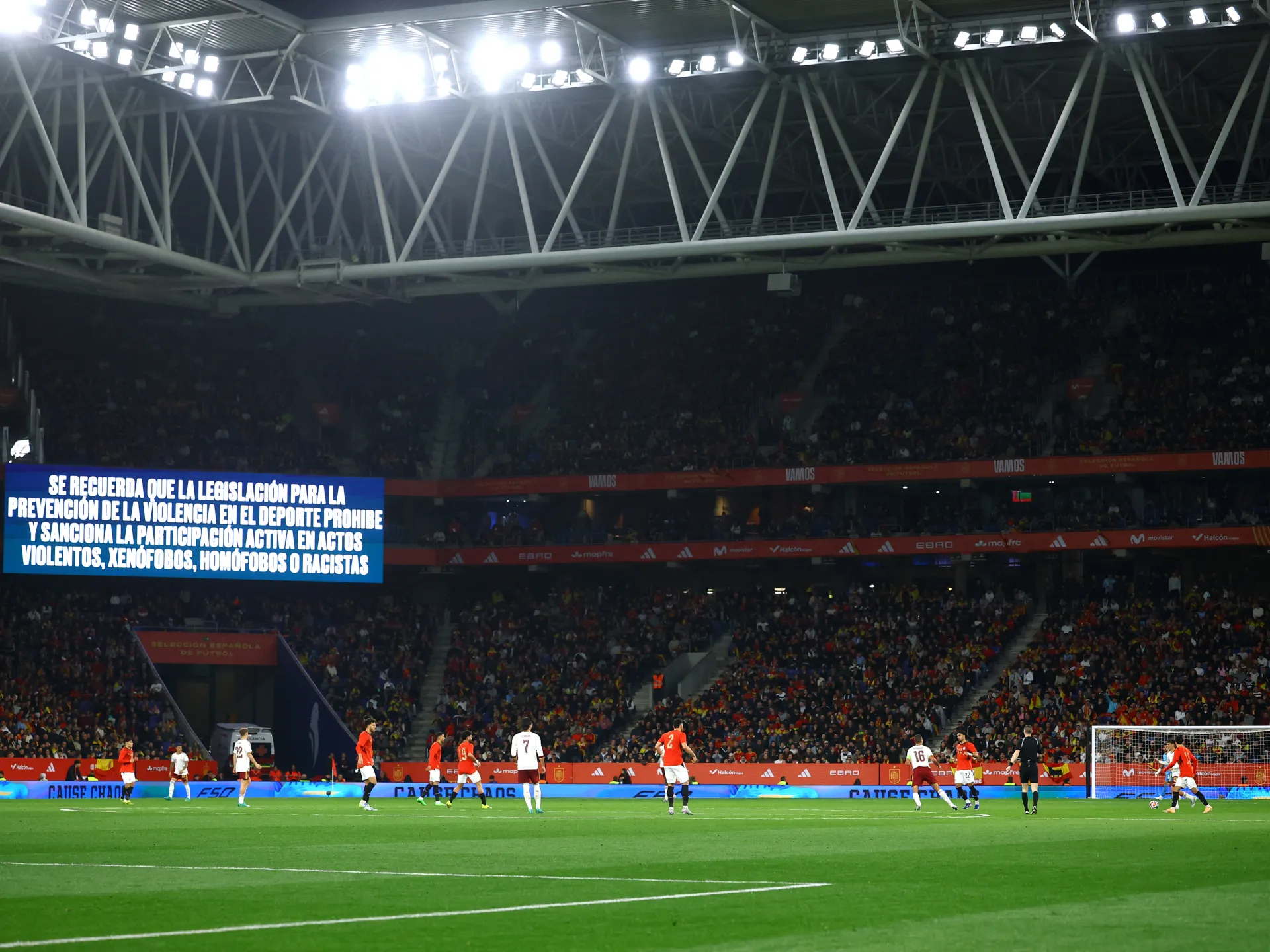
Spain have been fined $20,000 and ordered to partially close their stadium for their next friendly after supporters twice chanted Islamophobic slogans during the game against Egypt in March, FIFA said in a statement.
The sanctions relate to incidents at the RCDE Stadium near Barcelona, home of LaLiga club Espanyol, where some Spain fans chanted, “Who doesn’t jump is a Muslim” during a World Cup warm-up match which ended in a 0-0 draw.
Recommended Stories
list of 3 itemsend of list
After the second occurrence of the chant, the stadium announcer issued a warning and the scoreboard displayed a message against discriminatory behaviour.
Spain winger Lamine Yamal, who is Muslim, condemned the chants at the time, describing them as disrespectful and intolerable and calling those responsible “ignorant and racist”.
Spanish police launched an investigation the following day, while world governing body FIFA later started disciplinary proceedings against the Spanish football federation (RFEF).
It argued that the word ‘Muslim’ was “neither insulting nor pejorative”, adding that the fans’ conduct should be assessed under FIFA’s Article 17, which covers political, ideological, religious or offensive messages, rather than Article 15, which deals with discrimination and racist abuse.
However, FIFA’s disciplinary committee rejected that argument, saying Article 15 does not require the explicit use of a slur and that a term can be discriminatory when used in context as “an insult, taunt, or marker of inferiority”.
FIFA fined the RFEF and ordered the closure of at least 15% of available seats for Spain’s next friendly.
SPAIN has long reigned as the most popular holiday destination for Brits – but a cheaper alternative is set to rival it, according to easyJet.
Destinations across North Africa are seeing a huge boom in bookings, as holidaymakers look for better value holidays.
North Africa is continuing to boom in popularity as Spain slowsCredit: AlamyDestinations like Morocco, Egypt and Tunisia are seeing a jump in demandCredit: Alamy
North African holiday destinations include Morocco, Egypt and Tunisia – which all offer great winter sun options as well.
EasyJetholidays CEO Garry Wilson said at the recent ABTA convention in Madeira: “When we look at demand for next year, places like North Africa, we will see that continue to grow in popularity.
Sign up for the Travel newsletter
Thank you!
“Spain has been a bit overheated and we will see capacity demand slow down a bit.”
Luxury five star hotels are much cheaper across North Africa compared to mainland Europe.
For example, a five-star, all-inclusive week in Egypt can be found for under £450 each in November with loveholidays – the same in Spain is over £1,000.
Tunisia is even cheaper, with five star, all inclusive breaks just £249pp each in November for seven nights, while Morocco is around £509pp.
The Sun’s Head of Travel Lisa Minot explained further: “Holidaymakers looking for the best value this winter and into nextsummer should be honing in on the emerging – and wallet-friendly – North African destinations of Tunisia, Morocco and Egypt.
“With the number of flights from the UK more than doubling since 2019, they have become a serious contender to our traditional Spanish favourites.
“Now tour operators are joining the fray with easyJet Holidays, TUI and the UK’s largest tour operator Jet2 all offering even greater choice – at very competitive prices.”
She added that Brits are “recognising the value they offer as the cost of living crisis continues to hit family budgets,” which is despite the conflict in the Middle East.
New flights and holiday to Egypt have resulted in record tourism numbers this yearCredit: Alamy
Lisa continued: “I saw for myself the premium offering in Marsa Alam on a trip in February and holiday prices for this winter to the Red Sea resort are lower than before the escalating tensions.”
Egypt recently announced they had welcomed a record 14.4million international tourists in 2026, an increase of four per cent compared to last year.
With a target of 30million by 2030, hotel capacity is set to double, with plans for 35,000 extra hotel rooms.
BRITS could face hefty fines if caught smoking, or playing loud music at one popular holiday spot.
In some cases, the penalty could be as much as £2,500.
In areas of Tenerife it’s now it’s been banned to smoke on the beachCredit: Getty It’s also been banned to be disruptive around natural swimming poolsCredit: Getty
The area of La Laguna in Tenerife, has approved new rules banning smoking, camping, overnight stays and disruptive music on its beaches and natural swimming pools.
The announcement was made on October 7 and has been put in place to protect the coastline.
Sign up for the Travel newsletter
Thank you!
Under the new rules, beaches within the areas and natural pools are now smoke-free.
It also stops visitors from leaving rubbish behind including soap and shampoo in public showers.
A string of mazy runs down Barcelona’s right flank, two goal assists within three minutes, and a player of the match award cap off yet another impressive night in European football; Lamine Yamal continues to rack up remarkable statistics and mesmerising performances eight weeks into the club football season.
While this isn’t Yamal’s breakthrough year by any means – the Spanish forward first burst onto the scene as a 16-year-old in the 2023-24 season – his consistency for both club and country in the past eight weeks has led to comparisons with some of the greatest prodigies of recent years.
Recommended Stories
list of 3 itemsend of list
Since returning from the FIFA World Cup as a champion, Yamal has enjoyed scintillating form with the Catalan side.
Across the eight match weeks in club football, the 19-year-old has scored eight goals and provided nine assists in his 10 matches in all competitions for Barcelona, bringing his total number of goal contributions to an impressive 17.
All-time Barcelona and Argentina great Lionel Messi had 14 goal contributions – eight goals and six assists – to his name in the 2008-09 season, when he won his first Ballon d’Or award as a 19-year-old.
Barcelona’s Lamine Yamal vs Real Madrid’s Kylian Mbappe
Yamal has made no secret of his desire to win the award in 11 days, but he will face stiff competition from French star Kylian Mbappe and England captain Harry Kane.
Mbappe, who has broken goal-scoring records of his own, leads the attack at Real Madrid – Barcelona’s fiercest rivals and the undeniable kings of European football.
While Real have not won the Champions League since the 2023-24 season, which brought their record-extending 15th trophy, Mbappe helped them beat Italian giants Inter Milan in their first match last month.
Before joining Real in 2024, Mbappe was on a goal-scoring spree with French champions Paris Saint-Germain. He joined the club as an 18-year-old in 2017 and enjoyed great success a year later.
As a then-19-year-old, Mbappe scored 12 goals and made four assists in his first 10 games, bringing his goal contribution to 16 – one behind Yamal’s current record after the same number of matches.
The master Messi vs apprentice Yamal?
While comparisons between Yamal’s overall career with Messi’s would be grossly unfair, the Spaniard is following in his club legend’s footsteps.
Both players enjoy the unique statistic of having scored braces in their first five La Liga games. Messi’s came as a 25-year-old in the 2012-13 season, while Yamal has achieved the same feat this season.
In April 2007, Messi scored his famous solo goal against Getafe, dribbling from his own half past five players as Camp Nou watched in awe.
Three months later, Lamine Yamal was born, and not long after, Messi was seen with baby Yamal in a photo that went viral this year.
The hype reached fever pitch during the World Cup as a young Messi bathed baby Yamal during a TV commercial. At first, many thought it was an AI-generated image, but it’s indeed real and dates back to 2007.
During a UNICEF fundraising shoot at Camp Nou stadium, a 20-year-old Messi met Yamal, who was only five months old at the time.
The two Barcelona stars faced off in the World Cup final on July 19, with the Argentinian walking away in tears as Yamal’s Spain lifted the trophy, but not before they exchanged a warm embrace.
Yamal later revealed what he said to Messi on the pitch in New York.
“I said thank you for everything you gave football,” Yamal told a British newspaper.
Before the final, much of the attention had centred on the battle between 39-year-old Messi and 19-year-old Yamal, with the match likened to a master vs apprentice clash.
Nineteen years on from that iconic photo, Yamal is already chasing Messi’s Barcelona milestones. Here’s how old each of them was when they played their 150th game for the club.
Barcelona boss says ‘Everyone’s watching Lamine’
During the current season, Yamal’s incredible goal tally overshadows that of three other La Liga teams.
His seven individual goals in the league are more than what Valencia (six), Getafe (four) and Malaga (four) have managed as teams.
The forward’s form and skills are not lost on his manager, Hansi Flick.
The Barcelona boss heaped praise on his number 10 after the 4-1 win over Galatasaray in Istanbul.
“When you see the chances Lamine creates in every training session, it’s the same in matches. I have a lot of top-quality players. Everyone’s watching Lamine – that’s only natural.”
“It’s incredible to have players like that; he’s turned the game around for us.”
Jose Mourinho enjoyed a Roma reunion to remember as Real Madrid completed an astonishing comeback by scoring three late goals to claim a 4-3 away win in the Champions League on Wednesday.
Marten de Roon gave the hosts a deserved opener before Kylian Mbappe struck back on his 100th Champions League appearance to level the scores at the break.
Recommended Stories
list of 4 itemsend of list
Two Donyell Malen strikes in the space of six minutes early in the second half seemed to take the game away from the 15-time European champions as Roma ran rampant.
But Real scored three goals in the space of seven minutes late on, all stemming from corners, to turn the game on its head as Carlos Espi, Endrick and ex-Roma defender Antonio Rudiger struck at a stunned Stadio Olimpico.
Mourinho was a popular figure, leading Roma to the UEFA Conference League title and an Europa League final during two-and-a-half years in charge.
The home crowd honoured the Portuguese with banners and chants in Roma’s first home Champions League match in more than seven years, and the hosts started strongly as Mario Hermoso forced Thibaut Courtois into a flying fingertip save.
Roma took a deserved lead when De Roon swept a shot past Courtois from 25 yards in the 20th minute, and almost doubled it when Malen’s powerful shot squirmed under Courtois before being plucked off the line.
However, one costly moment of switching off proved enough to send them back to square one within five minutes of the opener being scored.
Hermoso misjudged an interception to allow Mbappe a clear run at goal, and the French striker’s deflected shot flew into the roof of the net to level the scores with Real’s first meaningful chance of the game.
Mbappe marked his Champions League centurion status – he is the youngest player to reach the milestone, aged 27 – with his 72nd tournament goal, one that moved him into the all-time top five ahead of Real legend Raul Gonzalez.
The equaliser appeared to subdue Roma and steady Mourinho’s men, who twice threatened a second before the break as Marc Cucurella and Jude Bellingham came close.
Roma take game to Real Madrid
But Roma boss Gian Piero Gasperini insisted pre-match that Roma would not compromise on their full-throttle style regardless of opposition, and he was true to his word as they came out firing after the break.
Roma quickly retook the lead when half-time substitute Rodrigo Mora fed the ball to Malen, who finished brilliantly by taking the ball in his stride with his first touch and lifting it over Courtois with his second.
Things got even better for the Italians just six minutes later when Malen raced onto a through ball to power home his second, given following a VAR review after initially being flagged for offside.
Real looked for a response as Mbappe twice tested Pierluigi Gollini, before having his second goal of the night ruled out for offside.
But set-pieces proved to be the key to unlock the Roma defence, as Espi tucked home a close-range rebound from a header to pull one back before Endrick powered home a header from another corner just two minutes later.
The final blow was struck by Rudiger in the 90th minute, the defender getting in front of his marker to guide home a close-range finish and complete an extraordinary turnaround.
The result leaves Real Madrid with six points from their opening two league phase matches, while Roma are on one point.
Shakhtar Donetsk beat AEK Athens in London debut
Nomadic Ukrainian champions Shakhtar Donetsk celebrated moving into their new Champions League “home” at Stamford Bridge by storming back to beat AEK Athens 3-1.
Fans of the club turned up in the thousands to support the team, who emerged from the tunnel draped in blue-and-yellow national flags.
The Greek side took the lead in the 28th minute through Lovro Majer but Pedrinho levelled confidently from the penalty spot just six minutes later.
With about 10 minutes of normal time to go, Vinicius Tobias found the net from a tight angle and substitute Gleiker Mendoza made the game safe, smashing home after cutting in from the left.
The result leaves Shakhtar on four points after two games, following a draw against PSV Eindhoven in their opening match in the league phase of the Champions League.
Giant-killers Bodo sink Dortmund in Champions League
Fredrik Sjovold’s 52nd-minute strike secured a 1-0 victory for Bodo/Glimt over Borussia Dortmund, extending the Norwegian side’s remarkable home record against Europe’s elite.
Bodo were a cut above the 2024 Champions League runners-up and took the lead through Sjovold just after the break.
Dortmund improved in the final half hour but were unable to strike back, despite a late chance for Felix Nmecha.
Dortmund join Manchester City, Inter Milan and Sporting as recent big-name scalps on the artificial turf of Bodo’s Aspmyra stadium.
Aston Villa put six past Fenerbahce in record rout
Aston Villa recorded their biggest ever European victory as Nicolas Jackson inspired a 6-0 rout of Fenerbahce.
Unai Emery’s side won at Villa Park for the first time this season to maintain their 100 percent start in Europe’s elite club competition.
Swiss forward Johan Manzambi put Villa in front, and Jackson was on target twice before the interval.
Ross Barkley scored twice in the second half before Tammy Abraham’s late strike completed the rout.
Vinicius will miss El Clasico on October 25, the first of his four-match ban for pulling Saliba’s hair in La Liga.
Published On 14 Oct 202614 Oct 2026
Real Madrid’s Vinicius Junior will miss the upcoming match against Barcelona in the Spanish league after being issued a four-match suspension for pulling an opponent’s hair during a La Liga game last week.
The Brazilian forward will miss Madrid’s next four league fixtures, including the highly anticipated October 25 El Clasico against fierce rivals and league champions Barcelona.
The Spanish federation’s disciplinary committee announced the ban on Wednesday after Vinicius received the red card against Villarreal last week.
The number seven thought he had scored Real’s second goal in the match on Saturday, but his effort was disallowed after a video assistant referee (VAR) review found he should be dismissed for pulling Nathan Saliba’s hair in the build-up.
The Spanish football federation’s disciplinary committee confirmed the Brazilian will be banned for several matches, including the visit to face league leaders Barca, because of both the red card and his subsequent protests.
After the match, Vinicius, who came on in the 52nd minute and was red-carded 20 minutes later, posted on social media, saying, “sorry to the team and the fans”.
Vinicius was celebrating after scoring when referee Isidro Diaz de Mera was called by the VAR to review the moments before his goal. The referee waved off the goal and pulled out a red card for Vinicius, who also goes by his nickname Vini Jr.
When he thought Vinicius had doubled the lead, Real manager Jose Mourinho ran to join the celebrations with his players.
But moments later, Vinicius was left livid by the referee’s decision. He screamed at Diaz de Mera while his teammates tried to calm him down as he left the field.
Without a quick deal to move fertiliser through the strait, agricultural productivity would ‘significantly drop’.
Published On 14 Oct 202614 Oct 2026
A senior United Nations official has warned that parts of Asia and Africa could face a food security crisis unless Iran and the United States quickly agree on a UN-backed plan to move fertiliser through the embattled Strait of Hormuz.
UN Under-Secretary-General Jorge Moreira da Silva said on Wednesday that it was “absolutely critical” that the two countries agree to the proposal within weeks as planting season approaches. It calls for a UN-staffed coordination centre in Oman to help register vessels and oversee their safe passage in the waterway, through which a large portion of key global fertiliser inputs traditionally flow.
Recommended Stories
list of 3 itemsend of list
“If we miss that planting season, the productivity of agriculture would significantly drop and the impact on prices will significantly increase,” Moreira da Silva told Reuters on the sidelines of International Monetary Fund and World Bank meetings in Bangkok, Thailand.
Farmers operate strict crop calendars, and even slight delays could severely affect yield.
‘Negligible’ fertiliser shipments
Traffic in the Strait of Hormuz has been severely disrupted since the start of the US-Israel war on Iran, with Iran targeting vessels in the strait and the US and Iran exchanging fire in and around the waterway.
The disruption has hit global supplies of urea, the world’s most widely used nitrogen fertiliser, as well as seaborne sulphur, a key input. Before the war, roughly a third of global urea shipments and nearly half of seaborne sulphur passed through the strait.
Although some ships have been able to sail through amid the crisis, fertiliser products have made up a “very negligible” share of moving cargo, according to the Washington-based International Food Policy Research Institute.
Moreira da Silva said the UN-backed fertiliser mechanism, drawn up in March, could be activated within seven to 10 days if both Iran and the US agree.
Under the plan, UN monitors would work alongside local authorities at Gulf ports to verify cargo loading. Ships would be tracked during transit, and additional inspections could be carried out if countries raised concerns about a vessel or its cargo, said Moreira da Silva. He did not say why the US and Iran have not yet agreed.
The passage of only five vessels per day through the Strait of Hormuz could keep fertiliser supplies flowing to countries in critical need, he added.
‘Let us do our job’
The UN mechanism could work alongside negotiations for a “comprehensive deal” to restore freedom of navigation in the strait, Moreira da Silva said.
Iran and the US have exchanged proposals through intermediaries since a June interim ceasefire collapsed. Efforts to reopen the Strait of Hormuz have stalled over Tehran’s conditions and Washington’s insistence on addressing Iran’s nuclear programme from the outset.
“What we are telling them is, while you continue your discussions towards a comprehensive deal, let us work, let us do our job,” said Moreira da Silva.
His plea comes amid growing concern that fertiliser shortages could hit global food supplies.
In May, the UN’s Food and Agriculture Organization warned that fertiliser scarcity could tighten food supplies from late 2026 into 2027, and would likely hit countries facing climate or other crises much harder.
In South Asia, where most rely on imported fertiliser, farmers are already struggling because of soaring costs and fertiliser scarcity. On Wednesday, farmers in Spain took to the streets to protest rising production costs amid high oil and fertiliser prices.
A NEW Spanish tourist tax being introduced this year is set to cause a hike in holiday costs.
The rule, which will be rolled out from the start of December, could see some holidaymakers slapped with an extra fee.
A new tax rule is being introduced in Spain and it’s set to impact touristsCredit: GettyCertain holiday rentals will now be subject to a 10 per cent VAT chargeCredit: SWNS
Tourists visiting Spain and the Canary Islands after December 1st, 2026, may have to pay an extra new charge if they opt for self-catering accommodation.
Those staying in apartments or villas booked via the likes of Airbnb could end up shelling out for an additional 10 per cent in VAT.
Sign up for the Travel newsletter
Thank you!
The tax, brought in by the Spanish Government, applies to qualifying furnished holiday rentals in popular travel destinations such as Ibiza, Mallorca, Barcelona and the Canary Islands.
Tourist accommodation in Spain has previously been exempt from VAT payments.
Any holiday home rented for 30 nights or fewer will be subject to the tax – unless the property is the landlord’s habitual home.
The government says that the VAT measure is being brought in to help combat the housing pressures faced by Spanish residents.
The Spanish property market is currently under strain due to the high amounts of apartments and houses being bought for short-term tourist use.
The new tax may not necessarily mean that tourists are forced to pay, though as it depends if the landlord of the holiday home decides to pay the additional VAT themselves.
Tourists are being urged to double check the price of bookings made for rental holiday homes before they pay.
Those booking accommodation that could be subject to the new tax should look carefully at the price breakdown of bookings
It is wise to check whether any additional VAT is included in the cost or whether paying it on top of the original booking will be a requirement.
Who: Atletico Madrid vs Manchester United What: UEFA Champions League, matchday 2 Where: Estadio Metropolitano, Madrid, Spain When: Tuesday, October 13, at 9pm (19:00 GMT) How to follow: Al Jazeera Sport will bring you all the build-up and live updates from 16:00 GMT.
Action in Europe’s premier club competition returns with a matchday two clash between in-form La Liga side Atletico Madrid and Premier League strugglers Manchester United.
There are contrasting moods in the camps ahead of Tuesday’s fixture in the Spanish capital.
Atletico are challenging Barcelona for the top spot in Spain’s top flight, while Man United are in the bottom half of England’s Premier League, several places below all their traditional rivals.
Left winger Alex Baena and striker Jonathan David have been running the show for Atletico, while playmaker Bruno Fernandes and marksman Bryan Mbeumo are trying to keep United’s hopes alive of turning things around.
Atletico and Man United are set to clash for only the fifth time in history and the third in the Champions League.
Here’s all you need to know about the match:
How have Atletico Madrid played this season?
Atletico have made a promising start to the 2026-27 La Liga season, as they sit in second place, five points adrift of leaders and title holders, Barcelona.
Of the eight league games they have played, Atletico have won six, drawn one and lost one.
That keeps Atletico 25th and Man United fourth in the league phase of this year’s Champions League.
The top eight teams at the end of the league phase qualify directly to the knockout rounds.
Atletico Madrid vs Manchester United: Predictions
Opta’s supercomputer has given Atletico a 48.5 percent probability of victory, while Man United have a 27.2 percent chance and a draw is estimated at a likelihood of 24.3 percent.
Atletico Madrid vs Manchester United: Head-to-head
Matches: 4
Atletico wins: 2
Man United wins: 0
Draws: 2
Encounters:
March 15, 2022: Manchester United 0-1 Atletico Madrid (Champions League)
February 23, 2022: Atletico Madrid 1-1 Manchester United (Champions League)
November 06, 1991: Manchester United 1-1 Atletico Madrid (UEFA European Cup Winners Cup)
October 23, 1991: Atletico Madrid 3-0 Manchester United (UEFA European Cup Winners Cup)
Atletico Madrid vs Manchester United: Form guide
(Last five matches across all competitions, latest match first)
Atletico Madrid: W-W-W-W-L
Manchester United: D-D-L-L-W
Alex Baena celebrates scoring for Atletico [File: Fran Santiago/Getty Images]
Who are the top players to watch?
Alex Baena and Jonathan David (Atletico): Baena is in good form for club and country, with four goals and two assists for Atletico this season. Further up the pitch, centre-forward David has three goals and two assists.
Bruno Fernandes and Bryan Mbeumo (Man United): Midfielder Fernandes, the United captain, has been the team’s top scorer with four goals in all competitions, while the playmaker also has an assist. Forward Mbeumo, meanwhile, has three goals and an assist.
What have the coaches said?
Diego Simeone (Atletico):
On Julian Alvarez failing to find the net so far this season: “I think strikers with Julian’s characteristics always need goals, not just him. It’s true that beyond his finishing, he’s a team player, a player that can link very well, he can assist and he’s got many more tools than just goalscoring.”
On facing Man United: “The game will be long, it will be tough and we have to manage our efforts to compete well.”
Michael Carrick (Man United):
On United’s poor form: “We’ve got to stay positive and keep doing the right things. We need to do better and we need more points, of course we do.”
On facing Atletico: “We’ve got big games coming up and are looking forward to Tuesday now. A fresh start, a fresh game and we will go there looking forward to the game.”
Did you know?
Atleti are unbeaten in the four meetings between the sides (W2 D2). Their most recent encounters came in the 2021-22 Champions League round of 16, where they drew 1-1 in Madrid before winning 1-0 in Manchester.
Atleti also dethroned United as European Cup Winners’ Cup holders in 1991-92, winning the second-round tie 4-1 on aggregate (3-0 home, 1-1 away).
United have lost only one of their last 11 matches against Spanish opponents (W7 D3). They beat Athletic Bilbao 3-0 away and 4-1 at home in the last fixtures in the 2024-25 Europa League semifinals to make it three successive victories.
United’s last 10 matches against Spanish opponents have produced 35 goals, an average of 3.5 per game.
United manager Michael Carrick is under pressure after a poor start this season [File: Carl Recine/Getty Images]
Team news and predicted lineups
Atletico Madrid
Atletico have a fully fit squad.
Predicted starting XI:
Jan Oblak; Marc Pubill, Cristian Romero, David Hancko; Marcos Llorente, Pablo Barrios, Koke, Giuliano Simeone; Kang-in Lee, Alex Baena; Julian Alvarez
Manchester United
As many as five United players are out with injuries. Those include Patrick Dorgu (hamstring), Benjamin Sesko (shin), Tom Heaton (abdomen), Manuel Ugarte (knee) and Matthijs de Ligt (back).
The beautiful spot is perfect for pensioners seeking a relaxed lifestyle
14:27, 12 Oct 2026Updated 14:35, 12 Oct 2026
Best town to retire in Spain as expats praise ‘affordable living’
New analysis from World Atlas has named the best Spanish towns to relocate to. They are all stunning, overlooked locations, ideal for retirees seeking a peaceful and authentic way of life away from well-known resorts such as Benidorm or the Costa del Sol.
The research highlighted seven picturesque towns with fewer than 50,000 inhabitants across Spain that feature “walkable, historic centres with accessible recreation, including coastal paths, mountain trails, canoeing rivers, and reservoirs a short drive from the front door”. On Reddit, expats praised the “affordable living” and the “amazing regional food” of some of these picture-perfect locations.
Trujillo, in Extremadura, was named the best small town to retire in, with the lowest housing prices of around €717 (£605) per month. Locals praised the town’s authenticity on social media, with one saying that “life is more or less affordable, with no uncontrolled tourism problems, and food is amazing”.
Trujillo was followed by Arcos de la Frontera, in Cádiz, which has an estimated population of 31,046. Experts at World Atlas noted: “For retirees who want a classic Spanish white town with water sports on the doorstep rather than just mountain views, Arcos is a rare combination.”
Baiona, in Galicia, was also named one of the best places to relocate to. The charming town in northern Spain has a population of 12,380. World Atlas stated: “Baiona offers a version of coastal Galicia that pairs history with a genuine beach-town feel, at a price most Mediterranean resort towns can’t match.”
Other places included the picturesque town of Sitges, just half an hour down the coast from Barcelona, and Cangas de Onís, best known as the historic gateway to the Picos de Europa National Park.
Real Madrid forward has a goal disallowed, is sent off for the hair-pull offence and could miss the next three games.
By Reuters and The Associated Press
Published On 11 Oct 202611 Oct 2026
Real Madrid’s Vinicius Jr has apologised to his teammates and the club’s fans after being sent off in the 1-0 win over Villarreal in La Liga at the Santiago Bernabeu but now faces a nervous wait for a ruling by the disciplinary committee, which could see him miss Real’s fixture with rivals Barcelona in two weeks.
The Brazilian thought he had scored Real’s second goal in the match on Saturday, but his effort was disallowed after a video assistant referee (VAR) review found he should be dismissed for pulling Nathan Saliba’s hair in the build-up.
After the match, Vinicius, who came on in the 52nd minute and was red-carded 20 minutes later, posted on social media, saying, “sorry to the team and the fans”.
Vinicius was celebrating after scoring when referee Isidro Diaz de Mera was called by the VAR to review the moments before his goal. The referee waved off the goal and pulled out a red card for Vinicius.
When he thought Vinicius had doubled the lead, Real manager Jose Mourinho ran to join the celebrations with his players.
But moments later, Vinicius was left livid by the referee’s decision. He screamed at Diaz de Mera while his teammates tried to calm him down as he left the field.
Vinicius was restrained by his teammates as he argued with the referee [Oscar Del Pozo/AFP]
“I don’t think he meant to hurt anyone, but it is a red card,” Villarreal defender Juan Foyth said about the hair yank of Saliba.
Diaz de Mera wrote in his match report that after being shown the red card, Vinicius “protested my decision, raising his voice, toward where I was standing in an aggressive manner, and being held back by teammates”.
Royal Spanish Football Federation regulations state that pulling an opponent’s hair is regarded as violent conduct.
The sanction for violent conduct without causing injury to an opponent, according to Article 130 of the league’s rules, is a ban of one to three matches.
Real’s next three La Liga games are against Sevilla, Barca and Racing Santander, but missing El Clasico would be a bitter blow for the 26-year-old Brazil international.
Mourinho did not appear at the mandatory post-game news conference.
Real Madrid forward Vinicius Junior sent off for pulling Villarreal player’s hair in 1-0 La Liga victory.
Published On 10 Oct 202610 Oct 2026
Yan Diomande earned Real Madrid a tight 1-0 victory over Villarreal on Saturday to keep them six points behind La Liga leaders Barcelona, even though winger Vinicius Junior was sent off for hair-pulling.
Brazil international Vinicius, on as a substitute, scored, but his goal was disallowed. He was then dismissed after a VAR review showed he had pulled the hair of Villarreal’s Nathan Saliba.
Recommended Stories
list of 4 itemsend of list
Jose Mourinho’s Madrid battled through the final stages with 10 men but held on to win and go provisionally third.
Champions Barca lead La Liga after a 3-0 win over Getafe, while Atletico Madrid are five points behind in second after they edged Alaves 2-1.
Striker Kylian Mbappe was fit to start the match for Madrid at their Santiago Bernabeu stadium after suffering a knee problem playing for France during the international break.
There was a smattering of whistles for the superstar forward, with some fans believing he has been unprofessional in recent weeks, but also applause from other supporters.
Mbappe, a candidate for the Ballon d’Or trophy later this month, was Madrid’s most threatening player in the first half, although he had little competition.
Mourinho started with out-of-form winger Vinicius on the bench, following his trips to Australia and India with Brazil during the international break.
Madrid improved defensively, giving Villarreal few chances of note, but struggled to build much in attack themselves in a drab opening half.
Mbappe struck the post from Alvaro Carreras’s layoff as Madrid pushed Villarreal back early on.
Villarreal soon gained a foothold and restricted Madrid’s opportunities, until Mbappe forced a good save from Peter Gulacsi.
There was some more mild whistling for Madrid’s display from their fans at half-time, but they were soon able to celebrate summer arrival Diomande’s first goal for the club.
The Ivorian winger, Madrid’s record 140 million euro ($157m) signing, produced a sharp low finish into the far corner after good work from Federico Valverde to play him in.
Vinicius thought he had doubled Madrid’s lead after Jude Bellingham charged in down the left and cut the ball back for him.
However, the winger’s joy turned to anger after referee Isidro Diaz de Mera was called to watch Vinicius’s hair pull on Saliba in the buildup by VAR and sent off the Brazilian, voiding the goal.
Madrid’s Belgian goalkeeper Thibaut Courtois, who had made a couple of smart saves earlier in the half, produced an acrobatic stop to thwart Carlos Romero.
Mbappe was denied again by Hungarian goalkeeper Gulasci as the forward left the Bernabeu frustrated in his hunt for goals, although his team were able to clinch three important points to stay on Barca’s trail.
Snap vote called after Parliament rejects measures to protect tenants and freeze rents.
Rising frustration about housing shortages and surging rents in Spain has led to mass protests.
The demonstrations started last month after the eviction of Maricarmen Abascal, who died at age 87 this week.
The Socialist-led government tried to introduce measures to protect tenants and freeze rents, but Parliament rejected them. The conservative opposition says the solution is to ease regulations and build more homes.
Prime Minister Pedro Sanchez has since announced early elections. Analysts say he wants to galvanise support, as he faces pressure on immigration and corruption investigations into his party.
Two recent polls indicate the right-wing People’s Party and far-right Vox are on track for a combined majority.
Can demonstrations against the housing crisis reverse Sanchez’s political fortunes?
Presenter: Sami Zeidan
Guests:
Hana Jalloul – Secretary of international politics and cooperation for the Spanish Socialist Workers’ Party and a member of the European Parliament
Daniel Lacalle – Chief economist at Tressis and professor at the IE Business School
Pablo Calderon Martinez – Associate professor in politics and international relations at Northeastern University
Striker takes fire for where and how he has chosen to recover from a knee injury as his return to play could come as early as Saturday.
Published On 9 Oct 20269 Oct 2026
Real Madrid coach Jose Mourinho has slammed criticism of star striker Kylian Mbappe, calling the attacks “ridiculous”.
The French captain has come under fire for spending his time recovering from a left knee injury in France and Switzerland rather than Madrid. He suffered a hyperextension of the joint while playing in a Nations League match against Turkiye on September 25.
Recommended Stories
list of 4 itemsend of list
The 27-year-old was also pictured at the entrance of a Parisian nightclub and photographed on a bicycle when he was in Switzerland.
Some fans claimed it was a deliberate snubbing of Mourinho, who only days before had said players should avoid skiing or riding bicycles to avoid injury.
“Are these criticisms over the top? They are ridiculous,” Mourinho said at a news conference on Friday on the eve of Real’s La Liga home match with Villarreal.
“All the players who were obliged to be present every day for their recovery were here.
“Mbappe came, like the others, to undergo scans in order to be diagnosed.
“He then went to see a specialist in France because he has history with his knee, which we cannot ignore.”
Mourinho, whose side lost to Atletico Madrid in their last match and already lag six points behind bitter rivals Barcelona, is never one to shy away from a confrontation and tackled each of the criticisms against Mbappe.
“Problems involving football are not sufficient for you,” the 63-year-old Portuguese coach told reporters.
“Therefore, you have raised the issue of the discotheque, which in fact was not one because it was used for a private event for Fashion Week.
“As for the bicycle in Switzerland, it was in a hotel made up of small houses which makes them available so guests can ride to the communal areas, and you would have us believe he was competing in the Tour of Switzerland.”
Mbappe, who returned to training on Wednesday, could feature on the pitch as early as Saturday. Mourinho shrugged off the potential of a hostile reception for Mbappe against Villarreal, reiterating that he was “certain” the all-time World Cup record goal scorer has fulfilled “his obligations to Real Madrid”.
It is not the first time this season that Mbappe has been subjected to attacks by fans.
The Ultras Sur, a Real Madrid supporters group linked to the far right and banned from the Santiago Bernabeu, took issue with him last month.
They were furious that before a Real Madrid match, Mbappe, alongside Vinicius Jr and fellow Frenchman Ibrahima Konate, partially rolled up T-shirts bearing the words “We are all Ceutans“, which was intended to be a message of support for people in the Spanish territory bordering Morocco.
Mbappe was also criticised earlier this season over his choice of a location for recovery from a previous injury, which led to an online “Mbappe Out” campaign by some Real fans.
A NATIONWIDE strike in Spain is expected to ‘bring the country to a complete standstill’ next month.
The industrial action will affect flights, public transport, shops, restaurants and museums.
Trips to Spain could be affected by a nationwide strike next monthCredit: Getty ImagesFlights are expected to be cancelled or face severe delays on November 11Credit: Getty
The shutdown is due to take place on November 11 when major trade unions in Spain will stage a 24-hour walkout.
The strike is protesting the escalating housing crisis – and it will be the country’s first joint general strike in almost 15 years.
Sign up for the Travel newsletter
Thank you!
While it hasn’t been confirmed, flights across Spain are expected to face cancellations or delays.
Previous general strikes have heavily involved airport ground staff, air traffic controllers, and airline cabin crews causing lots of disruption.
It’s not just flights either – on the ground, public transport will be affected.
The strike is expected to impact trains including high-speed lines, the city metro, and buses which could face severe disruption.
Roads could be closed as well in cities like Madrid and Barcelona which are likely to see large protest marches.
For anyone already on holiday there at the time, the walkout could see some restaurants, museum and shops close too.
If they’re not shut, the opening hours could be reduced to holiday hours.
Advice for those due to travel on November 11 is to keep an eye on any updates from your airline.
Keep an eye on notifications on the airline for those due to fly on that dayCredit: Alamy
Many airlines operate flights from the UK to Spain like BA, EasyJetRyanair, Iberia, TUI, Jet2, Wizz Air and Vueling.
Disruption to flights on this day would be deemed as being an “extraordinary circumstance” which means airlines aren’t required to pay extra compensation.
However, airlines are legally required to rebook you or offer a refund.
A look at your rights if a flight is delayed or cancelled, when your entitled to compensation and if your travel insurance can cover the costs.
What are my rights if my flight is cancelled or delayed?
Under UK law, airlines have to provide compensation if your flight arrives at its destination more than three hours late.
If you’re flying to or from the UK, your airline must let you choose a refund or an alternative flight.
You will be able to get your money back for the part of your ticket that you haven’t used yet.
So if you booked a return flight and the outbound leg is cancelled, you can get the full cost of the return ticket refunded.
But if travelling is essential, then your airline has to find you an alternative flight. This could even be with another airline.
When am I not entitled to compensation?
The airline doesn’t have to give you a refund if the flight was cancelled due to reasons beyond their control, such as extreme weather.
Disruptions caused by things like extreme weather, airport or air traffic control employee strikes or other ‘extraordinary circumstances’ are not eligible for compensation.
Some airlines may stretch the definition of “extraordinary circumstances” but you can challenge them through the aviation regulator the Civil Aviation Authority (CAA).
Will my insurance cover me if my flight is cancelled?
If you can’t claim compensation directly through the airline, your travel insurance may refund you.
Policies vary so you should check the small print, but a delay of eight to 12 hours will normally mean you qualify for some money from your insurer.
Remember to get written confirmation of your delay from the airport as your insurer will need proof.
If your flight is cancelled entirely, you’re unlikely to be covered by your insurance.
Thousands of protestors honor Maricarmen Abascal’s life, while tributes within parliament spark debate.
Published On 9 Oct 20269 Oct 2026
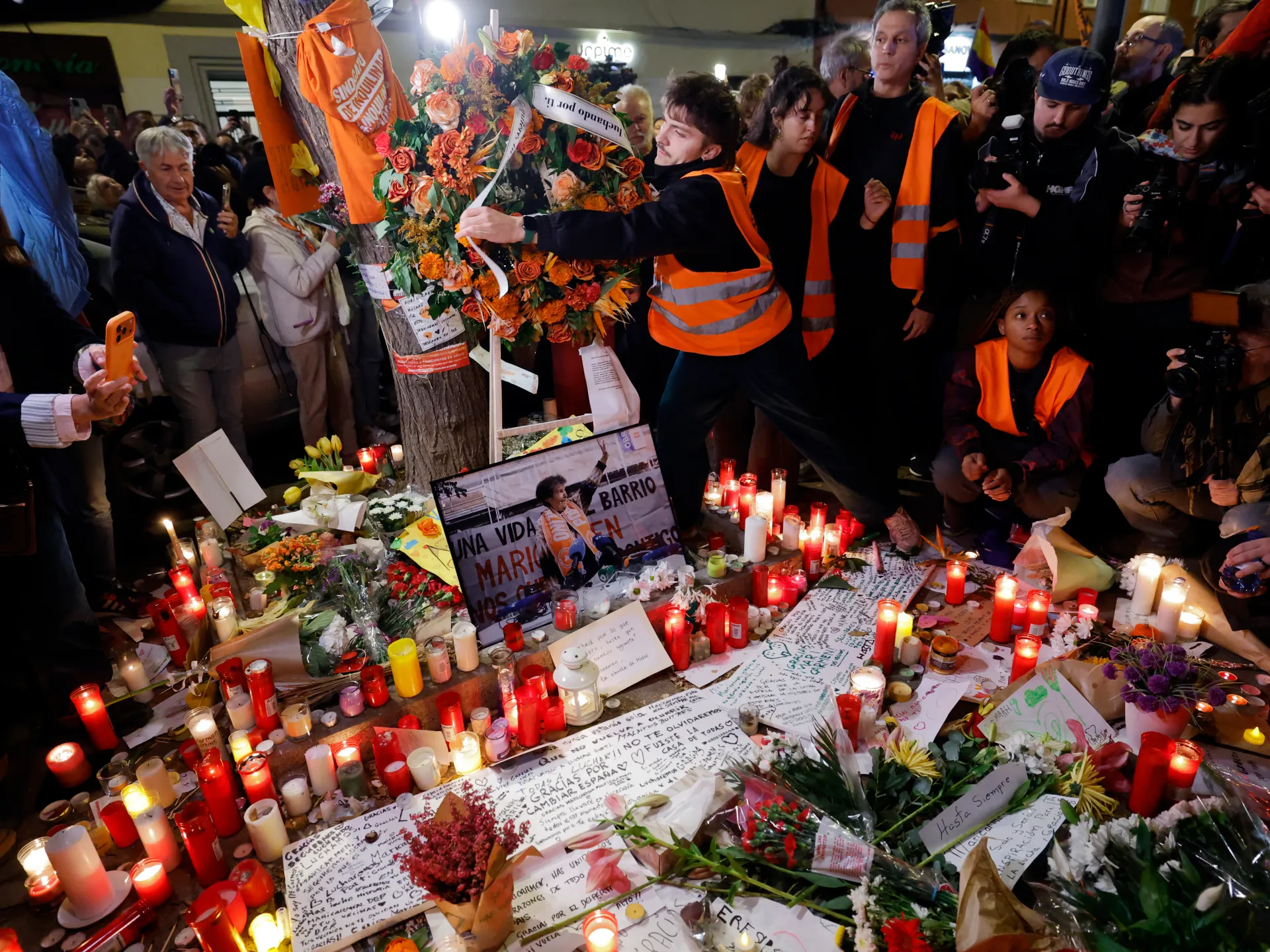
Thousands of Spaniards protested outside Spain’s parliament after the death of Maria del Carmen Abascal, the 87-year-old woman whose eviction ignited nationwide protests and sparked a snap general election.
Meanwhile, tributes to Abascal were debated within the legislature as lawmakers accused each other of exploiting the case ahead of the election.
Recommended Stories
list of 3 itemsend of list
Maricarmen Abascal died on Wednesday after being hospitalised for severe anxiety and exhaustion since her eviction on a stretcher from her Madrid home on September 23.
While in the hospital, she reached a deal to return to her home but died before she could return. No cause of death has been announced.
‘Killing someone’
“They killed her through heartbreak,” Diana, a demonstrator, told Al Jazeera. “Taking an 87-year-old woman out of her home after she had lived in the same house for 70 years, that is killing someone.”
Diana joined thousands of protesters outside Spain’s parliament.
Outside Abascal’s building, mourners left flowers, candles, handwritten notes and children’s drawings.
“They’re not deaths; they’re murders,” protesters chanted as they walked from a protest camp in the central Puerta del Sol square to Abascal’s former home on Thursday.
Tributes in Spain’s legislature
Protests over home shortages and surging rents following her eviction prompted Socialist Prime Minister Pedro Sanchez to call a snap general election for November 29 after parliament failed to pass emergency housing measures.
Tributes to Abascal in the Madrid region’s legislature caused arguments as lawmakers accused each other of exploiting the case ahead of the election.
Alberto Nunez Feijoo, leader of the conservative opposition People’s Party (PP), accused Sanchez and the Socialists of trying to exploit the housing crisis for political gain ahead of the election.
“We will not allow this attempt to manipulate the emotions of the Spanish people; all of this has happened during their eight years in government. It won’t fly,” Feijoo said.
The PP, which holds absolute majorities in the Madrid regional and local assemblies, refused to observe a minute of silence in her honour. Instead, hard-left deputies staged one outside City Hall and gave Abascal a 60-second standing ovation during a tense debate in the regional assembly, while PP lawmakers remained seated with folded arms.
Left-leaning parties criticised conservatives for rejecting legislation in parliament aimed at curbing soaring rental prices.
Support for housing intervention
A survey carried out in June and published by state pollster CIS on Thursday found that 76.3 percent of Spaniards supported intervention in the market to guarantee access to housing, while 79 percent believed the right to housing should take precedence over treating homes as a market commodity.
Ombudsman Angel Gabilondo said addressing the housing crisis would require greater commitment from all levels of government.
He said his office was preparing a housing report and reiterated proposals to expand public housing, restrict tourist rentals, increase rent assistance and strengthen protections against evictions for vulnerable households.