The US naval blockade of Iranian ports and the Strait of Hormuz, in place since April 13, has raised concerns that Iran could run out of crude oil storage capacity and be forced to curb production.
Bloomberg reported analysis on Tuesday from the data and analytics company Kpler suggesting Iran could run out of crude storage in 12 to 22 days if the blockade persists.
Last week, United States Treasury Secretary Scott Bessent claimed that storage capacity at Kharg Island, where most of Iran’s oil is exported, would be full “in a matter of days”.
So how quickly could Iran run out of oil storage, and why does it matter?
What is happening in the Strait of Hormuz?
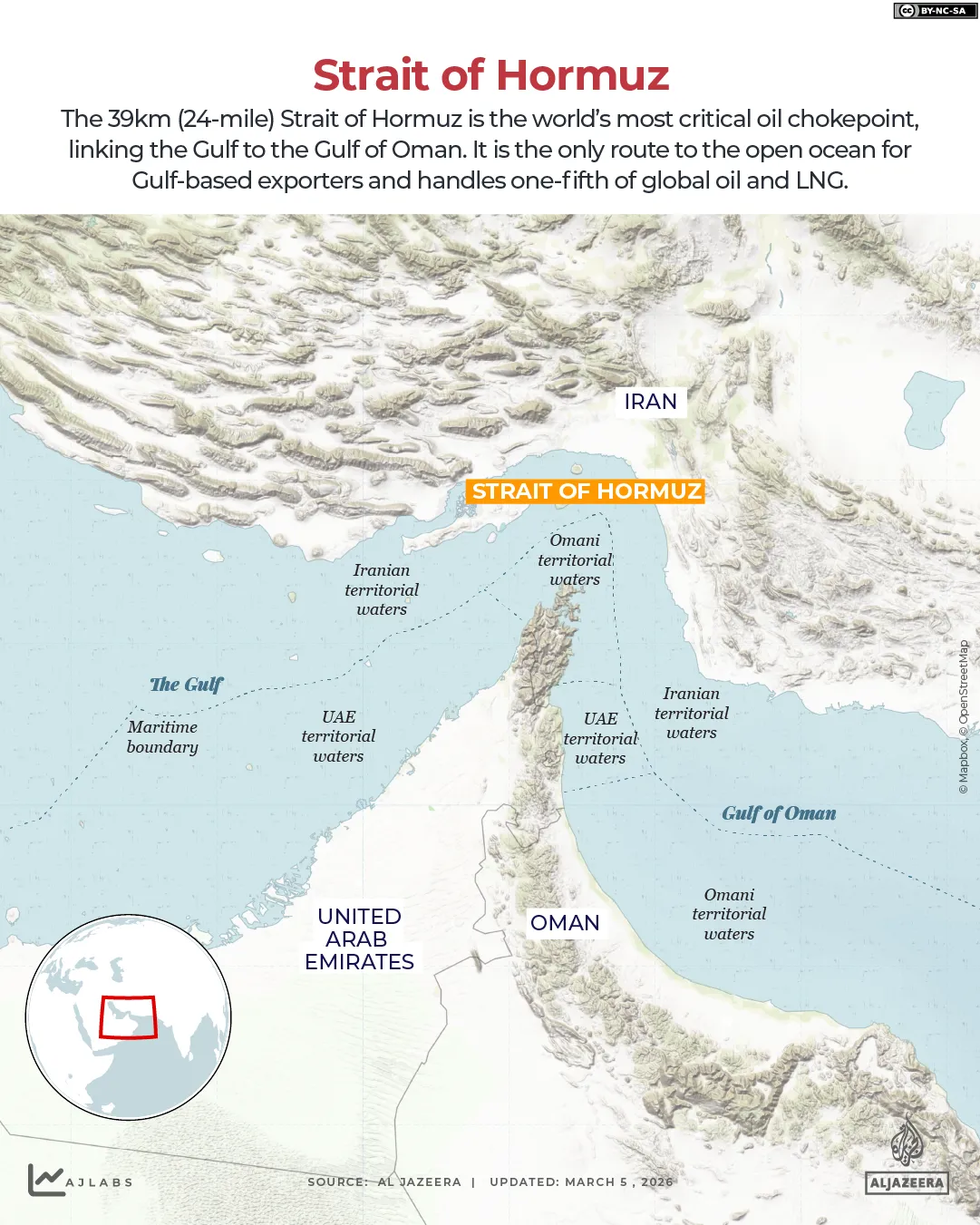
The Strait of Hormuz is a narrow channel that connects the Gulf to the open ocean. It spans the territorial waters of Iran on its northern side and Oman on its southern side. It is not in international waters.
During peacetime, 20 percent of the world’s oil and liquefied natural gas (LNG) supplies are shipped through the corridor.
Two days after the US and Israel launched their first air strikes in their war on Iran on February 28, Ebrahim Jabari, a senior adviser to the commander in chief of Iran’s Islamic Revolutionary Guard Corps (IRGC), announced that the strait was “closed”. If any vessels tried to pass through, he said, the IRGC and the navy would “set those ships ablaze”.

As the war has dragged on and negotiations have failed to achieve a settlement, Iran has at times in the past two months allowed some “friendly” ships and those that pay tolls to pass. It is currently refusing to allow any foreign-flagged ships, including those previously deemed friendly, to pass until the US lifts its own naval blockade.
Iranian First Vice President Mohammad Reza Aref said on April 19 that the “security of the Strait of Hormuz is not free”.
“One cannot restrict Iran’s oil exports while expecting free security for others,” he wrote in a post on X.
“The choice is clear: either a free oil market for all, or the risk of significant costs for everyone,” he added. “Stability in global fuel prices depends on a guaranteed and lasting end to the economic and military pressure against Iran and its allies.”
Since the US naval blockade on the strait began, the US has opened fire on and taken control of an Iranian-flagged tanker near the Strait of Hormuz while also redirecting vessels on the high seas transporting cargo to or from Iran. Iran’s armed forces have denounced these actions as “an illegal act” that “amounts to piracy”.
The US naval blockade of the strait means that Iran might have to store the oil it produces.
Iran is the third largest oil producer in the Organization of the Petroleum Exporting Countries (OPEC) after Saudi Arabia and Iraq and exports 90 percent of its crude oil via Kharg Island in the Gulf for shipping through the Strait of Hormuz.

What has the US claimed?
The US is eager to curb Iran’s oil revenues, which have risen since Tehran closed the Strait of Hormuz to other shipping. This is the primary motive behind Washington’s naval blockade of Iranian ports.
Iran exported 1.84 million barrels per day (bpd) of crude oil in March and shipped 1.71 million bpd in April, compared with an average of 1.68 million bpd in 2025, according to Kpler.
However, the US naval blockade since mid-April now means that most of its exports are having to be stored instead.
Bessent wrote in an X post on April 22: “In a matter of days, Kharg Island storage will be full and the fragile Iranian oil wells will be shut in.”
“Constraining Iran’s maritime trade directly targets the regime’s primary revenue lifelines.”
How much oil can Iran store?
Iran’s domestic refineries have a production capacity of 2.6 million bpd, according to the energy consultancy Facts Global Energy.
Satellite data show the amount of oil Iran has in storage has risen sharply since the US blockade began, and in the days after the US tightened it, stocks were rising so fast that it appeared Iran had been barely able to export any oil at all.
From April 13 to April 21, data showed that stocks rose by more than 6 million barrels, according to the Columbia Center on Global Energy Policy (CGEP). From April 17 to April 21, the stock increased very rapidly, growing by 1.7 bpd.
As of April 20, the storage tanks at Kharg were about 74 percent full after the island alone had taken on about 3 million extra barrels of oil, the CGEP reported.
Generally, oil companies avoid filling their storage beyond 80 percent capacity to balance safety, emissions control and flexibility.
However, Iran and other oil producing countries have exceeded this limit before, for instance, during the COVID-19 pandemic. In April 2020, Kharg island’s stocks reached close to 90 percent capacity, an all-time high.
Iran also has some crude oil storage capacity in the form of “floating tanks”, or parked ships. About 127 million barrels can be stored in this way, Frederic Schneider, a nonresident senior fellow at the Middle East Council on Global Affairs, told Al Jazeera in an interview on April 14.
Will Iran need to cut oil production?
Muyu Xu, a senior crude oil analyst at Kpler, told Al Jazeera that the blockade could eventually force Iran to cut production.
“However, given there is still available storage capacity onshore (roughly covering 20 days of Iran’s current production), we expect any production reduction to be gradual over the coming week with a higher likelihood of acceleration into May,” she said.
Analysis by CGEP nonresident fellow Antoine Halff echoed this. Halff wrote in an article published by CGEP on Tuesday that it may be some time before the US blockade causes Iran to shut off its production “in a big way”.
However, Halff added, Iran may still choose to halt production “fairly aggressively” but this “would be more by choice than by necessity”.
He explained: “Doing so would have the advantage of providing Iran with relatively ample spare storage capacity after the shutdown and would allow for a smoother restart of operations once conditions permit, and the constraint is relaxed, thus minimising adverse impacts from the blockade on longer-term supply.”
Why does this matter?
Halting oil production risks damaging underground reservoirs by reducing reservoir pressure, allowing water or gas to encroach into producing layers and changing patterns of oil flow. This can make some oil harder or more expensive to recover later, experts said.
Restarting the process of oil production can also be slow and costly, involving repairs of corroded equipment or unclogging pipelines.
Halting production would also cause Iran’s export revenues to drop. However, analysts said that for a few months, Iran can continue to earn revenue from oil that is already in transit at sea.
Kenneth Katzman, former Iran analyst at the Congressional Research Service in Washington, DC, said Iran is not exporting new oil during the US blockade of Iranian ports but Tehran has 160 million to 170 million barrels of oil on ships around the world currently.