New Delhi, India — United States Secretary of State Marco Rubio has arrived in India for a two-day visit, during which he is set to tour the Jamnagar refinery complex in Gujarat, owned by billionaire Mukesh Ambani’s Reliance Industries, a major player in global oil markets.
Reliance’s crude refinery in Prime Minister Narendra Modi’s home state is the world’s largest single-site refinery. In many ways, Reliance Industries’ businesses sit at the crossroads of the ongoing global energy crisis.
The conglomerate is central to Washington’s efforts to punish Russian energy buyers, while also trying to contain oil prices amid the war on Iran, on top of rising diesel costs in the US, where a crucial midterm election looms. Reliance has also only recently committed to a major investment in the US, which President Donald Trump’s administration has cited as an example of its successes in luring global capital.
Rubio is skipping the capital, New Delhi, at a time when the US-India bilateral relationship has been rocky, strained by a string of friction points — and an elusive trade deal.
So why is the top US diplomat visiting the world’s largest single-site oil refinery?
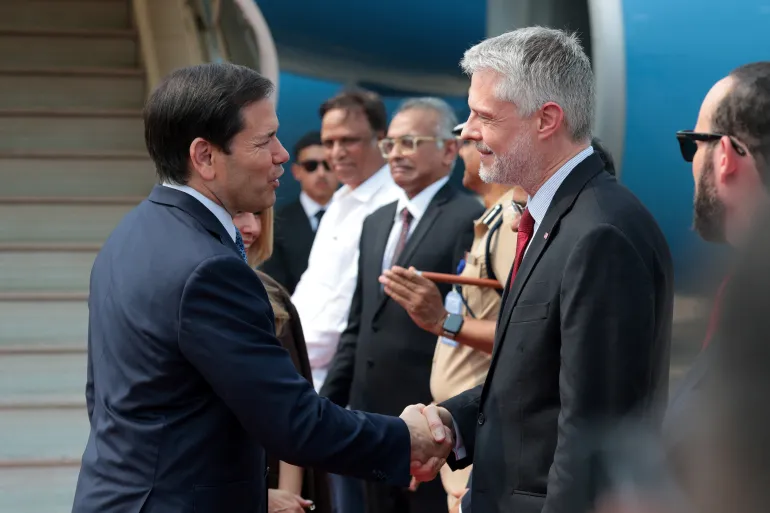
Secretary of State Marco Rubio shakes hands with US Consul-General in Mumbai Yuriy Fedkiw as he disembarks from a plane after arriving at Mumbai airport in India, October 20, 2026 [Kylie Cooper/Reuters]
Where is Rubio visiting?
After meetings in Mumbai, India’s financial hub in the western state of Maharashtra, Rubio will fly to Jamnagar in neighbouring Gujarat, near the Gulf of Kutch. Jamnagar opens into the Arabian Sea and is home to Reliance Industries’ refining complex, a major hub for crude processing and fuel exports, which processes 1.4 million barrels per day (bpd).
Rubio had visited India earlier this year too, but this trip “is a little more business-focused”, the US ambassador to India, Sergio Gor, told reporters last week. A readout from Rubio’s office noted that he would “meet with business leaders to promote opportunities for commercial investment and economic cooperation”.
“[At Jamnagar] he will meet some of the folks at Reliance,” Gor said.
The Reliance Industries oil refinery in Jamnagar, Gujarat, India, on July 31, 2021 [Bloomberg]
What’s in Jamnagar?
The world’s largest single-site oil-refining complex has a combined crude-processing capacity of 1.4 million bpd. That is nearly 1.5 percent of global refining capacity, according to the company.
The complex comprises two refineries: the original facility, commissioned in 1999 with a capacity of 660,000bpd, and a second, export-oriented refinery commissioned in 2008, adding 580,000bpd, which operates in a special economic zone.
Jamnagar imports crude from international suppliers and exports refined products to global markets. The refinery can process heavy, sulphur-rich crude that many facilities cannot handle efficiently, converting oil into higher-value products.
Reliance said last month that the complex has processed more than 216 crude grades, claiming to be “perhaps the only refinery to achieve this feat”.
The Jamnagar refinery’s capacity is also driving a sharp revival in imports of Venezuelan crude — taken over by the US earlier this year after abducting then-President Nicolas Maduro — as Washington seeks to reshape global oil trade.
Reliance is expected to account for roughly 350,000bpd to 370,000bpd of the October intake, according to estimates from analytics firm Kpler. “We will talk with Reliance about refining more Venezuelan crude,” Rubio told reporters in brief remarks on Tuesday.
Secretary of State Marco Rubio, right, with US Ambassador to India Sergio Gor, in Mumbai, October 20, 2026 [Kylie Cooper/Reuters]
Why is the refinery significant for global energy supplies?
Reliance is a central player in keeping global oil markets stable, as one of the world’s biggest suppliers of refined petroleum products. In September, for instance, six of the seven large cargo ships that docked at European Union ports carrying oil products were bearing Reliance goods.
Reliance’s biggest export is diesel, which Trump has been particularly worried about, with prices reaching historic highs in the US ahead of midterm elections early next month.
Though the data on exports by category is not public, an analysis by the Reuters news agency from trade sources noted that Reliance Industries exported 21.66 million tonnes of refined petroleum products in the first half of 2025 from Jamnagar. Diesel accounted for the largest share at 9.81 million tonnes, followed by petrol at 6.14 million tonnes and jet fuel at 2.06 million tonnes.
Europe accounted for the biggest share of the company’s exports, making up 28 percent of Reliance’s refined products during the period. Buyers include BP, ExxonMobil, Glencore, Vitol and Trafigura.
The Jamnagar refinery also shipped about $143m worth of oil products to the US last month, according to data cited by the Centre for Research on Energy and Clean Air (CREA), a think tank in Finland.
CREA noted in its report that the EU’s ban on importing petroleum products made from Russian crude from January 2026 does not adequately prevent products from refineries in third countries from entering Europe when those refineries also process Russian crude. The Jamnagar refinery is a prime example of that loophole.
Rubio’s visit to the refinery also comes as Trump faces his worst approval ratings amid inflation and rising fuel prices ahead of the midterm election in November. Just about 31 percent of Americans are happy with Trump’s performance – the lowest-ever number in his two terms, according to a Reuters/Ipsos survey.
The Trump administration has also reportedly been pushing Ukraine’s President Volodymyr Zelenskyy to stop strikes on Russian energy facilities, which have rattled the global fuel markets.
Why the refinery is important for the Russia-Ukraine war
Since the start of Russia’s full-fledged war on Ukraine in February 2022, India has emerged as the second-largest buyer of Russian oil after China. And Reliance is driving that surge in imports. While only 3 percent of its oil was sourced from Russia before 2022, that share rose to 50 percent by 2025.
So when Trump imposed an additional 25 percent tariff on Indian goods in August 2025 to punish New Delhi for the purchase of Russian oil, Reliance was directly affected. It cut back on Russian crude imports significantly in subsequent months, but it still made up a third of the oil processed by Jamnagar’s refinery during the July-September 2026 quarter.
That was under threat when the Trump administration appeared poised to impose a 100 percent tariff on Indian goods because of continued Russian oil imports, under a new law passed last month.
But Trump has since suspended those proposed tariffs, easing concerns for India and Reliance.
Rubio has said India has been diversifying its import mix away from Russian crude, even as it still buys millions of barrels of Russian oil every day. “You’ve got countries like India, for example, that have voluntarily diversified their energy portfolio, but are still getting a substantial amount of energy from Russia because it’s hard to pivot from one day to the next,” Rubio said on Sunday.
“But they’re also an important ally and partner of the United States.”
Is Reliance also investing in the US?
Yes, India’s richest man, Mukesh Ambani, the chairman and managing director of Reliance Industries, is investing in the US, primarily through energy-related projects.
It is backing America First Refining’s planned oil refinery at the Port of Brownsville in Texas, also the first major US refinery in about 50 years, announced by Trump in March.
The refinery is expected to cost $3bn to $4bn and process about 60 million barrels of US crude annually. Reliance has signed a 20-year agreement to buy a large share of the facility’s output, with operations expected to start around 2029.
In November 2024, Reliance’s US subsidiary also acquired a 21 percent stake in helium explorer Wavetech Helium for $12m as part of its low-carbon energy strategy.
Last month, Trump announced that India’s Essar Group — an oil major with knee-deep ties to Russia — is planning an $18bn integrated steel investment in the US through its subsidiary, Mesabi Metallics.
Didn’t Trump’s ally just lock horns with Ambani?
Despite Reliance’s investments in the US and Rubio’s upcoming visit to the Jamnagar facility, Elon Musk, the world’s richest man who is also a key Trump ally, recently hit out at Ambani.
His Starlink space telecommunications firm has struggled for years to secure a licence to operate in India.
In a series of X posts recently, Musk accused Prime Minister Narendra Modi’s government of stalling Starlink’s entry to favour market leader Ambani’s telecom firm, Jio. Musk taunted Ambani directly, addressing him as “Prime Minister Ambani” and asking whether he would “consider allowing Starlink to compete”. Starlink, Musk wrote, was being blocked by “oligarchs” protecting their “monopolistic chokehold” on Indians.
In a statement issued on X, Reliance said it has “never feared competition” and has “grown in an India that welcomes investment and innovation, homegrown or international”.
The U.S. government will authorize the sale of sanctioned oil tankers, allowing these vessels to ship crude legally to help rein in soaring shipping costs, Energy Secretary Chris Wright said during a Citadel Securities event on Monday.
United States President Donald Trump has signed an executive order waiving newly-passed Russia sanctions, claiming the move is in the US’s “national interest”.
Earlier this month, Trump also announced a deal to bring stocks of Russian diesel into global markets, in a bid to drive down energy prices that have spiked during the US-Israel war on Iran. The US Treasury waived sanctions on Russian diesel sales until April 2027.
Trump’s embrace of Russian energy has angered Ukraine, European partners and many US officials, who say the move rewards Moscow while it continues its four-and-a-half-year war against its neighbour.
Ukraine’s President Volodmyr Zelenskyy slammed Trump’s diesel deal as “a gift” to Russia’s President Vladimir Putin that will help fund his war effort.
While European countries have also criticised Trump’s embrace of Russian energy, the US president has accused them of “hypocrisy”, as figures show that European Union countries continue to import Russian gas.
Here’s what we know:
Which sanctions has Trump waived?
In his executive order on Friday, Trump called off numerous planned Russia-related sanctions days before they were due to take effect, including duties on Russian goods and penalties for buying the country’s oil and gas.
The now-blocked measures were part of legislation passed in Congress with bipartisan support last month, named after the late US Senator Lindsay Graham, an outspoken critic of Russia.
They would have included up to 100 percent tariffs on all goods brought into the US from the five top importers of Russian crude oil or gas, including China and India. They could also have imposed equal penalties on countries deemed to have knowingly bought oil or gas from Russia 30 days after the law’s implementation, or to be among the top five countries helping Moscow circumvent sanctions on sales of its oil.
The waiver will hold until the Trump administration believes “further action is appropriate”, according to the executive order.
US Congressman Don Beyer, a Democrat from Virginia, said the sanctions waiver amounts to a “surrender to Putin” that “betrays our Ukrainian partners and defies clear congressional intent”.
Who will benefit from this?
Vasily Astrov, an economist at the Vienna Institute for International Economic Studies, told Al Jazeera that the Russian government will likely be the greatest beneficiary because the easing of sanctions means Russian oil will not have to be further discounted.
He estimated that about 60 cents of every extra dollar in the price of a barrel of Russian oil would “end up in state coffers”.
Russian official Kirill Dmitriev, an envoy for Putin, hailed the US decision to waive the sanctions as “an important and truly historic moment”.
Other beneficiaries include major importers of Russian oil and gas, such as China and India, who are now less exposed to the risk of secondary US penalties.
While Trump hopes the measures will also help bring down oil prices for US consumers before November mid-term elections, experts say that is less certain.
Addressing the US’s recent diesel deal with Russia, EU economy chief Valdis Dombrovskis said it is unlikely to have a significant impact on global prices.
According to Trump, that deal would bring 300,000 tonnes of diesel fuel into US and global markets “immediately”, followed by 500,000 tonnes in November, and 1 million tonnes afterwards.
“If we look at the volumes, they are not of any macroeconomic significance, and frankly, there are strong doubts whether Russia is even able to supply those volumes, and according also to US quality standards, those are big question marks,” Dombrovskis told the AFP news agency.
Which countries still buy oil from Russia?
China and India are the largest buyers of Russian crude oil, purchasing 6 billion euros ($6.74bn) and 3.6 billion euros ($4.04bn) worth respectively in September, according to the Centre for Research on Energy and Clean Air (CREA), a nonprofit think tank.
Hungary and Slovakia, the landlocked EU members that have exemptions to the bloc’s ban on Russian crude, also remain big customers, buying a combined 290 million euros ($326m) worth of the commodity in September, said CREA. Turkiye imported 172 million euros ($193m) worth of Russian crude oil the same month, the think tank added.
Since the end of 2022, the largest importers of Russian oil products, which include diesel, have been Turkiye, China, Saudi Arabia, Brazil and Singapore.
Saudi Arabia imported the most Russian oil products in September at 534 million euros ($600m), followed by Turkiye with 321 million euros ($361m), China with 304 million euros ($342m) and India with 161 million euros ($181m).
Is Europe buying increasing amounts of gas from Russia?
“The European Council regrets the United States’ decision to temporarily lift sanctions on Russian diesel,” European leaders said in a joint statement adopted following a two-day European Council meeting in Brussels this week.
But despite its own near-blanket ban on Russian oil, the EU has continued to import large quantities of Russian gas, though it plans to phase out those imports next year.
Urgewald, a Germany-based group that researches coal companies, reported this week that more than 12 million tonnes of Russian Arctic LNG was transported into EU ports from January to September this year, a 9.5 percent jump from the same period last year.
In September, EU countries imported 817 million euros ($918m) of pipeline gas, and 615 million euros ($691m) of liquefied natural gas (LNG), according to CREA.
EU members France and the Netherlands were the largest LNG importers, bringing in 446 million euros ($501m) and 116 million euros ($130m) respectively, according to the think tank. France’s LNG imports represented a 103 percent increase from the previous month, it added.
France’s President Emmanuel Macron has been among the most outspoken about Trump’s diesel deal with Russia, saying on Friday that it “sends a negative message” and would have no impact on global prices.
Hungary imported the most Russian pipeline gas of any EU member by far during the month, with 414 million euros ($465m) worth. Slovakia and Bulgaria brought in 161 million euros ($181m) and 132 million euros ($148m), respectively, according to CREA data.
A woman holds a sign that reads in Spanish, “Corruption has left us in the dark,” during a protest against power cuts in Valencia, Venezuela, on Oct. 2, 2026. (Graphic by Truthdig; images by AP Photo, Adobe Stock)
The “biggest oil deal in history” was announced almost simultaneously by acting Venezuelan President Delcy Rodríguez and U.S. PresidentDonald Trump on Aug. 28. However, many Venezuelans didn’t find out until the next day because massive blackouts — up to 16 hours a day and partly caused by increased oil production — kept them from scrolling the news.
At the United Nations a month later, Trump bragged that he had taken Venezuela’s “spoils,” while Rodríguez said the deal with the U.S. would contribute to resolving the energy needs of “the hemisphere and the international economy.” Venezuelans then asked: What about our energy needs and economy?
The oil deal, the legal and operational details of which are still unknown, covers the exploitation of 17 fields and 65 billion barrels, which equates to 20% of Venezuela’s total reserves — the world’s largest, at an estimated 303 billion barrels. U.S. companies will invest $100 billion in exploiting the fields, a figure which — according to Venezuelan government projections — would translate into more than $209 billion in tax revenue for Venezuela over the years of the contract.
The announcement sparked questions and criticism from different sectors of the country, with concerns about the lack of information and the impact on sovereignty. In response, Rodríguez tried to explain the deal’s benefits in a nationally televised address, noting, “How much does Venezuela receive? Based on a barrel price of $65 … revenue would reach $209.3 billion for the state. In concrete terms, this means that for every barrel produced and sold, about $19 goes to [Venezuela].”
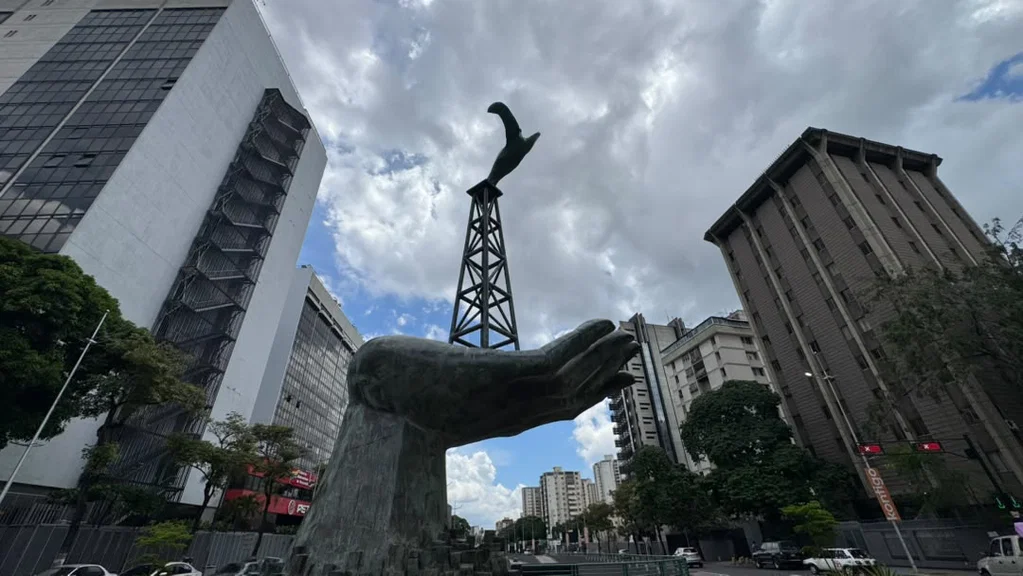
Paúl del Río’s Monument to Peace, erected in 2003, honors the recovery of the Venezuelan oil industry after the government increased state control in 2001, and after the opposition strike ended. (Jessica Dos Santos Jardim)
Oil drives the Venezuelan economy. Currently, it accounts for 71% of the nation’s total exports, but now much of that revenue goes to the U.S. In the first quarter of this year, out of a total of $7.76 billion in exports, $5.5 billion came from oil activity. As the acting president’s address went on, many of us only had more doubts.
A few hours later, Venezuelan economist Francisco Rodríguez summed up some of the nation’s concerns: “Do the projected tax revenues … correspond to nominal amounts, inflation-adjusted amounts, or net present values? A nominal amount of $19 per barrel in 2051, the project’s final year, would correspond to a real value of about $9 today.”
“The $209 billion equates, over 25 years, to about $8.4 billion annually, a relatively low amount compared with the tax revenue Venezuela has collected in the past at similar production levels. The amount would be even lower if it corresponds to a nominal total.” According to Central Bank of Venezuela data, Venezuela took in a record $82.8 billion in 2008 alone from oil sales.
Contradictions
Trump later contradicted Delcy Rodríguez’s 25-year timeline, saying the deal would involve a century of concessions. Francisco Rodríguez, the economist, noted that extracting 65 billion barrels in 25 years would be impossible, due to lack of infrastructure.
“What rights does the U.S. acquire over these resources after 25 years? Can a future Venezuelan government decide to withdraw from this deal if it doesn’t like it?” he asked.
And why wouldn’t they like it? Trump said on Truth Social that Venezuela will begin supplying the U.S. strategic oil reserve immediately through “a gift.” Nobody knows what that means exactly, but since the military intervention on Jan. 3, the revenue generated by the sale of Venezuelan oil — we don’t know how much that is either — is already “in the custody” of the U.S. Treasury.
“It doesn’t look like Venezuela will benefit broadly in the long term. It’s like being on floor minus-18 and going up to minus-10,” Venezuelan researcher Blas Regnault, who specializes in energy policy and oil governance, told Truthdig from The Hague, Netherlands.
“There could be an indirect reactivation of the economy because of the indirect jobs that may emerge in some regions. But let’s also keep in mind that the country has been 100% blockaded, suffocated, so any door that opens will bring some benefits, but this is not the benefit one would expect for a sovereign country,” he said.
“That’s the other problem: There’s no sovereignty of any kind over the resource itself, over what’s being sold. On top of that, there’s a lot of opacity — you’re analyzing blind.”
This “opacity” is also illegal. Articles 150 and Article 187, Paragraph 9, of Venezuela’s Constitution state that contracts of national public interest with foreign states or entities require approval from the National Assembly. However, although the Assembly endorsed the announcement of the deal on Sept. 1, its president, Jorge Rodríguez, said it had not yet been “submitted” to the legislature. Then, a month later he said that “according to some legal experts, it doesn’t need to be reviewed.”
It’s clear that Venezuela is once again, as it was for much of the 20th century, a kind of “U.S. oil province,” Regnault says, “Recovering sovereignty won’t be easy because Venezuela is strategic to U.S. interests.”
“On top of that, the other side of the coin is that China has become a key player [globally]. Today the Chinese do what Saudi Arabia used to do when it cut production and pushed prices up. With this Strait of Hormuz crisis, after the naval blockade of Iran, it was discovered that China had more reserves than previously thought, and that kept the crisis from being bigger and the price from reaching $150.”
That is precisely why U.S. Secretary of State Marco Rubio celebrated the fact that several of the oil fields included in the deal were once “dominated by China and Russia and Iran.” At the same time, the U.S. government has decided to maintain sanctions against Venezuela, thereby preventing any new economic players. In fact, the U.S. Treasury Department, through its Office of Foreign Assets Control, updated its oil licensing policy for Venezuela in late September through Orders 46E, 48D and 49B, which benefit U.S. businesses but maintain an absolute ban on Russia, Iran, Cuba, North Korea and China.
“The [Venezuelan] government has already amended the Hydrocarbons Law to try to create more favorable conditions for investors in the oil and gas sector, but … the [U.S.’] problem isn’t domestic supply. They need to monopolize the world’s energy reserves, markets and prices in order to prevail in the rest of their economic activities,” oil expert David Paravisini explains to Truthdig from Caracas, referring to a legal reform that was passed on Jan. 29 and created the possibility of technical and operational management and direct commercialization by private companies. He believes that for Venezuela, the deal is a diplomatic “quest” to survive.
People block a street during a protest against power cuts in Valencia, Venezuela, on Oct. 2, 2026. (AP Photo/Jacinto Oliveros)
Trump is also maintaining some of his domestic support by presenting Venezuela as the great economic and geopolitical victory of his administration, especially after the war against Iran — which was supposed to last “only a couple of weeks” — reached the six-month mark and cost more than $37.5 billion through the end of July. In fact, Trump has claimed again and again that this oil deal will lower fuel costs inside the U.S. and come “at no cost whatsoever to the American taxpayer.””
Does this mean the $100 billion investment will come from private companies? The deal also aims to exploit eight greenfield blocks, areas where crude has been identified but which have not yet been developed. But what happens if that investment does not materialize? Since Jan. 9, Trump has been trying, without success, to persuade U.S. oil companies to invest in Venezuela.
Corruption is fine if the U.S. profits
So far, the only company we’ve heard about is North American Blue Energy Partners (NABEP), which was selected on Aug. 31 by the Trump administration to lead oil extraction projects in the 17 Venezuelan fields.
According to the White House, the Department of Defense will hold a 35% equity stake in NABEP and, in addition, the Barbados-registered company will grant Washington the right to buy 20% of the oil it produces at the cost of production.
NABEP, which has only operated in Venezuela for two years, was awarded the deal without a prior bidding process. The company belongs to Venezuelan businessperson Alejandro Betancourt, who was under investigation by federal prosecutors in Florida until January 2026 for allegedly laundering more than $1 billion from the state-owned Petróleos de Venezuela (PDVSA). The case was then closed suddenly under the orders of U.S. Deputy Attorney General Todd Blanche (now the attorney general), after a decade-long investigation. He is still the subject of open investigations in Switzerland and Spain.
Betancourt comes from a middle-class family but studied at the private religious school Instituto Cumbres de Caracas, where he befriended Javier Alvarado Pardi, son of Javier Alvarado Ochoa, who later became president of Electricidad de Caracas, deputy energy minister and a PDVSA executive.
Back in 2009, Alvarado Ochoa presented Betancourt and his engineering firm, Derwick Associates, as the best solution to Venezuela’s power generation crisis. Betancourt went on to receive 12 government contracts, awarded without competitive bidding, worth a total of $5 billion, which were either never completed or were implemented improperly, according to Transparency Venezuela and the Organized Crime and Corruption Reporting Project (which is funded by the U.S. government, among other countries).
So why Betancourt? Rubio said that he is no longer under investigation by the U.S., has supported the Venezuelan opposition and he has demonstrated his ability to produce oil. In that vein, NABEP claims it produces 200,000 barrels of crude a day, just behind Chevron.
However, Victor Hugo Majano, a Venezuelan investigative journalist and director of the well-known outlet La Tabla, told Truthdig that Betancourt overbilled the Venezuelan state by billions of dollars for power plants that never worked. He cited information from Thor Halvorssen, an anti-Chavista activist and cousin of Venezuelan opposition leader Leopoldo López. With that money, Betancourt bought a Dassault Falcon private jet and the historic Alamíin Castle in Spain.
Halvorssen also says Betancourt, who is also linked to 50 companies spread across 15 countries, paid former New York prosecutor Adam S. Kaufmann to halt prosecutions; former Wall Street Journal reporters to discredit whistleblowers; and former New York City Mayor Rudy Giuliani to bring the U.S. Justice Department over to his side.
“Despite this, the U.S. still doesn’t attack Venezuelan corruption. They want to protect the dollar and the U.S. financial system. They are only worried about securing capital flow, money that is not controlled by the state, the [Venezuelan] government,” Majano said.
More oil for the U.S., less electricity for Venezuela
Meanwhile, Venezuelans are paying the price for both Betancourt’s alleged corruption and the oil deal. So far this year, oil production has increased by 29.9%, going from 924,000 barrels per day (bpd) in January to an average of 1.2 million bpd. The increase has been driven by the need to deliver oil to U.S. companies, and it has directly worsened the nation’s electricity crisis.
Authorities acknowledge this; Venezuela’s interior minister, Diosdado Cabello, said in May the country is seeing higher electricity demand due to the growth in oil production, which “is a very serious problem.” The Ministry of Electrical Energy also noted that demand has reached 15,625 megawatts (MW), “the highest energy consumption figure in the last eight years, an increase of 3.6% compared with the peak reported in 2025.”
However, this statement omits that Venezuela actually has a nominal installed capacity of approximately 35,000 MW, double the country’s peak demand, but stable real generation barely reaches 11,000 MW. This shortfall is a result of both U.S. sanctions and domestic corruption, which together have led to disinvestment, lack of maintenance, fuel shortages (plants designed to run on natural gas have been forced to use low-quality diesel) and transmission problems.
Where does oil production come in? Víctor Poleo, an electrical engineer and former vice minister of Energy and Mines from 1999 to 2001, told Truthdig that “the national oil industry uses up about 1,500 MW, of which about 250 MW is self-generated, but another 1,250 MW is taken from the national interconnected system. This draw is 24/7 and must be continuous in order to carry out crude extraction, transport, pumps and compressors and refining.”
High-voltage transmission lines cross the Waraira Repano mountain range overlooking Caracas, Venezuela. (Jessica Dos Santos Jardim)
Poleo, who bases his analysis on studies by fellow electrical engineer Nelson Hernández, says light, medium and heavy crudes are estimated to require between 9 kilowatt-hours and 15 kilowatt-hours per barrel to produce. For extra-heavy Orinoco crudes, the estimate is 24 kilowatt-hours per barrel. “As a result, citizens lose their quality of life so that oil can be produced.”
This deterioration is particularly notable in Zulia state, Venezuela’s so-called oil cradle, where production has risen to between 350,000 and 370,000 barrels per day of light and medium crude — far below the historic peak of 1.5 million bpd in 2004, but a figure that, for its residents, has translated into daily blackouts exceeding 12 hours.
From the Isla Dorada residential complex in northern Maracaibo, capital of Zulia, José Javier León tells Truthdig that power failures “have worsened dramatically.” In his area, outages used to last four hours but now exceed seven.
“In many places there are double rounds, meaning the power goes out in the morning and at night, or at night and then before dawn. All the problems have gotten worse, and we don’t know the real reasons. In the suburb of Cuatricentenario, one of the most working-class areas and where the government had the most electoral support, the cuts are the worst,” he says.
León complains that residents are not alerted when the outages will happen. There is nothing like the electricity rationing schedules of the past, which would at least let them plan better. “In my area, there is no domestic gas, so we have electric stoves. Also, these are apartment buildings, where we have to turn on pumps to get water.” To make matters worse, the temperature in Zulia often reaches 39 degrees Celsius (102 Fahrenheit) because of the humidity.
In the Andes, outages add up to as many as 12 hours a day, and 16 hours in rural or border areas. From La Hechicera, an urban neighborhood in the city of Mérida, Silvana Solano tells Truthdig that the power used to go out for seven to eight hours, once a day, “but for the past two months, it goes out twice a day, the first time for seven hours and the other for around five hours, and we can’t predict the schedule. This also affects phone signals, which keeps us from communicating, making payments, etc.”
Some government institutions, including the Mérida mayor’s office, are open only from 8 a.m. to noon. Solano says she is worried that public schools, which operate until 3 p.m., will also adopt this schedule, in turn affecting parents’ working hours. Throughout September, residents of the towns of Caja Seca (Zulia state) and Nueva Bolivia (Mérida state) blocked the Pan-American Highway to protest the power outages.
To Venezuela’s north, on the famous Margarita Island, Alejandro Pérez tells Truthdig there are areas that have gone seven to eight months without water service. “Here we pay for water trucks, $50 for 10,000 liters of water, sometimes with $60 we get 13,000 liters, but you have to pay in foreign cash or at the parallel rate because the Central Bank of Venezuela exchange rate isn’t accepted here.” The black market or informal exchange rate is worth more, for those with foreign currency, than the official exchange rate.
Unlike other Caribbean islands, Margarita doesn’t have significant natural sources of fresh water. Some 90% of the area’s water comes from the mainland, crossing the sea through underwater pipelines that require gigantic pumping stations.
The contradictory rhetoric and the endless problems we face daily mean that, according to the latest AtlasIntel poll conducted for Bloomberg News, only 10% of Venezuelans believe the country will benefit from the oil pact with the U.S. — data that also aligns with the most recent study by the firm Meganálisis, the same one that after Jan. 3 said 92.2% of Venezuelans loved Trump. Emotions change, social problems persist, and without electricity, no economic improvement will be possible.
The views expressed in this article are the author’s own and do not necessarily reflect those of the Venezuelanalysis editorial staff.
Fuel theft cited in Baniyas-Homs leak as gas export line in Hasakah catches fire.
Published On 15 Oct 202615 Oct 2026
Two pipelines carrying gas and oil products were damaged in separate incidents in Syria, state media reported, the latest disruptions to the country’s energy infrastructure following a series of suspected sabotage attacks.
The state-owned Syrian Petroleum Company announced the damage on Thursday, according to the Syrian Arab News Agency (SANA). The incidents add to a number of attacks on Syria’s oil and gas network in recent months, as the government tries to revive its energy sector.
Recommended Stories
list of 2 itemsend of list
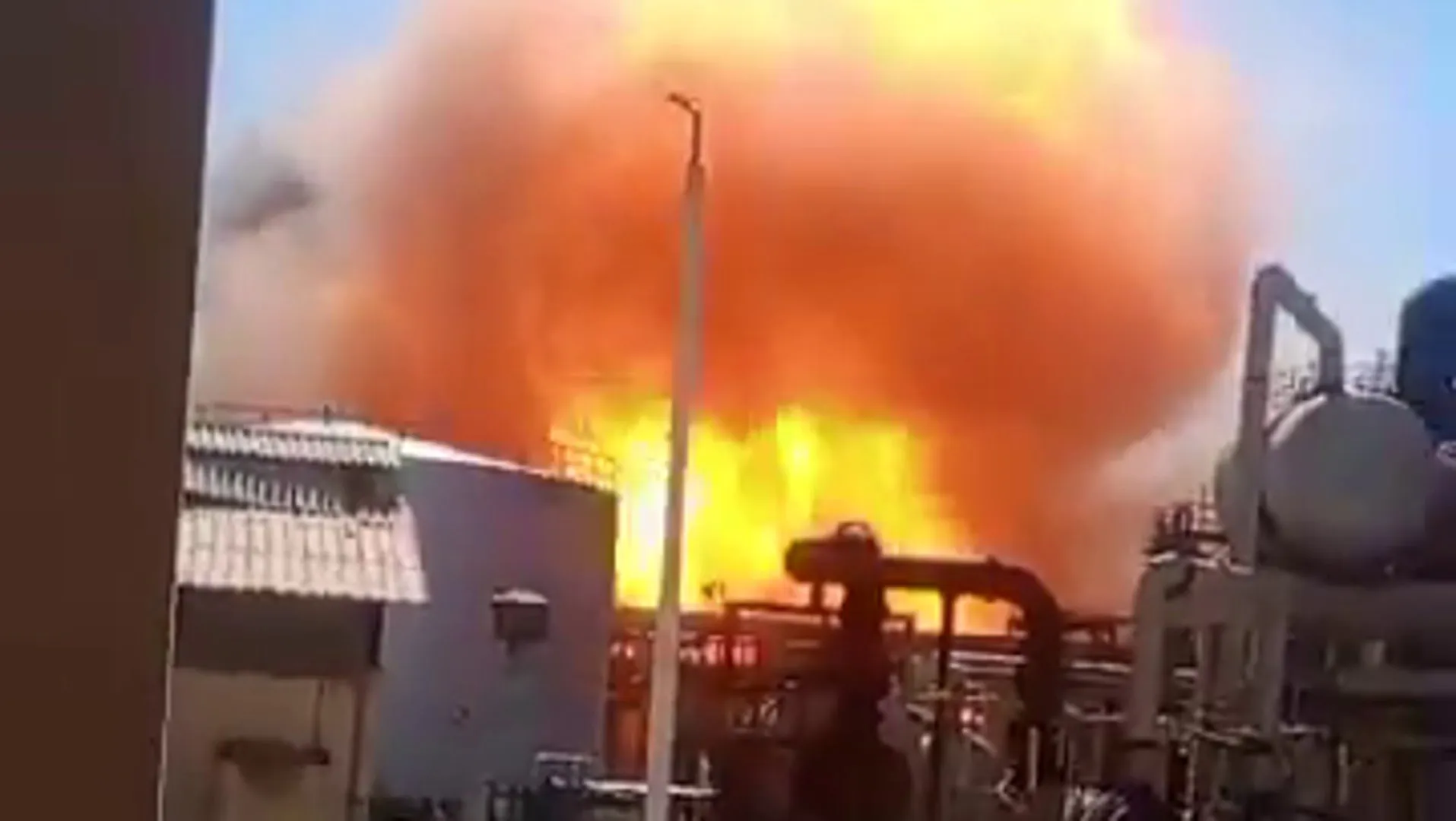
An explosion struck the Jbessa gas pipeline in southern Hasakah province in the late afternoon, hours after damage to a pipeline transporting oil products from the coastal city of Baniyas to Homs caused a fuel leak.
The company said the gas pipeline had been targeted in a “sabotage attack”, according to SANA.
Neither SANA nor the company named a suspect or group responsible for the attacks.
Repairs under way
Oday al-Satouf, head of the company’s media office, told SANA that a hole was found in the Baniyas-Homs pipeline in the Hadida area, west of Homs. Crews isolated the affected stretch and secured the surrounding area, he said, closing valves on either side of the damaged section. Repairs have begun, while other teams monitor the area for safety. State media said the leak was believed to be linked to an attempted fuel theft.
Al-Satouf said gas would continue to reach power stations through alternative arrangements, and that domestic gas supplies were unaffected, according to SANA.
A man fills a container with petroleum for heating at home in Suwayda, Syria [File: Elke Scholiers/Getty Images]
A string of incidents
More than a week ago, the company said an oil pipeline near Tal Hamis in the northeastern province of Hasakah was damaged in a sabotage attack. It added that authorities had arrested those responsible.
In late September, a fire broke out on a gas pipeline between al-Shoula and Deir Az Zor in the east, halting gas flows from the Jbessa plant to power stations, SANA reported. Hisham al-Saleh, a gas sector official at the company, said gas pressure in the area fell as crews worked to extinguish the blaze.
Syria has been working to restore its energy infrastructure and increase domestic oil production. That includes resuming operations at oil fields in Hasakah to supply refineries in Homs and Baniyas. In January, the petroleum company announced plans to transport crude from recently recovered fields to the two refineries as part of efforts to revive the sector.
Ukraine president earlier said Kyiv was ‘done’ with energy ceasefire and strikes on Russian oil refineries would resume.
Published On 15 Oct 202615 Oct 2026
Russia says Ukraine has targeted an oil refinery in Ryazan, about 180 kilometres (110 miles) south of Moscow, as President Volodymyr Zelenskyy said Kyiv was “done” with an energy ceasefire unilaterally announced by United States President Donald Trump over the weekend.
“The Kyiv regime attempted a large-scale attack on an oil refinery in Ryazan,” Moscow’s defence ministry said in a statement on Thursday, adding that a “fire broke out after drone debris fell onto the refinery site.”
Recommended Stories
list of 3 itemsend of list
Ukraine’s president earlier told the British newspaper the Financial Times that strikes on Russian oil refineries would resume, and accused the US of weakening Ukraine’s position on the battlefield by allegedly withdrawing crucial intelligence sharing.
Trump on Sunday unilaterally announced an “energy ceasefire” that was not publicly confirmed, and Moscow continued striking Ukrainian energy infrastructure. Ukraine said it suspended attacks on Russian energy sites for several days after Trump’s announcement.
The US has pressured Ukraine to halt strikes on Russian refineries, claiming that a suspension of attacks and a deal to purchase 1.8 million tonnes of diesel from Russia would help reduce soaring fuel prices.
“This politically is not simple [in America], because everybody will want to ask how it can be when some people are surviving, fighting, dying – and you make . . . business with the guys with such aggression,” Zelenskyy told the FT.
Zelenskyy also alleged that Ukraine’s access to SpaceX’s satellite internet service was restricted, potentially leaving it more vulnerable to Russian attacks. The Ukrainian armed forces use SpaceX’s military-grade Starshield system for offensive and defensive operations.
In a post on X on Wednesday evening, SpaceX owner Elon Musk said that only the US military and Trump had the authority to limit Starshield’s usage and speed for clients.
In a separate post, he called for Zelenskyy to “go” as Ukraine’s leader.
“And so the slaughter continues,” Musk wrote in a separate post on X. “Time for Zelensky to go.”
Ukraine is heavily dependent on Western military aid in its fight against Russia, particularly from the US and Germany. However, Kyiv’s relations with Washington have been strained in recent weeks, with Trump calling on Saturday for Zelenskyy to be replaced.
Against this backdrop of tensions, Zelenskyy said he would be willing to pause strikes on Russian energy sites again, but only if the US supplied Ukraine with crucial Patriot interceptors.
Zelenskyy is due to meet European leaders in Brussels on Thursday as he pushes for tougher sanctions on Moscow and faster delivery of support from the European Union.
Dutch Prime Minister Rob Jetten has called on EU leaders to “step up” their game to ensure Ukraine wins the war against Russia.
The EU has already pledged $50 billion in support for Ukraine next year. However, the sum falls far short of the $175 billion Kyiv plans to spend on its defences next year.
Trump has denied that the US has stopped sharing intelligence with Ukraine.
Recent US-Greenland-Denmark agreement excludes mining or drilling rights while reinforcing Greenland’s sovereignty.
Published On 14 Oct 202614 Oct 2026
Denmark has demanded that US resource exploration in Greenland respect the island’s laws amid President Donald Trump’s claim that oil, gas and mineral extraction will soon begin there.
The Danish Foreign Ministry reaffirmed on Wednesday that last month’s agreement between Denmark, Greenland and the US did not alter the rules for extraction.
Recommended Stories
list of 3 itemsend of list
The agreement “does not grant investors from the US any preferential treatment” over investors from other NATO and EU countries when it comes to access to natural resources in Greenland, the ministry said.
In a post on Truth Social, US President Trump called the semi-autonomous Danish territory “our new and beautiful Greenland”.
“Massive Oil, Gas, and Mineral Exploration is getting ready to begin,” he wrote, without providing details.
What the deal covers
Trump, Danish Prime Minister Mette Frederiksen and Greenland’s Prime Minister Jens-Frederik Nielsen signed the 10-page agreement on the sidelines of the United Nations General Assembly in New York on September 22, ending months of tensions over Trump’s threats to control Greenland.
The deal allows the US to “modernise and expand” its activities at the Pituffik Space Base, a remote US military installation in northwest Greenland.
It also paved the way for two new military bases and Trump’s “Golden Dome” missile defence system, while reaffirming Danish sovereignty and Greenlanders’ right to self-determination.
It did not allocate any rights for mining or drilling.
Greenland’s ban
Greenland banned uranium mining and all future oil exploration in 2021.
Its government is reviewing whether a Texas firm, Greenland Energy, can use permits that predate the ban.
The company said in August it planned to drill for oil in 2027 at an untested basin on Greenland’s east coast, although it lacked its own permit.
Danish security policy adviser Jacob Kaarsbo said Trump’s comments could signal that his desire to control Greenland remains unchanged.
“It is extremely dangerous to view this agreement between the Trump administration and Denmark as something that has altered Trump’s intentions,” he said.
Mikkel Olesen, a senior researcher at the Danish Institute for International Studies, told Al Jazeera that details regarding mining and exploration rights remained unclear and that information coming mostly from the US side should be taken “with a grain of salt”.
Richard Weitz, a fellow at the NATO Defense College in Rome, said Trump “backed down and settled for less” than he sought, but still “got pretty much everything he wanted, except formal annexation”.
As the United States maintains a naval blockade of Iran’s ports and imposes more sanctions on its oil exports, Tehran is confronting another problem: billions of dollars in revenue from previous oil sales that it says have gone missing.
A spokesperson for Iran’s judiciary said in September that a network of oil intermediaries known as “trustees” owed the Iranian government between 10 billion euros ($11bn) and 11 billion euros ($12bn). That figure was equivalent to half of the total oil revenue projected in Iran’s government budget for the current fiscal year.
Recommended Stories
list of 3 itemsend of list
US officials, including Treasury Secretary Scott Bessent, have tied Iran’s struggles to access oil revenues as evidence that its economic pressure campaign is having an effect. In August, Bessent said that “Iran’s shadow banking system was buckling” under pressure from the US campaign against the country, which has been ramped up as Washington seeks a way to force Tehran to capitulate in the war between the two countries, launched by the US and Israel in late February.
So who are the oil intermediaries, why does Iran depend on them, and what has happened to the billions of dollars they owe? Let’s take a closer look.
The debt, and the crisis it has created for the Iranian government, both stem from an oil-sales arrangement Tehran adopted in 2012 in response to US sanctions targeting Iranian oil exports.
American and European sanctions targeting Iranian oil sales and revenue collection began in 2012. The stated rationale behind both sets of measures was that revenue from oil sales helped finance Iran’s nuclear programme and that restricting Iranian oil exports could prevent the programme from advancing.
In response, the Iranian government devised a way to circumvent international sanctions on its oil sales. Unable to sell oil through the Oil Ministry and receive the proceeds through the Central Bank, it began selling oil to domestic buyers or using it to settle outstanding obligations to institutions and organisations owed money by the state.
This arrangement gave rise to a network of oil intermediaries often referred to in Iran as the “trustee network”. Rather than selling all its oil through official government channels, the state entrusted crude oil to institutions, individuals and companies to sell on its behalf. The proceeds were supposed to be transferred to the government’s treasury, with the sellers or recipient institutions subsequently recovering their agreed costs and outstanding claims. Some institutions sold the oil themselves, while others contracted private trading companies to handle the sales.
The Oil Industry Pension Fund, established for retired Oil Ministry employees familiar with the oil-sales process, was among the first institutions to receive crude oil for sale. Other recipients included Khatam al-Anbiya Construction Base, a major hub for large-scale infrastructure projects. Even the municipal police received payments owed to them by the government in the form of crude oil.
Effect of the nuclear deal
Even in those early experiments, discrepancies emerged between the revenue expected from oil sales and the amounts sellers actually deposited into the government’s treasury. These discrepancies eventually gave rise to some of Iran’s largest economic corruption cases.
The accounting discrepancies and the government’s inability to recover money from private sellers entrusted with Iranian oil persisted until 2016, when the Joint Comprehensive Plan of Action (JCPOA) nuclear deal was signed and when sanctions on Iranian oil sales were lifted. The government was subsequently able to regain control over oil sales.
Individuals who had sold Iranian oil but failed to return the proceeds were imprisoned. With the ability to sell oil again through legal and transparent channels, the government was able, for a time, to manage its oil revenues and spending with greater control.
How did money from oil sales go unreturned?
After US President Donald Trump withdrew the United States from the JCPOA in 2018 during his first presidential term, the Iranian government once again had to rely on private oil traders to sell its oil. But the problems associated with selling oil through intermediaries rather than official state channels, including delays in returning revenues, accounting discrepancies, debts owed by oil sellers to the government, and the occasional seizure of Iranian oil shipments at sea, once again constrained the government’s ability to manage its oil revenues.
Moreover, the US expanded its sanctions beyond Iranian government institutions and interests, adding bank accounts involved in transactions with the Iranian government, currency-exchange offices, companies, and individuals to its sanctions lists. As a result, the time between individuals participating in Iran’s oil-trading network and being sanctioned themselves, along with their assets and companies, and having their accounts blocked or frozen grew progressively shorter.
This contributed to an accumulation of debts owed by sanctioned oil traders – no longer able to access their accounts – to the government. It also left Iran with little choice but to expand its private oil-sales network. That meant increasing the number of people involved in trading Iranian oil, reducing the volume of oil allocated to each individual or company and, ultimately, increasing the risk that the proceeds would not be returned.
Iranian officials have also accused trustees of exploiting the sanctions workarounds to enrich themselves.
The billions of dollars owed by private oil sellers to the Iranian government are a combination of outstanding payments, disputed financial obligations and allegations of corruption. Iran’s judiciary chief recently addressed the issue, warning that oil sellers who refuse to return the proceeds from oil sales will face legal action. But such warnings do not change the sanctions environment or remove the obstacles that prevent some oil sellers from returning the money.
The Cuban government is pushing ahead with its plans to transition to renewable energy, amid a de facto oil blockade from the United States that has strangled the island’s economy.
In an interview with the Reuters news agency on Monday, Cuban Minister of Energy and Mines Vicente de la O Levy explained that the blockade has forced Cuba to explore domestic alternatives to foreign fuel imports.
Recommended Stories
list of 4 itemsend of list
“We are seeking our own alternative solutions, using our own resources, our sun, wind, tides, fuel, Cuban crude oil and the gas produced in our wells,” de la O Levy said.
He said 144 solar farms with a combined capacity of about 1,418 megawatts have been installed on the island in recent years.
China has been the largest supplier of solar panels to the island, and shipments have increased since the blockade began in early January.
At the time, US President Donald Trump halted all oil shipments from Venezuela, a close ally of the Cuban government.
Later that month, Trump also announced he would impose heavy tariffs on any country that exported oil to Cuba, justifying the threat by calling the island’s government a “national security” threat.
Since then, only a single oil tanker from Russia has reached Havana. The US has increased its shipments of oil to Cuba’s private sector, but it has largely barred fuel exports for nationalised industries on the communist-led island.
The government-run electrical grid, widely considered to be antiquated, relies heavily on fossil fuels. Only 40 percent of Cuba’s electricity comes from domestic oil production, according to the International Energy Agency.
As of 2023, only nine percent of the country’s energy consumption was covered by renewable sources.
De la O Levy admitted in his interview with Reuters that the country was facing difficulties. The blockade has caused shortages of medicine, water and fuel, pushing Cuba to the brink of a humanitarian crisis.
“We are surviving and moving forward, little by little, even if not at the pace we would like,” he said.
“We face long hours of blackouts and lack fuel for cooking and transportation. We lack fuel, but we are gradually making headway through our own solutions and our people.”
Cuba’s production of domestic crude oil remains stable, he added, but is almost entirely allocated to power plants.
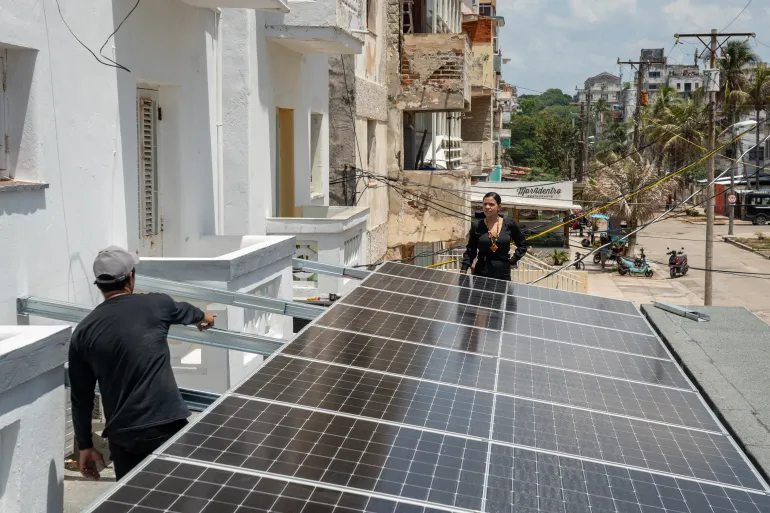
Aris Lopez Torres, owner of the Fuego Lento restaurant, speaks with technician Josecal Duarte during the installation of solar panels on the roof of her business along Havana’s waterfront [File: Lucien Migne/Al Jazeera]
The United Nations and human rights watchdogs have criticised the oil blockade as a violation of international law.
Cuban Foreign Minister Bruno Rodriguez Parrilla also condemned the oil blockade in his speech at the UN General Assembly last month.
“It is an unusual and unprecedented action,” Rodriguez said of the blockade.
“A superpower unilaterally deprives all states of their right to export the commodities that they wish to the country that they wish.”
The US has maintained an economic embargo on Cuba for more than 60 years, since the Cold War era.
But since taking office for a second term as president, Trump has sought to squeeze Cuba’s economy further, as part of a “maximum pressure” campaign. His administration has indicated that it wants to topple Cuba’s government.
On October 7, US authorities announced they had seized 90 biodiesel fuel shipments valued at over $2.8m destined for Cuba.
“These shipments were part of an attempt to unlawfully export fuel to Cuba in violation of federal export laws,” US Immigration and Customs Enforcement (ICE) said in a statement.
But in his interview with Reuters, de la O Levy denied the Cuban government had any link to the shipments.
“No Cuban state-owned company has managed to secure a fuel contract, whether for small or large quantities,” he said.
He added that any US oil shipments to private firms fall far short of the country’s requirements.
“I would venture to say that the amount entering the country doesn’t even cover 3 percent of its fuel needs,” de la O Levy said.
Tehran, Iran – Iranian authorities have signalled they intend to disrupt an Arab-operated and United States-assisted shuttle system that has enabled more energy exports through the Strait of Hormuz during the US-Israel war on Iran.
With the US naval blockade of Iran’s southern ports in place and sanctions tightening, Tehran has said it will pursue military and diplomatic efforts to put pressure on Washington to submit to its demands regarding reopening the Strait of Hormuz.
Recommended Stories
list of 3 itemsend of list
This strategic waterway, through which roughly a fifth of global oil and gas flowed before the war, has been largely closed to shipping following Iranian attacks since the US and Israel launched strikes on Iran on February 28.
But the US Navy has reportedly opened up a route so Gulf states can export oil and other commodities amid an energy crisis.
Iran’s security chief Mohsen Rezaei responded on Sunday night, saying the shuttle system is now an explicit target for Tehran.
Rezaei claimed that the US Central Command, with the assistance of the United Arab Emirates military, was using smaller vessels to transfer oil to larger tankers. He claimed Iran had been striking five or six participating vessels nightly for weeks.
“You are smuggling, but the strait is under Iran’s control, and we manage it,” he asserted.
This appeared to be a taunt aimed at US President Donald Trump, who has hailed energy exports at times reaching pre-war levels over recent weeks.
Rezaei appeared to give the impression that Iran wants to have lasting authority over Hormuz, and promised a harsh response if Iran’s energy and civilian infrastructure were attacked again.
His threats appeared aimed at Arab regional states, with a warning that digital infrastructure could be targeted. Rezaei threatened US-linked cables, data centres and artificial intelligence facilities in the UAE and around the Strait of Hormuz.
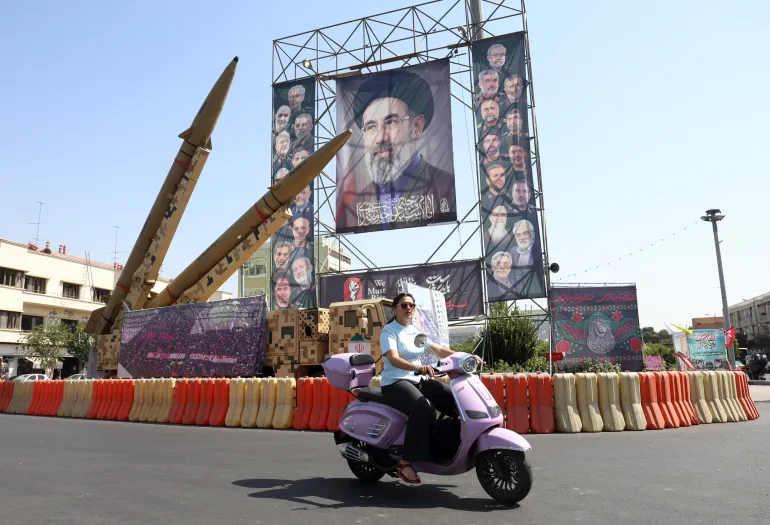
A woman rides her scooter past Iranian Zolfaghar missiles placed in front of a billboard of Iranian Supreme Leader Ayatollah Mojtaba Khamenei at Baharestan Square in downtown Tehran, Iran, September 28, 2026 [Abedin Taherkenareh/EPA]
Rezaei also accused Saudi Arabia of helping the US move oil around Iran’s restrictions. But he did not threaten a direct attack against Riyadh – which is currently being targeted by Yemen’s Tehran-aligned Houthis.
In early September, Iran’s Islamic Revolutionary Guard Corps (IRGC) threatened tankers at ports and anchorages in Kuwait and Bahrain, citing US attacks on Iranian tankers. It accused both countries of complicity through hosting US armed forces.
Iran has claimed the US accepted some of Tehran’s seven conditions for the full reopening of the Strait of Hormuz and ending the war. But Tehran insists that a deal will only materialise when all its demands are met.
Hamidreza Azizi, a senior Iran analyst at the Crisis Group, said this reflects Tehran’s apparent assessment that it is under no immediate pressure to reach an agreement with the US since its pressure in the Hormuz has a global impact.
“The question, however, is whether Tehran is overestimating its ability to sustain this pressure, given the growing economic costs of the confrontation for Iran itself,” Azizi wrote on X.
Transfer system
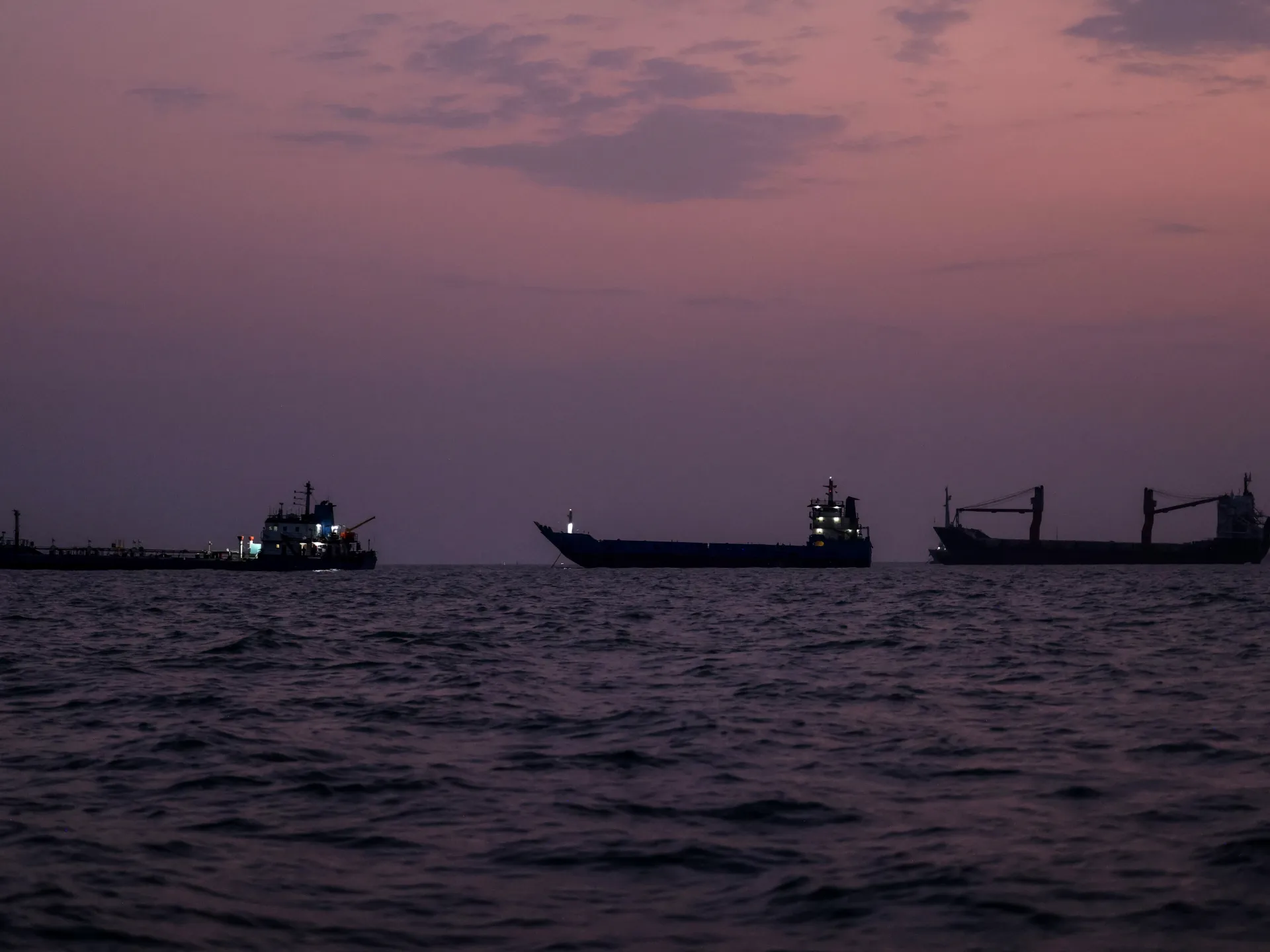
The system involves very large crude carriers (VLCCs) and smaller vessels coordinating with the US military to load crude oil at Arab ports and use southern corridors near the coast of Oman to exit the strait.
Vessels often switch off their transponders and travel at night to minimise the risk of being targeted by the Iranians. After ship-to-ship transfers in the Gulf of Oman, some of the shuttles come back to load more.
Multiple vessels were targeted overnight Sunday to Monday, including two outbound tankers and one in anchorage near Oman’s port city of Sohar, where ship-to-ship transfers are allegedly being conducted.
The IRGC has also increasingly driven a narrative that naval mines, believed to have been planted across the Strait of Hormuz since the start of the war, pose a serious threat to vessels attempting to navigate the waterway without coordinating with Iran’s Persian Gulf Strait Authority.
The IRGC said three tankers suffered major damage over the weekend after being struck by mines. It also released footage of one ship ablaze that is said to have been struck by a mine, although the footage did not appear to show a mine going off.
‘Cascading impact’
The shuttle system has provided Arab national oil companies with a way out of Hormuz via the southern corridor near Oman.
Michelle Wiese Bockmann, a London-based senior maritime intelligence analyst at Windward, said this system has proven highly effective.
“Under international maritime law, which underpins 11 billion tonnes of seaborne trade annually, vessels have what’s called the right of transit passage,” Bockmann told Al Jazeera. “So, what Oman has done is allow vessels to go through under international maritime law, but they have had US military assistance.”
Tehran says shipping will be disrupted so long as the US continues its choking naval blockade against Iran, which has also stepped up its efforts to counter efforts by Arab states to export oil. At least 15 ships are believed to have been targeted in October so far, according to Winward.
“The more effective the route has become in facilitating the transport of oil and gas, the less leverage Iran has over Hormuz, and more attacks we are seeing on vessels that are using that southern corridor,” Bockmann said.
Windward’s data shows 31 ships transited the Strait of Hormuz daily in the final week of September. This was considerably lower than the 138 before the war.
Eighty-seven percent of the 45 ships targeted by Iran during the third quarter of 2026 were tankers.
Around 47 percent belonged to Gulf Arab energy companies’ national shipping fleets, Windward noted, and 93 percent of the strikes took place in the Strait of Hormuz. Most attacks targeted vessels transiting the southern corridor with their transponders turned off.
These attacks have contributed to a massive increase in freight costs. Freight represented 25-30 percent of Gulf crude’s cost, versus just 1 to 3 percent before the war, according to Windward. National oil companies have resorted to offering discounts of up to $35 per barrel below official selling prices.
The main reason for the rise is a shortage of tankers willing to make the dangerous crossing. Between 15 and 20 percent of very large crude carriers (VLCCs) are tied up with an inefficient logistics system that relies on shuttle transfers, complicated by escalating attacks and exposure at loading ports and anchorages.
“This is having cascading impacts for all vessel classes on freight and values across the world,” Bockmann said.
US President Donald Trump has announced an immediate “energy ceasefire” between Russia and Ukraine, days after easing sanctions on Russian fuel to tackle soaring domestic and global fuel prices.
The energy truce, announced on Sunday, marks another shift in Washington’s approach to Russian energy, as the Iran-US war and recent Ukrainian strikes on Russian energy facilities disrupted global oil supplies and pushed up fuel prices. Trump has even asked Ukraine not to attack Russian oil facilities, as Moscow remains a major exporter of diesel.
Recommended Stories
list of 3 itemsend of list
The spike in diesel prices in recent weeks has particularly put pressure on Trump’s Republican Party ahead of November’s midterm elections. Surveys show Americans hold the Trump administration responsible for the soaring fuel prices amid the unpopular US war on Iran.
“Attacks on refineries and energy facilities have taken capacity out of an already stretched global fuel market, pushing up costs for transport, agriculture and businesses, with the pain ultimately passed on to consumers,” Susannah Streeter, chief investment strategist at Wealth Club, told Al Jazeera, referring to the mutual attacks on energy sites by Ukraine and Russia.
“A genuine ceasefire could help protect supplies and ease some of that pressure, particularly as winter approaches.”
However, she warned it was too early to call it a “diplomatic breakthrough”, citing Ukrainian President Volodymyr Zelenskyy’s statement that the energy truce came as a surprise to him.
Trump’s decisions have drawn criticism from US politicians and European allies, who warn that allowing Russian fuel back into global markets could provide Moscow with new revenue to finance its war in Ukraine. In March, the Trump administration gave a sanctions waiver to Russian seaborne oil.
So, why has Trump repeatedly changed his position on Russian energy, and what is behind his latest decisions?
What is the ‘energy ceasefire’ Trump announced?
On Sunday, Trump said Russia and Ukraine had agreed to immediately stop attacking each other’s energy infrastructure.
“Both parties have agreed. Do not break it!” he wrote on Truth Social, without providing further details.
Ukrainian President Volodymyr Zelenskyy said he was not aware of the energy truce, saying the deal was “news to me” but welcomed the announcement nonetheless.
However, he said Russian drones continued targeting Ukrainian energy facilities, including a power plant in Kharkiv, after Trump’s statement.
“We are waiting for the details of the conditions between the Americans and Russians, and we are waiting to see one specific step the Americans are ready to take,” Zelenskyy said on Monday during a video address to a security conference in Warsaw.
“This energy ceasefire, it can work, and it can become a major step towards ending the war if the Americans truly step in now and make sure Russians respect it.”
(Al Jazeera)
Ukraine has repeatedly targeted Russian oil refineries, arguing that energy revenues help fund Moscow’s war. Russia, meanwhile, has attacked Ukraine’s electricity and heating infrastructure throughout the four-year conflict.
Academic Alexey Muriaev has urged caution over Trump’s announcement, questioning whether an agreement has actually been reached, and if so, what it entails.
“Is it about suspending attacks on oil refineries? And if that’s the case, then the situation would be inadequate, because Ukraine’s oil refineries have already been taken out by Russia’s strikes beforehand,” Muraviev, senior research fellow in Defence and Strategic Studies at Edith Cowan University, told Al Jazeera.
“So, in this sense, it would mean effectively Ukraine suspending unilateral action against Russia’s oil refinery facilities.”
Muriaev also linked the announcement to Trump’s diesel agreement with Russian President Vladimir Putin, suggesting it may be a signal to Zelenskyy.
“Attacking Russian oil refinery capability would probably be interpreted by Washington as an attack on US economic interests,” he said, referring to the agreement on diesel exports through April 2027.
What’s the state of global oil prices?
The ongoing conflicts in the Middle East and Ukraine have continued to keep global oil markets under pressure.
On Monday, Brent crude, the international benchmark, fell to about $103.04 a barrel following Trump’s ceasefire announcement and Russian diesel deal, while US West Texas Intermediate crude traded at about $90.96.
However, prices remain elevated because of the US-Israel war on Iran, which began on February 28, and disruptions in the Strait of Hormuz, a key waterway through which one-fifth of the world’s oil supplies flow.
Recent attacks on Saudi oil installations and airports by Yemen’s Houthis and the fighting around the Red Sea and Bab al-Mandeb Strait have put further pressure on oil prices.
Ukrainian attacks on Russian refineries have compounded diesel shortages, affecting a fuel essential for the agriculture and trucking industries.
The crisis prompted the Group of Seven nations last week to agree to release 100 million barrels of emergency oil and diesel reserves. The G7 decision came after pressure from Trump.
How has the Trump administration zig-zagged between punishing and embracing Russian energy?
Washington’s approach to Russian energy has shifted repeatedly since Moscow launched its full-scale invasion of Ukraine in February 2022.
Under President Joe Biden, the US banned Russian oil and energy imports in March 2022, seeking to cut off revenue used to finance Moscow’s war.
But Washington simultaneously supported a G7 price cap on Russian oil, designed to restrict Moscow’s earnings without removing too much supply from global markets.
Moreover, the Biden administration also accepted India’s continued purchases of Russian crude to prevent global prices from rising.
After returning to power last year, Trump initially intensified pressure on Moscow. In August 2025, his administration imposed additional tariffs on Indian goods over New Delhi’s purchases of Russian oil.
(Al Jazeera)
Two months later, Washington sanctioned Russian energy giants Rosneft and Lukoil, accusing Moscow of failing to seriously pursue peace negotiations to end the war in Ukraine.
However, Washington’s approach took a dramatic turn this year. On March 5, Washington issued a 30-day waiver allowing India to buy Russian oil stranded at sea, as disruptions to shipping through the Strait of Hormuz amid US attacks on Iran threatened global supplies.
A week later, the Trump administration expanded the exemption, allowing countries worldwide to buy sanctioned Russian oil and petroleum products already loaded onto tankers, with the waiver lasting until April 11.
In September, Trump urged Ukraine to stop attacking Russian refineries, blaming the strikes for global diesel shortages.
On October 9, he announced an agreement with Russian President Putin for Moscow to release more than 300,000 tonnes of diesel immediately, with another 1.5 million tonnes to follow.
Why has Trump changed his position on Russian oil frequently?
Trump’s shifting public position on Russian energy reflects ongoing, and often competing, political and economic pressures.
“Trump is caught between his geopolitical ambitions and the domestic political consequences of expensive energy,” Susannah Streeter of Wealth Club, told Al Jazeera.
She said Washington was trying to pressure Moscow over its war in Ukraine while simultaneously allowing Russian fuel sales that could generate additional revenue for the Kremlin.
“The shift may deliver a short-term political gain if supplies increase and prices ease, but it could come at a longer-term diplomatic cost,” she said, adding that the benefits appeared limited while the Middle East war continued.
US diesel prices reached a record $6.52 per gallon in September, placing Trump under pressure ahead of the November 3 midterm elections.
However, according to academic Muriev, the US president’s public rhetoric should be distinguished from his administration’s actions.
“I don’t really see inconsistency in Trump’s approach because, apart from his public rhetoric, apart from his frequent media posting, there’s been a more steady approach on behalf of his administration,” he told Al Jazeera.
He pointed to discussions between Russian and American officials in August and September, suggesting that negotiations over the latest diesel agreement may have begun well before Trump’s announcement last Friday.
Muriev suggested the timing of the announcement could be politically motivated, allowing Trump to claim a victory on energy prices before the midterms.
Moreover, Moscow also has an interest in helping Trump retain political influence because his administration appears more willing to negotiate with Russia than former President Biden was. Trump has been relatively more accepting of the Russian position on the Ukraine war and has even blamed Zelenskyy for failing to end the war.
“For Putin, it’s not just about scoring immediate economic benefit, but also achieving longer-term political and strategic goals,” Muriev said, referring to other issues such as Iran, cybersecurity, space cooperation and nuclear arms control.
The energy crisis has also created contrasting consequences for American businesses.
While higher oil prices can boost revenues for US energy producers, they increase operating costs for businesses dependent on fuel.
Susannah Streeter said cheaper diesel could provide relief to trucking companies, farmers and manufacturers, although the additional Russian supplies were unlikely to make a significant difference while disruptions in the Middle East continued.
She also warned that frequent changes to sanctions could create uncertainty for companies making long-term investment and supply-chain decisions.
“If sanctions are relaxed, reimposed or changed at short notice, companies face greater uncertainty over sourcing, compliance and the risk of being caught on the wrong side of a policy reversal,” she said.
Russia to supply 300,000 tonnes of diesel immediately, followed by 1.5 million more, as prices soar amid the Iran war.
Published On 9 Oct 20269 Oct 2026
United States President Donald Trump said that Russia has agreed to supply 300,000 tonnes of diesel fuel to global markets amid discussions with Russian President Vladimir Putin.
“I have just concluded a highly successful discussion with President Vladimir Putin, of Russia, wherein it was agreed that Russia will immediately supply over 300,000 Tons of Diesel Fuel to the American and Global Marketplace, another 500,000 Tons during the month of November, and 1,000,000 Tons immediately thereafter,” Trump said in a post on his Truth Social platform.
Recommended Stories
list of 4 itemsend of list
The president added that Russia would deliver an additional 3 million tonnes of fuel “within a short period of time”. He said that the country would supply 500,000 tonnes in November.
An envoy for Russian President Vladimir Putin, Kirill Dmitriev, praised cooperation between Russia and the United States on diesel and energy in a post on X shortly after.
“Russia-US cooperation on diesel and energy will benefit the world,” Dmitriev wrote on X.
Petrol price pressures
The deal comes despite Ukrainian air strikes, which have taken more than half of the country’s oil refining capacity offline, according to claims made by Ukraine’s Ministry of Defence on Sunday.
The move also comes as prices of diesel, used in agriculture, heating homes and trucking goods, are near record highs ahead of the November 3 congressional elections that will determine control of Congress.
Diesel prices have been elevated in recent months but have started to decline. The average price for a gallon is $6.27 ($1.66 per litre), according to the American Automobile Association (AAA), which tracks daily petrol prices. That’s down $0.10 from this time last week, but up $5.94 from this time one month ago.
Diesel prices, which can drive inflation, are up 70 percent since the US and Israel’s war on Iran began this year, despite two high-profile recent moves by Trump to boost supplies of the fuel: pressuring allies to release emergency reserves and expanding access to tax-exempt red-dyed diesel, which is normally used for farm equipment.
The wars in Iran and Ukraine have triggered an unprecedented global fuel supply crunch.
ExxonMobil (XOM) is looking to replicate Guyana’s oil and gas boom off the coast of Trinidad and Tobago, the company’s head of exploration told the Financial Times in an interview Tuesday.
“A lot of people ask, where’s the next Guyana? In Trinidad, we
Countries in Central Asia have begun buying oil from Iran as the Russian fuel supplies they have long depended on run dry amid Ukraine’s mounting attacks on Russian energy infrastructure to degrade Moscow’s war effort.
In August, Tajikistan announced it was receiving oil and petroleum products from Iran as Dushanbe faces uncertainty over its fuel supply from Russia. Tehran also agreed to establish a joint refinery in Kyrgyzstan in August, and supply the country with crude oil.
Recommended Stories
list of 3 itemsend of list
Moscow has been facing fuel shortages due to Ukrainian drone strikes on its refineries as Russia’s war on its neighbour continues to rage.
Can the Russian fuel crisis give Iran a new oil opening in Central Asia?
Here’s what we know:
Which Central Asian countries have been affected by Russia’s fuel crisis?
Ukraine’s offensive against Russian energy infrastructure has caused panic across Central Asian countries like Tajikistan and Kyrgyzstan, which are dependent on Moscow for oil and petroleum products.
Tajikistan has traditionally sourced up to 80 percent of its petroleum products from Russia. Kyrgyzstan also relies on petroleum product imports, sourcing more than 90 percent of its petrol from Russia.
“They’ve been hurt the most,” Galiya Ibragimova, a Moldova-based expert on Central Asia with Carnegie Politika, which has its headquarters in Berlin, told Al Jazeera in an interview in August.
Kyrgyzstan is a member of the Eurasian Economic Union, the free trade bloc of five former Soviet nations dominated by Russia and the Kremlin’s political decisions.
Tajikistan is not a member of the group, but it bought discounted Russian fuel as “payment for political loyalty, not because [Russian President Vladimir] Putin is so kind”, Ibragimova added.
Kazakhstan, meanwhile, boasts three giant, Soviet-era oil refineries. Still, fuel prices in the country have increased by 15.6 percent this year, the UlusMedia website reported on July 10.
Uzbekistan, on the other hand, is less dependent on Russian energy, with domestic production capable of reaching 100,000 tonnes of petroleum products per month, satisfying most of the country’s needs. But due to the increase in oil demand from its regional neighbours, Uzbekistan has also been forced to diversify its imports and has begun striking deals with countries like Georgia and Iraq.
Why is there a fuel crisis in Russia?
Russia has been facing a severe fuel deficit as Kyiv’s drone strikes – launched in an effort to degrade Moscow’s ability to maintain its ongoing invasion of Ukraine – have knocked out an estimated quarter to half of its total oil refining capacity.
To tackle the problem, Russia has imposed fuel rationing. Sales are often limited to about 20-30 litres (about 5-8 US gallons) per vehicle, and drivers must pump fuel strictly into vehicle tanks. Filling jerry cans is largely prohibited.
Earlier, the government banned petrol and jet fuel exports. Officials are now weighing a ban on diesel exports, too. Authorities have loosened fuel-quality regulations, temporarily allowing lower-grade fuel for the domestic market.
A state of emergency has also been declared in Russian-occupied Crimea, which Moscow annexed from Ukraine in 2014. A Russian-owned oil firm in India, Nayara Energy, has reportedly sold petroleum to Russia.
While Russian President Putin acknowledges the crisis, he appears reluctant to end the war on Ukraine and insists the situation is under control.
“These attacks on our facilities certainly create problems – that is obvious. We are currently seeing a certain shortage, though I would say it is not critical,” he said earlier this year.
“First and foremost, we have to rapidly and significantly increase production of air defence systems that are most in demand. We must also continue to improve them… Repairs at refineries must be completed more quickly.”
So, how is Iran helping Central Asia?
Amid Russian fuel shortages, Central Asian countries like Tajikistan have begun striking deals with Iran.
In August, Tajikistan’s Energy and Water Resources Ministry told the Asia-Plus news agency that the country is receiving oil and petroleum products from Iran. The ministry has not disclosed the route used to transport the products, but Tajikistan expects to receive 2.55 million tonnes of oil and petroleum products from Iran.
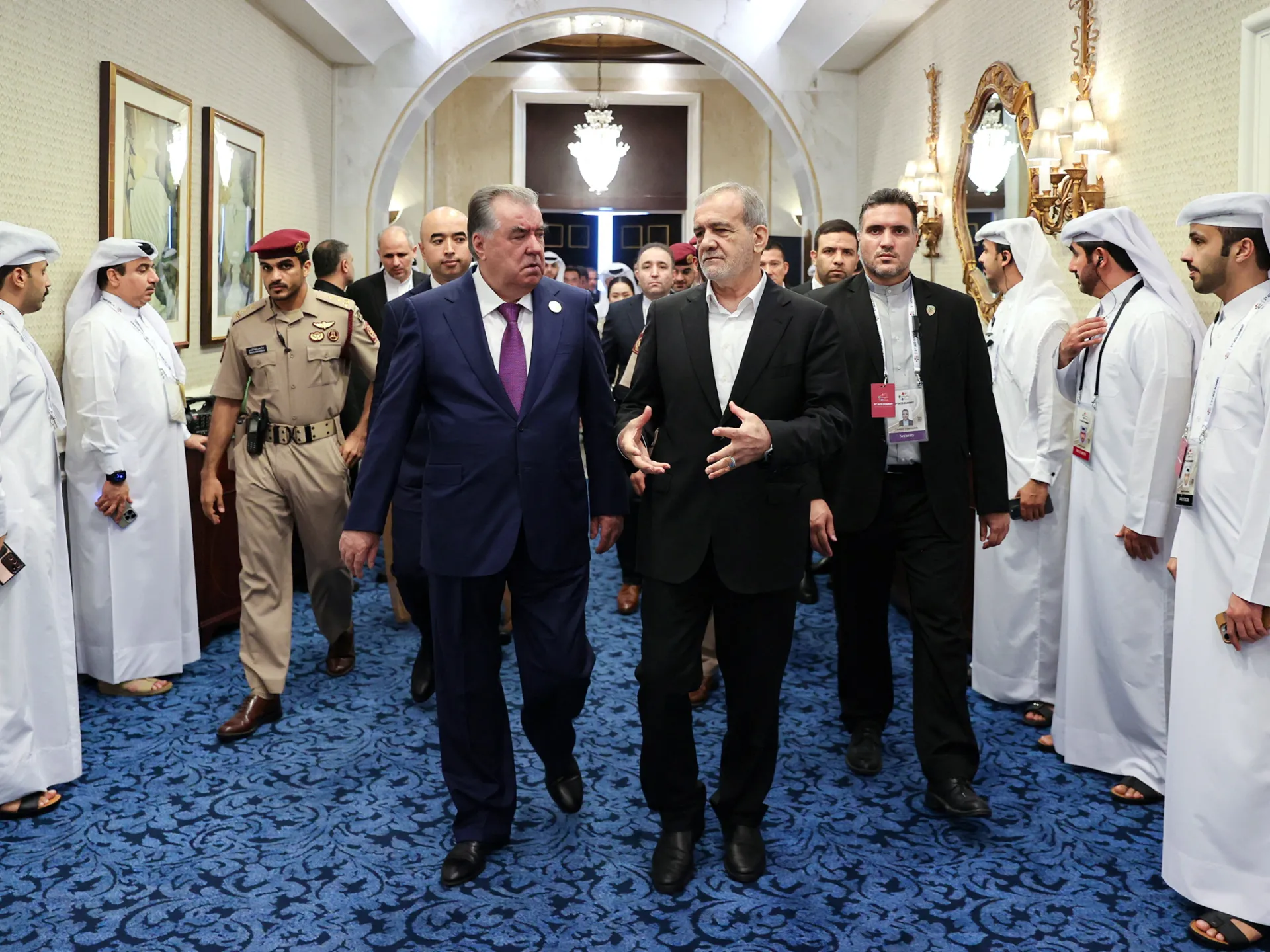
Besides Tajikistan, Iranian President Masoud Pezeshkian welcomed a proposal from Kyrgyzstan in August to establish a joint refinery in the Central Asian country, according to a report by Iran’s Tasnim news agency,
Under the agreement, Pezeshkian said, “The crude oil needed by the refinery can be supplied by Iran, and the products can be divided between the two sides.”
Will exporting oil to Central Asian countries help Iran?
The United States and Israel’s war on Iran has affected Tehran’s oil revenues. Data released by the government-administered Statistical Center of Iran in September showed that gross domestic product (GDP) shrank by 10.1 percent year-on-year between March 21 and June 20, the first quarter of the Persian calendar.
Tehran’s ability to sell crude has also been dramatically curtailed by the US naval blockade of Iran’s ports, imposed for most of the war, which began in late February.
Iranian crude and condensate loadings collapsed from about two million barrels per day (bpd) in March to roughly 740,000bpd in July and just 220,000-255,000bpd in August, according to estimates from Kpler and Vortexa.
TankerTrackers.com told the Reuters news agency in September that 29 tankers, carrying 36.11 million barrels of crude, were trapped in the Strait of Hormuz. Meanwhile, Vortexa estimated that total Iranian crude afloat had fallen from 135 million barrels at the end of July to 107 million barrels by late August.
Amid these challenges, Iran has been scrambling to find new countries to trade oil with. Russian fuel shortages have opened up new opportunities for Iran in Central Asia, at least in the short term, according to analysts.
How does Iranian oil reach Tajikistan and Kyrgyzstan?
Iran does not share a border with either country.
To get to Tajikistan, Iranian “oil and refined products have to cross Turkmenistan and Uzbekistan by rail”, said Frederic Schneider, a nonresident senior fellow at the Middle East Council on Global Affairs.
To get to Kyrgyzstan, Iranian oil would also need to pass through Turkmenistan and Uzbekistan.
Is trading oil with Iran logistically sustainable for Central Asia?
It is unlikely, Schneider said.
“This opportunity [for Iran] depends on Ukraine continuing to hit Russian refineries, which seems unlikely, both given the waning of Ukraine’s strike capability and the US government’s demand to stop the attacks as they put too much strain on global oil markets,” he told Al Jazeera.
He noted that US President Donald Trump has pressed his Ukrainian counterpart, Volodymyr Zelenskyy, repeatedly in September for an “energy truce” with Russia, since diesel prices have become a political problem for Trump ahead of the November midterm elections in the US.
“Those truces have so far collapsed within hours, but the direction is clear. Once the strikes stop, or once Russia repairs its plants, Russian fuel will come back to Central Asia duty-free under Eurasian Economic Union arrangements, and Iran will struggle to compete on price,” he said.
Logistics also favour Russia with respect to importing oil to countries like Tajikistan and Kyrgyzstan, he said.
Unlike Iran, Russia shares a border with both.
“Tajikistan’s own request [for oil] would need around 51,000 rail tank cars, and its main refinery at Dangara has never operated commercially at scale. Russia, by contrast, has decades’ worth of logistics infrastructure, pipelines, rail links, and supply contracts into the region,” Schneider said.
Is Central Asia a big enough market to compensate for Iran’s Hormuz losses?
No, according to Schneider.
Tajikistan’s total demand, Schneider said, was about 50,000bpd.
That is a drop in the ocean compared with the 1.7 million bpd Iran exported by sea a year ago. China reported $9.96bn in two-way trade with Iran in 2025, a figure that does not include some $31.2bn in Iranian oil shipments, according to the US-China Economic and Security Review Commission.
“This suggests that Central Asia can be a useful outlet for Iranian diesel and gasoline, but it cannot replace the Chinese market,” Schneider said.
For Tehran, Central Asia’s importance depends on how the US-Israel war on Iran develops, he said, adding that Tehran also needs to stay on good terms with Russia, with which it has a deep strategic partnership.
“Iran cannot afford to be seen as poaching Russian customers too aggressively, so it will present itself as a stopgap supplier, which, again, limits how much it can earn there,” he said.
What other risks does Central Asia face in buying Iranian oil?
Schneider warned that Central Asian nations could be hit with Washington’s secondary sanctions on Iran.
“Legally, US secondary sanctions apply to any foreign company or bank that conducts a significant transaction in Iranian petroleum, wherever it is based, and the Treasury expanded the list of sanctionable conduct in August. A Treasury official has already warned publicly that anyone in this trade ‘incurs that risk themselves’,” he noted.
But Schneider said that, politically, the US sanctioning Central Asian governments is unlikely.
“Central Asia is the arena of a new ‘Great Game’ between Russia, China and the United States, and Washington is courting the region harder than at any point since the 1990s, chiefly for its critical minerals. Kazakhstan alone holds about half of the minerals the US classifies as critical, including uranium and tungsten,” he said.
“Sanctioning a Central Asian government for buying fuel from Iran would push them straight back into closer ties to Russia and China,” he noted.
“What I would expect instead are targeted designations of individual traders, rail and logistics operators and smaller banks, combined with quiet pressure on the region’s correspondent banks. That alone is enough to raise the cost and slow the trade, but will come at the price of these countries redoubling their efforts to decouple economically and financially from the US.”
An explosion has ripped through Venezuela’s second-largest oil refinery, causing it to suspend activities. Reuters reports that the fire at the Cardon facility in Punto Fijo, Falcón state, started in a gas line. The facility can process 300,000 barrels of oil per day when operational.
Oil flows from the Middle East have rebounded to ~80% of pre-war volumes, a testament to the resilience of countries in the region to maintain their supply commitments to global markets, Shell (SHEL) CEO Wael Sawan said Tuesday, according
WASHINGTON — The Supreme Court justices sounded wary Monday of state-by-state lawsuits that could impose huge damage verdicts on energy producers for the impact of global climate change.
Instead, several of them suggested these local and state claims may be blocked by the federal Clean Air Act.
“Interstate air and water pollution are matters for federal law,” said Justice Brett M. Kavanaugh. “We don’t have to reinvent the wheel. This kind of pollution is a federal matter unless Congress says otherwise.”
Justice Elena Kagan appeared to agree. State-by-state lawsuits “get in way of how Congress decided to regulate greenhouse gases,” she said.
At issue before the court was the question of whether cities and states may sue oil and gas producers for the damages inflicted by climate change.
California and nearly three dozen states and municipalities have filed such claims, but none have gone to trial.
Last year, the Colorado Supreme Court ruled that Boulder County may sue for damages in a local court.
The Supreme Court agreed to hear an appeal from the oil industry backed by the Trump administration. Its lawyers argued that the Constitution and federal law do not allow for such claims to be resolved in local courts.
Chief Justice John G. Roberts sounded skeptical of opening the door to a wave of climate change lawsuits. “There will be 50 different cities. How would that work out?” he asked a lawyer representing Boulder.
For much of the two-hour argument, the justices struggled over whether federal law imposes a limit on such lawsuits, or instead whether states and their judges are free to seek damages for the harm they have suffered.
They did not signal a clear outcome but most of them sounded as though they leaned toward saying that federal law governs such far-reaching damage claims.
The energy producers turned to the Supreme Court after losing in state court.
They hope the high court will shut down more than three dozen lawsuits seeking damages for the impact of climate change.
So far, judges across the nation have been divided. Some have ruled that federal law preempts or blocks states and counties from suing under state law.
But others, including the Colorado Supreme Court, ruled the lawsuits may proceed under state law.
Justice Samuel A. Alito, a staunch conservative, said he is sitting out the case, presumably because he owns stock in oil companies that would be affected by a ruling.
If the court splits 4-4 and cannot rule, it would be major disappointment for the oil industry because it would allow all the climate-change suits to proceed, at least for now.
IRGC commander says oil flows through US-supervised route in Hormuz are ‘negligible’.
Published On 5 Oct 20265 Oct 2026
Crude oil exports from the Middle East have risen above pre-war levels on four of the seven days in the last week of September, provisional data from ship-tracking firm Kpler showed.
However, senior Islamic Revolutionary Guard Corps (IRGC) commander Ali Fadavi said in a televised interview on Sunday night that only three to four million barrels of oil per day (bpd) are now moving through the route, dismissing the amount as “negligible” when compared with pre-war traffic.
Recommended Stories
list of 3 itemsend of list
Fadavi said, for the first time, no US vessels were present in the Gulf, the Strait of Hormuz, the Sea of Oman or even the northern Indian Ocean and US warships are “100 percent vulnerable” to IRGC attacks.
Kpler data showed crude exports from the region exceeded pre-war levels on September 24 and between September 27 and 29, rising to 19.5-22.5 million bpd.
Around that time, Iran claimed success in attacking ships – including US Navy vessels – near the Strait of Hormuz, saying the strikes had forced Washington to move its warships further from the Iranian coast.
Before the US-Israel war on Iran began, exports averaged 18 million bpd between March 2025 and February 2026.
According to Kpler data, the overall tally for crude, oil products, chemicals and non-gas liquids averaged 22.4 million bpd in the seven days to September 30.
On October 1, the seven-day moving average for crude exports was at 18.5 million bpd. This includes transits via the Strait of Hormuz, the Red Sea, exports from terminals and ship-to-ship transfers in the Gulf of Oman.
The number of liquefied natural gas cargoes exiting the Strait of Hormuz also rose in September to its highest monthly level since February.
The figures exclude any vessels that might have crossed the strait with their automatic identification system transponders turned off to avoid detection.
The United Kingdom Maritime Trade Operations agency reported at least one attack a day in the Strait of Hormuz or in the Gulf of Aden since October 2.
On Sunday, Iran’s top negotiator and parliament speaker, Mohammad Bagher Ghalibaf, said the Strait of Hormuz would remain closed until the United States accepts Tehran’s seven-day plan to reopen the waterway.