oil

Kazakhstan Faces Pressure to Boost Oil Exports as Hormuz Risks Raise Supply Concerns

Kazakhstan’s Energy Minister Yerlan Akkenzhenov said international partners are urging the country to increase oil exports as concerns grow over disruptions to energy supplies linked to tensions around the Strait of Hormuz.

According to Akkenzhenov, buyers are seeking the maximum possible increase in Kazakh oil shipments due to uncertainty surrounding one of the world’s most important energy transit routes. However, he noted that Kazakhstan faces infrastructure and production constraints that limit how quickly exports can be expanded.

To support higher output, Kazakhstan has postponed planned maintenance work at the Kashagan Oil Field until 2027. The country is also considering increasing crude shipments through the Baku Tbilisi Ceyhan Pipeline, potentially raising volumes from 1.5 million tons to 2.2 million tons annually and beyond.

The development comes as global energy markets remain sensitive to geopolitical tensions involving Iran and the Strait of Hormuz, a key route for international oil and gas exports.

Why It Matters

Kazakhstan’s growing importance highlights how global energy markets are seeking alternative supply sources amid rising geopolitical risks in the Middle East.

Any disruption in the Strait of Hormuz could affect a significant share of global oil shipments, prompting importers to diversify supply chains and reduce dependence on vulnerable routes. Kazakhstan, one of the world’s major oil producers, is increasingly viewed as a reliable alternative supplier.

The decision to delay maintenance at Kashagan signals that Kazakhstan is prioritizing production stability and export capacity at a time when energy security has become a major concern for consuming nations.

The move could also strengthen Kazakhstan’s strategic position in global energy markets, giving it greater influence as countries seek dependable suppliers outside conflict affected regions.

Key Stakeholders

  • Kazakhstan – Seeking to expand exports while balancing OPEC+ commitments.
  • Yerlan Akkenzhenov – Overseeing the country’s energy strategy.
  • Kashagan Oil Field – One of the world’s largest oil fields and a key source of future production growth.
  • OPEC+ members monitoring compliance with production agreements.
  • Energy importing countries seeking alternative crude supplies.
  • Oil traders and global energy markets responding to supply risks.
  • Countries along the Baku Tbilisi Ceyhan Pipeline route that facilitate exports to international markets.

Future Outlook

Kazakhstan is likely to face increasing pressure from international buyers if instability around the Strait of Hormuz persists. While production constraints may limit immediate gains, the postponement of Kashagan maintenance suggests authorities are positioning the country to maximize output over the coming years.

The expansion of exports through the Baku Tbilisi Ceyhan pipeline could become increasingly important as energy consumers seek routes that bypass geopolitical hotspots. This would further enhance Kazakhstan’s role in global energy diversification efforts.

However, Kazakhstan must also balance market demand with its commitments under the OPEC+ framework. Any significant increase in production could attract scrutiny from fellow producers seeking to maintain supply discipline and price stability.

If Middle East tensions remain elevated, Kazakhstan is likely to emerge as one of the key beneficiaries of the global search for secure and reliable oil supplies.

With information from Reuters.

Source link

Iran conflict: Why has oil stayed near $100 a barrel? | US-Israel war on Iran

The worst-case oil scenario has been avoided, but inflation and slower growth continue to weigh on the global economy.

More than 100 days into the Iran conflict, 20 percent of the world’s energy flows remain disrupted, with the scenario described as the biggest supply shock in history.

For now, the nightmare scenario has been avoided. Oil prices are still at approximately $100 a barrel.

Many analysts have warned that a prolonged disruption to the Strait of Hormuz could send oil above $200 a barrel, triggering a global economic crisis.

Various countries have released their strategic reserves, exporters have found alternative routes and weaker demand has helped contain prices. But the buffers are thinning.

The Organisation for Economic Co-operation and Development (OECD) warns the economic impact could linger well into 2027, even if the conflict ends tomorrow.

Source link

Ukrainian military says it struck Russian oil depots, weapons sites

Ukrainian President Volodymyr Zelenskyy arrives at No.10 Downing Street in London on March 17. On Monday, Ukrainian forces said they attacked several Russian locations overnight, including multiple oil depots. File Photo by Hugo Philpott/UPI | License Photo

June 8 (UPI) — Ukrainian forces struck oil depots in Russian-occupied Crimea as well as other command and ammunition locations in Russia, the Ukrainian military said.

The strikes took place late Sunday, the general staff of Ukraine‘s military said in a Facebook post Monday, according to a translation by Ukrinform.

The Grushevaya oil depot in Krasnodar Krai and the Feodosia and Semikolodezyanskaya oil depots in Crimea were among the targets hit during the attacks, The Kyiv Independent and Ukrinform reported. Ukraine also struck the Krasny Line Production Dispatch Station in Volgograd oblast, which supplies oil to the Volgograd refinery and the Sheskharis export terminal.

Ukrainska Pravda reported that the Grushevaya oil depot is one of the largest oil storage facilities in the Caucasus, holding between 1.3 tons to 1.5 tons of petroleum. The site is used to store and transport oil for maritime export and generates a large amount of revenue for Russia.

There were large fires and billowing smoke reported at the oil depots said to be hit.

The strikes hit Russian drone command posts in various locations in Zaporizhzhia, Donetsk and Kursk oblasts. The military also said it hit areas with concentrations of Russian personnel in Donetsk, Zaporizhizhia and Sumy oblasts.

The Russian military said it struck down 310 Ukrainian drones overnight throughout Russia, Crimea, and the Black and Azov Seas.

Troops in landing craft approach Omaha Beach on D-Day in Normandy, France, on June 6, 1944. D-Day was the largest seaborne invasion in history and turned the tide of World War II. Photo by UPI | License Photo

Source link

OPEC to increase oil output amid continued closure of Strait of Hormuz

OPEC on Sunday announced that its member nations will increase oil production by nearly 200,000 barrels per day in July, despite the Strait of Hormuz remaining closed and it being very difficult to ship it anywhere out of the Middle East. Photo by Ismael Mohamad/UPI | License Photo

June 7 (UPI) — The Organization of the Petroleum Exporting Countries on Sunday agreed to increase production by nearly 200,000 barrels per day despite the Strait of Hormuz remaining closed, making it near-impossible to ship any of it.

Ordinarily, OPEC increasing oil production among the group of nations that comprise it would lower its cost, but experts have called the move largely symbolic because of the ongoing war in Iran, The New York Times and Wall Street Journal reported.

The Strait of Hormuz, which 20% of the world’s oil supply ordinarily would pass through daily, has been closed since early in the war as part of Iran’s effort to counter the war launched by the United States and Israel in February.

The OPEC members that agreed to the 188,000-barrel increase for July — the fourth month in a row that the group is increasing production — include Saudi Arabia, Russia, Iraq, Kuwait, Algeria, Kazakhstan and Oman.

The countries agreed to the increase as part of the group’s “commitment to support oil market stability” and said the latest production increase would also allow the participating nations to “accelerate their compensation,” OPEC said in a statement.

“The countries will continue to closely monitor and assess market conditions, and in their continuous efforts to support market stability, they reaffirmed the importance of a cautious approach,” the group said in the statement.

The Trump administration continues to negotiate an end to the war that would lead to the reopening of the Strait, in addition to working to limit Iran’s ability to build a nuclear weapon, amid a shaky weeks-long cease-fire.

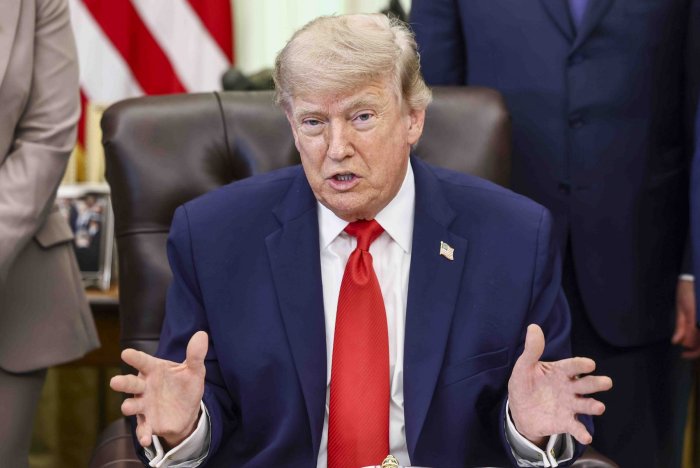
President Donald Trump discusses renovations to the Lincoln Reflecting Pool and makes an announcement on coal in the Oval Office at the White House on Thursday. Photo by Samuel Corum/UPI | License Photo

Source link

Iran’s oil exports sink to six-year lows amid U.S. naval blockade, analysts say (USO:NYSEARCA)

Jun 06, 2026, 8:15 PM ETUnited States Oil Fund LP ETF (USO), UCO, , , , , , By: Carl Surran, SA News Editor
Iran US Clash

Iranian exports of oil and condensate sank to the lowest level in at least six years in May, falling below 300K bbl/day, as the U.S. naval blockade of the Strait of Hormuz choked shipments and left tens of millions of barrels stranded at

Source link

Are Hidden Oil Flows From Hormuz Reshaping the Energy Market?

Oil shipments passing through the Strait of Hormuz have quietly increased in recent weeks, but traders say the movement reflects a fragmented and opaque energy market rather than a full recovery in global supply flows.

More than four months into the ongoing conflict involving Iran, tanker traffic remains heavily disrupted, with shipping patterns increasingly shaped by risk, secrecy and shifting political arrangements.

Tanker Traffic Shows Limited but Rising Movement

Shipping data suggests that only a small number of tankers are currently crossing the Strait of Hormuz compared with pre conflict levels.

Monitoring firms including LSEG and Kpler estimate that an average of just a few vessels per day are now passing through the strait, far below normal volumes.

Despite this, analysis of oil stored on tankers in the Gulf indicates that outflows have gradually increased, suggesting more crude is leaving the region than official shipping visibility shows.

Hidden Shipping Patterns and “Dark” Tankers

A growing share of tankers are reportedly turning off tracking systems during transit through the strait, a practice known as going dark.

This involves disabling Automatic Identification System signals, making it harder to track vessel movements in real time.

According to shipping analytics firms such as Vortexa, a large majority of outbound tankers recently used this method, reflecting rising caution among operators.

This has made it significantly harder for markets to accurately assess global supply flows and has increased uncertainty in oil pricing.

Oil Stored on Tankers Shows Gradual Decline

One key indicator of market movement is the volume of oil stored on ships inside the Gulf, often referred to as oil on water.

Estimates from Kpler suggest that volumes have fallen from a peak of around 184 million barrels in March to roughly 148 million barrels more recently.

This decline indicates that more oil is gradually leaving the region, even if it is not fully visible through standard tracking systems.

Analysts estimate that outflows have increased over recent weeks, suggesting a slow and uneven recovery in shipping activity.

Security Risks Continue to Disrupt Shipping

The ongoing conflict involving Iran has significantly disrupted maritime trade through the Strait of Hormuz, one of the world’s most important oil transit routes.

Limited access to the strait has forced producers to reduce output in some cases, while storage constraints have added pressure to supply chains across the Gulf.

Some shipping routes are reportedly being managed through informal arrangements or alternative corridors, while others rely on higher risk transit strategies to avoid detection or confrontation.

Recovery Remains Uncertain

Despite signs of increased movement, analysts warn that the situation is far from a return to normal.

A sustained recovery in oil flows would require consistent shipping access, stable security conditions and sufficient tanker availability to support exports.

Many shipowners remain reluctant to operate in the region due to elevated insurance costs and the risk of vessels being stranded or targeted.

Long Term Structural Change Possible

Industry observers warn that even if diplomatic progress leads to a formal reopening of the strait, the global oil market may not return to previous conditions.

There is growing discussion that Iran could attempt to impose tolls or control systems on shipping through the waterway, which would fundamentally alter global energy logistics.

Such a scenario could force Gulf producers to seek alternative export routes or invest in new infrastructure to reduce dependence on the strait.

Analysis: Market Stability Replaced by Managed Uncertainty

The situation in the Strait of Hormuz highlights a shift from predictable global energy flows to a more fragmented and opaque system.

While oil continues to move out of the Gulf, the lack of transparency in shipping routes is creating uncertainty for traders and pricing benchmarks.

The increased use of stealth navigation and alternative transit arrangements reflects a market adapting to geopolitical risk rather than resolving it.

As long as tensions persist, energy markets are likely to remain volatile, with supply visibility as important as supply itself in determining global prices.

Conclusion

Oil shipments through the Strait of Hormuz are slowly increasing, but hidden tanker movements and ongoing conflict mean the global energy market remains deeply uncertain. Without stable political conditions and transparent shipping routes, a full recovery in oil flows is unlikely in the near term, keeping traders cautious and markets volatile.

With information from Reuters.

Source link

Oil Climbs as Middle East Tensions Rise While AI Rally Lifts Global Stocks

Global markets are navigating two powerful and competing forces: escalating geopolitical tensions in the Middle East and continued investor enthusiasm for artificial intelligence-related stocks. While concerns over renewed conflict between the United States and Iran have boosted oil prices and supported demand for safe-haven assets, the AI-driven technology rally has continued to push stock markets higher, particularly in Asia.

What Happened

Oil prices rose for a third consecutive session on Wednesday after fresh hostilities emerged in the Gulf region. Brent crude climbed 1% to $94.74 per barrel as hopes for a quick resolution to tensions between Washington and Tehran faded.

The U.S. military reported that Iranian missile attacks targeting Bahrain, Kuwait and other regional locations were either intercepted or failed. The developments came after negotiations aimed at ending the conflict between the United States and Iran stalled despite both sides announcing a tentative agreement last week.

Meanwhile, financial markets showed mixed reactions. U.S. stock futures were largely unchanged, while European futures edged lower. In Asia, however, technology shares continued their strong advance, helping stock indexes in Japan and Taiwan reach record highs.

Why Markets Are Reacting to Middle East Risks

Investors had previously expected the United States and Iran to formalize an agreement that would reduce regional tensions and ease concerns about energy supplies. The lack of progress in negotiations has instead revived fears of a prolonged conflict that could disrupt oil shipments from the Gulf, a critical region for global energy markets.

Higher oil prices typically reflect concerns about potential supply disruptions. The latest military developments prompted traders to unwind some of their earlier bets on a diplomatic breakthrough, contributing to the rise in crude prices.

Currency markets also reflected growing caution. The U.S. dollar strengthened against the Japanese yen, briefly touching the closely watched 160 level before retreating amid concerns that Japanese authorities could intervene to support their currency.

AI Stocks Continue to Defy Market Uncertainty

Despite geopolitical concerns, enthusiasm surrounding artificial intelligence remained a major driver of equity markets. Wall Street indexes posted modest gains on Tuesday, supported by technology shares.

Chipmaker Marvell Technology surged more than 32% after Nvidia chief executive Jensen Huang described the company as a potential trillion-dollar business. Investor optimism surrounding AI also helped propel SoftBank Group above Toyota Motor Corporation as Japan’s most valuable listed company.

The AI boom has continued to attract investment even as broader markets grapple with geopolitical uncertainty and concerns about interest rates.

What Comes Next

Investors are now closely watching upcoming U.S. economic data, including services sector activity, private payroll figures and Friday’s employment report. Strong labor market data could reinforce expectations that the Federal Reserve will keep interest rates higher for longer or even consider further increases.

Bond markets remained relatively stable, while traders adjusted expectations from potential rate cuts earlier in the year to the possibility of additional rate hikes. Markets have also priced in the likelihood of monetary tightening in Europe and Japan.

At the same time, developments in the Middle East remain a key risk factor. Any further escalation between the United States and Iran could push oil prices higher and increase volatility across global financial markets, while continued strength in AI-related stocks may help support broader equity markets despite geopolitical headwinds.

With information from Reuters.

Source link

South Korea inflation tops 3% on Middle East oil shock

Consumer prices in South Korea rose 3.1% in May from a year earlier, driven by sharp increases in petroleum products, international airfares and overseas group tour fees. Data from National Data Agency. Graphic by Asia Today and translated by UPI

June 2 (Asia Today) — South Korea’s consumer price growth topped 3% in May for the first time in 26 months as a prolonged Middle East war drove up global oil prices, raising concerns that high inflation could continue through the second half of the year.

The consumer price index stood at 119.92 in May, with 2020 set as the base year of 100, up 3.1% from a year earlier, according to consumer price data released Tuesday by the National Data Agency. It was the first increase of 3% or more since March 2024.

Industrial products rose 4.2% from a year earlier, while service prices increased 2.8%. Petroleum prices showed the sharpest increase, jumping 24.2%, the largest gain in three years and 10 months since July 2022, when the Russia-Ukraine war was at its height.

Gasoline prices rose 23.1%, diesel prices climbed 33.3% and kerosene prices increased 21.7%.

Among services, international airfares, which are directly affected by fuel costs, rose 33.5%, while overseas group tour fees increased 26.3%.

The living price index, which tracks frequently purchased items with a high share of household spending, rose 3.3% from a year earlier, showing a worsening burden felt by consumers.

Lee Doo-won, an official in charge of economic trend statistics at the data agency, said petroleum prices rose more sharply because of higher international oil prices caused by the Middle East war.

“International airfares and prices for travel and lodging-related items rose sharply as fuel surcharges linked to global oil prices increased and the number of peak-season days, including holidays, grew,” Lee said.

The government said it will work to reduce price uncertainty by stabilizing petroleum prices.

A Finance Ministry official said the government’s petroleum price cap and fuel tax cut reduced the May consumer price increase by 0.6 percentage point.

“We will make every effort to stabilize prices felt by households through petroleum price stabilization measures and a task force on livelihood prices,” the official said.

Experts said inflation led by higher global oil prices is likely to continue in the second half.

“Although the United States and Iran have announced plans to discuss reopening the Strait of Hormuz, the high oil price trend is likely to continue in the second half even if the war ends, given the destruction of local oil facilities,” said Jeong Se-eun, an economics professor at Chungnam National University.

“For South Korea, which imports all of its oil, oil prices affect overall inflation. There is also concern that abnormal weather forecast for this summer could raise agricultural prices,” Jeong said.

“With no notable downward factor in the second half, inflation is expected to stay around 3%,” she added.

Park Jin, a professor at the Korea Development Institute School of Public Policy and Management, said prices are determined by market supply and demand.

“On the supply side, there are inflation concerns caused by unstable oil prices. On the demand side, there are price-increase factors such as a strong domestic stock market,” Park said. “Preemptive steps, including consideration of an interest rate hike, are needed.”

— Reported by Asia Today; translated by UPI

© Asia Today. Unauthorized reproduction or redistribution prohibited.

Original Korean report: https://www.asiatoday.co.kr/kn/view.php?key=20260602010000704

Source link

Oil prices climb as Israel expands military operation in Lebanon

Published on Updated

Crude prices climbed in early Asian trading on Monday after Israeli troops pushed further into Lebanon over the weekend, fuelling investor fears that the broader Middle East conflict could escalate rather than move towards a peace deal.


ADVERTISEMENT


ADVERTISEMENT

At the time of writing, West Texas Intermediate (WTI) crude was up 2.88% at $89.88 per barrel, while Brent crude rose 2.43% to $93.33 per barrel.

The Israeli advance has taken place despite a nominal ceasefire in place since 17 April and just days before the next round of direct talks between Lebanon and Israel, scheduled at the State Department on 2 and 3 June.

Asia-Pacific markets mixed

In other early trade dealings on Monday morning, Asia-Pacific markets were mixed with South Korea’s Kospi climbing 1.31%, while Japan’s Nikkei 225 edged up 0.17%. The broader Topix index, however, slipped 0.3%.

Australia’s S&P/ASX 200 fell 0.21%, while Hong Kong’s Hang Seng Index gained 0.73%. Mainland China’s CSI 300 dipped 0.32%.

Tokyo-listed shares in SoftBank Group, meanwhile, surged 5% after the Japanese conglomerate unveiled plans to invest €45 billion over the next five years to develop artificial intelligence infrastructure in France.

Wall Street pushes into record books

In the US, stock futures were flat after Wall Street pushed further into the record books on Friday. The major indexes extended the market’s recent winning streak and closed out a solid month of gains.

The S&P 500 rose 0.2%, notching its seventh consecutive gain and ninth straight winning week — the longest such streak since 2023. The benchmark index set an all-time high for the fourth day in a row.

The Dow Jones Industrial Average gained 0.7% and the Nasdaq composite added 0.2%. The Dow and Nasdaq also reached new heights after posting record highs earlier last week.

Big technology stocks have been behind much of the market’s record-breaking streak. Their pricey stock values give them more influence in directing the market higher or lower. In May alone, technology stocks within the S&P 500 rose more than 15%, while most of the sectors in the benchmark index actually lost ground.

“The rally has been largely tech-led and supported by resilient earnings, but the key question is whether it can be sustained,” wrote Angelo Kourkafas, senior global strategist at Edward Jones, in a research note.

Tech stocks also powered the market higher Friday. Microsoft rose 5.4% and Broadcom gained 4.7%.

Additional sources • AP

Source link

How Middle East Supply Risks Are Growing in Impact on Global Oil Trading

The Middle East has been a difficult region to deal with in oil markets. When it comes to energy geographies, the region has proven to be a disproportionately significant part of the world’s energy resources, with export facilities traversing a handful of maritime routes and political situations that have been tense, if not outright volatile, at times. The change in 2025 and into 2026 isn’t the nature of the forces but rather the confluence of overlapping pressures: ongoing sanctions enforcement, multiple theaters of conflict, OPEC+ tensions that are more public than ever in previous years, and disruptions to shipping in the Red Sea, which now seem to have become a semi-permanent part of the shipping route landscape.

There is no background information for commodity traders, market analysts, and energy investors. It’s a real-time, constantly evolving dynamic that can make all the difference in the day-to-day performance of prices, and it’s particularly important when prices are sliding around rapidly, and the stories behind them are changing just as fast.

The Behavior of Prices and the Risk of Middle East Supplies

The area is responsible for about one-third of the world’s crude production. That should make it significant in and of itself. What makes matters worse is that export infrastructure is concentrated in a handful of terminals, pipelines, and maritime corridors where a disproportionately large share of oil is exported. The disruption of any of them (even for a moment) reduces a large supply signal to an extremely short time frame.

Traders who follow crude oil price live data are the first ones to witness this. Real-time feeds are a reflection of more than just the fundamental supply-demand elements, but the market’s real-time assessment of the value of geopolitical risk and how much it “should” be worth at any given moment. A news event, which is a minor detail in a more stable environment, can cause future prices to move $5 or more in less than an hour. The consistent and tough question – and it is a tough one – is, which events actually have physical supply implications and which ones are sentiment-driven moves that die in a session or two?

The Strait of Hormuz

About 20-21 million barrels per day of crude oil and petroleum products go through the Strait of Hormuz, which is about 20% of the world’s oil consumption. No readily available bypasses can be found that can absorb that flow at a similar cost. There are partial alternatives, including the IPSA pipeline and Saudi Arabia’s East-West pipeline, but they would not even come close to filling the deficit should the Hormuz be closed en masse.

Source

It is a strait between Oman and Iran. Geography makes it so that any serious disruption in U.S.-Iran relations or of security conditions in the Gulf in general puts Hormuz back on the market’s agenda. Traders are all familiar with this: when there is a lot of Iranian tension, the futures positioning will always reflect the chokepoint risk, even if there is no incident per se.

Production Outages That Don’t Make the Front Page

The issue of the supply is something that generally doesn’t get the same kind of attention it should get, but the clearest example of this recurring issue is Libya. In recent years, internal political squabbles about how to divide up oil revenues have led to several production shutdowns that have temporarily increased the tightness of the light sweet crude grades refined by European and Asian plants. The disruptions are likely to persist when there is no political agreement, and the pattern is robust. In recent years, Iraq’s export pipeline to the North through Turkey has also been down for extended periods of time. These relatively inconspicuous disruptions can add up and impact medium-term supply dynamics, though not necessarily have the same impact as a more conspicuous incident.

Key Risk Factors Shaping Market Sentiment in 2026

The Middle East is a geopolitical risk that has many variables. It’s a combination of interwoven pressures that work in various ways and to varying effects on the length of the price impact. The issues that currently have the greatest attention of serious analysts are generally of three types:

  • Export infrastructure and production infrastructure are currently under physical threat to production.
  • Sanctions regimes and the dynamics of their enforcement.
  • Disruption of shipping routes and attendant disruption of the trade economics.

Everything is unique, and sometimes they are not in the same direction at the same time. That’s part of what makes the current situation more complicated than any one risk headline implies.

Active Conflict Zones and Exposure to Infrastructure

The latest example of large-scale infrastructure targeting is the 2019 attack on Saudi Aramco’s Abqaiq and Khurais facilities in the country, which was carried out using drones and missiles. The loss in output occurred temporarily, amounting to about 5.7 million bpd, the largest sudden supply shock in modern oil market history. The recovery was quicker than many expected, partly because of the operational robustness of Aramco and partly because the situation was swiftly contained diplomatically. But the event has permanently changed the way markets view the vulnerability of infrastructure in the Gulf, and that repricing has not been complete.

The Persistent Iranian Supply Question

Iran’s petroleum sales have also been sustained in the face of sanctions, largely via Asian markets out of reach to Western sanctions. A full-fledged deal between Tehran and Western governments has yet to be hammered out, as of early 2026. That has left volumes of Iranian supply in a limbo of sorts: they could be rapidly reduced by stepped-up enforcement, and they could be dramatically increased by a change in diplomatic circumstances. Both of these results can have significant price consequences, and even the uncertainty can be a factor in the market without a clear decision.

Infrastructure Concentration Risk

The concentration levels in Saudi Arabia’s export system warrant a more significant focus than is generally found outside of export specialist circles. Abqaiq processes and stabilizes a huge percentage of Saudi crude before it is shipped to export terminals, removing the sulfur from it. That kind of ‘single point of failure’ is not typical in most industrial supply chains. In the case of oil, it’s a structural aspect of the market and one that has been proven, not just thought.

OPEC+ Internal Dynamics

However, OPEC+ compliance has been quite lackluster at times, notably from Iraq and Kazakhstan, which have had a history of overproduction. This gives rise to an everlasting discrepancy between OPEC+ declarations and the actual supply data. For analysts, the bottom line is that it is important not to take production decisions at face value but to also consider the track record of implementation once a deal has been agreed on to see what the real supply impact was.

Non-State Actor Activity and Shipping Friction

Since late 2023, the Houthis have started to attack commercial shipping vessels in the Red Sea more frequently, and these attacks have persisted through 2025. What those disruptions drove home is that it’s not necessary to blow a wellhead to impact oil market economics. A round-the-Cape voyage will increase the time in transit by about ten to fourteen days, as well as the fuel costs. During periods of increased Houthi activity, insurance costs for tankers traveling in the Gulf area skyrocketed. Both impacts are not a direct factor in the crude benchmarks, but both impact the effective landed cost of Middle East barrels in destination markets.

How the Market Prices Geopolitical Risk

Knowing the difference is important, as geopolitical events do not affect oil prices in a single manner. Some effects are immediate and visible: a surge in the price of Brent futures within minutes of an incident report. Others come more slowly, via changes in freight rates, changes in the repricing of insurance, and changes in buyer behavior, which may take days or weeks to be reflected in trade flow data. The rate of these impacts varies, and so do their effects.

Then there is the issue of what the market “already” had in place whether there was an event or not. When there is a constant regional tension, there is usually some risk premium in prices. The incremental market move may therefore be less than anticipated when an event then reinforces concerns, the surprise element of the event, which is typically the one that produces the biggest market moves, is already discounted.

Risk Premium in Practice

Geopolitical risk premiums in times of heightened Middle East tension have varied from around $4 to $10 per barrel, depending on the market participants’ views on the probability of actual physical supply disruptions in the case of Brent crude, according to S&P Global Commodity Insights. That’s a fairly broad window for economic trading, and it has a tendency to close up very fast when the tension subsides and without a supply event, which is the more common scenario.

The geopolitical risk premium factors analysts may consider are:

  • The nearness to active conflict, producing fields, or the working export terminals.
  • Production capacity that would be available to make up for the loss of production elsewhere.
  • The availability and magnitude of the IEA’s strategic stockpiles to be tapped.
  • Current tanker market conditions and the viability of an alternative route.
  • Diplomatic messages sent by governments in the area, including the United States and other great powers
  • Past examples of similar events, which have had identifiable supply impacts.

It is not easy to give exact weights to these inputs. Part of the reason for the price action to seemingly be different with comparable geopolitical events can be due to different analysts forming different conclusions from the same events.

Historical Supply Disruptions and Price Responses

The following table shows some of the more significant supply events that took place in the Middle East and the approximate market impact. The trend of most entries was that the first price movement has been greater than the actual physical supply effect, at times much greater, and then it has partially retraced to a more stable situation.

Event Year Estimated Supply Impact Approximate Brent Price Reaction
Abqaiq/Khurais Attacks (Saudi Arabia) 2019 ~5.7 mb/d temporary loss ~15% intraday spike
Libyan Civil War Output Collapse 2011 ~1.4 mb/d reduction ~$20/bbl over several weeks
U.S. Re-imposition of Iran Sanctions 2018 ~1-1.5 mb/d reduction ~15% sustained over several months
Iraq-Northern Field Disruptions 2014 Partial northern output loss ~$10/bbl elevated premium
Houthi Red Sea Disruptions 2023-24 Rerouting; limited direct supply loss Moderate – primarily freight cost impact
Iran Sanctions + Red Sea Friction 2025-26 ~0.8-1.2 mb/d constrained Iranian output Persistent $4-8/bbl risk premium in Brent

The 2025-2026 entry is a more diffuse form of market pressure than those acute events listed above. It is not one particular incident, but rather sanctions enforcement and Iranian volumes kept low and shipping activity in the Red Sea continuing to cause friction in the transport system, which has kept transport costs elevated. The World Economic Outlook from the IMF pointed out that this type of persistent supply constraint is likely to have a longer-lasting impact on medium-term price expectations than acute supply shocks, which markets have historically been able to absorb and turn around in relatively short periods of time. Thus, a slow-burning risk premium can be more ‘sticky’ than a dramatic risk premium.

Broader Market Implications

Crude oil benchmarks are not the only place where supply risk from the Middle East exists. It extends out to related markets in ways that are not always apparent when the world’s focus is on the Brent or WTI headline price.

The second-order victim is likely to be refined product markets. In times of crude supply shortages or increased uncertainty, refinery margins and regional product availability may be affected to a greater extent, and the effects on end consumers may be magnified, especially in regions where there is little local refining or a high concentration of import logistics. The energy crisis of 2022 in Europe was a prime example of how the upstream pressure to supply energy flows through the downstream more quickly than most market players would have thought.

Other segments of the market that are impacted by increased supply risks in the Middle East are:

  • Tanker freight rates, which can also rise sharply without reference to crude prices during times of major-scale rerouting.
  • In oil-dependent economies, currency markets can be affected by changes in the prices of the oil that the state supplies, which change expectations of fiscal revenue and sovereign credit risk.
  • LNG markets with some short-term fuel switching demand in the exposed economies as a result of regional geopolitical pressure.
  • In agricultural commodity markets, where there is known overlap between energy input costs and food production, processing, and transport economics

Strategic Reserve Releases (SRRs) as a Counterweight

During the IEA’s coordinated strategic reserve release in 2022, it was seen that policy tools are in place to mitigate short-term supply shocks and that they can be implemented on a material scale when political conditions are right. However, there are drawbacks to those processes. During that time, reservoir levels were lowered significantly, and a rebuild takes time. There are also doubts about the effectiveness as a deterrent because, over time, markets will factor in the possibility of a release during the next big disruption event, effectively canceling the effect of a release in advance.

Geopolitical Risk Analysis: What It Does and Doesn’t Accomplish

It’s easy to fall into the temptation, because of the amounts of money potentially involved, of viewing geopolitical risk analysis as a predictive tool. It generally lacks it there. It’s actually helpful for comprehending markets and its actions, as well as for charting structural weaknesses that are price-relevant. What it doesn’t do well is tell you when an event will happen, or how big the market’s reaction will be when it does.

Instead of getting lost in qualifications, the specific limitations should be called out:

  • Escalation and de-escalation are non-linear and unpredictable to a great extent. Conflict situations that appear to be intractable can be solved in a flash, and stable times can fall apart in an instant. Both directions remain silent and don’t herald themselves.
  • When demand for a commodity is the same, the market price may be quite different in the two market conditions. There are interactions between the geopolitical trigger and positioning, sentiment and open interest that are not modelable in advance.
  • Secondary effects (such as freight repricing, product supply shifts and insurance cost changes) happen at varying rates to the initial crude price move, and thus the total impact of the market is more difficult to gauge in real time.
  • Analytical path dependency can occur when geopolitical narratives set up a framework that later information gets filtered through, without being recognized as such.

All this does not negate the analysis. It’s about calibration and about honesty when the power of explanation runs out, and speculation sets in.

Conclusion

Middle East supply risk is not a succession of shocks that will come and go and be completely addressed but rather a structural state in global oil markets. The combination of production weight, geographic concentration of export infrastructure, and political complexity of the region always comes with a certain level of supply uncertainty as a base case. The level of that uncertainty and the extent to which that uncertainty is priced into securities on a given day are what change.

The hard part for traders, analysts, and energy investors is not recognizing that there is risk – that’s obvious. It’s gaining a good enough sense of what matters most at a given moment, what the big picture supply-demand dynamics are, and at what point a careful study of the facts begins to look like well-informed guesswork. The clear understanding of that boundary is, in fact, probably more valuable than any single analytical framework that can be applied to the boundary.

Disclaimer

This article is provided for informational and educational purposes only. It does not constitute financial advice, investment advice, or a recommendation to buy, sell, or hold any financial instrument, commodity, or derivative product. Trading in energy markets, including crude oil futures, CFDs, and related instruments, involves substantial risk of loss, including the possible loss of capital invested. Past market behavior and historical price patterns referenced in this article are not reliable indicators of future performance. Geopolitical developments described may not materialize as anticipated or may evolve in ways that differ materially from historical precedent. Readers should conduct their own independent research and consult a qualified financial professional before making any investment or trading decisions. Nothing in this article should be interpreted as a trading signal, directional market recommendation, or endorsement of any specific trading approach.

Source link

European Shares Slip as US Strikes on Iran Dampen Peace Deal Hopes and Push Oil Higher

European shares edged lower on Tuesday as hopes for an imminent de-escalation in the Middle East conflict faded following fresh U.S. strikes on Iran, triggering renewed geopolitical uncertainty across global financial markets.

The pan-European STOXX Europe 600 Index slipped 0.2% to 630.33 points by 0833 GMT, retreating from gains that had recently pushed it close to record levels.

On Monday, the index had closed at its highest level since late February, briefly coming within 1% of an all-time high on optimism that diplomatic progress could soon ease tensions in the region.

That momentum quickly reversed after renewed military action and comments from U.S. Secretary of State Marco Rubio, who said negotiations with Iran could take “a few days,” tempering expectations of a near-term resolution.

Oil Prices Jump as Hormuz Risks Return to Focus

Global energy markets reacted sharply to the escalation, with Brent crude rising more than 3%, reigniting inflation concerns across energy-importing economies, particularly in the euro zone.

The market remains highly sensitive to risks surrounding the Strait of Hormuz, a critical global shipping route through which a significant share of the world’s oil flows.

Analysts warned that any sustained disruption in the region could deepen inflationary pressures just as central banks weigh their next policy moves.

Airlines and Autos Under Pressure

Travel and transport-related stocks were among the biggest losers in Tuesday’s session.

Airlines including Lufthansa and Ryanair fell 1.4% and 0.7% respectively, reflecting investor concerns that higher fuel costs could squeeze margins.

Luxury and automotive stocks also came under pressure after Ferrari dropped sharply following the unveiling of its first fully electric vehicle.

The decline was compounded by a broader sell-off in the European autos sector, which fell 1.6% as investors reassessed competition risks from Chinese EV manufacturers and weakening global demand trends.

Market Sentiment Balances War Risk and Policy Signals

Despite renewed volatility, some investors noted that markets remain partially supported by expectations that diplomacy could still stabilize the situation.

One portfolio manager at Franklin Templeton said markets were reacting cautiously because investors believe a potential agreement could still restore stability in the Strait of Hormuz and normalize energy flows.

However, uncertainty around timing and scope continues to limit upside momentum in equities.

Inflation and Central Bank Policy Back in Focus

Attention is now shifting toward upcoming inflation data across major euro zone economies and the United States, which will help shape expectations for future monetary policy.

European Central Bank policymaker Yiannis Stournaras signaled that any persistent inflation overshoot would require a cautious shift toward tighter policy.

Market pricing currently suggests at least two further 25-basis-point interest rate moves before year-end, according to LSEG data.

Corporate Movers: Winners and Losers

While broader markets weakened, some stocks moved against the trend.

Kingfisher rose 2% after maintaining its full-year profit guidance, easing concerns about demand softness in the home improvement sector.

However, the overall tone remained risk-off as investors continued to weigh geopolitical escalation against macroeconomic uncertainty.

Analysis

The latest pullback in European equities reflects a familiar pattern: markets oscillating between hopes of geopolitical de-escalation and fears of renewed conflict risk in the Middle East.

The key transmission channel remains energy. With Europe heavily dependent on imported oil and gas, any disruption involving Iran or the Strait of Hormuz immediately feeds into inflation expectations, bond yields, and corporate earnings outlooks.

At the same time, equity markets had recently been pricing in a relatively optimistic scenario in which diplomatic talks would gradually stabilize the region. That positioning left stocks vulnerable to abrupt reversals when military developments resurfaced.

Sectoral divergence also highlights how uneven the impact of geopolitical shocks can be. Energy-sensitive sectors such as airlines and autos are under pressure, while defensive or domestically oriented companies remain relatively insulated.

The broader question for markets is whether this marks a temporary setback in diplomatic momentum or a deeper breakdown in expectations for a negotiated settlement. If tensions persist, volatility in oil markets is likely to remain the dominant driver of global equity sentiment in the near term.

With information from Reuters.

Source link

Oil steadies at $100 and markets stay volatile as US-Iran talks stall

Brent crude edged 2.5% higher on Tuesday and seems to have steadied around $100 per barrel at the time of writing, as US-Iran negotiations stall.


ADVERTISEMENT


ADVERTISEMENT

On the other hand, WTI dropped over 4% and is trading around $92.6 per barrel.

Overall, oil prices were declining since last Wednesday as the framework for a peace deal, or at least a longer and more encompassing ceasefire, between the US and Iran was seemingly on the verge of being agreed.

However, Iran accused the US of breaching the current ceasefire after Washington carried out what it described as defensive strikes in the southern part of the country.

Iran’s foreign ministry stated that the US attacks in the Hormozgan province, where Iranian media reported hearing explosions early Tuesday, amounted to a “serious violation” of the fragile ceasefire that has been in effect for almost seven weeks.

Meanwhile, US Secretary of State Marco Rubio said negotiations aimed at ending the conflict could require “a few days” to reach an agreement.

On Monday, US President Donald Trump also reiterated nuclear demands in a social media post, as tensions continue to surround the fundamental aspects of a possible agreement.

Investors appear to have mixed reactions to the developments with some markets seeming to price in a decrease in the probability that a deal is imminent.

In Europe, the Euro Stoxx 50 has fallen more than 0.7% while the broader pan-European Stoxx 600 is trading around 1% lower as we approach the close of Tuesday’s session.

The UK’s FTSE 100, Germany’s DAX 30, France’s CAC 40, Italy’s FTSE MIB, the Netherlands’ AEX and Switzerland’s CH20 have all dropped between 0.1% and 0.7%.

Over in Asia, Japan’s Nikkei 225 and Taiwan’s TAIEX closed flat, but South Korea’s KOSPI jumped 2.5% primarily driven by a continuous demand for AI-related equities.

However, US markets appear completely decoupled from other indices and the broader situation. Not only have WTI prices continued to fall on Tuesday but the S&P 500 also opened 0.6% higher.

Latest on the Strait of Hormuz

Both the US and Iran had signalled headway toward a memorandum of understanding that could end the conflict and resume maritime traffic through the blocked Strait of Hormuz, while allowing negotiators a 60-day window to tackle more complicated matters such as Iran’s nuclear activities and supplies.

In his latest remarks, US Secretary of State Marco Rubio stated that the Strait of Hormuz must remain accessible “one way or the other” as traffic through the chokepoint has dropped sharply, with only a few dozen ships currently using the route each day, compared with the usual 125 to 140 vessels.

Iran has continued to permit limited shipping, prioritising vessels connected to allied or friendly nations and arranging passage through state-to-state agreements.

Continuous reports of attacks in the Strait of Hormuz underscore how far from the normalisation of energy flows and other supplies the global economy still is.

On Tuesday, the United Kingdom Maritime Trade Operations (UKMTO) reported that a tanker experienced an external blast near the waterline on its port side.

According to the agency, the vessel was located about 60 nautical miles from Muscat, the capital of Oman.

UKMTO said the tanker and all crew members were unharmed, although a quantity of bunker fuel spilled into the sea.

This is the most recent reported incident near the Strait of Hormuz at the time of writing.

Source link

Oil drops below $100 per barrel, but gas prices remain high in U.S.

May 25 (UPI) — With the United States and Iran reportedly nearing a peace deal, oil prices fell slightly below $100 per barrel early Monday, suggesting optimism from traders to start the week.

Gas prices also declined slightly in the United States in the last week, but remain above $4.50 per gallon for regular on Memorial Day.

President Donald Trump has indicated that negotiations are “proceeding nicely,” and Iran acknowledged that talks have progressed but that a deal has not been reached, The BBC reported.

In European trading, Brent crude dropped to $95.04 per barrel and WTI futures dropped dropped to $91.02 per barrel — both declines of more than 5% — the Wall Street Journal reported.

Even with gas prices high, The Hill reported that more than 39 million people were projected to travel the roads during Memorial Day weekend, even as gas prices have remained consistently high since the start of the war in Iran.

Regular gas on Monday averaged $4.50 per gallon, which is down $0.01 from one week ago, but still $0.40 higher than one month ago, AAA reported.

Similar, diesel averaged $5.59 per gallon on Monday, which is down $0.03 from one week ago, and $0.40 more than one month ago.

“Memorial Day travel is still reaching record levels, but with the smallest year-over-year increase in more than a decade,” said Tiffany Wright, spokesperson for AAA’s The Auto Club.

“Although travel demand remains strong, higher fuel prices and persistent inflation may cause some travelers to shorten trips, delay plans or stay closer to home.”

The longer that the United States and Iran take to agree on a peace plan and the Strait of Hormuz remains closed, gas prices are unlikely to decrease significantly and energy markets will take a while to get back to normal, Axios reported.

“Gas prices are currently falling, but until we see an agreement signed and a significant amount of ships transit the Strait, the national average prices of gasoline will likely remain well above $4.00 per gallon,” said Patrick De Haan, head of petroleum analysis for Gas Buddy.

Members of the 3rd U.S. Infantry Regiment, or “The Old Guard,” place some 250,000 American flags throughout Arlington National Cemetery in preparation for Memorial Day in Arlington, Va., on May 21, 2026. Photo by Bonnie Cash/UPI | License Photo

Source link

Oil prices fall amid mixed signals on US-Iran peace deal | Oil and Gas

Japan’s stock market surges to record high on hopes of an end to US-Israel war on Iran.

Oil prices have fallen sharply amid tentative hopes for a deal to end the US-Israel war on Iran.

Brent crude, the primary benchmark for global oil prices, fell about 5 percent on Sunday as US President Donald Trump gave mixed signals on the prospects for a permanent end to the conflict.

Recommended Stories

list of 4 itemsend of list

Brent futures for July stood at $98.47 a barrel as of 01:05 GMT, down about 9 percent from a month ago but still up by more than a third compared with before the start of the war.

Japan’s benchmark stock index, the Nikkei 225, surged more than 3 percent in morning trading, hitting an all-time high after closing at a record peak on Friday.

Trump said in a social media post on Sunday that negotiations with Tehran were proceeding in an “orderly and constructive manner”, but he had instructed officials “not to rush into a deal”.

“Both sides must take their time and get it right. There can be no mistakes!” Trump wrote on Truth Social.

Trump’s remarks came after he raised hopes for a breakthrough on Saturday by announcing that a deal had been “largely negotiated,” with the terms including the reopening of the Strait of Hormuz.

“Fundamentally, there is no change to the underlying picture, where 10-11 million barrels per day of crude oil continue to be shut-in for every day the Strait of Hormuz remains shut,” June Goh, a senior oil market analyst at Sparta in Singapore, told Al Jazeera.

“However, markets are expecting a gush of 100 million barrels of crude oil from the stranded ships to flow out once the deal is in place.”

Goh said markets are likely to remain on edge for some time after any deal is finalised.

“Sparta estimates still about three to six months required to get everything back to status quo, including time to bring production and refineries back online,” Goh said.

Iran has effectively blockaded the strait since the start of the war in late February, disrupting about one-fifth of the global oil trade.

The US has imposed its own blockade of Iranian ports since mid-April, further disrupting commercial shipping in the waterway.

In his Truth Social post on Sunday, Trump said the US blockade would remain “in full force and effect until an agreement is reached, certified, and signed”.

Source link