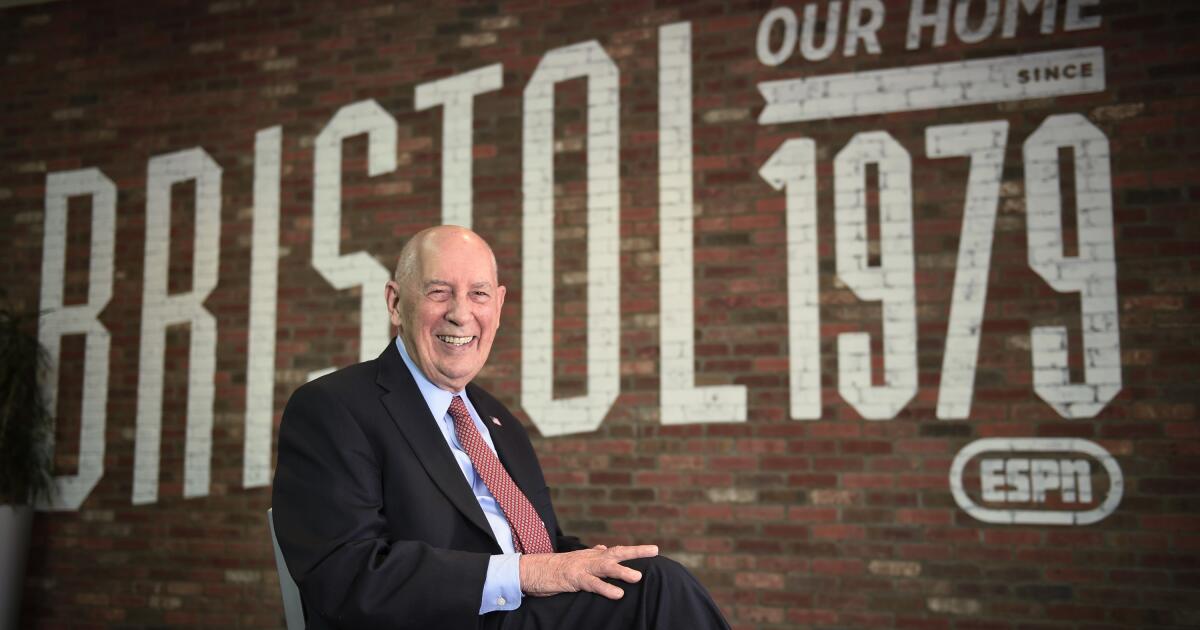
Bill Rasmussen, the founder of the world’s first 24-hour all-sports cable network ESPN, has died. He was 93.
The sports media company announced his death in a news release on Tuesday and said the cause was from the effects of Parkinson’s disease. The entrepreneur was first diagnosed with the movement disorder in 2014.
“Bill was a remarkable man — a visionary and an innovator who conceived the idea of a network entirely devoted to sports,” said ESPN Chairman Jimmy Pitaro in a statement. “Quite simply, none of us would be here today if it wasn’t for Bill’s passion and all the hard work and entrepreneurial spirit he put into building ESPN in the late 1970s.”
Rasmussen’s creation — which began in the small industrial town of Bristol, Conn., — became an integral part of the new television landscape that emerged from cable and satellite technologies in the 1970s. Before the launch of ESPN, consumers had a limited number of sports viewing options through the handful of local TV stations in their markets.
ESPN launched seven months before Ted Turner unveiled his 24-hour news channel CNN. The two channels became the most valuable assets in building the pay-TV business, as cable and satellite providers expanded across the country, forever changing consumer viewing habits by offering a wide array of choices. ESPN’s continued growth over the decades that followed also showed that viewers have an insatiable appetite for live sports programming.
William F. Rasmussen was born Oct. 15, 1932, in Chicago and raised in nearby Columbus Manor, Ill. As a child, he had a knack for sports and was considered an avid athlete. He attended DePauw University in Indiana and received his bachelor’s degree in economics. After he graduated, he served in the United States Air Force and later earned an MBA from Rutgers University in New Jersey.
He built an entrepreneurial venture in the advertising business and decided to pivot to a career in media in 1962 with a radio position in Massachusetts. A few years later, he moved to WWLP-TV, a broadcast news channel, where he worked for eight years as sports director and two years as news director. After leaving the station, he worked as the communications director for the New England Whalers but was later fired from the role in 1978.
Rasmussen and his son Scott had been chasing the new business of satellite television through the summer of 1978 and had secured space on an RCA transponder — Rasmussen financed the deposit on a credit card, using a $9,000 advance, by his own account. What they lacked was programming. Stuck in traffic on Interstate 84 on a Friday afternoon in August, driving toward the New Jersey shore, Rasmussen floated the idea of filling the channel with nothing but sports.
Their idea soon developed from a local station showing Connecticut sports to state residents to a larger 24-hour national sports network. They received financial backing from the Getty Oil Company, a contract for programming with the NCAA and an advertising agreement with Anheuser-Busch — marking the largest sponsorship deal in cable history at the time. The Entertainment and Sports Programming Network was soon founded in Bristol with around 80 employees.
ESPN officially launched to 1.4 million homes at 7 p.m. Eastern time on Sept. 7, 1979, with a short introduction followed by the opening show, “SportsCenter” hosted by Lee Leonard and George Grande. To this day, “SportsCenter,” remains a vital part of the network’s programming and holds the record for the most episodes in television history.
ABC acquired ESPN from Texaco, which had absorbed Getty for $237.5 million in 1984 after buying a small stake in the network earlier that year. The entity became part of the Walt Disney Co. after the media conglomerate purchased Capital Cities/ABC in 1996. ESPN absorbed ABC’s sports division in 2006.
ESPN currently employs more than 5,900 people worldwide and operates eight U.S. cable channels, according to the company, in addition to programming sports on ABC and running one of the most-used sports apps in the country. Rasmussen himself was gone from day-to-day operations roughly a year after launch, displaced by the professional managers and outside money his idea had attracted.
“Bill was our George Washington and a good friend,” said veteran ESPN anchor Chris Berman in a statement. He joined the network only three weeks after the original launch in 1979. “He was such a grateful person and every sports fan can be grateful for Bill.”
After leaving ESPN, Rasmussen continued to serve as a consultant to sports rights holders and media companies and also maintained his own startup ventures in sports.
He publicly disclosed his 2014 Parkinson’s disease diagnosis in 2019 and became an ambassador for Parkinson’s patients through both the American Parkinson Disease Assn. and the Michael J. Fox Foundation for Parkinson’s Research.
“I’m a positive guy . . . I always look at the positive side of people, projects, ideas, etc. For some reason, Parkinson’s is kind of an orphaned malady — people don’t like to talk about it, as if it were taboo,” said Rasmussen in an essay he wrote for ESPN that year. “Well, 40 years ago, people didn’t want to talk about a 24-hour sports network either as if competing with ‘The Big Three’ broadcast networks was taboo. We never stopped asking questions, solving problems and selling the dream. A lot of really good people did believe and we see the results of that effort today.”
Rasmussen’s wife of 56 years, Lois, died in 2011. He is survived by his three children, Scott, Glenn and Lynn Van Hollebeke, seven grandchildren, Andy, P.J., Wil, MaryAnn, Donna, Jessica and Sarah and two great-grandchildren, Otto and Adelaide.