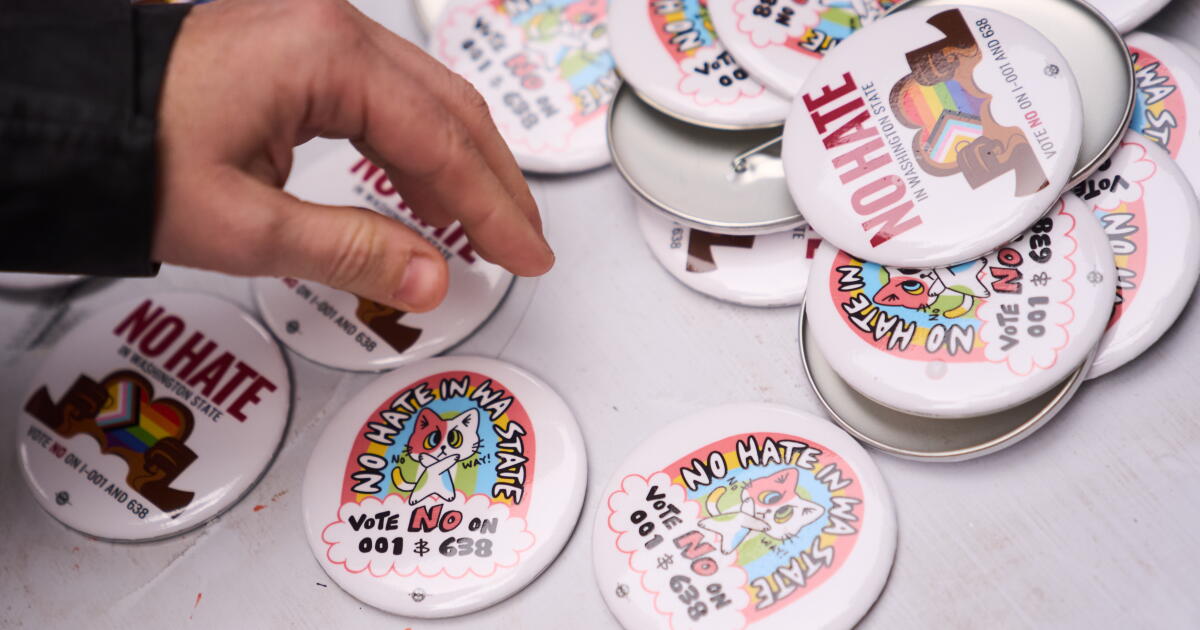
KALAMA, Wash. — Colorado and Washington are reliably Democratic states where elected officials have rejected moves to ban transgender women and girls from female sports competitions. Now activists have gone around lawmakers to put proposed bans on both states’ ballots.
At a time when some Democratic leaders nationwide are recalibrating their approach to transgender issues, particularly sports, and polls show Americans generally back the bans, supporters are optimistic they will pass and open the door to similar efforts in other places where lawmakers have blocked bans.
Though the issue has been debated in many legislatures, this is the first time it’s going to voters.
“What is happening in 2026 is a testing ground for the future,” said Chris Melody Fields Figueredo, executive director of the Ballot Initiative Strategy Center, which supports LGBTQ+ rights.
Twenty-seven states — including all where Republicans control both the legislature and governor’s office — already have such laws.
The efforts are billed as a way to protect women and girls and keep separate spaces for them, tapping into a concern that’s gained momentum. President Trump has taken steps to roll back transgender rights. The Supreme Court has upheld state sports bans.
A June poll from Quinnipiac University found that about 7 in 10 registered voters think transgender women and girls should not be allowed to play on female sports teams. About one-quarter think they should. Democrats are divided, with about half saying transgender women and girls should be allowed and about half saying they should not.
Robert Preuhs, a professor of political science at Metropolitan State University of Denver, said the absence of public polls on Colorado’s ballot measure, which also covers college sports, makes it hard to predict whether it will pass. “It’s probably going to get more support than some of the Republican candidates that will run,” he said.
Since transgender restrictions gained traction this decade, states with Democratic-led governors’ offices and legislatures generally have rejected proposals such as banning transgender people from the bathrooms that match their gender identity and restricting gender-affirming care. Most Republican-led states have adopted those policies.
In addition to the two blue-state questions, a measure in Arizona would broaden an existing ban to include private schools, and one in Nebraska would add an existing state law to the state constitution.
There’s not a clear consensus on whether transgender women and girls have a competitive advantage. Factors include the age of the athlete, the sport, whether the athlete went through male puberty and how long they’ve received hormone therapy.
But the idea that girls are being cheated is personal for some athletes.
Ahnaleigh Wilson, a 17-year-old junior at Eastmont High School, about 25 miles north of Seattle, has been speaking out against allowing transgender girls to compete in girls’ sports since she was in junior high. She said she’d won all of her 1,600-meter races in seventh and eighth grade — until she finished second to a transgender athlete in a major meet.
“Women have fought for Title IX and our own categories and it’s very important that we keep the dignity of that, and let women have their own sports and their own spaces to be safe and completely fair,” she said, referencing the federal law that prohibits discrimination based on sex in education programs and activities.
Opponents say excluding transgender girls is also unfair.
“They will say that they want to protect kids and in particular, young girls,” said Nadine Bridges, executive director of One Colorado, which is leading the opposition to the measure there, “but I don’t understand how you can protect kids and discriminate against kids at the same time.”
The Washington measure would require that a healthcare provider verify the student’s “biological sex, relying only on one or more of the following: The student’s reproductive anatomy, genetic makeup, or normal endogenously produced testosterone levels.”
“We see that as being as simple as a checkbox,” said Let’s Go Washington spokesperson Hallie Herzberg. “Doctors can use the history of the patient from treating them all their lives or their medical history forms.”
But Dr. Libby Loft, who opposes the measure, says the language calls for a genital inspection as part of a physical, or expensive testing.
“I think it doesn’t make any sense to force the working families of … girl sports players in Washington to pay for unnecessary medical tests to be able to weed out an estimated five or 10 girls in the state of Washington, trans girls,” Loft said.
She fears the verification requirement will lead to fewer girls — transgender or not — playing sports.
Mulvihill and Cooper write for the Associated Press. Mulvihill reported from Haddonfield, N.J.
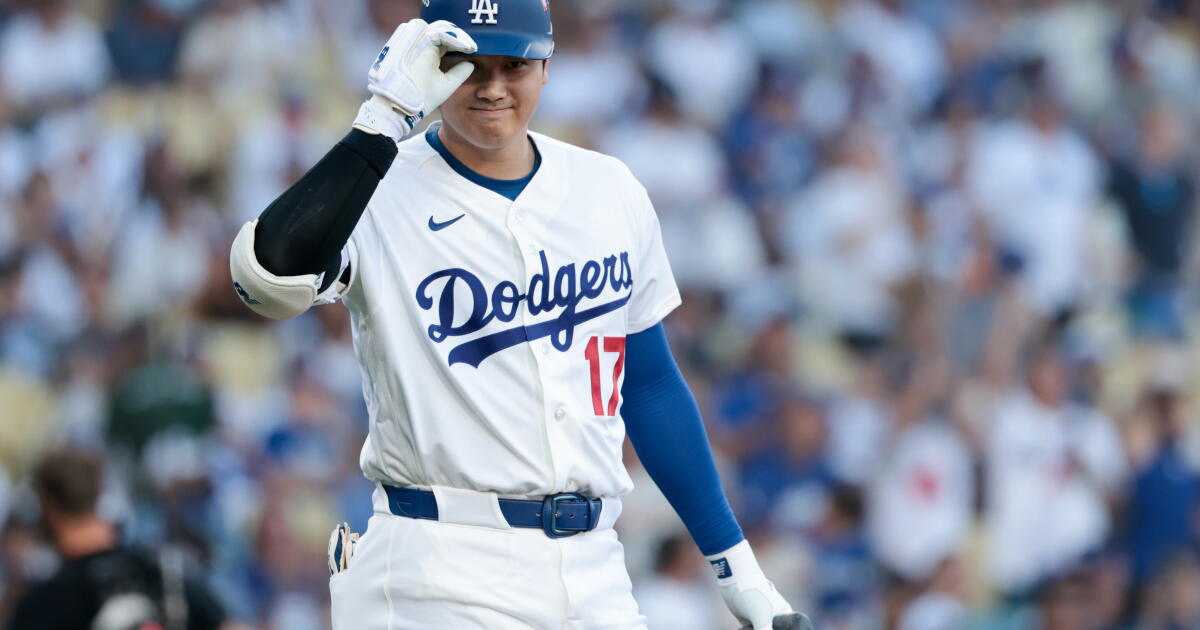
Given the problem the Dodgers have with their pitchers staying in the rotation for the whole season, and the way Shohei Ohtani was lunging for sweepers, I would say, “Don’t allow him to hit anymore.” Bill Plaschke says Ohtani led them to two championships. In 2024, the 55/55 year, he indeed did, although I would argue that Freddie Freeman did even more. But last year, many others were responsible for their ultimate victory, not Ohtani. Use him as a pitcher and a part-time hitter.
Mike Schaller Temple City
So Bill Plaschke has momentarily stopped playing psychic and has morphed into general manager, saying the Dodgers should either force Shohei Ohtani to stop pitching or trade him. Is Plaschke part of the medical staff of the Dodgers so he knows the root causes of Ohtani’s injuries this year, or what it might take this offseason to fix them?
He has written a lot of inane columns making bold statements that he usually has to eat crow on, and trading Ohtani while he is still one of the best players on the planet would fall into that category. Ohtani will eventually get to the point where his body can’t do both, but I’m sure no one is using Bill Plaschke’s medical expertise to determine when that might be.
Danny Balber Jr. Pasadena
OK, so now Plaschke is ready to give the boot to Shohei Ohtani, the baseball GOAT, as he much as he was gleefully behind basketball GOAT LeBron James’ departure based upon his controlling of the team’s condition, from trades to draft picks. This takes more chutzpah than Ohtani’s insistence to continue as a two-way player.
When will the L.A. Times decide they’ve had enough of him?
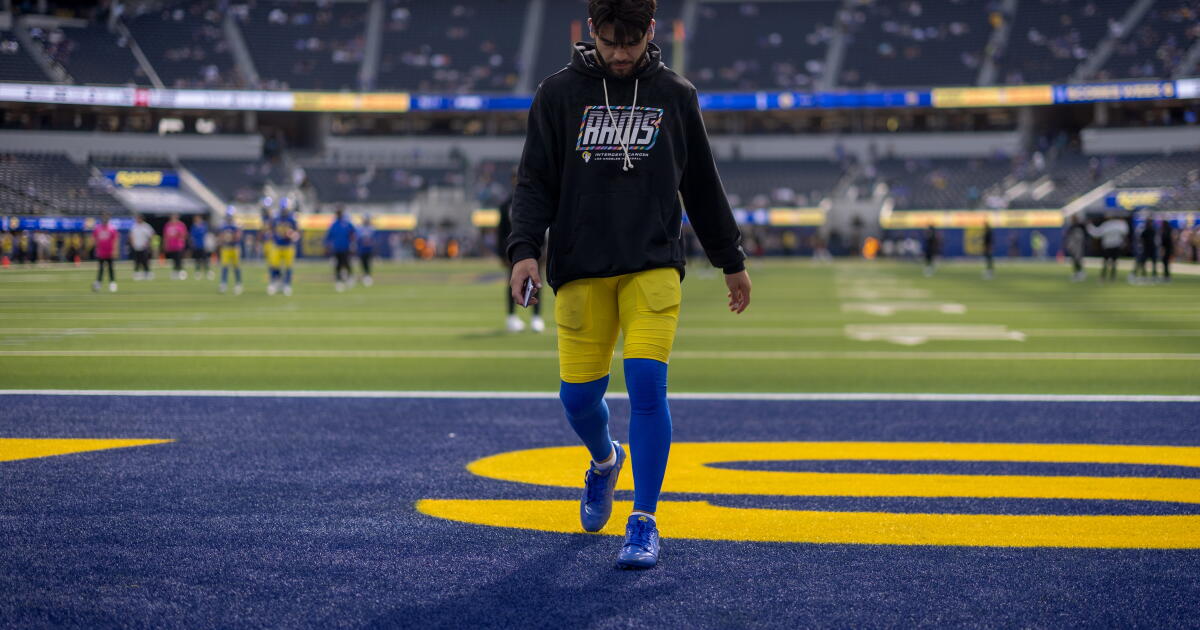
Nacua was sidelined for two games this season because of a hip injury, but he has played the last three games for a Rams team that opened the season as the Super Bowl favorite but is 2-4 heading into Sunday’s game against the Raiders in Las Vegas.
The Rams are already thin at receiver in the wake of a hamstring injury suffered by Davante Adams during the Rams’ 18-16 defeat by the Arizona Cardinals last Sunday. Adams, 33, will be sidelined for six to 10 weeks, coach Sean McVay said.
It remains to be seen if Nacua, who led the NFL in receptions last season, will play against the Raiders. He has 37 catches for 417 yards and a touchdown, and he has also rushed for a touchdown this season.
Jordan Whittington, Konata Mumpfield, Tutu Atwell and rookie CJ Daniels are other Rams receivers.
Mumpfield, a second-year pro, said he would be ready if called upon for a larger role.
Get the latest on L.A.’s teams in the daily Sports Report newsletter.
By continuing, you agree to our Terms of Service, which include arbitration and a class action waiver. You agree that we and our third-party vendors may collect and use your information, including through cookies, pixels and similar technologies, for the purposes set forth in our Privacy Policy such as personalizing your experience and ads.
Walker Kessler has great Lakers debut
From Thuc Nhi Nguyen: He spent the offseason admiring the great Lakers centers that came before him. He pondered how he could possibly continue such a legacy.
The new Lakers center scored 26 points on 12-for-12 shooting with nine rebounds, one assist and two blocks in his purple and gold debut to help the Lakers (1-0) to a dominant 127-105 win over the Golden State Warriors on Wednesday at Crypto.com Arena.
After admiring Lakers legends, Kessler can now be mentioned in the same breath. His 12 made field goals without a miss were the most by a Laker since Wilt Chamberlain in 1969. His 10 dunks are the most for a Laker since Shaquille O’Neal in 2003.
Not with superstars or championship aspirations. But with the promise of free parking, a jersey trade-in and a basketball team that is, at least, better than the Sacramento Kings, who they beat 121-96 in both teams’ season opener. Coach Tyronn Lue dedicated the win to suspended team owner Steve Ballmer: “Just want to say thank you for everything. We’re still fighting for him.”
For the first time in three years, Los Angeles faces a Fall Classic with no rooting interest.
Might we suggest the Milwaukee Brewers?
No?
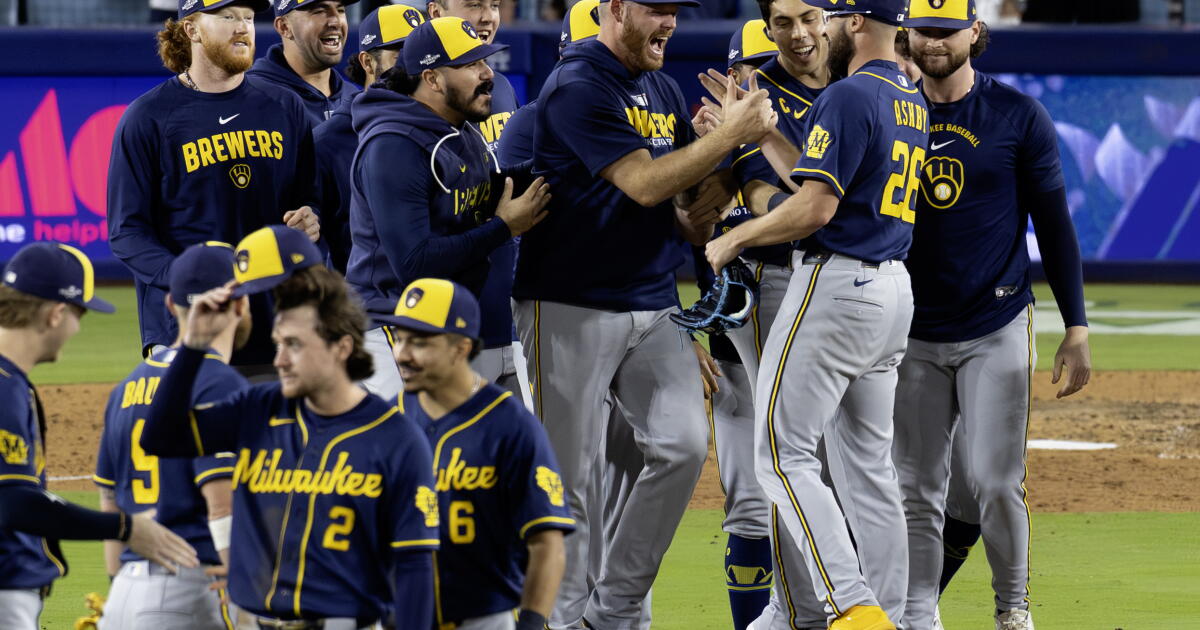
So maybe the sting has not dissipated, not after the Brewers so rudely swept the Dodgers in the National League Championship Series. But did you see the thousands of Brewers fans that arose within Dodger Stadium to salute the newly crowned NL champions, sticking around long after the Dodgers fans had retreated to traffic jams in the parking lot?
“It’s a good time to be a Milwaukee Brewers fan, for sure,” NLCS MVP Jake Bauers said. “It’s always fun going into a road stadium, especially in a postseason environment, and coming out with a win and seeing how many people hang around after the game.”
The Brewers are L.A.’s team, at least for the next week.
From Kevin Baxter: Mohammed Annour spent much of his youth living in a flimsy shelter in a dusty, overcrowded refugee camp in east Africa, where the days were long, the food was poor and the future nonexistent.
“Go to the army and fight. That’s one option,” said Annour, who fled war in Sudan for the refugee camp in Chad when he was 9. “The other one is you stay there. But you don’t have a future.”
If he had stayed, Annour, now 33, has little doubt how his story would have ended.
“Probably,” he said, “I’m dead.”
Instead, he’s in Sweden, raising two boys, working as a quality control inspector for a textile company and playing amateur soccer for a team in the country’s fifth division. And the only thing that separates his experience from the tens of thousands of desperate people he left behind in the camp is the fact someone believed in him enough to give him a chance.
Artemi Panarin had two goals, Brandt Clarke scored in overtime and the Kings won their second consecutive game, 3-2, at the New York Islanders on Thursday night.
The Kings have back-to-back victories after losing their first six games. They were the final NHL team without a win before defeating Washington on Tuesday night.
The Kings were outplayed for much of the game and were outshot 43 to 26. Panarin beat rusty backup Semyon Varlamov glove side twice, and Darcy Kuemper kept making stops even as his rebound control was lacking, finishing with 41 saves.
Kuemper cracked for the first time with just under six minutes left in the second period when rookie Victor Eklund’s shot squeezed through on a power play. Matthew Schaefer wired a wrist shot past Kuemper 7:06 into the third.
Arseny Gritsyuk and Nico Hischier scored first-period goals, Nico Daws made 16 saves and the New Jersey Devils beat the Ducks 4-1 on Thursday night.
Anthony Mantha restored the two-goal lead with 6:33 left in the third, and Jack Hughes added an empty-netter with 6.1 seconds remaining. New Jersey won its second straight to improve to 6-4-0, while the Ducks dropped their fifth in a row to fall to 4-6-0.
Gritsyuk and Hischier each scored their fifth goal of the season, with Jesper Bratt assisting on both scores. Hughes assisted on Gritsyuk’s goal.
World Series All games at 5 p.m. PT All game on FOX/FOX Deportes/FOX One
No. 1 Milwaukee vs. No. 1 Tampa Bay Friday at Milwaukee Saturday at Milwaukee Monday at Tampa Bay Tuesday at Tampa Bay *Wednesday at Tampa Bay *Friday at Milwaukee *Sat., Oct. 31 at Milwaukee
* if necessary
This day in sports history
1921 — Green Bay Packers play 1st APFA (forerunner to NFL) game; beat Minneapolis Marines, 7-6 at Hagemeister Park, Green Bay, Wis.
1945 — Jackie Robinson signs a contract with the Montreal Royals, minor league farm team of the Brooklyn Dodgers.
1949 — Don Doll of the Detroit Lions intercepts four passes in a 24-7 victory over the Chicago Cardinals.
1960 — Jim Martin of Detroit becomes the first kicker to kick two field goals over 50 yards in a game as the Lions beat the Baltimore Colts 30-17.
1964 — Joe Frazier dominates German Hans Huber for an easy points win to capture the boxing heavyweight gold medal in Tokyo.
1971 — Greg Pruitt rushes for 294 yards on 19 carries to lead the Oklahoma Sooners to an NCAA record 711 yards rushing and a 75-28 pounding of Kansas State.
1976 — Pittsburgh’s Tony Dorsett rushes for 180 yards in a 45-0 rout over Navy to become the top career rusher in NCAA history with 5,206 yards.
1988 — Dan Marino passes for 521 yards, three touchdowns and five interceptions as the Miami Dolphins lose to the New York Jets 44-30. Marino completes 35 of 60 passes as he produces the second-best single-game total yardage in NFL history.
1993 — The Toronto Maple Leafs break the NHL record for most victories at the start of the season, winning their ninth straight game by beating the second-year Tampa Bay Lightning 2-0.
1999 — Florida State’s Bobby Bowden gets his 300th win with a 17-14 win over his son, Clemson coach Tommy Bowden. With the victory Bowden joins Bear Bryant, Pop Warner, Joe Paterno and Amos Alonzo Stagg as the only major college coaches to reach 300 victories.
2000 — The New York Jets, trailing 30-7 at the end of the third quarter, come back to beat the Miami Dolphins 40-37 in overtime on Monday night. The Jets score four touchdowns and a field goal in the fourth quarter to force overtime.
2005 — San Diego’s LaDainian Tomlinson is held to a career-low seven yards rushing in 17 carries and fails to score in the Chargers’ 20-17 loss at Philadelphia, ending his NFL record-tying streak of games with a touchdown at 18.
2008 — Carolina’s Brandon Sutter gives one of hockey’s most famous families another milestone, scoring his first NHL goal in a 4-1 loss at Pittsburgh. The 19-year-old Sutter, son of New Jersey Devils coach Brent Sutter, is the ninth member of the Sutter family to play in the NHL.
2011 — Tim Tebow rallies the Broncos for two touchdowns in the final 2:44 of the fourth quarter to force overtime, and Matt Prater’s 52-yard field goal gives Denver an improbable 18-15 victory over the stunned Miami Dolphins. The Broncos appeared beaten when they trailed 15-0 with 5:23 left and took over at their 20.
2016 — Jay Ajayi ties an NFL record by surpassing 200 yards rushing for the second game in a row, helping the Miami Dolphins rally past the Buffalo Bills 28-25. Ajayi rushes for 214 yards in 29 carries after totaling 204 yards a week earlier in a win over Pittsburgh.
2019 — All Star point guard Kyrie Irving pours in 50 points, setting a new NBA record for points on debut with a new team as his Brooklyn Nets go down 127-126 at home to the Minnesota Timberwolves.
Compiled by the Associated Press
Until next time…
That concludes today’s newsletter. If you have any feedback, ideas for improvement or things you’d like to see, email me at houston.mitchell@latimes.com. To get this newsletter in your inbox, click here.
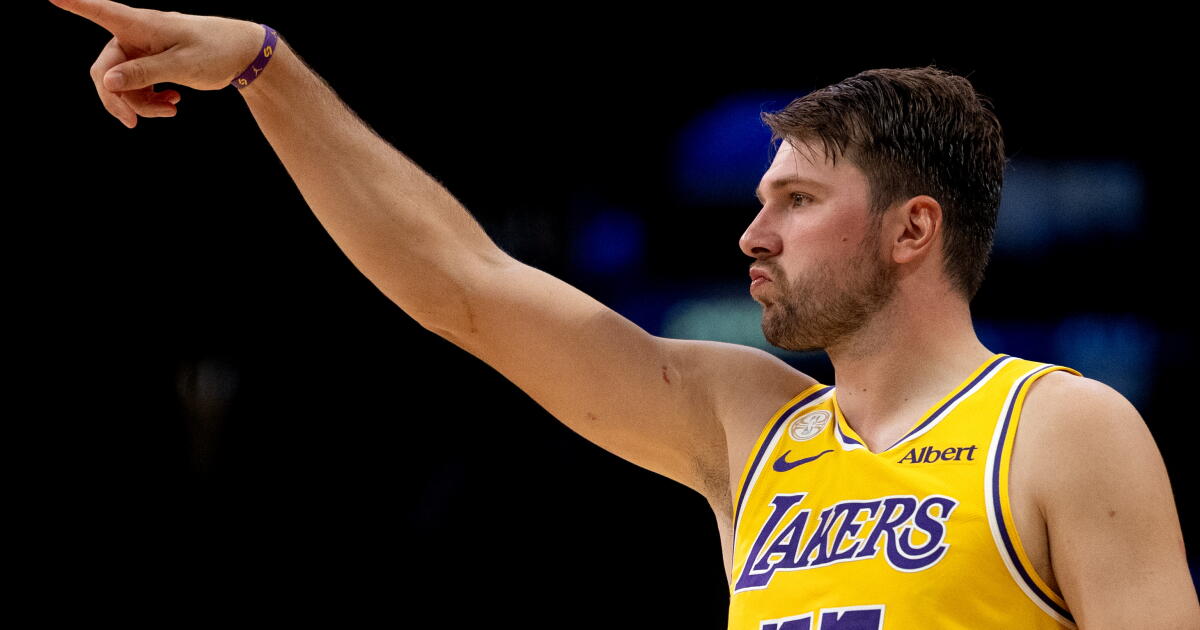
From Broderick Turner: As soon as Luka Doncic took the microphone to share some words with the Lakers’ faithful before their first game of the regular season Wednesday night, it was official that this was his team.
“Um, Laker nation. Thank you for supporting us,” Doncic said. “It’s the start of something new. It’s going to be a special season. So, thank you for your support.”
Then the game started and Doncic went right to work, throwing a lob pass to Walker Kessler for a dunk against Golden State at Crypto.com Arena.
Indeed it was the start of the Luka Doncic Show that included him finding an antagonist to direct his ire during the Lakers’ 127-105 win over the Warriors.
“I mean, obviously it’s the Lakers. It’s one of the biggest organizations in the world, if not the biggest,” Doncic said. “Some it’s a very…a lot of honor just to be the face of the franchise, and I hope I can stay here long. And it doesn’t feel…It’s very much an honor and just enjoy this moment.
Doncic and Warriors rookie Yaxel Lendeborg got into a little beef in the second quarter, leading to the Lakers All-Star guard to put in a little more effort while producing 28 points, eight rebounds and seven assists with six turnovers.
Doncic got help from Kessler, who was a force with 26 points on 12-for-12 shooting, nine rebounds and two blocked shot in his debut. Ten of his field goals were on dunks, and in the middle of it all, Kessler had several Lakers and NBA milestones.
Get the latest on L.A.’s teams in the daily Sports Report newsletter.
By continuing, you agree to our Terms of Service, which include arbitration and a class action waiver. You agree that we and our third-party vendors may collect and use your information, including through cookies, pixels and similar technologies, for the purposes set forth in our Privacy Policy such as personalizing your experience and ads.
Clippers win their season opener
From Joaquin Ruiz: Darius Garland, microphone in hand, waited patiently at midcourt to speak before the Clippers tipped off their 2026-27 NBA season against the Sacramento Kings on Wednesday night at Intuit Dome.
“Clipper Nation, Clipper Nation,” the eighth-year guard said to raucous cheers in Inglewood. “We’ve been working hard all summer, ready to really turn up this year. [We’ll] try to play at the highest level. [I] really appreciate the support from my teammates, coaching staff [and] organization — really appreciate everybody that comes out and … continues to support. We’re gonna be here all year.
“Clipper Nation, let’s go.”
Garland wasted no time giving Clippers fans something to smile about after an offseason of torment and transformation. He started the game shooting five-for-five from the field and three-for-three from deep, scoring 16 points in nine minutes and fueling the Clippers’ 121-96 blowout win over the Kings.
From Bill Plaschke: As they head into an offseason of overdue rest and roster reshaping, the Dodgers really only face one obstacle.
But it’s a $700-million obstacle. It’s a 5,400-mile obstacle. It’s an obstacle whose gravitas can be found in everything from international sponsorships to stadium tours, an obstacle with expansive implications and crushing consequences.
He is insanely charming… and unrelentingly stubborn.
He has derived his worldwide popularity from his ability to hit and pitch with equal prowess, a deft duality unmatched in the history of baseball. This ability has helped earn him four MVP awards and status as the unofficial greatest player ever.
But, he’s changing. His body is changing. His skills are changing. He’s 32, with 13 seasons of pro baseball burdening his lumbering 6-foot-4 frame, and part of his game is slowly disintegrating under the weight.
The Angels have fired manager Kurt Suzuki after he lost 100 games in his only season in charge of the long-struggling club.
Baseball operations consultant John Mozeliak announced Wednesday that the Angels declined the option on Suzuki’s contract and would open a search for a new manager in 2027. Suzuki has been offered the opportunity to stay with the organization as a special assistant.
“Kurt has earned tremendous respect in our clubhouse, and I’ve seen firsthand how much he cares about our players,” Mozeliak said in a statement. “I do not believe our record this year was a true reflection of his true abilities as a manager.”
World Series All games at 5 p.m. PT All game on FOX/FOX Deportes/FOX One
No. 1 Milwaukee vs. No. 1 Tampa Bay Friday at Milwaukee Saturday at Milwaukee Monday at Tampa Bay Tuesday at Tampa Bay *Wednesday at Tampa Bay *Friday, Oct. 30 at Milwaukee *Sat., Oct. 31 at Milwaukee
* if necessary
This day in sports history
1933 — Primo Carnera retains the world heavyweight title with a 15-round decision over Paolino Uzcudun in Rome.
1950 — The Rams beat the Baltimore Colts 70-27.
1961 — Erich Barnes of the New York Giants ties an NFL record by returning an interception 102 yards for a touchdown in a 17-16 loss to the Dallas Cowboys.
1966 — Bobby Orr of the Boston Bruins scores his first goal.
1975 — The 10-team World Football League, citing lack of television and season ticket support, disbands before the 12th week of a 20-week season.
1975 — The Cincinnati Reds beat the Boston Red Sox at Fenway Park to win the World Series in seven games.
1976 — Twin brothers Tom and Dick Van Arsdale play together in a game for the Phoenix Suns, becoming the first and only pair of brothers to play for the same NBA club.
1984 — Future Pro Football HOF quarterback Ken Stabler retires after 17 seasons in the NFL with Oakland Raiders, Houston Oilers and New Orleans Saints.
1994 — Alcorn State’s Steve McNair becomes the NCAA’s career yardage leader with 15,049, surpassing the old mark set by Brigham Young’s Ty Detmer, who had 14,665. McNair’s 649 yards also breaks his own Division I-AA single-game record as he leads the Braves to a 41-37 win over Southern.
2000 — Bengals running back Corey Dillon rushes for an NFL single-game record 278 yards in a 31-21 victory over the Denver Broncos. Dillon betters Walter Payton’s 27-year-old mark by three yards.
2001 — New York routs Seattle 12-3 in Game 5 to win the AL pennant for the 38th time. The Yankees become the first team since their predecessors in 1960-64 to win four straight pennants.
2005 — Mount Union drops a regular-season game for the first time since 1994, losing 21-14 to Ohio Northern in a Division III matchup. The Purple Raiders, winners of 110 straight regular-season games, had not lost a regular-season game since they were beaten 23-10 by Baldwin-Wallace on Oct. 15, 1994.
2012 — Lance Armstrong is stripped of his seven Tour de France titles and banned for life by cycling’s governing body after a report from the U.S. Anti-Doping Agency that accuses him of leading a massive doping program on his teams.
2014 — Serena Williams is routed 6-0, 6-2 by Simona Halep in the WTA Finals round-robin, one of the most one-sided losses in the 18-time Grand Slam champion’s career. The last time Williams managed to win just two games in a WTA Tour or Grand Slam match was in 1998 when she was 16.
2016 — Kyle Hendricks outpitches Clayton Kershaw, Anthony Rizzo and Willson Contreras homers early and the Chicago Cubs won their first pennant since 1945, beating the Dodgers 5-0 in Game 6 of the NL Championship Series.
2016 — Baker Mayfield has seven touchdown passes and 545 yards to help No. 16 Oklahoma beat Texas Tech 66-59 in the game that breaks the NCAA record for combined offensive yards with 1,708 yards.
2016 — Leonard Fournette breaks LSU’s single-game rushing record in just his first eight carries as the No. 25 Tigers beat No. 23 Mississippi 38-21. Fournette finishes with 284 yards rushing in his first action since aggravating a left ankle injury on Sept. 24. He averages 17.8 yards in 16 carries and his touchdowns go for 78, 76 and 59 yards.
2017 — The Phoenix Suns fire coach Earl Watson just three games in to the NBA season.
2020 — The NHL announced its annual All-Star Game and Skills Competition would be postponed due to the COVID-19 pandemic.
2024 — LeBron and Bronny James become the first father-son duo in NBA history to appear in a game together as Lakers beat Minnesota Timberwolves 110-103.
Compiled by the Associated Press
Until next time…
That concludes today’s newsletter. If you have any feedback, ideas for improvement or things you’d like to see, email me at houston.mitchell@latimes.com. To get this newsletter in your inbox, click here.
A HUGE multi-million pound upgrade is set to transform two popular holiday parks in the UK.
The two holiday parks are Parkdean’s Skipsea Sands Holiday Park in East Yorkshire and Thorness Bay Holiday Park on the Isle of Wight.
Parkdean Resorts has announced a huge £70million investment project in its parksCredit: Parkdean ResortsTwo parks will get upgraded in 2027Credit: Parkdean Resorts
At Skipsea Sands Holiday Park, there will be number of new activities including an indoor adventure climbing experience, indoor adventure golf and off-road driving experiences for children aged four and over.
The play areas, both indoors and outdoors, will be expanded including the bounce park, sports court and a Bear Grylls themed escape room.
Sign up for the Travel newsletter
Thank you!
The park will also add a Scoops Ice Cream shop and Joe’s American Grill as well as have a new outdoor entertainment space with seating.
The £5million investment is set to be completed by Easter 2027.
Steve Richards, CEO at Parkdean Resorts, said: “We’re committed to investing £5million in Skipsea Sands Holiday Park, upgrading our accommodation and further enhancing the holiday experience for guests and owners in East Yorkshire.
“From exciting new activities that include adventure golf and high ropes to an enhanced food and drink offering, there will be even more for families and holidaymakers to enjoy.”
Then, as for Thorness Bay Holiday Park on the Isle of Wight, the £6millon transformation will include a new high ropes, indoor adventure golf and off-road driving experiences for children aged four and over as well.
Just like Skipsea, the indoor and outdoor play areas will be improved too, with a bounce park, sports court and a Bear Grylls themed escape room.
The park will also gain a new two-storey building that will be home to the Hat-Tricks sports bar with interactive darts, pool and shuffleboard.
Food and drinks spots will also be expanded at the park with a new Scoops Ice Cream parlour, a Joe’s American Grill and Thunderbird Strip Shack.
They will get expanded play areas as well as new attractionsCredit: Parkdean ResortsAttractions includes sports bars, Bear Grylls escape rooms and high ropes coursesCredit: Parkdean Resorts
And once again similar to Skipsea’s expansion, there will be new outdoor areas for entertainment and dining.
Steve Richards, CEO at Parkdean Resorts, said: “This investment reflects our continued commitment to supporting local jobs, tourism and economic growth in the communities where we operate.
“We look forward to welcoming guests to a new and improved Thorness Bay from Easter 2027.”
A number of other Parkdean Resorts parks have recently undergone upgrades including Highfield Grange Holiday Park in Essex and Vauxhall Holiday Park in Great Yarmouth.
Vauxhall Holiday Park revealed its £5million upgrade earlier this year, with a new sports bar, darts and indoor adventure golf.
The holiday park has also been upgraded to include more kids’ play zones as well as high rope courses.
From Gary Klein: Other than the missing 23 carats of diamonds, the replica Super Bowl LVI rings fans received on Sunday at SoFi Stadium looked like the real thing.
Get the latest on L.A.’s teams in the daily Sports Report newsletter.
By continuing, you agree to our Terms of Service, which include arbitration and a class action waiver. You agree that we and our third-party vendors may collect and use your information, including through cookies, pixels and similar technologies, for the purposes set forth in our Privacy Policy such as personalizing your experience and ads.
Chargers fall to 0-6
From Kathleen Gier: The Chargers hit the road to face the undefeated, AFC West-leading Kansas City Chiefs, still looking for their first victory of the season.
They were unsuccessful, falling 22-6 on Sunday evening at Arrowhead Stadium. The Chargers are 0-6 to start the season for the first time since 2000, when they finished 1-16. They’ve also lost nine straight games since last season, tying a franchise mark for most consecutive losses.
“I truly believe and was confident that we would win this game,” Chargers coach Jim Harbaugh told reporters. “We have to address everything, guys, and especially offensively.
“We’re not scoring enough points. That’s the bottom line.”
The Chargers’ offense, already weakened by a series of injuries to its offensive line and receiving corps, struggled mightily, recording their second-lowest output of the season at 259 total yards. They also lost wide receiver Ladd McConkey, who was ruled out midway through the second quarter with a concussion. He had just one catch in his return from a foot injury that kept him out last week against Denver.
Miami is No. 1 in The Associated Press Top 25 for the first time since 2002, No. 2 BYU has its highest ranking since its 1984 national championship season and Notre Dame and Georgia stayed in the top five Sunday after both lost close games.
The UCLA Bruins, who are 6-0 after defeating Wisconsin, moved into the top 10 at No. 9, while idle USC moved up three spots to No. 16.
The Hurricanes took over the top spot from Georgia, which lasted one week at No. 1 after losing to Auburn at home. The Bulldogs were the second No. 1 team in two weeks — Texas was the other — to lose to an unranked opponent.
The Hurricanes received 40 of the 70 first-place votes from the media voting panel and were just 22 points ahead of BYU, which won a thriller at home over Notre Dame. The Cougars got 20 first-place votes and were 26 points ahead of Ohio State. The Buckeyes got nine first-place votes and were well ahead of No. 4 Notre Dame and No. 5 Georgia.
Miami is the first No. 1 team from the Atlantic Coast Conference team since Clemson in 2020. Other than Clemson, there had not been another ACC team ranked No. 1 since Florida State in 2014.
MLB postseason schedule
All times Pacific
NLCS
No. 1 Milwaukee vs. No. 2 Dodgers at Milwaukee 2, Dodgers 1 (box score) at Milwaukee 7, Dodgers 4 (box score) Milwaukee 6, at Dodgers 2 (box score) Milwaukee 6, at Dodgers 4 (box score)
ALCS
No. 1 Tampa Bay vs. No. 2 Cleveland Cleveland 7, at Tampa Bay 3 (box score) at Tampa Bay 3, Cleveland 1 (box score) at Cleveland 3, Tampa Bay 2 (box score) Tampa Bay 7, at Cleveland 3 (box score) Tampa Bay 3, at Cleveland 1 (box score) Monday at Tampa Bay, 5 p.m., TBS/truTV/UniMas/HBO Max *Tuesday at Tampa Bay, 5 p.m., TBS/truTV/UniMas/HBO Max
World Series All games at 5 p.m. PT All game on FOX/FOX Deportes/FOX One
No. 1 Milwaukee vs. TB/Cleveland Friday at Milwaukee, TBD, FOX/FOX Deportes/FOX One Saturday at Milwaukee, TBD, FOX/FOX Deportes/FOX One Monday, Oct. 26 at TB/Cle., TBD, FOX/FOX Deportes/FOX One Tuesday, Oct. 27 at TB/Cle., TBD, FOX/FOX Deportes/FOX One *Wed., Oct. 28 at TB/Cle., TBD, FOX/FOX Deportes/FOX One *Friday, Oct. 30 at Milwaukee, TBD, FOX/FOX Deportes/FOX One *Sat., Oct. 31 at Milwaukee, TBD, FOX/FOX Deportes/FOX One
* if necessary
This day in sports history
1940 — Alabama snaps Tennessee’s defensive scoreless streak of 71 quarters but still loses 27-12. Tennessee hadn’t allowed a point since Oct. 29, 1938, when it beat LSU 14-6.
1957 — Maurice Richard of the Montreal Canadiens scores his 500th goal in a 3-1 victory over the Chicago Blackhawks.
1960 — After 13 years in Minneapolis, the Lakers opened their inaugural season in Los Angeles with a 140-123 loss at Cincinnati.
1966 — Bobby Orr makes his NHL regular season debut for the Boston Bruins.
1985 — Robbie Bosco of Brigham Young passes for 585 yards in a 45-23 victory over New Mexico.
1985 — Dale Klein of Nebraska ties an NCAA record with seven field goals in a 28-20 victory over Missouri.
1986 — Lloyd Burruss of Kansas City intercepts three passes and returns two for touchdowns to lead the Chiefs to a 42-21 victory over the San Diego Chargers.
1994 — Duke beats North Carolina 3-2 in women’s soccer to end the Tar Heels’ unbeaten streak of 101 games.
1997 — Pittsburgh goaltender Tom Barrasso makes 22 saves to earn his 300th victory with a 4-1 win over Florida. Barrasso becomes the first American-born goaltender and 13th overall with 300 wins.
1997 — Sandy Alomar of the Cleveland Indians hits the 700th World Series home run.
2002 — Avon Cobourne becomes the fifth Division I-A rusher with four 1,000-yard seasons as West Virginia beats Syracuse 34-7. Cobourne has 108 yards in the game for 1,002 yards this season.
2012 — The National Hockey League announces the cancellation of the 2012-13 regular-season schedule through November 1. A total of 135 regular-season games are now lost from Oct. 11 through Nov. 1.
2014 — Peyton Manning breaks Brett Favre’s NFL record of 508 career touchdown passes and he throws four TD passes in Denver’s 42-17 victory over the San Francisco 49ers. The record-breaker was an 8-yarder to Demaryius Thomas with 3:09 left in the first half. Manning reaches the milestone in his 246th regular-season game. Favre needed 302.
2014 — DeMarco Murray becomes the first running back in NFL history to start a season with seven straight 100-yard games in a 31-21 win over the New York Giants. Murray, with 128 yards and a touchdown, breaks Hall of Famer Jim Brown’s 56-year-old record.
Compiled by the Associated Press
Until next time…
That concludes today’s newsletter. If you have any feedback, ideas for improvement or things you’d like to see, email me at houston.mitchell@latimes.com. To get this newsletter in your inbox, click here.
BRITISH holidaymakers are increasingly planning their travel around music, sporting and cultural events, according to a study.
Whether considering a trip for a concert, music or food festival, exhibition or sporting fixture in 2027, 36 per cent now more likely to do so than they were this time a year ago.
This shift towards event-led travel is reshaping behaviour, with 45 per cent having already visited cities and countries they wouldn’t otherwise have considered.
Similarly, out of those who have stayed somewhere overnight for an event in the past four years, 62 per cent based their most recent travel plans entirely around it.
Sign up for the Travel newsletter
Thank you!
For sports fans, the commitment to being there for the moment can stretch well beyond a weekend.
The poll of 2,000 adults found 56 per cent would use annual leave to follow their team or country, while 31 per cent would travel abroad to see them play.
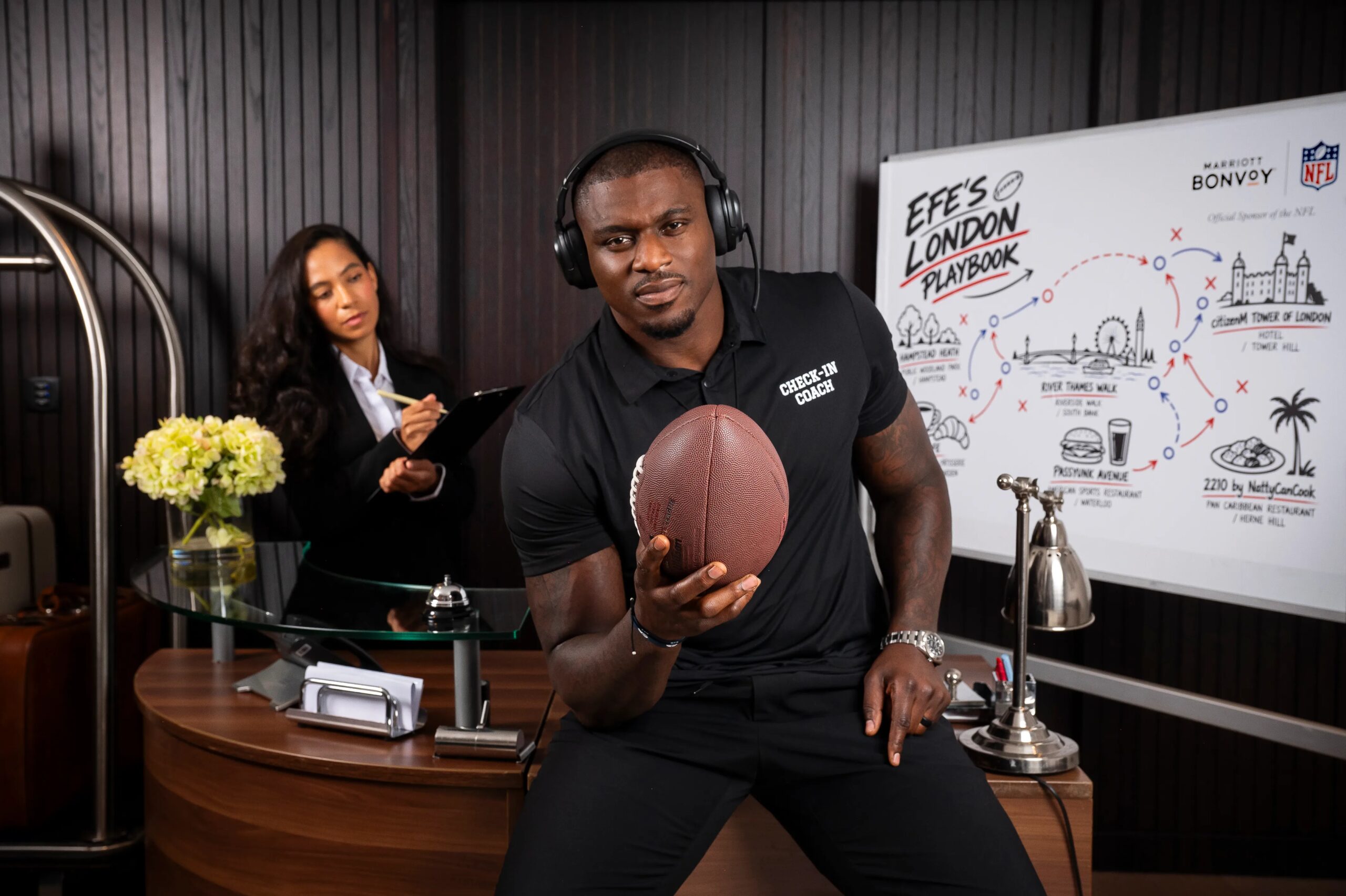
With hotels near almost every NFL stadium, MarriottBonvoy, which is an Official Sponsor of the NFL, is helping travellers create a game plan for this season’s trips by appointing Efe Obada as its Check-In Coach.
Efe Obada said: “In the NFL, preparation gives you a strong starting point, but you’ve also got to trust your team and be ready to adapt when things change.
“I approach travel in the same way. If you’ve only got a few days in a city, be tactical, adaptable and make a game plan.
“Book your hotel, know how you’re getting to the main event and ask people who know the city for advice. That’s how to make the most of every trip.”
The research found many are embracing spontaneity, as 52 per cent said an unplanned discovery has gone on to become one of the highlights of their holiday.
While 37 per cent will only book their hotel, transport, and key activities in advance, leaving the rest flexible.
NFL veteran Efe Obada is Marriott Bonvoy’s new ‘Check-In Coach’ to help travellers plan their holiday with an all-star strategyCredit: Will Ireland/PinPep
While spontaneity plays an important role, travellers still value a strong start to the day, with 52 per cent saying hotel breakfast is a non-negotiable part of their trip.
The study also uncovered four NFL-inspired travel personalities, revealing the roles travellers are most likely to play when travelling.
A quarter (25 per cent) identify as ‘The Quarterback’, the on-trip leader who brings everyone together, makes key decisions, and adapts the plan when things change.
The same number (25 per cent) see themselves as ‘The Coach’, the planner who has the logistics covered, from accommodation and transport to activities and timings.
While 24 per cent take the role of ‘Rookie’, the explorer who is experiencing a destination or event for the first time and turns to others for guidance and local recommendations.
Whereas 19 per cent were categorised as ‘The Receiver’, the spontaneous adventurer who spots opportunities, suggests unexpected detours, and helps create memorable moments.
Andrew Watson from Marriott International, said: “This research highlights what we see in our hotels, that travellers are increasingly planning trips around the things they are passionate about.
“Our partnership with the NFL is just one example of a wider commitment to helping our members pursue what they love.
Efe, who applied the strategy to his hometown, London, added: “London is one of those cities where every neighbourhood has its own personality.
“For a perfect weekend, I’d book at stay at citizenM Tower of London then grab a coffee at Qima Café in Covent Garden, walk along the Thames around Southbank or spend an afternoon at Hampstead Heath for unbeatable London views.
“For food, you can’t beat 2210 by NattyCanCook in Herne Hill or head to Passyunk Avenue in Waterloo for unmatched game-day vibes and a Philly cheese steak.”
EFE’S PLAYBOOK FOR A TACTICAL WEEKEND TRIP:
1. Do your pre-match analysis: Book your hotel early, check journey times and map out the key moments you don’t want to miss.
2. Kick off strong: Give yourself time to fuel up before heading out. A good game plan always starts with the essentials.
3. Teamwork is key: Local knowledge can make all the difference. Ask hotel staff for recommendations and insider tips.
4. Don’t be afraid to adapt: Leave room for unexpected discoveries – be that a bar, restaurant or neighbourhood. Sometimes the highlights aren’t part of the original strategy.
Guatemalan police say they arrested two men in connection with the killing of Juan Francisco Solorzano Foppa.
Published On 18 Oct 202618 Oct 2026
Lawyer Juan Francisco Solorzano Foppa, known for his high-profile cases against powerful businessmen in Guatemala, has died after being shot by two men during a visit to a sports centre.
The attack on Saturday at the Campo Marte sports complex in Guatemala City resulted in the deaths of Foppa and another man, Gustavo Adolfo Aguilar Gamarro, according to the Public Prosecutor’s Office.
Recommended Stories
list of 3 itemsend of list
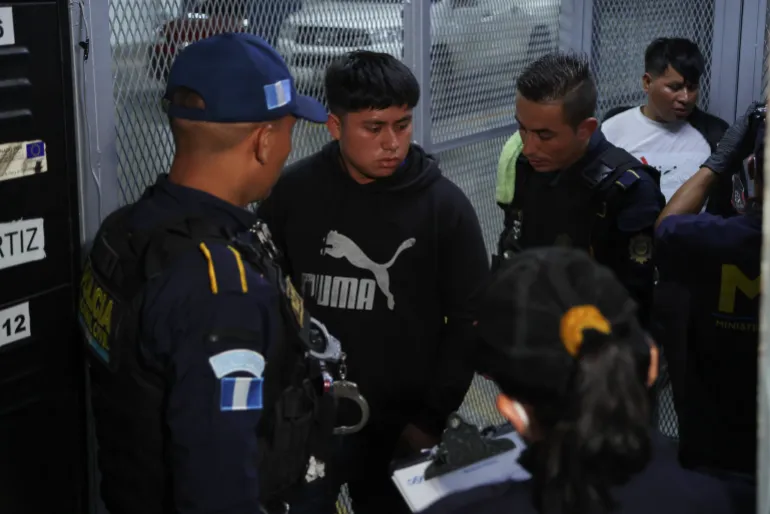
Shortly after, the Guatemalan police said they arrested two men and seized a carbine-style firearm and a motorcycle in connection with the case.
Suspects of lawyer Juan Francisco Solorzano Foppa’s murder in police custody, Guatemala City, October 17, 2026 [Mariano Macz/EPA]
Foppa was a 43-year-old former prosecutor and anticorruption lawyer who denounced wrongdoing by some of Guatemala’s most powerful politicians, business leaders and companies, and in 2023 briefly joined the defence team of a prominent journalist.
President Bernardo Arevalo condemned the attack. “I strongly condemn the cowardly murder of former prosecutor Juan Francisco Solorzano Foppa,” he wrote on his official X account. “Both the direct perpetrators and those who ordered the crime must face the full weight of the law.”
Arevalo said he has instructed his government to coordinate with the relevant authorities to solve the crime.
“Those who believe that terror can intimidate the people of Guatemala and the government I lead are mistaken. In honour of Foppa, in honour of our homeland, in honour of justice.”
Juan Francisco Solorzano Foppa, before entering a court hearing on charges of illicit association and conspiracy, in Guatemala City [File: Sandra Sebastian/Reuters]
Foppa headed the Criminal Investigations Directorate within the Public Prosecutor’s Office before he took charge of Guatemala’s tax authority (SAT) from 2016 to 2018, when he helped prosecute dozens of powerful Guatemalan business figures and recover unpaid taxes.
In 2025, Foppa alleged a connection between the Barrio 18 gang and the National Unity of Hope party, as well as links between criminal gangs and the judicial system. In 2023, he briefly joined the defence team of Guatemalan journalist Jose Ruben Zamora, who has become an international symbol of resistance to the criminalisation of journalism and the erosion of judicial independence in Central America.
Foppa had to leave the Zamora case after being accused by the Public Prosecutor’s Office of obstructing the proceedings and destroying or concealing information, a charge he denied but ultimately accepted as part of a plea agreement, saying he did not believe he would receive a fair trial.
From Maddie Lee: The hope for a Dodgers comeback in the National League Championship Series ended with the smack of the ball hitting leather.
Milwaukee Brewers left fielder Jackson Chourio, sprinting toward the warning track, had to leap to reel in Kiké Hernández’s line drive in the gap. But he secured the catch. And ended the Dodgers’ season.
The Dodgers’ hopes of making National League history with a three-peat died with a 6-4 loss to the Brewers on Thursday, completing Milwaukee’s four-game sweep.
“It sucked,” veteran left fielder Teoscar Hernández said. “Especially after [what] we had done the last two years. This year at the beginning of the year, what we’ve been through, a lot of injuries throughout the year the last two years, a lot of ups and downs. It just sucked that we’re in this situation, but it’s part of the game.
“Somebody has to win, somebody has to lose. This time, we’re the ones that lost, and just reflect on everything that we didn’t do great this year and just try to do it next year.”
As the Dodgers’ postseason hype video declared before the game: “October doesn’t remember who came close. It remembers who triumphs.”
The Dodgers, after reinforcing to their back-to-back championship roster in the offseason and entering the year as the World Series favorites, fell short. And instead the Brewers will represent the National League, making their first trip to the Fall Classic in 44 years.
“They may have a bunch of Hall of Famers, but we have a bunch of gamers,” Brewers manager Pat Murphy said from the stage. “And the gamers won this week.”
Get the latest on L.A.’s teams in the daily Sports Report newsletter.
By continuing, you agree to our Terms of Service, which include arbitration and a class action waiver. You agree that we and our third-party vendors may collect and use your information, including through cookies, pixels and similar technologies, for the purposes set forth in our Privacy Policy such as personalizing your experience and ads.
The veteran infielder stood by his locker at Dodger Stadium, his eyes red and watery, his uniform covered in dirt, knowing that when he pulled them off, it would be for the last time.
“This is it, guys,” he said, announcing his retirement, after the Dodgers were swept by the Milwaukee Brewers in the National League Championship Series on Thursday. “It’s been a lot, the last four years of my life here. And obviously making my debut here in 2014 changed my life, not just for me but for my whole family. They took care of my son, my daughter, my wife, and everybody in my family. It’s really amazing what I can think about, what happened to me and to my family the last few years.”
Rojas addressed the team after the 6-4 loss to the Brewers. He said he was going to stay loyal to the Dodgers organization but in a different role.
No. 1 Milwaukee vs. No. 2 Dodgers at Milwaukee 2, Dodgers 1 (box score) at Milwaukee 7, Dodgers 4 (box score) Milwaukee 6, at Dodgers 2 (box score) Milwaukee 6, at Dodgers 4 (box score)
ALCS
No. 1 Tampa Bay vs. No. 2 Cleveland Cleveland 7, at Tampa Bay 3 (box score) at Tampa Bay 3, Cleveland 1 (box score) at Cleveland 3, Tampa Bay 2 (box score) Friday at Cleveland, 5 p.m., TBS/truTV/UniMas/HBO Max Saturday at Cleveland, 5 p.m., TBS/truTV/UniMas/HBO Max *Monday at Tampa Bay, 5 p.m., TBS/truTV/UniMas/HBO Max *Tuesday at Tampa Bay, 5 p.m., TBS/truTV/UniMas/HBO Max
World Series No. 1 Milwaukee vs. TB/Cleveland Friday, Oct. 23 at Milwaukee, TBD, FOX/FOX Deportes/FOX One Sat., Oct. 24 at Milwaukee, TBD, FOX/FOX Deportes/FOX One Monday, Oct. 26 at TB/Cle., TBD, FOX/FOX Deportes/FOX One Tuesday, Oct. 27 at TB/Cle., TBD, FOX/FOX Deportes/FOX One *Wed., Oct. 28 at TB/Cle., TBD, FOX/FOX Deportes/FOX One *Friday, Oct. 30 at Milwaukee, TBD, FOX/FOX Deportes/FOX One *Sat., Oct. 31 at Milwaukee, TBD, FOX/FOX Deportes/FOX One
* if necessary
Lakers’ Ziaire Williams brings needed energy
From Thuc Nhi Nguyen: He made one of the biggest splashes in the Lakers’ first preseason game. Ziaire Williams set the tone of the Lakers’ new defensive style, pressuring the ball the full length of the court and injecting energy into his teammates. The Sierra Canyon High alumnus sank three three-pointers in a stellar debut for his hometown team.
Then came the swelling in his left foot.
After a minor injury slowed Williams’ preseason ascent, the 6-foot-9 forward could be in position to return to the lineup for the Lakers’ preseason finale at 7:30 p.m. Friday against the visiting Denver Nuggets. Williams practiced fully Thursday after missing the last three games. He’ll leave the final call up to the Lakers’ medical staff as the team tries to maximize its preseason preparation.
“It’s important, man, just to get game reps with each other, but health is key,” said Williams, who had 13 points and a steal as a starter in the preseason opener against the Sacramento Kings on Oct. 5. “If you can’t go, you just can’t. It’s not the end of the world. Going back to championship identity, we’re looking ahead at the bigger picture. So it’s not worth [it] to risk your body for a game that doesn’t count and then be out for the real games.”
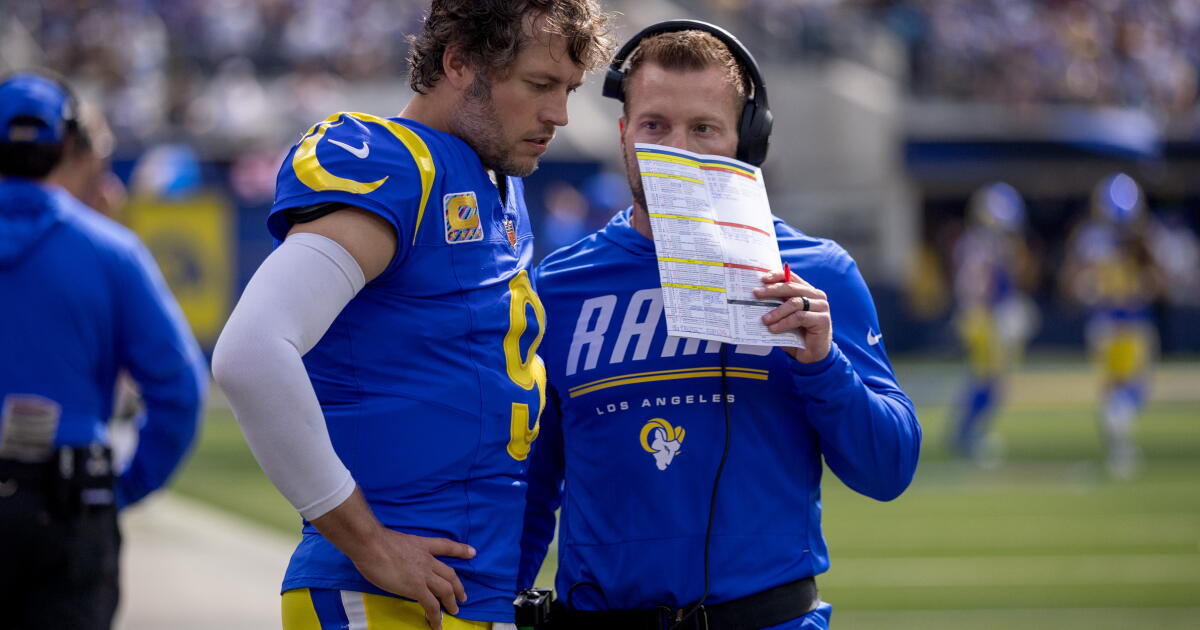
From Gary Klein: It was already going to be a short week, but Sean McVay navigated unexpected business that affected the start of preparation for Sunday’s game against the Arizona Cardinals.
Chargers’ Mike McDaniel is always coaching for his job
From Joaquin Ruiz: Chargers offensive coordinator Mike McDaniel didn’t shy away from discussing his job security Thursday amid a frustrating 0-5 start to the season.
“I feel like it’s core to my job to always feel that way,” McDaniel said when asked if he’s coaching for his job. “I need to do the very best I possibly can, all the time, because [of] the players, the organization, the fans.
“So, that’s second nature. … I think it’s disrespectful to all those that choose to invest in our game and our team to not look at things that way. The second you get comfortable in this league, it’s a wrap; it’s too good. I will be doing my very best, because from an integrity standpoint, I think it’s really insulting to do anything else. And that won’t change.”
1897 — Michigan beats Ohio State 34-0 at Ann Arbor, the first meeting between theses storied rivals.
1909 — In his fourth title defense, Jack Johnson KOs Stanley Ketchel in the 12th round at Mission St Arena, Colma, California to retain his heavyweight boxing crown.
1932 — After a 0-0 tie earlier in the season, the Green Bay Packers beat the Chicago Bears 2-0.
1946 — Detroit’s Gordie Howe scores a goal and gets into two fights in his first NHL game. The Red Wings tie the Toronto Maple Leafs 3-3.
1964 — Babe Parilli of the Boston Patriots passes for 422 yards and four touchdowns in a 43-43 tie with the Oakland Raiders.
1968 — Americans Tommie Smith and John Carlos give Black power salutes during the medal ceremonies of the 200-meter race and are later banned for life from all Olympic competition by the IOC.
1971 — Norm Ullman of the Toronto Maple Leafs records his 1,000th point in a 5-3 loss to the New York Rangers. Ullman gets two assists to become the fourth NHL player to reach the milestone.
1976 — Tony Franklin of Texas A&M kicks two field goals over 60 yards for an NCAA record. The distances are 65 and 64 yards as the Aggies beat Baylor 24-0.
1977 — The Denver Broncos intercept seven passes off Ken Stabler of the Oakland Raiders in a 30-7 victory.
1977 — The Minnesota Vikings beat the Chicago Bears 16-10 in overtime with the only successful fake field goal in NFL overtime.
1987 — Mike Tyson retains his undisputed heavyweight title with a seven-round knockout of Tyrell Biggs in Atlantic City, N.J.
1999 — Fourth-ranked Virginia Tech hangs a record-setting 62-0 loss on No. 16 Syracuse. It’s the worst shutout loss by a ranked team in the history of The Associated Press poll.
1999 — Mount Union beats Otterbein 44-20 for its 48th consecutive victory, surpassing Oklahoma’s 42-year-old all-division mark of 47 in a row.
2004 — 17-year-old Lionel Messi makes his league debut for FC Barcelona in a 1-0 win against cross-town rivals Espanyol.
2004 — Mount Union beats Marietta 57-0 for its 100th consecutive regular-season victory. The Purple Raiders’ last regular-season loss was on Oct. 15, 1994, at home against Baldwin-Wallace.
2011 — Danell Leyva becomes the first American man gymnast to win a gold medal at the World Championships since 2003. Leyva wins the parallel bars title to become the first gold medalist for the U.S. since Paul Hamm claimed the floor exercise and all-around titles in 2003.
2011 — Dan Wheldon, 33, dies in a fiery 15-car wreck at Las Vegas Motor Speedway when his car flew over another on Lap 13 and smashes into the wall just outside turn 2.
2017 — Louisville’s Athletic Assn. officially fires coach Rick Pitino nearly three weeks after the school acknowledged that its men’s basketball program is being investigated as part of a federal corruption probe. The association, which oversees Louisville’s sports programs and is composed of trustees, faculty, students and administrators, vote unanimously to oust the longtime Cardinals coach following a board meeting.
Compiled by the Associated Press
Until next time…
That concludes today’s newsletter. If you have any feedback, ideas for improvement or things you’d like to see, email me at houston.mitchell@latimes.com. To get this newsletter in your inbox, click here.
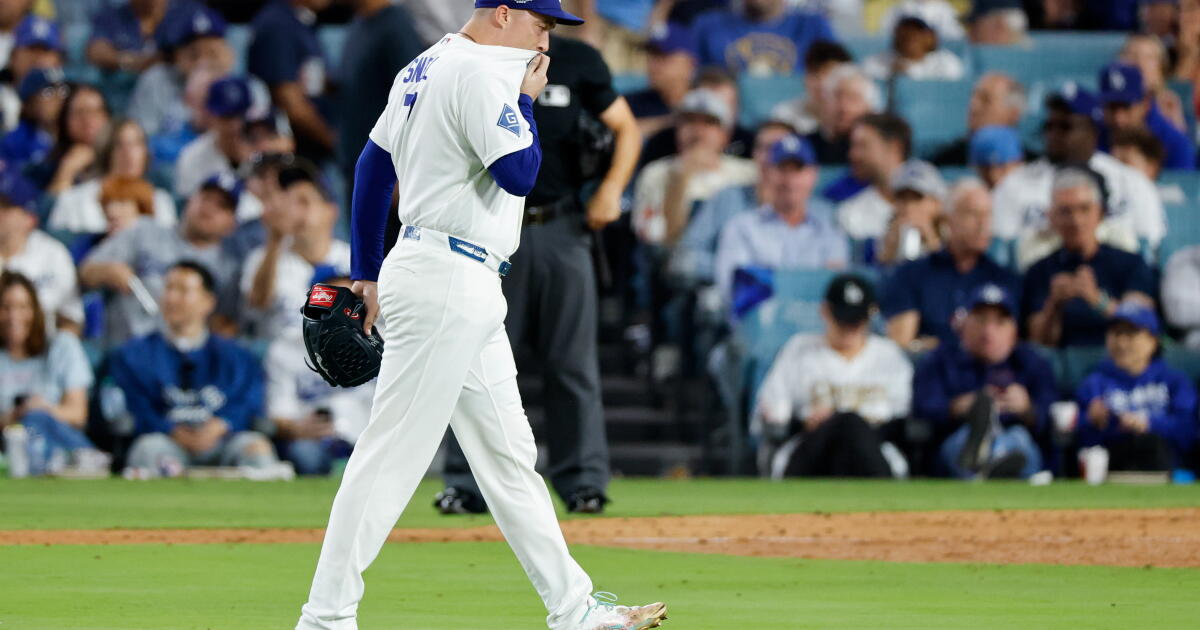
From Maddie Lee: Blake Snell stood on the mound with his hand on his hip, waiting for Jake Bauers to cross the plate before punching in his pitch call for the next batter.
The Dodgers left-hander had just given up the lead on Bauers’ two-run homer in the seventh inning, spoiling what had been a stellar start Wednesday night at Dodger Stadium. But Snell was ready to move on.
Two pitches later, he watched another ball fly over the fence, this time off Garrett Mitchell’s bat. And with it went the last of the Dodgers’ momentum in what would become a 6-2 loss to the Milwaukee Brewers in Game 3 of the National League Championship Series.
“It sucks,” Snell said of falling behind 3-0 in the series. “But it’s part of it. How do we bounce back? How do we fight? I think that’s the most important thing. It’s us coming together and finding a way to win.”
After setting their sights on a history-making three-peat, the Dodgers will have to win the next four games to advance to the World Series.
“At the beginning of this year, we set out to do something historic,” veteran third baseman Max Muncy said. “It looks like we’re going to have to make a little more history along the way if we want to accomplish that.
“That’s the task ahead of us. We still have the pitching staff to be able to do it. We just have to get some hits.”
Get the latest on L.A.’s teams in the daily Sports Report newsletter.
By continuing, you agree to our Terms of Service, which include arbitration and a class action waiver. You agree that we and our third-party vendors may collect and use your information, including through cookies, pixels and similar technologies, for the purposes set forth in our Privacy Policy such as personalizing your experience and ads.
Dodgers’ three-peat dream is nearly over
From Bill Plaschke: Blake Snell stood on the mound with his hand on his hip, waiting for Jake Bauers to cross the plate before punching in his pitch call for the next batter.
The Dodgers left-hander had just given up the lead on Bauers’ two-run homer, spoiling what had been a stellar start Wednesday night at Dodger Stadium. But Snell was ready to move on.
Two pitches later, he watched another ball fly over the fence, this time off Garrett Mitchell’s bat.
The Dodgers’ 6-2 loss to the Milwaukee Brewers in Game 3 of the National League Championship Series, after the visitors regained the lead with back-to-back home runs in the seventh inning, gave the Brewers a commanding 3-0 lead and set up an elimination game Thursday. After setting their sights on a history-making three-peat, the Dodgers will have to win the next four games just to advance to the World Series.
Let’s take you through the critical decisions Roberts made Wednesday night, the ones you second-guessed at home. They all pretty much backfired on him.
No. 1 Milwaukee vs. No. 2 Dodgers at Milwaukee 2, Dodgers 1 (box score) at Milwaukee 7, Dodgers 4 (box score) Milwaukee 6, at Dodgers 2 (box score) Thursday at Dodgers, 5 p.m., FS1/FOX Deportes/FOX One *Friday at Dodgers, 6 p.m., FS1/FOX Deportes/FOX One *Sunday at Milwaukee, 5 p.m., FS1/FOX Deportes/FOX One *Monday at Milwaukee, 5 p.m., FOX/FS1/FOX Deportes/FOX One
ALCS
No. 1 Tampa Bay vs. No. 2 Cleveland Cleveland 7, at Tampa Bay 3 (box score) at Tampa Bay 3, Cleveland 1 (box score) Thursday at Cleveland, 10 a.m., TBS/truTV/UniMas/HBO Max Friday at Cleveland, 3 p.m., TBS/truTV/UniMas/HBO Max Saturday at Cleveland, 5 p.m., TBS/truTV/UniMas/HBO Max *Monday at Tampa Bay, 2 p.m., TBS/truTV/UniMas/HBO Max *Tuesday at Tampa Bay, 5 p.m., TBS/truTV/UniMas/HBO Max
“Hearing officer Derrick Brooks, jointly appointed by the NFL and the NFLPA, has reduced the two game suspension of Los Angeles Rams offensive lineman Alaric Jackson to one game,” Michael Signora, the NFL’s senior vice president of football and international communications, said on social media.
Marco Reus had a goal and an assist to back JT Marcinkowski and the Galaxy beat the Portland Timbers 2-0 on Wednesday night at Dignity Health Sports Park.
Reus staked the Galaxy (10-11-9) to a 1-0 lead in the 17th minute when he used assists from Robert Taylor and Pablo Ruiz to score his eighth goal of the campaign.
That’s where the score stood until Reus set up up Justin Haak in the 80th minute for his second goal this season and his fourth in 110 matches. It was the career-high 11th assist for Reus.
1933 — The Philadelphia Eagles play their first NFL game and suffers a 56-0 loss to the New York Giants.
1961 — Mickey Wright wins her third LPGA Championship with a rout, nine strokes ahead of Louise Suggs. Wright shoots a 3-over, 287 at the Stardust Country Club in Las Vegas for her third major title of the year and her tenth tour victory of the season.
1972 — Stan Mikita of the Chicago Blackhawks becomes the sixth NHL player with 1,000 career points. Mikita assists on Cliff Koroll’s goal in a 3-1 loss to the St. Louis Blues at Chicago Stadium.
1983 — The Chicago Blackhawks and the Toronto Maple Leafs score five goals in 1 minute, 24 seconds to set an NHL record for the fastest five goals by two teams. The Maple Leafs beat the Blackhawks 10-8.
1988 — Oklahoma rushes for an NCAA-record 768 yards, including 123 by quarterback Charles Thompson. Thompson scores three touchdowns and passes for one in the first period of a 70-24 rout of Kansas State.
1988 — Mario Lemieux of the Pittsburgh Penguins scores eight points — two goals and six assists — in a 9-2 win over the St. Louis Blues at the Civic Arena in Pittsburgh.
1989 — Wayne Gretzky of the Kings passes Gordie Howe as the NHL’s all-time leading scorer in a during a 5-4 overtime win over the Edmonton Oilers. Gretzky flips a backhand shot past Oilers goaltender Bill Ranford with 53 seconds remaining to tie the score and pass Howe with his 1,851st point. Gretzky wins the game in overtime.
1995 — The Carolina Panthers beat the New York Jets 26-15 for their first NFL victory.
2005 — Michigan gives up a touchdown to Penn State with 53 seconds left, then marches down the field to score on a TD pass from Chad Henne to Mario Manningham with no time remaining for a 27-25 win over the eighth-ranked Nittany Lions.
2005 — USC’s Matt Leinart pushes and spins his way into the end zone with 3 seconds left to cap a chaotic finish to the top-ranked Trojans’ 28th straight victory, a back-and-forth 34-31 win over No. 9 Notre Dame.
2008 — Fabian Brunnstrom scores three goals in his NHL debut to match the league record in Dallas’ 6-4 victory over Nashville.
2009 — Detroit’s Nicklas Lidstrom becomes the first European defenseman and eighth overall to reach 1,000 points, assisting on two goals in the Red Wings 5-2 win over the Kings.
2012 — The Nets bring professional sports back to Brooklyn with a preseason victory, beating the Washington Wizards 98-88 in the first basketball game at the Barclays Center.
2015 — Carey Price makes 25 saves and the Montreal Canadiens make team history by starting a season with a five straight wins, the latest a 3-0 victory over the New York Rangers.
2017 — New England quarterback Tom Brady passes for 257 yards with two touchdowns in the Patriots’ 24-17 win at the New York Jets. Brady, who has 187 regular-season victories, surpasses Hall of Famer Brett Favre (186) and Peyton Manning (186) for the most regular-season victories by a starting quarterback in NFL history.
Compiled by the Associated Press
Until next time…
That concludes today’s newsletter. If you have any feedback, ideas for improvement or things you’d like to see, email me at houston.mitchell@latimes.com. To get this newsletter in your inbox, click here.
From Maddie Lee: Shohei Ohtani emerged from the visiting dugout at American Family Field with a bat in his hand, and the mass of media members scattered in foul territory up the third-base line shifted his way, pulled by the magnetic force that is Ohtani’s stardom.
Monday marked the third straight day Ohtani had hit on the field, after a multi-round session off the pitching machine on the workout day and batting practice before each of the first two games of the National League Championship series against the Milwaukee Brewers. But the novelty of the move — Ohtani only took batting practice on the field a few times during the regular season, always in the midst of a slump — had yet to fully wear off.
“The results, take full responsibility,” Ohtani said through interpreter Will Ireton on Tuesday. “That’s all I can really say, why the results haven’t been where I wanted it to be. But I think there’s different approaches to this, whether that be focusing on reducing the symptoms and getting rid of the pain and/or just making sure that I’m moving well in the swing.”
That break of routine for the start of the NLCS did not pay off in terms of results. But after a conversation with Ohtani, manager Dave Roberts said Tuesday that he felt “great” about playing Ohtani in Game 3 of the NLCS, even though Ohtani is still physically compromised by nagging right biceps and left knee problems.
“He’s adamant he feels good enough to be in there,” Roberts said. “He’s close to finding something with his swing. … Yeah, he wants to be in there and help us win a ballgame and win a championship. Great conversation, and I’m excited about having him in there.”
Get the latest on L.A.’s teams in the daily Sports Report newsletter.
By continuing, you agree to our Terms of Service, which include arbitration and a class action waiver. You agree that we and our third-party vendors may collect and use your information, including through cookies, pixels and similar technologies, for the purposes set forth in our Privacy Policy such as personalizing your experience and ads.
Dodgers should have benched Shohei Ohtani
From Bill Shaikin: The Dodgers never waver in their game plan for the regular season: win enough games to secure a bye in the opening round of the playoffs and, in so doing, afford players all the down time they need during the summer to be in top form come fall. They do not need to hurry anyone off the injured list so they can squeak out another National League West title.
Unfortunately for the Dodgers and their increasingly perilous hope of a three-peat, they did not follow that game plan with Shohei Ohtani. The Dodgers failed Ohtani this summer, and now all that remains is for them to cross their collective fingers and hope for the best.
Hope, as they say, is not a strategy.
The Dodgers should drop Ohtani from the postseason roster.
Amid headlines about how the Dodgers might have benched Ohtani for Game 3 of the NL Championship Series, manager Dave Roberts said the thinking was more about coupling Tuesday’s day off with a second consecutive day of rest.
No. 1 Milwaukee vs. No. 2 Dodgers at Milwaukee 2, Dodgers 1 (box score) at Milwaukee 7, Dodgers 4 (box score) Wednesday at Dodgers, 5 p.m., FS1/FOX Deportes/FOX One Thursday at Dodgers, 6 p.m., FS1/FOX Deportes/FOX One *Friday at Dodgers, 6 p.m., FS1/FOX Deportes/FOX One *Sunday at Milwaukee, 5 p.m., FS1/FOX Deportes/FOX One *Monday at Milwaukee, 5 p.m., FOX/FS1/FOX Deportes/FOX One
ALCS
No. 1 Tampa Bay vs. No. 2 Cleveland Cleveland 7, at Tampa Bay 3 (box score) at Tampa Bay 3, Cleveland 1 (box score) Thursday at Cleveland, 3 p.m., TBS/truTV/UniMas/HBO Max Friday at Cleveland, 3 p.m., TBS/truTV/UniMas/HBO Max Saturday at Cleveland, 5 p.m., TBS/truTV/UniMas/HBO Max *Monday at Tampa Bay, 2 p.m., TBS/truTV/UniMas/HBO Max *Tuesday at Tampa Bay, 5 p.m., TBS/truTV/UniMas/HBO Max
* if necessary
World Series starts Friday, Oct. 23
Walker Kessler makes Lakers debut
From Broderick Turner: The plan for the Lakers had been to turn their fourth preseason game into a dress rehearsal for the upcoming season.
But that was not the case.
The Lakers did get the preseason debut of center Walker Kessler on Tuesday night, a good sign for them to see their biggest acquisition of the summer play.
But on the flip side, Luka Doncic didn’t play in the Lakers’ 101-89 loss to the Golden State Warriors at T-Mobile Arena because he was resting.
“He’s not injured, just getting the night off,” Lakers coach JJ Redick said.
Kessler had 11 points, nine rebounds, one blocked shot and one steal.
From Gary Klein: Less than 24 hours after kicking-game issues led to the Buffalo Bills defeating the Rams in overtime, the team released kicker Harrison Mevis, a team official said Tuesday.
Mevis missed a 50-yard field-goal attempt in the first half, and a had potential 48-yard game-winning field-goal attempt blocked in overtime. The Bills went on to win 37-34 in overtime, dropping the Rams’ record to 2-3.
“Not even close to good enough,” coach Sean McVay said of the field-goal and extra-point units after the defeat. “It cost us the game tonight.”
From Gary Klein: Quarterback Matthew Stafford, the Rams’ most valuable and most important player, will have a new blindside protector when the reigning NFL MVP faces the Arizona Cardinals on Sunday.
With left tackle Alaric Jackson suspended by the NFL for two games for punching an opposing player after the Rams 37-34 loss to the Buffalo Bills on Monday night, coach Sean McVay said Tuesday that veteran David Quessenberry would take Jackson’s spot.
Quessenberry, 36, is a ninth-year pro in his second season with the Rams. He has not started a game since 2023 when he started four times for the Minnesota Vikings.
McVay said the Rams also would open the 21-day window for rookie tackle Keagan Trost to return from injured reserve.
Connor McDavid had a goal and two assists in the dynamic first period of his four-point night, propelling the Edmonton Oilers to a 4-1 victory over the winless Kings on Tuesday.
Vasily Podkolzin got his sixth and seventh goals of the season, Leon Draisaitl also scored and Devon Levi made 39 saves for the Oilers, who have won five straight and scored at least three goals in every game of their 5-0-1 start.
McDavid recorded at least three points in a period for the 33rd time in his 11-year career, doing it in the first period for the 10th time. The six-time Art Ross Trophy winner as the NHL’s top scorer has a whopping 16 points already this season with five multi-point games.
Martin Pospisil scored the tiebreaking goal with 4:22 left, Yegor Sharangovich added an empty-netter with 1:22 remaining and the Calgary Flames beat the Ducks 4-2 on Tuesday night.
Adam Klapka and Aydar Suniev added goals, and Dustin Wolf stopped 22 of 24 shots as the Flames (1-5) won for the first time this season. Beckett Sennecke and Leo Carlsson scored goals, and Lukas Dostal had 32 saves for the Ducks (4-2).
Pospisil’s decisive goal came after he took a pass from Suniev at the center circle, skated down the left side, deked Ducks defenders Tyson Hinds and Tristan Luneau by faking a shot and snapped the puck past Dostal’s short side for a 3-2 lead.
1945 — The Chicago Cardinals snap the longest losing streak in NFL history at 29 games with a 16-7 victory over the Chicago Bears.
1949 — Ezzard Charles TKOs Pat Valentino in 8 for heavyweight boxing title.
1951 — Detroit’s Jack Christiansen returns two punts for touchdowns, but the Lions still lose, 27-21, to the Rams.
1962 — Houston’s George Blanda throws six touchdown passes to lead the Oilers to a 56-17 rout of the New York Titans.
1967 — The Kings, led by Brain Kilrea, beat the Philadelphia Flyers 4-2 in their NHL debut. The game is held at Long Beach Arena. Kilrea scores two goals, including the first one in Kings history.
1978 — Darryl Sittler of the Toronto Maple Leafs gets seven assists in a 10-7 victory over the New York Islanders.
1979 — Edmonton’s Wayne Gretzky scores his first NHL goal in a 4-4 tie with the Vancouver Canucks. Gretzky beats goaltender Glen Hanlon with the game-tying power-play goal with 1:09 remaining in the third period.
1990 — Joe Montana passes for career highs of 476 yards and six touchdowns and Jerry Rice ties an NFL record with five scoring receptions as the San Francisco 49ers beat the Atlanta Falcons 45-35.
1991 — New York Rangers right wing Mike Gartner scores his 500th career goal in the first period of a 5-3 loss to the Washington Capitals.
2005 — Ryan Newman sets a NASCAR record by winning his fifth consecutive Busch Series race, the Charlotte 300 at Lowe’s Motor Speedway.
2006 — Mats Sundin scores his 500th career goal, completing a hat trick with a short-handed overtime game-winner and giving Toronto a 5-4 victory over Calgary. The third goal is Sundin’s 15th in overtime — the most in NHL history.
2007 — Tom Brady of New England passes for 388 yards and a career-high five touchdowns in a 48-27 win over previously unbeaten Dallas. The five TDs gives Brady the NFL mark with at least three in each of the first six games of the season.
2011 — Japan’s Kohei Uchimura becomes the first man to win three titles at the world gymnastics championships in Tokyo. Uchimura finishes with 93.631 points in the men’s all-around, more than three points ahead of Germany’s Philipp Boy.
2012 — Green Bay’s Aaron Rodgers sets a career high and ties a franchise record with six touchdown passes, three to Jordy Nelson, and the Packers rout the Houston Texans 42-24. Rodgers completes 24 of 37 passes for 338 yards and ties Matt Flynn’s single-game record for TD passes, set in last year’s regular-season finale against Detroit.
2015 — Sylvia Fowles has 20 points and 11 rebounds as the Minnesota Lynx capture their third WNBA title in five years with a 69-52 victory over the Indiana Fever in Game 5.
2018 — Stephen Gostkowski hit a 28-yard field goal as time expires, and the New England Patriots beat the Kansas City Chiefs 43-40 after blowing a big halftime lead. Tom Brady passes for 340 yards and a touchdown and runs for another score in his 200th victory as a starting quarterback, tops in NFL history. With New England leading 24-9 at halftime, Patrick Mahomes directs an impressive rally by Kansas City in the second half. He finishes 23 of 36 for 352 yards in his first loss as a starting quarterback, with three of his four TD passes going to Tyreek Hill.
2020 — The NFL cancels the Pro Bowl scheduled for January, 31, 2021 due to the COVID-19 pandemic.
Compiled by the Associated Press
This day in baseball history
1973 — 42-year-old future Baseball Hall of Fame center fielder Willie Mays′ last MLB career hit, as N.Y. Mets beat A’s, 10-7 in World Series Game 2 in Oakland.
Compiled by the Associated Press
Until next time…
That concludes today’s newsletter. If you have any feedback, ideas for improvement or things you’d like to see, email me at houston.mitchell@latimes.com. To get this newsletter in your inbox, click here.
From Maddie Lee: Mookie Betts slapped his bat with his free hand after tipping a slider from Brewers right-hander Abner Uribe back into catcher William Contreras’ mitt.
Betts had been setting the tone for the Dodgers from the leadoff spot all postseason, taking good at-bats against some of MLB’s best starting pitchers. But there wasn’t much he could do against a sinker-slider mix like Uribe’s.
Uribe shuffled off the mound, and the crowd at American Family Field roared.
Then, with left-handed-hitting Freddie Freeman coming to the plate, Milwaukee had an answer for him too. Manager Pat Murphy signaled to the bullpen, left-hander Aaron Ashby emerged and struck out Freeman on four pitches, only one of which touched the strike zone.
“They all throw 100 [mph] from different angles,” Freeman said after the Dodgers’ 7-4 loss in Game 2 of the National League Championship Series on Monday.
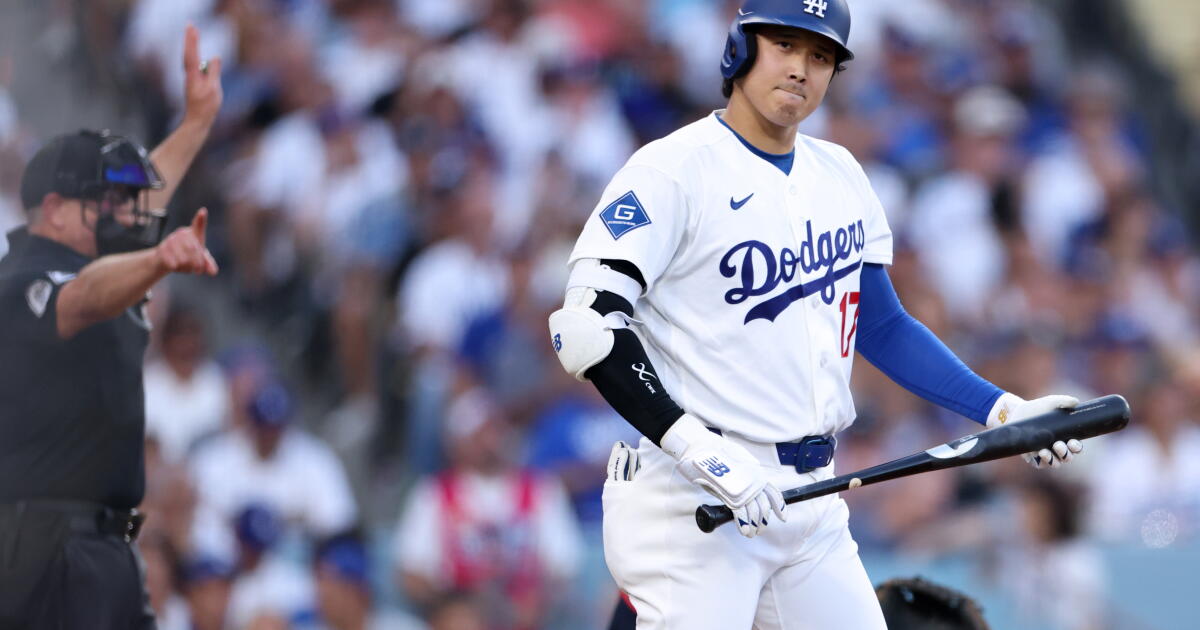
The Dodgers’ performance against the Brewers bullpen on Monday magnified how much the star-powered lineup hasn’t been clicking with Shohei Ohtani struggling at the plate. He went 0-for-4 in the cleanup spot in Game 2, bringing his postseason total to three hits, all singles, in 20 at-bats.
Manager Dave Roberts told The Athletic after the game that he would “have a conversation” with Ohtani Tuesday to determine “what’s best for him, what’s best for [the team].”
Get the latest on L.A.’s teams in the daily Sports Report newsletter.
By continuing, you agree to our Terms of Service, which include arbitration and a class action waiver. You agree that we and our third-party vendors may collect and use your information, including through cookies, pixels and similar technologies, for the purposes set forth in our Privacy Policy such as personalizing your experience and ads.
Three-peat chance is looking weak
From Bill Plaschke: Once brimming with life, the Dodgers’ historic quest has curled up into a withered heap.
The three-peat is slowly, agonizingly having the life squeezed out of it by a collection of hardscrabble Midwesterners with no regard for stardom or status.
Two games into the National League Championship Series, the three-peat was formally placed on life support Monday after the mighty Dodgers lost a second consecutive game to those little giants known as Milwaukee Brewers.
This time the score was 7-4 after another devastating night at American Family Field, and now the Dodgers trail two games to none in a best-of-seven series that appears beyond their control.
For a second consecutive game, their ace was knocked out. For a second consecutive game, their powerful offense petered out.
For a second consecutive game, they looked like a weary, aging band of fallen stars that had stumbled into a surprisingly deep pothole and had no idea how to climb out.
No. 1 Milwaukee vs. No. 2 Dodgers at Milwaukee 2, Dodgers 1 (box score) at Milwaukee 7, Dodgers 4 (box score) Wednesday at Dodgers, 5 p.m., FS1/FOX Deportes/FOX One Thursday at Dodgers, 6 p.m., FS1/FOX Deportes/FOX One *Friday at Dodgers, 6 p.m., FS1/FOX Deportes/FOX One *Sunday at Milwaukee, 5 p.m., FS1/FOX Deportes/FOX One *Monday at Milwaukee, 5 p.m., FOX/FS1/FOX Deportes/FOX One
ALCS
No. 1 Tampa Bay vs. No. 2 Cleveland Cleveland 7, at Tampa Bay 3 (box score) Tuesday at Tampa Bay, 5 p.m., TBS/truTV/UniMas/HBO Max Thursday at Cleveland, 3 p.m., TBS/truTV/UniMas/HBO Max Friday at Cleveland, 3 p.m., TBS/truTV/UniMas/HBO Max *Saturday at Cleveland, 5 p.m., TBS/truTV/UniMas/HBO Max *Monday at Tampa Bay, 2 p.m., TBS/truTV/UniMas/HBO Max *Tuesday at Tampa Bay, 5 p.m., TBS/truTV/UniMas/HBO Max
Iamaleava is expected to miss the rest of this season with a knee injury, according to a person with knowledge of the injury not authorized to discuss it publicly.
Chesney said he is waiting for UCLA doctors to “make the final call on things.”
“He has a meeting later today, and he’ll have a whole lot more clarity on exactly where things are at,” Chesney said of Iamaleava during a news conference Monday. “Everything being reported is what’s being reported. There is a serious concern at this moment, but at the same point in time, there is nothing that has been fully ruled at this moment.”
The injury is a blow for the No. 12 Bruins, who are 5-0 during Chesney’s first season and have a favorable path to the College Football Playoff.
Chesney said that while Ty Dieffenbach and Madden Iamaleava, Nico’s younger brother, both earned the right to start, Chesney will start Dieffenbach going forward and see how it plays out.
1893 — The U.S. yacht Vigilant wins the America’s Cup with a three-race sweep over the British challenger Valkyrie II.
1947 — The NHL holds its first All-Star game with the All-Stars beating the Toronto Maple Leafs 4-3. Toronto’s Harry Watson scores the game’s first goal and assists on the other two goals. Trailing 3-2 after two periods, Montreal’s Maurice Richard and Chicago’s Doug Bentley each score to give the All-Stars the win.
1961 — Jacky Lee of the Houston Oilers passes for 457 yards and two touchdowns in a 31-31 tie with the Boston Patriots. Charley Hennigan of the Oilers catches 13 passes for 272 yards.
1963 — Mickey Wright wins her fourth LPGA championship in six years by beating Mary Lena Faulk, Mary Mills and Louise Suggs by two strokes.
1982 — IOC Executive Committee approves the reinstatement of Jim Thorpe’s gold medals from the 1912 Olympics.
1985 — Phil Simms of the New York Giants passes for 513 yards with an NFL-record 62 pass attempts in a 35-30 loss to the Cincinnati Bengals. Simms completes 40 passes with 29 for first downs, also an NFL record.
1998 — For the first time in NBA history, the league cancels regular season games after labor talks break off.
2001 — DeShaun Foster of UCLA runs for a school-record 301 yards and four touchdowns as the Bruins beat Washington 35-13.
2001 — Georgia Southern fullback Adrian Peterson is held to 71 yards rushing, snapping his NCAA-record streak of 36 straight regular-season games with at least 100 yards.
2011 — American Jordyn Wieber wins another gold medal, beating Russia’s Viktoria Komova for the all-around title at the world gymnastics championships in Tokyo. Wieber, who led the Americans to the team title two days earlier, finishes with 59.382 points, just 0.033 ahead of the Russian.
2013 — Kenya’s Dennis Kimetto, six weeks removed from a bout of malaria, breaks the course mark in capturing the Chicago Marathon. Kimetto finishes in 2 hours, 3 minutes, 45 seconds, leading a 1-2-3 finish for Kenyan men. He beats the mark of 2:04:38 set by Ethiopia’s Tsegaye Kebede last year.
2017 — Gustav Nyquist scores twice and Detroit has four goals in the third period to beat Vegas 6-3, handing the NHL’s newest franchise its first loss. Vegas is the first NHL expansion team to win its first three games.
2019 — Simone Biles becomes the most decorated gymnast in history when she wins record 25th medal at the World Championships in Stuttgart, Germany.
Compiled by the Associated Press
This day in baseball history
1903 — The Boston Pilgrims win the first World Series, 5 games to 3, with a 3-0 victory over the Pittsburgh Pirates.
1960 — Bill Mazeroski opens the bottom of the ninth with a home run off Ralph Terry of the New York Yankees to give the Pittsburgh Pirates a 10-9 victory and the World Series championship.
Compiled by the Associated Press
Until next time…
That concludes today’s newsletter. If you have any feedback, ideas for improvement or things you’d like to see, email me at houston.mitchell@latimes.com. To get this newsletter in your inbox, click here.
And you probably figured Freddie Freeman would get it going. You had faith in playoff risers Max Muncy, Kiké Hernández and Teoscar Hernández — and in the Dodgers’ playoff-proven offense overall.
You were not, however, so bullish on the bullpen.
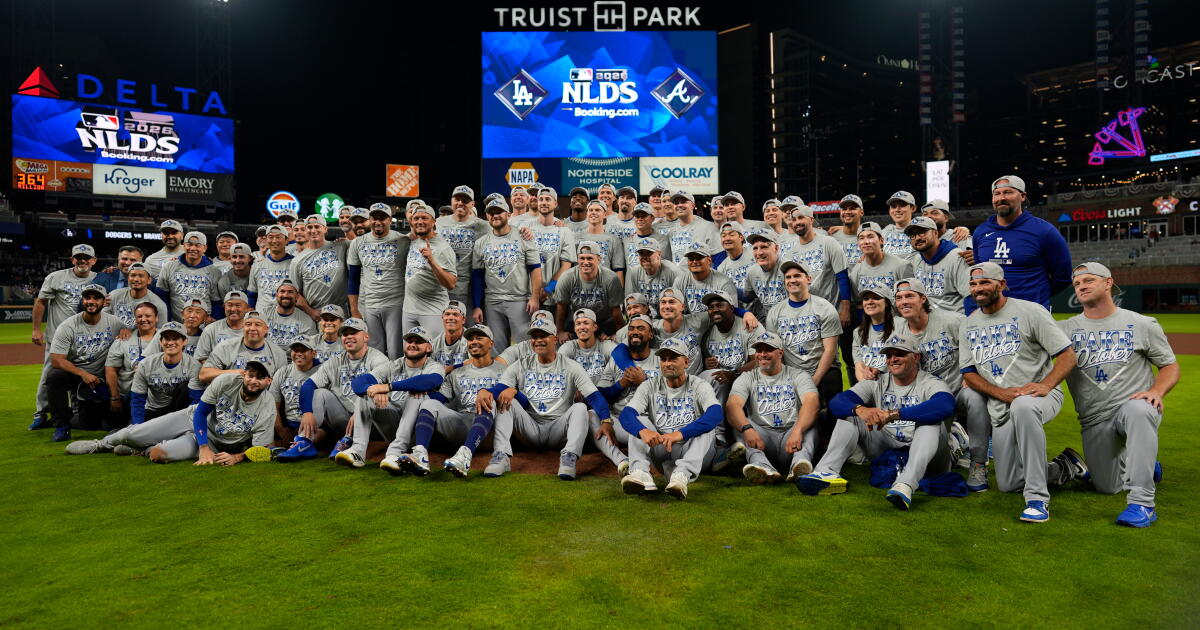
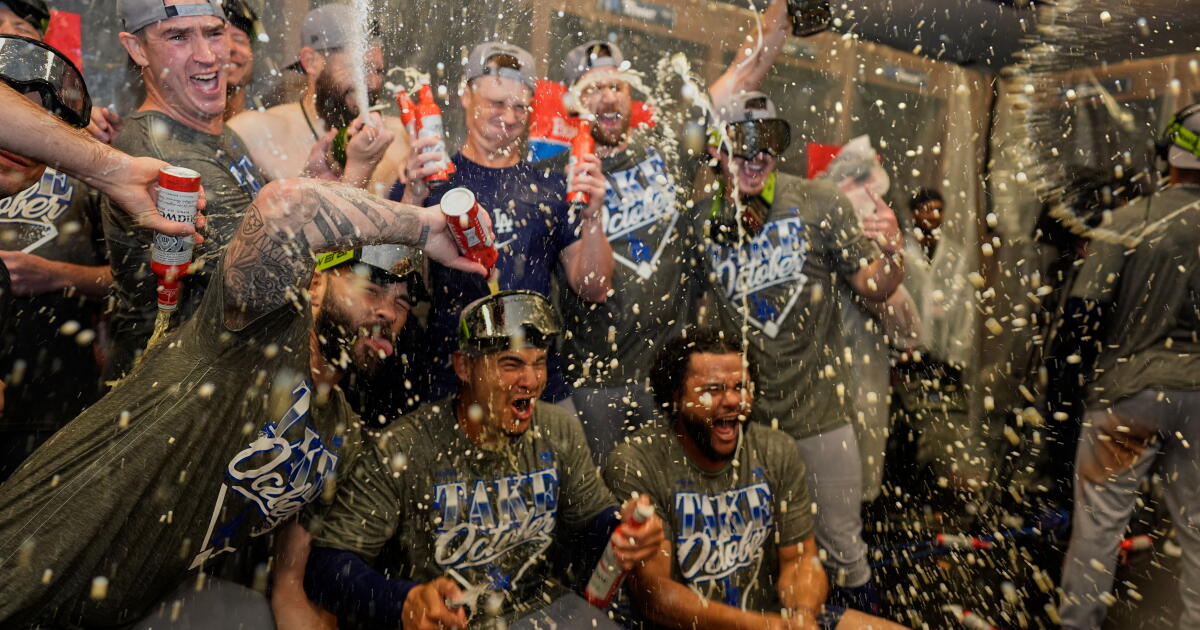
That was the proverbial, annual question mark entering the best-of-five National League Division Series against the Atlanta Braves, whom the Dodgers vanquished with a 4-1 victory Wednesday at Truist Park to set up an NL Championship Series rematch with the Milwaukee Brewers.
Get the latest on L.A.’s teams in the daily Sports Report newsletter.
By continuing, you agree to our Terms of Service, which include arbitration and a class action waiver. You agree that we and our third-party vendors may collect and use your information, including through cookies, pixels and similar technologies, for the purposes set forth in our Privacy Policy such as personalizing your experience and ads.
Dodgers: Reasons to believe, reasons to worry
From Bill Shaikin: As Dave Roberts delivered his victory address, dressed in a gray cap and a gray T-shirt that commemorate a triumph the Dodgers consider merely a speed bump on the road to the main event, the manager was not shy.
“There is no more talented team than the Los Angeles Dodgers,” Roberts told his players amid clubhouse floods of champagne and beer. “This is the best organization in sports, top to bottom. We’re smarter. We’re better. And we’re tougher.”
“This one is going to be special,” infielder Miguel Rojas said. “We have the motivation of winning three times in a row. That’s all we can think about right now. It’s never going to be easy in baseball. You have to go through tough things. But this team showed it before, and it showed it in this series.”
Nothing is guaranteed in October, not even the Dodgers in the World Series. For the Dodgers, here are four positive signs and four warning signs:
And though it was just a preseason game Thursday night, Doncic and Reaves showed why they form one of the most dynamic offensive backcourts in the NBA.
The Lakers duo linked up on the very first play against the Sacramento Kings, with Reaves passing to Doncic as he cut to the basket before scoring while being fouled.
Both played 25 minutes, with Doncic finishing with 23 points on six-for-16 shooting during the Lakers’ 114-110 win over the Kings at Crypto.com Arena. Reaves had eight points on two-for-seven shooting, eight assists and five
No. 2 Cleveland vs. No. 6 Chicago White Sox Chicago White Sox 3, at Cleveland 0 (box score) Chicago White Sox 4, at Cleveland 3 (box score) Cleveland 9, at Chicago 3 (box score) Cleveland 9, at Chicago 5 (box score) Saturday at Cleveland, 5 p.m., TBS/truTV/UniMas/HBO Max
NLCS
No. 1 Milwaukee vs. No. 2 Dodgers Sunday at Milwaukee, 5 p.m., FOX/FS1/FOX Deportes/FOX One Monday at Milwaukee, 2 p.m., FOX/FS1/FOX Deportes/FOX One Wednesday at Dodgers, 5 p.m., FOX/FS1/FOX Deportes/FOX One Thursday at Dodgers, 6 p.m., FOX/FS1/FOX Deportes/FOX One *Friday, Oct. 16 at Dodgers, 6 p.m., FOX/FS1/FOX Deportes/FOX One *Sunday, Oct. 18 at Milwaukee, 5 p.m., FOX/FS1/FOX Deportes/FOX One *Monday, Oct. 19 at Milwaukee, 5 p.m., FOX/FS1/FOX Deportes/FOX One
ALCS
No. 1 Tampa Bay vs. Cleveland/Chicago winner Monday, at Tampa Bay, 5 p.m., TBS/truTV/UniMas/HBO Max Tuesday at Tampa Bay, 5 p.m., TBS/truTV/UniMas/HBO Max Thursday at Chi/Cle, 3 p.m., TBS/truTV/UniMas/HBO Max Friday, Oct. 16 at Chi/Cle, 3 p.m., TBS/truTV/UniMas/HBO Max *Sat., Oct. 17 at Chi/Cle, 5 p.m., TBS/truTV/UniMas/HBO Max *Monday, Oct. 19 at Tampa Bay, 2 p.m., TBS/truTV/UniMas/HBO Max *Tuesday, Oct. 20 at Tampa Bay, 5 p.m., TBS/truTV/UniMas/HBO Max
* if necessary
World Series starts Friday, Oct. 23
Secret to Matthew Stafford’s success
From Sam Farmer: Both NFL most valuable players. Both bound for Canton. Both surgically precise with their passes.
Peyton Manning sat in the studio and cued the video. Stafford looked off a Philadelphia safety last Sunday to hold him in place. He froze a cornerback with a glance. Then he threw an out-and-up to Puka Nacua, absorbing a big hit as he released the ball.
“That’s a lot of looking off,” Manning said.
Hall of Fame linebacker Luke Kuechly, watching from his own home studio, agreed.
“The quarterback will lie to you,” Kuechly said. “He’s going to look you off. He’s going to pump you. But the one thing that never lies to you is the route.”
1943 — Bob Hoernschemeyer throws six touchdown passes, an NCAA record for a freshman, to lead Indiana past Nebraska 54-13.
1965 — The United States wins the Ryder Cup 19½-12½ at the Royal Birkdale Golf Club in Southport, England. Arnold Palmer clinches the title, beating Peter Butler 2 up. It’s the 13th victory for the Americans in this event, which began in 1927. Britain, a three-time winner, last won in 1957.
1974 — The Washington Capitals lose their first NHL game, 6-3 to the Rangers at New York’s Madison Square Garden.
1982 — Al Del Greco kicks six field goals for all of Auburn’s points in an 18-3 triumph over Kentucky.
1983 — Buffalo’s Joe Ferguson passes for 419 yards and five touchdowns in an 38-35 overtime win against Miami. Uwe Von Schamann of the Dolphins misses two field goals in the overtime and Joe Danelo ends the game with a 36-yard field goal.
1991 — The San Jose Sharks gain their first NHL victory, defeating the Calgary Flames 4-3.
1993 — Minnesota’s Scott Eckers passes for 402 yards and a school-record six touchdowns in his first college start, sending the Gophers past Purdue 59-56.
1993 — Carey Bender rushes 33 times for 417 yards, setting an NCAA all-division single-game rushing record, in Coe’s 69-7 Division III victory over Grinnell.
2004 — Texas Tech beats Nebraska 70-10, the worst lost in the Cornhuskers’ storied 114-year history.
2004 — Texas loses to Oklahoma 12-0, getting shut out for the first time in 282 games and ending the longest streak in the country.
2010 — Mike Brinkley passes for six touchdowns and Armond Smith runs for five scores to lead Union (Ky.) to an 84-55 victory over Bethel (Tenn.) in an NAIA game.
2010 — Derek Stepan becomes the fourth player to score three times in his NHL debut to lead the New York Rangers to a season-opening 6-3 win over the Buffalo Sabres.
2011 — Sebastian Janikowski kicks four field goals, including three from at least 50 yards (54, 55, 50), in Oakland’s 25-20 win over Houston. Houston’s Matt Schaub throws for 416 yards and two touchdowns.
2011 — The NHL returns to Winnipeg, but Carey Price stops 30 shots and the Montreal Canadiens dampen a city celebration with a 5-1 victory over the Jets.
2015 — Sepp Blatter, hoping to return to power as FIFA president, is banned for 90 days, essentially ending his 17-year reign as the leader of soccer’s governing body. UEFA President Michel Platini also gets a 90-day ban following an investigation of financial misconduct at FIFA in a Swiss criminal case.
2016 — Tom Brady returns from his four-game “Deflategate” suspension, passing for 406 yards and three touchdowns to Martellus Bennett in the New England Patriots’ 33-13 victory over the Cleveland Browns.
2022 — Dutch Red Bull driver Max Verstappen secures his second consecutive World F1 Drivers C’ship after finishing in front of Sergio Pérez and Charles Leclerc in the Japanese GP at Suzuka.
Compiled by the Associated Press
This day in baseball history
1928 — Baseball World Series: NY Yankees beat St. Louis Cardinals, 7-3 at Sportsman’s Park to become first to sweep consecutive World Series; Babe Ruth hits smashes three HRs for Yanks.
1934 — Baseball World Series: St Louis Cardinals rout Detroit Tigers, 11-0 at Navin Field to clinch 4 games to 3 series victory and third championship.
1966 — Baseball World Series: Baltimore Orioles claim first championship in franchise history; edge Dodgers, 1-0 at Memorial Stadium for 4-0 sweep; MVP: Orioles outfielder Frank Robinson.
1988 — Dennis Eckersley saves all four games in Oakland’s ALCS victory over Boston.
2005 — Chris Burke hits a home run in the bottom of the 18th inning and Roger Clemens pitches three scoreless innings of relief in Houston’s 7-6, series-ending victory over Atlanta in the NLDS. The longest postseason game in history takes 5 hours, 50 minutes.
Compiled by the Associated Press
Until next time…
That concludes today’s newsletter. If you have any feedback, ideas for improvement or things you’d like to see, email me at houston.mitchell@latimes.com. To get this newsletter in your inbox, click here.
His October track record suggested he was an unlikely hero. He entered Wednesday with a .123 playoff batting average. He was benched in Game 5 of the World Series last year. He’d even started this postseason hitless in the first two games of the National League Division Series against the Atlanta Braves, and was given the red light on ABS challenges.
He didn’t carry any of that up to the plate with him in the seventh inning, with the score tied, the bases loaded and hard-throwing Braves reliever Robert Suarez entering the game to face him.
“I like being in those at-bats,” Pages said in Spanish after the Dodgers’ 4-1 win in Game 4 of the NLDS. “There are times the result comes, sometimes not, but I prepare to be in those spots. And today I was able to get the result.”
He was patient, working a full count as he fouled off and then foul-tipped a pair of fastballs in the zone.
The next one, he sent through the middle of the infield for a two-run single to finally give the Dodgers the lead in the deciding moment of the series.
The Dodgers are headed to the NL Championship Series for the ninth time in 14 seasons. They will play the Milwaukee Brewers, who finished off the San Diego Padres in four games, starting Sunday. And they came one step closer to their goal of winning a third straight World Series.
Get the latest on L.A.’s teams in the daily Sports Report newsletter.
By continuing, you agree to our Terms of Service, which include arbitration and a class action waiver. You agree that we and our third-party vendors may collect and use your information, including through cookies, pixels and similar technologies, for the purposes set forth in our Privacy Policy such as personalizing your experience and ads.
When asked about his quarterback Tuesday, Trojans coach Lincoln Riley quickly replied that Maiava is not injured.
“Jayden has been pretty healthy,” Riley said. “They’ve kept him upright all season long.”
Maiava has adapted to shifting receiving options, calling it a learning experience as he connects with new pass catchers. USC freshman Trent Mosley was an early breakout star, but Maiava has had to look to others with Mosley out the past two games because of injury.
From Thuc Nhi Nguyen: The five Buss siblings who voted to sell the family’s shares of the Lakers filed their formal opposition to team governor Jeanie Buss’ attempts to block the sale on Wednesday, calling Jeanie’s petition “legally and factually baseless” in a statement provided to The Times.
“While discussions among the siblings continue, their focus remains on facilitating the proposed transaction and the Trust’s participation in it, while ensuring that all beneficiaries, including Jeanie, are treated equally,” Jimmy, Johnny, Janie, Joey and Jesse Buss said in the statement.
“Today’s filing is a necessary step to protect those interests and ensure the transaction proceeds on schedule.”
Evan Bouchard had two goals and an assist to become the second defenseman in NHL history with at least six goals through the first four games of a season, and the Edmonton Oilers used a five-goal second period to beat the Ducks 5-2 on Wednesday night.
Bouchard has a league-leading six goals through four games. Harry Cameron had eight goals in four games for the Toronto Arenas during the NHL’s inaugural season in 1917-18.
Leon Draisaitl had four assists, Connor McDavid had a goal and two assists, Kasperi Kapanen and Vasily Podkolzin also scored, and the Oilers overcame a sluggish start to win their third straight game. Devon Levi made 28 saves.
No. 2 Dodgers vs. No. 3 Atlanta at Dodgers 5, Atlanta 3 (box score) Atlanta 3, at Dodgers 2 (box score) Dodgers 3, at Atlanta 1 (box score) Dodgers 4, at Atlanta 1 (box score)
No. 1 Milwaukee vs. No. 4 San Diego at Milwaukee 3, San Diego 2 (box score) at Milwaukee 4, San Diego 3 (box score) at San Diego 4, Milwaukee 3 (box score) Milwaukee 3, at San Diego 1 (box score)
American League
No. 1 Tampa Bay vs. No. 4 New York at Tampa Bay 1, New York Yankees 0 (box score) at Tampa Bay 5, New York Yankees 2 (box score) Tampa Bay 4, at New York Yankees 3 (box score)
No. 2 Cleveland vs. No. 6 Chicago White Sox Chicago White Sox 3, at Cleveland 0 (box score) Chicago White Sox 4, at Cleveland 3 (box score) Cleveland 9, at Chicago 3 (box score) Thursday at Chicago, 2 p.m., TBS/truTV/UniMas/HBO Max *Saturday at Cleveland, 2 p.m., TBS/truTV/UniMas/HBO Max
NLCS
No. 1 Milwaukee vs. No. 2 Dodgers Sunday at Milwaukee, TBD, FOX/FS1/FOX Deportes/FOX One Monday at Milwaukee, TBD, FOX/FS1/FOX Deportes/FOX One Wednesday at Dodgers, TBD, FOX/FS1/FOX Deportes/FOX One Thursday at Dodgers, TBD, FOX/FS1/FOX Deportes/FOX One *Friday, Oct. 16 at Dodgers, TBD, FOX/FS1/FOX Deportes/FOX One *Sunday, Oct. 18 at Milwaukee, TBD, FOX/FS1/FOX Deportes/FOX One *Monday, Oct. 19 at Milwaukee, TBD, FOX/FS1/FOX Deportes/FOX One
ALCS
No. 1 Tampa Bay vs. Cleveland/Chicago winner Monday, at Tampa Bay, TBD, TBS/truTV/UniMas/HBO Max Tuesday at Tampa Bay, TBD, TBS/truTV/UniMas/HBO Max Thursday at Chi/Cle, TBD, TBS/truTV/UniMas/HBO Max Friday, Oct. 16 at Chi/Cle, TBD, TBS/truTV/UniMas/HBO Max *Sat., Oct. 17 at Chi/Cle, TBD, TBS/truTV/UniMas/HBO Max *Monday, Oct. 19 at Tampa Bay, TBD, TBS/truTV/UniMas/HBO Max *Tuesday, Oct. 20 at Tampa Bay, TBD, TBS/truTV/UniMas/HBO Max
* if necessary
World Series starts Friday, Oct. 23
This day in sports history
1933 — Cliff Battles of the Boston Redskins becomes the first NFL player to gain more than 200 yards rushing with 215 yards in a 21-20 win over the New York Giants.
1949 — Walt Pastuszak has five of Brown’s 11 interceptions in a 46-0 rout of Rhode Island.
1950 — Bill Grimes of the Green Bay Packers gains 167 yards in 10 carries in a 44-31 loss to the New York Yankees.
1966 — Jerry DePoyster of Wyoming becomes the first player in college football to make three field goals of 50 yards or more in a game. DePoyster connects on two 54-yard tries and a 52-yarder in the Cowboys’ 40-7 rout of Utah.
1961 — Paul Hornung scores 33 points, with four touchdowns, six extra points and a field goal, to lead the Green Bay Packers to a 45-7 romp over the Baltimore Colts.
1977 — No. 7 Alabama beats No. 1 USC 21-20 in Los Angeles. USC fullback Lynn Cain scores with 38 seconds remaining but the 2-point attempt fails.
1992 — Doug Smail scores two goals and the expansion Ottawa Senators rock the Montreal Canadiens 5-3 — the first regular-season NHL game by an Ottawa franchise in 58 years.
1993 — The Anaheim Mighty Ducks, before 17,174 at the Arrowhead Pond, lose 7-2 to the Detroit Red Wings in their first NHL game.
1995 — Dolphin’s Dan Marino breaks Fran Tarkenton’s NFL career completions record.
1997 — Adam Oates reaches 1,000 points with three goals and two assists as the Washington Capitals post a 6-3 victory over the New York Islanders.
2005 — Baylor wins a Big 12 road game for the first time in the league’s 10-year history, beating Iowa State 23-13. The Bears had been 0-37 on the road in the Big 12 Conference.
2006 — Randy Moss’ 22-yard TD catch between two defenders 51 seconds before halftime is the Oakland receiver’s 100th touchdown reception. He’s becomes the seventh receiver in NFL history with 100 TD catches.
2011 — Howard scores all its points in the fourth quarter, including 16 in the final 1:27 to beat 29-28 Florida A&M. Parker Munoz caps the improbable comeback by hitting a 21-yard field goal with 4 seconds left following FAMU’s Damien Fleming fumble on the 28-yard line.
2015 — Tampa Bay’s Jason Garrison scores his second goal of the game at 2:17 of the extra period to lead the Lightning past the Philadelphia Flyers in the first 3-on-3 overtime game in NHL history.
2016 — Will Worth and Navy stuns No. 6 Houston, romping to a 46-40 victory. Worth runs for 115 yards and throws two scoring passes for the Midshipmen. Navy hadn’t beaten a top 10 team since 1984, when it topped then-No. 2 South Carolina in Annapolis.
2017 — Aaron Rodgers throws a 12-yard touchdown pass to Davante Adams with 11 seconds remaining, lifting Green Bay over the Dallas Cowboys 35-31 in another thriller nine months after the Packers’ divisional playoff victory on the same field.
2018 — Drew Brees’ 62-yard touchdown pass to rookie Tre’Quan Smith makes him the NFL’s all-time leader in yards passing and sends the New Orleans Saints well on their way to a 43-19 victory over the Washington Redskins. Brees enters the game needing 201 yards to eclipse Peyton Manning’s previous mark of 71,940 yards. He finishes 26 of 29 for 363 yards and three touchdowns.
Compiled by the Associated Press
This day in baseball history
1956 — Don Larsen of the New York Yankees pitches the only perfect game in World Series history, a 2-0 triumph over Brooklyn.
2018 — Red Sox utility player Brock Holt becomes the first MLB player to hit for the cycle in a postseason game.
Compiled by the Associated Press
Until next time…
That concludes today’s newsletter. If you have any feedback, ideas for improvement or things you’d like to see, email me at houston.mitchell@latimes.com. To get this newsletter in your inbox, click here.
From Maddie Lee: The Dodgers’ first few innings Tuesday night were riddled with strikeouts and missed opportunities. But the work they did racking up Atlanta Braves ace Chris Sale‘s pitch count culminated in Kiké Hernández’s big fourth-inning moment in Game 3 of the National League Division Series.
“I felt hitting at the bottom of the lineup, my responsibility was to not chase him around, not give in to what he was trying to get me to do, which was roll over and hit into a double play,” Hernández said after the Dodgers’ 3-1 win against the Braves. “So my mentality was to grind out the at-bat, try to get a good pitch to hit. If not, just be patient so I could turn the lineup over to Mookie [Betts] at the top.”
Hernández let Sale’s first pitch, a changeup in and off the plate, go for a ball. Then, he recognized the pitch again, heading toward the inner third of the plate. And Hernández demolished it, taking three slow steps out of the batter’s box before dropping the bat.
Go beyond the scoreboard
Get the latest on L.A.’s teams in the daily Sports Report newsletter.
By continuing, you agree to our Terms of Service, which include arbitration and a class action waiver. You agree that we and our third-party vendors may collect and use your information, including through cookies, pixels and similar technologies, for the purposes set forth in our Privacy Policy such as personalizing your experience and ads.
Hernández has too many big postseason moments — a three-homer game against the Cubs in Game 5 of the 2017 NL Championship Series, for example — for a single homer in a non-elimination game to rank at the top. It was his 17th career postseason home run, which accounts for 11% of his home runs over 13 years in the majors, putting him in a category of his own.
It was, however, the biggest offensive moment of the Dodgers’ postseason so far. As the series teetered, in a matchup of rotation aces, all tied up and in Atlanta for the first time, he got his first at-bats of the 2026 postseason and immediately delivered.
“We played tonight like an elimination game,” manager Dave Roberts said. “Collectively it was probably one of our better performances, certainly with the [opposing] starter, as far as 1 through 9.”
Kiké Hernández celebrates after hitting a two-run home run in the fourth inning of the Dodgers’ 3-1 win over the Atlanta Braves in Game 3 of the NLDS at Truist Park on Tuesday.
Stepping warily into Atlanta’s Truist Park with their five-game division series tied at one game apiece and Braves’ ace Chris Sale waiting for them on the mound Tuesday, the Dodgers marched out three hours later on the verge of another champagne shower.
Yoshinobu Yamamoto was brilliant, showing everyone that they were focusing on the wrong ace.
The Dodger bats were reborn, showing everyone that they still know how to hit in October.
And, yes, the Dodgers finally have a closer, Edwin Díaz entering the ninth and allowing a leadoff double to Ozzie Albies before retiring the next three hitters for the biggest save of his brief Dodgers career.
The most forgotten hero in Dodger history stepped out of the shadows in 1987 as their instant general manager and created the miraculous monster that came to be in 1988.
The resuscitation of a Dodger brand during what was quite possibly its darkest moment? It all started with Fred Claire, the longtime Dodger executive who died Monday in his Pasadena home on his 91st birthday.
That is what UCLAcoach Bob Chesney told his team when he showed them their Associated Press Top 25 ranking during Sunday’s team meeting, reminding the Bruins what their priorities are as they come off their bye week and prepare for a showdown in Eugene, Ore., against the No. 13 Ducks.
“If you pay attention to this number it will go away,” Chesney said. “If you pay attention to what you did to get that number, and only focus on that and improve that, maybe the number even gets better. Who knows as time goes on, but that can’t be anything we talk about or worry about, and that’s why I wanted to bring it up one time and that was the end of it.”
The commitment to the process remains Chesney’s top priority as his team stares down its biggest test of the season to date.
Kings goaltender Darcy Kuemper makes a glove save during the first period against the Florida Panthers on Tuesday.
(Mark J. Terrill / Associated Press)
From Kevin Baxter: Before the first home game of their upcoming 60th anniversary year Tuesday, the Kings honored their past by unveiling a modest Hall of Fame on the concourse of Crypto.com Arena.
An hour later, this season’s Kings took the ice and made some history of their own, though not the kind they had hoped for, falling to the Florida Panthers 2-1 to open a season with three consecutive losses for the first time since 2020.
For Peter Laviolette, the history was even more unwanted since the team’s 0-2-1 start makes him the first Kings coach to go winless in his first three games since Robbie Ftorek in 1987.
Laviolette was a 23-year-old defenseman with the U.S. national team then. He would go on to win 934 NHL games as a coach, the most ever for an American, but he has yet to add to that total with the Kings. It didn’t help that two of the first three games with his new franchise came against Colorado and Florida, popular picks to finish the season in the Stanley Cup Final.
Lakers forward Adou Thiero looks to pass around Golden State forward Yaxel Lendeborg during the Lakers’ 124-98 preseason loss Tuesday.
(Ezra Shaw / Getty Images)
From Thuc Nhi Nguyen: This was never going to be a game for the Lakers to remember. But with nearly half of the roster sidelined because of injuries or resting, Adou Thiero at least tried to inject some life into a sleepy preseason back-to-back.
Thiero’s towering one-handed dunk over two Golden State defenders provided a highlight in the Lakers’ otherwise forgettable 124-98 preseason loss to the Warriors at Chase Center on Tuesday. The Lakers leaned on their depth to get through their second short-handed preseason game in as many nights.
Guard Quentin Grimes, the only player starting a second consecutive game for the Lakers, had 12 points and three assists. Forward Sandro Mamukelashvili started at center and had 15 points and a trio of three-pointers. Thiero, getting a rare starting moment, scored seven points and grabbed four rebounds while Bronny James had four points and five assists in a starting role.
No. 2 Dodgers vs. No. 3 Atlanta at Dodgers 5, Atlanta 3 (box score) Atlanta 3, at Dodgers 2 (box score) Dodgers 3, at Atlanta 1 (box score) Wednesday at Atlanta, 3 p.m., FOX/FS1/FOX Deportes/FOX One *Friday at Dodgers, 5 p.m., FOX/FS1/FOX Deportes/FOX One
No. 1 Milwaukee vs. No. 4 San Diego at Milwaukee 3, San Diego 2 (box score) at Milwaukee 4, San Diego 3 (box score) at San Diego 4, Milwaukee 3 (box score) Wednesday at San Diego, 7 p.m., FOX/FS1/FOX Deportes/FOX One *Friday at Milwaukee, 1:30 p.m., FOX/FS1/FOX Deportes/FOX One
American League
No. 1 Tampa Bay vs. No. 4 New York at Tampa Bay 1, New York Yankees 0 (box score) at Tampa Bay 5, New York Yankees 2 (box score) Wednesday at New York, 5 p.m., TBS/truTV/UniMas/HBO Max *Thursday at New York, 5 p.m., TBS/truTV/UniMas/HBO Max *Saturday, Oct. 10 at Tampa Bay, 5 p.m., TBS/truTV/UniMas/HBO Max
No. 2 Cleveland vs. No. 6 Chicago White Sox
Chicago White Sox 3, at Cleveland 0 (box score) Chicago White Sox 4, at Cleveland 3 (box score) Wednesday at Chicago, 1 p.m., TBS/truTV/UniMas/HBO Max *Thursday at Chicago, 2 p.m., TBS/truTV/UniMas/HBO Max *Saturday, Oct. 10 at Cleveland, 2 p.m., TBS/truTV/UniMas/HBO Max
* if necessary
NLCS starts Sunday, Oct. 11 ALCS starts Monday, Oct. 12 World Series starts Friday, Oct. 23
This Day in Sports History
1904 — Jack Chesbro registers his 41st victory of the season as New York defeats Boston 3-2.
1916 — Georgia Tech, coached by John Heisman, beats Cumberland 222-0 in the most lopsided college football game in history.
1933 — Baseball World Series: NY Giants beat Washington Senators, 4-3 at Griffith Stadium to clinch 4 games to 1 series victory.
1935 — Baseball World Series: Detroit Tigers beat Chicago Cubs, 4-3 at Navin Field for 4 games to 2 series win; Tigers win first championship in 5 WS appearances.
1945 — The Green Bay Packers score 41 points in the first quarter in a 57-21 win against the Detroit Lions.
1950 — Baseball World Series: New York Yankees beat Philadelphia Phillies, 5-2 at Yankee Stadium to sweep series, 4-0 for 13th WS title in team history; MVP: NY 2B Jerry Coleman.
1952 — Baseball World Series: NY Yankees beat Brooklyn Dodgers, 4-2 at Ebbets Field in Game 7 to tie own record 4th straight WS; MVP: NY 1B Johnny Mize.
1962 — Judy Kimball wins the LPGA championship with a four-stroke victory over Shirley Spork.
1967 — Tulsa wide receivers Ricky Eber and Harry Wood have the best day by a receiving duo in college football history. Eber has 20 receptions for 322 yards and three touchdowns, while Wood grabs 13 passes for 318 yards and three scores in Tulsa’s 58-0 win over Idaho State.
1970 — Willie Shoemaker wins his 6,033rd race to pass Johnny Longden as the winningest jockey. His first race was won on April 20, 1949.
1984 — Walter Payton breaks Jim Brown’s career rushing mark of 12,312 yards and Brown’s career mark of 58 100-yard rushing games in a 20-7 victory over New Orleans. Payton breaks the record on Chicago’s second play from scrimmage in the second half.
1985 — Lynette Woodard, captain of the women’s basketball team that won the gold medal at the 1984 Olympics, is chosen to be the first woman to play for the Harlem Globetrotters.
1995 — Coach Eddie Robinson gets his 400th victory as Grambling beats Mississippi Valley State 42-6.
2000 — Zamir Amin of Menlo College sets an NCAA all-divisions record, passing for 731 yards in the Division III school’s 37-32 loss to Cal Lutheran. Amin, 39-of-66 with four TDs and three interceptions, breaks the mark of 716 set by David Klingler of Division I-A Houston against Arizona State on Dec. 2, 1990.
2001 — San Diego’s Rickey Henderson becomes the 25th player with 3,000 hits with a bloop double in a 14-5 loss to Colorado.
2001 — Barry Bonds wraps up his record-breaking season with his 73rd homer and shatters the slugging percentage record that Babe Ruth had owned for 81 years. He finishes with a slugging percentage of .863, easily surpassing the mark of .847 that Ruth set in 1920.
2006 — Denis Hopovac’s fifth field goal of the game, in an NCAA record-tying seventh overtime, gives North Texas a 25-22 victory over Florida International. The other two seven-overtime games involved Arkansas — against Mississippi in 2001 and Kentucky in 2003.
2011 — Minnesota Lynx beat the Atlanta Dream 73-67 to complete a three-game sweep of the WNBA championship series.
2012 — Drew Brees finishes 29 for 45 for 370 yards with four TD passes and an interception in New Orleans’ 31-24 win over San Diego. Brees breaks the NFL record by throwing a touchdown pass in his 48th straight game. His 40-yard pass to Devery Henderson eclipses the mark of 47 consecutive games set by Johnny Unitas from 1956-60.
2017 — Jarvion Franklin runs in from the 12 to give Western Michigan a 71-68 victory over Buffalo in a record-tying seven overtimes with a record-breaking 139 total points.
2017 — Backup Khalil Tate rushes for 327 yards, an FBS record for a quarterback, and accounts for five touchdowns to help Arizona hold off Colorado 45-42.
2017 — Alex Ovechkin scores four goals to become the first player in 100 years with back-to-back hat tricks to open a season, and the Washington Capitals beat the Montreal Canadiens 6-1.
Compiled by the Associated Press
Until next time…
That concludes today’s newsletter. If you have any feedback, ideas for improvement or things you’d like to see, email me at houston.mitchell@latimes.com. To get this newsletter in your inbox, click here.
Along with its cosy caravans and lodges, there are some very exciting additions coming its way.
The park has announced it is undergoing a huge £4million upgrade with work starting this November.
Sign up for the Travel newsletter
Thank you!
One of the largest upgrades will be to its existing indoor swimming pool which will be expanded to become 18-metres long.
It will also add a new toddler splash area, designed specifically for little children – and for adults, there will be a new jacuzzi, steam room and sauna.
The pre-existing gym facilities will also be upgraded.
Its entertainment complex is set to be revamped too with new activities and facilities both indoors and outdoors.
Outside will be a new pirate-themed 9-hole adventure golf course, giant chess and lots of things to do like table tennis, curling – and it will install a padel court.
Inside will be a new soft play area with an upgraded games arcade including interactive darts.
The Hunter’s Bar and Restaurant is being refurbished, and will have a brand-new sports bar, as well as a transformed showbar where there will be entertainment for guests.
A new outdoor terrace will be a new spot that guests can enjoy throughout the year with open-air seating through the summer and covered for when the weather doesn’t play ball.
For those wanting sweet treats, there will also be a brand-new ice cream parlour.
When it comes to accommodation, holiday homes and pitches will be added to the site too.
Currently, guests can stay in basic caravans, to luxury lodges including The Hideout and The Hideaway which have outdoor decks and lots of inside space.
Work is due to start in November of this year with a Grand Opening event planned for Easter 2027.
For those who want to book a break that coincides with the new additions, three-night breaks on April 23 start from £219 – or £18.25pppn.
With this break, a family of four can stay in an Essential Clover Caravan which has two bedrooms (one double, one twin), kitchen and living area.
Simon Lane, CEO of Verdant Parks, said: “This is an incredibly exciting time for Verdant Parks, our employees, our owners and our holidaymakers.
“We’re committing our biggest investment to date to Thurston Manor Holiday Park and completely transforming what guests can see, do and experience when they visit.
“From the extended swimming pool and new toddler splash area to the new padel court, pirate-themed adventure golf and transformed entertainment offering, there will be something for everyone to enjoy.
“We’re delighted to reveal our plans for the next chapter of Thurston Manor and we can’t wait to share more details and sneak peeks as the transformation takes shape over the next six months.”
Hi, and welcome to another edition of Prep Rally. I’m Eric Sondheimer. Football forfeits have been happening. Athletic directors and coaches have been scrambling to make sure players are eligible and parental paperwork is accurate. That’s just a small part of the ethical dilemmas taking place in the high school sports world.
Let the debate begin on ethics
Nobody likes to be told what to do. Nobody likes to be told they are wrong. Nobody likes bureaucracy because it moves slowly. Everybody likes to find shortcuts and to be told they are right. It’s almost a daily experience working in the high school sports world, figuring out ethical dilemmas and how to proceed.
Get our high school sports newsletter
Prep Rally is devoted to the SoCal high school sports experience, bringing you scores, stories and a behind-the-scenes look at what makes prep sports so popular.
By continuing, you agree to our Terms of Service, which include arbitration and a class action waiver. You agree that we and our third-party vendors may collect and use your information, including through cookies, pixels and similar technologies, for the purposes set forth in our Privacy Policy such as personalizing your experience and ads.
Coaches are supposed to tell their players every season that hazing is wrong and won’t be tolerated. Then hazing happens, and the coach is the one held accountable, sometimes even losing their job.
There always are internal politics at play. A winning coach will be treated differently from a losing coach. That’s a fact. In my job as a sportswriter, I’ve been monitoring decisions on ethics for decades. I was around when the California Interscholastic Federation adopted lessons from the influential Michael Josephson, who created the Character Counts coalition. Awards continue to be given out to those who hold their ground and choose the ethically right decision to make.
Do you go out and check the address of transfer student or trust the paperwork submitted? Do you report another team using an ineligible player immediately or hold it back until right before the playoffs, causing the entire team to lose out on the playoffs because of forfeits?
Tahj Skinner of Sherman Oaks Notre Dame accounted for four touchdowns — throwing for three and returning an interception for another— in a 28-21 win over Chaminade.
(Craig Weston / For The Times)
Tahj Skinner of Sherman Oaks Notre Dame intends to play safety for UC Davis. But he’s been doing such a fantastic job playing quarterback for the unbeaten Knights that being a wildcat quarterback could be in his future. He had three touchdown passes and returned an interception for a touchdown in a win over Chaminade. Here’s the report.
In a battle of very good defenses, Santa Margarita defeated Mater Dei 14-7. Here’s the report.
Another week, another historic win for unbeaten Cleveland in the City Section. The Cavaliers defeated longtime power Birmingham 14-9 in the West Valley League opener. Here’s the report.
In a battle of unbeaten teams, Corona del Mar got past Villa Park, 24-10. Here’s the report.
Granada Hills Kennedy (6-0) has won 20 consecutive Valley Mission League games.
Ceasar Reyes of Garfield continues to pile up rushing yards. He had 374 yards in 39 carries and scored five touchdowns in a 42-28 win over Bell. He‘d better bring doughnuts to his offensive linemen on Monday mornings.
Quarterback Shawn Sanders of Paracete had a game for the ages in a 56-36 win over St. Paul. He was 14 for 15 passing for 205 yards and two touchdowns. He rushed for 188 yards and two touchdowns. He kicked seven PATs and seven balls into the end zone for touchbacks. Did he bring out the water bottles too?
Corona Centennial has nine players in its football program with variations of the same first name. Here’s the report.
One of the great teams from the 2026-27 school year is going to end up being JSerra flag football. The Lions won the Southern Section Division 1 title last season and are even better this season with 21 consecutive victories. If any opponent gets close, that will be news.
You need to go watch the duo of quarterback Kate Meier and receiver Tessa Russell.
Carson has taken over as No. 1 in the City Section.
Girls’ volleyball
There’s a clear pecking order in the Southern Section. Mater Dei and Sierra Canyon have been the top teams all season. Mira Costa, Los Alamitos and Marymount are right behind.
From Chaminade AD: Bryan Cantwell is taking personal leave and we have named long time assistant coach Chris Johnson as interim Head Coach. We expect Bryan to return at some point in the future. Basketball.
Yorba Linda’s football team has been forced to forfeit four victories, which means its record is 0-6 and making the playoffs would require earning an automatic berth from the Alpha League. The school district indicated there were violations involving bylaws 503.B (1) and 510, which involve administrative oversight and undue influence….
Todd Therrien, a former football coach at St. Bonaventure who won two state Division III championships, died on Sept. 30, the Ventura County Star reported. He was 47. He recently had a stroke and was a quadriplegic after a spinal cord injury from a car accident in 2022. He succeeded Jon Mack in 2007….
Freshman Emiliano Plascencia of Whitter has more than 100 goals for his water polo team this season.
(Los Angeles Times)
Whittier has a freshman water polo player scoring goals in bunches. Here’s the report. …
JSerra made it to the championship game in water polo at the Elite 8 tournament before losing to Cathedral Catholic….
The Southern Section football playoff pairings will be announced on Sunday, Nov. 1 at 10 a.m. That’s also the end of daylight savings time when the clocks move back one hour, so no sleeping in for coaches, parents or players….
The Luderer twins, Keira and Kelsey, from Sherman Oaks Notre Dame committed to Florida State for softball. Here’s the report….
Chaminade has begun construction of a $66-million project that will include new baseball and softball diamonds. Here’s the report.
From the archives: Jamie Dixon
Jamie Dixon was a star guard at Sherman Oaks Notre Dame, went on to Texas Christian, became a top assistant to Ben Howland at Northern Arizona, then an assistant at Pittsburgh before becoming coach. He has been TCU’s coach since 2016.
From the Los Angeles Times, a story on Inglewood football coach Mil’Von James saying he played three ineligible players in Texas because he didn’t know they were ineligible outside of California.
From the Los Angeles Times, a story on how unbeaten Sierra Canyon’s football team has found a top sophomore linebacker in Eli Zamorano, who spent nearly three months living on Easter Island when he was 15.
From Yahoo, a story on former Mater Dei receiver Cooper Barkate having a breakout performance for Miami.
Tweets you might have missed
𝘿𝙚𝙢𝙤𝙡𝙞𝙨𝙝𝙚𝙙 𝙗𝙮 𝘿𝙞 𝙈𝙖𝙜𝙜𝙞𝙤
Matti Di Maggio crushes one for a leadoff solo shot!
One reason why it’s going to be so difficult to get high school softball teams to play in state championships instead of club ball is seen in X profiles. Players mention their club team, not their high school team.
The JSerra Girls Flag Football team improved to 20-0 on the season, as the Lions defeated the Santa Margarita Eagles 34-20 in a Trinity League game on Tuesday at JSerra Catholic High School.
JSerra has now won 48 straight games dating back to last season.
The City Section will soon consider a proposal that would punish an individual student for playing on outside team (think soccer) when discovered in the playoffs and not eliminate the team.
BREAKING: Moorpark High striker Bella Sanabria Cora, the cousin of former Boston Red Sox manager Alex Cora and MLB All-Star Joey Cora, was named to the U17 World Cup team for Puerto Rico.
Keep an eye out for my exclusive interview with Sanabria Cora in The Star early next week. pic.twitter.com/aw3JmJPSN7
Matti Di Maggio (Dos Pueblos) and Bryant Ju (Cypress) are coming home with gold medals after USA won the 15U World Cup in Mexico with a 5-4 walk-off win over Dominican Republic in the B 8th.
A special night was had tonight as this ALL FEMALE officiating crew made history in Orange County! 👏✨
White Hat: Mary Margaret Montgomery Head Lines: Kristi Wilson Umpire: Maryann Menlove Line Judge: Nina Berbiglia Back Judge: Sarita Stamps pic.twitter.com/DrM86nO8ku
I’m hearing a growing concern of high school football players directing the N word at opponents. Enough. And coaches need to intervene before someone gets fired, suspended, kicked off. Just like hazing, it’s unacceptable. Officials have already thrown flags trying to stop the taunting.
Former Gardena Serra running back Kai Honda rushed for 219 yards and scored four touchdowns for Princeton in win over Columbia. Always knew his time would come in the Ivy League. https://t.co/SpDT0qeXDq
Have a question, comment or something you’d like to see in a future Prep Rally newsletter? Email me at eric.sondheimer@latimes.com, and follow me on X at @latsondheimer.
Did you get this newsletter forwarded to you? To sign up and get it in your inbox, click here.