LOONEY Tunes actor Eric Bauza, who voiced iconic cartoon characters such as Bugs Bunny and Daffy Duck, has died aged 46.
The award-winning star’s family posted on Instagram that he had died “suddenly” and there would be “more details to come”.
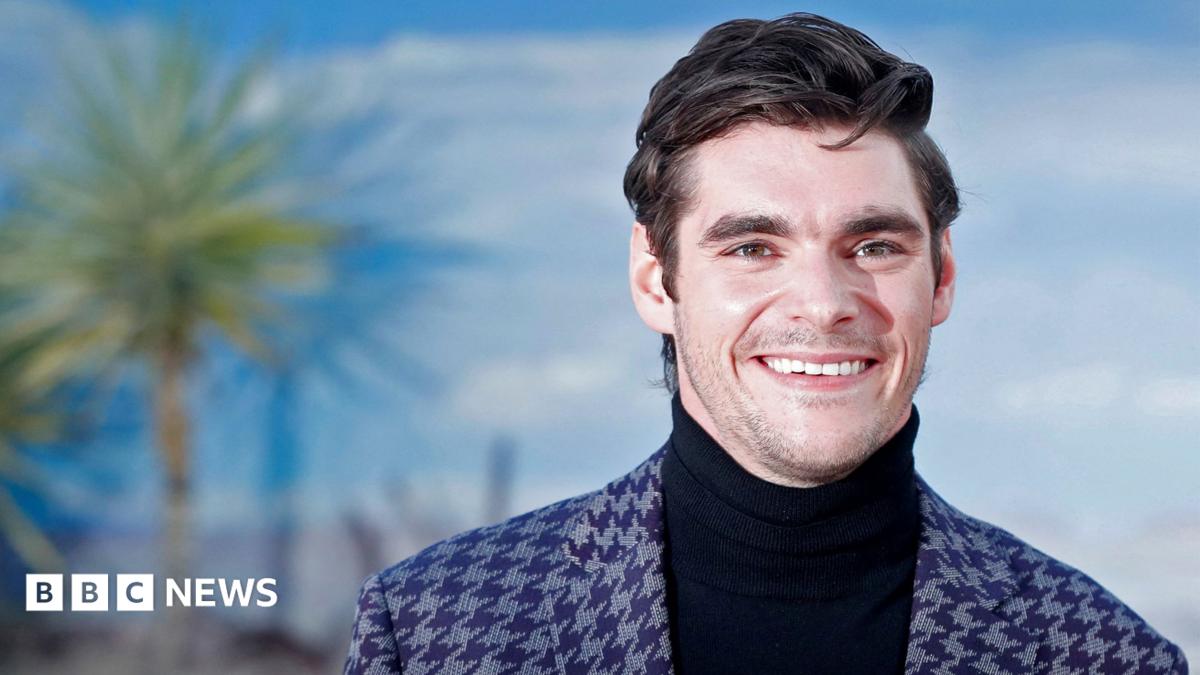
Emmy Award-winning voice actor Eric Bauza has died aged 46Credit: GettyThe star voiced iconic characters like Bugs Bunny, Daffy Duck and The Road RunnerCredit: Getty
The Canadian voiced dozens of beloved characters over more than 25 years in the industry, winning three Emmys for his Looney Tunes roles.
He died as a result of heart disease, according to Los Angeles County Medical Examiner records.
Sign up for the Showbiz newsletter
Thank you!
Bauza had multiple characters in this summer‘s hit animated comedy Coyote vs. Acme.
These included Bugs Bunny, Daffy Duck, Foghorn Leghorn, Pepé Le Pew, Porky Pig, Elmer Fudd and The Road Runner.
The actor told NBCNews in 2021 that he was a huge fan of Looney Tunes growing up and used to copy the voices.
He said: “Looney Tunes transcends all languages and all cultures.
“It doesn’t matter what part of the planet you’re from. You get the comedy.”
Bauza was also known for playing Toad General in 2023’s The Super Mario Bros. Movie and its sequel The Super Mario Galaxy Movie, this year’s fifth highest-grossing film internationally.
Most read in Entertainment
Bauza was a huge fan of Looney Tunes growing upCredit: GettyHe started voicing Bugs Bunny in 2018Credit: Getty
He won three Emmy Awards for outstanding voice performance in 2022, 2023 and 2025 for different animated shows.
Channing Dungey, the chairman of Warner Bros. Television Group and US Networks, said in a statement: “Eric Bauza was a unique voice talent who brought joy and laughter to millions around the world.
“He followed in the footsteps of giants like Mel Blanc. Eric said that carrying on the legendary legacy of the Looney Tunes was among the greatest honors of his life.”
Born in the Toronto suburb of Scarborough in Ontario, Bauza made his voice acting debut in the Canadian animated series The Ripping Friends.
Before stepping behind the microphone, he began his journey in animation as a character designer for Hollywood production studios.
He would go on to have more 421 voice acting credits in film, television and video games listed on his IMDb profile.
Bauza’s extraordinary vocal range allowed him to become the definitive modern successor to legendary voice actor Mel Blanc, and he first took on the iconic Bugs Bunny role in 2018.
He was hired by showrunner Peter Browngardt to audition during breaks in recording sessions for Uncle Grandpa.
His official debut episodes eventually premiered with the launch of the HBO streaming series Looney Tunes Cartoons in 2020.
Film producer and screenwriter Christopher DeFaria, who worked with Bauza on Coyote vs. Acme, told Variety the voice actor would be remembered for his “incredible impact”.
DeFaria said: “He’s a voiceover artist for animated characters that have historic precedents and roles, and somehow out of that, he carved out a place in this business.
“This past year, he had such an incredible impact, both on our movie, of course, but also on bringing attention to this amazing art form.”
Lawrence McCutcheon, a five-time Pro Bowl running back for the Rams who went on to have a long career in the team’s front office, died Friday. He was 76.
McCutcheon’s family announced his death through the Rams. In a statement, the family said McCutcheon had “a long, courageous battle with Parkinson’s disease.”
McCutcheon played his first eight NFL seasons for the Rams, who drafted him out of Colorado State in 1972. The native of Plainview, Texas, quickly emerged as one of the most dynamic running backs of the 1970s, earning a Pro Bowl selection and leading the Rams in rushing each year from 1973 to 1977 in coach Chuck Knox’s productive offense.
McCutcheon, nicknamed “Clutch,” was a second-team AP All-Pro selection in 1974.
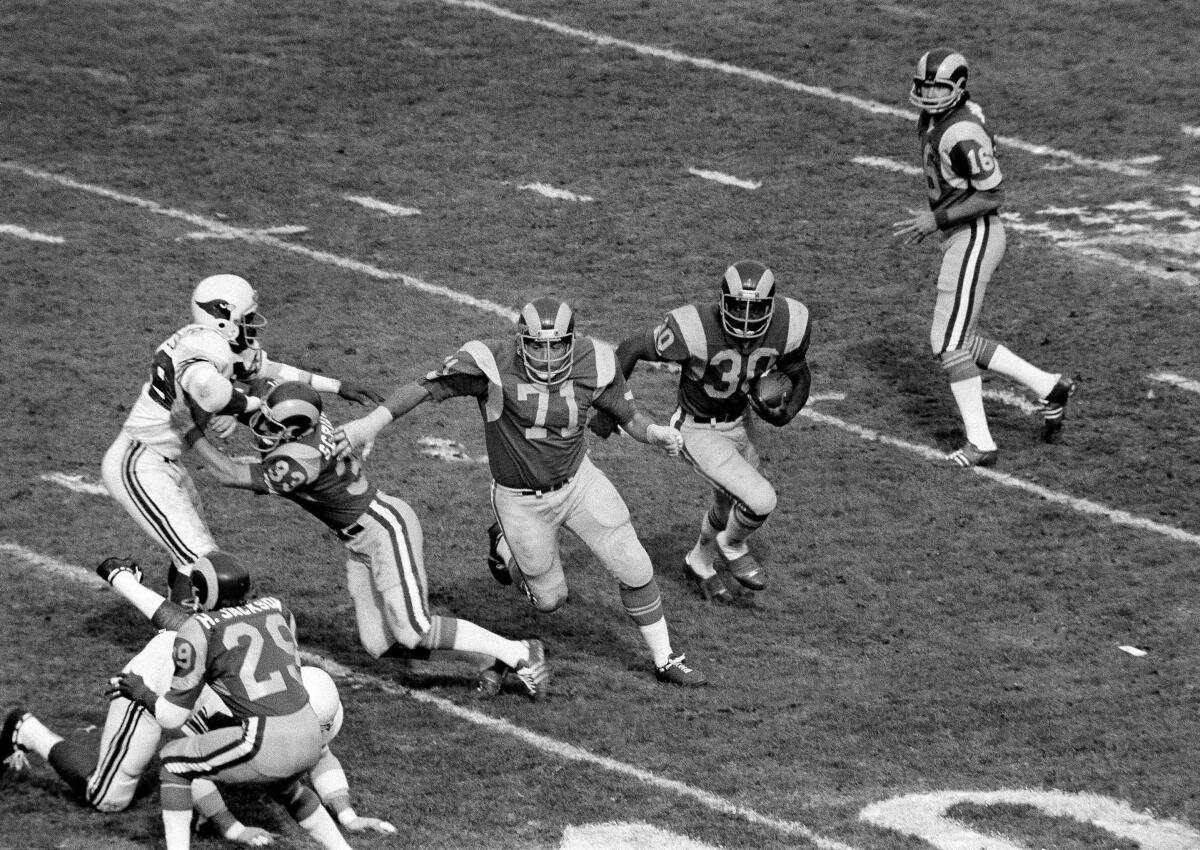
Rams running back Lawrence McCutcheon carries the ball against the St. Louis Cardinals in a divisional round playoff game at the Coliseum in December 1975.
(Associated Press)
He appeared in 11 postseason games for the Rams. In the Super Bowl in January 1980, he even threw a touchdown pass to Ron Smith to put Los Angeles ahead before the Pittsburgh Steelers rallied to win.
McCutcheon was the Rams’ career rushing leader when he left in 1980. After he finished his playing career with stops in Denver, Seattle and Buffalo over two seasons, McCutcheon became an executive for the Rams, eventually spending more than three decades in their front office.
McCutcheon rose to become the St. Louis Rams’ director of player personnel from 2003 until his retirement in 2016, shortly before the team moved back to Los Angeles.
“Through a decade-long playing career and another 32 years in the Rams’ front office, Clutch earned the respect and admiration of teammates, opposing players, colleagues and fans alike,” McCutcheon’s family said in its statement. “Clutch will be missed and remembered forever.”
McCutcheon’s son, Daylon, was a cornerback for the Cleveland Browns from 1999 to 2006. Lawrence McCutcheon’s grandson, Dyson, is a defensive back at Middle Tennessee.
Ron Duguay, a longtime New York Rangers star who finished his NHL career with the Kings, has died of cancer. He was 69.
The Rangers announced the loss of “one of the most popular players in franchise history” on Thursday morning after being informed by Duguay’s family.
“Ron’s signature skating style — with his hair flowing as he moved down the ice — captivated The Garden Faithful, and his skill, tenacity, and charisma earned him the admiration of all New Yorkers,” the team said in a statement. “We join the hockey community in sending our condolences to Ron’s friends, family, and loved ones during this difficult time.”
Former Alaska governor and 2008 Republican U.S. vice presidential nominee Sarah Palin, who dated Duguay over the last several years, posted on social media that the one-time NHL All-Star “passed away peacefully” Thursday “after a hard-fought battle with cancer.”
“It’s with a shattered heart, but also deep peace knowing Ron is with Jesus now,” Palin wrote. “He fought so hard. Love never ends.”
On Sunday, Palin posted photos that appeared to show her holding Duguay’s hand while he was in a hospital bed. “Prayers for Ron Duguay are felt & appreciated,” she wrote.
Born in Sudbury, Ontario, Duguay was selected by the Rangers at No. 13 overall in the 1977 draft. Known for his long, curly hair and flashy lifestyle — “why, he even danced with Cher at one of Manhattan’s best-known discos,” the New York Times wrote in 1983 — Duguay became a star during the six seasons of his initial stint in New York. He helped the Rangers make the 1979 Stanley Cup Final and earned his only All-Star nod in 1982.
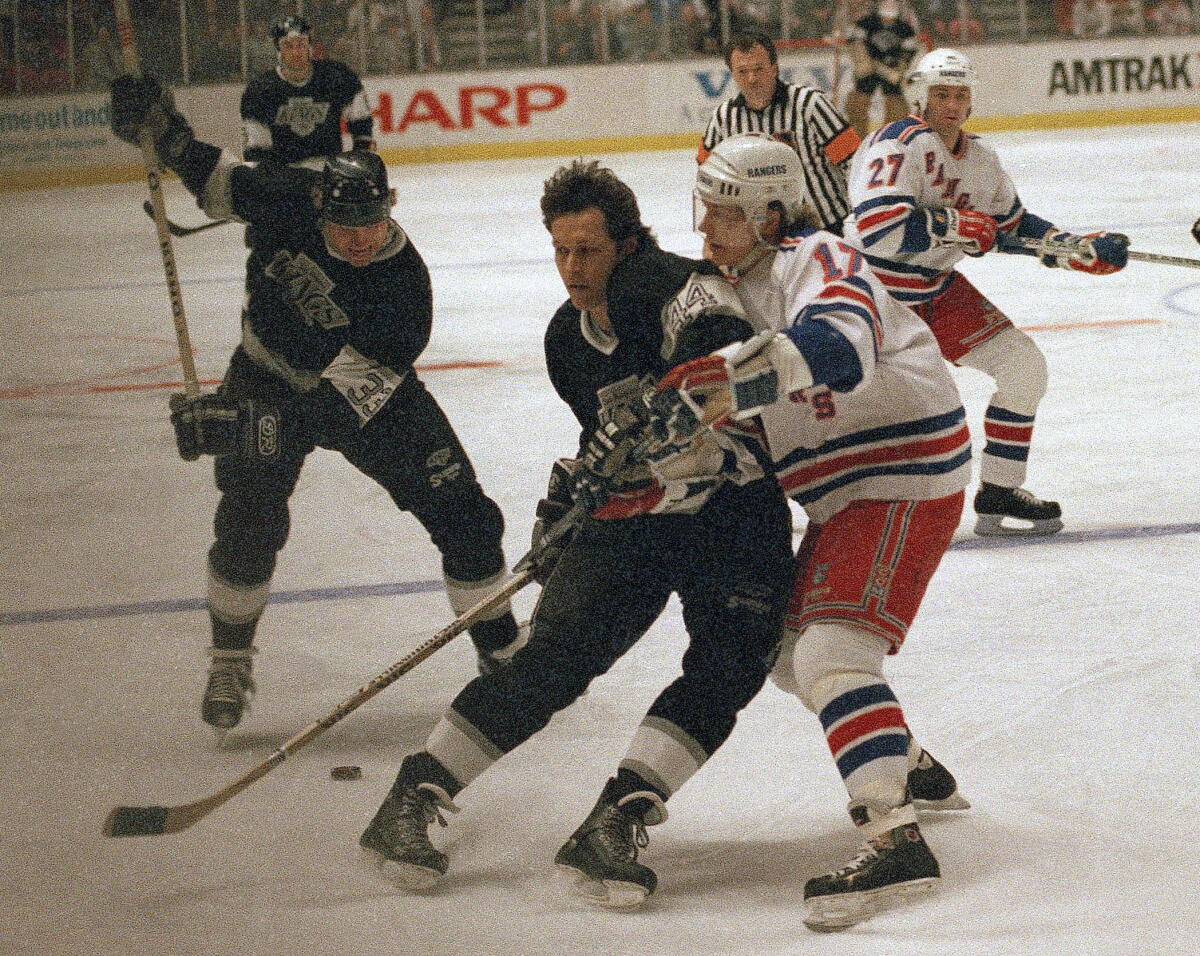
Ron Duguay, front left, blocks out New York Rangers’ Carey Wilson as Kings teammate Marty McSorley winds up to shoot Feb. 27, 1989, at Madison Square Garden.
(Ron Frehm / Associated Press)
Duguay was traded to the Detroit Red Wings in the summer of 1983 and had the two best seasons of his career, including career highs of 89 points on 38 goals and 51 assists during the 1984-1985 season. He also played for the Pittsburgh Penguins and a second time for the Rangers before wrapping up his career with the Kings from 1988 to 1989.
Overall, Duguay had 673 points (305 goals, 368 assists) in the NHL regular season and playoffs. He went on to play in the minor leagues, including two seasons with the IHL’s San Diego Gulls, and spent 12 years calling Rangers games as an MSG Network analyst.
“Ron greeted each day with the biggest smile, an incredible zest for life, and a positive outlook that shone through everything he saw, everything he did, and every life he touched,” the NHL Alumni Assn. wrote on X. “He will be remembered not only for the player he was, but for the extraordinary person he was. His warmth, his laughter, his kindness, and his beautiful spirit will forever remain in the hearts of his family, friends, teammates, and the entire NHL Alumni community.”
The Kings reposted the alumni association’s statement and added: “Our hearts are with Ron’s family & loved ones and we join them in mourning his passing.”
In 2024, Duguay was diagnosed with Stage 4 cancer, which had started in his colon before spreading to his liver and other parts of his body, according to a post on the GoFundMe page set up by his three adult children to help pay for his medical and travel costs. He lived in Florida but had to make regular trips to Orange County for treatment.
“Early this morning, our beloved father took his final breath after fighting a long and courageous battle. He fought with everything he had, right until the very end,” daughter Shay Thomas wrote on Thursday in a separate GoFundMe post. “Our hearts are shattered, and the world feels a little less bright without him in it. He will be missed by so many, but we find peace in knowing that he is finally free from pain and suffering.
“He fought the good fight until his very last breath, and today, Heaven gained a truly special angel.”
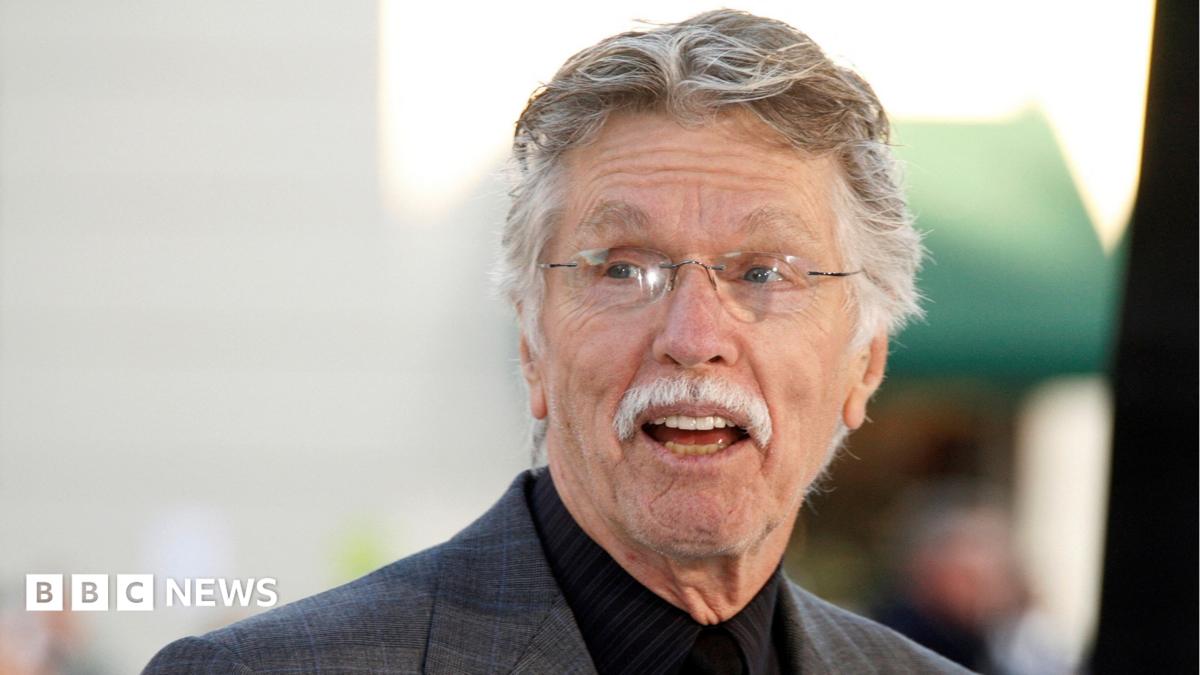
US actor Tom Skerritt, who starred in the TV series Picket Fences, and the films Alien and Top Gun, has died aged 93, his family says.
Skerritt died on Wednesday of natural causes, his family said: “While the world knew Tom through his remarkable acting career, we knew him for his humor, curiosity, wisdom, generosity, and the love he brought into our lives.”
In a six-decade career, he took on film and television roles, appearing in the film Mash, A River Runs Through It and Ted. He also co-founded TheFilmSchool in Seattle to support next-generation filmmakers and storytellers.
His family said he will be remembered “for his belief that stories can help people heal, find purpose, and create change.”
The mustachioed star of several 20th century hit films was born on 25 August 1933 in Detroit, Michigan, and served in the US Air Force before pursuing an acting career that boasted several military roles.
He made his film debut in 1962 alongside a young Robert Redford in War Hunt and years later re-teamed with Redford in the 1992 period drama A River Runs Through It, which starred Brad Pitt.
Skerritt’s breakthrough role came when he played US army surgeon Duke Forrest in the 1970 Korean War comedy Mash, which also starred Donald Sutherland, Elliott Gould and Sally Kellerman.
The hit film, which was released amid unrest over the Vietnam War, was nominated for five Academy Awards and was adapted for television two years later.
He also starred alongside Sigourney Weaver in the 1979 sci-fi film Alien, which earned two Oscar nominations, and led to three sequels and several crossover projects.
“It is spontaneity and impulse that make the difference, and that is what I felt we had with ‘Alien,'” Skerritt said in a 2019 interview, according to Reuters news agency.
“Every one of us had that immediate rapport with each other.”
Skerritt said that one of the things he liked most when he first read the script was that “the woman becomes a hero”, referring to Weaver’s character, Ripley.
During his career, he starred opposite several strong female leads.
He appeared with Shirley MacLaine in the 1977 film Turning Point and played Sally Field’s husband in 1989’s Steel Magnolias.
As Commander Mike “Viper” Metcalf in the 1986 classic Top Gun, the versatile actor appeared alongside a young Tom Cruise in the blockbuster.
On television, he won an Emmy Award in 1993 for his role as Sheriff Jimmy Brock in David E Kelley’s drama Picket Fences.
The procedural’s ensemble cast was nominated for SAG Awards in 1995 and 1996, and he received a nod for male actor in a drama series in 1995.
Skerritt also had guest roles on the small screen in The West Wing, Madam Secretary, Law & Order: SVU and Huff. He reteamed with Field as the family patriarch, William Walker, in the drama Brothers & Sisters from 2007-09.
He had a six-episode stint on Cheers playing Rebecca Howe’s crush-worthy boss Evan Drake.
In a statement, Skerritt’s family said that he leaves behind a “legacy that reaches far beyond the screen”
A deep believer in the power of storytelling, Skerritt helped found the TheFilmSchool in Seattle and co-founded the Red Badge Project, which helps veterans work through PTSD, anxiety and depression by writing and sharing their experiences.
Inspired in part by his experience filming A River Runs Through It, he also believed in protecting the natural world.
He created the documentary series Reflections of the River about America’s rivers and supported river conservation.
A decorated Air Force service member of 15 years died after a rappelling accident that took place during a salute to the military Saturday before the Navy-University of Texas at San Antonio game at the Alamodome.
U.S. Air Force Tech. Sgt. Ian Patterson was a Tactical Air Control Party instructor assigned to the 6th Combat Training Squadron, Detachment 2, Joint Base San Antonio, according to a news release by Nellis Air Force Base Public Affairs.
“This tragedy is felt deeply across the 57th Wing,” U.S. Air Force Brig. Gen. Scott C. Mills, 57th Wing commander, said in the release.
“Tech. Sgt. Patterson and his service mattered immensely to our wing, and to the family, friends, and teammates who had the privilege of knowing and serving alongside him. Our team is now focused on standing beside Ian’s family, loved ones, and fellow Airmen as we navigate this profound loss together.”
Patterson received several medals for his service and achievements, according to the Nellis Air Force Base Public Affairs, including the Air and Space Commendation Medal with three oak leaf clusters. In 2022, he was named the Air Force Special Warfare Enlisted Instructor of the Year at the Headquarters Air Force level.
Details surrounding the accident are under investigation, according to the news release.
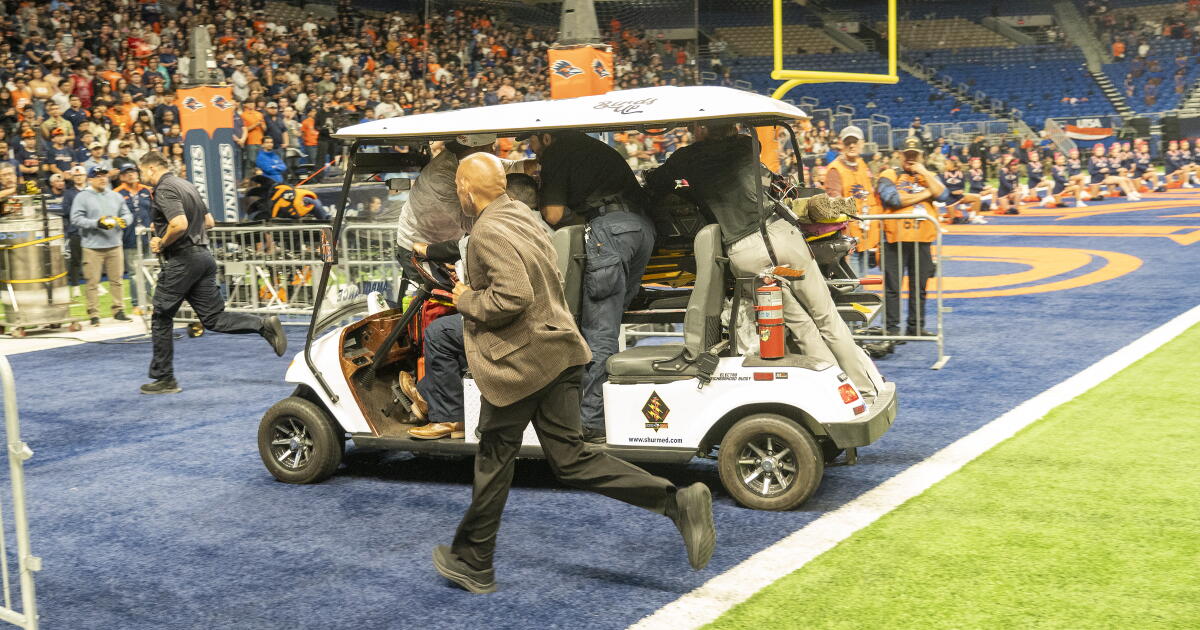
Video on social media appears to show Patterson rappelling from the arena’s rafters on a rope, and plummeting fast to the ground. He was treated on the field for several minutes and then taken away on a gurney.
Patterson later died at a local hospital, according to Nellis Air Force Base Public Affairs.
The football game between the two American Conference teams proceeded after a brief delay. The decision to play was made after a meeting that included conference commissioner Tim Pernetti, representatives from Navy and UTSA, Alamodome management and local authorities, according to a statement released by the American Conference.
“At the time of those discussions, Nellis Air Force Base Public Affairs had not publicly confirmed the service member’s condition,” the statement reads. “… In accordance with conference bylaws and with the support of both participating member institutions, the conference made the decision to continue the game. Respect for the family’s privacy and adherence to the military’s notification process guided the decision to mitigate speculation about the service member’s medical status and avoid additional distress for his family.”
The conference added that it extends “our deepest condolences to his family, friends, teammates and members of the 57th Wing who had the privilege of serving with him. We honor his service and join the military community in mourning his loss.”
UTSA president Taylor Eighmy also released a statement expressing “profound sadness.”
“In moments like these, words can offer only so much comfort,” Eighmy wrote. “But I hope the service member’s family, his fellow airmen and all those grieving know that they are in our thoughts and prayers. We stand together in sadness, united by our compassion for one another and our heartfelt support for all those whose lives have been touched by this tragedy.”
The UTSA vice president for intercollegiate athletics, Lisa Campos, said in a statement: “Moments like these remind us that we are all part of something much greater than a game. They remind us of the importance of standing together, supporting one another and finding strength in the bonds that unite us, especially in times of profound sadness. Today, our hearts are with this service member’s family, his fellow airmen and everyone impacted by this heartbreaking tragedy.”
Former Sale second row Hyron Andrews has died at his Johannesburg Lions’ team hotel before their Champions Cup match at La Rochelle on Saturday.
A statement from SA Rugby stated that his death had been an “accident” and that the 31-year-old had “died after a fall”.
“We are heartbroken by the passing of Hyron,” said Lions chief executive Rudolf Straeuli.
“He was not only a gifted rugby player, but also a cherished member of our Lions family having recently joined us this season.
“On behalf of our chairman, Mr Altmann Allers, the board and everyone at the Lions, I extend our deepest sympathies to [Andrews’ wife] Maighlin, their young sons Hendrix and Emerson and the entire Andrews family.
“We stand with them in their sorrow and will remember Hyron with great affection and respect.”
The Lions will fulfil their fixture against La Rochelle, which kicks off at 17:30 BST, in Andrews’ honour, while a moment’s silence will be observed at all the opening round’s fixtures.
“This is terrible and distressing news; our hearts go out to Hyron’s family and the whole Lions rugby community,” said Mark Alexander, president of the South African Rugby Union.
“There are no words to adequately convey our shock and the depth of sympathy we feel for his wife Maighlin, and for his extended family, friends, team-mates and loved ones during this time of immense sorrow.
“His untimely passing is a devastating loss, and we share in the grief of all who knew and loved him.”
Andrews left Sale in the summer to return to his native South Africa. He made 45 appearances for the club after arriving in February 2024 from the Durban-based Sharks as injury cover for England international lock Jonny Hill.
“Hyron was just a brilliant guy and a brilliant team-mate,” said Sale director of rugby Alex Sanderson.
“He was so skilled on the field but off it, he was always someone you would want to have a beer with.
“He was funny and charismatic in his own unique, dry way and the lads, to a man, loved playing with him and being around him.
“It was a big move for Hyron and his wife Maighlin to come to England, but he truly made a second home in Manchester. It was incredible to see how he and his family embraced the club and area.
“Most importantly, he was a loving husband to Maighlin and a doting father to his two gorgeous boys. It was an absolute privilege to get to know him and it’s just absolutely devastating for everyone.”
While he was yet to earn senior international honours, Andrews had represented the Junior Springboks in 2015.
The Lions, who play their home matches at Ellis Park, are making their first appearance in Europe’s premier club competition, with South African sides introduced into the continental competition in the 2022-23 season.
The hope for a Dodgers comeback in the National League Championship Series ended with the smack of the ball hitting leather.
Milwaukee Brewers left fielder Jackson Chourio, sprinting toward the warning track, had to leap to reel in Kiké Hernández’s line drive in the gap. But he secured the catch. And ended the Dodgers’ season.
The Dodgers’ hopes of making National League history with a three-peat died with a 6-4 loss to the Brewers on Thursday, completing Milwaukee’s four-game sweep.
“It sucked,” veteran left fielder Teoscar Hernández said. “Especially after [what] we had done the last two years. This year at the beginning of the year, what we’ve been through, a lot of injuries throughout the year the last two years, a lot of ups and downs. It just sucked that we’re in this situation, but it’s part of the game.
“Somebody has to win, somebody has to lose. This time, we’re the ones that lost, and just reflect on everything that we didn’t do great this year and just try to do it next year.”
As the Dodgers’ postseason hype video declared before the game: “October doesn’t remember who came close. It remembers who triumphs.”
The Dodgers, after reinforcing to their back-to-back championship roster in the offseason and entering the year as the World Series favorites, fell short. And instead the Brewers will represent the National League, making their first trip to the Fall Classic in 44 years.
“They may have a bunch of Hall of Famers, but we have a bunch of gamers,” Brewers manager Pat Murphy said from the stage. “And the gamers won this week.”
When the Dodgers went down 3-0 in the series, they faced a steep climb that only one team in MLB history has overcome. But the Dodgers showed resolve to begin the game.
Three singles in the second inning gave the Dodgers a lead, with Andy Pages driving in the first run. It was his third hit of the postseason with runners in scoring position and the Dodgers’ fourth overall. Then with two outs, Ohtani not only prolonged the inning but also made it the Dodgers’ highest-scoring frame of the postseason, with their first home run of the series.
It had been a maddening couple of months as Ohtani battled injuries, slid down the batting order and failed to produce when the Dodgers needed him most — in the postseason.
Then on Thursday, with the Dodgers on the brink of elimination, one swing momentarily wiped all that away.
Ohtani got his bat head down to a cutter from former Dodgers pitcher Dustin May on the inside corner. He lifted it into the stands for a three-run home run.
Ohtani turned to the Dodgers’ dugout, spread his arms wide and tossed his bat to the side. He tilted his face to the sky and yelled. He punched the air.
This was the version of Ohtani the Dodgers had sorely been missing. He announced his return with authority. And he breathed life into a stadium that had a crowd of only 49,104 — short of a sellout.
It was his first home run since Aug. 18. And it had been even longer since he’d hit a homer quite like that. With an exit velocity of 113.1 mph, it was his hardest-hit home run since June 20 and his third-hardest hit of the year, according to Statcast.
Even more important, it was the big swing the Dodgers had been waiting for all series.
“It was something that you don’t see very often from Shohei,” manager Dave Roberts said. “I think it was a lot of pent-up anger, frustration. It was the best ball he hit in probably two, three months, and it was a big hit. So I think that for him to look at the dugout, show that emotion, it just shows how much he cares. He’s still human. He still cares and wants to help his team win a baseball game. That was a big hit.”
Dodgers starter Tyler Glasnow kept the good vibes going, retiring the first 10 batters he faced. But the Brewers, as they had all series, had a comeback in them.
“We got a nice lead, we got Glas on the mound, we’re confident behind him,” third baseman Max Muncy said. “And they just kept stringing together one good at-bat after another after another after another. They were just kind of relentless.”
It began with one out in the fourth inning, as Brice Turang drew a walk, the first baserunner against Glasnow. Then William Contreras and Jake Bauers each bounced ground-rule doubles into the stands, Bauers’ driving in two runs to cut the Dodgers’ lead in half.
Shohei Ohtani strikes out with a runner on third during the seventh inning.
(Gina Ferazzi / Los Angeles Times)
The next inning, the Brewers used a walk, stolen base and David Hamilton’s RBI single to trim the Dodgers’ lead to one and knock Glasnow out of the game.
Right hander Evan Phillips replaced him and loaded the bases the rest of the way, before left-hander Alex Vesia entered to face Bauers, who had been a nightmare for the Dodgers this series.
Vesia walked Bauers on four pitches, tying the score at 4-4.
The Dodgers had lost their momentum, but they still had time.
Then, in the sixth, Dodgers setup man Tanner Scott took the mound early, at an inflection point in the contest. He worked ahead 0-and-2 in the count to Garrett Mitchell. But Mitchell spat on three straight balls to get to a full count.
Scott missed down the middle with a fastball. Mitchell sent it over the fence to give the Brewers the lead for the first time.
Even down by a run, Roberts continued to manage like he had hope, bringing in Edwin Díaz in the seventh to keep the game close.
The Dodgers’ offense got runners to third in three straight innings. In the sixth, Kyle Tucker hit a one-out double, and Teoscar Hernández moved him over with a groundout. In the seventh, Pages led off with a double, and Kiké Hernández bunted him over. In the eighth, with one out, Will Smith cut out the middle man by doubling into the right-field corner and advancing to third when Milwaukee’s Sal Frelick misplayed the carom off the wall.
The Dodgers stranded all three at third, failing to score the tying run.
“They just outplayed us this series,” first baseman Freddie Freeman said. “That’s just kind of how it goes. We had our opportunities. We just didn’t get it done.”
Díaz did his part to keep the Dodgers in the game, retiring eight straight batters. But the ninth batter he faced, Hamilton, hit a solo homer to add cushion to the Brewers’ lead.
“I wouldn’t want to go through this with any other group of guys,” Muncy said. “We really tried to do something special in this clubhouse, and I know next year we’ll be ready to get right back to it. But right now, this sucks.”
Mitte, who grew up in Louisiana, was a young teen when he auditioned for the breakthrough role after moving to Los Angeles to support his younger sister’s acting career in 2005.
He had said that his first audition in Los Angeles was for a California state public service announcement for an anti-meth commercial.
“Fast forward to auditioning for Breaking Bad, which is still, in my opinion, an anti-meth thing because it doesn’t end well for anyone,” he said on the Joe Vulpis Podcast earlier this month.
His character was based on Gilligan’s late friend who had a more severe case of cerebral palsy and used forearm crutches, which Mitte did not require.
Mitte was seen as playing the role with honesty and accessibility, cracking jokes as a teen whose health condition was rarely mentioned in the series.
Breaking Bad aired on US cable broadcaster AMC for five seasons from 2008-13.
After shooting to fame, Mitte fought for more varied roles and complex depictions of characters with disabilities, both visible and invisible.
“Whenever awards season rolls around, we always hope to see a diverse group of projects that reflect all of us, in body and mind,” he told the BBC in 2021.
“Watching the awareness grow around disability representation has been great to see, but breakthroughs sometimes come in pieces and moments instead of larger change,” he said.
Mitte’s other on-screen credits include Hannah Montana, Switched at Birth, Westhampton and his latest project, Talking to Strangers, which came out earlier this year.
Additional reporting by Rebecka Pieder.
If you have been affected by the issues raised in this story help and support is available via the BBC Action Line.
One person has died and several others were injured in an incident at Six Flags ‘Over Georgia’ theme park near Atlanta. Witnesses reported seeing a man fall from the Goliath rollercoaster, but authorities have not confirmed how the person died.
AARON Paul has paid tribute to RJ Mitte saying he has been left “heartbroken” after the Breaking Bad star died, aged 34.
Mitte, who famously played Walter White Jr in the Emmy Award-winning show, tragically died on Monday in Brownsville, Texas.
Aaron Paul has paid tribute to RJ Mitte after the Breaking Bad star died, aged 34Credit: AP:Associated PressMitte portrayed the son of Bryan Cranston’s Walter White during the hit series’ five-year runCredit: Alamy
Paul – Mitte’s Breaking Bad co-star who played Jesse Pinkman – told The Hollywood Reporter: “I am at a loss. I am heartbroken over this news.
“RJ, I love you my friend. You will be missed. And to whoever happens to be reading this, please know you are loved, and you are not alone. Always remember that.”
Sign up for the Showbiz newsletter
Thank you!
Dean Norris, who also played alongside Mitte as his on-screen uncle Hank Schrader also paid tribute, saying: “Though RJ didn’t play my TV son, I always looked out for him as a young kid on set.
“He was a sweetheart of a young man and will be greatly missed. This is so heartbreaking, I can’t believe it. Thinking of him and his family.”
Mitte’s representative confirmed to TMZ on Monday that Mitte had tragically passed away in Texas.
They said: “It is with profound sadness that we share the tragic passing of beloved actor, philanthropist, and passionate disability rights advocate RJ Mitte.
“RJ Mitte was best known for his role as Walter ‘Flynn’ White Jr on AMC’s critically acclaimed, award-winning series Breaking Bad.
“Drawing from his own experience living with cerebral palsy, Mitte brought authenticity to the role and built a platform on disability awareness and inclusion.”
Most read in Entertainment
Paul said he was ‘heartbroken’ in a tribute to the TV starCredit: GettyMitte, who had cerebral palsy, became a leading disability rights activistCredit: Alamy
His cause of death was not immediately disclosed, however, the outlet reported that he died by suicide.
Mitte was born on August 21, 1992, in Jackson, Mississippi, and was diagnosed with cerebral palsy at just three-years-old.
But he used his stardom as a Hollywood actor to become a leading disability rights advocate.
He spent most of his childhood using crutches, but improved his ability to walk over his teenage years through sports and exercise.
He told Future of Personal Health: “My hope is to inspire a ‘never give up’ mentality.
“If there is something you want in life, pursue it no matter how hard it may be. Keep your dreams alive. Don’t lose sight of who you want to become.”
Off the set, Mitte served as a celebrity ambassador for several organizations, including United Cerebral Palsy and Shriners Children’s.
Dean Norris, who played alongside Mitte in Breaking Bad, said he was a ‘sweetheart of a young man’Credit: GettyMitte was cast in the role, aged 15, and went on to star in 56 episodes of the hit crime dramaCredit: Alamy
He was also the president of his own charity – The Mitte Foundation – which supported philanthropic efforts and community initiatives, challenging stereotypes around people with disabilities.
Breaking Bad – often credited as one of the best TV series of all time – aired on AMC for five seasons between 2008 and 2013, earning a staggering 58 Primetime Emmy nominations.
Mitte was cast in the leading role of Walter “Flynn” White Jr in 2008 at the age of 15, going on to star in 56 episodes of the hit crime drama.
He played the son of Bryan Cranston and Anna Gunn’s characters – Walter and Skyler White – and his character also had cerebral palsy, as Mitte drew on his own experience for the part.
A week before his sudden death, Mitte appeared on the Joe Vulpis Podcast, where he spoke about his early days in acting and his time on the show.
He called auditioning for Walt Jr “one of the longest auditions of my life”, saying he was one of the last characters to be cast in an audition process that took six months.
A year before his death, Mitte got engaged to his longtime girlfriend, Kennedy SuarezCredit: GettyRJ Mitte pictured at the screening of Talking To Strangers at the Fine Arts Theatre on September 30 in Beverly HillsCredit: Getty
Mitte added: “It was me versus another individual at the time. An hour later, Vince called me and goes, ‘Hey, RJ, you got the part. Pack your bags. Go back to Los Angeles, and come back to set. You’re already late. We’re already filming. We need you here’.
“And that was history for me.”
Reacting to the news of Mitte’s death, Vulpis said on social media: “I had the honor of sitting down with RJ Mitte not too long ago and I can genuinely say he was such a kind, incredible, and gentle soul.
“My heart goes out to his family and loved ones, and I wish them peace and privacy during this difficult time.”
Mitte’s breakout role came after starting his career in entertainment as an extra in shows such as Everybody Hates Chris and Hannah Montana.
It opened up further opportunities with the TV star going on to feature in shows including Switched at Birth and Netflix’s animated series The Guardians of Justice.
He also appeared in several films including the drama “Triumph” from 2021, which he also executive produced.
Mitte’s final public appearance came just days before he tragically passed away as he smiled on the red carpet for the premier of his new movie – Talking to Strangers – on September 30 in California.
He was a Screen Actors Guild spokesman for actors with disabilities and in 2013, he received the SAG-AFTRA Harold Russell Award.
A year before his death, Mitte got engaged to his longtime girlfriend, Kennedy Suarez, in October 2025.
At the time, Mitte gushed about starting a life together with Suarez, telling People: “I’m thrilled to have found my person, my partner in life who makes me want to be better, no matter what we’re doing.
“Kennedy is my everything and I can’t wait to officially start our life together and see what adventures life takes us on next.”
If you or someone you know is affected by any of the issues raised in this story, call or text the 988 Suicide & Crisis Lifeline at 988, chat on 988lifeline.org, or text Crisis Text Line at 741741.
Six Flags Entertainment (FUN) shares sank 10.8% after-hours Monday following a report that one person died and several others were injured in an incident involving a Six Flags roller coaster in Georgia.
No details are available to clarify how the person
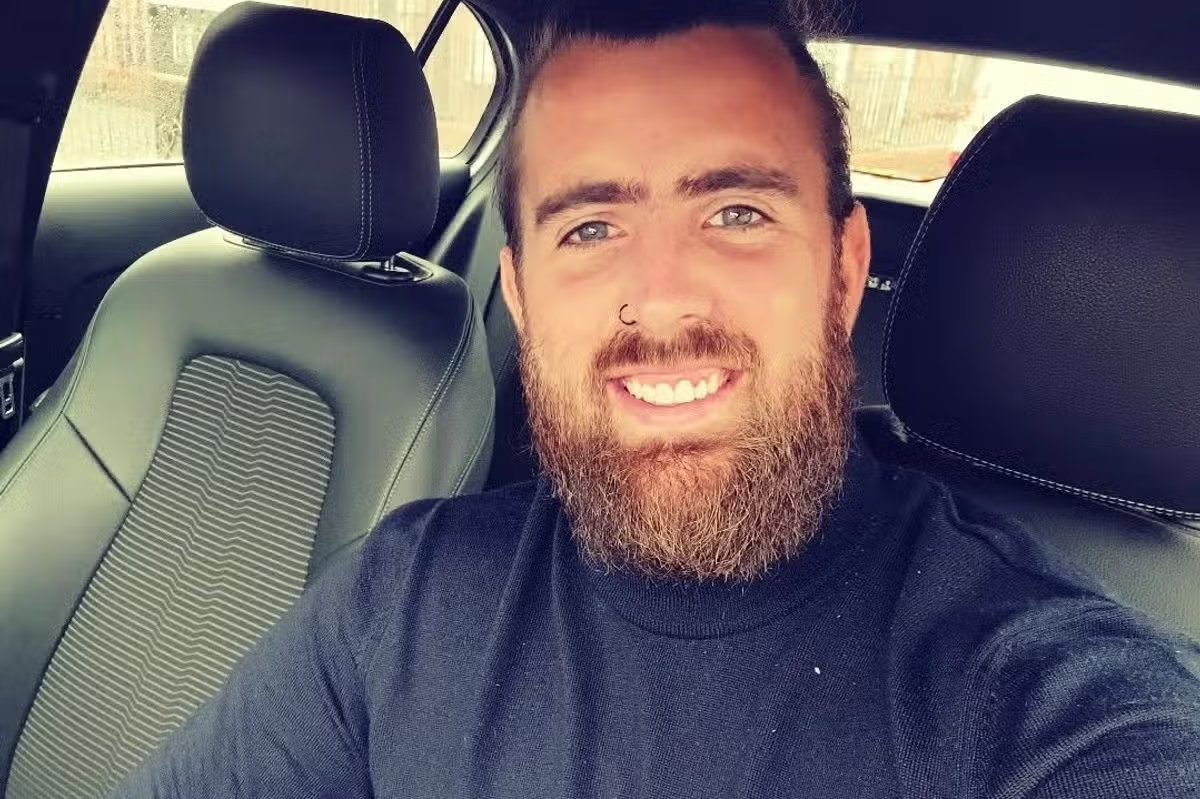
A football coach has died suddenly while on holiday with friends at just 37 – leaving behind his fiancée and two young sons. Warren Coard, from Co Antrim, Northern Ireland, died while on a trip in Tenerife with a group of friends.
The dad-of-two was a former goalkeeper and coach for several clubs and is remembered as a much-loved character who could light up any room. A fundraiser has been launched to help his fiancée Olivia Greer cover medical costs and funeral expenses.
It reads: “It is with the heaviest of hearts that we share the devastating news of the sudden loss of Warren Coard, who sadly passed away in Tenerife while away on a trip with his friends. At just 37 years old, Warren was taken from us far too soon, leaving behind a heartbroken family, friends and everyone who had the privilege of knowing him.
“Warren was the life and soul of every gathering. He had a personality that could light up a room, bring people together and make everyone around him smile. He was the kind of person who made memories wherever he went, and his presence, laughter and infectious spirit will never be forgotten.”
The appeal paid tribute to Warren’s fiancée, his sons Charlie and Levi, his mum Carol and his wider family. It added: “No family should ever have to experience such heartbreak, especially so suddenly and at such a young age. At this incredibly difficult time, Warren’s loved ones are facing the unexpected financial burden of funeral costs.
“This has placed additional pressure on his family during an already devastating time, when they should be able to focus on grieving, supporting one another and remembering Warren for the amazing person he was.”
Football clubs Warren played for also paid tribute to the former goalkeeper and coach. A spokesperson for Barn United Football Club in Carrickfergus said: “Everyone at the club is devastated to hear of the untimely passing of our former goalkeeper coach, Warren Coard aka Coardy.
“Our thoughts are with the entire family circle at this difficult time. Rest easy Coardy.”
Islandmagee Football Club said: “The club are saddened to hear of the passing of our former goalkeeper, goalkeeping coach and long term supporter Warren Coard. Everyone at the clubs thoughts are with ‘Coardys’ family and friends at this awful time.”
The fundraiser appealed for donations to help ease the financial pressure on Warren’s loved ones as they prepare to say their final goodbyes. It said: “Warren was loved by so many, and the number of lives he touched is a testament to the person he was.
“At only 37, he had so much more life to live, so many more memories to make and so much more love to give.
“Fly high, Warren. You were taken far too soon, but you will never be forgotten. Forever loved, forever missed, and always in our hearts.”
NEIGHBOURS and Home and Away legend Ray Kolle has died aged 85.
The Australian soap star and script writer passed away in Sydney, it was confirmed today.
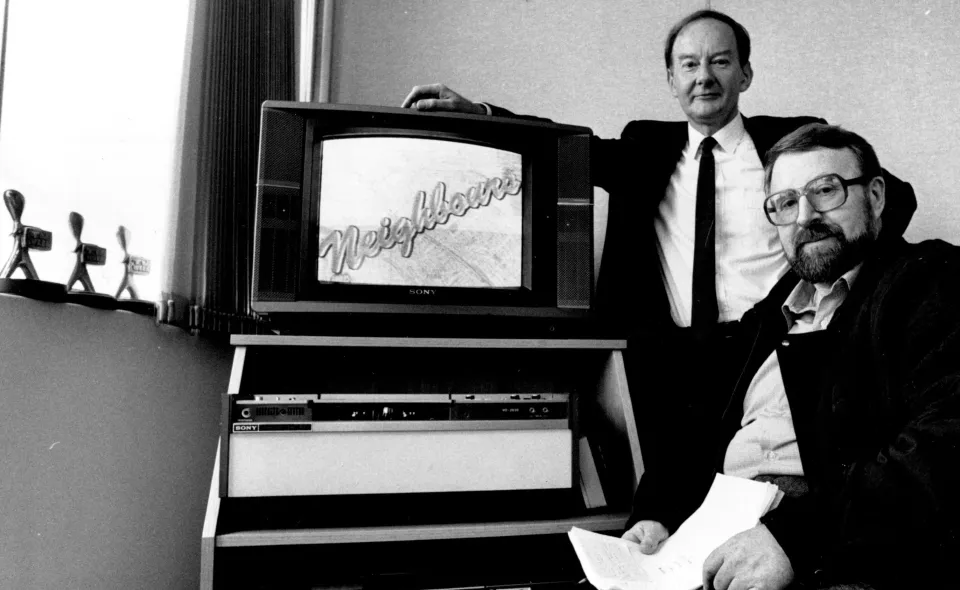
Don Battye, Executive Producer of Neighbours with Script Supervisor Ray Kolle in 1989Credit: GettyRay Kolle has passed away aged 85Credit: Facebook
Tributes have flooded in from heartbroken fans and friends who remembered Ray as an “important part of Australian television history”.
Australian entertainment and production company, TV City wrote in a statement: “Very sad news to hear of the passing of veteran Australian television writer and story editor Ray Kolle.
Sign up for the Showbiz newsletter
Thank you!
“Ray was one of those incredibly talented people working behind the scenes who helped shape some of Australia’s most iconic television dramas.
“Another important part of Australian television history has left us.
“Thank you, Ray, for the stories and memories you helped create for generations of television viewers.”
Ray served as head writer on Neighbours from 1986 until 1992, introducing iconic characters like Scott and Charlene Robinson.
His 46-year career began with a big break writing comedy sketches for In Melbourne Tonight.
More to follow… For the latest news on this story keep checking back at The Sun Online
Thesun.co.uk is your go-to destination for the best celebrity news, real-life stories, jaw-dropping pictures and must-see video.
A man has died after being attacked by a tiger at Yorkshire Wildlife Park, police have confirmed.
South Yorkshire Police said it had been called at 13:35 BST to reports of a man entering the tiger enclosure at the attraction near Doncaster. The tiger then attacked the man and he died at the scene, the force said.
His family had been informed and were being supported by officers, it added.
A park spokesperson said: “We are deeply saddened by today’s tragic incident. Our thoughts and heartfelt sympathies are with the family and loved ones of the person who has lost their life.”
They added: “We are working closely with the police and relevant authorities and would ask that the privacy of those affected is respected at this extremely difficult time. The park will remain closed tomorrow.”
Police said the tiger was uninjured, remained in the enclosure following the incident and there had been no wider risk to the public.
The park was evacuated and officers remain at the scene.
The force added: “We are aware of videos circulating online and we would encourage people not to share this footage.”
Earlier, in a statement posted on its website, the park said its emergency response procedures had been “immediately activated” and it was “working closely with the authorities to ascertain exactly what happened”.
Mustache. Aviator sunglasses. Bears sweater vest. Though Mike Ditka‘s look may be iconic, his time as a player and coach is what cemented his name in NFL history.
Ditka, the first ever tight end to be inducted into the Pro Football Hall of Fame and coach of the legendary 1985 Chicago Bears, has died. He was 86.. His family announced his death in a statement Friday.
“It is with profound sadness that we announce the passing of our beloved husband, father, grandfather, and friend, Mike Ditka,” The family said. “While the world knew Mike as a Hall of Fame football player, legendary coach, and leader of the Chicago Bears’ Super Bowl XX championship team, we knew him as the heart of our family. Mike will be missed beyond measure and remembered forever.”
With nicknames “Iron Mike,” “Da Coach” and “The Hammer,” Ditka was inducted into the Pro Football Hall of Fame in 1988 after a 12-year playing career that featured five Pro Bowls, 427 receptions, 43 touchdowns and 5,812 receiving yards.
Ditka, who won two Super Bowls as a coach and one as a player, revolutionized the tight end position, transforming it from a primarily blocking-focused role to one that could pose a threat in receiving.
Notorious for his fiery personality, Ditka also took his stardom from field to screen, starring alongside Will Ferrell in “Kicking & Screaming,” in which he played himself. Though instead of coaching the championship-winning Bears, he helps coach a little league soccer team — but his competitive spirit remains the same. He also made several TV appearances, including in “Cheers,” “L.A. Law” and “Entourage.”
Born in Carnegie, Pa., on Oct. 18, 1939, Ditka was a first-round draft pick of the Chicago Bears in 1961. The team at the time was helmed by Bears founder, president and head coach George Halas, who later bestowed Ditka with his first NFL head coaching job in 1982.
Coming from the University of Pittsburgh, where he also played basketball and baseball and received All-America honors in football, Ditka immediately became a mainstay in the Bears lineup, going on to start 84 straight games. He was named rookie of the year with 56 catches for 1,076 yards and 12 touchdowns, becoming the first tight end to reach 1,000 yards receiving in his rookie season.
He also earned All-NFL honors from 1961 to 1964 and made the NFL Pro Bowl five times in his first six seasons. Ditka was enshrined into the College Football Hall of Fame in 1986.
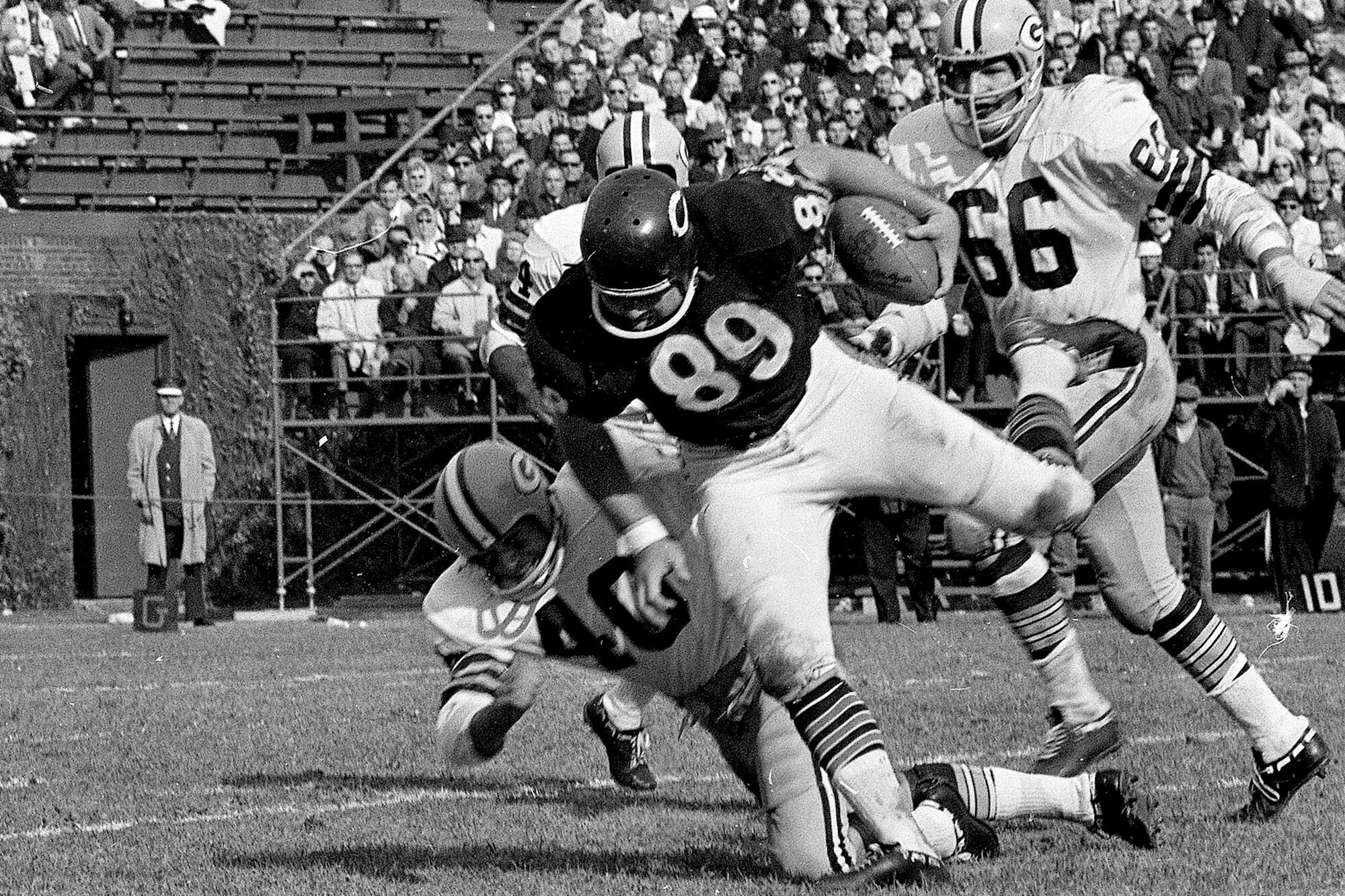
Chicago Bears tight end Mike Ditka is tackled after a pass reception against the Green Bay Packers at Wrigley Field on Oct. 16, 1966.
(Associated Press)
The tight end eventually became a coach, famously leading the 1985 Chicago Bears. The team, one of the best in NFL history, went 15-1 and scored 456 points while only allowing 198. The Bears had plenty of personality that year as well, audaciously recording a rap-styled video called “The Super Bowl Shuffle” that was released during the regular season.
But it was not only a strong season on paper — Ditka is credited with leading the Bears back to relevance and luster after losing records in 1980, 1981 and 1982. He built them back to a team fans adored and competitors feared.
“I think that’s the way Mr. Halas always wanted it,” Ditka told The Times in 1985. “He wanted to have a ballclub with a certain personality, a team made up of, you know, rough, tough guys, a team that didn’t take any crap from anybody and could dish it out.”
Ditka and the team brought triumph to Chicago in Super Bowl XX in New Orleans with a 46-10 win against the New England Patriots.
Winning NFL coach of the year with the ’85 team, Ditka is one of only two who have won a Super Bowl as a player, assistant coach and head coach.
“I believe Mike Ditka represents us, in more ways than one,” then linebacker and captain Mike Singletary told The Times. “We know he’s not coaching the Chicago Bears because he needed a job. The Bears mean something to Mike Ditka. The team is part of him.”
His time in Chicago wasn’t all glitz and glamour, though. Ditka wasn’t immediately welcomed back to the Bears as a coach, with his temper a source of strain between him and the owners. He also had a DUI conviction in 1985 and suffered a heart attack in 1988.
“There was a (magazine) poll of 200 NFL players who said the coaches they would least like to play for were, first, (Tom) Landry and, tied for second, Don Shula and me. I was flattered. What a great compliment,” wrote Mike Ditka in his 1986 autobiography.
Ditka was entrenched in controversy, having been outspoken about Washington not changing its name from the Redskins, also facing backlash for comments he made in 2016 criticizing Colin Kaepernick and social justice protests, later apologizing.
Despite it all, his name is etched in NFL history.
“Ditka was proud and headstrong,” wrote former Times sports columnist Mike Downey. “He was common and condescending. … He did as he pleased. But he restored the reputation of the Chicago Bears, made them winners and made them watchable.”
During his playing career, he made an iconic 63-yard catch-and-run against the Steelers on Nov. 23, 1963, which stands in 69th place on NFL’s 100 Greatest Plays. The highlight helped the Bears to a 17-17 tie after being down 17-14 in the fourth quarter; the team later went on to win the NFL championship.
In 1967, he was traded to the Philadelphia Eagles and then to the Dallas Cowboys in 1969. During his time with the Cowboys, Ditka made it to two Super Bowls, with a loss in 1971 and finally a win the following year in which he scored the final touchdown in a 24-3 win against the Miami Dolphins.
After retiring in 1972, Ditka joined the Cowboys as an assistant coach. He got his hands on the Super Bowl trophy once again in 1977 with the team and stayed on until joining the Chicago Bears.
The Hall of Famer’s ties with Chicago were once again severed, this time with his firing in 1993 following a 5-11 season. But he refused to shed the navy and orange in the years after he went 106-62 and led the Bears to seven playoff appearances in 11 seasons.
“Yeah, I was fired by the Bears, but that’s life,” Ditka said during a visit to Chicago’s practice field in 2013. “There has never been a time I was not a Bears fan. I have a right to be a Bears fan as much as anybody. I played on a championship team and I coached a championship team.”
The Bears retired Ditka’s number, 89, in 2013.
His involvement with the NFL expanded off the green as he explored TV commentating, even earning Sports Emmy nominations for outstanding sports personality in 1994 and 1996.
Ditka did have one more head coaching stint in the NFL from 1997 to 1999 with the New Orleans Saints. After two 6-10 seasons, the Saints traded all of their draft picks — plus a first-round selection in 2000 — to move up and select running back Ricky Williams. But the team went 3-13 in 1999 and Ditka was fired after the season.
He finished his coaching career 121-95 after the 15-33 stint in New Orleans.
“I’ve been to the top of the mountain and I’ve seen it,” Ditka told The Times in 2004. “And I’ve been to the bottom of the mountain and I’ve seen that too. I don’t want to get anywhere between them anymore.”
Professional football would not see the last of him, however, as he went on to do radio and TV broadcasting for programs such as The NFL Today, Monday Night Football and SportsCenter. His passion for football would never fade, apparent in his launch of X Football, women’s tackle football competition league, in 2021.
And his mark on Chicago was not confined to the stadium gates; he was a partner in Ditka’s Restaurant Group which first opened a steakhouse in downtown Chicago in 1997, boasting its signature dish, “Da Pork Chop.” While the original location closed in 2020, there are still locations in Oakbrook, Ill., and Pittsburgh.
After a short stint living in Florida, Ditka and his wife, Diana, replanted roots in Chicago at the end of 2024.
‘‘I was born in Pennsylvania and raised in Pittsburgh, but Chicago is my home . . . and it is my life,” Ditka told the Chicago Sun Times.
STRICTLY star Aston Merrygold has shared an emotional tribute following the death of his beloved mother-in-law Carole.
The JLS singer, 38, thanked wife Sarah’s mum for welcoming him into her family and being a devoted grandmother to their three children.
Aston Merrygold has paid an emotional tribute to his beloved mother-in-law CaroleCredit: SplashCarole with daughter Sarah on her wedding day to Aston MerrygoldCredit: sarahloumerrygold/Instagram
Sharing his heartbreak on Instagram, Aston wrote: “I still can’t believe this but thank you.”
He remembered meeting Carole for the first time, thanking her “for accepting me into your family with open arms and an amazing smile”.
Sign up for the Showbiz newsletter
Thank you!
Aston also praised her “for being the most loving thoughtful and HAPPY nanny to Grayson Macaulay & Riley”.
In the moving post, the singer recalled Carole telling him how much she wanted him to marry her daughter.
Aston praised Carole for being a loving grandmother to his three childrenCredit: sarahloumerrygold/InstagramThe singer shares Grayson, Macaulay and Riley with wife SarahCredit: Getty
He wrote: “You telling me at Sarah’s 30th after a few Tia Marias you can’t wait for me to marry your daughter (I did sh*t myself abit)”.
Aston also remembered her helping him organise a move with now wife, dancer Sarah Lou, and giving him her blessing ahead of their marriage.
Among his most treasured memories was a cuddle with Carole shortly before eldest son Grayson was born.
The sweet post also paid tribute to the bond she shared with her grandchildren, saying: “We all absolutely adore you and we always will”.
The heartbroken star said journeys to see the family would now feel different without her.
“It wont ever be the same going over that bridge but every time i do i’ll be looking out for the little rainbow and also give a wave to Nanny’s house,” he wrote.
He ended his tribute: “Until we get to have Nanny’s biscuits and a tea again..
“The mother of my bride, Our super Nanny, we love you and will always miss you.. Thank you Razzle”.
Family has long been at the heart of Aston’s life, with the singer sharing sons Grayson, eight, and Macaulay, six, and daughter Riley, two, with Sarah Lou.
And eldest son Grayson is already showing signs of following in his famous dad’s footsteps.
The proud singer danced alongside his son before lifting him onto his shoulders, later commenting on a clip: “My star boy.”
Aston previously described his sons as “mini showmen”, revealing they had picked up their love of performing from watching their parents sing and dance at home.
Speaking to PA, he previously said: “We haven’t pushed them in any way to do it.”
After composing the score for the BBC’s Trials of Life in 1990, Fenton went on to create the music for what became known as David Attenborough’s Earth Trilogy: The Blue Planet, Planet Earth and Frozen Planet.
Fenton’s music perfectly complemented the stunning visuals of the ocean’s depths and the polar ice caps, adding an emotional weight to the narrative, using the full might of the orchestra to evoke everything from wonder and awe to tension and suspense.
Following the success of the documentaries, Fenton created a show – The Blue Planet in Concert – which has been performed by leading orchestras in venues around the world.
Among his other well-known soundtracks were The Long Walk Home, You’ve Got Mail, Sweet Home Alabama, The Lady In The Van and Mrs Henderson Presents.
Fenton also scored more films for British director Ken Loach than any other composer.
Their 18 collaborations included Ladybird, Ladybird; I, Daniel Blake and The Wind That Shakes the Barley, which won the Palme d’Or at the 2006 Cannes Film Festival.
He also founded the Association of Professional Composers, which later merged with The Ivors Academy; and he is one of only a handful of musicians to receive the Academy’s fellowship, alongside Sir Andrew Lloyd Webber, Sir Elton John, Kate Bush, Bruce Springsteen and George Michael.
In addition, Fenton was a visiting professor at the Royal College of Music and the University of Nottingham. He was made a CBE for services to music in 2023.
The composer often said that his musical career had been an accident, but nothing gave him greater joy than seeing his work come to life.
On his episode of Desert Island Discs, Fenton chose one of his own compositions – Reunion, from the soundtrack to the movie Accidental Hero – as it reminded him of watching pianist John Lowe play the melody in the studio.
“If I was sitting on a desert island and thinking about what a good time I’d had writing music, which I have, I want just one thing to remind me about the best part – which is the fact that you write something and then you’re so surprised and thrilled at the way it’s played,” he told Sue Lawley.
“For a composer, that’s the biggest kick you can get.”
The baseball world was captivated by left-handed pitching prospect Jim Abbott ahead of the 1988 major league draft mostly because he didn’t have a right hand. Seven teams passed on him before the Angels picked him.
Why? Largely because Angels scouting director Bob Fontaine Jr. ignored the potential limitations that others fixated on when evaluating Abbott. Rather than dwelling on the absence of a right hand, Fontaine saw something wondrous coming out of Abbott’s left hand — a cut fastball.
“He’s actually more suited to the pro game than the amateurs with the aluminum bats,” Fontaine told The Times after the draft. “He’s going to be breaking off a lot of these wood bats with that cut fastball.”
As usual, Fontaine, who died Saturday at age 73, was prophetic in his assessment. Abbott became the rare pitcher to go straight from college — he’d starred at Michigan — to the major leagues, skipping the minors entirely and enjoying a 10-year MLB career while inspiring numerous fans in disabled communities.
Bob Fontaine Jr. as director of player development for the Seattle Mariners.
(Seattle Mariners)
“I think every scout, if they scout for any length of time, is going to have one player that just is special to you. Jimmy Abbott was that,” Fontaine told JapanBall in 2022. “There were people that were even kind of saying, ‘Oh, they did it for a publicity stunt.’ I remember saying, ‘Yeah, we took the eighth player in the country for a publicity stunt? Give us some credit!’”
Fontaine was showered with plenty of posthumous credit over the weekend. He scouted for six teams, and a highlight of his resume was drafting the nucleus of the Angels’ roster that won the 2002 World Series.
“What a character … what a storyteller … and what a talent evaluator … there is no 2002 World Series title for the #Angels without Bob Fontaine Jr. … RIP,” wrote former longtime Times baseball writer Mike DiGiovanna on X.
What a character … what a storyteller … and what a talent evaluator … there is no 2002 World Series title for the #Angels without Bob Fontaine Jr. … RIP https://t.co/1eHIStuWWY
“Crushed regarding Bob Fontaine Jr.’s passing, as he was a special man who I was lucky to work closely with three times @WhiteSox @Mariners, and @BlueJays. Fun as hell, elite evaluator, and phenomenal people skills. RIP, Robert,” added former Dodgers general manager Dan Evans.
“A gifted talent evaluator and mentor, Bob helped shape generations of Angels by overseeing the signing and development of numerous Halos, including Jim Abbott, Jim Edmonds, Garret Anderson, Tim Salmon and Darin Erstad,” the Angels said in a statement. “Bob left a lasting mark on baseball by devoting over five decades to the game. Our thoughts are with his family and loved ones.”
The Angels frustrated Fontaine at times by declining to spend big on players from talent-rich Latin America. Rather than sulk, however, he scoured the globe, in 1992 signing three players from Russia and a fast-pitch softball player from New Zealand named Gus Leger.
Asked by The Times’ Bill Shaikin if he had ever played baseball, Leger responded, “I haven’t. Would it help?”
The experiment failed — none of the quartet advanced beyond Class A — yet Fontaine maintained the sunny outlook he inherited from his father. Bob Fontaine Sr. was a scout who worked under the legendary Branch Rickey with the Brooklyn Dodgers before becoming scouting director of the Pittsburgh Pirates for 18 years and the first scouting director of the expansion franchise San Diego Padres. He also served as general manager of the Padres from 1977 to 1980.
“[My father] told me when I got started, ‘Don’t you ever, ever not appreciate where you are and what you’re doing, because you’re lucky. You’re going to a ballpark to make a living, so your bad days aren’t that bad,’” Fontaine Jr. said. “I never forgot that, I never forgot how lucky I am.
“Hey, you’re looking at a guy that barely squeaked through high school, who doesn’t have any ability, and I lasted almost 50 years. It’s because in baseball, if you listen, and you’re not afraid to take a chance once in a while, even somebody with my lack of ability can stay around for a while,” he said.
Fontaine got his foot in the door through his father. His first job as a teenager was as a minor league bat boy with the Pirates. Next he became a peanut vendor at Forbes Field. By age 19, he caught on with the Padres as an area scout.
Both Fontaines were scouts well ahead of the deep empirical and objective analysis of baseball data — sabermetrics is the catchall term — that some believe has made scouts obsolete. Fontaine maintained the best evaluations come when scouting is utilized along with numbers.
“What the traditional scout gives you is personal reference, like with things I learned on players that I missed on,” he said. “Analytics didn’t do that. I’m a firm believer that the best video camera is your eyes, the best model is your brain, and the best way to make a tough decision is with your heart.”
Fontaine’s methods produced results. Under his guidance in 1977, the Padres drafted future Hall of Fame shortstop Ozzie Smith in the fourth round. Four years later Fontaine plucked another future Hall of Famer, taking outfielder Tony Gwynn in the third round.
And when Fontaine moved to the Montreal Expos in 1985, he took a 6-foot-11 left-handed pitcher out of USC named Randy Johnson in the second round — another Hall of Famer.
Fontaine co-authored a memoir in 2021, “In Search of Millionaires (The Life of a Baseball Gypsy): The Accounts of Bob Fontaine Jr.”
“Baseball has provided me with a fabulous opportunity to see the world and work in an industry that most people envy,” he wrote in the book. “I didn’t get rich, except in experiences. To meet and work against so many fine people, as well as some great general managers and owners, has been a privilege.”
Times sports columnist Bill Shaikin contributed to this story.
CHICAGO — Dennis Hastert, the nation’s longest-serving Republican House speaker, who helped turn much of President George W. Bush’s agenda into law before his own political legacy was forever fouled by allegations that he molested high school athletes when he was a wrestling coach, died over the weekend, a coroner said Monday. He was 84.
Hastert, who was speaker from 1999 until 2007, died of natural causes at his home, according to Kendall County Coroner Jacquie Purcell.
When he was sentenced in 2016 to more than a year behind bars, the former history teacher became one of the highest-ranking American politicians ever ordered to prison.
In the late 1990s, Hastert was a little-known Illinois lawmaker with a reputation for congeniality that had helped him ascend the ranks of congressional leaders. When Newt Gingrich lost support because of ethics violations and the GOP’s poor showing in an election, Republicans elected Hastert to succeed him. In his first weeks on the job, he presided over the House while the Senate conducted Bill Clinton’s impeachment trial.
After the GOP reclaimed the White House, Hastert took much of what Bush proposed and steered it to passage, including massive tax cuts and a measure that amounted to a huge expansion of prescription drug benefits — the biggest change in Medicare in decades.
His legacy was suddenly thrown into doubt in 2015, when he was accused of evading banking regulations as part of a plan to pay hush money to conceal unspecified “prior misconduct.” Nearly a year later, prosecutors filed papers that described what media reports had suggested for months: Hastert’s misconduct involved the sexual abuse of teenage boys on his wrestling team in the small town of Yorkville, west of Chicago.
During a 16-year coaching career, he led his team to a state championship and was named national coach of the year in 1976. But behind the accolades, prosecutors said, Hastert sexually abused at least four team members from 1965 to 1981.
The person Hastert was paying, identified in court papers only as Individual A, said the abuse occurred in a motel room when he was 14 on the way home from wrestling camp. Hastert allegedly touched other wrestlers in a locker room after saying he would give them massages. Two wrestlers said Hastert performed sex acts on them.
Prosecutors also described a recliner where Hastert often sat in the locker room with a direct view of the stalls where the boys showered.
Hastert agreed to plead guilty to evading banking laws. In all, he paid more than $1.7 million out of $3.5 million that he had promised to Individual A, sometimes in lump sums of $100,000 cash.
At the sentencing hearing where he received 15 months behind bars, the visibly angry judge called Hastert a “serial child molester.” A former wrestler struggled with his emotions as he told the court about his “dark secret” from adolescence.
In his own statement, Hastert said he was “deeply ashamed” and admitted that he “mistreated” some of his athletes. But he never referred directly to sexual abuse.
The public knew nothing about Hastert’s past when Republicans lost seats in the 1998 midterm elections. Hastert confronted Gingrich about dissatisfaction in the GOP ranks, saying it was unlikely Gingrich could hold his post, Hastert wrote in “Speaker: Lessons from 40 Years in Coaching and Politics.”
“Well, I’ll make them support me,” he quoted Gingrich saying of the GOP rebels. Told that was unlikely, Gingrich asked Hastert what to do.
“Do what you have to do,” he replied. The next day, Gingrich stepped down as speaker and left the House.
Hastert’s path to the speaker’s office was cleared when Louisiana Rep. Bob Livingston, who was considered a lock to replace Gingrich as speaker, resigned after acknowledging several extramarital affairs.
In January 1999, Hastert broke with tradition by delivering his acceptance speech from the House floor and by allowing Minority Leader Dick Gephardt, a Missouri Democrat, to briefly preside over the day’s proceedings.
“Solutions to problems cannot be found in a pool of bitterness,” Hastert said in his speech. “They can be found in an environment in which we trust one another’s word, where we generate heat and passion, but where we recognize that each member is equally important to our overall mission of improving the life of the American people.”
Hastert was aware of the personal pitfalls of holding the powerful position.
“You know, in this business, especially in a job like this, you can get your head someplace where it shouldn’t be,” Hastert said in a 1999 interview with The Associated Press. “But you come back home, and you’re home. You’re back where you’ve always been, and your feet are back on the ground.”
He was generally viewed as a friendly, even-tempered lawmaker. His wrestling experience followed him to Washington, with GOP colleagues often calling him “coach.”
Hastert said he lacked the appetite for higher office.
As the recount of the 2000 presidential election dragged on, Hastert’s aides briefed him on the possibility that he might become acting president in the event of an Electoral College deadlock.
“I really didn’t want to be president, temporary or otherwise,” he wrote in his book. But he decided that he would not pass the office to the constitutional officer next in line if an Electoral College deadlock extended beyond Inauguration Day. In the end, the Supreme Court’s 5-4 ruling ended the recount, and Bush moved into the White House.
Hastert’s journey to Congress from his boyhood farm appeared to be the result of fate and luck.
In 1980, he finished third in an Illinois House primary. But the incumbent became fatally ill, and GOP leaders chose Hastert to take his place on the November ballot, where he won in a traditional GOP stronghold.
Hastert became a congressional candidate in 1986, when local Republican leaders put him on the primary ballot, replacing freshman Rep. John Grotberg, who was battling cancer. Hastert went on to beat the Democrat with 52 percent of the vote, his smallest margin of victory in a congressional race.
In Washington, Hastert served quietly in House leadership, working closely with Gingrich and then-House Majority Whip Tom DeLay after Republicans took control in 1995. Several years later, DeLay was the force driving Clinton’s impeachment and was simply too toxic to seek the speaker’s chair.
Hastert’s tenure was marked by a shift of power from committee chairmen to GOP leaders, fealty to the Bush administration and an explosion of congressional pet projects known as earmarks. Democrats fumed that he weakened the ethics process that ensnared DeLay, who left Congress under a cloud of criminal charges in 2006.
Hastert became wealthy largely through a complex web of transactions that coincided with one of his own highway earmarks increasing the value of land he had purchased in his district.
He was forced to step down as speaker in 2007, when Democrats gained control of the House, and he resigned his seat later that year. In 2008, he joined the Washington lobbying firm of Dickstein Shapiro as a senior adviser, specializing in government law and strategy.
Born in Aurora, Illinois, Hastert earned a bachelor’s degree in economics from Wheaton College in 1964 and a master’s in education from Northern Illinois University in 1967.
In 2007, Wheaton named its newly created public policy center the J. Dennis Hastert Center for Economics, Government and Public Policy. After Hastert’s indictment, the school removed his name in 2015. Other organizations abandoned associations with Hastert, and his portrait was removed from a hallway outside the House chamber.
Hastert lived his entire life in Chicago’s suburbs, primarily in the Yorkville area. While growing up, he helped his father with the family feed business.
Survivors include his wife, Jean, and two adult sons.
Tarm and McCann write for the Associated Press. Tarm and McCann are former Associated Press reporters.
A Russian agency links the lab worker’s death to ‘pneumonia of unknown’ origin.
Published On 5 Oct 20265 Oct 2026
An employee of a Russian anti-plague institute in the remote Siberian region of Irkutsk has reportedly died of a suspected pneumonic plague infection, according to a United States official.
“We are aware of reports of a fatal case of suspected pneumonic plague in Irkutsk Oblast, Russia. We are monitoring the situation closely with the CDC [Centers for Disease Control and Prevention] and our other interagency partners,” a State Department official told Al Jazeera
Recommended Stories
list of 3 itemsend of list
“Many details have not been confirmed. We encourage Russian authorities to share accurate information quickly and openly,” the official said.
Alexei Tsydenov, the governor of the Buryatia region, said in a post on his Telegram channel on October 3 that a woman in the neighbouring Irkutsk region had “died, maybe of the plague”.
Russia’s official TASS news agency reported on Sunday that the country’s consumer watchdog, Rospotrebnadzor, said in a statement that an employee of the Irkutsk Anti-Plague Research Institute of Siberia and the Far East had been diagnosed with “pneumonia of unknown aetiology”.
The watchdog also said it expanded testing of samples from the patient and found no microorganisms associated with her professional activities.
Pneumonic plague is caused by the bacterium Yersinia pestis, usually found in small mammals and their fleas. According to the World Health Organization (WHO), the plague is highly infectious and can be fatal if not treated early.
Local media named the woman who died as 28-year-old laboratory technician Darya Shipilova.
Media reports say that authorities in Siberia’s Irkutsk region have placed nearly 200 people under medical observation.
CANADIAN singer Sass Jordan has died aged 63, her family have announced.
Heartbreaking tributes have poured in for the Montreal rocker who passed away “peacefully” on Friday evening.
Sass Jordan during Molson Canadian Rocks for Toronto show in 2003Credit: GettySass was remembered by her family as a ‘force of nature’Credit: IMDB
Sharing the news of her death on social media, her family wrote: “On Oct. 2 2026, surrounded by her loving family, Sass Jordan peacefully crossed over to the other side.”
Her family remembered her as “an inimitable force of nature” and “an irreplaceable being of light and joy”.
Sign up for the Showbiz newsletter
Thank you!
Sass, behind iconic tracks Racine and Make You a Believer, was born in Birmingham, England.
She moved to Montreal aged three with her French literature professor father and former British Ballerina mother.
Aged 16 she was fronting bands in downtown Montreal clubs, later becoming singer and bassist for local favourites The Pinups.
Her debut album, Tell Somebody, won Sass the Juno Award for Most Promising Female Vocalist of the Year in 1989.
Three years later, after moving to Los Angeles, Billboard magazine named her Female Rock Artist of the Year after her album Racine.
It became the defining album of her career, selling an estimated 450,000 copies worldwide and 100,000 in Canada.
Sass Jordan was born in Birmingham, England before her family moved to MontrealCredit: GettySass performs for the Luminato arts festival opening night concert in 2010Credit: Getty
That same year she recorded the duet Trust in Me with Joe Cocker for ‘The Bodyguard’, a soundtrack that sold more than 45million copies.
Throughout her career Sass toured alongside Aerosmith, The Rolling Stones, AC/DC and Van Halen.
Later in 2003 she would join Canadian Idol as the only female judge on the panel.
She remained on the show for all six seasons.
Sass is survived by her husband, Derek Sharp, daughter Stella Jordan-Sharp, stepdaughter Brianne Sharp and brother Daniel Jordan.
Her family has asked for privacy to grieve and has thanked fans for their tributes to her remarkable life.
Tributes have flooded in for the late singer, with fans and fellow musicians paying tribute.
Deep Purple singer and bassist Glenn Hughes posted on Instagram: “So suddenly, I’m heartbroken.
“A true friend, we had so much love, joy and laughter and music together.
“RIP my Sasseroonie Girl.”
American rock and blues singer Ian Moore posted: “Love you Sass. Soul mama supreme.”
Others said her voice and art had “defined a generation”.
One user posted: “Thank you for everything and may your presence continue to be such a joy and comfort to us all.”