Irans

Is Iran’s economy buckling under war pressure or holding up? | US-Israel war on Iran

The Iran war has deepened the damage to its sanctions-hit economy, but oil revenues have provided a crucial cushion.

The US has spent decades trying to squeeze Iran economically.
Six weeks into the Middle East conflict, Tehran is still standing.
US and Israeli attacks on infrastructure, industry and trade have damaged Iran’s sanctioned economy even further.

But oil revenues have kept flowing, giving the regime a financial cushion.

The Strait of Hormuz is now at the centre of this economic battle; whoever controls it controls the pressure.

At the negotiating table, sanctions relief, billions in frozen assets and war reparations are all at stake.

Meanwhile, millions of Iranians are bearing the brunt of inflation, shortages and a collapsing currency.

Source link

Pakistan expecting ‘major breakthrough’ tied to Iran’s nuclear programme | US-Israel war on Iran

NewsFeed

A source has told Al Jazeera that Pakistan is expecting a breakthrough tied to Iran’s nuclear programme as Islamabad helps negotiate an end the US-Israeli war on Iran. Pakistani military and government officials met with Iranian and Saudi leaders on Wednesday.

Source link

U.S. says blockade has ‘completely halted’ Iran’s maritime trade

The U.S Central Command said late Tuesday that its forces have halted all maritime traffic to and from Iran. File Photo by Ali Haider/EPA-EFE

April 15 (UPI) — The U.S. military’s maritime blockade of Iran has “completely halted” sea-based trade with the Middle Eastern country, U.S. Central Command said late Tuesday.

President Donald Trump announced the blockade on Sunday after negotiations to end the U.S.-Israeli war with Iran collapsed.

The blockade of 12 U.S. warships, more than 100 fighter and surveillance aircraft and more than 10,000 soldiers began at 10 a.m. EDT Monday, an effort to prohibit maritime traffic to and from all Iranian ports.

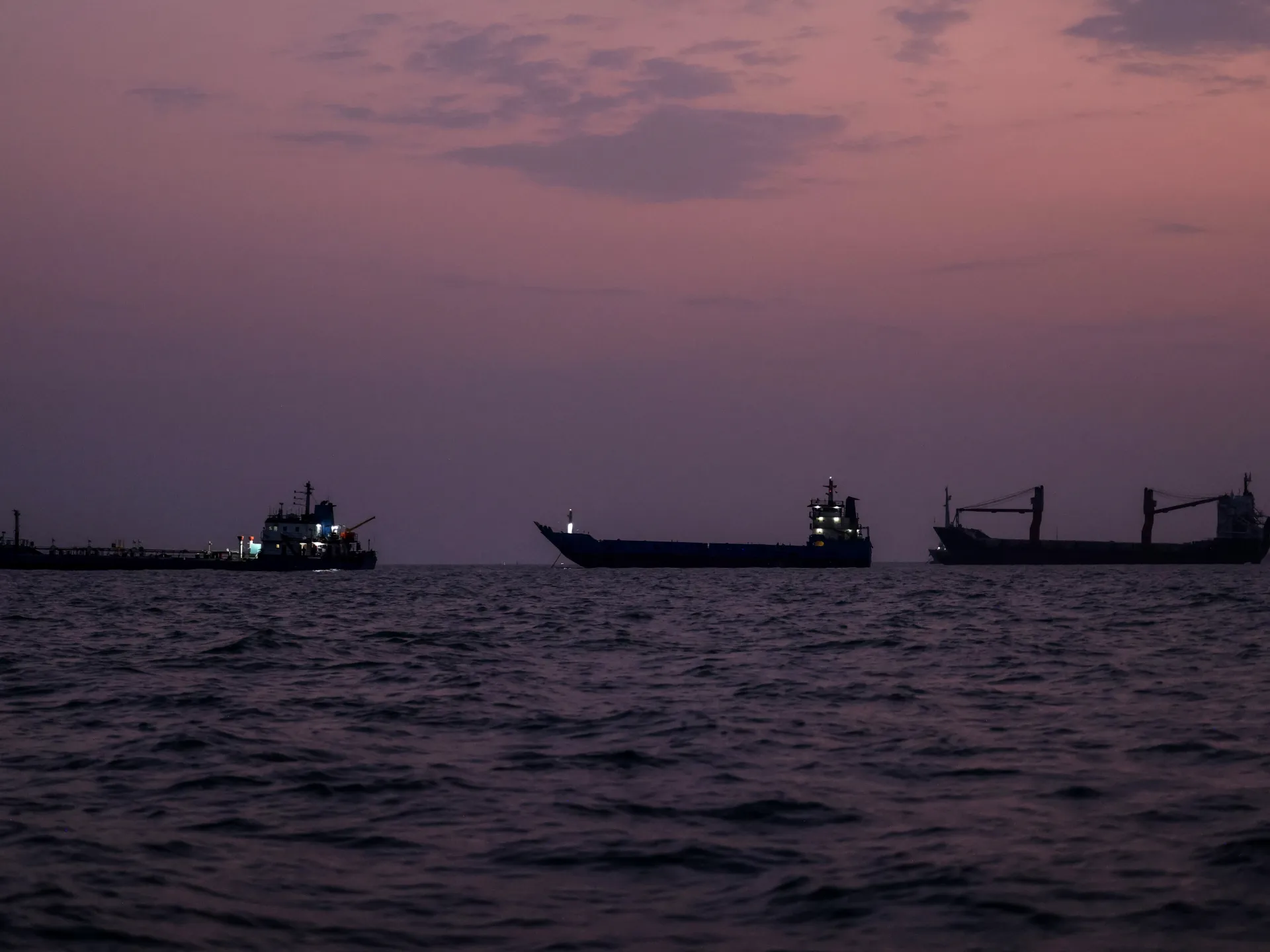
According to U.S. military officials, it covers the entire southern coastline of Iran, including ports on the Arabian Gulf and Gulf of Oman, between which lies the Strait of Hormuz.

“A blockade of Iranian ports has been fully implemented as U.S. forces maintain maritime superiority in the Middle East,” Adm. Brad Cooper, Central Command commander, said in a statement.

“In less than 36 hours since the blockade was implemented, U.S. forces have completely halted economic trade going into and out of Iran by sea.”

Central Command said earlier Tuesday that no ships had made it through during the blockade’s first 24 hours and that six vessels had complied with U.S. forces’ direction to return to an Iranian port on the Gulf of Oman.

“The blockade is being enforced impartially against vessels of all nations entering or departing Iranian ports and coastal areas,” Central Command said.

The blockade comes amid a two-week cease-fire between the United States and Iran that Trump announced on April 8. During the fragile truce negotiations on a permanent end to the war were to be conducted.

However, negotiations with Iran collapsed in Pakistan on Sunday, seemingly over disagreements on Iran’s nuclear program and control of the Strait of Hormuz.

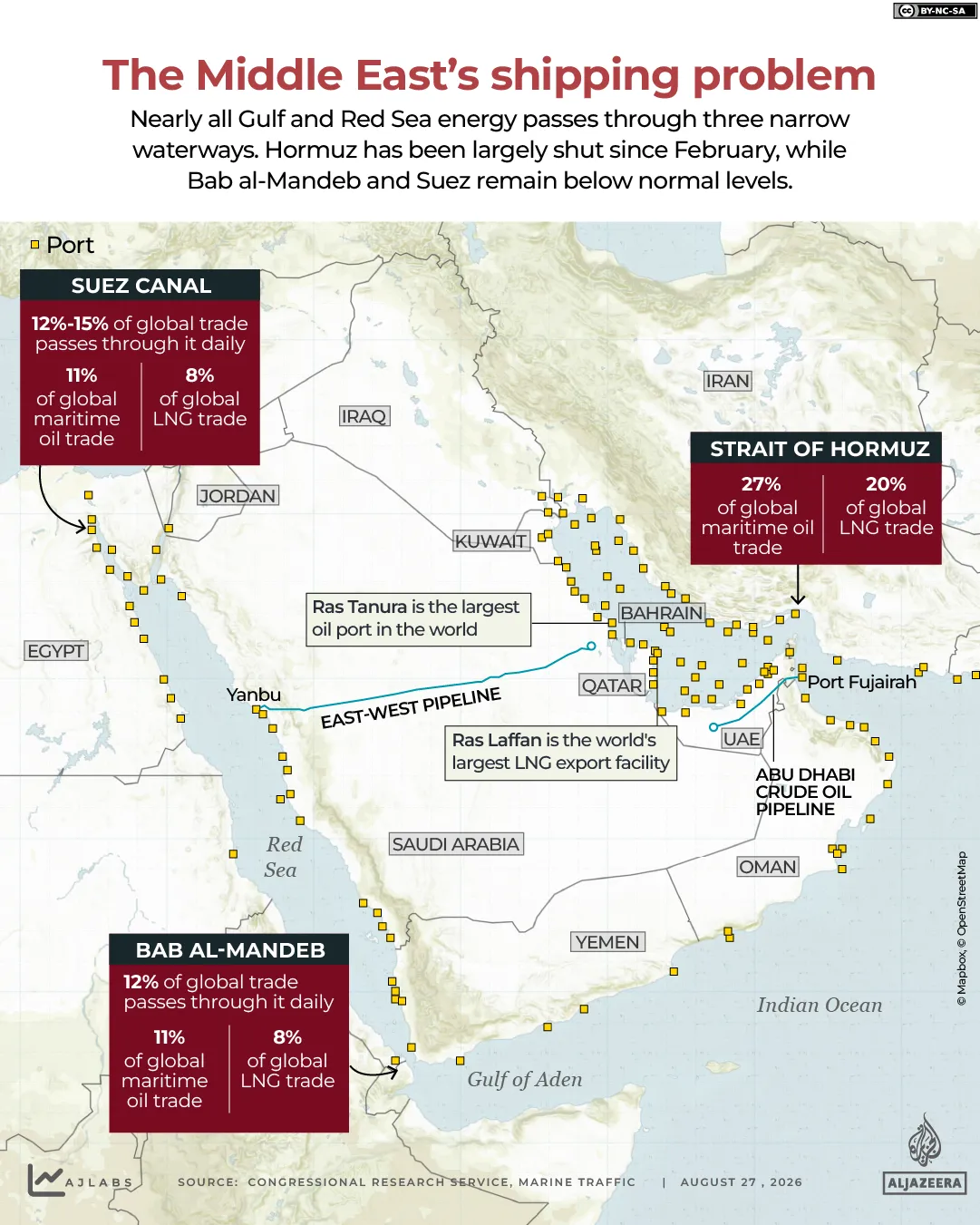
Not long after the war began with the United States and Israel attacking Iran on Feb. 28, Iran sharply restricted vessel traffic to the Strait of Hormuz, an important trade route through which flows roughly 27% of the world’s maritime trade in crude oil and petroleum products as well as 20% of global liquefied natural gas trade, according to the U.S. Congressional Research Service.

Iran’s control of trade through the strait has caused gas prices to spike, threatening countries with energy crises.

The U.S. blockade appears aimed at financially squeezing Iran by cutting it off from maritime trade revenue.

According to Maid Maleki, senior fellow of the Foundation for Defense of Democracies, a nonpartisan Washington, D.C., research institute, the blockade could cost Iran about $435 million a day.

“The blockade makes continued resistance economically impossible,” he said in a statement.

Source link

Iran’s Chokehold On Hormuz Remains On The Eve Of Peace Talks In Pakistan (Updated)

Donald Trump said he is “very optimistic” that a peace agreement with Iran is close, as a diplomatic team led by Vice President JD Vance heads to Pakistan for high-stakes talks this weekend aimed at ending the war. Meanwhile, however, there is no indication that Iran is easing its near-total blockade of the Strait of Hormuz, which has triggered what is reportedly the most severe disruption to global energy supplies on record.

Vance is leading the American delegation, joined by special envoy Steve Witkoff and Donald Trump’s son-in-law Jared Kushner, both of whom participated in three rounds of indirect nuclear talks with Iranian negotiators in Oman before the United States and Israel launched strikes on Iran on February 28.

Boarding Air Force Two on his way to the Pakistani capital of Islamabad, the vice president said, “We’re looking forward to the negotiation. I think it’s gonna be positive. We’ll of course see.”

Vice President @JDVance speaks to reporters before heading to Pakistan for peace talks with Iran:

“I think it’s going to be positive. As @POTUS said, if the Iranians are willing to negotiate in good faith we’re certainly willing to extend the open hand. If they’re going to try… pic.twitter.com/TBo0NNG1mh

— Trump War Room (@TrumpWarRoom) April 10, 2026

Vance also cited Trump, adding: “If the Iranians are willing to negotiate in good faith, we’re certainly willing to extend the open hand.”

But he said: “If they’re gonna try and play us, then they’re gonna find that the negotiating team is not that receptive.”

Iran’s parliament speaker, Mohammad Baqer Qalibaf, said on Friday that two previously agreed conditions — a ceasefire in Lebanon and the unfreezing of Iranian assets — must be fulfilled before any negotiations can begin.

Posting on X, he stated that these steps were part of mutual commitments between the parties and cautioned that talks should not proceed until they are implemented, as disagreements over ceasefire terms and ongoing fighting in Lebanon continue to escalate.

MORE –
(Reuters) – Iran’s ‌parliament speaker Mohammad Baqer Qalibaf said on Friday that two previously agreed measures, a ceasefire in Lebanon and the release of Iran’s blocked assets, must be implemented before negotiations begin.

Qalibaf said the steps were part of… https://t.co/J3D5RAXV5A

— Phil Stewart (@phildstewart) April 10, 2026

President Trump said that Iran has “no cards,” in a post on social media today.

Writing on Truth Social, he said: “The Iranians don’t seem to realize they have no cards, other than a short-term extortion of the World by using International Waterways. The only reason they are alive today is to negotiate!”

The New York Post reports that Trump is preparing military options in case talks with Iran fail. “We’re going to find out in about 24 hours. We’re going to know soon… We’re loading up the ships with the best weapons ever made, even at a higher level than we use to do a complete decimation.”

Trump says that he is preparing military options in case talks with Iran fail -NYP

“We’re going to find out in about 24 hours. We’re going to know soon…We’re loading up the ships with the best weapons ever made, even at a higher level than we use to do a complete decimation.”

— OSINTtechnical (@Osinttechnical) April 10, 2026

In regard to the upcoming discussions, the U.S. president had previously said that Iran’s leaders “talk much differently when you’re at a meeting than they do to the press. They’re much more reasonable,” echoing his administration’s view that Tehran’s private messaging differs from its public statements.

Meanwhile, U.S. military transport aircraft are already arriving in Pakistan ahead of the talks, including this Air Force C-17.

At the same time as U.S. negotiators were heading to Pakistan, multiple reports indicated that at least some of their Iranian counterparts were still to depart for the talks.

The delegation was expected to be led by the Iranian foreign minister, Abbas Araghchi, and the parliament speaker, Mohammad Bagher Ghalibaf.

Ghalibaf had previously taken to social media to reiterate that Lebanon and the release of Iran’s blocked assets had been “mutually agreed upon between the parties” but are yet to be implemented. In a post on X, he said: “These two matters must be fulfilled before negotiations begin.”

Two of the measures mutually agreed upon between the parties have yet to be implemented: a ceasefire in Lebanon and the release of Iran’s blocked assets prior to the commencement of negotiations.

These two matters must be fulfilled before negotiations begin.

— محمدباقر قالیباف | MB Ghalibaf (@mb_ghalibaf) April 10, 2026

UPDATES:

UPDATE: 4:35 PM EDT –

Imagery released by Al Jazeera shows the wreckage of an Iranian Air Force Su-24MK Fencer strike aircraft that was shot down by the Qatar Emiri Air Force over the Persian Gulf while nearing Qatari airspace.

UPDATE: 4:25 PM EDT –

Within the last hour, Jennifer Jacobs, CBS News senior White House reporter, posted this photo to X, showing the aircraft carrying Vice President Vance about to touch down in Paris, en route to Pakistan.

Further to our previous reporting, France has released footage of its Tigre attack helicopters and Rafale fighters intercepting Iranian drones over the Middle East during the Iran war.

France has released footage of its Eurocopter Tiger attack helicopters and Rafale fighters hunting down and destroying Iranian drones over the Middle East during the Iran war. pic.twitter.com/MqsNoRQYln

— OSINTtechnical (@Osinttechnical) April 10, 2026

UPDATE: 4:20 PM EDT –

The Iranian delegation has reportedly now arrived in Islamabad. Iranian media reports that the Iranian negotiating delegation is led by Parliament Speaker Mohammad Baqer Qalibaf.

The Iranian delegation has arrived in Islamabad for peace talks with the United States.

— Idrees Ali (@idreesali114) April 10, 2026

UPDATE: 3:30 PM EDT –

According to SPG Energy Oil data shared with NBC News, just two ships crossed the Strait of Hormuz today, the lowest daily total since Trump announced the Iran ceasefire on Tuesday. Prior to the conflict, 130 to 160 ships typically transited the waterway each day.

Data provided to @NBCNews by @SPGEnergyOil shows just two ships transited the Strait of Hormuz today, the lowest number since President Trump announced the ceasefire with Iran on Tuesday. Prior to the war, 130-160 ships would typically pass each day.

— Garrett Haake (@GarrettHaake) April 10, 2026

UPDATE: 3:20 PM EDT –

In a televised address, Pakistani Prime Minister Shehbaz Sharif described upcoming U.S.-Iran talks as “a make-or-break moment.”

“I ask all of you to pray that these talks are successful and countless lives are saved and the world shall see peace,” he said.

UPDATE: 3:10 PM EDT –

President Trump is preparing a $98-billion supplemental spending request for U.S. military operations in Iran, a significantly lower figure than earlier Pentagon proposals, according to two people familiar with the administration’s plans, NOTUS reports.

Defense officials initially proposed packages nearing $250 billion to fund troop, ship, aircraft, and weapons deployments to the region and to speed munitions production — a top Pentagon priority. Estimates put the cost of Operation Epic Fury to date at $25 billion to $35 billion.

Joseph Haboush, Washington correspondent for Al Arabiya, writes that a first phone call between the Lebanese and Israeli ambassadors to the United States will take place imminently. This is expected to pave the way to direct negotiations next week.

The first phone call between the Lebanese and Israeli ambassadors to Washington is set to take place shortly. This initial call, to include US envoy to Beirut Michel Issa, will set the stage and date for the beginning of direct negotiations expected next week.

— Joseph Haboush (@jhaboush) April 10, 2026

Further strain on the current temporary ceasefire comes from continued Israeli strikes on Lebanon, which both Iran and Pakistan say breach the truce. Trump says that he believes Israel is now “scaling back” its operations in Lebanon.

Israel has carried out a new wave of strikes targeting what it described as “Hezbollah launch sites” in Lebanon, after the Israel Defense Forces (IDF) earlier urged residents to evacuate Beirut’s densely populated southern suburbs. Later, Hezbollah said it launched a barrage of rockets toward settlements in northern Israel.

According to the Israeli military, Hezbollah fired around 30 projectiles from Lebanon into Israel on Friday, causing some damage.

A Hezbollah rocket struck a building at a sports court in the northern city of Nahariya a short while ago, causing damage but no injuries, according to rescue services.

According to the IDF, Hezbollah has fired some 30 rockets from Lebanon at northern Israel since this morning. pic.twitter.com/Ivdv0MXfI5

— Emanuel (Mannie) Fabian (@manniefabian) April 10, 2026

The IDF chief of staff, Eyal Zamir, said Israeli forces are continuing combat operations in southern Lebanon and are “not in a ceasefire” with Hezbollah. Zamir added: “The IDF is in a state of war; we are not in a ceasefire, we continue to fight here in this sector, this is our main fighting sector. In Iran, we are in a ceasefire, and we can return to fighting there at any moment, and in a very powerful manner.”

The IDF said in a statement that it has destroyed more than 200 rocket launchers, including approximately 1,300 launch tubes, belonging to the Iran-backed militant group since March 2.

Israeli Prime Minister Benjamin Netanyahu said he had directed his cabinet to begin direct negotiations with Lebanon focused on disarming Hezbollah, while maintaining that “there is no ceasefire” in Lebanon and that Israel will “continue to strike Hezbollah with force.”

Israeli PM Benjamin Netanyahu says he has directed his cabinet to begin ceasefire talks with Lebanon “as soon as possible”, a day after his country unleashed the largest-scale attacks yet on the country, killing at least 300 people.

Here’s what we know https://t.co/sqvfVTubBd pic.twitter.com/2RM0EdUFNB

— Al Jazeera English (@AJEnglish) April 10, 2026

Lebanon is now insisting on a ceasefire before direct negotiations with Israel can begin, with Lebanese President Joseph Aoun calling it “the only solution.” Beirut is also demanding that the United States serve as mediator and guarantor of any agreement. Those talks are scheduled for next week and will be hosted by the U.S. State Department in Washington.

Lebanese President Joseph Aoun said the only solution to the current situation in Lebanon is a ceasefire between Israel and Lebanon, followed by direct negotiations between the two countries. “I have conducted—and continue to conduct—intense international contacts in this… https://t.co/FG5BG0LD0O

— Ariel Oseran أريئل أوسيران (@ariel_oseran) April 9, 2026

In a social media post late Thursday, Trump said that Iran was doing a “very poor job” of allowing oil to go through the Strait of Hormuz. “That is not the agreement we have!” The U.S. leader also slammed Iran for reportedly charging tolls for the tankers that receive permission to transit the strait.

“There are reports that Iran is charging fees to tankers going through the Hormuz Strait — They better not be and, if they are, they better stop now!” – President DONALD J. TRUMP pic.twitter.com/wJIXNJ8z2Q

— The White House (@WhiteHouse) April 9, 2026

Iran is moving to further tighten its control over maritime traffic through the Strait of Hormuz in an effort to increase pressure on the United States, according to the think tank Institute for the Study of War (ISW).

ISW says the strategy is designed to keep oil prices elevated, giving Tehran greater leverage in upcoming negotiations with Washington and improving its ability to secure concessions.

According to the institute, Iranian officials have indicated that no more than 15 vessels per day will be allowed to transit the strait, down sharply from as many as 140 daily before the war. According to the ISW:

“The Iranian Ports and Maritime Organization published a graphic on April 8 instructing ships to follow designated entry and exit routes in coordination with the Islamic Revolutionary Guards Corps (IRGC) Navy to transit the strait. These routes move international maritime traffic into Iranian-controlled waters. The graphic warns that ships risk hitting mines outside of these routes.”

MORE ⬇️🧵(1/3): Iran is taking several steps to exert control over maritime traffic through the Strait of Hormuz, with the net effect of keeping oil prices high. Iran likely aims to use high oil prices to exert economic pressure on the United States and extract concessions from… https://t.co/J1pHUaSjUP pic.twitter.com/JUKCyYHe64

— Institute for the Study of War (@TheStudyofWar) April 9, 2026

On Thursday, four tankers and three bulk carriers transited the strait, taking the total number of vessels passing through since the ceasefire to at least 12, according to data firm Kpler.

Updated @MarineTraffic playback of the Strait of #Hormuz from 8 April (00:00 UTC) till 9 April (21:00 UTC). @Kpler data shows that 4 tankers and 3 bulk carriers have crossed today, bringing the total to 12 vessels since the ceasefire began, including 5 bulk carriers yesterday. pic.twitter.com/ER5x5ge6lh

— Nikos Pothitakis (@nikospoth) April 9, 2026

The Strait could be open, and the supply of oil can return to usual in the next two months, according to National Economic Council Director Kevin Hassett.

“There are boats going through, but at about 10 percent of the normal pace,” Hassett told Fox Business.

IDF officials told a closed Knesset briefing that Iran’s new leadership is “more extreme than its predecessor,” amid ongoing regional tensions and uncertainty over the durability of the ceasefire. The remarks, first reported by i24NEWS Knesset correspondent Amiel Yarchi, come as Israeli officials assess both the outcome of recent operations and the risk of renewed conflict.

IDF officials told a closed Knesset briefing that Iran’s new leadership is “more extreme than its predecessor,” – i24NEWS

— Faytuks Network (@FaytuksNetwork) April 10, 2026

Kuwait has accused Iran and its proxies of carrying out drone attacks against its territory on Thursday, despite the ongoing two-week ceasefire in the Iran conflict.

The Kuwaiti foreign ministry said that drones “targeted some vital Kuwaiti facilities” on Thursday evening.

However, Iran’s Revolutionary Guard (IRGC) has denied launching any new strikes on Gulf states.

In a statement carried on Iran’s state-run IRNA news agency, the IRGC said: “If these reports published by the media are true, without a doubt it is the work of the Zionist enemy or America.”

Just before the ceasefire, the number of ballistic missile interceptors left in Israel’s arsenal had reportedly dwindled to “double digits,” according to a Trump administration source with knowledge of the situation.

The critical shortage had led Israeli military officials to be significantly more selective when confronting ballistic missile attacks from Iran as well as from Yemen. “They’re having to pick and choose what they shoot down,” the official told Drop Site.

Hezbollah claims it targeted Israel’s Ashdod naval base with missiles.

“In response to the enemy’s violation of the ceasefire and its repeated attacks on Beirut, and after the Resistance adhered to the ceasefire while the enemy did not, the fighters of the Islamic Resistance targeted… the naval base in the port of Ashdod with missiles,” the group said in a statement.

Hezbollah says it has targeted Israel’s Ashdod naval base with missiles, two days after deadly Israeli airstrikes on Beirut have left more than 300 people dead.https://t.co/HtHTEfgCzY

— Al Arabiya English (@AlArabiya_Eng) April 10, 2026

Volodymyr Zelensky has said that Ukrainian teams sent to the Middle East to strengthen regional air defenses have successfully shot down Iranian Shahed drones.

“We demonstrated to some countries how to work with interceptors,” the Ukrainian president said in a post on X.

“Did we destroy Iranian ‘Shaheds?’ Yes, we did. Did we do it in just one country? No, in several. And in my view, this is a success.”

We sent our military experts to the Middle East, including specialists in interceptor drones and electronic warfare. We demonstrated to some countries how to work with interceptors. Did we destroy Iranian “shaheds?” Yes, we did. Did we do it in just one country? No, in several.… pic.twitter.com/lNVkOpMqn3

— Defense of Ukraine (@DefenceU) April 10, 2026

Zelensky said Ukrainian forces participated in active operations using domestically produced, combat-tested interceptor drones.

“This was not about a training mission or exercises, but about support in building a modern air defense system that can actually work,” he added.

We sent our military experts to the Middle East, including specialists in interceptor drones and electronic warfare. We demonstrated to some countries how to work with interceptors. Did we destroy Iranian “shaheds?” Yes, we did. Did we do it in just one country? No, in several.…

— Volodymyr Zelenskyy / Володимир Зеленський (@ZelenskyyUa) April 10, 2026

The Israeli military has accused Hezbollah of using ambulances for military purposes.

In a post on X, Avichay Adraee, the Arabic-language spokesperson for the IDF, claimed that the militant group has been making “extensive military use” of ambulances, without providing evidence.

Hezbollah must stop using ambulances as part of its terror operations in Lebanon immediately, IDF Arabic Spokesperson Col. (res.) Avichay Adraee warned.

— The Jerusalem Post (@Jerusalem_Post) April 10, 2026

The United Arab Emirates says it will reassess which regional partners it can “rely on” and review its national priorities after bearing the brunt of Iranian attacks during the conflict.

UAE presidential adviser Anwar Gargash said Abu Dhabi will “scrutinize” its “regional and international relationships” while strengthening an economic and financial system that boosts resilience.

UAE says it will reassess which regional partners it can “rely on” and review its national priorities after bearing the brunt of Iranian attacks.

• Last month, Gargash criticized “major” Arab and Islamic nations for failing to support Gulf Arabs in “times of hardship.”

•…

— Abbas Al Lawati (@allawati) April 10, 2026

The U.K. defense minister, Luke Pollard, has raised the possibility of Britain bringing allies and partners together to work out solutions to reopen the Strait of Hormuz. Pollard said that the United Kingdom can play a “unique convening role.”

He also hit back at Trump’s claims that the Royal Navy is “too old” and that its aircraft carriers “don’t work” and are “toys.” “We’ve got a strong Royal Navy,” he told the BBC. “We’ve got a globally deployed navy at the moment.”

BREAKING: Responding to mocking comments by Donald Trump about the depleted state of the Royal Navy, including describing Britain’s aircraft carriers as “toys”, John Healey, UK defence secretary, says: “I reject the descriptions that have been levelled against them”.
Healey says…

— Deborah Haynes (@haynesdeborah) April 9, 2026

Photos have been published online that claim to show the hulk of Iran’s sea base-like ship Shahid Mahdavi, a converted container ship that missiles and drones could be launched from. It was the target of U.S. airstrikes earlier in the conflict.

Reports out of France, citing French military officials, state that French Army Tigre helicopter gunships deployed in the United Arab Emirates have shot down their first Iranian drones, although when this happened is unclear. The helicopters used their 30mm cannons to bring down the Shahed-type drones, rather than Mistral air-to-air missiles. Meanwhile, the integration of laser-guided rockets for the counter-drone role is said to be making progress.

An intriguing photo of the aftermath of the attack on a U.S. command post in Kuwait that killed six American servicemen reveals a single Soviet-era free-fall aircraft bomb. This led to much speculation that it may have been dropped on the base by Iran, most likely using a Su-24 Fencer strike aircraft, two examples of which were shot down by Qatar.

Trevor Ball, a conflict researcher at Bellingcat, has got to the bottom of the story, namely that the bomb was an inert example that was placed outside the base as an ornament. The same weapon can also be seen in official photos of the base taken long before the conflict.

Contact the author: thomas@thewarzone.com

Thomas is a defense writer and editor with over 20 years of experience covering military aerospace topics and conflicts. He’s written a number of books, edited many more, and has contributed to many of the world’s leading aviation publications. Before joining The War Zone in 2020, he was the editor of AirForces Monthly.


Source link

What is Iran’s Strait of Hormuz protocol and will other nations accept it? | US-Israel war on Iran News

The Strait of Hormuz, which links the Gulf to the Gulf of Oman, has held global attention since Israel and the US began their war on Iran in February.

Until fighting began, the narrow channel, through which 20 per cent of the world’s oil and liquefied natural gas (LNG) supplies are shipped from Gulf producers in peacetime, remained toll-free and safe for vessels. The strait is shared by Iran and Oman and does not fall into the category of international waters.

Recommended Stories

list of 4 itemsend of list

After the US and Israel began strikes, Iran retaliated by attacking “enemy” merchant ships in the strait, effectively halting passage for all, stranding shipping, and creating one of the worst-ever global energy distribution crises.

Tehran continued to refuse to re-open the strait to all traffic at the start of this week, despite US President Donald Trump’s threats to bomb Iran’s power plants and bridges if it did not relent. Trump backed away from his threat on Tuesday night when a two-week ceasefire, brokered by Pakistan, was declared.

That followed a 10-point peace proposal from Iran that Trump described as a “workable” basis on which to negotiate a permanent end to hostilities.

As part of the truce, Tehran has now issued official terms it says will guide its control of the Strait going forward. The US has not directly acknowledged the terms ahead of talks set to begin in Islamabad on Friday. However, analysts say Tehran’s continued control will be unpopular with Washington, as well as other countries.

During the crisis, only a few ships from specific countries deemed friendly to Iran and those which pay a toll have been granted safe passage. At least two tolls for ships are believed to have been paid in Chinese yuan, in what appears to be a strategy to weaken the US dollar, but also to avoid US sanctions. China, which buys 80 percent of Iran’s oil, already pays Tehran in yuan.

Here’s what we know about how shipments will work from now on:

INTERACTIVE - Strait of Hormuz - March 2, 2026-1772714221
(Al Jazeera)

Who is controlling the strait now?

On Tuesday, Iran’s Foreign Minister Abbas Aragchi said Iran would grant safe passage through the strait during the ceasefire in “coordination with Iran’s Armed Forces and with due consideration of technical limitations”.

On Wednesday, the Islamic Revolutionary Guard Corps (IRGC) released a map of the strait showing a safe route for ships to follow. The map appears to direct ships further north towards the Iranian coast and away from the traditional route closer to the coast of Oman.

In a statement, the IRGC said all vessels must use the new map for navigation due to “the likelihood of the presence of various types of anti-ship mines in the main traffic zone”.

Alternative routes through the Strait of Hormuz have been announced by Iran's Islamic Revolutionary Guard Corps (IRGC), providing new entry and exit pathways for maritime traffic.
Alternative routes through the Strait of Hormuz have been announced by Iran’s Islamic Revolutionary Guard Corps (IRGC), providing new entry and exit pathways for maritime traffic [Screen grab/ Al Jazeera]

It is unclear whether Iran is collecting toll fees during the ceasefire period.

However, Trump said on Tuesday the US would be “helping with the traffic buildup” in the strait and that the US army would be “hanging around” as the negotiations go on.

The Strait will be “OPEN & SAFE” he posted on his Truth Social media site on Thursday, adding that US troops would not leave the area, and threatening to resume attacks if the talks don’t go well.

It’s not known to what extent US troops are directing what happens in the strait now.

Delhi-based maritime analyst C Uday Bhaskar told Al Jazeera that there is a lot of “uncertainty” about who can sail through the strait, and that only between three and five ships have transited since the war was paused.

How does Iran’s 10-point plan affect the Strait?

Among Tehran’s main demands listed on its 10-point plan are that the US and Israel permanently cease all attacks on Iran and its allies – particularly Lebanon – lift all sanctions, and allow Iran to retain control over Hormuz. The plan has not been fully published but is understood to be a starting point for talks.

Iranian media say Iran is considering a plan to charge up to $2m per vessel to be shared with Oman on the opposite side of the strait. Other reports suggest Iran could charge $1 per barrel of oil being shipped.

Revenues raised would be used to rebuild military and civilian infrastructure damaged by US-Israeli strikes, Tehran said.

Oman has rejected the idea. Transport minister Said Al-Maawali said on Wednesday that the Omanis previously “signed all international maritime transport agreements” which bar taking fees.

Interactive_Iran_US_Ceasefire_April8_2026

What does international law say about tolls on shipping?

Critics of Iran’s plan to charge tolls say it violates international law guiding safe maritime passage, and should not be part of a final ceasefire agreement.

The United Nations Convention on the Law of the Sea (UNCLOS) says levies cannot be charged on ships sailing through international straits or territorial seas.

The law allows coastal states to collect fees for services rendered, such as navigation assistance or port use, but not for passage itself.

Neither the US nor Iran has ratified that particular convention, however.

Even if they had, there could be ways to get around this law anyway. Analyst Bhaskar told Al Jazeera that if Iran instead charged fees to de-mine the strait and make it safe for passage again, that could be allowable under maritime laws.

There is no precedent in recent history of countries officially taxing passage through international straits or waterways.

In October 2024, a United Nations Security Council report alleged that the Iran-backed Houthis in Yemen were collecting “illegal fees” from shipping companies to allow vessels to pass through the Red Sea and the Bab-el-Mandeb strait, where it was targeting ships linked to Israel during the Gaza war.

Last week, a top adviser to Supreme Leader Mojtaba Khamenei suggested the Houthis could shut the Bab al-Mandeb shipping route again in light of the war on Iran.

INTERACTIVE - Bab al-Mandeb strait red sea map route shipping map-1774773769
(Al Jazeera)

How might countries react to a Hormuz toll?

Tolls for passage through the Strait of Hormuz would likely most affect oil and gas-producing countries in the Gulf, but ripple effects will spread to others as well, as the current supply shocks have shown.

Gulf countries, which issued statements calling for the reopening of the passage and praising the ceasefire on Wednesday, would also face a continuing degree of uncertainty, analysts say, as Iran could again disrupt flows in the future.

Before the ceasefire was announced, Bahrain had already proposed a resolution at the UN Security Council calling on member states to coordinate and jointly reopen the passage by “all necessary means”. It was backed by Qatar, the UAE, Saudi Arabia, Kuwait and Jordan. On April 7, 11 of 15 UNSC members voted in favour of that resolution.

But Russia and China vetoed the resolution, saying it was biased against Iran and did not address the initial strikes on Iran by the US and Israel.

Beyond the region, observers say the US is unlikely to accept indefinite toll demands by Iran as part of the negotiations expected to begin on Friday.

A toll to pass through the Strait of Hormuz “is not going to go down well with President Trump and his expectations that the strait should be open for everyone”, Amin Saikal, a professor at the Australian National University, said.

Other major powers have also voiced opposition. Ahead of the ceasefire, Britain had begun discussions with 40 other countries to find a way to reopen the strait.

Practical realities in the strait might see a different scenario play out with ship owners losing millions each day their vessels remain stranded seeking to get them out quickly and undamaged experts say. They are more likely to comply with Iran, at least for now.

“If I were the owner of a VLCC [very large crude carrier] which weighs about 300,000 tonnes, whose value could be a quarter billion dollars…I would believe the Iranians if they said we have laid mines,” Bhaskar said.

Source link

Top university says US-Israel attack targeted Iran’s progress, AI learning | US-Israel war on Iran News

Tehran, Iran – The head of Iran’s top science and engineering university believes that the United States and Israel are targeting symbols of Iran’s progress as a nation, and not merely hitting the governing establishment.

The Sharif University of Technology in Tehran was bombed on Monday, destroying and damaging multiple buildings, including what was described by the authorities as an artificial intelligence centre housing critical databases. The university’s website and other online services went dark.

Recommended Stories

list of 3 itemsend of list

“We believe the reason the enemy targeted these buildings and destroyed the entire infrastructure is that it did not want us to achieve AI technology,” university President Masoud Tajrishi said, adding that the higher education facility had been working on training AI models in Persian for two years and provided services to hundreds of companies.

“The enemy does not want us to succeed or have development and progress, but all our universities are united now by these attacks,” he said at the site of the bombing on Tuesday. Minutes later, another attack targeted the capital, with low-flying cruise missiles visible over downtown Tehran and air defence guns activated.

Tajrishi also said that no country had been prepared to provide Iran with the knowledge and know-how to work on AI technology due to US sanctions and competitive advantages, so all of the research was done domestically.

The US and Israel have not provided an official reason for targeting Iran’s main higher education hubs or cultural heritage sites, which are considered civilian infrastructure. No casualties were reported inside Sharif since all school and university classes are being taken online, but more than 2,000 people have been killed during the war.

The strike on the top university, which was founded six decades ago, came after a string of similar air raids targeting research centres inside other prominent facilities, including the century-old Pasteur Institute, a photonics lab at Shahid Beheshti University and a satellite development lab at the Science and Technology University.

More than 30 universities have been affected by US and Israeli attacks since the start of the war on February 28, Iran’s minister of science, research and technology, Hossein Simaei Saraf, told Al Jazeera last week.

The attacks prompted the Islamic Revolutionary Guard Corps (IRGC) to declare US and Israeli-affiliated universities “legitimate targets”.

Mohammad Hossein Omid, president of Tehran University, wrote a letter on behalf of 15 top university heads last week, urging the IRGC to refrain from attacking other universities in order to show that Tehran is committed to safeguarding higher education facilities anywhere as “human and global heritage” entities.

However, he has since shifted his position and demanded retaliatory attacks in kind after a huge backlash from local hardline media.

The US and Israel have continued to attack across Iran, targeting the country’s infrastructure, hours ahead of US President Donald Trump’s deadline for Iran to capitulate to his demands. The Israeli military has already on Tuesday hit Iran’s railway network, but Trump has threatened to bomb critical civilian infrastructure, such as the country’s main power plants and bridges, which would constitute a violation of international law.

Trump said “a whole civilisation will die tonight” in Iran, with the comment coming days after the country’s steel factories and petrochemical manufacturers were extensively targeted in another move that will affect all of Iran’s population of more than 90 million. He boasted that it would take 20 years for Iran to rebuild if Washington were to withdraw today, but it could take 100 years to rebuild if the war continues.

Destroyed building
A sign in front of Tehran’s damaged Sharif University says ‘Trump’s help has arrived’ [Maziar Motamedi/Al Jazeera]

Hitting Iran or the Islamic Republic?

Inside the Sharif University on Tuesday, a mathematics professor held an online class inside the remains of a bombed building as a show of defiance and continuity.

Placards placed nearby by the authorities read, “Trump’s help has arrived.”

This was in reference to repeated claims by the US president and Israeli Prime Minister Benjamin Netanyahu that they wish to “help” the Iranian people overthrow the Islamic Republic, which came to power after a 1979 revolution but has faced nationwide protests in recent years.

But the increasing systematic targeting of civilian infrastructure has caused deep concerns among many Iranians, especially since the country was already dealing with a host of issues before the war, including economic woes and an energy crisis.

“It was a strange feeling waking up in the morning and seeing your university attacked, not to mention the terror of feeling you might not have electricity to check anything tomorrow,” said a Shahid Beheshti student, who asked to remain anonymous.

“If you can justify attacks on power plants, steel, petrochemicals, bridges, universities and science institutes, you can justify anything,” he told Al Jazeera.

The civilian infrastructure attacks have also prompted local media to lash out against foreign-based Iranians, some of whom have supported US and Israeli attacks in the hope that they would lead to the toppling of the governing establishment of military, political, and theocratic leaders.

The Fars news agency, affiliated with the IRGC, claimed on Tuesday that the attack on Sharif University could not have been possible without “betrayal” from dissidents abroad. It accused Ali Sharifi Zarchi, a top former professor-turned-dissident at Sharif, of leaking the coordinates of the bombed centre, without providing evidence.

Sharifi Zarchi pointed out in a tweet in response that the centre was marked on Google Maps, and said that while he unequivocally condemns the targeting of universities and other civilian sites, “the aim of any attacks should be the overthrow of the Islamic Republic regime, which has held the Iranian people hostage through repression, mass killings, and internet shutdowns.”

The professor circulated a letter published in a number of nongovernment student groups on Tuesday, which also condemned the US and Israeli attacks but said that the establishment was responsible for pursuing policies that put it on a collision course with the two countries and their allies.

“Our people want to work, to study, to breathe, to have access to the internet, and to build their own future,” the students wrote. “Minds that leave do not return. A girl who is detained no longer studies. A child whose school is bombed does not grow up. The cost of these losses will be paid by all of our futures – including those who benefit from this divide today.”

Source link

What’s Iran’s 10-point peace plan that Trump says is ‘not good enough’? | International Trade News

Iran has proposed a 10-point peace plan to end the war as the United States and Israel intensify their attacks on Tehran and a deadline looms that was set by US President Donald Trump for Iran to open the Strait of Hormuz, whose near-closure has triggered a global energy crisis.

At the White House on Monday, Trump called the 10-point plan a “significant step” but “not good enough”.

Recommended Stories

list of 4 itemsend of list

Iran’s top university and a major petrochemical plant were hit on Monday after Trump threatened to target power plants and bridges until Tehran agreed to end the war and open the strait, through which 20 percent of the world’s oil and gas supplies pass.

Here is more about Iran’s 10-point plan and Trump’s response to it:

What is Iran’s 10-point plan?

On Monday, Pakistan, which has mediated talks in Islamabad aimed at ending the war, put forth a 45-day ceasefire proposal after separate meetings with US and Iranian officials. The Iranian and US negotiators have not met face to face about the 45‑day truce plan. In late March, Trump told reporters that his envoys were talking to a senior Iranian official, but this was not confirmed by Iran. Tehran has denied holding talks with US negotiators.

Iran’s state-run IRNA news agency said Tehran had conveyed its response via Islamabad. Iran reportedly rejected the proposed ceasefire, putting forward instead a call for a permanent end to the hostilities.

The Iranian proposal consisted of 10 clauses, including an end to conflicts in the region, a protocol for safe passage through the Strait of Hormuz, the lifting of sanctions and reconstruction, IRNA reported. The conflict has spread to the Gulf region and Lebanon, where 1.2 million Lebanese people have been displaced due to Israeli attacks.

Details about the 10 clauses have not been published.

How did the White House respond?

Speaking to reporters about Iran’s plan, Trump said: “They made a … significant proposal. Not good enough, but they have made a very significant step. We will see what happens.”

“If they don’t make a deal, they will have no bridges and no power plants,” he added.

In a profane Truth Social post on Sunday, Trump threatened to attack Iran’s civilian infrastructure, including bridges and power plants, if the Strait of Hormuz is not fully reopened. “Tuesday will be Power Plant Day, and Bridge Day, all wrapped up in one, in Iran. There will be nothing like it!!! Open the F****** Strait, you crazy bastards, or you’ll be living in Hell – JUST WATCH! Praise be to Allah,” he wrote.

The deadline is set for 8pm Washington time on Tuesday (00:00 GMT). Tehran has rejected this ultimatum and threatened to retaliate.

Human rights organisations and members of the US Congress have criticised Trump for threatening to attack civilian targets, which is considered a war crime.

The Axios news website reported that an unnamed US official who saw the Iranian response called it “maximalist”.

What other proposals have been on the table?

The last time the word “maximalist” was used to describe a peace plan in this war was late last month when Iran called a US plan “maximalist”.

An unnamed, high-ranking diplomatic source told Al Jazeera on March 25 that Iran had received a 15-point plan drafted by the US. The plan was delivered to Iran through Pakistan.

The source said Tehran described the US proposal as “extremely maximalist and unreasonable”.

“It is not beautiful, even on paper,” the source said, calling the plan deceptive and misleading in its presentation.

The 15-point plan included a 30-day ceasefire, the dismantling of Iran’s nuclear facilities, limits on Iran’s missiles and the reopening of the Strait of Hormuz.

In return, the US would remove all sanctions imposed on Iran and provide support for electricity generation at Iran’s Bushehr Nuclear Power Plant.

Iran has rejected a temporary ceasefire, arguing it would give the US and Israel time to regroup and launch further attacks. Tehran has pointed to Israel’s 12-day war on Iran in June. The US joined that conflict for one day, hitting Iran’s three main nuclear sites with air strikes. Trump claimed at the time that the US had destroyed Iran’s nuclear facilities but months later justified the current war by saying Iran posed an imminent threat.

The UN nuclear watchdog, however, said Iran was not in a position to make a nuclear bomb.

The US and Israel launched the war on February 28 as Washington was holding negotiations with Iran. On the eve of the war, Oman, the mediator of the talks, had said a deal was “within reach”.

Tehran has said for years that its nuclear programme is for civilian purposes and it does not intend to create nuclear weapons. It even signed a deal with the US in 2015 to limit its nuclear programme in exchange for sanctions relief. But Trump withdrew from the landmark deal in 2018 and slapped sanctions back on Iran.

In response, Iran decided to enrich uranium from 3.6 percent, which was allowed under the 2015 deal, to almost 60 percent after its Natanz nuclear facility was bombed in 2021. Iran blamed Israel. A 90 percent level of purity is required to make an atomic bomb.

Why does this matter?

With Tuesday’s deadline fast approaching, chances for a ceasefire appear remote as the two sides remain far from agreement and the conflict is now in its second month.

On Tuesday, Reza Amiri Moghadam, Iran’s ambassador to Pakistan, posted on X: “Pakistan positive and productive endeavours in Good Will and Good Office to stop the war is approaching a critical, sensitive stage …”

“Stay Tuned for more”.

Source link

Trump’s threat to strike Iran’s power plants looms | US-Israel war on Iran

NewsFeed

US President Donald Trump said ‘Tuesday will be power plant day’ in a vulgar post on social media. He says the US plans to start bombing electricity infrastructure unless Iran opens the Strait of Hormuz. Al Jazeera’s Hala Al Shami looks at Iran’s power plants and the dangers of potential attacks.

Source link

Why is Iran’s Bushehr nuclear power plant being attacked? | US-Israel war on Iran

The WHO has warned of ‘catastrophic’ risks if radioactive release occurs.

Iran’s Bushehr Nuclear Power Plant has been targeted four times since the United States-Israel war on Iran began more than a month ago.

And the World Health Organization (WHO has warned of “catastrophic” risks if a radioactive release occurs.

Recommended Stories

list of 3 itemsend of list

Tehran has accused the United Nations’ nuclear watchdog of inaction – an allegation that the International Atomic Energy Agency (IAEA) rejects. But it does acknowledge that the situation is of deep concern.

Why are the attacks happening, and what risks do they pose?

Presenter: James Bays

Guests:

Tariq Rauf – Former head of verification and security policy coordination at the IAEA

Abas Aslani – Senior research fellow at the Center for Middle East Strategic Studies

Alicia Sanders-Zakre – Head of policy at the International Campaign to Abolish Nuclear Weapons

Source link

Trump holds fast to Tuesday deadline, threatening Iran’s bridges and power plants

President Trump said Monday that the United States and Iran are at a “critical point” in negotiating a potential ceasefire agreement, but the chances of reaching a deal by a Trump-imposed deadline on Tuesday evening appeared uncertain.

In a lengthy news briefing at the White House, the president echoed an expletive-laden Easter Sunday warning to strike Iran’s vital infrastructure if Tehran does not agree to open the Strait of Hormuz by 5 p.m. PDT on Tuesday.

“The entire country can be taken out in one night and that night might be tomorrow night,” Trump told reporters.

Mediators from Egypt, Pakistan and Turkey sent the United States and Iran a draft proposal of the 45-day ceasefire on Friday, the Associated Press reported. Its prospects seemed dim amid the president’s threats and a lukewarm response from Iranian leaders, who dismissed the president’s diplomatic overtures as “unrealistic” and denying direct talks with the United States.

Iranian Foreign Ministry spokesman Esmail Baghaei rejected the latest ceasefire proposal, saying Monday that the American demands were “both highly excessive and unusual, as well as illogical.”

Still, Trump continued to assert that Iranian leadership has been negotiating in good faith. He characterized newly installed leaders as an improvement over their predecessors.

“The people that we are negotiating with now on behalf of Iran are much more reasonable,” he said Monday.

Trump declined to comment further on the ceasefire proposal at the news conference, but told reporters that Iran is negotiating ahead of his Tuesday deadline.

“I can tell you they’re negotiating, we think in good faith,” Trump said. “We are going to find out.”

The president did not say whom the United States is negotiating with, but said the most difficult challenge so far has been establishing a reliable channel of communicating with Iranian officials who he said have “no method of communicating.”

Trump also declined to say whether he was prepared to offer Iran assurances to wind down the conflict, or whether he would escalate by following through with his threats to bomb critical Iranian infrastructure, leaving the door open to both diplomacy and military action.

“I can’t tell you — it depends on what they do. This is a critical period,” he said,

Central to the negotiations is Iran’s control of the Strait of Hormuz, a choke point that, if left blockaded, could continue driving oil prices higher and further destabilizing global energy markets.

Trump, in characteristically unorthodox fashion, floated the possibility of the United States seizing operational control of the waterway and charging tolls for passage, a proposal that he provided without much detail.

“Why shouldn’t we?” Trump said. “We have a concept where we’ll charge tolls.”

He also mused openly about seizing Iranian oil, as he has in recent social media posts in which he floated the idea of using the war to claim Iranian energy resources. He acknowledged public pressure was holding him back from that course.

“Unfortunately the American people would like to see us come home,” he said. “If it were up to me, I’d take the oil, keep the oil and make plenty of money.”

In addition to reopening the Strait of Hormuz, Washington is also demanding the permanent decommissioning of Iranian nuclear sites and an end to its uranium enrichment programs. The proposal also requires Iran to halt support for regional proxies and accept strict ballistic missile limits.

In exchange, the United States says it will provide sanctions relief and assistance with civilian energy production, according to media reports.

Speaking at the White House Easter Egg Roll earlier Monday, Trump showed no signs of softening his posture to bring “hell” to Iran if a deal doesn’t materialize.

“We are obliterating their country. And I hate to do it, but we are obliterating. And they just don’t want to say uncle. … And if they don’t, then they’ll have no bridges, they’ll have no power plants, they’ll have nothing,” he said, adding ominously that “there are other things that are worse than those two.”

Iran has warned of “more severe and expansive” retaliations if Trump follows through on the threats.

Also at Monday’s briefing, Trump celebrated the dramatic rescue of the American officer whose fighter jet was downed by Iran last week. He told reporters the operation to retrieve the wounded officer from “one of the toughest areas in Iran” was possible with a mix of “talent” and “luck.”

The president, however, was angered that a news outlet, which he did not name, reported that the weapons system officer had gone missing and was stranded behind enemy lines. Trump vowed to root out the source of that information, including by threatening to jail the journalist who broke the story.

“We have to find that leaker because that is a sick person,” Trump said. “We are going to find out, it is national security. The person who did the story will go to jail if he doesn’t say.”

Also Monday, Israel struck Iran’s largest petrochemical facility in Asaluyeh and killed Gen. Majid Khademi, the head of the Islamic Revolutionary Guard Corps’ intelligence organization.

The Israeli military also hit three Iranian airports, purportedly targeting dozens of helicopters and aircraft it said belonged to the Iranian air force.

Iran responded with missile strikes targeting Haifa, Israel, and energy infrastructure in Kuwait and Bahrain.

Source link

Where are Iran’s power plants that Trump has threatened to destroy? | US-Israel war on Iran News

US President Donald Trump has issued a direct ultimatum to Iran: reopen the Strait of Hormuz by 8pm Eastern Time in the United States on Tuesday, April 7 (midnight GMT on April 8), or face the destruction of national power plants and bridges.

This echoes an earlier March 21 ultimatum in which he threatened to attack Iran’s power plants – “the biggest one first” – if the strait was not fully reopened within 48 hours.

President Trump has since extended that deadline several times, citing progress in negotiations he claims the US is having with Iran to end the ongoing war. Iran denies it is holding direct talks with the US.

While Trump has made grand statements such as “they’re going to lose every power plant and every other plant they have in the whole country”, he has not mentioned specific targets.

The US president has also threatened to destroy the country’s bridges. Over the weekend, a US-Israeli strike hit the B1 bridge in the city of Karaj, west of Tehran. The major highway link, described as the tallest bridge in the Middle East, had been scheduled to be inaugurated soon. It sustained significant damage in the strike.

Legal experts say that targeting civilian sites amounts to “collective punishment”, which is prohibited under the laws of war.

Where are Iran’s power plants?

Iran operates hundreds of power plants which, together, form one of the largest electricity systems in the Middle East, supplying energy to 92 million people.

Most of the country’s power plants are close to major population centres and industrial hubs. The majority of Iran’s population lives in the western half of the country, with Tehran, Mashhad and Isfahan the three largest cities.

INTERACTIVE - Iran population density - FEB26, 2026-1772104770
(Al Jazeera)

Iran has a mixture of gas, coal, hydro, nuclear and oil-fired power plants, but most are gas-fired. In the north and centre of the country, clusters of gas-fired plants supply electricity to the country’s largest population centres, including Tehran, Karaj, Isfahan and Mashhad.

Another major concentration of power plants lies along the Gulf coast. These plants sit close to major gasfields and ports, allowing large thermal stations to run on abundant natural gas.

The coast is also home to the Bushehr Nuclear Power Plant, Iran’s only nuclear power facility, which has a capacity of 1,000MW. The US and Israel have repeatedly hit this nuclear power plant, raising risks of radioactive contamination far beyond Iran’s borders, the state-run Atomic Energy Organisation of Iran (AEOI) has warned.

bushehr
A satellite image shows new reactors under construction at the Bushehr site in Iran in this handout image dated January 1, 2025 [Maxar Technologies/Handout via Reuters]

Iran also operates a handful of hydropower dams concentrated along the Karun River, the country’s most important source of hydroelectric generation.

Electricity generated from all these plants is fed into a national transmission network operated by Iran Grid Management Company, which distributes power to cities, industries and homes across the country.

The map below shows all of Iran’s power stations with a capacity of 100MW or more.

A 100MW power plant can typically supply electricity to roughly 75,000 to 100,000 homes, depending on consumption patterns.

Iran’s largest power plant by capacity is the Damavand Power Plant located in the Pakdasht area, roughly 50km (31 miles) southeast of Tehran, with a capacity of some 2,900MW, enough to power more than two million homes.

Which are Iran’s most important power plants?

Iran’s largest power plants include:

  • Damavand (Pakdasht) Power Plant – Near Tehran.
    Fuel: Natural gas (combined-cycle).
    Capacity: 2,868MW.
  • Shahid Salimi Power Plant – Neka, along the Caspian Sea coast.
    Fuel: Natural gas.
    Capacity: 2,215MW.
  • Shahid Rajaee Power Plant – Near Qazvin.
    Fuel: Natural gas.
    Capacity: 2,043MW.
  • Karun-3 Dam – Khuzestan Province.
    Fuel: Hydropower.
    Capacity: 2,000MW.
  • Kerman Power Plant – Kerman.
    Fuel: Natural gas.
    Capacity: 1,912MW.

Other smaller but strategically important power plants include:

  • Ramin Power Plant – Ahvaz, Khuzestan.
    Fuel: Gas.
    Capacity: 1,903MW.
  • Bushehr Nuclear Power Plant – On the Gulf.
    Fuel: Nuclear.
    Capacity: 1,000MW.
  • Bandar Abbas Power Plant – Near the Strait of Hormuz.
    Fuel: Oil.
    Capacity: 1,330MW.

How does Iran generate its electricity?

Iran’s electricity system relies heavily on large thermal power plants fuelled by natural gas. The country has one of the world’s largest natural gas reserves, and this fuel forms the backbone of its power system.

In 2025, 86 percent of Iran’s electricity came from natural gas.

Oil-fired plants provide a smaller share, generating roughly seven percent of electricity. Some power stations switch to diesel or fuel oil when natural gas supplies are tight, especially during winter demand peaks.

INTERACTIVE - How does Iran generate its electricity - April 3, 2026-1775478160
(Al Jazeera)

Hydropower accounts for about five percent of electricity. Large dams on rivers such as the Karun River generate power by using flowing water to spin turbines.

Nuclear energy contributes around two percent of the country’s electricity, mainly from the Bushehr Nuclear Power Plant, Iran’s only operational nuclear reactor.

Renewables such as solar and wind play a very small role, together accounting for less than one percent of electricity generation.

Overall, more than 90 percent of Iran’s electricity comes from fossil fuels, making it one of the most gas-dependent power systems in the world.

Source link

Iran’s top university bombed as US, Israel intensify attacks; 34 killed | US-Israel war on Iran News

Tehran says it will respond ‘in kind’ to any attacks on its infrastructure, warns Trump threats an ‘incitement to war crimes’.

At least 34 people have been killed, including six children, as the United States and Israel carried out massive attacks across Iran, targeting a top university as well as residential areas, after US President Donald Trump set a Tuesday deadline for Tehran to fully reopen the Strait of Hormuz or face strikes on its power plants and bridges.

The Fars news agency reported on Monday that an air attack killed 23 people, including four girls and two boys aged below 10 years, in Tehran province’s Baharestan County.

Recommended Stories

list of 3 itemsend of list

At least five people were killed in an attack on a residential building in the city of Qom, according to the political and security deputy of the governor, Morteza Heydari. Six others were killed in Bandar-e Lengeh, in southern Iran, authorities said.

At least a dozen cities were hit across Iran, including Bandar Abbas, Ahvaz, Mahshahr, Shiraz, Isfahan and Karaj.

US-Israeli strikes also hit Sharif University in Tehran, one of Iran’s leading scientific universities, often compared with the US’s Massachusetts Institute of Technology (MIT). Al Jazeera’s Tohid Asadi, reporting from Tehran, said the facility was severely hit, with extensive damage reported in the compound’s mosque and laboratories.

“The Sharif area has witnessed other attacks, including one on a gas facility,” Asadi said, adding that other civil facilities, including roads, power plants and bridges were also targeted across Iran.

“Iran’s Ministry of Science and Technology told us that at least 30 universities have been hit” since the beginning of the war on February 28, he said.

Iran vows retaliatory attacks

The attacks follow Trump’s expletive-laden threat on Truth Social, demanding that Iran reopen the Strait of Hormuz or face “hell”. Iran has warned of retaliatory attacks, saying it will respond “in kind” to any attacks on its infrastructure, with senior officials condemning the president’s remarks as an “incitement to war crimes”. The strait, through which some 20 percent of global oil and gas passes, has been under effective blockade by Iran in response to the war.

Ministry of Foreign Affairs spokesman Esmaeil Baghaei said Iranians were unfazed by Trump’s threats and that they would not be forced into any unfavourable deal. He said Trump’s statements were “an indication of a criminal mindset” and amounted to an “incitement to war crimes and crimes against humanity”.

Baghaei also warned that Iran would respond to any attacks on its infrastructure by launching similar attacks in the region.

Ali Akbar Velayati, an adviser to Iran’s Supreme Leader Mojtaba Khamenei, said a single misstep by either country could severely disrupt global energy flows and international trade.

Velayati added that while the US has learned certain lessons from Iran’s history, it “has yet to understand the geography of power”.

Meanwhile, Israel also faced several missile attacks, with alarms going off in parts of the country. According to the official Israeli radio station, four volleys of Iranian missiles were launched in the early morning hours on Tuesday.

Rescue workers pulled two bodies from the rubble of a building struck in Haifa, while two residents remained missing.

Ambulance and civil defence services reported several injuries, some serious, in more than 20 locations, including Tel Aviv, Petah Tikva and Ramat Gan.

The Ynet News outlet said a 34-year-old woman was “seriously injured” by interceptor missiles in Petah Tikva.

The Channel 2 broadcaster published images of smoke rising over Gush Dan and Bnei Brak, as well as a video of minor damage to a building in Tel Aviv.

Source link

Iran’s ex-FM Zarif proposes peace roadmap; Gulf points at erosion of trust | US-Israel war on Iran News

Former Iranian Foreign Minister Mohammad Javad Zarif has proposed a roadmap for ending the United States-Israeli war on Iran as tensions escalate across the Middle East.

Zarif’s plan was published by Foreign Affairs magazine on Friday and goes “beyond a temporary ceasefire”.

Recommended Stories

list of 4 itemsend of list

The war, which erupted on February 28 with US-Israeli strikes on Iran, has spread across the Middle East and convulsed the global economy as Tehran attacked its neighbours, claiming to be targeting US assets there and restricting movement of vessels in the Strait of Hormuz.

Regional hostilities showed no signs of abating on Sunday, a day after US President Donald Trump said Iran had 48 hours to cut a deal or face “all hell”.

Against this backdrop, Zarif’s roadmap said that although Iran viewed itself as successful in the war, prolonging the conflict – while potentially “psychologically satisfying” for Tehran – would only result in further loss of civilian lives and destruction of infrastructure.

Iran should, therefore, offer to “place limits on its nuclear program” under international monitoring as well as “reopen the Strait of Hormuz in exchange for an end to all sanctions”, Zarif wrote.

Since the war began, Iran has virtually blocked the key waterway, through which one-fifth of the world’s crude oil and natural gas supplies normally pass.

Nuclear limits on Iran would include a commitment to never seek nuclear weapons and to blend its entire stockpile of enriched uranium so its enrichment levels fall below 3.67 percent, Zarif said.

According to the International Atomic Energy Agency (IAEA) estimates, Iran is believed to have about 440kg (970lb) of uranium enriched to 60 percent, a level at which uranium can be quickly enriched to the 90 percent threshold needed to produce a nuclear weapon.

Zarif called Trump’s demand for zero enrichment “fanciful” thinking.

Iran should also “accept a mutual nonaggression pact with the United States” in which both countries pledge to not strike each other in the future, the former minister said.

The US should also end all sanctions and United Nations Security Council resolutions against Iran, he added.

Regional consortium

Zarif also outlined potential roles for regional and international actors.

He suggested that China and Russia along with the US could help create a regional fuel-enrichment consortium with Iran and its Gulf neighbours at West Asia’s sole enrichment facility with Iran transferring all enriched material and equipment there.

Zarif additionally proposed that Gulf states, UN Security Council powers and possibly Egypt, Pakistan and Turkiye should form a regional security framework to “ensure nonaggression, cooperation and freedom of navigation”, including arrangements to guarantee safe passage through the Strait of Hormuz.

“To further consolidate peace, Iran and the United States should initiate mutually beneficial trade, economic and technological cooperation,” Zarif added.

The Iranian politician said this roadmap would benefit Trump, offering him a “well-timed off-ramp” and an opportunity to claim peace.

“Emotions may be high, and each side is boasting about its war-front victories. But history best remembers those who make peace,” he said.

The US has presented Iran with a 15-point plan for a ceasefire as Pakistan, Turkiye and Egypt have been trying to achieve direct talks, but there has been no signs of progress on the diplomatic front.

What about the Gulf?

Officials from Gulf states have responded to Zarif’s proposal, criticising it for overlooking Tehran’s attacks against its neighbours.

“Reading M. Javad Zarif’s article in Foreign Affairs ignores one of the core flaws in Iran’s strategy: aggression against its Gulf Arab neighbors,” Anwar Gargash, the diplomatic adviser to the president of the United Arab Emirates, said on X on Saturday.

“Thousands of missiles & drones targeting infrastructure, civilians, even mediators, is not strength; it is hubris & strategic failure. The Arab world has seen this before: destruction peddled as victory,” he added.

Former Qatari Prime Minister Hamad bin Jassim Al Thani also responded to Zarif’s plan, writing on X on Sunday that he “agreed with much of it” and it took a “clever” approach.

Still, he pushed back, stating that the war has “led us all into a path that is more complicated and dangerous” and chiding Iran for its attacks on the Gulf.

“You may believe that you have achieved progress in some aspects, and perhaps temporary tactical gains, but the cost was clear: the loss of an important part of your friends in the region, and the erosion of the trust that was built over years,” he wrote.

“Today, we need a voice like yours [Zarif’s] merging from within Iran to propose solutions to this war,” he added.

Source link

Projectile hits near Iran’s Bushehr nuclear plant, killing one: IAEA | US-Israel war on Iran News

Tehran says it is the fourth attack near the nuclear plant amid the US-Israel war on Iran.

One person has been killed by projectile fragments after United States-Israeli strikes targeted a location close to Iran’s Bushehr nuclear plant, according to the International Atomic Energy Agency.

The agency, citing confirmation from Iranian authorities, said in a statement on X that there was “no increase in radiation levels” after Saturday’s attack.

Recommended Stories

list of 4 itemsend of list

Later on Saturday, Iran’s Foreign Minister Abbas Araghchi claimed the Bushehr facility had been “bombed” four times since the war erupted, criticising what he described as a lack of concern for its safety.

The strike comes as the US and Israel escalate their targeting of Iranian industrial sites, even as experts warn of the high risks of striking nuclear or petrochemical facilities.

IAEA Director General Rafael Grossi expressed “deep concern about the reported incident and says [nuclear] sites or nearby areas must never be attacked, noting that auxiliary site buildings may contain vital safety equipment”, the statement read.

Grossi also reiterated a “call for maximum military restraint to avoid risk of a nuclear accident,” the IAEA added.

The Atomic Energy Organization of Iran (AEOI) confirmed the incident, also in a post on X.

An “auxiliary” building on the site was damaged, but the main sections of the power plant were not affected by the strike, the government agency said, adding that the person killed was a member of security personnel.

It’s the fourth time the site has been attacked since the start of the US and Israel’s war on Iran, the AEOI noted.

The Bushehr plant is Iran’s only operational nuclear power plant. It is located in Bushehr city, home to 250,000 people, and is one of Iran’s most important industrial and military nodes.

Meanwhile, US and Israeli strikes on Saturday hit several petrochemical plants in the southern Khuzestan region, an important energy hub, according to Iranian media.

At least five people are reported injured.

Explosions were heard, and smoke was also seen rising after missiles hit several locations across the Mahshahr Petrochemical Special Economic Zone.

The state-run Bandar Imam petrochemical complex, which produces chemicals, liquefied petroleum gas (LPG), polymers and a range of other products, was struck and sustained damage, Iran’s Mehr news agency reported.

A provincial governor in Khuzestan added that the Fajr 1 and 2 petrochemical companies, as well as other nearby facilities, were also hit, according to the Fars news agency. The extent of damage is unclear.

Iran’s Islamic Revolutionary Guard Corps (IRGC) claimed it shot down an MQ-1 drone over central Isfahan province on Saturday, hours after authorities said they forced down two US warplanes.

Isfahan, which houses an underground uranium conversion and a research site, was one of three facilities bombed during US and Israeli strikes on Iran last June.

Source link

How the US and Israel are waging war on Iran’s medicines, vaccines | US-Israel war on Iran News

The United States and Israel have carried out multiple attacks on medical facilities in the course of their war on Iran.

On Thursday, Iranian President Masoud Pezeshkian appealed to international health organisations to respond to attacks on medical facilities in Iran, including the Pasteur Institute in capital Tehran, a key centre that Iranian officials said had been targeted that day.

At least 2,076 people have been killed and 26,500 have been wounded in Iran since the US and Israel first launched strikes on the country on February 28.

Here is a closer look at how the US and Israel have hit healthcare facilities in Iran.

What has the Iranian president said about attacks on healthcare?

On Thursday, Pezeshkian wrote in an X post: “What message does attacking hospitals, pharmaceutical companies and the Pasteur Institute as a medical research center in Iran convey?”

The Iranian president, 71, a heart surgeon by profession, continued: “As a specialist physician, I urge WHO [the World Health Organization], the Red Cross, Doctors Without Borders and physicians worldwide to respond to this crime against humanity.”

What is the Pasteur Institute, which has been targeted?

On Thursday, Iranian Foreign Ministry spokesman Esmaeil Baghaei wrote in an X post: “The American-Israeli aggressors have attacked the Pasteur Institute of Iran – the oldest and most prestigious research and public health centre in Iran and the entire Middle East, founded in 1920 through an agreement between the Pasteur Institute of Paris and the Iranian government.”

Baghaei deemed the attack “heartbreaking, cruel, despicable, and utterly outrageous”.

He did not specify whether there were casualties from the attack.

The institute was founded more than 100 years ago in collaboration with the Institut Pasteur in Paris, an internationally renowned centre for biomedical research, which itself was founded in 1887.

The institute in Iran conducts research on infectious diseases, produces vaccines and biological products and provides advanced diagnostics.

The centre has played a central role in fighting endemic diseases such as smallpox and cholera. It also supports Iran’s national immunisation programme by developing and producing vaccines and related biologicals – including those used against diseases such as tetanus, hepatitis B and measles.

Tedros Adhanom Ghebreyesus, the director general of the WHO, wrote in an X post on Friday that two departments of the Pasteur Institute of Iran have also been working closely with the WHO.

“The conflict in Iran, and the region, is impacting the delivery of health services and the safety of health workers, patients, and civilians present at health facilities,” Ghebreyesus wrote.

Which other healthcare facilities have been hit in Iran?

“Since 1 March, WHO has verified over 20 attacks on health care in Iran, resulting in at least nine deaths, including that of an infectious diseases health worker and a member of the Iranian Red Crescent Society,” Ghebreyesus wrote in his X post.

Some of the facilities hit include:

Red Crescent warehouse

On Friday morning, a drone strike hit a Red Crescent relief warehouse in Iran’s Bushehr province.

While no casualties were reported, the attack destroyed two relief containers, two buses and emergency vehicles, Fars news agency reported.

Tofigh Daru

On March 31, Israeli-US strikes hit one of Iran’s largest pharmaceutical companies in Tehran, the Iranian government said in a post on X.

The company was later identified as Tofigh Daru Research and Engineering Company, which is owned by the Social Security Investment Company, a state-run holding firm. On LinkedIn, Tofigh Daru states that it develops and produces active pharmaceutical ingredients “in the anticancer, narcotics, cardiovascular to immunomodulatory segments”.

No confirmed casualty numbers were reported from that strike.

Delaram Sina Psychiatric Hospital

This newly constructed hospital in Tehran was significantly damaged during an attack on the capital on March 29, according to the state-run Islamic Republic News Agency (IRNA).

About 30 patients were in the hospital at the time of the strike late on Monday, the hospital’s director told IRNA. No specific casualty figures for the hospital have been reported.

Ali Hospital

The hospital in Andimeshk in Iran’s Khuzestan province sustained damage from an explosion on March 21, according to the Mehr and Fars news agencies.

In his post on Friday, Ghebreyesus confirmed this attack and said the facility had been forced to evacuate staff and cease services.

Reports about the attack do not mention casualties at the hospital.

Gandhi Hospital

On March 2, Gandhi Hospital in Tehran was damaged during attacks on a television communications tower nearby.

No confirmed casualty figures were reported for the hospital itself.

What does international law say about attacks on healthcare?

International humanitarian law states that health establishments and units, including hospitals, should not be attacked, according to the International Committee of the Red Cross.

These protections also apply to the sick and wounded, to medical staff and to means of transport such as ambulances.

In 2016, the United Nations Security Council resolution 2286 was adopted unanimously. This condemns attacks on healthcare and calls on nations to respect international law.

However, last year record attacks on healthcare during armed conflict were recorded, according to the WHO’s Surveillance System for Attacks on Health Care (SSA).

The SSA said that in armed conflicts worldwide, 1,348 attacks on medical facilities resulted in the killing of 1,981 people. The majority of these deaths were in Sudan, where 1,620 people were killed, followed by Myanmar, where 148 people were killed.

This was a sharp uptick from 2024, when 944 patients and medical personnel were killed in armed conflict.

Where else has Israel targeted medical staff and facilities?

Lebanon

Besides Iran, Israeli attacks have also targeted healthcare facilities in Lebanon.

A month into its latest bombardment of Lebanon, Israel has killed 53 medical workers, destroyed 87 ambulances or medical centres, and forced the closure of five hospitals, according to Lebanon’s Ministry of Public Health.

“Israeli strikes and blanket evacuation orders are cutting people off from care and shrinking the space for health services to function,” Luna Hammad, the Lebanon medical coordinator for Doctors Without Borders (MSF), told Al Jazeera, adding that MSF has seen “a documented pattern of attacks affecting healthcare”.

Gaza

Throughout its genocidal war in Gaza, Israel has also attacked healthcare facilities in the Palestinian enclave.

In October 2023, hundreds of people sheltering in the car park of Gaza’s al-Ahli Hospital were killed in an Israeli attack, according to Palestinian health officials.

Israel attributed the explosion at the facility to a misfired rocket launched by the Palestinian Islamic Jihad, an allegation denied by the armed group.

In March 2024, the Israeli military said it killed 90 people in its raid on al-Shifa Hospital during a siege, as displaced Palestinians sheltering in the facility described long detentions and abuse.

In December 2024, the Israeli army arrested Dr Hussam Abu Safia, the director of Kamal Adwan Hospital, after refusing to follow orders to abandon one of the last functioning hospitals in northern Gaza. His arrest came a day after the military killed approximately 20 Palestinians and apprehended about 240 in a raid inside the hospital, which was one of the “largest operations” conducted in the territory until that time.

In March 2025, Israeli forces reportedly shot dead 15 Palestinian medics for the Palestine Red Crescent Society and inside clearly identifiable PRCS ambulances, during a rescue mission in Rafah’s Tal as-Sultan neighbourhood.

Source link

Trump wants to ‘take Iran’s oil’: Can he, and what would that mean? | US-Israel war on Iran News

United States President Donald Trump said on Sunday that he wishes to “take the oil” in Iran, as the US-Israel war against Iran enters its second month.

On Monday, President Trump threatened to target Iran’s energy infrastructure, including oil wells, if Tehran does not reopen the Strait of Hormuz, which has been under a de facto Iranian blockade for weeks, triggering a global energy crisis.

The Trump administration has unveiled no clear goal behind its military campaign against Iran, one of the world’s biggest oil producers and under US sanctions for decades.

Here is more about what Trump says, how much oil Iran has, and whether Trump could take it.

What has Trump said about Iran’s oil?

Trump told the Financial Times that his “preference would be to take the oil” in Iran and that US forces could seize Iran’s export hub at Kharg Island.

Kharg is a 22-square-kilometre (8.5-square-mile) coral outcrop in Iran’s Bushehr province. Closely guarded by the Islamic Revolutionary Guard Corps (IRGC), entry to the island is restricted to those with official security clearance.

Kharg processes 90 percent of Iran’s total oil exports, handling approximately 1.5 million barrels every day.

On March 14, Trump announced that the US Air Force had bombed Iranian military facilities on the island.

“For reasons of decency, I have chosen NOT to wipe out the Oil Infrastructure on the Island. However, should Iran, or anyone else, do anything to interfere with the Free and Safe Passage of Ships through the Strait of Hormuz, I will immediately reconsider this decision,” Trump wrote on Truth Social.

Critics say the Trump administration was emboldened by the success of its brazen military operation in January to abduct Venezuelan President Nicolas Maduro from Caracas. Washington says it is now in control of Venezuela’s oil exports.

Earlier this month, Trump claimed that 100 ⁠million barrels of Venezuelan oil had been brought to refineries in Houston, Texas in the US. He added that ⁠an additional 100 ⁠million barrels of Venezuelan ⁠oil were on the way.

Ties between Venezuela, which has the world’s largest proven reserves of crude oil, and Washington had deteriorated under former President Hugo Chavez, who decided to nationalise the oil sector. Relations collapsed further under Maduro, who succeeded Chavez in 2013. Venezuela’s current interim president, Delcy Rodriguez, has since opened the sector for private investment.

How much oil does Iran have?

Iran is one of the world’s biggest oil producers.

The country holds the world’s second-largest proven natural gas reserves and the third-largest crude oil reserves, according to the United States Energy Information Administration.

Iran holds around 24 percent of the Middle East’s and 12 percent of the world’s proven oil reserves, with about 157 billion barrels of proven crude oil.

It is the ninth-largest oil producer globally, and the fourth-largest within the Organization of the Petroleum Exporting Countries (OPEC), producing about 3.3 million barrels of crude oil per day.

Before the war, Iran was exporting around two million barrels of crude and refined fuel each day, though its exports dropped dramatically after Trump slapped sanctions on Iran in 2018 during his first term in power. The Iran nuclear deal signed under US President Barack Obama in 2015 – the Joint Comprehensive Plan of Action (JCPOA) – placed limits on Iran’s nuclear programme in exchange for sanctions relief in place for decades.

The US cut diplomatic ties with Iran after pro-Washington ruler Shah Mohammad Reza Pahlavi was toppled in the 1979 Islamic Revolution and the subsequent hostage crisis involving US citizens.

Can the US seize Iranian oil?

The Pentagon is preparing for limited ground operations in Iran, potentially including raids on Kharg Island and coastal sites near the Strait of Hormuz, according to US officials quoted by the Washington Post newspaper.

The plans, which fall short of a full invasion, could involve raids in special operations and by conventional infantry troops, the newspaper reported on Saturday.

However, even if the US invades or occupies Kharg Island, this would not give the US access to Iranian oil.

In order to access Iranian oil, the US would have to occupy Iran’s oil production sites and refineries. In essence, the US would need to occupy mainland Iran.

INTERACTIVE-IRAN-OIL-MAP-JUNE 17, 2025-1772104794
(Al Jazeera)

What would it mean if the US were to take Iranian oil?

In 2023, Iran’s gross domestic product (GDP) was around $457.5bn, according to World Bank data.

In the same year, Iran’s net oil export revenues were estimated at $53bn.

That export figure is equivalent to roughly 12 percent of Iran’s GDP, although export revenues and GDP are not directly comparable.

At the same time, if the US were to lift sanctions on Iranian oil after seizing it, it could lead to a flow of more Iranian oil into global markets, bringing down oil prices.

Iran is one of the most heavily sanctioned countries in the world. The US first imposed sanctions on Iran in November 1979, after Iranian students stormed its embassy in Tehran and took Americans hostage. The hostage crisis ended when dozens of US citizens were released after more than a year.

The US-Israeli war on Iran has sent global oil prices soaring. Benchmark Brent crude rose to more than 3 percent on Monday to $116 a barrel – the highest level in nearly two weeks. The oil price was about $65 per barrel before the war.

Has the US tried to interfere in Iranian oil before?

Yes; this is not the first time the US has shown an interest in Iranian oil.

In 1953, the government of Mohammad Mossadegh, Iran’s first democratically elected prime minister, was toppled in a CIA-orchestrated coup after he nationalised the British-controlled firm Anglo‑Iranian Oil Company (AIOC), the predecessor of modern-day BP.

Washington framed the operation – codenamed “Operation Ajax” – as a Cold War necessity to keep Iran and its energy reserves out of Soviet hands.

The coup restored and entrenched the shah’s rule, a turning point that still haunts Iran’s relationship with the West.

Neighbouring Iraq’s oil revenue is still effectively under US control more than two decades after the US invaded the Middle East nation. Iraq’s oil revenues are deposited into an account at the Federal Reserve Bank in the US before making it to Baghdad.

Source link

IAEA says Iran’s Khondab heavy water reactor no longer operational | United Nations

NewsFeed

The UN’s nuclear watchdog says Iran’s Khondab heavy water production plant is no longer operational after suffering severe damage in an Israeli strike on March 27. The reactor, which contains no declared nuclear material, was hit along with other key infrastructure sites.

Source link

Iranian academic describes US-Israeli attacks on Iran’s universities | US-Israel war on Iran

NewsFeed

A post-doctoral fellow in Tehran has told Al Jazeera there was no warning before US-Israeli strikes hit the Iran University of Science and Technology on March 28. Helyeh Doutaghi says the attack reflects a wider pattern and raises questions about what defines ‘legitimate retaliation’.

Source link