
Iranian exports of oil and condensate sank to the lowest level in at least six years in May, falling below 300K bbl/day, as the U.S. naval blockade of the Strait of Hormuz choked shipments and left tens of millions of barrels stranded at
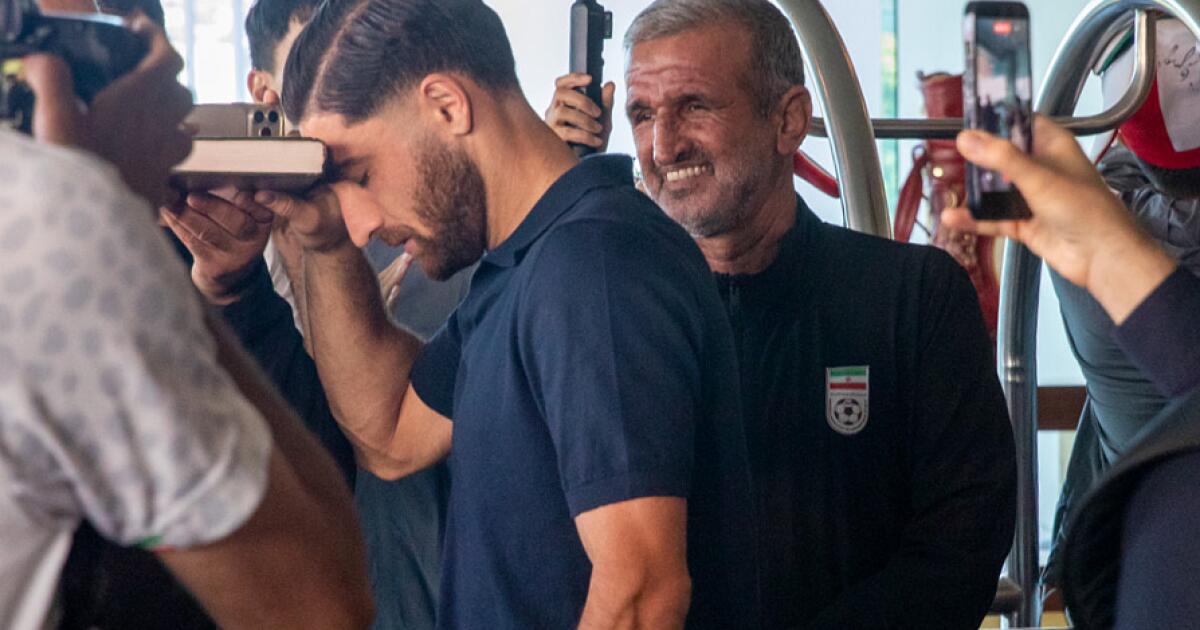
TIJUANA — About 150 miles from SoFi Stadium, south of the Mexican border, sits the hotel housing Iran’s World Cup team for its games at the Inglewood venue.
The entrance to the Marriott in Tijuana is barricaded, flanked by police and members of the Mexican National Guard, guns held close. No one enters without a hotel reservation or special pass.
Despite the tensions and challenges surrounding Iran’s participation in the World Cup, early Saturday morning finds the mood inside the four-star hotel relaxed, even jubilant. Several dozen fans mingle and bond over their shared excitement to see the squad’s players before they depart for their second group-stage match at SoFi.
“I wanted to come down to support Iranian soccer, and cheer for them when they exited the building and make them happy,” says Lucas Zarrabi, 13. The teen, who attended Monday’s 2-2 draw with New Zealand and has a ticket for Sunday’s match against Belgium, is one of several fans from Los Angeles who made the drive to stay with the team. Others flew in from San José and even Miami, turning up at the hotel not quite four miles from the U.S. border crossing.
Showing up is important, some said, because of what they describe as unfair conditions imposed on the team. After the outbreak of war, the Iranian team was forced to move its base camp from Tucson to Tijuana. Eleven team officials and staff members did not receive U.S. visas. The Trump administration has also denied Iran’s requests to arrive two days before matches — and mandated that the team must leave immediately after each game.
“Every little technicality is making it difficult for the team,” says Abbas Eftekhari, 65, who was born in Iran and has lived in the U.S. for more than 40 years. “I think this is going to drain them psychologically and also physically.”
Iran’s soccer federation has been vocal about the obstacles, saying it would lodge a complaint with FIFA.
“Football shouldn’t lose its power to politics,” Hedayat Mombeini, secretary-general of the Iran Football Federation, said Friday. He added that the restrictions “are certainly having a negative effect on us, but we are trying to overcome these problems with our Iranian pride.”
Since the team landed on June 7, Ali Eslami has visited the hotel gates nearly every day.
“It’s the best pleasure for me. I wished them the best luck. I told them it’s hard but they’re doing excellent things,” said Eslami, who splits his time between Southern California and Tijuana.
He was there again Friday, waiting for the players to return from afternoon training blocks away at the Estadio Caliente, home to the Liga MX’s Xolos.
“I have been in America for 50 years — this has been the most emotional thing, to see the team that I have not seen in 50 years,” he said.
Some Iran fans fear reprisal from fellow members of the diaspora for supporting the team, insisting they were in Tijuana for the love of soccer and the players, not politics. Eftekhari worries that the mood at Iran’s first match, where fans and protesters clashed, affected the players.
“As soon as they see that their countrymen have slogans against them, it also has a negative psychological effect on them. But, that’s how things are at this time,” Eftekhari says.
Just over 24 hours until Sunday’s noon kickoff, it’s not just Iranian fans contributing to the atmosphere. A group of flight attendants from China staying at the hotel embrace the excitement, donning jester hats and waving scarves colored red, white and green. And soccer fans from Tijuana are eager to show some local hospitality. Iran has diplomatic ties with Mexico, unlike with the U.S., and sought to move its group-stage matches to the country where it has an embassy.
“We love the Mexican people very much, and for us, the best situation is for our games to be held in Mexico,” Abolfazl Pasandideh, the Iranian ambassador to Mexico, said at the time.
Leonardo Ramirez Lopez, a 10-year-old soccer fanatic from Tijuana, clutches his autograph album in hopes he’ll get new signatures.
“It’s a new team that I don’t have experience with how they play,” he says. But Iran is already his third-favorite team, behind Colombia and Argentina.
After more than two hours of waiting, several dozen fans break into cheers as players finally file through the lobby. The squad smiles and waves, stopping for a few autographs. As each player leaves, he kisses a Quran, pressing his forehead against it before boarding the bus to Tijuana’s airport.
“Iran, Iran! Whoop, whoop!” fans cry, breaking into song.
Angueira writes for the Associated Press.
Unprecedented sports feats and historical firsts are usually joyous affairs. Something to celebrate, fun trivia to tuck away for later.
On Monday in Inglewood, the history was much more fraught, and not at all trivial.
Iran’s national soccer team played on American soil — this time on SoFi Stadium’s natural turf — for the first time in 26 years. And for the first time, a country hosted a World Cup participant with which it is mired in an on-again, off-again war.
There was, in the days and hours leading up to the match, protest and pushback from portions of the large, local Iranian diaspora who didn’t think it was possible to support the country’s football team without supporting the oppressive regime.
But inside SoFi Stadium, thousands of L.A.’s Iranian supporters gave the team its full-throated support. So did many new Mexican fans who’ve adopted Team Melli, which has been staying and training in Tijuana between matches as it was barred from the United States except for game days.
Most of the near-sellout crowd of 70,108 were there cheering Iran, helping propel this team under so much pressure to an entertaining 2-2 tie with New Zealand.
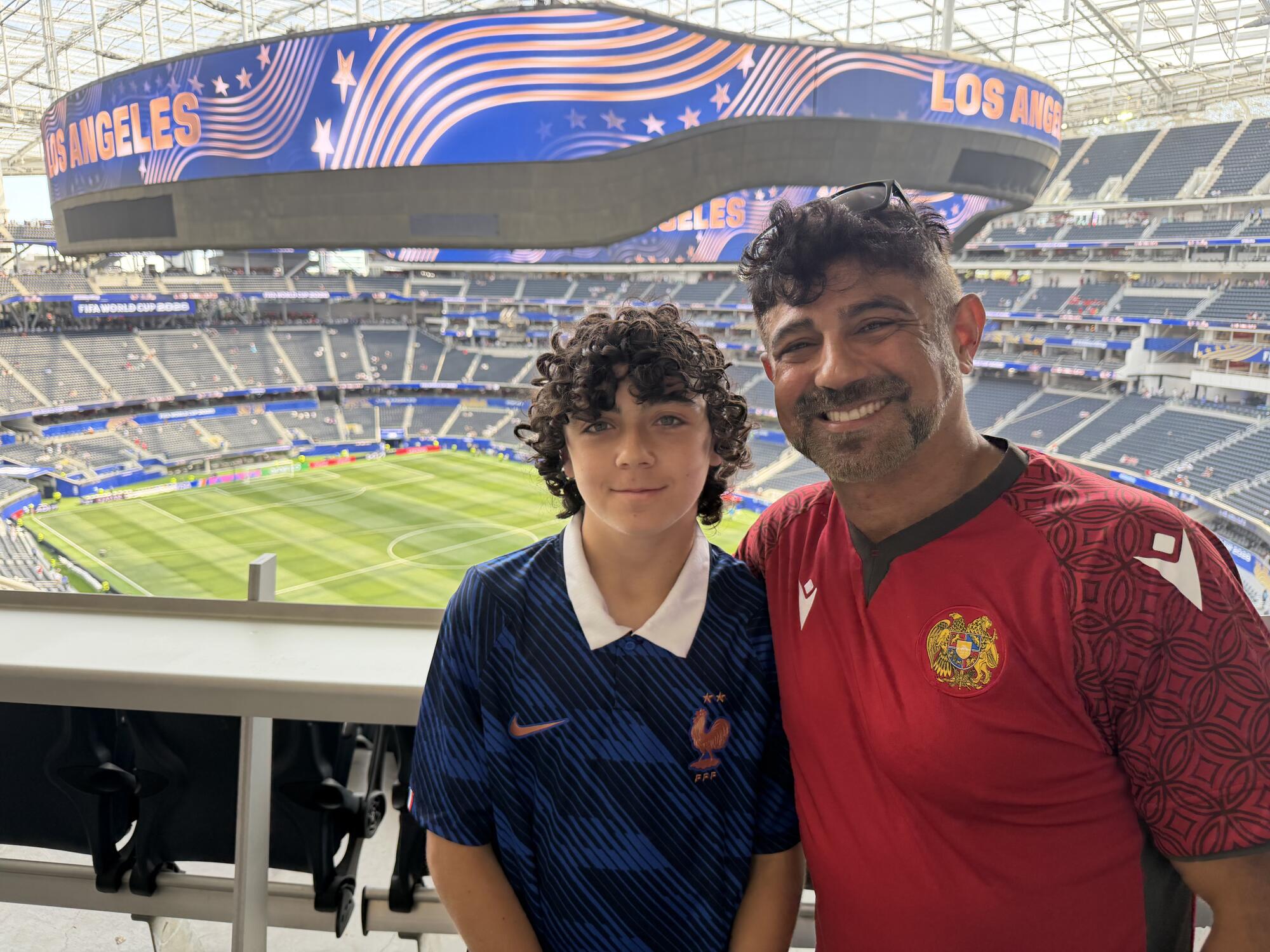
And there, among the thousands of enthusiastic Iran supporters swept up in the match, was my son’s favorite soccer coach, Narbé Mansourian, with his son, 13-year-old Daniel.
Narbé’s brother got his hands on a pair of nosebleed tickets and immediately handed them over to his soccer-loving relatives.
And Narbé — a fifth- and sixth-grade social studies teacher in Hollywood — had no qualms about backing these Iranian men. There were no second thoughts about separating the players from the politics in the country with the complicated geopolitical — and personal — history.
Now, know this: Mansourian is no fan of Iran’s Islamic regime. He was 7 in 1983 when his father, a political dissident, was executed in Evin Prison, nine months after he’d been apprehended.
Narbé remembers visiting his dad, Vazgen, at the notorious prison. He remembers the long drive to get there, the long wait to see him and the game he and his mom used to play: “Today you are 4 years old.”

Narbé Mansourian, right, and his son Daniel before Monday’s World Cup match between Iran and New Zealand at SoFi Stadium.
(Mirjam Swanson / Los Angeles Times)
What started as a way to avoid paying bus fares for 6-year-old Narbé became the way to fool guards at prison, where only the small children were allowed to physically touch their imprisoned loved ones.
He remembers being allowed behind the glass, where he’d wait for his dad to emerge, blind-folded.
When his dad was killed at 37, Narbé said his mother didn’t immediately find out. And when she did, she initially told Narbé that he’d been sick. There was no funeral and when they went to visit his father’s grave, they found a dirt field. There were no markers, Narbé recalls.
He has kept Vazgen’s Coke-bottle glasses, his watch and the still-intact little LEGO house they built together before his dad was taken to prison.
Narbé has held onto so many difficult memories, including the nighttime terrors associated with bombings during the Iran-Iraq war. But there are also happier recollections. Like the stories he would make up about good guys going against the greedy. And, yes, memories of going to soccer games with his dad.
So, “absolutely, I’m going to root for the Iranian national team,” Narbé said before Monday’s match, saying that, to him, equating the Iranian national team with the country’s regime is like rooting against the Knicks because you don’t like President Donald Trump, a native New Yorker.
“It’s not like a cartoon good guy, bad guy,” Narbé said. “There’s so much gray. Because they live there. My heart goes out to them. It can’t be easy, to kind of teeter-totter like that.”

A pre-revolutionary Iranian flag is displayed before the World Cup group stage match between Iran and New Zealand at SoFi Stadium.
(Allen J. Schaben / Los Angeles Times)
I should’ve expected this outstanding youth soccer coach would be most concerned with the players on the pitch.
Some fans got into SoFi on Monday with the Iranian Lion and Sun flag, a historic Iranian national and opposition flag that was banned from the stadium because FIFA desires to steer free of politics (unless it’s steering straight into them). It was a strange sight in Los Angeles, seeing stadium workers asking attendees to discard flags in an effort to censor the expression of people here.
Some of those fans turned their backs during the national anthem, which many in the stands jeered at its start. But then, once the game took hold, so did the support.
“There were many Iranians here,” Iran coach Amir Ghalenoei said through an interpreter. “They believe in different political affiliations, different beliefs, but they all wholeheartedly encouraged us, and I think that’s a victory for all of us.”

Los Angeles is often nicknamed “Tehrangeles” – a fact that drew smiles from both player and manager when it was mentioned at the news conference.
Many Iranian-Americans will be heading to SoFi Stadium on Monday where Iran will open their World Cup campaign against New Zealand.
Many will not be there to cheer, but to protest.
Fifa has banned the pre-revolutionary Lion and Sun flag – a powerful symbol for many Iranians living abroad.
The decision has angered parts of the diaspora.
“You don’t come to Los Angeles and tell us we can’t fly the Lion and Sun flag,” said activist Arezo Rashidian, who is helping organise demonstrations outside the stadium.
“This is the largest Iranian community outside Iran. Many of us came here after the revolution. We’re opposing Fifa’s ban and standing in solidarity with the people of Iran.”
Many members of the diaspora are hostile towards Iran’s regime, and some see the squad as an extension of the Islamic Republic.
“It’s unfortunate that the regime turns athletes into mouthpieces.” said Rashidian. “We want athletes to remain athletes.”
Despite that, she and many others still plan to attend the match.
“We understand the pressure they’re under,” she said. “We’ll carry our colours. We’ll cheer for Iran – the country – held captive by the Islamic Republic.”
But while protesters prepare to make their voices heard outside the stadium, Iran’s players say their focus remains on football.
“As players of the national team, we play for every single Iranian, whether in the diaspora or in Iran,” Taremi said.
“In every country people have different opinions. We are here to unite people and bring joy. Everyone is entitled to their opinion. We don’t get involved in politics.”
That may be the ideal.
But for Iran’s team, keeping politics outside the stadium could prove difficult in a tournament where football has often felt like a sideshow for this squad.
“There is no winning for Iran’s team,” investigative football journalist Samindra Kunti said.
“Given the circumstances, the political pressure, the location of the matches and the diaspora in Los Angeles, they’re under enormous pressure.”
“It’s impossible to avoid the politics.
“Everything becomes a reminder of their situation.”
The players face pressure from home, pressure from the host nation and pressure from a diaspora determined to make its voice heard.
All before a ball has been kicked.
The TWZ Newsletter
Weekly insights and analysis on the latest developments in military technology, strategy, and foreign policy.
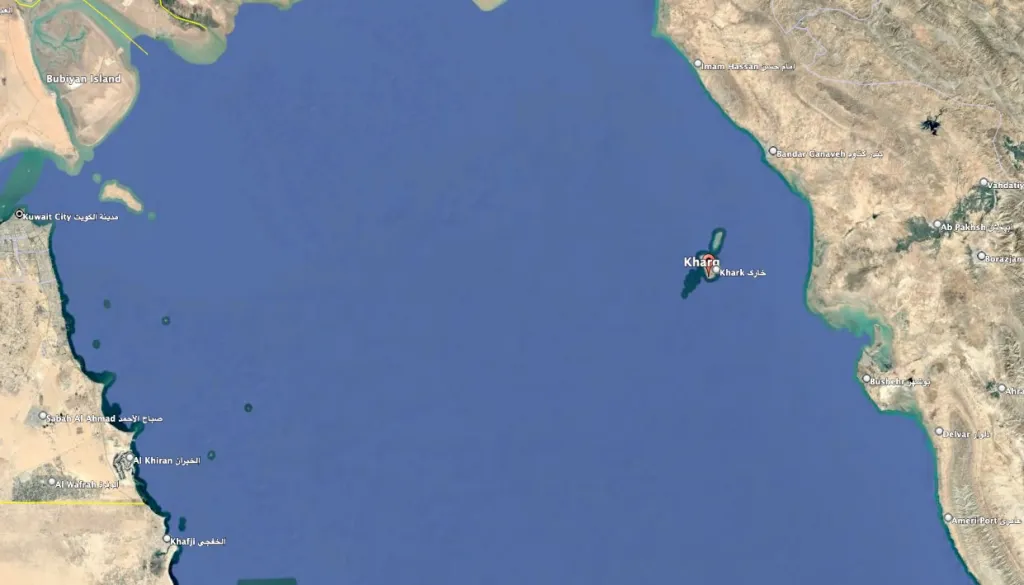
With President Donald Trump proclaiming his desire to take Iran’s Kharg Island — whether he actually means it or not – we reached out to some former military commanders to get a sense of what it would take to seize and hold it and how telegraphing such a move could impact operations. The island, as we have noted in the past, is Iran’s main center of oil exportation, and a U.S. seizure would have tremendous military and economic impacts. An attempt to take it by force and hold it, as we have highlighted in prior reporting, would be an extremely risky operation, by all accounts.
Trump’s latest statements about taking Kharg Island came in the wake of the most intense round of tit-for-tat attacks between the U.S. and Iran since the ceasefire went into effect April 8. The U.S. launched waves of strikes across Iran, including firing what Trump said was 49 Tomahawk land attack cruise missiles at Iranian targets. In response, Iran launched missiles and drones at U.S. bases in Kuwait, Jordan and Bahrain.
Meanwhile, Iran claimed it shut the Strait of Hormuz completely after the new round of kinetic action while U.S. Central Command (CENTCOM) insisted it remains “open for transit.”
Spoke with President Trump tonight as he oversaw the U.S. military strikes against Iran from the Situation Room.
The President told me he spoke directly with Iranian officials tonight who asked him to stop bombing.
49 Tomahawk missiles had been fired by the United States at… pic.twitter.com/s4WnsPTO4d
— Trey Yingst (@TreyYingst) June 10, 2026
However, in the wake of yesterday’s back-and-forth strikes, Trump proclaimed his desire to seize Iran’s vital oil infrastructure, including Kharg Island.
“At some point in the not too distant future, we will be taking Kharg Island, and other oil infrastructure points, and assume total control of their Oil and Gas Markets, much like we have with Venezuela, which is working out brilliantly for both Venezuela and the United States of America,” Trump said on Truth Social.
The United States will be hitting Iran (Whose Navy, Air Force, Radar, Anti Aircraft, and all other forms of Defense, together with most its offensive capability, are GONE!), VERY HARD TONIGHT. At some point in the not too distant future, we will be taking Kharg Island, and other… pic.twitter.com/RPeL3khVrr
— Commentary Donald J. Trump Truth Social Posts On X (@TrumpTruthOnX) June 11, 2026
A short while later, the president modified those remarks in an interview with Fox News.
“I don’t know that America has the stomach for it, to be honest with you,” Trump later told the network. “You’d make a fortune, but I don’t know that America has the stomach, I think they’d like to see us come home.”
NOW: President Trump tells Fox and Friends his preference has always been to “take Kharg Island,” but he doesn’t think “America has the stomach” for it. pic.twitter.com/iWCOooqioP
— FOX & Friends (@foxandfriends) June 11, 2026
Located about 20 miles from the Iranian coastline, Kharg Island presents a daunting challenge, leaving troops trying to take it under threat from Iran’s remaining arsenal of ballistic and cruise missiles, drones, rocket artillery, and fast boats that can launch swarming attacks on ships, fire missiles, and lay mines. This is something we were among the first to point out, before the possibility of invading the island became a nation news story.
There are also a number of islands in and around the Strait of Hormuz that could be used help put up a screen against shipping attacks etc. Also risky for obvious reasons. pic.twitter.com/0nolqdew9J
— Tyler Rogoway (@Aviation_Intel) March 13, 2026
“It seems unusual that we would announce an intention to seize Kharg Island in advance,” retired Army Gen. Joseph Votel, former leader of U.S. Central Command, told us. “Military commanders always want to preserve the principle of surprise in any operation – it helps reduce risk and often times gives us the tactical edge.”
“In this case the president did not announce any specific details – which can preserve some operational flexibility,” Votel noted. “It may also be a part of a more elaborate communications strategy that is focused on getting the regime to understand they are running out of options and that we can and will do whatever we need to, militarily, to support diplomatic efforts and bring the conflict to a conclusion.”
“Seizing Kharg Island is a significant undertaking,” added Votel, now a Distinguished Military Fellow at the Middle East Institute. “Not only will it involve ground troops to actually control the terrain – but also tactical delivery means, air cover, a strike campaign to set the conditions and then all the resources to protect this force while they are on the Island. In addition – the force has to be sustained meaning we have to have a way to get them supplies, engineering capabilities, life support, evacuate casualties, and if necessary reinforce them with additional force.”
All these actions would be taken close enough to the Iranian coast to “potentially subject [assault forces] to missile and drone attacks,” the former CENTCOM commander noted. “Not impossible, but certainly not insignificant either.”

When we first spoke to Votel about this issue in March when stories first bubbled up about Trump threatening Kharg Island, he told us that “a battalion sized force of Marines or soldiers could probably do that. So you’re probably looking at 800 to 1,000 troops, kind of size, maybe a little bit smaller, probably not much larger than that.”
Plans for the US military to try and capture the island “have been drawn up for months but continuously shelved because the operation was considered too risky,” a senior Pentagon official and two administration officials told CNN.
Speaking to us on Thursday, Chris Miller, who served as acting Defense Secretary at the end of Trump’s first administration, said it would take considerably more troops for such an operation than Votel first suggested.
“I would expect it would take an infantry brigade at a minimum,” said Miller, referring to a unit of between 3,000 to 5,000 troops. “I’d prefer two brigades and a lot of mobile air defense to protect from Shaheds and plenty of barrier material to make bunkers when artillery starts dropping in. Plus, obviously, significant air power to hit time-sensitive Iranian targets like artillery and missile batteries.”
An Iranian Shahed-136 One-Way-Attack drones reportedly flying over the sky of Kuwait in the early hours of this morning, June 3, 2026. pic.twitter.com/oUwbbilmzd
— Mehdi H. (@mhmiranusa) June 3, 2026
“It’s completely doable by our combat forces in the region, ” added Miller, now founder and CEO of FPF Defense, a startup building a low-cost Shahed drone interceptor. “This is exactly the type of operation they are designed and optimized for. It’s not that heavy of a lift for them.”
Holding the island, if taken, won’t be easy, however, Miller posited.
“The logistics would be challenging for us because it will be difficult to get resupply ships in under the Iranian defensive shield,” he explained. “And aerial resupply will be contested as well.”
Miller said he was not concerned that Trump told the world he wants Kharg Island.
“My assessment is the Iranian regime continues to misunderstand President Trump,” Miller said of his former boss. “I suspect the Iranians have already prepared for such an eventuality.”
Former Army Maj. Gen. Pat Donahoe, who retired in 2022 as commanding general of the U.S. Army Maneuver Center of Excellence and Fort Benning in Columbus, said asking how Kharg Island can be taken “is the wrong question.”
“It’s not taking it, it’s holding it over time and enduring the slow bleed of casualties that comes with holding it,” noted Donahoe, now chief operating officer at Columbus State University in Columbus, Georgia.
“It’s Khe Sanh,” explained Donahoe, a reference to one of the longest and bloodiest battles of the Vietnam War, where about 6,000 Marines and their South Vietnamese counterparts held out at a base along the Laotian border against 20,000 North Vietnamese troops for nearly 80 days.
“Sure we can grab it, but it puts us in range of all their stuff,” Donahoe said. “And we have to resupply it etc. It’s dumb.”
The U.S. struck military targets on the island during Epic Fury, but Trump has stated he ordered all the oil infrastructure to be left untouched. Since the ceasefire, Iran has been preparing for a possible U.S. operation to take control of Kharg Island, CNN noted today.
“Iran laid traps and moved additional military personnel and air defenses there earlier this year, according to multiple people familiar with US intelligence reporting on the issue,” the network reported. “The island already has layered defenses, and the Iranians moved additional shoulder-fired, surface-to-air guided missile systems known as MANPADs there.”
It remains to be seen whether Trump actually takes any action against Kharg or anywhere else on the ground in Iran. As we have previously noted, Trump has threatened to put boots on the ground to capture Iran’s highly enriched uranium and has constantly made grand military threats without following through. This includes repeated threats that he would order the destruction of Iran’s civilian infrastructure. Clearly these are meant to push the adversary to the negotiating table, but their potency has degraded as this has become increasingly clear.
Hours after raising the specter of seizing Kharg Island, the president seemingly reversed course, saying he was halting orders to bomb the Islamic Republic tonight due to a breakthrough in negotiations.
“Based on the fact that discussions with the Islamic Republic of Iran have been brought to the highest level of Iranian leadership and approved, I have, as President of the United States of America, cancelled the scheduled strikes and bombings against Iran this evening,” Trump stated on Truth Social. “Discussions and final points have been, in both concept and great detail, approved by all parties involved, including the United States, Israel, Saudi Arabia, UAE, Qatar, Turkey, Pakistan, Bahrain, Kuwait, Jordan, Egypt, and others. The Naval Blockade will remain in full force and effect until this Transaction is finalized — Time and place of the signing to be announced shortly.”
The Islamic Revolutionary Guard Corps (IRGC), however, reportedly pushed back on Trump’s negotiations claims.
“The Fars News Agency, associated with the Revolutionary Guards, quoted a ‘knowledgeable source close to the Iranian negotiating team’ who denied President Trump’s claim regarding an agreement on an initial deal, and stated that ‘no text of the initial memorandum of understanding with the United States has been approved,’” Axios reporter Barak Ravid stated on X.
🚨 סוכנות הידיעות פארס, המזוהה עם משמרות המהפכה, ציטטה ״מקור יודע דבר המקורב לצוות המשא ומתן האיראני״, שהכחיש את טענת הנשיא טראמפ בדבר הסכמה על הסכם ראשוני, ואמר כי “לא אושר שום נוסח של מזכר הבנות ראשוני עם ארצות הברית” https://t.co/I0LN2sxy25
— Barak Ravid (@BarakRavid) June 11, 2026
Trump has made repeated claims that a deal was virtually done, when it never materialized and the Iranians certainly have their own strategy they are executing. Whatever comes next, whether it be more bombing, a peace deal, a continued blockade and strait closure, or even an invasion of Kharg Island, it’s unclear, and that may be just as true moment-to-moment for the President of the United States as it is to everyone else.
Contact the author: howard@twz.com
June 11 (UPI) — President Donald Trump said Thursday that the United States may take control of Iran’s oil and gas industries like it did in Venezuela earlier this year.
Trump posted the threat on social media, warning that the United States will continue attacking Iran after a series of airstrikes on Wednesday.
“The United States will be hitting Iran (Whose Navy, Air Force, Radar, Anti Aircraft, and all other forms of Defense, together with most of its offensive capability, are GONE!), VERY HARD TONIGHT,” Trump wrote. “At some point in the not too distant future, we will be taking Kharg Island, and other oil infrastructure points, and assume total control of their Oil and Gas Markets, much like we have with Venezuela, which is working out brilliantly for both Venezuela and the United States of America.”
About 90% of Iran’s crude oil shipments were exported from Kharg Island before the United States and Israel launched the war on Feb. 28.
The United States has launched strikes on Kharg Island during the Iran war but it has not seized control of any of its oil and gas infrastructure yet.
Trump further discussed taking control of Iranian infrastructure during an appearance on Fox News on Thursday morning.
“Look, my preference has always been take Kharg Island,” he said. “I don’t think America has the stomach for that. I think they’d like to see us come home, but we did it with Venezuela. Venezuela’s worked out great for everybody.”
Fighting has heightened again between the United States and Iran with Iran shooting down a U.S. helicopter earlier this week near the Strait of Hormuz. The U.S. military launched what it is calling “self-defense strikes” on Iranian military surveillance, communication systems and air defense targets.
U.S. Central Command said Wednesday that the strikes were “in response to Iran’s unwarranted and continued aggression.”
Trump has said for weeks that Iran and the United States are close to reaching a peace agreement, saying at several points Iran wanted to reach a deal. Fighting between Iran and Israel paused over the weekend after Trump urged both sides to stop exchanging fire.
The United States continues to enforce a blockade on ships using Iranian ports on the Strait of Hormuz.

The United States and Iran engaged in some of the most intense fighting overnight since all-out hostilities in the ongoing US‑Israeli war on Iran were halted with a Pakistan‑mediated temporary ceasefire on April 8.
A comprehensive peace agreement remains elusive as Iran and the US have exchanged a series of proposals and counterproposals in the weeks since that pause. After a string of smaller escalations, however, the US struck targets in Iran following the downing of a US Apache helicopter close to the Strait of Hormuz on Tuesday, and Iran retaliated by hitting US military bases in the Gulf.
The US military said it targeted communications and radar facilities. Iranian officials, however, said civilian infrastructure was also damaged, including two water reservoirs.
If correct, this is the first reported strike on civilian infrastructure in Iran in several weeks, but it comes at a time when Iran is facing a severe water shortage.
The US launched waves of attacks starting late on Tuesday following the downing of the helicopter in the Strait of Hormuz. The US described the attacks as “self-defence strikes” and a “proportional response to unjustified Iranian aggression”.
While an official US inquiry into what caused the helicopter to crash has yet to conclude, US President Donald Trump quickly blamed Iran, which he said had deliberately shot it down.
“I have just been informed by our Great Military that last night the Iranians shot down one of our highly sophisticated Apache Helicopters while patrolling over the Strait of Hormuz. There were two pilots involved, both are safe and uninjured,” Trump wrote on social media.
“Nevertheless, the United States must, of necessity, respond to this attack.”
Iran’s Islamic Revolutionary Guard Corps (IRGC) said US strikes, which hit targets including Sirik, Jask, Minab, Qeshm Island and the port of Bandar Abbas, had caused major damage to a telecommunications tower in the town of Sirik and destroyed two water reservoirs there.
Iran’s West Asia News Agency (WANA) news outlet reported on Wednesday, citing “available reports”, that two concrete water storage reservoirs in the Bamani district in the Sirik County of Hormozgan Province, in southern Iran, 1,012km (629 miles) from the capital, Tehran, had been hit in the US attacks.
The IRGC claimed attacks on US military bases in Bahrain, Kuwait and Jordan in retaliation.
Yes. On March 7, while missiles were flying across the region in an all-out war between Iran and the US-Israel, Iranian Foreign Minister Abbas Araghchi accused the US of striking a desalination plant on Qeshm Island off the coast of Iran in the Strait of Hormuz. The strike reportedly cut off the water supply to 30 villages.
“Water supply in 30 villages has been impacted. Attacking Iran’s infrastructure is a dangerous move with grave consequences. The US set this precedent, not Iran,” Araghchi wrote in an X post.
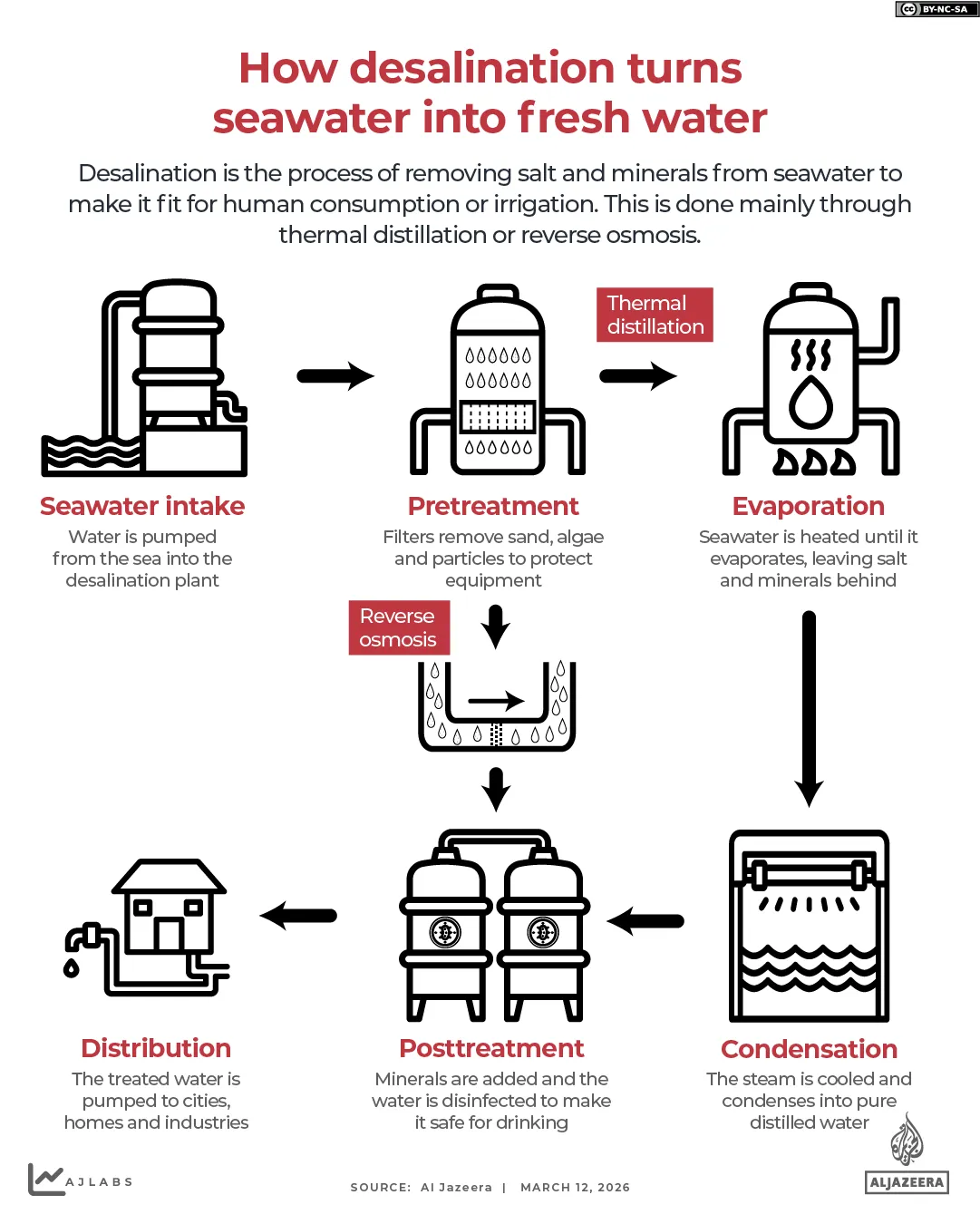
A desalination plant converts seawater into water suitable for drinking, irrigation and industrial use. These facilities are particularly critical in areas such as the Gulf, where freshwater is scarce.

The reservoirs that were struck provide drinking water to more than 20,000 residents in the city of Kouhestak and 10 surrounding villages. WANA reported initial estimates for damages amounting to $780,000 to $830,000.
Iran was already facing a multiyear drought and decline in precipitation before the US-Israeli war on Iran started. After years of poor agricultural practices and mismanagement, Iran’s main water supplies, including its reservoirs, rivers and groundwater reserves, continued to run dry.
According to Aqueduct data from the World Resources Institute, which tracks global water risk, Iran’s baseline water stress is classified as “extremely high” – meaning the country uses more than 80 percent of its renewable water resources in a typical year.
Last year marked Iran’s fifth consecutive year of drought. In November 2025, the water crisis was so dire that Tehran’s Amir Kabir Dam only held 8 percent of its capacity, while across the country, 19 major dams had run dry.

Isa Bozorgzadeh, spokesman for Iran’s water industry, claimed the US strike on the water reservoirs is a war crime, WANA reported.
International humanitarian law classifies water infrastructure, including drinking water installations, treatment plants and pipelines, as civilian property which is not deemed a legitimate target during war.
The Berlin Rules on Water Resources, drafted by the International Law Association (ILA) and adopted in 2004, are a set of non‑binding international legal principles about how countries should use, share and protect water.
The Berlin Rules prohibit countries at war from destroying water installations “if such actions would cause disproportionate suffering to civilians”.
For many Iranians, the most immediate threat is no longer just war, but water.
Years of drought, falling rainfall and unsustainable water use have pushed the country into severe water stress, depleting reservoirs, rivers and groundwater reserves. The US-Israel war on Iran has added further strain after reports of damage to desalination plants, pipelines and other civilian water infrastructure in the early weeks of the conflict.
Iran is classified by the World Resources Institute as facing “extremely high” baseline water stress, using more than 80 percent of its renewable water supplies each year.
In this visual explainer, Al Jazeera breaks down Iran’s worsening water crisis and what is driving it.
One of the most striking examples of Iran’s water crisis can be seen from space.

A time-lapse display of Lake Urmia in northwestern Iran shows how the largest saltwater lake in the Middle East, which covered nearly 6,000sq km (2,300sq miles) in the 1990s, shrunk to just 581sq km (224sq miles), less than 10 percent of its former size.

Consecutive droughts, agricultural water use, river diversion, and groundwater extraction have transformed vast stretches of Lake Urmia into exposed salt flats.
More than 60 dams built on its feeder rivers choked off inflows, while farmers diverted water into irrigation channels and decades of groundwater extraction drained the aquifers below. Rising temperatures accelerated evaporation as precipitation fell.

To sustain its freshwater resources, a country must replenish at least as much water as it withdraws for agriculture, industry, and household use.
Iran has long been on the wrong side of that equation. Decades of dam construction, intensive farming, and groundwater extraction have pushed consumption far beyond what rainfall can replenish.
In 2025, Iran’s 92 million people consumed around 100 billion cubic metres of water, nearly 13 billion more than its renewable resources could provide.
Agriculture is by far the largest consumer of water in Iran, accounting for about 91 percent of all withdrawals, compared with seven percent for households and two percent for industry. Yet much of that water is lost before it reaches crops, as ageing and inefficient irrigation systems waste a significant share of the country’s most precious resource.

Iran is one of the world’s major dam-building countries, and has constructed hundreds of large and small dams to store water, generate electricity, and manage shortages.
In recent years, dozens of reservoirs have dropped to extremely low levels, leaving several to nearly run dry.
Before-and-after satellite imagery of Lar Dam, Latyan Dam and Mamloo Dam, all clustered around Tehran and the southern slopes of the Alborz mountains and forming part of the main water supply system for the capital region, reveals how water levels have declined over time as drought and rising demand strain Tehran’s water system.
Water scarcity is increasingly reshaping where Iranians can live.
As wells run dry and farming becomes harder to sustain, many families are leaving rural communities in search of more secure livelihoods. According to Abdolkarim Hosseinzadeh, Iran’s vice president for Rural Development and Disadvantaged Regions, only 38,000 of the country’s 69,000 villages remain inhabited, while 31,000 villages have been abandoned.
The pressure extends far beyond abandoned settlements. According to Iran’s state-owned Water and Wastewater Company, about 27,000 villages, home to more than 10 million people, are currently experiencing water shortages. In total, more than 70 percent of Iran’s villages are facing some form of water crisis.
Many migrants head towards major cities such as Tehran, Mashhad, Isfahan, and Shiraz. Yet these cities are facing water pressures of their own. Home to more than nine million people, Tehran has seen growing strain on its water system as drought and demand continue to rise.
The map below shows how Iran’s population is concentrated in the western half of the country. Today, roughly 75 percent of Iranians live on less than 40 percent of the country’s land area, concentrating both people and water demand in a relatively small region.

The effects of water scarcity can also be seen along the Zayandehrud River, once one of central Iran’s most important waterways.
Satellite imagery of Zayandehrud Dam reveals declining water levels upstream after years of drought and overuse.
Further downstream, the consequences become visible in the heart of Isfahan. The historic Allahverdi Khan Bridge (Si-o-Se Pol) was built over a river that sustained the city for centuries.
Today, residents increasingly encounter dry riverbeds beneath its arches as sections of the Zayandehrud repeatedly run dry.


Desalination accounts for only about three percent of Iran’s water needs, a stark contrast to Gulf neighbours, which depend on it for the majority of their drinking water.
Most of Iran’s desalination plants are located along its southern coast on the Gulf. As a result, desalination is largely concentrated in coastal cities, while inland areas such as Tehran, Isfahan and most agricultural regions rely on other water sources.

Tehran, Iran – An ongoing war of words between Beirut and Tehran has highlighted the central role Lebanon has played in a ceasefire between Iran and the United States.
Iran on Sunday responded to an Israeli strike on an alleged Hezbollah site in southern Beirut – an unofficial red line for Tehran – by launching a barrage of missiles at Israel. Israel then hit Tehran and other cities on Monday, threatening to end a two-month ceasefire between Iran and the US.
Tensions had already heightened after Israeli forces crossed the Litani River last month – a point Israel had unilaterally set as a buffer zone to be cleared of Hezbollah elements – leading the Lebanese government to appeal for an end to foreign interference in the country.
Last week, it was reported that US President Donald Trump had convinced Israeli Prime Minister Benjamin Netanyahu not to target Beirut, understanding that such an escalation could end a regional ceasefire in place since April.
The Israeli invasion has deepened tensions between Iran, which backs Hezbollah, and the Lebanese government, which is seeking exclusive control over weapons in the country. Iran’s Islamic Revolutionary Guard Corps (IRGC) on Thursday warned “there will be no calm in the region” if Israel continued its occupation of southern Lebanon.
Lebanese President Joseph Aoun stressed that there is no way to end the war in the country “except through negotiation and diplomacy” and slammed Tehran for “using Lebanon as a bargaining chip in their negotiations” with the US.
He said “Hezbollah must understand that [there is] no other way but to sit and talk”, something Beirut is trying to achieve via direct talks between Israeli and Lebanese officials in Washington, DC.

Iranian Foreign Minister Abbas Araghchi responded by saying Aoun appeared to believe Iran, not Israel, was occupying Lebanese territory.
“Had Lebanon been a bargaining chip for Iran, we’d have a deal long ago. Save Lebanon from your real foe, Mr. President,” he posted on X on Saturday, likely referring to Israel and Aoun.
Hezbollah opposes direct talks with Israel and wants Iran to play a greater role in mediated talks to end the crisis, and the situation has led to an increasingly voracious back-and-forth between Beirut and Tehran.
A conditional “ceasefire” currently in effect between the Lebanese government and Israel, negotiated by Washington and excluding Hezbollah representation, set conditions that included the removal of armed groups south of the Litani River.
It also sought the establishment of “pilot zones” in southern Lebanon, where the Lebanese army would have sole authority, allowing the region to come under direct state control.
Negar Mortazavi, a senior fellow at the Washington, DC-based Center for International Policy, noted that while Israel had demonstrated patience regarding its continued offensive in the south, the targeting of Beirut’s southern suburbs, known as Dahiyeh, would be a serious escalation.
“Where exactly is the red line? So far, it seems that Tehran has tolerated attacks in southern Lebanon to some extent as part of a messy ceasefire, and instead allowed Hezbollah to engage with Israel,” she told Al Jazeera before Israel bombed Beirut suburbs on Sunday.
“I think the stalemate cannot continue for too long, so it will be going back to an escalated conflict, or heading for an actual peace deal.”
Iran has stressed that any long-term peace agreement with the US hinges on Israel’s war on Lebanon also ending.
“Hezbollah entered the war with them and helped them, so they want to help them by making them an extension of the peace deal,” Mortazavi said.
Israel’s largely unchallenged advances in southern Lebanon had angered and frustrated hardliners in Iran, who had called for the government to take action.
“Now that I’m speaking with you, it’s correct that [Israel] has stopped attacking Dahiyeh, but except for that, it is hitting wherever it wills,” Abbas Abdi, a state television analyst, told a gathering of state supporters near Enghelab (Revolution) Square in downtown Tehran on Friday night.
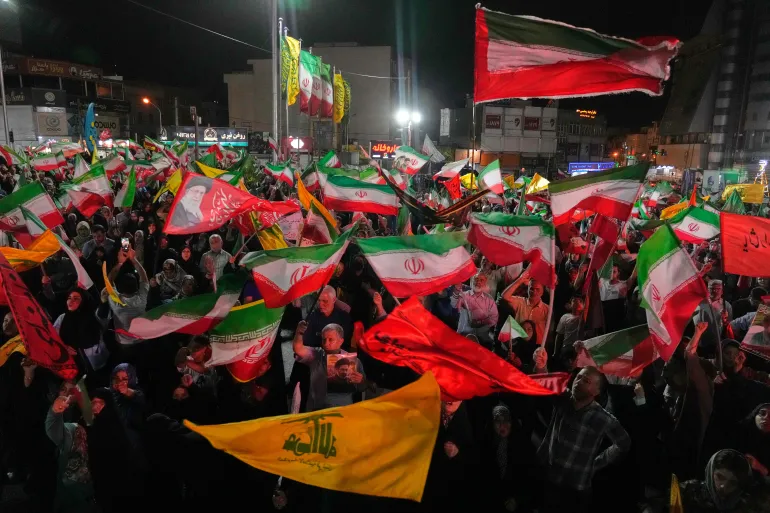
Hezbollah flags are regularly waved by supporters of the government during such rallies. On Friday, the iconic Azadi (Freedom) Tower was draped with a Hezbollah flag in a show of support for the Lebanese movement, amid Israel’s offensive in southern Lebanon.
Abdi said such facile shows of solidarity with Hezbollah were not a deterrence and that Iran might have to “show the enemy that negotiations are not important for us”.
“We are still releasing statements and saying we will do such if they do such, but we are not doing anything. Our dear people have gone to the [missile] launchers numerous times to respond, but they have been stopped,” he said.
There have been direct tensions between the two sides in recent weeks, with the US military attacking Iranian islands and the IRGC launching missiles and drones at its Central Command (CENTCOM) bases in Kuwait and Bahrain.

Mostafa Najafi, a state television political analyst, earlier this week characterised the Israeli attacks on Lebanon as intended to go hand-in-hand with the US blockade of Iran’s southern waters to force the government to capitulate.
“The aim of the ring of pressure created in Lebanon is not just Hezbollah, it is against our levers and to weaken our regional activities,” he said, pointing out that this elevates the issue to strategic significance.
“You cannot separate the file of Hezbollah and Lebanon from the file of Iran, because they have a meaningful ideological and geopolitical link together, they are in a geopolitical cluster together,” Najafi said.
Amirhossein Sabeti, a lawmaker representing Tehran in the hardline-dominated parliament, told state television that Trump was only “playing” with Iranian authorities to keep the peace until the World Cup in the US, Canada and Mexico is over.
“The US will start a more intense war with the US once the World Cup is over. They will turn the country into a second Gaza, where everything is destroyed,” he said.
“We must be prepared to deal stronger blows than before, and we can do this. We must not wait for them to hit before hitting back; we must strike even when they talk of striking, that’s deterrence.”
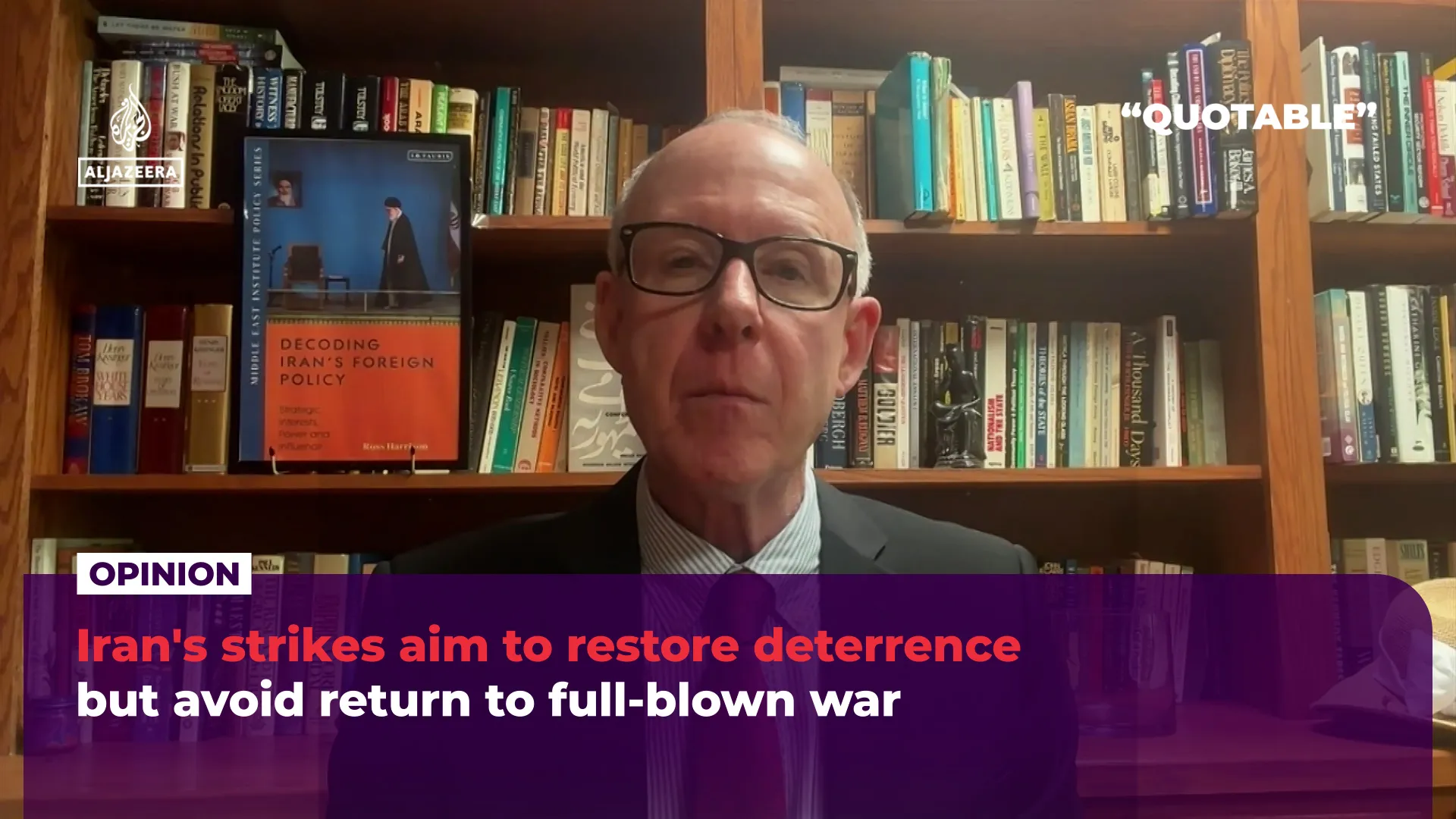
Ross Harrison, a senior fellow at the Middle East Institute, says that Iran’s renewed missile strikes on Israel aim to restore deterrence without reigniting full scale war.
Published On 7 Jun 20267 Jun 2026
Share
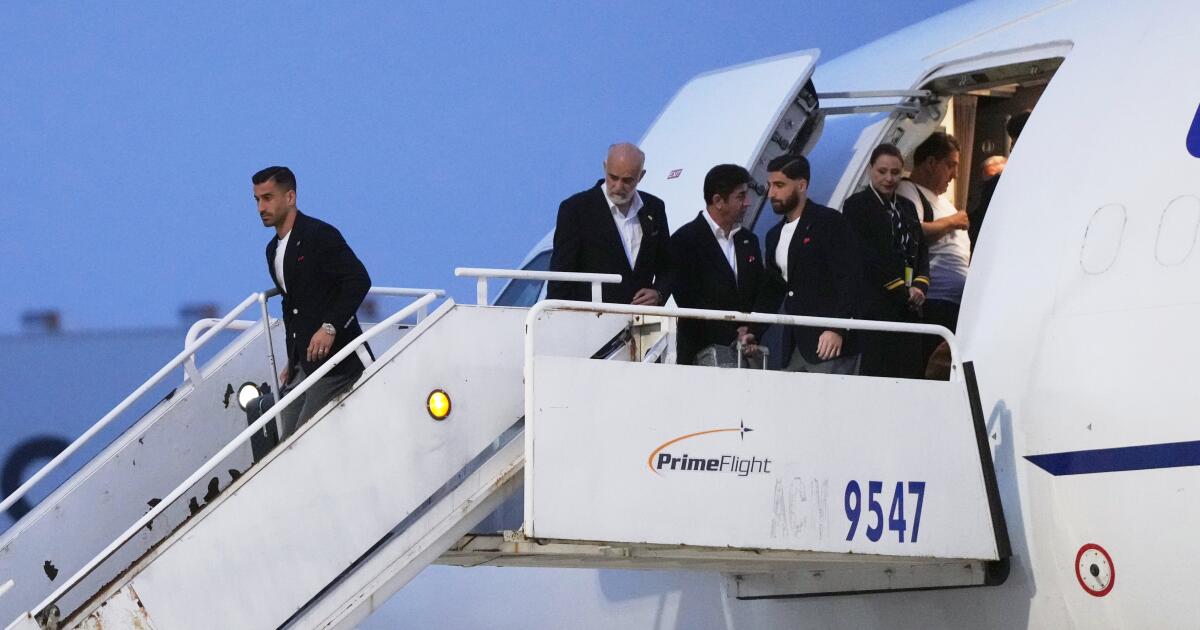
TIJUANA — Iran’s soccer team arrived in Mexico on Sunday morning for training ahead of the World Cup, before its first two group matches at SoFi Stadium in Inglewood later this month.
Ehsan Hajsafi was the first player to exit the plane with markings for German charter airline USC, which arrived at about 5:05 a.m. He led the team, dressed in blue blazers over white T-shirts, through a brief security check with Mexican officials and dogs before boarding a bus.
The bus stopped briefly at the entrance to the Tijuana airport, where around 20 or so Iran fans waved flags.
The team’s participation in the World Cup, jointly hosted by the United States, Mexico and Canada, has been complicated by the Iran war. Problems with processing visas earlier led Iran to move its training base from Tucson to Tijuana.
The team has been training in the Turkish city of Antalya. It flew directly to Mexico on a private jet from the Mediterranean city’s airport.
Some members of their entourage were reportedly still without U.S. visas, according to Iranian state television Saturday. Those include the Iranian Football Federation’s secretary-general, Hedayat Mombeini, and its vice president, Mehdi Mohammad Nabi.
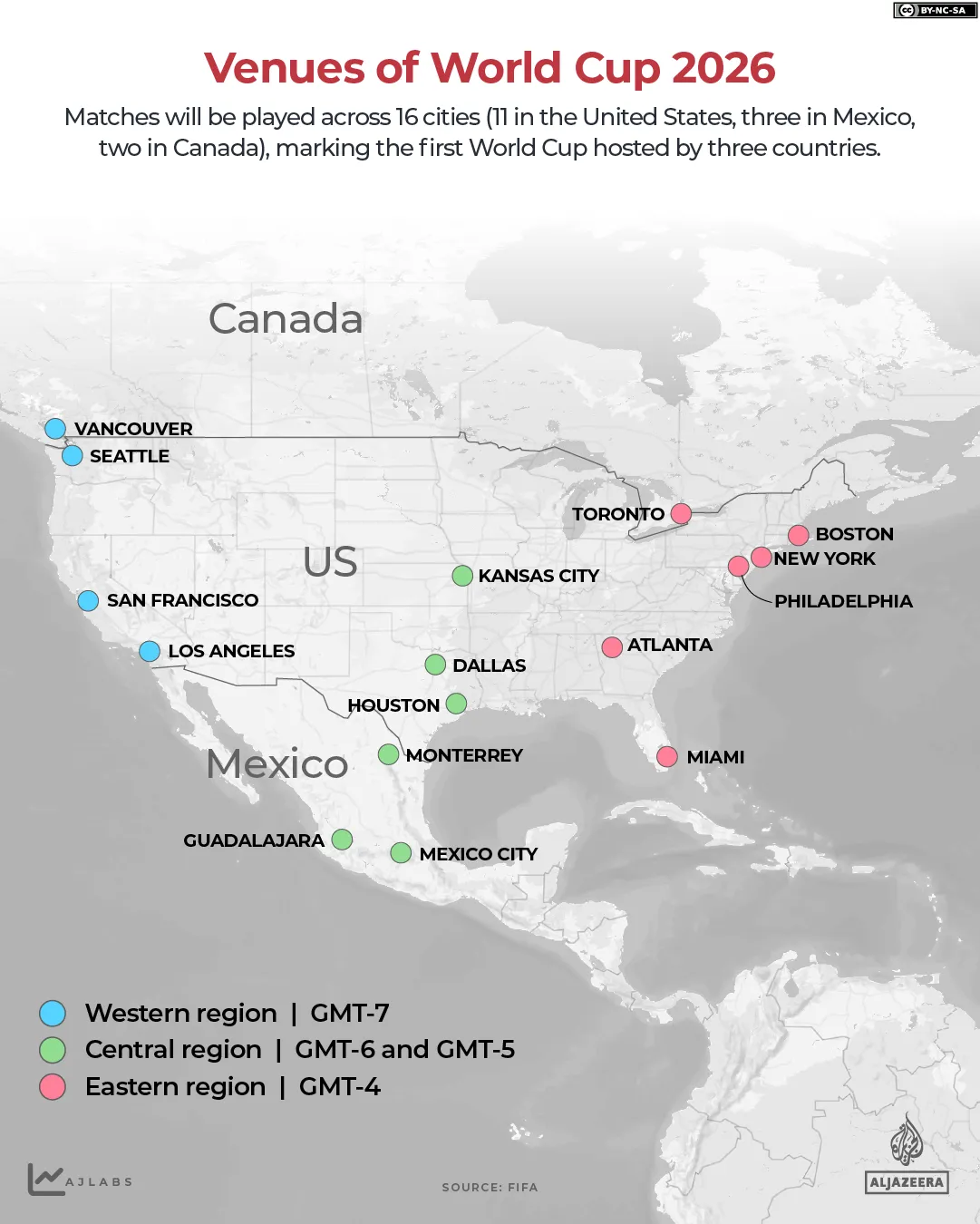
Iran plays its first two games at SoFi Stadium in Inglewood against New Zealand on June 15 and Belgium on June 21, then heads to Seattle to face Egypt on June 26. Iran and the U.S. could meet in the Round of 32 on July 3 in Arlington, Texas, if both teams finish second in their groups.
In March, President Trump discouraged Iran from participating in the tournament, saying he didn’t think it was “appropriate” and raising concerns over players’ “life and safety.” A day later, Iran’s national team countered, saying “no one can exclude” it from playing.
Iran finalized its team on Monday, including 17 home-based players whose clubs haven’t played since February because of the war. Star forward Sardar Azmoun was dropped in March, reportedly because of a social media post that angered Iranian authorities during the war.
Iran’s sports minister said in March that it would “not be possible” for the team to participate in the World Cup, but the Islamic Republic’s soccer federation said in May that it was moving ahead with a team. The federation had insisted that all players and staff be granted visas, including those who had military service in the Islamic Revolutionary Guard Corps.
Published On 7 Jun 20267 Jun 2026
Iran’s World Cup squad has landed in Tijuana, Mexico ahead of the World Cup – amid a diplomatic row with cohosts United States, which is at war with Tehran and has refused visas for several members of the Iranian delegation.
The squad touched down shortly after 5am (1200 GMT) in the Mexican city, across the border from San Diego in California, after an overnight flight from Turkiye, where they have been training for the past three weeks.
The Iranian football federation negotiated at the last minute to move the team’s base camp from Arizona to Mexico, due in part to uncertainty over whether they would be granted visas to enter the US.
The US awarded visas to all the players on Friday, just 10 days before their first match, but several members of the support squad were not given visas, including “key managerial and administrative members,” according to the federation.
The dispute comes days before the tournament kicks off on Thursday, when Mexico play South Africa in Mexico City.
Iran will be based in the city throughout the tournament, despite playing their entire group stage on the US West Coast.
When they do play in the US, it will be the first World Cup to see a host nation receive the team of a country it is at war with.
Iran’s team spent nearly three weeks at a training camp in Antalya, using their time in Turkiye to apply for visas for the three host nations.
On the eve of their departure for Mexico, the players received their US visas, Washington’s envoy to Turkiye, Tom Barrack, said on X late on Friday.
But Iran’s embassy to Turkiye said 15 administrative and management staff had been denied visas.
“You have now escalated the deliberate and discriminatory treatment against Iran’s national football team to its highest level,” the embassy posted on X on Saturday, calling for world football’s governing body FIFA “to hold the US accountable for violations of its rules”.
Adding to the tensions, Iran’s ambassador to Mexico said on Saturday that the squad had been notified that under their visa conditions the team must enter and leave US soil on the same day as their matches.
“We can enter in the morning and we must leave the same day,” Iran’s envoy Abolfazl Pasandideh told reporters.
That appeared to contradict what the team’s spokesman Amir Mahdi Alavi told state TV earlier.
“The visas issued for the national team are multiple-entry visas, and the national team will arrive at the match venue one day before the first game and, for the following games, two days prior to each match,” Alavi said.
FIFA rules for World Cups stipulate that a team’s coach must give a news conference on the eve of the match at the venue where the game will be played.

Iran’s Football Federation – whose chief Mehdi Taj was reportedly among those denied a visa – has described the decision as “political interference in sport in its worst form”.
In response, a US administration official confirmed that “the visas necessary for Iran to compete in the World Cup, including for athletes and necessary support staff, have been issued.”
Without directly addressing the matter of those whose visas were refused, the official added: “We will not allow the Iranian team to abuse this system to sneak terrorists into the United States under false pretences.”
In April, US Secretary of State Marco Rubio said any problem would not be with the Iranian players but “some of the other people (they) would want to bring with them,” suggesting some had ties to the Islamic Revolutionary Guard Corps, which is on the US blacklist of “terrorist” groups.
Iran are in Group G and will play New Zealand and Belgium in Los Angeles on June 15 and 21, followed by Egypt in Seattle on June 26.
Iranian exports of oil and condensate sank to the lowest level in at least six years in May, falling below 300K bbl/day, as the U.S. naval blockade of the Strait of Hormuz choked shipments and left tens of millions of barrels stranded at
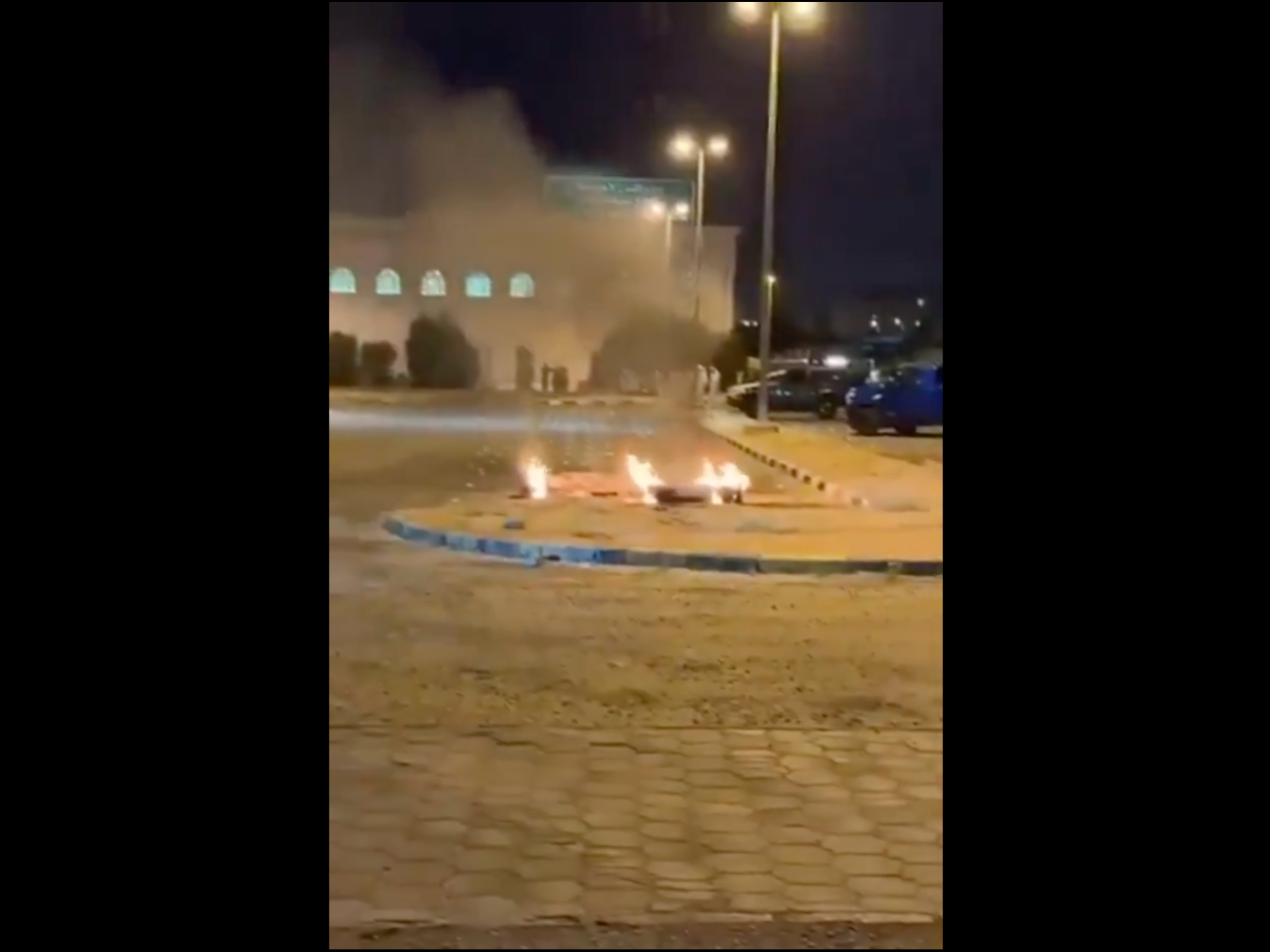
The US military says it carried out ‘self-defence’ strikes on Iran’s Qeshm Island after Iran earlier launched missiles and drones at US bases in Kuwait and Bahrain. Despite the exchange, the US says the US-Iran ceasefire remains in effect.
Published On 3 Jun 20263 Jun 2026
Share
US President Donald Trump reportedly lashed out at Israeli PM Netanyahu during a phone call over Israel’s threat to strike Beirut’s suburbs.


Published On 3 Jun 20263 Jun 2026
Share
May 28 (UPI) — The U.S. Treasury announced late Wednesday that it has sanctioned an Iranian entity, newly created to oversee and manage the Strait of Hormuz, as the Trump administration seeks to force Tehran to relinquish control over the vital energy trade route.
The strait has been an issue of contention between the United States and Iran, which are locked in negotiations to end the war.
Iran restricted navigation of the strait after the United States and Israel attacked the country in late February, igniting the war. Washington responded by imposing a military blockade of Iran’s ports, cutting it off from maritime trade.
Since imposing the restrictions, Iran has been adamant about maintaining control of the route, through which about one-fifth of the world’s energy trade flows. The Trump administration has repeatedly threatened that there will be free navigation of the strait again, one way or another.
Earlier this month, Iran launched the Persian Gulf Strait Authority to manage the strait.
The Treasury sanctioned the PGSA on Wednesday, accusing it of being an attempt by Iran’s Islamic Revolutionary Guard Corps to monetize the international waterway.
Treasury Secretary Scott Bessent described the mechanism in a statement as the Iranian military’s “latest attempt to extort global maritime trade.”
Bessent said the Wednesday blacklisting was part of Economic Fury, the Treasury’s rebranding of President Donald Trump‘s maximum pressure campaign of sanctions and other trade measures from his first administration seeking to coerce a new nuclear weapons deal from Iran.
The United States has been tightening its financial vise on Iran since 2018 when Trump first imposed sanctions on Tehran after unilaterally withdrawing the United States from a multinational Obama-era nuclear accord aimed at preventing Iran from securing a nuclear weapon.
Trump reimposed the campaign following his return to the White House in early 2025. It was renamed following the start of the military operation Epic Fury that began Feb. 28.
Treasury officials said Wednesday that through the maximum pressure campaign, the Trump administration has denied Iran access to tens of billions of dollars’ worth of revenue.
The sanctions generally prohibit those named from accessing the U.S. financial system and bar U.S. persons and companies from doing business with them. They also expose foreign financial institutions that knowingly facilitate significant transactions for those sanctioned to potential secondary sanctions.
Sen. Tom Cotton, a Republican from Arkansas, had over the weekend called on Bessent to sanction the PGSA, stating the United States “must ensure every actor enabling the terrorist Iranian regime is held accountable.”
“I support the use of existing authorities to impose sanctions on the PGSA, its officers and any foreign entity that pays, processes or facilitates tolls to Iran for passage through the Strait of Hormuz,” he said in a statement.
Iran has rejected the notion that it is running a toll. Iranian Foreign Ministry Spokesperson Esmaeil Baqaei has said that Iran charges fees to cover costs associated with navigational services and environmental protection measures.

Convictions handed down amid an intensified crackdown by Bahraini authorities on individuals accused of having ties to Tehran.

Published On 24 May 202624 May 2026
Bahrain has sentenced nine people to life in prison for carrying out what authorities describe as “hostile and terrorist acts” in cooperation with Iran’s Islamic Revolutionary Guard Corps (IRGC).
Two other defendants were also jailed for three years each after being convicted of collaborating with the IRGC in what prosecutors described as “terrorist and espionage” activities, state media reported on Sunday.
list of 3 itemsend of list
The convictions were handed down during an intensified crackdown by Bahraini authorities on individuals accused of ties to Tehran. The crackdown followed a wave of Iranian strikes on Bahrain after the United States and Israel launched their war on Iran in late February. Iran began striking all of its Gulf neighbours in response, saying it was targeting American interests, including military bases.
Prosecutors said some of the defendants photographed vital and strategic sites in Bahrain on behalf of the IRGC. Others were accused of facilitating the transfer of funds from Iran to Bahrain, including through cryptocurrency transactions, to finance the operations. Authorities also alleged that individuals inside the country were recruited to support some of the plans.
Bahrain began arresting individuals allegedly linked to Iran in March, shortly after the conflict began.
Earlier this month, authorities detained a further 41 people.
Less than two weeks later, more than 60 people were stripped of their citizenship for allegedly supporting Iranian attacks on Bahrain and “colluding with foreign entities”.
The London-based Bahrain Institute for Rights and Democracy described the move as “dangerous” and said it constituted a clear violation of international law.
Other Gulf states have also arrested individuals accused of cooperating with Iran. Last month, the United Arab Emirates said it had dismantled a group allegedly planning to carry out what officials described as “terrorist acts”.
Bahrain is home to a large Shia population. Many of its members have long accused the authorities of political and economic marginalisation. The government denies discriminating against Shia citizens, accusing Iran of fuelling unrest in the country.