Egyptian president pledges ‘any measure’ to help defend Saudi Arabia ‘if it is requested of us’.
Published On 17 Oct 202617 Oct 2026
Egypt’s President Abdel Fattah el-Sisi has called for an emergency parliamentary session to authorise him to approve any requests from Saudi Arabia for defence assistance, if Riyadh were to ask.
Speaking at a graduation ceremony at the Egyptian Military Academy on Saturday, el-Sisi emphasised Cairo’s readiness to back the kingdom.
Recommended Stories
list of 3 itemsend of list
Egypt will “carry out any measure to protect” Saudi Arabia “in accordance with the directives of His Majesty King Salman and the directives of the Crown Prince, Mohammed bin Salman”, he said.
“I know that this matter requires the approval of the Egyptian parliament, and I hope that parliament will convene in an emergency session to give us this authorisation, if it is requested of us,” he said.
“I am not speaking in order for us to fight anyone or attack anyone. I am speaking only for defence.”
Attacks on Saudi Arabia
The request follows a barrage of attacks on the kingdom from Yemen’s Iran-backed Houthis, including airports and oil facilities.
Recent Houthi strikes on Saudi Arabia have mainly targeted key infrastructure on the outskirts of the capital, Riyadh, but they appear to be edging closer to the city centre.
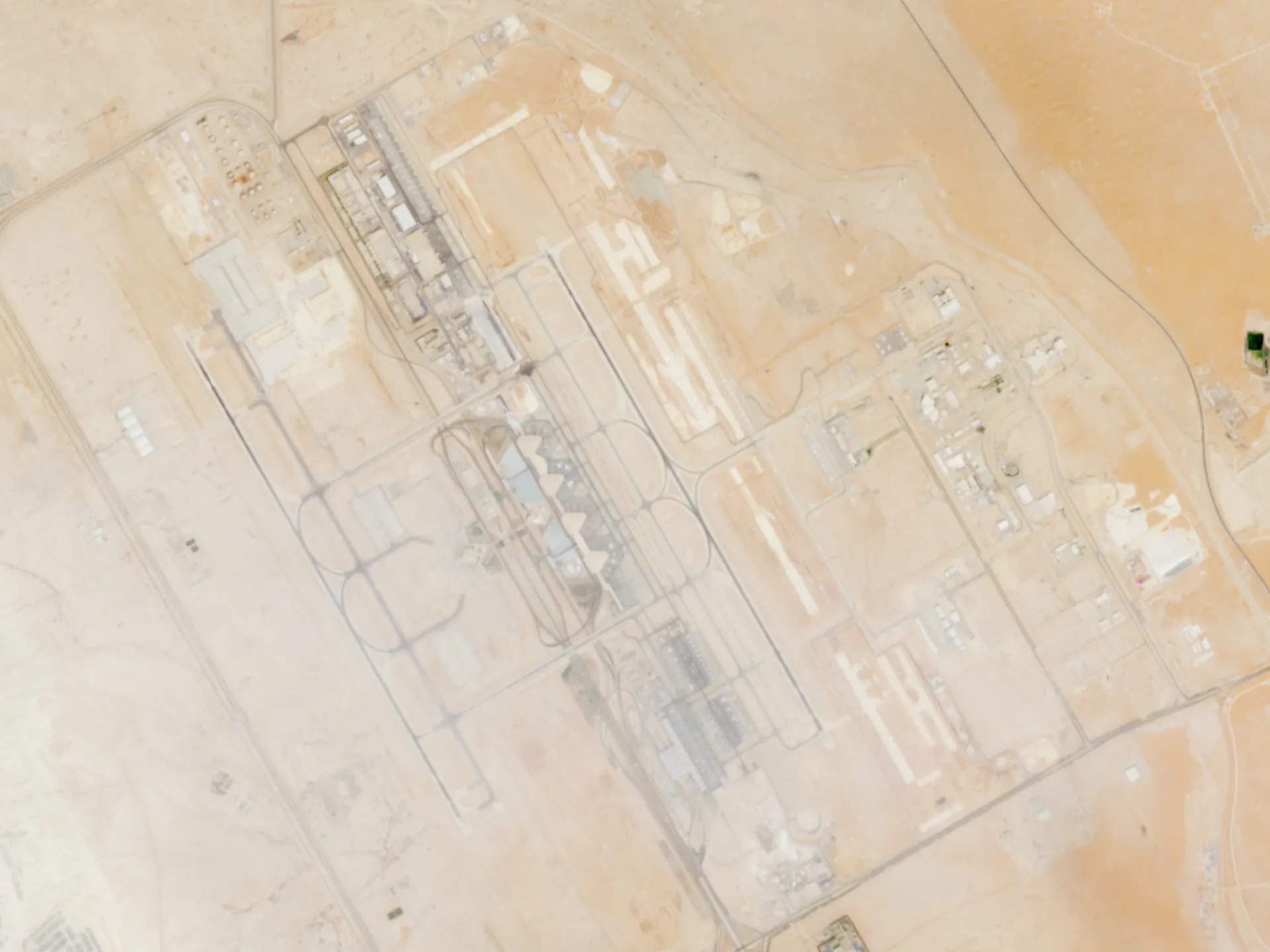
Houthi attacks on Riyadh’s King Khalid International Airport earlier this month killed 14 people and wounded more than 300. Houthi attacks have also been reported on other airports, including Dammam, Abha, Jazan and Najran.
Yemen’s Saudi-backed, internationally recognised government launched a full-scale military campaign against the Houthis this month to recapture territory seized by them.
El-Sisi had backed Saudi calls for secure and unhindered navigation in the Red Sea in a meeting with the Saudi Crown Prince, known as MBS, in Cairo last month.
A statement from the Egyptian presidency then said that “the security of Saudi Arabia and the Gulf states is an integral part of Egypt’s national security”.
Red Sea security

That meeting came just days after the Houthis seized Yemen’s Red Sea coast, gaining significant control over the Bab al-Mandeb strait, the southern gateway to the Suez Canal.
Saudi Arabia already has a defence pact with Pakistan and Turkiye, known as the Mecca Alliance for Defence, which was signed in August.
Earlier this month, the three countries agreed to activate “deterrence measures” under the pact and rapidly deploy forces to the Gulf kingdom to counter attacks by Yemen’s Houthis.
Analysts say Riyadh is looking for help to protect the kingdom and Red Sea shipping and that Egypt, whose Suez Canal revenue depends on the same traffic, is an obvious partner.
They say Egypt is eager to prevent Iran and its allies from imposing control over the region, especially over maritime traffic in the Red Sea, given the direct repercussions for the Suez Canal.
Saudi Arabia has accused Iran of encouraging Houthi attacks against the kingdom, a claim Tehran rejects. Iran has offered assistance to halt the conflict between the two sides.
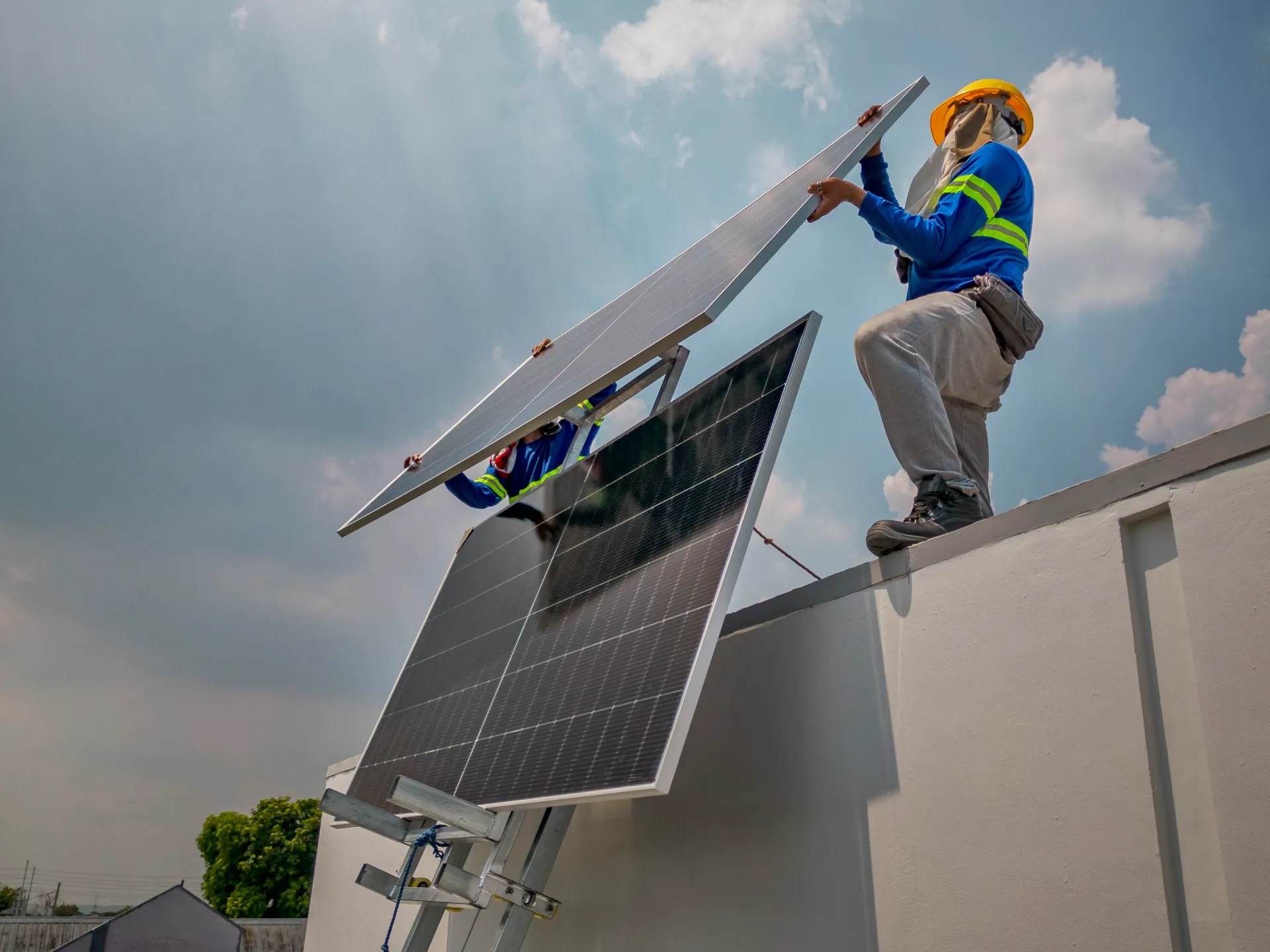
Manila, Philippines – Keith Cantera and his family have been thinking about having their own solar power grid at home for years. But spending up to $5,000 for solar panels was nothing to scoff at, so they put the idea on the back burner.
It all changed this year when the United States-Israel war on Iran rattled global energy markets and sent electricity prices soaring. From paying a monthly bill of about $150 before the war began in late February, Cantera said his family went to forking out as much as $220.
Eight months later, they are having solar panels installed on their rooftop.
“The cost is about the same as paying our electric bills for three or four years based on the current rate,” Cantera said. “But in the fifth year, we’ll have recovered our investment, and electricity will essentially be free.”
Cantera is one of a growing number of Filipino homeowners turning to solar power in a country that had Southeast Asia’s highest electricity costs even before the war. They were comparable only to Singapore, where the average income is more than 10 times higher.
A report by the energy think tank Ember estimated that rooftop panels had nearly doubled in the Philippines since early 2025.
And in the first months of the war from March to May, the rush for solar power led to $407m in panel imports, according to government trade data from China, where most panels are manufactured. The Philippines became the biggest single overseas market for that period. Only the Netherlands bought more, but it redistributes them to the rest of Europe.
Lexus Grepo, CEO of the solar power supplier Solarmaxx, can attest to the boom.
“There is a 30-day wait because solar panel shipments can’t keep up,” Grepo said. “In March, we had 40 projects, which was almost triple our monthly clientele. Since then, we have been setting up 25 to 30 systems a month.”
Grepo does not expect demand to slow down even if tensions in the Middle East ease and shipping routes for energy supplies reopen.
“I think people now realise that the world is an unpredictable place, so they have to be ready for any eventuality. Filipinos now see that they don’t necessarily have to be at the mercy of the global energy market.”
The Philippines, one of the few countries in the region where electricity is not subsidised, relies on imported coal and gas for more than 70 percent of its power mix. The value of its currency, the peso, which has slid to a record low of more than 63 to the US dollar, is making these imports even costlier.
In late March, President Ferdinand Marcos Jr declared a national energy emergency in response to the war and what he described as the “imminent danger” posed to the national energy supply. Still, electricity rates have continued to increase.
The shift to solar is also partly driven by anger at electric companies that have come under scrutiny for charging customers for so-called system losses, which include illegal connections.
Cantera said learning about having to pay for someone else’s electricity consumption was the last straw.
“Who would agree to paying for something that you did not use? It’s not like the money we spend for electricity just fell from heaven,” he added.
But while the soaring demand is real, the upfront cost of a solar power system is still too high for most Filipinos. The government in March launched a new initiative offering loans for residential rooftop installations, but these are available only to public sector workers.
What officials hope can bring power rates down for the majority of people are the dozens of renewable energy projects in the pipeline, including a 3,500-hectare (8,650-acre) solar farm north of the capital, Manila, that is projected to be the largest in the world. When fully operational, the project is expected to generate 850 megawatts of electricity for 2.4 million households.
But some consumers said such projects could take years to complete, leaving them with ballooning electricity bills unless they take action themselves.
“It’s just so unpredictable nowadays. You have the impending El Nino weather pattern. There’s still war, the continuing fuel price hikes and so much more,” Cantera said. “So why not utilise a natural resource?”
United States President Donald Trump has for the first time explicitly ruled out the use of a nuclear weapon against Iran, but has not denied US media reports that his administration is considering deploying the US’s most lethal non-nuclear munition, nicknamed the “mother of all bombs” in the near future.
In an interview published on Thursday by right-wing American news site Newsmax, Trump suggested he does not plan to use nuclear weapons, but also clarified that the devastating aerial weapon, the GBU-43/B Massive Ordnance Air Blast Bomb (MOAB – ‘mother of all bombs ) “is not nuclear”.
Recommended Stories
list of 4 itemsend of list
“I wouldn’t use nuclear. We don’t have to. We’re the greatest nuclear power in the world,” he told Newsmax.
The comments marked Trump’s first definitive statement on the nuclear topic following speculation about a possible atomic conflict earlier in the US and Israel’s war on Iran. They also appeared to confirm speculation that another phase of the war is imminent, likely after the US midterm elections on November 3.
Here’s what we know:
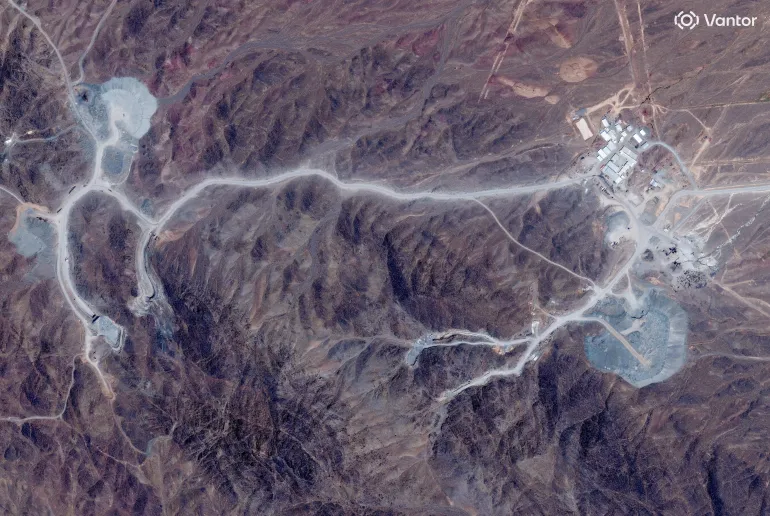
A satellite view of tunnel entrances on Pickaxe Mountain at the Natanz nuclear facility in Iran, June 30, 2026 [Vantor/via Reuters]
What did Trump say?
Trump told Newsmax that the US might indeed launch another strike on Iran’s nuclear sites, particularly on Pickaxe Mountain, where Tehran is believed to be hiding a nuclear facility deep under layers of granite.
He ruled out using a nuclear weapon or a tactical nuclear weapon.
“I wouldn’t use nuclear. We don’t have to. We’re the greatest nuclear power in the world,” he said.
He also clarified that the MOAB, which CNN reported the US government is considering using, “is not nuclear”.
Responding to a question about whether the MOAB is “tactical nuclear” – meaning smaller nuclear munitions – Trump reiterated that it is not.
“Well, the mother of all bombs is not nuclear,” Trump said. “It’s not nuclear at all. This is just an extremely large bomb.”
Trump declined to say whether he had authorised its use in Iran.
Trump also suggested renewed attacks are likely in the near future. The US cannot end the war now because it has to ensure Iran cannot produce a nuclear weapon, he argued, saying he believes that “if they had it, they would use it, in my opinion, instantaneously”.
Trump also reiterated that the war would end “very soon” whether by force or diplomacy and that oil prices would then drop.
When asked if he would put “troops on the ground”, Trump said: “No, I don’t see that, I don’t see it.” Earlier in the war, Trump had made comments regarding sending in troops, a move analysts said would be devastating for US soldiers because of Iran’s mountainous territory.
What is the ‘mother of all bombs’?
The MOAB carries a massive payload of about 8,500kg (18,000 pounds or 8.5 tonnes) of high explosives. It weighs 9,800kg (21,605 pounds or nearly 10 tonnes) – about the same as four cars – and is just over nine metres (about 30 feet) long. Stealth bombers are too small to carry it, so it has to be deployed by larger, Lockheed C-130 Hercules transporters.
It is designed to explode a few metres above the ground, sending out intense fireballs that can blast buildings and other hard-surface structures within a 1km radius, experts have told Al Jazeera. It is so powerful that a mushroom cloud from its blast has been seen 32km (20 miles) away in tests, the US Air Force has said.
“Its large explosive charge can produce devastating blast effects against exposed personnel, equipment and vulnerable structures,” Brussels-based military and weapons analyst Elijah Magnier said. “Its purpose is to generate an exceptionally powerful blast across a surface area.”
However, Magnier said there is doubt about whether using the massive surface explosive would be effective against deeply buried nuclear installations in Iran. He added that the terrain in Iran could be difficult for larger cargo aircraft to access.
What has Trump previously said about nuclear weapons?
Trump has never explicitly mentioned using a nuclear weapon, but he has also never ruled it out.
Speculation regarding whether Washington might use nuclear weapons was rife in the early days of the conflict, largely because of the extreme nature of Trump’s numerous threats against Tehran.
In April, for example, as Iran enforced a blockade on ships in the Strait of Hormuz, Trump posted on his Truth Social site that “…a whole civilisation will die tonight, never to be brought back again”, if Iran did not agree to a peace deal and reopen the strait.
He also threatened to destroy Iran’s infrastructure, saying a bombing campaign “will be Power Plant Day and Bridge Day, all wrapped up in one”, in Iran.
Experts widely interpreted his statements as a threat of nuclear destruction, but one that still failed to force Iran to the table.
Although Trump largely moved away from his sabre-rattling rhetoric in the following weeks, he reiterated at the United Nations General Assembly in New York last month that he could “annihilate” Iran. He also told the assembly that he believed a deal would emerge after the midterms.
What is a ‘tactical’ nuclear weapon?
“Tactical” nuclear weapons (TNW) are smaller nuclear munitions designed for the battlefield as opposed to strategic nuclear munitions designed for mass destruction.
Some perceive TNWs as having a lesser impact than an atomic bomb, but experts warn that their names are misleading and they can nevertheless be devastating. Their explosive yield, between 0.3 and 50 kilotons, can impact areas within a 500-600km radius.
The US dropped a 15-kiloton nuclear bomb on Hiroshima, meaning that weapon would today be considered a TNW. The US, North Korea and Russia have TNWs in their arsenals, although no country has ever used them. TNWs are not subject to any international treaties and are largely unregulated.
What might another US attack on Iran look like?
With Trump failing to rule out dropping the MOAB, analysts speculate that the US might launch another – perhaps final – intensive bombing campaign targeting Iran’s nuclear and defence sites, particularly Pickaxe Mountain.
The US could also continue its naval blockade on Iranian ports, while providing escorts for commercial ships through the Strait of Hormuz.
Iran has vowed to respond to escalatory strikes by targeting oil and digital infrastructure in neighbouring Gulf states.
Senior defence officials have also warned that Iran will invade its neighbours if the US launches a ground operation, although Trump appears to have ruled that out.
Earlier in the war, he hinted at the possibility of sending ground forces to retrieve some 400kg of “yellowcake” – highly enriched uranium that Washington and Israel claim Tehran has hidden underground.
Trump’s phone calls in March to Kurdish militia groups fighting Iran provoked speculation that Washington could coordinate with them for an invasion, although that did not happen.
The United States has developed plans to strike Iran with the largest non-nuclear bomb in its military arsenal on Iran’s energy infrastructure and nuclear sites if President Donald Trump orders renewed combat operations, according to US officials cited by CNN.
Deploying the GBU-43/B Massive Ordnance Air Blast Bomb (MOAB), nicknamed the “mother of all bombs”, could significantly escalate the ongoing conflict at a time when fighting has lulled, experts say.
Recommended Stories
list of 4 itemsend of list
Concerns are also being raised, including within the Trump administration itself, over what such a move would even achieve. Officials familiar with military planning discussions told US news outlet CNN and Al Jazeera that deploying the MOAB would be unlikely to help the US achieve its stated strategic goals, including to destroy Iran’s nuclear capabilities.
Brussels-based military expert Elijah Magnier told Al Jazeera that using the MOAB would not even guarantee the destruction of Iran’s deeply buried underground nuclear installations and that such a strike would likely amount to little more than “political theatre”.
Here’s what we know:
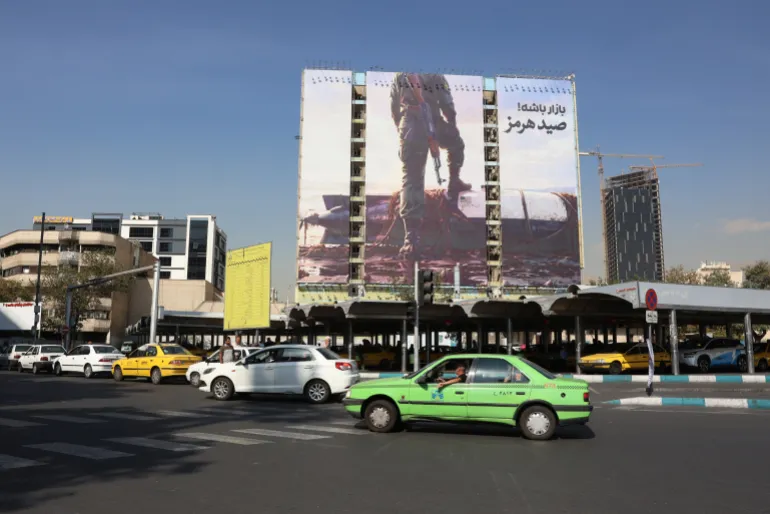
Iranians drive past an anti-US billboard depicting a member of Iran’s Revolutionary Guard (IRGC) with a US unmanned underwater vehicle that Iran claimed to have seized in the Strait of Hormuz and the slogan ‘Hormuz Catch’. In Vanak Square in Tehran, Iran, 14 October 2026, amid the ongoing conflict between Iran and the United States [Abedin Taherkenareh/EPA]
What is the MOAB?
The GBU-43/B Massive Ordnance Air Blast Bomb (MOAB) is a massive munition containing about 8,500kg (18,000 pounds or 8.5 tonnes) of high explosives. It weighs 9,800kg (21,605 pounds or nearly 10 tonnes) – about the same as four saloon cars – and is as long as a small yacht at just over 9 metres (about 30 feet).
The MOAB is typically deployed from the Lockheed C-130 Hercules cargo aircraft because it cannot fit in a stealth bomber.
The bomb, which was first manufactured between 2002 and 2003, has undergone 12 detonation tests.
Its name is a reference to former Iraqi President Saddam Hussein’s comments during the 1991 Gulf War when he invoked the “mother of all battles”.
The US has only deployed the MOAB once before – during its 2017 attacks on an Islamic State Khorasan Province (ISKP) cave and tunnel complex in Afghanistan. Afghan authorities claimed that while 94 Islamic State-Khorasan Province (ISKP) fighters were killed in the blast, no civilians were hurt. However, there were unconfirmed, local reports of civilian casualties and many homes were destroyed.
What is the ‘mother of all bombs’?
The GBU-43/B, the US’s most powerful non-nuclear bomb, was used once, against Islamic State-Khorasan…
GBU-43/B
Pallet is deployed from rear cargo door of MC-130H or C-17aircraft.
Released from the aircraft.
Cradle separates; GPS and fins guide it.
H6 explosives detonate.
A powerful shockwave spreads.
Hot gases, smoke and debris rise in a mushroom cloud.
1 of 4
What kind of damage can it cause?
Designed to explode a few feet above the ground, the MOAB sends out lethal waves of fire when it detonates, blasting away buildings, cave openings and other hard-surface structures.
“Its purpose is to generate an exceptionally powerful blast across a surface area,” Magnier said.
Military expert Colonel Nidal Abu Zeid told Al Jazeera the bomb does not require impact in order to detonate and that its massive blast will destroy everything above ground within a 1km (0.6-mile) radius.
It is likely that the US would aim to use the high-explosive MOAB to completely destroy Iran’s ground-force positions above ground, and to reach its underground facilities, including Pickaxe Mountain, which Trump has previously threatened to attack, Abu Zeid said.
However, Magnier said the bomb’s radius and level of destruction would depend greatly on the terrain it is used within and how populated the area is. He added that it may not be particularly effective against targets buried deep underground.
Some of Iran’s nuclear sites which the US may wish to target, such as the Fordow complex and an under-construction site at the Pickaxe Mountain, are heavily fortified and deeply buried.
“Its large explosive charge can produce devastating blast effects against exposed personnel, equipment and vulnerable structures,” Magnier said. “The Afghanistan operation demonstrates its intended application against a cave-and-tunnel position; it does not demonstrate an ability to destroy every kind of underground installation.”
While its blast can reach underground, the MOAB is not especially designed to punch through deep concrete or mountain rock in the way that a “bunker buster” bomb is. The US military’s most powerful bunker buster is the GBU-57 Massive Ordnance Penetrator. Weighing about 30,000 pounds (13,600kg), including a 2,700kg (6,000 pound) warhead, this precision-guided bomb is made of high-strength steel and built to penetrate up to 200 feet (61 metres) underground before exploding.
Would the US really use an MOAB?
It already has done – in Afghanistan in 2017.
However, besides not being guaranteed to hit underground targets effectively, Magnier told Al Jazeera it could be difficult to deploy the necessary aircraft in the regions of Iran where nuclear sites are located. Stealth bombers which are better suited to this terrain are not able to carry this size of bomb.
Using the bomb could also destroy infrastructure without inducing Iran to make any concessions, he added, noting that its deployment would risk turning “a spectacular event” into one that ultimately delivers few political results for Washington.
“The question I would put to any commander advocating its use is straightforward: What will this weapon accomplish that another available weapon cannot, and how will that result advance an achievable political settlement?,” Magnier said.
“If the answer centres on the spectacle of the explosion, the proposal is stronger as political theatre than as military strategy,” he added.
CNN reported that Trump, in private discussions, has been seeking a “definitive” end to the war that will prove Washington has been undefeated.
How might Iran respond?
A MOAB strike would likely prompt a major reaction from Iran, experts say, warning that Tehran could even invade its neighbours who host US military assets in response.
Iranian security officials have for months made comments regarding a possible invasion of countries like Kuwait to capture US troops and force Washington to surrender.
In May, during a pause in hostilities, Kuwait alleged that sailors from Iran’s Islamic Revolutionary Guard Corps (IRGC) infiltrated its Bubiyan Island, leading to an exchange of fire between Iranian and Kuwaiti forces. One Kuwaiti was injured and four Iranian soldiers were captured.
Iran denied that it had invaded the island and said the troops’ navigation system had malfunctioned.
On Tuesday, IRGC security adviser Mohammad Reza Naghdi warned that Iran could capture troops if Washington were to launch ground attacks, although military experts have long dismissed Trump’s earlier threats of an invasion due to Iran’s mountainous terrain.
“If the United States launches a ground attack, so many of its troops will be captured that it will be forced to raise the white flag,” he said.
Experts say Iran has been preparing for another round of war by stockpiling weapons, fortifying key nuclear and defence locations, and rallying its supporters.
In a television broadcast on Sunday, National Security Council chief Mohsen Rezaei threatened that Iran would attack regional digital infrastructure, including communication cables, data centres and artificial intelligence facilities in the United Arab Emirates and others, if American strikes resume.
Forces aligned with Yemen’s government on Thursday said that they had intercepted a drone headed towards Medina in Saudi Arabia, and a missile fired towards Riyadh, amid escalating fighting between them and Yemen’s Houthi group.
Fighting between the Saudi-backed Yemeni government forces and Iran-aligned Houthi rebels has intensified along the country’s western Red Sea coast, along with expanding Houthi attacks on oil facilities and airports in neighbouring Saudi Arabia.
Recommended Stories
list of 3 itemsend of list
On Wednesday, Yahya Saree, the military spokesman for the Houthis, also known as Ansar Allah or Supporters of God, said the group’s forces had conducted “a high-quality military operation targeting Aramco in Dhahran”, as well as strikes on Riyadh airport and a refinery in the capital.
He added that operations “will continue in the coming days, targeting Saudi enemy airports and oil facilities”.
A Saudi Ministry of Energy official confirmed that a building belonging to Aramco in Dhahran was hit, resulting in a “limited fire” but “no casualties or fatalities”. Dhahran is home to Aramco’s headquarters, a vast complex comprising numerous buildings and residential compounds.
Meanwhile, the Saudi-led coalition launched strikes against the Houthi stronghold in the Yemeni capital, Sanaa, which the armed group seized in 2014 and has held ever since. The coalition fought the Houthis, who also seized large quantities of Yemen’s military assets, until a ceasefire was agreed in 2022. That ceasefire has broken down in recent months.
Reporting from Sanaa, Al Jazeera’s Yousef Mawry said the war has become a tit-for-tat exchange of blows. The Iran-backed group “will continue to launch these air strikes and … its goal is to meet fire with fire – air strike for air strike, capital for capital, airport for airport, and energy facility for energy facility”.
Which sites have the Houthis targeted in Saudi Arabia?
Recent Houthi strikes on Saudi Arabia have mainly targeted key infrastructure on the outskirts of Riyadh, but they appear to be edging closer to the city centre.
Houthi attacks on Riyadh’s King Khalid international airport over the weekend killed 14 people and wounded more than 300 others. Houthi attacks have also been reported on other airports, including Abha international airport in southern Saudi Arabia, where two people were killed, and on Saudi Aramco energy facilities.
Authorities say Riyadh airport will remain shut at least until Saturday as several airlines cancelled flights, emptying the skies over the kingdom’s capital.
Al Jazeera’s Mawry said Saudi Arabia “has much more to lose” from tit-for-tat attacks disrupting air traffic, as Sanaa international airport has been closed for many years due to the damage it has sustained over the years of civil war. There are currently no Yemeni airliners at the airport.
Additionally, by disrupting security, the Houthis are signalling that Saudi Arabia will suffer mounting economic costs for its involvement in Yemen. Earlier this year, the Houthis similarly began launching strikes on Saudi-linked shipping in and around the Bab al-Mandeb strait at the entrance to the Red Sea. Saudi Arabia has increasingly relied on this shipping route for oil exports since Iran closed the Strait of Hormuz in March, under fire from the United States and Israel.
The kingdom is set to host a major investment conference in Riyadh later this month, dubbed “Davos in the desert”, but it is now unclear whether the event will go ahead amid the attacks.
Organisers of the Six Kings Slam tennis tournament, originally slated to begin next week in Riyadh, have announced the event will be pushed to December.
Saudi Arabia is also preparing to host the FIFA World Cup in 2034.
Al Jazeera’s Zein Basravi, reporting from the Qatari capital, Doha, said, “These military hits by the Houthi forces are meant to create a pressure campaign that is also having knock-on economic effects.”
“The Gulf Cooperation Council has become a place where these enormous events have been playing out over the past year, and if they carry on, the international implications for the global economy will continue to be negative,” he added.
What’s the situation on the ground in Yemen?
Yemeni government forces are currently engaged in a major counteroffensive operation, called “Dawn of Yemen“, to retake coastal territory seized in recent weeks by the Houthis near the Bab al-Mandeb strait, a vital maritime trade chokepoint.
The Saudi cabinet pledged in a meeting led by Crown Prince Mohammed bin Salman this week that it “will not allow its security or freedom of navigation in the Red Sea and Bab al-Mandeb strait to be threatened”.
On Wednesday, Yemeni government forces said they had carried out 2,309 “targeting operations” against the Houthis as part of their “Dawn of Yemen” military campaign.
The forces’ spokesperson, Majeed al-Nuzaili, said the operations were conducted using combat aircraft, drones, artillery and rocket launchers, and destroyed 460 Houthi military vehicles.
Government forces say they have retaken areas in Sabr al-Mawadim and al-Sarari in Taiz governorate and have repelled a large Houthi attack west of Taiz city in southwest Yemen, a government-held city that was besieged by Houthi fighters earlier this month. Taiz governorate includes the flat, western coastal region on the Red Sea, which contains the port city of Mocha and the Bab al-Mandeb. Much of the governorate also lies within Yemen’s highlands while its capital, Taiz, is nestled between mountains.
Al Jazeera’s Mawry said fighting has been so intense in the area because of its strategic value. “Whoever controls the altitude and gains control of the mountains controls the landscape. They control the Red Sea coastlines and even the city of Taiz,” he said.
The internationally recognised Yemeni government has been calling for more reinforcements as well as Saudi air attacks on the positions recently taken over by the Houthis, mainly in the district of al-Misrakh, south of Taiz, and the district of at-Turbah, which are the gateways to the city of Taiz.
Mawry reported that while the Saudi-led coalition’s aerial strikes are forcing the Houthis to withdraw and retreat, allowing government forces to advance, they have not been able to gain a full hold over some of those positions.
“It is then followed by another counter-military offensive by the Ansar Allah group to retake the area. And this is sort of the routine that we have been seeing since early September,” he said.
The Houthi siege of Taiz has resulted in civilian casualties and severe shortages of fuel, gas and other supplies. On Wednesday, the United Nations World Food Programme (WFP) reported that wheat flour stocks have been nearly exhausted.
The Red Cross said front-line hospitals in areas including Marib, Taiz and Yemen’s Red Sea coast are registering unprecedented numbers of weapon-wounded patients, with some facilities admitting more than 700 casualties in a single week.
Without a quick deal to move fertiliser through the strait, agricultural productivity would ‘significantly drop’.
Published On 14 Oct 202614 Oct 2026
A senior United Nations official has warned that parts of Asia and Africa could face a food security crisis unless Iran and the United States quickly agree on a UN-backed plan to move fertiliser through the embattled Strait of Hormuz.
UN Under-Secretary-General Jorge Moreira da Silva said on Wednesday that it was “absolutely critical” that the two countries agree to the proposal within weeks as planting season approaches. It calls for a UN-staffed coordination centre in Oman to help register vessels and oversee their safe passage in the waterway, through which a large portion of key global fertiliser inputs traditionally flow.
Recommended Stories
list of 3 itemsend of list
“If we miss that planting season, the productivity of agriculture would significantly drop and the impact on prices will significantly increase,” Moreira da Silva told Reuters on the sidelines of International Monetary Fund and World Bank meetings in Bangkok, Thailand.
Farmers operate strict crop calendars, and even slight delays could severely affect yield.
‘Negligible’ fertiliser shipments
Traffic in the Strait of Hormuz has been severely disrupted since the start of the US-Israel war on Iran, with Iran targeting vessels in the strait and the US and Iran exchanging fire in and around the waterway.
The disruption has hit global supplies of urea, the world’s most widely used nitrogen fertiliser, as well as seaborne sulphur, a key input. Before the war, roughly a third of global urea shipments and nearly half of seaborne sulphur passed through the strait.
Although some ships have been able to sail through amid the crisis, fertiliser products have made up a “very negligible” share of moving cargo, according to the Washington-based International Food Policy Research Institute.
Moreira da Silva said the UN-backed fertiliser mechanism, drawn up in March, could be activated within seven to 10 days if both Iran and the US agree.
Under the plan, UN monitors would work alongside local authorities at Gulf ports to verify cargo loading. Ships would be tracked during transit, and additional inspections could be carried out if countries raised concerns about a vessel or its cargo, said Moreira da Silva. He did not say why the US and Iran have not yet agreed.
The passage of only five vessels per day through the Strait of Hormuz could keep fertiliser supplies flowing to countries in critical need, he added.
‘Let us do our job’
The UN mechanism could work alongside negotiations for a “comprehensive deal” to restore freedom of navigation in the strait, Moreira da Silva said.
Iran and the US have exchanged proposals through intermediaries since a June interim ceasefire collapsed. Efforts to reopen the Strait of Hormuz have stalled over Tehran’s conditions and Washington’s insistence on addressing Iran’s nuclear programme from the outset.
“What we are telling them is, while you continue your discussions towards a comprehensive deal, let us work, let us do our job,” said Moreira da Silva.
His plea comes amid growing concern that fertiliser shortages could hit global food supplies.
In May, the UN’s Food and Agriculture Organization warned that fertiliser scarcity could tighten food supplies from late 2026 into 2027, and would likely hit countries facing climate or other crises much harder.
In South Asia, where most rely on imported fertiliser, farmers are already struggling because of soaring costs and fertiliser scarcity. On Wednesday, farmers in Spain took to the streets to protest rising production costs amid high oil and fertiliser prices.
Economists divided on Fed rate hike as inflation creates uncertainty in run-up to US midterm elections in a tense market.
United States consumer prices jumped in September in the final inflation report before the midterm elections, increasing chances of an interest rate hike later this month.
Annual inflation accelerated to 3.7 percent, up from 3.4 percent in August. On a monthly basis, prices rose by 0.6 percent, according to the Consumer Price Index report released by the Labor Department’s Bureau of Labor Statistics (BLS) on Wednesday.
Recommended Stories
list of 4 itemsend of list
Petrol prices led the surge as tensions between the US and Iran, as well as Russia and Ukraine, weighed on global energy prices. Petrol prices rose 9.1 percent in September, accounting for more than half of the CPI monthly increase, according to the BLS. They were up 34.2 percent from the same time a year ago.
“The directionless war in Iran continues to disrupt global supply chains, driving up the prices of food and fuel,” Kyle Moore, chief economist at The Century Foundation, an economic think tank, said in a statement provided to Al Jazeera.
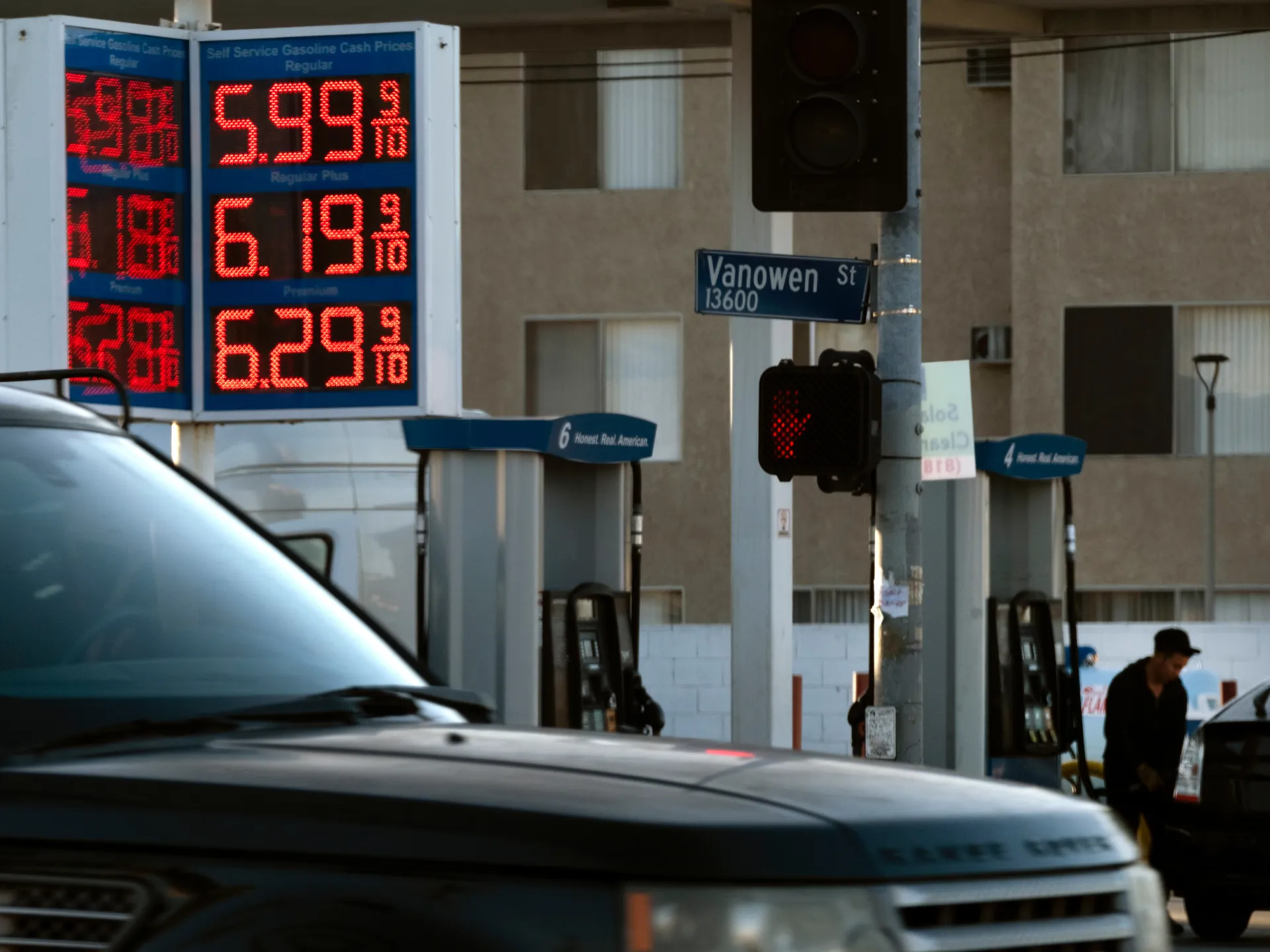
Petrol prices have continued to climb. The average price for a gallon of petrol is $4.33 ($1.14 per litre), compared with $4.31 a month ago, according to the American Automobile Association (AAA), which tracks daily petrol prices. Diesel prices are higher, at $6.29 per gallon (1.66 per litre), compared with $6.23 a month ago.
In a post on X, Patrick DeHaan, head of petroleum analysis for GasBuddy, said, “2026 has now seen more days with average gas prices over $4/gal than any year before: 158 days.”
Shelter costs also jumped 0.4 percent from the previous month, following a 0.3 percent increase in August. Food costs were a bright spot in the report, remaining unchanged overall.
Food away from home, including restaurant meals, rose 0.2 percent, but that increase was offset by a 0.1 percent decline in food-at-home prices, which track grocery costs.
At the grocery store, poultry prices jumped 0.7 percent, fruit and vegetable prices rose 0.5 percent, and juice prices increased 1.1 percent. However, milk prices dropped 2.1 percent and beef prices fell 0.9 percent.
Amid heavy investment in AI infrastructure, prices for computer software and accessories have jumped 28 percent from the same time last year.
“The AI boom is playing a huge part, and we have all read about the hundreds of billions being poured into data centers, AI firms, and models,” Rami Cassis, principal of Parabellum Investment, said in comments provided to Al Jazeera.
Fed pressures
The inflation data comes days before the US Federal Reserve’s interest rate decision later this month. Last month, the US central bank raised rates by 25 basis points, bringing the target range to 3.75–4.00 percent, the first hike in three years.
Economists are divided over whether the Fed will raise rates again or hold them steady. According to CME FedWatch, which tracks the likelihood of monetary policy decisions, there is a 52.9 percent chance that rates will remain in the 3.75–4.00 percent range, while a 47.1 percent chance of a quarter of a percentage point hike that would bring them to 4.00–4.25 percent.
The inflation data puts pressure on Republicans before the midterm elections on November 3. A recent Reuters/Ipsos poll showed that about 78 percent of Americans blamed US President Donald Trump’s policies for price increases.
US markets trended downward following the inflation report. The Nasdaq fell 0.8 percent and the S&P 500 dropped 0.6 percent, while the Dow Jones Industrial Average was roughly flat in midday trading.
Explosions in Sanaa reported shortly after Saudi-led coalition’s evacuation order as Houthis promise ‘harsh’ response.
Published On 13 Oct 202613 Oct 2026
Yemen’s Houthis have warned all employees and civilians near Saudi Arabia’s oil facilities to evacuate, calling the sites “a legitimate target”.
The group’s spokesman, Yahya Saree, issued an evacuation alert on Tuesday following the Saudi-led coalition’s statement urging civilians to evacuate Yemeni Oil Company’s al-Sabah central station in the Houthi-controlled capital Sanaa before a planned military operation.
Recommended Stories
list of 4 itemsend of list
Shortly after the Saudi-led coalition’s evacuation order, Al Jazeera’s team on the ground reported hearing explosions in Sanaa. Media outlets affiliated with the Houthis said air strikes by the Saudi-backed forces struck an oil facility in the al-Sabaha area of the capital.
Following the reported explosions, Saree said Houthi fighters were confronting Saudi-backed forces in Sanaa.
Saree responded to the coalition’s evacuation order, warning that any strikes on Sanaa would be met with a “harsh and painful” response in the Saudi Arabian capital Riyadh.
In a statement on X, Saree said the Houthis would target the sites that were ordered to be evacuated if the Saudi-led coalition proceeded with an attack on Sanaa.
Civilians were told to evacuate the Aramco Company headquarters in Dammam, King Khalid International Airport and a refinery affiliated with Aramco in Riyadh.
An attack on King Khalid International Airport on Saturday left at least 13 people dead and more than 300 injured, rocking the world’s top crude oil exporter. Another person was killed, and 11 were wounded on Sunday after a projectile struck the airport in Riyadh.
Many international airlines have since suspended flights to Saudi Arabia and neighbouring countries following the deadly weekend attacks by the Houthis, including Air France-KLM, Air India, Etihad, Lufthansa, Delta, Gulf Air and Qatar Airways.
The kingdom, which backs Yemen’s internationally recognised government, was still weathering new attacks on Tuesday, with the coalition saying its forces intercepted three drones north of Riyadh.
Saree also reiterated the Houthis’ warning to airports in Saudi Arabia following recent attacks on multiple airports and oil facilities across the country since last week in a spillover from the wider regional conflict between the US and Iran.
Saudi Arabia has in recent weeks launched strikes against the Houthis and is backing a Yemeni government counteroffensive known as the “Dawn of Yemen” after the group seized strategic territory along the Red Sea coast last month.
Sheikh Tamim bin Hamad Al Thani says Qatar has demonstrated its strength and cohesion.
Published On 13 Oct 202613 Oct 2026
Qatar’s Emir Sheikh Tamim bin Hamad Al Thani has told the Shura Council that the region has faced “exceptional events”, following months of instability amid the United States-Israeli war on Iran.
Speaking in the Qatari capital, Doha, on Tuesday morning, Sheikh Tamim said the events had demonstrated the strength and cohesion of the country’s state institutions.
“Our country and the region have faced exceptional events that have once again proven the cohesion of state institutions,” the Emir said.
Qatar has found itself caught up in the war, which began on February 28 and has triggered a global energy crisis. The Gulf state has been directly attacked by Iran on several occasions, including in March, when Tehran struck Qatar’s Ras Laffan gas facility, the world’s largest liquefied natural gas (LNG) production site.
Sheikh Tamim said Qatar had been able to absorb the consequences of the regional instability due to policies implemented before the war, stressing that Doha’s preference was to resolve conflicts through peaceful means and dialogue. However, the Emir maintained that the Gulf Cooperation Council’s (GCC) security was non-negotiable.
“The security of the Gulf Cooperation Council states and the preservation of their sovereignty is a matter that cannot be compromised on,” he said.
The war on Iran has disrupted global supply routes, particularly the Strait of Hormuz, which Tehran has effectively blocked since the start of the conflict.
Sheikh Tamim said efforts to safeguard maritime routes must be increased.
“Efforts must be doubled to secure navigation in the Gulf and the Strait of Hormuz and to protect energy facilities and civilian infrastructure.”
As the United States maintains a naval blockade of Iran’s ports and imposes more sanctions on its oil exports, Tehran is confronting another problem: billions of dollars in revenue from previous oil sales that it says have gone missing.
A spokesperson for Iran’s judiciary said in September that a network of oil intermediaries known as “trustees” owed the Iranian government between 10 billion euros ($11bn) and 11 billion euros ($12bn). That figure was equivalent to half of the total oil revenue projected in Iran’s government budget for the current fiscal year.
Recommended Stories
list of 3 itemsend of list
US officials, including Treasury Secretary Scott Bessent, have tied Iran’s struggles to access oil revenues as evidence that its economic pressure campaign is having an effect. In August, Bessent said that “Iran’s shadow banking system was buckling” under pressure from the US campaign against the country, which has been ramped up as Washington seeks a way to force Tehran to capitulate in the war between the two countries, launched by the US and Israel in late February.
So who are the oil intermediaries, why does Iran depend on them, and what has happened to the billions of dollars they owe? Let’s take a closer look.
The debt, and the crisis it has created for the Iranian government, both stem from an oil-sales arrangement Tehran adopted in 2012 in response to US sanctions targeting Iranian oil exports.
American and European sanctions targeting Iranian oil sales and revenue collection began in 2012. The stated rationale behind both sets of measures was that revenue from oil sales helped finance Iran’s nuclear programme and that restricting Iranian oil exports could prevent the programme from advancing.
In response, the Iranian government devised a way to circumvent international sanctions on its oil sales. Unable to sell oil through the Oil Ministry and receive the proceeds through the Central Bank, it began selling oil to domestic buyers or using it to settle outstanding obligations to institutions and organisations owed money by the state.
This arrangement gave rise to a network of oil intermediaries often referred to in Iran as the “trustee network”. Rather than selling all its oil through official government channels, the state entrusted crude oil to institutions, individuals and companies to sell on its behalf. The proceeds were supposed to be transferred to the government’s treasury, with the sellers or recipient institutions subsequently recovering their agreed costs and outstanding claims. Some institutions sold the oil themselves, while others contracted private trading companies to handle the sales.
The Oil Industry Pension Fund, established for retired Oil Ministry employees familiar with the oil-sales process, was among the first institutions to receive crude oil for sale. Other recipients included Khatam al-Anbiya Construction Base, a major hub for large-scale infrastructure projects. Even the municipal police received payments owed to them by the government in the form of crude oil.
Effect of the nuclear deal
Even in those early experiments, discrepancies emerged between the revenue expected from oil sales and the amounts sellers actually deposited into the government’s treasury. These discrepancies eventually gave rise to some of Iran’s largest economic corruption cases.
The accounting discrepancies and the government’s inability to recover money from private sellers entrusted with Iranian oil persisted until 2016, when the Joint Comprehensive Plan of Action (JCPOA) nuclear deal was signed and when sanctions on Iranian oil sales were lifted. The government was subsequently able to regain control over oil sales.
Individuals who had sold Iranian oil but failed to return the proceeds were imprisoned. With the ability to sell oil again through legal and transparent channels, the government was able, for a time, to manage its oil revenues and spending with greater control.
How did money from oil sales go unreturned?
After US President Donald Trump withdrew the United States from the JCPOA in 2018 during his first presidential term, the Iranian government once again had to rely on private oil traders to sell its oil. But the problems associated with selling oil through intermediaries rather than official state channels, including delays in returning revenues, accounting discrepancies, debts owed by oil sellers to the government, and the occasional seizure of Iranian oil shipments at sea, once again constrained the government’s ability to manage its oil revenues.
Moreover, the US expanded its sanctions beyond Iranian government institutions and interests, adding bank accounts involved in transactions with the Iranian government, currency-exchange offices, companies, and individuals to its sanctions lists. As a result, the time between individuals participating in Iran’s oil-trading network and being sanctioned themselves, along with their assets and companies, and having their accounts blocked or frozen grew progressively shorter.
This contributed to an accumulation of debts owed by sanctioned oil traders – no longer able to access their accounts – to the government. It also left Iran with little choice but to expand its private oil-sales network. That meant increasing the number of people involved in trading Iranian oil, reducing the volume of oil allocated to each individual or company and, ultimately, increasing the risk that the proceeds would not be returned.
Iranian officials have also accused trustees of exploiting the sanctions workarounds to enrich themselves.
The billions of dollars owed by private oil sellers to the Iranian government are a combination of outstanding payments, disputed financial obligations and allegations of corruption. Iran’s judiciary chief recently addressed the issue, warning that oil sellers who refuse to return the proceeds from oil sales will face legal action. But such warnings do not change the sanctions environment or remove the obstacles that prevent some oil sellers from returning the money.
Tehran, Iran – Iranian authorities have signalled they intend to disrupt an Arab-operated and United States-assisted shuttle system that has enabled more energy exports through the Strait of Hormuz during the US-Israel war on Iran.
With the US naval blockade of Iran’s southern ports in place and sanctions tightening, Tehran has said it will pursue military and diplomatic efforts to put pressure on Washington to submit to its demands regarding reopening the Strait of Hormuz.
Recommended Stories
list of 3 itemsend of list
This strategic waterway, through which roughly a fifth of global oil and gas flowed before the war, has been largely closed to shipping following Iranian attacks since the US and Israel launched strikes on Iran on February 28.
But the US Navy has reportedly opened up a route so Gulf states can export oil and other commodities amid an energy crisis.
Iran’s security chief Mohsen Rezaei responded on Sunday night, saying the shuttle system is now an explicit target for Tehran.
Rezaei claimed that the US Central Command, with the assistance of the United Arab Emirates military, was using smaller vessels to transfer oil to larger tankers. He claimed Iran had been striking five or six participating vessels nightly for weeks.
“You are smuggling, but the strait is under Iran’s control, and we manage it,” he asserted.
This appeared to be a taunt aimed at US President Donald Trump, who has hailed energy exports at times reaching pre-war levels over recent weeks.
Rezaei appeared to give the impression that Iran wants to have lasting authority over Hormuz, and promised a harsh response if Iran’s energy and civilian infrastructure were attacked again.
His threats appeared aimed at Arab regional states, with a warning that digital infrastructure could be targeted. Rezaei threatened US-linked cables, data centres and artificial intelligence facilities in the UAE and around the Strait of Hormuz.
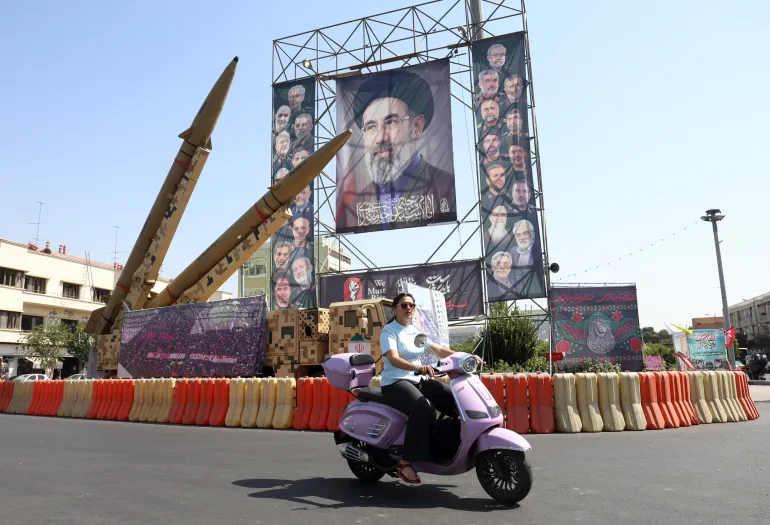
A woman rides her scooter past Iranian Zolfaghar missiles placed in front of a billboard of Iranian Supreme Leader Ayatollah Mojtaba Khamenei at Baharestan Square in downtown Tehran, Iran, September 28, 2026 [Abedin Taherkenareh/EPA]
Rezaei also accused Saudi Arabia of helping the US move oil around Iran’s restrictions. But he did not threaten a direct attack against Riyadh – which is currently being targeted by Yemen’s Tehran-aligned Houthis.
In early September, Iran’s Islamic Revolutionary Guard Corps (IRGC) threatened tankers at ports and anchorages in Kuwait and Bahrain, citing US attacks on Iranian tankers. It accused both countries of complicity through hosting US armed forces.
Iran has claimed the US accepted some of Tehran’s seven conditions for the full reopening of the Strait of Hormuz and ending the war. But Tehran insists that a deal will only materialise when all its demands are met.
Hamidreza Azizi, a senior Iran analyst at the Crisis Group, said this reflects Tehran’s apparent assessment that it is under no immediate pressure to reach an agreement with the US since its pressure in the Hormuz has a global impact.
“The question, however, is whether Tehran is overestimating its ability to sustain this pressure, given the growing economic costs of the confrontation for Iran itself,” Azizi wrote on X.
Transfer system
The system involves very large crude carriers (VLCCs) and smaller vessels coordinating with the US military to load crude oil at Arab ports and use southern corridors near the coast of Oman to exit the strait.
Vessels often switch off their transponders and travel at night to minimise the risk of being targeted by the Iranians. After ship-to-ship transfers in the Gulf of Oman, some of the shuttles come back to load more.
Multiple vessels were targeted overnight Sunday to Monday, including two outbound tankers and one in anchorage near Oman’s port city of Sohar, where ship-to-ship transfers are allegedly being conducted.
The IRGC has also increasingly driven a narrative that naval mines, believed to have been planted across the Strait of Hormuz since the start of the war, pose a serious threat to vessels attempting to navigate the waterway without coordinating with Iran’s Persian Gulf Strait Authority.
The IRGC said three tankers suffered major damage over the weekend after being struck by mines. It also released footage of one ship ablaze that is said to have been struck by a mine, although the footage did not appear to show a mine going off.
‘Cascading impact’
The shuttle system has provided Arab national oil companies with a way out of Hormuz via the southern corridor near Oman.
Michelle Wiese Bockmann, a London-based senior maritime intelligence analyst at Windward, said this system has proven highly effective.
“Under international maritime law, which underpins 11 billion tonnes of seaborne trade annually, vessels have what’s called the right of transit passage,” Bockmann told Al Jazeera. “So, what Oman has done is allow vessels to go through under international maritime law, but they have had US military assistance.”
Tehran says shipping will be disrupted so long as the US continues its choking naval blockade against Iran, which has also stepped up its efforts to counter efforts by Arab states to export oil. At least 15 ships are believed to have been targeted in October so far, according to Winward.
“The more effective the route has become in facilitating the transport of oil and gas, the less leverage Iran has over Hormuz, and more attacks we are seeing on vessels that are using that southern corridor,” Bockmann said.
Windward’s data shows 31 ships transited the Strait of Hormuz daily in the final week of September. This was considerably lower than the 138 before the war.
Eighty-seven percent of the 45 ships targeted by Iran during the third quarter of 2026 were tankers.
Around 47 percent belonged to Gulf Arab energy companies’ national shipping fleets, Windward noted, and 93 percent of the strikes took place in the Strait of Hormuz. Most attacks targeted vessels transiting the southern corridor with their transponders turned off.
These attacks have contributed to a massive increase in freight costs. Freight represented 25-30 percent of Gulf crude’s cost, versus just 1 to 3 percent before the war, according to Windward. National oil companies have resorted to offering discounts of up to $35 per barrel below official selling prices.
The main reason for the rise is a shortage of tankers willing to make the dangerous crossing. Between 15 and 20 percent of very large crude carriers (VLCCs) are tied up with an inefficient logistics system that relies on shuttle transfers, complicated by escalating attacks and exposure at loading ports and anchorages.
“This is having cascading impacts for all vessel classes on freight and values across the world,” Bockmann said.
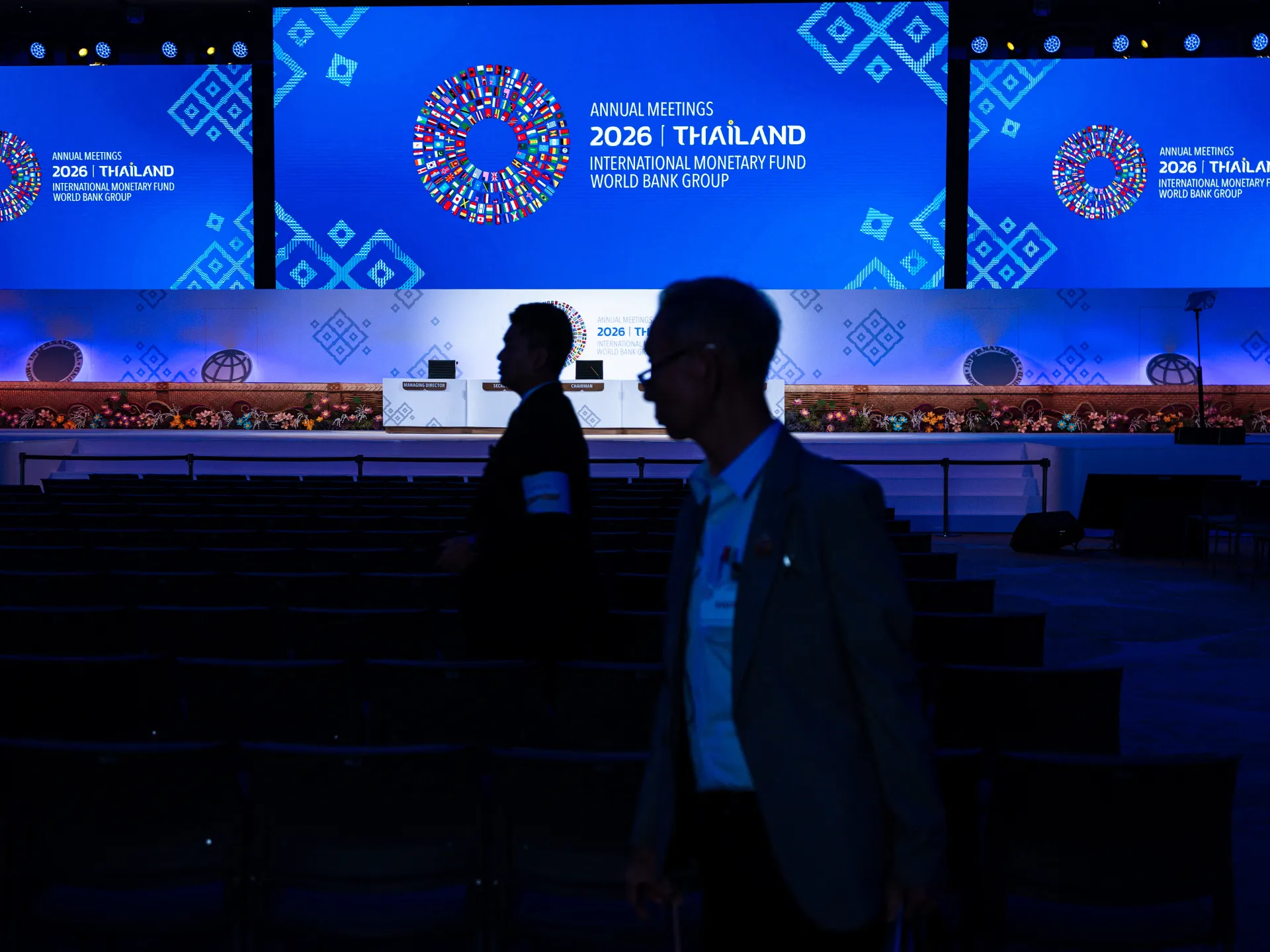
Finance officials from around the world will gather in Bangkok this week under the shadow of a widening war in the Middle East, the biggest-ever energy supply shock and rising interest rates that together pose daunting risks to already-sluggish global economic growth.
The US-Israel war on Iran, now in its eighth month, and its inflationary impact are slated to dominate the agenda and sideline conversations during the annual meetings of the International Monetary Fund (IMF) and World Bank, held outside Washington for the first time in three years.
Recommended Stories
list of 4 itemsend of list
IMF Managing Director Kristalina Georgieva told Reuters News Agency that 18,000 people were registered to attend the meetings, 4,000 more than the last off-site meetings held in Morocco in October 2023.
Notably absent will be United States Treasury Secretary Scott Bessent, who dispatched two senior officials in his stead while he handles some “domestic engagements”, a US official said. Federal Reserve Board Chairman Kevin Warsh will attend and is slated to participate in a public event with Georgieva on October 16.
Several other finance ministers were also staying home due to domestic budget and election duties, but most central bankers would attend, Georgieva said.
Bessent’s decision to skip the high-profile gathering and a meeting of the Group of 20 (G20) major economies, which the US leads this year, may frustrate counterparts amid rising tensions over the Iran war, Ukraine’s battle against Russia’s invasion, and the US move to impose sanctions on the International Criminal Court.
Fossil energy reserve release
The Group of Seven (G7) countries have agreed to release 100 million barrels of diesel and crude oil from emergency reserves under pressure from US President Donald Trump, who is keen to see lower petrol prices before November elections that could see his Republican Party lose control of Congress.
Trump on Friday announced a deal with Russia that would provide even more diesel to global markets and a temporary waiver of US sanctions designed to deprive Moscow of revenues for its war on Ukraine. The move drew swift criticism from Ukrainian President Volodymyr Zelenskyy.
More than one billion barrels of oil have been released, mainly from onshore commercial inventories, since the start of the war on February 28. But industry executives say the amount of oil in storage that is accessible to the global market is running low, making the market more fragile and fuelling pressure on prices.
The IMF has signalled little change in its forecast for three percent global growth in 2026, and may edge its forecast for next year slightly higher. But some countries will see downgrades, including Ukraine, now in its fifth year of war against Russia’s invasion, and Gulf countries hit by Iranian strikes and sharply reduced energy exports.
IMF research released on Tuesday showed that sharp spikes in food and energy prices are an increasingly common source of crises that drive inflation expectations higher for longer, worsen poverty and threaten economic stability.
One headache for policymakers is the growing public debt burden that is sapping growth and adding inflationary pressures. The IMF says public debt is at the highest level since World War II and will exceed 100 percent of gross domestic product (GDP) before 2030.
Advanced economies, led by the US, have the highest debt-to-GDP ratios, but emerging markets and low-income countries are particularly vulnerable, given a perfect storm of challenges: capital outflows in search of higher US rates, weather extremes triggered by the El Nino climate phenomenon, and a lack of investment in artificial intelligence (AI), which has mitigated negative supply shocks in the US and other rich countries.
Developing countries are particularly vulnerable given high public debt levels that will have to be renegotiated at higher interest rates. Together, they face $400bn in debt payments to external creditors in 2026, and interest payments already exceed 10 percent of revenue on average.
Many lower-income countries are worried about new IMF recommendations for loan programmes that call for fewer but deeper reforms as a condition for approving lending, a change that many fear will lead to painful austerity measures.
A Houthi attack on Riyadh airport killed at least 12 people and injured more than 300. The Saudi-led coalition fighting the Houthis in Yemen called the missile strike a ‘war crime’, which has been condemned by the UN, Qatar, Pakistan, Canada and others.
A US fighter jet bombed a commercial cargo ship in the Gulf of Oman, according to CENTCOM. The US military says the ship’s crew ignored repeated warnings and attempted to ‘breach its blockade’ of Iranian ports.
US military jet strikes stern of commercial cargo ship in the Gulf of Oman ‘without harming the crew’, CENTCOM says.
Published On 11 Oct 202611 Oct 2026
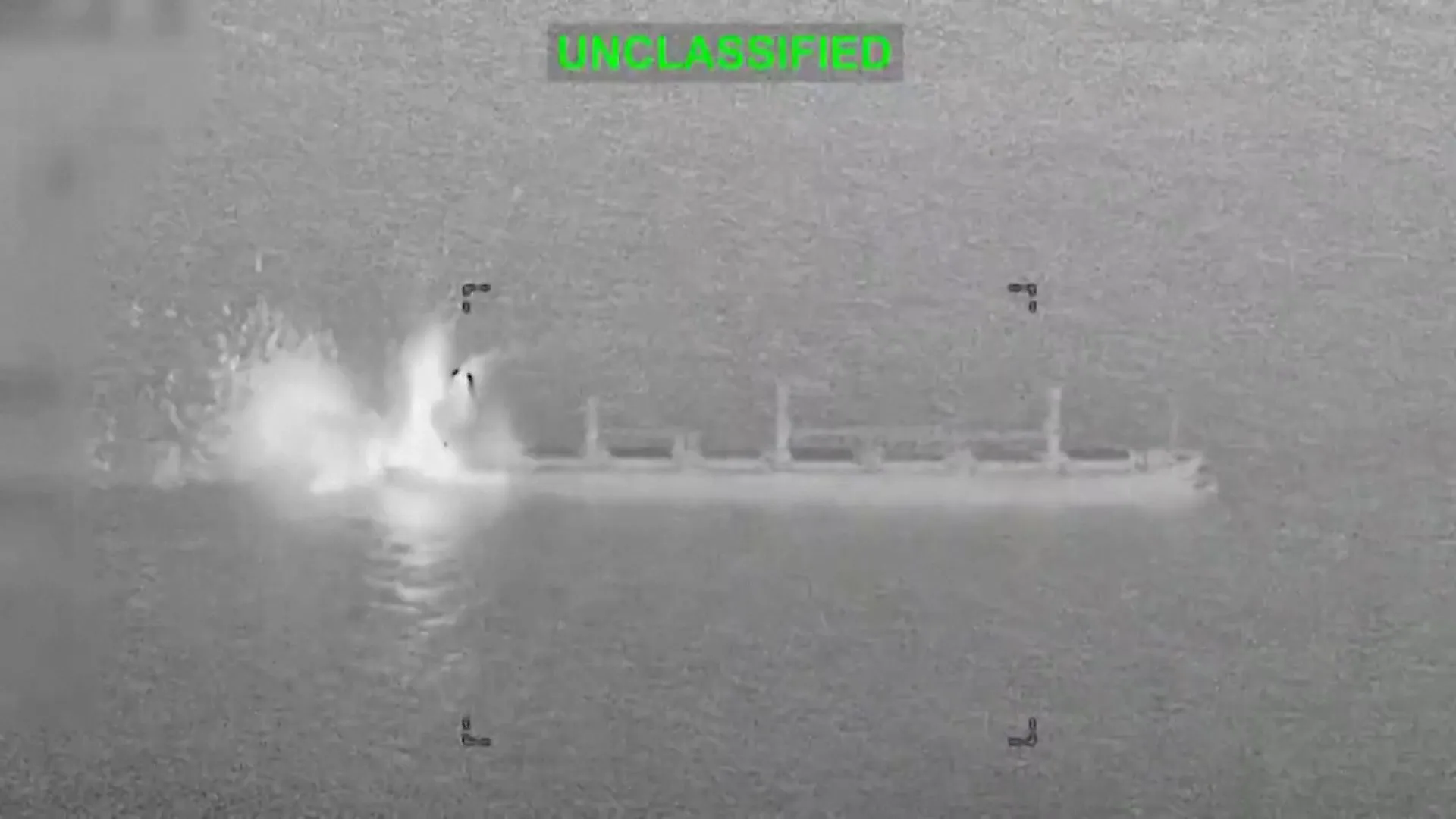
United States forces have disabled a commercial cargo vessel in the Gulf of Oman after its crew “ignored repeated warnings and attempted to run the ongoing naval blockade against Iran”, according to US Central Command (CENTCOM).
A US military fighter jet struck the stern of the Panama-flagged M/V Ocean Molica, also known as the Arika Sun, with a precision munition on Saturday, “fully disabling the ship’s propulsion without harming the crew”, CENTCOM said in a statement. The vessel was attempting to transit regional waters after “having previously departed an Iranian port”.
Recommended Stories
list of 3 itemsend of list
CENTCOM said its forces resumed their blockade against all ships “entering or departing Iranian ports on July 14”, disabling four commercial vessels and turning around 135 ships during “three months of strict enforcement”.
US forces also destroyed 10 tankers linked to the Islamic Revolutionary Guard Corps’ (IRGC’s) “multibillion-dollar shadow network” over the same period, CENTCOM said.
Meanwhile, Iran’s IRGC said it struck a vessel in the Strait of Hormuz for attempting to take an “illegal route”, as Tehran seeks to enforce its own blockade on the vital waterway.
In a statement carried by official Iranian media, the IRGC claimed Iranian forces “have taken control of the administration of the strait”.
“In carrying out this mission, a few hours ago, a giant LPG carrier named NV Sunshine, owned by NatWit, which was attempting to transit via the illegal route south of the Strait of Hormuz, was struck,” the statement said.
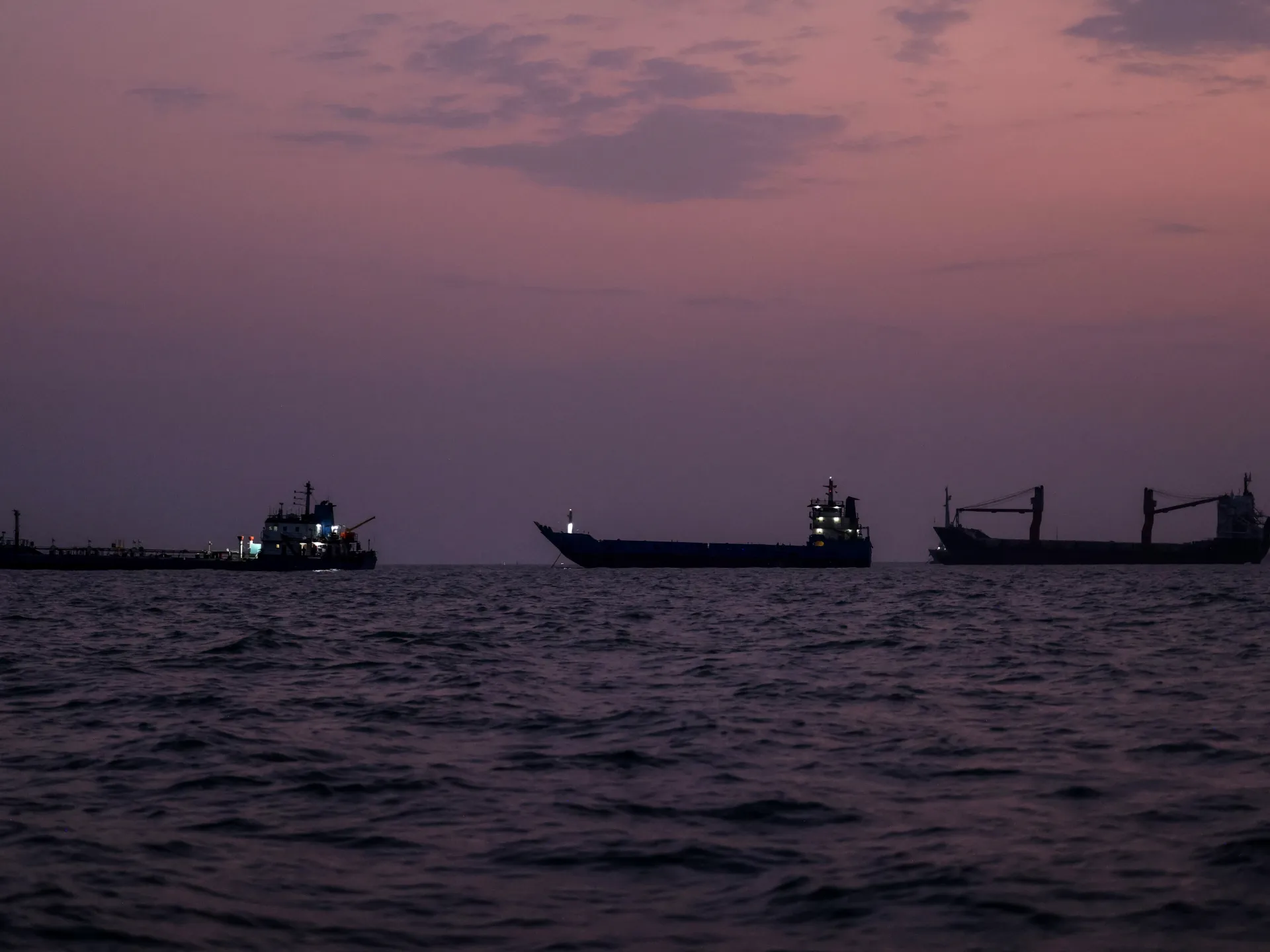
Vessels in the Strait of Hormuz near the beach of Bandar Abbas, Iran, October 6, 2026 [Amirhosein Khorgooi/ISNA via WANA/Reuters]
The United Kingdom Maritime Trade Operations (UKMTO) agency said on Sunday that an outbound tanker in the strait was struck on the port side by an unknown projectile, causing a fire on board. The UK agency said crew members were reported safe, while the damage and environmental impact remained unknown at the time of the report.
Tehran has attempted to enforce control over the Strait of Hormuz during the US-Israel war on Iran, insisting that ships obtain permission to cross via its preferred routes. However, vessels have increasingly risked taking an alternative route hugging the strait’s southern coast.
The UKMTO said on Thursday that a vessel sailing 94km (58 miles) north of Madinat ash Shamal, off the north coast of Qatar, was struck by multiple projectiles, resulting in a number of casualties.
The agency did not specify the origin of the ship or the number of people killed or injured, adding that authorities were investigating the incident amid a recent rise in attacks on vessels near the Strait of Hormuz.
Ships in the Gulf attempting to cross the strait, which is the sole maritime route in or out of the oil-rich region, have faced repeated attacks since the US and Israel began the war in late February.
The Strait of Hormuz remains vital to the global economy, with about a fifth of the world’s oil and liquefied natural gas passing through the passage before the war began.