The City Council passed two film-friendly measures, one that creates free permits for so-called micro-shoot productions and another that limits parking fees on city-owned lots, yards and civic properties and staging areas to $1 a day, regardless of the size of the project.
The city currently charges $450 a day for base camp parking at city-owned parks and $100 to $300 a day for crew parking, according to FilmLA.
“Both efforts advanced today aim to support independent shoots and attract aspiring storytellers to our city,” Councilmember Adrin Nazarian, who introduced the initiatives, said in a statement. “As we work to protect established productions, we must also uphold Los Angeles’ reputation as a hub for the next generation of filmmakers. People need to believe that this is still the town to turn their filmmaking dreams into reality.”
Micro-shoot permits refer to sets with up to 10 filmmakers on site that have a minimal community impact. Under this new ordinance, student filmmakers, documentary crews and ultra-low-budget projects will be able to obtain free permits. City departments soon will report back to the Council on how they plan to implement this.
The idea behind the $1 permits is to turn more areas of L.A. into homes for all kinds of productions.
Nazarian is chairman of the Council’s recently formed Ad Hoc Committee on Film, Entertainment and the Creative Industry, aimed at making filming in L.A. more accessible.
“The stark reality is that California is on the brink of losing its position as the nation’s premier destination for production spending,” Nazarian said during a City Council meeting this month. “While we retain the Hollywood name, the data makes it urgently clear, crisis-level clear, that Los Angeles is fast losing its footing as the center of film and television production.”
The U.S. Air Force has handed Lockheed Martin a $694 million contract for the production of AGM-183A Air-launched Rapid Response Weapon (ARRW) hypersonic missiles. In 2023, the service had moved to cancel ARRW, which had been in line to be the U.S. military’s first operational hypersonic weapon. At the time, we had reservations about the service’s intent and speculated the missile could make a major comeback or continue development in a classified setting. The program has since made an incredible turnaround, and there are already plans for another variant that will be able to use an all-new seeker to hit moving targets, including enemy warships.
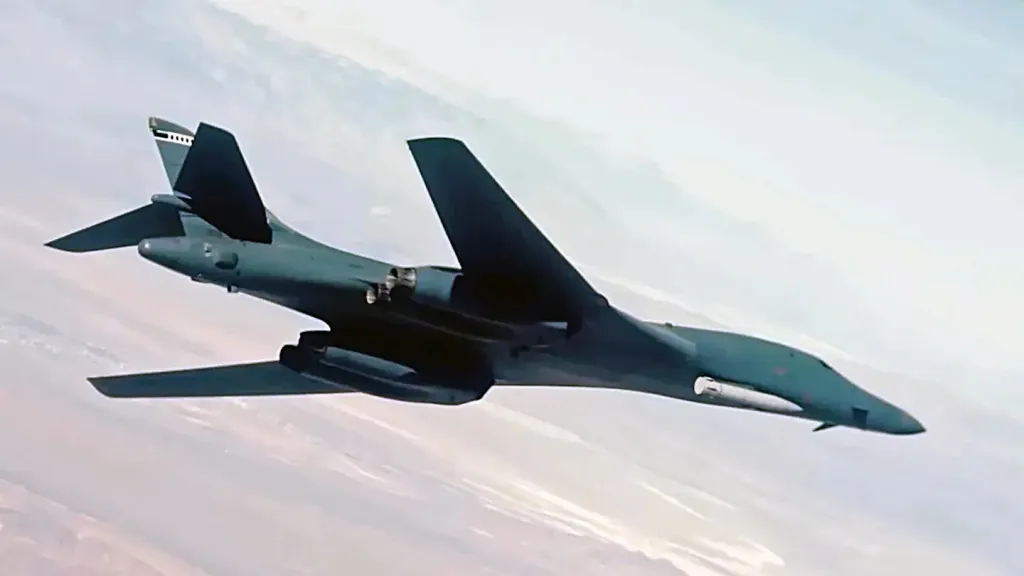
The ARRW contract was awarded on September 29, but only announced today. It is not immediately clear how many missiles are to be built under this deal or when the Air Force expects to start taking delivery of them. The Air Force has previously disclosed plans to integrate the missiles onto its B-52 and B-1 bombers. Other aircraft with sufficiently large payload capacities and physical space to carry outsized stores could potentially carry AGM-183As, or variants thereof, in the future.
A B-1 bomber seen carrying an ARRW missile, or a relevant test article, on an external pylon during a flight test. USAF capture
“The contract was executed under the Department of War’s Enterprise-Wide Agile Acquisition Contract to modernize America’s Arsenal of Freedom,” according to an Air Force press release. “This milestone marks the formal transition of the boost-glide hypersonic missile program from prototyping and flight testing into production, solidifying the Air Force’s commitment to fielding standoff, high-speed strike options.”
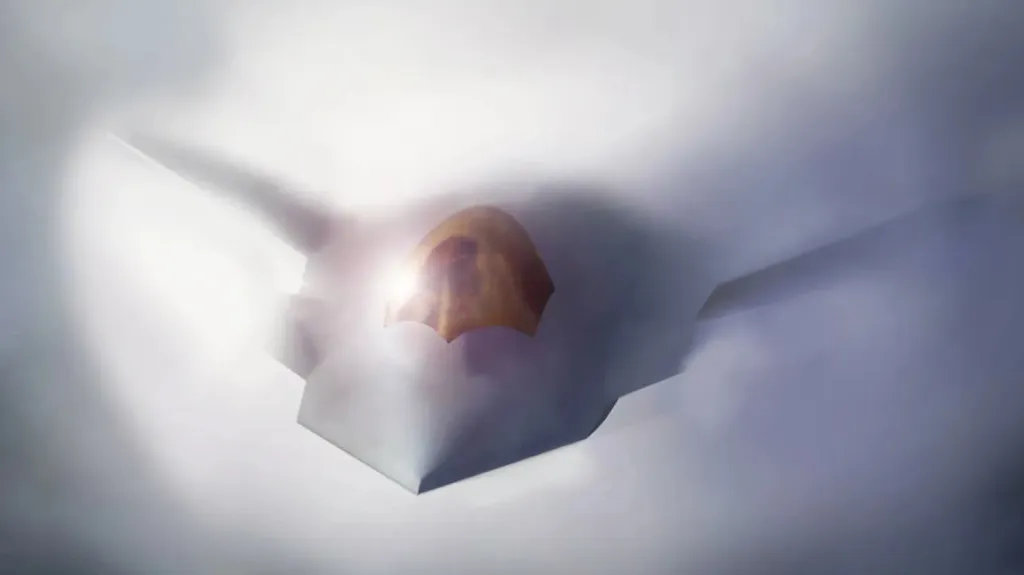
As noted here, the AGM-183A is a so-called boost-glide vehicle-type hypersonic weapon, which uses a rocket booster to bring it first to an optimal speed and altitude. The nose cone on ARRW then breaks away, and a wedge-shaped unpowered boost-glide vehicle concealed within is released.
A rendering depicting an ARRW hypersonic missile’s nose cone breaking away to reveal the unpowered boost-glide vehicle inside. Lockheed Martin
The vehicle then glides to its target along a relatively shallow flight path within the Earth’s atmosphere at hypersonic speed, defined as anything above Mach 5. It is capable of maneuvering along the way, sometimes erratically. The mix of speed, flight trajectory, and maneuverability creates significant challenges for opponents in terms of spotting and tracking the glide vehicle, let alone attempting to intercept it. As a result, hypersonic weapons of this type offer particular benefits for piercing enemy air defenses to very rapidly strike time-sensitive and otherwise high-value targets.
The ARRW production contract “is a turning point in our advanced weapons roadmap,” Secretary of the Air Force Troy Meink said in a statement accompanying today’s release. “By moving ARRW from test to production, we’re providing our combatant commanders with a credible, high-speed strike weapon capable of penetrating the most advanced anti-access and area-denial systems.”
“Fielding ARRW enhances our ability to hold targets at risk anywhere around the world,” Air Force Chief of Staff Gen. Ken Wilsbach said in his own statement. “This hypersonic weapon provides the Joint Force a flexible and rapid response option for highly contested environments.”
A graphic offering a very general comparison of the typical flight trajectories of hypersonic boost-glide vehicle weapons and air-breathing hypersonic cruise missiles, as well as aeroballistic (or quasi-ballistic) missiles and traditional ballistic missiles. GAO
There had already been steady signs in recent years that ARRW’s fortunes were changing and that it had not actually been axed, despite the Air Force’s stated plans to do so. The Air Force’s 2026 Fiscal Year budget request last year confirmed that the service had fully rebooted the program and was seeking new funding to procure actual missiles.
The service’s 2027 Fiscal Year budget request, released earlier this year, revealed further plans “to begin [ARRW] INC 2 [Increment 2] technology efforts such as but not limited to integrating pre-planned product improvements, design, trade studies, hardware upgrades, facilitization, affordability initiatives, and testing.”
A live AGM-183A ARRW missile seen under the wing of a B-52 bomber at Andersen Air Force Base on Guam ahead of a test in 2024. USAF
A request for $296 million would support “the design, test, and evaluation of Air-Launched Rapid Response Weapon (ARRW) Increment 2 with terminal seeker and data link capability and other cost reduction production initiatives into ARRW,” those same documents added.
In general, the U.S. Air Force has historically framed hypersonic weapons, including ARRW and HACM, as being especially critical for success in future conflicts, especially high-end fights, such as one in the Pacific against China. This was underscored by the launch of an AGM-183A with a live warhead from a B-52 flying from Andersen Air Force Base on Guam in 2024. The future anti-ship variant could be even more relevant in a Pacific context.
“…the Guam test sent clear signals to China. The Air Force has made no secret of how important it views the development and fielding of hypersonic weapons as part of larger preparations for a potential future high-end fight against the Chinese People’s Liberation Army (PLA) in the Pacific. This is further underscored by the fact that the mention of the ‘terminal seeker and data link capability’ for Increment 2 of ARRW is actually contained in the Pacific Deterrence Initiative (PDI) section of the Pentagon’s Fiscal Year 2027 budget request.”
A rare look at an ARRW shortly after launch, from a test in 2021. USAF A low-quality image of an ARRW after launch during a previous live-fire flight test. USAF
“In the context of a major conflict in the Pacific, there would also be a very high demand for prompt, long-range anti-ship capability. The ability to conduct those strikes even in the face of dense anti-air defenses would be even more attractive for engaging very high-value vessels, such as China’s growing fleets of aircraft carriers or big deck amphibious assault ships. The PLA Navy’s (PLAN) combat fleets, overall, continue to grow in scale and scope at a prodigious rate, as well. This, in turn, has put additional emphasis on the development and fielding of new and improved anti-ship capabilities that can be air-launched, as well as employed from the maritime and ground domains, across the U.S. military in recent years. Increment 2 ARRWs could also offer another means to strike mobile, high-value targets on land, such as ballistic missile transporter-erector-launchers.”
China’s aircraft carriers Shandong, at left, and Liaoning, at right, sail together, along with various escorts, as elements of their air wings fly overhead, in 2024. Chinese state media
If nothing else, after moving to cancel the ARRW three years ago, the Air Force has now fully reversed course and has placed its first order for production examples of this hypersonic missile.
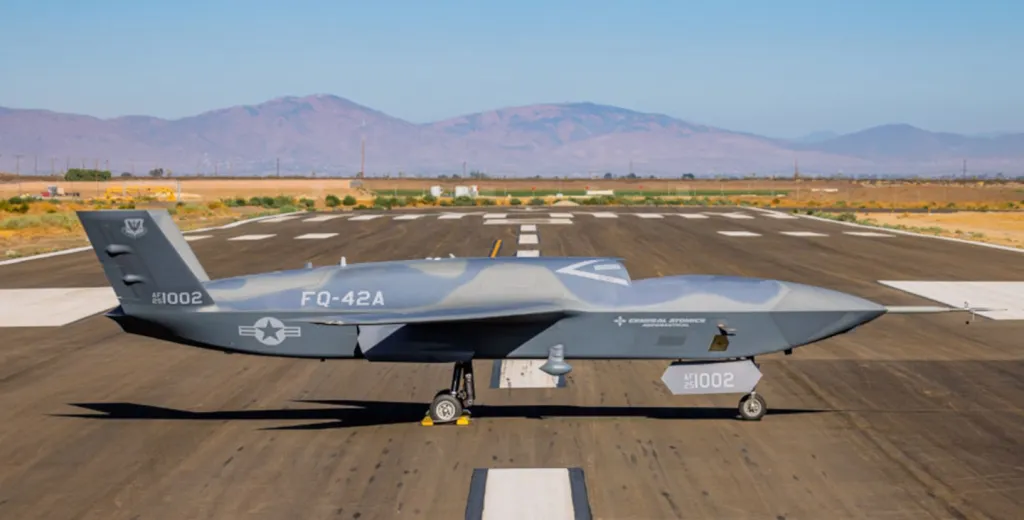
General Atomics’ Aeronautical Systems, Inc. division (GA-ASI) announced the team-up with Spirit on FQ-42 production earlier today. The Vengenace is one of two designs the Air Force has ordered into production under the first phase, or Increment 1, of its CCA program. The other is Anduril’s FQ-44A Fury. The 500-drone target the Air Force has laid out covers a mixed fleet of both FQ-42s and FQ-44s. The service is still planning to acquire additional CCAs, potentially with completely different designs, through a follow-on Increment 2.
A FQ-42A Vengeance CCA drone. GA-ASI
When it comes to FQ-42 production, “Spirit Defense’s role as a fuselage design-build partner brings together the company’s engineering and advanced manufacturing capabilities to support the program from design through production,” according to a GA-ASI release. “Partnering with Spirit Defense is a strength multiplier for the company and the nation, offering manufacturing capacity and industrial depth to scale CCA production faster, while strengthening production resilience, and reducing the risk of single points of failure.”
“We’re excited to be working with Spirit Defense,” David R. Alexander, GA-ASI’s President, said in an accompanying statement. “We’ve established our proven design, development, and manufacturing capability for the FQ-42. With Spirit Defense, we add capacity, which is exactly the kind of production resilience our U.S. Air Force customer is looking for with its CCA ramp-up. This kind of partnership represents the scalable industrial base the Air Force and the U.S. Department of War are looking for from industry.”
“The intent for them [the Air Force] is to go up to as many as 500 aircraft by 2032,” Mike Shortsleeve, Vice President for Strategy Business Development at GA-ASI, also told TWZ’s Jamie Hunter on the floor of the Air & Space Forces Association’s (AFA) 2026 Air, Space & Cyber Conference in September. “We’re ready to do that production.”
FQ-42 Vengeance fighter drone update from General Atomics
At the conference, Shortsleeve highlighted investments in additive manufacturing and advanced robotics, along with efforts to build out the company’s skilled workforce, to help meet those production demands.
General Atomics is already an established drone maker with significant serial airframe production experience of its own. At the same time, the company is seeing growing demand for its MQ-9B series of drones, including a sale to the U.S. Coast Guard announced earlier this month. The MQ-9B design builds on the highly successful MQ-9A Reaper. It is also pursuing a host of other opportunities in the U.S. and abroad that could add production demands.
Mike Atwood, GA-ASI’s Vice President of Advanced Aircraft Programs, notably acknowledged potential hurdles for meeting CCA production demands, specifically, in the past.
“We have basically a hot production line where I can take an MQ-9 out and put a Collaborative Combat Aircraft in,” Atwood said on an edition of The Merge podcast back in 2024. “We were able to essentially take Reaper parts out of stock rooms and build the first [CCA] aircraft.”
An MQ-9 Reaper drone. General Atomics (General Atomics)
“Composites are inherently expensive … they’re really for high-performance applications where you need certain strength and stiffness,” he also noted at that time. “When you look at Collaborative Combat Aircraft … we’re actually falling back on more metallic – what we call hybrid structures, metal frames with composite skins.”
The production of advanced composites and hybrid structures is Spirit’s main business. The company also has a well-established history of working as a subcontractor on military aerospace projects, including in support of bleed-edge programs like the B-21 Raider bomber.
It is also important to note here that, before its founding as an independent company in 2005, Spirit was actually a division of Boeing. By the early 2020s, Spirit had been suffering from significant financial losses and quality control lapses. Boeing subsequently decided to reacquire it in a multi-billion-dollar deal. The acquisition process began in 2024 and was finalized last year. Since then, Boeing has faced continued challenges in getting the firm back on track.
In 2024, when General Atomics and Anduril were selected to move ahead in the Increment 1 phase of the Air Force’s CCA program, TWZ explicitly raised the prospect of both companies bringing in help, especially to meet future production demands. At the time, the focus was more on Anduril, which was not a major airframer at the time and had yet to establish significant production facilities of its own for Fury. It was also unclear then whether the Air Force might pick a single winning Increment 1 drone rather than go the route it ultimately chose of ordering batches of both designs.
A Fury drone seen at Anduril’s Arsenal-1 production facility in Ohio. Anduril
However, as we wrote at the time: “No matter who is selected in the end as the prime contractor, a large pool of manufacturer partners will likely be key to meeting the Air Force’s production volume and schedule goals.”
As an aside, Boeing is already in the CCA business itself, with the MQ-28 Ghost Bat developed originally through a separate subsidary in Australia. The company has been working to expand its own production capacity to build those drones in recent years.
“The nuance here that probably is overlooked, is the fact that they’re [the Air Force] recognizing with 500 that they require, the factory floor is now becoming part of the battle space,” General Atomics’ Shortsleeve had told TWZ at the AFA conference last month. “So the ability for companies to be able to manufacture and produce those aircraft in numbers that are needed for the fight rapidly is going to be a key part to going forward in the future.”
The Air Force is otherwise still very much laying the rest of the groundwork for fielding its future CCAs operationally toward the end of the decade. A full playbook for deploying, launching, recovering, supporting, and otherwise operating CCA-type drones on a day-to-day basis, let alone employing them tactically, still has yet to be written. Answering these questions will be important for other CCA programs across the U.S. military and elsewhere globally.
A Vengeance drone seen flying in formation with an F-35 fighter during a test flight. USAF
General Atomics’ new partnership with Spirit Defense underscores how production of Increment 1 CCAs is ramping up already in reponse to the Air Force’s current CCA program goals.
New satellite imagery shows four of China’s new KJ-3000 airborne early warning and control (AEW&C) aircraft at the Xi’an Aircraft Company (XAC) facility at Xi’an-Yanliang, raising the possibility that the large radar planes are moving toward or have entered serial production.
Satellite imagery captured on October 5 and provided by Vantor shows three KJ-3000s near the XAC factory in the western part of the facility, with a fourth at the nearby China Flight Test Establishment (CFTE). J. Michael Dahm, a senior fellow at the Mitchell Institute for Aerospace Studies, assesses that the presence of four aircraft points to the type having entered serial production.
Andreas Rupprecht, an analyst of Chinese military aviation and TWZ contributor, offered a more cautious assessment, noting that the imagery could indicate that series production or low-rate initial production (LRIP) has begun. However, he also pointed out that all four previously identified prototypes could simply have been at the facility at the same time. Specifically, he identified the aircraft seen at the CFTE portion of the airfield as being a prototype.
Whatever the explanation, the imagery offers a fresh look at a program set to significantly expand China’s already substantial airborne surveillance and battle-management capabilities.
The KJ-3000, also referred to as the KJ-20, is based on the four-engine Y-20 transport aircraft, specifically the improved Y-20B variant powered by Chinese-made engines. The aircraft features a large circular radome mounted above the rear fuselage, along with a prominent series of antennas on the forward fuselage. An aerial refueling probe is mounted above the cockpit, while a conspicuous intake at the base of the tailfin is likely intended to provide cooling air for its extensive onboard electronics.
A stock Y-20B transport with its distinctive locally produced WS-20 turbofan engines. via Chinese internet
The first low-quality photographs of the aircraft began circulating in December 2024. More detailed imagery emerged in May 2025, showing an example at an undisclosed Chinese airfield. That aircraft, bearing the serial number 7821 and assessed to be the first example, was still wearing primer, in contrast to the examples now seen at the XAC factory.
This photo emerged in May 2025 and shows the presumed first KJ-3000 on the ground at an undisclosed airfield in China. The aircraft still wears a coat of primer, and the serial number 7821 is clearly visible on the forward fuselage. via Chinese internet
The KJ-3000 is expected to address longstanding limitations in China’s existing large jet-powered AEW&C fleet. To date, only four KJ-2000 Mainring aircraft have been completed. Based on the Russian-built Ilyushin Il-76MD transport, the KJ-2000 program was constrained by the limited availability of suitable airframes, and now faces the twin issues of reliance on Russian supply chains and aging aircraft.
A side view of a standard PLAAF KJ-2000, albeit with the serial number censored from the photo. FYJS/via Chinese internet
A domestically produced Y-20-based platform provides a more sustainable basis for a much larger AEW&C fleet, with greater scope for upgrades and potentially export opportunities.
The larger airframe should also provide advantages over China’s numerous turboprop-powered AEW&C aircraft, including greater speed, range, and endurance. Its higher operating altitude would give its radar a better vantage point for detecting and tracking targets, particularly low-flying aircraft and missiles that may be masked from ground-based sensors by terrain or the radar horizon.
The aerial refueling probe could further extend the aircraft’s range and time on station, although the precise operational capabilities of the KJ-3000 remain unclear.
The exact configuration of the KJ-3000’s primary radar has yet to be established. China’s existing KJ-2000 and smaller KJ-500 use fixed radomes containing three active electronically scanned array (AESA) antennas to provide 360-degree coverage, rather than the rotating radomes found on aircraft such as the U.S. E-3 Sentry and Russia’s A-50 Mainstay. Whether the new aircraft follows the same approach remains to be seen.
A Russian Aerospace Forces A-50U Mainstay. Russian Ministry of Defense Russian Air Force A-50U Mainstay. (Russian MoD)
As well as its large AESA radar, the new aircraft is likely to carry additional intelligence, surveillance, and reconnaissance (ISR) systems, while its communications equipment could make it an important networking node for Chinese forces operating across the vast distances of the Indo-Pacific. Such capabilities would be particularly valuable for coordinating combat aircraft, including uncrewed ones, sharing targeting information, and extending the reach of China’s integrated air defense and broader military networks.
The KJ-3000 is also part of a broader expansion and diversification of China’s AEW&C fleet. Alongside the new jet-powered aircraft, the People’s Liberation Army continues to field and develop smaller platforms based on the four-turboprop Y-9 transport family.
These include the KJ-500, which has been produced and delivered at a rapid pace, as well as the newer KJ-700, believed to combine radar with electro-optical and infrared sensors for a broader range of surveillance missions. The precise capabilities of the KJ-700 remain uncertain, but you can read about the platform in more detail here.
A prototype KJ-700. via Chinese internet
The smaller turboprop aircraft offer advantages of their own. They are better suited to operating from dispersed and relatively austere airfields, and they regularly appear at Chinese island outposts and in the strategically important Taiwan Strait. Together, the different types give Chinese forces a range of options for surveillance and command and control, from persistent coverage close to home to operations farther afield.
The U.S. Department of Defense has repeatedly highlighted the growing importance of China’s AEW&C fleet.
In its latest annual report on Chinese military developments, the Pentagon specifically pointed to the KJ-3000:
“The PLA conducted an initial flight with the KJ-3000 Airborne Early Warning and Control (AEW&C) aircraft, which will serve as a surveillance aircraft to monitor aircraft, ships, and other vehicles. The KJ-3000 will probably be the world’s first model to use digital radar and will be capable of anti-jamming, passive detection, and target identification.”
Airborne radar and command-and-control aircraft are also important force multipliers for increasingly capable Chinese combat jets, including the stealthy J-20 and aircraft armed with long-range air-to-air missiles. Radar planes like these can serve as critical networking nodes for data sharing and, in some cases, allow Chinese fighters to prosecute targets without turning on their own radar.
In 2022, then-Pacific Air Forces commander Gen. Kenneth Wilsbach praised the command and control associated with J-20 operations, noting that some of China’s long-range air-to-air missiles benefit from support provided by the KJ-500.
A stock photo of a J-20 stealth fighter. PLAAF
For China, a larger and more capable AEW&C fleet would support both the defense of its airspace and efforts to project military power across the Indo-Pacific. These aircraft could help coordinate operations around Taiwan and the South China Sea, improve situational awareness over maritime approaches, and support combat operations at greater distances from the mainland.
The same Pentagon report from 2025 further noted:
“China’s integration of support aircraft, such as the KJ-500 airborne early warning aircraft, provides the PLAAF with improved ISR capability to support PLA operations, as demonstrated during surge operations near Taiwan.”
A KJ-500 arrives at the Zhuhai Air Show Center in November 2022 in Zhuhai, Guangdong Province of China. This is specifically the probe-equipped KJ-500A version. Photo by VCG/VCG via Getty Images VCG
A domestically developed, jet-powered platform such as the KJ-3000 would be a logical centerpiece of that effort, particularly since it can be produced in substantially greater numbers than the KJ-2000.
The October 5 imagery does not confirm that serial production has begun. Further imagery showing additional airframes, activity around production facilities, or aircraft in new operational markings may provide a clearer indication of the program’s progress.
Regardless, the KJ-3000 appears poised to become an important addition to China’s expanding airborne surveillance and command-and-control architecture.
Bitupan Deka was out shopping for a “gamusa” (traditional scarf) with his mother in India’s northeastern state of Meghalaya when he noticed something unusual.
“Every shop selling the scarf had the same handful of patterns repeated over and over,” he told Al Jazeera over the telephone from Shillong, the capital of Meghalaya.
Recommended Stories
list of 4 itemsend of list
“When I asked around, I found that weavers in Sualkuchi [district in neighbouring Assam state] are paid a one-time fee of roughly 2,000 rupees [$21] for each design they develop, instead of royalties. Cutting down the number of designs they produce was a cost-saving practice followed by the manufacturers.”
Bitupan Deka [Courtesy of Bitupan Deka]
This discovery prompted Deka, an assistant professor of computer technology at Shillong’s MIT University, to create a system that can produce infinite new designs for such fabrics.
“My work isn’t meant to replace the traditional designers. I hope, instead, that it will become a tool in their hands to create new and modern motifs more easily, so the consumers can have variety,” Deka said.
Once the patent, which is being applied for under the research and development department of his university, comes through, Deka plans to monetise the system by making it a commercial designing service that the textile industry can avail.
In India’s varied textile traditions, patterns and motifs carry the memory of a place and the mythology of its people – sometimes even the history of migrations.
The designs are imagined by weavers from things that exist around them, and then painted with locally available colours, mostly using carved clay and wooden frames. These weavers do not simply reproduce a pattern; they inherit it. Their hands hesitate where their grandmother’s did, and they know why a particular flower must face left.
A computer has no such inheritance or hesitation. It learns by analysing pictures and repeating them in endless variations. And yet, as Deka’s system shows, the computer can now draw and weave the same flower.
The Rekh Sanganeri Dataset is a similar system developed for hand-block printed Sanganeri textiles from the western Indian state of Rajasthan. It includes high-resolution images of printed patterns, annotated down to ink bleed and slight misalignment – the imperfections that are the hallmark of the handmade work.
Its developer, Reddy Sai Nivas C, says it should be used as a resource for research and art, not as a substitute for artisans.
But the disclaimer is the paradox: Tools built to preserve a craft are making its visual language easier to digitally reproduce without involving the craftsperson.
Dinesh Chhipa comes from one of the oldest Chhipa families, an artisan and merchant caste renowned for dyeing and block printing. He is a Bagru designer – a block printing technique from Bagru town in the western state of Rajasthan – and a textile businessman.
“Traditional craft is slow to produce. Even if someone offered us a fortune, we wouldn’t be able to produce these pieces in mass numbers, so I don’t fault those using digital technology and AI to fill the gap,” he told Al Jazeera.
“But don’t borrow craft and regional names like Bagru and Jaipuri [named after the capital city of Rajasthan]. These designs and motifs were born out of a culture and necessities of the communities they come from.”
Dinesh Chhipa is a Rajasthan-based artisan and merchant [Courtesy of Burgoyne Original Masters]
Who owns culture when it turns into plain data?
India has been digitising its textile memory for years – from the Botanical Survey of India’s historical collections to the Bharatiya Vastra Shilpa Kosh, a national portal built by the state-run National Institute of Fashion Technology and the Centre for Development of Advanced Computing (C-DAC).
Without documentation, the fragile traditions and knowledge could disappear. But digitisation also allows the same archive to be used by an AI system seeking to reproduce these crafts at scale.
At the India AI Impact Summit in New Delhi in February this year, Indian software company Tata Consultancy Services (TCS) showcased Bridgital Loom, an AI system that converts textile designs into loom-ready instructions. LED lights on the loom guide a weaver through the thread sequences of intricate Banarasi and Kanchipuram patterns – named after the cities where these iconic arts grew.
TCS says the technology helps weavers execute complex designs faster and with fewer errors, and is meant to be a bridge between the artisans and technology. A pilot project that uses the loom is already under way at Kanchipuram, a town in southern Tamil Nadu state.
In an interview with the online platform Digit at the New Delhi summit, the head of AI strategy at Bridgital Loom, Muthulakshmi Nellaiappan, pointed out that a new weaver takes more than 15 years to master the art.
“With the technologies we have in hand … the younger weaver who has just entered the skill can become a master much sooner,” she said.
Several classic Indian motifs used by traditional weavers [Courtesy of Burgoyne Original Masters]
Technology flattens the master-apprentice hierarchy of traditional knowledge systems. The weaver no longer has to conceptualise or remember patterns, colours and codes; he blindly follows the machine’s instructions, handing creativity and memory to AI.
Nellaiappan said that since a large percentage of India’s looms are non-electronic, TCS has ensured its system works with handlooms as well and that it was essential for scaling up the technology.
But digital looms also raise another question: Who owns culture when it turns into plain data?
For generations, India’s textile knowledge sat outside intellectual property systems. It lived in community memory, passed from master to apprentice with no certificate of ownership. Kanchipuram, Mekhela-Sador, Sanganeri and Banarasi are names for places that these textiles helped shape, not merely emerged from.
Now, this knowledge is entering generative models that owe nothing to these traditions.
For designers and manufacturers, the possibilities are seductive: Motifs combined at will, colours changed with a command, and thousands of designs generated instantly. The machine offers abundance.
The artisan, on the other hand, has always lived with scarcity: Of money, bargaining power, or recognition.
Ananthalakshmi Vadivel, a third-generation weaver and owner of Vadivel Silk Looms in Kanchipuram, says their venture is already competing in the market with cheaper Kanchipuram sarees produced on electronic looms.
“Perhaps, with AI, these sellers can create trending designs faster and cheaper to attract mass consumers. But these imitations can never replace the original,” she told Al Jazeera.
“There will always be a market for authentic Kanchipuram and handcrafted textiles, no matter how much technology makes the imitation cheaper. True Kanchipuram weave, colour, and designs can only be created by hand, and discerning buyers know this.”
Then again, the question is no longer whether AI can recreate a textile. It sure can. The question is: Who gets paid when it does?
Legal gaps
In December 2025, the federal government’s Department for Promotion of Industry and Internal Trade floated a statutory “blanket licence” – a system where AI developers could train models on lawfully obtained copyrighted material without seeking permission from each rights holder. Once commercialised, those systems would owe royalties to copyright owners at rates set by the government.
But intellectual property (IP) laws assume a traceable work with a traceable author. A motif, on the other hand, is communal property, its technique passed down through generations with no single originator.
In such cases, who is entitled to royalty and copyright? The artisan who first created the design? The photographer who documented it? The researcher who assembled the dataset? The developer who built the tool? India’s laws offer no clear answers. The artisan whose name never appeared on a label may once again be missing from the paperwork.
A weaver in West Bengal state rinses the colourful jute fibre to dry under the sun, which will be used to extract threads to make handloom dresses [Avishek Das/SOPA Images/LightRocket via Getty Images]
Meanwhile, the government is planning a dedicated AI-handloom research department under the Centre of Excellence for Handloom Technology at the Indian Institute of Technology (IIT) in the capital, New Delhi. Inaugurated in August, the $1.4m facility aims to modernise India’s handloom sector by combining traditional weaving heritage with contemporary technology.
The government also plans to register thousands of weavers and fit their handlooms with sensors that convert weave patterns into digital data, and issue QR-coded tags to trace provenance. Maharashtra’s Vingatha system does something similar at the state level by authenticating handloom sarees such as Paithani and Karvat Kathi.
The idea is simple: If a saree can tell you where it came from, the person who made it becomes harder to erase.
While these measures cannot stop AI-enabled design and mass production, they may give artisans more visibility and turn each piece into an archive.
In art galleries, the traditional textiles are increasingly shedding the label of craft for the more lucrative category of contemporary art.
Gurjeet Singh, an artist from Chandigarh city, recently hosted a textile-based solo show in New York. His work transforms discarded fabrics, buttons and embroidered scraps into sculptures that explore queer identity and social prejudices surrounding gender and sexuality.
Sayan Chanda, an Indian artist based in London, works with cut and rewoven vintage Bengali quilts to question fixed notions of cultural belonging. Gurugram-based artist Sumakshi Singh uses delicate embroidery and suspended thread structures to reconstruct the architectural fragments of vanished homes, gardens and personal histories. There are many more.
An art gallery in New Delhi displaying some weaving traditions [Courtesy of Burgoyne Original Masters]
In New Delhi, 20 such artisans and craft-led collectives featured last month at an art show celebrating the traditional textile crafts.
“Our aim is to present these traditional crafts as living practices that continue to evolve through contemporary artisans, rather than as heritage to be archived. Kanmai Payun, one of the artists featured in the show, for example, is the last practitioner of Fulor Saneki, a flower pattern used by Assamese weavers. We encouraged her to teach her 17-year-old son so the craft outlives her,” Aparupa Ray Ganguly, the curator of the show, told Al Jazeera.
But as textiles gain value in art galleries, their makers do not necessarily gain automatic control over their work.
In April, another art exhibition in New Delhi, titled No ‘One’ Maker, saw artisans missing from the show’s preview, exposing how traditional textiles are aestheticised, but the people who carry that knowledge remain unrecognised.
“You cannot separate the names from the community. Call your mass-produced work digital prints and leave the traditional names to the original artisans,” says Chhipa, the artisan and merchant from Rajasthan.
Caledonia Mining (CMCL) fell 2.6% in Friday’s trading after reporting Q3 gold production at its Blanket mine in Zimbabwe declined 11% Y/Y to 19,106 oz, citing a shortage of compressed air at certain high-grade, high-volume mining areas and
A top U.S. Air Force acquisition officer says work to set up a full production line for the F-47 sixth-generation fighter is getting closer and closer on the horizon. Prime contractor Boeing is in the midst of a nearly $2 billion expansion to its facilities in St. Louis, Missouri. The F-47 program otherwise continues to progress along an aggressive schedule, with a first flight still being targeted for 2028 and the goal of production jets entering operational service in the early 2030s.
Air Force Brig. Gen. Timothy Helfrich, the service’s Portfolio Acquisition Executive for Fighters and Advanced Aircraft, provided an update on the F-47 program during a virtual talk hosted by the Air & Space Forces Association’s Mitchell Institute for Aerospace Studies yesterday. Boeing won the Air Force competition to produce the F-47 in March 2023, and at least one pre-production example is being built now. The Air Force’s stated plan now is to acquire at least 185 of these jets.
“We have an imperative, I would call it a strategic asset, which is fighter production capacity,” Helfrich said during his opening remarks. “We only have so many production lines, and so we have to get the very most out of those that we can while planning for CCA [Collaborative Combat Aircraft drone] production, and pretty soon F-47 production.”
A rendering of the F-47 sixth-generation fighter. USAF
“There are only three active fighter production lines, right? We got F-35 down in Fort Worth, the F-15EX in St. Louis, and F-16 in Greenville,” Helfrich elaborated later on in the discussion in response to a question about steps the Air Force is taking to maintain sufficient operational capacity across its fighter fleets, in general. “So we need to grow the existing production lines, and we need to – or at least maximize what we can get out of those existing production lines, and we need to add production lines.”
“We’re not too far away from an F-47 production line, which will be additive to the production capacity,” he added.
Since 2023, Boeing has been working to substantially expand its production and other facilities in St. Louis by more than one million square feet. The company has repeatedly shied away from explicitly linking the $1.8 billion construction project to the F-47 program, but there have been clear signs of a connection for years now.
An undated aerial view of work to expand Boeing’s facilities in St. Louis. PARIC Corporation
“The project’s first phase includes plans to erect and renovate 1.1 million ft.2 of facilities on the 110-acre Brownleigh and 75-acre Northern tracts adjacent to St. Louis Lambert International Airport, according to planning documents released by the airport authority in 2023,” Aviation Week reported in 2025. “Phase 1 includes the construction of a 880,000-ft.2 aircraft assembly building on the Brownleigh [site], plus a 185,000-ft.2 hangar, 80,000-ft.2 radar cross-section test facility, open aircraft shelters, hush house, maintenance building, fuel calibration building and fire house totaling 90,000 ft.2 on the Northern tract.”
At that time, parts of the new facility were reportedly expected to open in 2026 ahead of the completion of the full project in 2030.
A post across Boeing’s social media accounts in July highlighted continued progress with this construction. This included the completion of roof and exterior panels and the installation of hangar doors at a section of the site dedicated to “Advanced Combat Aircraft Assembly,” as well as the “first steel column installed for the Central Utility Plan” in the North Tract area.
Progress you can see. Built for what’s next. Momentum continues on our St. Louis expansion:
✅ Advanced Combat Aircraft Assembly: roof and exterior panels complete, hangar doors installed ✅ North Tract: first steel column installed for the Central Utility Plant
“Momentum continues on our St. Louis expansion,” Dan Gillian, Vice President and General Manager of Air Dominance at Boeing, also said in July, according to Flight Global. “We are expanding our defence footprint while supporting next-generation capabilities.”
All of this is in line with Brig. Gen. Helfrich’s comments yesterday about a full production line for the F-47 steadily taking shape now. This, in turn, fits squarely with the aforementioned aggressive timeline the Air Force is pursuing for the program overall. Accelerated work on the F-47 has been aided by years of flight testing in secret of advanced demonstrator aircraft.
There is also a question of whether Boeing’s expansion of its production capacity in St. Louis could also be tied to the Navy’s F/A-XX next-generation carrier-based fighter program. Boeing has been facing off against Northrop Grumman in the F/A-XX competition with a design that looks related, at least to some degree, to the F-47.
A rendering of Boeing’s proposed F/A-XX design. Boeing
The F-47 and F/A-XX programs have become very closely intertwined in other ways. In 2025, the Pentagon moved to freeze F/A-XX, explicitly over concerns about competition for industrial base resources with F-47. This would include production line capacity. Congress subsequently intervened to keep the Navy effort going, but a final winner still has yet to be announced.
Just earlier this month, Air Force Gen. Dale White, the service’s Direct Reporting Portfolio Manager for Critical Major Weapon Systems, reiterated concerns about industrial capacity. White’s comments came in response to a question about potential challenges in building F/A-XXs at the same time as F-47s at a media roundtable at the Air & Space Forces’ Air, Space and Cyber Conference at which TWZ was in attendance. The general also acknowledged that these concerns were “not unique” to F/A-XX and F-47.
During the virtual talk yesterday, Brig. Gen. Timothy otherwise touted continued progress on the F-47 program.
“The F-47 is going to be the world’s first sixth-generation fighter, and I can’t wait to fly it [sic; see it fly] this administration,” he said. “That’s a commitment that I made, that we are on track to do.”
The “administration” referred to here is President Donald Trump’s second term in office, which will come to a close in January 2029. With this deadline in mind, the Air Force has openly said in the past that it is aiming for a first flight of the F-47 in 2028. Beyond that, the stated goal is to be operating the jets operationally sometime in the early 2030s.
A stock picture of a US Air Force F-22 Raptor. USAF
When the jets do enter service, “one of the things that we know F-47 is going to bring is more survivability and lethality than anything that’s ever been delivered before. And going into that highly contested environment, you have to meet certain levels of survivability if you want to execute there,” Helfrich noted yesterday. “Beyond just the survivability and lethality that we know is going to come, there’s also an adaptability that the F-47 will bring.”
“The F-47 will come out of the box with full open architecture,” he continued. “Amongst other great things, it brings the ability to upgrade rapidly, faster than the threat if needed. That is what is going to be required in that kind of environment. Other things it’s going to bring, it’s going to be much more survivable than our fifth-gen platforms, as well as have a combat radius of over 1,000 nautical miles, which you’re familiar with. That’s a long way, which is needed for that kind of environment. You need to be able to execute and persist there.”
“Especially in these highly contested environments, no one’s going to be fighting alone. So we need to make sure that we are integrating,” he added. “There’s some ability to get lift from one platform to another, right? Whether it’s a mission system, it’s communications, it’s open architectures, we’re seeing that integration pay dividends, so that we are integrated from day one.”
This kind of integration and cross-platform commonality in mission systems will be particularly relevant for F-47s acting as airborne controllers for CCA drones. Brig. Gen. Helfrich’s comments above also came in the midst of a discussion about future operations involving both F-47s and B-21 Raider bombers.
Many questions do still remain about plans for the F-47 and its design, including what engines will power the aircraft when it first enters service. In July, TWZ published a deep-dive feature about what is known about the aircraft to date, which you can find here.
In the meantime, the Air Force and Boeing are continuing to push ahead with laying the groundwork for full production of the F-47 as the jet gets closer to its first flight in the coming years.









![Bitupan Deka [Courtesy of Bitupan Deka]](https://i0.wp.com/occasionaldigest.com/wp-content/uploads/2026/10/bitupan-deka-1792487445.jpg?w=640&ssl=1)
![Dinesh Chhipa is a Rajasthan-based artisan and merchant [Courtesy of Burgoyne Original Masters]](https://i0.wp.com/occasionaldigest.com/wp-content/uploads/2026/10/Dinesh-Chhipa-1792487454.jpeg?w=640&ssl=1)
![Several classic Indian motifs used by traditional weavers [Courtesy of Burgoyne Original Masters]](https://i0.wp.com/occasionaldigest.com/wp-content/uploads/2026/10/Courtesy-of-Burgoyne-Original-Masters-1792487874.jpg?w=640&ssl=1)

![An art gallery in New Delhi displaying some weaving traditions [Courtesy of Burgoyne Original Masters]](https://i0.wp.com/occasionaldigest.com/wp-content/uploads/2026/10/Masters-in-Making-5-1792487523.jpeg?w=640&ssl=1)