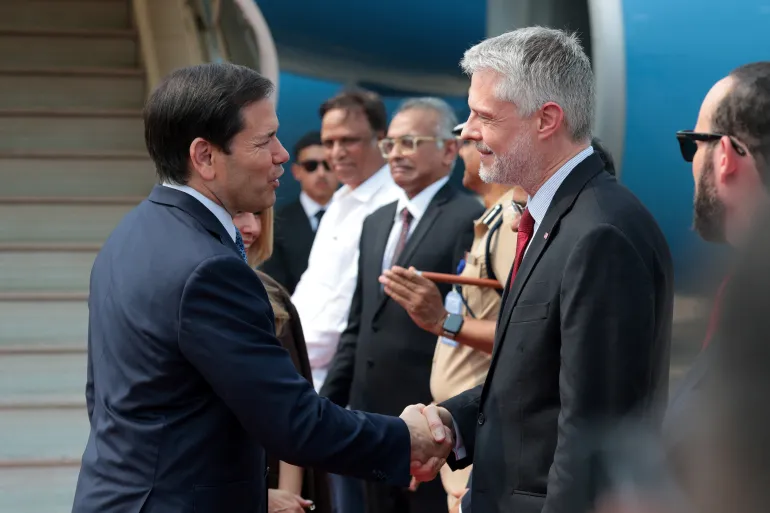
Petro was the first head of state to visit Caracas since the January 3 US attacks. (Presidential Press)
Caracas, April 24, 2026 (venezuelanalysis.com) – Venezuelan Acting President Delcy Rodríguez hosted Colombian President Gustavo Petro for bilateral talks in Caracas on Friday.
The meeting marked the first official visit by a head of state since the kidnapping of President Nicolás Maduro during a US military operation on January 3.
Following talks at Miraflores Presidential Palace, Rodríguez said both governments committed to tackling organized crime along their shared border, one of the longest in the region at over 2,200 kilometers.
“We have undertaken a very serious and concrete approach to combating criminal groups and transnational crime,” she said, announcing the development of joint military plans and “immediate” mechanisms for intelligence sharing in a new level of security cooperation.
Petro, for his part, stated that both countries would work toward the “liberation of border communities” through coordinated military, police, and social action.
“Building a fully coordinated common effort to free border populations from mafias engaged in various illegal economies,” he said, accusing irregular groups of human trafficking, drug trafficking, and illegal gold trade activities.
The leaders also agreed on economic initiatives aimed at supporting Venezuelan and Colombian populations in border regions. Petro expressed hope that these efforts would help reintegrate the two territories and boost food security.
The joint action commitments come amid escalating violence in the Catatumbo region of Colombia’s Norte de Santander department, which borders Venezuela’s Táchira state, where clashes between armed groups have displaced thousands in recent weeks.
Armed organizations operating in the area include the National Liberation Army (ELN), the Estado Mayor Central (EMC) and the Segunda Marquetalia, both descendants of the former FARC, and the Clan del Golfo, among others.
Friday’s talks also included the neighboring nations’ trade relations. Rodríguez highlighted discussions on “import substitution” between the two countries.
“It makes no sense for Colombia or Venezuela to look to other regions or hemispheres for what we can produce within our own territories,” she said, noting that bilateral trade currently stands at approximately $1.2 billion per year.
The leaders further addressed electrical interconnection projects for western Venezuela, a region heavily affected by blackouts, as well as reopening a pipeline that would allow Venezuela to export natural gas to Colombia and beyond.
Rodríguez and Petro also discussed the revival of air connectivity to boost tourism, including the development of multi-destination travel initiatives.
Present at the private meeting were Colombia’s foreign minister Rosa Villavicencio and defense minister Pedro Sánchez, alongside Venezuela’s foreign minister Yván Gil and Interior Minister Diosdado Cabello. The presidential summit followed an earlier meeting of the two countries’ Neighborhood and Integration Commission, with bilateral working groups established for a number of areas, including trade, energy and defense.
A prior meeting scheduled between Rodríguez and Petro on the border in early March was suspended due to security concerns.
Rodríguez hosts new US chargé d’affaires
Venezuelan Acting President Delcy Rodríguez also welcomed the Trump administration’s new chargé d’affaires to Venezuela John Barrett at the presidential palace on Friday.
Alongside Cabello and Gil, Rodríguez held a private meeting that reportedly focused on energy and a “long-term cooperation agenda.” For its part, the US embassy in Caracas stated that Barrett will continue implementing Washington’s “three-phase plan” for the Caribbean nation.
Barrett recently replaced Laura Dogu, who had been on the post since January. A career diplomat, he last served as chargé d’affaires in Guatemala, where he was accused of interference in magistrate elections in March.
Washington and Caracas fast-tracked a diplomatic rapprochement following the January 3 military strikes and kidnapping of Maduro. In March, the White House recognized Rodríguez as Venezuela’s sole leader, while the acting president recently thanked Trump and Secretary of State Marco Rubio for their “good disposition” in establishing “cooperation” between the two countries.
The diplomatic reengagement and US recognition have likewise led to a resumption of ties between Caracas and the International Monetary Fund (IMF).
Edited and with additional reporting by Ricardo Vaz in Caracas.
United States President Donald Trump has claimed Iran is “collapsing financially” and said the country is losing millions of dollars a day due to Washington’s naval blockade of Iranian ports.
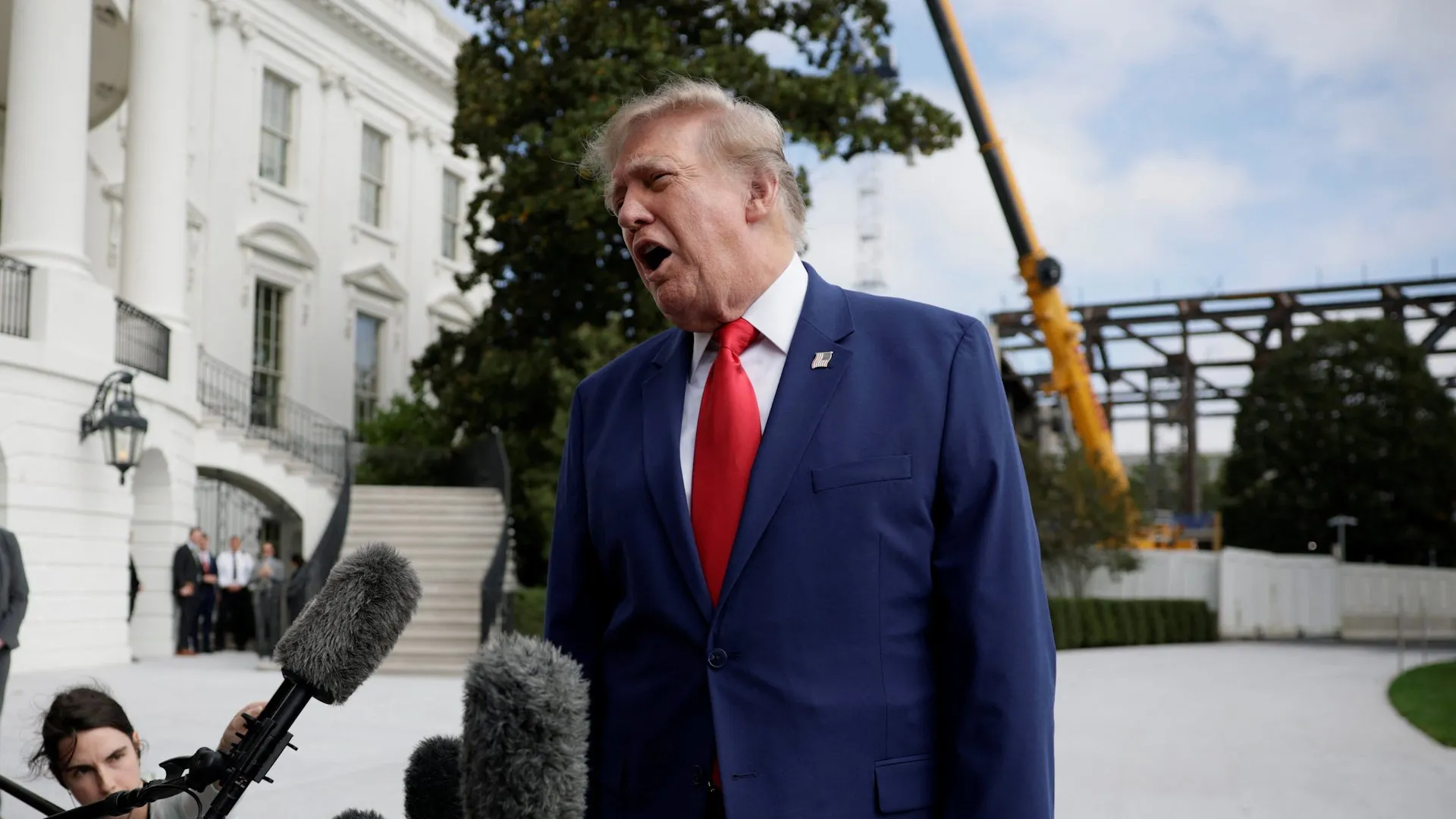
In a post on his Truth Social platform on Tuesday night, Trump wrote: “Iran is collapsing financially! They want the Strait of Hormuz opened immediately – Starving for cash! Losing 500 Million Dollars a day. Military and Police complaining that they are not getting paid. SOS!!!”
Recommended Stories
list of 3 itemsend of list
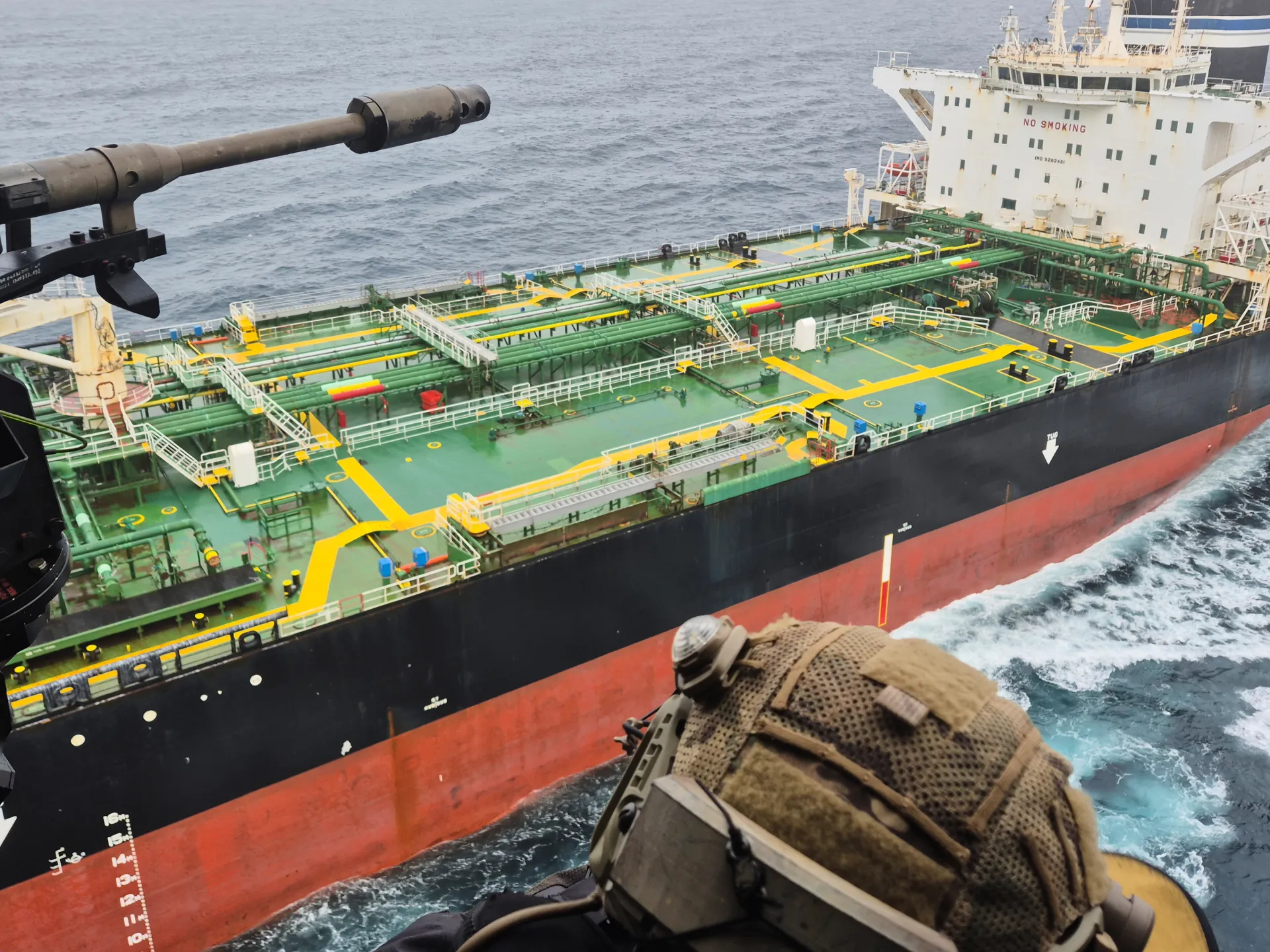
The US blockade of Iranian ports began at 14:00 GMT on April 13. Since then, the US has fired on and seized an Iranian-flagged tanker near the Strait of Hormuz, and redirected ships in the open seas carrying cargo to or from Iran. Iran’s armed forces have called this “an illegal act” that “amounts to piracy”.
In response to the US naval blockade, Iran has closed the Strait of Hormuz to all foreign shipping and has captured several foreign-flagged ships. Previously, it had allowed some ships deemed “friendly” to Iran to pass.
On April 19, Iran’s First Vice President Mohammad Reza Aref said the “security of the Strait of Hormuz is not free”.
“One cannot restrict Iran’s oil exports while expecting free security for others,” he wrote in a post on X.
“The choice is clear: either a free oil market for all, or the risk of significant costs for everyone,” he added. “Stability in global fuel prices depends on a guaranteed and lasting end to the economic and military pressure against Iran and its allies.”
In a statement on social media on Thursday, Iran’s parliamentary speaker and lead negotiator in the ceasefire talks, Mohammad Bagher Ghalibaf, said a full ceasefire could only work if the US naval blockade is lifted.
Analysts say the blockade is hurting Iran but believe the country has the economic and political will to sustain it.
How long can Iran survive the naval blockade?
Here’s what we know:
How is the naval blockade hurting Iran?
Iran exports oil, gas and other goods including petrochemicals, plastics and agricultural products by sea. Analysts say the US naval blockade of its ports, including in the Strait of Hormuz, could therefore affect this trade.
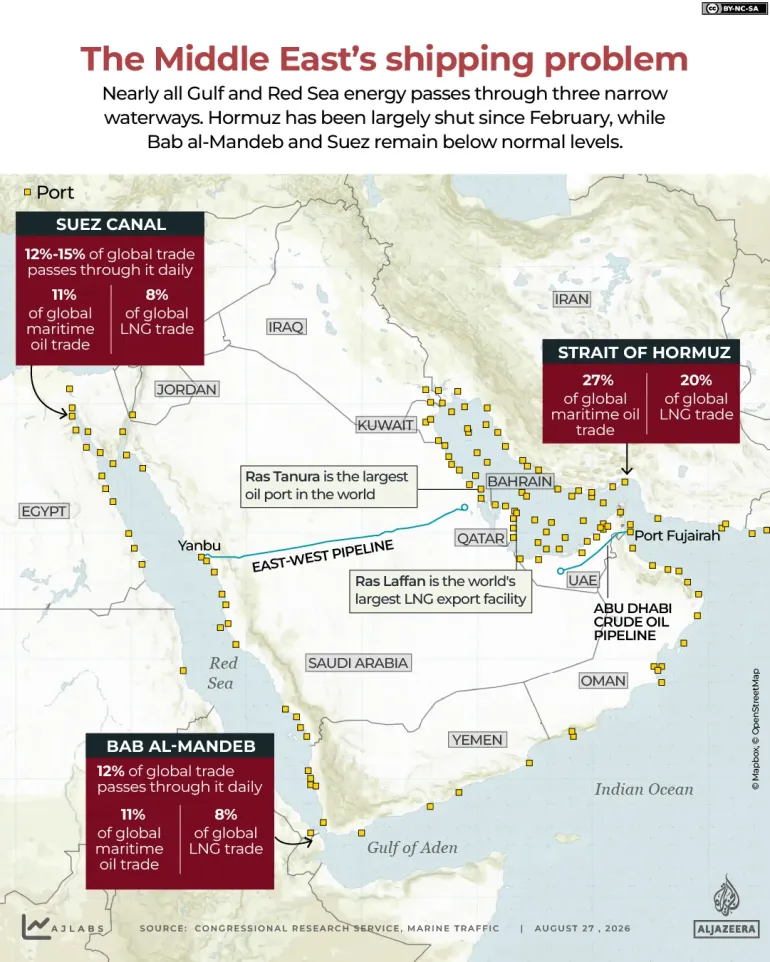
Soon after the start of the US-Israel war on Iran on February 28, authorities in Tehran implemented the effective closure of the Strait of Hormuz, the only waterway out of the Gulf, through which 20 percent of the world’s oil and liquefied natural gas (LNG) supplies were shipped from Gulf producers in peacetime.
The near-shutdown of the vital chokepoint sent global oil and gas prices soaring, and since then, Iran has controlled the strait. However, it has continued to export its own energy products through the waterway.
Iran’s oil exports through the Strait of Hormuz account for about 80 percent of its total oil exports. According to Kpler, a trade intelligence firm, Iran exported 1.84 million barrels per day (bpd) of crude oil in March and has shipped 1.71 million bpd so far in April, compared with an average of 1.68 million bpd in 2025.
From March 15 to April 14, it exported 55.22 million barrels of oil. The price per barrel of Iranian oil – across its three major variants, known as Iranian light, Iranian heavy and Forozan blend – has not fallen below $90 per barrel over the past month. On many days, the price has surpassed $100 a barrel.
Even at the conservative estimate of $90 a barrel, Iran has earned at least $4.97bn over the past month from its ongoing oil exports.
By contrast, in early February before the war started, Iran was earning about $115m a day from its crude oil exports, or $3.45bn in a month.
Simply put, Iran has earned 40 percent more from oil exports in the past month than it did before the war.
Stopping this is a key motivation behind the US naval blockade of Iranian ports.
In an interview with Al Jazeera on April 14, Frederic Schneider, a nonresident senior fellow at the Middle East Council on Global Affairs, told Al Jazeera that the previous six weeks had been a boon for Iran in terms of oil revenues, but with the US blockade, that will change.
“Iran has some buffer in the form of crude oil reserves in floating tanks – basically parked tankers – which was estimated at about 127 million barrels in February. But that doesn’t mean that the blockade wouldn’t hurt Iran,” he said.
On Friday, Schneider told Al Jazeera that Iran, however, seems to be “playing the longer game” and has anticipated and prepared for this sort of conflict to some degree.
“The naval blockade has added economic strain, as several civilian ships have been captured in international waters. But it remains unclear how tight the blockade is, how many ships manage to pass given the considerable amount of floating Iranian oil, and how long Trump can maintain the blockade,” he said.
(Al Jazeera)
Can the US keep the blockade going for long?
Schneider noted that Trump will face a legislative challenge by May 1, when the 60 days he can maintain a foreign offensive without congressional approval come to an end.
Dire conditions have been reported on the ships that are upholding the blockade, he said, and it remains to be seen how China will react to the continuing seizure of ships that carry any of its cargo.
“China has already said it sees the blockade of Chinese trade with Iran as unacceptable. Further, the closure of Hormuz by Iran in retaliation is hurting, if not the US itself that much, American allies in the region and globally, raising the pressure on Trump,” he said.
“If we can glean anything from the behaviour of the two sides, it is Iran that is signalling patience and Trump showing impatience,” he added.
Adam Ereli, a former US ambassador to Bahrain, told Al Jazeera’s This is America programme that while the US blockade of Iranian ports and seizure of vessels transporting Iranian oil “makes sense” as a policy, it may not work as intended due to domestic political considerations in the US.
“The Iranians have prepared for this, for this eventuality. They have their own plans. They’ve got alternative means of storing their oil or selling their oil,” Ereli told Al Jazeera.
“Even if they ran out of oil, they have ways to survive a very tough blockade and sanctions regime that, frankly, I think will outlast Trump’s patience and the patience of the American people,” he said.
“Remember, this isn’t just about moving soldiers and ships and planes around on a map. There’s politics involved here in the United States,” he added.
“Trump is nothing if not attuned to the political winds. And for that reason, I think that you’ve got this Iran strategy on the one hand that runs up against an electoral strategy on another hand, and therefore, the question is, which one is going to give?”
Can Iran store the oil the US is blockading in the meantime?
Iran’s domestic refineries have a capacity of 2.6 million bpd, according to consultancy FGE Energy. Its oil and gas production facilities are concentrated in southwestern provinces: Khuzestan for oil and Bushehr for gas and condensate from the South Pars gasfield.
Iran is also the third-largest oil producer in the Organization of the Petroleum Exporting Countries (OPEC) and exports 90 percent of its crude oil via Kharg Island for shipping through the Strait of Hormuz.
The US naval blockade has begun affecting the country’s storage capacity, according to TankerTrackers, the maritime intelligence agency. The blockade means Iran has to store more oil, and space could become tight.
TankerTrackers said that on Kharg Island, to prepare for the possibility of running out of oil storage space, Iran has brought an old tanker named NASHA (9079107) out of retirement.
“She’s a 30yo [year old] VLCC [Very Large Crude Carrier] that’s been anchored empty for the past few years; currently spending 4 days on a trip that should take 1.5-2 days,” TankerTrackers said in a post on X, suggesting that the tanker is being used to store oil. It is unclear if the ship has a heading or course.
Can Iran continue to earn revenues from oil?
Yes, analysts say that for a few months, Iran can continue to earn revenue from oil which is already in transit at sea.
Kenneth Katzman, former Iran analyst at the Congressional Research Service in Washington, DC, said Iran is not exporting new oil amid the US blockade of Iranian ports, but Tehran has between 160 million and 170 million barrels of oil “afloat” on ships around the world currently.
Those supplies, which transited the Strait of Hormuz before the US blockade was imposed, are on board hundreds of tankers and “waiting to be delivered”, Katzman told Al Jazeera.
Katzman said he had been informed by an Iranian professor that, based on those supplies, Tehran could have revenue flows that can last until August despite the US naval blockade.
“Which is a long time. Does President Trump have until August? Probably not,” he said.
“He’s probably going to have to look at kinetic escalation if he wants to bring this to the conclusion that he wants, or he’s going to have to accept less than the deal he ideally wants,” he said.
Iranian ships will still have to avoid US naval ships on the open ocean, as the US Navy has also recently intercepted ships carrying Iranian cargoes.
On Wednesday this week, for example, the US military intercepted at least three Iranian-flagged tankers in Asian waters, Reuters reported, and was said to be redirecting them away from their positions near India, Malaysia and Sri Lanka.
How else can Iran earn revenue?
Besides oil revenue, Iran is also currently receiving revenue from a “toll booth” system that the country imposed on the Strait of Hormuz in March.
On Thursday, Iran’s deputy parliament speaker Hamidreza Haji-Babaei said Tehran’s central bank had received the first revenues from tolls imposed since the start of the war, according to the semiofficial Tasnim news agency. It is unclear how much that toll revenue is.
Iranian politician Alaeddin Boroujerdi told the United Kingdom-based, Farsi-language satellite TV channel Iran International in March that the country has been charging some vessels as much as $2m each to pass through the strait.
According to Lloyd’s List, the shipping news outlet, at least two vessels that have transited the strait so far have paid fees in yuan, China’s currency. Lloyd’s List reported that one “transit was brokered by a Chinese maritime services company acting as an intermediary, which also handled the payment to Iranian authorities”. It is, however, not clear how much the vessels paid.
How resilient is Iran’s leadership?
In recent days, while pressuring Iran to negotiate a ceasefire deal, US President Donald Trump has claimed that Iranians are “having a very hard time figuring out who their leader is”, alleging that there is “crazy” infighting between “moderates” and “hardliners” in Tehran.
But the country’s officials have insisted that Iran’s government is united.
Mohammad Reza Aref, Iran’s first vice president, said on Thursday: “Our political diversity is our democracy, yet in times of peril, we are a ‘Single Hand’ under one flag. To protect our soil and dignity, we transcend all labels. We are one soul, one nation.”
Foreign Minister Abbas Araghchi also dismissed allegations that the Iranian military may be at odds with the political leadership.
“The failure of Israel’s terrorist killings is reflected in how Iran’s state institutions continue to act with unity, purpose, and discipline,” he wrote on X, referring to the assassinations of Iranian political and military figures Israel has carried out in recent weeks.
“The battlefield and diplomacy are fully coordinated fronts in the same war. Iranians are all united, more than ever before.”
One of the strongest messages of unity came from Iran’s President Masoud Pezeshkian.
“In Iran, there are no radicals or moderates,” he said on X.
“We are all Iranians and revolutionaries. With ironclad unity of nation and state and obedience to the Supreme Leader, we will make the aggressor regret.”
How strong is Iran militarily?
Iran has demonstrated considerable military resilience in the face of weeks of US-Israeli strikes through its use of asymmetric warfare.
This includes the use of guerrilla tactics, cyberattacks, arming and supporting proxy armed groups and other indirect tools.
During its war with the US and Israel, Iran has targeted energy infrastructure in Israel and across the Gulf, threatened to target banking institutions and targeted US data centres of technology companies such as Amazon in the United Arab Emirates and Bahrain.
Iran has also blocked the Strait of Hormuz and reportedly placed mines in the strait to disrupt shipping, sending global oil prices soaring.
Since the US began its naval blockade of Iranian ports in mid-April, Iranian officials have repeatedly promised that their country will defend itself and respond to any US attack.
Earlier this week, after the US military said it had seized an Iranian vessel and ordered dozens of others to turn around, Iran also retaliated by capturing foreign commercial vessels around the Hormuz Strait, which it said violated naval regulations.
Ereli, the former US ambassador, told Al Jazeera that Iran and the IRGC have “revolutionary fervour”, which means they can “survive”. “They can tolerate pain for a lot longer than I think most American decision makers and planners calculate,” Ereli said.
Ereli said it was unknown how long Tehran could last under “siege conditions” imposed by the US, but probably a lot longer than the US anticipates.
“I think they can go a lot longer, especially than most people imagine, and especially when it comes to kneeling to the Americans,” Ereli said.
“There’s a level of pride and survival. They’re at war with us, and for them it’s a war of necessity. They’ve got to survive,” he added.
Jump in prices comes as Donald Trump says vessels will need permission of US Navy to transit key waterway.
Published On 24 Apr 202624 Apr 2026
Oil prices have jumped on heightened tensions between the United States and Iran in the Strait of Hormuz following Washington and Tehran’s tit-for-tat captures of commercial vessels.
Brent crude, the international benchmark, topped $106 per barrel early on Friday morning as Washington and Tehran stepped up their confrontation over the key maritime route for transporting the world’s energy.
Recommended Stories
list of 4 itemsend of list
Brent stood at $106.80 as of 01:00 GMT, up nearly 5 percent from its closing price on Wednesday, when it surpassed $100 per barrel for the first time in two weeks.
US stocks fell overnight, with the benchmark S&P 500 index dipping 0.41 percent and the tech-heavy Nasdaq Composite dropping 0.89 percent.
Shipping in the Strait of Hormuz, which normally carries about one-fifth of the world’s supply of oil and natural gas, remains at a standstill as Iran continues to demand the right to decide which vessels may pass and the US blocks Iran’s maritime trade.
US President Donald Trump said in a Truth Social post on Thursday that he had ordered the US Navy to destroy any Iranian boats laying mines in the strait, shortly after the Pentagon announced that it had seized a tanker carrying sanctioned Iranian oil for the second time in less than a week.
Trump also appeared to expand the scope of the US naval blockade beyond Iranian ports, writing on Truth Social that no ship “can enter or leave” the strait without the approval of the US Navy.
“It is ‘Sealed up Tight,’ until such time as Iran is able to make a DEAL!!!” Trump said.
Trump’s threats came a day after Iran’s Islamic Revolutionary Guard Corps announced the capture of two foreign cargo ships in the waterway.
The IRGC said it had seized the Panamanian-flagged MSC Francesca and Greek-owned Epaminondas after the vessels had endangered maritime security “by operating without the necessary permits and tampering with navigation systems”.
The Greek Maritime Affairs and Insular Policy Ministry has denied that the Epaminondas was captured and said the vessel remains under the control of its captain.
Only nine commercial vessels transited the strait on Wednesday, compared with seven on Tuesday and 15 on Monday, according to maritime intelligence platform Windward.
Before the US and Israel launched their war against Iran on February 28, the waterway saw an average of 129 transits each day, according to United Nations Trade and Development.
Disruption to fuel and fertiliser supplies due to the Strait of Hormuz closure will hit crop yields, UNDP chief warns.
Published On 23 Apr 202623 Apr 2026
The Iran war will push more than 30 million people back into poverty, with the knock-on effects of the conflict likely to increase food insecurity in the coming months, the United Nations has warned.
Disruption to fuel and fertiliser supplies due to the ongoing blocking of cargo vessels through the Strait of Hormuz has already lowered agricultural productivity and will hit crop yields later this year, the UN’s development chief said on Thursday.
Recommended Stories
list of 4 itemsend of list
“Even if the war would stop tomorrow, those effects, you already have them, and they will be pushing back more than 30 million people into poverty,” said Alexander De Croo, administrator of the United Nations Development Programme (UNDP).
He also warned of other fallouts of the United States-Israeli war on Iran, including energy shortages and falling remittances.
Much of the world’s fertiliser is produced in the Middle East, and one-third of global supplies passes through the Strait of Hormuz, where Iran and the US are jostling for control.
The UN’s Food and Agriculture Organization (FAO) last week warned that a prolonged crisis in the strait could lead to a global food “catastrophe”.
India, Bangladesh, Sri Lanka, Somalia, Sudan, Tanzania, Kenya, and Egypt are among the countries most at risk, according to the FAO.
“Food insecurity will be at its peak level in a few months – and there is not much that you can do about it,” De Croo said.
Straining humanitarian efforts
The knock-on effects of the Iran conflict have already wiped out 0.5 percent to 0.8 percent of global gross domestic product (GDP), according to De Croo, who noted, “Things that take decades to build up, it takes eight weeks of war to destroy them.”
De Croo, the former prime minister of Belgium, also warned that the Middle East crisis is straining humanitarian efforts in other parts of the world, with the sector already facing funding cuts.
The US-Israeli attacks on Iran, which began on February 28, have also choked up key humanitarian aid routes, delaying life-saving shipments to some of the world’s worst crises.
“We will have to say to certain people, really sorry, but we can’t help you,” De Croo said. “People who would be surviving on help will not have this, and will be pushed into even greater vulnerability.”
Visitors look at a South Korea-developed innovative small modular reactor model during this year’s International Nuclear Energy Expo at the BEXCO exhibition center in Busan, South Korea, 22 April 2026. Photo by YONHAP / EPA
April 22 (Asia Today) — Global nuclear industry leaders gathered in Busan on Tuesday, highlighting the growing role of nuclear power in meeting surging electricity demand driven by artificial intelligence and data centers.
The Korea Atomic Industrial Forum opened its annual conference at BEXCO, bringing together policymakers, industry leaders and researchers under the theme “Nuclear energy for the AI era.”
This year’s event is being held alongside the Pacific Basin Nuclear Conference, which returned to South Korea for the first time in 14 years, and the Busan International Nuclear Industry Exhibition. Organizers expect around 19,000 participants.
The event features representatives from 19 countries and 156 companies, making it the largest exhibition of its kind to date.
Participants emphasized that rapid growth in AI technologies is fundamentally reshaping global energy demand. Electricity consumption by data centers is projected to reach 1,300 terawatt-hours by 2035, while AI-related power demand is expected to grow at an annual rate exceeding 120% through 2028.
To meet this demand, major technology companies have significantly increased investments in nuclear energy, with total spending surpassing $30 billion over the past 18 months.
Government policy is also shifting. The United States has set a target to expand nuclear capacity to 400 gigawatts by 2050 – roughly four times current levels – while about 15 new nuclear reactors are expected to come online globally in 2026.
Keynote speakers included Mesut Ozman of Fermi Nuclear, who is leading an 11-gigawatt nuclear project in Texas, and Tomas Ehler of the Czech Ministry of Industry and Trade, along with other senior officials and industry executives.
The conference also includes sessions focused on Southeast Asia, where countries such as Singapore, Malaysia and Vietnam are exploring nuclear energy adoption.
Discussions are covering a wide range of issues, including reactor lifetime extensions, carbon neutrality, artificial intelligence, energy security, small modular reactors and radioactive waste management.
South Korean companies are also expanding their global footprint. Hyundai Engineering & Construction is participating as an engineering, procurement and construction partner in negotiations for four AP1000 reactor projects, while Doosan Enerbility is supplying key components such as reactor vessels and steam generators.
The Czech Republic is also pursuing an expanded nuclear strategy, aiming to increase the share of nuclear power in its energy mix to as much as 50% to 60% through new projects at Dukovany and Temelin.
As energy demand accelerates in the AI era, industry leaders said nuclear power is increasingly being viewed as a reliable and scalable solution to ensure energy security and meet climate goals.
United States President Donald Trump has claimed that a new nuclear deal being negotiated with Iran will be “far better” than the 2015 Joint Comprehensive Plan of Action (JCPOA), which the US withdrew from in 2018 during his first term.
On Tuesday, Trump extended the two-week ceasefire with Iran a day before it was set to expire, with hopes for a second round of talks in Islamabad, Pakistan.
Key among the US demands is that Iran stop all enrichment of uranium.
Iran has always insisted its nuclear programme is for civilian use only, such as for power generation, which requires uranium enrichment of between 3 percent and 5 percent. To build nuclear weapons, uranium needs to be enriched to 90 percent.
In this explainer, we visualise what uranium is, how it is enriched and how long it could take Iran to make a nuclear weapon.
What is uranium, and which countries have it?
Uranium is a dense metal used as a fuel in nuclear reactors and weapons. It is naturally radioactive and usually found in low concentrations in rocks, soil and even seawater. About 90 percent of the world’s uranium is produced in just five countries: Kazakhstan, Canada, Namibia, Australia and Uzbekistan. Reserves of uranium have also been found in other countries.
Uranium is extracted either by digging it out of the ground or, more commonly, through a chemical process that dissolves uranium from within the rock.
Before it can be used as nuclear fuel, uranium is processed through several different forms, including:
Yellowcake: Mined ore is crushed and treated with chemicals to form a coarse powder known as yellowcake, which, irrespective of its name, is usually dark green or charcoal in colour, depending on how hot it has been treated.
Uranium tetrafluoride: Yellowcake is then treated with hydrogen fluoride gas, which turns it into emerald-green crystals known as uranium tetrafluoride or green salt.
Uranium hexafluoride: Green salt is further fluorinated to create a solid white crystal known as uranium hexafluoride. When heated slightly, this crystal turns into a gas, making it ready for enrichment.
Uranium dioxide: The gas is spun in a centrifuge machine, which chemically converts it into a fine, black powder.
Fuel pellets: The black powder is pressed to form black ceramic pellets, which can then be used in a nuclear reactor.
How is uranium enriched?
Natural uranium exists in three forms, called isotopes. They are the same element, with the same number of protons but different numbers of neutrons.
Most naturally occurring uranium (99.3 percent) is U-238 – the heaviest and least radioactive – while about 0.7 percent is U-235 and trace amounts (0.005 percent) are U-234.
To generate energy, scientists separate the lighter, more radioactive U-235 from the slightly heavier U-238 in a process called uranium enrichment. U-235 can sustain a nuclear chain reaction while U-238 cannot.
To enrich uranium, it must first be converted into a gas, known as uranium hexafluoride (UF₆). This gas is fed into a series of fast-spinning cylinders called centrifuges. These cylinders spin at extremely high speeds (often more than 1,000 revolutions per second). The spinning force pushes the heavier U-238 to the outer walls, while the lighter U-235 stays in the centre and is collected.
A single centrifuge provides only a tiny amount of separation. To reach higher concentrations – or “enrichment” – the process is repeated through a series of centrifuges, called a cascade, until the desired concentration of U-235 is achieved.
What are the different levels of uranium enrichment?
The higher the U‑235 percentage, the more highly enriched the uranium is.
Small amounts (3-5 percent) are enough to fuel nuclear power reactors, while weapons require much higher enrichment levels (about 90 percent).
The International Atomic Energy Agency (IAEA) considers anything below 20 percent to be low-enriched uranium (LEU), while anything above 20 percent is considered highly-enriched uranium (HEU).
Low enriched – less than 20 percent
Commercial grade – 3-5 percent: This is the standard fuel for the vast majority of the world’s nuclear power plants
Small modular reactors – 5-19.9 percent: Used in more modern reactors and advanced research reactors
Highly enriched – More than 20 percent
Research grade – 20-85 percent: Used in specialised research reactors to produce medical isotopes or to test materials
Weapons grade – above 90 percent: This is the level required for most nuclear weapons
Naval grade – 93-97 percent: Used in the nuclear reactors that power submarines and aircraft carriers
Depleted uranium, which contains less than 0.3 percent U‑235, is the leftover product after enrichment. It can be used for radiation shielding or as projectiles in armour‑piercing weapons.
How long does it take to enrich uranium?
The effort it takes to enrich uranium is not linear, meaning it is much more difficult to go from 0.7 percent natural uranium to 20 percent LEU than it is to go from 20 percent to 90 percent HEU. Once uranium reaches 60 percent enrichment, it becomes much quicker to reach 90 percent weapons grade.
The effort it takes to enrich uranium is measured in separative work units (SWU).
According to the IAEA, Iran is believed to have about 440kg (970lbs) of uranium enriched to 60 percent – enough to theoretically build 10 or 11 low-technology atomic bombs if refined to 90 percent.
The then-President Mahmoud Ahmadinejad inspecting the Natanz nuclear plant in central Iran, March 2007 [Handout/Iran President’s Office via EPA]
Ted Postol, professor emeritus of science, technology and international security at the Massachusetts Institute of Technology (MIT), told Al Jazeera that before the US attack on Iran’s nuclear facility at Fordow, the country had at least 10 cascades of 174 IR-6 centrifuges in operation – meaning 1,740 IR-6 centrifuges.
The IR-6 is one of Iran’s most advanced centrifuge models. The country also has tens of thousands of older centrifuges.
Little is known about the conditions of these centrifuges or the stocks of uranium hexafluoride, which are still believed to be buried underground.
Postol has calculated that Iran’s cascade of centrifuges could produce 900 to 1,000 SWUs annually.
“Getting from natural uranium to 60 percent enrichment, which Iran has already achieved, takes roughly five years, and about 5,000 SWUs using Iran’s cascades.”
“If I want to go from 60 to 90 percent, I only need 500 SWUs. So, instead of five years, [by] starting with the 60 percent here, this might take me four or five weeks. Because I am already very enriched,” Postol said.
Using an analogy of a clock, Postol explained: “Let’s say it takes seven minutes to get 33 percent enrichment, and then eight minutes to get to 50 percent enrichment. It only takes me one minute to get to total [90 percent] enrichment.”
How easy would it be for Iran to build a nuclear weapon?
Postol said Iran’s stockpile is held underground, meaning a military strike would not necessarily eliminate the nuclear threat.
A single centrifuge cascade capable of enriching weapons-grade uranium could take up “no more floor space than a studio apartment, making it easily hidden in a small laboratory”, he said, estimating the area at 60sq metres (600sq feet).
“A single Prius Compact Hybrid car can produce enough electric power to run four or more of these cascades at a time,” Postol added, meaning “Iran can covertly convert its 60 percent uranium into weapons-grade uranium metal”.
“What they have done is put themselves in a position where anybody who thinks about attacking them with nuclear weapons has to know that they could be sitting in those tunnels after such an attack, refining [and] enriching the final step they need to build atomic weapons and converting it to metal, and building a nuclear weapon, and that they have the means to deliver it,” Postol said.
“They would have all of the technical equipment they need to build the atomic weapons. And they have the missiles, which are also in the tunnels and can be manufactured in addition to what they already have. And the atomic weapon would not need to be tested, because uranium weapons do not need to be tested before they’re used.”
What does the NPT say about enrichment?
The Treaty on the Non-Proliferation of Nuclear Weapons (NPT), established in 1968, is a landmark international agreement aimed at preventing the spread of nuclear weapons and promoting peaceful uses of nuclear energy. Iran is a signatory to this pact.
The treaty supports the right of all signatories to access nuclear technology and enrich uranium for peaceful purposes, including energy, medical or industrial purposes, with precise safeguards to ensure it is not diverted to make weapons.
Under the NPT, nuclear-weapon states agree not to transfer nuclear weapons or assist non-nuclear-weapon states in developing them. Non-nuclear-weapon states also agree not to seek or acquire nuclear weapons.
Despite this, most nuclear powers are currently modernising their arsenals rather than dismantling them.
Most of the countries are signatories, except five: India, Pakistan, Israel, South Sudan and North Korea.
What agreements has Iran made about its nuclear programme in the past?
In 2015, under the Obama administration, Iran struck a deal with six world powers — China, France, Germany, Russia, the United Kingdom and the US — plus the European Union, known as the JCPOA.
Under the pact, Tehran agreed to scale down its nuclear programme, capping enrichment to 3.67 percent, in exchange for relief from sanctions.
“The Iranians agreed to it, and they were following the treaty. There was no problem with the treaty at all, absolutely no problem,” Postol said.
“They were allowed to have 6,000 centrifuges, which, if they had natural uranium, they could probably build a bomb within a year if they were secretly using these centrifuges, but that was all under inspection. They were just simply going to enrich to 3.67 percent, which is for a power reactor. They’re allowed to do that by the Non-Proliferation Treaty.”
But in 2018, Trump pulled out of the deal, calling it “one-sided” and reimposing sanctions on Iran. Iran responded by eventually resuming enrichment at Fordow.
After the US killed Iran’s General Qassem Soleimani in January 2020, Tehran stated it would no longer follow the set uranium enrichment limits.
Former President Joe Biden made attempts to revive the deal, but it never came to fruition due to disagreements over whether sanctions should be lifted first or Iran should rejoin the JCPOA first.
Trump has repeatedly said Iran should not have the ability to produce nuclear weapons. It has been one of Washington’s red lines during talks with Iranian officials over the past year, and was also the central justification that Washington used when it bombed Iranian nuclear facilities during the 12-day US-Israel war on Iran last year.
In the current negotiations, Iran has said it is willing to “downblend” its 60 percent enriched uranium to about 20 percent – the threshold for low-enriched uranium. The process of downblending involves mixing stocks with depleted uranium to achieve a lower percentage of enriched U-235 overall.
“From the point of view of showing goodwill, I think it’s good, it shows that the Iranians are thinking of ways to address what the Americans claim are their concerns,” Postol said.
Which countries have nuclear weapons?
Nine countries possessed roughly 12,187 nuclear warheads as of early 2026, according to the Federation of American Scientists. Approximately two-thirds are owned by two nations – Russia (4,400) and the US (3,700), excluding their retired nuclear arsenals.
Some 9,745 of the total existing nuclear weapons are military stockpiles for missiles, submarines and aircraft. The rest have been retired. Of the military stockpile, 3,912 are currently deployed on missiles or at bomber bases, according to the Federation of American Scientists. Of these, some 2,100 are on US, Russian, British and French warheads, ready for use at short notice.
While Russia and the US have dismantled thousands of warheads, several countries are thought to be increasing their stockpiles, notably China.
The only country to have voluntarily relinquished nuclear weapons is South Africa. In 1989, the government halted its nuclear weapons programme and began dismantling its six nuclear weapons the following year.
Israel is believed to possess nuclear weapons, with a stockpile of at least 90. It has consistently neither confirmed nor denied this, and despite numerous treaties, it faces little international pressure for transparency.
‘Unfortunately, it’s very likely that many people’s holidays will be affected, either by flight cancellations or very, very expensive tickets’
13:55, 22 Apr 2026Updated 14:53, 22 Apr 2026
Passengers have been told ‘it’s very likely that many people’s holidays will be affected’ by the European Union(Image: Getty Images)
The EU has issued a warning that Europe faces a “very serious crisis” as aviation fuel supplies begin to dwindle due to the conflict in Iran, and holidaymakers may need to alter their summer travel plans.
“Unfortunately, it’s very likely that many people’s holidays will be affected, either by flight cancellations or very, very expensive tickets,” Dan Jorgensen, the EU energy commissioner, told Sky News. “Even if we do everything we can do, if the jet fuel is not there, then it’s not there.”
Jorgensen added: “[Currently] it is primarily a crisis of prices and not yet a crisis of supply, but unfortunately we cannot be sure to prevent a crisis of supply, especially on jet fuel in the future, if the crisis continues.”
The International Energy Agency has cautioned that significant supply problems could emerge within the next five to six weeks.
Airlines are already implementing measures to curb demand: the Lufthansa Group, among Europe’s largest airline operators, has confirmed the scrapping of 20,000 flights over the coming months. Meanwhile, other carriers are hiking ticket prices on long-distance routes to offset rising fuel costs.
“If we had peace tomorrow and the Strait of Hormuz opens, I think we will manage without that happening, but I have to say that even in the best-case scenario, the price crisis will still last for quite some time,” Jorgensen warned.
“Gas infrastructure has been ruined to a degree that will take years to rebuild and this means for months and maybe years yet we will see much higher prices than we had before this crisis started.”
The head of Italy’s Civil Aviation Authority told Sky News that people should consider spending their summer holidays in their home countries.
“In the past petrol prices have reached and exceeded more than $100 without any significant side effects on air travel but this time, the psychological effect is having a destructive effect on passengers,” Pierluigi di Palma warned. “It is best to recommend holidays nearby, rediscovering beautiful places in our country. “For those who still want to risk taking a long trip, it’s a good idea to consider special insurance that can provide reassurance regarding a guaranteed refund in the event of a delayed or cancelled flight.”
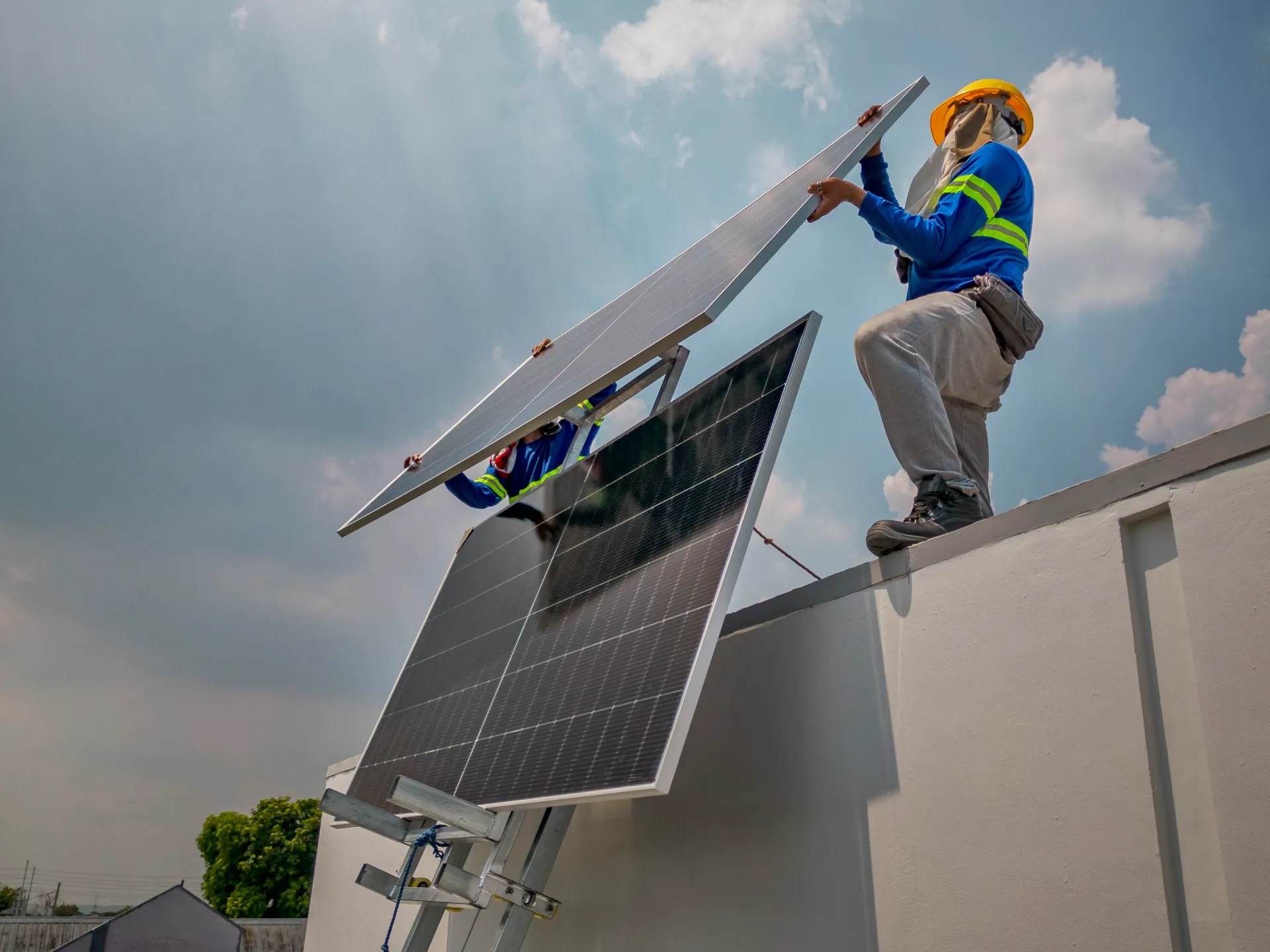
The EU has unveiled a raft of measures aimed at curbing the impact of the energy crisis, including proposals to accelerate the rollout of renewable energy sources and incentives for households to install clean energy solutions such as heat pumps and solar panels. The bloc is also pushing member states to slash tax on electricity, in a bid to encourage more motorists to make the switch to electric vehicles.
A group representing British Airways, easyJet, Jet2, Loganair, Ryanair, TUI, UPS and Virgin Atlantic has given a stark warning to ministers about holidays this summer. According to ITV News, Airlines UK has told passengers, ‘you can forget your holidays’ according to Good Morning Host Susanna Reid.
The letter, which has gone to ministers and the Civil Aviation Authority, calls on the government and officials to change the rules to bring down passenger duty, allow more night flights, and also to scrap compensation for cancelled or delayed flights.
Presenter Susanna said: “You can forget about your summer holidays. That is the stark warning issued to some air passengers hoping to fly abroad this year. With the war in Iran doubling the price of jet fuel, airlines say they face having to increase fairs or cut flights altogether.”
Co host Ed Balls added: “UK operators are now calling on the government to bring in emergency measures. In a confidential letter seen by ITV News, they’re asking for help to protect fuel supplies, reduce taxes on tickets, and waive strict rules. on compensating passengers.”
ITV said airlines are urging the government to step in to protect business travel, holiday flights and freight operations from the economic fallout of the war in the Middle East. A confidential briefing document submitted to ministers and the aviation regulator, the Civil Aviation Authority, seen by ITV News, warns that if the disruption “continues or worsens,” airlines will be forced to cut flights and push up fares.
The document, from Airlines UK, which represents British Airways, easyJet, Jet2, Loganair, Ryanair, TUI, UPS and Virgin Atlantic, warns that jet fuel costs have doubled, with fuel accounting for around a third of airline operating costs.
Correspondent Nick Dixon said: “Airlines are now at the stage where they are monitoring their reserves of jet fuel very carefully, very closely. There’s no indication just yet of any immediate cancelled flights or fuel shortages, but the airlines clearly need a backup plan in the longer term. And they are pushing for that. Now, some of the airlines have already taken steps. Lufthansa, the European airline, has cancelled thousands of its short-haul flights in an effort to conserve jet fuel. EasyJet, Virgin Airlines, as well as others, have expressed a lot of concern about the coming weeks.
“Virgin Atlantic has cancelled one of its long-haul routes. EasyJet has said, really, beyond the next few weeks into mid-May, they’re not entirely clear on what they will do for jet. Let’s just take a look at what the airlines are asking from the government in this letter that you mentioned.”
In terms of the changes the airlines want, he said: “So firstly, they want to relieve or reduce air passenger duty to help bring down the cost of travel generally and holidays during this period. Allow for nighttime flights to keep things moving if the schedules are disrupted, and also to scrap compensation for cancelled or delayed flights caused by fuel shortages. All of that, of course, would have a huge impact. on passengers.
“What most passengers want to know is, will my holiday flight be affected? It may well be that if the airlines win concessions from the government, we start to see some tactical flight cancellations of what would otherwise be loss-making departures. Well, the Department for Transport has said that it’s continuing to work with fuel suppliers, with airlines, and international counterparts on our contingency emergency planning to ensure that people keep moving and businesses are supported while the conflict is ongoing. But it’s all quite vague really at the moment and very concerning for passenger passengers who have either spent hundreds if not thousands on flights or are looking to plan uh trips throughout the summer.”
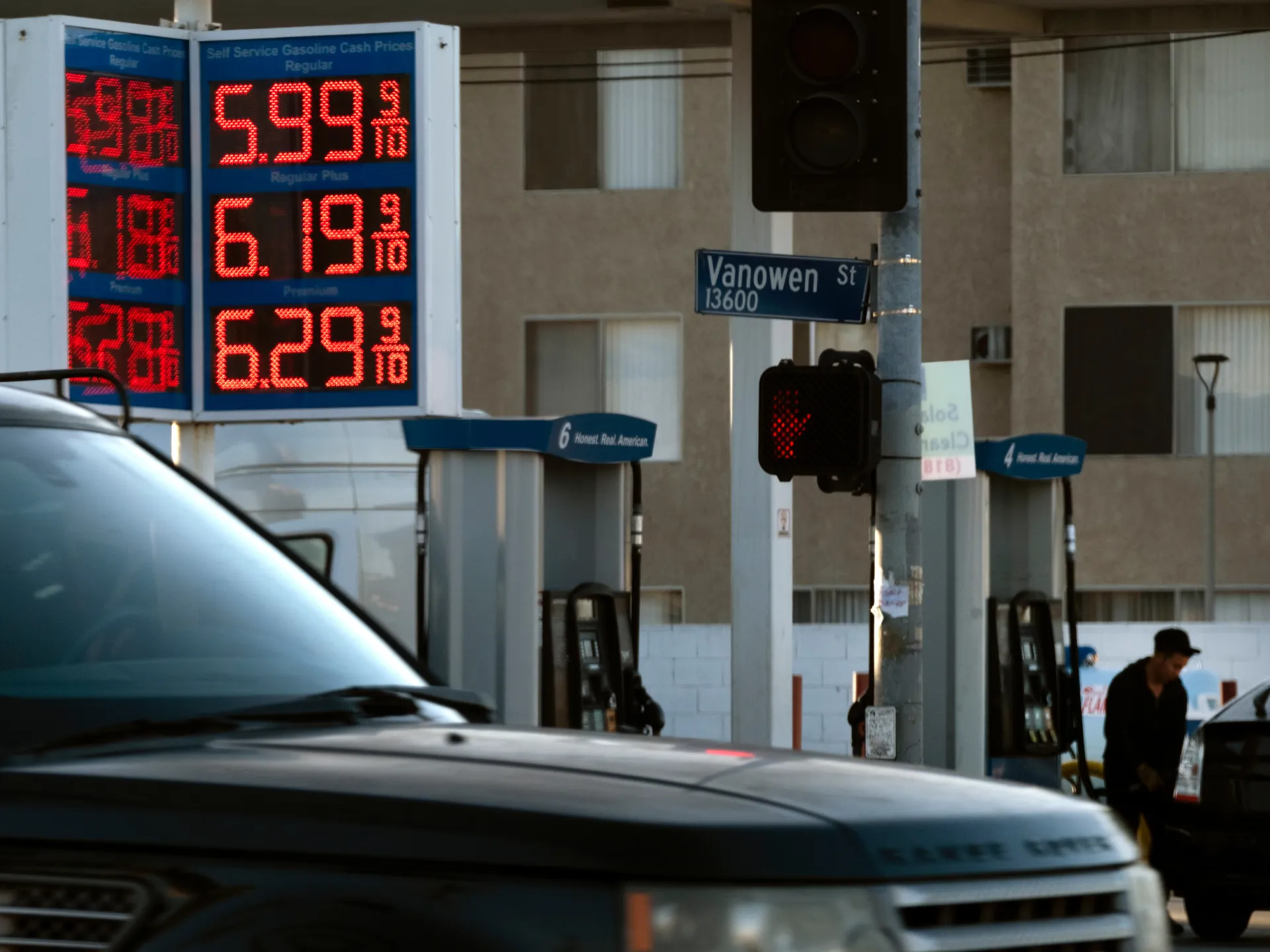
The cost of living in the UK accelerated throughout March, propelled by a significant increase in petrol and diesel prices following the outbreak of the Iran war.
ADVERTISEMENT
ADVERTISEMENT
According to the Office for National Statistics, the annual consumer price inflation rate moved to 3.3% from 3% the previous month, a shift that matched the forecasts.
This inflationary pressure is largely attributed to an 8.7% monthly jump in motor fuel costs, which represents the sharpest rise seen since the summer of 2022, following Russia’s full-scale invasion of Ukraine.
Beyond the petrol stations, the fallout from higher energy prices has trickled down into airfares and food supplies, complicating the economic landscape for the government and the Bank of England.
UK Treasury chief Rachel Reeves noted that while the conflict is not a domestic one, it is directly pushing up bills for families and businesses across Britain.
Lindsay James, an investment strategist at Quilter, observed that “this morning’s inflation data showed CPI creeping back up to 3.3%, confirming that price pressures are re-accelerating rather than fading away since the outbreak of the war in Iran.”
While international markets have shown some signs of recovery in equity prices, the physical market for oil delivery into Europe remains under immense strain.
Experts suggest that a swift reopening of the Strait of Hormuz is the only viable path to unwinding the current inflationary trend, yet the situation remains volatile and unpredictable.
The Bank of England’s policy dilemma
The timing of this inflation surge is particularly problematic because it coincides with a period of cooling in the domestic economy.
Recent data from the labour market indicates that payrolled employment is falling and economic inactivity is on the rise, while wage growth has started to ease.
For the average British worker, the combination of rising essential costs and stagnating earnings growth creates a challenging environment for real purchasing power.
As for the Bank of England, this sudden spike in prices has disrupted the projected path of beginning to lower borrowing costs this spring.
Prior to the escalation of the Iran war, there was a growing consensus that the central bank would reduce its main interest rate from 3.75% as inflation appeared to be heading back toward the official 2% target.
However, with inflation now expected to potentially hit 4% in the coming months, the Monetary Policy Committee faces a much more difficult decision during its meeting next week.
There is a growing debate among economists regarding whether traditional interest rate hikes are the correct tool to address this specific crisis.
According to James “a rise in rates risks misdiagnosing the problem. This inflationary pulse is being driven by supply disruption, not excess demand. Higher interest rates will do nothing to increase the flow of oil or other goods from the Middle East.”
This sentiment suggests that the Bank of England may choose to maintain its current stance, keeping rates on hold while monitoring whether these price increases begin to manifest in higher wage demands across the broader economy.
President Trump said the US would extend the ceasefire until Iran presents a proposal and talks are concluded, but a naval blockade of its ports continues.
Published On 22 Apr 202622 Apr 2026
President Donald Trump said the United States is extending the ceasefire until Tehran submits its latest proposal with conditions for ending the war, and until negotiations conclude, keeping diplomacy open while maintaining pressure on Iran.
However, Trump said the US naval blockade on Iran would remain. Iran has insisted that the blockade represents a violation of the ceasefire, and has said it will not negotiate under the “shadow of threats” or while the blockade remains in place, underscoring the fragile and uncertain path to talks.
Meanwhile, violence continues across the region, with Israeli settlers killing two people, including a child, in the occupied West Bank, and Israeli strikes in southern Lebanon wounding civilians and damaging homes despite a 10-day ceasefire.
In Iran
The Islamic Revolutionary Guard Corps (IRGC) said oil production across the Middle East could be targeted if attacks were launched from Gulf neighbours’ territory.
The US is continuing its naval blockade of Iranian ports despite the truce, a move Iran says undermines the ceasefire.
An adviser to Iran’s parliamentary speaker said the ceasefire extension could be a “ploy to buy time” for potential military escalation.
Foreign Minister Abbas Araghchi described the US naval blockade as an “act of war” and a violation of the truce.
War diplomacy
Tehran open to diplomacy: Reporting from Tehran, Al Jazeera’s Almigdad Alruhaid said there was no official response to Trump’s ceasefire extension, but officials signalled openness to talks. The US blockade of the Strait of Hormuz is seen as a violation of the truce, with commanders saying forces are fully prepared to respond to any escalation.
US sanctions widened: The US imposed new sanctions linked to Iran’s weapons programmes, while the European Union is moving to expand its own measures.
Talks planned in Washington, DC: The US is set to host ambassador-level negotiations between Israel and Lebanon, as Lebanese Prime Minister Nawaf Salam pushes for a full Israeli withdrawal from the country’s territory as Beirut’s main objective.
In the Gulf
Trump said a potential currency swap with the United Arab Emirates is “under consideration”, adding Washington would support the Gulf ally if needed, after reports the idea was raised with US officials amid concerns the war could strain the UAE’s economy.
In the US
The US president said he was extending a ceasefire with Iran to give more time for negotiations, but would maintain the naval blockade of Iranian ports.
Reporting from the White House, Al Jazeera’s Alan Fisher said Trump has shifted between conciliatory and hardline rhetoric, linking the blockade of the Strait of Hormuz to forcing Iran to negotiate, while warning of military action if negotiations fail.
The mixed messaging has unsettled markets, but some analysts argue the strategy shows calculated pressure and a willingness to wait for Iran’s response.
In Israel
Israeli Prime Minister Benjamin Netanyahu said the country has been strengthened by its campaigns against Iran and its allies, claiming joint efforts with the US weakened Tehran’s capabilities and boosted Israel’s regional position, opening the door to new alliances.
In Lebanon
Prime Minister Salam said on Tuesday that Lebanon needed $587m to address the conflict’s ongoing humanitarian fallout amid a fragile ceasefire between Israel and Hezbollah.
Tensions remain high as Israel and Hezbollah accuse each other of breaching the truce. Israel said rockets were fired at its troops in southern Lebanon and that it responded with strikes, while Hezbollah said its attacks were retaliation for Israeli shelling and ongoing strikes on Lebanese areas.
Oil and global economy
Shipping through the Strait of Hormuz remains severely limited, raising concerns over global oil flows.
A Cuban Foreign Ministry official said the exchange with Washington was ‘respectful and professional’ and devoid of threats.
Published On 21 Apr 202621 Apr 2026
The Cuban government has confirmed that it held recent talks in Havana with officials from the United States, as tensions remain high between the two countries over Washington’s energy blockade of the Caribbean country.
Alejandro Garcia del Toro, deputy director general in charge of US affairs at the Cuban Ministry of Foreign Affairs, said on Monday that the US delegation included assistant secretaries of state, and the Cuban delegation included representatives at the level of deputy foreign minister.
Recommended Stories
list of 4 itemsend of list
Garcia de Toro said that the US delegation did not issue any threats or deadlines as had been reported by some US media outlets.
“The entire exchange was conducted with respect and professionalism,” he said.
In comments reported by Cuba’s Communist Party newspaper Granma, Garcia del Toro emphasised that ending the three-month-old US oil blockade was “a top priority” for the Cuban government in the talks, and accused Washington of “blackmail” for threatening countries that export oil to Cuba with tariffs.
“This act of economic coercion is an unjustified punishment for the entire Cuban population,” he said.
“It is also a form of global blackmail against sovereign states, which have every right to export fuel to Cuba, in accordance with the principles of free trade,” he added.
US news outlet Axios reported on Friday that officials from US President Donald Trump’s administration held multiple meetings in Havana on April 10, including with Raul Guillermo Rodriguez Castro, grandson of former President Raul Castro. The meetings marked the first time that American diplomats had flown into Cuba since 2016 in a new diplomatic push.
According to reports, US officials laid out several conditions for negotiations with Cuba to continue, including the release of prominent political prisoners, an end to political repression, and liberalising the island’s ailing economy.
The Reuters news agency said that US proposals for Cuba also include allowing Elon Musk’s Starlink internet terminals into the country and providing compensation for Americans and US corporations for assets confiscated by Cuba after the 1959 revolution. Washington is also concerned about the influence of foreign powers on the island, a US official told the news agency.
Trump has hinted at military intervention in Cuba and warned of tariffs on any country that sells or supplies oil to Cuba. The fuel blockade has aggravated Cuba’s economic and energy crisis, leading to warnings of a humanitarian disaster.
Cubans have also braced for a possible attack following Trump’s repeated warnings that the country will be “next” after his war on Iran and the US military’s abduction of Venezuela’s President Nicolas Maduro in January.
Last week, Cuban President Miguel Diaz-Canel said that his country was prepared to fight if the US carried through on its threats.
The leaders of Mexico, Spain and Brazil on Saturday voiced concern over the “dramatic situation” in Cuba and urged “sincere and respectful dialogue”.
German Chancellor Friedrich Merz said on Monday there was no evident justification for the US to attack Cuba.
“The ability to defend oneself does not mean the right to intervene militarily in other states when their political systems do not match what others might have in mind,” he said.
Avilio Troconiz (C), regional president of the Primero Justicia party in Zulia, speaks at a press conference in front of the Las Tarabas electrical substation in Maracaibo, Zulia state, Venezuela, on March 26. The party denounced the the electricity crisis, which has worsened in recent months. Photo by Henry Chirinos/EPA
April 20 (UPI) — Venezuela’s interim president, Delcy Rodríguez, said her government is talking with two major companies to address the country’s power crisis, citing recent diplomatic engagement with the United States.
“Thanks to that diplomatic dialogue, I can say we are now in direct contact with Siemens and General Electric to resolve the electricity problem in Zulia state,” Rodríguez said Sunday during a public event broadcast by state television.
She said the government decided to “open a new chapter in national political life” and in Venezuela’s international relations following a Jan. 3 U>S> military operation that captured President Nicolás Maduro and his wife, Cilia Flores.
Analysts say Zulia, a key oil-producing region in western Venezuela, is critical to the country’s hydrocarbons industry. Persistent electricity shortages have limited efforts to boost crude production, making restoration of the power system a strategic priority for economic recovery.
Situated at the western edge of the national grid, Zulia is the last region to receive electricity transmitted from the south. Failures in the transmission network often leave it disconnected. The system in the region operates at less than 40% of installed capacity.
According to local outlet El Tequeño, both companies conducted technical missions in March to assess Venezuela’s electrical infrastructure and present rehabilitation proposals.
The inspections included hydroelectric facilities in the Bajo Caroní complex in Bolívar state, following a February visit to Caracas by U.S. Energy Secretary Chris Wright.
Rodríguez made the remarks at the launch of a 13-day pilgrimage she called to demand the full lifting of economic sanctions imposed on Venezuela.
“Enough sanctions against the noble Venezuelan people,” she said, addressing the governments of the United States and Europe, according to Globovisión. She added that economic freedom is a sovereign right, not a concession from foreign powers.
The mobilizations began in Zulia, Amazonas and Táchira states and were led by Rodríguez, National Assembly President Jorge Rodríguez and ruling party leader Diosdado Cabello.
International sanctions have worsened Venezuela’s electricity crisis by limiting access to financing and technology needed to maintain and upgrade infrastructure.
A partial easing of U.S. sanctions on the oil and mining sectors has opened the door to talks with companies such as Siemens and General Electric to address those gaps.
Brent crude rises more than 7 percent as Washington and Tehran offer conflicting accounts on ceasefire negotiations.
Published On 20 Apr 202620 Apr 2026
Oil prices have risen sharply following attacks on commercial vessels in the Strait of Hormuz and conflicting messages about the prospect of renewed negotiations between the United States and Iran.
Brent crude futures, the primary benchmark for global prices, jumped more than 7 percent in Asia on Monday as the outlook for peace between Washington and Tehran darkened.
Recommended Stories
list of 4 itemsend of list
Prices eased somewhat later in the morning, with the benchmark at $94.69 a barrel as of 02:05 GMT, up from just under $90.40 on Friday.
The latest price surge came after US President Donald Trump said US forces seized an Iranian-flagged cargo vessel that had attempted to evade the US blockade of Iran’s ports.
Trump’s announcement followed reports by the United Kingdom Maritime Trade Operations (UKMTO) Centre over the weekend that two vessels came under attack while transiting the strait.
Iranian gunboats fired on a tanker, while an “unknown projectile” struck a container ship, according to the UKMTO.
After declaring the strait “completely open” on Friday, Tehran reversed course less than 24 hours later, citing the ongoing US blockade.
Earlier on Sunday, Trump said that a US delegation would travel to Pakistan on Monday to hold a second round of ceasefire talks with Iranian officials.
Iranian state news outlet IRNA later reported that Tehran would not participate in the talks, citing the US blockade and Washington’s “excessive demands” and “unrealistic expectations”.
A two-week ceasefire between Washington and Tehran is set to expire on Wednesday if the sides cannot agree on an extension.
An initial round of talks held in Islamabad earlier this month broke down without any agreement between the sides.
Iran’s effective closure of the strait, which usually carries about one-fifth of global oil and natural gas supplies, has driven a surge in fuel prices worldwide, forcing governments to tap emergency supplies and roll out energy-saving measures.
Nineteen vessels crossed the strait on Saturday, up from 10 the previous day, but far below the historical average of 138 daily transits, according to the UKMTO.
Asia’s main stock markets opened higher on Monday despite the dimming prospects of de-escalation.
Japan’s Nikkei 225 rose more than 1 percent in morning trading, while South Korea’s KOSPI gained about 1.3 percent.
Hong Kong’s Hang Seng Index rose about 0.5 percent, while the SSE Composite Index in Shanghai gained more than 0.4 percent.
The smartest thing Trump can do for the United States is to adopt a “cake-sharing” strategy to cope with the arrival of a multipolar era. He wants to ensure that America still gets the largest slice of the cake, with its power base rooted in traditional energy—oil and natural gas.
This aligns well with “Cold War thinking.” From the perspective of oil reserves, the United States plus its friendly Gulf states accounts for about 55%–60% of the global total. If Venezuela—now under U.S. control—is added, the share rises to 72%–77%.
Spreading out the energy map, according to estimates by the U.S. Geological Survey (USGS), Greenland holds approximately 39 billion barrels of oil equivalent (combining East and West Greenland). Cuba has 4–5 billion barrels.
Nigeria, a major oil-producing country in Africa, has 37 billion barrels of oil reserves. The Trump administration has threatened military action against it under the pretext of “persecuting Christians.”
Iran’s oil reserves stand at 2,086 billion barrels, accounting for 13.3% of the global total.
The regions Trump has singled out—Iran, Venezuela, Greenland, Cuba, and Nigeria—clearly show that he is deciding how to “share the cake” with China and Russia based on the traditional energy map.
Although reserves and actual output are two different things, for Trump this is irrelevant. What he puts on the negotiating table is merely a piece of paper for “bidding”—he doesn’t need to worry about minor details.
On the other side of the negotiating table, China’s chips are new energy and critical minerals. In the area of critical minerals, Iran, Venezuela, Greenland, Cuba, and Nigeria all possess rich potential, and all have varying degrees of investment and cooperation ties with China.
One reason Trump scorns “new energy” may be that, within his limited term, competing with China in the new energy field is simply impossible. In the traditional energy domain, however, the United States holds a significant advantage.
Successfully pocketing Venezuela has encouraged Trump to take risks in Iran. Originally, Trump wanted to approach Beijing for a major deal from the position of a traditional energy hegemon, but Iran’s fierce resistance has dampened his ambitions. The United States has been outmaneuvered by Iran, and Trump has postponed his visit to China.
Iranian President Pezeshkian publicly stated: “China is now also seen by the United States as its main enemy; we are just next in line. They want to take us down first, then deal with China.” Behind this statement lies the landscape of U.S.-China competition over energy and critical minerals.
It cannot be said that Trump is unrealistic—this “cake-sharing” strategy has its own rationality. Nor can it be said that Trump has overestimated America’s military strength, because he knows very well that the United States cannot even handle the Houthis, let alone Iran. One can only say that the success of the “decapitation operation” in Venezuela has inflated his sense of luck, and Israel has exploited this psychology to successfully lure Trump into risking involvement in Iran.
The United States and Israel jointly eliminated the appeasement faction in Tehran and greatly underestimated Iran’s counterattack capability. They wanted to control oil but ended up being controlled by Iran on oil export routes. This is a complete strategic failure, and its medium- to long-term damage to the United States far exceeds the energy sector.
We don’t even need to discuss the rise and fall of petrodollars versus petroyuan—just look at the new energy sector. This round of energy crisis has greatly heightened the global urgency for new energy development, and the countries and regions most urgently in need are precisely America’s allies worldwide, including the Gulf states.
America’s allies are mostly developed countries. They have long recognized that China is a superpower in new energy. Before the Iran war, the broader Western camp was developing new energy while trying to reduce dependence on Iran. Now, however, the sense of urgency has pushed these countries to rely even more deeply on China.
These countries and regions include France, Germany, Portugal, Spain, the United Kingdom, and the European Union, as well as India, Japan, South Korea, and Southeast Asian nations such as Vietnam, Thailand, the Philippines, and Indonesia. They are either industrially advanced or rapidly industrializing countries that heavily depend on stable energy supplies.
In the core area of the Iran war—the Gulf states—are also actively accelerating the development of new energy industries, with the solar industry as the key focus. China is the only source capable of providing cheap, high-quality equipment and products. After the war ends, Iran may also exchange oil for the components needed for new energy development with China, achieving economic diversification like the Gulf states and reducing reliance on oil exports.
China’s solar equipment originally suffered from overcapacity; now it stands to gain relief.
What revolves around the core issues of new energy is nothing more than industrial supply chains and critical minerals. In this regard, mainland China’s industrial strength needs no emphasis. In critical minerals, the Democratic Republic of the Congo—China’s deep cooperation partner—will see half of its cobalt mines belong to Chinese enterprises. Given that Congo holds the world’s largest cobalt reserves, China will possess an indisputable “cobalt dominance.” Cobalt is a key mineral for lithium-ion batteries.
In addition, graphite and tantalum are also dominated by China. Tantalum is a critical metal for capacitors, which are essential for stabilizing wind and solar power generation. Graphite is the anode material for lithium-ion batteries and an indispensable mineral for renewable energy storage systems and solar panel production.
Currently, renewable energy plus nuclear power accounts for 40% of global electricity generation, while fossil fuels still account for 60%. However, when looking at the global share of “capacity” (installed capacity) for renewable energy plus nuclear, it has already reached about 55%. Among this, renewable energy accounts for 49.4% and nuclear for about 5%.
“Capacity” refers to installed capacity—in plain terms, the theoretical maximum power generation. The actual global generation share of renewable energy is about 32%. The gap between theoretical and actual values exists because renewable energy generation is less stable than fossil fuels. Adding nuclear’s actual generation share (about 8%), the actual generation share of so-called low-carbon energy reaches 40% globally.
There is no doubt that the oil crisis will inevitably trigger a “green energy surge.” Looking ahead five years, the actual generation share of green energy will exceed 50%. Assuming nuclear can grow to 10% of actual generation and renewables grow by 8%, China’s additional revenue from the global renewable energy business in the next five years could reach the level of hundreds of billions of dollars.
From this perspective, China—which strongly supported green energy development from the very beginning of the climate agenda—did so not so much for carbon reduction as for industrial preparation in the name of energy security. Expanding the global new energy business is merely an added value.
Of course, the key technologies for manufacturing new energy equipment may be even more important than critical minerals. Last November, China imposed export controls on certain lithium batteries, key cathode and anode materials, and their manufacturing equipment and technologies. Given that China controls about 96% of global anode material production capacity and 85% of cathode material capacity, the impact of these export controls is enormous.
On April 15, according to Reuters, China has held preliminary consultations with solar panel production equipment suppliers and is considering restricting exports of the most advanced technologies and equipment to the United States. If true, Beijing is raising the stakes in new energy, waiting for Trump to come to the negotiating table in May.
Admittedly, Trump has no intention of developing new energy. However, considering that the Democrats may return to the White House in three years, Beijing is now blocking America’s path to new energy development, essentially laying the groundwork for U.S.-China competition three years from now.
If Trump’s energy strategy map on the table also included a new energy layer, he should realize that the setback in the Iran war has allowed the new energy domain to encroach upon the traditional energy domain, enabling China to expand its energy power without firing a single shot. As for critical minerals, the United States has made no outstanding progress—at least nothing sufficient for Trump to boast about.
Now, the “cake” being pushed in front of Xi Jinping is getting bigger and bigger. On the surface, Beijing has gained it effortlessly, but today’s harvest is mainly due to strategic 布局 made one step ahead. These layouts are often “low-profit” but highly effective investments, and new energy is merely one of them.
In an uncertain world, those who provide “certainty” win. Therefore, the winner of the Iran war is China—even if Beijing is extremely reluctant to admit it.
Brent crude falls more than 9 percent after Iran said it will reopen the strategic waterway, only to shut it down again over US blockade of its ports.
Published On 18 Apr 202618 Apr 2026
Oil prices have plummeted to their lowest point in weeks after Iran said the Strait of Hormuz was open for passage during a ceasefire in Lebanon, and United States President Donald Trump said he expected to reach a deal to end the war soon.
Brent crude, the international benchmark, fell more than 9 percent to $90.38 a barrel on Friday, taking it below $91 for the first time since March 10.
Recommended Stories
list of 4 itemsend of list
The plunge came after Iranian Foreign Minister Abbas Araghchi said the strait was “completely open” and would remain so for the duration of the 10-day ceasefire between Israel and Lebanon, which took effect on Friday.
Hailing Tehran’s announcement, Trump declared the waterway “ready for business and full passage,” but said the US Navy’s blockade of Iranian ports would remain in “full force” until the sides reached a peace deal.
On Saturday, however, Iran rowed back on its decision to reopen the Strait of Hormuz, warning that it would continue to block transit through the key waterway as long as the US blockade of Iranian ports remained in effect.
The announcement came after Trump said the blockade “will remain in full force” until Tehran reaches a deal with the US, including on its nuclear programme.
Roughly one-fifth of the world’s oil passes through Hormuz and further limits would squeeze already constrained supply, driving prices higher once again.
Amid the escalation, Pakistani officials say they are trying for more talks between the US and Iran ahead of the April 22 ceasefire deadline.
Meanwhile, ship tracking data displayed by MarineTraffic earlier on Saturday showed a significant uptick in vessels crossing the strait, which is located between Iran, the United Arab Emirates and Oman.
“It’s busy out there, the busiest I’ve seen it since the Strait of Hormuz was effectively closed at the beginning of the war,” Michelle Wiese Bockmann, an analyst at maritime intelligence firm Windward, said in a post on X.
“Last night there were few ships taking the risk but overnight there seems to have been a change.”
While Iran allowed a limited number of vetted ships to transit the waterway since the start of the war, traffic has remained at a trickle compared with pre-conflict levels.
The near-total closure of the strait has triggered one of the worst energy shocks in history, driving up fuel prices and prompting governments to roll out emergency measures.
Oil prices have swung wildly since the US and Israel launched strikes on Iran on February 28, hitting a post-conflict peak of $119 a barrel on March 19.
April 17 (UPI) — The Supreme Court ruled unanimously in favor of Chevron in a case related to damage to wetlands in Louisiana that dates to World War II.
The case was brought more than a decade ago and relates to damage allegedly done when Chevron’s corporate predecessors were refining aviation gas on behalf of the federal government during the war, Scotusblog and The Washington Post reported.
The 8-0 ruling sent the federal lawsuit back to a lower court in a move that could jeopardize a $745 million ruling against the company to restore the wetlands, as well as other similar cases with fossil fuel companies before courts in the United States.
Parishes in Louisiana filed the case with the help of state officials against oil and gas companies refining crude oil along the coast during the war, claiming that proper permits were never obtained for their work and that they had not followed “prudent industry practices.”
The previous decision on the $745 million ruling was made by a state court, which Chevron contended does not have the jurisdiction to rule because it was working under the auspices of the federal government.
After the state court judgement was handed down, the company’s lawyers asked the U.S. Supreme Court to move the case to a federal court, where it may be able to have the ruling thrown out.
U.S. President Donald Trump departs the White House en route to Davos, Switzerland on Wednesday. Photo by Olivier Douliery/UPI | License Photo
Hungary’s newly elected leader, Peter Magyar, stormed to power last weekend after campaigning to, among other things, take a step back from Russia.
Instead, Magyar has promised voters he will steer Hungary back towards the European Union, following the 16-year rule of far-right Prime Minister Viktor Orban, who went to great lengths to deepen ties with Russia.
Recommended Stories
list of 3 itemsend of list
Under Orban, Hungary opposed most of the European Union’s stances against Russia and blocked sanctions and obstructed military aid for Ukraine.
Above all, he and his Fidesz party entrenched Hungary’s reliance on Russian oil.
Now, following a massive electoral turnout and a landslide victory, Magyar – once a devotee of Orban and now leader of the centre-right Tisza party – has promised to end Russian oil imports by 2035. But how realistic a goal is that? And can he achieve it?
Peter Magyar celebrates after Prime Minister Viktor Orban conceded defeat in the parliamentary election in Hungary, April 12, 2026 [File: Leonhard Foeger/Reuters]
How much does Hungary depend on Russia for energy?
Hungary has been central to keeping Russian oil and gas flowing into the EU, even as Europe and the US banned some imports and imposed sanctions on anyone paying more than $60 a barrel for Russian oil.
Following Russia’s invasion of Ukraine, the EU banned seaborne imports of Russian oil but kept land flows legal. That allowed Hungary to continue importing most of its crude by pipeline via Ukraine.
The EU first announced plans to phase out Russian energy imports in May 2022, shortly after Russia’s invasion of Ukraine. In December 2025, a binding agreement was made for member nations to completely phase out Russian oil and gas imports by late 2027. But, instead of diversifying from Moscow, Hungary increased its dependency.
According to a 2026 report by the Center for the Study of Democracy (CSD), Hungary had expanded its reliance on Russian crude from 61 percent in 2021 to 93 percent by 2025.
Much of the crude oil Hungary imports from Russia comes via the Druzhba pipeline. It is one of the key pipelines that ensures the continued flow of Russian crude to both Hungary and Slovakia. At 5,500 km (3,420 miles) long, it begins in Almetyevsk in western Russia and runs into Belarus. It splits at Mozyr, with one branch going to Poland and Germany and the southern branch goes through Ukraine into Slovakia, Hungary and Czechia.
The Druzhba oil pipeline from Russia at the Danube Refinery in Szazhalombatta in Hungary, May 18, 2022 [File: Bernadett Szabo/Reuters]
In January, the section of the pipeline running through Ukraine suffered significant damage. Ukraine blamed a Russian airstrike – Moscow denies that.
Hungary and Slovakia have complained that Ukraine has been deliberately slow to repair the damage. As a result, in March, Orban vetoed a 90 billion euro ($106bn) loan from the EU to Ukraine until the pipeline reopens.
On Tuesday this week, Ukraine’s President Volodymyr Zelenskyy said oil will flow again through the conduit by the end of April as he expects the new Hungarian leadership to lift its veto on the loan by then.
As for gas, Hungary remains one of the most dependent EU member states on Russian natural gas, accounting for roughly three-quarters of its annual imports, the CSD report shows.
Since the start of Russia’s invasion, Hungary has imported an estimated 15.6 billion euros ($18.4bn) worth of Russian gas. Long-term contracts with Russia’s state-owned Gazprom, the continued reliance on TurkStream – a natural gas pipeline running from Russia to Turkiye – and “the weak use of alternative interconnectors have locked the country into Russia’s reconfigured gas export system”, the CSD report states.
Nuclear energy dependency is yet another issue. Hungary granted Rosatom, the Russian state nuclear energy corporation, the construction contract for the expansion of its Paks atomic plant, 100km (62 miles) southwest of Budapest on the Danube River. Russia, in turn, provided Hungary with a state loan to finance most of the development of new reactors. The European Commission approved the plan in 2017 and construction started in February.
Now, Magyar says he intends to reassess the project’s financing. But the Paks plant provides 40 to 50 percent of all electricity generated in Hungary. The expansion plans will increase that to between 60 and 70 percent, which would cut reliance on imported energy, but keep Hungary tied to Russia.
According to a 2025 joint research paper by the Center for the Study of Democracy and the Center for Research on Energy and Clean Air, Hungary could potentially diversify its energy supply by importing non-Russian oil via alternative sources such as the Adria pipeline. It transports crude from the Adriatic Sea to refineries in Croatia, Serbia, Hungary and Slovakia. Their refiners, which are controlled by Hungarian oil and gas company MOL, are capable of processing non-Russian crude, the research paper said.
Russian oil has been coming in at a discounted rate as a result of Western sanctions, so any diversification will likely be more expensive.
Can Hungary wean itself off its dependence on Russian oil?
It won’t be easy, and Magyar knows it. “The geographical position of neither Russia nor Hungary will change. Our energy exposure will also be here for a while,” he said before last weekend’s election. And in an interview with the Financial Times, Magyar insisted that Russian imports should remain an option. “This does not mean that by ending dependence on someone you no longer continue to buy from them,” he said.
Magyar will seek to strike a balance between respecting current contracts with Moscow to ensure Hungary’s energy security, while establishing political distance, said Pawel Zerka, a senior policy fellow at the European Council on Foreign Relations.
“I would expect this government not to be pro-Russia in the sense of going to Moscow and keeping ties with the Russian government, but they don’t have easy options to replace Russian fuel with something else, especially considering the international situation with the Middle East,” Zerka said, referring to the closure of the Strait of Hormuz in the Gulf which has blocked the shipping of 20 percent of the world’s oil and LNG supplies.
Zerka added that the newly elected leader will not have political room to be particularly cordial with Russian President Vladimir Putin, considering the disapproval of Russia by his electoral base. A recent poll by the European Council on Foreign Relations shows that a majority of Tisza’s voters see Russia as an adversary or rival to compete with.
“It will be interesting to see how he combines this with energy needs,” Zerka said.
How does the EU view Hungary’s energy ties to Russia?
The strong energy ties between Russia and Hungary have long caused friction with the EU. Following Moscow’s invasion of Ukraine in 2022, the European bloc has worked to cut imports of Russian oil and gas. Budapest has done the opposite.
In January, the EU passed legislation to completely phase out Russian gas and LNG imports by late 2027.
Orban’s government had called for all restrictions on Russian oil to be lifted as a result of the global energy crisis triggered by the war in the Middle East. While Trump has made some concessions on Russian oil already loaded on tankers at sea – causing several heading for China to head to India instead – EU leaders have maintained they will hold firm on sanctions.
In the lead-up to last weekend’s election, Magyar’s manifesto called the dependence on Russian energy a “systemic risk” and he would wean Hungary off its reliance by 2035. But whether he can do that in time to beat the EU’s 2027 deadline is likely to provoke discussion in Brussels.
The International Monetary Fund has downgraded its global growth forecast for 2026 from 3.3 to 3.1 percent, citing the impact of the United States-Israeli war on Iran and the shutdown of the Strait of Hormuz on the world economy.
The war has damaged energy infrastructure across the Gulf, while critical exports like oil, gas, chemicals and fertiliser remain largely stranded by Iran’s shutdown of the strait and the subsequent US naval blockade of Iranian ports.
Recommended Stories
list of 4 itemsend of list
In the worst-case scenario of a prolonged war, the IMF said global growth could fall to 2.5 percent in 2026, with low-income and developing economies hit the hardest by soaring commodity and energy prices. The global shipping and logistics industry is facing a separate crisis.
But every economic crisis also has beneficiaries: despite the dire macroeconomic outlook, some corners of the global economy are thriving on the uncertainty.
Here’s a look at five industries that are doing well either despite – or because of – the darkening economic outlook.
Wall Street investment banks
Global investors have been on a rollercoaster since the start of US President Donald Trump’s second term last year. The president’s erratic decision-making, where he often issues an ultimatum one day and then changes it the next, has led traders to coin the term “TACO trade”, where TACO stands for “Trump Always Chickens Out”.
The recent volatility has made some investors anxious, but it’s been a boon to investment banks, which make millions in commissions and revenue from the surging volume of trade, according to Sean Dunlap, a director of equity research at Morningstar Research Services.
“Clients want to reposition, so they trade frequently,” he told Al Jazeera. “Spreads tend to increase, which increases the profitability for trade intermediaries like banks.”
First-quarter results for 2026 – released this week – showed that Morgan Stanley reported a profit of $5.57bn, up 29 percent year on year, while Goldman Sachs reported a profit of $5.63bn, up 19 percent year on year.
JP Morgan Chase also reported major gains, with first-quarter earnings of $16.49bn, up 13 percent year on year. The banks all cited high levels of trading, deal-making, and “robust client engagement” as the reasons behind surging profits.
The boomtime for banks could reverse course, however, if volatility persists for too long, Dunlap warned, because investors may become increasingly cautious and less willing to borrow money to make trades.
Prediction markets
As mainstream Wall Street banks reap profits, the crypto-based prediction platform Polymarket has been earning upwards of $1m a day since the start of the month by letting users make peer-to-peer bets on everything from sports tournaments to elections.
Polymarket has been doing well since the start of the war, but it revised its fee structure on March 30 to cash in even more on its popularity.
Rival platforms like Kalshi, Novig and Robinhood also follow the same business model, but Polymarket has been the standout winner of 2026 because it controversially allows users to bet on the outcome of conflicts like the Iran war.
Polymarket revised its fee structure on March 30 to cash in on its popularity. The change has already netted the platform more than $21m in fees since April 1, up from $11.6m for all of March and $6.23m for all of February, according to DefiLlama, a website that provides data analysis for decentralised finance platforms.
If the current trend continues, Polymarket could make $342m in fees this year alone, according to DefiLlama’s analysis.
Anonymous users have also made millions correctly predicting the dates of major events like the US-Iran ceasefire, but the outcomes for rank-and-file users are typically less impressive.
Researchers found that the top 1 percent of Polymarket users captured 84 percent of all trading gains, according to a new report released this month analysing 70 million trades from 2022 to 2025. The returns are so high that US federal regulators have pledged to crack down on insider trading in prediction markets following suspiciously well-timed bets on Iran war outcomes.
Aerospace and defence
Unsurprisingly, the aerospace and defence industries are booming this year due to major conflicts in Ukraine, Iran, Sudan, Gaza and Lebanon and a surge in global defence spending.
About half of the world’s countries have increased their military budgets over the past five years, according to an April report from the IMF, which means they are also buying everything from drones to missiles — more than ever before. Demand is growing particularly fast in Europe, where NATO countries have committed to raising defence spending to 5 percent of gross domestic product (GDP) by 2035.
The defence industry has, in turn, seen major gains on the stock market. The MSCI World Aerospace and Defence Index – which tracks aerospace and defence stocks across 23 global markets – reported net returns of 32 percent year on year at the end of March.
The defence index outpaced the MSCI World Index, which tracks 1,300 large and mid-cap companies across the same 23 markets. The index, which gives a broader overview of global stock markets, reported net returns of 18.9 percent over the same period.
Artificial intelligence
Last year, the United Nations Trade and Development (UNCTAD) office predicted that the AI industry would grow from $189bn in 2023 to $4.8 trillion by 2033, and the Iran war does not seem to have dented the outlook.
“Despite the shocks from the Iran war, we’re still seeing resilience in a lot of sectors like artificial intelligence and renewable energy,” said Nick Marro, lead analyst for global trade at the Economist Intelligence Unit.
One metric for the AI boom has been the high volume of semiconductor chips still being exported out of East Asia, he said. At the top of the chart is chipmaking powerhouse Taiwan, which reported record-breaking merchandise exports of $80.2bn in March, up 61.8 percent year on year, according to EIU analysis.
The surge was led by exports to the US, which grew by 124 percent year on year, the EIU said.
Taiwan Semiconductor Manufacturing Company, the world’s top chipmaker better known by its acronym “TSMC,” on Thursday posted a net income of 572.8 billion New Taiwan Dollars (NTD) ($18.1bn) for the first three months of 2026 – up 58 percent year on year in NTD.
Another metric, initial public offerings or “IPOs,” also shows that the industry is confident for the moment, with industry leaders Anthropic and OpenAI both planning to go public this year.
Renewable energy
The Iran war has highlighted the need to transition from fossil fuels not only for environmental reasons, but also for reasons of energy security. The war marks the third major energy shock this decade, following the COVID-19 pandemic and the 2022 Russian invasion of Ukraine.
The Iran war has “boosted” renewable energy “given the urgency to switch away from fossil fuels and diversify towards renewable sources,” Marro of the EIU said.
Even before the Iran war began, the International Energy Agency reported that global governments were already taking active measures to invest in renewable energy for geopolitical reasons.
According to an IEA report released this month, “150 countries have active policies to advance renewable and nuclear deployment, 130 have energy efficiency and electrification policies, and 32 have policies to incentivise supply chain resilience and diversification across critical minerals and clean energy technologies.”
The Iran war has triggered another flurry of policymaking in Asia, which typically buys 80 to 90 percent of the oil and gas that transits through the Strait of Hormuz. Since the shutdown, the region has been struggling to find alternative sources of energy, forcing governments to deploy emergency measures like fuel rationing and price caps.
South Korea, Thailand, India, Cambodia, Indonesia, Vietnam and the Philippines have all announced a variety of measures from tax breaks for at-home solar panels to commissioning new renewable energy projects – and even restarting nuclear reactors.
The surge in policymaking has been good for the renewable industry. The S&P Global Clean Energy Transition Index, which tracks 100 companies that produce solar, wind, hydro, biomass and other renewable energy across emerging and developed markets, is up 70.92 percent year on year.
Miguel Diaz-Canel marks anniversary of socialist revolutionary declaration under threat of US attacks.
By AFP and The Associated Press
Published On 16 Apr 202616 Apr 2026
Cuban President Miguel Diaz-Canel has said that his country does not seek conflict with the United States but is prepared to fight if necessary, as Cuba marks the anniversary of its socialist revolutionary character amid the threat of US attacks.
Diaz-Canel struck a defiant tone on Thursday in remarks before a crowd marking the 65th anniversary of Fidel Castro’s declaration of the socialist nature of the Cuban Revolution and the failed invasion at the Bay of Pigs by forces aligned with the US the day after.
Recommended Stories
list of 3 itemsend of list
“The moment is extremely challenging and calls upon us once again, as on April 16, 1961, to be ready to confront serious threats, including military aggression,” Diaz-Canel said. “We do not want it, but it is our duty to prepare to avoid it and, if it becomes inevitable, to defeat it.”
President Donald Trump has threatened that the US could overthrow the Cuban government, a longtime source of ire for Washington, and has ratcheted up energy restrictions meant to squeeze the island’s economy.
“We may stop by Cuba after we finish with this,” Trump said earlier this week, stating that his attention could turn to Cuba after the end of the US-Israel war on Iran.
A US energy blockade and an end to oil shipments from Venezuela after the US abducted former Venezuelan President Nicolas Maduro in January have caused deteriorating conditions on the island. Fuel shortages and energy blackouts have roiled the island for weeks, heaping strain on workers and businesses.
Even before those increased restrictions, Cuba’s economy had suffered from decades of economic embargo from the US, along with economic mismanagement and political repression that prompted many Cubans to leave the country.
A vote at the United Nations in 2025 demanding an end to the US embargo passed with 165 votes in favour and seven against, including the US, Israel, Argentina, and Hungary. The resolution has been passed annually for more than 30 years.
“Cuba is not a failed state. Cuba is a besieged state,” Diaz-Canel said on Thursday. “Cuba is a state facing multidimensional aggression: economic warfare, an intensified blockade and an energy blockade.”
United States Pentagon Chief Pete Hegseth has said the military blockade of Iran’s ports will continue “as long as it takes”, saying Washington remained “locked and loaded” to attack Iran’s energy facilities.
The US Pentagon chief spoke on Thursday as a tenuous pause in fighting agreed to last week has continued. On Monday, President Donald Trump announced the military would blockade Iran’s ports in the Strait of Hormuz and the Persian Gulf after US-Iran talks in Pakistan failed to reach a breakthrough.
Recommended Stories
list of 3 itemsend of list
Hegseth struck an aggressive tone as he maintained the US military was monitoring Iran’s military movements during the pause in fighting, which currently is meant to extend through early next week.
“We are reloading with more power than ever before…even more importantly, better intelligence than ever before,” Hegseth said.
“As you expose yourself with your movement to our watchful eye, we are locked and loaded on your critical dual-use infrastructure, on your remaining power generation and on your energy industry,” he said.
Still, the Pentagon chief said the US prefers to resolve the conflict, which began with US-Israeli attacks on Iran on February 28, through diplomacy.
“You, Iran, can choose a prosperous future, a golden bridge, and we hope that you do for the people of Iran,” he said. “In the meantime and for as long as it takes, we will maintain this blockade, successful blockade, but if Iran chooses poorly, then they will have a blockade and bombs dropping on infrastructure, power and energy.”
On Wednesday, a Pakistani delegation arrived in Tehran to coordinate a new round of talks. While both sides have indicated they remained open to further negotiations, Major-General Ali Abdollahi, the commander of the Khatam al-Anbiya Central Headquarters of the Islamic Revolutionary Guard Corps (IRGC), warned that the US blockade could end the current pause in fighting.
White House spokesperson Karoline Leavitt, meanwhile, indicated the US maintained a positive outlook on future talks.
“At this moment, we remain very much engaged in these negotiations, in these talks,” she said.
But reporting from Tehran on Thursday, Al Jazeera’s Ali Hashem says deep-seated distrust remains. The US under Trump twice attacked Iran amid ongoing indirect talks over Iran’s nuclear programme, a fact that has cast a long shadow over the most recent bout of diplomacy.
“Clearly, there have been several messages conveyed to the Iranians. But rather than consolidating a feeling of trust and optimism, it seems that it’s already shaken,” he said.
“We saw a platform closely associated with the foreign ministry tweeting today, quoting a source saying that whatever is being demonstrated or said in the media regarding the optimism is just hype, and this is used for PR and it’s for President Trump to use in the markets,” he said.
Iran’s speaker of parliament, Mohammad Bagher Ghalibaf, who led the Iranian delegation in the talks with Iran, told his Lebanese counterpart on Thursday that a ceasefire in Israel’s invasion and ongoing bombardment of Lebanon is “as important” as the pause in fighting in Iran.
A Lebanon ceasefire has emerged as one of the main sticking points in talks, which also include control of the Strait of Hormuz and the future of Iran’s nuclear programme.
‘We will use force’
Speaking during the news conference on Thursday, General Dan Caine, the chairman of the Joint Chiefs of Staff, said so far, 13 ships leaving Iranian ports have turned around in response to US military warnings.
“If you do not comply with this blockade, we will use force,” Caine said.
Admiral Brad Cooper, the head of US Central Command (CENTCOM), meanwhile, said the US is using the wear to rearm and reposition its forces.
“We’re rearming, we’re retooling, and we’re adjusting our tactics, techniques and procedures. There’s no military in the world that adjusts like we do, and that’s exactly what we’re doing right now during the ceasefire,” said.
During questions with reporters, Hegseth also shot down reports that China was planning to send weapons to Iran amid the pause in fighting. Hegseth said Washington had received assurances from Beijing that this was not the case.
Hegseth also used a large portion of the news conference to attack US press coverage of the war, which the Trump administration is receiving criticism for its shifting objectives and justifications for launching the conflict.
Hegseth called the coverage “incredibly unpatriotic”.
Rodríguez hosted US Energy Assistant Secretary Kyle Haustveit at Miraflores Palace. (Presidential Press)
Caracas, April 15, 2026 (venezuelanalysis.com) – The US Treasury Department’s Office of Foreign Assets Control (OFAC) issued two new general licenses on Tuesday facilitating transactions with Venezuelan state institutions.
for Venezuela on Tuesday: a commercial license (No. 56) and a financial license (No. 57), signaling a partial easing of restrictions while maintaining key controls.
General License 56 (GL56) authorizes US entities to negotiate and sign “contingent contracts” for future commercial operations in Venezuela. This allows firms to move forward with agreements, investments, or projects, though their final execution remains subject to separate OFAC approval.
The waiver maintains important restrictions, including a ban on payments in gold or cryptocurrencies, as well as prohibitions on transactions involving China, Russia, Iran, North Korea, and Cuba. It likewise forbids transactions involving Venezuelan debt and does not unblock currently frozen Venezuelan assets.
For its part, General License 57 (GL57) permits a broad range of financial operations with the Venezuelan Central Bank (BCV), as well as Venezuela’s public banks: Banco de Venezuela, Banco Digital de los Trabajadores, Banco del Tesoro, and entities in which these institutions hold a 50 percent or greater stake.
The allowed transactions include opening and managing accounts, conducting US dollar transfers, issuing loans, and providing banking services. The BCV was sanctioned in April 2019, effectively isolating Venezuela from international financial circuits and increasing costs for basic transactions.
The latest sanctions waivers are expected to facilitate financial flows to the Venezuelan economy, including the transfer of Venezuelan oil revenues that are currently controlled by the Trump administration. US authorities have returned a confirmed US $500 million out of an initial deal estimated at $2 billion, while US and Venezuelan officials have confirmed the purchase of US-manufactured medicines and hospital equipment using Venezuelan funds.
Analyst Hermes Pérez warned that reincorporation into the SWIFT system and establishment of US-based accounts could take several months due to security and technological requirements. Other economists argued that GL57 could allow the Central Bank to stabilize the Venezuelan foreign exchange system.
For several years, a parallel exchange rate between the US dollar and the Venezuelan bolívar has coexisted with the official one set by the Central Bank, often with a gap above 50 percent that fueled distortions in retail activities and currency speculation.
Since the January 3 military strikes and kidnapping of Venezuelan President Nicolás Maduro, the Trump administration has issued several licenses to expand US influence in the Caribbean nation, particularly in key economic sectors such as hydrocarbons and mining.
In parallel, Venezuelan authorities have promoted several pro-business reforms, while multiple Trump officials and corporate executives have come the South American country and held meetings with the acting government led by Delcy Rodríguez.
The latest waivers coincided with the visit to Caracas of a US Department of Energy delegation led by Assistant Secretary Kyle Haustveit. Rodríguez hosted the official on Wednesday in a work meeting at the presidential palace.
During a short, televised intervention, Rodríguez argued that OFAC licenses do not provide sufficient “legal certainty” and reiterated calls for Trump to lift unilateral coercive measures against the country.
“An investor requires greater legal certainty. A license does not provide long-term legal guarantees because it is subject to temporality,” she argued. Rodríguez claimed Washington and Caracas have “enough maturity” to establish “long-term” energy cooperation ties.
“We are working very hard on changes that can attract investment, and which can build an energy cooperation agenda with the United States,” she said.
Rodríguez additionally disclosed recent meetings with representatives from ExxonMobil and ConocoPhillips, stating that authorities have “taken into account recommendations” from oil majors in recent legislative overhauls. Both ExxonMobil and ConocoPhillips refused to accept hydrocarbon reforms under former President Hugo Chávez in the 2000s, later securing multi-billion-dollar arbitration awards against the Caracas as compensation for the nationalization of their assets.
Haustveit and the Energy Department delegation were also present on Monday during the signing of agreements with Chevron that granted the Texas-based conglomerate an increased stake in the Petroindependencia joint venture and awarded an additional extra-heavy crude bloc for exploration to the Petropiar mixed company. Chevron owns minority stakes in both joint enterprises with Venezuelan state oil company PDVSA.
Shell, Eni and Repsol are among the other energy giants to have recently advanced in deals with the Venezuelan government under the improved conditions of the new Hydrocarbon Law.
US Chargé d’Affaires in Venezuela Laura Dogu was also present at the Chevron deal-signing ceremony and the meeting with Haustveit’s delegation. However, the White House announced Wednesday that her post will be taken over by veteran diplomat John Barrett.
Barrett, who previously served as chargé d’affaires at the US Embassy in Guatemala since January 21, 2026, was recently accused by Guatemalan President Bernardo Arévalo of interference during judicial elections for the Constitutional Court held in March.
Watch the moment a Democratic congresswoman tells the US Energy Secretary he is ‘living in a different world’ after his response to whether he’d adequately warned the White House that a war on Iran would have global consequences.
Minister of Electricity and Renewable Energy Carlos Perez (C) visits the Coca Codo Sinclair hydroelectric power plant during a tour for journalists in El Chaco, Ecuador, in June 2018. The government at the time was preparing to hire a specialized company check the plant for safety issues, File Photo by Jose Jacome/EPA
April 14 (UPI) — Ecuador’s government will formally accept the Coca Codo Sinclair hydroelectric plant this week, nearly a decade after technical disputes first delayed final delivery of the Chinese-built facility.
The handover follows resolution of an international arbitration dispute with Sinohydro, a subsidiary of PowerChina, over structural defects at the plant.
Ecuadorian Environment and Energy Minister Ines Manzano said the transfer will proceed under guaranteed conditions, allowing immediate operation and maintenance of the infrastructure.
Since the plant began partial operations in 2016, Ecuador and the Chinese contractor remained locked in a legal dispute over major structural flaws that prevented final acceptance of the project.
A 2018 report by Ecuador’s comptroller identified more than 7,600 cracks in the plant’s eight water distributors — key components that channel water to the turbines, local newspaper La Hora reported.
Subsequent technical reports and audits raised that figure to more than 17,000 cracks, fueling concerns over material quality, welding processes and possible design flaws.
The comptroller’s office warned the defects pose serious risks, including possible flooding of the powerhouse, total shutdown of the plant and danger to workers.
After Sinohydro declined to undertake permanent repairs, Ecuador took the dispute to the International Chamber of Commerce’s arbitration court.
The dispute was resolved through a financial and operational agreement under which Ecuador will receive $400 million in compensation. The government will next sign an operation and maintenance contract with PowerChina requiring the company to repair damage and replace defective water distributors, local newspaper El Comercio reported.
Separate from the structural issues, the facility also faces a broader environmental threat from regressive erosion of the Coca River, a geological process that has altered the surrounding area since the plant entered service.
The erosion has advanced toward the plant’s water intake structures, prompting the government to carry out emergency work that includes construction of permeable dams to slow the river’s force and retain sediment at a cost of $19 million.
The Coca Codo Sinclair plant is Ecuador’s largest and most strategic power generation facility.
With installed capacity of 1,500 megawatts, it supplies about 30% of Ecuador’s electricity demand on average and can account for more than half of the country’s hydropower generation during peak operations.
According to Infobae, the Coca Codo Sinclair case has become a symbol for analysts citing problems in Chinese-financed infrastructure projects across Latin America.
The plant was built with loans from the Export-Import Bank of China during the administration of Rafael Correa and has been at the center of investigations into alleged corruption tied to its contracting.