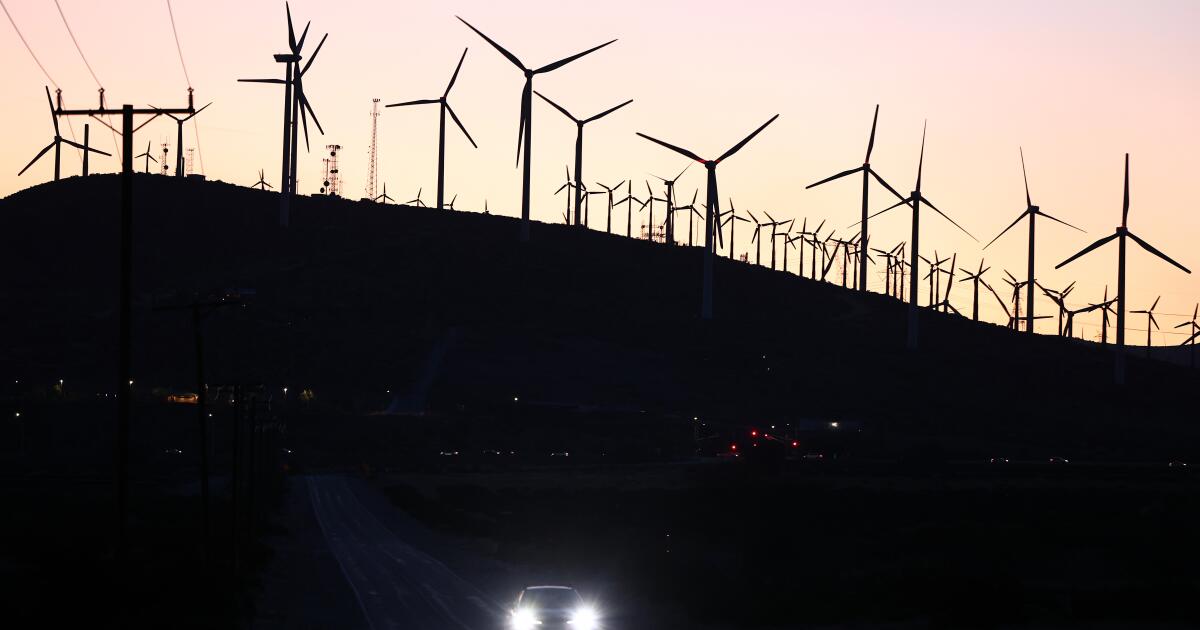
Trump is shelling out $2 billion of taxpayer money to kill wind power projects, but his hatred for the technology is based on myths
Picking the wildest fantasy promoted by President Trump as a basis for public policy is increasingly challenging — is it his yarn about schoolchildren being secretly abducted from their classrooms and given sex-changing operations? The notion that the vaccines given to children are like “a vat, like a big glass, of stuff pumped into their bodies?”
Here’s one that has disrupted the economics of renewable energy generation and will cost Americans billions of dollars: It’s Trump’s “completely weird war on wind power in the United States,” based on a sheaf of “fact-free arguments.”
That judgment comes from Steven Cohen, a climate policy expert at Columbia University, who points out that wind already accounts for 10.5% of U.S. energy generation, that it’s destined to continue growing — and that most of it is generated today in red states such as Texas, Oklahoma, Iowa and Kansas.
Fifty years from now, people are going to be amazed that we burned these rare, useful hydrocarbons for fuel, when the sun was just sitting up there providing an essentially infinite source of energy.
— Steven Cohen, Columbia University
There is no question that Trump’s weird war against wind is full blown. On the day of his second inauguration, he issued an executive order shutting down all new permits for offshore wind farms and ordered the Interior Department to review existing permits.
A federal judge in Massachusetts blocked the executive order in December, and his orders suspending work on existing offshore wind projects have been halted by other federal judges. The Trump administration has blocked or delayed as many as 165 wind projects on private land, citing “national security” concerns, according to the American Clean Power Assn.
Most recently, Trump has reached agreements with offshore wind firms in which the government will pay them a combined $2 billion to abandon their U.S. projects.
At some level, this crusade resembles Trump’s misguided effort to revive the American coal industry, which is on the glide path to inevitable extinction. In that case, Trump is waging an explicitly partisan and ideological battle. “We’re ending Joe Biden’s war on beautiful, clean coal,” he declared last April.
Trump’s anti-wind program is part of his campaign to dismantle U.S. renewables policy because of its roots in the Biden administration.
Additionally, multiple commentators conjecture that his hostility to wind originated in 2011, when he groused that an offshore wind farm would be visible from one of his golf courses in Scotland. He sued to thwart the “ugly” project, and lost.
But Trump has mustered other arguments against wind, on- and offshore, none of which holds water.
During a cabinet meeting in July 2025, he called wind “a very expensive form of energy.” In fact, on average it’s cheaper than natural gas, coal and nuclear generation. Perhaps more important, the cost has been coming down sharply as technology improves and the sector reaches critical mass: falling to eight cents from 21 cents per kilowatt-hour from 2010 to 2024 for offshore projects, and to 3.4 cents from 11.3 cents for land-based wind farms over the same period.
Trump blamed wind turbines for mass killing whales and birds. Neither assertion is correct.
The National Oceanic and Atmospheric Administration, a federal agency, says “there are no known links between large whale deaths and ongoing offshore wind activities.”
The Audubon Society reported in January that although wind turbines can present hazards to birds, “developers can effectively manage these risks without significantly increasing project costs.” The biggest risks to birds come from the climate: “Two-thirds of North American birds are at increasing risk of extinction from global temperature rise,” the society reported — a threat that wind power can ameliorate.
Trump spokeswoman Taylor Rogers didn’t respond to my questions about the derivation of his anti-wind stance, but told me by email only that “President Trump has been clear: hard-earned taxpayer dollars shouldn’t be wasted on unreliable and costly wind farms that pose serious threats to our national security. Instead, we should be strengthening and expanding our infrastructure that produces reliable, affordable, and secure energy like natural gas plants.”
That brings us to the recent deals with offshore wind developers. The largest single deal, signed in March, was with the French firm TotalEnergies, which is to receive approximately $1 billion from the federal government to abandon all of its U.S. offshore wind projects and invest instead in oil and gas projects, including a liquefied natural gas export facility in Texas.
In his March 23 announcement of the deal, Interior Secretary Doug Burgum called offshore wind “one of the most expensive, unreliable, environmentally disruptive, and subsidy-dependent schemes ever forced on American ratepayers and taxpayers.”
This is what Huck Finn would call a “stretcher,” given the decades of subsidies spooned out to the oil and gas industry, reaching more than $30 billion a year in federal and state tax credits, indulgent regulation of pollution and low-cost access to federal lands. Indeed, the investment firm Lazard recently reported that renewables, including wind, are a cost-competitive form of generation even without subsidies. (Lazard’s calculation is of the “levelized cost of energy,” meaning the average cost over a generating plant’s lifetime.)
TotalEnergies fell into lockstep with the Interior Department in its own announcement, explaining its willingness to renounce U.S. offshore wind power because “offshore wind developments in the United States, unlike those in Europe, are costly,” echoing the agency’s position that “the development of offshore wind projects is not in the country’s interest.” Never mind that one factor that makes U.S. offshore wind development costly compared with Europe is the Trump administration’s opposition.
The government subsequently reached an agreement to pay the French company Ocean Winds $885 million to walk away from two offshore wind projects, including one in the waters off California. Ocean Winds described the deal as one driven chiefly by economics, but hinted at pressure from the White House.
“We welcome the opportunity to engage constructively with the administration on this agreement and acknowledge the clarity they have provided with this decision and deal,” Michael Brown, the chief executive of Ocean Winds North America, said when the deal was announced last month. “Our priority remains disciplined capital allocation and delivering reliable energy solutions that create long-term value for ratepayers, partners, and shareholders.”
The TotalEnergies deal, which the government has described as a “refund” of money the firm paid for its offshore leades, raised the hackles of congressional Democrats, who assert that it violates the law and constitution in multiple ways.
“We will hold you accountable for this billion-dollar ripoff,” Reps. Jamie Raskin (D-Md.), ranking member of the House Judiciary Committee and Jared Huffman (D-San Rafael), ranking member of the House Committee on Natural Resources, warned TotalEnergies CEO Patrick Pouyanné in an April 29 letter.
Among other infirmities Raskin and Huffman alleged, the government’s national security rationale for canceling offshore wind leases looks “fabricated”; the payout violates the statutory formula for compensation for canceled leases; the money is to come from a fund designed only to pay court-ordered judgments and settlements of lawsuits, which don’t exist in this case; and includes a provision preventing the deal from being reviewed by a court.
The last of those provisions would have to be authorized by Congress, the letter states, asking for documents and a response from the company by Wednesday. Committee spokespersons weren’t available to say whether they received a response from TotalEnergies, and the company didn’t respond to my request for comment. I received no response from the Department of the Interior.
The California Energy Commission has opened an investigation into the Ocean Winds deal.
“The Trump Administration is recklessly spending billions of taxpayer dollars on backroom deals that would turn back the clock on innovation” CEC Chair David Hochschild said. “Taxpayer dollars should be used to build a sustainable energy future, not to pay to make projects disappear.”
What’s especially wasteful about Trump’s crusade against wind power is that it’s almost certain to be time-limited.
It’s hardly debatable that renewables such as solar and wind will be our principal sources of energy in the future; holding back the clock achieves nothing but injecting uncertainty into investment decisions that need to be made now, at a time when the price of oil is on the upswing thanks to Trump’s Iran adventure and Europe and China are racing to transition away from fossil fuels, while the U.S. remains becalmed by ideology.
“In the long run, fossil fuels will be used for petrochemicals and not for burning,” Cohen told me. “Fifty years from now, people are going to be amazed that we burned these rare, useful hydrocarbons for fuel, when the sun was just sitting up there providing an essentially infinite source of energy.”