The market is just emerging, but domestic banks may already be exposed to global risk.
This article appears in the October issue of Global Finance Magazine.
Japan’s private credit market may still be small, but its exposure to private credit is not.
That is an important distinction as the Bank of Japan warns that growing links between Japanese financial institutions and global private credit funds could have implications for financial stability.
The BOJ’s concern is not that Japan has suddenly embraced the $2 trillion-plus private credit industry. It is that Japanese banks and institutional investors are becoming part of it, just as vulnerabilities in the asset class are attracting greater scrutiny.
For now, regulators see no evidence of a systemic problem. According to reports, Japan’s Financial Services Agency has been examining financial institutions’ lending and investment exposure to private credit, while Finance Minister Satsuki Katayama has said Japan’s exposure is not substantial.
But Japanese banks have increased financing to global private credit funds in search of higher returns, while exploring domestic strategies in the same vein, creating potential channels through which overseas stress could spill into Japan.
In 2020, for example, Sumitomo Mitsui Financial Group’s (SMFG) banking division took a 4.9% stake in U.S.-headquartered Ares Management Corp., making a strategic commitment to support the U.S. entity’s private credit business.
Earlier this spring, SMFG and Nippon Life Insurance were reported to be in talks to create a new private credit fund of at least 500 billion yen to finance leveraged buyouts, real estate and mezzanine transactions.
“The market is only emerging,” said Yuuichiro Nakajima, managing director at Tokyo-based M&A advisory firm Crimson Phoenix. “It is certainly not replacing bank finance in any meaningful way.”
Nakajima pointed out that Japan may well have less need for private credit than the U.S. or Europe because its banks remain deeply embedded in corporate finance and continue to provide relatively inexpensive funding.
Filling the M&A Gap
Furthermore, Nakajima expects private credit to complement rather than displace traditional lenders, particularly as mergers & acquisitions in Japan become more complex and larger: Japanese M&A involving domestic companies reached a record 53 trillion yen in 2025, according to LSEG data cited by Reuters.
Indeed, take-privates, succession deals, overseas acquisitions and infrastructure investment are generating financing requirements that can stretch conventional bank structures.
In such an environment, private credit can fill gaps in leveraged buyouts, mezzanine finance and other transactions where flexibility, speed or longer maturities matter.
“As the variety of M&A transactions becomes broader and more complex,” Nakajima said, “it wouldn’t be hard to imagine banks finding it difficult to keep up with the pace of financing needs.”
Global managers are betting on precisely that opportunity. According to reports, Apollo Global Management Inc., Blackstone Inc. and KKR & Co. are building private-credit capabilities in Tokyo, although industry executives expect adoption to take years rather than months.
But the domestic opportunity should not obscure the systemic risk concern: private credit globally has grown rapidly while remaining relatively opaque and illiquid.
John Amari is a contributing writer based in Japan.
Hundreds of flights have been cancelled in a union dispute that could affect thousands of passengers
Robert Rowlands Deputy editor, money and lifestyle, content hub and Maria Ortega
17:24, 02 Oct 2026
EasyJet says it is “extremely disappointed” that the action is taking place – file image of one of the airline’s planes at Lisbon airport(Image: Sergey Sokolnikov via Getty Images)
A ‘massive’ EasyJet cabin crew strike has resulted in the cancellation of hundreds of flights in a popular British tourist destination – and could jeopardise Christmas plans for holidaymakers.
The initial 5-day industrial action is expected to ground approximately 500 scheduled flights across Lisbon, Porto and Faro airports. And the festive period is also set to be disrupted.
The strike began this Friday, October 2, in Portugal and is the first of two walkouts planned for this year. The affected flights involve all domestic airports, but mainly Lisbon and Porto.
The EasyJet cabin crew strike goes on until Tuesday, with 443 flights from the Lisbon, Porto, and Faro bases already scrapped as of this morning, according to the National Union of Civil Aviation Flight Personnel (SNPVAC). “80% of flights involving the Lisbon, Porto, and Faro bases” between October 2 and 6 have already been cancelled, union official Ana Dias told local news agency Lusa. They noted that “the impact has already been massive.”
EasyJet, meanwhile, said 55% of flights were set to operate over the five-day strike period. The National Union of Civil Aviation Flight Personnel (SNPVAC) reported strong participation on Friday, the first of five scheduled strike days for EasyJet cabin crew, adding that only minimum services are being maintained.
EasyJet has confirmed that two return flights from Manchester Airport to Portugal have been axed in the coming days due to industrial action, the MEN reports. The walkout was announced by the National Union of Civil Aviation Flight Personnel and is set to impact flights from Lisbon, Porto and Faro airports, all served by EasyJet from Manchester Airport.
Sic Noticias reports that the union has said other currently scheduled flights could still be disrupted by the strike, although some may be operated by aircraft and crews from other European bases. An official EasyJet source told Lusa on Thursday that the airline anticipates operating approximately 55% of its schedule during the strike period. The source explained that, in addition to “minimum services” (representing about 22% of its Portugal-based operations), the airline is maintaining flights to and from the country operated by crews from other European bases.
The company says these operations are being conducted “in full compliance with applicable laws and regulations,”. The SNPVAC union deems the use of workers from other bases to replace striking staff “illegal” and is considering taking the matter to court.
EasyJet said it was “extremely disappointed” that the strike was taking place, despite its “ongoing efforts to maintain a constructive dialogue and reach an agreement.” It expressed regret over the disruption caused to passengers.
An EasyJet spokesperson said: “We are extremely disappointed that the union representing our Portugal-based cabin crew has announced an industrial action from 2 to 6 October, despite our willingness to continue a constructive dialogue and reach an agreement to meet our employees’ requests and protect the sustainability of EasyJet business in Portugal.
“We are sorry for the impact the unnecessary action will have on our customers, and are doing all we can to minimise disruption, including cancelling two return flights from Manchester in advance to allow our customers to rearrange their travel plans. Customers have been informed directly and offered options including a free transfer or a refund.
“We advise customers travelling to or from Portugal between 2 and 6 October to check the status of their flight via our Flight Tracker.”
Eritrea has cut off diplomatic relations with neighbouring Ethiopia, escalating a long-simmering conflict between the two states rooted in territorial disputes and mutual accusations of interference.
The move comes as fighting flares in northern Ethiopia between Ethiopian federal troops and an opposition alliance that Addis Ababa accuses Eritrea of backing.
Recommended Stories
list of 3 itemsend of list
The clashes are the most severe in Ethiopia since its 2020-2022 civil war that killed hundreds of thousands of people.
But this time, the ripple effects could go further, potentially fuelling broader unrest in a region already plagued by numerous interrelated conflicts, analysts warn.
Here’s what we know about the Ethiopia-Eritrea conflict, the latest fighting in northern Ethiopia and what it could mean for the region at large:
Why did Eritrea break off ties with Ethiopia?
Eritrea announced it was severing ties with Ethiopia on Thursday, after Addis Ababa announced it would close its embassy in Asmara and expel 10 Eritrean diplomats.
In a statement, Eritrea’s Ministry of Foreign Affairs said Ethiopia’s actions had left it with “no option but to reciprocate in kind and sever all diplomatic ties with Ethiopia”.
The Eritrean ministry accused Ethiopia of pursuing a years-long “agenda of incessant hostility”, including by infringing on its coastal areas and arming fighters opposed to Ethiopia’s government.
Ethiopia has likewise accused Eritrea of backing armed groups opposed to its government. Both sides have rejected the other’s accusations.
The diplomatic breakdown follows months of worsening relations, driven largely by disputes over landlocked Ethiopia’s push for access to the Red Sea and allegations that Eritrea is backing the rebel Tigray People’s Liberation Front (TPLF), which leads the Ethiopian Peoples’ Forces Alliance for Survival, a rebel alliance fighting for control of parts of northern Ethiopia.
Have Ethiopia’s ties with Egypt and Sudan been hit, too?
Yes. Ethiopia accuses Egypt and Sudan of joining Eritrea in backing Tigrayan rebel forces, worsening already strained ties with both countries.
Ethiopia has long been at odds with Egypt over the status of Ethiopia’s Grand Ethiopian Renaissance Dam (GERD) project, which Cairo views as a risk to its water security and share of the Nile.
Ethiopia and Egypt have also expelled diplomats. Cairo ordered an Ethiopian diplomat to leave the country on Thursday, after Addis Ababa earlier kicked out an Egyptian diplomat, Egyptian state-linked media reported.
Egyptian state-linked broadcaster Al-Qahera News quoted an Egyptian official as calling Ethiopia’s move to expel the Egyptian diplomat as “regrettable and unjustified” and saying that Cairo responded in line with “the principle of reciprocity”.
The latest conflict also has implications for Sudan, whose military-backed government accuses Ethiopia of backing rebel forces it is fighting in its own civil conflict. Ethiopia rejects those allegations.
“The conflicts in Ethiopia and Sudan have become more interconnected, with the Ethiopian government and Sudanese Armed Forces accusing each other of harbouring and equipping respective opposition forces from inside their own borders,” Ahmed Soliman, senior research fellow at the Chatham House think tank’s Africa programme, told Al Jazeera. “Egypt has also been drawn into the escalation with its long-running enmity with Ethiopia over the Nile.”
What is happening in northern Ethiopia?
Tigrayan-led rebel forces have engaged in clashes with Ethiopian government-backed forces in the country’s north since last week. Fighting is concentrated in three regions: Tigray, Amhara and Afar.
Al Jazeera’s bureau chief in Ethiopia, Mohammed Taha Tawakel, reported that forces loyal to the federal government have made significant gains in the Tigray region, taking control of several towns and closing in on the regional capital, Mekelle.
Further east in Afar, a pro-government armed group claimed on Thursday to have recaptured the town of Erebti, which rebel forces had taken control of earlier in the week. The pro-government group thanked the Ethiopian military for its “magnificent air support” and said it would pursue further advances.
Despite the pro-government advances, Tawakel reported that rebel forces still maintain what he described as a “strong rear link with Eritrea” along the countries’ border.
He also reported growing fears that fighting could move into major urban centres of Tigray, such as Adwa, Axum, Shire and Mekelle. Some people have already begun fleeing to Amhara and Afar, he added.
Outside northern Ethiopia, the conflict appeared to spill into the capital, Addis Ababa, for the first time early on Thursday, as an explosion was reported at the Ministry of Defence.
AFP quoted a diplomatic source as saying small drones were the most probable cause of the blast.
While Ethiopia’s army has a much larger arsenal of drones, rebel forces have previously used them to target airbases and airports in various parts of the country, reported conflict monitor ACLED.
What are the roots of the Ethiopia-Eritrea dispute?
Ties between the neighbours have been historically fragile. In 1962, Ethiopia annexed Eritrea. An armed independence struggle, led by Eritrea’s current President Isaias Afwerki, secured independence in 1993. The countries fought another border war from 1998 to 2000.
When Ethiopian Prime Minister Abiy Ahmed came to power in 2018, he moved to end the tensions and normalise diplomatic relations with Eritrea. During Ethiopia’s last civil war in 2020-2022, Eritrea even backed Ethiopia’s government against the TPLF.
But Abiy’s ambitions to seek direct sea access for landlocked Ethiopia have contributed to recent tensions, say analysts. Abiy has repeated that Ethiopia has a right to sea access, words that officials in Asmara take as a declaration of territorial conflict with Eritrea.
Could the current conflict spread in the region?
Many analysts fear it could.
Laura Hammond, professor in development studies at SOAS University of London, told Al Jazeera this scenario is already under way.
“The risks that conflict will spread to other countries, or that neighbours in the region will be brought into the present conflict are already playing out in terms of Eritrea’s support for the TPLF and the Alliance for Survival,” said Hammond.
“There is a strong possibility that Eritrea will become more involved in the conflict on the ground inside Tigray if it continues much longer,” she continued. “There is also a risk that the conflict could inflame relations with and inside Sudan.”
Martin Plaut, an analyst specialising in the Horn of Africa, also said there was a “real danger” of the conflict spreading.
“The situation is extremely tense and it would only require a spark to ignite a conflagration that could engulf [Ethiopia and Eritrea], as well as neighbouring Sudan,” he told Al Jazeera.
His initial statement read: “I have been silent for years and made every effort to keep these matters private.
“Unfortunately my parents and their team have continued to go to the press, leaving me with no choice but to speak for myself and tell the truth about only some of the lies that have been printed.
“I do not want to reconcile with my family. I’m not being controlled, I’m standing up for myself for the first time in my life.”
As renewed fighting spreads across northern Ethiopia, the government has accused Eritrea, Sudan and Egypt of backing armed opposition groups, raising fears that the conflict could draw in regional powers.
Over the weekend, Ethiopian army chief Birhanu Jula attributed his country’s unrest to those he called Ethiopia’s “historical and contemporary adversaries”.
Recommended Stories
list of 3 itemsend of list
Birhanu accused Eritrea of being the go-between linking these external powers – including Sudan and Egypt, which he explicitly named – with armed groups inside Ethiopia.
Eritrea, Sudan and Egypt have all rejected the accusations. Speaking to Al Jazeera, Egyptian Foreign Ministry spokesperson Nader Zaki said that Egypt’s foreign policy was founded on “full respect for the sovereignty, unity and territorial integrity of states, and noninterference in the internal affairs of other countries”.
Zaki added that Egypt “is fully committed to the rules of international law and the Charter of the United Nations, and rejects any practices that would undermine regional security and stability”.
Major-General Samir Farag, the former head of the Egyptian Armed Forces’ Morale Affairs Department, also told Al Jazeera that the accusations against Egypt were false. “It has not been Egypt’s policy to interfere in the internal affairs of any state in the region,” he said.
Sudan’s military also dismissed the accusations as “baseless” and levelled its own charge of destabilising behaviour at Ethiopia, accusing it of supporting the paramilitary Rapid Support Forces (RSF), which has been fighting the Sudanese Armed Forces since 2023. Ethiopia has denied those allegations.
Troubled relations
Ethiopia’s relations with the countries it has accused have already been strained by other disputes that predate the latest fighting.
Relations between Cairo and Addis Ababa have remained tense as a longstanding dispute over the Grand Ethiopian Renaissance Dam (GERD) remains unresolved. Competition between the two has increasingly extended to regional security, the Red Sea and the Horn of Africa.
The Grand Ethiopian Renaissance Dam, the construction of which stoked fears in Cairo that Ethiopia could choke off the Nile River, September 9, 2025 [File:Tiksa Negeri/Reuters]
Sudan’s relations with Ethiopia are similarly troubled. Since the outbreak of the Sudanese civil war, Khartoum has accused Addis Ababa of providing training, supplies and the use of Ethiopian territory to the RSF.
Eritrea had fought alongside Ethiopia against rebel groups in the latter’s Tigray region during a war between 2020 and 2022, but relations between the two neighbours have since soured, with Eritrea alarmed by Ethiopia’s attempts to gain access to the Red Sea.
Against that background, some analysts and Ethiopian opposition figures say that Addis Ababa is pointing the finger at foreign conspiracies in a bid to rally support behind its national army.
Mohamed Selim, deputy chair of the Egyptian parliament’s African Affairs Committee, told Al Jazeera that he believes the accusations were an attempt to shift attention from Ethiopia’s domestic problems by creating an external enemy and seeking to unify the internal front.
Amani al-Tawil, director of the Africa Programme at the Al-Ahram Centre for Political and Strategic Studies, similarly described the accusations as “an understandable attempt to escape from internal crises”.
She questioned why Egypt would choose this moment to intervene militarily in Ethiopia, given the two have been in dispute over GERD since 2011.
Al-Tawil said the breadth of the new opposition alliance in Ethiopia – seven groups representing disparate ethnic groups and regions announced the coalition last week – presented a challenge to Addis Ababa.
(Al Jazeera)
Spillover concerns
The renewed fighting in Ethiopia has spread across Tigray and into neighbouring Amhara and Afar.
Mohammed Hussein, the chairman of the Prosperity Party Afar Region Branch Office – the ruling party in Ethiopia’s Afar region – told Al Jazeera that the three regions together have a population of more than 38 million, according to his estimate, and include areas near the borders with Djibouti and Eritrea, raising fears of a regional war.
Ammar Arki, a writer focusing on Horn of Africa affairs, told Al Jazeera that Ethiopia had, at various stages, blamed Sudan, Egypt and Eritrea for contributing to instability inside Ethiopia.
He said the latest accusations could be interpreted as an attempt to redirect some domestic attention towards an external threat and build support around the federal government.
But Arki warned that the longer Addis Ababa continued to explain its internal crisis in terms of an “external conspiracy”, particularly if neighbouring states responded in the same way, the greater the risk that Ethiopia’s conflict could move beyond Ethiopia’s borders and become regional.
If your GHIC is due to expire soon and you are also due to travel soon, then apply for a new card for free via official NHS BSA Healthcare Cover Application, as soon as possible.
It usually takes around 15 working days for the card to arrive once your application is approved.
If you travel before your card arrives, then don’t worry – if you need medical treatment when abroad, then you or someone on your behalf can request a Provisional Replacement Certificate (PRC) online or by phone.
All you need to provide is your name, address, date of birth and your National Insurance Number.
The card is free to apply for and takes about 15 days to arriveCredit: Alamy
The certificate can then be emailed directly to the hospital or medical centre you are seeking treatment at and gives you the exact same healthcare cover as a physical card.
It is worth remembering though that GHIC cards are not a substitute for travel insurance.
GHICs do not cover private medical care, mountain rescue, flight cancellations or being flown back to the UK – all things that you will need travel insurance for.
Tim Knighton, travel insurance expert at Compare the Market, said: “With nearly 1.3 million GHICs due to expire this year, anyone travelling to Europe should check their card well before they set off.
“It’s an easy thing to overlook, particularly if you haven’t needed to use your GHIC on previous trips.
“The rise in applications for PRCs also highlights that people could find themselves needing access to healthcare unexpectedly while abroad, so checking you have a valid GHIC before travelling is an important part of preparing for your trip.
“A GHIC can be very useful if you need medically necessary state healthcare while abroad, but it’s important to remember that it isn’t a substitute for travel insurance.
“There are costs and circumstances that a GHIC may not cover, so having appropriate travel insurance can provide additional protection if something goes wrong.
“Before travelling, check the expiry date on your GHIC and make sure you understand what healthcare you can access at your destination.
“It’s also worth arranging travel insurance as soon as you book your trip and comparing policies carefully to make sure the level of medical and other cover suits your needs.”
EASYJET flights are set to be disrupted across Portugal for five days due to strikes – and it starts this weekend.
Staff are staging walkouts which will see flights cancelled at airports in cities like Lisbon, Porto and Faro.
EasyJet staff in Portugal are staging walkouts which start this weekendCredit: Alamy Stock PhotoFlights to Lisbon are expected to be disruptedCredit: Getty
Members of the SNPVAC union, which the airline’s cabin crew in Portugal belongs to, has announced walkouts from October 2–6.
The union has estimated that the strike in October could ground around 500 scheduled flights overall.
Sign up for the Travel newsletter
Thank you!
Some UK flights have already been cancelled ahead of the strike action.
Two return flights and one outbound flight from Southend Airport have been cancelled.
No flights from London Stansted Airport have been affected so far, according to reports.
From the UK, easyJet operates flights to Portugal from the likes of Birmingham, Bristol, Edinburgh, Glasgow, Liverpool, Gatwick, Luton, Southend, Manchester and Newcastle.
Passengers due to travel to or from Portugal during the strike dates are being advised to monitor communications from easyJet.
The Portuguese government has ensured that there will be a minimum of one Lisbon-London-Lisbon rotation per day during the strike.
No UK service from Faro or Porto appears on the protected list, and the order does not identify specifics when it comes to flights.
Anton Radchenko, aviation expert and CEO of AirAdvisor advised that “passengers should wait for a flight-specific decision and preserve the exact time of any cancellation notice.”
As many as 500 flights could be affected by the industrial actionCredit: Markus Mainka
He added: “If easyJet cancels and they still need to travel, they should request rerouting at the earliest opportunity, including on another airline where that would reach the destination materially sooner, rather than automatically accepting a refund.”
Last month, easyJet pilots, again in France, staged a walkout across two days in September.
Members of the SNPL pilots’ union staged the strike over a pay dispute between September 13-14.
The SNPVAC union has announced further walkouts later on in the year in December between 19–23.
A spokesperson from the airline said: “We are extremely disappointed that SNPVAC is planning strike actions despite our willingness to continue a constructive dialogue.
“We had just started a conciliation process through the mediation of DGERT with the aim to reach an agreement to meet our employees’ requests and protect the sustainability of easyJet business in Portugal.
“The current union demands are unworkable especially given that our crew are already paid significantly above the Portuguese national average
“We are doing everything we can to minimize the impact of the strike on our customers including actioning some cancellations in advance to allow our customers to rearrange their travel plans.”
Flight compensation rules
A look at your rights if a flight is delayed or cancelled, when your entitled to compensation and if your travel insurance can cover the costs.
What are my rights if my flight is cancelled or delayed?
Under UK law, airlines have to provide compensation if your flight arrives at its destination more than three hours late.
If you’re flying to or from the UK, your airline must let you choose a refund or an alternative flight.
You will be able to get your money back for the part of your ticket that you haven’t used yet.
So if you booked a return flight and the outbound leg is cancelled, you can get the full cost of the return ticket refunded.
But if travelling is essential, then your airline has to find you an alternative flight. This could even be with another airline.
When am I not entitled to compensation?
The airline doesn’t have to give you a refund if the flight was cancelled due to reasons beyond their control, such as extreme weather.
Disruptions caused by things like extreme weather, airport or air traffic control employee strikes or other ‘extraordinary circumstances’ are not eligible for compensation.
Some airlines may stretch the definition of “extraordinary circumstances” but you can challenge them through the aviation regulator the Civil Aviation Authority (CAA).
Will my insurance cover me if my flight is cancelled?
If you can’t claim compensation directly through the airline, your travel insurance may refund you.
Policies vary so you should check the small print, but a delay of eight to 12 hours will normally mean you qualify for some money from your insurer.
Remember to get written confirmation of your delay from the airport as your insurer will need proof.
If your flight is cancelled entirely, you’re unlikely to be covered by your insurance.
The Ebola outbreak has spread to new areas in the Democratic Republic of the Congo, with 10 neighbouring countries at high risk as officials step up border health measures.
The Foreign Office is urging UK travellers to ‘avoid’
11:03, 25 Sep 2026Updated 11:07, 25 Sep 2026
UK travellers continue to be warned(Image: Daniel Garrido via Getty Images)
The Foreign, Commonwealth and Development Office (FCDO) has issued a stark warning to British holidaymakers, urging travellers to stay safe while abroad.
In a recent update on X, formerly Twitter, the FCDO said: “Free drinks aren’t worth the risk. To help reduce the risk of methanol poisoning abroad, avoid free cocktails or shots, unlabelled bottles, and unusually cheap or discounted drinks claiming to be brand-name alcohol.”
The FCDO is raising awareness following the deaths of several British travellers who consumed alcohol contaminated with methanol while overseas.
Kirsty McKie, 38, died in 2022 after inadvertently ingesting the substance while at home with a friend in Bali, where she had lived for eight years. As little as 10ml of methanol can result in blindness, while 30ml can prove fatal.
TravelAware warns: “In some parts of the world methanol products are sometimes illegally mixed with ‘real’ alcohol such as spirit-based drinks and cocktails.”
Holidaymakers are advised only to buy alcoholic drinks from licensed venues, bars and hotels, to avoid homemade alcoholic beverages, check bottle seals haven’t been tampered with, and look out for poor quality labels or spelling errors.
You should also get urgent medical help if you or anyone in your travel group falls ill after drinking alcohol. Early symptoms of methanol poisoning include impaired judgement, loss of balance, and drowsiness.
Between 12 and 48 hours after consumption, you may suffer abdominal pain, dizziness, hyperventilation, breathlessness, blurred vision and/or blindness, coma, and seizures. If you or anyone travelling with you experiences these symptoms, seek urgent medical attention.
Visual problems are a particularly significant warning sign, especially blurred vision, sensitivity to bright lights, and in some cases complete blindness. “Snowfield vision” (seeing snowy static resembling an old television) or tunnel vision may also occur.
If you experience any of these symptoms, seek urgent medical help.
In California’s Sacramento Valley, a grower was cited for multiple pesticide safety violations in a stone fruit orchard.
In the sweeping farmlands near the Central Coast, a seed supplier that cultivates peppers, vegetables and fruit was hit with more than two dozen pesticide safety violations, some of them serious offenses that caused health or environmental hazards.
And in the San Joaquin Valley, an agricultural retailer with a history of pesticide safety violations was cited for failing to provide protective equipment for workers and post emergency medical information in the fields.
In all, nearly 18,000 regulatory actions were taken by county pesticide safety inspectors across California from the start of 2020 through June 2025. Fewer than 30% resulted in fines, though, according to state enforcement records.
When regulators did levy penalties, they were often as low as $50 to $250, and they varied widely from county to county for the same violations, according to an analysis of more than 40,000 state enforcement records obtained through public records requests.
The regulatory system designed to protect farmworkers from pesticides is enforced haphazardly across California. Even in cases where regulators found that companies endangered workers or committed multiple violations, few were penalized for all their citations. Instead, they received warnings or notices to correct problems for cases in which they were not penalized, an investigation by Capital & Main has found.
In interviews, dozens of farmworkers reported suffering from nausea, burning eyes or irritated throats due to chemical-laced fields. Most said they didn’t report the problems because they feared retaliation or lacked confidence in the regulatory system.
“Yes, there are laws,” said Jesus, his face wrinkled from years of harvesting garlic, pruning grape vines and picking blackberries in the sun-baked San Joaquin Valley.
“But unfortunately, at times the law favors the powerful — it sides with the wealthy,” he added, asking that his last name not be used for fear of reprisal from his bosses.
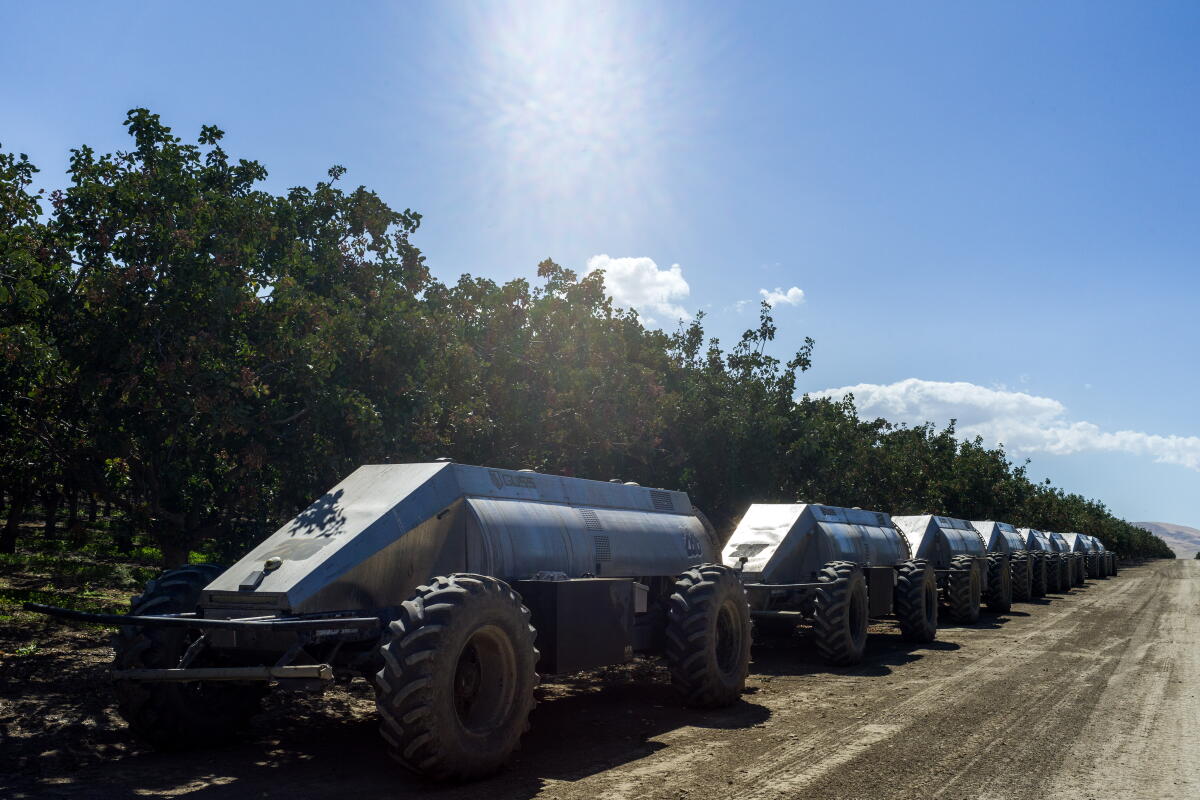
Autonomous tractors, which are used to apply pesticides, line a field in Fresno County. The machines are operated remotely and spray crops including pistachio and almond trees.A scarecrow overlooks a field of corn at La Huerta de Cantua Creek.
Labor and community activists who track pesticide safety issues contend that lenient penalties, as well as warning letters and written notices, fail to deter violators, especially repeat offenders and larger businesses that can absorb the costs of fines.
State records show that warning letters and written notices were issued more than twice as often as penalties, “[raising] serious questions about accountability and deterrence,” said Bianca Lopez, co-founder and project director at Valley Improvement Projects, which monitors pesticide safety in the northern San Joaquin Valley.
The findings come as state officials are proposing to overhaul decades-old pesticide regulations to toughen enforcement and standardize penalties. Those proposals are strongly opposed by groups representing growers, retailers and providers of agricultural services.
Current regulations are enforced by county agricultural commissioners, who police pesticides in their jurisdictions and also promote California’s $61-billion agricultural industry.
In a statement, the California Department of Pesticide Regulation acknowledged the need to improve regulation and ensure it is applied consistently in every county.
Department spokesperson Amy MacPherson said officials are also proposing new regulations that would increase fines for violations that affect people’s health. This can include cases in which toxic chemicals drift into neighboring fields or communities and sicken people.
MacPherson said county agricultural commissioners have discretion in deciding which enforcement tools — warning letters, written notices, fines — to use in a given situation, depending on the “nature and severity of the violation.”
Paola Lopez, who has harvested raisins in the central San Joaquin Valley, supports stronger regulations.
On a Saturday in late September 2025, the 40-year-old mother of four was loading crates of grapes onto a forklift in a Fresno County field. A tractor pulling a pesticide sprayer passed by on a street just a few yards away. She remembers a loud blast — then a toxic spray covered her face and arms.
“It was a little hard for me to breathe, and my eyes started burning a lot,” she said in Spanish, recounting the incident to a reporter. “I could hardly see.”
Disoriented, she called local activist Nayamin Martinez, executive director of the Central California Environmental Justice Network. Lopez had received pesticide safety training from the organization.
Martinez told Lopez to go to a hospital and said she would file a complaint with the Fresno County agricultural commissioner’s office.
“She started vomiting and became dizzy,” the local activist wrote of Lopez in the complaint.
Paola Lopez, 40, harvests raisins in the San Joaquin Valley and cares for her four children when she is not working in the fields. In September 2025, she was exposed to toxic pesticides and required emergency medical treatment. The county agricultural commissioner investigated the incident and found multiple state pesticide safety violations. Above, Lopez at home with two of her children on April 4.
A reporter reviewed copies of safety notices required by federal law that detail the hazardous chemicals that were mixed into the pesticide load that sprayed Lopez.
“Harmful if inhaled,” one notice says. “Causes skin irritation.”
“Danger … Causes serious eye irritation,” a second document adds.
“May cause cancer,” it warns.
California, unlike other states, has a split system of pesticide oversight. The Department of Pesticide Regulation is charged with statewide enforcement and provides guidance and training for 55 county agricultural commissioners, who police their jurisdictions.
State officials do not supervise the agricultural commissioners, who are appointed by and report to their elected boards of supervisors.
In interviews, commissioners lauded California’s enforcement system, saying they think it’s important to have discretion when applying regulations because crops, growing seasons and pesticide use vary from county to county. They said their work has improved safety in the fields.
The flexibility “gives us the ability to closely work with growers and … keep our communities safe,” said Juan Hidalgo, agricultural commissioner for Monterey County, one of the top farming counties in the nation with a gross agricultural production value of $4.8 billion in 2025.
Last year, a Capital & Main investigation found that companies with violations in multiple counties across California were not fined for hundreds of those offenses — many involving worker safety.
In 2023, a federal audit flagged serious pesticide incidents in half a dozen counties and uncovered patchwork oversight by agricultural commissioners. The county regulators interpret pesticide safety laws differently, are not required to justify fines and are not mandated to check a company’s statewide compliance history, the audit found.
The Department of Pesticide Regulation in late 2025 unveiled searchable county and statewide data breakdowns for regulatory actions taken by agricultural commissioners from the start of 2020 through the end of June 2025.
During that period, commissioners took 17,742 regulatory actions for pesticide violations of all types, but only 4,885 resulted in fines or referrals to district attorneys for possible prosecution, according to the data.
The treatment of violators, including repeat offenders and companies cited for serious infractions, varied depending on the county, according to the analysis by Capital & Main, which examined 40,150 state enforcement records detailing investigations, violations and civil penalties from 2018 through early 2024.
In one county, for instance, an agricultural commissioner fined a farmer $2,000 for failing to provide safety training for workers who applied pesticides in fields. In another county, a grower was fined $200 for the same violation.
1
2
1.A farmworker, 43, who is not identified for her safety, picks grapes that will be sold as raisins in southwest Fresno County on Sept. 3. She works from 6 a.m. to 3 p.m. and is paid 36 cents for each paper sheet she fills.2.A grape farm in Fresno County.
Failure to provide pesticide safety training for workers who handle pesticides is one of the most common violations in California, according to state regulators. Such training is crucial for all field workers because pesticides have different safety requirements and can pose serious health risks.
Many farmworkers who were interviewed, including Lopez, who was sprayed in the raisin field, said employers did not provide pesticide safety training.
According to the analysis, more than 240 businesses were cited for at least 1,268 violations in multiple counties across California, but they paid no fines for nearly half of these citations — many involving worker safety.
Labor advocates who have studied pesticide regulation say the oversight gaps and failures to impose stiffer fines underscore the need for more vigilant enforcement. They note that rural and predominantly Latino communities are disproportionately affected.
“We need much stronger and more consistent enforcement to protect workers and communities,” said Anne Katten, director of the Pesticide & Work Health & Safety Project for the California Rural Legal Assistance Foundation.
In June, the Department of Pesticide Regulation unveiled proposed changes to state pesticide regulations. The approval process will take months and has involved public comment; revised rules are expected to be adopted next year, officials said.
To address uneven enforcement, the new rules would require agricultural commissioners to check whether companies were cited for violations in other counties, officials said. Commissioners would also have increased reporting requirements when they don’t impose fines. Minimum levels for penalties would be raised and stiffer fines would be imposed for repeat offenders.
But individual farmers as well as more than a dozen associations that represent growers, agricultural retailers and firms that spray pesticides have voiced opposition to the changes. They argue that current regulations are effective, that agricultural commissioners need flexibility to investigate violations and that more training is needed to help growers understand the rules, according to written comments obtained through California Public Records Act requests.
“A one-size-fits-all enforcement approach fails to account for California’s agricultural diversity,” said a letter sent to state officials in December that was signed by groups such as the California Strawberry Commission and California Agricultural Aircraft Assn.
“Maintaining county-level discretion,” the letter says, “ensures that enforcement decisions reflect on-the-ground realities and local expertise.”
Some supporting the overhaul say it doesn’t go far enough to protect workers and communities.
Violations of reporting requirements, including those involving pesticide spraying near schools, would trigger only minor, optional fines, said Yanely Martinez, an organizer with Safe Ag Safe Schools, which monitors pesticide safety in the Salinas and Pajaro valleys.
In early June, the investigation into the pesticide exposure case involving Paola Lopez was closed.
Officials found five violations, including failure to have an emergency medical plan for workers, failure to protect people and wildlife from pesticide drift and failure to have pesticide safety records on file, according to a copy of the investigative report obtained through a public records request.
The agricultural commissioner’s office referred the case in June to the Fresno County District Attorney’s Office for possible criminal prosecution. As of mid-September, the case was still under review and there was no timeline for a decision regarding potential criminal charges, said Taylor P. Long, spokesperson for the district attorney.
1
2
3
1.Crates stacked at a grape farm in Fresno County.2.Crates of raisins dry in the sun in Caruthers in Fresno County.3.Sweet Harvest Church is surrounded by agricultural fields in an area of Fresno where many low-income families live and work.
If prosecutors reject the case, it would go back to the agricultural commissioner’s office, which would determine the severity of the violations and how much the fines would be, said Mario Reeves, Fresno County’s assistant agricultural commissioner.
Lopez was at her apartment in the prosperous farmland known as the “Raisin Capital of the World” when a reporter told her about the investigation’s findings and the timeframe for penalties.
She expressed frustration that months would pass before anyone is held accountable.
“How many more people will be exposed? … How many more people will get injured?” she said.
Lopez’s medical bills are covered by workers’ compensation insurance, but her health has worsened and her doctor has referred her to specialists who deal with respiratory and nervous system disorders, she said.
She had gone back to the raisin fields days after she was exposed, even though her throat was sore and she was coughing, because she needed the money. “We cannot afford the luxury of just walking away from a job,” she said.
She lasted less than two days before becoming too sick to work. She has not returned.
Lopez is an independent journalist and fellow at the McGraw Center for Business Journalism. Data journalist Cherry Salazar analyzed state pesticide records for this report.
Mark Walter may be selling the Lakers, but the new owners plan to take a money-making page out of the Dodgers’ playbook nonetheless: Dump the ticket brokers and leverage control over the resale market to drive up the cost of a ticket.
As a result, the average price for a Lakers ticket could rise from $217 to $361 within the next two years, the Wall Street Journal reported Friday, citing documents prepared for potential investors.
Thrive Eternal, the sports properties company run by incoming Lakers owner Joshua Kushner, declined to comment because the NBA has not yet approved the sale.
However, the $361 figure was intended to illustrate to potential investors how much incremental ticket revenue the Lakers could gain by booting the brokers, not to signal another immediate and steep price hike, according to a person familiar with the deal but not authorized to comment publicly about it.
In February, under Walter’s ownership, the Lakers announced significant increases in ticket prices for the 2026-27 season. No announcement has been made for seasons beyond then, but the investor presentation provides information on how prices have increased for NBA tickets across the league.
Sports teams often enjoyed long and beneficial relationships with brokers, who bought out blocks of season tickets. That guaranteed the teams with revenue, with brokers benefiting from a markup for popular games but taking the risk that tickets to less popular games would sell at a loss, or not at all.
Over the past decade, the Dodgers and other teams have kicked out the brokers and taken that risk themselves, with the aid of dynamic pricing: the constant raising or lowering of ticket prices based on real-time supply and demand. For the Dodgers, the worst tickets seldom fall to market rate, because the team would rather live with a few empty seats rather than condition fans to hold out for a lower price.
The Dodgers lead the major leagues in attendance, on pace to sell 4 million tickets for the second consecutive season. The Lakers played to 99.8% of capacity last season, according to ESPN. So the calculus is simple for both teams: Sell a $100 ticket to a broker, who would then sell it for $200; or cut out the broker, sell the ticket for $200, and pocket the $100 difference.
Kushner and former Disney Chief Executive Bob Iger agreed last month to buy controlling interest in the Lakers, at a $12.5-billion valuation. The world’s most valuable sports team, according to Sportico: the Dallas Cowboys, at $15.5 billion.
According to the Journal, the Thrive Eternal investor pitch projected that the Lakers could leverage increases in ticket prices, media rights, sponsorships and international growth to generate close to $600 million in annual profit by 2037, when the value of the franchise could reach $30 billion.
Times owner Dr. Patrick Soon-Shiong holds a 4% stake in the Lakers. He is not selling his stake in the Lakers, his attorney told The Times last month, in part because “we believe they are still undervalued.”
The reality star and fashion mogul reveals in the reality series’ Season 8 trailer released Thursday that she has been diagnosed with esophagitis.
“I have something called esophagitism,” Kim tells a stylist in the trailer. The Skims founder is then shown in a hospital bed in a series of clips, one in which it appears she’s being wheeled into a procedure. While it’s unclear who is speaking to Kim, someone off-screen says, “Didn’t your father … isn’t it what he died of?”
If esophagitis is left untreated, there’s a risk of developing Barrett‘s esophagus condition, in which the cells lining the esophagus are damaged from acid reflux, according to Mayo Clinic. The condition raises the risk of cancer that starts in the esophagus, which is called esophageal cancer.
Kim’s dad, famed attorney Robert Kardashian, died in September 2003 at the age of 59. He had been diagnosed with esophageal cancer just months before his death.
“I can’t, it makes me want to cry,” Kim’s mom Kris Jenner says in the trailer, alluding to the frightening diagnosis.
Esophagitis is inflammation of the tissues that line the esophagus, per the Mayo Clinic. The condition can be painful and make swallowing difficult, and it can cause chest pain. While there are a variety of causes for the condition, the trailer does not reveal which has contributed to Kim’s case.
Kim Kardashian in “The Kardashians” in 2022.
(Photo from Hulu)
Treatment for the health issue can vary and depends upon the severity of tissue damage and the cause. Without proper treatment, the lining of the esophagus, which is the tube that carries food and water to your stomach, can be badly damaged. This can lead to more serious health issues including scarring and narrowing of the esophagus, or even tearing in the esophagus.
When detected early, however, the condition is considered treatable.
Fund managers have shifted their primary market worry. Bank of America’s September Global Fund Manager Survey, which polled 170 investors overseeing $470B in assets now ranks a disorderly rise in bond yields as the top tail risk.