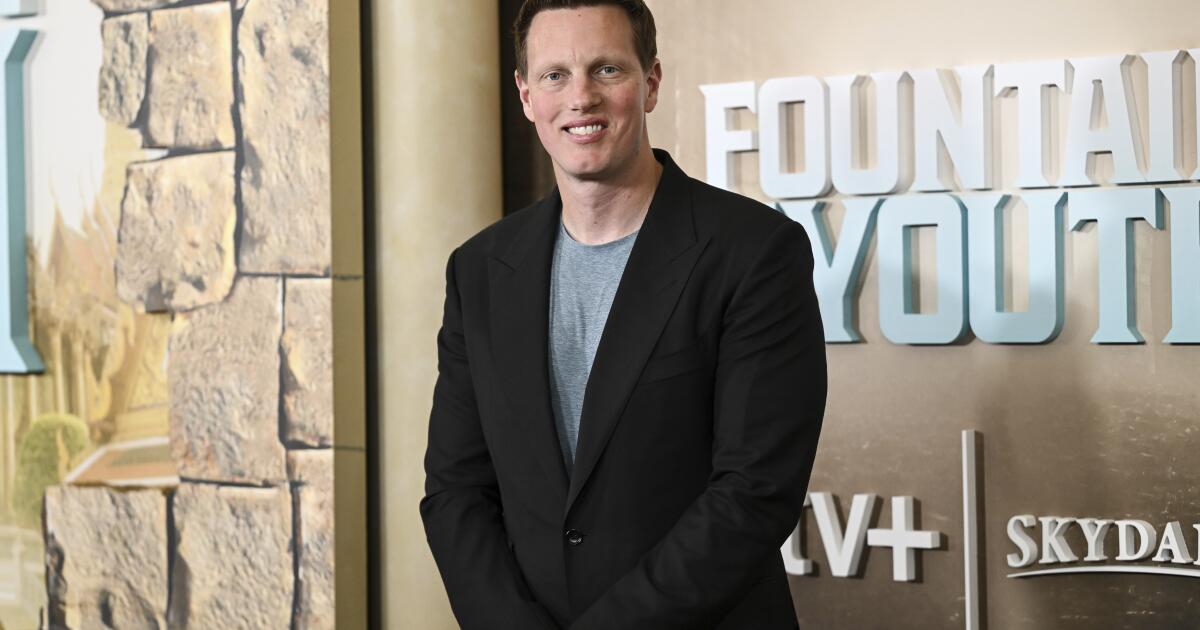
A year ago, David Ellison was viewed as a white knight poised to save Paramount.
Hollywood embraced billionaire Larry Ellison’s son, figuring he had the means and the mettle to revive the faded studio after decades of neglect.
But now, as the 43-year-old tech scion works to close his $111-billion deal to buy Warner Bros. Discovery — which would mark his second major studio acquisition in less than a year — a large swath of Hollywood has soured on the budding mogul and his audacious bid to build a new media colossus.
More than 5,000 artists and industry workers — including J.J. Abrams, Javier Bardem, Lin-Manuel Miranda, Kevin Bacon and Tiffany Haddish — have signed an open letter opposing the union of two century-old studios.
“Our industry is already under severe strain,” the group wrote.
Many anticipate the U.S. Justice Department will rubber-stamp the deal because President Trump is friendly with Larry Ellison, co-founder of software giant Oracle. Trump and his team want David Ellison to make sweeping changes at CNN, one of Warner Bros. Discovery’s premier properties.
David Ellison has spent the last year courting the president and his allies, including hosting a black-tie gala to honor Trump and attending state dinners and the president’s State of the Union address.
Ellison’s perceived coziness with the administration, along with controversial changes at CBS, has sullied his reputation in a town where image is everything.
Should the merger clear its regulatory hurdles, the Ellison family would control CNN and CBS News in addition to holding a significant stake in TikTok, the hugely influential social media app.
“When power is concentrated in fewer and fewer hands, the stories that get told and the livelihoods of the people who tell them become hostage to whoever that power serves,” Jane Fonda, the Oscar-winning actor who is helping lead the opposition, told The Times. “We are not going quietly.”
Paramount declined to comment. Ellison previously has pushed back on fears that Paramount’s takeover of Warner Bros. would be bad for Hollywood. Instead, Ellison envisions building a stronger company to boost the industry, including movie theaters.
If the Warner Bros. Discovery deal is finalized, Ellison would control two legendary news organizations and two iconic studios. His determined White House outreach to speed approval of the Warner Bros. deal has aroused deep suspicion among many in Hollywood, which has long been considered a liberal bastion.
“They got too close to Trump,” said Norm Eisen, executive chairman of Democracy Defenders Fund, one of the groups coordinating the opposition campaign. “People in Hollywood are concerned that the Ellisons are going to do to CNN what they did to CBS.”
One of Ellison’s first moves after taking over Paramount was to hire journalist Bari Weiss, who had no TV news experience, as CBS News editor-in-chief. Weiss, who built her reputation being a contrarian voice, along with her recently installed evening news anchor Tony Dokoupil got off to a rocky start.
During his inaugural week, Dokoupil awkwardly saluted Secretary of State Marco Rubio (a fellow Floridian). “CBS Evening News” viewership fell 9% this season. The program, which attracts 4.1 million viewers, musters less than half the audience for ABC’s “World News Tonight with David Muir.”
Ellison is aiming to get his deal done by September.
“The projected merger timeline would have Ellison in control of CNN before November,” Fonda said, noting the high stakes this fall because the midterm elections will decide control of Congress.
“If this merger goes ahead, the administration will have yet another lever to cast doubt on results it does not like,” Fonda said. “This is about corruption, not optics.”
Her group has urged California Atty. Gen. Rob Bonta to file a lawsuit to try to block the merger. Bonta has said his team is reviewing potential antitrust concerns with the deal, which he said has “red flags everywhere.”
Some in Hollywood favor Ellison’s takeover, saying it would lift two middling players to create more robust competition to Netflix, Disney and Amazon.
“This deal will set up an environment where we will have four competitive streaming services, and that’s a good thing for the creative community,” said Ari Emanuel, executive chairman of WME Group and Ellison’s agent.
Ellison is pressing ahead, working to secure government approvals in Britain, Europe and the U.S. Prominent Democrats in Congress have decried the deal and Ellison’s proposed ownership structure, which would include the royal families of Saudi Arabia, Qatar and Abu Dhabi as significant, but passive, investors.
Paramount leaders have tried to keep their heads down by focusing on their businesses. This year, the company has signed deals with Kim Kardashian, Neil Patrick Harris, Tituss Burgess and Kinetic Content, the reality TV firm behind Netflix’s “Love Is Blind.”
Hollywood opposition
But the “block the merger” campaign has picked up prominent Paramount and Warner Bros. talent, including Oscar-winning filmmaker Adam McKay (“The Big Short”); “South Park” co-creator Trey Parker; and Emmy Award-winning actors Noah Wyle (“The Pitt”) and Mark Ruffalo, a stalwart of critically acclaimed HBO productions, including “Task.”
Some filmmakers have privately discussed whether to steer clear of Paramount, according to people knowledgeable of the discussions who were not authorized to comment. Taylor Sheridan, the prolific producer behind “Yellowstone” and “Landman,” last fall opted to switch teams. He eventually will make new shows for NBCUniversal instead of Paramount.
CBS late-night host Stephen Colbert’s sign-off Thursday night has added to the hand-wringing.
Colbert learned he was getting the boot in July, two days after he called Paramount’s $16-million settlement with Trump “a big fat bribe” during a show monologue. Paramount had agreed to pay the money to end Trump’s lawsuit over edits to a “60 Minutes” interview, a payout blasted by 1st Amendment advocates who viewed the Trump suit as frivolous.
Paramount settled because it needed Federal Communications Commission approval as part of its sale to the Ellison-owned Skydance Media. Paramount’s CBS has blamed declining revenues for its decision to oust Colbert, which came just before Ellison officially took the keys to Paramount.
This week, for the first time in 18 years, CBS will fall short of claiming the largest live audience in broadcast TV. NBC snagged the ratings crown, thanks to its sports-heavy lineup, prompting NBC late-night comedian Seth Meyers to crow about his network’s victory.
“We have taken down CBS,” Meyers told advertising buyers last week in New York. “Well, the Ellisons did, but I like to think we helped.”
Ellison’s supporters view the anti-merger campaign as politically motivated.
“So much of the criticism and negative sentiment originates from [Ellison’s] apparent relationship with Trump,” said one observer who was not authorized to speak publicly about the topic.
But interviews with numerous industry insiders reveal that concerns over Paramount’s proposed purchase of Warner go well beyond anti-Trump sentiment — or worries about CNN’s future.
The merger comes during an existential crisis for the industry, and for Los Angeles, as the shift to streaming has upended established business models.
“Whether it’s Ellison, Amazon, Apple or Netflix, these are essentially tech companies that are gaining increasing control over what has been a cultural and entertainment sector,” said Dominic Asmall Willsdon, executive director of the International Documentary Assn.
Amazon founder Jeff Bezos and Apple’s outgoing Chief Executive Tim Cook also have openly embraced Trump, which some see as a pragmatic move to curry favor in Washington to advance their sprawling businesses, which include film and TV operations in Culver City.
Much of the angst over the Ellison deal is driven by economic uncertainty. L.A.’s film industry has been decimated by a flight of production to other locations.
“L.A. has already had a taste of things to come,” Eisen said. “There’s less competition so the artists get hurt, and so do the working people who have long been an integral part of Hollywood.”
A combined Warner-Paramount would instantly become the largest employer for union writers, said Michele Mulroney, president of the Writers Guild of America West. It would control HBO, CBS, CNN, Comedy Central, HGTV, Animal Planet and two of the largest film and television studios.
“This media behemoth would have enormous leverage to reduce content, raise prices, increase control of production, suppress our members’ compensation and silence the voices of our members,” Mulroney said.
Jessica J. González, the L.A.-based co-chief executive of the 1st Amendment group Free Press, said: “This isn’t just about David Ellison. It’s about what David Ellison did with his last merger and how he uses his power.”
Ellison’s wealth and privilege have also fueled resentment among the rank and file who are struggling amid America’s growing economic disparity. Said one veteran executive: “We’re living in a new gilded age.”
For many, the prospect of more job losses is most unsettling.
Ellison and his team have vowed to make $6 billion in cuts following the merger. Those cuts are expected to include sizable layoffs on top of nearly 2,000 in job cuts at Paramount since last fall.
Hollywood has a troubled track record with mergers, including two failed takeovers of Warner Bros.
AT&T misfired with its 2018 acquisition of Time Warner, and within four years, the phone company had unloaded the firm to David Zaslav’s smaller Discovery. That transaction saddled Warner with more than $50 billion in debt, and Zaslav and his team laid off thousands of workers and cut dozens of projects to dramatically reduce the company’s debt and keep the company solvent.
Walt Disney Co.’s $72-billion acquisition of much of Rupert Murdoch’s 21st Century Fox in 2019 led to thousands of layoffs as one of the industry’s original studios all but disappeared.
“We have seen from that merger the earnings and employment numbers for screenwriters significantly reduced,” Mulroney said.
Emanuel, the power agent, pointed to Ellison’s commitment to keep the Warner and Paramount studios largely intact, with each entity releasing about 15 films into theaters each year.
“He’s going to be making a minimum of 30 movies a year for theatrical release plus content for both their own and other platforms because that’s the only way to generate revenue,” Emanuel said.
Still, critics question whether Ellison will be able to keep his commitment due to the $79-billion debt load he will take on.
“I’m sure [Ellison’s] intentions are genuine,” Mulroney said. “But a promise like that’s not enforceable, and there are no consequences if you don’t meet the quota that you’ve set for yourself.”
On Wednesday, S&P Global Ratings agency said Paramount Skydance will remain on a negative credit watch due to balance sheet concerns.
S&P also cited worries about Ellison’s prospects “given the immensely complicated endeavor of combining two of the largest global media companies and the limited track record of PSKY’s management team in integrating and transforming such companies.”
Emanuel and others say Ellison’s image won’t suffer long-term damage.
The two sides, he predicts, will eventually work together.
“Here’s a guy who’s willing to put a lot of money on the line and take huge risks to make our environment more competitive,” Emanuel said. “The one thing about David is that he’s not a vindictive person. He always does what’s best for the project.”