SACRAMENTO — Look, Xavier Becerra could cruise to a South Pacific island and bask on the beach until election day and Californians would still choose him as their next governor.
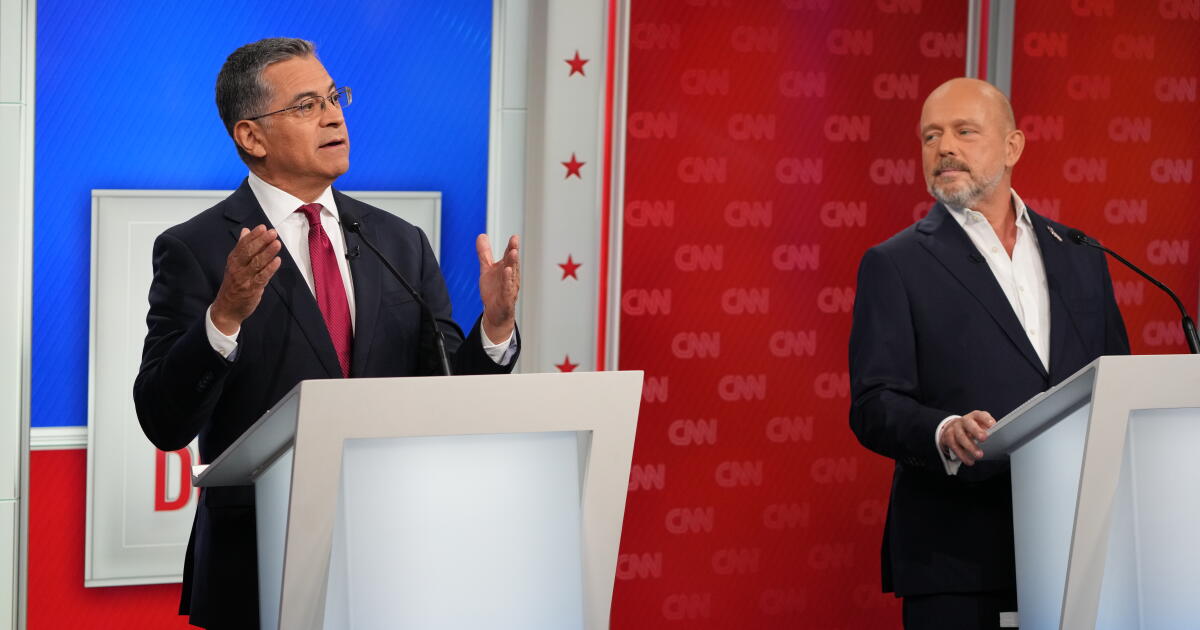
Who won the debate? Becerra, because he came across as calm, collected and capable of governing this troubled state — certainly very few voters’ ideal candidate, but the only real choice for most Californians.
Moreover, Hilton’s only previous political experience was as an advisor to a British prime minister and his sole claim to U.S. notoriety was as a Fox News TV host–not exactly resume boosters in California.
He’s a shoo-in simply because he has a “D” beside his name in this state where Democrats outnumber Republicans nearly 2-to-1 and despise the GOP president.
Expert columnists cover the insights, legislation, players and politics you need to know.
By continuing, you agree to our Terms of Service, which include arbitration and a class action waiver. You agree that we and our third-party vendors may collect and use your information, including through cookies, pixels and similar technologies, for the purposes set forth in our Privacy Policy such as personalizing your experience and ads.
“You’re the candidate who is supported by the machine in Sacramento — the unions, big business, all these people that for 16 years have given us the highest cost of living in the country, made it impossible to build anything, given us the highest unemployment rate, the highest poverty rate….
“And that’s why we’ve got to try something different this time instead of voting for more of the same.”
OK, fair point. But try what exactly? That’s where Hilton stalls or veers erratically.
He’d build “10 new cities.” Build them where exactly? He doesn’t say.
He definitely doesn’t want to construct new apartment buildings in the suburbs “when we have got so much space that we could be building on in California.”
Like out in Southern California deserts or Central Valley farm fields — requiring two-hour commutes to urban jobs?
And where does the water come from for these 10 new cities as the West scrambles for what’s left of diminishing supplies? But unfortunately there was no discussion of that during the debate.
One debate exchange that caught my attention was about vaccines. Hilton seemed to be carrying the torch for whacko anti-vaxxer Robert F. Kennedy Jr., Becerra’s successor as U.S. health secretary in the Trump administration.
Debate co-moderator Dana Bash recalled what Hilton said previously about children’s vaccinations: “The government should have nothing to do with these fundamental and vital decisions.” And she asked whether he’d push to eliminate California’s vaccine requirements.
“No,” Hilton replied. “I’m pro vaccine.” But then he seemed to wander all over the stage looking to have it both ways.
It’s a “very, very emotional issue for a lot of parents,” he said, adding there’s “data around the world” showing that where vaccine “mandates are lower… you actually have higher [vaccination] compliance, where parents don’t feel that they’re being bullied into doing something that they don’t want to do. And that’s what I want to see here.”
But he ultimately said,“I’d follow the law.”
In California, the law requires all children without medical exemptions to be vaccinated for several diseases — including polio, measles, mumps, chickenpox, hepatitis B and whooping cough — before they’re admitted to school.
That’s a blessing. When I grew up, practically every kid at some point was bedridden with one or more of those dangerous ailments. Then some saviors invented vaccines.
“We had nearly eradicated measles,” Becerra said, responding to Hilton. “When I left HHS, you rarely heard of a case of measles…. Today, children are dying of measles. Today, the spread of measles has reached a proportion we haven’t seen since the 1960s.
“That’s what happens when vaccine deniers take over.”
Becerra achieved all he needed to in the debate. He didn’t screw up. He kept cool and actually was fairly quick on his feet in replying to Hilton’s attacks, while planting a MAGA hat firmly on the Republican’s head.
He missed an opportunity to accomplish more, however — like making Californians feel really good about voting for him, rather than merely because he’s the only Democrat left standing in the contest to replace the termed out Gov. Gavin Newsom.
Voters might like to hear what Becerra’s vision is — if he has one — for the California he wants to build.
What does he have in mind besides just defending California against Trump? That’s a given. How’s he going to lower our living costs? Upgrade public education? Prevent wildfires? Details, not platitudes.
Rather than relaxing on his lead, Becerra should be constantly moving around the state, introducing himself to Californians and — more importantly — listening to their problems and ideas. To his credit, he’s doing that this week.
“The debate was boring and uneventful, but Becerra won it,” says Republican consultant Rob Stutzman. “He is perfectly vanilla and that makes it really hard to pin him down in an attack.”
“We got the genuine Xavier Becerra. That’s exactly who he is,” says veteran Democratic strategist Garry Sragow, a longtime political ally. “Thoughtful, committed and very decent, but does not go very high on the charisma meter.”
In California right now, a candidate’s charisma rates much lower than a simple “D.”
Michael Harris II shouldn’t have been 90 feet away from scoring the go-ahead run in the first place.
But he was, after Teoscar Hernández took a bad route to his line-drive triple. Then, to make matters worse, Dodgers left-hander Kris Bubic lost control of a sweeper. It flew high and outside, off the end of catcher Will Smith’s glove and to the edge of the grass behind home plate.
Harris scored standing up. And the Dodgers handed the lead back to the Atlanta Braves.
The Dodgers had every advantage heading into Game 2 of the National League Division Series against the Braves. In a 3-2 loss to even the series at one win apiece, they gave away every edge they had.
“The advantage for us is we have an opportunity to not let their pitching staff come up for air,” manager Dave Roberts said this week, when asked about how taxed the Braves pitching staff was coming out of their wild-card series. “… We have an opportunity to really expose them if we take the right at-bats and the right approach.”
Braves left-hander Ray Kerr, who excelled out of the Braves bullpen down the stretch as a long reliever, served as the opener Sunday, in the Braves’ second straight bullpen game this series and third overall. And for the second straight day, the Dodgers failed to score against the Braves opener or even run up his pitch count to get him out of the game early.
The Dodgers managed just two hits off Kerr, each to open an inning. Freddie Freeman lined a single into right field to kick off the second inning. And Miguel Rojas sent a double into the left-field corner to begin the third.
The Dodgers stranded both.
The failure to bring in Rojas was especially egregious. Tommy Edman popped up a bunt immediately after. Then Mookie Betts, the Dodgers’ only other baserunner before Kerr handed over the ball with two outs in the third inning, drew a four-pitch walk. Shohei Ohtani came up to the plate with two runners on and popped up a high cutter on a full count. He was the last batter Kerr faced.
So, the Dodgers offense let the Braves come up for air. And Dodgers left-handed starter Blake Snell’s short start forfeited their starting pitching advantage Sunday.
His first inning could have been a bigger blow. With one out, Snell gave up a single to Ronald Acuña Jr. and then walked Matt Olson and Ozzie Albies to load the bases. He escaped with just one run scored, on a grounder up the middle from Mauricio Dubón. Betts made a diving stop but had no chance at throwing out Dubón at first.
Snell then struck out Sean Murphy to end the inning, finishing the at-bat with three straight curveballs for strikes.
The one-run deficit could be erased. But the damage on his pitch count, up to 27 in that first inning, was done.
Snell surrendered just one more hit, but when he issued his fifth walk of the game, with two outs in the fourth inning, his pitch count was already up to 90 pitches. Roberts strode from the dugout to pull him from the game. Snell had lasted just one inning longer than the Braves’ opener.
In the bottom half of the inning, Freeman, who was optimistic that he could shake off his September slump over the bye week, tied up the game with a solo homer. But in the fifth, the Dodgers handed the lead right back to the Braves.
With two outs, in an 0-2 count, Bubic got Harris to chase an outside sweeper moving away from him. Harris leaned over to get his bat out to it and send a line drive into the left field corner.
Hernández took a circuitous route to the ball, trying to cut it off and then having to adjust back when it became clear he was too shallow. He still only missed the ball by inches, and it carromed off the wall, allowing Harris to reach third base, in position to score on a wild pitch.
The Braves expanded their lead in the seventh inning against Dodgers hard-throwing right-hander Edgardo Henriquez, who gave up a single to Olson and an RBI double to Harris.
Then right-hander Roki Sasaki got himself into a bases-loaded situation in the eighth, with Ronald Acuña Jr. at the plate, but got out of it with a double play. Sasaki then retired the side in order in the ninth.
By contrast, the Dodgers offense barely threatened in the late innings. The Braves relievers retired 15 of the last 16 batters they faced to end the game, with Max Muncy’s solo home run in the ninth the only exception.
Rookie Josue De Paula made his psotseason debut as a pinch hitter, with two outs in the ninth. But he popped up in foul territory to end the game.
Next, the series heads to Atlanta, where the Braves will have home-field advantage for two games.
There are few people, if any, who’ve tracked U.S. elections for longer or in greater depth than Charlie Cook.
Ever since 1984, when he started his eponymous political newsletter, Cook and his stellar crew of nonpartisan analysts have plumbed many thousands of races — for president, Congress, governor — following the money, sussing out the candidates, watching their ads and assaying the campaign landscape at a granular level.
What’s unusual, Cook suggested, is the prospect of big Democratic gains when Republicans started out this election season with so many advantages. (And that was before the GOP set off on a gerrymandering jag at Trump’s behest.)
Roughly two-thirds of the Senate seats up in November are in states Trump carried in 2024. Five of the seven toss-up races are in states Trump won, several by double digits.
On the House side, Republicans maintain control by an exceedingly narrow margin, meaning there aren’t a lot of low-hanging districts for Democrats to aim for. As Cook rightly noted, “A party cannot lose a seat they don’t have.”
We’ll get to predictions in a moment. (Patience, dear reader.)
First, let’s hear from Nathan Gonzales, another longtime election handicapper. He’s been tracking political contests nationwide for more than 25 years and edits and publishes Inside Elections — formerly the Rothenberg Political Report — another nonpartisan field guide to campaigns. Like Cook, he traffics in clear-eyed, dispassionate analysis, not partisan wish-casting or political spin.
A detail of the exhibit in the Epstein Files Bookmobile during a campaign stop for Democratic House candidate Bob Brooks at the United Steelworkers of America office in Bethlehem, Pa. Brooks is challenging Republican incumbent Ryan Mackenzie (R-Pa.) in Pennsylvania’s highly competitive 7th Congressional District in the upcoming midterm election.
(Alex Wong / Getty Images)
Trump’s performance — his approval rating is flirting with record lows — “has inspired Democrats, turned off independents and created a group of apathetic Republicans,” Gonzales said, “and those are the ingredients for a good or great Democratic year.”
He noted Democrats don’t need a big wave to seize control of the House. A pickup of just three seats would flip the House, marking the seventh straight midterm election in which one chamber or the other changed partisan hands.
(For the record, there is no authoritative definition of a wave election, though it’s generally agreed the term applies to an election in which one party or the other gains a large and lopsided number of House and Senate seats.)
It’s beginning to feel a lot like 2006, Gonzales said.
Gonzales and his team of experts believe the House is most likely gone for Republicans, forecasting a Democratic gain of seven to 15 seats, unless the bottom falls out for the GOP and their losses climb much higher.
In the Senate, where Democrats need to pick up four seats to take control, Gonzales sees the chamber teetering on a knife’s edge, forecasting a Democratic gain of three to five seats.
“It’s too late to fundamentally change the trajectory of this election,” Gonzales said. “But if Republicans can boost Republican turnout, it might be enough to save the Senate.”
For his part, Cook agrees that Mike Johnson may be nearing the end of his speakership. The best-case scenario for the GOP would be keeping its losses to 25 House seats or less, Cook said, which is right around the average for midterm elections going back well over half a century.
“It starts getting into eyebrow-raising territory if it gets north of 35,” Cook said, “because that shouldn’t be possible with the few competitive districts we have now.”
As for the Senate, he suggested the best Republicans can hope for is a net loss of two seats, keeping the GOP barely in control. (A loss of three would mean a 50-50 split, leaving Vice President JD Vance poised to be the tiebreaker on close votes — and wouldn’t he love having to drop off the 2028 campaign trail to be on hand, just in case.)
Of course, there’s still an election to be held, votes to be cast and ballots to be counted.
House Speaker Mike Johnson plans to visit California on Wednesday to stump and fundraise for Republican candidates in a state that could determine control of the U.S. House of Representatives during President Trump’s final two years in office.
Johnson (R-La.) plans to visit the Central Valley and the Inland Empire, a sign of the importance of California congressional contests in the November midterm election.
David Wasserman, a congressional forecaster for the nonpartisan Cook Political Report, said that Johnson is attempting to mitigate the aftermath of Proposition 50, the redrawing of California’s congressional districts that voters approved in November in response to Trump’s efforts to tilt districts in his favor elsewhere in the nation, notably Texas.
“If it weren’t for Republican efforts to redraw Texas, Proposition 50 wouldn’t have seen the light of day,” said Wasserman, who predicts Democrats will win control of the House, and said that Republicans would have a better chance at holding more seats if they hadn’t prompted the redistricting fight.
Redrawing congressional districts typically happens once a decade after the U.S. Census, and in California, voters in 2010 decided to hand the power of crafting the state’s districts to an independent commission. After Trump pushed Texas to redraw its congressional boundaries to increase GOP representation in Congress last year, California Democrats responded by persuading voters to reshape its districts to favor Democrats, who already dominate the state’s 52-member congressional delegation.
“California Republicans are on the verge of extinction because of the White House action,” Wasserman said.
In Chowchilla, Johnson is scheduled to hold a fundraiser and a rally in support of former Stockton Mayor Kevin Lincoln, who is trying to topple Rep. Adam Gray (D-Merced) in one of the most competitive congressional races in the nation. He is expected to be joined by Republican National Committee chairman Joe Gruters, California Republican Party Chair Corrin Rankin and Congress members from Texas and Michigan.
He is also holding a get-out-the-vote event in support of Rep. David Valadao (R-Hanford), a longtime Democratic target given the voter makeup of his Central Valley district. Johnson is also holding an evening fundraiser in Riverside for Jim Desmond, a member of the San Diego County Board of Supervisors who is running in the district being vacated by longtime Rep. Darrell Issa (R-Vista).
Issa decided to retire after his congressional district was redrawn because of Proposition 50. He has endorsed Desmond to represent the new district, which spans San Diego and Riverside counties.
The California trip is part of Johnson’s plans to campaign in 22 states in an effort to help Republicans retain control of the House before the Nov. 3 election.
Despite California’s sapphire tilt — registered Democratic voters outnumber Republicans nearly two-to-one — the state’s residents are often the largest donors to politicians on both sides of the aisle. Democrats headed here in coming days include gubernatorial candidates Amy Acton of Ohio, Deb Haaland of New Mexico and Gina Hinojosa of Texas.
Trump sent followers a fundraising appeal Tuesday focused on Democrats’ ability to win control of Congress, which would upend his agenda during his final two years in office.
“I’ve never asked for sympathy. I’ve never asked this country to feel sorry for me. I’ve never asked for anything,” he said in the email. “That changes today. With less than 45 days until midterm elections, the left is ready to put the final nail in my coffin.”
Christian Martinez, a spokesman for the National Republican Congressional Committee, pointed to the pivotal role California will play in determining control of Congress.
“California’s House races will decide whether working families keep fighters like David Valadao, James Gallagher, Kevin Lincoln, and Jim Desmond or get more of the same from Democrats who raised costs, left the border wide open, and made communities less safe,” Martinez said. “Californians are done paying more, waiting longer, and living with less safety so corrupt Sacramento and Washington Democrats can protect their socialist agenda.”
Anna Elsasser, a spokesperson for the Democratic Congressional Campaign Committee, shot back that the policies and beliefs of Desmond, Lincoln and Valadao have deeply harmed California families, including high gas prices and the cost of living.
“That’s why Mike Johnson is swooping in to try and save their fledgling campaigns. Voters won’t forget who sold them out to hand massive tax breaks to billionaires and wealthy corporations by gutting health care and food assistance, championing chaotic tariffs, and refusing to rein in a costly war that has sent gas prices soaring,” she said. “Californians are ready for change, not another two years of Mike Johnson and DC Republicans’ status quo.”
IF YOU are due to head to or from Italy today you might want to check your flight as strikes across the country have seen huge cancellations.
Strike action is set to take place across Italy today between 1pm and 5pm with ENAV – the company that runs Italian air traffic control – walking out at all 33 Italian airports.
A number of major Italian airports including Milan are set to be impactedCredit: Alamy
The main airports expected to be affected include Rome, Naples, Milan and Venice.
Flights cancelled today already include:
Sign up for the Travel newsletter
Thank you!
10:15am British Airways flight to Milan from London Heathrow
3:25pm British Airways flight to London Heathrow from Milan
11:50am British Airways flight to Venice from London Heathrow
5:20pm British Airways flight to London Heathrow from Venice
1:25pm British Airways flight to Milan from London City
2:25pm British Airways flight to London City from Florence
5:50pm British Airways flight to London City from Milan
3:50pm Ryanair flight to Bologna from London Luton
Currently, flights to Italy from London Heathrow and London Gatwick state they are scheduled as planned, though this may change.
ITA Airways has already warned that 29 per cent of its scheduled flights are cancelled today.
Passengers are being advised to check their flight status with their airline and airport before travelling.
If you are due to fly this morning between 7am and 10am or this evening between 6pm and 9pm then your flight is guaranteed to go ahead as normal, under Italian law.
If you are able to move your flight, then it might be worth doing this to avoid disruption.
Airlines are advising passengers to check their flight status ahead of travelling to the airportCredit: Alamy
Unfortunately though, if your flight is delayed or cancelled you won’t get any compensation as a strike is deemed to be outside of the airline’s control.
But airlines do have a duty of care so should provide you with food and water and if necessary, accommodation overnight.
There is also set to be a strike on October 16 in Italy, lasting 24 hours – but this time it will be easyJet flight crew walking out.
Fatalities reached 3,901 across the DRC as health workers battle community anger and a vaccine-resistant strain.
Published On 28 Sep 202628 Sep 2026
The Democratic Republic of the Congo (DRC) has recorded over 8,000 cases of Ebola, including almost 4,000 deaths, amid the worst outbreak in the country’s history, according to government data.
The latest report, published on Monday by the DRC’s public health institute, put the number of cases at 8,067 and deaths at 3,901, representing a fatality rate of 48.4 percent.
Recommended Stories
list of 4 itemsend of list
People’s mistrust and anger towards government policies have become a major obstacle in limiting the outbreak since it was officially declared on May 15. A senior member of the ruling UDPS party was beaten to death after raising awareness about the epidemic on radio, a party representative said on Monday. The killing happened on Sunday in Butembo in North Kivu province, which has become a hotspot in the ongoing Ebola outbreak.
The number of cases has levelled off after a rapid increase, according to the African Union’s health agency, Africa CDC, though it still considers the outbreak “not under control”.
Several treatments and vaccines are being trialled against the Bundibugyo strain of the Ebola virus, for which there is no approved vaccine or treatment.
The current outbreak, which is the DRC’s 17th, has spread rapidly. Experts say that weak health infrastructure, the region’s remoteness and ongoing conflict near the DRC’s borders with South Sudan, Uganda and Rwanda have damaged efforts to respond to cases quickly and effectively.
Those issues have also hindered the government’s efforts to fight the outbreak, increasing public mistrust and anger towards its suggested prevention measures.
Marie-Celestin Karondwa, acting president of the UDPS party’s federal executive committee in Butembo, was attacked by local residents after appearing on a radio show where he discussed Ebola prevention measures, according to the Congolese health authorities.
In their latest case report, authorities highlighted a “low capacity” to treat cases at health centres in Ituri province and described a “complete shortage” of stocks of an experimental vaccine against the Bundibugyo strain in the northeastern province of Tshopo, where cases have been recorded.
The World Health Organization has said the outbreak is “far from over” and on track to surpass the regional 2014-2016 West Africa Ebola outbreak. It killed more than 11,000 people, primarily in Guinea, Liberia and Sierra Leone.
The United States announced last week that it was releasing a further $267 million to help fight Ebola. It is hoping for pledges from other countries to meet a target of $2 billion to fight the disease, mainly found in the DRC.
He told me he had sent his children to a displacement camp because they could no longer cope with the shelling and gunfire. He had stayed with his wife and sisters to look after their animals.
“I am terrified,” he said, “but I have no choice, we will all go hungry without our animals and die anyway.”
He gave only his first name, fearful of repercussions if the Houthis take over the area in the days ahead. Contacts from the Houthi side have told us they are consolidating troops, preparing for a major offensive. When we asked government forces about this they said they are aware and were preparing too.
At the closest checkpoint to the front line, we met some fighters who had just returned from positions high on the mountain, just a few hundred metres from advancing Houthis. One of them said the bodies of 18 government soldiers lay in an area his unit could fire across but not reach.
“We shoot over them, but we can’t pull them out,” he said.
Fighting around Taiz has intensified since the Houthis seized the strategic Red Sea port of Mokha, 85km to the west of the city, on 10 September, after a ceasefire that had largely held for four years unravelled.
The group took control of a swathe of territory overlooking the strategic Bab al-Mandab Strait – a crucial shipping corridor linking Europe and Asia. This contributed to a rise in oil prices as fears rose of further disruption to supplies from the region.
Manchester City‘s legal fight with the Premier League has the potential to “spiral out of control”, a former top club executive has warned.
Christian Purslow, a former Liverpool managing director and Aston Villa chief executive, who also held a senior role at Chelsea, said the case could begin a chain of events that would be “appalling for the game”.
City have been found guilty of the vast majority of 115 charges brought forward by the Premier League.
The club were accused of a wide range of rule breaches which centred around claims that they inflated sponsorship revenue from connected companies and made other “off the books” payments to circumvent football’s financial rules.
Premier League clubs are seeking legal advice about compensation relating to the charges, while BBC Sport has been told that City will appeal.
Sanctions on the club are yet to be announced, but repercussions could include a points deduction, expulsion from the Premier League or a huge fine.
Speaking on Radio 4’s Today programme, Purslow appeared alongside football law expert Paul Gilroy KC, who described the case as a “seismic moment for world football”.
Purslow said: “It’s a sort of ‘where does this end?’ because if you look at every single season – the nine seasons which we now know Manchester City breached rules – then all of their 19 Premier League rivals in that season, to differing extents, suffered easy-to-compute loss. Whether it was a place in the Premier League – every place was worth £3m.
“Teams that came fifth who didn’t make the Champions League maybe lost tens of millions of pounds – and of course teams that were relegated. Let’s say the team that finished 18th would’ve finished 17th if Manchester City weren’t there. And they, of course, suffered huge loss.
“If you add all those claims up, over nine years, and that’s just in the Premier League, you can see that the potential here for this to spiral out of control is huge.
“I really hope that common sense prevails here and that there is a comprehensive solution between the authorities and Manchester City that looks at all these issues and tries to draw a line in the sand.
“Because a never-ending waterfall of legal claims and uncertainties for another four or five years would be absolutely appalling for the game.”
Gilroy added that, so far, four clubs have put in protective claims “reserving the right to claim compensation if City are found guilty”.
WASHINGTON — China’s president issued a call from the White House on Thursday for artificial intelligence to remain “under human control” as the world’s two superpowers race for technological supremacy.
Xi Jinping’s remarks reflect growing concern within China over whether governments in Washington or Beijing will be able to contain a technology with potentially transformative capabilities, according to a U.S. official.
Lawmakers and AI industry leaders urged President Trump to use his summit with Xi this week to pursue a safety framework for AI, which researchers warn could soon surpass human understanding.
But Trump preempted the meeting with a post on social media stating he had no intention of negotiating limits on AI development.
“A big day with President Xi of China,” Trump wrote. “Super Intelligence (SI) will be a big topic of discussion, but I want to leave it exactly where it is. That is China’s position also. Our guardrail is the DOJ!”
After offering Xi a lavish welcome on the White House grounds, Trump made a passing reference to AI. “The decisions we make in these areas today can promote peace and prosperity for decades and decades to come,” he said.
But Xi gestured to substantial concerns, noting AI first among priorities to discuss between the two nations.
“Both China and the United States are leading nations in artificial intelligence,” Xi said. “We have both the capability and responsibility to develop and manage AI for good — and ensure that the development of AI is always under human control, and serves the well-being of the people.”
The two held a private meeting with aides in the Oval Office after participating in a military review in the Rose Garden and exchanging gifts in the Blue Room.
In the evening, a guest list of top banking and technology leaders — including AI industry executives — were scheduled to attend a state dinner in the East Room of the White House.
“Given Trump’s statements going into the summit about not wanting guardrails, I have tepid expectations about tangible outcomes” on AI, said Aalok Mehta, director of the Wadhwani AI Center at the Center for Strategic and International Studies.
“The most likely scenario seems to be the establishment of a hotline — though how useful that will be depends on who will be staffing it, and how much each government prioritizes it,” Mehta added, “and likely some discussions about issues blocking cooperation, like distillation, with a promise to engage in ongoing dialogue.”
Earlier in the week, on the sidelines of the United Nations General Assembly in New York, Treasury Secretary Scott Bessent met with his Chinese counterpart primarily to discuss AI development, according to U.S. officials.
“What we discussed was setting up a mechanism — so it’s going to be called the U.S.-China AI Dialogue. We’ve agreed to meet again,” Bessent said Monday. “The U.S. has proposed that we have a notification mechanism between the two countries, and we want a shared vision of common goals, and common threats.”
While Trump’s team has remained divided over whether — and how extensively — to regulate AI, Bessent has favored a cautious approach, advocating modest, voluntary guardrails that have shaped administration policy in recent months.
China, too, has shown increasing willingness to open channels of communication on AI, despite deep distrust between the two sides.
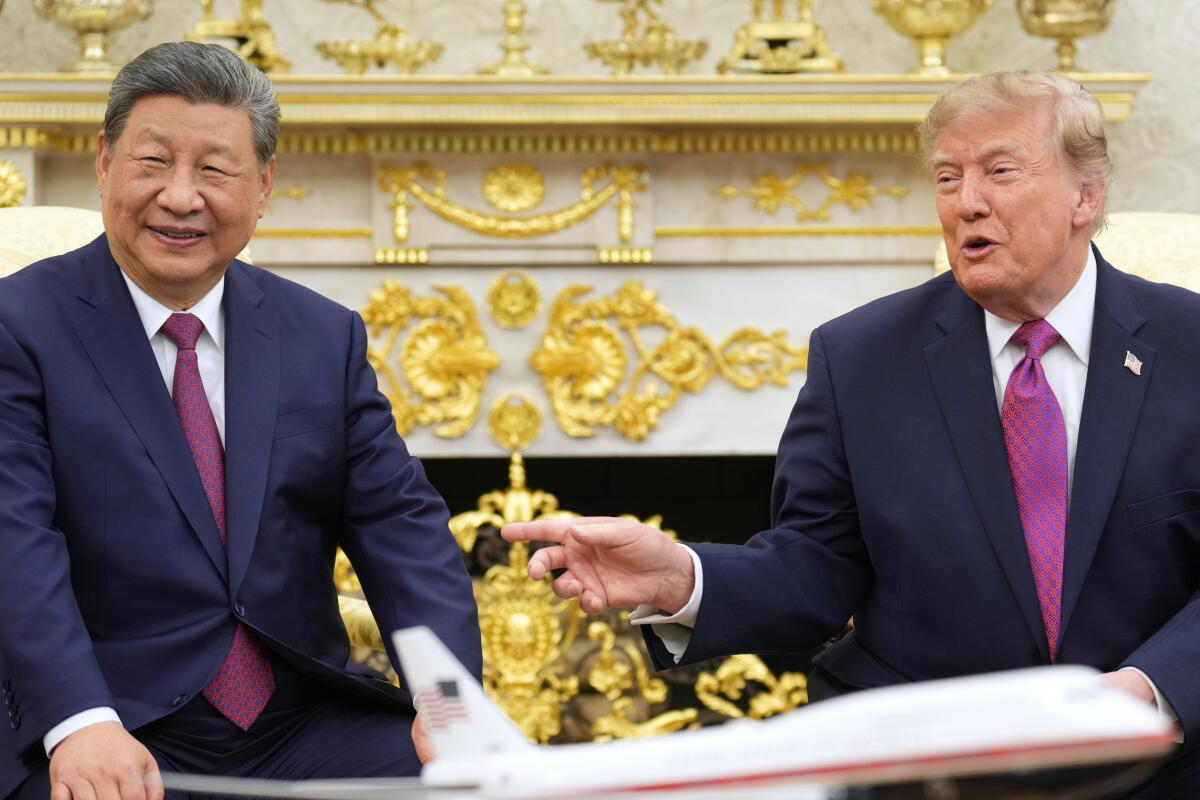
President Trump and China’s President Xi Jinping meet in the Oval Office on Thursday.
(Jacquelyn Martin / Associated Press)
Two American AI companies, OpenAI and Anthropic, are widely viewed to be developing the most advanced AI models in the world, leading at the frontier of technological breakthroughs.
Both have begun to use their most sophisticated models to train the next generation, in a process known as recursive self-improvement. Researchers and industry experts believe the first company to master that process could set off an exponential cycle of progress, pulling so far ahead that competitors can no longer catch up.
But those same companies also fear what they’re creating: machines capable of continuously improving their own intelligence, pushing AI development beyond human control.
Leaders from the two companies have called on Beijing and Washington to cooperate, warning that geopolitical competition could thwart the two sides from preventing a human catastrophe.
In his remarks, Xi said that China and the United States “stand to gain from cooperation, and will both lose in confrontation.”
“We do not need to avoid mentioning competition, but our competition should be a healthy one, and should be kept within bounds,” the Chinese president said. “It should be a race of catching up with one another, not a wrestle in which one either wins or loses. China and the United States must hold the line of no conflict, and no confrontation between us.”
“Our two militaries should maintain regular dialogue, and improve mechanisms for crisis communication and prevention,” he continued, adding a historical reference to rising powers challenging established ones: “The Thucydides trap can be overcome.”
Xi’s trip to Washington follows just months after Trump traveled to Beijing for a state visit in May, where the U.S. president was greeted with a similarly imperial welcome.
The leaders emerged from that summit with few deliverables. But Trump left Beijing declaring the trip a success, emphasizing the importance of his personal relationship with Xi, China’s most powerful leader in generations.
This time, Trump himself greeted Xi on the tarmac upon his arrival at Joint Base Andrews — a rare honor reserved in recent decades only for Catholic popes — before pulling out several red carpets and draped ceremonies for the Chinese leader.
The pageantry seen during the state visit has served China’s long-standing desire for respect and dignity on the international stage, said Jessica Chen Weiss, the director of the John Hopkins SAIS Institute for America, China and the Future of Global Affairs.
“Trump is someone who loves spectacle, and right now the spectacle is working in both leaders’ favor,” Weiss said.
For Xi, the ceremonies have offered a chance to demonstrate that relations with the United States remain under control and that China is being treated as a significant global power, she argued.
The state visit comes at a time when Americans are appearing to warm up to China, according to recent polls. A survey by the Chicago Council on Global Affairs recently found that a majority of Americans say the United States should have friendly engagement and cooperation with China.
“I tend to think we focus too much on the optics,” Weiss said. “But I also think treating China as a significant player on the world stage is not a concession. It’s appropriate if we want a stable relationship and is hardly something to worry about.”
The shadow of Bill Cosby hangs over the “The Peterson Show,” a new play by Janine Nabers about the fallout of a disgraced TV dad on the grown-up cast members who played his children on the show.
Echo Theater Company, which is presenting the world premiere of this play in a production directed by Michelle Bossy, has reconfigured its Atwater Village Theatre space for the occasion. The refresh — in terms of the position of the stage and the audience and in the level of the design elements, including video monitors showing clips of Black sitcoms — promises a vital evening of theater.
Unfortunately, the production is hamstrung by fundamental problems in the writing, directing and acting, all pointing to a failure of control. Control of the story, control of the tone and control of the cast.
In my fall preview item for this show, I wrote that the “production is all but guaranteed to be more enlivening than an evening spent surfing Netflix.” Well, it’s certainly lively, but in a boisterous way that made me regret I had left my couch.
Not even Netflix would give “The Peterson Show” the greenlight. The story centers on the adult lives of the sitcom’s five child stars who are thrust once again into the spotlight after a reunion rumor goes viral and their TV mom, Valerie, kills herself.
Deanna Reed-Foster, left, and Tamberla Perry in “The Peterson Show” at the Echo Theater Company.
(Cooper Bates)
Ronika (Tamerla Perry), the troublemaker of the group, careens through life with faulty brakes. Zoe (Kristen Ariza), who has traded TV stardom for an academic career and motherhood, wants the normalcy that her former fame keeps threatening.
Dwight (Devere Rogers) is messy and loud as well as addicted to fame and other substances. Blair (Kelly McCreary), who pulled herself out of a miserable childhood, has made a successful career as an award-winning actor and isn’t going to let her flimsy talent or her TV siblings stand in her way. Elliot (John Clarence Stewart), who seems the best adjusted of this crew, left the business to become a lawyer and hasn’t looked back.
Haywood Peterson, the patriarch of the TV show who’s serving jail time for rape, doesn’t appear in “The Peterson Show.” But his voice tyrannically resounds with sadistic orders and conservative cultural commentary during the second-act flashback scene, in which a fateful day on the set of the show changes the lives of Ronika and Blair.
The unsettled first act, full of false starts, feels like an early draft of the play. Nabers, an Emmy-nominated TV writer and author of the play “Serial Black Face” (winner of the Yale Drama Series Prize), can’t figure out how to center the work.
Ronika is the protagonist, but her introduction is off-putting — not only to Zoe, whose home she has invaded, but to the audience, who isn’t given much reason to care about this abrasive, screechy and just-plain-annoying personality.
The cast members perform at a fever pitch of amateur sitcom acting. Ronika evolves as the scene shifts to Blair’s home (which confusingly has the same layout as Zoe’s house in Michael Kramer’s eye-catching scenic design) for the home funeral of their TV mom. But more thought is spent in reworking Ronika’s hairstyle and outfit than in developing her story.
Kristen Ariza, left, Devere Rogers, Kelly McCreary, John Clarence Stewart and Tamberla Perry in “The Peterson Show” at the Echo Theater Company.
(Cooper Bates)
Ronika’s resentment toward Blair, who has avoided condemning Haywood in public, seethes monotonously until her own backstory is finally unearthed. Ronika’s trauma plot, however, has to compete with Valerie’s related breakdown story, and neither is given its dramatic due.
In the meantime, there’s a lot of unwieldy comic commotion involving a missing corpse, a tweaking, naked Dwight and enough insipid TV sibling bickering to clog the airwaves for a decade.
“The Peterson Show” is exhausting. The play isn’t ready for prime time. Bossy’s direction raises the clamorous volume instead of sorting out the disordered structure or digging into the unexamined silences.
The actors are led completely astray. Echo has built its reputation on quirky plays idiosyncratically performed. The theatrical marching orders here seem to involve throwing spaghetti against the wall and laughing uproariously as it slides to the floor.
WASHINGTON — President Trump on Monday headed into a week full of high-stake meetings with world leaders after spending a 72-hour period banning reporters from the White House, mulling whether it was time to “blow … up” Iran, and proposing to house military drones and snipers in his triumphal arch in the nation’s capital.
The weekend — which also included the announcement of a security deal over Greenland and the creation of a new “A.I. Force” — captured an American president operating unpredictably across multiple fronts even as each one drew friction. The actions now stand to color the backdrop of a week that will feature meetings with world leaders at the United Nations General Assembly in New York and a state visit by Chinese President Xi Jinping in Washington.
Each of those moves carries its own political weight ahead of the diplomatic talks, but also ahead of the midterm elections, where these topics are front and center in key races.
Trump’s handling of the Iran war, its subsequent shocks to the global economy, his push to fast-track the development of artificial intelligence and the Greenland agreement are likely to come up in meetings with world leaders. His deal with Denmark to bolster U.S. military presence in Greenland, a territory Trump has repeatedly tried to annex, is expected to be signed Tuesday in New York, though action is still needed by the Danish and Greenland governments before it can be enforced.
While all the details of the Greenland deal are not public yet, Trump has said it is a “dream come true for the United States of America.”
“This solution is a great one for the United States of America, Denmark, Greenland and all of our Allies,” Trump wrote on social media Friday. “We look forward to working with the wonderful people of Denmark and Greenland toward a magnificent future with respect to this large, and highly strategic, parcel of land. We will be very protective of it.”
In an interview Sunday, Trump also indicated that he was trying to make a decision on Iran as the war stretches into its eighth month. The president said he would “probably be open” to meeting with Iranian President Masoud Pezeshkian during the U.N. General Assembly.
“My question is, if and when do I blow the entire nation up?” Trump told Fox News. “They better behave.”
Of all the actions Trump took, the press dispute has become the most contentious and drawn an immediate legal response. Three major news outlets — CNN, MS NOW and Politico — sued the Trump administration Monday for banning their reporters from the White House grounds, and major television networks suspended their pool coverage of the president’s activities.
In a joint statement, the organizations said the White House has acted “without notice or process” and called the arbitrary decision a “blatant violation” of the 1st Amendment.
Trump, meanwhile, argued Monday that the banned news outlets are “corrupt” and a “threat to our national security.”
Vice President JD Vance defended the press ban.
“He’s not banning media outlets. What he’s doing is saying we’re not going to give you special access to the White House if you engage in what is effectively propaganda,” Vance said Monday, arguing that the three outlets push out “negative” coverage of Trump.
The tense showdown between Trump and the White House press corps led to audio problems during the president’s ribbon-cutting ceremony for a new helipad on the South Lawn. Without television cameras and microphones set up by the major TV networks, it was impossible to hear what Trump was saying through the White House’s official YouTube stream, signaling further technical difficulties in the week ahead.
Behind the public displays of control, news reports have painted a picture of a president increasingly frustrated by the lack of credit he feels he is owed. At a recent closed-door meeting, reported by the Wall Street Journal, Trump told advisors he was aggravated that his allies hadn’t lauded him enough for his efforts to take over the Kennedy Center or other accomplishments made during his second term.
Trump has tried to put his name on the building’s facade and run into resistance from Democrats, arts patrons and a federal judge who blocked the move last week. Trump was then photographed aboard Air Force One looking at a large printout appearing to show demolition plans for the center.
Over the weekend, Trump posted on social media a link to a news article that claimed he was seeking to fix “safety hazards” at the performance center. He then posted an image of him watching the Western Hemisphere with the words, “His Hemisphere,” and wrote that his proposed triumphal arch near the National Mall would be used as a military complex for drones and snipers.
Trump also announced that he would be creating the “A.I. force,” modeled after the Space Force he launched during his first term, to ensure the country does not “in any way hinder or stifle the growth of the industry.” The announcement came amid growing backlash to data centers and the fast-paced development of artificial intelligence, an issue that in recent weeks has prompted stark warnings about the technology’s power and its threats to humanity.
Tech executives, including Dario Amodei and Sam Altman, have even called for a slowdown on the technology’s advancement and last week, four leading AI companies — Anthropic, OpenAI, SpaceXAI and Google — faced a lawsuit claiming they made an illegal deal to slow the pace of their respective AI development.
Trump’s announcement over the weekend comes as lawmakers, including congressional Republicans in tight races, have called for new guardrails on the technology.
Despite technology becoming a political flashpoint during the midterms, Trump has dismissed concerns about AI as a hoax and asserted that those who oppose data centers are intent on being “backwards and poor.”
Sen. John Kennedy (R-La.) is among the lawmakers who have called for action on regulating the technology, and he has warned that not doing so could come at a cost on Nov. 3.
“We really need to send a memo around explaining we’ve got midterm elections coming,” Kennedy told Politico. “I may send that out.”
A GROWING number of UK airports are facing delays and cancellations following another air traffic control failure.
This comes just a fortnight after a major outage left thousands of passengers stranded at airports across the UK.
Brits are facing delays at a number of UK airports following air traffic control issuesCredit: Zenpix
London Gatwick, Glasgow Airport and Belfast International Airport are amongst airports currently seeing disruptions.
Earlier this morning, it was reported that an issue with National Air Traffic Services (NATS) was affecting airspace in the north of England and Scotland.
Sign up for the Travel newsletter
Thank you!
NATS has stressed that the issue is unrelated to the major air traffic control outage that saw over 500,000 passengers stranded.
Belfast International Airport has confirmed on its website that it is experiencing NATS-related delays, saying: “We are currently experiencing some delays to flights due to a NATS air traffic control issue.”
Passengers who do not have a confirmed flight have been instructed to not travel to the airport.
Glasgow Airport has also issued a statement on its website about the delays, saying: “A technical issue affecting NATS air traffic control services at the Prestwick Centre is causing disruption to some flight departures and arrivals.
Passengers have been seen waiting for their flights at Manchester Airport this morningCredit: ZenpixNats have now fixed the issues, but delays are expected to continueCredit: Zenpix
“As a result, some services operating to and from our airports are experiencing delays, primarily at Glasgow Airport, and further disruption is expected due to the knock-on impact across the network.”
London City Airport said on X: “We are experiencing some disruption due to an issue at @NATS Prestwick.
“We are monitoring the situation closely and working with NATS as they resolve the issue.“
It also told passengers to check with their airline to find out the latest flight information.
Both London Gatwick and Stansted are “operating as normal”, the airports have confirmed, but a handful of departing flights may be delayed.
After over an hour of fixing delays, NATS has now confirmed the issue at its Prestwick centre in Scotland is now fixed.
Full list of airports facing delays following NATS outage
Aberdeen Airport
Belfast City Airport
Belfast International Airport
Bristol Airport
Glasgow Airport
Highlands and Islands Airport
Leeds Bradford Airport
Liverpool John Lennon Airport
London City Airport
London Gatwick Airport
London Stansted
Manchester Airport
Newcastle Airport
The air traffic control firm has apologised for today’s flight disruption and said it is working with airports and airlines to “minimise any further disruption”.
Transport Secretary also commented on the incident, calling the disruptions “deeply frustrating” and warning passengers of “some delays”.
THE under fire boss of air traffic control has been told he “must quit” after a number of UK airports were hit with delays following another technical glitch.
Thousands of passengers saw their flights disrupted after an issue with the National Air Traffic Services [Nats] affected airspace in the north of England and in Scotland.
Passengers faced lengthy delays after another air traffic control failureCredit: ZenpixMartin Rolfe, the head of NATS, Britain’s air traffic control service is under-fireCredit: Alamy
Holidaymakers are facing lengthy delays after the issue which began at Nats’ Prestwick centre in Scotland.
Airports in Edinburgh, Belfast and Manchester were registering delayed flights and urged passengers to check with their airlines while Luton Airport said domestic flights had been disrupted.
Sign up for the Travel newsletter
Thank you!
Nats has stressed that the issue was unrelated to a massive outage that saw hundreds of flights cancelled just two weeks ago.
In a statement on the most recent air traffic control outage, a Nats spokesperson confirmed the issue was now fixed – but disruption is still on the cards for many holidaymakers.
But calls for Nats chief Martin Rolfe to resign have intensified after the latest debacle.
The 51-year-old senior executive of National Air Traffic Services was paid £1.5 million, including £871,000 in bonuses, last year and has already faced questions over his future.
The executive has previously been accused of overseeing a “litany of failures” during his time as CEO of the UK’s air traffic control services.
At least 200 flights departing or arriving into the UK have been cancelled so far today, aviation analytics company Cirium has said.
Ryanair has said more than 25,000 of its passengers are expected to be disrupted after the latest air traffic control incident and called for Rolfe to resign.
Chief operations officer Neal McMahon said: “Just three days after Nats assured airlines and passengers that it had introduced robust ‘mitigation plans’, its flight data processing system has failed again.
“More than 25,000 Ryanair passengers have already suffered disruption, with over 140 Ryanair flights delayed, yet Nats still cannot tell passengers when this disruption will end.
He added: “Rolfe has presided over repeated system failures, repeated passenger disruption and repeated failures to deliver an effective back-up system.
“Enough is enough. Martin Rolfe should resign today.”
Easyjet said in a statement: “A NATS Air Traffic Control system failure in its Prestwick Centre is causing delays to flights with some unable to operate.
“This, once again, calls into question the resilience of NATS’ systems and demonstrates the need for firm actions to prevent these repeated failures.
“We will do all we can minimise the impact of this for our customers and advise anyone due to fly today to check our flight tracker for the latest information.”
The airline said the latest disruption “calls into question the resilience of Nats’ systems.”
The firm said earlier this morning that engineers were working to resolve the issue but that regulations had been imposed to “maintain safety.”
Some passengers were left stuck on the tarmac while the issue was dealt withCredit: WovenPete/XQueues build up at Manchester Airport this morning after the latest technical glitchCredit: ZenpixDisgruntled passengers at the major airportCredit: Zenpix
And, British Airways said it is “disappointing” that some customers may experience disruption after “yet another technical fault with Nats”.
A spokesperson for the airline said: “Yet another technical fault with Nats means some of our customers are likely to experience disruption to their travel plans today.
“This is disappointing and whilst it is an issue that is entirely out of our control, we’re doing everything we can to limit the impact on customers and are keeping them updated.”
A Nats statement this afternoon read: “The issue in our Prestwick centre is now fixed. We are working with airports and airlines to safely lift air traffic regulations as quickly as we can to minimise any further disruption.
“Passengers should still check the status of their flight with their airline.
“We apologise for the disruption.”
Passengers tpoday are being advised to check with their airline for information on their flights.
Holidaymakers at Glasgow airport were reportedly been left waiting on the tarmac for hours amid the delays.
Meanwhile, Luton Airport said domestic flights had been disrupted by the air traffic control issue.
And several flights at Manchester Airport have been delayed with passengers warned to expect further disruption.
However, most airports south of Manchester are broadly unaffected by the issue but flights travelling north may be subject to some delays, Nats said.
British Airways and Easyjet have issued messages to passengers hoping to travel today, warning them that some delays are expected.
Highlands and Islands Airports Limited has said flights are being disrupted across all of the airports it operates.
Meanwhile, Belfast International Airport said it is experiencing some delays amid the air traffic control issue.
Passengers and airlines “deserve better”, an aviation industry body has said after the second air traffic control issue within two weeks.
Tim Alderslade, chief executive of Airlines UK, said: “The UK’s ATC (air traffic control) system is critical national infrastructure and it must be resilient enough to keep people moving.
“Passengers and airlines deserve better and the independent CAA (Civil Aviation Authority) report, together with the forthcoming Civil Aviation Bill, must address the underlying weaknesses in the system so that these failures stop happening.”
The previous Nats failure affected thousands of passengers with many stuck abroad amid the chaos.
Nats announced that a “technical issue” with its “flight processing system” had caused the widespread travel chaos just two weeks ago.
A majority of the UK’s biggest airports were brought to a standstill by the failure, which is understood to have been caused by a software error.
It led to calls for Nats chief Martin Rolfe to resign with furious airline executives blaming him for the failure.
TransportSecretary Heidi Alexander previously demanded Rolfe launch a rapid review into the chaos last week and said that she did not believe the most recent air traffic control issue was “unavoidable.”
He previously faced turbulence in 2023 when he oversaw his first failure in air traffic control, which affected more than 250,000 passengers.
The August bank holiday failure was sparked when a small piece of incorrect data set off a mass system failure lasting just a few hours.
United States President Donald Trump claims the US has reached a deal with Denmark granting it “permanent control” over Greenland’s security “and all other needs”.
The announcement comes more than a year after the US president threatened to seize the self-governing Arctic territory, which is part of Denmark. Those threats roiled the NATO security alliance that Washington and Copenhagen are part of.
Recommended Stories
list of 3 itemsend of list
According to Denmark, the deal is expected to be signed during next week’s United Nations General Assembly meeting in New York. Copenhagen has stressed that it retains sovereignty over Greenland, and this deal will still need to be ratified in the Danish and Greenland parliaments.
Here’s what we know about the deal and what it could mean for the US and Greenland:
What’s in the deal?
The official text has yet to be released. But according to Trump, the deal gives the US permanent control over Greenland’s security and “all other needs”, at no cost to the US.
The deal bars US adversaries from establishing a military presence or making “sensitive investments” in Greenland without US approval, said Trump.
A US Department of State official cited by the BBC said the deal will mean non-NATO states won’t be able to set up bases in Greenland and will be barred from “making investments in Greenland that could threaten the United States”.
The official said that means China and Russia won’t be able to build bases or send troops to Greenland, and that those states would be blocked from investing “in sensitive sectors”.
However, Mikkel Olesen, a senior researcher at the Danish Institute for International Studies, told Al Jazeera that it is unlikely to be a major concession because “the Danes and Greenlanders never wished for Russia or China to have bases in Greenland.”
However, it is unclear whether other countries could similarly be labelled “adversaries” to the US in the future, subjecting them to these restrictions.
Trump called the deal an “‘Infinite Life’ Agreement”, meaning “it never ends”.
The State Department official also said the agreement gives the US the right to build more military sites on the island without Greenland or Denmark approving. According to the official, the deal would remain in force even if Greenland were to become an independent state in the future.
There was no specific mention of potential US mining rights in Greenland, which has a rich deposit of rare-earth minerals, including zinc, iron, uranium and graphite, that are likely to interest Trump. These minerals are highly sought after and are used in the manufacture of hundreds of technological products, from smartphones to fighter jets.
However, some observers think this could be what Trump means by his mention of “sensitive investments”.
The US president has sought to expand the US’s global access to rare-earth metals, especially as China, a global leader in the technology, AI and renewables industries with 60 percent of the world’s known deposits of these minerals in its territory, restricts their exports.
(Al Jazeera)
What have Greenland and Denmark said?
Greenland and Denmark acknowledged the deal on Friday, but neither gave specific details about its terms. They said the agreement would be announced next week.
Greenland’s Prime Minister Jens-Frederik Nielsen said it “recognises Greenland’s interests” and is “to the benefit of us all”.
Denmark’s Prime Minister Mette Frederiksen said it is “great for NATO and Europe”, as it “strengthens our common security in the Arctic and the North Atlantic Area”.
Olesen stressed that details of the deal remain unclear and that available information should be taken “with a grain of salt” as most of it has so far come from the US side.
Denmark’s Frederiksen said the agreement “recognises the sovereignty and territorial integrity of the Kingdom and the Greenlandic people’s right to self-determination”.
Olesen said the deal could be positive for Greenland and Denmark as it “has the potential to end the crisis” caused by Trump’s insistence on acquiring Greenland last year, without sacrificing sovereignty.
Trump’s earlier threats to seize control of Greenland were met with high resistance on the island of 56,000 people. A January 2025 poll found that 85 percent of Greenlanders opposed becoming part of the US.
People protest against Trump’s policy towards Greenland in front of the US Consulate in Nuuk, Greenland, January 17 [Evgeniy Maloletka/AP Photo]
What military rights does the US already have in Greenland?
A substantial number. Under a 1951 treaty, the US has broad overflight and basing rights on the island.
In addition to giving the US the right to build bases and maintain personnel, the treaty also stipulates that the US can “control landings, takeoffs, anchorages, moorings, movements, and operation of ships, aircraft, and waterborne craft”.
As part of the treaty, the US currently operates a Space Force base in a remote part of northwestern Greenland – the Pituffik Space Base. It has more than 100 personnel stationed there.
What would actually change under this new agreement?
That largely remains to be seen. Trump said the US will “immediately” begin building up a large military presence on Greenland. However, the US already had the right to build bases and send personnel there under the 1951 treaty.
Imran Bayoumi, a former Pentagon official, told the Reuters news agency that it would be new if the US could now build bases unilaterally, but “it seems that Washington could have achieved a lot of these objectives through diplomacy and dialogue without straining the broader US-NATO relationship.”
Trump has also said the US will support Greenlanders with “development and construction”, without elaborating.
Richard Weitz, a fellow at the NATO Defense College, told Al Jazeera the deal “defuses perhaps one of the most severe sources of internal tension” within NATO.
While Trump “backed down and settled for less” than he sought with respect to Greenland, he still “got pretty much everything he wanted, except formal annexation”, added Weitz.
US President Donald Trump says the US will gain ‘permanent control over security’ in Greenland under a deal reached with Denmark. The agreement is expected to be signed next week, following months of Trump’s threats to ‘take’ the Danish territory.
Denmark and Greenland plan to sign a US defence pact next week, pending approval from both parliaments.
Published On 18 Sep 202618 Sep 2026
United States President Donald Trump claimed on Friday that Washington has entered into an agreement with Denmark and Greenland that gives the United States “permanent control over security and all other needs”.
In a post on his Truth Social platform, Trump said, “At my direction, we worked with representatives of Denmark and Greenland to guarantee that the US will FOREVER have the complete ability to do what is necessary in Greenland”.
Recommended Stories
list of 3 itemsend of list
He added that US adversaries will be barred from establishing military bases or personnel in Greenland unless they receive written authorisation from the United States.
Trump alleged that plans will begin immediately to build a significant US military footprint in suitable areas across Greenland, noting there are numerous potential locations.
Denmark and Greenland released a joint statement on Friday indicating that a pact with the US is set to be signed during next week’s high-level United Nations General Assembly summit.
The statement added that the agreement remains subject to formal parliamentary approval in both Nuuk and Copenhagen.
Denmark’s Prime Minister Mette Frederiksen said the agreement “recognizes the sovereignty and territorial integrity of the Kingdom and the right of the Greenlandic people to self-determination.”
HENRICO, Va. — In-person voting for this year’s midterm elections began Friday, ushering in the final six weeks for Americans to decide which party they trust to lead Congress through a cost-of-living crisis, a prolonged war in Iran and other pressing issues.
Election administrators say they are prepared and confident the vote will be accurate and secure. Nevertheless, President Trump has continued with efforts to denigrate certain voting methods and reshape how elections are run, through court challenges, an expansive federal hunt for noncitizen voters and a pressure campaign to force election officials to share sensitive voter data.
Friday marked the start of early voting in Virginia. Voters in a handful of other states, including Idaho, Minnesota and South Dakota, can cast absentee ballots in person, typically at a local election office or voting center. More expansive early voting is scheduled to begin in those and other states in the coming weeks.
At a voting location in Fairfax, Virginia, 18-year-old college student Sanya Singhal was among the first to vote early in person Friday morning, arriving well before the site opened to get in line.
“Why not just have a little fun in life, you know, try to be the first early voter?” she said. “I really want to participate in my democracy.”
At a voting location in suburban Richmond, a poll worker rang a bell as the building opened and about a dozen voters in line began to file in. Stephen Gura was excited to be the first.
“This election is critical. We need to stop the Trump agenda. We need to start electing people who will stand up for people in this district,” said Gura, who added that he voted for U.S. Sen. Mark Warner, a Democrat, and Shannon Taylor, the Democratic nominee against Republican incumbent Rob Wittman in the 1st Congressional District.
The Nov. 3 election includes votes for governor and state legislature in most states and will determine whether Republicans maintain control of the U.S. House and Senate. If Democrats retake Congress, it will alter the trajectory of the final two years of Trump’s term, most likely leading to investigations and other oversight efforts.
Voting underway after unusual redistricting and Trump’s bid to control how elections are run
At the suburban Richmond voting center, a steady stream of voters flowed in and out for the first hour of early voting. William Curry, a 74-year-old retiree who described himself as a libertarian-leaning independent conservative, voted for Warner’s Republican challenger, Bert Mizusawa, and Wittman. Curry said he generally approves of the job Trump has done, apart from the war with Iran.
“He’s in a mess he can’t get rid of,” Curry said of the conflict.
On a rainy day in Sioux Falls, South Dakota, Bill Goehring, 67, said he voted early at the county office because he will be traveling later. He voted for a mix of Democrats and independents, and said Trump’s “dictatorial tendencies are bad for America.”
The start of early voting comes at a time of deep angst among many Americans about issues including rising gas and grocery prices, the war in Iran, the looming risks of artificial intelligence and Trump’s aggressive immigration enforcement campaign.
It also follows an unprecedented spate of mid-decade redistricting for the U.S. House that began when Trump urged the Republican-controlled legislature in Texas to redraw its congressional map to help the party. California and other states followed.
The changes affect millions of people: Research shows 1 in 10 Americans this fall is a resident of a different congressional district than in 2024.
Those partisan efforts are expected to continue before the 2028 elections after a landmark ruling this year from the U.S. Supreme Court weakened the federal Voting Rights Act’s protections against racially discriminatory redistricting.
As the start of early voting approached, Trump was focused on efforts to assert federal control over election administration, even as the Constitution bestows the power to run elections on the states and, in some cases, Congress. The nation’s highest court rejected Trump’s bid to restrict mail ballots this week, but several of his administration’s other efforts to influence the voting process and mine state voter lists for illegitimate voters continue.
Virginia’s attorney general said Thursday that Trump’s administration may have violated several of the state’s laws after a whistleblower accused federal employees of misrepresenting themselves on voter lookup tools to hunt for noncitizen voters. In a letter, Attorney General Jay Jones demanded that the Department of Homeland Security confirm in writing whether it had directed anyone to access Virginia voters’ information without first obtaining permission from those voters.
Trump for years has raised the specter of widespread noncitizen voting in U.S. elections, and this year is no exception. But despite his administration’s insistence that hundreds of thousands of people are illegally on voting rolls across the country, research continues to show noncitizen voting is exceptionally rare.
David Becker, executive director and founder of the Center for Election Innovation and Research, said he wouldn’t be surprised if the Republican president continues “his disinformation campaign and his attack on election officials.” But he said he thinks despite that and other challenges, “ultimately the process will hold as it has in past years.”
Advocates suggest voters cast their ballots early
Voting rights advocates have encouraged voters this year to cast mail ballots early, in part because of concerns about recent changes in U.S. Postal Service operations that could delay the application of postmarks to ballots.
“Voting early, whether in person or by mail, is good for all of our communities because it gives voters options, eases lines on Election Day and can even mean faster results,” said Hannah Fried, co-founder and CEO of the voting rights group All Voting Is Local.
The top official at the U.S. Postal Service also encouraged voters who cast ballots by mail to get them in early.
“We say seven days,” postmaster general David Steiner said in an interview. “Everything is solved if people vote early.”
In a news briefing Thursday, Minnesota Secretary of State Steve Simon urged people not to be swayed by stories they might have seen or read that cast doubt on election operations. They would be able to vote “just like they always have,” he said.
“I just want to reaffirm that Minnesota’s elections are fundamentally free, fair, accurate, honest and secure,” he said.
Swenson, Rankin and Raza write for the Associated Press. Swenson reported from New York and Raza from Sioux Falls, S.D. AP writer Mike Catalini in Philadelphia and AP video journalist Nathan Ellgren in Fairfax, Va., contributed to this report.
The Federal Communications Commission on Thursday granted Paramount Skydance’s request to allow Middle Eastern royal families to hold a substantial stake in a merged Paramount-Warner Bros. Discovery.
The sovereign wealth funds of Saudi Arabia, Qatar and Abu Dhabi are slated to indirectly own nearly 50% of the equity in David Ellison’s proposed mega-studio, Paramount-Warner Bros. That will give them a hefty stake in CBS, CNN, Comedy Central, HBO and two historic Hollywood film studios.
As part of the Communications Act of 1934, Congress placed restrictions on foreign ownership of broadcast outlets because of concerns about national security. Current rules prevent foreign investors from owning more than 25% of a company that holds a U.S. broadcast license — unless the FCC determines that foreign ownership would serve a public interest.
CBS owns more than two dozen TV stations with FCC licenses, including KCBS-TV Channel 2 and KCAL-TV Channel 9 in Los Angeles.
“Upon review of [Paramount’s] Petition and consideration of the record of this proceeding, we find that the public interest would be served by granting the Petition,” FCC said in its ruling, noting that Paramount has said the proposed ownership changes would “not result in a transfer of control of Paramount.”
Instead, “Ellison family will retain a majority of the voting interests and control of Paramount,” the FCC said.
FCC Chairman Brendan Carr, an appointee of President Trump, has been supportive of Paramount’s takeover of Warner Bros. Trump and his lieutenants, including Defense Secretary Pete Hegseth, have been cheering for Ellison to control CNN, a Warner property.
Anna M. Gomez, the lone Democratic FCC commissioner, slammed the agency’s decision, saying it “just let some of the most repressive governments in the world indirectly control nearly all of a combined Paramount-Warner Bros.”
“An investment this large in one of America’s biggest media companies doesn’t just buy equity, it secures influence over what gets said and what gets made,” Gomez said. “That’s why I called for this new and novel issue to go to a full commission vote given what’s at stake. Instead, the FCC snuck this ruling out as a staff-level decision, with no public vote and no accountability for a call of this magnitude.”
Ellison’s billionaire father, Oracle co-founder Larry Ellison, in February agreed to personally guarantee the $47 billion in equity needed to buy out Warner Bros. Discovery’s existing shareholders for $81 billion. Ellison and longtime Skydance investor, RedBird Capital Partners, then entered into agreements to assign some of their purchase rights to the sovereign wealth funds.
The funds plan to invest $24 billion in the Paramount-Warner deal. Saudi Arabia’s Public Investment Fund is set to contribute $10 billion while the Qatar Investment Authority and Abu Dhabi’s L’imad Holding Co. will separately add $7 billion.
Paramount has separately lined up debt financiers to help pull off the leveraged buyout of Warner Bros. Discovery — Hollywood’s biggest merger in decades. The deal has been stalled by an antitrust challenge brought by California Atty. Gen. Rob Bonta and 11 other Democratic attorneys general, representing such states as New York, New Jersey, Colorado, Nevada and Oregon.
The foreign ownership rule was adopted nearly a century ago because members of Congress wanted to make sure that hostile foreign players were barred from using U.S. airwaves to spread propaganda, particularly in times of war.
“We appreciate the FCC’s careful review and are pleased that it has granted Paramount’s petition,” Paramount said in a statement, adding the Trump administration’s Committee for the Assessment of Foreign Participation in the United States Telecommunications Services Sector had separately recommended approval of the deal, subject to several conditions to protect the data of the company’s U.S. based consumers.
Paramount said that, once the deal closes, the Ellison family and RedBird would “collectively hold the largest equity stake in the combined company and 100% of the voting shares, with no other equity participant having any governance rights.”
Paramount has two classes of stock — an ownership structure that will be replicated in a merged Paramount-Warner Bros.
The Ellison family owns 77.5% of Paramount’s voting Class A common stock. RedBird indirectly holds the remaining 22.5% of the Class A shares. The Ellison family separately has 40% of the non-voting Class B shares.
“At a time when the media industry faces unprecedented competitive pressure from dominant big tech companies, a combined Paramount-WBD will have the scale and resources necessary to compete, invest, innovate, and deliver premium content to audiences worldwide,” Paramount said in its statement.
Chelsea chairman Todd Boehly and director Mark Walter have sold their stakes in the club to majority owner Clearlake Capital.
Swiss billionaire Hansjorg Wyss has also sold his stake, meaning Clearlake – led by co-founders Behdad Eghbali and Jose E. Feliciano – have now acquired full control of the club.
Boehly, Walter and Wyss each had a 12.8% stake, with Clearlake previously owning 61.5% of the Blues.
American Boehly will leave his role as chairman, a position he has held since 2022, when the consortium bought the club for £2.3bn from Roman Abramovich, who was sanctioned by the UK government in March 2022 over alleged links to Russian president Vladimir Putin – something he has denied.
Multiple sources said talks started within Chelsea‘s ownership group after a rift, first apparent in 2024, led both sides to explore buying each other out.
Boehly, who is a co-owner of baseball franchise the Los Angeles Dodgers, said it had been an “honour” to serve as Chelsea chairman.
“I would like to thank the many who helped secure a bright future for the club, including the English Premier League, the coaches and players, the talented leadership and staff at Chelsea, and the legions of dedicated fans,” he added.
“I have valued my partnership with Clearlake and the wider ownership group, and the collective decisions and investment we have made to support the immediate and long-term success of the club. I am confident that Chelsea is well positioned for continued success under Clearlake’s leadership.”
America’s nuclear weapons deterrent and how it is controlled is increasingly critical in the face of the rapidly-expanding arsenals across multiple adversaries. A new fleet of E-4C nuclear-hardened survivable airborne operations center aircraft is now in development, as is the U.S. Navy E-130J, which will provide next-generation communications with nuclear ballistic missile submarines deep beneath the waves. Focus is also turning to a mission that’s dedicated to emergency communications with the U.S. nuclear forces in times of crisis, a role known as Operation Looking Glass, which is also poised for updating under a program dubbed Looking Glass-Next.
The comprehensive modernization of America’s nuclear strike muscle involves three major elements – new B-21 Raider stealth bombers, the LGM-35A Sentinel intercontinental ballistic missile (ICBM) program to replace Minuteman IIIs, and new Columbia-class nuclear ballistic missile submarines. A fourth facet that ties all these new elements, as well as existing ones, together is the next generation nuclear command, control, and communications (NC3) architecture. It securely connects nuclear weapons systems to decision-makers. Without it, America’s nuclear deterrent isn’t a deterrent at all.
A USAF E-4B assigned to the 595th Command & Control Group at Offutt Air Force Base, Nebraska. USAF/TSgt Codie Trimble
America’s nuclear modernization is set against a backdrop of rapidly-developing nuclear strength across adversaries and pacing threats, which could threaten not only U.S. fighting forces, but also the existing aging NC3 infrastructure. This could impede the collective responsiveness and effectiveness of the American nuclear enterprise. For example, a coordinated attack on NC3 could degrade the National Command Authority chain, which could prevent communications that are necessary to conduct a retaliatory strike.
If fixed underground command posts are targeted and rendered inoperable, the current strategy would involve turning to a set of highly-survivable air assets that are designed to be on hand to execute emergency war orders. This includes the U.S. Air Force’s E-4B National Airborne Operations Center (NAOC) “Nightwatch” aircraft, and the E-6B Mercury that is operated by the U.S. Navy.
A major recapitalization effort is already underway for the NAOC E-4Bs, which are being superseded under the E-4C Survivable Airborne Operations Center (SAOC) contract. It is being led by defense contractor SNC. The new SAOC aircraft are based on the far more modern 747-8i, and are planned to have a much broader mission set than the four E-4B Nightwatch types they are set to replace, as you can read more about here.
The Navy’s E-6B Take Charge and Move Out (TACAMO) aircraft have a primary role of strategic connectivity with the ballistic missile submarine fleet. These converted 707s also execute another mission known as the Airborne National Command Post (ABNCP), more recently renamed “Looking Glass.” For this they are manned by U.S. Air Force missileers and U.S. Strategic Command (USSTRATCOM) battle managers who are responsible for running the airborne nuclear NC3 systems.
An E-6B Mercury flies over U.S. and UK submarines during a joint exercise. U.S. Navy
The joint service team on Looking Glass mirrors some operations performed by USSTRATCOM’s underground command posts, and a small portion of what the NAOC executes. The Looking Glass mission is really focused on performing an airborne backup mission solely for USSTRATCOM to ensure another means of communicating with fielded nuclear bombers, their assigned tankers, ICBMs and deployed nuclear submarines. It is best known for its ability to supply airborne communications connectivity to the USAF’s ICBM force on the ground and can command remote launches of those weapons if necessary.
Additional NC3-related modernization is coming on the heels of SAOC, with the new E-130J set to assume the Navy’s TACAMO role from the ageing E-6Bs, assuming strategic connectivity for nuclear ballistic submarines. It means that at some point roughly two-thirds of the E-6 current mission will go to the new E-130J aircraft – raising the question of what will fulfill the critical Looking Glass mission.
Since the E-130J is not planned to take on the Looking Glass role, the USAF is in the early stages of what’s dubbed Looking Glass-Next (LG-N), which presents the future pathway for USSTRATCOM’s mobile contingency operations. This could take on a number of forms, including NC3 communications functions being increasingly moved to space-based assets and more distributed operations across the ground, although an air platform is still likely to form a major part of the overall capability.
The need to modernize America’s NC3
Brian Golden is a retired USAF colonel who intimately understands nuclear command and control (NC2) and the associated NC3 equipment and processes from both a service and industry perspective. As a subject matter expert for SNC, he draws on his extensive experience as a former E-4B NAOC commander and he commanded much of the USAF’s multi-domain NC3 systems, including the Airborne Launch Control System onboard the current E-6B Looking Glass. He is also extremely familiar with all the nation’s continuity of government and continuity of operations missions for both Congressional and executive branches of the U.S. government.
“Everyone referred to the nuclear triad as the platforms that were controlled through the NC3 architecture,” Golden told TWZ during a detailed discussion. “Those platforms received their messages and executed their missions. But this isn’t just about that platform triad. The U.S. nuclear enterprise has four primary pillars, and nuclear command, control, and communications is a critical part of it. Without a robust NC3 system, it’s like having a brand new Bugatti Veyron but without the keys! It looks awesome on the driveway, but you can’t drive it.”
Secretary of War Pete Hegseth working aboard an E-4B Nightwatch. USAF/SrA Madelyn Keech
Golden explains that the current NC3 enterprise consists of a series of exquisite systems that are extremely reliable, but that are in need of modernization to stay ahead of the steepening threat curve, and stay in front of supply chain constraints. “What we have currently is very reliable, robust, and very survivable, but it can be difficult to maintain some of our legacy systems. Additionally, as threats evolve we must ensure our communications pathways also evolve.
“Our nation’s industrial base engineers figured out extremely robust methods of nuclear communications when these systems were fielded. Looking at the overall command and control [NC2], and then the NC3 communications pathways, any new systems that we introduce must be sustainable, scalable and modular.”
The U.S. nuclear enterprise is facing greater threats than ever with adversaries challenging U.S. nuclear infrastructure in multiple domains: space, cyber, ground, air. Because of this, NC3 demands a continuous process of improvement.
Going forward, the NC3 enterprise will likely need to integrate upgraded proven legacy systems with all-new technology. “Sometimes the physics of radio waves may dictate the need for a legacy approach with upgraded systems, such as communicating with a submarine that’s very deep in the ocean.”
Golden’s view is that NC3 requires a layered, open architecture approach as modernization is evaluated. “Applying those same physics and then adding new layers such as artificial intelligence may determine a better way of doing things.”
Upgrading to SAOC
Golden points to the SNC-led E-4C SAOC program as a clear example of critical NC3 modernization, while emphasizing that the NC2 mission is far from being the primary role of the E-4B and its forthcoming successor. “Nuclear command and control is only a fraction of what the current NAOC does and what the future SAOC will do for our nation and our allies and partners.”
An E-4B Nightwatch at Yokota Air Base, Japan. USAF/A1C David S. Calcote
The E-4B initially featured just a handful of communications systems, which have grown over time, leading to what Golden calls the “King Kong” of communication capabilities today. The E-4 is not a battlefield communications platform, its mantra is all about supporting Presidential-level requirements across the board. It does possess an extensive NC3 suite, but it also serves the White House Communications Agency (WHCA) and the Department of Homeland Security, through the Federal Emergency Management Agency (FEMA), in many other crisis roles. Another mission the E-4B fleet performs is to safely transport the Secretary of War on trips within the United States and abroad.
The E-4B NAOC and Looking Glass are two complementary tiers of the same survivable architecture. The NAOC (and future SAOC) is designed to anchor national-level decision-making and government continuity from the very top, while Looking Glass provides USSTRATCOM with the dedicated airborne command and battle-management capacity required to direct forces. Both roles are critical and non-negotiable.
An artist’s rendition of the new E-4C SOAC. SNC
“The new E-4C SAOC, like the E-4B before it, will deliver an expansive communications suite and increased capacity supported by a larger fleet,” Golden explains. “SAOC is built to ensure the President and national leadership can direct the entire country through any crisis. Looking Glass supports an equally vital and highly specialized mission. It is dedicated to USSTRATCOM’s operational needs, connecting directly to bombers, ICBMs and submarines. Attempting to merge these unique missions on a single airframe would compromise the unique, essential role that each was created to perform.”
Looking Glass-Next
The Looking Glass role and the platform that fulfills it is not classified as a national-level mission. As Golden alluded to earlier, it’s not assigned to the Chairman of the Joint Chiefs or to the Secretary of War. It’s exclusively assigned to USSTRATCOM; however, without the Looking Glass mission being upgraded soon, America has a gaping hole in its nuclear architecture.
An E-6B Mercury flying over Colorado. USAF/Greg L. Davis
The commander of USSTRATCOM is the customer and ultimately the decision-maker when it comes to Looking Glass-Next, and the USAF has been tasked by the Secretary of War to develop and field it. SNC is looking at several options for the requirement, with some sort of air platform at its core, which Golden refers to as an “E-6C.” He endorses that the current E-6B is one of the “cogs in the wheel that has to be replaced,” but adds that this doesn’t mean the next-generation Looking Glass is just an aircraft.
“At SNC, we have significant expertise and experience with mission system integration,” says Golden, adding that SNC is evaluating what he calls “aggressively creative options,” for the modernization requirement. He further noted that the modern threat is driving a requirement for Looking Glass-Next to be very difficult to target and must be dispersed.
“Having an aircraft as the only option for this USSTRATCOM mission is a legacy mindset,” Golden states. “We have advanced multi-domain capabilities, including numerous space capabilities available through the Sierra Space Corporation. Future mission resilience requires a creative and integrated approach.”
“We believe a creative approach to provide NC3 options will ensure a robust, reliable, survivable and cost-effective solution.”
Golden endorses this approach to creativity and development and indicated that SNC will continue to inform and respond to the ongoing Looking Glass-Next requests for information that may result in a future program.
One of the 747-8is that is being modified by SNC in Dayton, Ohio, to become an E-4C SAOC. SNC
“SNC has leaned heavily into the nuclear command, control, and communications architecture and it’s a natural fit for us, building on our work with the Department of War and our subcontractors on the E-4C SAOC. Our Looking Glass-Next responses and inputs will leverage relevant work and experience gained from SAOC, but we are also focused on being creative. We’re small enough to be agile, but big enough to deliver. That’s why we think we’re very well positioned in the NC3 space.”
The majority of SNC’s work on the E-4C SAOC is being completed at the NC3 Center of Excellence, housed in the Aviation Innovation and Technology Center (AITC) in Dayton, Ohio.
Golden believes the timing couldn’t be better to deliver bold and creative NC3 solutions. “The USAF is already asking the right questions, and industry is really able to innovate, which will result in a transformational era for nuclear command, control and communications.”
Rodríguez and Obregón have praised the oil agreement with Trump and NABEP. (PDVSA)
Caracas, September 9, 2026 (venezuelanalysis.com) – The president of Venezuelan state oil company PDVSA, Héctor Obregón, backed the recent agreement with the Trump administration as a “win-win relationship” on Monday.
“We signed Productive Participation Contracts where we put forward crude reserves and qualified personnel. What were we missing? Foreign capital,” he said in an interview with Unión Radio.
Productive Participation Contracts (CPP) are concession-type agreements whereby energy projects are turned over to private corporations which run operations and commercialization while paying a negotiated portion of proceeds to the Venezuelan state.
The recent oil deal, hailed by Trump as “the biggest in history,” will see Venezuela transfer 17 prime oilfields, containing 65 billion in proven crude reserves, to private operator NABEP. The projects are split between extra-heavy crude fields in the Orinoco Oil Belt and mature light- and medium-crude ones in the Lake Maracaibo basin.
Obregón insisted on the mutual benefits, explaining that Venezuela will collect taxes and royalties while the US will be able to supply its domestic demand. Regarding the agreement’s timeline, which the White House has claimed to span 100 years, Obregón stated that the concession is for 25 years but may be renewed for similar periods “as many times as necessary.”
After initially vowing that NABEP would invest US $100 billion in the oilfields, a figure repeated by Venezuelan officials, the Trump administration changed the pledge to “more than $10 billion.”
According to a White House “fact sheet” on the deal, the US State Department will be able to secure 20 percent of the NABEP’s output at cost and have a right of first refusal over the remaining 80 percent.
Obregón suggested that Washington could secure additional benefits, indicating that a reference $65 barrel would have a $15 “sales discount.” The oil official likewise estimated capital and operational expenditures at $12-15 and stated that NABEP would never secure a smaller portion of proceeds than the Venezuelan state, with the percentage increasing for greenfield projects.
The $19 revenue estimate offered by Venezuelan officials as the government’s take for a reference $65 barrel is significantly lower than the benchmarks established under the 2001 Hydrocarbon Law approved by former President Hugo Chávez and subsequent reforms. Under the previous framework, only PDVSA or PDVSA-majority joint ventures were allowed to operate oilfields, with the Venezuelan state securing as much as $0.80 for every $1 of oil proceeds in the latter case.
NABEP, owned by Venezuelan oil mogul Alejandro Betancourt, will grant a 35 percent stake at no cost to the Pentagon’s Office of Strategic Capital (OSC). Washington will likewise have veto power over NABEP’s board of directors. Betancourt has faced corruption accusations in Venezuela, with authorities issuing an arrest warrant in 2022 that was later dropped. For its part, the Trump administration has sought to halt money laundering investigations against the Venezuelan businessman both in the US and in Switzerland.
Obregón went on to acknowledge that Venezuelan export revenues are currently deposited in a US Treasury account before US officials decide on the disbursement amounts and timings back to Caracas.
“There is a state-to-state agreement to receive Venezuelan funds in Treasury accounts,” he disclosed, echoing Washington’s assertion that its seizure of Venezuelan export proceeds aims to protect them from potential creditor claims.
“The channeling of revenues through the US Treasury could be considered a protection measure, since there are debt claims against PDVSA and creditors could target our accounts,” he argued.
Neither US nor Venezuelan authorities have disclosed the amount of revenue collected and disbursed back to Caracas. Luigi Pisella, an advisor to Acting President Delcy Rodríguez, claimed that the Trump administration is deducting the costs of its January 3 military operation against Venezuela from the country’s funds.
The costs of goods and services supplied by US-based exporters to Venezuela are also being directly deducted from the funds held in the Treasury accounts.
Apart from controlling export earnings, US officials have publicly participated in a pro-business overhaul of the Caribbean nation’s hydrocarbon law and regulations, including reviewing drafts of the legislation.
The Trump administration has maintained sanctions on the Venezuelan oil industry while issuing licenses for select Western corporations. US Energy Secretary Chris Wright oversaw the signing of agreements with Chevron, Eni, and smaller US-backed energy firms during a visit to Caracas earlier this month.