Scientists honoured for solving mystery of asymmetric ‘mirror image’ molecules that has helped in manufacture of pharmaceuticals.
Published On 7 Oct 20267 Oct 2026
Scientists Henri Kagan and Kenso Soai have won the 2026 Nobel Prize in Chemistry for solving a longstanding riddle of asymmetric “mirror image” molecules, a discovery hugely important for pharmaceutical manufacturing.
The Royal Swedish Academy of Sciences said on Wednesday the pair – Kagan, 95, from France; and Soai, 76, from Japan – were honoured “for the discovery of nonlinear effects and autocatalysis in asymmetric organic synthesis”.
Recommended Stories
list of 2 itemsend of list
Their findings showed how chemical reactions can be driven to favour a single molecular mirror image, work that has been key for chemists who design reactions for the manufacture of pharmaceuticals.
Many of the molecules essential to life exist in two forms that are mirror images of each other, like left and right hands. Yet living organisms almost exclusively use only one version, a phenomenon known as “homochirality” – from the Greek word for hand – that has puzzled chemists for more than a century.
“The left-handed version of the drug can have one effect, and the right-handed version can have another effect, and then we need methods for selectively preparing them,” said Peter Somfai, a member of the Nobel Committee for Chemistry.
“In developing such methods, the findings of this year’s laureates are important. They provided powerful tools for that,” he said.
Heiner Linke, chair of the committee, said the two scientists provided “a solution to a chemical mystery that is over a century old: how homochirality can emerge spontaneously”, calling the chemical reactions they developed “spectacular”.
‘Most exciting day’
Soai, speaking by phone to the Nobel Prize news conference, said he had been out shopping when he received the news.
“This is the most exciting day in my life, I am very glad to share this prize with Professor Henri Kagan,” he added.
Last year’s chemistry award went to scientists Susumu Kitagawa, Richard Robson and Omar Yaghi for the development of so-called metal-organic frameworks, molecular constructions that can help tackle challenges such as climate change and lack of freshwater.
The chemistry Nobel is always the third prize to be awarded during Nobel week, following those for medicine and physics.
The literature laureate will be revealed on Thursday, while the keenly anticipated peace prize is due on Friday.
Established in the will of Swedish inventor and businessman Alfred Nobel, the prizes for achievements in science, literature and peace have been awarded since 1901, with a few interruptions mostly due to the world wars.
Nobel, a chemist by trade, amassed huge wealth in the 19th century from inventions primarily tied to warfare, most notably dynamite. The economics prize is a later addition funded by the Swedish central bank.
Last month, a woman identified as Jane Doe filed a lawsuit against Cornell University, the fraternity Chi Phi and the seven fraternity members she accused of gang-raping her on the night of October 19, 2024.
Her allegations have triggered a nationwide reckoning in the United States over the prevalence of sexual assault on college campuses.
Recommended Stories
list of 3 itemsend of list
But the case has also reignited efforts to reform laws in the state of New York.
While the left-leaning state has long presented itself as a leader in women’s rights, advocates say sexual assault survivors still face pervasive legal barriers when they seek justice.
Erica Vladimer, a lawyer and founding director of Harassment-Free New York, a survivor-led nonprofit, told Al Jazeera that much of the legislation currently in the spotlight is the culmination of years, if not decades, of work.
“These are bills that we have been fighting for for years when sexual violence is not in the news,” Vladimer said.
She drew a line between the #MeToo movement, which began in 2017 as an online campaign to denounce sexual misconduct, and the current wave of outrage following Doe’s allegations.
“It speaks to the fact that the #MeToo movement is not dead. It is a movement, not a moment,” Vladimer said.
Already, leaders in Albany, the state capital, have signalled they would take action following the Cornell case.
On Wednesday, the New York Assembly announced it had formed a working group to examine the state’s sexual-assault laws and develop recommendations for the 2027 legislative session.
Still, advocates say more concrete measures are needed to address the crisis.
“I appreciate that this work is happening,” said Lindsey Boylan, a New York City Council candidate. “It doesn’t undo the fact that rape culture is pervasive in the United States and very much so alive and well in New York.”
Boylan was the first woman to publicly accuse former New York Governor Andrew Cuomo of sexual harassment in another high-profile misconduct case, back in 2020. She is among those calling for greater reform.
Here are some of the measures advocates are pushing state lawmakers to adopt or amend:
‘Voluntary intoxication’ statute
The Cornell University case has brought renewed attention to New York’s “voluntary intoxication” statute, a legal loophole that can make it harder to prosecute sexual assault when a person has willingly consumed alcohol or drugs.
New York Governor Kathy Hochul pledged on Friday to work with lawmakers to close the gap.
“It should not matter whether they chose to use drugs or alcohol. Voluntary intoxication is not a license for sexual assault or gang rape. Period,” Hochul said.
Under the current state law, a person who voluntarily drinks or takes drugs is not considered “mentally incapacitated” during an assault, even if they become too intoxicated to consent.
That can make it harder for prosecutors to bring a sex-crime charge. The law primarily recognises incapacitation in the context of sexual assault when a person was involuntarily intoxicated, unconscious or otherwise “physically helpless”.
That distinction has become central to the Cornell case. Doe has acknowledged that she consumed substances before the alleged rape, saying that she was pressured into drinking alcohol and taking the dissociative drug ketamine.
The Tompkins County district attorney initially declined to bring charges, pointing to the law’s stance on “voluntary intoxication”. But the investigation has since been reopened, amid public pressure.
New York is one of 19 states in the US that distinguish between “voluntary” and “involuntary” intoxication when it comes to determining consent in sexual violence cases.
But the Cornell case has spurred a push to remove the distinction from the law books. Critics have argued that sexual assault is no less grievous if a victim is drunk or has chosen to take drugs.
“I mean, to have New York, a supposedly progressive state, penalise people who are sexually abused for drinking is disgusting,” Boylan told Al Jazeera.
Vladimer, for her part, explained that distinguishing between “voluntary” and “involuntary” intoxication as a means for pursuing sexual assault cases shifts the focus onto the actions of victims, rather than perpetrators.
“We essentially have codified victim-blaming by saying if you become voluntarily intoxicated and then are sexually assaulted, you essentially cannot seek justice in our court system,” Vladimer told Al Jazeera.
In June, the New York state Senate unanimously passed a bill to allow sexual assault charges regardless of whether a victim is intoxicated voluntarily or involuntarily.
But the legislation has yet to be taken up in the state Assembly.
Students look on at Cornell University’s campus in Ithaca, New York, on October 1 [Lauren Petracca/Reuters]
The rape-shield gap
New York’s rape-shield protections limit the use of evidence about a complainant’s sexual history and conduct in criminal proceedings. But those protections do not currently extend to civil cases.
This distinction could matter in the Cornell case because Doe filed a civil lawsuit.
Vladimer said questions about a survivor’s behaviour could come up in the discovery process of a civil case, as well as in court.
“There is the potential of her having to face questions about things like her sexual history,” Vladimer said.
Bridie Farrell, the director of victim rights advocacy and legislation at the law firm Weitz and Luxenberg, told Al Jazeera that she has seen major differences in how male and female survivors are questioned in civil cases where this practice is still permitted.
In one case involving a brother and sister who were both sexually assaulted, Farrell said the man was not questioned about his sexual history while the woman was “grilled on it”.
A bill sponsored by State Senator Liz Krueger would extend rape-shield protections to civil proceedings. The measure passed the Senate in June and is currently before the Assembly Judiciary Committee.
A student walks through an archway at Myron Taylor Hall on the Cornell University campus in Ithaca, New York, on October 1 [Lauren Petracca/Reuters]
Retaliatory defamation lawsuits
Advocates are also pushing for legislation to prevent retaliatory defamation lawsuits.
Boylan said she has spent more than $2m defending herself in legal proceedings connected to her accusations against Cuomo, who stepped down as New York governor in 2021.
He has repeatedly denied any allegations of wrongdoing, despite a state attorney general’s report that concluded he “engaged in conduct constituting sexual harassment”.
“Every step of the way, we have a system that penalises people for speaking up about their own harm,” Boylan said.
Boylan and Charlotte Bennett, a former aide who also accused Cuomo of sexual harassment, are proponents of the Speak Your Truth Act, which would provide legal protections for people who publicly report sexual assault, harassment or discrimination.
The bill, sponsored by Assembly member Jessica Gonzalez-Rojas, would make certain communications about sexual assault, harassment or discrimination privileged when they are made without malice.
It would also allow survivors of sexual misconduct who successfully defend themselves against a defamation lawsuit to recover legal fees and costs. The bill remains in an Assembly committee.
Cornell University and local officials in Ithaca, New York, have faced questions about how they handled the Jane Doe case [Lauren Petracca/Reuters]
A recent win, a long way to go
For Bridie Farrell, the victims’ rights advocate, the fight for legal change is personal.
Farrell was a 15-year-old competitive speed skater in 1997 when she said she was sexually abused by her 33-year-old teammate and mentor. She came forward with her story of abuse in 2013.
By then, the statute of limitations in her case had expired. Farrell later became an advocate for changes to New York’s laws, helping to pass the Child Victims Act in 2019 that extended the time available for survivors of childhood sexual abuse to pursue criminal and civil claims.
The law allowed Farrell to file her own case, which she did in 2020. She tells Al Jazeera that a trial has finally been scheduled for June 2027.
“Before we passed the Child Victims Act in 2019, New York was one of the worst in the country,” Farrell said of the situation for sexual assault survivors seeking justice.
Farrell considers the legal impediments to Doe’s case — like the “voluntary intoxication” statute — all too predictable. “I’m not surprised if we haven’t updated a law that is archaic,” she said.
Still, lawmakers have signalled willingness to reform such laws. In announcing the state Assembly’s working group on sexual-assault laws, Speaker Carl Heastie pledged to “thoughtfully” consider how the state can strengthen its laws.
“The allegations being reported out of Cornell University are truly horrifying,” Heastie said on Wednesday. “We want to do everything we can to ensure victims of sexual assault see justice served.”
But survivors and sexual violence advocates say the Cornell case points to problems that go beyond any single law. They hope to see widespread systemic and societal change.
“Changing legislation is incredibly important. But legislation in a lot of cases can only go [as far as] the paper that it’s written on,” Boylan said. “It would be amiss to orient this horrible, tragic, unacceptable, infuriating case in isolation without looking at the broader rape culture of our state and our country.”
A researcher falls down a rabbit hole of academia in “Chronovisor,” a singular indie that sneaks up on you. Filmmakers Jack Auen and Kevin Walker — who operate under the name Cosmic Salon — make movies in the belief that intellectual pursuits can be both exciting and cinematic. “Chronovisor,” a pleasurably hand-crafted curio, firmly asserts that the sensorial possibilities of film can seem infinite.
That said, the movie opens deceptively: Béatrice (Anne-Laure Sellier), a professor of philosophy at Columbia in New York, is clearly boring her two unseen colleagues over drinks with a monologue about her theories of memory and brain function. Alone afterward, however, with the camera following her as if she were a secret agent and the orchestral swell of Gustav Holst’s “The Planets” lending Hitchcockian tension, the real story begins to unfold in large, ornate libraries.
What draws Béatrice’s attention is a fantastical claim made by a Benedictine monk in an Italian magazine article from the 1970s. He insists he discovered an instrument with the power to pull images and sound from the whole of human history, presenting them on a television screen. With this time-shaping device called the Chronovisor, Father Pellegrino Ernetti professed to have seen footage of the crucified Christ and even enjoyed a lost play staged by an ancient Roman dramatist. At the end of a slow zoom shot, we see the article’s title in Italian until it’s translated for us in English: “A Machine Has Been Invented That Photographs the Past.”
With that, “Chronovisor” and its obsessed protagonist enter a trancelike, analog-heavy state in which obscure texts in myriad languages tease a concealed parascientific history of potentially great importance. In other words, get ready to read a lot and yet, surprisingly, to enjoy the immersion, as one might the hushed thrill of a surveillance sequence. As Béatrice’s amateur detective work pulls her in deeper, the strands begin to suggest a conspiracy, one marked by mysterious disappearances and the clandestine sway of the Vatican.
The question of what’s real and not isn’t only Béatrice’s to unpack — you may wonder yourself whether Auen and Walker have fabricated their esoteric source materials and invented the strange saga of Ernetti. They haven’t. Not entirely, that is, which is part of the woozy enjoyment. Enhanced by cinematographer Leo Zhang’s atmospheric 16mm grain and a natural onscreen performance from first-time actor Sellier (a real-life French scholar in behavioral science), “Chronovisor” hums with deep appreciation for research and evidence. We get both a tantalizing armchair mystery steeped in occult-ish authenticity, but also a sly commentary on our own relationship to the pursuit of curiosity.
If your own interpretation of Béatrice’s quest leads to the realization that this supposedly long-lost technology may already be with us, so be it. The filmmakers surely won’t disabuse you of that notion. They save their most disorienting trick for last: a reality-bending sequence that could qualify as video art. Whether it proves anything is, of course, up for grabs, but it surely helps “Chronovisor” remain wonderfully unclassifiable.
‘Chronovisor’
In English, French, Italian and German, with subtitles
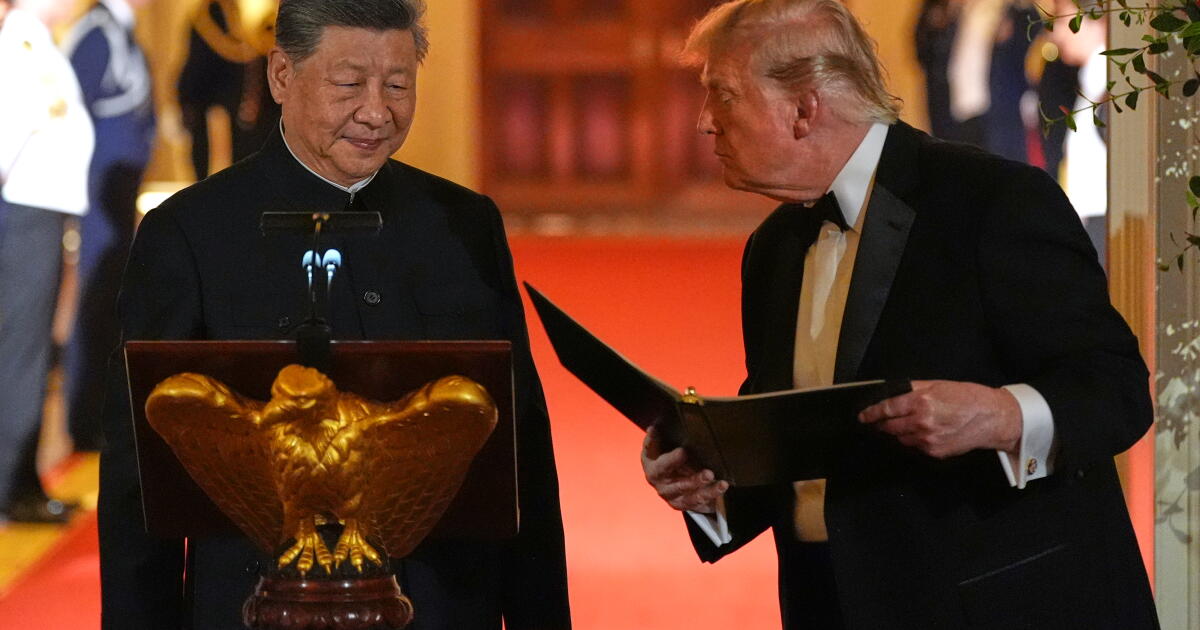
BEIJING — It’s unclear if President Trump’s elaborate reception of his Chinese counterpart in Washington dazzled President Xi Jinping, but for the Chinese public, it made quite an impression.
Trump’s rare welcome of Xi and his wife, Peng Liyuan, at the airport, as well as the bilateral and cultural events the leaders attended were closely covered — and praised — by Chinese state media. Those who watched at home saw a China elevated in status.
“I read the news that the U.S. reception standards for President Xi are very high,” Xiang Ziyu, a postgraduate student in Beijing, told The Associated Press. “I’m quite impressed because it shows that our country has become really powerful.”
That takeaway was shared by several people interviewed by the AP as well as in comments on Chinese social media, which praised China’s cooperation with the United States.
The official People’s Daily newspaper allocated the entire front page to the trip, featuring six photos of the Xi-Trump meetings.
Meanwhile, on the Chinese search engine Baidu, the three most popular search topics on Friday were the talks between Trump and Xi; the state dinner attended by Xi and Peng; and greetings extended by Xi to Chinese people on the occasion of the Mid-Autumn Festival being celebrated on Friday.
Shen Zuohang, a Beijing resident, felt reassured by the coverage and by Trump and Xi’s seeming agreeability on topics like trade, artificial intelligence and security.
“We have no trade war and no military conflict. Even on the issue of Taiwan we are moving in a good direction instead of having heated confrontation,” Shen said.
“The two sides are handling issues in a more acquiescent way.”
According to China’s Foreign Ministry, Xi called on Trump to oppose the independence of Taiwan, an island democracy China claims as its own territory, and to handle the issue with caution. Trump did not immediately make comments on Taiwan, but had previously described U.S. arms sales to the island as open to negotiations with China.
Xiang, the student, said the summit overall sent a positive signal and will help improve the Chinese public’s opinion of the relations between the two countries.
“It is better than not communicating,” he said.
Associated Press video producer Wayne Zhang in Beijing and writer Simina Mistreanu in Taipei, Taiwan, contributed to this report.