Amid the bustle and glitz of last week’s CinemaCon in Las Vegas, one question loomed over the annual trade convention — how will the proposed Paramount Skydance-Warner Bros. Discovery deal affect the movie theater business?
That anxiety showed up in a state of the industry speech from Cinema United trade group President Michael O’Leary, who reiterated his organization’s opposition to further industry consolidation.
It showed up in a trailer for Amazon MGM Studios’ upcoming film “Spaceballs: The New One,” when a voiceover poked fun at Hollywood studios “merging willy-nilly” as images of the Paramount sign and Warner Bros. water tower flashed across the screen.
And the subject again took center stage — literally — when Paramount Chief Executive David Ellison himself gave a speech during his studio’s presentation at Caesars Palace. He sought to reassure the assembled movie theater operators and exhibition executives that the combined company would indeed release a minimum of 30 films a year.
“I wanted to look every single one of you in the eye and give you my word,” he said during an onstage speech, in which he also committed to a 45-day theatrical window and 90-day period before films go to streaming services. “People can speculate all they want, but I am standing here today telling you personally that you can count on our complete commitment. And we’ll show you we mean it.”
It’s true that Paramount has nearly doubled its theatrical releases since Ellison took over. As he noted in his speech, the storied studio is now planning 15 films this year, up from eight in 2025.
But as I’ve written previously, theater owners and other studio executives question how releasing 30 movies a year across the combined Paramount-Warner Bros. would work — not only in terms of giving each film the proper marketing campaign to succeed in theaters but also because of the massive cost cuts that will inevitably occur once the merger is final.
Still, Ellison’s commitment to 30 films a year got a round of enthusiastic applause — and at least one high-profile boost.
A day earlier, AMC Entertainment Holdings Inc. Chief Executive Adam Aron told me in an interview that he backed Ellison’s takeover of Warner, saying he and AMC believed in the tech scion’s talent as a filmmaker and a movie executive, as well as his pledge to release those 30 films a year.
“We’re enthusiastic that David will fulfill his promises,” Aron said. “And that in the end, this will prove to be a good thing for our company and our industry.”
Not everyone shares that enthusiasm.
More than 4,000 people have now signed an open letter opposing the Paramount-Warner deal, arguing that consolidating two studios will lessen consumer choice and job opportunities for creatives, particularly at a time when Hollywood is already struggling. (Notable signatories include “Dune” director Denis Villeneuve, actors Glenn Close and Emma Thompson, as well as director and producer JJ Abrams.)
O’Leary of Cinema United similarly wasn’t convinced.
“While recent pledges attempt to address the threats of consolidation to our industry, they are not yet sufficient in addressing our concerns,” he said in a statement released hours after Ellison’s speech. “We remain open to tangible commitments that will ensure a vibrant global theatrical exhibition industry for years to come.”
Elsewhere at CinemaCon, the mood was upbeat.
Warner Bros. film chiefs Mike De Luca and Pam Abdy struck a triumphant tone after an award-winning year for the studio, capped off by the best picture win for “One Battle After Another.”
They unveiled footage from new films like the upcoming “Digger” from director Alejandro G. Iñárritu and brought out lead actor Tom Cruise to a sustained standing ovation from the audience. And both De Luca and Abdy espoused optimism for the future of the theatrical business. The studio plans to release 14 films this year and as many as 18 for 2027.
“The film business has always required smart betting, and we have 4 billion reasons from last year to think we’re holding the right cards,” De Luca said during the presentation, referring to the studio’s worldwide box office revenue last year.
“We all know they’re not all going to work. That comes with taking swings,” Abdy said of the studios’ films. “There’s no version of this business that’s risk-free. But our job is to step up, make our bets and own it when it doesn’t work.”
But the end of the presentation felt more somber, with the executives asking the heads of Warner Bros.’ labels to come to the stage and be recognized. Shortly after, they asked Warner Bros. employees in the audience to stand for applause. It was hard to escape the feeling that this may be the end of an era.
Stuff We Wrote
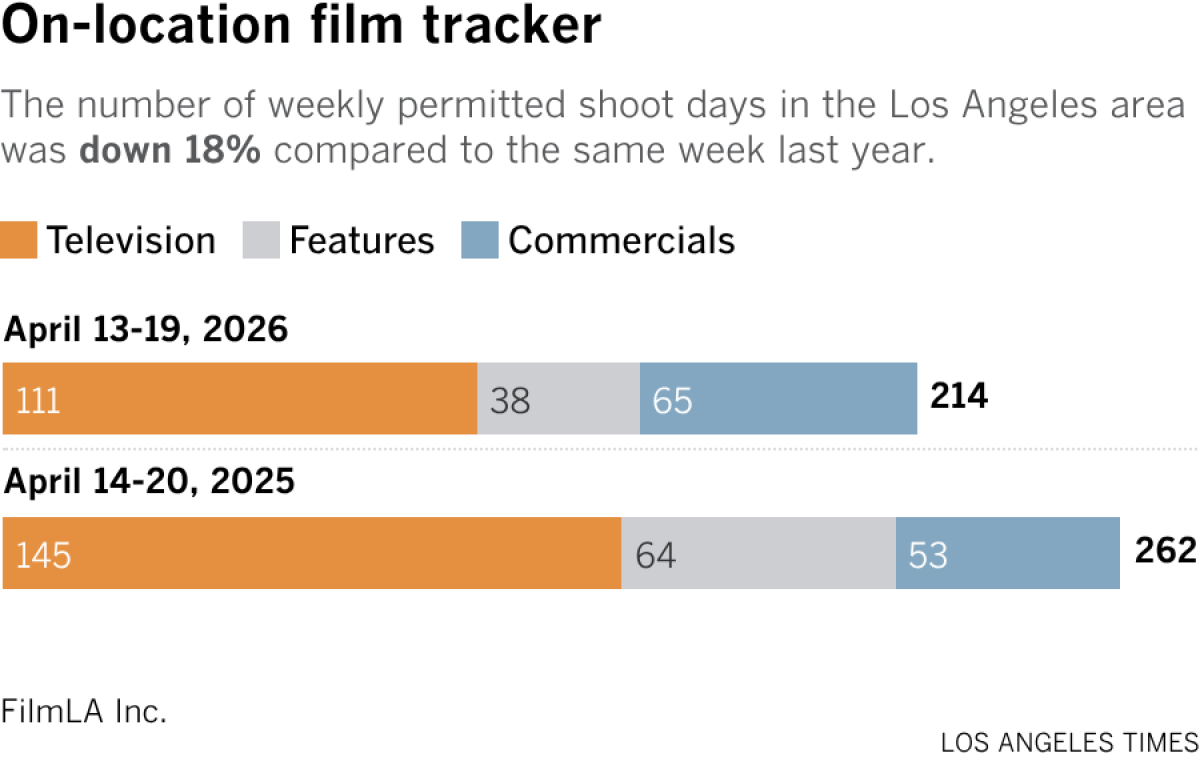
Film shoots

Number of the week
1,000
Last week, Walt Disney Co. began a sweeping round of layoffs that’s expected to cull 1,000 jobs across multiple divisions.
As my colleague Meg James reported, the cuts hit Disney’s television and movie studios, sports giant ESPN, its product and technology unit, corporate functions and marketing. Even Marvel Studios’ visual development team was affected.
The layoffs are one of the first major moves under new Disney Chief Executive Josh D’Amaro, who took the reins of the company last month. In a message to employees, he said the company needed to “constantly assess how to foster a more agile and technologically-enabled workforce to meet tomorrow’s needs.”
What I’m watching
Some friends and I watched “Fukushima: A Nuclear Nightmare” this past weekend, a truly eye-opening documentary that explains what happened during the March 11, 2011, nuclear accident and whether the world has learned anything from it.