star wars

Our predictions for the summer box office

It’s been about a month into the all-important summer box office season, and already, there is a noticeable boost in optimism.

I wrote last week about how the massive debut of Walt Disney Co. and Pixar’s “Toy Story 5” was a promising sign; many analysts and movie theater operators believe the summer’s theatrical revenue could finally reach pre-pandemic levels.

The cinema business has been propelled by the likes of Paramount Pictures and Miramax‘s “Scary Movie,” Universal Pictures’ “Disclosure Day” and, of course, A24’s “Backrooms” and Focus Features’ “Obsession.”

With more potential blockbusters on the way, my colleagues David Viramontes, audience editor for arts and entertainment, and Cerys Davies, who covers the business of the entertainment industry, joined me to give our best predictions for how this summer will shape up.

What will be the biggest movie of the summer?

Masunaga: After seeing how family movies — specifically, PG-rated films — were the winners of the last two years, I think we’ll be seeing “Toy Story 5” emerge at the top. The movie has already brought in more than $585 million worldwide less than two weeks after it opened, and if its billion-dollar-grossing predecessors are any indication, this franchise may still have a long life at the box office.

Viramontes: After the R-rated, three-hour drama “Oppenheimer” made nearly $1 billion at the worldwide box office in 2023, it would be professional malpractice not to pick Christopher Nolan’s “The Odyssey” as the biggest movie of the summer — and possibly the year. 70-millimeter IMAX screenings were sold out a year in advance and premium format tickets are still hard to come by in Los Angeles. Not to mention tentpole movies like this attract repeat viewings and even encourage viewers to seek out screenings in every format. And we haven’t even talked about how the film boasts one of the most stacked casts in recent history.

Davies: In an effort to play it safe, I’m going to pick a family movie and bet on “Toy Story 5.” Think about the dog days of summer — when the air gets heavy, a sense of inexplicable boredom takes over and it’s almost too hot to do anything. Deep down, you know the only reprieve is sitting in the comfort of your local theater chain’s air conditioning. But, at this point, you already saw “The Odyssey” with all your friends at the earliest available IMAX showing. What else will scratch that box office itch? I’m willing to bet it’ll be none other than the familiar faces of Woody, Jessie and Buzz Lightyear, as they fend off technology in their home.

You’re reading the Wide Shot

Samantha Masunaga delivers the latest news, analysis and insights on everything from streaming wars to production — and what it all means for the future.

Which movie’s marketing campaign will be the talk of the summer?

Masunaga: The marketing for “The Odyssey” has been less overt than that of other summer releases, giant Trojan horse in Venice Beach notwithstanding. But a film helmed by Nolan and starring a plethora of A-list actors basically markets itself. After all, both official trailers for the film have garnered more than 30 million views on YouTube.

Viramontes: I’m prepared for Spider-Man to be everywhere. From buses and billboards to talk shows and TikTok, the movie will reach full saturation. While “Brand New Day’s” marketing campaign hasn’t reached fever pitch just yet, I’m prepared to be inundated with activations, posters and commercials for the four-quadrant fave that’s poised to be one of Marvel’s biggest successes in years.

Davies: A massive orange monster named Irene with dozens of eyeballs has nearly engulfed the historic Carney’s restaurant on Sunset. A giant inflatable “Rich” minion, sporting a goatee and a blinged out chain, popped up on Fairfax. And minions have taken over Wendy’s frosty machines with a new banana flavor. At this point, Universal and Illumination could put a minion on every Los Angeles street corner, and I wouldn’t grow tired of them. (The ominous, goggle-wearing eye overlooking the 101 freeway just isn’t enough.)

What will be the biggest wild card of the summer?

Masunaga: The biopic “Young Washington” could make waves. Distributed by Provo, Utah-based Angel Studios, the movie has the backing of the studio’s 2 million Angel Guild members, who determine its slate and get other perks, including free movie tickets. That support proved crucial for 2023’s “Sound of Freedom,” which ended up grossing more than $250 million worldwide, and could end up being a factor here, too.

Viramontes: “The End of Oak Street” has been teasing a dinosaur adventure in trailers, but can the mystery box movie starring Anne Hathaway and Ewan McGregor attract audiences? There’s also potential counter programming to blockbuster hopefuls dotted throughout the summer with “Teenage Sex and Death at Camp Miasma.” But I’m putting my money on “Evil Dead Burn.” Horror movies put butts in seats, and this summer doesn’t have many other straight-down-the-middle scares in store for audiences.

Davies: There’s an Anthony Bourdain biopic called “Tony” hitting theaters in August. These days, it feels like Hollywood will make a biopic about just anyone, but something about seeing Dominic Sessa channel the chef’s undying passion for food and effortless swag on screen seems irresistible. Plus today’s audiences love stories about intense kitchens (“The Bear”) and debatable biopics (“Michael”) — let’s see what happens when the two marry.

Both Warner Bros.-owned DC Studios’ “Supergirl” and Sony Pictures‘ “Spider-Man: Brand New Day” are part of this summer’s lineup. Will we see a turnaround from the recent superhero fatigue at the box office?

Masunaga: This past weekend marked a disappointing debut for “Supergirl,” which brought in just $37.1 million in the U.S. and Canada and about $62.6 million worldwide on a reported budget of $170 million. Box office analysts had been expecting a domestic opening of about $47 million to $50 million. On the other hand, pre-sales for “Spider-Man: Brand New Day” have been extremely strong. Not every superhero movie prints money anymore, so even with a potentially big haul for “Spider-Man,” I don’t know that it’ll signify a complete turnaround for the genre as a whole.

Viramontes: If there’s any superhero with enough pull to rescue the genre from fatigue after “Supergirl’s” poor performance, it’s your friendly neighborhood box office king Spider-Man.

Davies: Tom Holland’s Spider-Man definitely has the potential to cure superhero fatigue, at least for a few months. But as soon as the internet’s favorite couple, Zendaya and Holland, stop walking red carpets and doing press together, audiences are likely to put superhero movies on the back burner once again.

Analysts and theater owners have predicted that this summer’s box office will reach pre-pandemic levels. Will that momentum continue for the rest of the year?

Masunaga: Yes. The lineup of movies this year is more plentiful and varied than in years past, and with massive blockbusters slated for the holiday season, I think it’s very possible we could see a year-end domestic box office total of $9 billion or more.

Viramontes: Yes. We’ll have an action horror in September with “Resident Evil,” Zach Cregger’s follow-up to “Weapons.” In October, Tom Cruise’s long-awaited “Digger” might hit pay dirt. Following that in November is the new “Hunger Games” movie, “Sunrise on the Reaping.” And I don’t even have to mention “Avengers: Doomsday” and “Dune: Part Three,” the juggernauts waiting for us in December, do I?

Davies: Given the overall excitement from audiences of all ages and the variety this summer’s box office has to offer, this season will definitely be the one to do it. When Christopher Nolan, Spider-Man, the minions and the toys from “Toy Story” join forces, there’s no stopping them.

“The Pitt” and its economic effect on California

As film and TV production has fled the Golden State in search of cheaper locales, HBO Max medical drama “The Pitt” stands out as a major contributor to California’s economy.

My colleague Meg James wrote about the economic impact of the show, which films almost entirely on the Warner Bros. lot in Burbank and has provided jobs for about 1,000 people. The show’s first season alone contributed $125 million to California’s gross domestic product, according to an estimate from Oxford Economics.

“We’re old men who didn’t want to go away from our homes any longer,” series star Noah Wyle, who also serves as an executive producer and writer on the show, said, half-joking. “We’ve all been plying our trades out of state, chasing tax credits and being away from our families for a really long time.”

Stuff We Wrote

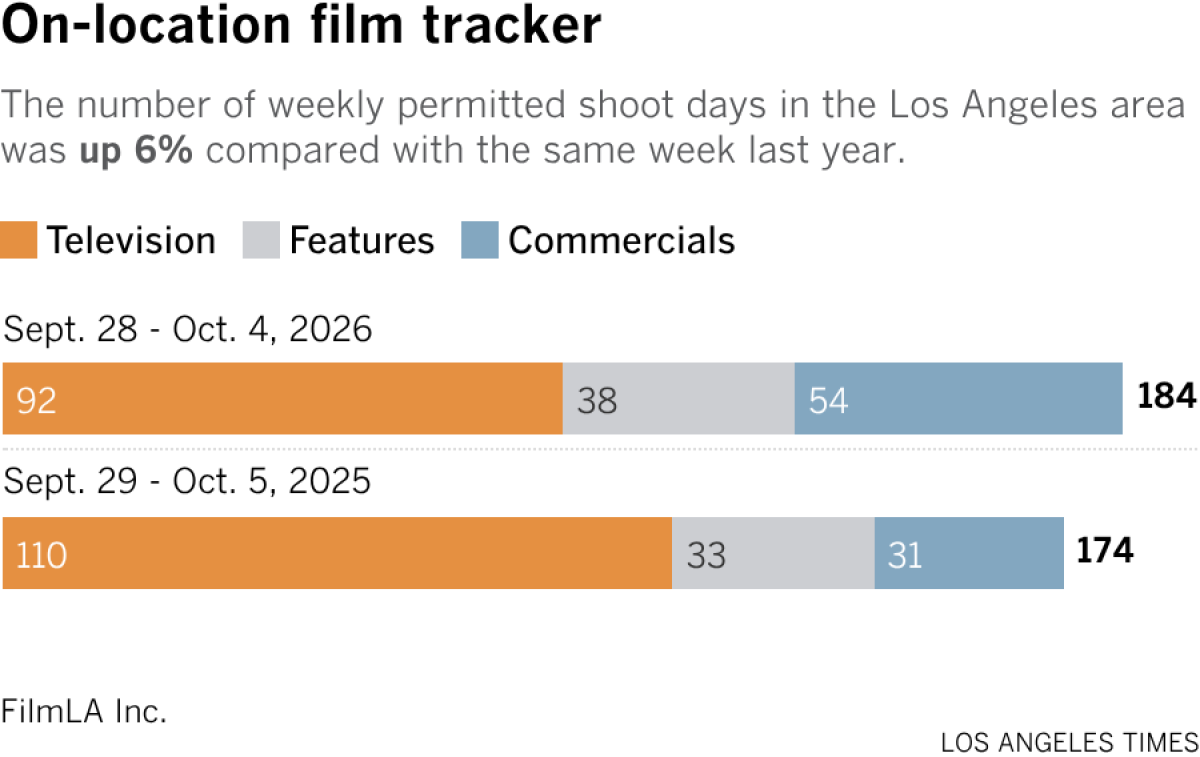
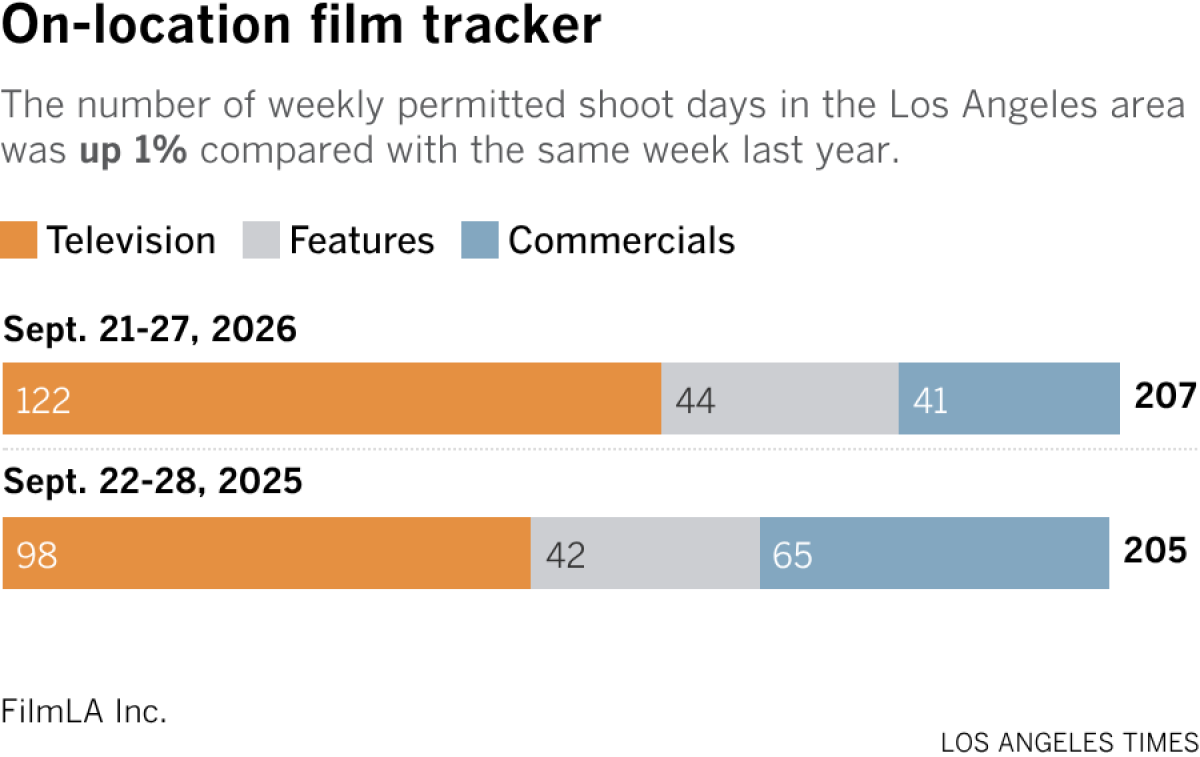
Film shoots

Number of the week

seventy million dollars

Disney and Pixar’s “Toy Story 5” continued its dominance this weekend, pulling in $70 million in the U.S. and Canada to stay on top at the box office.

The animated film has now grossed more than $585 million worldwide in less than two weeks. The haul for “Toy Story 5” helped push Disney past the $3-billion mark at the global box office, making it the first studio so far this year to hit that milestone.

What I’m watching

I feel like I’m always catching up on shows, and this week was no exception. I’m just now starting Season 2 of Netflix’s “A Man on the Inside,” which continues the hilarious exploits of retired engineering professor-turned-private-investigator Charles, played by Ted Danson. As a fan of “The Good Place,” I’ve loved the similar humor of this latest Michael Schur show.

Source link

‘Supergirl’ review: Let Milly Alcock party harder next time

Kara Zor-El (Milly Alcock) can swill an entire sorority’s supply of booze. As a Kryptonian, her hangovers are instantly cured by a yellow sun. And so director Craig Gillespie’s “Supergirl” follows a trail of empty beer bottles to find Superman’s lonely younger cousin marking her birthday on a solo interstellar bender, pounding shots alongside her dog, Krypto.

Unlike sweet-natured Kal-El (David Corenswet), a.k.a. Clark Kent, who escaped Krypton as a baby, this traumatized 20-something bore witness to their home planet’s long and painful extinction. Playing grief like the sandblasted absence of emotion, Alcock’s Supergirl isn’t in the mood for Metropolis do-gooding. She prefers slumming it at extraterrestrial honky-tonks with suitors who look like armadillo-plated slugs. She’s most visibly depressed when she tries to convince herself she’s having fun.

Who doesn’t want to go on a “Star Wars” cantina crawl? The opening stretch of “Supergirl” is great — Alcock even passes out on a toilet with aplomb. Briefly we hope that Gillespie and screenwriter Ana Nogueira are shaking up the superhero format like a bottle of gas-station champagne. I’d love to see Alcock’s heroine in a grotty, silly “Animal House”-style comedy, out-drinking a galaxy of alien squids. But the limits of Hollywood’s imagination squeeze Supergirl to stop partying and start doing some regular old rescuing. Sigh. Someone’s gotta save franchise movies from themselves.

As usual, there’s a tyke in trouble: 13-year-old Ruthye (Eve Ridley), a fellow orphan with a ramrod disposition and a tidy brunet braid that gives away that her character is modeled on Hailee Steinfeld’s vengeful teenager in “True Grit.” Ruthye wants to hunt and kill the creep who murdered her family. Unlike Supergirl, the child thinks it’s healthier to exorcise — not imbibe — one’s heartache. The duo visit an Epstein-island-like planet of kidnapped breeding women where, in one of the script’s subtler sick horrors, the locals imply that pubescent Ruthye is more valuable than aged 23-year-old Supergirl. (Although some of the caged extras appear to be as ancient as 30.) It’s yet another swiped idea, this one from “Mad Max: Fury Road,” for a minor story beat that’s unnecessary. Still, Alcock reacts with exactly the right note of disdain: “Cool,” she croaks. ‘Nuff said.

They’ve come to this cesspool to find the villainous Krem, an unrecognizably vile Matthias Schoenaerts with a mug that’s been pierced all over like he face-planted into a pile of thumbtacks. His biker-scumbag-times-infinity prosthetic design is fantastic, but what makes it genius is that the makeup team allowed a couple of metal studs to fall off Krem’s forehead before his first close-up. You know, for that lived-in barbarian sex trafficker look.

As Ruthye, Ridley’s crisp British elocution is the cleanest thing in the movie, which is shot by Rob Hardy in shades of mustard smog and latrine brown. Neither Supergirl as a babysitter nor Gillespie as a storyteller let the kid carry her share of the action, but I suspect Ridley has the talent for it. She seizes her small opportunities to impress in the film’s second half. Spitting on a baddie, her righteous loogie stings like a moral disinfectant.

Meanwhile, Jason Momoa swaggers into the fray from the cover of an ’80s hard-rock album with Kiss’ makeup, Manowar’s muscles and Meatloaf’s motorcycle. His character, a blue-skinned bounty hunter, only tangentially slots into the plot. Really, Momoa’s massive presence is here to prove that James Gunn was serious when he announced he was hard-resetting DC Comics’ film canon up to 2023’s “Aquaman and the Lost Kingdom.” Momoa as Aquaman is dead. Long live Momoa as Whoever This Guy Is.

Gillespie likes to champion difficult women, from Tonya Harding in “I, Tonya” to the Dalmatian-skinning Disney villain of “Cruella.” Yet as his budgets have mounted, so has the pressure to make his problematic ladies popular with a mass audience. “Supergirl” feels anxious to entertain. The jokes all have the same sense of snarky humor, no matter what species is cracking them. One scene even has a comic slow clap that, in my theater, didn’t get a reaction. The camera and cutting pace refuse to relax. Major set-piece action shots are impossible to follow. You can’t squint past the distracting lens flares.

Alcock’s wildling Supergirl is the one reason to see the film. As in her too-brief role on the “Game of Thrones” prequel “House of the Dragon” and her rollicking cameo at the end of 2025’s “Superman,” the Australian actor is a striking combination of grounded conviction and otherworldly essence, the ideal one-two for a character who plays anti-gravity fetch with her dog. Floating weightless in the stars, her hair unbrushed and bathrobe-like jacket shrugged on, she makes the impossible look casual. (Supergirl’s iconic red-and-blue minidress is so not her style.)

Alas, Krypto the pup is sidelined early on with a whimper, both from him and us. Maybe he’ll get more screen time when the digital animators figure out how to make him look more realistic. (Between the mutt’s anime eyes and that gawky-phony deer in “Disclosure Day,” are CGI creatures getting worse?)

Grief tethers Supergirl to Ruthye, even though they disagree on how to handle it, and it also seems to repel her from Corenswet’s dopey, innocent Clark Kent. There’s rich irony in the personality contrast between the cousins. Her Kryptonian parents raised her to help humanity; his parents intended their son to rule it. But due to twists of fate, she’s the miserable, maladjusted one. The movie has no time to mine the psychology underneath their clash, let alone summon a sniffle for the other pitiful characters who die during this escapade. Perhaps it’s holding that tension back for a sequel, but I’d rather invest in the characters now.

A flashback to Supergirl’s first touchdown on Earth has the awkwardness of a study-abroad student realizing she doesn’t like her host country at all. Despite our planet seeming to have enforced its monoculture on outer space — an extraterrestrial dive bar band even does “The Girl From Ipanema” — Supergirl appreciates little of it besides some product-placement dog treats and, in a forced touch, the pop music on her headphones as well as crammed into the soundtrack next to Claudia Sarne’s gravelly score. I’ll accept this degenerate Supergirl sporting a retro Blondie shirt, but not her willingly choosing to listen to mopey contemporary Earth jams like Rilo Kiley and a twee cover of Jimmy Eat World over, say, Kryptonian death metal.

Still, the production design has imaginatively askew takes on the mundane: gridded jail cells, plodding space buses, clumsy oxygen suits that shimmy on with a satisfying squeak. When Supergirl makes a pit stop at a celestial convenience store, she samples a snack that I’m forced to call poop-corn. If “Supergirl” sells enough of it, hopefully Alcock can rampage again in a more confident sequel that truly cuts loose.

‘Supergirl’

Rated: PG-13, for sequences of strong violence, action, language, and smoking

Running time: 1 hour, 48 minutes

Playing: Opens Friday, June 26 in wide release

Source link

‘Toy Story 5’ could be the start of a big summer box office

It’s been more than 30 years, but Andy’s toys are proving irreplaceable at the box office.

Walt Disney Co. and Pixar’s “Toy Story 5” opened to a massive $160 million in the U.S. and Canada last weekend, marking the biggest domestic box office debut so far this year. Internationally, the film brought in $152 million for a worldwide total of $312 million.

With those numbers, “Toy Story 5” broke several franchise records for opening weekend totals. As my colleague Cerys Davies and I wrote last week, it’s a sign of the long-running juggernaut’s firm grip on audiences amid a sea of Hollywood sequels, reboots and spinoffs.

You’re reading the Wide Shot

Samantha Masunaga delivers the latest news, analysis and insights on everything from streaming wars to production — and what it all means for the future.

“‘Toy Story’ has been breaking ground since it first hit the screen more than 30 years ago,” Disney Entertainment Studios Chairman Alan Bergman said in a statement. “It’s wonderful to see ‘Toy Story 5’ continuing that tradition and connecting with audiences around the world to deliver the biggest opening for the franchise and the biggest of this year as well.”

For theater owners, “Toy Story” may have seemed like a surefire bet. After all, the franchise has grossed more than $3 billion in worldwide box-office revenue, and its third and fourth installments each made more than $1 billion globally.

The big opening weekend for “Toy Story 5” has no doubt brightened the outlook for many theater operators as the all-important summer movie season gets underway.

Already, last weekend’s box-office totals were a whopping 80% improvement compared with a year ago, when Universal Pictures’ live-action “How to Train Your Dragon” was in its second weekend in theaters. But more importantly, the domestic box office is now up 14% to $4.46 billion compared with the same time a year ago, according to data from Rentrak.

This summer’s lineup of films, including “Toy Story 5,” will play an important role in terms of whether 2026 will truly be the year that the theatrical business turns the corner from the COVID-19 pandemic and the dual Hollywood strikes of 2023.

In one promising sign, summer box-office revenue so far is up 15.2% to about $1.84 billion compared with the same May to mid-June period in 2025. (That summer ultimately ended in a dismal finish of $3.67 billion.) Compared with pre-pandemic 2019, this year’s summer box office to date is down just 1.9%.

Studio executives and theater owners have told me they feel good about this summer and are optimistic about the overall outlook for 2026.

It’s easy to see why. The deck is stacked, with upcoming titles such as Universal and Illumination’s “Minions & Monsters,” Disney’s live-action “Moana,” Christopher Nolan’s “The Odyssey” and Sony Pictures’ “Spider-Man: Brand New Day.”

In a propitious sign, presales for “The Odyssey” and “Spider-Man” have already shown massive demand. Overall, there’s just more and varied movies in theaters now, which expands the pool of potential moviegoers, theater owners have said.

Take A24’s “Backrooms” or Focus Features’ “Obsession,” for instance. The two original and digital-native films shocked the industry by keeping a weeks-long grip on the box office, largely by attracting Gen Z audiences who were familiar with the 20-something directors from their followings on YouTube.

Beyond these two, as well as Steven Spielberg’s “Disclosure Day,” many of this summer’s films continue established franchises.

Although not all spinoffs have performed this year — including Disney and Lucasfilm’s “Star Wars: The Mandalorian and Grogu,” which saw ticket sales drop sharply after its late May opening — “Toy Story” has remained a consistent force in theaters over the decades.

Disney and Pixar executives credit the films’ focus on character relationships, particularly that of Tom Hanks’ Woody and Tim Allen’s Buzz Lightyear. And as the franchise spanned years, its appeal became generational.

“Having parents now that say, ‘I grew up with ‘Toy Story,’ and now I’m showing my kids,’ has been really gratifying,” Pixar Chief Creative Officer Pete Docter told me by phone a week before the movie’s opening.

“Toy Story” is now the most-watched franchise on the Disney+ streaming service, with more than 2 billion hours streamed. And its beloved characters have spawned 19 theme park rides, four themed lands, two hotels and roughly $1 billion a year in global retail sales.

That has no doubt kept the franchise front and center for both adults and children, as well as fueling interest in future stories.

Stuff We Wrote

Film shoots

Number of the week

six million

The FIFA World Cup has been a major boost for broadcasters, as an average of 6 million viewers tuned in to Fox and cable network FS1 for the first 16 group stage matches, an increase of 128% compared with the last World Cup in 2022, according to Nielsen data released last week.

On Spanish language network Telemundo, which is owned by Comcast, the first 12 group stage matches drew an average of 7.5 million viewers, up 234% from four years ago. (The Telemundo telecasts are also streamed on Peacock.)

I was in the Bay Area last week on vacation and didn’t watch many of the games, but I did catch my colleague Clara Harter’s great read about the mutual love and respect between fans of Mexico and South Korea and how that has played out in Los Angeles.

What I’m watching

Since I was out of town last week, I didn’t watch a ton of TV. But I did make time to watch the series finale of “The Way Home,” a quirky time-travel drama on Hallmark that I’ve followed for all four seasons.

I’m a big fan of time-travel stories (The “Back to the Future” trilogy is one of my favorites), so the usual past-future questions, plus the complicated family dynamics anchored by matriarch Andie MacDowell, made this a must-watch for me. The series finale was a satisfying ending, though there are definitely some loose strings that deserve further exploration.

Source link

Amazon’s AI boss on the primacy of humans in a changing Hollywood

At the AI on the Lot media conference last week in Culver City, speakers laid out a view of artificial intelligence that was very much complementary to human workers.

Artificial intelligence is a tool that must be wielded by humans, several said. The idea was to help skilled artists and production specialists do their jobs and experiment, others said.

Of course, to many in Hollywood, AI is not that simple.

Guardrails on its usage emerged as a central issue in the 2023 writers’ and actors’ strikes, and additional rules were added in the recent Screen Actors Guild-American Federation of Television and Radio Artists and Writers Guild of America contracts. There are still big questions about AI’s effect on jobs in the entertainment business, as well as copyright and ethical concerns.

Whether it’s good or bad or some combination of both, AI, in some form, is probably here to stay.

So, eight months ago Amazon MGM Studios opened an AI Studios division to start work on Project Nara, an AI production toolkit built on Amazon’s AWS cloud computing platform that could be used by teams of filmmakers. Project Nara is still in beta mode, and the company set up a GenAI Creators’ Fund to give filmmakers interested in using the toolkit financial support, while also giving the studio feedback.

The beta testers got eight weeks to produce an animated short and, out of those, the company greenlighted three animated series.

Shortly after the conference, filmmaker Jorge Gutierrez, whose stop-motion-style “Punky Duck” was chosen as one of the greenlighted series, pulled out after an online backlash over his use of AI.

You’re reading the Wide Shot

Samantha Masunaga delivers the latest news, analysis and insights on everything from streaming wars to production — and what it all means for the future.

“We respect Jorge’s decision, as well as his incredible talent, his voice and the world he created with ‘Punky Duck,’” an Amazon MGM Studios spokesperson said in a statement. “We continue to be excited about the innovative work moving forward at our studio and the GenAI Creators’ Fund.”

Before the flap over “Punky Duck,” I spoke with Albert Cheng, head of Amazon MGM Studios’ AI Studios, about the goal of the division, what’s next for AI and his belief that humans are at the center of creativity. The conversation has been edited for length and clarity.

Why was AI Studios formed?

AI Studios was started last fall because we wanted to learn how to leverage AI technology to build tools that would help enhance or redefine the workflows for film and TV production.

When you look at the horizon of what it takes to drive continued engagement of a global streaming service like Prime Video, we need more original programs. So if you can figure out how we take the same amount of money that we spend and be able to make more shows, that’s ultimately what we want, and we think AI is going to be a help to drive that.

With AI, now we’re looking at how does technology change the way we actually create our cinematic storytelling? It could mean that with AI, we will hear from a lot more voices. If we can actually get the biggest costs down, we will be able to have more voices, be able to take more risks and creative risks most of all.

There’s always concern about what does AI mean for jobs. We believe that it actually creates more jobs and different types of jobs. In fact, people with experience, plus the tools, become even more valuable in terms of their ability to produce excellent quality work. So it’s always about the human behind it.

You mentioned that some of these production crews had more than 100 people, but crews in the past would have been much larger. How do you respond to concerns about that?

You may have smaller crews, but we’ll do more of them [productions], and more in a short period of time. When you actually have smaller productions and you do more of them, you’re increasing your throughput. Your turnover rate of the available jobs is much faster, so your job totals are actually going to be bigger.

You spoke about the idea of AI filmmaking bringing jobs back to L.A. and expanding California’s production incentive eligibility to include AI-assisted filmmaking. Can you elaborate on that?

When you look at AI production, it can be done on a soundstage. We don’t need to go to London, we don’t need to go to other places.

We do have technology companies in California that are driving this, we have people here in the city that have experience, if given the AI tools, can produce great work. So, how can we not incentivize more companies to use our soundstages and finally make productions and make more of them?

Have you or anyone else at Amazon spoken with government officials about this idea of expanding the incentive criteria?

We’ve been talking to a number of bodies about whether it’s possible. The question is, who’s going to take the ball?

How much can you decrease a show’s production budget by using AI?

I think we can get a show to half the cost, [or] to almost a fifth of the cost.

What was the thinking behind the GenAI Creators’ Fund?

We wanted to provide a support and invest in creators who wanted to try it, and then also give us feedback.

We also wanted to show that storytelling is the thing that drives the content. It’s not the technology; the technology just enabled them to make it.

What is the biggest misconception of AI use in production?

There’s a narrative that AI can do so many things by itself, that you don’t need people. That’s absolutely not true. It’s just a technology, it can’t make decisions.

In order for something actually quality to be made, a person actually needs to be behind that, and that’s been proven over and over again. People are still responsible for the output.

Stuff We Wrote

Film shoots

Number of the week

eighty-one point four million dollars

Internet culture drove the box office over weekend, with A24’s “Backrooms” hauling in $81.4 million in the U.S. and Canada.

The $10-million horror flick, which stars Chiwetel Ejiofor as a furniture store owner who finds a mysterious portal in his basement, was directed by 20-year-old YouTuber Kane Parsons and is based on his online series of the same name. Worldwide, the film made nearly $118 million in its debut weekend.

Focus Features’ “Obsession” also had a big weekend with a 10% jump in domestic box-office revenue in its third outing. The horror movie, which had a production budget of less than $1 million, was directed by Curry Barker, who also built his reputation on YouTube.

Together, the two films highlight the growing power of YouTube — and online culture as a whole — on the big screen. They beat out franchise film “Star Wars: The Mandalorian and Grogu,” which dropped 69% from its debut last weekend to rank third at the box office.

What I’m watching

I’m just one episode away from finishing this season of “Bridgerton” on Netflix. While I liked that the show dived into the social class dynamics behind Benedict and Sophie’s romance, I have to say that I loved the secondary focus on Violet Bridgerton and Lord Anderson finding a second chance at love.

Source link

Marcia Lucas dead aged 80: Star Wars’ ‘secret weapon’, Oscar winner for A New Hope & George Lucas’ ex-wife dies

An image collage containing 1 images, Image 1 shows A woman with auburn hair, large hoop earrings, and a brown bandana around her neck, smiles while wearing a green, polka-dotted shirt

OSCAR winner Marcia Lucas has died from cancer aged 80.

Known as the secret weapon and unsung hero of Star Wars, Marcia died at her holiday home in Rancho Mirage, California.

Marcia Lucas, the secret weapon of Star wars, has died aged 80
Marcia married George Lucas in 1969

The ex-wife of George Lucas, Marcia was best known for editing Star Wars and Return of the Jedi.

Marcia died on Wednesday evening, her family said.

In an emotional statement, they called the filmmaker a “trailblazer”.

A family member said: “Marcia was a force.”

“A true trailblazer for women in film and one of the most influential editors in cinematic history; she helped redefine what film editing could be and paved the way for generations of women who followed.”

She won an Academy Award in 1977 for Best Film Editing.

In 1969 she married George Lucas, who she had met while working on the documentary Journey to the Pacific.

Raised in North Hollywood, Marcia met her future husband while they were working as assistants for editor Verna Fields.

Marcia won an Academy Award in 1977 for Best Film Editing Credit: Kobal Collection – Shutterstock

Source link

Seth Rogen on comedy, money and all those awards

It’s been a big year for Seth Rogen’s Point Grey Pictures.

The 15-year-old production company founded by Rogen, his childhood friend and longtime collaborator Evan Goldberg and producer James Weaver is coming off a huge awards season for its comedy, “The Studio.”

The Apple TV series, which simultaneously pokes fun at the institutions of Hollywood while also peeling back some of the industry’s mystery, is now the most-awarded new comedy in TV history.

“The Studio” has won 13 Emmys, a BAFTA TV award in the international category, two Golden Globes and three Critics Choice awards. It’s currently filming its second season, with most details still under wraps.

I spoke with Rogen, Goldberg and Weaver about the success of the show, which primarily films on the Warner Bros. lot, and what’s next for Point Grey.

On all those awards?

“We’ve never, literally, won any awards before this, so I by no means expected this,” Rogen said, with a chuckle. “I hoped people would creatively recognize that we were really swinging for the fences, but awards were not really something that I was thinking that much about.”

In the show, the Canadian actor and comedian plays beleaguered movie studio head Matt Remick, who must balance the art of filmmaking with the economics of the business. In a nod to Hollywood’s pull toward intellectual property, one storyline focuses on the studio embarking on a movie about the Kool-Aid Man, which Rogen’s character only reluctantly agrees to pursue.

It’s not all about the money

“To me, what is interesting, and what people don’t seem to think about Hollywood, is that the people involved in it actually care about movies, even the ones who make bad ones, even the ones who make choices that stop good ones from being made,” Rogen said. “If you really just wanted to make money, there are much easier ways to make money where you don’t have to deal with people like me.”

He also noted that there’s a role for movies such as the fictional Kool-Aid flick.

“You could argue it’s the Kool-Aids of the world that keep theaters open,” Rogen said. “It’s our fake Kool-Aid movie that allows smaller movies to exist and allows theaters to take risks on smaller movies.”

Remembering comedy

“The Studio” also stemmed from a desire to make a pure comedy, despite the tough time comedies have had recently in the marketplace.

“We just all agreed that we wanted to make something that was just funny,” Goldberg told me. “It just felt like the world stopped making those, and we just wanted to make something that when you tuned in, was just absolutely hilarious.”

A serious L.A. business

Los Angeles-based Point Grey, which has 15 employees, is named for the Canadian school where Rogen and Goldberg met (the first project they wrote together, which became 2007’s “Superbad,” was based on their experiences there). Despite their comedic reputations, the more serious-sounding company name was deliberate so it could be used with any kind of project.

In fact, the company got its start with the Joseph Gordon-Levitt-led dramedy “50/50” about a 20-something who learns he has cancer. Over the years, Point Grey’s projects have spanned genres, including supernatural series “Preacher,” 2016’s “Sausage Party,” the satirical superhero show “The Boys” and biographical mini-series “Pam and Tommy.”

A Point Grey project is “genuinely original” and “daring,” said Weaver, Rogen’s former assistant who now serves as president of the company, which has a first-look film deal with Universal Pictures and a first-look TV deal with Lionsgate. He declined to discuss financials but said the company is profitable.

“We’ve managed to be really productive in terms of the amount of things that we’ve made, and we try to be smart about how we run our financials,” Weaver said. “The company is doing quite well.”

Point Grey is in production on “Teenage Mutant Ninja Turtles: Mutant Mayhem”; just wrapped a romantic comedy for Amazon MGM Studios starring Cameron Diaz and Stephen Merchant; and recently screened an animated film at Cannes called “Tangles” that’s based on a graphic novel about Alzheimer’s.

The production company may eventually expand into video games (“We love video games,” Goldberg told me), and plan to continue to navigate the changes in Hollywood, which is reeling from a continued drought in local production that my colleague Stacy Perman and I wrote about recently.

“Personally, I feel like people are very fatalistic about the trajectory of the industry, but it’s not like the industry is going down, the industry is just changing,” Goldberg said. “We just are very flexible and embrace the change, and hopefully in doing so, we don’t get left behind.”

Stuff We Wrote

Number of the week

one thousand eight hundred and ten

After 1,810 episodes as the host of “The Late Show,” Stephen Colbert signed off for the final time Thursday.

CBS has said it canceled Colbert because the show was losing $40 million a year as viewers have increasingly migrated away from late-night viewing in the streaming era.

But many in the TV business are skeptical of the claim and believe Skydance wanted to silence Colbert, a frequent Trump critic, to pave the way for its deal last year to acquire parent network Paramount. (The Federal Communications Commission’s approval of the transaction came days after the show’s cancellation was announced.)

My colleague, Stephen Battaglio, has written about what the future of late-night TV talk shows will now look like.

What I’m watching

I watched the “Survivor 50” finale Wednesday with some friends, despite only watching two episodes this season (or ever). It was fun seeing the drama unfold, though I was, like everyone else, shocked at that “last twist” of Jeff Probst accidentally spoiling who lost in the final fire-making challenge.

Source link

Star Wars has big opening weekend with “The Mandalorian and Grogu”

After a nearly seven-year absence from theaters, Star Wars proved it still has the Force, as the latest installment, “The Mandalorian and Grogu,” is on track to earn an estimated $102 million in the U.S. and Canada for the Memorial Day weekend.

The movie, which is a continuation of “The Mandalorian” streaming show that debuted on Disney+ in 2019, met studio expectations for its opening weekend results.

Globally, the film was on track to pull in $165 million for the four-day holiday weekend.

Director Jon Favreau’s “The Mandalorian and Grogu” now ranks as the year’s third-highest grossing domestic opening, based on its Friday-Sunday ticket sales of $82 million, according to ticket tracker Comscore.

The results are likely a relief to Walt Disney Co.-owned Lucasfilm, which had not released a theatrical Star Wars film since 2019’s “Star Wars: Episode IX — The Rise of Skywalker.”

Since then, the San Francisco-based studio has largely focused on its Star Wars streaming shows, which have included both live-action and animated series. Some of those shows received mixed reviews, though “The Mandalorian” and “Rogue One” spin-off “Andor” were breakout hits, praised by critics and largely revered by fans.

The movie — starring Pedro Pascal, Sigourney Weaver and Jeremy Allen White — benefited from positive reviews from moviegoers, but it stopped short of shattering expectations. Its initial financial performance was on par with the disappointing 2018 opening weekend for “Solo: A Star Wars Story.” That film notched $103 million in its opening weekend.

Still, as cinemas struggle to recover from pandemic-era shutdowns, a film that generates more than $100 million in its the opening weekend is typically seen as a success.

Box office revenue for “The Mandalorian and Grogu,” which played in 4,300 theaters, will be just one indicator of the movie’s success.

The Burbank entertainment giant is counting on the film to boost other parts of its business, including views of Star Wars shows on the Disney+ streaming service, its gaming collaboration with Fortnite and its all-important theme parks sector. The main characters are present in the Star Wars: Galaxy’s Edge-themed land, and the Millennium Falcon: Smugglers Run ride has been overlaid with a new “Mandalorian and Grogu” storyline at Disney parks in Anaheim and Orlando.

The weekend ticket sales underscore the enduring appeal of Star Wars, which remains among Disney’s top five franchises, producing more than $1 billion in annual retail sales.

Reception for the film was seen as critical to keeping the franchise fresh in moviegoers’ minds, particularly as Disney prepares for the upcoming 50th anniversary of Star Wars and a new movie starring Ryan Gosling set for next year.

Locally, “The Mandalorian and Grogu” is the first Star Wars movie to be made entirely in Los Angeles.

The film received a state tax credit to film in the Golden State, Favreau said at the premiere last week.

“The Mandalorian and Grogu” faced little new competition at the box office this Memorial Day weekend. Rival studios largely stayed on the sidelines, with no other potential blockbuster debuting at the same time.

Focus Films’ horror hit “Obsession” came in second at the box office with $22.4 million for its three-day total, according to Comscore.

Lionsgate’s blockbuster Michael Jackson documentary, “Michael,” snared $20 million, bringing its total to $314 million. “The Devil Wears Prada 2” came in fourth with $12.6 million, bringing its purse to $196 million since it opened earlier this month.

Amazon’s MGM studio’s “The Sheep Detectives” rounded out the top five with nearly $9 million.

Source link

Tom Kane dead: ‘Star Wars,’ ‘Powerpuff Girls’ voice actor was 64

Tom Kane, a prolific voice actor whose signature roles included Master Yoda in a number of animated “Star Wars” shows as well as Professor Utonium on “The Powerpuff Girls,” has died. He was 64.

Kane died Monday from complications of a stroke he suffered in 2020, his representative Zachery McGinnis confirmed to The Times. The voice actor’s death was announced on social media by his talent agency, Galactic Productions.

“From his unforgettable performances in Star Wars to countless animated series, documentaries, and games, Tom brought wisdom, strength, humor, and heart to every role he touched,” reads a statement posted Monday on Galactic Productions’ Facebook page. “His voice became part of our lives, our memories, and the stories we carry with us. … Though his voice may now be silent, the characters, stories, and love he gave to the world will live on forever.”

Kane first joined the “Star Wars” franchise through video games in the 1990s, voicing droids, Imperial officers and rebel pilots in installments such as “Star Wars: Shadows of the Empire” and “Star Wars: X-Wing vs. TIE Fighter.” He would go on to voice other characters, including the iconic protocol droid C-3PO, Jedi Master Yoda and the bounty hunter Boba Fett, in various games over the years.

He continued to voice Yoda in animated “Star Wars” shows, first in “Star Wars: Clone Wars,” Genndy Tartakovsky’s series set after the events of the 2002 film “Episode II — Attack of the Clones,” in which Kane also voiced C-3PO.

But Kane’s most notable “Star Wars” role was as the narrator of the 2008 film “Star Wars: The Clone Wars” and the subsequent series of the same name, where he kicked off each adventure as the spoken version of the classic “Star Wars” opening crawl to set the stage for the story that followed.

“Tom loved ‘Star Wars,’” Dave Filoni, Lucasfilm’s president and chief creative officer, said in the studio’s tribute to Kane. “Fans may best remember him as the voice of the animated Yoda, but truly his voice was the spirit of the Clone Wars. His opening narration introduced an entire generation to the ‘Star Wars’ galaxy getting viewers ready for another adventure far, far, away.”

“When I was first starting out as a director I was fortunate to have someone as legendary as Tom there to help me learn and guide me towards what the actors needed. Very Yoda like indeed,” Filoni added.

Besides his “Star Wars” roles, Kane’s credits also include the devoted valet Woodhouse in “Archer,” the mutant Magneto in Marvel video games, the prim and proper head of house Mr. Herriman in “Foster’s Home for Imaginary Friends” and the flamboyant villain Him in “The Powerpuff Girls.”

Kane said in a 2014 Reddit AMA that “The Powerpuff Girls’” Professor Utonium, who combined sugar, spice and everything nice — along with chemical X — to create the super-powered kindergartners, was the character he most identified with.

“He’s a dorky dad who loves his kids,” Kane wrote in a comment. “That’s pretty much me.”

Tara Strong, who voiced Powerpuff Girl Blossom, described Kane as “Brilliant. Giving. Funny. Supportive. [And] Kind.” in her tribute.

“They say there’s no such thing as a perfect man… those people never met [Tom Kane]. I’ve never in my life met a sweeter soul or a better human being,” Strong wrote in a Monday post on X. “I’m beyond grateful for all the hours we spent together in the booth, and so grateful we got to see him again recently… hug him tight and tell him how much we love and miss him.”

“I love you, Professor. You were the best dad, the best human, and I feel so honored to have known you and called you my friend,” she added.

Born April 15, 1962, in Overland Park, Kan., Kane began his voice acting career at age 15 doing commercials in his hometown of Kansas City, according to IMDb. In addition to his work in games, film and television, Kane has lent his voice to announce awards shows, including the 78th, 80th, 83rd, 84th and 90th Academy Awards broadcasts, as well as on attractions at Disney Theme parks.

“I’m also glad that his characters and voice will live on in many ways,” Filoni said in his tribute. “Wherever you go there’s always a chance that Tom is the voice you hear guiding you through Disneyland or a galaxy far, far away.”

Kane is survived by his wife, Cindy, and their nine children, six of whom joined the family through adoption and fostering.


Source link

‘The Mandalorian and Grogu’ review: The nostalgia is strong with this one

Nearly 50 years on from “Star Wars” and the launch of a media empire (large or small “e”? You decide), the fandom has become its own galaxy of warring planets. But based on the success of the streaming series “The Mandalorian,” set around the title bounty hunter, we can all agree that his charge Grogu — green, wrinkled, big-eyed Baby You-Know-Who — is still adorable. Of the many “Star Wars” offshoots, this seems to be the sturdiest.

The brand is back together for “The Mandalorian and Grogu,” which is a movie, a hoped-for franchise revival, a fourth season of sorts and an affable throwback. But it’s never quite riveting enough as canon or fodder to supplant anyone’s memories of [insert favorite “Star Wars” film here].

The expectations game was never going to help series creator Jon Favreau’s big-screen version, written with Dave Filoni and Noah Kloor. Granted, this upscaled, agreeably rangy treatment of an adventure storyline that wouldn’t have been out of place on the show could have attempted more. Especially when it puts sci-fi icon Sigourney Weaver in an X-wing pilot uniform as a veteran of the Rebellion, but barely gives her anything to do besides secure Mando a job and keep tabs on his progress. (Gang, try harder. It’s Sigourney Weaver.)

Aimed squarely at kids of all sizes, “Star Wars” has become a glorified tour of a billionaire’s expanding playworld and “The Mandalorian and Grogu” wants the track well-oiled, not bumpy. The simple pleasures here of good vs evil, IMAX hugeness and composer Ludwig Göransson’s space-opera-hits-the-club score, go down easy enough to not be aggravating. It’s a lot.

But it’s not this reviewer’s position to tell you what “a lot” is — loose lips spoil scripts. When the moment comes at an appropriately dangerous time for our heroes, we sense the kind of thing that only movies can do well when they’re myths writ large: slow things down, shift momentum away from the tyranny of exposition and let emotion, humor, wonder and character co-exist. “The Mandalorian and Grogu” takes the series’ thematic underpinnings — what parenting looks like between a masked human loner and an otherworldly toddler — and deepens them.

The movie takes place in wonderfully detailed environments that evoke the earlier, beloved films. You’re not being pandered to, however; the payoff is a lovely echo. Elsewhere, the action set pieces are serviceably handled by Favreau. (One of them plays like, of all things, an homage to “The French Connection.”)

Otherwise, this is another hunt-and-retrieve narrative for the bounty hunter voiced by Pedro Pascal, physically embodied in armor by Brendan Wayne and, in combat, by fight choreographer Lateef Crowder. Still independent but New Republic-curious, Mando is tasked by Weaver’s Col. Ward to find a wayward scion of the slimy gangster Hutt clan, Rotta (voiced by Jeremy Allen White), whose return will unlock some important information. Of course, things don’t go as planned, which for a while is interesting — are the Hutts like the Corleones, perhaps? — until it’s not, because then the dialogue would need to rise above the level of a middle-school play.

That being said, one of the movie’s strong points, absent its story deficiencies, is that, across its many wordless scenes, it’s at heart a solidly rousing, delightfully icky creature feature, in the vein of a supercharged Ray Harryhausen-meets-Guillermo del Toro joint. “It’s a hard world for little things,” Lillian Gish famously says in “The Night of the Hunter,” a movie nobody will ever confuse with “The Mandalorian and Grogu.” But we all know summer fare like this is only ever as enjoyable as the monsters conjured up for conquering.

‘The Mandalorian and Grogu’

In English and Huttese, with subtitles

Rated: PG-13, for sci-fi violence and action

Running time: 2 hours, 12 minutes

Playing: Opens Friday, May 22 in wide release

Source link

Why fans obsess over the idea of a third park at Disneyland

Last week, news organizations and Disney bloggers learned that the Mouse House had filed building permits with the city of Anaheim related to a parking structure at Disneyland Resort.

That immediately sparked rumors about a third park — a long-held dream of Walt Disney Co. fans who want to see more rides, themed areas and Mickey-related shopping destinations.

But that will remain a dream — at least for the foreseeable future.

Anaheim city officials confirmed as much in an internal email about one of the news articles, noting to City Council members and the mayor that the permits were, in fact, for minor parking lot improvements within the existing Toy Story parking structure off Harbor Boulevard.

You’re reading the Wide Shot

Samantha Masunaga delivers the latest news, analysis and insights on everything from streaming wars to production — and what it all means for the future.

The email, which was reviewed by The Times, said the improvements were not related to an already-approved expansion of Disneyland Resort, or “what could ultimately be developed on the property in the future.”

A Disneyland spokesperson told me the permits are related to painting and striping at the Toy Story parking structure. So much for a third theme park.

It’s not the first time there’s been a hullabaloo about an additional park at Disneyland Resort.

In the early 1990s, there were serious talks about a Disneyland expansion called Westcot Center, a West Coast version of Walt Disney World’s Epcot in Florida. The plan at one point was to include three hotels, a public plaza and a number of retail, dining and entertainment options all around a central lake. At one point, both Anaheim and Long Beach were vying to be chosen as the site.

But that all collapsed in the mid-’90s amid financial concerns. Disney later built California Adventure, and briefly teased the idea of a third theme park complex with both a water park and amusement park that could complement the two-park resort. But that but never came to fruition.

The idea came up yet again about 10 years ago at an annual shareholders meeting in San Francisco, when former Chief Executive Bob Iger batted down speculation about a third park.

“We have plans at Disneyland for an expansion that we have not announced but those plans at the present do not include a third gate,” he said at the time.

More on that expansion later, but the truth is Disney simply doesn’t have enough land in Anaheim to build out a third theme park. I spoke with Len Testa, president of theme park travel site TouringPlans.com, who laid out the issues for me.

A third park would probably need a minimum of 80 to 120 acres of land to accommodate big new rides, as well as necessary behind-the-scenes facilities like employee break rooms and other back-of-the-house infrastructure.

“They’re landlocked,” he said. “And to acquire that land now in any way that would keep the campus centralized and avoid the logistics of a far-flung transportation network, that would be prohibitively expensive.”

That’s not to say that Disneyland Resort isn’t expanding on the land it does have.

Two years ago, Anaheim approved expansion plans for a project known as DisneylandForward, which will allow the company to build new attractions alongside shops, restaurants and hotels.

Development plans include a bigger Avengers campus with two new rides, as well as a “Coco” ride and “Avatar”-themed area in California Adventure, as well as a new parking structure.

Although it’s not a park, adding new lands and rides is “mission critical” for Disneyland Resort, Testa told me. After all, to drive attendance, you need to regularly open new attractions.

And these new rides can’t just be any old rides — they have to be “epic, mammoth blockbusters” that no one’s seen before, which takes time, space and money, he said.

Disneyland Paris is a good example. The European tourism resort saw a notable boost in attendance after it opened a World of “Frozen”-themed land in March.

“When you have that type of expansion and you can fill the park, you feel very, very good about that,” Disney Chief Financial Officer Hugh Johnston said last week at the MoffettNathanson media, internet and communications conference. “When we leverage our [intellectual property] and take that IP and build big new attractions, not little things … it’s these big new things that actually tend to just really bring in the consumers.”

That’s also key when you consider Disney’s growing competition from Universal Studios, which recently opened Epic Universe in Orlando and siphoned off some attendance from Walt Disney World.

And while the company’s TV and film business is vital, its theme parks still throw off most of the cash — new Disney CEO Josh D’Amaro recently called the parks the “physical centerpiece of the company.” And of course, they retain a deep link to Disney’s heritage.

As Walt himself noted, Disneyland is a “living” entity that would “never be finished.”

Stuff We Wrote

Film shoots

Number of the week

twenty-six point one million dollars

Lionsgate’s musical biopic “Michael” retook the top spot at the box office last weekend with a haul of $26.1 million in the U.S. and Canada.

The film, which chronicles the early career of singer Michael Jackson, has had remarkable staying power atop the charts since it debuted in late April. The film’s weekend revenue was down only 31% in North America compared with the previous weekend.

Overall, “Michael” has now made an estimated $703.9 million in worldwide box office revenue, with $421.1 million coming from international markets.

What I’m watching

Now that WNBA season is in full swing, I’ve been watching my L.A. Sparks and caught the game against the Toronto Tempo on Sunday. It was a rough game, but here’s hoping the Sparks can start turning things around, and quickly.

Source link

Pedro Pascal goes undercover for ‘Star Wars’ surprise at Disneyland

Pedro Pascal took his “Star Wars” character to the streets on Saturday, going undercover as the Mandalorian to surprise Disneyland guests aboard the Millennium Falcon: Smuggler’s Run attraction.

A video posted on Disney’s social media showed the actor in full costume, then lifting his helmet to reveal himself.

“Now you all have to die because you’ve seen my face,” he joked to the stunned parkgoers.

After the surprise, Pascal posed for pictures with the dozen or so fans.

Pascal was later joined by co-star Sigourney Weaver, director Jon Favreau and LucasFilm President Dave Filoni at Galaxy’s Edge, the 14-acre “Star Wars”-themed section of the park modeled after an outpost on the fictional planet of Batuu.

The appearance was part of the press tour for “The Mandalorian and Grogu,” a spinoff of the Disney+ series “The Mandalorian.” The film, which releases on May 22, is the first “Star Wars” movie to hit theaters since 2019.

Source link

Darth Vader arrives at ‘Star Wars’ Land, marking a pivot for Disneyland

Not every crowd will gleefully applaud and cheer a known notorious villain. But the Disneyland faithful certainly will, as when Darth Vader set foot in the park’s Star Wars: Galaxy’s Edge on Wednesday morning and the audience erupted in approving hollers.

Kylo Ren has officially been evicted from the fictional “Star Wars” town of Black Spire Outpost. Vader has instead taken up residence, and he will appear multiple times daily in front of the land’s militaristic TIE fighter before stalking the area on the prowl for Luke Skywalker.

In Vader’s first two appearances Wednesday, he spoke of his quest to hunt down the young Jedi. He was flanked by two classic Stormtroopers, who had different dialogue in each showing — one time critiquing Black Spire Outpost and later talking of a run-in with a Jedi.

Vader isn’t the only new addition to the area. Leia, Han and Luke, the latter of whom previously appeared in the land for a limited time last year, are also now regularly appearing in Galaxy’s Edge.

Their presence marks a major shift in direction for the 14-acre theme park land. When Galaxy’s Edge opened in 2019, it was set at a fixed point in the “Star Wars” timeline, namely one in the middle of the latest films in the series.

This was done in part to promote the new cinematic works, but to also facilitate interaction, placing guests on an unknown adventure rather than one with a fixed outcome. It was a theme park experiment to see how much Disneyland attendees would lean in and role play.

But Disneyland wisely hasn’t completely pivoted on the Galaxy’s Edge mission. The characters appear out in the land and on a quest rather than simply standing and posing for photos.

Leia, for instance, spent the bulk of one appearance working with the furry Chewbacca to fix up the starship Millennium Falcon. Later, she joked around with Luke and asked young fans if they wanted to train to learn the ways of the Force.

We’ll have more on the changes to Galaxy’s Edge and what they mean for the future of Disneyland in our theme park newsletter, Mr. Todd’s Wild Ride.

Source link

Can the new tax credits bring animation back to California?

Last year, studios and Hollywood labor unions lobbied hard to ensure animated movies and shows could compete for California’s expanded film and television tax credit program.

The payoff came last week, when three animated movies were among the nearly 40 film projects that received a production incentive in the latest round of awards, the California Film Commission announced Thursday.

Walt Disney Co.-owned 20th Century Studios received $21.9 million for “The Simpsons Movie 2,” Disney Entertainment Television got $3.5 million for “Phineas and Ferb” and DreamWorks Animation was awarded $24.7 million in credit allocation for a yet-untitled animated film.

The three are the first animated feature films to receive tax credits from the state of California. (Last month, two animated shows — a spin-off of “Rick and Morty” and “Stewie,” which branches off from the “Family Guy” cartoon — also received tax credits.)

I spoke with DreamWorks Animation Chief Operating Officer Randy Lake about the award, which he called a “potential game changer” for the Glendale-based studio known for the “Shrek” and “Kung Fu Panda” franchises.

You’re reading the Wide Shot

Samantha Masunaga delivers the latest news, analysis and insights on everything from streaming wars to production — and what it all means for the future.

“Unlike live-action, our projects are years long,” he said. “You’re talking about not just a job for six or nine months on set. It’s literally three or four years that these projects can take. It’s long-term employment.”

Like most of Hollywood, the animation industry has suffered from the effects of the 2023 dual writers’ and actors’ strikes, as well as the retrenchment in studio spending after the initial rush to invest in content for streaming services.

And like much of U.S. film and TV work — particularly in California — the animation business has been deeply affected by the increasingly rich tax credits offered by other countries.

Over the last 15 years, countries including Canada and Ireland have slowly built up animation hubs, aided by their local talent and lucrative production incentives specific to animation and visual effects.

For instance, visual effects and computer animation unit Sony Pictures Imageworks, which Lake ran for years, relocated its Culver City headquarters to Vancouver more than a decade ago.

DreamWorks, too, has outsourced work to partner studios, particularly in Vancouver and Montreal, as costs in the U.S. have increased and studios face pressure to rein in their production expenses while theatrical box-office revenue has become less reliable.

Just three years ago, DreamWorks cut about 70 jobs across its corporate functions, feature films, TV and technology departments. In 2024, Disney-owned computer animation studio Pixar laid off about 175 employees as it pulled back on its production of streaming series.

But with the recent tax credit allocation, DreamWorks will hire about 100 people in California for its upcoming untitled film. Those jobs would probably would have been outsourced to a third-party studio, Lake said. Keeping all of the jobs on that film in California helps improve collaboration among the teams and foster more creativity, he said. Today, DreamWorks has about 1,000 employees.

To understand why the new incentives are meaningful, consider that a DreamWorks Animation movie similar to the one that received the credit will typically have a crew of about 400 to 500 people.

That film is a big feature, though Lake declined to share details since the project hasn’t been announced.

Both the Animation Guild and studios have pointed to the incentive as a way to bring back animation jobs to the Golden State.

“Studios have been chasing animation tax credits in other states and countries for years, so it’s incredibly rewarding to see them use California’s for the very first time,” Marissa Bernstel, a trustee on the union’s executive board and member of the task force that helped lobby for the expanded production incentives, said in a statement last week. “The results feel very real, and I’m excited to see what future employment opportunities the incentive inspires.”

Lake said DreamWorks hopes to take advantage of the state incentives for all of its full-budget films.

“We’ll be applying for the next window,” he said, adding that he hoped they will be successful so “we’ll be able to have more and more of our films be fully produced in state. That’s the goal.”

Stuff We Wrote

Film shoots

Number of the week

two hundred and seventeen million dollars

Lionsgate’s “Michael” had a massive opening weekend with just over $217 million in global box-office revenue. In the U.S. and Canada, the Michael Jackson biopic hauled in about $97 million, far surpassing studio expectations.

The film, which stars Jackson’s nephew, Jaafar Jackson, as the late singer, chronicles the pop star’s rise from his early days in the Jackson 5 through the growth of his solo career. The movie ends in 1988 while Jackson is on tour for his hit album “Bad.”

The premiere for “Michael” marks the biggest domestic opening for any biopic, musical or otherwise. The 2015 movie “Straight Outta Compton” previously held the record for highest opening weekend total for a musical biopic, with $60 million in the U.S. and Canada, followed by the Queen biopic “Bohemian Rhapsody” in 2018, which had a $51.1-million domestic opening.

Critics’ reviews of “Michael,” however, were largely negative. Many noted the plot sidesteps the child sexual abuse allegations against Jackson and said the film presents a more one-dimensional view of the singer.

An earlier cut of the film did end in 1993 and addressed the allegations, but that ending had to be scrapped due to a clause in a legal settlement with an accuser that stipulated he could never be pictured or mentioned in a dramatization of Jackson’s life. Jackson and his estate have denied that the pop star abused children.

What I’m watching

I finally finished the Hulu series “Paradise” this last week, which kept me guessing about literally everything all the way until the end. I’m interested in seeing where this genre-morphing show goes next season.

Source link

David Ellison faces plenty of Hollywood skeptics. Did he win over movie theater owners?

Amid the bustle and glitz of last week’s CinemaCon in Las Vegas, one question loomed over the annual trade convention — how will the proposed Paramount Skydance-Warner Bros. Discovery deal affect the movie theater business?

That anxiety showed up in a state of the industry speech from Cinema United trade group President Michael O’Leary, who reiterated his organization’s opposition to further industry consolidation.

It showed up in a trailer for Amazon MGM Studios’ upcoming film “Spaceballs: The New One,” when a voiceover poked fun at Hollywood studios “merging willy-nilly” as images of the Paramount sign and Warner Bros. water tower flashed across the screen.

And the subject again took center stage — literally — when Paramount Chief Executive David Ellison himself gave a speech during his studio’s presentation at Caesars Palace. He sought to reassure the assembled movie theater operators and exhibition executives that the combined company would indeed release a minimum of 30 films a year.

You’re reading the Wide Shot

Samantha Masunaga delivers the latest news, analysis and insights on everything from streaming wars to production — and what it all means for the future.

“I wanted to look every single one of you in the eye and give you my word,” he said during an onstage speech, in which he also committed to a 45-day theatrical window and 90-day period before films go to streaming services. “People can speculate all they want, but I am standing here today telling you personally that you can count on our complete commitment. And we’ll show you we mean it.”

It’s true that Paramount has nearly doubled its theatrical releases since Ellison took over. As he noted in his speech, the storied studio is now planning 15 films this year, up from eight in 2025.

But as I’ve written previously, theater owners and other studio executives question how releasing 30 movies a year across the combined Paramount-Warner Bros. would work — not only in terms of giving each film the proper marketing campaign to succeed in theaters but also because of the massive cost cuts that will inevitably occur once the merger is final.

Still, Ellison’s commitment to 30 films a year got a round of enthusiastic applause — and at least one high-profile boost.

A day earlier, AMC Entertainment Holdings Inc. Chief Executive Adam Aron told me in an interview that he backed Ellison’s takeover of Warner, saying he and AMC believed in the tech scion’s talent as a filmmaker and a movie executive, as well as his pledge to release those 30 films a year.

“We’re enthusiastic that David will fulfill his promises,” Aron said. “And that in the end, this will prove to be a good thing for our company and our industry.”

Not everyone shares that enthusiasm.

More than 4,000 people have now signed an open letter opposing the Paramount-Warner deal, arguing that consolidating two studios will lessen consumer choice and job opportunities for creatives, particularly at a time when Hollywood is already struggling. (Notable signatories include “Dune” director Denis Villeneuve, actors Glenn Close and Emma Thompson, as well as director and producer JJ Abrams.)

O’Leary of Cinema United similarly wasn’t convinced.

“While recent pledges attempt to address the threats of consolidation to our industry, they are not yet sufficient in addressing our concerns,” he said in a statement released hours after Ellison’s speech. “We remain open to tangible commitments that will ensure a vibrant global theatrical exhibition industry for years to come.”

Elsewhere at CinemaCon, the mood was upbeat.

Warner Bros. film chiefs Mike De Luca and Pam Abdy struck a triumphant tone after an award-winning year for the studio, capped off by the best picture win for “One Battle After Another.”

They unveiled footage from new films like the upcoming “Digger” from director Alejandro G. Iñárritu and brought out lead actor Tom Cruise to a sustained standing ovation from the audience. And both De Luca and Abdy espoused optimism for the future of the theatrical business. The studio plans to release 14 films this year and as many as 18 for 2027.

“The film business has always required smart betting, and we have 4 billion reasons from last year to think we’re holding the right cards,” De Luca said during the presentation, referring to the studio’s worldwide box office revenue last year.

“We all know they’re not all going to work. That comes with taking swings,” Abdy said of the studios’ films. “There’s no version of this business that’s risk-free. But our job is to step up, make our bets and own it when it doesn’t work.”

But the end of the presentation felt more somber, with the executives asking the heads of Warner Bros.’ labels to come to the stage and be recognized. Shortly after, they asked Warner Bros. employees in the audience to stand for applause. It was hard to escape the feeling that this may be the end of an era.

Stuff We Wrote

Film shoots

Number of the week

1,000

Last week, Walt Disney Co. began a sweeping round of layoffs that’s expected to cull 1,000 jobs across multiple divisions.

As my colleague Meg James reported, the cuts hit Disney’s television and movie studios, sports giant ESPN, its product and technology unit, corporate functions and marketing. Even Marvel Studios’ visual development team was affected.

The layoffs are one of the first major moves under new Disney Chief Executive Josh D’Amaro, who took the reins of the company last month. In a message to employees, he said the company needed to “constantly assess how to foster a more agile and technologically-enabled workforce to meet tomorrow’s needs.”

What I’m watching

Some friends and I watched “Fukushima: A Nuclear Nightmare” this past weekend, a truly eye-opening documentary that explains what happened during the March 11, 2011, nuclear accident and whether the world has learned anything from it.

Source link

England’s oldest ancient woodland used as film location for two major film franchises

Against its otherworldly scenes of ancient woodland, rustic bridges, snowdrops, and spiralling rivers, is a landscape that has attracted worldwide attention and featured in mega movies

You don’t need a ticket to Hollywood to immerse yourself in movie magic, but simply a visit to a UK ancient woodland.

Situated between the Rivers Wye and Severn in Gloucestershire and on the Welsh border, is the enchanting Forest of Dean, one of England’s largest ancient woodlands. It’s made up of around 27,000 acres of towering forest, with a fairytale-like atmosphere, and was once a medieval royal hunting ground.

Rich in heritage, the woodland previously served as a vital timber supply for Tudor warships, before transforming into industrial terrain for coal mines, ironworks and tramways. It became England’s first National Forest Park in 1938, and today it’s a renowned area of spectacular beauty, set against a serene backdrop, that attracts hundreds of visitors for a day out or weekend escape.

There are scenic views of the River Wye from Symonds Yat Rock, the Clearwell Caves that are 100ft beneath the forest, winding cycling and walking trails, and an array of activities on offer.

Forest Ranger for Forest Holidays, Gerry O’Brien, exclusively told the Mirror: “The Forest of Dean was used where Harry and Hermione were camping in Harry Potter and the Deathly Hallows: Part 1.”

In the movie, Hermione also recalls memories of a holiday to the Forest of Dean with her parents. Symonds Yat and Coppett Hill, near Goodrich, were also featured in Harry Potter and the Deathly Hallows: Part 1, along with the forest pool where Harry retrieved Gryffindor’s sword.

Sharing an insight into the area, Gerry said: “If you’re looking down from Symonds Yat Rock, with the River Wye below you, you can look out over Copper Hill and on the other side, it’s the woodland where Harry Potter was filmed.”

But there’s another notable credit that the Forest of Dean holds. The Ranger at Forest of Dean added: “If you go to Symonds Yat East, it’s a little hamlet by the river, it’s beautiful and really picturesque. But you walk right past the house that was used in the Netflix series, Sex Education.

“It’s the red house, so all of that was filmed in and along the Wye Valley. There are a lot of hidden gems around the Forest of Dean. They’ve done alot of movies and TV work around the forest.”

Living amongst the Hollywood fame, the Forest of Dean has a diverse wildlife of free-roaming fallow deer, Pine martens, beavers, foxes and badgers, and is a favourite among birdwatchers. It’s also home to England’s largest wild boar population, earning it the nickname “wild boar capital of the UK”; yet visitors will be relieved to hear that they typically forage at dawn and dusk.

Thanks to its remarkable terrain, the ancient woodland has become a popular spot for those looking to explore nature, with its collection of winding footpaths and trails, tranquil lakes and ponds, nestled among the woodland. To experience this enchanting part of the world, many opt for a stay at Forest Holidays in the Forest of Dean, which offers a collection of lodges, cabins and treehouses, some with outdoor hot tubs to soak under the towering trees. Meanwhile the likes of Sykes Holiday Cottages and Holidaycottages.co.uk both also offer various stays in the region.

For something extra enchanting, the beautiful Puzzlewood woodland is a must-visit. Nestled in the heart of the Forest of Dean, it offers 14 acres of twisting, moss-covered trees, rustic wooden bridges, and snowdrops decorating the rugged ground, and is often tipped as being one of the region’s most beautiful spots.

This otherworldly feel has meant it’s also enjoyed some Hollywood spotlight, serving as a location for the likes of Star Wars: The Force Awakens, The Secret Garden, The Huntsman: Winter’s War, Doctor Who, Merlin, Netflix’s Our Planet and BBC’s Atlantis.

It was even named in Big 7 Travel’s ’50 Most Beautiful Places in the UK’ list for 2025 and again this year. Noting its characteristics that are used so widely as a film location, Big 7 Travel said: “Gnarled wooden trees, ancient wooden bridges and mossy mounds all create the perfect atmosphere for a fantasy novel setting.”

But that’s not all. Puzzlewood is also believed to have been an inspiration for Middle Earth in The Lord of the Rings series, including Mirkwood and the Old Forest. The magical woodland is also said to have influenced JK Rowling, for the Forbidden Forest featured in the Harry Potter franchise.

Do you have a travel story to share? Email webtravel@reachplc.com

Source link

Everything to know about ‘Spaceballs 2’ a.k.a. ‘The New One’

It turns out the “Spaceballs” sequel won’t be called “Spaceballs 2: The Search for More Money” after all.

Mel Brooks beamed into Amazon MGM Studios’ CinemaCon presentation to set the record straight via a pre-taped video Wednesday. The follow-up to his 1987 film set in a galaxy very, very, very, very far away is actually titled “Spaceballs: The New One.”

“After all these years, I found the money,” the comedy icon explains as he waves toward a duffel bag overflowing with “Spaceballs” money. “But everywhere I go people say, ‘Mel, Mel, where’s the new “Spaceballs”? When are you going to make the new “Spaceballs”? When are you going to make the new one?’”

“Well, we did it, and the title is ‘Spaceballs: The New One,’” Brooks continues. “It’s just like the old one, but it’s newer.”

While details about “The New One’s” story remain under wraps, the studio did offer attendees a glimpse of the film with a new trailer that pokes fun at the current state of the industry. A voice-over declares Hollywood studios are “merging willy-nilly” as images of the Paramount and Warner Bros. signs appeared on screen — before noting that the merger between Amazon and MGM Studios is what led to “Spaceballs 2.”

Dark Helmet’s look appears to be updated for the times, as his mask resembles that worn by the “Star Wars” sequel trilogy’s Dark Side warrior Kylo Ren. The trailer also included footage of lightsaber (or Schwartz ring) fights as well a nod to the “Avatar” franchise, with Dark Helmet crossing paths with a Na’vi in the restroom.

“Spaceballs: The New One” is slated to hit theaters April 23, 2027. Here’s everything we know about the sequel so far.

What is “Spaceballs: The New One” about?

According to Amazon MGM’s press release, the film’s story details “are being kept under lock, key and an industrial-strength Schwartz shield.”

Who is in the movie?

Original “Spaceballs” cast members Rick Moranis (Lord Dark Helmet), George Wyner (Colonel Sandurz), Daphne Zuniga (formerly Princess, now Queen Vespa), Bill Pullman (Lone Starr) and Mel Brooks (Yogurt) are confirmed to return for “The New One.” This marks Moranis’ first onscreen film role since taking a hiatus in 1997.

Newcomers include Josh Gad, Keke Palmer, Lewis Pullman and Anthony Carrigan playing new characters who’ve yet to be revealed.

Who are the filmmakers?

“The New One” is directed by Josh Greenbaum (“Barb and Star Go to Vista Del Mar,” “Will & Harper”) from a script written by Josh Gad, Dan Hernandez and Benji Samit (based on characters created by Brooks, Thomas Meehan and Ronny Graham).

Brooks is among the producers of “The New One,” which also includes Brian Grazer and Jeb Brody as well as Gad, Greenbaum and Kevin Salter. Executive producers include Adam Merims, Samit and Hernandez.

Time staff writer Samantha Masunaga contributed to this report.

Source link