bob chapek

Can the new tax credits bring animation back to California?

Last year, studios and Hollywood labor unions lobbied hard to ensure animated movies and shows could compete for California’s expanded film and television tax credit program.

The payoff came last week, when three animated movies were among the nearly 40 film projects that received a production incentive in the latest round of awards, the California Film Commission announced Thursday.

Walt Disney Co.-owned 20th Century Studios received $21.9 million for “The Simpsons Movie 2,” Disney Entertainment Television got $3.5 million for “Phineas and Ferb” and DreamWorks Animation was awarded $24.7 million in credit allocation for a yet-untitled animated film.

The three are the first animated feature films to receive tax credits from the state of California. (Last month, two animated shows — a spin-off of “Rick and Morty” and “Stewie,” which branches off from the “Family Guy” cartoon — also received tax credits.)

I spoke with DreamWorks Animation Chief Operating Officer Randy Lake about the award, which he called a “potential game changer” for the Glendale-based studio known for the “Shrek” and “Kung Fu Panda” franchises.

You’re reading the Wide Shot

Samantha Masunaga delivers the latest news, analysis and insights on everything from streaming wars to production — and what it all means for the future.

“Unlike live-action, our projects are years long,” he said. “You’re talking about not just a job for six or nine months on set. It’s literally three or four years that these projects can take. It’s long-term employment.”

Like most of Hollywood, the animation industry has suffered from the effects of the 2023 dual writers’ and actors’ strikes, as well as the retrenchment in studio spending after the initial rush to invest in content for streaming services.

And like much of U.S. film and TV work — particularly in California — the animation business has been deeply affected by the increasingly rich tax credits offered by other countries.

Over the last 15 years, countries including Canada and Ireland have slowly built up animation hubs, aided by their local talent and lucrative production incentives specific to animation and visual effects.

For instance, visual effects and computer animation unit Sony Pictures Imageworks, which Lake ran for years, relocated its Culver City headquarters to Vancouver more than a decade ago.

DreamWorks, too, has outsourced work to partner studios, particularly in Vancouver and Montreal, as costs in the U.S. have increased and studios face pressure to rein in their production expenses while theatrical box-office revenue has become less reliable.

Just three years ago, DreamWorks cut about 70 jobs across its corporate functions, feature films, TV and technology departments. In 2024, Disney-owned computer animation studio Pixar laid off about 175 employees as it pulled back on its production of streaming series.

But with the recent tax credit allocation, DreamWorks will hire about 100 people in California for its upcoming untitled film. Those jobs would probably would have been outsourced to a third-party studio, Lake said. Keeping all of the jobs on that film in California helps improve collaboration among the teams and foster more creativity, he said. Today, DreamWorks has about 1,000 employees.

To understand why the new incentives are meaningful, consider that a DreamWorks Animation movie similar to the one that received the credit will typically have a crew of about 400 to 500 people.

That film is a big feature, though Lake declined to share details since the project hasn’t been announced.

Both the Animation Guild and studios have pointed to the incentive as a way to bring back animation jobs to the Golden State.

“Studios have been chasing animation tax credits in other states and countries for years, so it’s incredibly rewarding to see them use California’s for the very first time,” Marissa Bernstel, a trustee on the union’s executive board and member of the task force that helped lobby for the expanded production incentives, said in a statement last week. “The results feel very real, and I’m excited to see what future employment opportunities the incentive inspires.”

Lake said DreamWorks hopes to take advantage of the state incentives for all of its full-budget films.

“We’ll be applying for the next window,” he said, adding that he hoped they will be successful so “we’ll be able to have more and more of our films be fully produced in state. That’s the goal.”

Stuff We Wrote

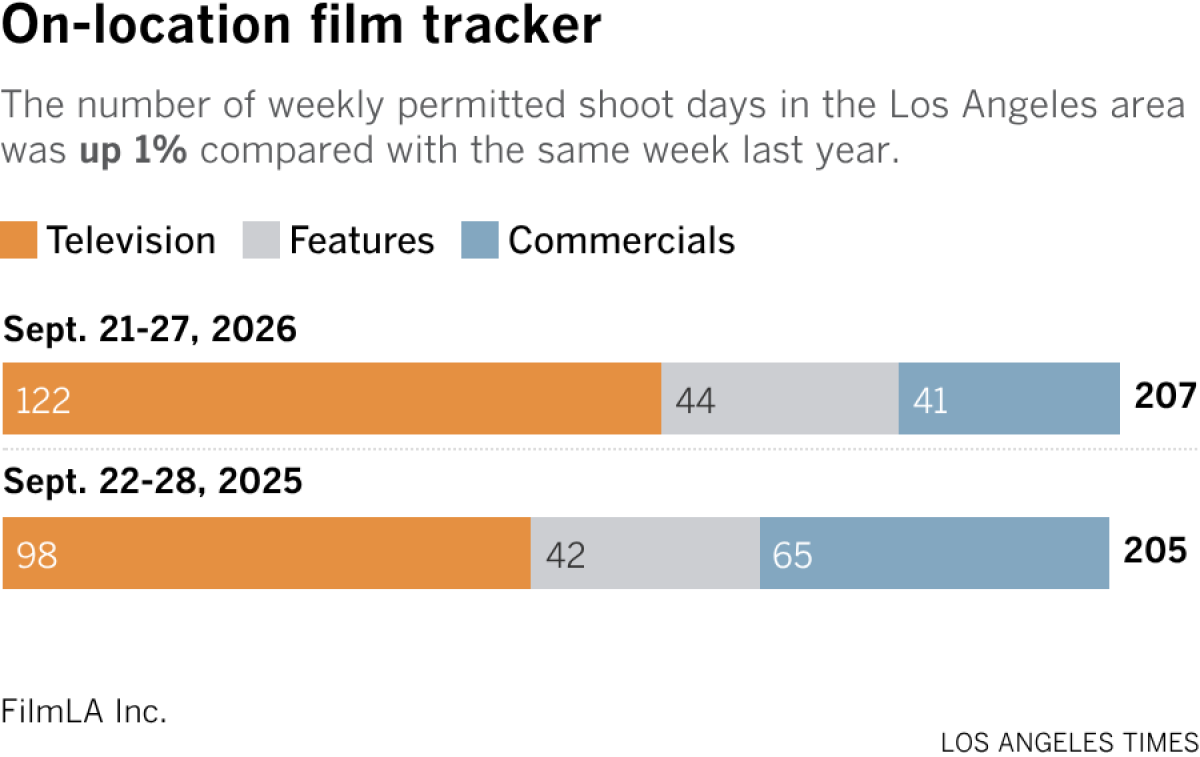
Film shoots

Number of the week

two hundred and seventeen million dollars

Lionsgate’s “Michael” had a massive opening weekend with just over $217 million in global box-office revenue. In the U.S. and Canada, the Michael Jackson biopic hauled in about $97 million, far surpassing studio expectations.

The film, which stars Jackson’s nephew, Jaafar Jackson, as the late singer, chronicles the pop star’s rise from his early days in the Jackson 5 through the growth of his solo career. The movie ends in 1988 while Jackson is on tour for his hit album “Bad.”

The premiere for “Michael” marks the biggest domestic opening for any biopic, musical or otherwise. The 2015 movie “Straight Outta Compton” previously held the record for highest opening weekend total for a musical biopic, with $60 million in the U.S. and Canada, followed by the Queen biopic “Bohemian Rhapsody” in 2018, which had a $51.1-million domestic opening.

Critics’ reviews of “Michael,” however, were largely negative. Many noted the plot sidesteps the child sexual abuse allegations against Jackson and said the film presents a more one-dimensional view of the singer.

An earlier cut of the film did end in 1993 and addressed the allegations, but that ending had to be scrapped due to a clause in a legal settlement with an accuser that stipulated he could never be pictured or mentioned in a dramatization of Jackson’s life. Jackson and his estate have denied that the pop star abused children.

What I’m watching

I finally finished the Hulu series “Paradise” this last week, which kept me guessing about literally everything all the way until the end. I’m interested in seeing where this genre-morphing show goes next season.

Source link

David Ellison faces plenty of Hollywood skeptics. Did he win over movie theater owners?

Amid the bustle and glitz of last week’s CinemaCon in Las Vegas, one question loomed over the annual trade convention — how will the proposed Paramount Skydance-Warner Bros. Discovery deal affect the movie theater business?

That anxiety showed up in a state of the industry speech from Cinema United trade group President Michael O’Leary, who reiterated his organization’s opposition to further industry consolidation.

It showed up in a trailer for Amazon MGM Studios’ upcoming film “Spaceballs: The New One,” when a voiceover poked fun at Hollywood studios “merging willy-nilly” as images of the Paramount sign and Warner Bros. water tower flashed across the screen.

And the subject again took center stage — literally — when Paramount Chief Executive David Ellison himself gave a speech during his studio’s presentation at Caesars Palace. He sought to reassure the assembled movie theater operators and exhibition executives that the combined company would indeed release a minimum of 30 films a year.

You’re reading the Wide Shot

Samantha Masunaga delivers the latest news, analysis and insights on everything from streaming wars to production — and what it all means for the future.

“I wanted to look every single one of you in the eye and give you my word,” he said during an onstage speech, in which he also committed to a 45-day theatrical window and 90-day period before films go to streaming services. “People can speculate all they want, but I am standing here today telling you personally that you can count on our complete commitment. And we’ll show you we mean it.”

It’s true that Paramount has nearly doubled its theatrical releases since Ellison took over. As he noted in his speech, the storied studio is now planning 15 films this year, up from eight in 2025.

But as I’ve written previously, theater owners and other studio executives question how releasing 30 movies a year across the combined Paramount-Warner Bros. would work — not only in terms of giving each film the proper marketing campaign to succeed in theaters but also because of the massive cost cuts that will inevitably occur once the merger is final.

Still, Ellison’s commitment to 30 films a year got a round of enthusiastic applause — and at least one high-profile boost.

A day earlier, AMC Entertainment Holdings Inc. Chief Executive Adam Aron told me in an interview that he backed Ellison’s takeover of Warner, saying he and AMC believed in the tech scion’s talent as a filmmaker and a movie executive, as well as his pledge to release those 30 films a year.

“We’re enthusiastic that David will fulfill his promises,” Aron said. “And that in the end, this will prove to be a good thing for our company and our industry.”

Not everyone shares that enthusiasm.

More than 4,000 people have now signed an open letter opposing the Paramount-Warner deal, arguing that consolidating two studios will lessen consumer choice and job opportunities for creatives, particularly at a time when Hollywood is already struggling. (Notable signatories include “Dune” director Denis Villeneuve, actors Glenn Close and Emma Thompson, as well as director and producer JJ Abrams.)

O’Leary of Cinema United similarly wasn’t convinced.

“While recent pledges attempt to address the threats of consolidation to our industry, they are not yet sufficient in addressing our concerns,” he said in a statement released hours after Ellison’s speech. “We remain open to tangible commitments that will ensure a vibrant global theatrical exhibition industry for years to come.”

Elsewhere at CinemaCon, the mood was upbeat.

Warner Bros. film chiefs Mike De Luca and Pam Abdy struck a triumphant tone after an award-winning year for the studio, capped off by the best picture win for “One Battle After Another.”

They unveiled footage from new films like the upcoming “Digger” from director Alejandro G. Iñárritu and brought out lead actor Tom Cruise to a sustained standing ovation from the audience. And both De Luca and Abdy espoused optimism for the future of the theatrical business. The studio plans to release 14 films this year and as many as 18 for 2027.

“The film business has always required smart betting, and we have 4 billion reasons from last year to think we’re holding the right cards,” De Luca said during the presentation, referring to the studio’s worldwide box office revenue last year.

“We all know they’re not all going to work. That comes with taking swings,” Abdy said of the studios’ films. “There’s no version of this business that’s risk-free. But our job is to step up, make our bets and own it when it doesn’t work.”

But the end of the presentation felt more somber, with the executives asking the heads of Warner Bros.’ labels to come to the stage and be recognized. Shortly after, they asked Warner Bros. employees in the audience to stand for applause. It was hard to escape the feeling that this may be the end of an era.

Stuff We Wrote

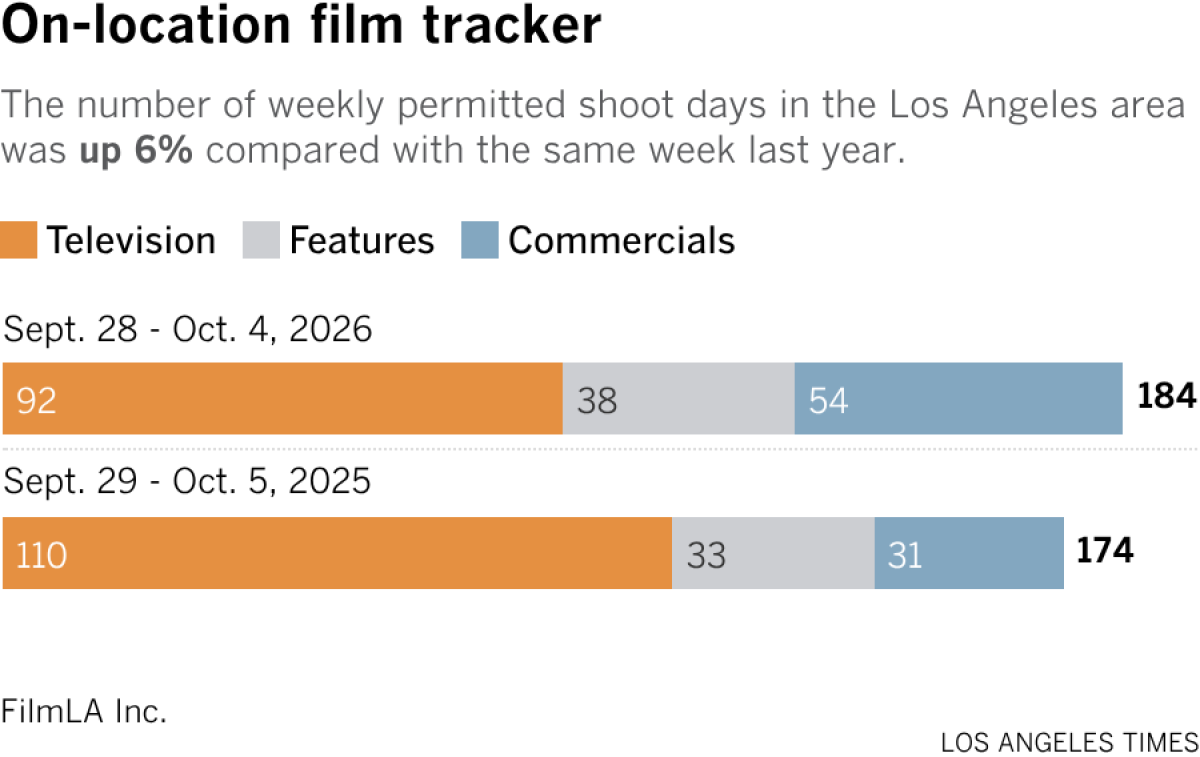
Film shoots

Number of the week

1,000

Last week, Walt Disney Co. began a sweeping round of layoffs that’s expected to cull 1,000 jobs across multiple divisions.

As my colleague Meg James reported, the cuts hit Disney’s television and movie studios, sports giant ESPN, its product and technology unit, corporate functions and marketing. Even Marvel Studios’ visual development team was affected.

The layoffs are one of the first major moves under new Disney Chief Executive Josh D’Amaro, who took the reins of the company last month. In a message to employees, he said the company needed to “constantly assess how to foster a more agile and technologically-enabled workforce to meet tomorrow’s needs.”

What I’m watching

Some friends and I watched “Fukushima: A Nuclear Nightmare” this past weekend, a truly eye-opening documentary that explains what happened during the March 11, 2011, nuclear accident and whether the world has learned anything from it.

Source link

Will 2026 be the long-awaited rebound for movie theaters?

It has been just one day at CinemaCon in Las Vegas, and there’s already a palpable sense of relief in the air.

Attendance at this year’s show is up about 5% from last year, according to Cinema United, the trade group that organizes the four-day convocation of thousands of movie theater owners, studio executives and industry folks at Caesars Palace.

Groups of people wearing orange-colored lanyards are everywhere throughout the hotel and casino, with many filling the Colosseum on Monday afternoon for a presentation from specialty film companies Angel Studios, Sony Pictures Classics and StudioCanal.

“The energy in every room reflected a sector that believes deeply in its own future,” said Stephanie Silverman, owner of the Belcourt Theatre in Nashville who serves on Cinema United’s strategic planning committee. “For independents, that sense of collective purpose is powerful — we’re not just holding on, we’re building toward something real and lasting.”

Amid such upbeat sentiment, CinemaCon allows theater owners and their business partners to see what’s coming from each studio and get a snapshot of the year ahead.

You’re reading the Wide Shot

Samantha Masunaga delivers the latest news, analysis and insights on everything from streaming wars to production — and what it all means for the future.

On Monday, Provo, Utah-based Angel Studios showed footage from their upcoming film “Young Washington,” about the early life of the first U.S. president, as well as a trailer from an animated retelling of George Orwell’s “Animal Farm.”

“Theatrical isn’t fragile,” Shelley Schulz, vice president of domestic theatrical sales and exhibitor strategy at Angel Studios, said during the presentation. “It’s not fading. It’s evolving.”

European indie film studio StudioCanal also unveiled some of its upcoming films, including scenes from a new animated “Shaun the Sheep” movie that got laughs from the audience, before bringing out director Danny Boyle to applause and cheers to speak about his new film “Ink,” about the beginnings of the British tabloid “The Sun.”

Later this week, Warner Bros., Universal, Amazon MGM, Paramount and Disney will unveil footage from their upcoming releases and likely bring their major stars on-stage to build excitement about this year’s slate.

As I reported Monday, a string of recent hits like Amazon MGM Studios’ “Project Hail Mary” and Universal Pictures, Nintendo and Illumination’s “The Super Mario Galaxy Movie” have pushed year-to-date domestic box office revenue about 23% higher than the same time last year.

The upswing signals that the exhibition business is embarking on its long-awaited recovery from the devastating downturn that occurred in the aftermath of the pandemic.

Studio executives and theater operators chalk up the improved prospects in part to a better and more plentiful crop of bankable movies that are bringing people back to the multiplex.

Exhibitors feel better about the lineup this year — it’s full of major franchises like “Star Wars” and Marvel superheroes as well as well-known animated titles such as “Toy Story 5” and “Minions & Monsters.” Also coming are anticipated films from acclaimed directors Christopher Nolan and Steven Spielberg.

“We’re getting into that cadence we needed in terms of having good movies, different types of movies being released every weekend,” Cinépolis USA Chief Executive Luis Olloqui told me ahead of CinemaCon. “This year in general, we’re feeling more confident, more optimistic.”

It’s quite the turnaround from the anxiety I heard last year leading into CinemaCon, when theater owners grappled with the box office downturn and the general shakiness of the industry.

Not to say that this year is all roses.

As I wrote, there are still major question marks facing the industry, including how Paramount Skydance’s proposed acquisition of Warner Bros. Discovery will affect the business. Paramount Chief Executive David Ellison has said the combined company will release 30 films a year, but exhibitors fear that cost cuts from the deal could impede that goal, which many believe is unrealistic.

And Hollywood is still going through a painful retrenchment.

Just last week, Sony Pictures Entertainment said it would cut hundreds of jobs across its film, TV and corporate divisions. Then came the news about upcoming layoffs at Disney, which could number as many as 1,000.

It hasn’t been much better in the exhibition space, either. In February, Dallas-based Look Dine-In Cinemas abruptly closed three Southern California locations; then, in March, the iPic chain filed for Chapter 11 bankruptcy protection and said it planned to pursue a sale of its assets.

A better box office this year wouldn’t solve all of these problems, but it would inject more hope into an industry that has been in turmoil since the pandemic.

Stuff we wrote

Film shoots

Number of the week

eight hundred eighty-seven million dollars

Warner Bros. Discovery Chief Executive David Zaslav could get as much as $887 million to leave the company after the Paramount Skydance acquisition.

That amount “represents one of the highest golden parachute estimates ever observed,” investor advisory firm Institutional Shareholder Services wrote in a recent report. The firm said support for the proposal “is not warranted.”

Warner shareholders will vote April 23 on the proposed takeover.

What I’m watching

For years, one of the shows on my weekly must-watch list is “Ghosts,” the delightful comedy about a couple who moves into a historic mansion haunted by its previous inhabitants. After a long week, the antics of Viking ghost Thorfinn always make me laugh.

Source link