pandemic

LeBron, Austin and Ayton: Lakers roundtable on the biggest offseason questions

Welcome back to The Times’ Lakers newsletter, where we’re calling in reinforcements for the home stretch of the NBA season.

The Finals begin Wednesday. All but the New York Knicks and the San Antonio Spurs are left to reckon with their rosters from the sidelines. Some of the recently eliminated teams have major decisions that could affect the market for the Lakers, who, I’m sure you know, are facing some huge roster questions. To break down the offseason, I sent the bat signal out to some of my favorite co-workers for their thoughts.

All things Lakers, all the time.

Get all the Lakers news you need in Thuc Nhi Nguyen’s weekly newsletter.

What say you?

Joining me at our virtual roundtable are Los Angeles Times reporters Broderick Turner and columnists Bill Plaschke and Mirjam Swanson. With an assist from our assistant editor Dan Loumena, we examine the upcoming offseason.

The biggest question facing the Lakers: Re-sign LeBron James, let him walk as a free agent or hope he retires?

Nguyen: LeBron deciding to retire would definitely make things simpler for the Lakers, but nothing about this franchise can be simple. With how the season ended and the way he played, it feels unlikely that he would walk away at this point. It’ll come down to the money. This free agency class is not very strong. A soon-to-be 42-year-old could be the best of the bunch. But if the Lakers are on the hook for something close to what James made last year, building out the rest of the roster seems untenable. At the right price, he still feels like a player who could help the Lakers.

Plaschke: There is no “right price” for the Lakers and LeBron. He’s still one of the best players in the game, and he’ll demand to be paid like it, but the Lakers aren’t going to want to pony up. Not for a third option. Not for a 42-year-old consistent injury threat. And not for a guy who, if they give him what he wants, they’ll have no chance to begin building what they want, which is a championship. Bring back LeBron James? Pass.

Swanson: There absolutely is a right price — for the Lakers. Will that be the right price for LeBron? What if a low-low price of $20 million-ish would do it? Higher than the mid-level but far less than he’s used to? I think there’s a world where the Lakers can make a $20-million to 30-million pay cut make sense for LeBron — and I think he’s waiting to see if they can do it.

LeBron is such a Rorschach test because everyone hears what he says and so many of us perceive it differently. What I heard when he spoke about his future on the recent “Mind the Game” podcast was A) not someone who’s lost his love for the game, B) someone who really enjoyed last season’s Lakers team, C) someone who’s L.A.-lifestyle-loving family is going to have a lot of sway in this latest Decision and D) someone who was letting it be known that he isn’t making the call until “late-June into August,” by which time the music will have all but stopped on the NBA’s annual musical chairs number.

I take that to mean that LeBron is going to sit back and see what the Lakers do with the money they’re going to be reallocating to other players and whether it brings them closer to contention. If they do that, I think he comes back for another hurrah for substantially less — and they should want him! He’s not only one of (if not the) best players of all time. He was still a massively productive player at 40 and 41. He led the Lakers to a playoff series victory against Houston and was their most dependable player on the court for much of the Oklahoma City series in which they were otherwise completely overmatched.

Turner: Let’s be clear first: LeBron is one of the best free agents in a market that is not strong this offseason. That, alone, puts the Lakers in a precarious situation, because they know it’s a weak market and so do James and his representatives. James’ asking price and what the Lakers are willing to pay him will be the test for both sides. It’s called negotiations and James and his people already are letting the media machine suggest James wants the same $52.3 million he earned last season again. Or if not, James, rightfully, wants to know how the Lakers will build their team if he does take a pay cut. He proved his worth again in the playoffs, leading the Lakers past the Houston Rockets with Doncic out and Reaves playing in just two of those games. The Lakers will have to pay The Man.

Austin Reaves is expected to opt out of his contract to enter unrestricted free agency. The Lakers can bring him back for up to five years and $241 million. Other teams can sign him for up to four years and $178 million. What should the Lakers do?

Austin Reaves controls the ball during the first half of Game 6 against Houston.

Austin Reaves controls the ball during the first half of Game 6 against Houston.

(Ashley Landis / AP)

Plaschke: Bring back AR. He got batted around a bit in the playoffs, but he was trying to return too soon from his oblique injury. Judge him by his entire body of work, which meshes perfectly with Luka’s body of work. Give AR what he wants. Bring him back.

Swanson: Unless the Brooklyn Nets or Atlanta Hawks or Memphis Grizzlies want to massively overpay, Austin is coming back. He loves L.A. and L.A. loves him back. But I don’t think anyone thinks Austin is going to get $240 million from the Lakers, it’s more likely going to be a five-year, $200-million deal — that extra year the Lakers can offer being the sweetener in any potential bidding war.

And the Lakers shouldn’t overpay him, because they need to make sure he’s on a tradeable contract — in case they can’t figure out how to overcome Austin’s and Luka’s redundancies as defensively suspect shot-makers. Or if his toughness doesn’t override his unfortunate susceptibility to injury. Or if uneven playoff performances in the future put a lid on the Lakers’ postseason potential. You know, just in case.

Turner: He wants to return and the Lakers want him back. At what price is the question. Reaves earned $13.9 million last season and has a player option for next season at $14.8 million. He’s going to bet on himself and decline that option for a bigger payday. At the very least, Reaves will earn $40 million or more per season. The Lakers know a few teams have their eyes on Reaves. Reaves and his representatives know they can get up to five years and $241 million from the Lakers, and that’s what they want.

If the Lakers and LeBron do not come to an agreement, what other options do they have via trade or trying to sign a star?

Nguyen: The Lakers are trying to remodel the roster to fit around Luka Doncic, which means they need shooting, defense and a perfect pick-and-roll partner. Despite lingering hamstring injuries, Denver’s Peyton Watson, who is a restricted free agent, was an intriguing name, especially with a potential homecoming for the former UCLA Bruin. Detroit’s Jalen Duren is a restricted free agent and coming off an underwhelming postseason run, which could complicate negotiations for the third-team All-NBA player. If Cleveland is willing to part with one of their big men after getting swept out of the Eastern Conference finals, maybe the Lakers could lurk around for a big trade. Come draft night, the Lakers have three first-round picks available to trade: 2026, 2031 and 2033.

Swanson: The Lakers need to target stars in their roles. Most of those guys Thuc Nhi mentioned would be good — though Duren’s playoff nosedive would make me not want him at his going price. For the Lakers, it’s: Shooters wanted, defenders wanted, ATHLETES wanted. Think the New Orleans Pelicans’ Trey Murphy or maybe Herb Jones. And bring back Rui Hachimura, a big-bodied shooter who we trust in the clutch. Build Luka a suitable army, as much as possible, with the cap space and draft picks they’ve been saving for this offseason.

Turner: Here’s the thing: The Lakers can re-sign LeBron and AR and still use the mid-level exception that will be about $15 million to sign a free agent. Denver’s Peyton Watson is a name that has been attached to the Lakers. The problem is he is a restricted free agent and the Nuggets can match any offer he receives. Also, if the Lakers make him an offer, the Nuggets have 48 hours to make a decision. During that waiting period, the Lakers would have cap space tied up and could lose out on other free agents. But word around the NBA is that the Nuggets will shed some salaries so they can pay Watson because they need young, athletic wings.

Then there’s the Deandre Ayton situation. Can the Lakers upgrade at center?

Deandre Ayton defends against Oklahoma City Thunder guard Luguentz Dort during the playoffs.

Deandre Ayton defends against Oklahoma City Thunder guard Luguentz Dort during the playoffs.

(Kyle Phillips / Associated Press)

Nguyen: It feels likely that Deandre Ayton will be back on his player option. It’ll be hard for him to get anything better on the open market. But the Lakers definitely need more out of that position. If he comes back with Luka and Austin, “run it back” is starting to give “running in circles” while Oklahoma City and San Antonio run circles around everyone else in the West.

Plaschke: DA is going to take the Lakers’ money, so this feels like a moot point. A better question is, how can they get rid of him once he’s back? His motor doesn’t run at 100% all the time, and at this level, that is inexcusable.

Swanson: Yeah, DA proved he is who we all thought he was: A great talent with wavering focus. But remember, he’s not taking very much of the Lakers’ money; dude is on an $8-million contract. Together he and [Jaxson] Hayes make close to $13 million. Considered the price tag, the Lakers actually got a lot of bang for their buck.

Now, can either of those guys stop Wemby? Of course not. Can anyone on the planet, though? Uh, no. So, sure, the Lakers could spend big to upgrade at center, but it wouldn’t make much of a difference. They’d be better served to save money in the post — and potentially on LeBron — and spend it on wing defenders and shooters, which is where they can hope to counteract the top teams.

Turner: DA underperformed most of the season and was even less impressive in the playoffs against OKC. Teams are not lining up to get him, so he’ll probably pick up his player option of $8.1 million next season. Portland center Robert Williams is an unrestricted free agent that, when healthy, is an upgrade if the Lakers look his way. He earned $13.3 million last season and the Lakers could use the mid-level exception to entice him. He’s a really good defender and the sort of lob threat that Doncic loves to have on his team.

Favorite thing I ate this week

A Vietnamese bar spread.

A Vietnamese bar spread: Salt and pepper chicken (top left), salt and pepper tofu (bottom left), baby clams with shrimp chips and sesame crackers (center), Vietnamese BBQ pork skewers (top right) and mango salad (bottom right).

(Thuc Nhi Nguyen / Los Angeles Times)

When I was growing up, my parents had an open door policy. Family members dropped by basically unannounced on random weekdays after work or weekend afternoons to sit around our table, share a few drinks and snack on some bites. In Vietnamese, we call it “nhậu.”

It means “to go drinking,” but just as important as the cold beer is the spread of snacks that kept my uncles and aunts drinking, laughing and hanging out for hours together.

You don’t need a reason to nhậu. You just need friends, food and beer. While my friends helped stock the fridge with drinks this week, I shared some of my Vietnamese favorites. We grazed on salt and pepper chicken, salt and pepper tofu, baby clams with shrimp chips and sesame crackers, BBQ pork skewers and mango salad. It was just like Vietnam except without the oppressive humidity.

In case you missed it

Luka Doncic invests in purchase of Italian basketball team with eye on NBA Europe

Shaikin: For Dodgers, getting to playoffs is not good enough for Mark Walter. For Lakers?

Lakers layoffs part of sweeping changes to business operations

Swanson: NBA’s anti-tanking draft reform might be great for Lakers but is bad for basketball

Lakers hire former Pelicans executive Rohan Ramadas amid front office expansion

Firing Jason Kidd removes the last reminder of the Luka Doncic trade from Dallas

A new board game mocks Shai Gilgeous-Alexander for ‘foul baiting.’ He wants it destroyed

‘Bonkers’ bribery case raises questions about why NBA star Terry Rozier would allegedly risk millions by participating

Until next time…

As always, pass along your thoughts to me at thucnhi.nguyen@latimes.com, and please consider subscribing if you like our work!

Source link

Amazon’s AI boss on the primacy of humans in a changing Hollywood

At the AI on the Lot media conference last week in Culver City, speakers laid out a view of artificial intelligence that was very much complementary to human workers.

Artificial intelligence is a tool that must be wielded by humans, several said. The idea was to help skilled artists and production specialists do their jobs and experiment, others said.

Of course, to many in Hollywood, AI is not that simple.

Guardrails on its usage emerged as a central issue in the 2023 writers’ and actors’ strikes, and additional rules were added in the recent Screen Actors Guild-American Federation of Television and Radio Artists and Writers Guild of America contracts. There are still big questions about AI’s effect on jobs in the entertainment business, as well as copyright and ethical concerns.

Whether it’s good or bad or some combination of both, AI, in some form, is probably here to stay.

So, eight months ago Amazon MGM Studios opened an AI Studios division to start work on Project Nara, an AI production toolkit built on Amazon’s AWS cloud computing platform that could be used by teams of filmmakers. Project Nara is still in beta mode, and the company set up a GenAI Creators’ Fund to give filmmakers interested in using the toolkit financial support, while also giving the studio feedback.

The beta testers got eight weeks to produce an animated short and, out of those, the company greenlighted three animated series.

Shortly after the conference, filmmaker Jorge Gutierrez, whose stop-motion-style “Punky Duck” was chosen as one of the greenlighted series, pulled out after an online backlash over his use of AI.

You’re reading the Wide Shot

Samantha Masunaga delivers the latest news, analysis and insights on everything from streaming wars to production — and what it all means for the future.

“We respect Jorge’s decision, as well as his incredible talent, his voice and the world he created with ‘Punky Duck,’” an Amazon MGM Studios spokesperson said in a statement. “We continue to be excited about the innovative work moving forward at our studio and the GenAI Creators’ Fund.”

Before the flap over “Punky Duck,” I spoke with Albert Cheng, head of Amazon MGM Studios’ AI Studios, about the goal of the division, what’s next for AI and his belief that humans are at the center of creativity. The conversation has been edited for length and clarity.

Why was AI Studios formed?

AI Studios was started last fall because we wanted to learn how to leverage AI technology to build tools that would help enhance or redefine the workflows for film and TV production.

When you look at the horizon of what it takes to drive continued engagement of a global streaming service like Prime Video, we need more original programs. So if you can figure out how we take the same amount of money that we spend and be able to make more shows, that’s ultimately what we want, and we think AI is going to be a help to drive that.

With AI, now we’re looking at how does technology change the way we actually create our cinematic storytelling? It could mean that with AI, we will hear from a lot more voices. If we can actually get the biggest costs down, we will be able to have more voices, be able to take more risks and creative risks most of all.

There’s always concern about what does AI mean for jobs. We believe that it actually creates more jobs and different types of jobs. In fact, people with experience, plus the tools, become even more valuable in terms of their ability to produce excellent quality work. So it’s always about the human behind it.

You mentioned that some of these production crews had more than 100 people, but crews in the past would have been much larger. How do you respond to concerns about that?

You may have smaller crews, but we’ll do more of them [productions], and more in a short period of time. When you actually have smaller productions and you do more of them, you’re increasing your throughput. Your turnover rate of the available jobs is much faster, so your job totals are actually going to be bigger.

You spoke about the idea of AI filmmaking bringing jobs back to L.A. and expanding California’s production incentive eligibility to include AI-assisted filmmaking. Can you elaborate on that?

When you look at AI production, it can be done on a soundstage. We don’t need to go to London, we don’t need to go to other places.

We do have technology companies in California that are driving this, we have people here in the city that have experience, if given the AI tools, can produce great work. So, how can we not incentivize more companies to use our soundstages and finally make productions and make more of them?

Have you or anyone else at Amazon spoken with government officials about this idea of expanding the incentive criteria?

We’ve been talking to a number of bodies about whether it’s possible. The question is, who’s going to take the ball?

How much can you decrease a show’s production budget by using AI?

I think we can get a show to half the cost, [or] to almost a fifth of the cost.

What was the thinking behind the GenAI Creators’ Fund?

We wanted to provide a support and invest in creators who wanted to try it, and then also give us feedback.

We also wanted to show that storytelling is the thing that drives the content. It’s not the technology; the technology just enabled them to make it.

What is the biggest misconception of AI use in production?

There’s a narrative that AI can do so many things by itself, that you don’t need people. That’s absolutely not true. It’s just a technology, it can’t make decisions.

In order for something actually quality to be made, a person actually needs to be behind that, and that’s been proven over and over again. People are still responsible for the output.

Stuff We Wrote

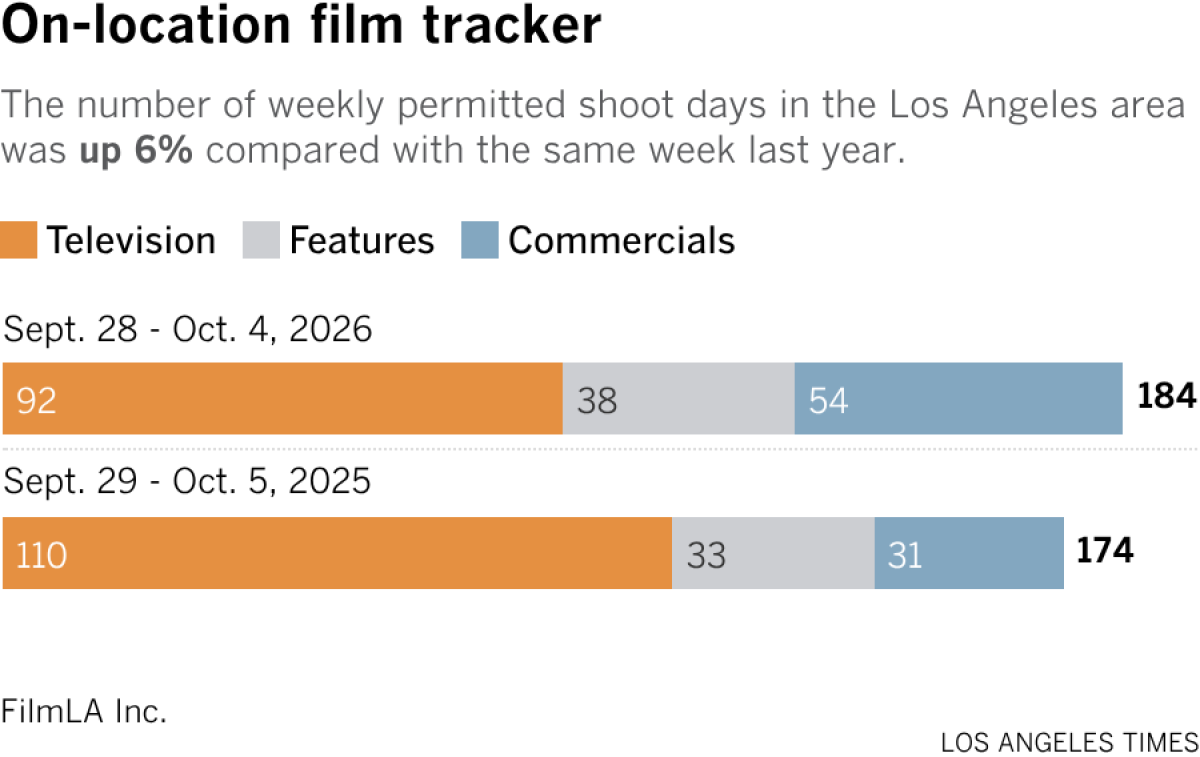
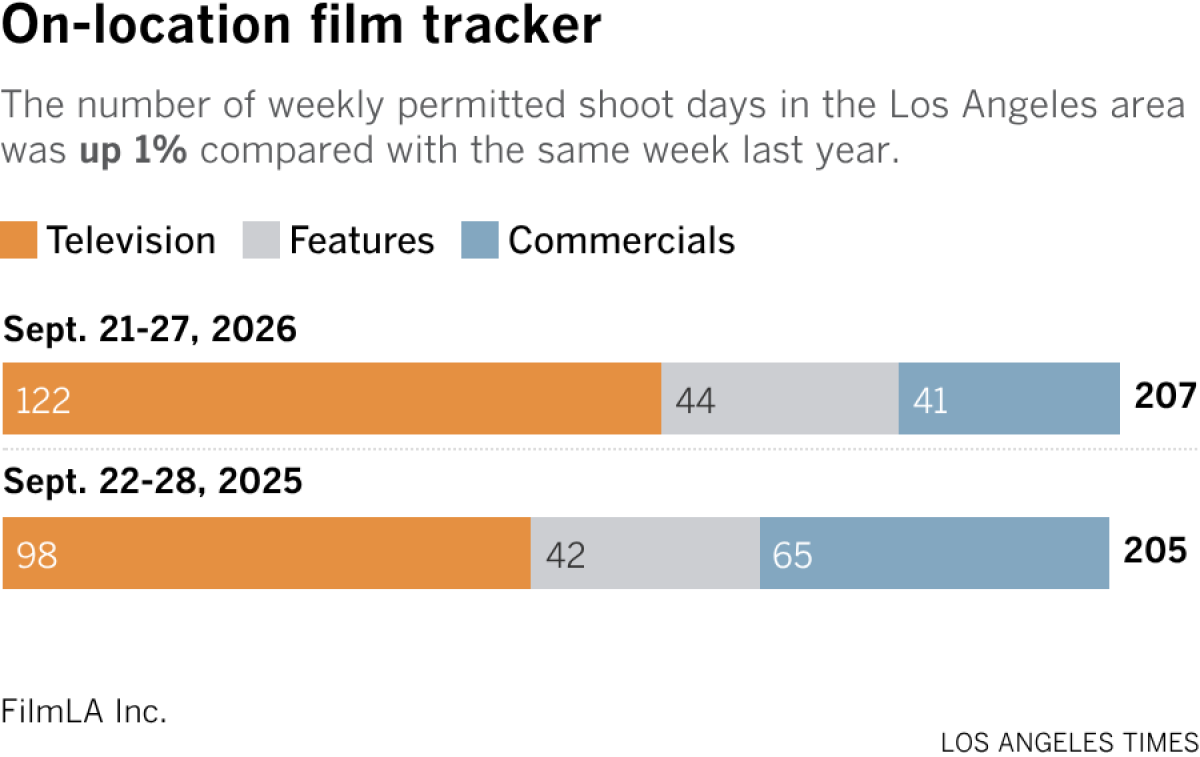
Film shoots

Number of the week

eighty-one point four million dollars

Internet culture drove the box office over weekend, with A24’s “Backrooms” hauling in $81.4 million in the U.S. and Canada.

The $10-million horror flick, which stars Chiwetel Ejiofor as a furniture store owner who finds a mysterious portal in his basement, was directed by 20-year-old YouTuber Kane Parsons and is based on his online series of the same name. Worldwide, the film made nearly $118 million in its debut weekend.

Focus Features’ “Obsession” also had a big weekend with a 10% jump in domestic box-office revenue in its third outing. The horror movie, which had a production budget of less than $1 million, was directed by Curry Barker, who also built his reputation on YouTube.

Together, the two films highlight the growing power of YouTube — and online culture as a whole — on the big screen. They beat out franchise film “Star Wars: The Mandalorian and Grogu,” which dropped 69% from its debut last weekend to rank third at the box office.

What I’m watching

I’m just one episode away from finishing this season of “Bridgerton” on Netflix. While I liked that the show dived into the social class dynamics behind Benedict and Sophie’s romance, I have to say that I loved the secondary focus on Violet Bridgerton and Lord Anderson finding a second chance at love.

Source link

Seth Rogen on comedy, money and all those awards

It’s been a big year for Seth Rogen’s Point Grey Pictures.

The 15-year-old production company founded by Rogen, his childhood friend and longtime collaborator Evan Goldberg and producer James Weaver is coming off a huge awards season for its comedy, “The Studio.”

The Apple TV series, which simultaneously pokes fun at the institutions of Hollywood while also peeling back some of the industry’s mystery, is now the most-awarded new comedy in TV history.

“The Studio” has won 13 Emmys, a BAFTA TV award in the international category, two Golden Globes and three Critics Choice awards. It’s currently filming its second season, with most details still under wraps.

I spoke with Rogen, Goldberg and Weaver about the success of the show, which primarily films on the Warner Bros. lot, and what’s next for Point Grey.

On all those awards?

“We’ve never, literally, won any awards before this, so I by no means expected this,” Rogen said, with a chuckle. “I hoped people would creatively recognize that we were really swinging for the fences, but awards were not really something that I was thinking that much about.”

In the show, the Canadian actor and comedian plays beleaguered movie studio head Matt Remick, who must balance the art of filmmaking with the economics of the business. In a nod to Hollywood’s pull toward intellectual property, one storyline focuses on the studio embarking on a movie about the Kool-Aid Man, which Rogen’s character only reluctantly agrees to pursue.

It’s not all about the money

“To me, what is interesting, and what people don’t seem to think about Hollywood, is that the people involved in it actually care about movies, even the ones who make bad ones, even the ones who make choices that stop good ones from being made,” Rogen said. “If you really just wanted to make money, there are much easier ways to make money where you don’t have to deal with people like me.”

He also noted that there’s a role for movies such as the fictional Kool-Aid flick.

“You could argue it’s the Kool-Aids of the world that keep theaters open,” Rogen said. “It’s our fake Kool-Aid movie that allows smaller movies to exist and allows theaters to take risks on smaller movies.”

Remembering comedy

“The Studio” also stemmed from a desire to make a pure comedy, despite the tough time comedies have had recently in the marketplace.

“We just all agreed that we wanted to make something that was just funny,” Goldberg told me. “It just felt like the world stopped making those, and we just wanted to make something that when you tuned in, was just absolutely hilarious.”

A serious L.A. business

Los Angeles-based Point Grey, which has 15 employees, is named for the Canadian school where Rogen and Goldberg met (the first project they wrote together, which became 2007’s “Superbad,” was based on their experiences there). Despite their comedic reputations, the more serious-sounding company name was deliberate so it could be used with any kind of project.

In fact, the company got its start with the Joseph Gordon-Levitt-led dramedy “50/50” about a 20-something who learns he has cancer. Over the years, Point Grey’s projects have spanned genres, including supernatural series “Preacher,” 2016’s “Sausage Party,” the satirical superhero show “The Boys” and biographical mini-series “Pam and Tommy.”

A Point Grey project is “genuinely original” and “daring,” said Weaver, Rogen’s former assistant who now serves as president of the company, which has a first-look film deal with Universal Pictures and a first-look TV deal with Lionsgate. He declined to discuss financials but said the company is profitable.

“We’ve managed to be really productive in terms of the amount of things that we’ve made, and we try to be smart about how we run our financials,” Weaver said. “The company is doing quite well.”

Point Grey is in production on “Teenage Mutant Ninja Turtles: Mutant Mayhem”; just wrapped a romantic comedy for Amazon MGM Studios starring Cameron Diaz and Stephen Merchant; and recently screened an animated film at Cannes called “Tangles” that’s based on a graphic novel about Alzheimer’s.

The production company may eventually expand into video games (“We love video games,” Goldberg told me), and plan to continue to navigate the changes in Hollywood, which is reeling from a continued drought in local production that my colleague Stacy Perman and I wrote about recently.

“Personally, I feel like people are very fatalistic about the trajectory of the industry, but it’s not like the industry is going down, the industry is just changing,” Goldberg said. “We just are very flexible and embrace the change, and hopefully in doing so, we don’t get left behind.”

Stuff We Wrote

Number of the week

one thousand eight hundred and ten

After 1,810 episodes as the host of “The Late Show,” Stephen Colbert signed off for the final time Thursday.

CBS has said it canceled Colbert because the show was losing $40 million a year as viewers have increasingly migrated away from late-night viewing in the streaming era.

But many in the TV business are skeptical of the claim and believe Skydance wanted to silence Colbert, a frequent Trump critic, to pave the way for its deal last year to acquire parent network Paramount. (The Federal Communications Commission’s approval of the transaction came days after the show’s cancellation was announced.)

My colleague, Stephen Battaglio, has written about what the future of late-night TV talk shows will now look like.

What I’m watching

I watched the “Survivor 50” finale Wednesday with some friends, despite only watching two episodes this season (or ever). It was fun seeing the drama unfold, though I was, like everyone else, shocked at that “last twist” of Jeff Probst accidentally spoiling who lost in the final fire-making challenge.

Source link

Louise reveals she’s working on new music after being inspired by Madonna ahead of huge comeback tour

HER last tour in 2020 was cut short thanks to the Covid pandemic but now Louise is gearing up to go back on the road.

The Borderline singer will play five live shows as part of her Naked/Confessions tour next April, taking in cities including London, Birmingham and Manchester, with tickets on sale today.

Eternal’s Louise is gearing up to go back on the road
British pop group Eternal consisted of Vernie, Kelly, Easther & Louise Credit: Andrew Styczynski – The Sun

And in an exclusive interview to celebrate the announcement, ex-Eternal star Louise says she’s never felt so inspired after her last album Confessions became her fourth top ten record.

“I’m so proud of that album,” Louise tells me.

“That’s really what spurred me on to carry on writing.

“It taught me that it’s OK not to please everybody.

STAR’S GLASTO AIM

Superstar singer bidding to headline Glastonbury in 2027 after epic year


STAR GONE

Clannad singer and Enya’s sister Moya Brennan dies aged 73 as tributes pour in

“I’m enjoying the creative process of not worrying about if people might hate on it.

“Knowing that you just can’t please everyone.

“It’s all about the mindset and the confidence.

“I do think that comes with age as well.”

After saying yes to going back on the road, Louise reveals she’s learned the power of saying no — and was inspired by pop royalty Madonna.

“I am a big fan, I loved the show she did with Sabrina Carpenter. As a woman, for me, it’s about celebrating people and their achievements,” Louise says.

“I hated reading anything negative about that because for me, she is a genius. I’m at that stage where I’m trying to embrace everything and go with it, but I am also saying no.

“I just wrote a song about saying no and I love it.

Louise reveals she’s learned the power of saying no — and was inspired by pop royalty Madonna Credit: Rafael Pavarotti
Louise is a big fan of Madge Credit: Instagram

“The basis of the song is when you finally learn to say, ‘That’s not for me.’

“We all live in a world where we don’t want to say no to anything for a multitude of reasons.”

The tour, which kids off in Sunderland on April 8 next year, will see Louise picking her favourite tracks from her debut album Naked — which turns 30 in 2027 — and from Confessions for the set list.

And Louise — who will play The Mighty Hoopla festival in London next weekend — has promised to throw in some brand new tunes too.

Louise, who has scored nine Top Ten solo singles including 2 Faced and Pandora’s Kiss, adds: “I get that people will want the hits. It’s about celebrating Naked and Confessions — but I definitely will do new stuff on the tour.

“I don’t want to play it particularly safe.

“The one thing I have learned in this industry is that you have to keep changing.

“You have to keep finding new ways to motivate yourself. Whether that be music, what you’re wearing, the lyrics you’re writing.

“Now I know the lane that I’m in and I know what I want to do.”

Girls single minded

Remember Monday have today dropped the first single, Delusional Credit: Adam Brazier
Remember Monday with The Sun’s Howell Davies Credit: supplied

THEY have been together for over a decade, represented the UK at Eurovision and performed at Wembley Stadium.

Now, British girl group Remember Monday have given Bizarre’s Howell the exclusive that they’ve just completed work on their debut album in Prague – and have today dropped the first single, Delusional.

The trio, made up of Lauren Byrne, Charlotte Steele and Holly-Anne Hull first started work on the track two years ago, but only finished it last summer with the help of McFly’s Danny Jones and Dougie Poynter, after being introduced to them at the Capital Summertime Ball.

Lauren, who posed with her bandmates for the single artwork, said: “It feels like it was the first song that started the whole new era.

“After that session, it was like, this is the kind of music that we want to be working on now.”

Holly continued: “We just wanted to kind of hone in on our sound, really solidify what we want to say moving forward.

“I don’t know if we can say, but . . . well, we’re releasing an album.

“The sound that we’re going down is quite nostalgic. Like, we really love the Nineties rom-com energy of music.”

The group will support McFly on tour this summer.

They admit their path is not always easy given that they are independent artists without the financial backing of a major record label.

Referencing the title of their single, Charlotte said: “Our whole band is run and fuelled by delusion.”

Lauren added: “It’s weird to be around. But we do just talk about things as if they are happening regardless of whether we have the funds or contacts. We just speak it into existence.

“And it actually has worked. I don’t even know how we’ve got to this stage.”

It’s working so far ladies.

Good for you.

Too pretty for this ditty

Linda Perry wrote song Beautiful for Christina Aguilera Credit: Splash

SONGWRITER Linda Perry has revealed she almost turned down Christina Aguilera’s request for her song Beautiful after admitting she thought she was too pretty to sing it.

Linda wrote the track which ended up being one of Christina’s most enduring songs from her 2002 album Stripped.

Appearing on the Zach Sang Show, Linda said she played American star Christina, pictured at the Abbey’s 35th anniversary party in Hollywood, the track and explained: “She was like, ‘ I want that.’

“And I’m thinking, ‘No, you’re like, a hot chick. I’m not giving you this song. No way. Are you kidding me?”

It was only after Christina sang the track for Linda that she changed her mind, adding: “It broke the ice between the both of us when I saw that.

“That’s when I discovered beautiful people are actually insecure and just as damaged as I am.”

Sphere come all the Girls?

The Spice Girls aren’t interested in a quick nostalgia cash-in Credit: Refer to Caption

THE SPICE GIRLS might fancy zig-a-zig-ah-ing their way into a Las Vegas residency, but I’m told bosses at the Sphere aren’t interested in a quick nostalgia cash-in.

Insiders have confirmed bosses will only give the green light if Victoria Beckham, Melanie C, Melanie B, Geri Horner and Emma Bunton are all on board.

My Sphere insider said: “The Spice Girls would be a massive draw, but this couldn’t be done as a one-off or a short residency.

“The costs involved in creating a Sphere show are enormous. There’s special cameras, bespoke visuals and millions of dollars in production costs before a ticket is sold.

“They’d need all five on board and would want 40 to 60 shows.”

Last month Posh Spice teased that she was keen for the shows to go ahead, saying: “How good would the Spice Girls be at the Sphere? I love the idea of it.”

The venue, which has mind-blowing wraparound screens, has already hosted U2, The Eagles and No Doubt.


TREVOR NELSON was handed a top gong at last night’s Audio Academy Arias.

Rylan Clark hosted the bash at The Roundhouse in North London, which saw Radio 2 legend Trevor honoured with a Special Recognition Award.

He was handed the gong by my pal Craig David, who spoke about Trevor’s impact on the British music scene.

It was a great night for Radio 1 DJ Greg James too, with his Breakfast show landing the top prize in its category, while BBC Radio 6 Music’s Beth Ditto was handed Best New Presenter.


LOUIS TOMLINSON reckons there’s one man who could tempt him into a collaboration – fellow Doncaster star Yungblud.

Ex-One Direction singer Louis admitted he’s not keen on teaming up with artists for the sake of it, but working with the rock wild man would feel different.

Louis explained: “I really like his music and he’s from Doncaster, my hometown, I think that would make it even more interesting.”

But he joked that their might be a slight age gap issue.

Louis laughed: “I’d be the senior one in that conversation.”

Doncaster might be running the UK music scene soon . . . 


MY fellow Spurs fan AJ Tracey has joined talkSPORT as a World Cup pundit.

The Thiago Silva rapper will join footballer-turned-Strictly star Jimmy Floyd Hasselbaink and Burnley ace Kyle Walker on the station’s line-up for the big event this summer.


CRUZ BECKHAM And The Breakers lead the new music releases today with their catchy new single, Yeah, Yeah, Yeah.

DJ Sonny Fodera also drops his new tune, Let Me Be In Your Arms, ahead of his performance at Radio 1’s Big Weekend tonight.


LEGENDARY recording studio Abbey Road has announced its fifth annual Music Photography Awards.

This year’s judging panel is packed with music industry royalty, including Raye and Nile Rodgers.

Photographer to the stars, Rankin, is also on the panel ahead of the VIP ceremony on September 24.

Rankin said: “With another stellar judging panel joining us, I can’t wait to get stuck in and review the 2026 submissions. What are you waiting for?”
Submissions are open now.


Source link

Why fans obsess over the idea of a third park at Disneyland

Last week, news organizations and Disney bloggers learned that the Mouse House had filed building permits with the city of Anaheim related to a parking structure at Disneyland Resort.

That immediately sparked rumors about a third park — a long-held dream of Walt Disney Co. fans who want to see more rides, themed areas and Mickey-related shopping destinations.

But that will remain a dream — at least for the foreseeable future.

Anaheim city officials confirmed as much in an internal email about one of the news articles, noting to City Council members and the mayor that the permits were, in fact, for minor parking lot improvements within the existing Toy Story parking structure off Harbor Boulevard.

You’re reading the Wide Shot

Samantha Masunaga delivers the latest news, analysis and insights on everything from streaming wars to production — and what it all means for the future.

The email, which was reviewed by The Times, said the improvements were not related to an already-approved expansion of Disneyland Resort, or “what could ultimately be developed on the property in the future.”

A Disneyland spokesperson told me the permits are related to painting and striping at the Toy Story parking structure. So much for a third theme park.

It’s not the first time there’s been a hullabaloo about an additional park at Disneyland Resort.

In the early 1990s, there were serious talks about a Disneyland expansion called Westcot Center, a West Coast version of Walt Disney World’s Epcot in Florida. The plan at one point was to include three hotels, a public plaza and a number of retail, dining and entertainment options all around a central lake. At one point, both Anaheim and Long Beach were vying to be chosen as the site.

But that all collapsed in the mid-’90s amid financial concerns. Disney later built California Adventure, and briefly teased the idea of a third theme park complex with both a water park and amusement park that could complement the two-park resort. But that but never came to fruition.

The idea came up yet again about 10 years ago at an annual shareholders meeting in San Francisco, when former Chief Executive Bob Iger batted down speculation about a third park.

“We have plans at Disneyland for an expansion that we have not announced but those plans at the present do not include a third gate,” he said at the time.

More on that expansion later, but the truth is Disney simply doesn’t have enough land in Anaheim to build out a third theme park. I spoke with Len Testa, president of theme park travel site TouringPlans.com, who laid out the issues for me.

A third park would probably need a minimum of 80 to 120 acres of land to accommodate big new rides, as well as necessary behind-the-scenes facilities like employee break rooms and other back-of-the-house infrastructure.

“They’re landlocked,” he said. “And to acquire that land now in any way that would keep the campus centralized and avoid the logistics of a far-flung transportation network, that would be prohibitively expensive.”

That’s not to say that Disneyland Resort isn’t expanding on the land it does have.

Two years ago, Anaheim approved expansion plans for a project known as DisneylandForward, which will allow the company to build new attractions alongside shops, restaurants and hotels.

Development plans include a bigger Avengers campus with two new rides, as well as a “Coco” ride and “Avatar”-themed area in California Adventure, as well as a new parking structure.

Although it’s not a park, adding new lands and rides is “mission critical” for Disneyland Resort, Testa told me. After all, to drive attendance, you need to regularly open new attractions.

And these new rides can’t just be any old rides — they have to be “epic, mammoth blockbusters” that no one’s seen before, which takes time, space and money, he said.

Disneyland Paris is a good example. The European tourism resort saw a notable boost in attendance after it opened a World of “Frozen”-themed land in March.

“When you have that type of expansion and you can fill the park, you feel very, very good about that,” Disney Chief Financial Officer Hugh Johnston said last week at the MoffettNathanson media, internet and communications conference. “When we leverage our [intellectual property] and take that IP and build big new attractions, not little things … it’s these big new things that actually tend to just really bring in the consumers.”

That’s also key when you consider Disney’s growing competition from Universal Studios, which recently opened Epic Universe in Orlando and siphoned off some attendance from Walt Disney World.

And while the company’s TV and film business is vital, its theme parks still throw off most of the cash — new Disney CEO Josh D’Amaro recently called the parks the “physical centerpiece of the company.” And of course, they retain a deep link to Disney’s heritage.

As Walt himself noted, Disneyland is a “living” entity that would “never be finished.”

Stuff We Wrote

Film shoots

Number of the week

twenty-six point one million dollars

Lionsgate’s musical biopic “Michael” retook the top spot at the box office last weekend with a haul of $26.1 million in the U.S. and Canada.

The film, which chronicles the early career of singer Michael Jackson, has had remarkable staying power atop the charts since it debuted in late April. The film’s weekend revenue was down only 31% in North America compared with the previous weekend.

Overall, “Michael” has now made an estimated $703.9 million in worldwide box office revenue, with $421.1 million coming from international markets.

What I’m watching

Now that WNBA season is in full swing, I’ve been watching my L.A. Sparks and caught the game against the Toronto Tempo on Sunday. It was a rough game, but here’s hoping the Sparks can start turning things around, and quickly.

Source link

How the Lakers’ huge offseason revolves around Luka Doncic

Welcome back to The Times’ Lakers newsletter, where we’re not in Cancun just yet.

I fortunately have gotten some much-needed sleep during the week since the Lakers were eliminated, but NBA news never rests, especially during this pivotal offseason that could reshape the entire roster.

With almost half of the roster spots in flux, we’ll start with one player who we know will be back next season.

All things Lakers, all the time.

Get all the Lakers news you need in Thuc Nhi Nguyen’s weekly newsletter.

Luka Doncic fourth in MVP voting

He led the league in scoring but Luka Doncic finished a distant fourth in the most valuable player voting, which was announced Sunday before Game 7 of the Eastern Conference semifinals.

While Oklahoma City’s Shai Gilgeous-Alexander won his second consecutive MVP in a landslide, Doncic didn’t receive a first-place vote. Gilgeous-Alexander finished with 939 total points and 83 first-place votes. Nikola Jokic was second (634 total points, 10 first-place votes) and Victor Wembanyama was third (569 points, five first-place votes). Doncic, who had 250 total points, only had one second-place vote, and even fifth-place finisher Cade Cunningham had two first-place votes that contributed to his 117-point total.

This MVP discussion was one of the most competitive in recent memory. A fourth-place finish, especially without a single first-place nod, doesn’t quite do justice to how productive Doncic’s season was. He averaged 33.5 points, 7.7 rebounds, 8.3 assists and 1.6 steals per game. Despite playing without Doncic for the last month, the Lakers maintained a top-four seed in the competitive Western Conference and won 50 games for the second consecutive year. It was just the fourth time in the last 20 years that the league’s scoring champion didn’t receive a first-place MVP vote.

Some of the MVP race comes down to campaigning. Wembanyama, along with stellar play, repeatedly made his case during interviews. Doncic brushed off any chances to do the same.

Doncic preferred to let his play speak, but the message didn’t quite get through. During one of the most magical Marches in league history, Doncic dropped from second in NBA.com’s MVP ladder to fourth.

The season-ending hamstring injury on April 2 didn’t give him a chance to restate his case.

The more disappointing effect of the injury was that Doncic was not close to returning in time for the postseason, where he watched from the sideline as the Lakers got swept by the Thunder.

“It’s very frustrating,” Doncic said last week in his exit interview immediately after the season-ending loss. “I know some people wanted me back, but obviously I wasn’t close to clearing. … If I could be out there, I would be, 100%. Everybody in that room knows that. But it was very tough. Like I said, this is the best time to play basketball. I was sad not to be able to help my team.”

Doncic said he will not play for the Slovenian national team this summer while he prioritizes time with his daughters and recovering. His second daughter Olivia was born in December, and Doncic, who missed two games to be present for the birth, quietly managed a custody battle during the season after he and his former fiancee split.

The last 15 months have been tumultuous for Doncic, but he grew as a leader for the Lakers, coach JJ Redick said, specifically in his dedication to building off-court relationships with teammates after the shocking trade that brought him to L.A. left him in a daze for months.

“I don’t think we got the best version of Luka, the person, [last year],” Redick said. “He was great, but he was phenomenal this year as a teammate and a leader. And obviously, as a player, the guy had a tier one season relative to the rest of the league.”

Still first in the Lakers’ hearts

Will Marcus Smart and Deandre Ayton be back with the Lakers next season?

Will Marcus Smart and Deandre Ayton be back with the Lakers next season?

(Kenneth Richmond / Getty Images)

Doncic took his role as a leader so seriously last season that it started during free agency when he placed recruiting calls to Marcus Smart and Deandre Ayton. With both players facing player options to return, Doncic didn’t commit to trying to woo anyone back.

“We’ll see,” Doncic said. “Can’t tell you nothing.”

Most of the Lakers’ roster could change next season, but Doncic is still at the center of every decision. General manager Rob Pelinka said it’s an “ongoing collaborative process” with Doncic regarding any offseason moves.

Pelinka said the roster will be “retrofitted” around Doncic. It wasn’t that long ago that a superstar still in his prime fell in the franchise’s lap, which shook up every existing blueprint. The new archetype are three-and-D players and rim-running centers.

Ayton was supposed to be a solution at center when he signed last year. When asked how he is approaching his player option, Ayton said after the season-ending game that he hadn’t made a decision yet, but that he had enjoyed his time with the organization thus far.

“It’s purple and gold, that’s about it,” said Ayton, who was the No. 1 pick in the same draft in which Doncic went third. “Just being honored and happy to be on this platform. And another chance, and all of that. There’s great players I learned [from] here.”

Ayton flashed his potential. He was a force during the first-round playoff win over Houston. The Lakers needed him in that series and he delivered. But he also acknowledged that it was “a very humbling experience” being on a team that did not need him to score, instead asking him to primarily rebound and defend the rim with consistency.

Considering that Ayton is coming off career-lows in points (12.5), rebounds (eight) and minutes (27.2) per game, it might be hard for him to command a better salary than the $8.1-million option he has on the table.

Smart can opt into $5.4 million. The 32-year-old could decline the player option with hopes of securing a long-term contract, whether with the Lakers or elsewhere, after he proved he could still be an effective defensive spark plug and offensive shot-maker. Had a late-season right ankle injury not lingered so long, Smart, who played only 62 regular-season games, could have been in the conversation for an all-defensive team nod.

The Lakers need strong defensive players around Doncic and Austin Reaves if the duo reunite as the team’s backcourt of the future. The chemistry on and off the court between the guards was one of the highlights of the season and a reason to be hopeful that it could work in the future.

Doncic called playing with Reaves and LeBron James “an unbelievable experience.” Pelinka said at his end-of-season news conference that Reaves has expressed interest in returning to the Lakers. James’ future is more uncertain: Pelinka said the team will give James space to decide on his own, although he “would love” to have the NBA’s all-time leading scorer back.

Favorite thing I ate this week

Pho with rare beef and beef balls from Pho Show in Culver City.

Pho with rare beef and beef balls from Pho Show in Culver City.

(Thuc Nhi Nguyen / Los Angeles Times)

I was playing hurt the last few days of the season. I sniffled, sneezed and hand-sanitized my way through Game 4 and the end-of-season news conference with Pelinka and Redick then scooped up the ultimate sick day dinner: pho.

The pho tai bo vien (rare beef and beef ball pho) from Culver City’s Pho Show didn’t heal me completely, but it sure helped. I basically slept for three straight days after the Lakers’ season ended. Now between the remaining playoff games across the league, I’ll be catching up on TV shows, reuniting with the friends I neglected for months and enjoying my rent.

In case you missed it

Letters to Sports: Another split decision on future of LeBron James and the Lakers

Lakers continue retooling of organization with plans for more hires

Lakers want LeBron James and Austin Reaves to return next season

‘I don’t know.’ LeBron James unsure if he’ll return for 24th season or retire

Until next time…

As always, pass along your thoughts to me at thucnhi.nguyen@latimes.com, and please consider subscribing if you like our work!


Source link

Ebola, hantavirus: Is the world prepared for the next pandemic? | Health News

The World Health Organization (WHO) has declared that an Ebola outbreak in Uganda and the Democratic Republic of the Congo (DRC) is a “public health emergency of international concern”, setting off alarm bells around the world.

The WHO’s announcement on Sunday came as several countries are battling to contain a hantavirus outbreak linked to a cruise ship trip to South America.

Recommended Stories

list of 3 itemsend of list

While the cause and treatment for the two viruses differ, news of their outbreaks has caused world leaders and health agencies to question what this means for international travel and cross-border coordination in containing them. These questions are particularly pertinent following the COVID-19 pandemic, which resulted in global lockdowns due to the lack of preparedness for the spread of the coronavirus.

But as the WHO faces a funding crisis, is the world better prepared now if another pandemic occurs – or could it be even less so?

Here’s what we know:

Why is the WHO facing a funding crisis?

Every time a health emergency occurs anywhere in the world, the first response of the WHO is to determine the danger the disease poses and then implement a plan to respond to it.

But since 2025, the United Nations health agency has been struggling financially due to a lack of funding from donors.

WHO Director-General Tedros Adhanom Ghebreyesus warned in May 2025 that global health would be at serious risk without enough donor support and that the agency was facing “the greatest disruption to global health financing in memory”.

The crisis deepened after the United States, which had previously covered nearly one-fifth of the WHO’s budget, officially withdrew from the organisation in January this year. US President Donald Trump announced the decision in January 2025, alleging the WHO had mishandled the COVID-19 pandemic and other international health crises.

As a result, the programme budget for the agency’s 2026-27 projects has been set at more than $6.2bn, a 9 percent decrease from the previous year.

In response, the WHO revised its financial plans and scaled back spending by cutting back some of its critical programmes, which has significantly curtailed pandemic preparedness, health experts told Al Jazeera.

“Funding cuts to the WHO have directly weakened disease surveillance efforts, which in turn affect the readiness and preparedness to deliver an effective response to epidemics and pandemics,” Kaja Abbas, associate professor of infectious disease epidemiology and dynamics at the London School of Hygiene & Tropical Medicine and Nagasaki University, said.

Following the recent hantavirus outbreak, passengers and crew members from more than 20 countries on the affected cruise ship, MV Hondius, required coordinated monitoring, contact tracing, medical evacuation, and public health guidance across borders.

Under the International Health Regulations (IHR), the WHO helps to facilitate communication and response efforts among countries, deploys experts, supports laboratory testing and organises emergency responses in case of an outbreak.

Following the Ebola outbreak in the DRC and Uganda, the WHO has deployed experts, personal protective equipment (PPE), laboratory support and emergency funding while coordinating regional preparedness efforts.

But these sorts of efforts are at risk with the current funding crisis, Krutika Kuppalli, an infectious diseases physician in Dallas, in the US state of Texas, with expertise in emerging pathogens, global health and outbreak response, told Al Jazeera.

As infectious diseases do not respect borders, rapid international coordination is essential, she added.

“Weakening WHO through funding cuts risks delaying outbreak detection, slowing response times, and reducing the world’s ability to contain emerging threats before they spread globally.”

In a statement to Al Jazeera, the International Pandemic Preparedness Secretariat (IPPS), an independent entity which helps world leaders prepare and respond to pandemics, highlighted that preparedness relies on consistent funding.

“Sustained investment and strong multilateral coordination are essential to maintain the systems, partnerships, and scientific capabilities needed before the next pandemic threat emerges,” IPPS said.

What else is hampering a global response to another pandemic?

Besides funding issues, the WHO has been struggling to get world leaders to agree on a pandemic treaty for 2026 amid a pathogen-sharing dispute.

In May 2025, it adopted a Pandemic Agreement, which sets out what it describes as a “comprehensive approach to pandemic prevention, preparedness and response that improves both global health security and global health equity”.

But UN member nations have not been able to reach a consensus on the Pathogen Access and ⁠Benefit-Sharing (PABS) aspect of the agreement – or “annex” – due to differences over ensuring every country receives equitable access to vaccines and treatment after data on disease samples have been shared.

Talks on PABS mainly focus on setting up a system to ensure countries can quickly share pathogens that could cause pandemics while receiving fair access to vaccines, tests and treatments that result from their use.

Following talks on PABS in May this year, the WHO chief urged countries to keep working with urgency and said the next pandemic was “a matter ⁠of when, not if”.

“The PABS annex is the last piece of the puzzle not only for the Pandemic Agreement,” he added.

Kuppalli told Al Jazeera that getting agreement on this is crucial, as international cooperation is essential during emerging outbreaks.

“Countries must rapidly share pathogen samples, genomic sequencing data, and epidemiologic information so diagnostics, vaccines, and therapeutics can be developed quickly,” she said.

“Delays or political disputes over information sharing can cost valuable time in the early stages of an outbreak, when containment is most possible,” she warned.

Why is antivaccine sentiment growing?

During the COVID-19 pandemic, when the US and a handful of other countries began rolling out coronavirus vaccines, many people resisted the vaccines, fearing adverse reactions as social media was flooded with misinformation about their safety and purpose.

According to a July 2025 report in The BMJ (formerly the British Medical Journal), antivaccine sentiment among the leadership of US health agencies has also been on the rise. Robert F Kennedy Jr, US health secretary, is among those leaders who often promotes unverified claims about the dangers of vaccines and also opposed the COVID vaccine.

In the report for the BMJ, authors Anna Kirkland and Scott Greer argued that if health agencies are led by such people, it will “likely mean that vaccination information campaigns are reduced, vaccine hesitancy increases, insurance coverage for vaccinations is limited, and public sector capacity to vaccinate is reduced”.

“Research money will be wasted on investigating already debunked links between autism and vaccination, while vaccination infrastructure, such as vaccination programmes run by local governments, will be eroded,” they added.

This is a major issue because public trust is critical during outbreaks, Kuppalli said.

“If large portions of the population reject vaccines or public health guidance, it becomes much harder to control transmission, protect healthcare systems, and reduce deaths,” she said.

“Equally concerning are funding cuts to vaccine research and development. Pandemic preparedness depends on investing in vaccines before a crisis occurs, not after,” she added.

Last August, the US Department of Health and Human Services (HHS) cancelled about $500 million in contracts and grants dedicated to mRNA vaccine development. These cuts affected 22 research initiatives and clinical trials focused on emerging pathogens, pandemic flu, respiratory syncytial virus (RSV), and COVID-19 boosters, according to Harvard University’s TH Chan School of Public Health.

Kuppalli said the development of mRNA vaccines targeting H5N1 avian influenza is an important effort in preparing for the possibility of a pandemic.

“Reductions in funding for these types of programmes risk slowing scientific progress, limiting manufacturing readiness, and leaving the world less prepared when the next outbreak emerges,” she said.

Is the world economically prepared for a pandemic?

Amid antivaccine movements and funding cuts, the current state of the world economy is also making it challenging for world leaders to prepare a pandemic response.

The US-Israel war on Iran has resulted in a sharp rise in oil and gas prices, which has in turn upended the world economy. High fuel costs have disrupted supply chains and international travel, resulting in a spike in the cost of medicines. In the United Kingdom, for example, pharmacies are charging 20 to 30 percent more for over-the-counter medicines. In India, chemists are reporting price rises of common painkillers of as much as 96 percent.

“Wars and economic pressures also strain supply chains, divert government resources, displace populations and weaken already fragile health systems. These all increase the risk of outbreaks spreading unchecked,” Kuppalli warned.

“Emerging infectious diseases are becoming more frequent and more complex, yet many countries are reducing investments in preparedness rather than strengthening them. The result is a growing mismatch between the scale of the threat and the resources available to respond,” she said.

IPPS told Al Jazeera that pandemics and disease outbreaks have devastating economic consequences. “In 2020 alone, the global economy contracted by around 3 percent of GDP, representing trillions of dollars in lost output, alongside widespread job losses and trade disruption.”

“Sustained investment in pandemic preparedness and response (PPR) can help prevent such losses by ensuring that vaccines, therapeutics, and diagnostics are ready to deploy rapidly when new threats emerge,” IPPS said.

Investing in research and development during peacetime ensures that when the next pandemic threat arises, the world has products and systems in place to respond quickly, protect lives, and avoid the economic losses experienced during COVID-19, it added.

“Sustained and diversified funding for pandemic preparedness is not just a health priority; it is also an economic safeguard.”

Has there been any progress at all since COVID-19?

“The pandemic taught all of us many lessons, especially that global threats demand a global response,” Ghebreyesus said in February, six years after the COVID-19 pandemic hit. “Solidarity is the best immunity,” he added.

Besides adopting a Pandemic Agreement last May, in 2022, the WHO launched a fund in collaboration with the World Bank. As of February this year, the fund has “provided grant funding” totalling more than $1.2bn, the WHO says. It has “helped catalyse an additional $11bn that has so far supported 67 projects in 98 countries across six regions, to expand surveillance, lab networks, workforce training and multi sectoral coordination”, it adds.

In 2023, the WHO also set up the Global Health Emergency Corps “in response to the gaps and challenges identified during the COVID-19 response”. The Corps mainly supports countries experiencing public health emergencies “by assessing emergency workforce capacities, rapidly deploying surge support, and creating a network of emergency leaders from multiple countries to share best practices and coordinate responses”.

As a result of all this, Kuppalli said, there are reasons to be hopeful.

“One of the clearest lessons from recent outbreaks is that the global scientific and public health community can collaborate remarkably quickly when faced with an urgent threat,” she said.

She noted how during COVID-19, scientists around the world rapidly shared genomic sequences, clinical data and research findings in real time.

“The development of highly effective COVID-19 vaccines in less than a year was a historic scientific achievement and demonstrated what is possible when there is political will, funding, international cooperation, and regulatory flexibility,” she said.

“In addition, advances in vaccine platforms, particularly mRNA technology, mean we now have the capability to design and begin producing candidate vaccines much faster than in the past,” she explained.

“While many challenges remain, including funding, misinformation, and geopolitical tensions, the scientific progress made over the last several years has unquestionably improved our ability to detect emerging threats and develop medical countermeasures more rapidly than ever before,” she added.

Source link

Cannes 2026: Korea’s Na Hong-jin on his new sci-fi thriller ‘Hope’

The movies of Na Hong-jin aren’t hard to love — they’re as obsession-worthy as the stylish rigor with which they are made. His 2008 debut, “The Chaser,” found new febrility in the post-Fincher serial killer thriller. “The Wailing” somehow added ghosts, demon-possessed children and inky black crows to the mix with a near-crazed sense of showmanship.

That was 10 years ago. Na, 51, now sits on the other side of a project that has consumed him for years, a sci-fi action film called “Hope” that arrives with expensive CGI, a pair of A-list stars (Michael Fassbender and Oscar-winner Alicia Vikander) and James Cameron-sized franchise ambitions. It will undoubtedly make Na’s gallows-humor-inflected brand more global, even if it lifts him out of the cult niche that’s nourished him to date.

Cannes is an unlikely place to launch “Hope.” That could be seen as a sign that the festival’s increasing accommodation of blockbuster bigness doesn’t need Hollywood. Na sits in the corner of a Côte d’Azur waterfront lounge on a glorious midday, the sky an almost abstract blue. He tugs at his goatee distractedly. His world premiere is tonight.

Neon, the distributor currently enjoying a six-year Palme d’Or winning streak, will release “Hope” in America sometime after its summer bow in Na’s native South Korea. The following conversation has been edited for length and clarity. It also contains significant spoilers.

Two people peer through a window, nervously.

A scene from the movie “Hope,” directed by Na Hong-jin.

(Neon)

When did you realize that you had a big sci-fi alien monster movie in you?

The idea came to me in 2017 in Seoul. The premise started off with somebody watching news in a diner or a small restaurant. It was that image that I had in my head. So I started developing that initial image in more detail. By 2018, I was able to write my first draft.

“Hope” brings to mind several genre classics, from “Jaws” and John Carpenter movies like “The Thing,” to something more homegrown such as Bong Joon Ho’s “The Host.” Were those inspiring to you?

I must have looked all the genre films that I could find, including the ones you mention, before I went into filming. And, as I hope you noticed, I was looking more at films from before 2000 and I tried to reflect that look.

It seems like you’re using Cannes as a moment to pivot or reinvent yourself. Is that intentional?

I didn’t intend for this to be a turning point in terms of style or direction going forward. I never thought of it that way. What I really dwelled on was thinking about how to tell this story in a way that was approachable and entertaining for people.

Why did you set the story in the demilitarized zone?

If you look at it from a universal perspective, what happens in this very shabby, humble, small, insignificant space potentially creates an impact that can go on infinitely. I think none of the characters in the film do anything with any malice. I guess the underlying story I want to tell is that there is no reason for evil intention behind anything, but innocent acts can build up to something tragic.

Michael Fassbender and Alicia Vikander are wonderful surprises in the movie as some rather dignified aliens. What led you to them?

When I was casting the alien roles, I had a bigger story in mind. I don’t know whether there’ll be a sequel after this one, but if so, that sequel is going to be centered around them. So picking the right actors was very important for me. We asked them to learn this invented alien language, which they prepared and came onto set knowing.

How important to you is comedy and releasing tension with laughs?

Very. I try to really think it through and if it comes out the way I intended, that gives me such a thrill. I tried to incorporate it in many places.

A lot of the movie feels like a virtuoso chase sequence, people barreling down the road, guns blazing. But it took me a minute to realize that the more interesting question is: Who’s doing the chasing? Is “Hope” meant to make us examine our own violence?

Yes, very much so. And two of the major chase scenes were designed so that what starts off as righteous somehow tilts toward being unjust. I wanted the action to bring up that transition in perspective.

You’ve premiered at Cannes before but, in a way, it feels like the wrong festival for a movie like this. You’re laughing because I think you agree with me.

It goes without saying. I’m incredibly nervous. And I feel so grateful that you’re treating me so nicely and gently.

A man rides a horse in the woods.

A scene from the movie “Hope,” directed by Na Hong-jin.

(Neon)

Why did it take you 10 years to make this film?

There was a pandemic in the middle of that. But except for the pandemic where everything stopped, I was working my ass off before and after. It still took this long. I’m a little concerned myself, like: How did this happen?

With “Hope,” are you saying goodbye to the filmmaker you once were?

Not at all. Throughout the entire process of making this film, I was bloodthirsty. I was thirsting for blood. I have another script written already.

And maybe now it’ll go faster because there won’t be a pandemic. Are you hoping that this movie is going to have an impact on the Korean film industry?

It’s not my place to say that. I’m not sure. I want things to be freer.

Would it be a mistake to read this film as an allegory for what’s happening now in the world? Is it a plea for understanding?

I don’t regard it as a plea for understanding. Rather, let’s hope people will be able to relate to it and be empathetic about the story and realize for themselves, understand for themselves. Maybe there’s something more to it, but you take away what you will from that.

Your dark humor flares on occasion. Did you make it a point to try to preserve that?

Well, you can’t just do something like this without having that. It’s not fun.

This doesn’t feel like an “Avatar”-style film. There’s an openness to it, a sense of exploration. Do you believe in heroes?

I do believe in heroes, but, as I tell in the story, anyone can be a hero.

Source link

Airline boss warns fuel crisis is WORSE than Covid as costs triple in just months

A MAJOR airline boss has said that the ongoing fuel crisis is causing more problems than Covid did.

AirAsia chief executive Tony Fernandes said the quick increase in jet fuel overnight was “much worse”.

AirAsia CEO Tony Fernandes speaking at a podium with an Airbus A220 aircraft in the background.
AirAsia’s Tony Fernandes said the increase of fuel was worst than Covid Credit: Shutterstock Editorial

He told the FT: “I thought I’d seen it all with Covid but having seen jet fuel go up almost three times – this is much worse.

“You wake up one day and your major cost has tripled – it was quite a new experience for me and I’ve been through a lot in my life.”

This was backed by the Chancellor of Germany earlier this year who said if it continues, it would affect the European economy as “heavy as we recently experienced during the Covid pandemic”.

The closure of the Strait of Hormuz since March has already caused problems for airlines, due to shortages of fuel.

FUEL FEAR

All the airlines that have cancelled flights amid jet fuel shortage holiday fears


TOWIE TRAGEDY

Towie’s Jake Hall dies in Majorca after ‘smashing into glass’ at villa party

Airlines have been forced to cancel thousands of seats, with European airlines such as Lufthansa and Scandinavian Airlines already scrapping routes this month.

Globally, major airlines such as United, Cathay Pacific and Emirates have all reduced capacity as well.

Data from Cirium estimated that there were two million fewer seats on sale in May compared to predicted.

American budget airline Spirit Airlines was even forced into administration, citing the higher jet fuel costs as a major cause.

Thankfully, UK airlines are yet to be massively affected, with most tour operators confirming that holidays are still going ahead as planned.

The only disruption is to the Middle East with destinations like Dubai still on the travel ban list.

On The Beach has even launched a new initiative for travellers this summer, where, if their flight is cancelled, they will get a refund on the same day.

Four yellow Spirit Airlines jets sit on the tarmac at Fort Lauderdale–Hollywood International Airport.
Budget airline Spirit was forced to close, citing fuel costs Credit: EPA

However, Ryanair boss Michael O’Leary warned that unless fuel prices dropping, airlines are at risk of failing this summer.

According to Politico, he said: “If pricing stays higher for longer this summer, we think a number of our airline competitors in Europe are going to face real financial difficulties. I think there will be failures.”

To protect passengers from last minute travel chaos, the Department for Transport has also revealed new measures which will allow airlines to cancel flights up to two weeks in advance, without losing their airport slots.

Transport Secretary Heidi Alexander said it would “give families long-term certainty and avoid unnecessary disruption at the departure gate this summer.”

But Which? Travel Editor Rory Boland warned: “Many passengers will understand that disruptions can occur and may be happy to travel a few hours or a day later.

“But for those on short trips or connecting flights it could mean the trip is no longer worthwhile.”

Source link

Block or charge? Lakers’ Marcus Smart ready to deliver in postseason

Welcome back to the Lakers newsletter, where, against all odds, we’re still kicking.

The Lakers defied expectations by winning their first-round series against the Houston Rockets. Most didn’t give them any chance. It felt dicey after a deflating Game 5 loss at home. But the Lakers pulled it off with a headlining performance from their 22-time All-Star and award-worthy supporting performances from the ensemble cast.

Against the league-leading Oklahoma City Thunder, even fewer people are giving the Lakers a chance for an encore performance. But as Kevin Garnett once said: “Anything is possible!”

All things Lakers, all the time.

Get all the Lakers news you need in Thuc Nhi Nguyen’s weekly newsletter.

Set the tone

Marcus Smart rotated over to the baseline. He came face to face with Houston’s Tari Eason as the 6-foot-8 Rockets forward leapt toward the basket. The 6-3 guard jumped right along with him.

Smart is used to taking on big challenges.

The Lakers brought Smart in for this moment. It’s not just the defensive tenacity to block a forward five inches taller and eight years younger than him, but when the postseason inevitably challenged the Lakers in unforeseen ways, they needed Smart’s leadership. He proves it every time he steps up to take a charge, gets a deflection or just pulls a teammate aside for a quick word.

“Marcus is a true leader,” center Deandre Ayton said. “Besides [Le]Bron [James], Luka [Doncic] and AR [Austin Reaves], Marcus is the other guy with the grit where [if you feel] discombobulated, he tries to be that guy that puts his arm around you and some of the younger guys. Whether it’s coming down to his competitiveness, keeping that same, consistent edge, Marcus tries to keep that level of intensity pretty high and it’s contagious, too.”

With Doncic (hamstring) still sidelined to begin the Western Conference semifinals against the top-seeded Thunder, the Lakers are counting on their supporting players for major performances. Smart’s role will be one of the most taxing; he’ll be the top defender for a team trying to slow down the NBA’s reigning most valuable player.

On his long list of elite matchups, Smart ranked Shai Gilgeous-Alexander at the top.

“I think we all know that, right?” the former defensive player of the year said. “He does a really good job of getting to the free-throw line. He’s mastered it. … It’s tough, but it can be done, it’s just going to take a lot of effort from everybody and we gotta stay together.”

Gilgeous-Alexander is a front-runner for his second consecutive most valuable player and led the Thunder to a sweep over the Phoenix Suns in the first round. The Thunder easily carved up Phoenix’s ninth-ranked defense, scoring 126.9 points per 100 possessions. Their offensive efficiency was five points better than the next best team in the first round.

The Lakers are coming off their own defensive masterpiece against Houston, holding the Rockets to less than 100 points in four of the six first-round games. Their 78 points allowed in the series-clinching Game 6 were the fewest in a playoff game by a Lakers opponent since May 16, 2012.

The anchors of the defensive performance are two major offseason additions acquired to help the Lakers bounce back from their disappointing first-round series loss to Minnesota last year. Smart and Ayton are quietly starring this postseason.

Ayton’s 11 points per game didn’t accurately reflect the influence he made against the Rockets. His 10.8 rebounds per game, including four games in which he had 10 or more rebounds despite being ejected in the third quarter of Game 4, were even more impressive against a team that dominated the rebounding battle at a historic rate.

A strong performance from Ayton lifts the ceiling on the team more than anyone else, Lakers coach JJ Redick said. An underrated and unexpected part of Smart’s value is his ability to unlock the team’s most important piece.

“I’m just somebody who he respects,” Smart said. “He sees [me] go out there and not only preaching, I’m actually doing what I’m preaching.”

Smart and Ayton barely knew each other before this season. But their paths are parallel: Former postseason mainstays who, in Ayton’s words, “disappeared.” The center who helped Phoenix to the NBA Finals trudged through Portland for two seasons; Smart, the former Boston Celtics stalwart, bounced between Memphis and Washington.

They’re now soaking up the spotlight in L.A.

“We’re both here, we’re both trying to get our names back into the good graces of the basketball gods,” Smart said, “and just show what we still can do.”

Priority No. 1

The Lakers had two keys for their first-round series against the Rockets: boxing out and taking care of the ball.

Now against what Redick estimated was “one of the greatest teams ever in NBA history,” that list has narrowed to one big thing.

Turnovers.

The Lakers, who got swept in the four-game regular-season series by an average of 29.3 points per game, averaged 17.5 turnovers per game against the Thunder during the regular season, three more than their regular-season average. Turnovers nearly undid the Lakers’ first-round series: they averaged 17.7 against the Rockets and gave up 19 points off turnovers per game.

The Thunder are an especially dangerous matchup for a team that can’t take care of the ball; Oklahoma City led the league in points off turnovers with 22 per game during the regular season.

“Whatever moments we felt Houston pressuring, like the maximum amount of pressure they put on us, that’s OKC’s baseline,” Redick said.

The Thunder, even playing without star two-way wing Jalen Williams for much of the season, were the NBA’s most disruptive defense. They’re league-leading defensive rating came with the third-most steals (9.7), sixth-most blocks (5.5) and the second-most turnovers forced (16.7) per game.

“They somehow do all of that without fouling,” Redick said with a hint of sarcasm in his voice, “which is one of the most remarkable things, I think, in NBA history.”

The Lakers, who attempted the second-most free throws in the league behind Doncic’s top-ranked 10.1 attempts, committed fewer fouls than the Thunder this season: 18.5 fouls per game compared to Oklahoma City’s 19.

On tap

Tuesday at Oklahoma City, 5:30 p.m. PDT (Game 1)

Two of the Lakers’ worst losses of the year were in Oklahoma City. If November’s 29-point loss wasn’t painful enough, the injury-plagued disaster on April 2 could be enough for the Lakers to want to sage the whole arena.

Thursday at Oklahoma City, 6:30 p.m. PDT (Game 2)

The Thunder have had the league’s best home record for each of the last two seasons, including a 34-7 mark this season, but still had two home playoff losses last year. Oklahoma City dropped Game 1 of the Western Conference semifinals and the NBA Finals last year, needing to win both series in seven games en route to the championship.

Saturday vs. Oklahoma City, 5:30 p.m. (Game 3)

The Thunder lost Game 3 in three of their four playoff series last year. The only exception was their first-round sweep over Memphis.

Monday vs. Oklahoma City, 7:30 p.m. (Game 4)

Could this be the final Lakers game of the year?

Status report

Luka Doncic (left hamstring)

After missing the first round, the Lakers’ superstar guard is still sidelined with a Grade 2 hamstring strain. He is not expected to return for the start of the series and has yet to progress to live on-court workouts.

Jalen Williams (left hamstring)

The Thunder’s All-NBA wing will miss at least Game 1 after he suffered a Grade 1 left hamstring strain on April 22, which kept him out of the Thunder’s last two games. After last year’s breakout season, Williams was plagued by injuries to his wrist and right hamstring that limited him to just 33 regular-season games.

(Second) favorite thing I ate this week

Because I did not take a picture of it, the only evidence I have from my No. 1 meal from Houston is a lingering sweet and spicy tang on my tongue from Rodeo Goat’s Billy F Gibbons burger. It was delicious: candied bacon, caramelized onions, gouda, mango pico, cream cheese and habanero sauce.

Street taco plate from Luchi & Joey’s in Houston.

Street taco plate from Luchi & Joey’s in Houston.

(Thuc Nhi Nguyen / Los Angeles Times)

A close second was the street taco plate from Luchi & Joey’s, a food stall in downtown Houston’s underground tunnels. The five-taco spread hit the spot while I was hiding from the heavy storm moving through Houston on the day of Game 6. The six-mile tunnel system is lined with restaurants and shops that came in handy during torrential rain. I was safe from the elements while I hunted for lunch then only had to make a one-block scramble through the rain back to my hotel.

In case you missed it

‘Changes our ceiling’: Why Deandre Ayton is key to Lakers upset vs. Thunder

‘You can’t fear them’: Upset-minded Lakers refuse to be intimidated by Thunder

How the Lakers and Thunder match up entering their playoff series

‘There’s no quit.’ Lakers’ leadership, resilience shines through in series-clinching win

Ex-Lakers assistant admits role in gambling schemes, could face years in prison

Until next time…

As always, pass along your thoughts to me at thucnhi.nguyen@latimes.com, and please consider subscribing if you like our work!

Source link

Former Fauci aide charged with concealing pandemic emails

Dr. Anthony Fauci, then-director of the National Institute of Allergy and Infectious Diseases, testifies before a Senate committee hearing in 2022 in Washington, D.C. One of Fauci’s former aides has been charged with concealing emails, the Justice Department said Tuesday. Fauci is not implicated in the case. File Photo by Greg Nash/UPI | License Photo

April 28 (UPI) — A former aide to Anthony Fauci faces charges for allegedly concealing emails that involve the origins of the coronavirus pandemic, the U.S. Justice Department said Tuesday.

David M. Morens, 78, worked with Fauci from 2006 to 2022. Fauci, former director of the National Institute of Allergy and Infectious Diseases and chief medical adviser to the president from 2021 to 2022, is not accused of any wrongdoing in the case. Congressional Republicans have been investigating the U.S. coronavirus response, which started during President Donald Trump‘s first administration.

The indictment charges Morens with conspiracy against the United States and destruction and concealment of records in a federal investigation. Prosecutors say that he purposefully concealed emails he’d exchanged with the president of a nonprofit group. This group had worked with a Chinese lab that’s faced scrutiny over a perceived connection to the coronavirus, the Washington Post reported.

The indictment does not name the president or the group, but previous records have shown the former to be Peter Daszak, former president of EcoHealth Alliance, the Post reported. The group received a grant in 2014 to study bat coronaviruses.

Morens was released on his own recognizance after appearing Monday in federal court in Maryland. He has said he tried to keep some records off his government email in part to keep coronavirus misinformation from spreading and to discourage conspiracy theories.

Controversy over the origins of the virus has existed for as long as it’s been known. While many scientists say it jumped naturally from bats to humans through another animal, Trump and his administration have promoted other theories, including that the virus came from a Chinese lab.

Some Republicans hailed the charges against Morens as validation, including Rep. James Comer, R-Kentucky, chairman of the House Oversight Committee.

“I applaud the Trump Justice Department for taking action to hold his public official accountable for hiding information from the American people,” Comer said Tuesday.

Under Trump’s second administration, the White House’s covid.gov website has been changed to a site that promotes the “lab leak” theory, replacing information about vaccines, testing and health issues related to the virus.

Source link

Former Fauci adviser indicted for allegedly concealing communications related to COVID-19 research

A former senior adviser to Dr. Anthony Fauci was indicted on federal charges alleging he conspired to hide his communications related to COVID-19 research as the pandemic raged across the country, the Justice Department said Tuesday.

Dr. David Morens, 78, is accused of using his private email account to intentionally circumvent public records laws while employed at the National Institutes of Health. The Justice Department alleges that he concealed or destroyed records of discussions related to COVID-19 research grants, including an effort to revive a controversial coronavirus grant.

“These allegations represent a profound abuse of trust at a time when the American people needed it most — during the height of a global pandemic,” acting Atty. Gen. Todd Blanche said in a statement Tuesday. “Government officials have a solemn duty to provide honest, well-grounded facts and advice in service of the public interest — not to advance their own personal or ideological agendas.”

Morens faces charges of conspiracy against the United States; destruction, alteration or falsification of records in federal investigations; concealment, removal or mutilation of records; and aiding and abetting, according to a Justice Department news release. If convicted, he could face decades in prison. An attorney for Morens declined to comment.

The indictment reflects Republicans’ long-held belief that the federal government covered up key information about COVID-19 as the pandemic unfolded. Despite numerous probes, the origins of COVID have never been proven. Scientists are unsure whether the virus jumped from an animal, as many other viruses have, or came from a laboratory accident. A U.S. intelligence analysis released in 2023 said there is insufficient evidence to prove either theory.

Blanche said Morens’ alleged conduct was part of an effort to “suppress alternative theories” about COVID-19’s origins. The Justice Department also accused Morens of having an improper relationship with a collaborator, including allegedly accepting a gift of wine and discussing COVID-19 research and potential publications in a prominent medical journal.

The indictment follows a probe by House Republicans into the origins of the COVID-19 pandemic that scrutinized Morens’ email communications and accused him of intentionally concealing records. In congressional testimony, Morens denied attempting to evade federal transparency laws by using his personal email.

Source link

Can the new tax credits bring animation back to California?

Last year, studios and Hollywood labor unions lobbied hard to ensure animated movies and shows could compete for California’s expanded film and television tax credit program.

The payoff came last week, when three animated movies were among the nearly 40 film projects that received a production incentive in the latest round of awards, the California Film Commission announced Thursday.

Walt Disney Co.-owned 20th Century Studios received $21.9 million for “The Simpsons Movie 2,” Disney Entertainment Television got $3.5 million for “Phineas and Ferb” and DreamWorks Animation was awarded $24.7 million in credit allocation for a yet-untitled animated film.

The three are the first animated feature films to receive tax credits from the state of California. (Last month, two animated shows — a spin-off of “Rick and Morty” and “Stewie,” which branches off from the “Family Guy” cartoon — also received tax credits.)

I spoke with DreamWorks Animation Chief Operating Officer Randy Lake about the award, which he called a “potential game changer” for the Glendale-based studio known for the “Shrek” and “Kung Fu Panda” franchises.

You’re reading the Wide Shot

Samantha Masunaga delivers the latest news, analysis and insights on everything from streaming wars to production — and what it all means for the future.

“Unlike live-action, our projects are years long,” he said. “You’re talking about not just a job for six or nine months on set. It’s literally three or four years that these projects can take. It’s long-term employment.”

Like most of Hollywood, the animation industry has suffered from the effects of the 2023 dual writers’ and actors’ strikes, as well as the retrenchment in studio spending after the initial rush to invest in content for streaming services.

And like much of U.S. film and TV work — particularly in California — the animation business has been deeply affected by the increasingly rich tax credits offered by other countries.

Over the last 15 years, countries including Canada and Ireland have slowly built up animation hubs, aided by their local talent and lucrative production incentives specific to animation and visual effects.

For instance, visual effects and computer animation unit Sony Pictures Imageworks, which Lake ran for years, relocated its Culver City headquarters to Vancouver more than a decade ago.

DreamWorks, too, has outsourced work to partner studios, particularly in Vancouver and Montreal, as costs in the U.S. have increased and studios face pressure to rein in their production expenses while theatrical box-office revenue has become less reliable.

Just three years ago, DreamWorks cut about 70 jobs across its corporate functions, feature films, TV and technology departments. In 2024, Disney-owned computer animation studio Pixar laid off about 175 employees as it pulled back on its production of streaming series.

But with the recent tax credit allocation, DreamWorks will hire about 100 people in California for its upcoming untitled film. Those jobs would probably would have been outsourced to a third-party studio, Lake said. Keeping all of the jobs on that film in California helps improve collaboration among the teams and foster more creativity, he said. Today, DreamWorks has about 1,000 employees.

To understand why the new incentives are meaningful, consider that a DreamWorks Animation movie similar to the one that received the credit will typically have a crew of about 400 to 500 people.

That film is a big feature, though Lake declined to share details since the project hasn’t been announced.

Both the Animation Guild and studios have pointed to the incentive as a way to bring back animation jobs to the Golden State.

“Studios have been chasing animation tax credits in other states and countries for years, so it’s incredibly rewarding to see them use California’s for the very first time,” Marissa Bernstel, a trustee on the union’s executive board and member of the task force that helped lobby for the expanded production incentives, said in a statement last week. “The results feel very real, and I’m excited to see what future employment opportunities the incentive inspires.”

Lake said DreamWorks hopes to take advantage of the state incentives for all of its full-budget films.

“We’ll be applying for the next window,” he said, adding that he hoped they will be successful so “we’ll be able to have more and more of our films be fully produced in state. That’s the goal.”

Stuff We Wrote

Film shoots

Number of the week

two hundred and seventeen million dollars

Lionsgate’s “Michael” had a massive opening weekend with just over $217 million in global box-office revenue. In the U.S. and Canada, the Michael Jackson biopic hauled in about $97 million, far surpassing studio expectations.

The film, which stars Jackson’s nephew, Jaafar Jackson, as the late singer, chronicles the pop star’s rise from his early days in the Jackson 5 through the growth of his solo career. The movie ends in 1988 while Jackson is on tour for his hit album “Bad.”

The premiere for “Michael” marks the biggest domestic opening for any biopic, musical or otherwise. The 2015 movie “Straight Outta Compton” previously held the record for highest opening weekend total for a musical biopic, with $60 million in the U.S. and Canada, followed by the Queen biopic “Bohemian Rhapsody” in 2018, which had a $51.1-million domestic opening.

Critics’ reviews of “Michael,” however, were largely negative. Many noted the plot sidesteps the child sexual abuse allegations against Jackson and said the film presents a more one-dimensional view of the singer.

An earlier cut of the film did end in 1993 and addressed the allegations, but that ending had to be scrapped due to a clause in a legal settlement with an accuser that stipulated he could never be pictured or mentioned in a dramatization of Jackson’s life. Jackson and his estate have denied that the pop star abused children.

What I’m watching

I finally finished the Hulu series “Paradise” this last week, which kept me guessing about literally everything all the way until the end. I’m interested in seeing where this genre-morphing show goes next season.

Source link

LeBron James needs sidekicks back to help Lakers hold off Rockets

Welcome to this week’s Lakers newsletter, where the brooms are going back in the closet.

The Lakers squandered their first playoff sweep since 2010, but are still one win away from their first playoff series win of the JJ Redick era.

Three weeks ago, even this moral victory of a 3-1 lead seemed out of reach. Now actually grabbing a spot in the conference semifinals could take more than one super-human performance.

All things Lakers, all the time.

Get all the Lakers news you need in Thuc Nhi Nguyen’s weekly newsletter.

Help needed

The forceful drives turned into desperation jumpers. The dominant dunks became limp layups that dribbled off the rim.

LeBron James carried the Lakers to a historically insurmountable 3-0 lead in the best-of-seven first-round series against the Houston Rockets. But with a chance to clinch the series Sunday, he showed just how much the Lakers need someone else to help carry the team across the finish line.

James had his worst shooting game of the season, settling for 10 points on two-of-nine shooting. The nine field-goal attempts he took were tied for the fewest he’s taken in a playoff game. He didn’t extend his streak of consecutive playoff games with double-digit scoring to 144 until the fourth quarter.

Just after accepting a third-option role behind Luka Doncic and Austin Reaves, James was thrust back into the top spot when the star guards were injured April 2. The NBA’s all-time leading scorer had no problem putting on his Superman cape again. He started taking — and making — more shots than he had in months. His usage rate spiked.

But with the ball back in his hands more, James had eight turnovers in each of the last two games. The turnovers, 24 total by the Lakers on Sunday, were their “kryptonite,” James said.

The Lakers’ lack of guard play is becoming a glaring weakness.

“That’s the biggest challenge we have is just the ballhandling and downhill drivers, not having those guys,” Redick said.

Doncic and Reaves are progressing in their returns. Just three weeks after his oblique injury, Reaves was questionable for Games 3 and 4. He even warmed up before the games. But his timeline for return is still indefinite.

Considering the Lakers’ 3-0 start to the series, it might be safe to think the team would just wait until the conference semifinals for Reaves’ return. Redick said it’s fair to consider all factors when deciding when to bring Reaves back. But after a long conversation with the guard Saturday, Redick said the most important variable is the player’s confidence.

“That’s always the final hurdle coming back from an injury,” Redick said, “is the psychological component of it.”

Doncic, hampered by a balky hamstring, is ramping up, but is still not as close as Reaves.

The hope of getting their two most important players back was “a carrot” for the Lakers to keep extending their season, Redick said. A two-day break between games could be just as significant of a lifeline.

The one day of rest between Games 3 and 4 was the shortest of the series so far. The Lakers, led by 41-year-old James and 32-year-old Marcus Smart, looked especially desperate for the extra downtime.

Smart was wearing inflatable compression boots on both legs in the locker room before the game. Lakers were dropping passes like they were loose coffee plans with someone who lives across town.

Meanwhile the 23-year-old Alperen Sengun was doing spin moves in transition, finishing through contact and flexing toward the crowd in the third quarter with the Rockets up by more than 20.

Smart insisted the mistakes were mental. They looked like physical fatigue manifesting as mental blunders.

“It’s something we gotta clean up,” said Smart, who had four turnovers Sunday. “We know it, we understand it.”

The Lakers have time to fix it. The two-day break between Games 4 and 5 will be the last such break of this series if the Lakers let this stretch on.

Games in mirror are closer than they appear

This series is 30 inexplicable seconds away from being 2-2.

That critical stretch of Game 3 swung the Lakers’ postseason.

NBA teams that have a 3-0 lead in a best-of-seven playoff series are 159-0. Since 1984 – when the NBA expanded its playoffs to 16 teams – teams with home-court advantage in the current series format are 125-42. Had that comeback never materialized, the Lakers would still have the upper hand in this series but they surely wouldn’t be invincible.

In a tighter-than-it-appears series, the Lakers have their 3-1 lead thanks to a run of hot shooting.

They were already the NBA’s most efficient shooting team, but the early part of the playoff success came from a sudden uptick in three-point shooting. The Lakers’ 40.8% three-point shooting through the first four games was 5.1 percentage points better than their regular-season mark. On the other hand, the Rockets are shooting 5.1 percentage points worse than their regular-season rate.

Chart

The Lakers identified turnovers and limiting offensive rebounds as the two most important items against the Rockets. They’ve struggled on both. The Lakers averaged 20 turnovers per game in the first four games and gave up 16.8 offensive rebounds. The Rockets’ 39% offensive rebounding rate is almost identical to their league-leading 38.8% from the regular season.

The Lakers have turned the ball over on 20.9% of their possessions, the highest turnover rate in the playoffs.

The Rockets have scored 21.5 points per game off the Lakers’ turnovers, the second-most of any team in the playoffs. Only Oklahoma City — the team that’s waiting for the winner of this series — has scored more points off turnovers in the playoffs.

On tap

Wednesday vs. Rockets, 7 p.m.

The Lakers can clinch the series at home and earn extra rest days before facing the Oklahoma City Thunder in the conference semifinals. The Thunder finished a sweep of the No. 8 seeded Phoenix Suns in the first round Monday.

Friday at Rockets, 6:30 p.m. (if necessary)

If this game is necessary, it will be especially difficult to win for the Lakers. Both teams will have to travel from L.A. to Houston and we just watched what happens when the shorthanded Lakers play on one day of rest in the playoffs.

Sunday vs. Rockets, TBD (Game 7, if necessary)

The Rockets are trying to become the fifth team in NBA history to force a Game 7 after trailing 3-0 in a best-of-seven series. The 2023 Celtics were the last team to even a series after a three-game deficit. Smart’s Celtics lost Game 7 of the Eastern Conference finals to the Miami Heat.

Status report

Luka Doncic (left hamstring strain)

Approaching the four-week mark, Doncic is ramping up his on-court work. On Sunday, he progressed to more movement instead of standstill shooting. He is still out indefinitely.

Austin Reaves (left oblique muscle strain)

Reaves’ return has been faster than many expected. He was questionable for Games 3 and 4, a quick three-week turnaround from his initial injury on April 2.

Kevin Durant (left ankle sprain)

After missing Game 1 with a knee bruise, Durant sprained his ankle in the fourth quarter of Game 2 and missed the next two games. Rockets coach Ime Udoka said Sunday pain and limited range of motion because of a bone bruise in Durant’s ankle are keeping him sidelined, but there’s a chance he returns this series.

Favorite thing I ate this week

Seafood boil with the Combo No. 4 (crawfish, snowcrab, shrimp, corn and potato) at Crawfish Cafe in Houston.

Seafood boil with the Combo No. 4 (crawfish, snowcrab, shrimp, corn and potato) at Crawfish Cafe in Houston.

(Thuc Nhi Nguyen / Los Angeles Times)

This was a culinary bucket list item for me: Viet cajun food in Houston.

At Crawfish Cafe, you choose your seafood combination for a delicious, and slightly messy, seafood boil. I went for a combination of crawfish, shrimp and snow crab tossed in a mix of Viet cajun and Thai basil sauces. But there are more than a half-dozen sauce choices, so with that many options left to explore, maybe I wouldn’t be mad if this series returns to Houston.

In case you missed it

Plaschke: No sweep, big problem for Lakers after Game 4 loss to Rockets

Even the Rockets thought Deandre Ayton’s controversial ejection was ‘soft’

Turnover-plagued Lakers fail to pull off sweep in Game 4 loss to Rockets

‘It keeps getting better and better.’ Bronny James settling into Lakers playoff role

Plaschke: Believe yet? Lakers leave no doubt in stunning comeback win over Rockets

LeBron James and Lakers showcase their clutch-time prowess in Game 3 win

Rare Kobe Bryant trading card ‘at the top of every wish list’ sells for record sum

Swanson: Lakers’ JJ Redick makes a case that he’s the right coach for the playoffs

Until next time…

As always, pass along your thoughts to me at thucnhi.nguyen@latimes.com, and please consider subscribing if you like our work!

Source link

Meet the Mexican revolutionary turned L.A. Times columnist

Ninety-five years ago next month, Aurelio Manrique Jr. landed a job as a mild-mannered L.A. Times columnist. But the resume this native of the central Mexico state of San Luis Potosí brought to the paper was that of a firebrand.

You’re reading the Essential California newsletter

Sign up to start every day with California’s most important stories.

Medical student turned political prisoner. Fought in the Mexican Revolution. Governor of his home state. Trusted advisor of general-turned-president Álvaro Obregón. Founder of a left-wing political party. Mexican legislator. He even took to the floor of Mexico’s congress to denounce former president Plutarco Elías Calles as a farsante — a phony — and then pull a gun on a rival who took issue with his vitriol.

Tall, with round wire glasses and a shock of black hair that was the inverse of his Moses-like beard, Manrique cut an exciting figure in Latino L.A. when he arrived as a political exile in 1929 after the so-called Escobar rebellion, which was an attempt to overthrow the Mexican government. A Oct. 28, 1929 Times dispatch noted that “it is not uncommon to find among the shabby, shuffling street venders [sic] of Sonoratown” former Mexican bigwigs “offering sweetmeats and trinkets from trays” in an effort to survive.

Finding a home in L.A.

They, like so many other political refugees before and since, made L.A. a home but also a place to fight for the freedom of their homeland.

Manrique, on the other hand, was hailed as the “intellectual head” of his fellow Mexican refugee politicos and an “accomplished linguist” who spoke Spanish, English, French and German.

“He stands in my memory as a pillar of fire because, at all times, he has never been afraid to do or say what he considered to be right, regardless of his own personal or political fate,” an admirer would recall decades later in the Virginia Quarterly Review.

The revolutionary found welcome audiences across the Southland with lectures and Spanish-language radio show appearances to talk about what was going on in his home country. He participated in Mexican Independence Day and Cinco de Mayo festivities and even found work in Hollywood films as everything from a British lord to an Arab sheikh.

But reputation doesn’t pay the bills, so Manrique also offered translation and interpreter services from a small Bunker Hill office. He also held Spanish-language classes twice a week at the L.A. Central Library. Soon after, The Times — a paper that back then loathed leftists of all stripes — hired Manrique as a columnist in May 1931. He was to be in charge of its daily Spanish-language roundup of world and local events, which the paper had regularly published since 1922.

The revolutionary plays a more reserved role

I wish I could say that Manrique used his platform to inveigh against the mass roundups of Mexican Americans that kicked off that year and that would lead to the repatriation of hundreds of thousands of Mexican Americans, citizens and not, during the 1930s. Or that Manrique taught his Times bosses that Latinos were more than domestic help or a societal scourge. Or that he deserves a spot in the pantheon of legendary Times metro columnists like Jack Smith, Ruben Salazar and Steve Lopez.

Alas, it was not to be.

The daily columna was just a roundup of wire stories published in Spanish, part of The Times’ effort to teach the language of Cervantes to those interested. Every Monday, the 40-year-old Manrique also wrote Platicas de Los Lunes [Monday Lessons], a place for the professor to teach new words to readers via translations, poems and sample sentences.

Manrique’s last byline was April 25, 1932. In the hundreds of columnas he wrote for us, I found nothing even remotely hinting at the progressive lion that Mexicans in Southern California knew him as. But in an era in which Latino visibility in Anglo Southern California was nonexistent when it wasn’t heavily stereotyped, Manriquez’s brief tenure at The Times was an important step for future Latino writers at the paper, all of us whom owe a debt to the man.

He returned to Mexico in early 1933 after President Abelardo L. Rodríguez announced amnesty for him and other exiles. The former revolutionary spent the rest of his life working for the Mexican government, most notably as ambassador to Scandinavian countries from 1946 to 1956.

In 1962, the retired Manrique returned to his old L.A. stomping grounds one final time five years before his death for a lecture at the Alexandria Hotel.

“He finds Los Angeles completely changed,” La Opinión reported, “and told us, with a tone of barely concealed sadness, that many of those who knew him had disappeared.”

The fate of all Angelenos, alas.

Today’s top stories

Republican candidate for governor Steve Hilton at a town hall

Republican gubernatorial candidate Steve Hilton speaks at a March 7 town hall in Mentone.

(Gina Ferazzi / Los Angeles Times)

A Trump-endorsed Republican could become California’s next governor

A second ticket drop for the Olympics

  • A second ticket drop is set to open in August and will offer refreshed inventory across all sports at a range of prices.
  • Those who registered but did not receive a slot in the first ticket drop or did not buy all 12 of their tickets will be enrolled in a lottery for a spot in the second ticket drop.

Court strikes down California mask law

California is getting 3 new state parks

  • California will establish the new parks in the Central Valley, marking the state’s largest park expansion in decades and bringing the statewide total to 283 parks.
  • The parks will serve historically underserved communities with recreation and historic preservation.

What else is going on

Commentary and opinions

This morning’s must-read

Other must-reads

For your downtime

Waffle with maple butter at Max & Helen's in Larchmont

The waffle with maple butter is the drive-across-town dish at celebrity-backed Max & Helen’s, the Larchmont diner opened by Phil Rosenthal and Nancy Silverton.

(Ron De Angelis / For The Times)

Going out

Staying in

A question for you: What’s your favorite California-themed book?

Marya says, “Hard Times in Paradise” by David and Micki Colfax.

Cristina says, “Grapes of Wrath” by John Steinbeck.

Email us at essentialcalifornia@latimes.com, and your response might appear in the newsletter this week.

And finally … from our archives

A white triangle inside of a red square inside of a white square inside of a black square that reads "YouTube"

On this day 21 years ago, “Me at the zoo” was the first video uploaded to YouTube, opening the door to a new medium of television.

For the 20th anniversary last year, The Times’ Wendy Lee wrote about the video sharing platform and how it changed TV as we know it.

Have a great day, from the Essential California team

Jim Rainey, staff reporter
Hugo Martín, assistant editor, fast break desk
Kevinisha Walker, multiplatform editor
Andrew Campa, weekend writer
Karim Doumar, head of newsletters

How can we make this newsletter more useful? Send comments to essentialcalifornia@latimes.com. Check our top stories, topics and the latest articles on latimes.com.

Source link

David Ellison faces plenty of Hollywood skeptics. Did he win over movie theater owners?

Amid the bustle and glitz of last week’s CinemaCon in Las Vegas, one question loomed over the annual trade convention — how will the proposed Paramount Skydance-Warner Bros. Discovery deal affect the movie theater business?

That anxiety showed up in a state of the industry speech from Cinema United trade group President Michael O’Leary, who reiterated his organization’s opposition to further industry consolidation.

It showed up in a trailer for Amazon MGM Studios’ upcoming film “Spaceballs: The New One,” when a voiceover poked fun at Hollywood studios “merging willy-nilly” as images of the Paramount sign and Warner Bros. water tower flashed across the screen.

And the subject again took center stage — literally — when Paramount Chief Executive David Ellison himself gave a speech during his studio’s presentation at Caesars Palace. He sought to reassure the assembled movie theater operators and exhibition executives that the combined company would indeed release a minimum of 30 films a year.

You’re reading the Wide Shot

Samantha Masunaga delivers the latest news, analysis and insights on everything from streaming wars to production — and what it all means for the future.

“I wanted to look every single one of you in the eye and give you my word,” he said during an onstage speech, in which he also committed to a 45-day theatrical window and 90-day period before films go to streaming services. “People can speculate all they want, but I am standing here today telling you personally that you can count on our complete commitment. And we’ll show you we mean it.”

It’s true that Paramount has nearly doubled its theatrical releases since Ellison took over. As he noted in his speech, the storied studio is now planning 15 films this year, up from eight in 2025.

But as I’ve written previously, theater owners and other studio executives question how releasing 30 movies a year across the combined Paramount-Warner Bros. would work — not only in terms of giving each film the proper marketing campaign to succeed in theaters but also because of the massive cost cuts that will inevitably occur once the merger is final.

Still, Ellison’s commitment to 30 films a year got a round of enthusiastic applause — and at least one high-profile boost.

A day earlier, AMC Entertainment Holdings Inc. Chief Executive Adam Aron told me in an interview that he backed Ellison’s takeover of Warner, saying he and AMC believed in the tech scion’s talent as a filmmaker and a movie executive, as well as his pledge to release those 30 films a year.

“We’re enthusiastic that David will fulfill his promises,” Aron said. “And that in the end, this will prove to be a good thing for our company and our industry.”

Not everyone shares that enthusiasm.

More than 4,000 people have now signed an open letter opposing the Paramount-Warner deal, arguing that consolidating two studios will lessen consumer choice and job opportunities for creatives, particularly at a time when Hollywood is already struggling. (Notable signatories include “Dune” director Denis Villeneuve, actors Glenn Close and Emma Thompson, as well as director and producer JJ Abrams.)

O’Leary of Cinema United similarly wasn’t convinced.

“While recent pledges attempt to address the threats of consolidation to our industry, they are not yet sufficient in addressing our concerns,” he said in a statement released hours after Ellison’s speech. “We remain open to tangible commitments that will ensure a vibrant global theatrical exhibition industry for years to come.”

Elsewhere at CinemaCon, the mood was upbeat.

Warner Bros. film chiefs Mike De Luca and Pam Abdy struck a triumphant tone after an award-winning year for the studio, capped off by the best picture win for “One Battle After Another.”

They unveiled footage from new films like the upcoming “Digger” from director Alejandro G. Iñárritu and brought out lead actor Tom Cruise to a sustained standing ovation from the audience. And both De Luca and Abdy espoused optimism for the future of the theatrical business. The studio plans to release 14 films this year and as many as 18 for 2027.

“The film business has always required smart betting, and we have 4 billion reasons from last year to think we’re holding the right cards,” De Luca said during the presentation, referring to the studio’s worldwide box office revenue last year.

“We all know they’re not all going to work. That comes with taking swings,” Abdy said of the studios’ films. “There’s no version of this business that’s risk-free. But our job is to step up, make our bets and own it when it doesn’t work.”

But the end of the presentation felt more somber, with the executives asking the heads of Warner Bros.’ labels to come to the stage and be recognized. Shortly after, they asked Warner Bros. employees in the audience to stand for applause. It was hard to escape the feeling that this may be the end of an era.

Stuff We Wrote

Film shoots

Number of the week

1,000

Last week, Walt Disney Co. began a sweeping round of layoffs that’s expected to cull 1,000 jobs across multiple divisions.

As my colleague Meg James reported, the cuts hit Disney’s television and movie studios, sports giant ESPN, its product and technology unit, corporate functions and marketing. Even Marvel Studios’ visual development team was affected.

The layoffs are one of the first major moves under new Disney Chief Executive Josh D’Amaro, who took the reins of the company last month. In a message to employees, he said the company needed to “constantly assess how to foster a more agile and technologically-enabled workforce to meet tomorrow’s needs.”

What I’m watching

Some friends and I watched “Fukushima: A Nuclear Nightmare” this past weekend, a truly eye-opening documentary that explains what happened during the March 11, 2011, nuclear accident and whether the world has learned anything from it.

Source link

This season was his ‘last chance.’ Can Lakers’ Deandre Ayton deliver in the playoffs?

Welcome to this week’s Lakers newsletter, where we’re playing chess, not checkers.

The intensity has picked up now that the playoffs have started. The Lakers won Game 1 against the Houston Rockets and now the fun begins. Coaches tinker with their game plans trying to capitalize on every perceived advantage. Players are locked in intense multi-game matchups. For a self-proclaimed basketball sicko such as JJ Redick, it’s almost basketball nirvana.

“Every day I wake up, I’m excited to go to work,” Redick said. “Every day feels exciting.”

All things Lakers, all the time.

Get all the Lakers news you need in Thuc Nhi Nguyen’s weekly newsletter.

Playoff DA

Days before the game, on the day of the game and the day after the Lakers’ playoff opener, Redick fielded different versions of the same question.

How influential will Deandre Ayton be in these playoffs?

“The ceiling for our team is maximized when he’s playing at a high level,” Redick said Monday, one day after Ayton’s 19-point, 11-rebound double-double highlighted the Lakers’ Game 1 win. “I remember saying that three times already in the last week. I don’t know how else to answer that.”

Facing consistent scrutiny as the Lakers’ biggest X factor, Ayton now needs to deliver consistent performances in the playoffs. Just one impressive performance won’t be enough to silence critics.

Ayton sent a solid statement in Game 1. In addition to shooting 80% from the field, Ayton helped hold Rockets All-Star center Alperen Sengun to 19 points on six-of-19 shooting. The Lakers’ defense, anchored by Ayton on the back line, smothered Houston. Playing without Kevin Durant, who was a late scratch with a right knee contusion, the Rockets shot just 37.6% from the field.

“I really tried my best to show [Redick] that I’m here and I’m ready throughout those practices just being super and extremely consistent,” Ayton said after the Lakers’ playoff opening win Saturday. “I couldn’t wait to just beat up on somebody else in the first game.”

In front of a buzzing Crypto.com Arena crowd, Ayton made his presence felt early. He scored the Lakers’ first points with a turnaround floater in the lane. He caught two two lobs for dunks. The Lakers’ crowd erupted each time.

Ayton, after two lost years in Portland, hadn’t experienced that thrill in too long.

“It got my blood boiling a little bit,” Ayton said of not playing in the postseason since 2023.

Ayton’s career was fading in Portland. He became known more for inconsistent play and lagging energy than his soft shooting touch or defensive prowess. He looked at the two-year, $16.6-million contract with a player option from the Lakers as a lifeline. It felt like the last chance for him to prove he could still be that player who started for the Phoenix Suns in the NBA Finals.

Ayton averaged 14.7 points, 12 rebounds and 1.5 blocks on 53.1% shooting in the 2021 Finals series against the Milwuakee Bucks. When speaking of Lakers players with playoff experience, LeBron James always leads the conversation, but Redick, conscious of Ayton’s importance to this team, never leaves out Ayton’s playoff past.

There is still a reason why Ayton was the No. 1 overall pick in 2018, center Jaxson Hayes said.

“When it comes to this serious time of year, like playoffs, he already knows,” Hayes said. “He’s been there, and so he knows what to do. He just came locked in. And I loved it. It was awesome.”

The Lakers were 22-3 in the regular season when Ayton took 10 or more shot attempts and 15-1 in games when he had 11 or rebounds. The trend continued in the playoffs when Ayton made eight of 10 shots in Game 1. He grabbed his 11th rebound in the final seconds.

Ayton’s dominance allowed Hayes to “take a chill day,” the backup center joked. But both big men aren’t resting on one successful game.

“We’re not gonna sit here and take this for granted,” Ayton said. “We have to take care of home court, and that’s our job.”

Gang’s all here

Los Angeles Lakers' Luka Doncic, left, and Austin Reaves chat as they sit.

Luka Doncic, left, and Austin Reaves chat as they sit on the bench during Game 1 against Houston.

(Mark J. Terrill / Associated Press)

Each seat in Crypto.com Arena for Game 1 was carefully decorated with a yellow T-shirt featuring every Lakers player and Redick. Each photo, a little black-and-white headshot, was the same size arranged in a grid, symbolizing unity from everyone on the Lakers’ bench. On the free T-shirt and in real life, the Lakers brought the entire band together just in time for the playoffs as Luka Doncic reunited with the team Saturday.

The superstar guard is still out indefinitely while rehabbing a Grade 2 hamstring strain, but his presence on the bench at least offered a timely morale boost.

“I think people don’t know how much impact Luka has, not only on the court, but off the court,” forward Rui Hachimura said. “He’s a guy that always wants to be around with us. We love him just being around, just hanging out, talking. So, yeah, we’re happy that he’s back finally and he’s doing funny things always.”

While continuing treatment for his injury, Doncic’s role at practice was limited to rebounding and passing the ball in shooting drills. He and Reaves helped distract teammates during free-throw shooting drills at the end of practice Monday and engaged in a quick game of rock-paper-scissors while Jarred Vanderbilt was at the free-throw line. After their shared agent Bill Duffy helped Hayes get a Slovenian passport to potentially play internationally together, Doncic has been calling the 7-foot center from Cincinnati “my Slovenian brother.”

Doncic adds his joyful energy to a typically tense time. Maintaining that balance of lightness and focus has been key for the Lakers all season. Like how Redick often describes when Doncic is at his best, the Lakers look their best when they’re having fun too.

In the final seconds of Saturday’s Game 1, when the Lakers were dribbling out the clock, Hachimura was standing dutifully in the corner in front of the Lakers’ bench with his hands up ready for a pass. Doncic playfully smacked his teammate on the head several times.

Hachimura had no recollection of the moment. That’s just life with Doncic.

“I’m used to it,” Hachimura said.

On tap

Tuesday vs. Rockets, 7:30 p.m.

The Lakers have a chance to go up 2-0 in a playoff series for the first time since the 2020 NBA Finals.

Friday at Rockets, 5 p.m. PDT

The Lakers have lost nine consecutive road playoff games. The last postseason win on the road came in Game 1 of the second round in 2023 against Golden State. The Lakers won that series in six and advanced to the Western Conference finals.

Sunday at Rockets, 6:30 p.m. PDT

Maybe the Lakers are going for the sweep Sunday. If not, they will at least get two days’ rest before Game 5 back in L.A.

Status report

Luka Doncic (left hamstring strain)

Doncic is still out indefinitely but at least reunited with the team Saturday after returning from Spain. Redick said Doncic is in good spirits to be back with his teammates, and he sat on the bench for Saturday’s Game 1.

Austin Reaves (left oblique strain)

Reaves is working diligently with hopes of returning this postseason. Like Doncic, he had an initial four- to six-week recovery timeline, which would make April 30 the roughly four-week mark.

Kevin Durant (right knee contusion)

The Rockets superstar missed Game 1 after banging his knee in practice last week. He was a game-time decision Saturday and remains questionable for Tuesday’s Game 2.

Favorite thing I ate this week

Duck tsukune meatballs and wagyu beef tongue skewers from RVR in Venice.

Duck tsukune meatballs and wagyu beef tongue skewers from RVR in Venice.

(Thuc Nhi Nguyen / Los Angeles Times)

My friends heard conflicting opinions about RVR — a new izakaya on Abbot Kinney — so, naturally, we had to investigate.

Our verdict is all the thumbs up.

The menu rotates so often that between sitting down and ordering, our server handed us new menus because the kitchen got a different batch of produce from the farmers market that morning.

There were waves of small shareable plates and we started with the duck tsukune meatballs and wagyu beef tongue skewers (pictured). The meatballs are among the most popular dishes on the menu, our server told us. The beef tongue wasn’t popular at all, he said, but they were his favorite. We’re on his side. He said the beef tongue is brined for days in dashi, and the care shows in the beautifully tender pieces; we cut one of the cubes with the skewer that it came on.

We had a seasonal blood orange and fennel salad, pan fried pork rib gyoza that came with a unique yozu kosho sauce, and wagyu beef keema curry. The miso-orange glaze-soaked mochi beignets were the ideal sweet treat.

In case you missed it

Luka Doncic providing Lakers a big playoff boost, even from the bench

Luke Kennard provides a jolt of Luka magic, helping the Lakers beat the Rockets

Plaschke: Can Lakers steal series? Anything is possible after Game 1 win

Nike is denied trademark for Bronny James ‘b9’ logo. Here’s why

Swanson: Can LeBron James pull off his second-greatest playoff feat?

‘He knows the most’: How LeBron James sets the tone for Lakers entering playoffs

L.A.’s Blue Era: How popular are the Dodgers? Even the Lakers look up at them. Way up

Until next time…

As always, pass along your thoughts to me at thucnhi.nguyen@latimes.com, and please consider subscribing if you like our work!

Source link

Here are some fresh and favorite food haunts to try

Much of the news dominating the local restaurant scene has focused on sadness.

Two Los Angeles icons, Cole’s French Dip and Echo Park’s Taix restaurant, closed after more than 215 combined years of service.

It’s easy to be down and not necessarily want to go out.

Fortunately, our Food team, led by senior editor Danielle Dorsey, has some amazing recommendations for new favorites and old haunts that will fill your stomach and lift your spirits.

This month’s highlighted selections include locales from Altadena and Echo Park to Malibu and Westwood that the team feels are all worth your time.

Let’s take a look at a few of their selections.

Duke’s (Malibu)

The iconic restaurant along PCH was on the heels of reopening after the Pacific Palisades fire last February when heavy rain caused mudslides that led to flooding and extensive damage.

Fourteen months later, Duke’s Malibu is open with significant renovations and limited lunch and dinner menus featuring Hawaiian-influenced seafood staples such as crispy coconut shrimp, Korean sticky ribs and hula pie.

As the restaurant celebrates 30 years in operation, plans are underway for an anniversary party this summer.

Traditional Taiwanese dishes at the Golden Leaf restaurant on Wednesday, March 18, 2026, in San Gabriel, CA.

(Kayla Bartkowski/Los Angeles Times)

Golden Leaf Restaurant (San Gabriel)

A Taiwanese restaurant in San Gabriel was forced to remove stinky tofu, a popular, culturally significant dish, from its menu after repeated complaints from residential neighbors and fines from the city.

City officials have encouraged Golden Leaf restaurant to install an expensive filter to address the pungent smell, though owners insist that none of their immediate shopping center neighbors have complained about the odor.

Supporters launched a Change.org petition last summer backing the preparation of the dish.

Ramen birria is a highlight at the Hoja Blanca popup hosted at Truss & Twine in Palm Springs.

(Bill Addison / Los Angeles Times )

Hoja Blanca (Palm Springs)

If you’re heading to Coachella today, it’s worth making a detour for this weekly pop-up at a sleek Palm Springs bar.

From married couple Omar Limon and Blanca Flores Torres, with help from Omar’s brother Arnold Limon, Hoja Blanca offers a playful take on modern Mexican food with dishes such as quesabirria tacos, esquites with cauliflower and a tetela topped with pork belly, all served alongside Bryan Jimenez’s classic cocktails.

People gather for dinner at Meymuni Cafe in Los Angeles, CA on Saturday, March 7, 2026.

(Stella Kalinina/For The Times)

Meymuni Cafe (Rancho Park)

As war unfolds in Iran and neighboring countries, L.A.’s Persian community has found comfort and support at restaurants such as Meymuni, a modern Persian cafe that offers free tea and cookies to diners, many of whom stop by after related protests at the nearby Federal Building.

The cafe opened in 2025 with barbari bread and lavash wrap sandwiches, tahini-date shakes and chai lattes, plus a full slate of events aimed at uplifting the local Persian community.

A double cheeseburger, cookie, fries and dipping sauces on a bright red plastic tray

(Stephanie Breijo / Los Angeles Times)

NADC Burger (Westwood)

The rapidly expanding smashburger chain from Pasta Bar and Sushi by Scratch Restaurants chef Phillip Frankland Lee has opened its first L.A. location in Westwood Village, with plans to open additional locations in the city.

The signature burger at NADC — an acronym for “not a damn chance” — features two Wagyu patties, American cheese, grilled onions, jalapeños, pickles and a house sauce, with beef tallow fries and brown butter chocolate chip cookies rounding out the short menu.

An exterior of the wood-accented Bengali restaurant Roshana Bilash in Melrose Hill.

(Stephanie Breijo / Los Angeles Times)

Roshona Bilash (Larchmont)

After stepping away from the kitchen for decades, Abul Ibrahim has opened a quick-service restaurant in Melrose Hill that celebrates the Bangladeshi flavors he grew up with.

Roshona Bilash, which translates to “luxurious taste,” features Bengali classics such as bone marrow nihari, rice pilafs and meats and breads cooked in a clay oven, with plans to expand with regional specialties such as seafood dishes popular along the Bangladesh coast.

Check out the full list here.

You’re reading the Essential California newsletter

Sign up to start every day with California’s most important stories.

The week’s biggest stories

The long line at the Los Angeles Times Festival of Books.

(Kyra Saldana/For De Los)

Los Angeles Times Festival of Books

California living

Crime, courts and policing

Entertainment and media news

What else is going on

Must reads

Other meaty reads

For your downtime

Photo of a person on a background of colorful illustrations like a book, dog, pizza, TV, shopping bag, and more

(Illustrations by Lindsey Made This; photograph by Frazer Harrison / Getty Images)

Going out

Staying in

L.A. Affairs

Get wrapped up in tantalizing stories about dating, relationships and marriage.

Have a great day, from the Essential California team

Jim Rainey, staff reporter
Hugo Martín, assistant editor, fast break desk
Kevinisha Walker, multiplatform editor
Andrew J. Campa, weekend writer
Karim Doumar, head of newsletters

How can we make this newsletter more useful? Send comments to essentialcalifornia@latimes.com. Check our top stories, topics and the latest articles on latimes.com.

Source link

How Coachella grew from a small desert festival into a global cultural behemoth

Commenters who never have been — and never will go — complain about the cost, the influencers, the hype. Purists wax poetic about the days when they disappeared into three days of music and the field wasn’t overtaken by brands like Barbie and e.l.f. cosmetics. Defenders claim they can camp their way to an affordable weekend, and others spend the whole time posting. A select few even talk about great performances they saw — it’s still a music festival.

You’re reading the Essential California newsletter

Sign up to start every day with California’s most important stories.

But one thing everybody can agree on: Coachella has changed. I should know. I’ve been covering it as a journalist since 2007.

Rapid advancements in technology and mass adoption of social media have brought out the best and worst of the festival — not just on screens thousands of miles away, but to those of us trying not to trip over the makeshift photoshoot you might have seen on Instagram.

Coachella pre-2010 was a purist’s paradise

Some of Coachella’s most iconic moments happened before smartphones: The Flaming Lips in a human hamster ball in 2004; Daft Punk’s 2006 pyramid set; Rage Against the Machine reuniting and calling for the George W. Bush administration to be tried for war crimes in 2007. If you even had a cellphone when Coachella started in 1999 it was probably a Nokia brick or a flip phone with an antenna that had limited talk and text options.

In the early years, there were no brand activations on the field; nobody knew what an influencer was and the only corporate sign you saw was for Heineken in the beer gardens. (There was no Heineken House with its own stage, just signs advertising the beer.)

The grounds were also considerably smaller, making it easier to explore the different stages and discover new music. You didn’t have fancy food options, but a slice of Spicy Pie was less than $10. (Coachella upgraded its food options from festival staples to weekend outposts of L.A. restaurants in 2014.)

The music was the draw. The festival’s track record includes artists like the Killers, the Black Keys, Childish Gambino and Kendrick Lamar climbing up from small type to headliner on the lineup poster.

Livestreams and influencers made Coachella’s reach global

The vibes started to shift in 2010 as smartphones grew in popularity, although the service on the field was spotty. It was the first year Coachella offered a livestream — available via Facebook and MySpace. The next year, the stream moved to YouTube, where it remains and draws millions of viewers.

As Coachella expanded to twin weekends due to popular demand on the ground in 2012, it also had the first viral moment fans could enjoy from thousands of miles away: Dr. Dre and Snoop Dogg brought 2Pac back to life via a hologram.

Celebrities were always at Coachella (I spotted Ryan Seacrest, Corbin Bernsen, David Hasselhoff and Danny DeVito in my early years), but the rise of social media made celebrity culture a key part of the event. By 2011, TMZ was posting about stars like Lindsay Lohan. Clips from Coachella went viral and ended up on shows like “Tosh.0” and referenced in “Community.”

The art, which was always part of the festival, became bigger and more iconic. On the growing photo app Instagram, larger-than-life sculptures of astronauts started appearing in selfies.

Brands saw an opportunity. American Express, H&M and Samsung launched activations on-site in 2015. The party scene outside the festival, with non-affiliated events that were timed because everyone was in town for Coachella, became marketing vehicles. Brands are still cashing in more than a decade later.

The next watershed moment was Beyoncé in 2018. Today, most headlining sets at the fest feel as if they are designed for the viewing experience on the livestream rather than the fans on the field (ahem, Justin Bieber and his laptop). But Beyoncé’s spectacle was just as mind-blowing on-site as it was at home. A year later, the “Homecoming” special debuted on Netflix, widening the reach.

Coachella became a key part of the pop culture landscape, and then it became a cornerstone of the influencer economy.

Behind all the hype, there’s still a music festival hiding

I inadvertently photobombed approximately 500 people just trying to go to and from the press tent last weekend and my inbox is overflowing with requests for coverage of off-site events with brands, celebs and TikTok influencers, including social media clips.

But at the end of the day, Coachella is still a music festival, and a really good one at that. The Strokes, David Byrne, Jack White, Iggy Pop, Turnstile, Wet Leg, Fujii Kaze and even Less Than Jake in the Heineken House were some of the best performances I had seen in years.

Coachella is what you make of it. And besides, everyone knows there are fewer influencers on Weekend 2.

Today’s top stories

A health worker administers a measles test.

A health worker administers a measles test on Fernando Tarin, of Seagraves, Texas, at a mobile testing site outside Seminole Hospital District on Feb. 21, 2025.

(Julio Cortez / Associated Press)

Increasing measles cases in California

  • California in 2026 has already seen its highest number of annual measles cases in seven years amid an ongoing resurgence of a disease once considered effectively eradicated in the U.S.
  • The re-emergence comes as vaccination rates have tumbled nationwide in recent years.

Testing LAX’s long-awaited train

  • LAX’s 2.25-mile electric train system will begin running without passengers next week as testing advances following a series of delays.
  • The Automated People Mover system began construction in 2019 and was initially slated to open to the public in 2023.
  • Specific bottles of Xanax, one of the most widely prescribed medications to treat anxiety and panic disorders, has been recalled due to its failure to dissolve at a standard rate.
  • FDA officials are not warning against consuming the product at this time.

What else is going on

Commentary and opinions

This morning’s must-read

Another must-read

For your downtime

A reporter lies on an AI massage table.

Reporter Deborah Vankin gets a massage by an “Aescape” robot at Pause Wellness Studio.

(Christina House / Los Angeles Times)

Going out

Staying in

A question for you: Are you planning on leaving California for another state? If so, tell us why.

Laura says, “I left California during the pandemic. Part of the push factor for me was politics, but not blue politics. I had been living in OC since 2018 and was surprised it was so Conservative (and conservative). That became a bigger source of discomfort for me as the vaccine question demonstrated how our neighbors’ decisions can impact us directly. Rather than moving elsewhere in California, which would have sorted out the political discomfort nicely, I moved to a much more affordable state where I had family.”

Email us at essentialcalifornia@latimes.com, and your response might appear in the newsletter this week.

And finally … from our archives

Kendrick Lamar rapping into a microphone on a dark smoky stage with a dark red backdrop

Kendrick Lamar performs at Coachella Music & Arts Festival at the Empire Polo Club on April 16, 2017.

(Amy Harris / Invision / AP)

On April 16, 2018, Compton’s own Kendrick Lamar became the first hip-hop artist to win the Pulitzer Prize for music.

He won for his album “Damn.,” which the Times’ Mikael Wood heralded as Lamar’s graduation to pop superstardom.

Have a great day, from the Essential California team

Jim Rainey, staff reporter
Hugo Martín, assistant editor, fast break desk
Kevinisha Walker, multiplatform editor
Andrew Campa, weekend writer
Karim Doumar, head of newsletters

How can we make this newsletter more useful? Send comments to essentialcalifornia@latimes.com. Check our top stories, topics and the latest articles on latimes.com.

Source link