Amid the bustle and glitz of last week’s CinemaCon in Las Vegas, one question loomed over the annual trade convention — how will the proposed Paramount Skydance-Warner Bros. Discovery deal affect the movie theater business?
That anxiety showed up in a state of the industry speech from Cinema United trade group President Michael O’Leary, who reiterated his organization’s opposition to further industry consolidation.
It showed up in a trailer for Amazon MGM Studios’ upcoming film “Spaceballs: The New One,” when a voiceover poked fun at Hollywood studios “merging willy-nilly” as images of the Paramount sign and Warner Bros. water tower flashed across the screen.
And the subject again took center stage — literally — when Paramount Chief Executive David Ellison himself gave a speech during his studio’s presentation at Caesars Palace. He sought to reassure the assembled movie theater operators and exhibition executives that the combined company would indeed release a minimum of 30 films a year.
You’re reading the Wide Shot
Samantha Masunaga delivers the latest news, analysis and insights on everything from streaming wars to production — and what it all means for the future.
By continuing, you agree to our Terms of Service, which include arbitration and a class action waiver. You agree that we and our third-party vendors may collect and use your information, including through cookies, pixels and similar technologies, for the purposes set forth in our Privacy Policy such as personalizing your experience and ads.
“I wanted to look every single one of you in the eye and give you my word,” he said during an onstage speech, in which he also committed to a 45-day theatrical window and 90-day period before films go to streaming services. “People can speculate all they want, but I am standing here today telling you personally that you can count on our complete commitment. And we’ll show you we mean it.”
It’s true that Paramount has nearly doubled its theatrical releases since Ellison took over. As he noted in his speech, the storied studio is now planning 15 films this year, up from eight in 2025.
But as I’ve written previously, theater owners and other studio executives question how releasing 30 movies a year across the combined Paramount-Warner Bros. would work — not only in terms of giving each film the proper marketing campaign to succeed in theaters but also because of the massive cost cuts that will inevitably occur once the merger is final.
Still, Ellison’s commitment to 30 films a year got a round of enthusiastic applause — and at least one high-profile boost.
A day earlier, AMC Entertainment Holdings Inc. Chief Executive Adam Aron told me in an interview that he backed Ellison’s takeover of Warner, saying he and AMC believed in the tech scion’s talent as a filmmaker and a movie executive, as well as his pledge to release those 30 films a year.
“We’re enthusiastic that David will fulfill his promises,” Aron said. “And that in the end, this will prove to be a good thing for our company and our industry.”
Not everyone shares that enthusiasm.
More than 4,000 people have now signed an open letter opposing the Paramount-Warner deal, arguing that consolidating two studios will lessen consumer choice and job opportunities for creatives, particularly at a time when Hollywood is already struggling. (Notable signatories include “Dune” director Denis Villeneuve, actors Glenn Close and Emma Thompson, as well as director and producer JJ Abrams.)
O’Leary of Cinema United similarly wasn’t convinced.
“While recent pledges attempt to address the threats of consolidation to our industry, they are not yet sufficient in addressing our concerns,” he said in a statement released hours after Ellison’s speech. “We remain open to tangible commitments that will ensure a vibrant global theatrical exhibition industry for years to come.”
Elsewhere at CinemaCon, the mood was upbeat.
Warner Bros. film chiefs Mike De Luca and Pam Abdy struck a triumphant tone after an award-winning year for the studio, capped off by the best picture win for “One Battle After Another.”
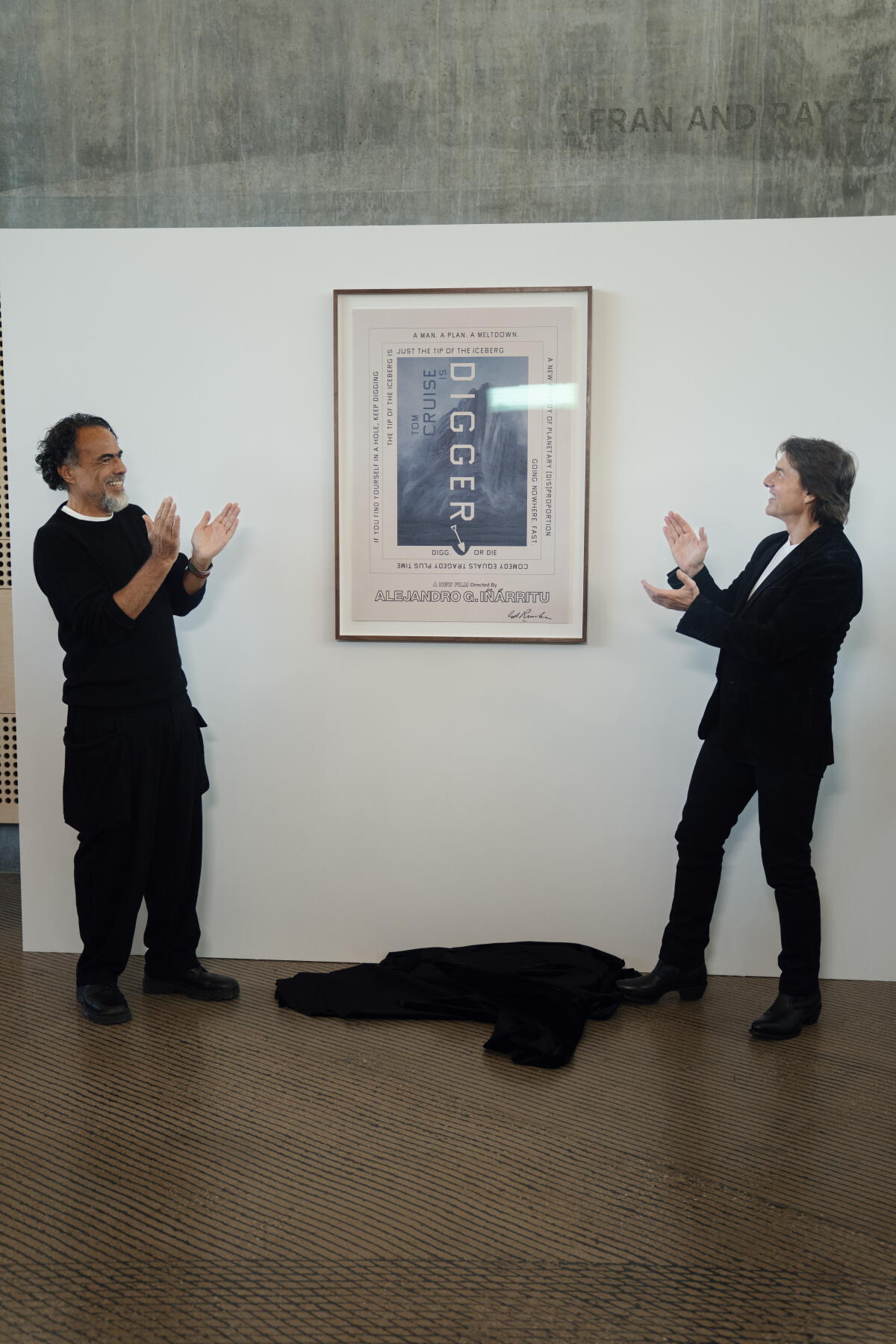
They unveiled footage from new films like the upcoming “Digger” from director Alejandro G. Iñárritu and brought out lead actor Tom Cruise to a sustained standing ovation from the audience. And both De Luca and Abdy espoused optimism for the future of the theatrical business. The studio plans to release 14 films this year and as many as 18 for 2027.
“The film business has always required smart betting, and we have 4 billion reasons from last year to think we’re holding the right cards,” De Luca said during the presentation, referring to the studio’s worldwide box office revenue last year.
“We all know they’re not all going to work. That comes with taking swings,” Abdy said of the studios’ films. “There’s no version of this business that’s risk-free. But our job is to step up, make our bets and own it when it doesn’t work.”
But the end of the presentation felt more somber, with the executives asking the heads of Warner Bros.’ labels to come to the stage and be recognized. Shortly after, they asked Warner Bros. employees in the audience to stand for applause. It was hard to escape the feeling that this may be the end of an era.
As my colleague Meg James reported, the cuts hit Disney’s television and movie studios, sports giant ESPN, its product and technology unit, corporate functions and marketing. Even Marvel Studios’ visual development team was affected.
The layoffs are one of the first major moves under new Disney Chief Executive Josh D’Amaro, who took the reins of the company last month. In a message to employees, he said the company needed to “constantly assess how to foster a more agile and technologically-enabled workforce to meet tomorrow’s needs.”
What I’m watching
Some friends and I watched “Fukushima: A Nuclear Nightmare” this past weekend, a truly eye-opening documentary that explains what happened during the March 11, 2011, nuclear accident and whether the world has learned anything from it.
Patrick Muldoon, known for his roles on “Days of Our Lives,” “Melrose Place” and “Starship Troopers,” has died. He was 57.
The actor and producer reportedly died Sunday, his manager confirmed to Variety. According to Deadline, Muldoon died suddenly after a heart attack. The Times has reached out to Muldoon’s reps for comment.
Muldoon originated the role of Austin Reed on the daytime soap opera “Days of Our Lives.” He first portrayed the aspiring boxer and brother of Lisa Rinna‘s Billie Reed from 1992 to 1995, and returned to reprise the role from 2011 to 2012 (the character had since become a forensic accountant).
“Austin is a wonderful role,” Muldoon told The Times in 1995. The actor explained he took his “sweet time” mulling over whether to leave the show because “it was one hell of a decision to make.”
“I’m leaving for no other reason than why other people leave soaps,” Muldoon said at the time. “To take a shot at doing other things like nighttime, movies and other things. … I feel confident right now so I figured I better take the shot sooner than later. If I don’t, I’ll always wonder ‘what if.’ ”
He played the recurring villain Richard Hart on the primetime soap “Melrose Place” for three seasons beginning in 1995. Muldoon’s big-screen roles include Zander Barcalow, a pilot and rival of Casper Van Dien’s Johnny Rico, in Paul Verhoeven’s 1997 movie “Starship Troopers.”
Born September 27, 1968, in San Pedro, Muldoon’s early passions included football. He started playing at the age of 6 and would go on to play at Loyola High School and then at USC.
“I did fairly well for being a smaller tight end,” Muldoon told The Times in 2012, adding that getting run over during practice by USC teammateJunior Seau — the late linebacker who had a 20-year NFL career — was among the factors that led him to pursue acting instead. Muldoon began his acting career during the sport’s offseason, and his earliest roles were on shows such as “Who’s the Boss?” and “Saved by the Bell.”
In addition to acting, Muldoon was a producer with credits on films such as “Riff Raff” (2024), “Marlowe” (2022), “The Card Counter” (2021) and “The Comeback Trail” (2020). Most recently, he shared on Instagram his excitement of being among the executive producers for the upcoming film “Kockroach.”
Nearly two years after actor Alec Baldwin was cleared of criminal charges in the “Rust” movie shooting death, a long simmering civil negligence case is inching toward a trial this fall.
On Friday, a Los Angeles Superior Court judge denied a summary judgment motion requested by the film producers Rust Movie Productions LLC, as well as actor-producer Baldwin and his firm El Dorado Pictures to dismiss the case.
During a hearing, Superior Court Judge Maurice Leiter set an Oct. 12 trial date.
The negligence suit was brought more than four years ago by Serge Svetnoy, who served as the chief lighting technician on the problem-plagued western film. Svetnoy was close friends with cinematographer Halyna Hutchins and held her in his arms as she lay dying on the floor of the New Mexico movie set. Baldwin’s firearm had discharged, launching a .45 caliber bullet, which struck and killed her.
The Bonanza Creek Ranch in Santa Fe, N.M. in 2021.
(Jae C. Hong / Associated Press)
Svetnoy was the first crew member of the ill-fated western to bring a lawsuit against the producers, alleging they were negligent in Hutchins’ October 2021 death. He maintains he has suffered trauma in the years since. In addition to negligence, his lawsuit also accuses the producers of intentional infliction of emotional distress.
“We are pleased with the Court’s decision denying the motions for summary judgment filed by Rust Movie Productions and Mr. Baldwin,” lawyers Gary Dordick and John Upton, who represent Svetnoy, said in a statement following the hearing. “He looks forward to finally having his day in court on this long-pending matter.”
The judge denied the defendants’ request to dismiss the negligence, emotional distress and punitive damages claims. One count directed at Baldwin, alleging assault, was dropped.
On Oct. 21, 2021, he was helping prepare for an afternoon of filming in a wooden church on Bonanza Creek Ranch. Hutchins was conversing with Baldwin to set up a camera angle that Hutchins wanted to depict: a close-up image of the barrel of Baldwin’s revolver.
The day had been chaotic because Hutchins’ union camera crew had walked off the set to protest the lack of nearby housing and previous alleged safety violations with the firearms on the set.
Instead of postponing filming to resolve the labor dispute, producers pushed forward, crew members alleged.
New Mexico prosecutors prevailed in a criminal case against the armorer, Hannah Gutierrez, in March 2024. She served more than a year in a state women’s prison for her involuntary manslaughter conviction before being released last year.
On the second day of his July 2024 trial, his criminal defense attorneys — Luke Nikas and Alex Spiro — presented evidence that prosecutors and sheriff’s deputies withheld evidence that may have helped his defense . The judge was furious, setting Baldwin free.
Film buffs understand that nearly every movie is, at heart, a travelogue — even if it occurs in your neighboring town — and that most travelogues can come across like love stories, whether anyone ends up together or not. That’s the whimsical, charged appeal of the Charli XCX-starring “Erupcja,” a mélange of romance, escape and disruptive coincidence in modern Warsaw from American micro-auteur Pete Ohs.
If you put footage of a smoke-spewing volcano under that Polish title, you’ll gather what the word means, which is exactly what Ohs does at the beginning, color-tinting his boxy frame ’60s-arthouse-style and adding a vintage Mancini-esque track from a Polish chanteuse. All the better to seed the belief that we’re about to experience something dreamy and convulsive.
That said, a volcano isn’t why British couple Bethany (Charli XCX) and Rob (Will Madden) have arrived in Warsaw. That rumbling you hear could also just be suitcases rolled over ancient streets. Besotted Rob’s surprise plan was to propose to Bethany in Paris — as revealed to us in omnipotent voice-over (by Jacek Zubiel) that fills in the feelings and backstories of our protagonists.
Bethany chose Warsaw, however, because she has a rekindling in mind, in the form of her longtime friend Nel (Lena Góra), a florist for whom Bethany’s unprompted arrival under her balcony one night — stealing away from her Airbnb with Rob — is complicated and exciting. With the news breaking that Italy’s Mount Etna has just erupted, grounding planes across Europe, a mighty passion they forged as teenagers, fueled by drugs, clubbing, heart-to-hearts and poetry, has once more been unleashed. It’s just their thing: Whenever Bethany and Nel connect, a volcano announces itself somewhere in the world. Woe be to the moony boyfriend or, in Nel’s case, exasperated girlfriend (Agata Trzebuchowska), left behind to dust off the ash.
“Erupcja,” which Ohs also photographed and edited with impressionistic verve, unfolds as if Jacques Rivette’s playful air of mystery and Roberto Rossellini’s earthy melancholia had somehow come together to form a zillennial with a restless heart. Ohs makes movies with the in-the-moment creative participation of his cast — he, Charli, Madden, Góra and playwright Jeremy O. Harris, who portrays a friendly American artist, are the credited writers and the whole enterprise goes down like a cocktail of ruminations and swerves invented on the spot, but not haphazardly.
You get the buzz (music by Charlie Watson and Isabella Summers plays a big part), the hangover, but also an aura of remedy and renewal. It’s all very human, evident in the pop star’s subtly frisky portrait of someone drawn to abandon (Charli should definitely continue acting), but also in Madden’s unshowy, mature hurt and in how Góra suggests the more grounded half of a self-mythologizing duo. Ohs works in evocative details: inserted frames of color, like mood flashes, or a shot of a lonely phone ringing, never getting picked up.
He leaves it up to you to wonder if Bethany and Nel have ever been more than friends — “It’s not Romeo and Juliet,” Nel coolly declaims from her balcony upon glimpsing Bethany waiting below — but what’s fun is how that’s ultimately beside the point. The edgy appeal of “Erupcja” is in the way it maps humans as molecules and electrons, fizzed by location, inspired by connection, driven to hover, fuse and release. The characters may get bounced around a bit and some will feel stranded, but you’ll know you’ve been taken somewhere new by this charming indie.
‘Erupcja’
In English and Polish, with subtitles
Not rated
Running time: 1 hour, 12 minutes
Playing: Opens Friday, April 17 at Landmark’s Nuart Theatre
BACK in the 80s and early 90s, this movie star was known for huge blockbuster films, and was one of the biggest names in Hollywood.
Sadly, in 1991, the actor’s beloved wife died and he started to take a step back from the limelight and eventually quit fame – but now the 72-year-old star is making his big comeback.
Sign up for the Showbiz newsletter
Thank you!
Hollywood star Rick Moranis is making his return to Hollywood after leaving the spotlight when his wife diedCredit: GettyThis actor has made his comeback to the spotlight after three decadesCredit: GettyRick made a rare appearance at CinemaCon to promote his new movie SpaceballsCredit: GettyLast year it was revealed how Rick had signed on for the new Spaceballs sequel, reprising his role as Dark HelmetCredit: Alamy
Rick Moranis, famed for 80s films like Ghostbusters, thrilled fans when he made a rare appearance at CinemaCon 2026.
It was announced last year that the Canadian actor would be reprising his role as Dark Helmet.
The original movie, which is a spoof of Star Wars, came out in 1987 and starred many notable names, including Mel Brooks, Daphne Zuniga, Bill Pullman, the late John Candy, and Joan Rivers, among others.
Many of Rick’s former co-stars have returned for the sequel, such as Mel, Daphne, Bill, and George Wyner.
There are also several new faces among the cast, including Josh Gad and Keke Palmer.
The cast joined Rick at a panel event to promote the movie at CinemaCon.
Despite the star rarely being seen in the last three decades, the actor hasn’t changed much in appearance.
The Flintstones star wore his trademark round-framed glasses, which he was famed for in his iconic movies.
Other than Spaceballs, Rick starred in many successful films in the 1980s and 1990s, including Honey, I Shrunk the Kids and its sequels, and playing Barney in The Flintstones.
Rick thrilled fans when he stepped out on stage at CinemaConCredit: GettyRick starred in a string of successful films in the 1980s and 1990s – seen here in Little Shop of HorrorsCredit: HandoutRick is probably best known for Honey I Shrunk The KidsCredit: RexRick left Hollywood in the 90s to focus on raising his two kids following his wife’ Anne’s deathCredit: Alamy
Sadly, Rick started to take a step back from Hollywood when his wife, Anne Belsky, passed away from breast cancer in 1991.
During the 90s, he slowly started to quit fame to focus on parenting his two children.
Although Rick hasn’t been seen on screen, he hasn’t entirely distanced himself from acting.
He lent his voice to several animated projects over the years, including Disney‘s Brother Bear in 2003, and its sequel, Brother Bear 2, in 2006.
Rick’s voice also appeared in a 2018 episode of The Goldbergs and a 2020 episode of the Disney+ docuseries Prop Culture.
However, he hasn’t appeared in a live-action film since Disney’s Honey, I Shrunk Ourselves, which was released directly to video in 1997.
But Rick is now set to be back on the big screen, with production for Spaceballs 2 underway.
The hotly-anticipated sequel is set to hit cinemas in 2027.
Rick also starred in 90s movie, The FlintstonesCredit: BBCThe actor was famed for his round glasses back in the 80s and 90sCredit: Getty
It has been just one day at CinemaCon in Las Vegas, and there’s already a palpable sense of relief in the air.
Attendance at this year’s show is up about 5% from last year, according to Cinema United, the trade group that organizes the four-day convocation of thousands of movie theater owners, studio executives and industry folks at Caesars Palace.
Groups of people wearing orange-colored lanyards are everywhere throughout the hotel and casino, with many filling the Colosseum on Monday afternoon for a presentation from specialty film companies Angel Studios, Sony Pictures Classics and StudioCanal.
“The energy in every room reflected a sector that believes deeply in its own future,” said Stephanie Silverman, owner of the Belcourt Theatre in Nashville who serves on Cinema United’s strategic planning committee. “For independents, that sense of collective purpose is powerful — we’re not just holding on, we’re building toward something real and lasting.”
Amid such upbeat sentiment, CinemaCon allows theater owners and their business partners to see what’s coming from each studio and get a snapshot of the year ahead.
You’re reading the Wide Shot
Samantha Masunaga delivers the latest news, analysis and insights on everything from streaming wars to production — and what it all means for the future.
By continuing, you agree to our Terms of Service, which include arbitration and a class action waiver. You agree that we and our third-party vendors may collect and use your information, including through cookies, pixels and similar technologies, for the purposes set forth in our Privacy Policy such as personalizing your experience and ads.
On Monday, Provo, Utah-based Angel Studios showed footage from their upcoming film “Young Washington,” about the early life of the first U.S. president, as well as a trailer from an animated retelling of George Orwell’s “Animal Farm.”
“Theatrical isn’t fragile,” Shelley Schulz, vice president of domestic theatrical sales and exhibitor strategy at Angel Studios, said during the presentation. “It’s not fading. It’s evolving.”
European indie film studio StudioCanal also unveiled some of its upcoming films, including scenes from a new animated “Shaun the Sheep” movie that got laughs from the audience, before bringing out director Danny Boyle to applause and cheers to speak about his new film “Ink,” about the beginnings of the British tabloid “The Sun.”
Later this week, Warner Bros., Universal, Amazon MGM, Paramount and Disney will unveil footage from their upcoming releases and likely bring their major stars on-stage to build excitement about this year’s slate.
As I reported Monday, a string of recent hits like Amazon MGM Studios’ “Project Hail Mary” and Universal Pictures, Nintendo and Illumination’s “The Super Mario Galaxy Movie” have pushed year-to-date domestic box office revenue about 23% higher than the same time last year.
The upswing signals that the exhibition business is embarking on its long-awaited recovery from the devastating downturn that occurred in the aftermath of the pandemic.
Studio executives and theater operators chalk up the improved prospects in part to a better and more plentiful crop of bankable movies that are bringing people back to the multiplex.
Exhibitors feel better about the lineup this year — it’s full of major franchises like “Star Wars” and Marvel superheroes as well as well-known animated titles such as “Toy Story 5” and “Minions & Monsters.” Also coming are anticipated films from acclaimed directors Christopher Nolan and Steven Spielberg.
“We’re getting into that cadence we needed in terms of having good movies, different types of movies being released every weekend,” Cinépolis USA Chief Executive Luis Olloqui told me ahead of CinemaCon. “This year in general, we’re feeling more confident, more optimistic.”
It’s quite the turnaround from the anxiety I heard last year leading into CinemaCon, when theater owners grappled with the box office downturn and the general shakiness of the industry.
Not to say that this year is all roses.
As I wrote, there are still major question marks facing the industry, including how Paramount Skydance’s proposed acquisition of Warner Bros. Discovery will affect the business. Paramount Chief Executive David Ellison has said the combined company will release 30 films a year, but exhibitors fear that cost cuts from the deal could impede that goal, which many believe is unrealistic.
And Hollywood is still going through a painful retrenchment.
Just last week, Sony Pictures Entertainment said it would cut hundreds of jobs across its film, TV and corporate divisions. Then came the news about upcoming layoffs at Disney, which could number as many as 1,000.
It hasn’t been much better in the exhibition space, either. In February, Dallas-based Look Dine-In Cinemas abruptly closed three Southern California locations; then, in March, the iPic chain filed for Chapter 11 bankruptcy protection and said it planned to pursue a sale of its assets.
A better box office this year wouldn’t solve all of these problems, but it would inject more hope into an industry that has been in turmoil since the pandemic.
That amount “represents one of the highest golden parachute estimates ever observed,” investor advisory firm Institutional Shareholder Services wrote in a recent report. The firm said support for the proposal “is not warranted.”
Warner shareholders will vote April 23 on the proposed takeover.
What I’m watching
For years, one of the shows on my weekly must-watch list is “Ghosts,” the delightful comedy about a couple who moves into a historic mansion haunted by its previous inhabitants. After a long week, the antics of Viking ghost Thorfinn always make me laugh.
No actor in a movie this month is enjoying themselves more than Ian McKellen as an egomaniac painter in Steven Soderbergh’s slender pleasure “The Christophers.” Once, his Julian Sklar was the bisexual provocateur of the London art scene commanding millions for a single piece. Now he’s better known as the villain of “Art Fight,” a reality competition show where he took cruel pleasure destroying amateurs’ hopes.
Equally dismissive of his own output, Julian hasn’t wielded a paintbrush in decades. And so his adult children Barnaby and Sallie (James Corden and Jessica Gunning of “Baby Reindeer”) — two money-grubbing, untalented brats — hire a broke art restorer, Lori (Michaela Coel), to finish a stack of half-sketched portraits Julian made of his male ex-lover that were left abandoned in the attic. Don’t think of it as forgery, Barnaby assures Lori, “more like forging through them until they are completed.”
That’s a great line, and “The Christophers” has a dozen more almost as good. Nearly all get delivered by McKellen’s Julian, waving a champagne coupe while monologuing about humidifiers, cancel culture and a doctor who smells like radishes. He seems to imagine acolytes — or at least, television audiences — eagerly soaking up his bon mots. Meanwhile, Lori, a young Black woman hired under false pretenses as an assistant, stares mutely. If their first meeting as boss and employee were freeze-framed into a painting, it would be called “A Study in Contrasts.”
The script is by Ed Solomon, who also collaborated with Soderbergh on the more action-packed 2021 gangster movie “No Sudden Move.” This plot doodles along, rarely going where we expect. Mostly, Julian and Lori take turns thwarting his obnoxious kids and threatening to quit. I chuckled every time Corden and Gunning showed up for more abuse, including from Soderbergh, who shoots them like a wall of stupidity, blocking doorways as they stand side-by-side like Tweedledee and Tweedledum.
The inequalities of the art world are gestured to as fact. Lori, who might be every bit as technically gifted as Julian, ekes out a living serving egg rolls in a food truck while sharing a walk-up loft with three other struggling painters. Julian lords over not one but two swanky adjoining townhouses stuffed with antiques. Once, to flip off the establishment, he sold a work worth 2 million British pounds for the price of a used car. His version of disdain is her idea of a fortune.
One stick figure by Julian would be worth more than anything Lori’s ever done, which makes it extra maddening that he chooses instead to earn a little extra pocket money recording video messages for fans who only care about him as that mean guy on TV. In the glow of a ring light, he tosses off glib advice that might itself be worthless. Quit art school, he tells one, and “happy birthday, blah, blah, blah.” (Even imagining a popular TV show about art is, in itself, culturally aspirational for those of us who enjoy reruns of Bob Ross.)
Why is there such disparity between the value of Julian and Lori’s work? The reasons are so obvious that, to the film, they’re barely worth mentioning: age, gender, era, fame and skill. Julian would dismiss the first two, claiming that wokeness gives an old, white male like him the handicap. But it’s frustrating that the film doesn’t dig very deep into the rest, either. I especially wanted a scene where Julian must reckon with a no-name interloper’s ability to copy his genius, but comparing whether Lori is Julian’s equal would call the film’s bluff and force it to actually show us their art. The handheld camera prefers to lurk on the wooden side of the easel.
Really, I’m not sure Soderbergh even has an opinion on their clash. He just wants to be an eavesdropper in the room, standing back against the dusty brick-a-brack. Of course, if you squint, you can see what interests Soderbergh in this set-up. Like Julian, he’s been threatening to retire for years. He knows how irritated people are when an artist claims they don’t want to bother anymore. And like the neglected paintings in the attic — the Christophers of the title — every filmmaker has their own unfinished projects taking up mental space overhead, treasured ideas that will never emerge to their satisfaction.
Still, I suspect that even if Soderbergh personally identifies with the premise (even though he continues to release more movies in one year than his peers do in five), he still finds Julian’s paralysis a bit pathetic. Julian just needs paint, a brush and the will to create. Filmmakers, now those poor bastards need rich patrons.
Even so, Soderbergh likes to make movies as resourcefully as he can, doing his own editing and cinematography and, above all, prioritizing the act of invention. He can’t be copied because his own work is so eclectic. Have you ever heard of any director being called the next Soderbergh? You sense that, to him, forgery is as creatively dull as a factory-issued franchise sequel. (Except, of course, his “Magic Mike” and “Ocean’s” series, which are, at their best, closer to wacky Warhols.)
Tasked to play the foil to McKellen’s clown, Coel comes off stiff. She has the spine to hold her own against him, but it’s hard to play withholding, particularly when the film needs her character to be both the voice of reason and a politically correct scold. Only her carved cheekbones give off an impression of Lori’s hungry ambition. Still, when she does deign to speak, there’s a dynamite scene where she dresses down Julian critically and psychologically. Whether or not she’s the second coming of him as an artist, she’s more insightful than he ever was insulting watercolors of kittens on TV.
Really, we’re just watching McKellen give a bravura, scene-gobbling performance that doesn’t hold back one iota. My favorite detail he pulls off comes when he greets Lori at the front door undressed and, when she insists he wear clothes, ties on a trench coat that somehow makes him look even more pervy and naked in how McKellen wears it, leaving one bare shoulder roguishly exposed.
The film has plenty of funny little asides like that which make it worth your while. Angelenos will chuckle at a scene in which two characters verbally commit to a meet-up both know won’t happen — or, as we say here, let’s do lunch. Out of magnanimity, I’ll liken this trifle to a Rothko. The more I think about “The Christophers,” the more I imagine it has interesting layers. But I won’t fault anyone who just sees a simple square.
‘The Christophers’
Rated: R, for language
Running time: 1 hour, 40 minutes
Playing: Opening Friday, April 10 in limited release
To laugh or to cry? It’s a question that feels a little too familiar of late — one confronted often while watching “Maddie’s Secret,” the debut as writer-director from comedian and performer John Early.
Playing the title role with an unnerving sincerity and startling sense of vulnerability, Early stars as Maddie Ralph, a young woman climbing the ranks as a Los Angeles food influencer while secretly hiding her struggle with bulimia.
Early’s performance is a truly remarkable highwire act, all the more so for the wig, padding and prosthetics he wears to play the character. Made in the earnest style of a disease-of-the-week television movie without ever tipping over into winking irony, the film is both funny and tender.
“That, to me, is Maddie’s true secret,” says Early, 38, on a recent video interview from the apartment he is renting in New York City while appearing onstage in Wallace Shawn’s new off-Broadway play “What We Did Before Our Moth Days.”
“The secret of the movie — the real twist of the movie — is not any kind of trope-y reveal,” Early says. “The twist is actually a tonal twist. What I hope is then that becomes funny: the sheer commitment to the stakes of it.
“At any given moment, you can experience it as totally sincere, you can absorb it genuinely and be moved by it,” Early continues, “or you can take a little break and step out of it and find it uproariously funny that we’re even doing this to begin with.”
John Early, front, and Eric Rahill in the movie “Maddie’s Secret.”
(Magnolia Pictures)
Early’s skillfully wrought psychodrama, which had its world premiere at last fall’s Toronto International Film Festival, is now the opening-night selection for this year’s Los Angeles Festival of Movies, playing Thursday at Eagle Rock’s Vidiots with members of the cast present for a Q&A, and then again on Friday at 2220 Arts + Archives in Historic Filipinotown.
“Maddie’s Secret,” which opens in theaters June 12, makes for a fitting kickoff for this year’s event. Though the programming includes movies from all over the world, organizers ended up leaning heavily into films made in Los Angeles.
“This year it really does feel like a homegrown festival,” said Sarah Winshall, LAFM’s co-founder and festival director. “What it ended up doing is making us think about L.A. as a small town as a result.”
“I think the movie is an incredible accomplishment,” said Micah Gottlieb, LAFM co-founder and artistic director. “It’s made by somebody who’s not just a great comedian but also is a cinephile, knows the history of cinema, is trying to make something that fits within that lineage, while also just making an all-out entertaining movie.”
“Maddie’s Secret” was shot in the same workaday, creative-class neighborhoods where LAFM unspools. (Maddie’s house in the movie is Early’s own home.) The actor and filmmaker describes it as a “very Echo Park, Silver Lake, Eagle Rock, Frogtown, Glassell Park, Highland Park, Los Feliz movie.”
The story is also rooted in Early’s own complicated feelings about the L.A. food scene.
“It’s completely born out of my time in L.A. and my initial shock when I was confronted with a burgeoning restaurant scene,” says Early, who grew up in Nashville and moved to L.A. from New York in 2016.
“Not to always be talking about millennials, but it seemed very much of my generation,” he says, “specifically these kinds of restaurants where the food is really expensive but you’re sitting on a milk crate, eating lots of Middle Eastern food made by white people. There was just something very funny about all of it to me, even though I completely also sincerely loved it and still do.”
The film’s supporting cast is drawn largely from Early’s own circle of friends, including his most frequent collaborator, the comedian and writer Kate Berlant, along with Conner O’Malley, Claudia O’Doherty, Eric Rahill and Vanessa Bayer. The film’s production designer Gordon Landenberger is his ex-boyfriend and Early is excited that a number of other key collaborators, including costume designers Kimme Aaberg and Izzy Heller and cinematographer Max Lakner, are working on a feature for the first time, just as he is as writer-director.
“I think I wanted to force myself at gunpoint into a place of innocence and naivete,” says Early. “I think this movie is a strange mutation of the camp tradition.”
(Justin Jun Lee / For The Times)
Berlant plays Maddie’s best friend in the film. She and Early have worked together on shorts, live performances and their 2022 Peacock special “Would It Kill You to Laugh?” The two always share what they are developing and so Berlant first heard about “Maddie’s Secret” when it was just percolating as an idea.
“It was a very wild proposition,” she recalls with a laugh while driving down L.A.’s Beverly Boulevard. “He’s like, ‘I’m going to play a woman who’s struggling with bulimia.’ I was like, ‘Good luck.’ I was astonished that he totally pulled it off and he’s such a true filmmaker. It was kind of miraculous.”
Berlant describes their shared sensibility, the ability to simultaneously play comedy and pathos, as a kind of freedom. “Just the underlying absurdity or joke really gives you the ability to go to these really intense emotional places,” she says. “It gives you the permission to go to places that otherwise would be too unbearably saccharin.”
For Early it was also a chance to fulfill his longtime desire to play an old-school ingénue.
“I think I wanted to force myself at gunpoint into a place of innocence and naivete,” says Early. “I think this movie is a strange mutation of the camp tradition.”
“I was astonished that he totally pulled it off and he’s such a true filmmaker,” says Kate Berlant, Early’s longtime collaborator. “It was kind of miraculous.”
(Justin Jun Lee / For The Times)
He references Susan Sontag’s famous essay “Notes on Camp” to say there are two kinds of camp humor, one that is unknowing and another that is knowing. It is near impossible now to genuinely create the first kind, but the process of making “Maddie’s Secret” was in a sense about being the second and striving for the first.
“In the age of the internet and in the kind of crumbling, depressing world we live in, it’s almost impossible to be the first kind of camp,” says Early, “to feel innocent and naive and to twirl. But obviously there is a part of me, there’s a part of all of us, that is very childlike and innocent and has hope. So I think this movie, it knows itself to be camp but it’s aching to be more like the first kind of camp. It’s aching to be pure and naive.”
Though it may be easy to place what Early is doing in the tradition of drag performers such as Divine’s work with filmmaker John Waters, to Early his performance in “Maddie’s Secret” sits outside of it.
“Drag is often obviously about a certain kind of extravagance and fabulousness and Maddie is very humble,” he says. “And so I don’t really see it as drag. It didn’t feel like drag doing it, whatever that means. It honestly just felt like acting to me.”
In dealing with the serious topic of bulimia, Early was careful never to make the eating disorder the joke. He points to a trio of TV movies — 1986’s “Kate’s Secret,” starring Meredith Baxter Birney; 1997’s “Perfect Body,” starring Amy Jo Johnson; and 1981’s “The Best Little Girl in the World,” starring Jennifer Jason Leigh — along with Lauren Greenfield’s 2006 documentary “Thin” as key influences on how he approached the film’s depiction of the illness. (Other non-bulimia influences include Alfred Hitchcock’s “Marnie,” Paul Verhoeven’s trashy “Showgirls” and Adrian Lyne’s “Flashdance.”)
“I don’t find bulimia itself funny,” says Early. “The genre of these movies — that’s what’s funny. It’s the emotional pitch of those movies and the way that they’re made and the acting style and the kind of moralistic quality while being totally pervy. All that was funny to me. And then also putting contemporary life — young, gentrified L.A. food-content influencer culture — putting all that through a melodrama-style filter, that was funny to me.”
While writing the screenplay, Early says he often found himself weeping, overtaken by the emotions of what he was creating. “I guess I’m not above the genre at all,” he admits.
But playing the part was another matter, having sold everyone involved in the production on a very specific tone and conception of what they would do together.
“I was like, ‘I am so stupid, I can’t believe I have put myself in this position,’” Early says, laughing at the memory. “I had set myself up to do the thing that I really had no proof that I could do, which is to play an almost Juliet kind of character who’s going through these extreme things. And I was the one that promised everyone that we would take it seriously. And then suddenly I was like ‘OK, well you have to do it. You actually have to do it.’”
Even if Early was uncertain in the moment, the result is undeniable: a dizzying, disarming blend of humor and emotion — and one of the year’s boldest performances.
One of L.A.’s most unique art galleries is closing up shop.
Gallery 1988, which opened in 2004 and proclaimed itself “the first pop culture-focused art gallery in the world,” will cease operations at the end of April. In a post on Instagram, gallery owner Katie Sutton said that while the gallery had been forced to close its physical space on Melrose a few years back, she had “really tried to keep things going [online], especially for our amazing artists.” Unfortunately, she wrote, “the [art] market is the worst I’ve seen it in over two decades,” and the decision to close became inevitable.
A launching pad for artists whose work paid tribute to television, film, video games and more, Gallery 1988 was renowned for shows like the annual “Crazy 4 Cult,” which showcased pieces celebrating underground classics from across the entertainment space. It also specialized in single-focus shows like “Weird Al,” which celebrated the career of the oddball recording artist “Weird Al” Yankovic, and “You’re the Very Best, Like No One Ever Was,” which paid tribute to the world of Pokémon.
Exhibitions at Gallery 1988, which is closing after 20 years, often featured lines around the block, with fans who camped out for a chance to score a prized piece.
(Courtesy of Gallery 1988)
Perhaps most famously, the gallery collaborated with studios to create art-focused campaigns around properties such as “The Avengers” and “Star Wars: The Force Awakens,” while also launching solo shows from artists like Scott C, Luke Chueh and Tom Whalen.
Gallery 1988 was renowned for selling work that ranged in price from $10 into the thousands, enabling customers from around the world to buy pieces that spoke to them, whether a postcard-sized digital print or a large oil-on-canvas painting.
A number of other galleries have closed in recent months across Los Angeles, including Blum, Nino Mier Gallery, Clearing, Tanya Bonakdar Gallery and L.A. Louver. Sutton says that she’s heard through the gallery grapevine that “even galleries that haven’t closed are struggling,” adding that “it’s a hard time for everybody.”
Though there’s never one reason a business closes, some industry observers and art fans have cited the rise in AI-generated content potentially devaluing original art overall. It’s especially true in the pop culture space, with consumer activity down not just at places like Gallery 1988 but also at events such as WonderCon in Anaheim, where artists could often expect to make a good chunk of change.
Jensen Karp, who co-founded Gallery 1988 with Sutton but stepped back after a health scare nearly two years ago, says that while he certainly sees a “malaise in culture because of AI” that’s indicative of the population “losing the understanding of what true art is,” he wouldn’t attribute the collapse of Gallery 1988 solely to that one thing.
Kristin Tercek “Rejoice” 2015 for the “Force Awakens” show with Disney, LucasFilm and Unicef at Gallery 1988.
“Our customer base was the people who looked up release dates and who went to the Arclight, and that sense of community is just not there anymore post-pandemic,” Karp says. With the entertainment industry struggling in L.A. as well, that means less disposable income floating around for things like art — especially from the kinds of people who might be inclined to buy a portrait of, say, Steve Martin in the movie “The Jerk.”
Greg Simkins, a California based artist who often sold through Gallery 1988 under the name “CRAOLA,” says he’s felt the impact of the entertainment industry’s contraction firsthand. “People like directors, producers and actors were some of our biggest clients,” Simkins says. “All of the sudden they’re leaving, going to places like Atlanta and Canada. AI is screwing up the movie industry too, and those are the kinds of people who had expendable money to buy original art so it trickles down.”
It doesn’t help that there’s more pop culture-centered art floating around now, and not just on sites like Instagram and Etsy. Though Gallery 1988 was a frontrunner in celebrating popular culture through art when it opened, even hosting a “Rick and Morty”-themed show before the Adult Swim series had a lick of merchandise, it also became a proof of concept for companies including Disney and Netflix, which have started selling their own artist-created material inspired by their properties.
And with Hollywood releasing fewer movies into theaters, the base of what Gallery 1988 artists could pay tribute to also began to contract. Frequent gallery contributor Whalen says that when Gallery 1988 opened, it was filling a niche and “creating fresh content for movies that spoke to” people in their 20s and 30s. Over time, though, art that celebrated properties like “Ghostbusters,” “Back to the Future” and “The Goonies” started to overwhelm the market, causing “a lot of the 1970s and ‘80s movies to become stale,” Whalen says.
Scott C’s “Breaking Bad Upon the Mount,” 2012, for the “Breaking Bad Art Project: With Sony and Vince Gilligan” at Gallery 1988.
While Sutton and Karp both say they’re beyond grateful that they got to open Gallery 1988 in the first place, let alone keep it open for more than 20 years, they’re worried about what closing the gallery will mean to some of their contributing artists.
“There are so many incredible artists out there and there are so many more places for them to show their work now and that’s amazing,” Sutton says. “But with that bombardment of media from everywhere, it’s hard to really see stuff because it’s coming at you from all directions. So many artists are out there trying to make a living and support their families and that’s just becoming harder and harder.”
“So many of the artists we showed never expected to have an art gallery email them,” Karp says. “I’m so proud of all the artists we worked with and what we were able to do, but I also know that [Gallery 1988 shutting down] closes up an avenue for all of them too and that sucks.”
Sony Pictures Entertainment plans to lay off a few hundred employees globally in a move to restructure its business.
The cuts, announced Tuesday afternoon, are set to affect employees who work across Sony’s film, TV and corporate divisions the company said, declining to specify how many would lose their jobs.
Sony said the cuts reflect a shift in business strategy under its new chief executive, Ravi Ahuja.
“As we lean into those priorities, we need to operate with greater focus, speed, and alignment to strengthen our differentiated capabilities,” said Ahuja in a statement. “To support our growth, we are aligning our organization with where the business is going — not where it has been. That requires changes to how we are structured and where we invest.”
Ahuja, who was promoted just over a year ago, added that the company is ”reducing roles in certain areas while increasing focus and investment in others that are most critical to our future.”
Sony plans to focus on franchise strategy and brand extension with game shows, as well as develop more anime, experiences and invest in content that will connect with a younger audience. This includes more game adaptations and growing its YouTube capabilities.
One of the studio’s biggest franchises is the “Spider-Man” universe, which includes both live-action films starring actors like Tom Holland and the Oscar-winning animated “Spider-Verse” movies. The studio is set to release the latest live-action installment, “Spider-Man: Brand New Day,” this summer. The previous movie “Spider-Man: No Way Home” was a major win for Sony as it generated $1.9B globally.
Sony Pictures operates under its Japanese parent company Sony Group Corp, alongside other subsidiaries like Sony Music Group and Sony Electronics. The film studio was established in 1987 and maintains a strong presence in Culver City.
The company has also combined its game-show group with its nonfiction TV department and is slowing down areas of its business that have low growth, like the VFX and virtual production studio, Pixomondo.
The layoffs are the latest to hit Hollywood, which has been hard hit by the exodus of film and TV jobs to other states and countries, a cutback in the number of films being released and media consolidation. Last year, Paramount cut 10% of its workforce after it was acquired by David Ellison’s Skydance Media.
The box office hit a power-up this weekend, as “The Super Mario Galaxy Movie” continued a healthy streak for family films in theaters.
The animated sequel from Universal Pictures, Nintendo and Illumination raced to $190 million in the U.S. and Canada in its five-day holiday weekend debut, placing it solidly in first place, according to studio estimates and Comscore data. That total was in line with expectations of a $186-million domestic opening.
Globally, the film earned $372.5 million, the largest opening so far in 2026.
The first film based on the video game franchise, “The Super Mario Bros. Movie,” made $146.4 million in its 2023 debut.
“The Super Mario Galaxy Movie,” which had a production budget of $110 million, continues the story of iconic Nintendo characters Mario, Luigi and Princess Peach as they journey to rescue Princess Rosalina.
Amazon MGM’s “Project Hail Mary” came in second at the box office with a domestic total of $30.7 million – pushing its total to $217 million. A24’s “The Drama ($14.4 million), Disney’s “Hoppers” ($5.8 million) and Universal’s “Reminders of Him ($2.2 million) rounded out the top five.
The success of “Mario” this weekend is another example of the power of family films at the box office.
Animated movies like Sony Pictures Animation’s “Goat” and Walt Disney Co. and Pixar’s “Hoppers” have performed well in theaters this year, along with the strong holdover performance of Disney’s 2025 hit “Zootopia 2,” which has now made more than $1.87 billion worldwide.
That’s all contributed to a stronger first quarter in the theatrical business, as this year’s revenue was up more than 20% compared with the same period in 2025. March was especially strong, with the massive haul from “Project Hail Mary.”
Early in “The Drama,” things are still good between Emma (Zendaya) and Charlie (Robert Pattinson). The young happy couple, about a week away from getting married, have enjoyed a whirlwind romance. As this dark comedy’s opening credits roll, they’re blissfully practicing their first dance, laughing and stumbling as they try to get their twirls and steps right.
But the scene’s highlight is the song that plays in the background, airy, gentle and simple. Spare guitar chords give way to a female voice that sounds unpolished but beautiful: “I want to lay with you/ In an open field/ Where yellow flowers are suns of Earth.”
For many viewers, this will be the first time they’ve ever heard “I Want to Lay With You,” one of the most gorgeous love songs of the 1970s. It’s also likely they’ll have no idea who the singer is. Her name is Shira Small, and in 1974, she recorded an incredible album, “The Line of Time and the Plane of Now,” when she was 17. She never recorded another — at least, not yet. Now nearly 70, Small may finally be getting her moment in the spotlight.
“I’m cracking up,” says Small over Zoom from her Cooperstown, N.Y., home, “because I had no idea whatsoever that that movie was coming out until my dear sister informed me via you.” Flashing a relaxed smile and sporting long gray hair, Small knows little about the controversial “The Drama,” an A24 film with a heavily guarded twist.
Robert Pattinson and Zendaya in the movie “The Drama.”
(A24)
But it’s becoming a delightfully frequent occurrence that Small learns after the fact that her music is featured prominently in a movie or television show. “The record company does what they do and then they send me royalties and I get it in a statement,” she explains. “I had a song that HBO bought for ‘Pause With Sam Jay.’ They sent me an email that was not even to me — it was this interdepartmental thing. At the bottom, it said, ‘Oh, by the way, it airs tonight.’”
Jemma Burns, music supervisor for “The Drama,” had been a fan of Small’s album, thinking “I Want to Lay With You” would be perfect for this idyllic scene, right before Emma and Charlie’s relationship implodes over a disturbing revelation that turns their dream wedding into a nightmare.
“He was trying to set up the rom-com tone,” says Burns of the movie’s writer-director Kristoffer Borgli, “one that would contrast with the modernity of the setting and where the film goes. He wanted something that was from a bygone era, but also something that felt disarmingly charming. The two lead characters are very switched-on, fashionable, arty. So it felt like something they would’ve had in their record collection.”
The youngest of five siblings, Small always loved singing. But even as an adolescent growing up in Harlem, she felt like an old soul, her thoughts running deeper than the average kid’s.
“My focus was on not understanding war and hatred and bigotry,” she says. “I was seriously into trying to make love happen everywhere.”
Against the backdrop of the war in Vietnam and the Black Power movement, Small was well on her way to becoming a hippie, a transformation amplified by her enrollment in a private Quaker boarding academy, George School, in Newtown, Penn., on a full scholarship. When she arrived at George School, Small recalls, laughing, it was “very rich and very white. But I’ve always been a flotation device. I can walk around like I don’t have a clue about things.”
Shira Small, photographed in 1971 at George School in Newtown, Penn.
(Courtesy of Shira Small)
At George School, Small sported an Afro and smoked weed. She was drawn to theater and music, impressing music teacher and classical pianist Lars Clutterham, who saw she had talent. They worked on songs together, with Small coming up with the lyrics and vocal melodies. Every student had to complete a senior project, so Small proposed that hers be an album. Not long after, she and Clutterham drove to a Philadelphia studio for a one-day session.
The 10 songs on “The Line of Time and the Plane of Now” — each recorded in only one take — mix folk, soul and jazz, radiating innocence. The arrangements, awash in old-school analog warmth, are straightforward: guitar or piano supplemented with drums, leaving plenty of space for Small’s lilting voice, which contains both idealism and, even as a teen, traces of real-life sorrow.
Her mother died while she was at George School, inspiring “My Life’s All Right,” a ballad about surviving tough times, which later appeared on the Sam Jay show. “Eternal Life” sprang out of her in one burst, celebrating the power of love to transcend life’s harsh realities. As for the movie’s “I Want to Lay With You,” it was about a boy Small liked. She just can’t remember who anymore.
“It was somebody who was just as much a friend as a person that I had a crush on,” she recalls. “I honestly felt that we could have a life together.”
Small laughs at her adolescent self. “Like I knew what it would be like to have a freaking life together! To be able to wake up with somebody and have a beautiful day and always make them smile.”
According to Small, George School’s parents and students raised money to pay for the album and 300 copies were produced. “It was a joyous time,” she recalls. “I was on my way — to somewhere!” After graduation, though, she struggled to find her footing, eventually graduating summa cum laude from the City University of New York with a theater degree. But then she chose pre-med, becoming a physician assistant.
“When I became pre-med, it was so hard for me that I was just tunnel-visioned,” explains Small about why she said goodbye to music. “I had to devote my whole self to it. It was so all-encompassing that I could think of nothing else.”
But there was another reason she walked away from music. From an early age, Small suffered debilitating stage fright. “It was so bad that it would twist my stomach into a knot,” she recalls. She gutted it out to do plays at George School and, later, record her album. After a while, though, “It just got to be too much.”
Still, didn’t she miss singing? “Constantly,” replies Small, who retired about five years ago from the medical profession. “I sang unconsciously a lot. My patients always picked up on it — they’d be like, ‘Every time you come in, you’re singing.’”
But although Small abandoned music, “The Line of Time and the Plane of Now” never went away. In 2006, the Numero Group, an archival record label, put together a compilation, “Wayfaring Strangers: Ladies From the Canyon,” devoted to under-the-radar female singers from the 1970s. Numero Group co-founder Ken Shipley made sure “Eternal Life” was included.
“I was the first person to ever reach out to Shira,” he says proudly in a separate phone interview. Shipley heard “Eternal Life” on a burned CD of femme-folk artists that was making the industry rounds at the turn of the millennium while he was putting together his “Wayfaring Strangers” lineup. “Shira was a top want for me.”
The Numero Group put “Eternal Life” on Spotify in 2013. But when the label released the full album digitally in 2022, “I don’t know that anybody really cared,” Shipley says. Undeterred, he reissued it on vinyl the following year. Maybe listeners just needed time.
“Music finds a way,” Shipley says. “Music’s like water. It’s going to get down the creek into the river into the ocean. It’s going to find its audience.”
Sure enough, strange serendipitous moments started happening for Small. A future bandmate’s ex had one of her songs on a playlist, having no idea it was Small. She recently started working part-time at a local opera house and one of the opera singers adored “Eternal Life,” unaware that Small was an employee.
And now, royalty checks arrive for the usage of her songs in films like “The Drama.” It still feels unreal to Small that her album generates revenue. “It was never for commercial purposes,” she says. “I can’t believe that I am collecting any royalties on that music and that it just keeps going and going.”
Small’s husband died in 2019 after 34 years of marriage. It sent her spiraling, but then something remarkable happened. “The day I came out of it, the music was gushing out of me so fast that I couldn’t keep up with it,” she says. “I had to walk around with a voice memo. I hadn’t spoken to Lars in more than a decade. I sent him all of these voice memos and he sent me a note: ‘Shira, you still got it.’”
In 2024, she released her first song in 50 years, “Why,” which lays out her fears for the world. Her voice is different, deeper, possessing a lifetime of experience that her teenage self couldn’t have possibly imagined. Small is now plotting out an album and has some shows lined up. Even better, she’s worked through her stage fright.
Eventually, she’ll perform her old songs, but she’s figuring out how to hit that higher register from her youth. “I’ve gone through decades of hormones and cigarettes and all the other things that I did that I’m happy I lived through,” she says, wryly.
“I still have a thing about yellow flowers in open fields,” she admits. “We have these huge sunflower fields here. The whole idea of being in such a beautiful place with yellow flowers that light up a great day is what popped into my head when I wrote that lyric.”
I ask her what she makes of that young woman she hears on “The Line of Time and the Plane of Now” today.
“I know her so well,” replies Small. “You know why? Because she’s still here. I am, at this point, everybody I’ve ever been ever, leading up to this moment.
“I still feel the same way about many things,” she continues. “I’m probably angrier now than I was when I was a child, but I still have this underlying thing about looking at a bigger picture to help me keep my lid on. When I think back on ‘Eternal Life’ and ‘My Life’s All Right,’ that music was born from my core. And my core does not have an age.”
Hello! I’m Mark Olsen. Welcome to another edition of your regular field guide to a world of Only Good Movies.
This is another strong week for new releases. By now you have likely heard something about “The Drama,” which has become inescapable thanks to the tireless promotion of its two stars, Zendaya and Robert Pattinson.
In a movie written and directed by Norwegian provocateur Kristoffer Borgli (“Dream Scenario”), the pair play Emma and Charlie, an engaged couple who find their wedding week thrown into disarray by the revelation of a deep secret from the bride-to-be.
Robert Pattinson and Zendaya in the movie “The Drama.”
(A24)
As Amy Nicholson put it in her review, “To another screenwriter, ‘The Drama’ would be an intimate study and a more emotionally wrenching film. But Borgli forces us to parse the mushy stuff from the mess and analyze the pending nuptials as an impersonal problem: What comes after a public shaming for the guilty and the inquisitors? That’s one of the most important (and unresolved) questions of the modern era, so I’ll forgive the filmmaker for being no more interested in writing Emma and Charlie as complex human beings than if they were character names in a math quiz about two people on two trains speeding toward a crash.”
Meanwhile, Tim Grierson spoke to Shira Small, the folk artist whose sole 1974 album features a song heard in an early scene of “The Drama.” Small, a delightful interview, goes into the music career she left behind a long time ago — one which may be reigniting now thanks to the movie.
Also opening in Los Angeles this week is Israeli filmmaker Nadav Lapid’s “Yes,” a guaranteed conversation-starter. Ariel Bronz stars as a musician who, in the aftermath of the Oct. 7 attacks, decides to say yes to composing a vicious new political anthem..
Reviewing the film, Joshua Rothkopf said, “It’s a movie about a citizenry at war with itself, hoping to keep the plates spinning for one more night. You watch it and think how easy it would be to envision an American remake — and wonder, too, if a filmmaker like Lapid even exists here.”
One of my favorite films from SXSW 2025, “Fantasy Life,” is finally coming to theaters. Written and directed Matthew Shear, the movie is an affectionate nod to the chatty dramedies of Noah Baumbach (some of which Shear has acted in). Here he plays Sam, a troubled law school dropout who takes a job looking after the children of a Brooklyn couple (Amanda Peet and Alessandro Nivola) and finds himself in an emotional affair with the wife.
“Fantasy Life” actor-writer-director Matthew Shear and star Amanda Peet bond in New York.
(Justin Jun Lee / For The Times)
I recently spoke to Shear and Peet about their collaboration on the film. Peet’s character in the film is also an actor and, though much of the film’s anxieties felt familiar to her, one scene in particular is drawn from Peet’s own experience: She is often mistaken in public for Lake Bell, including once on a red carpet.
“It’s a weird thing because you’re like, what do I do here?” said Peet with a laugh. “What’s the least douchey way to get out of this?”
The Black Pack’s resistance humor
Robert Townsend in the 1987 movie “Hollywood Shuffle.”
(Samuel Goldwyn Company / Photofest)
Curated around a new book by Artel Great, the UCLA Film and Television Archive is launching the series “The Black Pack: Rewriting American Comedy,” to spotlight a moment in the 1980s and ’90s when a small group of Black creators reached the very heights of Hollywood.
Eddie Murphy, Paul Mooney, Robert Townsend, Keenan Ivory Wayans and Arsenio Hall were friends and collaborators who, from 1987 to 1994, created the work showcased in the series. The Black Pack is a name they gave to themselves, partly in response to the John Hughes-affiliated Brat Pack.
Things begin tonight with a 35mm screening of Townsend’s essential 1987 satire “Hollywood Shuffle.” Great will be there for an introduction and a Q&A with cast member Anne-Marie Johnson and Spring Mooney, daughter of late actor Paul Mooney, who also appeared in the movie.
The cast of “In Living Color,” to be celebrated as part of the UCLA screening series “The Black Pack.”
(Fox / Photofest)
Other events include an evening of episodes of Wayans’ sketch comedy series “In Living Color,” 1988’s “Coming to America,” starring Murphy and Hall, a 35mm screening of Townsend’s 1991 “The Five Heartbeats” and a 35mm screening of 1989’s “Harlem Nights,” the only movie starring, directed, written and produced by Murphy, then at the height of his cultural capital.
This series is a terrific example of why smart programming matters. Here is a group of films (and a TV show) that might seem only related in a vague way, but when put together under a specific theme or idea, they are suddenly transformed into something revelatory.
Each evening of the series is designed to make the case for a different aspect of the Black Pack’s work and influence. The series as a whole puts forward a larger concept Great has coined a term for.
“I’m arguing through the series that the Black Pack’s cultural material is connected to a longstanding tradition that I call Black resistance humor,” says Great, now an associate professor at San Francisco State University, in an interview this week. “This idea of Black resistance humor is really a cultural practice where Black cultural workers are using political wit, irony, satire, parody, absurdity to challenge corrupt authority, to give voice to racial trauma and also attach themselves to re-imagining what freedom can really look like.”
From left, Arsenio Hall, Eddie Murphy, James Earl Jones and Madge Sinclair in the movie “Coming to America.”
(Paramount / Photofest)
There are plans for Black Pack programs in other cities, including Atlanta, San Francisco and Chicago, bringing this fresh look at their specific moment to venues around the country.
“I’m hopeful that the series will allow communities and audiences to see the Black Pack as cultural strategists who are using this idea of Black resistance humor to address very serious issues of power, identity and race,” says Great. “But also as a way of thinking, as a way of seeing and as a way of building alternative systems. Because that’s what they were able to do.”
Points of interest
‘The Birthday Party’ in 35mm
Actor Robert Shaw, left, with director William Friedkin on the set of “The Birthday Party” in 1968.
(Larry Ellis / Getty Images)
As part of its series celebrating the legacy of actor Robert Shaw, the Academy Museum will screen 1968’s “The Birthday Party” in 35mm on Sunday. One of the earliest features directed by William Friedkin (who would go on to such classics as “The Exorcist” and “To Live and Die in L.A.”), the film’s screenplay was written by Harold Pinter, adapting his own play. Shaw, Friedkin and Pinter make for a combustible intensity.
Shaw plays Stanley, the lone boarder at a seaside inn. When two mysterious men (Dandy Nichols and Sydney Tafler) arrive, they engineer a party for Stanley that becomes increasingly ominous.
In his original review, Charles Champlin lauded Shaw, saying he gives “one of the total and totally engrossing movie performances,” adding that Friedkin “as a director is everything a dramatist, and an audience, could want. The sense of loving care and artistic sureness which characterizes every aspect of the movie is extremely tonic. Pinter may be an acquired taste, but it is easy to acquire.”
‘He Got Game’ in 35mm
Denzel Washington in 1998’s “He Got Game.”
(David Lee / Touchstone Pictures)
Spike Lee’s prolific career is now studded with movies that maybe didn’t quite get their due in their day but deserve renewed attention. Screening in 35mm on Sunday at Brain Dead Studios is Lee’s 1998 “He Got Game,” which is just that kind of movie: stuffed with ideas and ambitions even if it doesn’t totally all come together for everyone. I particularly like his use of composer Aaron Copland’s music, which gives many of the images an epic quality they might not otherwise fully achieve, challenging preconceived notions of what can be thought of as Americana.
The movie stars a particularly electric Denzel Washington as Jake Shuttlesworth, a once-promising basketball player whose life took a turn. Now he’s in prison. His son, Jesus (played by NBA star Ray Allen), is a promising prospect and Jake is given an offer of a reduced sentence if he can convince his son to attend a certain college. The mixture of two of Lee’s own personal preoccupations, basketball and family, makes for a potent combination.
Reviewing the movie when it was released, Kenneth Turan wrote, “Given that writer-director Lee is one of the most visible of the New York Knicks’ celebrity fans, what’s surprising is not that he made a film about the sport he cares so much about but that he waited so long. … Though ‘He Got Game’ is periodically awkward and unruly, it benefits, as many of Lee’s films do, from the director’s determination to connect with the troublesome issues of the real world. Too few American directors work with Lee’s kind of social immediacy, and that makes his films, flawed and didactic though they sometimes are, essential viewing.”
Harmony Korine’s ‘Gummo’
Jacob Reynold, left, and Nick Sutton in Harmony Korine’s ‘Gummo’
(Criterion Collection)
Harmony Korine’s first feature as director, 1997’s “Gummo,” will screen at Vidiots on Monday. The event is co-presented by the Cinegogue, a group perhaps best known for their limited-edition movie-themed clothing drops, but who describe their mission thusly: “Our goal: make movies cool again through concert-like experiences and fanfare. … Because even though a movie might end, cinema is forever.” (And that’s a sentiment we here can get behind.)
The film finds Korine attempting to bring elements of experimental film and video to a nominally more mainstream context. It’s both confrontational and playful. Using a collage-like structure, the film follows a few kids as they make their way around their small town in Ohio after a tornado. Mostly featuring non-actors, the cast also includes Linda Manz and Chloë Sevigny, who is also credited as the film’s costume designer.
Writing about “Gummo” and Korine’s subsequent “julien donkey-boy,” Kevin Thomas made special note of “the intensity of Korine’s compassion for individuals who have so little going for them and so much going against them, yet at times are capable of experiencing an exhilarating freedom of spirit.”
Spring has sprung, but is it ever a bad time to see a movie in Los Angeles? Not really, especially when local programmers keep upping their game. This month brings the third edition of the Los Angeles Festival of Movies, an event that’s growing in ambition. Meanwhile, we’re about as far away from Halloween as we can get, yet the thrillers keep coming: Martin Scorsese’s ominous remake of “Cape Fear,” David Fincher’s landmark “Zodiac” and (the sometimes scary!) “Pinocchio.”
These screenings feature special guests, archival prints and other surprises. Consider our guide a handy catch-all of the best special screenings of the month, mostly reserved for older films playing in unique circumstances.
Whatever your plans may be, change them for the following 8 events.
As “The Super Mario Galaxy Movie” lands in theaters, coloring stations, collectible popcorn containers and mascot Marios are all in place to entice arguably the most prized moviegoers to Hollywood today: kids.
By Sunday, Universal Pictures expects the five-day opening of the “Super Mario” sequel to reach $186 million domestically, and around $350 million worldwide. That would make it easily the biggest hit of the year, surpassing a pair of successes that also launched with young moviegoers in mind: Pixar’s “Hoppers” ($297 million worldwide) and Amazon MGM’s “Project Hail Mary” ($300.8 million).
It’s not the start of a new trend but the culmination of one. In 2024, PG-rated movies outgrossed any other rating for the first time in decades, with $3.18 billion in domestic ticket sales according to Comscore. Five of the top six movies worldwide were PG movies: “Inside Out 2,” “Moana 2,” “Despicable Me 4,” “Wicked” and “Mufasa: The Lion King.”
Last year was no different. PG-rated films amassed $2.96 billion, again besting the longtime leader, PG-13. The top draws globally were “Ne Zha 2,” “Zootopia 2,” “Lilo & Stitch,” “A Minecraft Movie” and the PG-13-rated but not exactly kid-adverse “Avatar: Fire and Ash.”
Good news has been hard to come by in Hollywood. Contraction, most recently with Paramount Skydance’s planned purchase of Warner Bros. Discovery, has added to the anxieties of an already jittery industry. While ticket sales are up so far in 2026, they remain more than 20% below pre-pandemic levels. In February, AMC, the nation’s largest exhibitor, said it would continue to shutter underperforming theaters.
But despite a lot of talk about the imperiled future of moviegoing, future moviegoers — kids — are turning out in droves.
“There’s a recognition that this is an increasingly important group of movie fans and we’re doing everything we can to make sure their experience is wonderful,” says Michael O’Leary, president and chief executive of Cinema United, the trade group for theater owners.
Gen Alpha, those aged 12 or younger, may even be the movies’ best hope. A study last year by the National Research Group found that no generational group wanted to watch movies on the big screen, as opposed to at home, more than Gen Alpha.
“We’re emboldened by some of the research that indicates younger folks are the fastest growing demographic of people going to the movies,” O’Leary says. “We’re very much focused on the fact that we have to build the next generation of movie fans.”
Mario, Minions and more
In 2023, “The Super Mario Movie,” part of Universal’s collaboration with Nintendo and “Minions”-maker Illumination, grossed $1.36 billion. Its sequel is likely to get close to that, and add to a mounting string of $1 billion kids movies. The most recent was The Walt Disney Co.’s “Zootopia 2,” which became the highest-grossing Hollywood animated film of all time with a whopping $1.87 billion.
Increasingly, a generation that grew up with smartphones, iPads and Netflix is propelling today’s biggest blockbusters.
“What’s been true for a long time and is maybe even truer today: Families want to be out,” says Jim Orr, distribution chief for Universal, which recently announced the expansion of its exclusive theatrical window from three weekends to five. “They want to do things. They want to make memories.”
“No one talks about: Remember that great time when we sat on the couch?”
And this year may be the most kid-catered year at the movies yet. There are 26 wide-release PG movies slated for 2026, up from 24 in 2025 and 18 in 2024.
That includes a summer lineup that’s family friendly on a nearly week-to-week basis. Potential blockbusters lined up include “Toy Story 5” (June 19), “Minions & Monsters” (July 1) and the live-action “Moana” (July 10). Though currently unrated, “The Mandalorian and Grogu” (May 22) and “Supergirl” (June 26), not to mention “Spider-Man: Brand New Day” (July 31), will all also target young moviegoers.
A PG comeback
The PG surge comes several years after most family movies detoured to streaming during the pandemic, a shift that some, at the time, feared would become permanent.
“The family film has literally come back from near-extinction,” says Paul Dergarabedian, head of marketplace trends for Comscore. “The one genre that really took a major hit with the pandemic was the family film.”
But kids increasingly count among a key category for theaters: the habitual moviegoer. That’s considered going to six or more movies a year. And it’s not just younger kids. Last year, 41% of Gen Z moviegoers went to the movies at least six times, according to NRG, up from 31% two years earlier.
For cinephiles who have long feared movie theaters effectively turning into mini theme parks, the predominance of kid-oriented franchise blockbusters is unlikely to allay those concerns. Mid-budget, adult releases are increasingly rare. Dramas and comedies have struggled to attract audiences. Family-friendly movies occupying a bigger slice of cinemas is partially because adult moviegoing has waned.
But if older moviegoers are harder to coax away from the couch, families have been more eager. For them, the appeal of getting out of the house, despite rising ticket costs or the options on streaming services, is as strong as ever.
“In many instances, they’re going to the theater to get away from all of the other screens that inhabit their lives,” says O’Leary. “When I was a kid, you went to the movies, in part, to escape from something. So it’s a new variation on that old theme.”
Dergarabedian has taken to calling PG the new PG-13. If slightly adult-leaning movies once occupied the center of the multiplex, that territory now belongs to the PG movie.
“The kids that are going to the movies today are going to take their kids tomorrow,” Dergarabedian says. “As long as people keep making kids, the future of the movie theater experience is assured.”
The movie, 65, was originally released in 2023 and gives film fans the ideal way to begin their extended bank holiday weekend. According to its synopsis, the story follows a lone pilot named Mills, who after a catastrophic crash, lands on an unknown planet.
He quickly discovers he’s actually stranded on Earth… 65 million years ago. Now, with only one chance at rescue, Mills and the only other survivor, Koa must make their way across an unknown terrain riddled with dangerous prehistoric creatures in an epic fight to survive.
Those wanting to watch the film will be able to watch it tonight (April 2) from 9pm on Film4. Fans will need to make sure they tune in if they don’t want to miss it as at the time of writing, the title is not currently streaming anywhere. Viewers could alternatively tune in to Film4+1 where the film will begin an hour later at 10pm.
Adam Driver, known for playing Kylo Ren in the Star Wars sequel trilogy leads the cast as Mills, while he is also joined by Ariana Greenblatt as Koa. Former Disney actress Greenblatt has since appeared in Barbie, Borderlands and Now You See Me Now You Don’t.
The film was written and directed by writing partners Scott Beck and Bryan Woods. The pair are most famously known for being the ones who penned the original horror film A Quiet Place before handing off creative control of the franchise to John Krasinski. They also made Heretic together, with fans calling both of their spooky offerings as ‘one of the best horror movies ever’.
Meanwhile, 65 failed to repeat the commercial success of their previous projects. It only made $60 million against a $45 million budget at the worldwide box office. And despite its less than favourable 35% rating on Rotten Tomatoes, many fans say it is well worth checking out.
Although one critic looking back on the film did share an updated verdict for why it is worth watching years after its release.
the film delivers a tense sci-fi survival story where action drives a narrative of isolation and connection. Fans of creature features and suspense will appreciate its concise format, focused on impact and pacing, echoing the tradition of dinosaur movies that have long held a unique place in the world of blockbuster cinema.
Many fans go so far as to disagree completely with the negative critical reviews. Its brief 93 minute runtime is also hailed as a positive and preferred option than slogging through a marathon release.
One fan went so far say it is the “best dinosaur movie ever made” with many making comparisons to how it has superior action to the Jurassic World movies. Another viewer added: “This film deserves 10 STARS!!! Instant Classic!!!”
Someone else claimed: “This movie checked off all the boxes. Space travel, dinosaurs, suspense, emotional connection, and Adam Driver! It doesn’t waste any time grabbing your attention, and the compelling story line is a great ride all the way through.”
However there are some who disagree, although they largely feel disappointed in the ending. Others argue that 65 did not get a fair chance at the cinema because it ended up against some big franchise sequels like John Wick 4, Shazam 2, Scream VI and Creed III.
One fan gave the ultimate approval when they commented: “Think Jurassic Park but much better and believe me when I say a lot better. This is that rare science fiction action movie that people have tried to make but didn’t get it right. Here, they finally not only got it right but they excelled!! Plus, real life marine Adam Driver is top notch in a really exciting movie.”
This story contains spoilers for “The Super Mario Galaxy Movie.”
Everybody’s favorite fearless and super capable princess is back for another adventure — along with the denizens of her kingdom and a pair of New York plumber brothers — in “The Super Mario Galaxy Movie.”
Now in theaters, the follow-up to the 2023 blockbuster “The Super Mario Bros. Movie” sees Princess Peach, Mario, Luigi and Toad joined by some new yet also very familiar faces as they try to thwart yet another evil plan by a member of the Bowser clan. The result is some intergalactic travel and family-friendly action.
Directed by Aaron Horvath and Michael Jelenic, who also helmed the first film, “The Super Mario Galaxy Movie” formally introduces into Nintendo’s movie universe the cosmically powerful Rosalina and her flock of star-shaped Lumas, Bowser’s ambitious mini-me, Bowser Jr., the insatiable dinosaur-like Yoshi, ace pilot Fox McCloud and more video game fan favorites. (That includes Mr. Game & Watch, one of Nintendo’s earliest playable characters.)
These introductions, of course, don’t stop when the film’s main story ends.
Much like the first installment, “The Super Mario Galaxy Movie” features a couple of bonus scenes that are shown after the credits begin to roll. The first is a mid-credits scene that involves a breakout character from “The Super Mario Bros. Movie,” and the second, shown after the credits end, introduces another Nintendo royal.
Many Lumas appear in “The Super Mario Galaxy Movie.”
(Nintendo and Illumination)
The mid-credits scene is justice for Lumalee
Lumalee quickly won audiences over in “The Super Mario Bros. Movie” with his cheerfully nihilistic one-liners while imprisoned by Bowser. The blue Luma doesn’t appear during the main story of “The Super Mario Galaxy Movie,” but the star-shaped creature steals the mid-credits scene.
The bonus scene takes place sometime after the movie’s main story ends at the prison where Bowser and Bowser Jr. have been locked up. After Fox teases a possible sequel or “Star Fox” spin-off by mentioning he is finally “heading home” as he approaches his ship, audiences get a glimpse of what’s in store for the Bowser duo’s foreseeable future.
Peace may not be an option, because their prison guard is former Bowser captive Lumalee. And the role reversal — complete with uniform — doesn’t appear to have changed Lumalee’s outlook on life in any way.
The blue Luma said it best in the first “Mario” movie: “Life is sad, prison is sad, life in prison is very, very sad.” Just how sad things might get for the Bowsers will be up to Lumalee.
Peach fights off some Ninjis in “The Super Mario Galaxy Movie.”
(Nintendo and Illumination)
The second post-credits scene introduces a new princess
The final bonus scene in “The Super Mario Galaxy Movie” is more of a teaser for what could come in a future “Mario” installment.
This stinger takes place back at the hub known as the Gateway Galaxy. The mischievous thieving monkey Ukiki is once again trying to make off with the belongings of a passerby when he is stopped by another traveler: Princess Daisy.
Daisy is a character that first appeared in the 1989 Game Boy game “Super Mario Land.” Much like Peach in the first “Super Mario Bros.” video game, Daisy was the princess players were trying to rescue. She has since become a Nintendo regular, being featured as a playable character in “Mario”-related titles including in the “Mario Kart,” “Mario Party” and “Super Smash Bros.” series of games as well as the latest main series installment, “Super Mario Wonder.”
Although Daisy does not have any lines in the film, the video game incarnation of her is known to be energetic and feisty.
This brief glimpse of Daisy is another indication that there is more to come in the Mario movie franchise. Audiences will have to wait to see if (or when) a third movie is officially announced.
Actor James Tolkan, known for his role as the Hill Valley High principal in “Back to the Future” and the no-nonsense commanding officer in “Top Gun” has died. He was 94.
Tolkan died Thursday in Lake Placid, N.Y., where he lived, his booking agent, John Alcantar, told the Associated Press on Saturday.
In “Back to the Future,” Tolkan portrayed Vice Principal Gerald Strickland, who surveyed the school’s halls with a whistle around his neck and a tardy slip burning a hole in his pocket.
“You got a real attitude problem, McFly,” Tolkan’s character snaps at Michael J. Fox’s character, Marty McFly, in the cult classic 1985 film. “You’re a slacker. You remind me of your father when he went here. He was a slacker, too.”
The line became one of Tolkan’s most famous, and mega-fans would flock to Comic-Cons around the country to ask the star to call them a slacker, requests he typically obliged.
The actor had a number of film and television gigs through the 1960s and ’70s, but he was doing David Mement’s Broadway play “Glengarry Glen Ross” when he got the offer to play Strickland in “Back to the Future.”
“I always said, ‘I’m never going to Hollywood until they send for me,’ ” he told T.C. Restani during a 2015 interview. “And I said, OK, this is my chance. And of course, nobody realized that it was going to be such an important picture. But it was. It was one of those marvelous events where all the planets were aligned and ‘Back to the Future’ became this shooting star of a movie.”
Tolkan was also well known for drilling Maverick and Goose with swift reprimands and tough love between puffs of his cigar as their commanding officer, Tom “Stinger” Jardian, in the 1986 blockbuster “Top Gun.”
“That was very special, because when you make a movie you never know, but in ‘Top Gun,’ everybody felt like it was going to be a success,” Tolkan told Bob McCarthy during a 2016 Comic-Con interview. “ They just felt it, knew it right from the first day.”
Born June 20, 1931, in Calumet, Mich., Tolkan was the son of a cattle dealer — Ralph M. Tolkan. He moved around in his adolescence, spending time in Chicago and landing in Arizona after his parents’ divorce. It was there that his athletic skills got him noticed by the Eastern Arizona College football coach. Tolkan landed a scholarship to the college, but his academic career was short-lived, and he left to enlist in the U.S. Navy.
After a year of service during the Korean War, he was discharged due to a heart ailment, and with $75 to his name he set out for the Big Apple to try his hand at acting. In New York, Tolkan studied under Stella Adler and Lee Strasberg at the famed Actors Studio and started landing stage roles before working his way to the big screen.
Although his experience in the military informed the types of roles Tolkan would play — Army office, Air Force commander, police lieutenant, attorney — his work as an actor was his passion. “If you choose to be an actor, you have to choose to be an actor, and you have to stick with it through thick and thin,” he told a FanX audience member during a 2023 panel at the Salt Lake City pop-culture convention. “When things get tough, you can’t think about doing something else. You’ve got to say to yourself, ‘I’m gonna do this.’ ”
Other notable acting projects of Tolkan’s include the 1973 film “Serpico,” starring Al Pacino; the 1981 movie “Prince of the City”; the role of Napolean in Woody Allen’s 1975 film, “Love and Death”; and the 1983 film “WarGames,” in which he acted alongside Matthew Broderick.
Tolkan is survived by his wife of 54 years, Parmelee Welles.
The bass genius Thundercat has, to his regret, been spending way too much time absorbing bad news on his phone.
“We are cellphones at this point, basically,” he said. “That’s what life feels like. It’s a weird one we’re living through right now, to say the least. You have to try to stay inspired, to keep moving forward. But like, you’re processing absolute hell and war in the background, and you’re still supposed to look cute.”
In Sunday Funday, L.A. people give us a play-by-play of their ideal Sunday around town. Find ideas and inspiration on where to go, what to eat and how to enjoy life on the weekends.
That whipsaw feeling — processing grief and destruction, while doing your song-and-dance to survive, all via the same rectangle — is the backdrop of Thundercat’s new album, “Distracted,” his fifth LP and first in six years. The album is a typically dense and playful showcase for his extravagant musicality, and packed with guests like ASAP Rocky, Tame Impala and Lil Yachty.
But it’s poignantly introspective on tracks like “What Is Left to Say” and “I Wish I Didn’t Waste Your Time.” “She Knows Too Much” has a touching cameo from his late friend and frequent collaborator Mac Miller.
“After [Miller’s] death, there were a lot of questions, a lot of stones left unturned,” Thundercat said. “But this song came to be from the simplicity of making music between friends. It’s a language, a snapshot. It was a beautiful moment between us.”
Thundercat, born Stephen Bruner, grew up in L.A. immersed in the city’s progressive jazz scene, playing with everyone from Kendrick Lamar to Suicidal Tendencies. These are some of the places around Los Angeles that still keep his inner comics-nerd satiated and musical curiosity fed — no matter what bleak news is blowing up his phone.
9 a.m. Find some coffee that slaps
If I notice that I’m doomscrolling, if stuff is getting a little bit too dark and weird and twisted, I’ll put my phone down and go drink some coffee and get way too much energy. I’ll go to the good old boys at Commissary. That’s good coffee.
My day doesn’t always consist of me picking my instrument up, but it’s more like as it feels right. If I’m not intentionally writing or working on somebody’s music, a lot of the time it’s just me. The time between is just as important as the time spent with music, so it’s learning to be OK without my bass in my hands for a second.
But there’s still so much to learn about harmony and melody from that instrument, you know? Nothing makes up for spending time with an instrument and learning it in a different manner. That’s how Larry Graham came up with slap bass. It has no bounds for what you want to create. It’s just about how far your mind can go with it.
Noon. Pick up a comic book
I find myself to be very much like a Lebowski-like character. The things that I enjoy bring me peace, like fashion and comics. The family at Golden Apple on Melrose have been my family since I was a child. The family there has always looked out for me and been avid supporters of my career. They remember my dad bringing me in — I remember the day that Image Comics premiered at Golden Apple. It’s nothing but love and artistry and great people to meet in Golden Apple — they’ve been one of the through lines in my life that has just been consistent. L.A.’s landscape keeps changing, but Golden Apple has been a beacon of nerdisms.
5 p.m. Fun at the movies
I have always been a fan of Universal CityWalk’s AMC theaters, even though they charge ridiculous prices. Everybody’s trying to keep their industry alive in this moment; it’s of one of those grit-and-bear kind of things. But at the same time, the experience that you have there is absolutely golden.
I love seeing movies there, because there’s so much to do around there. There’s a comic store, Halloween Horror Nights, Nintendo Land. There’s a Hot Topic, because I am a goth hoochie daddy. I’ve been going my whole life. I just enjoy going to the movies there by myself or with friends. Sometimes they get bored, because I will keep choosing to do this, but I don’t care, because it is a movie theater that I love. It’s always a joy to have AMC at Universal City Walk.
8 p.m. Sushi that’s a cut above
One of my favorite restaurants in L.A. is a restaurant by the name of Asanebo. It’s a sushi restaurant that is of very high prestige. The chefs there are very loving and caring. They make the most amazing food on the planet. It’s a beautiful environment — one of the best sushi restaurants, I would say, in the world. But it’s about the history for me, and the family that is built there, from the waitresses to the hosts. They treat you like royalty there.
10 p.m. Fun with friends and all that L.A. jazz
Most of the time, I don’t know what the hell is going on. A lot of the time, I would rather just sit on the couch and watch “Star Trek.” I’m not always wanting to immediately get up and just go sacrifice myself to the nightlife.
I really enjoyed growing up playing gigs all over L.A., but a lot of those places don’t even exist anymore. We could play outside the Hollywood Bowl. We’d play at a dive bar or play at a wedding, but my childhood friendships were linked to to the functionality of music in my life. If we were playing at a musty bar or some weird coffee house, it was like, “I get to play with Kamasi [Washington], and they’re going to pay us in sandwiches.”
I enjoyed The World Stage in Leimert Park. Low End Theory at the Airliner — I’d be hanging out with Flying Lotus or Tyler would drop an album and come up to perform. It was about my friends and hanging with the people that I love.
I think as time progresses, I enjoy spending time with my friends — whatever that entails. If it’s going out to a club and all that, seeing a friend perform, my friend Anderson has a beautiful club called Andy’s. There’s a restaurant called Verse, that’s owned by my friend Manny, that serves absolutely amazing food and has live music. It’s just fantastic. They just erected a Blue Note here in Los Angeles, which is awesome.
Where would you go to listen to a song by me and Channel Tres where you can dance on somebody’s butt? I’m still gonna say Andy’s, but I can finish off the night at Living Room. That’s a good place to listen and enjoy the nightlife, just a great club.
Hello! I’m Mark Olsen. Welcome to another edition of your regular field guide to a world of Only Good Movies.
In another busy week for new releases, the horror-comedy “Forbidden Fruits” is among the standouts. Having just premiered at SXSW, it is the feature debut for director Meredith Alloway, who co-wrote the screenplay with Lily Houghton, adapting Houghton’s play. Diablo Cody is a producer on the film, and the movie shares a sensibility with her beloved “Jennifer’s Body.”
Set at a Texas shopping mall, the plot follows a group of female employees at a boutique who are secretly a coven of witches after hours. They bring a new employee into their fold. Lili Reinhart, Lola Tung, Victoria Pedretti and Alexandra Shipp star.
Alexandra Shipp, from left, Victoria Pedretti, Lili Reinhart and Lola Tung in the movie “Forbidden Fruits.”
(Sabrina Lantos / Independent Film Co. / Shudder)
Though Katie Walsh gave the film a mixed review, declaring it “essentially the fast fashion of girly pop horror,” the film casts a spell when it is working.
Pedretti in particular is a standout, and Malia Mendez spoke to her about the role. “It asks a lot of people to try to step into a world like this one,” Pedretti said of the film’s knowing, campy style. “And as nerve-racking as it may be to take that big swing, you gotta take the big swing.”
Also opening in L.A. this week is Sofia Coppola’s “Marc by Sofia.” The director’s first documentary, it’s more a snapshot than a definitive portrait of the life and career of her longtime friend, fashion designer Marc Jacobs, as he prepares for his spring 2024 collection. While not as in-depth or revealing as one would hope, the film has a warmth and charm all its own. And anyone feeling nostalgic for ’90s New York after watching the recent TV series “Love Story” will get a buzz from this too.
Larry Karaszewski on ‘Last Summer’
Richard Thomas, left, Barbara Hershey and Bruce Davison in the movie “Last Summer.”
(Warner Archive)
The American Cinematheque at the Aero Theatre on Sunday will host the world premiere of a new restoration of the theatrical version of 1969’s “Last Summer,” directed by Frank Perry from a screenplay by Eleanor Perry. Actors Barbara Hershey and Bruce Davison will be there for a Q&A moderated by screenwriter Larry Karaszewski.
“This is one of the holy grails for movie nerds,” says Karaszewski in a recent phone interview. The restoration happened in no small part thanks to his persistent and vocal fandom of the film. Best known for his work with writing partner Scott Alexander (including “Dolemite Is My Name” and “Ed Wood”) and currently a governor in the academy’s writer’s branch, Karaszewski is also a pillar of the repertory scene around Los Angeles, frequently moderating Q&As and an avid moviegoer.
Richard Thomas, left, Barbara Hershey and Bruce Davison in the movie “Last Summer.”
(Warner Archive)
“Last Summer” follows three teenagers (Hershey, Davison and Richard Thomas) whiling away the summer at the beach on New York’s Fire Island. As a certain psychosexual energy escalates among them, winding each other up, they turn their attention to a younger girl (Catherine Burns) and torment her in increasingly sadistic ways.
For her performance, Burns was nominated for an Oscar for supporting actress, while Hershey briefly changed her last name to Seagull after a bird was accidentally injured on set.
In his original July 1969 review, The Times’ Charles Champlin called “Last Summer” “a compelling and disturbing movie, with moments of quite extraordinary power and poignance.”
“This was a movie that people who saw it were just fascinated by,” says Karaszewski. “Even though it came out in ’69, it feels like an important ’70s-style movie, a really rough youth film that used the new freedom that cinema had at that time. But you couldn’t see it.”
Director Frank Perry and screenwriter Eleanor Perry during production of “Last Summer.”
(Warner Archive)
Over time, the rights to the movie changed hands, elements went missing and it became a rarity. Due to an intense rape scene, the movie was also briefly released to some theaters with an X-rating, though Karaszewski says the differences to the R-rated version are minimal — a matter of a few frames and a single word. Released on VHS, “Last Summer” has never been on DVD or Blu-ray. (The Warner Archive label will release a disc of the new restoration later this year.) An edited TV version of the film has circulated, and the last few times “Last Summer” has shown in Los Angeles, it has been from a print discovered at an archive in Australia.
Karaszewski has long had a fascination with the film, one that was only fueled by its inaccessibility.
“It became famous as just, ‘Oh, that’s the movie Larry champions, that’s the movie that Larry won’t stop talking about,’ ” he says. Karaszewski jokes that he won’t know what to do with himself now that his longtime obsession with seeing the film revived has been fulfilled.
“I’ve been championing it so long,” he says. “It could have been just like, ‘Oh, Larry’s a little crazy. He loves this movie.’ And that would’ve been fine too. I’m a person that feels like every movie should have its day in the spotlight.”
The complete Akira Kurosawa in 35mm
An image from Akira Kurosawa’s “Ran.”
(Rialto Pictures)
On Saturday, the Academy Museum launches “Darkness and Humanity: The Complete Akira Kurosawa,” a comprehensive retrospective of the Japanese filmmaker’s 30 existing features, all of which will screen in 35mm. The series opens with two of Kurosawa’s best-known films, “Seven Samurai” and “Rashomon.” Other highlights include “Throne of Blood,” “Ikiru,” “Hidden Fortress,” “Stray Dog,” “High and Low,” “Dreams” and “Ran.” This is a rare opportunity to take in the true breadth of Kurosawa’s work.
Writing about the filmmaker in 2009 to commemorate the centennial of his birth, Dennis Lim said, “The wonder of Akira Kurosawa’s 50-year career is that it was at once remarkably varied and satisfyingly coherent …. But the constant in his films was the principle of heroism, not as a vaporous ideal but a way of life, an awareness of individual agency and personal responsibility in a world that does not always reward or even allow heroic behavior.”
Toshiro Mifune in Akira Kurosawa’s “Yojimbo.”
(Janus Films)
Kurosawa’s influence on other filmmakers around the world has been widely acknowledged. Upon the news of Kurosawa’s death, Steven Spielberg proclaimed him “the visual Shakespeare of our time” and added, “I am deeply saddened by Kurosawa’s death. But what encourages me is that he … is the only director who right until the end of his life continued to make films that were recognized as, or will be recognized as, classics.”
In 1985, while in Los Angeles for a screening of his film “Ran,” Kurosawa described his own work by saying, “I just make up stories and film them. When I am lucky, the stories have a lifelike quality that makes them appealing to people and the film is successful.”
Points of interest
‘To Sleep With Anger’ in 35mm
Actor Danny Glover and director Charles Burnett during production of “To Sleep With Anger.”
(Samuel Goldwyn Company / Photofest)
To celebrate the release of Ashley Clark’s new book “The World of Black Film: A Journey Through Cinematic Blackness in 100 Films,” the UCLA Film and Television Archive will screen Charles Burnett’s 1990 drama “To Sleep With Anger” in 35mm at the Billy Wilder Theater on Sunday. Clark will be there for a book signing, and Burnett will join him for a Q&A.
Recently included as part of The Times’ ranked list of the 101 best Los Angeles movies, “Anger” stars Danny Glover in a galvanizing performance as Harry, an old friend from the South who arrives for an unexpected visit to a family in South Central L.A., upending their lives.
In his book, Clark describes the film as “a singular work with a distinct yet tantalizingly hard-to-pin-down performance from Danny Glover, who, as the inscrutable Harry, flickers between menace and charm, using all of his six-foot-four-inch stature to dominate the frame.”
In a 1990 Times story by David Wallace, Burnett spoke about how the film was meant to evoke a sense of Black cultural history, saying, “I didn’t appreciate the [storytelling] tradition until it disappeared. I had a sense of who I was because of that experience. … This film was an attempt to go back and deal with the past. To tell a story about a story.”
Added Glover: “I think there is a little of Harry in all of us. We’re constantly in conflict between the good side and the other. Harry’s involvement with the dark side is not that uncommon.”
Clark will also appear at the Academy Museum on Monday for the world premiere of Ngozi Onwurah’s restored 1995 film “Welcome II the Terrordome.”
‘Thank You for Smoking’
Aaron Eckhart in the movie “Thank You for Smoking.”
(Dale Robinette / Fox Searchlight Pictures)
On Saturday, Vidiots will host a 20th anniversary screening of Jason Reitman’s debut feature “Thank You for Smoking” in 35mm, with the filmmaker in attendance for a Q&A. Adapted by Reitman from a novel by Christopher Buckley, the film is media satire that follows the misadventures of a lobbyist (Aaron Eckhart) for Big Tobacco. The cast also includes Katie Holmes, Robert Duvall, William H. Macy and Sam Elliott.
In his original review, Kenneth Turan called the movie “that rare film that actually has a sense of humor,” before adding, “Reitman’s script and direction retain the novel’s rhythms and black comic sensibility while at the same time eliminating and/or rearranging large chunks of its plot. He’s also figured out a way to make the story more conventionally audience-friendly without losing the extraordinary bite that made the book so successful.”
I recall an afternoon spent on the Fox lot talking to Reitman and Buckley together for a piece I wrote in 2006. The political climate that the film examines, one of extreme partisanship, has only heightened in the years since.
“The compliment the book always got,” said Reitman at the time, “which I thought was wonderful, was Democrats always thought it was theirs and Republicans always thought it was theirs. Like all good satire, the book was a mirror. … It doesn’t feel like it’s coming from one way or the other. It’s ridiculing both, and hopefully the film does the same thing.”
WASHINGTON — The Supreme Court made it harder for music and movie makers to sue for online piracy, ruling Wednesday that internet providers are usually not liable for copyright infringement even if they know their users are downloading copyrighted works.
In a 9-0 decision, the justices threw out Sony’s lawsuit and a $1-billion verdict against Cox Cable for copyright infringement.
Lower courts upheld a jury’s verdict against Cox’s internet service for contributing to music piracy, which the company did little to stop.
Sony’s lawyers pointed to hundreds of thousands of instances of Cox customers sharing copyrighted works. Put on notice, Cox did little stop it, they said.
But the high court said that is not enough to establish liability for copyright infringement.
“Under our precedents, a company is not liable as a copyright infringer for merely providing a service to the general public with knowledge that it will be used by some to infringe copyrights,” Justice Clarence Thomas wrote for the court.
Two decades ago, the court sided with the music and motion picture producers and ruled against Grokster and Napster on the grounds their software was intended to share copyrighted music and movies.
But on Wednesday, the court said “contributory” copyright infringement did not extend to internet service providers based on the actions of some of their users
“Cox provided Internet service to its subscribers, but it did not intend for that service to be used to commit copyright infringement,” Thomas said. “Cox neither induced its users’ infringement nor provided a service tailored to infringement.”
In its defense, Cox argued that internet service providers could be bankrupted by huge lawsuits for copyright infringement, which they said they did not cause and could not prevent.