Marvel Unlimited, the company’s digital comics subscription service, is shutting down after 19 years.
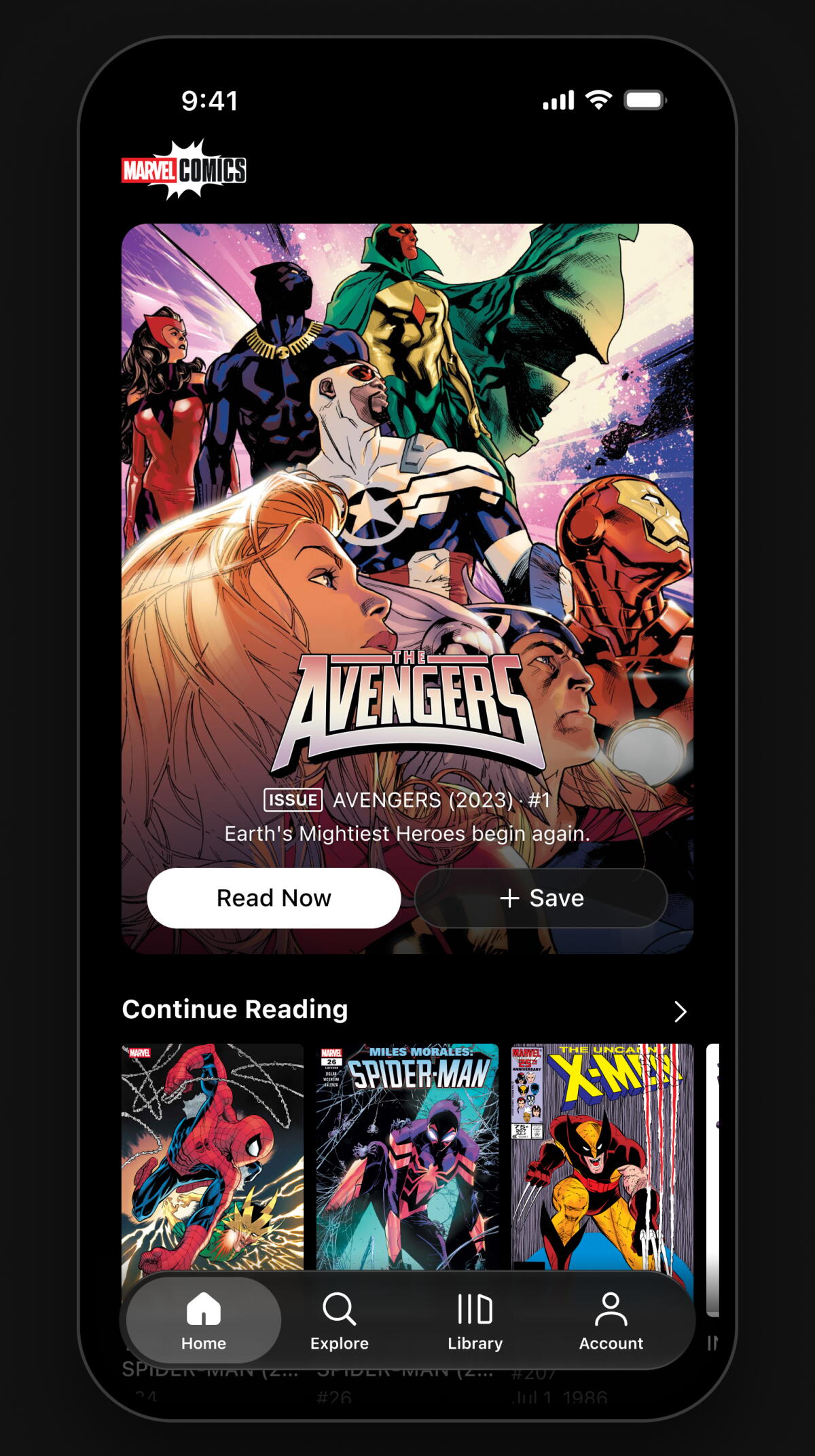
Marvel announced Monday that it is launching Marvel Comics, a new digital comics app that will house more than 35,000 current and classic titles featuring Spider-Man, the X-Men, Captain Marvel and more from its extensive library. The new platform is built and operated by Webtoon and will launch Nov. 16.
The Marvel Comics app library will feature comics spanning Marvel, Star Wars and 20th Century Studios titles at launch, with stories from Disney’s other brands — like Pixar and Disney Animation — expected to follow. The new app will support both the traditional page-based comics format that mirrors physical books and the more mobile-device-friendly vertical-scroll format. (Marvel Unlimited also featured vertical-scroll comics under its Infinity Comics banner.)
A preview of the Marvel Comics app.
(Marvel Comics)
Those attending New York Comic Con this Thursday through Sunday can get an early look at the new app at the Marvel Comics booth (#2435).
With the arrival of the new Marvel Comics app, Marvel Unlimited will “sunset” on Dec. 7. Marvel Unlimited has been the company’s in-house digital hub for its comics since its launch as Marvel Digital Comics in 2007. Subscriptions and payment information from Marvel Unlimited will not automatically carry over into the Webtoon-operated Marvel Comics, and Marvel says those whose paid subscriptions will be cut short because of the shutdown can expect a prorated refund on or around Nov. 16.
Marvel Unlimited members who sign up for Marvel Comics will be able to import their current library and reading history into the new app once it’s launched. The steps required for that process have not yet been detailed, but the company says these members will have until Dec. 21 to access their Marvel Unlimited library to ensure the transfer was successful.
Marvel Comics will offer two subscription tiers: The base-tier membership will run $9.99 per month or $69.99 annually for access to the app’s full catalog, with new issues of ongoing titles added as early as three months after print release. For those who would rather not wait that long to read newer comics, Ultimate-tier members will be able to access new issues as early as a month after its print release. Subscriptions for that tier will run $12.49 a month or $99.99 a year. Marvel is currently offering a special $59.99 “founder member” price for the first year of an annual Ultimate-tier memberships for those that preorder the service.
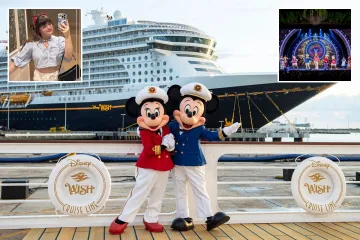
DISNEY has revealed what to expect onboard its huge new ship, Disney Believe from new restaurants to one-of-a-kind performances.
Launching in late 2027, it will be the ninth ship, and the fourth in the Wish class alongside Disney Wish, Disney Treasure and Disney Destiny.
Disney to launch its new cruise ship in 2027 – with all family-favourite characters onboardCredit: Disney Cruise LineIt will have its usual top deck swimming pools along with world-first performancesCredit: Disney
Onboard will be 7 swimming pools, splash areas, food outlets and restaurants, character meet-and-greets as well as Disney-first experiences.
Something that guests won’t be able to see anywhere is the Encanto musical which will debut exclusively on Disney Believe – and it’s a world first.
Sign up for the Travel newsletter
Thank you!
Other performances joining the line-up for onboard entertainment are Broadway-style shows, Tangled: The Musical and Disney Seas the Adventure.
Returning will be the fan-favourite Pirate’s Rockin’ Parlay Party which is a nighttime spectacular with a live rock band and fireworks at sea.
There will also be a Zootropolis-inspired entertainment hub called Gazelle where during the day it will hold trivia, games, and a family show alongside Judy Hopps and Nick Wilde.
In the evening, Gazelle will be open for adult-only entertainment which includes silent discos and variety acts.
There are some other strictly adult zones including Sea Notes, a piano lounge inspired by Ariel’s grotto.
The relaxed Wishing Well lounge is centered around its own castle courtyard where adults can relax and enjoy mocktails, cocktails, spirits, and coffees while musical performances take place.
Skygazers is a new observatory-themed pub serving up custom-made craft brews, cocktails and snacks.
Returning venues will include the Haunted Mansion Parlour, Arnaud Lallement, Quiet Cove as well as the Senses Spa, Untangled Salon, and Hook’s Barbery.
Sea Notes will be an adults-only piano lounge inspired by The Little MermaidCredit: Disney Believe
When it comes to dining, there will be a brand-new restaurant onboard the Disney believe called Oaken’s Table: A Frozen Family Feast.
While guests are eating, characters like Oaken, Anna and Kristoff will perform renditions of songs from the soundtrack.
Another option is 1923 which is onboard the sister ships which celebrates Disney animation and Worlds of Marvel.
Sweet treats can be bought from Inside Out: Joyful Sweets which has nearly 20 flavors of gelato and ice cream.
Two new cafes will be onboard, the first is Big Hero Sips which is inspired by San Fransokyo from Disney Big Hero 6.
Meanwhile, Café Kakamora is focused on Moana – and both will serve up coffee, tea and other specialty drinks.
Moana will take centre stage in the Grand Hall of the new shipCredit: Disney BelieveOaken’s Table: A Frozen Family Feast will have musical breaks with songs from the soundtrackCredit: Disney Believe
On the upper deck will be an open-air food court called Mickey and Friends Festival of Dining where guests can choose from barbeque, cantina bowls and salads, pizza, burgers and ice cream.
Pluto’s Pita Platters is one of the new stalls serving up Mediterranean-inspired foods from kebabs to pittas.
Like on Disney’s other ships, there will be clubs for kids, tweens and teens called 2319 with dedicated space for children between 3-17.
At “it’s a Small World” Nursery families can use babysitting services for little ones between six months to three years old.
The ship will have classic staterooms with most having ocean views and 450 are interconnecting which is suitable for larger families.
There will be four royal suites on Believe where guests can step into the world of fairytales – some inspired by The Little Mermaid, and Beauty and the Beast.
The Royal Reef Suite is inspired by The Little Mermaid and has floor to ceiling windowsCredit: Disney BelieveThe first sailing will be on December 18,2027Credit: Disney Believe
The Believe Tower Suite is exclusive to the ship and has been called a ‘one-of-a-kind suite for dreamers’.
It’s two-storeys, nearly 2,000-square-foot and sleeps up to eight people – it has two main bedrooms and four and a half bathrooms.
The views will be unbeatable thanks to its floor-to-ceiling windows.
The Disney Believe will offer four and five-night sailings from south Florida to the Caribbean and The Bahamas.
During its journey it will make stops at one or both of Disney Cruise Line’s island destinations, Disney Castaway Cay and Disney Lookout Cay at Lighthouse Point.
Like its sister ships, Believe will have a top deck with cinema and entertainmentCredit: Disney BelieveDon’t forget the swimming pools and and watercoasterCredit: Disney
And the new Disney Believe is just one of many new additions coming to the Disney attractions.
Disneyland Paris is getting a new Lion King log flume as well as the Up-themed Wilderness Explores Sky Swings.
An entire Villains Land will open at Magic Kingdom at Disney World, with a Maleficent rollercoaster and Magic Mirror dark ride.
Two new Cars rides, as well as an Indiana Jones and Encanto ride will be part of the expansion too.
The Walt Disney Co. announced Wednesday that ESPN’s telecast of the NFL’s marquee event on Feb. 14 at SoFi Stadium in Inglewood, Calif. will be available to Disney+ subscribers. The company also said Disney+ will carry two ESPN “Monday Night Football” games in the current season.
ESPN is producing the Super Bowl for the first time in its history. The game is airing on Disney’s broadcast network ABC which last carried the game in 2006, and on ESPN and the ESPN app.
The addition of Disney+ makes the game available to casual fans who may not have cable or subscribe to a sports TV channel. The Super Bowl is the most-watched TV event of the year, with audiences exceeding 120 million viewers in recent years.
Streaming platforms are bringing in additional advertising revenue for the networks that carry the game.
In 2025, the Fox telecast of Super Bowl LIX averaged 13.6 million viewers on Tubi, the ad-supported streaming service owned by the network’s parent company. Fox was able to sell streaming-only ads on the telecast at around $2 million for a 30-second commercial. The spots aired in the commercial breaks for local Fox TV affiliates.
Disney is offering advertisers the opportunity to buy streaming-only ads across Disney+, the ESPN app, Hulu Live and Fubo. The company has already sold out the commercial time on the ESPN and ABC telecasts with some 30-second spots going for $10 million.
As a lead-up to the game, Disney+ will carry ESPN’s “Monday Night Football” match-up between the Dallas Cowboys at Philadelphia Eagles on Oct. 26 and another contest later in the season.
Disney+ has been adding sports to its lineup, with select ESPN college football games and Formula E races now available on the platform.
It’s an annual fall tradition that Disneyland increase its prices — and stealthily in the night. Starting Tuesday, guests will pay more to experience the Happiest Place on Earth.
But the increases are relatively light. For the eighth year in a row, Disneyland did not raise the cost of the lowest-priced ticket, which is $104. And its highest-priced ticket, which is $224, also did not change. The increases were felt primarily on mid-level tiers for single-day, single-park tickets, and were limited to $5 apiece.
You’re reading Mr. Todd’s Wild Ride newsletter
Todd Martens’ newsletter delivers news and commentary on the past, present and future of theme parks, right from the theme park capital of the world — Southern California.
By continuing, you agree to our Terms of Service, which include arbitration and a class action waiver. You agree that we and our third-party vendors may collect and use your information, including through cookies, pixels and similar technologies, for the purposes set forth in our Privacy Policy such as personalizing your experience and ads.
Other prices also remain unchanged. The cost of Disneyland’s popular annual pass program, the Magic Key, did not increase. The top-tiered Magic Keys have been subject to hefty yearly spikes over the last decade. Parking remains fixed at $40, and multiday tickets have not been affected.
Collectively, this is one of the smallest overall increases made by the Disneyland Resort in recent history, as last year, its highest-priced single-day ticket jumped in cost $18. At a time when leisure costs are rising and forcing Americans to stay home, it comes as somewhat of a relief that Disneyland is not asking its fans to pony up substantially more cash to get through the gates.
While the Walt Disney Co. provided no official statement on the increases, Disneyland Resort officials noted in an email that it is aware guests are more closely watching their wallets in 2026. Thomas Mazloum, chairman of Disney Experiences, in a comment given to CNN, said, “Our goal is to put guests at the center of our decision making, and that starts by listening to them. That matters more now when families are watching every dollar, and we see it in the choices they make every day — in how they plan, in how far ahead.”
It’s also an indication that, at least for the time being, the Disneyland Resort has pushed its prices as far as they can go. Disneyland is blessed with an in-demand product, but every commodity has its limits.
In May, the Walt Disney Co. reported a 1% decline in attendance at its U.S.-based parks compared with the prior year, which the company attributed to “continued softness” in international visitors. In August, however, Disney bounced back, and noted, especially at Florida’s Walt Disney World, that attendance had perked up. Overall, visitation at its U.S.-based theme parks was 3% higher than in the previous year’s third quarter, the company said. This boost was largely attributed to a variety of summer deals.
As someone who is at Disneyland nearly every week, I can report that summer crowds were relatively manageable. There have been some asterisks, such as the World Cup and high heat, both likely keeping guests away, but anecdotally, Disneyland crowding hasn’t been nearly as extreme this year. I simply believe that people do not currently have the excess funds that they once had.
And Disney seems to be responding to the economic climate, especially in making it easier for its biggest fans to visit the resort. In conjunction with the price increases, Disneyland President Jill Estorino announced Tuesday that the company would be removing its no-show penalty on annual passholders. Additionally, passholders can now cancel their reservations up to 11:59 p.m. on the day of their reservations.
These are welcome changes, as previously guests were allowed three no-show penalties before their ability to make reservations was restricted, and had to cancel the night before. But plans change, and the reservation system restrictions, initially put in place to manage crowding during the COVID-19 pandemic, had increasingly felt like an impediment. While reservations are still required, which Disneyland has stated helps the resort plan its crowd-forecasting and staffing, the system is more lax and user-friendly than it has been.
Digging deeper into Disneyland’s pricing, there have been some small changes elsewhere. The cost of the line-skipping feature Lightning Lane, which can fluctuate based on crowding levels, now has a top price of $38, an increase of $1. And the park-hopper add-on for single-day tickets, which can also fluctuate, increased $5-$10, depending on the day. And earlier this year Disneyland did increase its prices on a number of food items.
The Disneyland Resort, to be sure, is not cheap. In the world of entertainment, it remains a luxury good on par with postseason Dodgers tickets (albeit with cheaper parking than Dodger Stadium). But I credit the Disneyland Resort for reading the cultural room. Pulling the plug on its recent steady and hefty price increases, especially on annual passes, shows the company can occasionally listen to its audience as much as it does Wall Street. Sure, a price decrease would be nice, but we don’t live in a fantasyland.
This week in SoCal theme parks
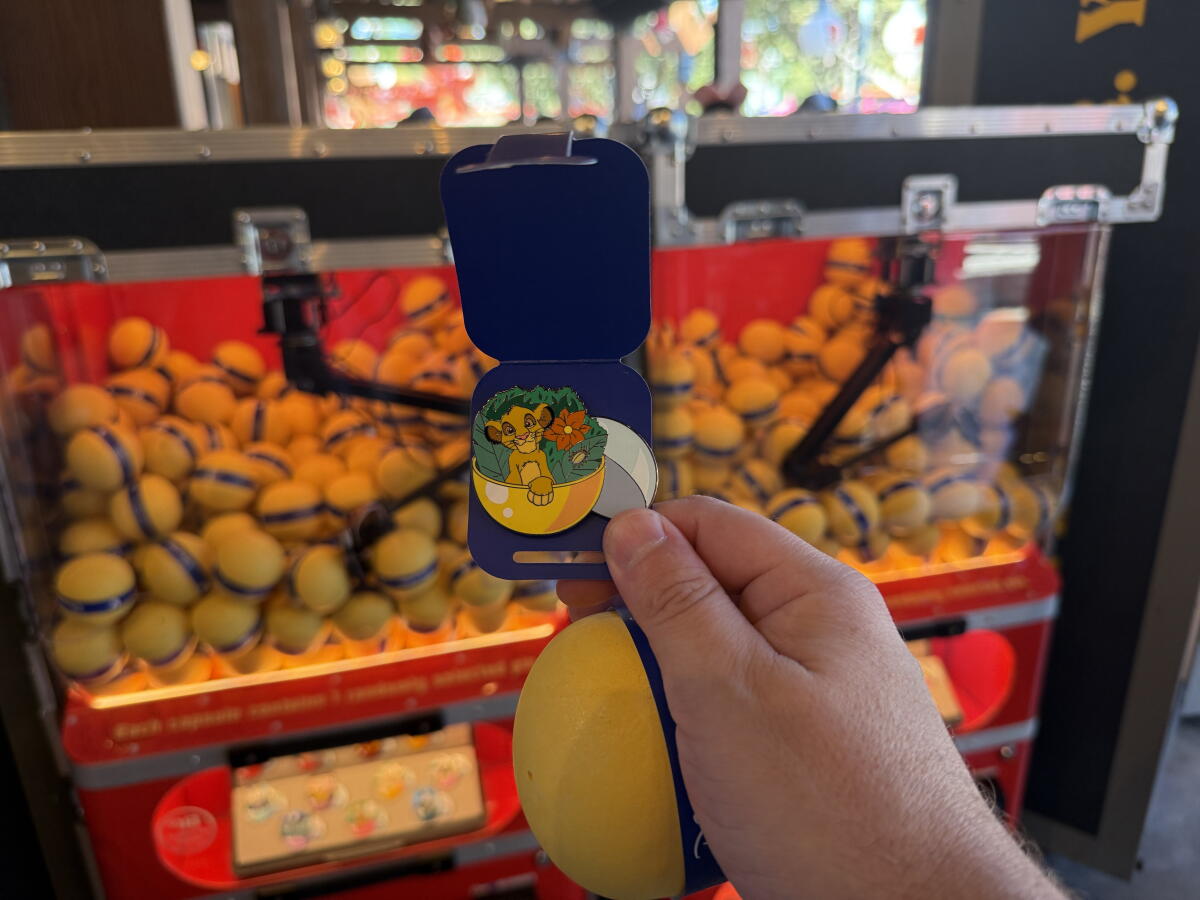
The Disneyland Resort has added new collectible pin trading vending machines.
(Todd Martens / Los Angeles Times)
Attention Disneyland pin traders! The Disneyland Resort has added a new pin line available in select vending machines throughout the property— look for them in San Fransokyo Square and Pixar Pier in Disney California Adventure and at the Star Wars Trading Post in Downtown Disney. Each pin is $18, and one buy gets you one egg-like orb with a mystery pin. There are 15 in the set — I got Simba, as seen above — and offerings include park staples such as the Hatbox Ghost as well as classic characters such as Princess Aurora and Dumbo. Some are marked limited edition — “chasers,” in Disney pin trading speak — so be on the lookout. Thanks to Mr. Daps for the heads-up.
A Disneyland ticket deal. With life constantly getting more expensive (see above), it’s a good time to hunt for a deal. If you’re a Costco member, reports are that there’s a pretty good one happening right now. Valid through Dec. 18, Costco is said to be selling a two-day Disneyland park hopper ticket with the line-skipping feature Lightning Lane already added in for $329.99. The offer includes a $60 dining card, and works out to a savings of a couple hundred. Disney Tourist Blog has more details on the limited deal.
An applaudable energy project. Six Flags Magic Mountain has announced the completion of its solar carport project, the largest solar carport in California. Covering 4,315 parking spaces, the project was designed to offset 100% of the energy consumption of Magic Mountain and Hurricane Harbor (while also providing some shade and sun protection for its parked cars). The project is interconnected with the Southern California Edison grid, meaning excess energy may be exported as well as allowing the parks to draw energy from the project when needed. The carport also offers 109 electric vehicle charging stations.
A pause at Castle Park. Riverside’s long-standing Castle Park is beginning the creation of what it says is a“reimagined experience.” As such, on Nov. 1 its Ride Park will halt operations for the foreseeable future. “We’re taking the time to plan the right rebuild and will share updates as plans take shape,” the company says in an FAQ on its site. Its mini golf and arcade areas will continue to welcome guests.
More on the noise issues around the ‘Fast & Furious’ coaster
Riders on Universal’s new Fast & Furious: Hollywood Drift.
(Ronaldo Bolanos / Los Angeles Times)
There will be no shortage of updates and news on Universal’s new Fast & Furious: Hollywood Drift coaster in the coming weeks, months and maybe even years, especially as the attraction continues todraw the ire of the park’s neighbors in Toluca Lake. Universal Studios Hollywood held a meeting with nearby residents on its studio lot last Wednesday. The session was closed to the media but was said to attract more than 350 neighbors. I spoke with a number of residents, as well as Universal, after the session, and indications are that the two sides still haven’t settled on a compromise. The issue, of course, stems from the sound of rider screams from the coaster drifting into the residential area.
Universal has promised, through the end of the year, to not begin operating the coaster before 9 a.m., and has also, in response to community feedback, installed a new sound barrier featuring an additional 1,900 square feet of sound absorbing material. The new barrier includes a sail that’s about 63 feet tall and 31 feet wide. But residents I spoke to feel it’s not yet enough. I’ve heard many stories from neighbors in recent weeks regarding the disruption caused to their lives. They range in extremes. A neighbor without air conditioning says they can no longer open their windows. A resident who offers meditation services from their home says their business is now potentially forever impacted. A teen was unable to complete a SAT prep test due to the incessant screaming. Many report insomnia from the rise in anxiety levels. There’s plenty more.
The meeting was said to grow contentious near its end. Residents provided data on how the effects of noise, specifically screams, can cause stress-related responses. Universal is said to have discussed the challenges in further mitigating the sound. County supervisor Kathryn Barger was in attendance and is calling for additional communication between the two sides. “The meeting’s dialogue made clear that the lives of surrounding residents are being impacted and disrupted,” Barger said via a statement. “I respect Universal’s decision to host this forum and listen to the concerns being raised. I encourage all stakeholders to maintain an ongoing honest dialogue.”
Tell us your stories. Ask us your questions.
Have a theme park tale to share? Whether it was a good day or less-than-perfect day, I would love to hear about it. Have a question? A tip? A fun photo from the parks to share? Email me at todd.martens@latimes.com. I may feature your note in an upcoming newsletter.
Ride on,
Todd Martens
—
This newsletter is free thanks to the support of L.A. Times subscribers. If you’re not yet a subscriber, explore subscription packages to unlock unlimited digital access and support award-winning local reporting.
Was this newsletter forwarded to you? Sign up here to get it in your inbox.
Several years ago, DreamWorks Animation veterans Joel Crawford and Januel Mercado pitched the studio an original story centered on friendship and steeped in Filipino culture.
That draft became the animated film “Forgotten Island,” which opened in late September and counts singer H.E.R., Liza Soberano and Dave Franco among its voice cast. The movie focuses on best friends Raissa and Jo, who will soon be separated when Raissa goes to college in the U.S., and the final adventure they take to the fantastical island of Nakali.
The movie opened to a softer $13 million in the U.S. and Canada and has so far made $23.6 million at the domestic box office over two weekends. Globally, “Forgotten Island” has brought in $38.5 million on an $80-million production budget.
That opening haul is lower than the average for original animated films from a major studio, which is about $14.6 million, according to the FranchiseRe movie industry newsletter. But the studio is hoping the movie — which has garnered a strong 95% rating on Rotten Tomatoes — will pick up steam and benefit from the relative lack of animated competition at the box office until the early November debut of “The Cat in the Hat,” developed by Warner Bros. Pictures Animation.
You’re reading the Wide Shot
Samantha Masunaga delivers the latest news, analysis and insights on everything from streaming wars to production — and what it all means for the future.
By continuing, you agree to our Terms of Service, which include arbitration and a class action waiver. You agree that we and our third-party vendors may collect and use your information, including through cookies, pixels and similar technologies, for the purposes set forth in our Privacy Policy such as personalizing your experience and ads.
“Forgotten Island” is a big bet for Glendale-based DreamWorks Animation, which like many studios, has largely depended on sequels to drive box office success.
Original animated stories — or original movies at all — have become rarer gambles in Hollywood these days, when sequels and reboots feel like safer options. But Crawford and Mercado knew they wanted to develop a new story together.
The pair, who wrote and directed the film, have been friends for nearly two decades after they met at DreamWorks Animation as storyboard artists. Together, they’ve worked on 2011’s “Kung Fu Panda 2,” 2013’s “The Croods” and 2022’s “Puss in Boots: The Final Wish.” The two bonded over their similar sense of humor and their love for movies, and their longtime friendship was apparent in their easy banter during a joint interview shortly after the “Forgotten Island” premiere last month.
Early on, Crawford and Mercado knew they wanted to tell a story set in the Philippines that celebrated Filipino culture. Mercado is Filipino American and Crawford’s wife is Filipino, so a movie that authentically represented Filipino culture was important to them. In the film, the island of Nakali has many creatures inspired by Filipino folklore, and the characters casually use Tagalog words alongside English.
“There’s a sophistication in terms of respecting that the audience is smart, and doing our part as filmmakers to make sure that the visual storytelling and the context gives everything the audience needs to know,” Mercado told me.
Audiences, too, are more comfortable with content in other languages these days, as I wrote last week about Neon’s Korean-language thriller “Hope.” After all, kids will sing Korean lyrics in K-pop songs, and even “Puss in Boots: The Final Wish” interspersed Spanglish into the story.
“It feels timely to update the way we tell stories, to not treat the audience like, ‘They won’t understand this,’ but really treat them with respect,” Crawford said. “It just felt right to chase authenticity and let go of expectations, especially of what an animated movie should be and has been, and really do something fresh because it’s just coming from who we are.”
In the last few years, animation has been a powerhouse at the box office. Disney and Pixar’s “Toy Story 5” and Universal Pictures, Nintendo and Illumination’s “The Super Mario Galaxy Movie” have each crossed $1 billion at the global box office, two of only five movies to do so this year. In 2024, Disney and Pixar’s “Inside Out 2” was the highest grossing movie in the U.S. and Canadian markets.
Original stories have been tougher. Pixar has recently struggled to match the theatrical success of its prior original films and the slower start for “Forgotten Island” may be a sign of similar hurdles for new stories. But culturally accurate storytelling has paid recent dividends — just look at the success of Netflix’s “KPop Demon Hunters,” which won two Oscars, broke streaming records and sold out theatrical singalongs.
“We believe that there is a platform and space for everyone’s story, for people to feel seen and to know they matter,” Mercado said. “Even when they see a story that is specifically Filipino, if we’ve done our job right, we’ve shown you that you could connect to the story, whether or not you have this experience with the Filipino community or the culture.”
With “Forgotten Island,” Mercado and Crawford also want to push the boundaries of animation beyond its perception as films just for kids. Later this year, films such as Laika’s PG-13 rated “Wildwood” and Brad Bird’s noir film “Ray Gunn” will test the audience appetite for more adult animated and original fare.
“We’re in a time of massive sequels,” Crawford said of stories today. “When you expand where you’re telling them and who is telling them, you naturally get originality. This year has been really exciting for original stories in both animation and live action. You are taking a chance on originality, but it pays off.”
The Warner Bros. film was plagued by very mixed reviews from critics, as well as a challenging marketing campaign. The film stars Cruise as an aging oil tycoon whose drilling operations trigger a catastrophic climate change disaster. Worldwide, the film brought in $20 million on a production budget of $125 million.
It’s been a tough theatrical year for Warner Bros., which has seen a string of disappointments before “Digger.” Beyond the cinema, the company is now in the process of being absorbed by Paramount Skydance, with the merger set to finalize Tuesday.
What I’m watching
It’s been yet another busy week, so about the only thing I was able to watch was a few WNBA playoff games. Since the Sparks were left out of the playoff picture again, I’ve sort of adopted the Golden State Valkyries as the next best California team to root for, and what a wild game that was over the weekend against the Las Vegas Aces.
Walt Disney Co. laid off nearly 300 workers this week, the latest wave in an industry-wide consolidation that continues to reverberate throughout Southern California.
Several people close to the Burbank entertainment giant confirmed this week’s cuts, which came as Disney separately offered early retirement packages for older workers. The voluntary separation program is underway, and the number of executives who will exit later this year has not been determined, one of the knowledgeable sources said Friday.
D’Amaro took the reins from former CEO Bob Iger in March, and the former parks chief has begun to organize the company around a “One Disney” approach to break down corporate silos that sprouted with each large acquisition, including Disney’s 2019 takeover of much of 21st Century Fox.
Disney also has been working for the past year to make Disney+ the company’s central streaming hub. As part of that effort, executives have begun to diminish the Hulu service and brand, which sprung to life nearly 20 years ago.
Disney employees are bracing for further cuts. Many expect a significant television division restructuring early next year, which could result in hundreds of layoffs, according to the Wall Street Journal.
Disney’s legal government affairs department also will be downsized, according to a recent internal memo Disney Chief Legal Officer Horacio Gutierrez.
A Disney spokesperson declined to comment.
Disney President Dana Walden, during a Thursday appearance at Bloomberg News’ Screentime media conference in Hollywood, acknowledged the industry turmoil.
Traditional studios and TV networks have shed tens of thousands workers in recent years after the streaming bubble burst and twin labor strikes paused projects.
Production workers in Los Angeles have felt a double-whammy as other states and countries have offered generous tax subsidies that have pulled productions from L.A.
Separately, Warner Bros. Discovery workers are anxious that David Ellison’s planned takeover of their company next week will ultimately result in hundreds of layoffs as the tech scion and his team hunt for $6 billion in cost cuts that they promised investors and prospective debt holders.
The merger will leave the combined company, which will go by the name Skydance, with more than $80 billion in debt.
Walden suggested her company’s cuts would be more modest. She said restructurings were necessary as companies adapt to changing consumption patterns, which have eroded the more lucrative TV economics of yesteryear.
“There is a need to constantly evaluate how you’re structured,” Walden said. “It is extremely painful. We’ve exited colleagues who I’ve worked with for most of my career and it is, in many ways, a harsh reality.”
She described Disney’s voluntary retirement program as a “generous” program to give “long-tenured executives agency and the opportunity to make their own decisions around whether the timing was right to leave.”
“This evolution, it will never stop,” Walden added. “Technology set their sights on our business, and we must survive, and thrive and grow. And that’s what we’re going to do.”
Former Walt Disney Co. Chief Executive Bob Chapek knows his reputation among Disney fans, especially Disneyland loyalists. In his new book “Behind the Castle Walls,” he defends his changes to the Disneyland experience, the vast majority of which are still felt today.
“Contrary to what some people tried to paint me as,” he writes, “I wasn’t just a maniacal, money-optimizing machine.”
Sign up for Mr. Todd’s Wild Ride
An insider guide to the ever-changing world of theme parks, coming to you straight from SoCal — the theme park capital of the world.
By continuing, you agree to our Terms of Service, which include arbitration and a class action waiver. You agree that we and our third-party vendors may collect and use your information, including through cookies, pixels and similar technologies, for the purposes set forth in our Privacy Policy such as personalizing your experience and ads.
When I had the chance to talk to him last week, I wanted to know if having that image bothers him.
“I’m not concerned about it,” he says, speaking via phone from his Florida home. “I don’t give that any thought at this point. But I’m very proud of the performance of the parks segment during my time. The numbers bear that out.”
Chapek, in his role as chairman of the parks division and later CEO of the company, presided over an eight-year period beginning in 2015 in which Disneyland would significantly raise prices, introduce add-on perks, and, in my opinion, create the unsettling sense that you could be having more fun if you just spent more money.
When Chapek took over the parks segment, Disneyland would begin to fully remake its annual passholder program, largely by significantly increasing its price and limiting access. (In 2015, the top priced annual pass was close to $800. Today, it’s $1,899.) Single-day tickets to the parks would also begin a period of aggressive price hikes. Today, a one-day, one-park ticket tops off at $224. It’s widely expected that Disneyland will be raising its prices again this October, as it has done nearly every year in recent history.
Additionally, benefits that Disneyland guests long took for granted as free, such as the line-skipping Fastpass program, would become a paid perk on Chapek’s watch. Access to some attractions would be grouped together as part of a package now known as a Lightning Lane. In-demand rides such as Star Wars: Rise of the Resistance would be sold separately.
Bob Chapek has defended price increases at Disneyland, noting that ambitious projects like Galaxy’s Edge require capital.
(Allen J. Schaben / Los Angeles Times)
Prices on all of the above typically increase yearly. Today, guests who spring for the front-of-the-line Lightning Lane pass as well as individual access to Rise of the Resistance can expect to pay around an extra $65 per person once having their tickets scanned.
Chapek notes he faced significant opposition at Disney in making these changes.
“To all who come to this happy place, welcome,” goes Walt Disney’s original dedication speech, which for decades was used as a guiding light that every guest who entered Main Street, U.S.A., would be treated as an equal. That meant, with limited exceptions, no special access for anyone.
This was seen as an “inviolable virtue” at Disney, but one Chapek was ready to break, as he writes in his book.
“Everyone is equal when they come through the gates no matter what walk of life they come from,” Chapek tells me. “What’s different, though — and this isn’t because we say it’s different, it’s because the guests say it’s different — it’s that guests say they want an experience that’s tailored to what they can afford.”
Maybe. I don’t have access to guest satisfaction surveys, but that sounds like something only people with a certain privilege say. No doubt guests who can afford less don’t want a worse experience.
Chapek in his book describes himself as a “disruptor,” and considers Lightning Lane-like add-ons “bespoke” experiences that appeal to guests who crave a more customizable day. While they are common at nearly every theme or amusement park, I consider them classist, creating a haves-versus-have-nots mindset as soon as guests step through the gates.
Chapek defends the move to me, pointing out that while he presided over the parks, it’s lowest price one-day, one-park ticket stayed steady at $99 (today it’s $104). While true, and while Disneyland has even sought to increase the number of days offered at its introductory price since Chapek was ousted from the company in 2022, these are often midweek tickets, necessitating that working families take a day off and force a child to skip school.
“How about demand?” says former Walt Disney Co. CEO Bob Chapek, seen here with Minnie Mouse at Hong Kong Disneyland, when defending his price hikes.
(Kin Cheung / Associated Press)
“How about demand?” Chapek says to me when I point out that I have been critical of the moves. “Do people stop coming? That would obviously be a big concern. Even with the increase in prices that were taken on the annual passes, it would temporarily soften demand, but a year later they were subscribed just like they were before. Wall Street has certain expectations that may not be consistent with the expectations of guests of a certain pass type.”
Chapek reveals in his book that there is somewhere around 1.1 million annual passholders to Disneyland, which is today known as a Magic Key. With each price increase, he writes, that number would tumble to around 1 million, but within about 12 months they would be back to a level they were at before the rise in prices.
During Chapek’s reign, the company also introduced a reservation system, which asks guests to plan in advance. The price increase, later coupled with a reservation system, is designed to cut down, in part, on spontaneous trips to the resort, forcing guests to be more intentional about their Disneyland plans. This can aid, of course, in forecasting crowds and park staffing, but is also intended to limit days in which the park can feel overcrowded.
During his five-year tenure as parks chairman, Chapek writes that profits within the segment went up 18%. And that was largely due to an increase in individual guest spending. Over the decades, certain leaders of the Walt Disney Co. have arguably more closely ingratiated themselves with fans than Chapek has, but the fact remains that Chapek fundamentally and forever altered the approachability and the affordability of a Disneyland visit.
“In order to build things like Galaxy’s Edge and Avengers Campus, that takes capital,” Chapek says. “That capital takes revenue.”
My long-term fear, however, is that this has created a slippery slope. Disneyland guests now brace for yearly price hikes each fall, and this is coupled with yearly spikes on food prices each summer. Once the company and its shareholders become accustomed to such a financial boost, an environment where individual guest spending sharply increases even when domestic park attendance is soft or steady, there’s likely no turning back. Disney has created a business that will target the highest-spending consumer year in and year out.
And thus, guest equality, what was once an “inviolable virtue,” is forever a thing of the past, no matter who is in charge.
This week in SoCal theme parks
The X2 roller coaster at Six Flags Magic Mountain.
(Myung J. Chun / Los Angeles Times)
X2 has been retired. Six Flags has officially pulled the plug on Magic Mountain’s X2 coaster, which has been the subject of recent controversy after several lawsuits allege people were injured on the ride. Six Flags shut down X2 in July amid a state investigation into the coaster. “While X2 consistently passed a multitude of safety tests, we have decided to close the ride because we believe it’s the right thing to do. Ride safety is a cornerstone of our business, and when we see guest confidence affected, we take it seriously,” Brian Oerding, Six Flags Magic Mountain president, said in a statement. The Times’ Fedor Zarkhin has more on the news.
Don’t miss Disneyland’s mariachi band. There are a few more opportunities to catch Mariachi Alegría de Disneyland in Rancho Del Zocalo park inside Frontierland. The performances, set for the evenings of Oct. 6, 7, 13 and 14, are part of the resort’s National Hispanic Heritage Month celebrations. Also, beginning Oct. 4 and lasting through Oct. 15, guests can meet the character of Elena of Avalor near Royal Hall next to Sleeping Beauty Castle.
Heads up for those attending Halloween Horror Nights. If you have a visit planned to Universal Studios Hollywood’s Halloween Horror Nights and you’re interested in the park’s new Fast & Furious: Hollywood Drift coaster, there’s now an opportunity to ride it. For a cost. Universal is selling access to the coaster for $19.95 per person. Previously, the coaster was only available to those who sprung for the fancy R.I.P. Tour, which is now sold out.
Work out in Disneyland! The Disneyland Resort has announced new fitness classes across its two parks, an early morning perk for guests staying at one of its three hotels. Among the offerings is the ability to do yoga in Star Wars: Galaxy’s Edge, agility and strength exercises in Cars Land, and a mini-boot-camp-style class in Avengers Campus. Classes range in price, but most are under $49.
Tell us your stories. Ask us your questions.
Have a theme park tale to share? Whether it was a good day or less-than-perfect day, I would love to hear about it. Have a question? A tip? A fun photo from the parks to share? Email me at todd.martens@latimes.com. I may feature your note in an upcoming newsletter.
Ride on,
Todd Martens
P.S.
Me, enjoying a beverage, on the now shuttered Star Wars: Galactic Starcruiser.
(Allen J. Schaben / Los Angeles Times)
There is one area where the former CEO of the Walt Disney Co. and I are in complete agreement. Chapek and I both miss Star Wars: Galactic Starcruiser, colloquially known as the Star Wars Hotel. The ambitious, but costly, multi-day experience was one of the most creatively inspiring offerings in company history.
In “Behind the Castle Walls,” Chapek writes that he believes it was shuttered too soon. The Starcruiser closed after about a year of operation. “Was it perfect the first time? Absolutely not,” Chapek tells me. “Was it one of the most ambitious lodging experiences we have ever created? Yes.”
A place dedicated to play — and light role-play — the Starcruiser allowed guests to fully inhabit a fictional world. It was an argument that interactivity could have been the future of theme parks. “It seemed to have the plug pulled on it prematurely,” Chapek says, “and I think it was a big opportunity missed.”
— This newsletter is free thanks to the support of L.A. Times subscribers. If you’re not yet a subscriber, explore subscription packages to unlock unlimited digital access and support award-winning local reporting.
Was this newsletter forwarded to you? Sign up here to get it in your inbox.
Director Na Hong-jin’s action movie “Hope” opened in 1,500 U.S. cinemas this month, marking the biggest domestic theatrical footprint for a Korean-language film since the Academy Award-winning “Parasite.”
That’s a big bet, particularly for a foreign film. But after the success of “Parasite,” the growth of Korean shows such as Netflix’s “Squid Game” on streaming and the broader acceptance of subtitles in film and television, it was a bet Neon was willing to make.
The indie studio snapped up North American and English language rights to “Hope” for an undisclosed price before the film’s world premiere in the spring at the Cannes Film Festival.
Right off the bat, Neon knew the film would be positioned in South Korea as a big action thriller and massive event film for director Na, and wanted to match that.
In the film, which includes Alicia Vikander and Michael Fassbender in its cast, a group of people fight back against a creature that rampages through a Korean village.
“The reality is that just because a movie has subtitles, doesn’t make it an art film or a niche film,” Elissa Federoff, Neon’s chief distribution officer, told me this month. “And this, to us, felt like a big action blockbuster.”
You’re reading the Wide Shot
Samantha Masunaga delivers the latest news, analysis and insights on everything from streaming wars to production — and what it all means for the future.
By continuing, you agree to our Terms of Service, which include arbitration and a class action waiver. You agree that we and our third-party vendors may collect and use your information, including through cookies, pixels and similar technologies, for the purposes set forth in our Privacy Policy such as personalizing your experience and ads.
She continued, “To me, it was this movie that certainly cinephiles were going to be curious about. But I also knew that we could cross over to a broader audience if we gave it a shot.”
So far, “Hope” has grossed more than $8 million domestically and $45.6 million worldwide on a reported production budget of at least $45 million.
Neon expected to reach Korean and Korean American audiences with “Hope,” but the film also over-indexed with Latinos, who represented 27% of the audience, according to PostTrak theatrical data.
Such a wide national release is unusual for foreign films, which typically play in specialty theaters on fewer than 100 screens. Though its domestic box office total doesn’t indicate that the film fully crossed over to mainstream audiences, “for a foreign film, it’s very successful” and has done “solid business,” said David A. Gross, who writes the FranchiseRe movie industry newsletter.
Neon, of course, has experience with Korean cinema. It distributed 2019’s “Parasite,” which became the first non-English-language film to win Best Picture. After “Parasite” won the Oscar, it was shown on 2,000 screens, about 17 weeks after its release. The Bong Joon Ho-directed film ended up grossing more than $53 million domestically and brought in more than $263 million worldwide.
The film put Neon on the map in many ways, Federoff said, and also pushed the boundaries for what the industry considered a best picture nominee. Films such as “Parasite” and “Hope” should also expand what studios consider to be mainstream fare.
“Studios and distributors are still boxing things out a little bit and thinking of these as not as accessible or not for a general commercial audience,” Federoff said. “And I would totally disagree with it.”
Though “Hope” is a long way from the domestic box-office success of “Parasite,” these kinds of swings are important to keep the pipeline of original films humming and to vary the types of fare mainstream audiences can see at their local theaters.
Although art house films once skewed toward older audiences, indie films are now popular with younger generations, who have also become accustomed to reading subtitles.
That could bode well for future foreign language films looking to make inroads with mainstream audiences. While giving a wide release to a foreign language film could be seen as risky, it’s a move Federoff believes can help bolster creative filmmaking and keep people engaged at cinemas.
“My hope is that studios start to trust their audience and respect their audiences a little bit more,” she said. “I think we can all do this. I think we can all say that we just have to have more risk taking involved with what we do. There’s a lot of incredible international cinema out there that should be seen by everybody.”
Paramount and the states fight back
Paramount Skydance and the state attorneys general are defending their proposed settlement in the face of skeptical questions from Sen. Cory Booker (D-N.J.), arguing that the judge overseeing the case should approve the agreement without the deeper review the senator has requested.
On Thursday, U.S. District Judge Araceli Martínez-Olguín told both sides to answer Booker’s questions before she ruled on whether to approve the proposed consent decree. She said at the time that she would issue a ruling “in due course.”
On Monday, both sides issued separate filings that argued the terms of the settlement were adequate. In particular, the states pushed back on assertions that the consent decree was too weak, saying it “reflects a reasonable compromise that addresses the competitive issues posed by the proposed merger in the markets alleged in the complaint.”
“The decree’s enforcement provisions have teeth,” the states wrote in their filing.
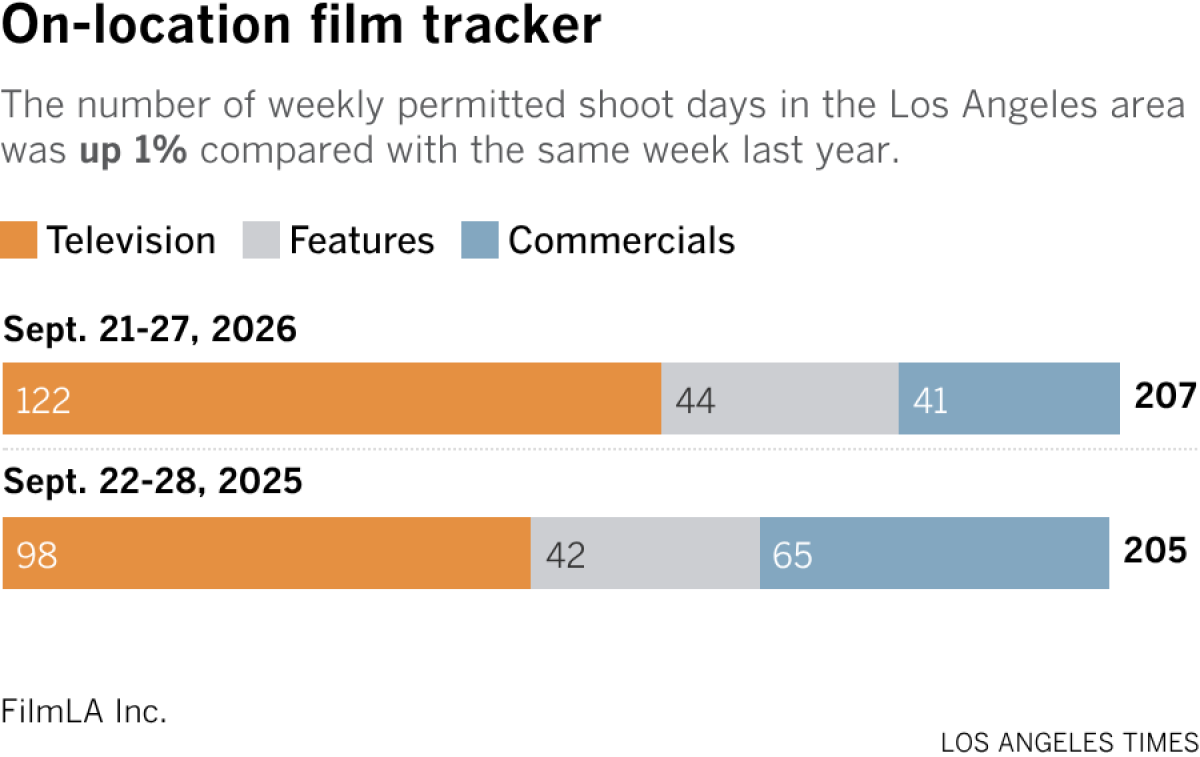
The proposed legislation would provide a 20% credit on above-the-line and below-the-line U.S. labor costs for eligible productions, including postproduction and visual effects work — two industries that have increasingly moved overseas.
The uncapped credit could increase to 30% with several uplifts, including for independent productions or filming in a federally declared disaster area, such as Los Angeles County.
What I’m watching
It’s fall, which means I’m all in on “Dancing with the Stars,” as I have been since Season 2, when Drew Lachey won with pro partner Cheryl Burke back in 2006.
This season feels like it was made for millennials like me, with contestants such as Julia Stiles, Harry Shum Jr. and Jenna Dewan. But my favorite dance last week was actually Guillermo Rodriguez’s paso doble.
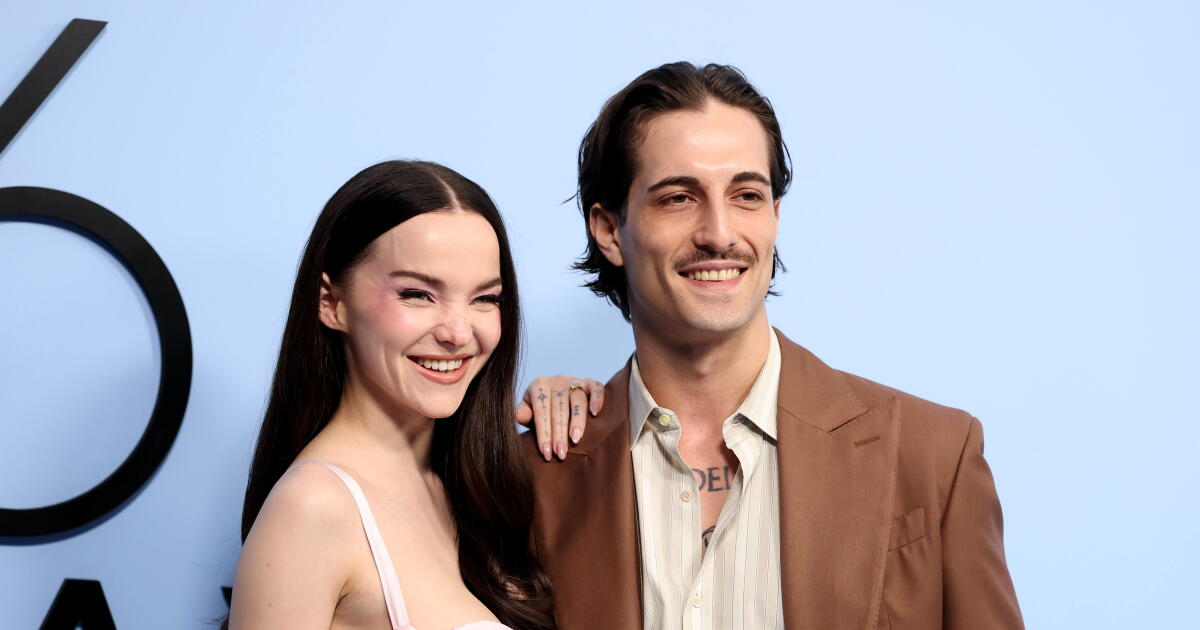
Dove Cameron and Damiano David have tied the knot!
The 30-year-old former Disney star and pop starlet married the 27-year-old Italian rock singer in a civil ceremony Thursday at the town hall in Montalcino, Italy, per Vogue, which first shared details of their nuptials.
The couple began dating in 2023 after meeting at the MTV Video Music Awards a year prior, where they were both contending for best new artist — Cameron took home the prize.
After a long stretch on Disney playing identical twins on the show “Liv and Maddie” and the daughter of Maleficent and Hades in the “Descendants” film series, Cameron successfully entered the mainstream music landscape with her sultry vocal flair. In 2022, she released the smoky electro-pop, queer anthem “Boyfriend,” which reached No. 16 on the Billboard Hot 100 chart, and the theatrical “Breakfast,” a man-eater melody that declares she’s in charge.
David is the frontman of the Italian rock band Måneskin, which formed in Rome in 2016 and won the Eurovision Song Contest in 2021 with their song “Zitti e Buoni.” Now David is focused on his solo career; in 2025 he released his debut album, “Funny Little Fears,” which reached critical acclaim on various European charts, reaching gold status in France, Italy and Poland.
Cameron revealed the pair’s engagement in January, uploading a picture to her Instagram account that zoomed in on the engagement ring. The proposal took place in an “intimate moment” back in October 2025, the “56 Days” star would later tell Vogue in a Jan. 26 article.
The couple — who live in a quiet Rome neighborhood — kept hush about the wedding plan details, sharing with Vogue earlier this month only that a date was set for September.
In an otherwise empty compartment of a regional train on its way to a small town in Germany last month, a friendly passenger asked if I was headed to Halberstadt for “the note change.” He was an Australian law professor based in Hong Kong who was traveling with his Swiss mother for the irregular ritual every few years of a new note being sounded on a decommissioned old church’s diminutive modern pipe organ in what feels like the middle of nowhere.
He was hardly alone. The audience the next day in the packed late-Romanesque St. Burchardi “John Cage Organ” Church had come from seemingly everywhere, along with international media, to witness a barely distinguishable new note added to a sustained chord in Cage’s “Organ2/ASLSP.”
“ASLSP” stands for as “As Slow(ly) and Soft(ly) as Possible,” adapted from the opening line of the final paragraph in James Joyce’s “Finnegans Wake”: “Soft morning City! Lsp.” Cage had meant his organ piece to enjoy the indeterminacy of neither the performer nor the audience knowing how long the score, in eight parts, would last. In Halberstadt, they are stretching it out 639 years! The performance began in 2001 with the intent that each note change would be a great event.
Four years ago, Times columnist Nicolas Goldberg wrote an opinion piece about his fascination with what to him sounded like a profound project about the meaning of time. I tried to talk him out of what I believed to be a gimmicky violation of the being-in-the-moment spirit of Cage. But what mattered to Nick was the idea, not the intent, and he used me in his column as a foil. Still, Cage has been central to my practicing what some people (not me) call music criticism, and I contended wild horses couldn’t drag me to Halberstadt.
Nevertheless, early August’s “From 7 to 8,” as the note change was advertised, occurred almost exactly to the day, as when, 50 years earlier, I filed my first music review in the Los Angeles Herald Examiner. This was also to be my last summer and 121st season on staff of the Los Angeles Times. I step down as music critic Friday. (I still plan to contribute to The Times on an irregular basis.)
I happened to be visiting the Salzburg Festival in August and, in a spirit of endgame, hopped on a train to Halberstadt. On the seven-hour ride, my half-century Cage-suffused career passed through my mind.
I thought about how Cage had once told me that when he was a boy in Los Angeles, he loved Grieg with no need to know why. When he studied music, reason replaced love. It was only regaining the ability to hear music as music that he could compose.
Cage described this as an example of the celebrated Zen koan about reality: First there is a mountain, then there is no mountain, then there is.
When I accidentally stumbled into music criticism with an academic penchant for music analysis, my crutches for writing about music were technical and of little use in a newspaper. I had to find a way to simply listen. It gave me new ears, and I was hooked.
Cage solved my next problem by insisting that the way to discover new things is to overcome our dependence on our likes and dislikes, those supposed pillars of criticism. College taught me to investigate the “great” composers who mattered and disdain those of no value. Consequently, I had never paid attention to the likes of Rachmaninoff and Shostakovich but discovered that they moved listeners deeply. Again, for me, so-called criticism proved a pathway to opening the mind, and writing about discovery is an ancient pleasure. Cage put it this way: “It’s not what I don’t know that scares me, it’s what I do know.”
The great enticement to return to L.A. after spending nine years in New York (and periodically reporting on Cage from the East Coast and Europe for The Times) was the prospect of Walt Disney Concert Hall. Construction hadn’t yet begun and fundraising was iffy; the community was scared about what it didn’t know. I came armed with another Cage-ism: Every seat is the best seat in the house.
I tried to get the Music Center to make that the motto of the hall. After all, Cage was born at Good Samaritan Hospital about a mile from Disney. That didn’t fly. Still, thanks to Frank Gehry, every seat meant every view inside and out was the best. Every way of seeing also meant every way of hearing. Disney taught L.A. the joy of architecture in a way many of us had never known in this haphazardly built town. Once it was built, there was no choice but to embark on an ongoing love letter to L.A.
Such thoughts on the Cage train poorly suited arriving in the heart of the state of Saxony-Anhalt. One of the first things to catch my eye was a campaign billboard for a far-right Alternative for Germany candidate. A month later AfD would win a landslide victory, dividing Germany and alarming much of Europe.
The streets were mostly deserted. There wasn’t much open, giving the handsome and well-preserved Halberstadt a “Twilight Zone” aura.
In the St. Burchardi Church in Halberstadt, Germany, “The Cage Organ Project” is to be played for 639 years.
(Mark Swed/Los Angeles Times)
Dawn, though, attracted life. “The Cage Organ Project” proved marvelous, to use one of Cage’s favorite words. Whether they were 200-euro ticket holders who had journeyed long and far to be in the church for the note change or the hundreds on complimentary folding chairs outside on the lawn, unshaded in the hot sun watching on large video screens and listening with the assist of a fine amplification system, the aura was now calmness, grace and gratitude.
Nick had been right all along. Time became grounded. The note change is a marker, but the organ, in which air is electronically blown through the pipes day and night for all to hear, has become an endearing sound that connects you to your being. Here and now and hear and now are the same.
ASLSP, moreover, reflects the magical unhurriedness the world craves, be it the slowing down of AI or turning down the volume on social media and politicians’ bully pulpits. None of this may have been on Cage’s mind when “Organ2/ASLSP” had its premiere in Metz, France, in 1987, five years before Cage’s death. That performance lasted a half hour. But Cage is no longer with us, and “Organ2/ASLSP” now has a marvelous life of its own.
One of my most memorable interviews at The Times was with the Dalai Lama in 1999. He had never given one about music and appeared at first sorry he had agreed to. Every question about music got a negative response. The only need he expressed for it was as a fundraising tool for his Tibetan government in exile.
Noting my distress, he explained the problem with music is how easily we get attached to it, and at the heart of Buddhism is nonattachment. Then, breaking the tension with his trademark belly laugh, he admitted his problem was attachment to Buddhism.
At Halberstadt, I may have found my way of letting go. But I also leave The Times with the gratitude not only for the freedom it allowed me to champion causes but also to be part of a very long, quirky process that makes this newspaper unique.
Going back to 1925, there have only been four Times classical music critics in 101 years, and arriving here in 1996, I immediately discovered my roots in Isabel Morse Jones. A violinist who covered music from 1925 to 1947, she was a modernist with her finger on the pulse of the times and stood in refreshing contrast to the fussy East Coast male critics.
She was said to have provided an intellectual awakening of music on the West Coast. She put the Hollywood Bowl on the map. She championed new music and not just the stellar locals, Stravinsky and Schoenberg, but also the avant-garde and world music no one else gave the time of day. After leaving The Times, Jones founded the Music Academy of the West in Santa Barbara originally modeled after the Salzburg Festival.
She threw her lot in with the society page editor, who covered women’s clubs. Together they became a power duo who campaigned to build a home for the Los Angeles Philharmonic, which three decades later led to the Music Center. That society editor — who chronicled and illuminated the social, political and artistic issues in L.A. in the 1930s from the women’s perspective — was Crete Cage. John Cage’s mother was a must-read for all women in L.A.
We cannot hold on to Cage, but we can’t escape him either. Times look bad. L.A. feels in the dumps. It was like that, as well, when I arrived at The Times in 1996. The city was still recovering from the 1992 riots — the beating of Rodney King had caused a profound social reckoning — and the 1994 earthquake. There was a recession. The L.A. Phil, now the model arts institution in the country if not the world, was millions of dollars in the hole.
Today, catastrophe is wherever you look. The Olympics, the environment, the damn developers, self-driving cars, LAX. The news business isn’t so hot either.
But let history — and John Cage — remind us that opening our ears can be the conduit to opening our minds. We have a wealth of new artistic leadership on the way at the L.A. Phil, L.A. Opera, L.A. Chamber orchestra and Pacific Symphony; new management at the L.A. Master Chorale and the Wallis and Long Beach Opera. And new ideas all around us.
Just as Disney Hall spread joy when we needed it most, one of Gehry’s final masterpieces is taking shape, the Colburn Center on 2nd Street a block from Disney. I took a hard-hat tour after returning home from Halberstadt and experienced the same combination of awe and promise. When it opens next year, it will be a game changer.
And even here, Cage the connector can’t keep out. At the press opening of Peter Zumthor’s new LACMA building, I buttonholed the architect, telling him I see John Cage all over the place. He looked startled for a moment and then with an uncharacteristic grin replied that he considered that a welcome compliment. Chance, he said, is very important.
Across town, one of MOCA’s most successful exhibitions was its 1993 Cage celebration, “Rolywholyover A Circus.” Cage asked for natural light, so that paintings would always look different whenever you saw them. He wanted the surprise of artwork hung in an unpredictable fashion. He wanted to let the outdoors in and the indoors out.
It is no coincidence that this describes aspects of the new LACMA. “Rolywholyover” traveled to the Guggenheim in New York’s SoHo district the next year, and the young curator in charge was Michael Govan, LACMA’s visionary head behind the Zumthor galleries.
Along with the new LACMA building we have a new Metro D Line stop nearby. Now a direct connector between LACMA and the Colburn Center passes almost directly under Good Samaritan Hospital.
Let me make my last suggestion as “music critic.” How about naming the new D Line connection between LACMA and the Colburn Center the John Cage Express?
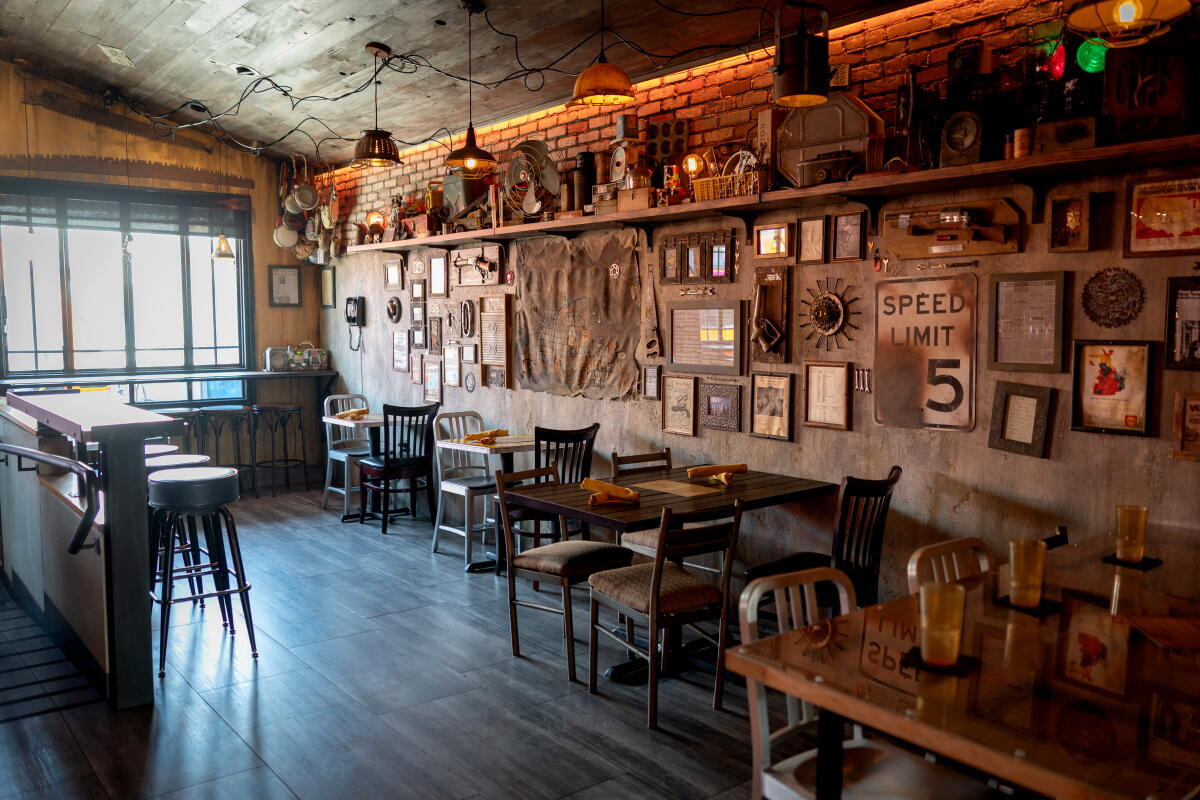
Normally when a telephone rings inside a bar, it’s the duty of the staff to pick it up. But when an old-timey rotary dial phone suddenly springs to life at the Last Canteen, it’s up to guests to decide what to do next.
Answer it — or attempt to make a call from it — and you’ll encounter one of dozens of pre-recorded messages. They’re calls from an imagined future, one when a war-torn America is on the mend from some sort of apocalyptic catastrophe. They’re messages, perhaps, for the bar’s fictional founder, a shotgun-carrying mysterious woman known for her mean bartering skills, or maybe if you’re lucky, you will dial into what sounds like an early 20th century party line and hear from those looking for a date in the Valley, now a neutral zone among warring factions.
You’re reading Mr. Todd’s Wild Ride newsletter
Todd Martens’ newsletter delivers news and commentary on the past, present and future of theme parks, right from the theme park capital of the world — Southern California.
By continuing, you agree to our Terms of Service, which include arbitration and a class action waiver. You agree that we and our third-party vendors may collect and use your information, including through cookies, pixels and similar technologies, for the purposes set forth in our Privacy Policy such as personalizing your experience and ads.
The Last Canteen, situated on a stretch of Ventura Boulevard that’s just a short walk from the Universal City metro and minutes from Universal Studios Hollywood, is a new restaurant and bar that looks lifted from a theme park. It also feels like a throwback to an earlier time, when Los Angeles was an epicenter of the themed restaurant.
Southern California has a storied history when it comes to themed establishments. There’s our penchant for food-shaped eateries, of course — see our giant doughnuts or the Tail o’ the Pup — but dinner with a side of story is a Los Angeles-area staple that predates any corporate chains such as Rainforest Cafe or Chuck E. Cheese. From the long-forgotten Jail Cafe in the 1920s to our region’s birth of the tiki bar to the themed restaurant explosion of the ‘80s and ‘90s, when even Steven Spielberg got into the action with the submarine-focused DIVE! in Century City, the themed restaurant has long found a receptive audience in Southern California.
And the Last Canteen feels especially built for our moment.
The Last Canteen’s three founders were going for a lived-in feel.
(Eric Thayer / Los Angeles Times)
Taking influence from the likes of “Mad Max,” “Fallout” and a host of other dystopian, postapocalyptic media, the Last Canteen is a bar for an era — and a city — when the future seems especially uncertain. Whether it’s AI, corporate consolidation, inflation or the struggles of Hollywood that’s got you down, the Last Canteen wants to be your “Cheers” of sorts.
“It’s not the brightest of times, I would say for most of the world, but certainly younger generations are feeling like we got the rug pulled over us — the state of the economy and corporate overreach,” says Jimmy Clements, 32, who founded the Last Canteen with two other friends from the hospitality industry.
“We always joke that the world is ending, but there’s some charm in fully embodying what that would mean, and realizing there’s something on the other side,” he adds. “That’s what attracts me to the genre. OK, the worst thing possible happened, but there’s still people on the other side. We still need community and a place to eat and drink.”
A grenade fashioned out of a baseball is one of the items hidden in the Last Canteen.
(Eric Thayer / Los Angeles Times)
Or as Clements’ partner TJ Lewis says, “Who doesn’t watch ‘Mad Max’ and dream of riding on top of a crazy car with a spike in your hand?”
Despite a potentially bleak concept, the Last Canteen is open and welcoming. The color palette is soft, leaning heavily on dust-like sandy vibes, the cocktail menu takes influence from the fruity, complex world of tiki bars, and a sense of humor permeates the main dining room.
Yes, a demolition bomb, which is actually a movie prop from Angelina Jolie’s “Unbroken,” hangs from the ceiling, but take a moment to explore the venue and you’ll find grenades colorfully fashioned out of baseballs, or rewritten maps of the Valley in its new “Wasteland” era. Universal Studios’ famed minion still stands, but the Ikea is now a “hall of justice.”
Newspapers dot the walls. They’re filled with fiction that tell of the bar’s new reality, giving the place a sense of history and lore. One article, for instance, speaks of a battle that broke out near the remnants of US-101 next to the old “sidewalk stars site.” Another tells of how the bar’s founder took over the land where the establishment now stands. By force, of course. And don’t miss the beer taps, fashioned out of bullets, guns and baseball bats.
The Last Canteen is a themed bar that feels ripe for our era, one in which the future is filled with uncertainty.
(Eric Thayer / Los Angeles Times)
“It’s the difference for us between immersive and themed,” says Lewis. “Like the Hard Rock Cafe is themed. It’s got music on the wall, but you don’t feel like you’re at a concert when you’re there. It’s not immersive. What we were really going for is a lived-in space. We didn’t cover this in ‘Max Max’ posters. It is in the world of. It’s really open-ended. All the details on the wall help paint a picture.”
Of course there were limits. The team jokes that if they really wanted to exploit the dystopian theme, then drinks should likely be served in red plastic cups. Instead, the Last Canteen has proper drinkware, but each type of glass does come from a different set, as the owners wanted to give it a found materials vibe. The menu doesn’t stray too heavily from bar fare, and there are bowls of bison chili ($18), a burger ($18), a charcuterie plate ($21) and, of course, a “Last Meal,” which is a half grilled cheese, a cup of chili and a glass of sarsaparilla ($25).
The cocktail program, however, is extensive. The blackberry-infused Blackthumb or the spiced A Torch or Rosemary feel like darker twists on brighter, lively tiki fare. For those craving the latter, there is currently a frozen version of a Zombie. Bar founders Clements, Lewis and Drew Aloe say the menu, both cocktails and food, will change seasonally.
The Last Canteen founders Jimmy Clements, from left, TJ Lewis and Drew Aloe.
(Eric Thayer / Los Angeles Times)
And the tiki influence is no accident. The three cite the Disneyland Hotel’s Trader Sam’s as the Last Canteen’s primary influence. Also an inspiration? Oga’s Cantina at Disneyland’s Star Wars: Galaxy’s Edge. Theme parks were on their mind as much as the apocalypse.
“What they do so well is they feel really lived in,” Clements says of Trader Sam’s and Oga’s. “It doesn’t feel like a cute homage. You walk in the door and you’re somewhere else.”
And guests are noticing.
“We had someone opening weekend tell me that this feels like an end-of-the-world Trader Sam’s. Thank you. That’s all we want,” Lewis says.
This week in SoCal theme parks
Fast & Furious: Hollywood Drift is now in daily operations at Universal Studios Hollywood.
(Ronaldo Bolaños / Los Angeles Times)
New coaster. New accolades. New noise complaints. Universal Studios Hollywood officially opened its Fast & Furious: Hollywood Drift last week after months of running the thrill ride in a soft open phase. Fans were happy, with some even calling it the “best” coaster in SoCal. But nearby neighbors in Toluca Lake still want change, arguing that the sound of rider screams from the coaster is disrupting their lives.
Calling all Disney film buffs. Starting this Sunday, Santa Ana’s Frida Cinema will begin hosting a weekly “Walt Disney Studios” film series hosted by historian/educator Jeff Kurtti. First up is “20,000 Leagues Under the Sea,” which will also feature a presentation from artist/designer Kevin Kidney, who over the years has contributed to many a Disney parks project. Other Sunday screenings will include “Alice in Wonderland,” “Disneyland Handcrafted,” “Swiss Family Robinson” and more. Check out the full series here.
And speaking of “Disneyland Handcrafted.” It’s the last call for tickets to a stellar Disneyland history and charity event at Santa Ana’s Bowers Museum, which on Sunday will screen the Leslie Iwerks documentary as well as host a reception and panel. Historian and author Tim O’Day will moderate a talk that includes the film’s producer, Mark Catalena, former Imagineer-turned-historian Tom Morris and current Imagineer Emily “Emo” O’Brien, who oversees creative at Disneyland and is leading the team behind the just-announced makeover of Tomorrowland. Tickets start at $125 and are on sale now.
Ride report
The concluding, trippy scene in Inked, a new maze from Knott’s Scary Farm.
(Todd Martens / Los Angeles Times)
As we get deeper into Halloween season, I wanted to highlight another haunted maze, this one being the best one at this year’s Knott’s Scary Farm event. Inked is the maze, and it’s set in a 1930s cartoon studio. While of course having the requisite number of scare actors who will pounce on guests after they turn any corner, the maze also charms as it features original animation in the style of Disney’s classic “Silly Symphony” cartoons. Nearly every room in the haunted house boasts a cartoon scene starring a cutesy ghost, a little cat and an often sad pumpkin man.
The story is the drawn figures have come to life and are now murderous, but you’ll wish you could stop and watch a graveyard short or hang with a jazzy skeleton band. Giant pumpkin heads are animated with cartoon eyes and a mirror-heavy psychedelic scene, pictured above, brings the maze to a fiery conclusion. Knott’s is perhaps relying too heavily on returning mazes of late, but Inked is a winner.
Tell us your stories. Ask us your questions.
Have a theme park tale to share? Whether it was a good day or less-than-perfect day, I would love to hear about it. Have a question? A tip? A fun photo from the parks to share? Email me at todd.martens@latimes.com. I may feature your note in an upcoming newsletter.
Ride on,
Todd Martens
P.S.
Magic Mountain’s currently shuttered X2 coaster has been in the news of late.
The X2 ride has for years been the Valencia park’s crown jewel, the first roller coaster in the world that spun riders 360 degrees in their seats. It even topped my ranking of thrill rides at the park. I wrote that it was a risky choice, as the coaster is not for the faint of heart. Its seats extend off the track, giving you a sensation of flight at its most chaotic, with an assortment of loops that suddenly shift direction and segue into drops. Due to the constantly changing direction of its seats, the path of the track can be hard to discern.
But X2 has come under close inspection after several lawsuits allege people were injured on the ride. Six Flags shut down X2 in July amid a state investigation into the coaster. The Times’ Fedor Zarkhin has the story.
Former child star Bobb’e J. Thompson, who acted in “That’s So Raven” and “30 Rock,” has been sentenced to more than two years in federal prison.
Thompson was arrested last fall after police said he was driving 104 mph — more than 30 mph over the speed limit — in Cerro Gordo County, Iowa. A news release issued by U.S. attorney’s office of the Northern District of Iowa said an officer stopped the vehicle and spotted Thompson and the passenger switching seats. The officer reported that, when he approached the car, there was a smell of marijuana coming from the vehicle.
Officers searched the vehicle and, according to the news release, found a backpack holding bags of dispensary-bought marijuana and a .40-caliber handgun that was fully loaded with a 15-round magazine. Police said the gun had been reported stolen from a car in Kansas City, Mo.
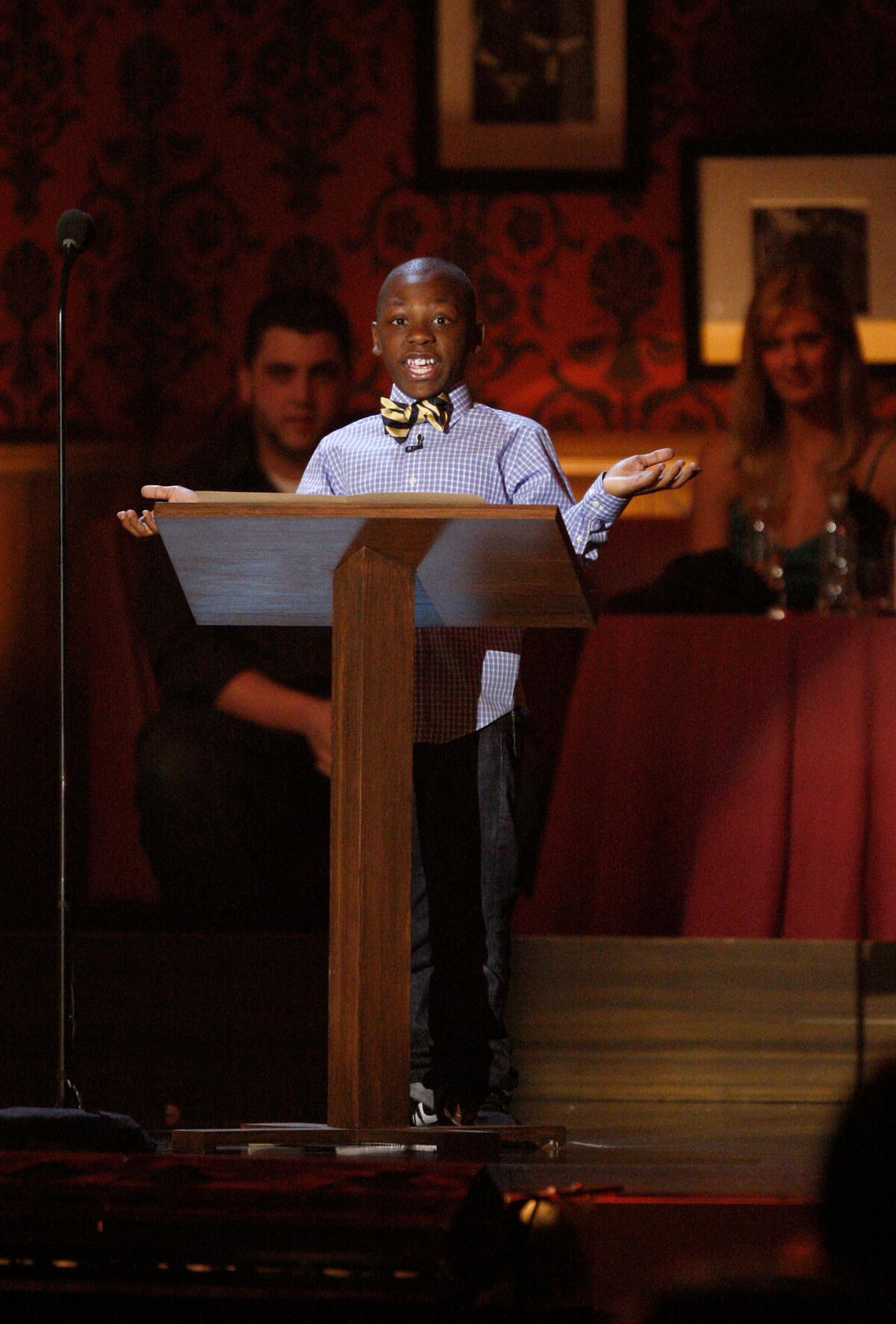
Actor Bobb’e J. Thompson speaks at Spike TV’s 2009 Guys Choice Awards at Sony Studios in Culver City.
(Kevin Winter / Getty Images)
The “Role Models” and “Tyler Perry’s House of Payne” actor was also convicted of battery and assault in 2020. Then in 2022 he was convicted of possession of a firearm, which was prohibited because he was a felon.
In April, Thompson pleaded guilty to possession of a firearm, and last week he was sentenced by an Iowa district judge to more than two years in prison.
Thompson’s “That’s So Raven” co-star Kyle Massey told TMZ on Monday that he loved his former co-star no matter what.
“Free Bobb’e J., man, that’s my brother,” he said. “We love you, we support you, we got your back, whatever you need, man, we’re gonna take care of you. It just always sucks to see one of your friends or someone that you love go through something hard like that. So we’re just gonna be rooting for him no matter what.
“Keep your head up, we’re here and we love you,” he added. “We love you so much, bro. No matter what.”
Coleen and Wayne as you’ve never seen them before, as they star in their new Disney+ reality series The Real Rooneys
17:16, 17 Sep 2026Updated 17:18, 17 Sep 2026
Coleen and Wayne Rooney are keeping things real in their latest show
It’s a Premier League makeover for Wayne Rooney, who is embracing his latest position of reality TV star.
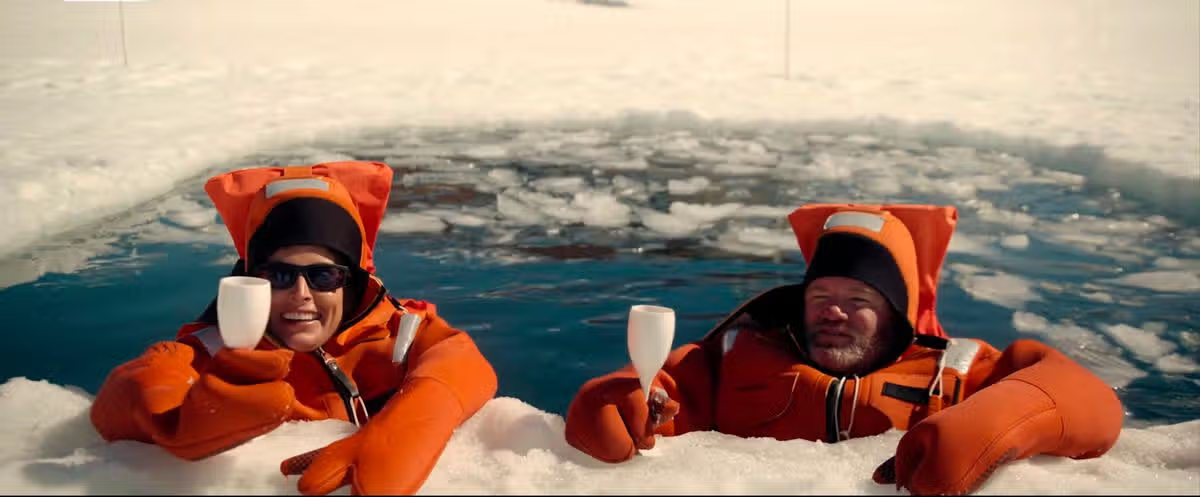
Together with wife Coleen and their four boys, Wayne lets the cameras in to the family’s £20million Cheshire mansion to witness the highs and lows of their chaotic family life. “This is a side of us you’ve never seen before,” promises Coleen. Mrs Rooney appears to be spot on. The former number 10 is seen quaffing champagne in a snowsuit, cuddling up to Mickey Mouse and trying to keep up with his growing sons playing football in the garden.
But it’s not all fizz and frolics, Wayne is also filmed being given the hairdryer treatment by Coleen in scenes that could make Sir Alex Ferguson wince. Coleen tells her husband that he’s ruined a family holiday and storms out of shot as the cameras follow them on a beach, leaving Wayne alone and subdued on a sun-lounger contemplating his actions. “The dog house manual? I’m on the third book,” Wazza quips, safely out of Coleen’s ear.
When he’s not receiving instructions on the shopping list or juggling the school run, Wayne is also seen embracing a career pivot to the BBC Sport punditry team. The former England star was a surprise hit at this year’s FIFA World Cup. His no-nonsense commentary and blunt put-downs were a winner with viewers, especially after branding the multi-million pound half-time show ‘crap.’ “I’ll do my job, entertaining the country,” Wayne smirks to the camera, turning on the charm in one of his first TV confessionals.
A summer at the BBC may have signalled a new showbizzy Wayne, but in his new reality series he dives right in.
In the new Disney+ series, Wayne, 40, shares the spotlight with Coleen, 40, and sons Kai, 16, Klay, 13, Kit, 10, and Cass, eight.
Reflecting on their incredible turn of fortunes, after meeting as teenagers on a council estate in Liverpool, Coleen says: “This house is everything I’ve dreamed of, the only problem is we’ve got to share it with our four boys.”
Klay is seen being interviewed by an off-camera producer who asks: “Who’s more famous, mum or dad?” He replies: “My dad. My mum is only known because of my dad.” Wayne also confirms the couple will not have any more children, saying: “No chance, I’ll have the snip.” Coleen references her court case against fellow WAG Rebekah Vardy and her appearance on I’m A Celebrity… Get Me Out Of Here! as she works on developing a collection with Primark and filming a TV advert alongside actor Danny Dyer. She says: “Since the court case and then the jungle, it’s opened up a lot of doors.” Wayne is also seen in his natural habitat, revelling in having a kick around with eldest son Kai, who is a forward for Manchester United’s youth academy.
Later in the trailer, Wayne holds Coleen up in his arms as they recreate the Dirty Dancing lift.
“It feels like we’re on the edge of a new life,” the mum says in a voiceover.
Wayne also appears to be fully in the grips of a new look. The footballer appears to have undergone a glossy glow-up to match his new on-screen ‘fun dad’ persona.
Ditching his beard for some rugged manscaping, the ex England captain appears noticeably more primped and preened for the small screen. Growing out his salt and pepper hair, Wayne is happy to show off his locks after his many famous hair transplants over the years.
He underwent his first back in 2011, “I was going bald at 25 why not. I’m delighted with the result,” he previously said.
This year Wayne also revealed he had gone under the knife to have nose surgery to correct long-term breathing difficulties from breaking his nose twice during his playing career
Ready for his close-ups, the former striker is also smiling a little more brightly – sporting some straighter white teeth.
They are the latest footballing family to join the race to become Britain’s next reality star. They follow The Vardys on ITV and the Owens after Michael and his family also let the cameras in for Prime Video with Peter Crouch and Abbey Clancy set to follow suit in the new year.
The Real Rooneys will launch on September 24 on Disney+.
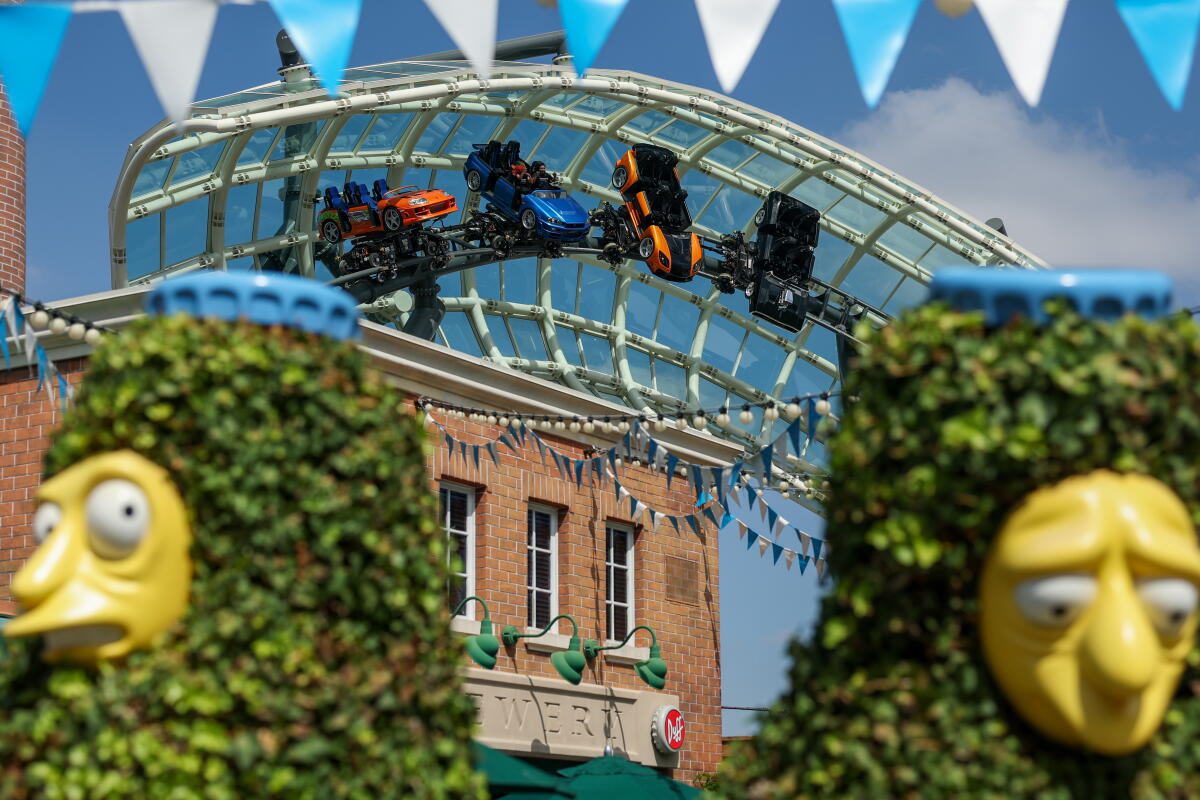
Universal Studios Hollywood’s landscape-changing, park-altering new thrill ride, Fast & Furious: Hollywood Drift, is officially open. The coaster boasting spinning, drifting cars along 4,100 feet of track had been in a soft launch phase since late July. But as of Wednesday morning, the theme park has declared the ride fit for daily operation.
“It elevates us to a new level,” says Jon Corfino, the park’s lead creative executive. “When we first started thinking about this 10 years ago, we recognized that. It’s our first big outdoor coaster. It changes the complexion of who we are, even the visual nature of who we are. You can see this from the freeway.”
You’re reading Mr. Todd’s Wild Ride newsletter
Todd Martens’ newsletter delivers news and commentary on the past, present and future of theme parks, right from the theme park capital of the world — Southern California.
By continuing, you agree to our Terms of Service, which include arbitration and a class action waiver. You agree that we and our third-party vendors may collect and use your information, including through cookies, pixels and similar technologies, for the purposes set forth in our Privacy Policy such as personalizing your experience and ads.
The theme park hosted a private ribbon-cutting ceremony — in this case, a metal chain cutting to better represent the action-focused, garage-like grit of the “Fast & Furious” film franchise — on Tuesday evening. Mark Woodbury, the chairman and chief executive of Universal Destinations & Experiences, and Scott Strobl, executive vice president and general manager of Universal Studios Hollywood, together sliced the cable.
‘“Fast & Furious’ has delivered 25 years of high-speed thrills and big blockbuster movie moments and it was the perfect story for us to build this incredible, one-of-a-kind innovative attraction,” Woodbury said, noting a similar coaster, set to open next year, is under construction for Universal’s Florida resort.
Universal Studios Hollywood’s Fast & Furious: Hollywood Drift towers over the theme park.
(Ronaldo Bolaños / Los Angeles Times)
The coaster reaches a top speed of 72 mph, the fastest coaster in Universal’s global portfolio, and places riders in authentic, mini-re-creations of real cars that can rotate 360 degrees to create the drifting sensation of a stunt vehicle. With four inversions that bring guests upside down, Hollywood Drift is decidedly intense.
Wait times on Wednesday were hovering around 90 minutes. “I’m a big fan of the movies, and I think this is the best coaster in Southern California, hands down,” said L.A.’s Peter Lee, 43, as he was exiting the attraction on Wednesday. Lee has ridden the coaster 10 times since late July, but wanted to attend its opening day to purchase a picture of himself on the ride on its first proper day of operations.
Phillip Lambert Duke, 42, of Orlando, came to Universal Studios Hollywood to experience the West Coast edition of Halloween Horror Nights but said Hollywood Drift will be a highlight of the trip. “It’s fantastic,” Lambert Duke said. “It’s beautiful. I love how all the cars move independently of one another. “
Yet Fast & Furious: Hollywood Drift has also attracted some unwanted attention from the neighboring community of Toluca Lake, where residents have cried foul at the sound of rider screams emanating from the coaster. “Untenable,” “disturbing” and “like someone is getting murdered” have been a few of the ways longtime Toluca Lake homeowners have described the noise of riders.
An upside down rider enjoying Fast & Furious: Hollywood Drift at Universal Studios Hollywood.
(Ronaldo Bolaños / Los Angeles Times)
A number of Toluca Lake residents sent a media alert and hosted reporters in their neighborhood on Wednesday’s opening day to showcase just how disruptive the screams could be. Standing in the backyard of a house situated near a neighboring golf course, rider screams are certainly audible, and residents said the consistency of them is destroying their quality of life.
“It’s a constant stress,” said Colby Jensen, 55, a Toluca Lake resident of 26 years. Jensen said some residents have begun exploring their legal options, citing both the emotional duress of hearing constant screams and also a fear of potentially lower property values.
“It’s not just a noise, like the freeway, which is in the background,” Jensen said. “It’ll be quiet for a minute, and then you’ll hear this cacophony of screams. It inherently raises your blood pressure and stress level and it’s unnatural to hear that.”
Sofia S., who declined to give her full last name, said she just returned home to Toluca Lake after graduating from Indiana University. The 22-year-old noted the coaster has made it difficult to work from home.
“I have a little dog, and she’s barking a lot more because she thinks people are trying to come into the house,” she said.
Fast & Furious: Hollywood Drift was designed as one of the quietest thrill rides ever constructed so as not to disrupt the working studio below and the communities nearby. Its track has been filled with pea gravel to mitigate rumbles, and multiple walls and glass-outfitted curved shields have been placed on or near its layout. Universal has even stated that it can rotate the cars so riders scream away from the nearby neighborhood at particularly extreme moments. Such measures have been welcomed by the community, but they’re not enough, say many neighbors.
Universal has scheduled a community meeting with residents for Sept. 30. The park also last month pledged to build additional sound barriers to further dampen rider screams.
Fast & Furious: Hollywood Drift has been the most anticipated theme park attraction of 2026.
(Ronaldo Bolaños / Los Angeles Times)
At Tuesday’s media event, Universal executives declined to discuss community concerns or efforts to alleviate them, but later issued a statement acknowledging that community feedback has been an important part of the process.
“Testing completed to date confirms the attraction is operating in compliance with sound ordinances applicable to Universal property, which are more stringent than city and county codes,” the emailed comment reads.
Toluca Lake residents dismiss criticisms that this comes with the territory of living next to a theme park, noting for much of its history Universal focused on indoor attractions and has previously worked with the community, such as adjusting the audio on its “WaterWorld” stunt show.
Fred Iberri, who said he’s lived in his inherited Toluca Lake home since the early ’70s, said everyone has a right to peace in their home.
“People say, ‘If you don’t like it, it’s your choice to live next to a theme park.’ That’s not true. Universal hasn’t had a coaster outside until three months ago,” Iberri said. “I’ve been here for 52 years, my family for 90, and Toluca Lake has been a peaceful neighborhood until three months ago. Anyone who says that doesn’t know us or the neighborhood. It’s not so easy for seniors to just pick up and move.”
Mr. Todd’s Wild Ride comes out every Tuesday, but we occasionally publish special editions (like this one!) when we have breaking theme park news. Make sure you’ve signed up to be the first to know.
The association said Wednesday that the television tribute — titled “CMA Presents I Will Always Love You: A Celebration of Dolly Parton” — will be recorded live at the Fisher Center for the Performing Arts, on the campus of Belmont University in Nashville.
The tribute will air Oct. 21 at 6 p.m. Pacific on ABC and Disney+, and will stream on Hulu a day later.
In a news release, CMA described the special as a “joyful, emotional celebration” dedicated to Parton, the rhinestone-studded singer whose life began humbly, in a one-room cabin at the foothills of the Great Smoky Mountains.
Robert Deaton, veteran executive producer of the Country Music Awards and Billboard Music Awards, will fill that role on the Parton project.
“Dolly gave Country Music its heart, and giving some of that heart back to her is an incredible honor,” said Deaton in a news release Wednesday. “My hope is simply that we do right by her story, her music and the people who love her, so that this evening feels like the tribute my friend deserves.”
Sarah Trahern, CMA chief executive, added that the tribute is the association’s “responsibility”: “This special is our way of saying thank you, on behalf of every artist, industry member and fan who found a piece of themselves in her music.”
The tribute is in partnership with Belmont University, which hosted the 2025 world premiere of “Dolly: A True Original Musical,” a biographical production about the “9 to 5” singer that is scheduled for its Broadway debut on Jan. 19, what would have been the Parton’s 81st birthday.
The university also previously launched “Dolly U,” an immersive educational partnership designed to connect students with hands-on opportunities in entertainment, media and creative industries.
Greg Jones, president of Belmont University, welcomed the special with a statement of his own: “It is a privilege to welcome artists, friends and fans from around the world to celebrate her extraordinary life and legacy from this stage in Nashville, honoring a woman whose love for Tennessee was woven into everything she did.”
Both the CMA and Belmont University will make a donation from the proceeds to Parton’s Imagination Library, which was launched by the Dollywood Foundation in 1995 to address childhood literacy by giving millions of children the gift of a free book each month. Disney will also support the program.
News of the television tribute follows an announcement last month by Parton’s estate that revealed plans for Dollyfest, a two-day celebration in Nashville and London next year across two consecutive weekends to honor her legacy.
Additional details for the CMA special, including performers and tickets, will be announced at a later date.
Early in life I discovered I had a particular affliction, and that was a proclivity for spending time at theme parks. I only phrase it that way because I understand some may find such a desire peculiar, which has made me particularly attuned to many comments about theme parks, especially those that aren’t positive.
Too hot, too crowded, too expensive or simply geared only for children. And while I’m happy to discuss or debate all aforementioned topics, there’s one particular criticism that I find especially grating: Theme parks are fake.
This is the argument that they are heavily fabricated and designed to elicit an emotional response, or worse, manipulate us. And it’s one I hear time and time again from grown-up peers. Over the years, it’s cropped up from friends. “Why do you go there?” they will say. “Everything is fake.” It’s appeared in books such as Henry A. Giroux’s and Grace Pollock’s scathing “The Mouse that Roared,” which dismisses the parks as presenting an “infantilized” worldview. And I’ve heard it from people I’ve interviewed, such as the USC professor of psychology who told me that theme parks were so fake, they forbade surprises.
You’re reading Mr. Todd’s Wild Ride newsletter
Todd Martens’ newsletter delivers news and commentary on the past, present and future of theme parks, right from the theme park capital of the world — Southern California.
By continuing, you agree to our Terms of Service, which include arbitration and a class action waiver. You agree that we and our third-party vendors may collect and use your information, including through cookies, pixels and similar technologies, for the purposes set forth in our Privacy Policy such as personalizing your experience and ads.
The criticism irks me, in part, because of what it implies. By dismissing a Disneyland or a Universal Studios park as “fake,” there’s an implication that something is “more real.” A national park, perhaps, or a dedicated art institution. I adore those types of spaces as well, of course, but there’s an ignorant snobbery to this sort of remark, a thumbing of the nose that seems to argue I should spend some of my free time elsewhere.
This has been on my mind of late for a pair of reasons. One, I recently visited the Lucas Museum of Narrative Art and have been consumed with the discourse surrounding the value of story-driven art. And two, I recently read “Floating Mountains: The Art of Imagining the Impossible” by famed Disney designer Joe Rohde. The book is many things — an impassioned dissection of creative collaboration, a look at Rohde’s 40 years with Walt Disney Imagineering — but it is also a subtle argument that theme parks are vital, artistic spaces.
A statue of Walt Disney and Mickey Mouse in front of a very real fantasy castle.
(Christina House / Los Angeles Times)
I agree, and so I decided to bring up my pet peeve while talking to Rohde at the recent all-things-Disney fan convention D23.
“It’s a very odd criticism,” Rohde says of the knock on theme parks as being fake.
“Of course they are not real,” he tells me. “Movies are not real. Theater is not real. It’s like René Magritte, ‘Ceci n’est pas une pipe.’ Of course, a picture of a pipe is not a pipe. I don’t understand why that is an issue. It is a creation. In some cases it is a photo-realistic creation. In some cases it is a stylistic creation. But it is a creation. That’s what makes it a work of art.”
In “Floating Mountains,” Rohde, the primary creative behind the stunning Disney’s Animal Kingdom (second only to the original Disneyland in my mind), documents the myriad of disciplines that must come together to create such spaces. Animal Kingdom is full of real-world details. I can spend days exploring just the Africa section of the park, reading anti-poaching signs and piecing together a story that helps inform the area’s magnificent safari ride.
This is a work of art, albeit a less understood one, for narrative place-making and environmental storytelling are borderline experimental, less common than, say, a book or a film. Place-making requires that we not just take in our surroundings but constantly analyze them for story insights.
Joe Rohde, in 2017, discussing Pandora — the World of Avatar at Disney’s Animal Kingdom in Florida’s Walt Disney World.
(Jay L. Clendenin / Los Angeles Times)
Rohde also notes the degree to which Imagineers are taking influence from real-world spaces in an effort to bring narrative details into the parks, ensuring they appear at once familiar and fantastical. In the case of Animal Kingdom, it was Africa’s Lake Manyara National Park, among many other locales, that gave that park its realistic grit. And when it came to the fully imagined floating mountains of Pandora — The World of Avatar, it was finding inspiration in the Italian Baroque art of Gian Lorenzo Bernini, as seen in the entangled vines descending from the apparently hovering mountains.
Now, I am not someone who argues that a trip to Animal Kingdom is a stand-in for a vacation to Africa. Or that visiting the World Showcase of Epcot is akin to a jaunt around Europe. Or that hanging out in Cars Land is a substitute for a drive down Route 66. And an afternoon slugging pints at Hog’s Head at Wizarding World of Harry Potter is certainly not the equivalent of a day at an authentic British pub. No, what a theme park offers is an artistic interpretation, one that filters the natural world through the stories that define our lives.
Theme parks are not so much an escape from the world but a way to make sense of it. View them with an open mind, and they are an entree into storytelling exploration. This is different to me than, say, a re-creation of the Eiffel Tower being plopped into Las Vegas, which is preying on replication as generic spectacle. Theme parks, of course, can fall victim to this, too, when they utilize signposts or characters from a film as a substitute for innovation (see much of the design of Pixar Pier at Disney California Adventure).
Cars Land in Disney California Adventure was inspired by the scenery and history of Route 66.
(Mark Boster / Los Angeles Times)
France at Epcot’s World Showcase, in contrast, aims to weave a brochure-like tale of the country, to introduce us to culinary and architectural standouts that can inspire us to dig deeper. For some, sure, that’s deeper into their wallets, but World Showcase inspired a young me to be curious about the world beyond the suburban Chicago neighborhood I grew up in.
And purely fantastical creations — at least the ones that are done well — are not just references to things we saw on a movie or television screen. I think of Guardians of the Galaxy — Mission: Breakout! at Disney California Adventure, which is specifically designed as a cartoon-like intrusion, a building meant to clash and call attention to its surroundings. It’s all an effort to heighten the concept that the modern American myth — the superhero film — is work that encroaches, with uplifting exaggeration, on real-world settings.
And even a Disneyland classic such as Pirates of the Caribbean requires deep analytical reframing to properly understand it. Sure, it’s a boat ride with singing robot pirates, but that’s not the reason it has endured for more than half a century. I’ve described the attraction as the template for the perfect theme park ride, one that invites the guest to discover a host of mini stories based upon where riders are directing their focus. It’s a huge influence, for instance, on the world of open-world video games, which allow players to pick a direction and discover a narrative path. It’s anything but fake.
Pirates of the Caribbean is a study in environmental storytelling.
(Christina House / Los Angeles Times)
The criticism that theme parks are fake is a surface one, one that fails to properly meet the medium where it’s at. It’s easy, of course, to look at the nostalgia of a Main Street, U.S.A, and the castle up ahead and to write off Disneyland as a rosy, idealized take on America. This is the undiscerning view, for Disneyland is a presentation of an America that never existed, one disrupted by a castle that also doubles as an extended hand.
Think of it as an ask to use one’s imagination and to be open to play: Theme parks are a wholly unique medium that requires a different set of criticism, one that is looking at architecture and design as a storytelling device. And when one gets on a ride, a theme park expects us to be open to a somewhat abstract form of storytelling. Theme parks are also, at their core, a form of participatory art, inviting us to take on a starring role.
The mechanization of what makes a theme park a theme park is simply too complex, too vast and involving too many people to be dismissed as fake. And let me say that there’s no shame in wanting to be immersed in a world crafted by the hands of many a skilled artist, whether that’s the new David Geffen Galleries at LACMA or the Disneyland Resort.
This week in SoCal theme parks
Concept art for Magic Mountain’s upcoming 2027 coaster Thrill Glider.
(Six Flags Magic Mountain)
A new coaster coming to Magic Mountain. Six Flags announced that coming in 2027 to its Valencia park will be Thrill Glider, a first of its kind thrill ride designed by coaster manufacturer Vekoma exclusively for Magic Mountain. Riders will board what the park is referring to as “hoverbikes,” essentially bike vehicles designed to simulate a flying sensation by being suspended from the track.
Scary Farm is upon us. Halloween season is officially in full swing as Knott’s Scary Farm opens Thursday. New this year are two mazes, including one that intermixes a host of vintage animation, as well as a magic show collaboration with the Magic Castle.
Fast & Furious: Hollywood Drift officially opens. Though it’s been in a soft open phase since late July, Universal Studios Hollywood’s Fast & Furious: Hollywood Drift will be properly open as of Wednesday. This means the coaster has passed its final testing and is ready for daily operation. Here’s everything you need to know about Universal’s fancy new coaster.
Legoland expands its Halloween event. Brick or Treat at Carlsbad’s Legoland begins on Saturday and it’s bigger than ever in 2026. The family friendly event, for which costumes are encouraged, this year has added Brick or Treat Street, with six life-size monster homes to interact with. Also, be sure to head to the park’s new coaster, the Galacticoaster, which has received a Halloween overlay.
A Walt Disney exhibition at Forest Lawn. Head to Glendale’s Forest Lawn Museum on Saturday evening for the opening reception of “California Visionaries: The Lives and Legacies of Walt Disney and Hubert Eaton,” which explores the connection between Disney and Forest Lawn Memorial-Parks founder Eaton. The exhibition, which promises concept art, rare Disney sheet music as well as items from early Disneyland attractions, is on display until Feb. 7.
Tell us your stories. Ask us your questions.
Have a theme park tale to share? Whether it was a good day or less-than-perfect day, I would love to hear about it. Have a question? A tip? A fun photo from the parks to share? Email me at todd.martens@latimes.com. I may feature your note in an upcoming newsletter.
Ride on,
Todd Martens
P.S.
Attention readers who are in or near Fillmore: This Saturday is the first-ever edition of the “Time Travel Convention,” a new interactive theatrical experience from Live Action Attractions. Many veterans of the theme park industry worked to bring this event to life, including some who collaborated on the now-shuttered Star Wars: Galactic Starcruiser, colloquially known as the “Star Wars” hotel.
The story: Once a year, time travelers from the distant future head back in time to witness a historic day in small-town America. Players are cast in the role of time travelers, and throughout the day Saturday expect a series of games and costumed characters to interact with. There will be three theatrical moments staged throughout downtown Fillmore beginning at 10:01 a.m.
Register online, and you’ll receive info on where to meet. The event is highly recommended.