“Spider-Man: Brand New Day” opened to $360 million in the U.S. and Canada this weekend, pushing out 2019’s “Avengers: Endgame” to claim the biggest domestic debut in history.
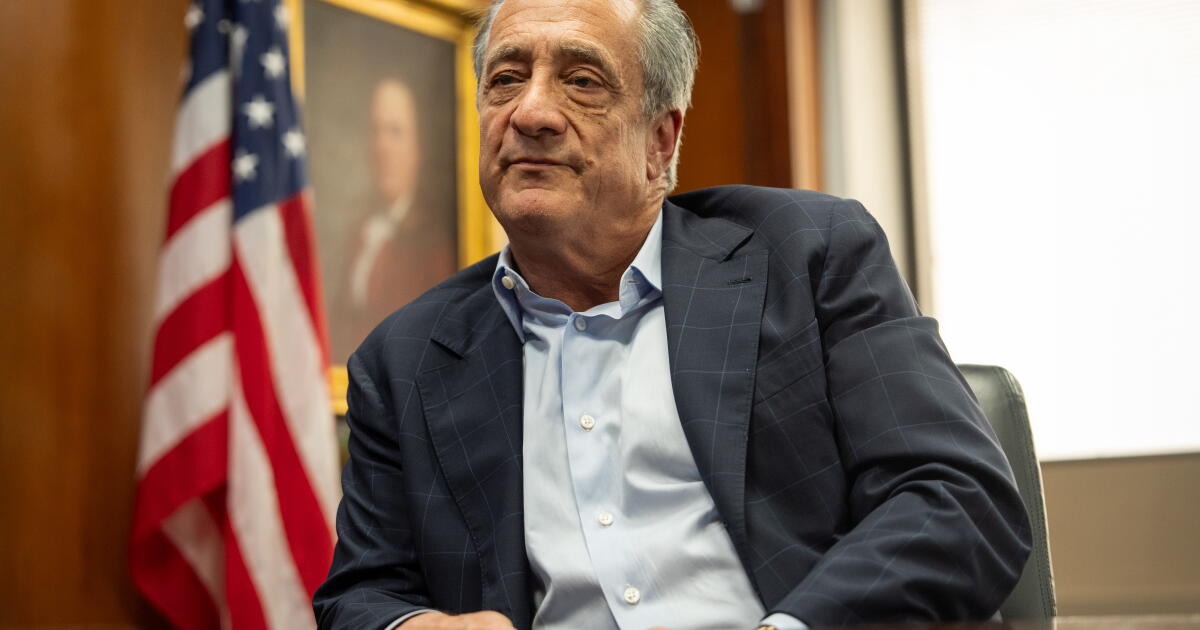
“Records are made to be broken,” Sony Motion Picture Group Chairman Tom Rothman said in a statement Monday. “But we will take great pride in this one, for as long as we hold it.”
Internationally, the web-slinger picked up an additional $572 million for a worldwide total of $932 million. The film, which stars Tom Holland and Zendaya, was produced by Sony-owned Columbia Pictures, Marvel Studios and Pascal Pictures on a production budget of about $225 million.
By Monday morning, nearly everyone in the exhibition business was cheering.
The chief executives of AMC Entertainment Holdings, Regal and Cinemark Holdings all put out statements about record revenue at their chains, plus deep demand for merchandise, food and drinks. Cinema United trade group chief executive Michael O’Leary applauded the “great slate of films” that have populated theaters this year.
You’re reading the Wide Shot
Samantha Masunaga delivers the latest news, analysis and insights on everything from streaming wars to production — and what it all means for the future.
By continuing, you agree to our Terms of Service, which include arbitration and a class action waiver. You agree that we and our third-party vendors may collect and use your information, including through cookies, pixels and similar technologies, for the purposes set forth in our Privacy Policy such as personalizing your experience and ads.
There’s a lot to be excited about here. Expectations for the film were high, but breaking a pre-pandemic record — previously held by an “Avengers” movie, no less — is a big deal.
“The buildup to what ‘Endgame’ was at $357 million just seemed out of reach,” Jeff Bock, senior box office analyst at entertainment data firm Exhibitor Relations, told me on Monday, referring to the previous domestic debut record. “It’s pretty gratifying to see that characters and emotions still matter in filmmaking. This movie was just really about relationships.”
That emotional core was a major focus for the filmmakers. When I spoke with producer Amy Pascal in the lead-up to the opening, she said there was no topping the multiverse storyline of 2021‘s “Spider-Man: No Way Home,” which featured the return of Tobey Maguire and Andrew Garfield. Instead, the filmmakers chose to go smaller, focusing on the internal conflict and loneliness of Holland’s Peter Parker after a spell forces his friends to forget him.
Spider-Man has always been one of the most popular superheroes. But not every Spidey film has had this level of box office success. What “Brand New Day” shows is that a strong story matters more to audiences than the name of the superhero alone — an important distinction as the genre has weathered an uneven track record in recent years. Just this summer, we saw stumbles from Amazon MGM Studios’ “Masters of the Universe” and Warner Bros. Pictures and DC Studios’ “Supergirl.”
The next test arrives in December with Walt Disney Co. and Marvel Studios’ “Avengers: Doomsday,” which “Brand New Day” teases in a post-credits scene, as well as throughout the film. “As audiences saw, it sets up exciting things to come,” Marvel Studios President and “Spider-Man” producer Kevin Feige said in a Sunday statement.
The recovery, by the numbers
Domestic box office revenue for the weekend totaled $436.5 million, according to data from Rentrak. Spider-Man accounted for 82% of it, but Christopher Nolan’s “The Odyssey” also hauled in $51 million in its third weekend, on its way to worldwide revenue of more than $912 million.
Together, the pair have combined for a unique, and telling, one-two punch. It’s the same phenomenon that drove moviegoers to A24’s “Backrooms” and Focus Features’ “Obsession.” Originality in storytelling really does matter, despite the plethora of reboots and sequels. And when moviegoers have more choices, they’re coming back, again and again, analysts say.
“These two films in particular have really turned moviegoing itself into the event,” Bock said. “The audience isn’t rejecting theatrical movies. They’re rejecting films that don’t feel essential.”
Domestic summer box office revenue to date now stands at nearly $3.6 billion, up 16.7% compared to 2025 and — importantly — only 0.7% behind the same period in 2019. Year-to-date revenue is about $6.2 billion, a 15.4% improvement from last year, though it still lags 2019 by 11.6%.
And with another blockbuster to come in December — Warner Bros. and Legendary Entertainment’s “Dune: Part Three” — analysts now predict 2026 domestic revenue is on track to reach $10 billion, a milestone that hasn’t happened since before the pandemic.
What could undo it
Here’s the catch. A major part of that recovery rests on volume: more titles, more genres, more reasons to leave the house on a given weekend. Which is exactly what a federal judge in Oakland is weighing right now.
Paramount Skydance’s nearly $111-billion acquisition of Warner Bros. Discovery has cleared the Justice Department, the European Commission and regulators in more than a dozen other countries. What it has not cleared is a coalition of 12 state attorneys general, led by California’s Rob Bonta, who sued July 13 to block the deal under the Clayton Antitrust Act.
On Friday, the parties each proposed their preferred dates for an antitrust trial over which U.S. District Judge Araceli Martínez-Olguín will preside as Paramount argues for its merger to proceed and the state attorneys general argue against it. The judge has said the states had presented compelling evidence the combined company would hold a substantial share of the wide-release theatrical distribution market — enough, she said, to presume the deal likely violates antitrust law. The Writers Guild of America has joined the states’ lawsuit.
Paramount has said the merger will benefit consumers, workers and the entertainment industry, and that the states’ claims of anticompetitive effects “are without any basis in modern market realities.”
Hollywood has seen this movie before. The last unaccounted-for variable from the pre-pandemic era is Disney’s 2019 acquisition of the entertainment assets of 21st Century Fox, which combined two studios and led to fewer theatrical releases.
“If they’re able to execute on that promise of 30 titles a year, I think we’re going to accelerate even further,” said Daniel Loria, a senior vice president at The Box Office Co. “We’re on a great trajectory. But there are serious questions that remain on their capacity to do so, and what the impact of another slowdown in releases from a major studio would bring.”
Paramount has said it won’t close the deal before June 2027 unless the litigation resolves sooner, and is pushing for a November trial; the states want April 2027. Either way, the industry just posted its biggest opening weekend ever while the question of how many movies get made is sitting in a courtroom in Northern California.
Stuff We Wrote
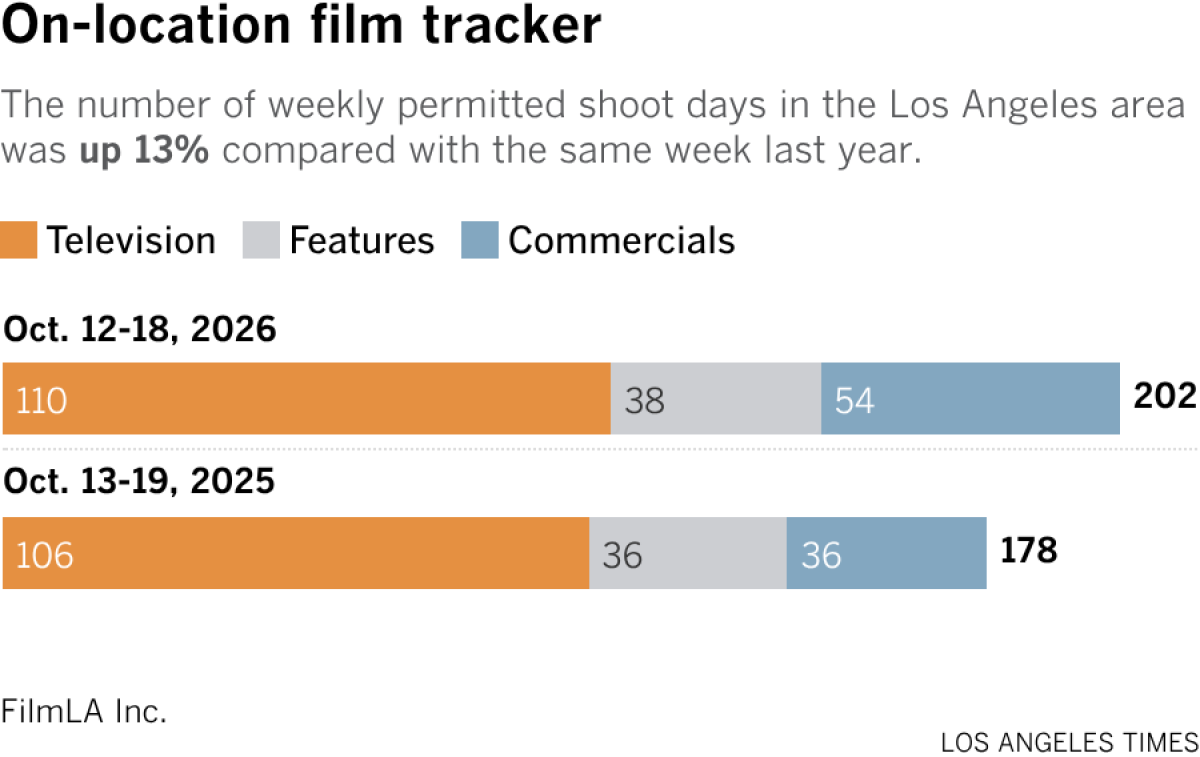
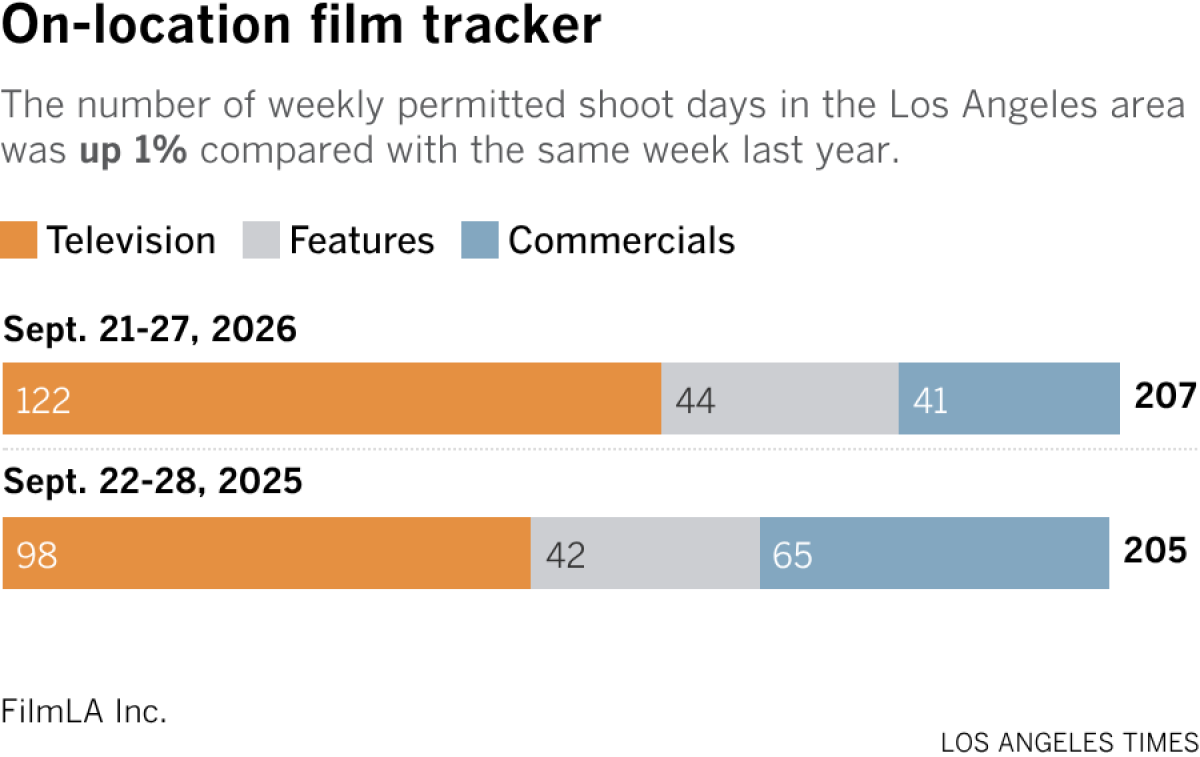
Film shoots
Number of the week
The Hollywood Foreign Press Assn. has sued Jay Penske, Penske Media Corp., the Golden Globe Foundation and others over the 2023 acquisition of the Golden Globe Awards, alleging antitrust violations.
As my colleague Stacy Perman reported, the Hollywood Foreign Press Assn. is seeking at least $150 million in damages.
The group, which founded the Golden Globes, said in its lawsuit that Penske and the other named defendants “orchestrated and participated in a clandestine scheme to fraudulently acquire the Golden Globe Awards, dismantle the HFPA [Hollywood Foreign Press Assn.], and exert monopolistic control over Hollywood trades and the awards circuit thereby violating California’s antitrust and consumer protection statutes.”
A spokesperson for Penske and the Golden Globes denied the allegations, saying the suit “continues the absurdity and irrationality that the industry has come to expect from the defunct organization formerly known as the HFPA.”
What I’m watching
I had a pretty hectic week, which didn’t leave a lot of time to catch up on TV. But I did go see the L.A. Sparks game against the New York Liberty, which unfortunately ended in a loss. We’ll see what happens now that star Kelsey Plum has been traded.
Truth Social, the social media firm owned by Trump Media & Technology Group (DJT), on Saturday launched Truth API, a licensed data feed that enables real-time access to posts from its high-profile users, including President Donald Trump.
SpaceX executives vowed to comply with Venezuelan regulations. (CONATEL)
Mérida, July 31, 2026 (venezuelanalysis.com) – Venezuela’s National Telecommunications Commission (CONATEL) held a formal working session with SpaceX executives to establish the legal, technical, and financial parameters for the regularized rollout of Starlink’s satellite internet services nationwide.
CONATEL Director General Enrique Quintana led the bilateral meeting with representatives from the Elon Musk-owned company: Emmanuel Cárdenas, SpaceX’s Director of Legal and Regulatory Affairs for Latin America; Catalina Castellanos, regional telecom legal advisor; and Rebecca Hunter, Director of Market Access.
During the sessions, the regulatory body requested that SpaceX initiate the formal homologation process for its satellite hardware via CONATEL’s digital platform. This step assures that user terminals and ground equipment comply with national standards for data security, spectrum allocation, and operational quality. The talks also focused on data transport infrastructure and the formal authorization for radio frequency bands required under Venezuela’s Organic Telecommunications Law.
SpaceX’s delegation reportedly expressed full willingness to align the company’s legal and corporate status with Venezuela’s regulatory requirements. Quintana, on behalf of Acting President Delcy Rodríguez, highlighted the importance of the working group to promote telecommunications throughout the country.
While imported Starlink receiver dishes have already been circulating among private buyers for years, the satellite service officially made its signal available across Venezuelan territory following the January 3 US strikes on Venezuela and the kidnapping of President Nicolás Maduro. At the time, SpaceX offered a free promotional connectivity window for both newly registered local users and existing international roaming hardware.
CONATEL’s engagement accelerated following the June 24 double earthquake, which damaged communications infrastructure in central coastal regions. To assist with emergency management and humanitarian relief, CONATEL granted SpaceX a temporary pilot authorization.
This operational exemption allowed civil protection and disaster relief teams to deploy Starlink terminals in hard-hit areas, notably across La Guaira state, where damaged fiber-optic networks had disrupted local communications.
Acting President Rodríguez thanked Musk and his team via social media.
“Thank you, Elon Musk and the Starlink team, for helping those affected by the earthquakes in Venezuela with free internet access. Every connection counts in times like these,” she wrote at the time.
In addition, CONATEL highlighted that expanding satellite internet options complements existing state-owned and private telecommunications providers, offering critical redundancy during natural disasters or power disruptions.
The institutional dialogue between state regulators and SpaceX unfolds a political history, following clashes between President Nicolás Maduro and company CEO Elon Musk.
Tensions peaked in August 2024 following Venezuela’s presidential election, when Musk used his social media platform X to launch verbal attacks against the Venezuelan government, accusing Maduro of electoral fraud and calling for foreign intervention.
In response, Maduro denounced the tech billionaire for using his digital platform to incite hatred, destabilization, and political violence inside Venezuela. “Out of Venezuela, Elon Musk!” he said in a public rally.
CONATEL initially enacted a 10-day suspension of X in the Caribbean nation which was later extended. In recent weeks, Venezuelan telecom and mobile service providers have unblocked access, though CONATEL has not formally announced the reinstatement of the social media platform.
Musk has drawn scrutiny across Latin America and internationally for his open alignment with far-right political figures and reactionary causes.
The outspoken billionaire has frequently used his global platform to endorse far-right politicians, express support for neoliberal deregulation, and launch hostile commentary directed at progressive and leftist governments.
Starlink has also been embroiled in controversy as a result of Musk’s direct control and political views. The company introduced a “whitelist” to ban access to Russian users in an effort to disrupt communications amid the war in Ukraine. In Gaza, Starlink has operated in integration with Israeli occupation forces, raising concerns of complicity in war crimes.
Roughly six weeks before the first midterm ballots are mailed out, the U.S. Postal Service is emerging as a pivotal player in an election season that will determine control of Congress.
President Trump is seeking greater control over mail balloting through an executive order while a change to how the agency processes mail is leading to criticism that it’s failing to deliver ballots on time.
Democratic officials have raised concerns over the past week about how quickly the Postal Service will process ballots after tens of thousands of them in California and hundreds in Wisconsin arrived at local election offices too late to be counted in elections earlier this year. The top election offices in Kansas and Michigan are urging voters who want to cast their ballots early to avoid the mail and instead drop them off in person.
The Postal Service replied to those concerns by saying it remains “committed to fulfilling our role in the electoral process.”
“We provide a secure, efficient, and effective way for citizens to participate when policymakers decide to use mail as part of their elections,” it said in a statement Tuesday.
Trump’s order puts more focus on mail ballots
The Postal Service faced similar questions about mail delivery in 2024, but the scrutiny this year is heightened because of an executive order Trump issued in March that seeks to create a national voter list to guide the Postal Service in deciding who gets a mail ballot.
The order has sparked multiple lawsuits and federal court orders, leading to a case now before the U.S. Supreme Court in which the administration is asking the justices to allow it to impose its restrictions on mail balloting.
Trump has lied for years about voter fraud to try to explain away his loss to Democrat Joe Biden in 2020, and mail balloting is a favorite target, even though he has used the method himself. During a recent stop in Michigan, he falsely characterized mail balloting as “inherently corrupt” and added, “Hopefully there will be no mail-in ballots.”
A 2025 report from the research group Brookings identified about four cases of fraud for every 10 million mail ballots cast.
Despite Trump’s attacks, the method remains popular with voters of both major parties. In 2024, nearly 30% of U.S. voters cast their ballots by mail, according to federal data. In Michigan, where competitive U.S. House and Senate races could help determine the balance of power in Congress, the state said it has sent out more than 2 million absentee ballots for the state’s Aug. 4 primary.
“We want to keep vote by mail. We want to protect it. We want to expand it,” said Jonathan Smith, president of the 200,000-member American Postal Workers Union, which launched a campaign in April promoting it and is opposed to turning the Postal Service into an election administrator. “Why? Because it works.”
Legal battles intensify over Trump’s order
The Postal Service proposed a rule in June in line with Trump’s executive order that would create a national list of eligible voters, based on databases kept by other federal agencies. Only those on the list would be eligible to receive mail ballots.
Democratic officials in nearly two dozen states filed a federal lawsuit in Massachusetts. A federal judge there blocked Trump’s order last month, and an appeals court upheld that ruling, prompting Trump’s appeal to the Supreme Court. But the appeals court for the District of Columbia refused Tuesday to block the order in a separate case, calling a legal challenge premature.
Democratic senators and governors have written to the Postal Service urging it to abandon efforts to implement Trump’s order.
“Donald Trump has shown he’ll stop at nothing to meddle in our upcoming elections,” Wisconsin Sen. Tammy Baldwin said in a statement to The Associated Press. “At best, this new push will exacerbate already severe delays for mail-in voters and at worst, it will stop eligible Americans from casting their ballots.”
In a letter to Democratic senators earlier this month, the heads of the Postal Service said they were abiding by the court rulings that had halted the executive order. But Smith, of the postal workers union, told the AP on Tuesday that USPS information technology staffers who are union members are working on a planned portal for the list of eligible voters “behind the scenes.”
The Postal Service declined to respond to Smith’s statements and said it could not comment about whether it’s moving forward with work related to Trump’s order because of the litigation.
The postal workers’ union opposes the plan for a portal, a national list of eligible voters and using that list to determine who can receive a mail ballot. Smith said it shouldn’t be postal workers’ responsibility “to decide who can vote and who can’t vote.”
A plan to consolidate mail processing centers upsets officials
The Postal Service has been under financial stress for years and has been consolidating mail processing into fewer regional centers. Mail travels an average of 139 miles to reach one and sometimes 500 miles, according to a recent Brookings report.
In January, a group of mostly Democratic senators said it was concerned about a decision to end twice-daily mail dispatches from local post offices to regional processing centers. The result is that mail arriving after the only daily dispatch would go out the next day.
California officials said the change was a factor in the state rejecting more than 148,000 ballots from its June primary, with 63% of them arriving too late despite a seven-day grace period. Officials worried that some ballots were postmarked at processing facilities the day after they were dropped off at a post office, possibly invalidating them. Wisconsin officials also said hundreds of ballots from an election in April arrived late.
The Postal Service said postmarks generally are being applied with automated equipment at processing centers, “in the same manner and to the same extent as before.” It said someone who wants to make sure their ballot envelope gets a timely postmark can get a free one applied by a postal worker.
A report on the 2024 election by the USPS Office of Inspector General said the Postal Service handled more than 59 million pieces of ballot mail from Sept. 1 to Nov. 15 that year and that 97.3% arrived on time.
Some state election officials advise voters to avoid the mail
The Michigan secretary of state’s office is advising voters to hand-deliver ballots to their local clerk’s office or a drop box.
“We’ve seen these issues over a number of election cycles now — they’re always concerning, and that’s why we’ve put out that guidance,” said Deputy Secretary of State Aghogho Edevbie.
The Postal Service said its Michigan centers are not seeing processing delays.
In Kansas, concerns about late ballot deliveries in the state’s 2024 primary election prompted a quip on the social platform X from Secretary of State Scott Schwab, a Republican: “The Pony Express is more efficient at this point.” Asked his view now, spokesperson Whitney Tempel said Schwab still believes “keeping your ballot out of the hands of the federal government is best.”
Jamie Shew, a Democrat elected to oversee elections in Douglas County, home to the main University of Kansas campus, said his office is trying to change voters’ perceptions.
“I think voters are used to, you can drop it off on Friday and we’re going to receive it by Election Day,” Shew said Tuesday. “That’s just not the reality.”
California’s state budget includes $10 million for social media campaigns and other efforts to discourage last-minute ballot mailings.
And the Postal Service said it hasn’t changed its own longstanding advice for voters: They should get their ballots in the mail at least a week before their state’s deadline for receiving them.
Hanna writes for the Associated Press. AP writers Scott Bauer in Madison, Wis., Michael R. Blood in Los Angeles, Michael Casey in Boston, and Jacqueline GaNun in Lansing, Mich., contributed to this report.

WASHINGTON — Sen. Lindsey Graham, the son of pool hall owners who rose to become one of his generation’s more influential U.S. politicians at home and abroad, is being eulogized Tuesday as a “swashbuckling” public servant and “true American original” during memorial services in Washington.
Graham’s remains arrived at the U.S. Capitol, where the Republican served for more than 30 years as an indefatigable dealmaker who talked and laughed and badgered his colleagues into action. His flag-draped casket was carried inside by an armed forces team, in recognition of his military service.
Later, a funeral will be held at Washington National Cathedral with lawmakers and foreign leaders, a testament to his stature on the global stage.
“Lindsey was a towering figure,” said Senate Majority Leader John Thune, adding there was “no one more capable of cracking up a room.”
“I look forward to the days when you make us all laugh again,” said Thune (R-S.D.), choking back tears.
President Trump is expected to deliver remarks at the cathedral, alongside Fox News Channel’s Sean Hannity and other conservative leaders.
Israel’s Benjamin Netanyahu and Ukraine’s Volodymyr Zelenskyplan to be in attendance, a nod to Graham’s role as a foremost believer in the power of the U.S. and its military to intervene in the world’s problems.
It’s the start of two days of services, with burial Wednesday in Graham’s home state of South Carolina. Joint Base Charleston will be renamed in his honor, the White House said.
Graham died suddenly on July 11 at his home in Washington of a likely aortic tear, according to preliminary findings. He had just returned from a whirlwind trip to a NATO summit in Turkey, where he celebrated his birthday, and a visit to Ukraine. He was 71.
A place of honor to ‘say our final goodbyes’
The morning service in the Capitol Rotunda provided a place of tribute where former presidents and military leaders and other prominent Americans have been memorialized.
Vice President JD Vance along with several Cabinet officials and former senators, including Markwayne Mullin, the Homeland Security secretary, were in attendance, as was acting Atty. Gen. Todd Blanche, who faces a rocky Senate confirmation for the job.
Vance described Graham as a “swashbuckling” figure — “who swashbuckled into the Senate” with his suit jacket open — and was impossible not to like.
“A true American original,” Vance said.
First elected to Congress in the 1994 Republican revolt that swept the GOP to power, Graham was part of a new era of conservatives to take their seats in the House — and among the first Republicans from his Southern state since Reconstruction.
Mascaro, Kinnard and Jalonick write for the Associated Press. Associated Press writer Michelle L. Price contributed to this story.
Other than “The Odyssey,” the biggest news in Los Angeles film circles last week was the return of the Cinerama Dome.
The iconic theater, which has been closed since March 2020, will be restored and reopened by Sony Pictures Entertainment and its Alamo Drafthouse theater chain. As my colleague Cerys Davies reported, renovations begin next month and will continue until early 2028.
For more than 60 years, the dome has been a landmark on Sunset Boulevard. With its 86-foot-wide curved screen, it has premiered such iconic Hollywood films as 1977’s “Close Encounters of the Third Kind,” and made a cameo of its own in 2019’s “Once Upon a Time … in Hollywood.”
Ever since the dome closed at the start of the COVID-19 pandemic, there have been questions about whether it would return. Filmmakers like “Anora” director Sean Baker and “Baby Driver” director Edgar Wright publicly called for its reopening, while a “Save Your Cinema” preservation campaign led by Benjamin Steinberg kept the geodesic icon in the public eye.
“It was definitely the capital of, like, the movie-going experience in L.A.,” Steinberg told my colleague, adding that he plans to visit the theater two to three times a week when it reopens. “I can’t wait to go back inside the Cinerama Dome and watch movies.”
You’re reading the Wide Shot
Samantha Masunaga delivers the latest news, analysis and insights on everything from streaming wars to production — and what it all means for the future.
By continuing, you agree to our Terms of Service, which include arbitration and a class action waiver. You agree that we and our third-party vendors may collect and use your information, including through cookies, pixels and similar technologies, for the purposes set forth in our Privacy Policy such as personalizing your experience and ads.
The theater will be operated by Alamo Drafthouse, though Sony says it plans to keep the “Cinerama” name and exterior branding, as well as the dome’s “traditional concession experience” — meaning you won’t be able to order food and drinks to your seat. (Cinephiles recently have criticized the chain for changing its in-seat ordering system to require use of mobile phones in the theater.)
Alongside traditional theatrical showings, the dome also will include some Alamo Drafthouse specials, including repertory screenings, premieres, events and filmmaker series.
Adjacent to the dome, the 14-screen former ArcLight Cinemas will reopen as an Alamo Drafthouse, Sony said, offering dine-in food and beverages, as well as karaoke rooms and “fan celebrations.”
“It’s such a great location,” Ravi Ahuja, chief executive and chairman of Sony Pictures, told me. “It’s historic, people love it and the theater was successful before it closed. It’s one of a kind, which is the kind of experience we’re after.”
The move also highlights the opportunity Sony sees in the experiences business — an increasingly important strategy for Hollywood.
The Alamo Drafthouse acquisition was part of this, as was the studio’s recent $100-million investment and minority stake in Cosm, a virtual reality venue operator that has a location at Inglewood’s Hollywood Park.
The studio also has “Wheel of Fortune Live!,” a touring version of the popular game show, “Jeopardy! Bar League,” which was incubated at Alamo Drafthouse, and events for its streaming service Crunchyroll at anime conventions.
“It’s another leg of the franchise stool,” Ahuja said. “Fans want to engage in person with each other. It’s part of a human need when you have deep fandom around something.”
As the theatrical market waxes and wanes and the television business has become more unpredictable, it makes sense that studios like Sony increasingly look to diversify and attract fans in new ways.
After all, people have a lot of things they can do with their time and money. And after a period of slow returns since the pandemic, they’ve increasingly been coming back to in-person activities. To keep loyal fans in the fold, studios need to give them more ways to interact with the stories and entertainment they love, or they’ll move on.
Betting on the experiences business isn’t new. Walt Disney Co. makes the majority of its operating income not from its theatrical movies or streaming service, but from its theme parks and cruise line division. Last year, Universal opened Epic Universe, a major investment in its Orlando theme park resort that indicates the importance of this business for the company and owner Comcast.
But not every company wants or needs to start a theme park business. For one, it’s expensive. And for a studio like Sony, which doesn’t have a lot of kid-focused franchises, it doesn’t really make sense.

As a result, some are getting into the experiences space in more specific and limited ways, such as studio tours or branded attractions.
For Sony, that’s meant building a business around these in-person offerings that align more with its adult-leaning audiences. Lionsgate has a “John Wick Experience” in Las Vegas, while Warner Bros., among other things, recently debuted “Harry Potter: A Hogwarts Express Adventure” train event at the Southern California Railway Museum in Perris. (Universal licenses Harry Potter from Warner Bros. for inclusion in its parks.)
For most studios without a major theme park presence, this kind of location-based entertainment is still likely a relatively small part of their corporate revenue, potentially less than 1%, said Dennis Spiegel, founder and chief executive of the International Theme Park Services, Inc. consulting firm. But what these experiences do is help lengthen the life of a franchise by keeping licensing revenue flowing and keeping brands relevant between film releases, he said.
“Hollywood increasingly sees it as an essential part of maximizing the lifetime value of its intellectual property,” he wrote in an email. “In many ways, we have seen how these experiences have become as much of a marketing engine as they are a profit center.”
As for the Cinerama Dome, don’t take it as a sign that Sony is looking to build out an exhibition empire. The studio is looking for only special and selective deals like the dome, Ahuja said, and there are no plans to add more L.A. exhibition locations.
Stuff We Wrote
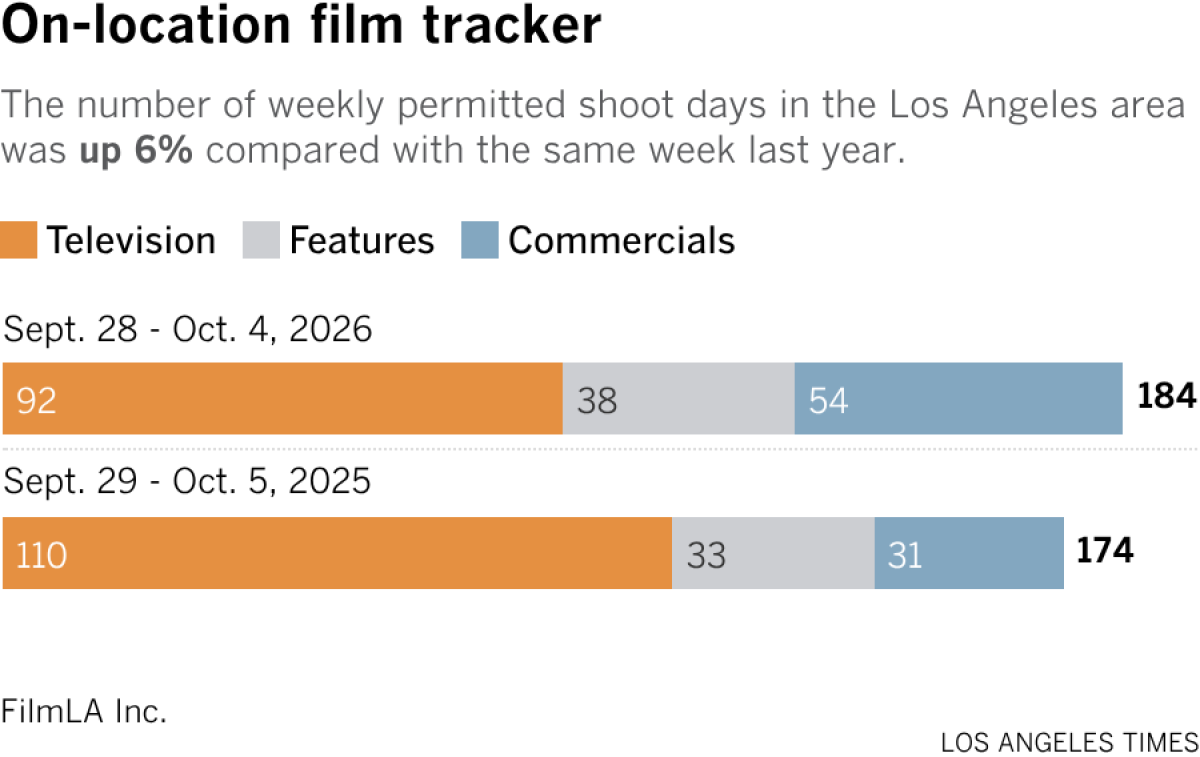
Film shoots
Number of the week
Christopher Nolan’s “The Odyssey” continued its dominance at the box office in its second outing with a three-day domestic haul of $90 million, down only 27% from its debut weekend.
Internationally, the Universal Pictures film raked in $137.6 million for a worldwide total of $652 million.
The big box office performance came as an unauthorized copy of the film leaked online over the weekend. The studio said it “immediately initiated takedown protocols” once it became aware of theillegal posting on X and “will pursue all appropriate remedies to protect our content and intellectual property rights.” The post was viewed more than 2.1 million times before a takedown notice replaced the copy of the film.
What I’m watching
I did not expect Amazon MGM Studios’ “The Sheep Detectives” to deliver a profound message on death and grieving when I sat down to watch it with a friend, but those talking ovine sleuths really got to me.
NBCUniversal’s Peacock is stretching its wings by joining the subscription YouTube Premium service — a significant boost for the streaming platform that has struggled to find its niche in the increasingly crowded landscape.
NBCUniversal and YouTube on Monday announced the multi-year partnership. Beginning early next year, Peacock will be available as part of YouTube Premium’s U.S. subscription bundle, which also includes ad-free videos and music.
The pact represents Peacock’s largest wholesale distribution agreement to date, one that will introduce the service into millions of new homes.
On Friday, NBCUniversal owner Comcast disclosed the service had finally reached profitability in the second quarter after billions of dollars of investment.
The important benchmark comes as Comcast prepares to spin off NBCUniversal entertainment and news media businesses into a separate company. Peacock, which launched in 2020, grew its paid subscribers by 4% to 48 million in the second quarter, compared to the first quarter.
Comcast has long tried to make Peacock an asset for its Xfinity broadband and cable TV subscribers, but recently began to expand its partnerships in recognition that consumers were getting overloaded with pricey choices.
As part of the agreement, NBCUniversal’s linear television channels will remain on the YouTube TV service.
“This partnership brings NBCUniversal’s world-class content and iconic franchises to YouTube’s unmatched scale and global platforms,” Mike Cavanagh, NBCUniversal’s chief, said in a statement. “We’re excited to deepen our relationship with YouTube through a collaboration that reflects our strategy of partnering with industry leaders to drive sustained growth for NBCUniversal.”
The deal will give YouTube, owned by Google, a bevy of sports, including NFL football, NBA basketball, soccer and Major League Baseball.
“We’re incredibly excited to expand our partnership with NBCUniversal to redefine what a modern entertainment subscription can be for consumers,” YouTube Chief Executive Neal Mohan said in the statement. “YouTube Premium brings your favorite creators, artists and cultural moments together uninterrupted, and now, we’re pairing that ultimate viewing experience with Peacock’s expansive lineup of live sports.”
Butlin’s has created a new high-tech solution to avoid the issue of bar queues, and it means you can enjoy many of your favourite alcoholic and soft drinks in just a few seconds
The change will be made across all three Butlin’s resorts(Image: MEN MEDIA)
Butlin’s has announced a huge change to the way holidaymakers can order a drink at its three resorts in Bognor Regis, Minehead, and Skegness, and it’s already in place for guests visiting this summer.
The popular holiday park firm, which recently celebrated its 90th anniversary, has rolled out over 100 self-serve bars across its three sites, which it claims makes it the first in Europe to offer these kinds of bars for guests.
The technology, developed by Boxbars in a £1 million investment by Butlin’s, means there’s much less queuing for drinks, and guests can enjoy a soft or alcoholic drink in as little as six seconds.
The new self-serve bars will be available for both family and Big Weekender breaks, and will offer a huge range of beverages for all the family including branded beers, ciders, and spirits, as well as kid-friendly favourites.
More than 20 options will be available at the touch of a button including pints of Madri and Guinness, Smirnoff with mixers, and cocktails including the brand’s very own Butlin’s On The Beach, which is a mixture of vodka, peach schnapps, cranberry juice, and orange juice, and is reportedly the most popular option across the resorts for All Inclusive guests.
A statement from Butlin’s says the new bars will “help guests get served faster and spend less time queuing”, claiming that “the new technology has the potential to pour hundreds of drinks every minute across the three resorts”.
Guests will either be able to scan their All Inclusive wristband to dispense their drink, or can use contactless payment to quickly pay for their round. Butlin’s confirmed that bars will still be open as usual for guests who’d rather order in person.
Butlin’s launched its all inclusive drink package back in 2024, costing from £25.95 per adult per day, which includes alcoholic drinks such as draught beers, spirits and cocktails from 11am, and all-day Costa coffee and soft drinks across the parks.
Heidi Watson, from Butlin’s said: “This is an exciting first for Butlin’s. Everything we do is about improving the guest experience and our new Boxbar Self-Serve Bars will make a real difference to guests on a family break or a Big Weekender.
“Open in time for the school summer holidays, the bars are designed to reduce wait times and make it quicker and easier for guests to get a drink. This means less time queuing and more time enjoying their holiday with family and friends.”
Earlier this year Butlin’s announced new bookable karaoke pods, which groups of up to 12 people could hire for an exciting sing-along experience. Hiring the pods costs £36, and once inside visitors can choose from 45,000 chart-topping hits and throwback songs, allowing them to enjoy a private sing-song with friends and family as part of their Butlin’s break.
Have a story you want to share? Email us at webtravel@reachplc.com
Peacock, NBCUniversal’s streaming service, reached profitability for the first time, boosted by FIFA World Cup, NBA playoffs and reality dating show “Love Island USA.”
The milestone comes as Comcast Corp. prepares to spin off NBCUniversal entertainment and news media businesses into a separate company. Peacock, which launched in 2020, grew its paid subscribers by 4% to 48 million in the second quarter, compared to the previous quarter. The company said Peacock’s earnings before interest, taxes, depreciation and amortization was $189 million.
“In just six years, we built Peacock into a streaming business with real scale in the U.S.,” said Brian Roberts, chairman and co-CEO of Comcast on Thursday in an earnings call, adding that Peacock has added 2 million paid subscribers in each of the last two quarters.
Co-CEO Mike Cavanagh said that performance “reinforces the value of NBC, Telemundo, Bravo, and Peacock together as one integrated media business with continued opportunity to drive stronger engagement, advertising, and profitability into the future.”
Comcast plans to spin off Peacock, NBC and Telemundo broadcast networks, Bravo, Universal film, television studios and theme parks and British TV service Sky into its own separate company, with a goal of completing the separation in about a year.
Michael J. Wolf, CEO of Activate Consulting, said Peacock’s first profit proves that live sports and premium programming “remain the single most powerful anchors for consumer attention and subscriber growth.”
“As Comcast prepares to spin off NBCUniversal, freeing it from legacy cable, a standalone NBCU is now structurally positioned to compete at the highest level of streaming,” Wolf said in a statement.
Peacock was the last major premium subscription video-on-demand service launched by a legacy studio to reach profitability, said Brandon Katz, director of insights and content strategy at Greenlight Analytics. The streaming service is available only in the U.S. and certain U.S. territories. Its reach is much smaller than other rivals like Netflix, which has about 80 million households in the U.S. and Canada.
“It was a long and arduous process for Peacock to reach profitability, and this is obviously a very important step for their business, but one small step in a much larger journey,” Katz said.
The Peacock news was part of Comcast’s earnings results. Comcast said revenue declined 1% to $29.9 billion in the second quarter, compared to a year ago, hurt by the loss of broadband residential customers.
Net income was $3.5 billion, down 68% from a year ago, when its profit was boosted by a $9.4 billion gain from Comcast’s sale of its share in Hulu.
Content and experiences revenue increased 22.9% to $10.7 billion, thanks to increases in advertising and theatrical revenue from popular movies including “The Super Mario Galaxy Movie,” horror movie “Obsession” and the international distribution of “Michael.”
Comcast’s stock closed Thursday at $21.92 a share, down about 7%.
In the latest salvo in the war between the Trump administration and California, Health and Human Services Secretary Robert F. Kennedy jr. said Tuesday that his agency withheld $867.5 million in Medicaid payments to the state over concerns about fraud.
Kennedy also said his agency defered $199 million in Medicaid payments to Minnesota over similar concerns.
“If Gov. Gavin Newsom or Gov. Tim Walz wants this funding released, all they have to do is provide basic documentation showing that these services are legitimate and not fraudulent,” Kennedy said at a news conference.
Just under half of the funds withheld from California were in connection with in-home health services.
Dr. Mehmet Oz, the administrator for the Centers for Medicare and Medicaid Services, said California’s spending on in-home health services went up by more than double the national average over the last two fiscal years.
“That doesn’t make sense,” he said.
About a quarter of the funds withheld involved care provided to individuals with “unsatisfactory immigration status,” whose eligibility to be in the country and receive these services is in question, which Oz characterized as an “ongoing massive problem for California.”
The announcement by Kennedy and Oz on Tuesday comes two months after Vice President JD Vance announced that the administration would be deferring $1.3 billion in Medicaid payments over fraud concerns, largely connected to hospice services and in-home healthcare.
Newsom’s office, in a social media post, called the announcement a “recycled political stunt.”
“California isn’t being targeted because Trump has evidence of fraud,” the post said. “We are being targeted for political reasons — and because Dr. Oz doesn’t understand that we are *SAVING* taxpayers money by keeping seniors and people with disabilities out of far more expensive nursing homes!”
Newsom’s office also said that the state stands “ready to collaborate” with the Centers for Medicare and Medicaid Services “in good faith efforts to combat fraud.”
The office of California Atty. Gen. Rob Bonta said it is reviewing the deferral of payments and allegations of fraud.
“We have not hesitated to challenge unlawful actions by the Trump administration, and we will continue to act whenever Californians’ rights or access to critical services are threatened,” Bonta’s office said.
Despite Newsom’s claims that the accusations are political, the California state auditor has repeatedly flagged Medi-Cal eligibility discrepancies that have exposed the state to billions of dollars in questionable payments.
California Department of Healthcare Services spokesperson Anthony Cava noted, however, that a 2020 state audit of in-home care found “no program integrity concerns” and encouraged expansion of the program to reduce spending on institutional care.
Cava also pointed out that the federal government had previously approved California’s approach to in-home care.
Newsom and Oz have clashed before.
Newsom filed a civil rights complaint in January against Oz, after Oz posted a video to social media from Van Nuys in which he accused the “Russian Armenian mafia” of being a leading driver of $3.5 billion in fraud in hospice and home-care services.
Newsom said that Oz’s claims were “baseless and racist.”
The announcement by Kennedy and Oz on Tuesday is the latest effort by the Trump administration to crack down on suspected Medicaid fraud in numerous states across the country.
POTUS has just departed Turkey on the “Old Air Force” (VC-25A) Speculating if it will meet the new VC-25B Bridge in the UK for a fuel stopover and POTUS will return to Andrews on the VC-25B Bridge. pic.twitter.com/Xm4qOt52uq
“Mr. President, this plane does not have anti-missile defense systems on it. Why are you flying it?” S.V. Date, White House correspondent for HuffPost, asked Trump at a press gaggle at Andrews Air Force Base outside Washington, D.C., yesterday. The President had just returned from a trip to attend the FIFA World Cup final in New Jersey.
“Well, it has – it has a lot, and, you know, it has a lot of capability,” Trump said in response. “But as I understand it, in about a month or so, they’re going to send it to have it be maxed out. So they’re going to be sending it, and they’ll have it be maxed out. It’ll take about a month.”
Reporter: Mr. President, this plane does not have antimissile defense systems on it. Why are you flying it?
Trump: Well, it has — it has a lot, and uh, you know it has a lot of capability, but as I understand it, in about a month or so, they’re going to send it to have it be,… pic.twitter.com/wDimk6RiQm
Trump did not elaborate on what “maxed out” might mean for the Bridge aircraft.
“The new Air Force One is perfectly safe for the President’s travels, but will receive additional upgrades and enhancements in the fall which will take approximately one month to complete,” White House Press Secretary Karoline Leavitt said in a statement to TWZ. “During that time, the President will fly on the old Air Force One.”
We have also reached out to the U.S. Air Force and L3Harris for more information. L3Harris is the defense contractor that served as the lead integrator for the modifications to the former Qatari 747. You can read more about what is known about the conversion process, which took approximately 10 months, here.
The VC-25B Bridge aircraft, seen at Andrews Air Force Base at its official unveiling in June. USAF
“We knew there were some issues around security with the plane. We’ve known that from the very beginning,” Senator Jeanne Shaheen, a New Hampshire Democrat, said separately at a roundtable at the Farnborough International Airshow in the United Kingdom today, according to Breaking Defense. “Obviously, there was an effort to address that.”
“If there … was an examination and a problem apparently was determined to exist, the good news is that it’s apparently going to be addressed,” Senator Jerry Moran, a Kansas Republican, also said, per Breaking Defense. “And I think it’s important for all of us to determine what that problem is and to be supportive of corrective measures.”
Shaheen and Moran both serve on the Senate Appropriations Committee’s Subcommittee on Defense. Shaheen is also a member of the Senate Armed Services Committee.
As noted, there has been significant new scrutiny of the Bridge aircraft’s defensive and other capabilities since Trump’s trip to Turkey and the swap with the VC-25A on the way back. On July 9, The New York Times reported that the ex-Qatari jet “lacks the same defensive countermeasures that were security features of the old model, including its advanced antimissile capabilities,” citing unnamed officials.
A stock picture of one of the Air Force’s existing VC-25A Air Force One jets. USAF
The Times‘ story included a statement from White House Communications Director Steven Cheung, saying that “the new Air Force One is a state-of-the-art aircraft that has been fitted with high-level security protocols that ensure the safety of the president and his staff.”
Other outlets published similar stories about Air Force One’s capabilities, also citing anonymous sources. In a highly unusual development, the FBI subsequently subpoenaed four journalists at the Times as part of a leak investigation, which now appears to go beyond the more recent reporting on the Bridge aircraft.
The current array of defensive features found on the VC-25B Bridge aircraft is unknown. Details about the self-protection capabilities of the existing VC-25As — arguably the most well defended aircraft on the planet — are not usually openly discussed, but at least some of the countermeasures systems on those aircraft are plainly visible to the general public. This includes a version of the AN/AAQ-24 directional infrared countermeasures (DIRCM) system, also called Nemesis or the Large Aircraft Infrared Countermeasures (LAIRCM) system. There is the AN/ALQ-204 Matador infrared countermeasures (IRCM) system, as well. The AAQ-24 uses lasers to blind and confuse the seekers on infrared-homing missiles. These laser turrets are mounted all over the bottom of the aircraft. The older ALQ-204 system has a similar function, but sends out large fixed pulses of infrared energy rather than a steerable laser beam. The VC-25As also have visible missile launch warning sensors at various points around the aircraft to cue these and other defensive capabilities, and to just provide general alerts to incoming threats. There are certainly other capabilities that are not so plainly visible, as well. The planes are hardened against electromagnetic pulses (EMP), as well.
Large Aircraft Infrared Countermeasures (LAIRCM)
To date, there have been no visible signs of any of these obvious defensive features found on the VC-25As being present on the VC-25B Bridge aircraft. This is something we have noted since the official rollout of the new aircraft in June. The Air Force and L3Harris have previously pushed back on any operational security concerns surrounding the jet gifted by Qatar.
There are additional questions now about what modifications could reasonably be made to the Bridge aircraft during another month-long upgrade period. As we previously wrote after Trump’s swap back to the VC-25A on the way back from Turkey:
“Defensive countermeasures, in particular, take time and careful work to integrate onto any airframe, let alone a newer type for which there might not be pre-existing procedures. Rigorous testing has to be done after integration to ensure those systems work as intended and do not conflict with other features, physically or in the radiofrequency spectrum.”
That being said, there are countermeasures systems that have already been qualified on at least some 747 variants, such as the aforementioned capabilities known to be found on the VC-25As today. There are other self-protection options available on the open market today for 747s and other similarly large aircraft, such as the C-MUSIC DIRCM system from Elbit in Israel. Northrop Grumman also offers a podded DIRCM system called Guardian that utilizes some of the same components as NEMESIS/LAIRCM. Both of these examples are not for high-volume threats, though.
Elbit Systems / DIRCM Missile Defense
Any move to upgrade the Bridge aircraft’s defensive capabilities now can only prompt the question as to why this was not done already. This is a matter of ensuring the safety of the President of the United States, whoever that might be, and underpinning the credibility of America’s nuclear deterrent whenever they are onboard.
There was certainly a push to have the Bridge aircraft in service, at least to some degree, by July 4th. The plane was a centerpiece of flyovers above the nation’s capital to mark this year’s Independence Day. Trump had flown on the jet for the first time just before, on a trip to North Dakota to attend the opening of the Theodore Roosevelt Presidential Library and other celebrations marking the 250th anniversary of the United States.
The new VC-25B Bridge aircraft, at left, and one of the older VC-25As, at right, seen together at Andrews Air Force Base ahead of flyovers over Washington, D.C., on July 4, 2026. USAF
If the Bridge aircraft was rushed into service without certain defensive systems installed to be available for July 4th and other 250th anniversary celebrations, it could still have been sent back for additional upgrades afterward. However, there appears to have been no plans to get the Bridge aircraft any additional defensive or other capabilities before it was put into full service. This was proven when Trump and many other passengers headed overseas to Turkey aboard the new jet. Before the plane was delivered, TWZ had questioned whether the jet would ever fly abroad in the Air Force One role, and not be reserved for lower-risk domestic travel, due to these exact kind of security concerns.
There is an additional operational security layer to the equation here given that any aircraft serving in the Air Force One role inherently slots into America’s nuclear deterrent posture. Beyond their array of self-protection features, the VC-25As, in particular, have an extensive secure communications suite designed to ensure the President remains in contact with the National Command Authority at all times. The National Command Authority is the mechanism through which the President would order a nuclear strike, as you can read about in more detail here.
A report from CBS News earlier this month implied that the new Bridge aircraft lacks the same communications capabilities, as well as defensive features, found on the VC-25As. That story suggested both aspects here pushed the Secret Service to recommend Trump use the older aircraft on the return trip from Turkey, which came amid the start of the new campaign against Iran. The President had also just directed a new round of strikes on Iranian targets from the sidelines of the NATO summit. TWZ highlighted all of this at the time as potential contributing factors in the swap between Air Force One jets.
All of this raises further questions about what risks may have been accepted in allowing Trump to use the Bridge aircraft to travel to Turkey in the first place. There’s an additional question here of what would have happened had circumstances not prompted Trump to swap Air Force Ones, and had The New York Times and others not reported on the reasons behind that decision. Would it have ever gotten these extra defenses if those things didn’t happen?
The Boeing VC-25B Bridge, Air Force One, carrying President Donald J. Trump has landed in Ankara, Turkey, ahead of this week’s NATO Summit. pic.twitter.com/Qqea5RihiM
The Bridge aircraft has been the subject of criticism and controversy from the start. The circumstances under which the Qatari government gifted the plane to the United States in the first place were highly irregular.
The justification for needing the Bridge Air Force One at all remains a subject of debate, now fueled further by the clear continued relevance of the VC-25As. The Air Force’s efforts to acquire two fully equipped VC-25B Air Force One jets from Boeing have been repeatedly delayed, and the costs of that effort continue to rise. The first of those jets is now expected to be delivered in 2028, which is actually a slight improvement in the timeline. What will happen to the Bridge aircraft afterward is unclear.
The Air Force has separately acquired another 747-8i from German flag carrier Lufthansa, which is now being used as a trainer for aircrew and ground personnel. An additional ex-Lufthansa 747 will be cannibalized for spare parts, as well, in support of the burgeoning Air Force One fleet.
It is worth noting here that the VC-25As are also based on older 747-200 models, a type that has all but disappeared from service globally, even with commercial airlines. Those jets are becoming more complicated and costly to operate and maintain just as a result of diminishing supply chains.
With Trump’s comments yesterday, the VC-25B Bridge aircraft is now slated to get the defenses it should have had originally, or at least more than it has now, but the path to getting there is bizarre and raises real concerns, to say the least.
It took an ancient Greek epic to ignite a fire at the box office last weekend, as Christopher Nolan’s adaptation of “The Odyssey” became one of the biggest movie events of the year.
The film, led by Matt Damon as Odysseus, hauled in $123.5 million in the U.S. and Canada on its way to a global total of nearly $264 million — the biggest-ever global opening for one of Nolan’s films.
In many ways, “The Odyssey” is a throwback to old-school Hollywood filmmaking, with Nolan’s use of practical effects and numerous on-location shoots. It’s also a sign that audiences will still pack theaters for the right kind of movie.
The Universal Pictures film also outperformed studio expectations of a $117-million domestic premiere and set a record for the highest-grossing opening weekend for a live-action or R-rated film this year.
“Audiences always want to be thoroughly immersed in the theatrical experience and engulfed by the story and the production, and Christopher Nolan’s ‘The Odyssey’ is a perfect example of that,” Jim Orr, Universal’s president of domestic distribution, said Sunday. “When you have a very substantial opening, and you have those kinds of audience scores, it only points to what should be a remarkable run throughout the summer and into the fall.”
That’s good news for the summer box office, which lately has seen a bit of ebb and flow.
“The Odyssey” now ranks as the third-largest domestic opening of the year, trailing only kid-friendly films such as Walt Disney Co. and Pixar’s “Toy Story 5” and Universal, Illumination and Nintendo’s “The Super Mario Galaxy Movie.” Though family-friendly films have become power players for theaters, the two most recent flicks — Disney’s live-action “Moana” and Universal and Illumination’s “Minions & Monsters” saw softer openings.
After the big weekend for “The Odyssey,” the summer box office is up 7.3% compared with the lackluster 2025 season, according to entertainment data firm Rentrak. More encouraging, the year-to-date domestic box office is now 10.4% higher than for the same period last year.
That’s been helped not only by big blockbusters such as “The Odyssey,” which had a production budget of $200 million to $250 million, but also by the success of smaller-budget films such as A24’s “Backrooms” and Focus Features’ “Obsession.”
The common denominator is the draw of directors who have cultivated strong fan bases. “Obsession” director Curry Barker, 26, and 21-year-old Kane Parsons, who helmed “Backrooms,” have been building their reputation on YouTube among Gen Z audiences, and that loyalty is starting to count for something at the box office.
Nolan, of course, is one of the masters of building a faithful following over more than two decades. Fans started grabbing Imax 70 millimeter tickets for “The Odyssey” when they first went on sale a year ago, and the film ended up driving record presales for the Canadian entertainment tech company, which operates out of Playa Vista.
The film has notched a 95% on aggregator Rotten Tomatoes and an A CinemaScore rating.
“His films have tapped into the cultural zeitgeist,” said Shawn Robbins, director of movie analytics at Fandango and founder of the website Box Office Theory. “That’s what keeps bringing people back. They know they’re going to get a different experience; there’s always going to be a watercooler conversation around his movies, and they’re part of the cultural fabric.”
For “The Odyssey,” part of that conversation was Nolan’s old-school movie magic, including the puppetry, animatronics and robotics he used in scenes with the Cyclops, as well as the real Viking ship that the actors learned to sail.
The film also has driven interest in 70mm screenings from film buffs and casual moviegoers.
Ahead of the premiere of “The Odyssey,” Allen Michaan, owner of Oakland’s Grand Lake Theater, knew the weekend would be very busy for his four-screen movie palace. He is showing the film both in standard digital format and on 70mm film.
You’re reading the Wide Shot
Samantha Masunaga delivers the latest news, analysis and insights on everything from streaming wars to production — and what it all means for the future.
By continuing, you agree to our Terms of Service, which include arbitration and a class action waiver. You agree that we and our third-party vendors may collect and use your information, including through cookies, pixels and similar technologies, for the purposes set forth in our Privacy Policy such as personalizing your experience and ads.
Michaan has made 70mm showings a priority since 1982, when the projector was installed for the release of Steven Spielberg’s “E.T. the Extra-Terrestrial.” He said the theater played that movie for 45 weeks that year. Due to the demand at the time, he installed two more 70mm projectors, making three of his four screens capable of the old-fashioned format.
Demand for the 70mm showings of “The Odyssey” has significantly outperformed their digital screenings, he said.
“We’re thrilled to get any 70mm print because it’s a gift from the filmmaker and the studio,” Michaan said.
Enhanced format screenings for “The Odyssey” made up 53% of the domestic weekend box office, with Imax film and digital revenue accounting for nearly 24%.
Imax 70mm accounted for about 4% of that total, with Imax digital making up the rest. Non-Imax 70mm film screening revenue totaled 3%, while 35mm showings made up 0.3%.
The nearly three-hour epic also marked the first feature film shot entirely on Imax cameras, a feat that required extensive collaboration between Nolan and Imax.
Nolan first told Imax Corp. Chief Executive Rich Gelfond in early 2024 that he was considering making an entire film with Imax cameras and laid out what he’d need for that to happen, including a quieter and lighter camera, a way to make film reloads easier and getting enough trained projectionists.
“It took a fair amount of time and investment” to figure out those challenges, Gelfond said. But by August 2024, the Imax team put together a series of tests to show cinematographer Hoyte van Hoytema. Two months later, Nolan saw the tests and was impressed.
“As filmmakers and studios integrate Imax, we become an increasingly important part of the ecosystem,” Gelfond said. “When a film is released in Imax or shot in Imax, I think it’s a signal to audiences that it’s somewhat special, and the filmmaker is really leaning in in a unique way.”
Times staff writer Cerys Davies contributed to this report.
Stuff We Wrote
Film shoots
Number of the week
Streaming giant Netflix narrowed its 2026 revenue forecast to $51 billion to $51.4 billion from its previous, larger range of $50.7 billion to $51.7 billion in its last Thursday’s second-quarter earnings report, renewing concerns among investors and equity analysts about the Los Gatos-based company’s future growth.
On the Friday morning after the earnings call, Netflix stock slid 13% to $65.08 a share, marking a new 52-week low. Shares eventually closed that day at $68.95.
As my colleague Wendy Lee has reported, investors are growing nervous that in recent months, Netflix’s share of TV viewing time in the U.S. has been decreasing, while YouTube’s share has increased, according to Nielsen data. Investors are concerned that if consumers are watching Netflix less, they’ll cancel their subscriptions, and that will put pressure on the company’s ability to raise prices in the U.S.
Netflix has said its engagement rates are healthy.
What I’m watching
I love a good teen mystery show, especially when it has a bit of a “Veronica Mars” vibe, so I binged Paramount+’s “School Spirits” last weekend.
Where Veronica Mars was solving realistic crimes around her local beach city, “School Spirits” tries to dig into why so many teens have died at (and haunt) a Wisconsin high school. At times, they’re hitting at a lot of different themes and storylines, but I loved the colorful ensemble of ghost characters from different decades, and Jennifer Tilly makes for an incredible villain.
On Monday, a federal judge temporarily blocked Paramount Skydance’s efforts to complete its purchase of Warner Bros. Discovery, ruling that the proposed $111-billion merger “raises serious questions” about whether the combination violates U.S. antitrust law.
District Judge Araceli Martínez-Olguín, based in Oakland, granted a request for a temporary restraining order from a coalition of 12 state attorneys general, led by California Atty. Gen. Rob Bonta, to freeze the deal while the court delves more closely into its impact on markets.
The order pauses the deal for 14 days. Martínez-Olguín’s ruling sets up a showdown for Aug. 3, when she considers a motion for a preliminary injunction — which, if granted, could tie up the deal for months in advance of a trial.
“This is a critical first win in our case to ensure this megamerger never sees the light of day,” Bonta said in a statement. “History tells the tale of what happens when a few people have great power over markets that are central to Americans’ lives: fewer opportunities for more people, worse products and services for all people.”
Two century-old film studios — with rights to Harry Potter, Batman, Scooby-Doo, “Top Gun,” “Ted Lasso” and “Game of Thrones” — would be combined, and HBO, CNN and HGTV would come under new ownership.
“The judge basically said, ‘Look, let’s not race to the finish line here,’” Eric Talley, a Columbia Law School professor, said in an interview. “At the end of the day, maybe this thing gets signed off on, but I think the AGs are going to be given a fair chance to bring their claims forward.”
The ruling dealt a blow to tech scion David Ellison’s efforts to quickly finalize his massive merger, which has the support of President Trump. Ellison wants to complete the deal by September to avoid a higher payout to Warner Bros. Discovery shareholders.
Paramount, in a statement, said the restraining order simply preserves the status quo, which Paramount had already pledged to do in court papers last week that offered to hold off on finalizing the transaction.
“We are confident the evidence will demonstrate that the State AGs’ antitrust arguments are without merit as their alleged markets and claims of anticompetitive effects are without any basis in modern market realities,” Paramount said in the statement.
Larry Ellison, co-founder of software giant Oracle, is bankrolling his son’s ambitions to acquire a second major entertainment company in less than a year. The Ellison family acquired the smaller Paramount in August.
The Democratic state attorneys general, including from New York, New Mexico, Nevada, Oregon and Washington, filed their lawsuit a week ago.
The 37-page lawsuit alleges that Paramount’s proposed takeover — the largest Hollywood deal in decades — would violate the U.S. Clayton Antitrust Act, a century-old law to prevent mergers that weaken competition and raise costs for consumers.
The lawsuit represents the stiffest challenge to a deal that had been swiftly clearing its various regulatory hurdles. Nearly two dozen regulators from around the globe, including Australia, Austria and Saudi Arabia, have already signed off.
The U.S. Justice Department last month approved the merger, saying the combination would probably bolster competition — not harm it. That decision wasn’t a surprise because Trump has been rooting for a CNN shakeup. The president told the network’s Jake Tapper earlier this month: “We’re trying to have CNN go on a normal path.”
“This merger is lawful, pro-competitive, and will benefit consumers, creators, workers, and the entertainment industry,” Paramount said. “We will continue to vigorously defend the transaction and will look forward to the hearings on the substance of the State AGs’ action.”
Paramount shares slid 2% to $8.57 on Monday. Warner shares tumbled nearly 4% to $25.86 — the stock’s lowest mark this year.
Martínez-Olguín’s order came after a hearing in Oakland on Friday that represented an opening salvo between the two sides in the fight over a merger that would dramatically reshape the entertainment industry.
“In many ways this case is a poster child for a much larger set of questions — some of which are specific to the entertainment industry but many are more specific to our regulatory state in general,” Talley said.
Because of the case’s expedited status, the judge said she looked closely at only one of the three markets where the plaintiff states allege the merger could bring anticompetitive harms — wide-release Hollywood films.
“Plaintiffs present compelling evidence that the combined firm resulting from the transaction will possess substantial market share in the wide-release theatrical distribution market,” Martínez-Olguín wrote in her 10-page order.
If allowed to merge, Paramount-Warner Bros. would control about 27% of the market of films that are initially released into more than 3,000 theaters.
“On this combined firm market share alone, the Court is persuaded that it can presume the proposed merger is likely to violate antitrust laws,” the judge wrote.
The ruling doesn’t signal that the states will win but, Talley said: “This is an important mark in the road that suggests that, in the eyes of the judge, at least one of their allegations has the seeds of a valid case.”
Paramount and Warner Bros. Discovery are “temporarily enjoined and restrained from closing or consummating the transaction or taking any steps, directly or indirectly, to integrate or consolidate their operations pursuant to the transaction,” the judge wrote.
The order extends to all officers, attorneys, and “other persons who are in active concert or participation with Defendants,” Martínez-Olguín wrote.
The merger is far from dead, Emarketer senior analyst Ross Benes said in a statement after the ruling.
“The order is likely to be a speed bump,” Benes wrote. “Thanks to the company’s symbiotic relationship with Trump, most challenges ahead that could stop the deal will be steamrolled.”
An airport has revealed an easy trick for a shorter wait at airport security
People could save time using the airport-approved tip (stock photo)(Image: Getty)
Holidaymakers can cut down the time they spend waiting at airport security using a little-known trick. The travel hack was shared by Manchester Airport, and it could be perfect for families ahead of the busy summer holidays.
According to Manchester Airport, there’s an easy way to reduce your queue time if you’re allowed to choose which lane to wait in. Posting tips for passengers online, the travel hub shared an ‘Ultimate Airport Guide’ on its website. There are various tips, covering everything from the best shoes to wear and how to decorate suitcases for maximum visibility.
In the ‘at the airport’ section of the guide, there’s a hack that could help passengers fly through security using ‘reverse psychology.’ Manchester Airport said: “If given the choice of security lanes, pick the left. Most passengers are right handed and will subconsciously prefer the right, making the left a little quieter.”
The airport added that customers can also pay to upgrade to FastTrack for a faster experience. “For just a few pounds, you can purchase FastTrack tickets to use the priority lane and avoid the queues before Security on your way out and Passport Control on your way in.” Many airports offer a similar experience, allowing passengers to pay to use FastTrack.
Elsewhere, London Stansted Airport offers the same security advice for passengers. The airport retierates: “If given the choice of security lanes, pick the left.”
The tip could be especially helpful when many passengers are travelling at the same time, such as during the school summer holidays. However, it’s worth noting that passengers don’t always get to choose their lane.
Nonetheless, they can help speed up the process by avoiding accessories that are difficult to remove. This makes the process faster for everyone.
Offering advice online, London Stansted Airport said: “To prepare your outfit for security, wear shoes that you can take off and put on easily. Avoid fiddley belts or fastenings in your clothes and excess jewellery. Try and keep your pockets empty of non-essentials.”
Despite this, passengers might still want to pack a few layers for later in their journey. The airport recommends packing items such as jumpers, which are easy to take on and off when the temperature changes.
The travel advice said: “Temperatures aboard flights can vary so wearing a few removable layers is advised. An extra jumper can always be used as a pillow if nothing else.”
Mothers and daughters are often caught in a double bind: biologically kindred yet divided by competing claims on identity and selfhood. In Cay Kim’s debut novel “The Future Perfect”, that bond is tangled by cultural discontinuity.
The novel’s mother has been reared in a South Korean household that places a high value on academic rigor and head-down discipline. She devotes all of her energy to grinding that work ethic into her daughter (Kim’s characters are unnamed), who is shuttled between her native Seoul and Minnesota, and grapples with finding the one true way for her to navigate the world.
I spoke with Kay, a native of Seoul who relocated to the States, about mothers, daughters and the unstoppable power of language.
You’re reading Book Club
An exclusive look at what we’re reading, book club events and our latest author interviews.
By continuing, you agree to our Terms of Service, which include arbitration and a class action waiver. You agree that we and our third-party vendors may collect and use your information, including through cookies, pixels and similar technologies, for the purposes set forth in our Privacy Policy such as personalizing your experience and ads.
✍️ Author Chat
Author Cay Kim
(Margaryta Bushkin)
This is your first novel. Did you start writing it in college?
This actually originated from a long poem that I wrote. I didn’t know I was going to turn it into a novel at the time. I just had the idea, the summer before my MFA, to expand each stanza into a chapter. That made the writing process relatively easier for me because it was such a straightforward process. I already had the frame of it.
Even though the novel is grounded in a very specific milieu — that of a child who is ensnared between Korean and American cultures — it’s very much a universal story, of a mother who feels the burden of raising a perfect daughter and is resentful when the daughter rebels against her ministrations.
It’s something that occupies so much of my head space. I wanted the mother to be portrayed as a victim of her society. The way that people choose to parent isn’t something that they learn in a vacuum. She has deep-seated beliefs about suffering and self-abnegation. But there’s a point at which an act of service risks inverting into a selfish act.
A big concept for the mother is endurance.
Exactly. It’s a generational trauma the mother is dealing with. She has had such ingrained beliefs passed down to her, and she’s unable to recognize when her methods result in her own mental and physical splintering, as well as her daughter’s.
Is it a function of the mother’s ego, or some kind of twisted narcissism?
She is putting herself through so much suffering because she believes she is doing the right thing. And there’s an extent to how much you can excuse that self-unawareness.
Yet despite this, the daughter feels tied to her mother, even when they are at loggerheads and she is living thousands of miles away.
The mother is such an integral part of the daughter’s consciousness that severance is impossible. They have a shared history and the daughter wants to share things with her mother, even when they are fighting. When she feels lonely at Stanford, the daughter verbalizes the fact that she has learned loneliness from her mother.
There are a lot of scenes in the novel tied to meals prepared by either the mother or the grandmother.
I do a lot of thinking about how cooking plays a role in our everyday lives. It’s something that people can spend hours preparing, only to have it disappear. It’s her mother’s domain. It is so opposed to the way the father thinks, which is very much tied to capital, to amassing and saving money.
The daughter really comes into herself when she is exposed to American culture.
Minnesota is where she acquires language for the first time. Language is so important to this character. Then she is shuffled back to Korea, and this disjunction is the thing that propels her narrative development. But as the story goes on, the daughter reaches a point where she has such mastery of expression and that is a power she acquires.
“The Future Perfect” is written in a very precise and concise way. What fiction writers do you admire, or who may have served as models?
I love writers whose use of language jolts the mind. My favorite writer of all time is Marguerite Duras. “The Lover” reads so easy but when you pay attention to the language, it’s very precisely engineered. I also love Clarice Lispector, for the way she expresses human spirituality.
Is this book drawn from your life? I ask that only because your protagonist winds up attending Stanford, as you did.
When I first started learning how to write, my teacher always used to say that writing shouldn’t necessarily contain the factual truth, but it should have emotional truth. And I feel like that has been the core of my writing practice throughout my life, and that even for those that don’t think consciously about it, that’s often the case.
This Q&A was edited for length and clarity.
📰 The Week(s) in Books
Country music performer Kenny Chesney sat down with Holly Gleason, the co-author of his new memoir, to talk about writing the book.
(Jill Trunnell)
The state of Ohio is celebrating America’ssemiquincentennial by offering a statewide reading project that features Toni Morrison’s fictional oeuvre, thus providing a vivid alternative history of the country. “Not only does her work re-center African Americans in the story of our country, it also tackles major events from our founding, through slavery, to the impact of Jim Crow, to the great migration and beyond,” Literary Cleveland Executive Director Matt Weinkam tells Leigh Haber.
Chef-Podcaster-Author etc. Eddie Huang has written his first novel, a lightly autobiographical twirl through the foodie-verse called “Come Undone.“ “This book was very much about breaking up with your family to start your own,” he tells Mariella Rudi.
At a time when teen literacy is declining, Rudi polled five high school teachers to find out what books students should be reading now.
Gabrielle Korn’s novel “Long Island Girls” is a Millennial coming-of-age story that drips with Y2K nostalgia and the ways in which youthful optimism and hope can drift into middle-aged cynicism. “One thing I wanted to capture about early adulthood is the constant humiliation,” Korn tells Emily St. Martin. “The thing about being young is that people are so resentful of your youth, but you don’t understand that it’s resentment, you just think everybody hates you.”
📖 Bookstore Faves
The Loved Ones bookshop
(James Alan Duran)
J.C. Gabel, the owner of local book imprint Hat and Beard, has opened a new bookshop called The Loved One, and it already feels like an essential anchor for Historic Filipinotown’s burgeoning cultural scene. The store, which is also a gallery and events space, is expansive (5,000 square feet) and inviting, with patinated hardwood floors and a wall of picture windows that bathes the interior in natural light. I spoke with Gabel about his future plans for his new space.
What is the mission statement of The Loved One?
The Loved One reflects our ongoing commitment to independent publishing, original exhibitions, and the belief that books (and ideas within them) are best experienced in conversation with one another, in-person, whenever possible. In our post-post digital age, the serendipitous nature of organically curating physical objects is, in a sense, the point of the entire operation. We envision The Loved One as a space where everyone can exchange ideas, free from data-mining tech overlords, AI slop and click-bait tomfoolery.
What kind of books are you selling?
We’re going to focus mostly on new books about the visual arts, but we’ll also have several curated tables of fiction and nonfiction organized by subject and publisher, to highlight and promote the work of publishers we admire. Moreover, our genre-based book clubs and live author events — which will run weekly by August — will also influence the titles carried in the shop, too. Lastly, we’re bringing back Big Table, our books and conversation podcast — which we started with Dub Lab during COVID — now that we have a physical space to host and record these conversations.
It’s a very large space. What are your plans for it?
We are really keeping the space as modular as possible so we can change the interior of both storefronts to exhibit art and photography, as well as host author events, artist talks, live music, comedy, book clubs, etc.
You’re also a publisher, with Hat and Beard. How will that tie into The Loved One?
At least half of the arts programming I bring to the table will tie back to Hat and Beard’s original publications; the other half will be curated by Aubrie Wienholt and her team, working in tandem with myself and the H&B family. H&B will, of course, continue to program events all over the city regularly, but it will be nice to have a storefront again for the publishing house. We also intend to sell our rare and limited edition bundles of our books at TLO. There will finally be a physical space where one can come see this work in person before purchasing.
What about Historic Filipinotown? The Loved One is such a cool addition to what is becoming a vital cultural hub for L.A.
We are honored and thrilled to be working out of Historic Filipinotown. So much has opened in and around this neighborhood since COVID. It is a really vibrant community. There is a great camaraderie among all the small businesses in and around our cluster off Temple Street and Glendale Boulevard. Our immediate neighbors, Couplet Coffee and the bar 1642, are both actively involved in our programming monthly: Couplet has sent over a pop-up barista to serve coffee and tea at our literary events, and most of our after-parties are now held at 1642, two doors down.
Nexstar Media Group’s The Hill, the political web site that started as a free newspaper read in most congressional offices in Washington, is launching a new direct-to-consumer streaming service that will be behind a paywall.
Starting Wednesday, Nexstar will offer The HIll Insider, which will carry daily streaming video programs and newsletters. Subscribers will also be able to interact with The Hill’s journalists and analysts, who will take questions live.
The service, available for $5.99 a month or $59.99 a year, is the first digital subscription product for the Irving, TX-based Nexstar, the largest owner of television stations in the U.S. Premium memberships are available for $9.99 a month, or $99.99 a year, which will be ad-free and offer access to live events presented by The Hill.
The endeavor is the first subscription streaming service offered by Nexstar. The Hill already produces a free ad-supported streaming channel distributed on such platforms as Roku.
The free version of The Hill is the most viewed political web site in the U.S. with 1.24 billion page views in 2025, a year-to-year increase of 7%, according to Comscore. The Hill is known for offering brisk, up-to-date reports out of each branch of government in Washington, and is often linked to on other websites.
Nexstar, which also owns the cable network NewsNation, acquired The Hill in 2021 from New York-based entrepreneur James Finkelstein for $130 million. NewsNation adapted The Hill brand name for its Washington-based programs, including a Sunday roundtable show with Chris Stirewalt, politics editor for The Hill and NewsNation.
NewsNation politics editor Chris Stirewalt on the set of “The Hill Sunday.”
(NewsNation)
Stirewalt and the Washington journalists and commentators seen on NewsNation programs will be featured on The Hill Insider. The service will also use the resources of Decision Desk HQ, the political media firm that was the first to call President Trump’s victory on election night in 2024. Decision Desk will be involved in a streaming show called “Data Nerds.”
The Hill Insider will be aimed at the political junkie who wants to go deeper on polling data and hear longer, in-depth discussion on issues. Bill Sammons, senior vice president of editorial content for Nexstar, said the company’s research shows there is a national appetite for such content, as only 5% of The Hill’s current audience is based in Washington.
The Hill has long touted itself as non-partisan and Stirewalt hopes users will gravitate to the subscription version to become better informed about legislative and political issues and not reaffirm their existing opinions.
“My imagined audience is of people in America who are not addicted to politics but are addicted to good citizenship and the idea of fulfilling their civic virtue,” Stirewalt said in a recent interview. “And they would like to do it in a way that doesn’t insult their intelligence.”
While the free version of The Hill has been growing, the new subscription product enters a crowded field of digital programs and platforms aimed at the consumers of political news.
The launch comes as journalists from legacy media such as former CNN anchor Jim Acosta, former ABC News correspondent Terry Moran, and Chuck Todd, the longtime moderator of NBC’s “Meet the Press,” have launched their own daily podcasts and newsletters as second acts in their careers.
MS NOW, the progressive-leaning cable news channel, is entering the direct to consumer market later this year making the channel available outside of pay-TV packages for the first time. Like The Hill Insider, the MS NOW streaming product is expected to offer users additional benefits, such as access to live events and content not seen on the cable network.
Original topical programming that does not have a shelf life is challenging to sustain on a streaming service. When Fox News Media launched its streaming service Fox Nation in 2018, it carried a line-up of live, politically-oriented shows aimed at its conservative-leaning audience. The service eventually pivoted to documentary, movies and lifestyle programming and became the home of the annual Fox News fan event, The Fox Nation Patriot Awards.
Japan’s ispace is expanding its role in the commercial lunar economy after two unsuccessful moon landing attempts in 2023 and 2025. The company is developing its next-generation Ultra lunar landers, including a mission under NASA’s Commercial Lunar Payload Services (CLPS) programme, as competition intensifies in the race to build sustainable infrastructure for future lunar exploration.
Ispace partners with SpaceX for shared lunar transport
Japanese lunar transport company ispace said on Wednesday it would launch a new lower-cost lunar cargo business using SpaceX’s Starship rocket and lunar landing system, marking a significant expansion of its commercial Moon ambitions.
Tokyo-based ispace has purchased 500 kilograms (1,102 pounds) of payload capacity aboard a future Starship mission expected to land on the Moon as early as 2030. The agreement, valued at $50 million, will allow the company to transport customer payloads through a shared-ride service while developing a lunar surface vehicle capable of carrying cargo from multiple clients.
The company described the new offering as a “lunar access integrator” service, providing a cost-effective way for governments, research organisations and commercial customers to send equipment to the Moon without requiring dedicated spacecraft.
Stay ahead of the geopolitical week.
MD Briefing delivers expert analysis across five global fronts — the Indo-Pacific, energy, geoeconomics, European security, and the Middle East — every Monday morning. Free.
Shared rides aim to cut lunar mission costs
Hideari Kamiya, ispace’s executive vice president, said the service would complement the company’s ongoing development of dedicated lunar landers described as “taxis” by functioning more like a shared transportation “bus” for lunar cargo.
The partnership expands an existing relationship between the two companies. ispace previously relied on SpaceX’s Falcon 9 rockets for its lunar missions in 2023 and 2025, although both attempts ended unsuccessfully before achieving a soft landing.
Ispace continues long-term Moon ambitions
Despite those setbacks, ispace continues to pursue its long-term lunar programme and plans to land three next-generation Ultra landers by 2030, including one mission under NASA’s Commercial Lunar Payload Services initiative.
Chief Executive Takeshi Hakamada said working with Starship would “exponentially” accelerate the company’s growth in the emerging lunar infrastructure market while allowing it to continue developing its own landing technology.
SpaceX expands commercial lunar partnerships
SpaceX welcomed the expanded partnership, saying Starship’s reusable design could significantly improve access to the Moon for commercial customers.
Stephanie Bednarek, SpaceX’s vice president of commercial sales, said ispace’s integration services would provide an important pathway for smaller payloads seeking affordable lunar transportation.
Although the agreement is not exclusive, NASA plans to use Starship for its first crewed lunar landing under the Artemis programme in 2028, while U.S.-based lunar rover developer Astrolab has also reserved space on future Starship missions.
Hakamada said SpaceX initially approached ispace with the idea of creating a shared lunar cargo integration business, adding that while competitors may eventually enter the market, few companies currently possess both the transportation expertise and the capability to continue supporting payloads after landing on the Moon.
Future outlook
The partnership reflects the rapid commercialisation of lunar exploration, with companies increasingly seeking lower-cost and more flexible ways to reach the Moon. If Starship enters operational lunar service on schedule, ispace could establish itself as a key provider of shared lunar logistics, expanding opportunities for governments, research institutions and private companies. However, the project’s success will depend on Starship meeting its development milestones and sustaining a reliable launch cadence, making the coming years critical for both companies’ ambitions in the emerging lunar economy.
Planned Parenthood and two smaller regional abortion providers are resuming billing Medicaid for services other than abortion after being cut off for most of a year.
The defunding, which was mandated in President Trump’s big tax and policy law last year, has been blamed in the closure of multiple clinics as well as a reduction in the number of Planned Parenthood patients being screened for breast cancer or tested for sexually transmitted infections.
The Medicaid billing was allowed to resume last weekend.
The restored funding does not mean the battle over federal abortion policy has ended, and not all services that were cut will return.
Here’s what to know about the situation.
Planned Parenthood closed clinics and saw fewer patients
Many abortion providers, including Planned Parenthood affiliates, have struggled financially since the 2022 Supreme Court decision that overturned Roe v. Wade and allowed state abortion bans to be enforced. Clinics have closed in states with abortion bans and restrictions as well as those without.
Planned Parenthood says its affiliates have closed nearly 30 of its roughly 600 clinics over the past year, citing the funding change as a key reason.
Over that period, affiliates dispensed about 25% fewer packs of birth control pills and conducted about 20% fewer breast cancer exams than the previous year.
Many patients — especially in places where healthcare can be hard to access — may not have had care at all because of the defunding, the organization said.
Planned Parenthood Action Fund spokesperson Angela Vasquez-Giroux said the cuts have also led to limited abortion access in some places.
Planned Parenthood of Wisconsin halted abortions for about a month, then dropped its status as an “essential community provider” so it could resume seeking reimbursement. The Arizona affiliate paused offering many of its services to patients covered by Medicaid.
Two smaller providers were also impacted
The defunding provision also affected two other healthcare providers that met the criteria in the law because the were nonprofit family planning organizations that provided abortion and received more than $800,000 yearly in Medicaid reimbursements.
Their experiences were very different.
Maine Family Planning closed three primary care clinics that served about 1,000 patients in the largely rural state.
Evelyn Kieltyka, a senior vice president of program services, said that even with help, their former patients had to wait an average of four to six months to be established with new providers.
Meanwhile, the number of abortions the group provided held steady, she said. Maine is one of several states where state-funded Medicaid covers abortion.
Patients at Health Imperatives in Massachusetts may not have noticed the change, as no services were dropped.
The state government funded Medicaid reimbursements that the federal government stopped — something that Planned Parenthood says happened in some form in 14 states. On top of that, the clinic system received a grant from Melinda Gates’s foundation.
Some services are returning but others may not
Planned Parenthood’s Arizona affiliate has already announced expanded hours and more telehealth options linked to the ability to bill Medicaid again.
Some other services are not likely to be restored.
Kieltyka said Maine Family Planning isn’t planning to bring back its primary care practices again.
“When you close something down and you lose positions,” she said, “it’s very difficult to bring that back and build it back up again.”
And Michelle Quesada, vice president of communications, brand and marketing for the Planned Parenthood affiliate in Florida, said a closed clinic in Lakeland isn’t expected to reopen, partly out of concern that Congress or the Trump administration could cut Medicaid reimbursements for the organization again.
“There’s no telling with this uncertainty,” she said. “It’s like a yo-yo effect.”
Abortion opponents want to stop the Medicaid reimbursements again
The political battle isn’t over.
Abortion opponents are pushing Congress to adopt another defunding policy.
“They’ve defunded Big Abortion before,” Kelsey Pritchard, a spokesperson for Susan B. Anthony Pro-Life America, said Monday, “and they should do everything in their power to do it again.”
Planned Parenthood contends that most general election voters don’t want the organization to be defunded. Pritchard said that the Republican base does.
Gustavo Dudamel’s farewell to Los Angeles will also function as a benefit for his homeland of Venezuela, which suffered catastrophic losses from twin earthquakes in late June.
Dudamel and the Los Angeles Philharmonic announced Monday that the beloved composer’s final Hollywood Bowl performance as the orchestra’s music and artistic director, originally programmed as “Celebrating Gustavo at the Bowl: A Musical Legacy,” will instead be called “A Concert for Venezuela.” Still scheduled for Aug. 23, the show will raise funds for communities affected by the earthquakes.
“Venezuela will always be my home, and every moment, my thoughts are with the families whose lives have been forever changed by this tragedy,” Dudamel said in a statement. “The suffering is immense, but so is the strength and resilience of our people. This concert at the Hollywood Bowl is an invitation to stand together and transform our compassion into action.”
A full program and special guests will be announced later. Dudamel and the musicians will contribute their time and services free of charge.
Donations will benefit Dudamel’s Earthquake Recovery to Support Venezuelan Communities fund, in partnership with the United Nations Development Programme and the Development Bank of Latin America and the Caribbean fund. The L.A. Phil will contribute $50,000 to the fund, announced President and Chief Executive Kim Noltemy.
“In moments of profound need, our responsibility as an institution extends beyond the stage,” she said. “We are grateful for the opportunity to provide direct financial support to relief efforts for communities in Venezuela with a $50,000 charitable donation and to stand alongside Gustavo in bringing this concert to life at the Bowl.”
Twin earthquakes on June 24 devastated Venezuela, with more than 3,300 deaths and more than 30,000 people reported missing. As international rescue teams depart and locals are left to search through rubble, Venezuelans abroad, including L.A. restaurants, have looked for ways to send support.
Dudamel, who was born and raised in Barquisimeto, Venezuela, wrote in a 2015 op-ed for The Times that he is a “product” of El Sistema, the country’s government-funded youth music program. He has been the music director of the Simón Bolívar Symphony Orchestra since 1999.
“I’ve been doing that before because, like the story said, that’s legal in Puerto Rico,” Díaz said.
USA Today published a story in May highlighting social media posts advertising cockfighting tournaments that picture Díaz in his Dodgers uniform. The story also referenced a story in El Nuevo Día, the largest circulating newspaper in Puerto Rico, quoting Díaz.
No one from Major League Baseball has reached out to Díaz about a possible suspension, he said.
“They didn’t reach out to me because I wasn’t doing anything illegal,” Díaz said.
In 2019, a federal law banning cockfighting took effect in Puerto Rico. Before the law, the blood sport had been made illegal in all 50 states, but not U.S. territories. Many Puerto Ricans saw the ban as an attack on their culture and vowed to defy the law.
Puerto Rico responded by passing a law saying that it’s legal to host cockfights as long as people don’t export or import the animals or any goods or services related to cockfighting. The U.S. Supreme Court in 2021 declined to hear a challenge to the federal law brought by a group that argued Congress exceeded its power by applying the ban to Puerto Rico.
Anyone found guilty of taking part in cockfighting faces up to five years in prison and a $250,000 fine. Spectators could receive a one-year prison sentence.
Still, some Puerto Ricans such as Díaz view the topic as part of the island’s history, initially brought to the Caribbean by 16th-century Spaniards when the island was first colonized.
“It’s a pastime I’ve followed since I was a child,” Díaz told El Nuevo Día in March. “It’s legal in Puerto Rico, thank God. Otherwise, I wouldn’t be here.”
Diaz is on track to return to the Dodgers after the All-Star break, although his exact return date remains unclear. His fastball felt good, so locating his slider was the next step toward his return.
Times staff writer Hannah Fry contributed to this report.
Jet2 has reminded passengers to bring their physical card on board to help keep its cashless onboard service running smoothly and efficiently
Jet 2 is a popular UK airline(Image: Photofex-AT via Getty Images)
Jet2 has encouraged passengers to bring a simple everyday item on board to help minimise certain in-flight delays. The airline says having this item helps keep its onboard service running smoothly and efficiently.
In the “onboard service and conduct” section under payments, it states: “To make our service as efficient as possible, we only accept card payments.”
Urging travellers to bring a card with them, which may help any delays with orders, it adds: ” We’ve also introduced a few updates to contactless, including Apple Pay and Google Pay. So, please bring your physical card to use chip and PIN when needed.”
Can I smoke or drink alcohol on a Jet2 flight?
Passengers should also be aware that only alcohol purchased on board is permitted to be consumed during the flight. Smoking is strictly prohibited.
It warns: “In accordance with safety laws, smoking and the use of e-cigarettes is strictly prohibited on all flights. Please note that only alcoholic drinks purchased on board may be consumed during the flight. Jet2.com reserves the right to serve alcoholic drinks at our absolute discretion.”
Passengers could be kicked off Jet2 flight
Passengers are also reminded that disruptive behaviour will not be tolerated. The aircraft’s Captain has the authority to refuse boarding or take appropriate action against anyone considered disruptive, disorderly, or likely to pose a risk or cause unnecessary inconvenience to fellow passengers or crew.
It adds: “Anyone falling foul of this provision shall be liable to indemnify us in full against any liability or loss we may suffer as a result. In addition, they may be prevented from flying with us in the future.”