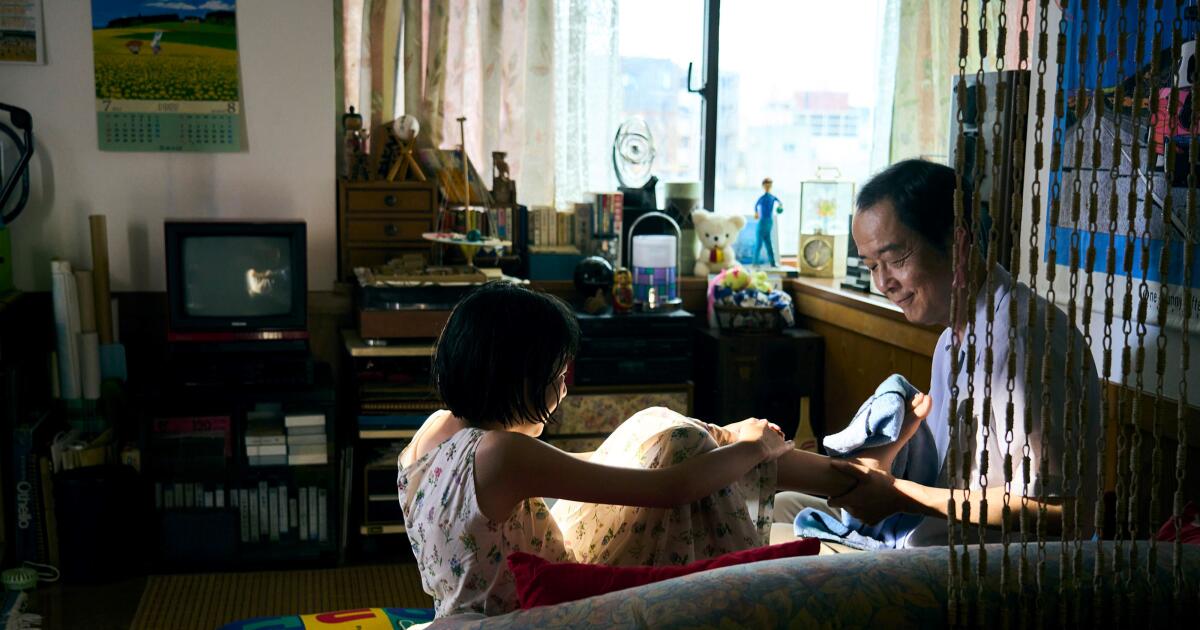
Japanese filmmaker Chie Hayakawa isn’t afraid to look death in the eye. The writer-director’s 2022 feature debut, “Plan 75,” imagined an unsettling future in which the elderly are offered a subsidy by the government to be euthanized. For her follow-up, she travels into her own past, drawing from memories of her father’s battle with cancer.
But while “Renoir” features no sci-fi elements, the nearness of oblivion remains just as prominent. Shorn of sentimentality, this gentle drama follows a quietly observant fifth-grader who feels the grim shadow of mortality all around her. How the character will absorb that realization is anyone’s guess — including Hayakawa’s.
Newcomer Yui Suzuki stars as Fuki, who lives in a nondescript Tokyo suburb in 1987. Her soft-spoken dad, Keiji (Lily Franky), is suffering with terminal cancer in its final stages, the emaciated man spending as much time in the hospital as he does at home. Fuki’s mother, Utako (Hikari Ishida), doesn’t seem very despondent, though: One senses an emotional exhaustion that comes from preparing so long for the inevitable that she’s now mostly numb, her anticipatory grief having given way to frayed nerves.
Fuki’s pre-mourning process is equally complicated. Outwardly, she shows no signs of being devastated by her dad’s imminent passing, happily playing with him, almost in denial of his fate. But “Renoir” subtly suggests the impressionable girl is more aware than she lets on, surrounding her with random reminders of death. Local news breathlessly reports on random domestic murders. Even when Fuki gets away from the city, the camera lingers on her watching a campfire’s dying embers. The film derives its title from the girl’s interest in “Little Irène,” a painting by influential French impressionist Pierre-Auguste Renoir. She asks if Renoir is still alive. No, he’s dead too.
Hayakawa pulls from her childhood in multiple ways for her sophomore feature, which premiered in competition at Cannes last year. “Renoir” takes place in 1987 specifically because that’s the year she turned 11, and, like her protagonist, she was infatuated with “Little Irène.” But there’s a refreshing absence of nostalgia in Hayakawa’s conception of Fuki and her quizzical processing of her father’s fatal illness.
For school, Fuki writes an essay about her wish to be an orphan. She becomes obsessed with hypnotism and mind-reading, an unorthodox strategy to create a sense of control. And, occasionally, she wanders into daydreams that Hayakawa presents so matter-of-factly that viewers may sometimes be unsure if what they’re seeing is actually happening. In “Renoir,” Fuki’s flights of fancy are as naturalistic as her everyday life — a sharp reminder that, for children, imagination and reality are often indistinguishable.
If death has been integral to Hayakawa’s two features, it’s society’s callous reaction to aging that is her primary focus. “Plan 75” eschewed dystopian-thriller conventions to ponder how Japan might one day treat its senior citizens, viewing them as little more than a drain on resources. “Renoir” makes a similar point within a memory piece. Keiji is the one dying, but it’s telling that Hayakawa centers the story on Fuki and Utako, who each, in their own way, seem more concerned about their own personal dramas.
As Keiji’s situation grows more dire, Utako enters the orbit of Toru (Ayumu Nakajima), a workplace advisor with whom she’s instantly smitten, pondering pursuing him romantically. Ironically, Toru preaches the importance of good communication skills in the office, a lesson the film’s guarded family would be wise to heed. While Utako hides her feelings for Toru, Fuki begins a secret odyssey in which she impulsively joins a phone dating service, engaging in conversations with a creepy college student (Ryota Bando) who pushes her to meet in person. This potentially traumatic subplot is the closest “Renoir” gets to traditional suspense, but even here Hayakawa adopts a muted approach, sidestepping shock value for bittersweet commentary about young people’s confusion around love. Both Utako and Fuki chase after human connections fraught with danger, each trying to insulate themselves from the tragedy waiting at home.
“Renoir” may be a delicate wisp of a film, but it’s flecked with thoughtful questioning about whether childhood’s sorrows leave permanent scars on us as adults. Suzuki exudes the fragility and buoyancy of adolescence, playing Fuki as someone constantly imbibing the world, rarely revealing what she’s doing with that stimulus. The simplest moments resonate the strongest, such as when the moody 11-year-old holds a balloon over the balcony of her family’s high-rise apartment, casually releasing her grip so that it tumbles to the ground far below. Does it speak to a desire to jump herself? “Renoir” won’t say, but the character is so poised you feel confident she’ll survive her father’s death. Who knows: Maybe years from now, she’ll even make a touching, emotionally astute movie about it.
‘Renoir’
In Japanese, with subtitles
Not rated
Running time: 1 hour, 56 minutes
Playing: Opens Friday, June 5 at Landmark’s Nuart Theatre