Editorial decisions at ABC News are being influenced by the Federal Communications Commission’s early license review of its TV stations, the network’s legal team told a U.S. District Court judge Tuesday.
The Disney-owned network is seeking a restraining order to stop the FCC’s action, which its attorneys said was unprecedented and an attempt by the Trump White House to chill free speech.
Disney attorney Beth Wilkinson said the FCC’s action is having an impact on ABC News coverage in the weeks leading up to the midterm elections, as the network tries to avoid further action from the agency that regulates over-the-air broadcast TV licenses.
“We are making different editorial decisions,” Wilkinson said during the court hearing in Washington. “We are watching everything that we do because every time we do something — even not broadcasting this presidential speech — brings out the anger in the administration and the retaliation from the agency.”
Wilkinson was referring to President Trump’s frustration over ABC’s decision not to air his July 16 speech about voter fraud. The network chose to run it on its news streaming platform. FCC Chairman Brendan Carr criticized the move and said it would be considered in the license renewal process.
Wilkinson cited Carr’s complaint as an example of how the review is being driven by Trump’s unhappiness over the network’s coverage across its news programs, its late-night show “Jimmy Kimmel Live” and its topical daytime chat show “The View.” The FCC’s action, she said, is the administration “retaliating with their government power against ABC’s right to protected speech.”
Assistant U.S. Atty. Dimitar P. Georgiev argued for the FCC that ABC is trying to avoid the commission’s regulatory process by taking the case to the U.S. District Court. Georgiev said the license renewal was initiated because of a dispute over documents in the commission’s investigation into alleged discriminatory hiring practices at Disney.
Judge Loren L. AliKhan did not issue a ruling. She asked the FCC to provide further documentation on its claim. Disney will have until Oct. 14 to respond.
Trump has frequently threatened to have TV station licenses pulled when he believes he is treated unfairly on news and talk programs. He has also successfully extracted multimillion-dollar settlements from CBS and ABC after suing the networks over news content he said had treated him unfairly.
ABC is the first network to take the FCC to court over the threats.
Wilkinson noted that Carr said during a visit to Trump’s Mar-a-Lago Club in Palm Beach, Fla., that “broadcasters that are running hoaxes and news distortions, also known as fake news, have a chance now to correct course before their license renewals come up.”
The licenses for eight ABC-owned TV stations, including KABC in Los Angeles, were originally scheduled for renewal between 2028 and 2031.
Carr has said ABC’s daily talk show “The View” should not be exempt from the FCC’s equal time rule that requires broadcasters to bring on opposing candidates to provide balanced coverage. Wilkinson noted that the program — which was given the exemption in 2002 — has avoided using clips of politicians during its popular “Hot Topics” segment at the top of the program.
Carr also said earlier this year that stations could be subject to discipline if they “don’t operate in the public interest” after criticisms from the White House about coverage of the Iran war.
Carr called for the ABC license review in April, days after Kimmel delivered gags about the White House Correspondents’ Assn. dinner attended by Trump for the first time as president and described First Lady Melania Trump as having a “glow like an expectant widow.”
The satirical remarks drew criticism after a man later breached security at the Washington Hilton event while armed with a shotgun, handgun and several knives. The dinner was cut short and rescheduled.
These protest-laden times couldn’t be more receptive to the stirring “Everybody to Kenmure Street,” which speaks to a moment when the machinery of institutional cruelty was ground to a halt by righteous neighborliness. Felipe Bustos Sierra’s immersive documentary about a consequential block party — one that happened in Glasgow, Scotland, in May 2021 — is not simply one of the year’s best films, but a potent reminder of where meaningful change begins.
On the morning in question, a dawn immigration raid initiated by the U.K. Home Office snatched two men from the diverse, tight-knit community of Kenmure Street, and the timing couldn’t have been more hostile: in front of a mosque on the first day of Eid. And yet, what reaction is more gratifying than residents of all stripes stepping outside to do something about it?
Word spread quickly, and soon a throng of smartphone-wielding citizens had surrounded the immigration enforcement van, which couldn’t move because one enterprising, early-arriving activist had slid underneath it. Soon, the police were there in force, but the dedication of the outraged, chanting crowd demanding the men’s release ensured this would be no ordinary standoff.
Sierra, a Scotland-based filmmaker born to Chilean exiles, whose previous film recounted the solidarity of Scottish factory workers against Chile’s dictatorship, primes us over the credits with an archival montage of his adopted country’s disputatious lineage, from suffragists and trade unionists to independence campaigners and Glaswegian schoolgirls advocating for their asylum-seeking classmates, all set to the serenading lilt of Lee Hazlewood’s classic 1966 ache “Your Sweet Love.”
But the tale of that Thursday’s spontaneous, viral resistance is narrated by its proud participants. Each is interviewed separately, looking directly at us to burnish the intimacy. We aren’t told their names — save human rights lawyer Aamer Anwar, a key public figure that day — because it isn’t the point. Everyone’s observant, humor-filled testimony both individuates and connects them to each other. Over those hours, the many became one. They became witnesses unsatisfied with mere witnessing.
The interviewees who didn’t want to be filmed are played by actors, including executive producer Emma Thompson wedged between an undercarriage and pavement as the unidentified van protester. That this doesn’t play like jokey stunt casting speaks to the spirit of communal, all-hands-on-deck engagement. Who got under the van wasn’t important. That someone did was.
Sierra also contextualizes Kenmure Street within the long shadow of slavery, industry, imperialism and grassroots opposition. It’s a valuable history lesson in echoes and dignity, one of the film’s more moving illustrations of the legacy of demonstrating for what’s right.
As it happens, Sierra himself wasn’t there that day. He chose to stay at home, watch on the news, and — as someone here might, post-Minnesota — assume the worst. “Everybody to Kenmure Street” is the ultimate what-did-I-miss movie, a life-affirming corrective, his respectful curiosity and everyone’s cherished memories in singular harmony. Like Sierra, you’ll wish you’d been there, to experience the world made better by those who show up. This is the next best thing.
A researcher falls down a rabbit hole of academia in “Chronovisor,” a singular indie that sneaks up on you. Filmmakers Jack Auen and Kevin Walker — who operate under the name Cosmic Salon — make movies in the belief that intellectual pursuits can be both exciting and cinematic. “Chronovisor,” a pleasurably hand-crafted curio, firmly asserts that the sensorial possibilities of film can seem infinite.
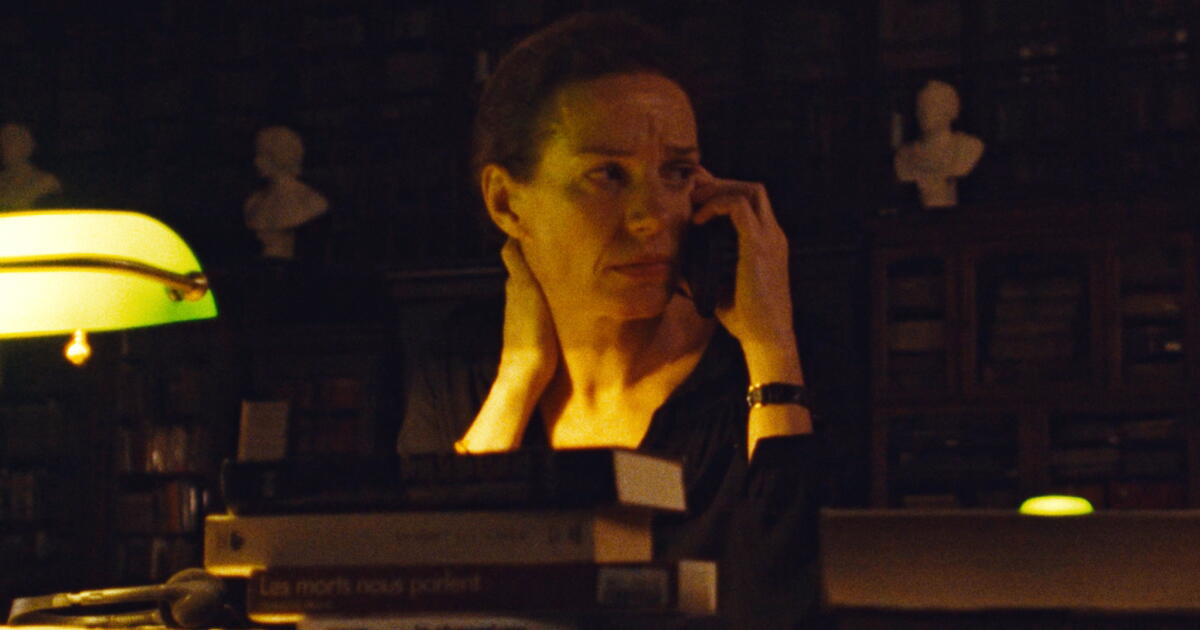
That said, the movie opens deceptively: Béatrice (Anne-Laure Sellier), a professor of philosophy at Columbia in New York, is clearly boring her two unseen colleagues over drinks with a monologue about her theories of memory and brain function. Alone afterward, however, with the camera following her as if she were a secret agent and the orchestral swell of Gustav Holst’s “The Planets” lending Hitchcockian tension, the real story begins to unfold in large, ornate libraries.
What draws Béatrice’s attention is a fantastical claim made by a Benedictine monk in an Italian magazine article from the 1970s. He insists he discovered an instrument with the power to pull images and sound from the whole of human history, presenting them on a television screen. With this time-shaping device called the Chronovisor, Father Pellegrino Ernetti professed to have seen footage of the crucified Christ and even enjoyed a lost play staged by an ancient Roman dramatist. At the end of a slow zoom shot, we see the article’s title in Italian until it’s translated for us in English: “A Machine Has Been Invented That Photographs the Past.”
With that, “Chronovisor” and its obsessed protagonist enter a trancelike, analog-heavy state in which obscure texts in myriad languages tease a concealed parascientific history of potentially great importance. In other words, get ready to read a lot and yet, surprisingly, to enjoy the immersion, as one might the hushed thrill of a surveillance sequence. As Béatrice’s amateur detective work pulls her in deeper, the strands begin to suggest a conspiracy, one marked by mysterious disappearances and the clandestine sway of the Vatican.
The question of what’s real and not isn’t only Béatrice’s to unpack — you may wonder yourself whether Auen and Walker have fabricated their esoteric source materials and invented the strange saga of Ernetti. They haven’t. Not entirely, that is, which is part of the woozy enjoyment. Enhanced by cinematographer Leo Zhang’s atmospheric 16mm grain and a natural onscreen performance from first-time actor Sellier (a real-life French scholar in behavioral science), “Chronovisor” hums with deep appreciation for research and evidence. We get both a tantalizing armchair mystery steeped in occult-ish authenticity, but also a sly commentary on our own relationship to the pursuit of curiosity.
If your own interpretation of Béatrice’s quest leads to the realization that this supposedly long-lost technology may already be with us, so be it. The filmmakers surely won’t disabuse you of that notion. They save their most disorienting trick for last: a reality-bending sequence that could qualify as video art. Whether it proves anything is, of course, up for grabs, but it surely helps “Chronovisor” remain wonderfully unclassifiable.
‘Chronovisor’
In English, French, Italian and German, with subtitles
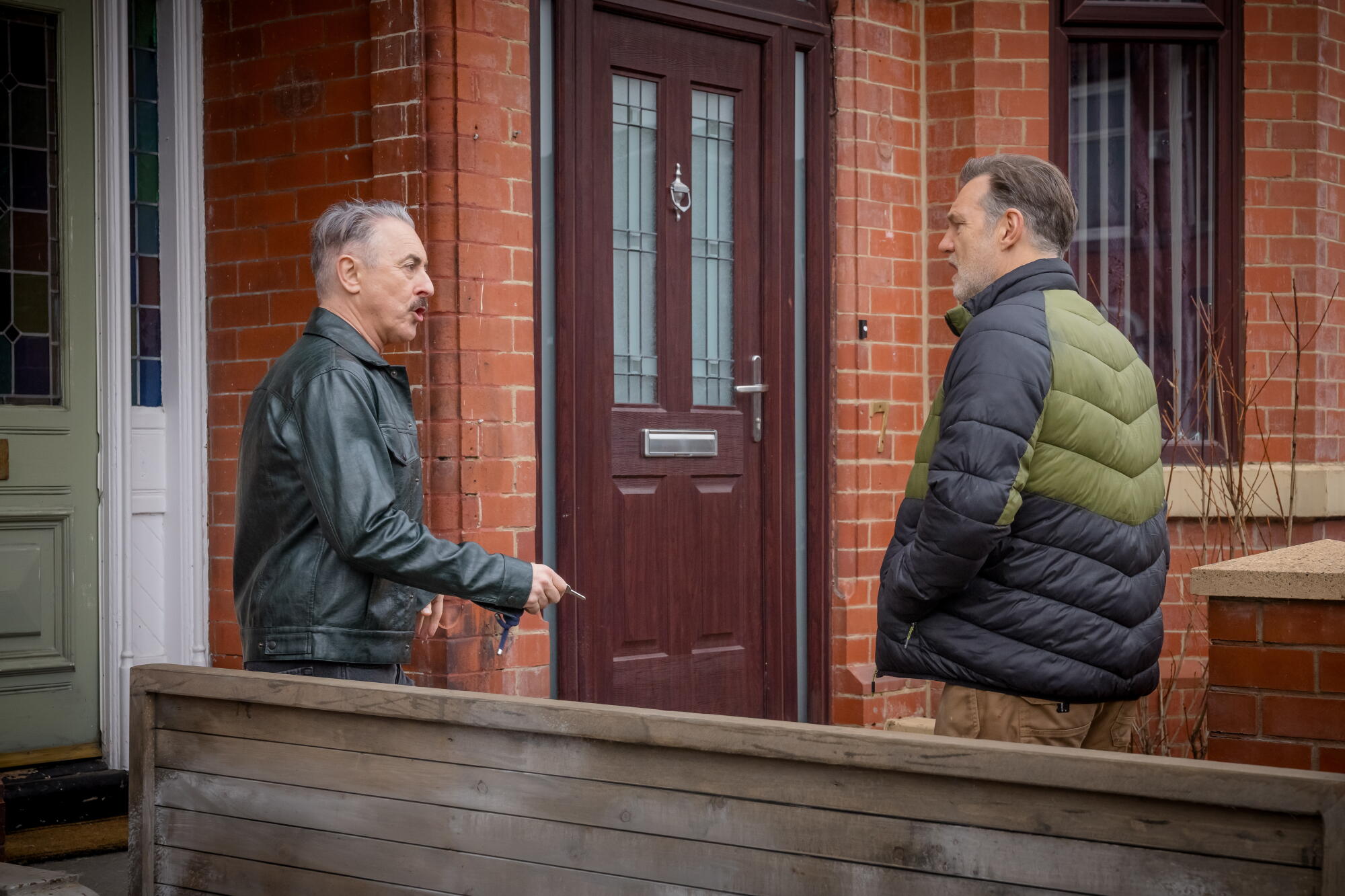
“Tip Toe,” a fine new drama from Russell T Davies premiering Friday on Starz, begins at the end, with Leo Struther (Alan Cumming, phenomenally good), a gay Manchester bar owner, hanging dead from a streetlight outside his house, as a woman screams and his neighbor Clive Goss (David Morrissey) stands breathing heavily on his porch. Then, as so many series do nowadays, it goes back in time — 10 days here — to tell the tale that got them there.
And so you are prepared from the beginning for tragedy, though not everything that happens in its five episodes will be tragic — some of what we see will be sweet and even celebratory — and one might forget for a moment where this is all heading, and even believe that what we’ve already seen will turn out differently.
The series sets off in a comparatively light mood. Chasing a one-night stand who’s stolen his laptop, Leo finds he’s locked himself out of his house, and, dressed only in his underwear, goes next door to ask if he can borrow a phone to call his friend Stephanie (Elizabeth Berrington) to bring him a spare key; here we meet the Goss family, Clive, an out-of-work electrician; his wife, Marie (Pooky Quesnel), who doesn’t like Clive; 16-year-old son George (Jackson Connor), gay and closeted; and 25-year-old son Saul (Joseph Evans), an easygoing hunk who lives at home, secretly makes money on OnlyFans and accepts everyone for who they are. Leo and the Gosses have been living amicably at arm’s length for 14 years, though their lives are about to become closely entwined, with disastrous results.
In an act of something like willful, somewhat disturbing friendliness, or a desire not to have to deal with Leo the next time he’s locked out, Clive makes a copy of Leo’s key and installs a lock box by his door. (By the Chekov’s gun rule, a key copied in Episode 1 is bound to be turned in a lock in whatever later act Davies deems advantageous.) Then, Leo gives Clive work at his bar.
Alan Cumming and David Morrissey play neighbors whose relationship escalates to violence in “Tip Toe.”
(Ben Blackall / Starz)
Leo’s bar, Spit and Polish, sits on Canal Street in Manchester’s long-established “gay village.” It’s a safe space for his employees and regulars, including Zee (Iz Hesketh), who’s been sleeping hidden in the bar, frightened of new flatmates since coming out as a trans woman, and Melba (Paul Rhys, brilliant), a former drag performer who holds down the end of the bar like Norm from “Cheers” and carries a torch for Leo.
Things will go generally downhill from here, in a narrative of escalating misunderstanding — not in the sense of an innocent mistake, of simply getting the wrong end of the stick (though that’s part of it), but as a contemporary habit of mind, blinkered, closed to facts but open to conspiracies. (Clive, a consumer of social media disinformation, believes that AIDS and COVID are fake); he lives in fear.
Directed by Peter Hoar, it’s a rough watch, yet beautifully wrought and delicately performed, inspiring and depressing, hopeless and hopeful by turns Davies has points to make — hanging your protagonist is not subtle — but his dialogue carries a lot of weight lightly; long conversations ebb and flow and rise and fall like compressed playlets. If there is something schematic about the arc, the characters within it, Clive as much as Leo, are completely human. They stand for something bigger than themselves, but they also stand for themselves.
Davies brought gay life in its infinite variety to television with the 1999 series “Queer as Folk” (also set on Canal Street) and gender fluidity to “Doctor Who,” the series he revived in 2005 and returned to in 2023. (The Tardis is currently in limbo.) His “Cucumber,” about middle-age gay men, and “Banana,” about young LGBTQ+ people, are also set in Manchester, where Davies has lived since the late 1980s. “Tip Toe” has been crafted for an age of surging homophobia and anti-gay violence. “The president of America has given these men permission to attack us,” says Melba, as he sits with Leo late one night by the canal. The series’ dark prophet, he gives it its title.
“It’s a storm, it’s a tide, it’s a great big tsunami. We’re in the middle of it right now … If you’d asked me in 1996 what do you think 2026 will be like, I’d have said ‘glory days’ … But they tricked us didn’t they? They let us all come out, so now we’re standing in he open ready for them to shoot us down. I used to walk into a room and just go, ‘Ta-da!’ Now I tip toe, just in case.”
WASHINGTON — The Supreme Court on Thursday agreed to review a Trump administration policy denying bond hearings for immigrants as the government carries out a sweeping crackdown.
The justices will consider whether immigrants who have been living in the U.S. have a right to a hearing to determine if they should remain detained while challenging their possible deportation.
The case will test a key pillar of the Trump administration’s hard-line immigration agenda.
Most appeals courts to have considered the issue have found that it violates federal law to detain immigrants, including those living in the U.S. illegally, without a bond hearing. Those decisions conflict with rulings by the 5th and 8th circuits, which held that immigrants accused of illegally entering and remaining in the U.S. must be detained while their deportation cases are pending.
The high court agreed to hear the case of Ricardo Aparecido Barbosa da Cunha, a citizen of Brazil. Authorities say he entered the United States illegally two decades ago and applied for asylum in 2016. He sought a bond hearing after an immigration judge determined that his detention was mandatory following his September 2025 arrest.
He has never been charged or convicted of a crime, his attorneys said. The court is expected to hear the case in the coming months.
President Trump’s administration had urged the high court to take up a different but related case that involves the broader constitutional implications of the new policy.
Attorneys from the Republican administration argue the circuits’ split is “disrupting the orderly administration of immigration law.” They say the nation’s courts have been inundated with thousands of petitions filed by immigrants challenging the government’s legal interpretation.
“The result is an unworkable patchwork of inconsistent immigration enforcement, where aliens present without admission are subject to mandatory detention in some circuits but are entitled to bond hearings and often released in others,” lawyers for the administration wrote.
The plaintiffs are immigrants represented by the American Civil Liberties Union, which says hundreds of district court judges have joined most circuits in rejecting the Trump administration’s new reading of the statutes. Plaintiffs’ lawyers say the administration is trying to deny bond hearings for immigrants apprehended anywhere in the U.S. — no matter how long they’ve lived in the country — rather than limiting the restriction to noncitizens stopped at the border.
“Millions of noncitizens could be affected by the government’s new interpretation,” ACLU attorneys wrote.
The Trump administration says its new mandatory detention policy is legal under a 1996 immigration law. The policy change departs from the practices of prior administrations, which typically allowed most noncitizens without criminal records to request a bond hearing if they were arrested away from the border.
John Steinbeck’s 1952 novel “East of Eden,” an Oprah’s Book Club Selection in 2003, is a retelling, or actually two retellings, of the Cain and Abel story, first in Connecticut with half-brothers Charles and Adam Trask, and then in the author’s native Salinas Valley with Adam’s fraternal twin sons, Cal and Aron, in each case competing with one another for their father’s love. Not wanting you to miss his meaning, if you haven’t already guessed by the title, Steinbeck has a character read the entire passage from Genesis.
The stories, which together run from the late 19th century through World War I, are connected by a woman named Cathy Ames, whom Adam marries and who gives birth to Cal and Aron — which I suppose makes her the Eve in this household, though that’s not a theological road Steinbeck chose to really explore.
In 1955, Elia Kazan directed a film version, a color-mad Cinemascope melodrama that told only the Cal and Aron part of the story; significantly, it was the film debut of James Dean and so will live forever. Writing in The Times in 2005, Kenneth Turan called it “not only one of Kazan’s richest films and Dean’s first significant role” but “arguably the actor’s best performance.”
Kazan’s granddaughter Zoe Kazan has written the screenplay and worked with Jeb Stuart as co-showrunners for a new “East of Eden” adaptation, a seven-episode miniseries debuting Thursday on Netflix. Though it omits a sizable chunk of what is after all a very long book, it takes its chronology whole, putting Cathy front and center in the publicity and in the show, owing largely to Florence Pugh‘s performance as its most dynamic character.
Kazan begins her telling with a badly beaten woman dragging herself through the night as a female voice delivers an edited, elaborated version of the author’s thoughts on difference. (It is a book brimming with thoughts.) “I believe there are monsters born in this world to human parents … A child may be born perfect of body but without kindness or the potential of conscience. Still, you must not forget, everyone is normal to himself. And to a monster, the norm must seem monstrous.” Given that the novel’s narrator is Steinbeck, it’s hard to say just who the “I” is here, but I assume the gender swap has something to do with wanting to literally give this version a female voice.
The monster is Cathy, crawling to the porch of the farmhouse occupied by Charles (Mike Faist), who thinks they should call the sheriff, and Adam (Christopher Abbott), who is compelled to care for her. Close your eyes if you don’t want to know anything more about this 73-year-old bestseller, but Cathy has already possibly driven a man to suicide and definitely burned down her house with her parents locked inside. She was beaten up by her former pimp, whose mistress she’d become and from whom she was stealing. You may be thinking “sociopath.”
The series backs up 25 years to a Connecticut farm where father Cyrus Trask (Tracy Letts), a peg-legged Civil War veteran, rejects Charles’ gift of a new knife in favor of Adam’s present of a stray puppy, creating a long trail of jealousy. He’ll later pack pacifistic Adam off to the army (because, he says, he loves him better), with Charles unhappily constrained to stay and work the farm (though he proves good at it). After years in service and living in hobo jungles, Adam returns home.
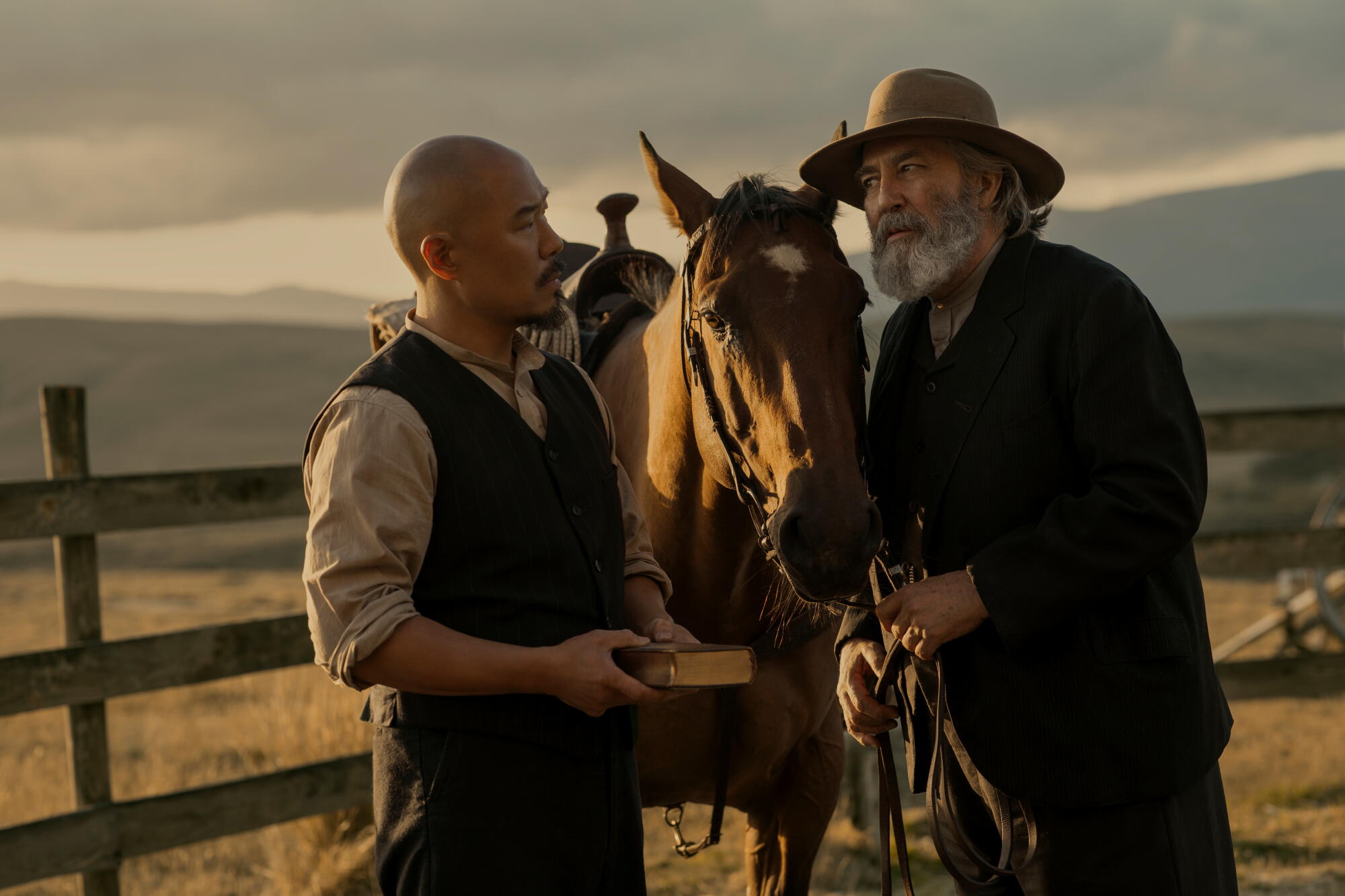
Standout performers include Hoon Lee as Lee, left, and Ciarán Hinds as Samuel Hamilton.
(Kirsty Griffin / Netflix)
Cathy crawls to their doorstep; Charles sees through her, which will earn him her respect, but Adam falls for her, marries her and drags her west to California, where she doesn’t want to go and doesn’t plan to stay. (She’s quite upfront about this, but Adam is a poor listener.) She gives birth to Cal (younger, Bodhi Aisher; older, Joseph Zada), who will grow up to wonder if he’s bad, and Aron (younger, Jonah Wren Phillips; older, Joe Anders), whom everyone thinks is good, and returns to the life of a prostitute, which suits her fine. And that is probably enough plot for me to relate.
Pugh impressively represents Cathy’s outward self through successive stages; she’s not a character born to develop, though she will have various crises to navigate, and the actor imbues her with as much nuance as the part allows. She’s the main reason to watch, though there are standout performances from Hoon Lee as Lee, a philosophical, intellectual, American-born Chinese man who works for Adam and becomes a kind of surrogate mother to Cal and Aron; and from Ciarán Hinds as Samuel Hamilton, a jovial Irishman, virtually the only remnant of the novel’s Hamiltons, who stand in for Steinbeck’s own family. Faist does a lot with the taciturn, perceptive Charles. Martha Plimpton, never not great, plays Faye, a madam for whom Cathy works; and Zoe Phillips makes an impression in her scattered scenes as Abra Bacon, who’ll date Aron but feels connected to Cal.
Kazan and Stuart do cover all the main plot points and themes — good and evil, love and jealousy, inherited character and (the big one) the possibility of change. Unavoidably the text has been chopped and channeled, with some swapping of parts, bits of narration screwed into dialogue and events described in a paragraph blown out into scenes. Certain thoughts inside Cathy’s head have been made concrete.
The adapters don’t add too much material of their own, Steinbeck having provided a wealth of character descriptions, backstory, philosophical rumination and social criticism for every occasion, but here and there they’ll stress a point or provide something new in order to make sense of Cathy. But they don’t overdo it. (Steinbeck, declaring her unknowable, cuts her a lot of slack, walking back his earlier “monster” comments: “Who knows but that she tried to tell someone or everyone what she was like and could not, for lack of a common language. It is easy to say she was bad, but there is little meaning unless we know why.”) Oddly, the Cain and Abel elements in the Cal and Aron story, which launched Dean’s career, don’t really register.
If nothing else, the miniseries reminds us that adaptation is a difficult job that grows harder the more complex and celebrated the original text, and the more necessary it is to honor it. (This is why pulp fiction has produced so many memorable movies.) Things will always be lost in translation, not least from the pictures in your head to the pictures on the screen. If you’re going to film a literary monument, and a period piece to boot, you’re going to have to spend some money.
But the production here betrays its economy, and the direction, by Garth Davis and Laure de Clermont-Tonnerre, remains earthbound, held down by mournful strings and devoid of color. The New Zealand landscape does echo the rolling hills of Central California, in a dry season, but it’s a dreary vision, hardly the paradise of Steinbeck’s memory, book or metaphor.
A bloke moaned that his full English breakfast at a cafe in Benidorm, which was under five pounds, was too expensive, and it led to a brutal response from the owner
The Corner Bar Benidorm (Image: GoogleMaps)
The family behind a British-owned restaurant in Benidorm have hit back at a customer’s damning one-star review — after being floored by the price of his full English breakfast.
The Corner Bar is a favourite for both expats and holidaymakers looking for a taste of home but one customer, Peter Jones, recently shared his disapproval. He wrote: “Careful of the OAP discounts, especially at breakfast (€5.50). You can get a full English breakfast elsewhere for €4.50 (£3.86) or less.”
However, Ashley, who runs the cafe, shared the review online, before telling Peter to “have a day off” because she was “not having that” about the cost.
Defending her business in a Facebook post, she wrote: “I’m sure Peter is “fishing” here…surely he’s got to be…and I’m gonna be honest…he’s caught me. I mean. You can maybe not like our food. Not like our service. Not like us… maybe all 3, and honestly, I don’t mind, we try our best, every day, and that’s all you can do…
“But to give us a 1 Star Review on our prices…to suggest to the public you need to be careful of our prices. Nah, not having that. The breakfast in question…a No4 (pictured below).
“That’s 1 English Bacon, 1 Irish Sausage, 1 Black Pudding, 1 Fried Egg, 1 Roberts Bread Toast, Heinz Beans, Fresh Mushrooms & Tinned Tomatoes…and it’s €5.50.
“Cooked Fresh to Order by the Owner or the same 2 British Cooks who have been on The Corner for years…And apparently you need to be careful of our prices! Have a day off, Peter!”
The post soon took off and led to hundreds of comments from loyal customers who also defended the prices. One man, who has had the €5.50 (approx £4.70) full English before, wrote: “You cannot beat a No 4 at the Corner for value.”
Another person added: “Peter needs to give his head a shake! He wants €4.50 then bye bye mate! It will certainly not be as good.”
One person sarcastically said “wow a whole €1 less” before Ashley wrote another post in the comments thanking everyone for the support.
She said: “Cheers Everyone. Some lovely comments. We know we’re well supported and it’s massively appreciated. Just sometimes them review sites after a hard days work can be hard to read. We’re a small family business, currently have 5 WORKING members of staff plus us. We do our best. Thankfully, clearly the majority appreciate what we do.”
The Corner Bar has received 585 reviews on TripAdvisor with an average score of 4.2 out of five. They’ve also had 1,170 reviews on Google with an average score of 4.5 out of five.
And after the viral post, Michelle Baker, who has lived in Benidorm for more than 40 years, also shared it to her Benidormforever Facebook page. She said: “LOVE that Ashley from The Corner Bar Benidorm called this chap out… there’s just no pleasing some people!”
Ever watched a TV show like Amazon Prime’s Lego Masters and wished you were the one under the studio lights, racing against a ticking clock? That is the exact magic Lego House is trying to capture with its recently opened Lego Masters Academy in Billund, Denmark – the ultimate pilgrimage site for brick fans.
I took my seven-year-old resident Lego expert to test out the 75-minute Level 2: Build Me Up session, and it delivered from start to finish. Enthusiastic Play Agents, as they call themselves, started the experience by getting the crowd excited outside the studio with an interactive live countdown. Once the doors rolled open, we all entered a vibrant space designed to mirror the TV set, complete with a central podium, upbeat music, and studio lighting.
Do you have a travel story to share? Email webtravel@reachplc.com
The session started with an accessible warm-up follow along building session where we were shown professional building techniques. Small challenges were then added, before we were ready for the main event – building a completely original custom build, in our case our own self portrait Lego figure.
Timers flashed up on massive overhead screens as we were told to help ourselves to colour-coded, shape-sorted brick pits to grab materials for our custom builds. Here it really felt like the TV show, with everyone reaching out to grab handfuls of bricks, aware that the 15-minute timer was now ticking. After brick selecting ended, we all raced back to our building stations to get started on our builds.
A little overwhelemed by the noise, my seven year old opted out of this custom build, and instead preferred to help me finish mine and watch others at work. This wasn’t an issue at all – with the Play Agents keeping him included, making him smile by asking about his favourite LegoLand rides, and making sure he was still having fun. My mistake was not showing him any episodes of the TV show before we visited – I’d really recommend parents of younger children prep them this way.
By the time the timer went off, we had just about finished our slightly wonky multicoloured person. Unlike the competitive TV show, at the end all creations are showcased in a shared gallery, so we went up and put our creation on the podium, ready for all to admire, before coming together with new friends for a joint picture.
While the Masters Academy costs extra, on top of a Lego House ticket, the value for money is outstanding. Every participant keeps their custom build as a souvenir, and you are encouraged to jam-pack an official takeaway box with loose bricks at your station. Organisers promise the contents are worth far more than the ticket price – and the only rule is the lid has to be able to shut.
Overall we really enjoyed our session. My son threw himself into marking every countdown, glowed with pride over our creation and was delighted by his heavy tressure-like takeaway box – which came in very handy that night keeping him occupied at dinner. Whether you are a die-hard Lego fanatic or traveling as a family, it is a unique experience.
Top Tips for anyone visiting the Lego House Billund Lego Masters Experience
Pricing for the Lego Masters Experience is split by age and experience level. The Level 2 session which we did costs £15 per guest for 75 minutes. Older builders aged ten and above can opt for Level 3: aROUND the Bricks We Go, which runs for 90 minutes at £17 with a focus on advanced techniques. The 60 minute level one session is £14 and marketed at beginner builders.
Keep in mind that these require a separate add-on ticket on top of standard LEGO House general admission, which costs £29 per person, with discounts for booking online. Children under thirteen must be accompanied by a paying adult for the Lego Masters Experience.
If you are planning to go, binge watch a couple of episodes of Lego Masters show beforehand so younger kids can anticipate the studio set and timer format.
Book well in advance – ideally before picking your trip dates – as sessions are limited and often full. Make sure to select an English-language session if applicable.
Make sure to pick up your wristbands at least 15 minutes early, as studio doors lock strictly on time. Keep your wristband – this also gives you access to photos of the session.
Book the holiday
Norwegian Air offers direct flights from London Gatwick to Billund with return fares from £120 on norwegian.com.
LEGO House tickets start from £29 when booked in advance on legohouse.com.
Lizzie and family enjoyed a two-day Legoland pass, starting from £57 for a 2-day pass when booked online, or £40 for a 1-day pass. You can find out more at legoland.dk/en.
Lego fans can explore the original Legoland and Lego House less than two hours from the UK – here’s my review of the underrated family holiday
This article contains affiliate links, we will receive a commission on any sales we generate from it. Learn more
(Image: Lego)
As you wander around the picture-perfect Danish town of Billund, you could almost kid yourself you’ve stepped into the real-life version of the Lego City range – it feels as if someone planned the entire town, piece by piece. And in a way, they did.
Dedicated Lego fans may have heard of Billund as the home of Lego – the toy was created here in 1958. To this day the vast majority of Lego sets, themes, and bricks are designed at the headquarters here, with Lego employing the majority of local residents, and contributing hugely to the town’s development. Visitors come in their tens of thousands to enjoy the original Legoland – but we found the true star of Billund to be the unique Lego House, which rightly bills itself as the ‘ultimate interactive Lego experience’.
My seven year old and I took advantage of a mild, if a little rainy, early September weekend for a three-night stay in the Legoland Holiday Village’s Pirate Motel, booking a cheerful pirate-themed room complete with treasure chest, and combining a day at Lego House with a two-day Legoland pass.
While my Lego fanatic son and I have a soft spot for Legoland Windsor, we found the spotlessly clean Danish Legoland way less crowded. Indeed throughout our Friday/ Saturday visit even the most popular rides never more than a 15 minutes wait – and at times we were able to stay on for a second go.
Yet despite the tried and tested joys of a day at Legoland it was Lego House that was the absolute highlight of our visit. If at Legoland your child enjoys free play in the Lego pits as much as the thrill of the rides, then Lego House is for them.
Designed like a giant stack of 21 overlapping blocks, scaled up precisely from standard Lego bricks, the sprawling building feels like a living playground. The website describes four ‘interactive experience zones’, but this undersells what is on offer. There are endless activities which are carefully designed to be just as enjoyable for adult fans of Lego (afol as they call them here), as they are for children.
In just one section of an experience zone, we built our own Minifigures, photographed them for magazine covers, then used them to create stop-motion films in dedicated recording booths. These were then sent to us to view later via our wristbands.
Elsewhere, our highlights included racing our custom-built cars down speed tracks, creating Lego fish that were then scanned and joined a huge aquarium, and exploring a huge Lego world far more detailed than any Miniland we’ve seen, featuring everything from miner-filled mountains and underground train sets to volcanoes, fairgrounds, and cities.
There are innovative building challenges throughout, sitting alongside breathtaking installations like a cascading multi-coloured Lego waterfall and the jaw-dropping, 15-metre-tall Tree of Creativity built from over 6.3 million bricks which grows right up through the centre of the building.
My son loved watching Lego bricks being created from start to finish in the mini-factory on the ground floor before picking up our own complimentary bag of six freshly molded bricks to take home. Scanning your wristband creates a personalised card showing a unique combination to build.
Down in the basement vault, a history museum displays early prototypes and sets from across the years – I really enjoyed finding the ones my brother and I used to own in the 80s and 90s, and showing them to my son.
Up on the primary-coloured terraced roofs, which cascade down like giant red green and yellow steps, my son took a breather from crafting his creations. As I soaked up the panoramic views over Billund’s forests he played in a huge submarine, climbed a skyscraper and enjoyed an impromptu game of hide and seek with children speaking four different languages.
One of the best bits was trying out the Lego Masters Academy, which costs an extra fee on top of the Lego House entrance. We also loved visiting the Mini Chef restaurant, where we built our orders using physical Lego bricks and had our meals delivered by robots in giant Lego containers.
All in all, we thought Lego House was absolutely unmissable.
Everything you should know before you visit Lego House Billund
Standard Lego House general admission starts around around £28 per person with some discounts for booking online. It is often fully booked and is not open every day, especially out of season, so check availability before booking a trip.
The Lego Masters activity is an extra fee on top of Lego House, costing from £14 to £17 per person depending on the option booked. You can do this activity without entering the experience zones inside the Lego House, or on the same day you do these. Make sure you heck opening days, book ahead as slots fill up fast, and choose English language (if applicable).
Likewise Mini Chef reservations fill up well in advance and are rarely available on the day – it’s worth planning ahead. Meals when we visited cost £15 for a child meal which included a Minifigure surprise, and £27 for adults.
The Lego Shop on the ground floor opens an hour before the Lego House and stays open an hour later. We arrived early and did our shopping first thing, which was an unhurried pleasant experience compared to the packed store at the end of the day. You can leave purchases in a free secure locker on the ground floor, using your Lego House wristband.
Along with unique Lego House Lego sets, in the shop you can buy personalised custom printed Minifigures for £11.50, which make brilliant gifts.
If you are staying at LegoLand Holiday Village, as we were, or the neighbouring Lalandia, the walk to Lego House is a pleasant 20 minute stroll through Billund Sculpture Park.
Book the holiday
Norwegian Air offers direct flights from London Gatwick to Billund with return fares from £120 on norwegian.com.
LEGO House tickets start from £29 when booked in advance on legohouse.com.
Lizzie and family enjoyed a two-day Legoland pass, starting from £57 for a 2-day pass when booked online, or £40 for a 1-day pass. You can find out more at legoland.dk/en.
“Heartwarming” is a cliche of theater reviewing that I have studiously tried to avoid, but I’m tempted to use the word in my review of “Begin Again,” the new musical based on the 2013 John Carney romantic comedy about two dreamers trying to rekindle the love of making music that the industry nearly destroyed.
The show, which is having its world premiere at the Old Globe’s Donald and Darlene Shiley Stage, is just so damn heartwarming that I can’t help but resort to the language of blurbs. But let the ticket buyer beware: Heartwarming is a feeling, not a complete verdict.
Featuring a book by Jenna Clark Embrey and Molly Beach Murphy and a score by Pat Monahan and his bandmates from Train (Jerry Becker and Matt Musty), “Begin Again” does a pretty good job of distilling and updating the movie. Carney’s film, notable mostly for the vibrantly gritty New York setting, the Oscar-nominated song “Lost Stars” and the lived-in performance of Mark Ruffalo, couldn’t help languishing in the shadow of the filmmaker’s breakout hit “Once,” which later became a Tony-winning musical.
“Begin Again” the musical is likely to suffer a similar fate. It lacks the quirky originality that made “Once” an unexpected Broadway juggernaut. But the new show, directed by Lorin Latarro and choreographed by David Neumann, has heart — there I go with that overused word again!
I succumbed to the show’s charms despite being aware that the comedy isn’t as freshly articulated as it should be and the music, while exuberant, doesn’t seem to emanate from the soul of Gretta, a reworked American version of the singer-songwriter character indifferently played by Keira Knightley in the movie.
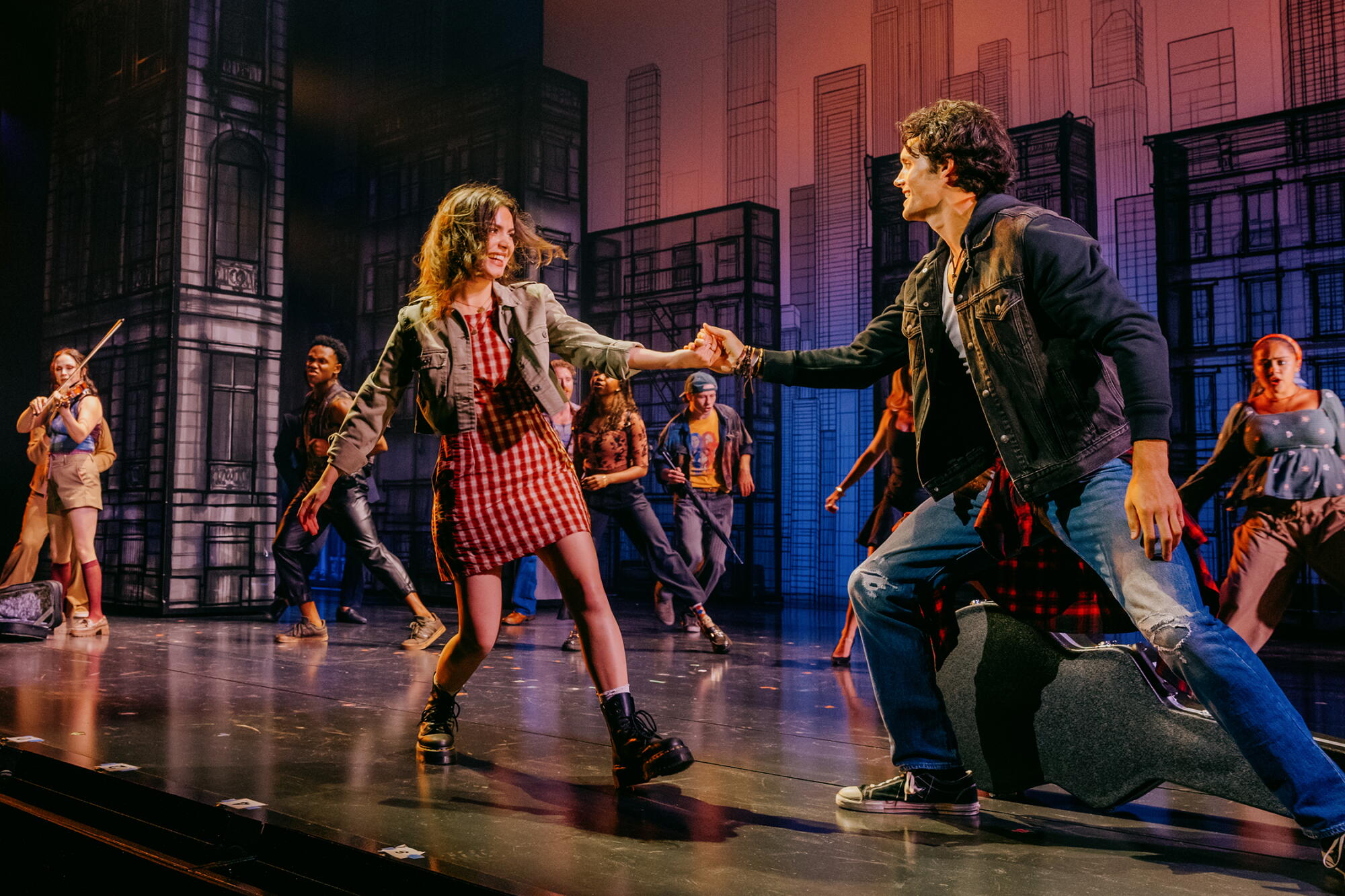
Emma Busse as Gretta, center left, and Kevin William Paul as Max with the cast of “Begin Again.”
(Jeff Lorch)
Gretta relates to her songs as though she were the next Joni Mitchell, but the new material she’s composing on the fly with her new friends doesn’t seem particularly intimate or revealing. I liked the indie rock sound, but mostly for the collaborative liftoff. Lyrically, I wasn’t drawn in. But who could resist the ecstatic momentum of her ad hoc band members buying into her grassroots dream?
Gretta, played with folksy innocence by Emma Busse, has traveled to New York from Pennsylvania with her boyfriend Max (Kevin William Paul). A musician with frontman good looks, he’s about to be packaged into a rock star. Gretta’s songwriting has paved the way for this opportunity, but Max is told that he’s being signed as a singer-songwriter and sharing credit is a deal-breaker.
Selfless, naive Gretta gives Max her blessing and her rights, and almost immediately he betrays her with another woman. Perhaps even more disloyally, he allows his producers to run her song “Don’t Let Go” through a pop blender that drains it of all its personal meaning and artistic integrity.
Alone in the big city, she takes refuge at the Queens apartment of college friend Stevie (Casey Whyland), formerly Steve in the movie, the comic sidekick role played by James Corden. Stevie, conveniently, is a sound engineer with an analog heart. She’s not only how Dan (an electric Patrick Heusinger), a washed-up music executive with a broken marriage and a drinking problem, discovers Gretta. But without Stevie’s technical ingeniousness, the prospect of recording an album in outdoor New York locations would never have been possible.
The professional meet-cute between Gretta and Dan happens at an open-mic night at a dive. Stevie calls a heartbroken Gretta to the stage to perform, and she reluctantly complies before giving up in embarrassment. She thinks she’s bombed, but Dan, who has “magic ears,” hears what the song could be.
Patrick Heusinger as Dan, left, and Adrienne Walker as Miriam with the cast of “Begin Again.”
(Jeff Lorch)
Just as Dan glimpses Gretta’s raw potential, she sees his lost purpose, and the two launch a mutual rescue mission. He brings Gretta to meet Saul (Nik Walker), who co-founded Distressed Records with him and just fired him for his erratic behavior. Saul doesn’t have Dan’s ability to spot future talent, but he agrees to give the singer a listen if they cut a demo. And so off Dan and Gretta go, with no budget, to make memorable music together.
Friends are their main resource — and that proves an inexhaustible boon. “Begin Again” really comes alive as Gretta, Dan and their expanding, can-do music network starts pooling its expertise.
You can hear the songs germinating from lonely inspiration to group transformation — and the sound is exhilarating. The process of songwriting, rather than being a solitary slog, is a collective joy, rapturously captured in the number “Write a Way.” And “Twilight Summer Sky,” the number performed on the rooftop of Stevie’s apartment building in Queens, represents perhaps the fruit of all the group’s effort.
“Begin Again” is a musical fantasy, not a work of realism. Gretta and Dan are seemingly brought together by fate to heal one another. As they separately go about their business in New York before they’re introduced, they continually pass like ships in the night in a New York that scenic designer Derek McLane summons in a shifting comic-strip landscape of high-rises that gives the city an industrial quaintness.
The action rewinds from Gretta and Dan’s initial meeting at the bar, and later fast–forwards to speed up some of the more boring bits of the album-writing process. The ensemble moves backward and forward with these narrative jump-cuts.
This literalness can seem overly cute. (I prefer the idiosyncratic yet fully integrated movement direction Steven Hoggett brought to John Tiffany’s Broadway production of “Once.”) But Latarro’s staging and Neumann’s choreography keep the storytelling moving at a pleasantly brisk clip. And Skylar Fox’s illusion design adds an element of visual sorcery.
The cast of “Begin Again.”
(Jeff Lorch)
It’s the actors, however, who elevate the material, supplying a depth of feeling where the writing offers something more general. Heusinger makes it possible to leave Ruffalo’s fine portrayal behind. This is a different and more dynamic Dan, at least in terms of the musical demands placed on the character. Paul’s Max is every bit a rock star, but Dan is convincing as both a burned-out music mogul with a self-sabotaging streak and a gifted artist in his own right who just needs someone to believe in his producing instincts again.
Adrienne Walker, who plays Miriam, Dan’s estranged wife, and Charlotte MacLeod, who plays Violet, Dan’s disaffected daughter, endow their characters with more lineaments than the book provides. Walker’s Saul doesn’t do what Yasiin Bey managed in the movie — make Distressed Records seem like a real New York record company — but his singing compensates for some of the clumsier aspects of his reduced role.
Whyland’s Stevie, serving as emcee when the occasion calls for one, combines genuine camaraderie with comic relief. The gender switch makes sense, and Whyland embodies the spirit of artistic cooperation that makes “Begin Again” such an invigorating experience.
I wish that the musical didn’t amplify Gretta’s artistic insecurities and distress over the breakup with Max. The character seems less self-assured and more wounded than she did in the movie, making her fervently held idealistic beliefs about creative independence seem borrowed from another character. But Busse brings an American innocence to the role, and her ardor about music and community seems genuine.
“Begin Again” transcends its limitations through the kinetic connection of the cast. When all the elements of the music come together, a triumphant feeling — call it uplift — charges the air.
“A Different World,” a multicamera comic collegiate soap opera spun off from “The Cosby Show,” has been updated and reborn as a single camera sequel a mere 39 years after the original series welcomed its freshman class and 33 after it packed them off into adulthood. It’s a different “A Different World,” times being what they are, but in many respects the same, set over a school year at the same fictional Hillman College, “the preeminent HBCU in the country.”
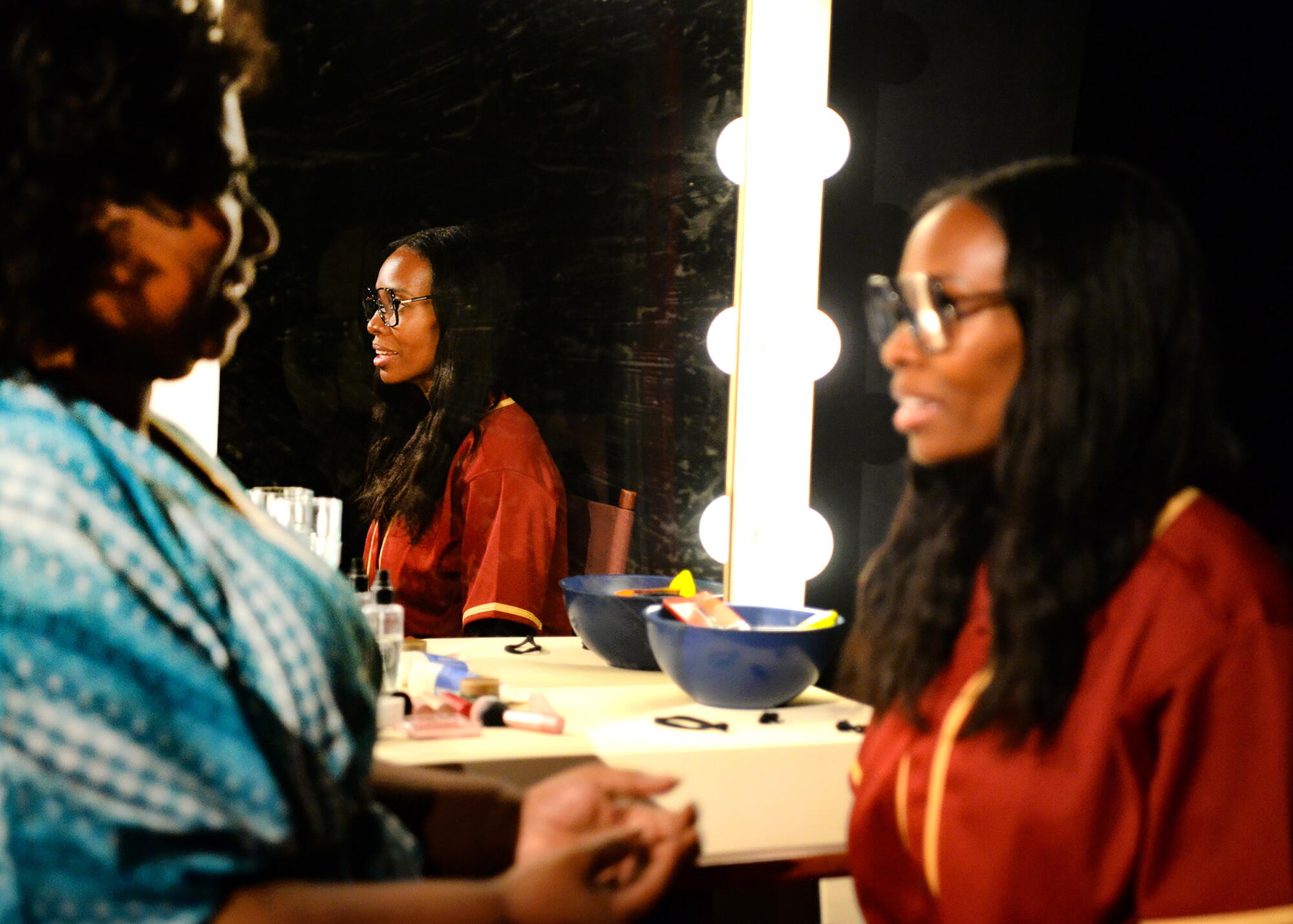
As before, we begin with the arrival of new students, sorting themselves out, meeting roommates, finding friends. Many members of the original cast have returned, including Jada Pinkett-Smith, Cree Summer, Charnele Brown, Jenifer Lewis, Dawnn Lewis, Glynn Turman and Joe Morton, as parents or teachers or counselors, three decades older though not necessarily wiser. In a way I can’t exactly articulate — and which has nothing to do with the earlier series, which I know hardly at all — the new “A Different World” made me happy, especially in the early episodes, before the characters are entangled in plot and everything is new, infused with sweetness and energy. (A climactic talent show is just as corny and unpersuasive as every other climactic talent show in television history.)
At the center of a large and sometimes confusing Gen Z cast is Deborah Wayne (Maleah Joi Moon), the daughter of Dwayne Wayne (Kadeem Hardison), who is now the provost, and Whitley Gilbert-Wayne (Jasmine Guy), who in the intervening years founded and sold a beauty empire, which is to say that Deborah, accent on the “bo,” is a rich girl — not at all mean and not especially spoiled, though she doesn’t know how to operate a washing machine. (It also means she is not afraid to raise a ruckus.) She thinks of herself as an artist, but her admission to NYU’s Tisch School of the Arts was rescinded after “a horrible misstep.” And at Hillman, she is required to keep a B average and not get into any trouble, both of which will prove difficult.
Shaquille Johnson (Cornell Young IV), a football star who arrives a week late to practice in a Lamborghini accompanied by his domineering father — it’s Ron Johnson (Darryl M. Bell) from the original cast — who thinks it’s a shame that his son is at tiny Hillman when he could be making a pot of money elsewhere. (Shaquille promised his late mother he’d go there.) “Not everything is about money,” he says. Shaquille also has a gone-wrong romantic past with Deborah, but they are glad to see one another again.
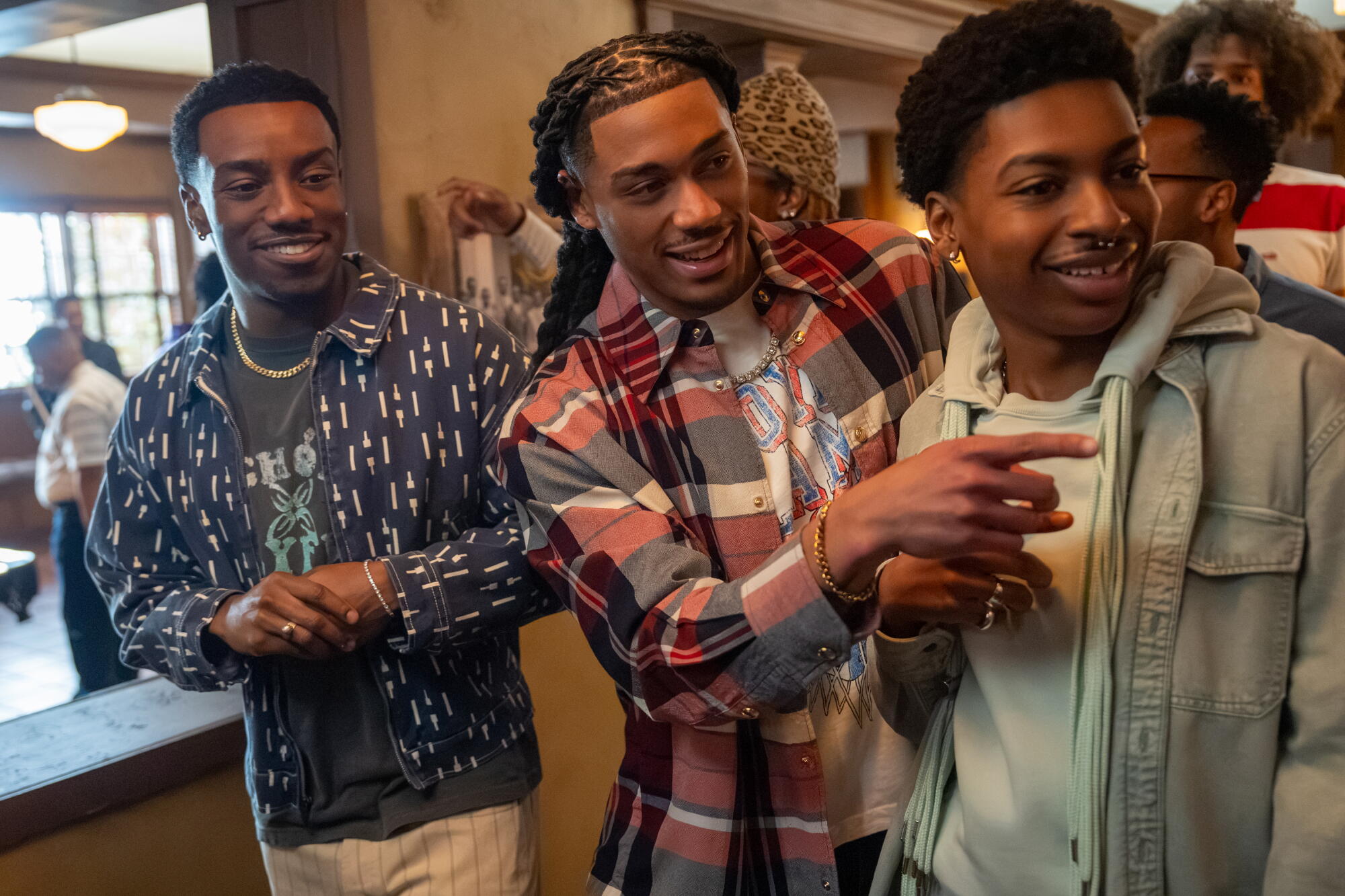
While the show features members of the original cast, the younger generation sorts itself into trios, including Kojo (Chibuikem Uche), left, Shaquille (Cornell Young IV) and Amir (Jordan Aaron Hall).
(Quantrell Colbert/Netflix)
Deborah wants to show her parents, who have been separated for six months but are rarely apart, that she can “enter my full studious season.” This will lead to her engaging a tutor, Ellington (Vincent Jamal Hooper), introduced for some light romantic tension vis a vis Shaquille. Athletic RA Candace (Renee Harrison), who likes Shaquille, provides a counterweight.
The younger generation sorts itself into two entwined trios. For a roommate Deborah draws Rashida (Alijah Kai), who’s from Compton and supposedly a champion gymnast, a characteristic that seems to exist simply to support a joke about Deborah’s “most improved” trophies for Choate women’s pickleball, since it’s never mentioned again. (Some storylines do just melt away.) She’s majoring in criminal justice “to get my cousins out of prison” and thinks Deborah is an unserious student. They’re joined by Hazel (Kennedi Reece), a nice Christian girl looking for a nice Christian guy.
On the boys’ team, alongside Shaquille, are Amir (Jordan Aaron Hall), a gay Harlemite whose deferred admission was because of a year in what they seemingly still call juvie and whose dream is to design clothing; and Ghanian Nigerian “by way of the U.K.” Kojo (Chibuikem Uche), an aspiring influencer bootlegging T-shirts of Shaquille; he, too, has marriage on his mind. They will learn as much in the dorms as they do in the classroom, but the classroom scenes are more on point than they often are in school-set shows.
Shaquille has a rival on the team, Andre (Joshua Suiter), whose wrist he fractures in a locker room fight — but this never really turns into anything. There aren’t any villains here, just young people making young people mistakes and older people making older people mistakes. No one is evil, but people do stupid things, which accords with my own memories of college.
Created by Felicia Pride, who has writing credits on “Queen Sugar,”“Bel-Air” and “Grey’s Anatomy,” it also includes plenty of scenes in which the young folks just have fun, dancing and singing. Big scenes are very well staged, which might have something to do with having choreographer Debbie Allen, director of the premiere episode (and 83 episodes of the original series), as an executive producer. (She also reprises her role as academic counselor Dr. Langhorne, whose motto is “Relax, relate, release,” as if anyone could.)
Over the course of 10 episodes, we’ll encounter many issues relevant to student life and beyond — dyslexia, ADHD (this was my introduction to the parking lot and pomodoro techniques), how lockdown “wreaked havoc” on a generation’s ability to read social cues, STDs, adultification bias, federal cuts to education (Hillman is in the red, and students are losing their grants). bell hooks is quoted on socializing men toward love instead of sex, and, indeed, the series is refreshingly modest on that account.
Welcoming the incoming freshmen, Deborah’s father says, “This is a watershed moment where this country that we built is trying to erase our Black history. Our gains, our culture. They wanna demoralize us. They wanna deport us, they wanna jail us, they wanna shoot us down in the street. But you, you all are their greatest threat. You future leaders who are about justice and community and each other. I know you will stand up. I know you will fight, build and change the world.” It’s a bit speechy — well, it’s in an actual speech — but it’s nice to have that laid out so cleanly in a Netflix sitcom in these difficult days.
And in the wake of a bomb threat, Deborah will declare to the world, “We are not going anywhere. We are studying, we are partying, and we are living our best young, gifted, Black, talented lives right here in our space.” Which sums it up nicely.
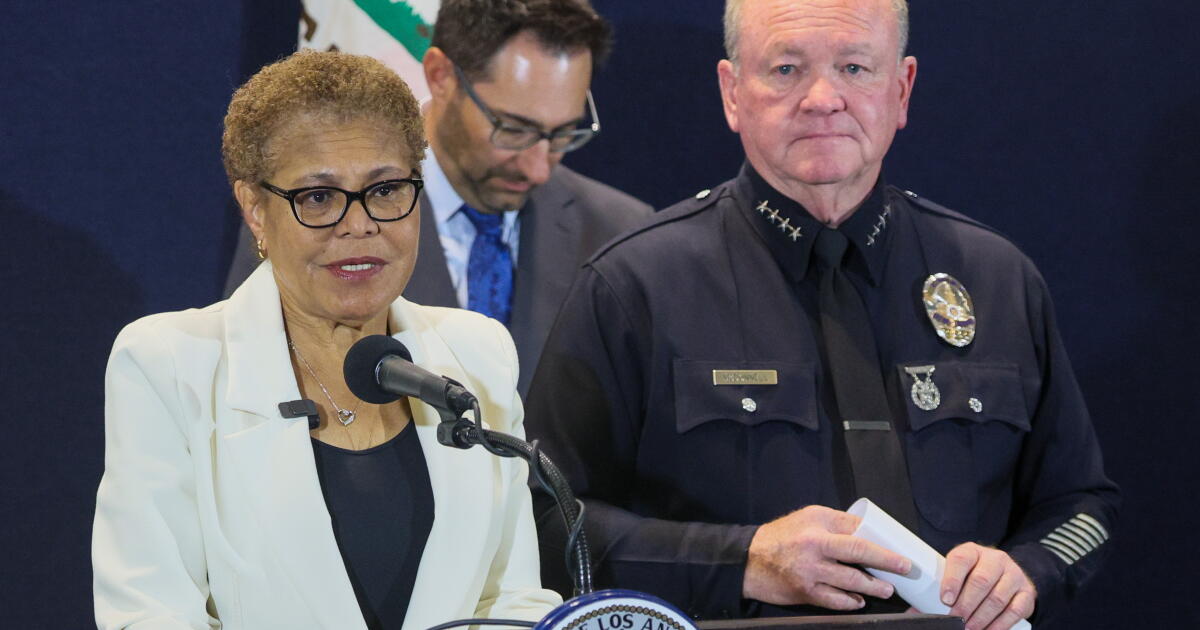
Mayor Karen Bass called the training that LAPD officers receive for handling mental health calls “woefully inadequate” and ordered an outside review of the department’s policies Thursday, saying recent shootings highlight continued shortcomings in how police deal with people in crisis.
Bass is particularly concerned by the relative lack of specialized intervention training for patrol officers who respond to the vast majority of service calls. While the SWAT team and other units receive such training, it is not standard across the Los Angeles Police Department.
“After the academy, they have spot training that is essentially videos that are played at roll calls,” Bass said in an interview week with The Times.
The mayor’s directive comes as she’s locked in a reelection fight with progressive challenger Nithya Raman, who, like Bass, has criticized the LAPD over shootings of mentally ill people.
“The ability of the city to respond to someone’s pleas for help is incredibly important in ensuring that we maintain the trust of the public,” Raman recently told The Times. “And right now, there is no alternative system besides LAPD to respond to many of the calls that are coming into 911 besides, of course, Fire Department calls.”
Polling by the UC Berkeley Institute of Governmental Studies, co-sponsored by The Times, shows Raman is favored by 39% of likely L.A. voters, compared to 28% support for Bass — with 33% still undecided.
LAPD officers have fired their weapons at people 16 times this year — down from 34 shootings in 2025, but recent incidents have highlighted how officers continue to turn to their guns when confronting individuals with mental illnesses. In years past, department statistics showed at least a third of all police shootings involved someone with obvious signs of emotional distress.
Bass was particularly disturbed by a July 29 incident in the Olympic patrol area in which police fatally shot a man who approached them with an aluminum bat.
Body-camera video captured officers approaching 33-year-old Alejandro Garcia as he was walking through traffic on Normandie Avenue underneath the 10 Freeway overpass. Officers ordered him to drop the bat, although it’s unclear whether he heard them. While Garcia could be seen holding the bat with both hands, the footage appeared to contradict an early LAPD account suggesting he swung at them.
The shooting could have been avoided if “the officers were trained differently or better,” Bass said, noting that one of the officers had been on the job for roughly five months.
The LAPD has yet to identify the officer or officers who opened fire.
Bass said it would have been appropriate for the department to deploy a unit that sends a social worker out with officers when responding to calls involving a person in crisis.
“You knew before that he had a bat and he was going around smashing cars,” she said.
About a week later, two officers shot and killed Canas Zimran, 44, in Boyle Heights after, department officials say, he approached officers with what was later determined to be a tree trimmer.
The shootings occurred despite policies that prioritize deescalation techniques and the use of “less-lethal” alternatives, such as bean bag rounds meant to subdue people without resorting to firearms.
Bass said the killings reflect, in part, a broader failure of the mental health system to get people the care they need. Also of concern, the mayor said, was the lack of training for officers on how to distinguish between symptoms caused by mental illness, physical and cognitive disabilities and drugs such as phencyclidine, or PCP, which seems to be having a resurgence on city streets.
Bass said her review would be a top-down evaluation that also scrutinizes the roles of dispatchers, supervisors and others involved in responding to reports of people behaving erratically.
She said the audit will examine calls from the last five years involving people with “with known histories of mental or behavioral health conditions” in which police officers avoided using force. The goal, Bass said, is to “identify common themes or best practices that successfully de-escalated the incident or allowed officers to gain compliance.”
Bass added that it’s also important to consider the needs of LAPD officers and ensure they “receive appropriate assistance” to cope with stress. She was struck by the willingness of younger officers to openly talk about the mental toll of the job, recalling a recent visit to a roll call in which an officer described feeling a lack of support after being involved in an on-duty shooting.
LAPD officials have said the department has made numerous changes in recent years to curb police shootings, including adopting deescalation training focused on slowing down volatile situations, particularly those involving people who may be mentally ill. Still, the agency’s critics pack police commission meetings each week to argue for removing police from such calls, saying that officers are too quick to fire on people — particularly those wielding knives.
Although the city has experimented with programs that send specialists to help deescalate such encounters, LAPD policy still requires armed patrol officers to clear a scene of any potential threats beforehand.
Bass said she always has been a proponent of approaches that don’t involve police, some of which are employed by her Office of Community Safety. But she said stabbings and other incidents that pose an immediate danger to the public still require a police response.
Beyond looking at how to avoid police shootings, Bass’ directive calls for further assessment of the department’s training for handling people who’ve been booked into jails and detention facilities, including how they are restrained and transferred to medical facilities.
Bass wanted to ensure the review was done by an outside body, hinting at her frustration with the inaction of department leaders and the police commission on addressing the issue.
Something’s in the air this fall — and it’s not just the autumnal chill. For some reason, survival thrillers are all the rage; there are even two featuring a man and his dog. First, we had Ridley Scott’s “The Dog Stars” with Jacob Elordi and a Belgian Malinois traversing a postapocalyptic landscape.
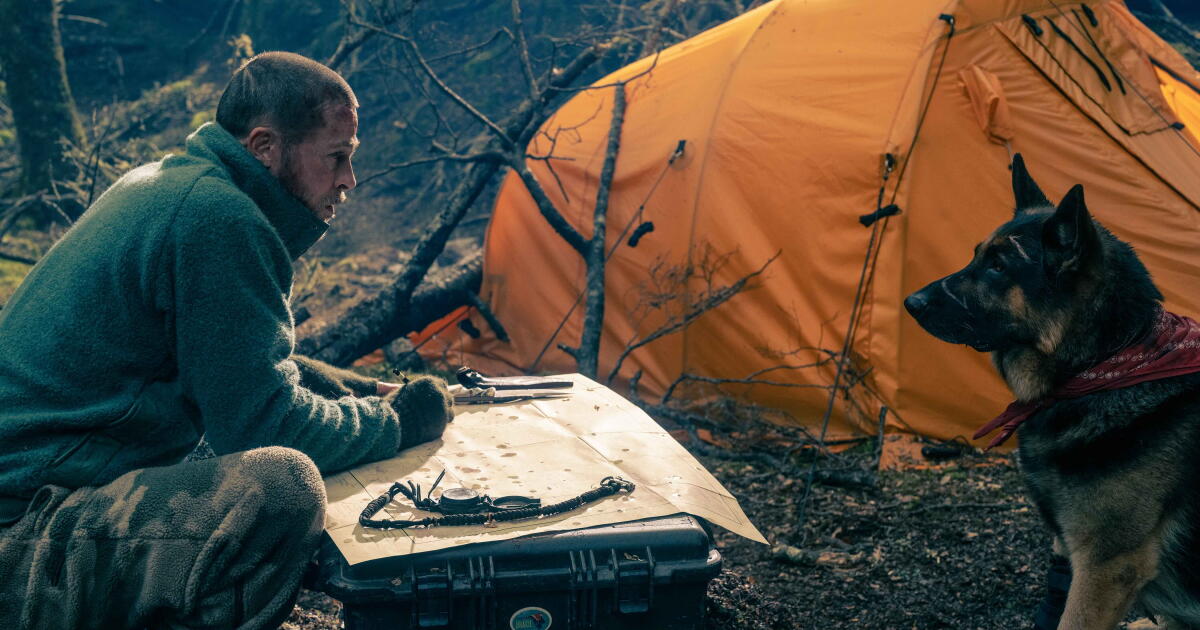
The latest is “Heart of the Beast,” an Alaskan-set story about two combat veterans — one human, one canine — who set out for a post-retirement camping trip and find themselves in a perilous situation after the human, retired Special Forces officer James (Brad Pitt), suffers a heart attack while piloting his seaplane. James and his combat dog Odin survive the crash, just barely, but they’re stranded deep in the wilderness, miles from civilization.
The film is directed by David Ayer, a purveyor of wild action flicks and ballads of masculinity; the screenplay is the debut effort of Cameron Alexander. Their intent is to deliver something muscle-bound and emotional — if a man can’t cry about an Army dog, what can he cry about? But until the last two minutes of the film, “Heart of the Beast” is essentially “Homeward Bound” for adults. You know, the 1993 kids adventure film featuring a golden retriever, a bulldog and a cat named Sassy who have to make their way home through the wild. Marry the structure of that film with a Jack London-inspired milieu, add some blood, gore and rather cheesy Iraq war flashbacks, and you have “Heart of the Beast.”
We watch James as he’s rained on, chewed on, pulls trunks out of an icy lake, falls off a log, breaks his arm, faces down a bear, fights off wolves, sustains many head injuries and inexplicably keeps going, in hopes of saving if not himself his dog, the most important creature in his life.
And oh, is Odin worth it. Played by four different dogs named Uber, Seeka, Ryker and Hondo, the performance that these dogs collectively deliver is worthy company to an Oscar winner — the dogs may even eclipse Pitt for sheer screen presence. With every whimper, sigh, howl, bark and head tilt, these dogs create an empathetic portrayal of a highly intelligent creature that has been through battle and has the scars (and nightmares) to prove it. Odin is a bionic dog, with titanium teeth and a prosthetic foot from injuries sustained during wartime, but nothing slows him down, not even a plane crash. However, the film does have its limitations when it comes to the other wildlife, all digitally created and the CGI isn’t convincing in the slightest.
“Heart of the Beast” is an onslaught of danger and misery, alleviated only by the pleasure of watching James’ survival skills and ingenuity. This man makes a lot of mistakes on this journey (he’s constantly calling himself “stupid” and “dumb”), but he’s also kind of a MacGyver. He starts a fire with cotton balls and Neosporin. He carries an alarming number of knives. He splints his own arm. If anything, it’s an excellent lesson on carrying the right gear and always taking medical supplies on a camping trip — if you ever go camping again after this.
Pitt typically excels when there’s a little (or a lot) of levity for him to exercise his loose-limbed charms and there’s precisely none of that in “Heart of the Beast.” Ayer pushes the emotional and physical extremes and it feels like a dirge: a forced march through the muddy Alaskan wilderness with plenty of body horror on top. The one moment of camaraderie comes in the beginning, when James shares a beer with a mysterious stranger (J.K. Simmons) who happens upon his camp and might even be an apparition of an old miner. James does share moments of affection and victory with Odin but there’s nothing to relieve the constant danger, even though structurally, the film has already sapped its potential suspense.
“Heart of the Beast” has its highs and lows but cinematically, it’s a mixed bag — entirely predictable and just not great. Nevertheless, there’s no denying that the star of the movie is indeed Odin and he’s a very, very good boy.
Walsh is a Tribune News Service film critic.
‘Heart of the Beast’
Rated: PG-13, for violence, peril, bloody/injury images and some language
The shadow of Bill Cosby hangs over the “The Peterson Show,” a new play by Janine Nabers about the fallout of a disgraced TV dad on the grown-up cast members who played his children on the show.
Echo Theater Company, which is presenting the world premiere of this play in a production directed by Michelle Bossy, has reconfigured its Atwater Village Theatre space for the occasion. The refresh — in terms of the position of the stage and the audience and in the level of the design elements, including video monitors showing clips of Black sitcoms — promises a vital evening of theater.
Unfortunately, the production is hamstrung by fundamental problems in the writing, directing and acting, all pointing to a failure of control. Control of the story, control of the tone and control of the cast.
In my fall preview item for this show, I wrote that the “production is all but guaranteed to be more enlivening than an evening spent surfing Netflix.” Well, it’s certainly lively, but in a boisterous way that made me regret I had left my couch.
Not even Netflix would give “The Peterson Show” the greenlight. The story centers on the adult lives of the sitcom’s five child stars who are thrust once again into the spotlight after a reunion rumor goes viral and their TV mom, Valerie, kills herself.
Deanna Reed-Foster, left, and Tamberla Perry in “The Peterson Show” at the Echo Theater Company.
(Cooper Bates)
Ronika (Tamerla Perry), the troublemaker of the group, careens through life with faulty brakes. Zoe (Kristen Ariza), who has traded TV stardom for an academic career and motherhood, wants the normalcy that her former fame keeps threatening.
Dwight (Devere Rogers) is messy and loud as well as addicted to fame and other substances. Blair (Kelly McCreary), who pulled herself out of a miserable childhood, has made a successful career as an award-winning actor and isn’t going to let her flimsy talent or her TV siblings stand in her way. Elliot (John Clarence Stewart), who seems the best adjusted of this crew, left the business to become a lawyer and hasn’t looked back.
Haywood Peterson, the patriarch of the TV show who’s serving jail time for rape, doesn’t appear in “The Peterson Show.” But his voice tyrannically resounds with sadistic orders and conservative cultural commentary during the second-act flashback scene, in which a fateful day on the set of the show changes the lives of Ronika and Blair.
The unsettled first act, full of false starts, feels like an early draft of the play. Nabers, an Emmy-nominated TV writer and author of the play “Serial Black Face” (winner of the Yale Drama Series Prize), can’t figure out how to center the work.
Ronika is the protagonist, but her introduction is off-putting — not only to Zoe, whose home she has invaded, but to the audience, who isn’t given much reason to care about this abrasive, screechy and just-plain-annoying personality.
The cast members perform at a fever pitch of amateur sitcom acting. Ronika evolves as the scene shifts to Blair’s home (which confusingly has the same layout as Zoe’s house in Michael Kramer’s eye-catching scenic design) for the home funeral of their TV mom. But more thought is spent in reworking Ronika’s hairstyle and outfit than in developing her story.
Kristen Ariza, left, Devere Rogers, Kelly McCreary, John Clarence Stewart and Tamberla Perry in “The Peterson Show” at the Echo Theater Company.
(Cooper Bates)
Ronika’s resentment toward Blair, who has avoided condemning Haywood in public, seethes monotonously until her own backstory is finally unearthed. Ronika’s trauma plot, however, has to compete with Valerie’s related breakdown story, and neither is given its dramatic due.
In the meantime, there’s a lot of unwieldy comic commotion involving a missing corpse, a tweaking, naked Dwight and enough insipid TV sibling bickering to clog the airwaves for a decade.
“The Peterson Show” is exhausting. The play isn’t ready for prime time. Bossy’s direction raises the clamorous volume instead of sorting out the disordered structure or digging into the unexamined silences.
The actors are led completely astray. Echo has built its reputation on quirky plays idiosyncratically performed. The theatrical marching orders here seem to involve throwing spaghetti against the wall and laughing uproariously as it slides to the floor.
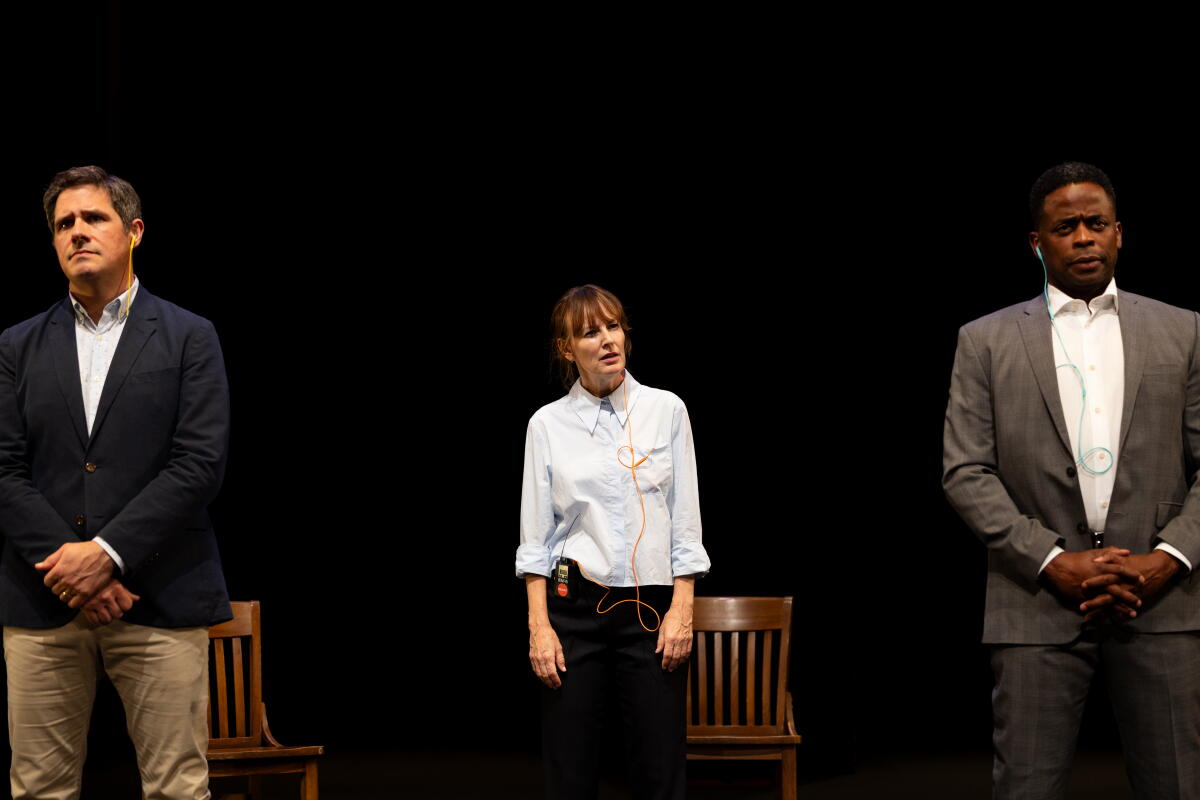
The staging is simple. A circle of nine stately wood chairs on a bare stage. Four actors, affixed with in-ear monitors, occupy different seats as testimony is elicited, provided and undermined.
The Senate Judiciary Committee is back in session in “The Ford/Hill Project,” now at REDCAT through Saturday. What follows is some of the most riveting and distressing testimony ever delivered in such a setting.
Anita Hill and Christine Blasey Ford are called back to testify under oath about the Supreme Court nominations of Clarence Thomas and Brett Kavanaugh, respectively. This documentary drama, created by Elizabeth Marvel and director Lee Sunday Evans, is composed from the verbatim transcripts of these painful proceedings.
In 1991, Hill testified that Thomas had repeatedly sexually harassed her when he was her supervisor at the U.S. Equal Employment Opportunity Commission and the Department of Education. In 2018, Ford testified that she had been sexually assaulted in 1982 by a 17-year-old Kavanaugh when she was 15.
Marvel and Evans create a double helix from excerpts of these two hearings, which are separated by nearly 30 years yet reveal highly entrenched patriarchal patterns. Two women, summoning the courage to tell what they know about two men who are about to be entrusted with the most consequential governmental power, are put through the wringer as the political machine shifts into gear.
The actors wear in-ear monitors that feed them edited clips from the real audio of the hearings.
(Angel Origgi / REDCAT)
Marvel, one of the treasures of New York theater, takes on the role of Ford at the Brooklyn Academy of Music in a run that ends Sunday. (The piece premiered at Woolly Mammoth Theatre Company in 2024.) At REDCAT, the superb Rosemarie DeWitt assumes Marvel’s place, standing in for Ford but never attempting anything as crass as an impersonation.
The production, under Evans’ precise direction, manages to find a tone that might be paradoxically described as emotionally resonant neutrality. Those in-ear monitors that the actors are wearing feed them edited clips from the real audio of the hearings.
Ford, a psychology professor with an expertise in biostatistics, answers prosecutorial questions about a life-altering trauma in a manner that leans on her scientific training for security. Hill, a Yale-educated lawyer asked to elaborate on the prurient conduct she was chronically subjected to at work, never loses her professional composure.
“Indelible in the hippocampus is the laughter,” Ford tells Sen. Patrick Leahy when asked about the strongest memory she has of the incident. (Ford’s voice, resounding at the start of the production, keeps the brutality of the assault at the forefront of our minds.)
Hill, played by Betty Gabriel, describes the threatening nature of the unwanted advances that created such a toxic work environment. Aware of the damage that Thomas could inflict on her young career, Hill was determined to do what she could to salvage an extraordinary legal opportunity.
At times during Thursday’s performance, Gabriel appeared to stumble on her lines, but it was hard to tell because Hill is speaking extempore in the most difficult of public forums and she doubles back on her sentences, carefully parsing out her words. What both DeWitt and Gabriel honor exquisitely in their performances is the quiet integrity of these women as they willingly expose themselves to political attacks for the sake of causes greater than themselves — the truth, first and foremost, but also gender equality and the Senate’s advisory role as a cornerstone of American democracy.
The actors change not only their seats but also their roles.
(Angel Origgi / REDCAT)
Dulé Hill channels the presence of Thomas, who eventually theatrically hijacks the hearing by referring to the experience as a “high-tech lynching for uppity Blacks.” Rich Sommer gives us the voice of Kavanaugh extolling the pleasures of beer and barking at senators who pointedly ask about the extent of his drinking.
The actors change not only their seats but also their roles. The interrogated become the interrogators in a way that gets a little blurry when the focus initially shifts from Hill and Ford to Thomas and Kavanaugh. But the murkiness doesn’t last long in a production that achieves an admirable balance between objectivity and emotion, abstraction and representation.
The restraint imposed by the production adds to its power. There’s no need to editorialize. The proceedings skewer themselves.
When Sen. Alan Simpson quotes from “Othello” in defense of Thomas, he uses Shakespeare’s lyrical authority but fails to realize that he is in fact invoking the false words of the tragedy’s villain, Iago. Not that the easily impressed senators, eager to exculpate a favored man, took note of the irony.
The patriarchy cares mostly about shoring up its own power. Thomas and Kavanaugh were part of the Supreme Court majority that voted to overturn Roe vs. Wade.
The ending, the only time when Evans’ direction loses its poise, blares “make it right,” performed by the Tune-Yards, as Thomas and Kavanaugh, adorning themselves in black robes, find their seated place according to seniority among the nine chairs. The theatrical flourish seems jarring, but so too is the historic moment.
“The Ford/Hill Project” filled me with sadness but not despair. The bravery of Hill, who educated a nation on sexual harassment, and the emotional strength of Ford, who bared her trauma for public enlightenment, live on in the American consciousness as it progresses, in fits and starts, toward justice.
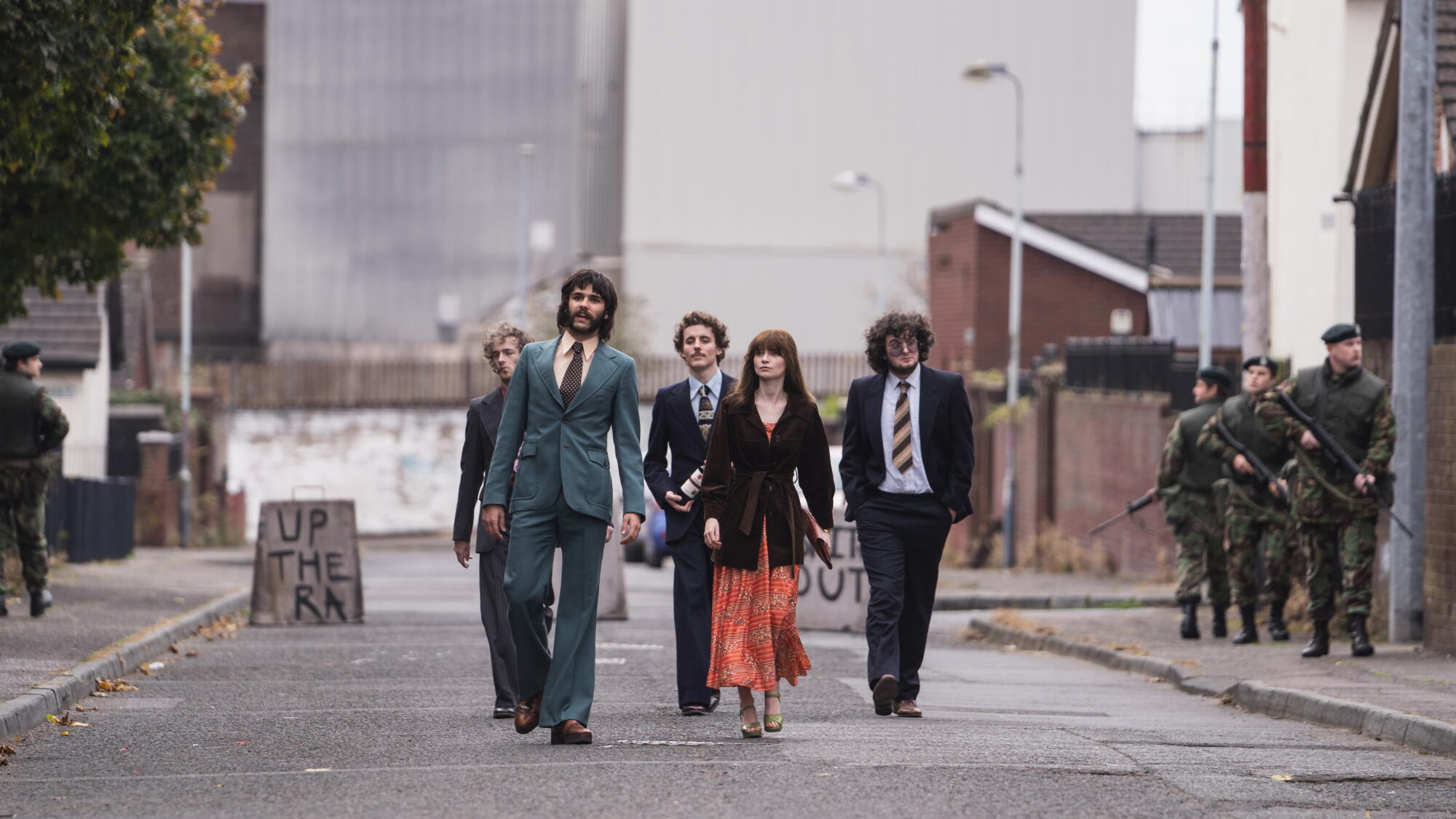
Premiering Sunday on PBS, “Trespasses,” a four-part adaptation of Louise Kennedy’s 2022 debut novel, is a story of love in a time of choler. Set outside of Belfast in 1975 during the Troubles, it follows a clandestine affair between Cushla Lavery (Lola Petticrew, the serial killer in “Furious”), a 24-year-old Catholic elementary school teacher, and Michael Agnew (Tom Cullen), an older, married Protestant barrister known for defending stone-throwing Catholic youth with an eye to keeping them out of the IRA.
Emptying the thesaurus, press materials stress the hot stuff — “scandalous,” “risqué,” “racy,” “torrid,” “titillating” and “steamy” — and while there is more than a modicum of modest sex scenes, the actual tone of the limited series, as adapted by Ailbhe Keogan and directed by Dawn Shadforth, is quite measured; it runs on talk. That’s not to say, given the setting and the setup, which betokens tragedy as surely as Romeo meeting Juliet, it doesn’t throb with tension, let’s say, three-quarters of the time.
Along with teaching, Cushla works for her brother Eamonn (Martin McCann) at the family bar. The clientele includes Catholics and Protestants, united in their love of whiskey, lately including Michael — whose opposition to extremism grants him the honor of being disliked by both sides — seemingly there expressly, even too expressly, to gaze upon Cushla while he pretends to do crosswords. And she gazes back. Moving through discussions of Malcolm McDowell’s typecasting and group lessons in Irish, led by Cushla, they will go beyond gazing.
She’s a ray of light; he’s magnetically mature. You may or may not buy the mutual attraction the series insists upon, or for that matter, trust the lovers’ motivations. (I think we’re meant at least not to wholly trust Michael, as the older party, with a reputation as a womanizer — I didn’t, anyway.) But you will also be invited to change your mind. Because the camera never leaves Cushla’s side, anything there is to learn we learn along with her, which pays some dramatic dividends and means we’ll be forced to revise earlier judgments, usually for the better.
It’s a dangerous liaison. Michael, who is given to speechifying (and actual speechmaking), declares, “We cannot let the old bigots and the boys with guns tell us how to live … Otherwise nothing will ever change. Hate wins” and, in a favorite refrain, “We must find the bravery to choose freedom over fear.” Cushla, however notes that she comes “from a long line of Catholics that have survived by keeping their heads down and their mouths shut. Having a big opinion like yours, it’s a luxury I don’t have.”
Gerry Harkin (Oisin Thompson), left, Cushla’s colleague and confidant.
(Peter Marley / Channel 4)
Many shots are framed as if Cushla and Michael are being watched, whether or not they are, though sometimes they are, including by each other. (“They like to let me know they know where I am,” Michael says, when Cushla mentions seeing a patrol car outside his flat.) We’re shown the oppressive presence of loyalist troops, and some anti-Catholic vandalism, and a neighbor reflexively checking his car for a bomb, but the greater violence comes through as background noise on the radio or TV news, or reported by Cushla’s young students.
Fortunately, if no less terribly, there is more to the story, and many of the most compelling scenes have little or nothing to do with Michael. (Every scene is a Cushla scene.) She’s wonderful with her class, and her colleague and confidant Gerry Harkin (Oisin Thompson), who will jump onstage at a school assembly to interrupt a strident, bigoted superior, leading the students in a peace song — “Take away the hate and the violence / Bring love into our hearts.” Viewers will consider his bowl haircut a romantic nonstarter, but there are levels to be revealed.
Cushla may not have the luxury of big opinions, but as an obviously good person, whatever one thinks of adultery, she’s unafraid to go against the grain in support of her student Davy McGeown (Daithi Ó Haragain), whose mother (Emily Taaffe) is Protestant and whose Catholic father, in the child’s words, has been “beat up for loving my mummy.” She’s also supportive of Davy’s bright older brother Tommy (Conlaoch Gough-Cunningham), teetering on the edge after the attack on his father.
Above all, there is Cushla’s mother, Gina, played by Gillian Anderson, in a downward spiral since the death of her husband, some two years earlier. Introduced in a state of drunken collapse, Anderson — fearful, bitter, despairing, protective — is quite magnificent limning different levels of intoxication. But she’s even more impressive in her sober scenes, participating in the world beyond her couch, bringing food to the McGeowns and, finally, acting as a mother to Gina.
Michael’s declarations not even aside, Keoghan has a gift for writing dialogue that feels native to the speaker and doesn’t land heavily on a point, and apart from the lovemaking interludes and a gauzy montage of a romantic trip to Dublin, Shadforth’s naturalistic direction enhances the drama by not underscoring it. She has an especially convincing way with party scenes — a school disco, a wedding, an art opening, a birthday party (at which Michael performs a soulful, foreshadowing version of the Carter Family’s “The Last Move For Me”) — where so many productions fall down.
Come for the promised steaminess. Stay for the rest of it.
After his existential suburban horror epic “Weapons” became an Oscar winner (for Amy Madigan’s chilling supporting performance as Aunt Gladys), filmmaker Zach Cregger has dashed off a fun little riff on one of his favorite video games. His “Resident Evil” reboot is the eighth film in the big-screen franchise based on the Japanese zombie survival game, though Cregger’s “Resident Evil” is its own beast — put those Milla Jovovich movies out of your head entirely.
There are, of course, a few shared strands of DNA in the screenplay by Cregger and Shay Hatten: an evil company, Umbrella Corporation, responsible for a virus that mutates humans into zombies and all manner of monsters, located in the lovely Raccoon City. But our hero, Bryan (Austin Abrams), a hapless medical courier, knows none of this when he takes a gig delivering what he thinks is an organ on the snowy mountain roads to the metropolis.
Abrams, who was a standout in the ensemble cast of “Weapons,” has another big movie out this fall in which he stars as the lone protagonist, “Whalefall,” and the two films comprise an apt survival thriller double feature. In “Resident Evil,” Abrams’ Bryan spends much of his lonely mission muttering to himself in annoyance and sometimes victory, much like a gamer would. During one self-reflective moment, Bryan yells, “Yeah! Video games!” elated at how his shooting is improving.
Cregger’s approach to “Resident Evil” is to seamlessly blend the cinematic with a gaming experience and his adaptation best mimics the feeling of playing an actual game or watching someone else play one. At one point, Bryan and a comrade he meets along the way (Paul Walter Hauser) marvel at the shooting skills of Maxine (Kali Reis) as if they’re watching her play the game too.
Immediately, Cregger establishes a camera that follows closely behind Bryan, a similar motif to the cinematography he used in “Weapons.” As Bryan starts to encounter the strange beings who appear on the outskirts of Raccoon City, the game mechanisms click into place. Different characters — villains and helpers — pop up along his journey, as well as different tools and weapons. He frequently encounters locked doors, obstacles and empty spaces that he has to explore. Cregger uses first-person-shooter point-of-view shots, with the long barrel of a rifle or automatic weapon lining up our sights; one running gag sees Bryan, completely hopeless with guns, having to shoot the locks off of gates.
What was already a very darkly funny and incredibly gross film gets even more disturbing as Bryan ventures into the Raccoon City hospital, trying to make his delivery. He encounters monsters that vomit acid or explode with zombie rats; one particular ward is full of undulating sacs of bloody viscera.
Cregger remains one of our finest horror image-makers, creating surreal and snowy landscapes that are as beautiful as they are disturbing: the red and blue lights of a flipped police car in a blizzard, dark pools of blood and mysterious footsteps, tentacles greeting and meeting each other, stomach acid decimating an elevator. With impeccable sound design and an eerie score by Ryan and Hays Holladay, Cregger delivers a textured, wholly realized world.
But our guide is just a regular guy, which lends to the charm. Bryan is dealing with relationship problems that add to the urgency of his desire to survive, but he’s also just a dude with questionable self-preservation instincts, which makes for a good adventure. He has an overwhelming desire to help, which leads to some ridiculous circumstances and is a quality that Cregger plays for laughs. Abrams plays the goofball well and we’re constantly rooting for him, even as his fortunes take a turn in a tragic reversal that we’ve seen in monster movies before.
Cregger wears his influences well and they aren’t just video games but pulled from the history of horror. Still, he blends it all into his own vision so it doesn’t feel derivative. While the unwieldy ending might get away from him, the tightly controlled and efficient stretch that precedes it is the work of a new master, one who delivers imaginative, terrifying and hilarious thrills and chills, whether he’s reanimating a dead franchise or dreaming up his own uncanny vibe. “Resident Evil” might be his most playful — and gooey — film yet.
Katie Walsh is a Tribune News Service film critic.
‘Resident Evil’
Rated: R, for strong bloody violence, gore and language throughout
Somewhere in the overlap between William Friedkin’s 1977 action thriller “Sorcerer” and Kelly Reichardt’s 2020 Pacific Northwest pioneer indie “First Cow” lies Padraic McKinley’s directorial debut “The Weight.”
“Sorcerer” is about a group of fugitives driving a load of dynamite across the jungle; “The Weight” follows a group of Depression-era convicts transferring gold through the forest. “First Cow” is about the sweetness of friendship and French pastries in the wilds of Oregon during westward expansion; “The Weight” is about the corrupting forces of capitalism. McKinley’s movie marries the instincts of modern indie filmmaking with a New Hollywood ethos, while bringing an authenticity to the details of the period.
We follow the story of Murphy (Ethan Hawke), a World War I vet and single father in Eugene, Ore., struggling to provide for his daughter, Penny (Avy Berry), three years into the Great Depression. After an unfortunate run-in with the law, Murphy finds himself in a prison labor camp, building a road and trying to shorten his sentence so he can get out before his daughter is adopted by a new family.
Opportunity presents itself in Murphy’s foreman, Clancy (Russell Crowe), who takes a shine to him after he fixes his car and devises an ingenious way to remove boulders without dynamite. Cuddly but dangerous, Clancy makes a seemingly simple offer to Murphy: He and three friends can earn their freedom if they hike a load of gold out of a mining camp on the eve of President Franklin D. Roosevelt confiscation of all gold stockpiles.
The how and why details aren’t that important; the story is merely that the prisoners have to get from point A to point B through a rugged forested terrain, under the watch of two intimidating chaperones, Amis (Sam Hazeldine) and Letender (George Burgess). A mining camp servant, Anna (Julia Jones), joins their group as a runaway and while it seems a straightforward task, the arduous and brutal journey is one that is liable to turn these convicts into runaways.
Murphy’s gang weren’t really outlaws to begin with — he was imprisoned for defending his daughter from some undercover cops, while Singh (Avi Nash) was arrested for his associations with socialism. Olson (Lucas Lynggaard Tønnesen) was part of a group going after a judge for seizing Scandinavian farms, while the most hardened criminal among them is Rankin (Austin Amelio), who grew up in juvie. But in order to survive the woods, Murphy will have to dig deep into his wartime past and rely on his own skills and smarts to make out it out intact.
McKinley pours his craft into authentically representing the era, from the perfectly worn denim of the costumes to the refreshingly real and craggy faces of the cast (and thank goodness Hawke and Crowe are respectably aging into their character-actor looks). The Bavarian forest beautifully stands in for 1930s Oregon and cinematographer Matteo Cocco balances ’70s-inspired slow zooms with composed, high-contrast images that hark to early 20th century styles of photography. A score by Latham and Shelby Gaines balances discordant, atonal tones with suspense-driven sound design that captures the creaking noises of the forest and the concealed dangers it holds.
McKinley stages a few bullet-sweating sequences of peril, including a particularly brutal transport of gold bars across a crumbling rope bridge and an underwater accident exacerbated by floating logs. Both are nail-biters but you can’t help but think he could have pushed it even further. Tonally, the film is torn between wanting to be brutally bleak and offering some kind of hope for Murphy and his precocious, adorable daughter.
When “The Weight” leans into its nasty, mean and grim moments, it gets at something that seems closer to truth than the saccharine resolution we fear is coming. It seems like McKinley wants to deliver a crushing blow, but then feints at the last minute, opting for a more optimistic kind of fantasy.
Politically and culturally, what “The Weight” speaks to is as ugly as the violence that occurs in the mud and fog of the forest. But it ends on an oddly cheery note that doesn’t square with what we’ve seen. It’s a cutesy ’70s nod that feels more “Smokey and the Bandit” than “Sorcerer.” The bolder choice would have been to commit to expressing the despairing lessons of this world. We want to see these characters changed by what they’ve experienced, even if it’s dark. We want to see them actually carry the weight.
Katie Walsh is a Tribune News Service film critic.
‘The Weight’
Rated: R, for language and some violence/bloody images
José Rivera’s “Marisol” came out around the same time as Tony Kushner’s “Angels in America,” and both plays, vibrating with millennial anxieties, carry the earthly battle for human survival up to the heavens.
There’s a dramatically prominent Angel (Taylor Scott) as well in Rivera’s drama, now in an Open Fist Theater Company revival at Atwater Village Theatre. This celestial warrior has been protecting Marisol (Jade Santana) without her knowing it throughout her life. Marisol, referred to by a publishing colleague as “Miss Puerto Rican Yuppy Princess of the Universe,” still lives in the Bronx and is assailed by dangers just getting to and from work every day.
After an incident on the subway with a deranged man threatening her with a golf club, Marisol returns to her cramped, noisy apartment to learn that her guardian angel is abandoning her to enlist in the battle to replace a senile God, who (to judge by the ailing state of the universe) has grown too old for the job.
Jack Sharpe and Jade Santana in ‘Marisol’ at Open Fist.
(John Dlugolecki)
Marisol will have to fend for herself in New York, a dystopian landscape where crime is rampant, poverty is pervasive and the unhoused are threatened by roving gangs of Nazi skinheads who set them on fire for kicks.
What follows is a modern picaresque journey, in which a clever underdog has to rely on her wit and wiles to survive a corrupt and perilous world. Rivera’s play, which won an Obie Award, caught fire in its 1993 New York premiere at the Public Theater with its theatrical street sense, savage imagery and Puerto Rican-inflected magical realism.
The apocalyptic fears boiling up in the play are perhaps even more acutely felt today, with the ravages of climate change compounding each year and the threat of AI hanging an existential cloud over our heads.
But what’s most satisfying about this reencounter with “Marisol” is seeing a new generation embrace the play’s kinetic freedom. Rivera, who received an Oscar nomination for his adapted screenplay for the 2004 film “The Motorcycle Diaries,” solidified his reputation with this play after his breakthrough work “The House of Ramón Iglesia.”
Director Amanda Weier and her company approach “Marisol” as though it were a new play. The quicksilver changes of scene in this urban hellscape are handled with crisp dispatch. Subway cars and burned-out streets don’t require much in the way of elaborate illustration for the overhang of menace to be felt.
Occasionally, particularly in the early going, the blocking and Christopher Moscatiello’s sound design seemed to be working at cross-purposes. The production’s adventurousness, traversing every corner of Brad Bentz’s scenic design, can have a diffuse effect.
But the clever props design (Bruce Dickinson and Anna Krause) fills in any shoestring gaps. And Mylette Nora’s costumes artfully conjure both the underworld and the spiritual realm.
Jade Santana and Hutchins Foster in ‘Marisol’ at Open Fist.
(John Dlugolecki)
Santana’s Marisol, likable yet spiky, anchors the revival. Her interactions with the golf club maniac (Matthew Goodrich) and the scarred homeless man (Hutchins Foster) are fearfully intense, as they should be.
Grace Soens, who plays June, Marisol’s confederate at work, and Jack Sharpe, who takes on the role of Lenny, June’s mentally disturbed brother, expand this unstable world, where it’s hard to know who to trust.
“Marisol” is rife with ambiguity. One of the biggest questions is whether Marisol is dead or alive. But the surreal reality extends to the map of New York. Marisol can no longer tell if she is heading north or south. And the number of characters wielding golf clubs as deadly weapons raises the concern that the villains are interchangeable — and that the good guys have all fled.
One thing that’s certain is that Marisol will have to take up the fight for her own future. With no one left to protect her, she’s learning to look after herself and those she cares about. To become, in other words, the hero that’s needed to turn this momentous struggle around.
‘Marisol’
Where: Atwater Village Theatre, 3269 Casitas Ave, L.A.
When: 8 p.m. Fridays-Saturdays, 4 p.m. Sundays. (Check for exceptions and additions.) Ends Oct. 24
As the fall equinox approached from a week away, the Primetime Emmy Awards made its 78th visit, leaving trophies in some hands, the honor of just being nominated for others and bupkes for the rest of the thousands who make what we call television. Once again I have been called to witness (from afar) and report, so let’s get down to it.
It was the turn of NBC (and Peacock) in the round robin of major networks who broadcast the show, and to keep things literally in-house it was hosted by Mariska Hargitay, “America’s sweetheart sex cop Olivia Benson” from the network’s “Law & Order: Special Victims Unit” and broadcast from the Peacock Theater, formerly the Microsoft Theater, formerly the Nokia in #DTLA, formerly downtown Los Angeles.
When reviewing the Emmys, or any awards show, as television in its own right, the only real questions are what distinguishes it from its many previous appearances on the karmic wheel of life — how it tricks up the basic, immutable form, like different decorations on the same sugar cookie recipe you have been using forever. Anything unexpectedly or especially moving, rousing, funny or strange, things that go against the grain of a production that wants to keep things controlled in order to bring the ship in on time.
This year the critic has been given the gift of Hargitay, primarily a serious actor (and director and producer), following in a long line of comedians and comic actors. There have been other serious actors as host, for example, Raymond Burr in 1959, Tom Selleck in 1984 and Angela Lansbury in 1993. And certainly, if you’re looking for someone to represent the medium rather than merely to comment on, celebrate or joke about it, you could do no better than Hargitay, the longest-serving actor on the longest-running prime-time live-action series on American TV. She’s beautiful, glamorous, self-possessed. She was recently on Broadway in “Every Brilliant Thing,” which involved a degree of what comedians call “crowd work,” so standing up in front of a live audience of people no more famous than she wasn’t going to throw her. Professional comedian Nate Bargatze, who hosted last year, was much more of a dark horse.
Emmys host Mariska Hargitay with singer Taylor Swift and her cat Olivia Benson on screen during a skit the 78th Primetime Emmy Awards.
(Patrick T. Fallon / AFP via Getty Images)
Although I would have bet on a pre-filmed “Special Victims Unit” routine to open the show, which is why I’m not a gambler, it wasn’t until an hour in that it appeared. (It involved murder-style boards, concerning the Case of Whether Taylor Swift would be making an appearance; she did, in the bit.) The pre-filmed production number that did open the show began with Hargitay and her actual good friend New York Knick Jalen Brunson steaming their clothes when Hargitay suddenly realizes she is due across the country to host the show. This led to Joan Jett’s “I Love Rock ’N Roll” reconceptualized as “I Love TV Screens,” which included the “Widow’s Bay” sea hag revealed to be Jennifer Coolidge, bringing boba tea (rhymes with “TV”); other rhymes matched “eating beef” and “watching ‘Beef’” and “Ed Gein” and “mean.” It moved to the live stage, with Hargitay flanked by dancers with television heads. Both segments felt more effortful than funny, but not unfunny.
On her own, however, Hargitay was above all a woman having a good time, never less than likable and game and enthusiastic, managing the scripted patter as well as anyone might have. Her monologue included several jokes about age, one about “L&O” producer Dick Wolf’s real name (Richard Penis), and another about her inability to pronounce “finale” because she’d never been in one. As is practically an Emmys tradition, some of these were confusing (even to the people performing it), or went on too long (Nick Offerman, cornered at his table, describing his work as an erotic house painter), or just had the effect of having been put on their feet without much, if any, rehearsal. Presenting the final award, for outstanding comedy, Woody Harrelson and Matthew McConaughey, told to stretch — the show was actually running short — described the plot of their upcoming Apple series, “Brothers,” until they were allowed to move on.
As to what the Television Academy calls “creative elements,” everything that isn’t a presentation or a speech, they advertised tributes to the 30th anniversary of “Buffy the Vampire Slayer,” certainly a typo, and the 50th of “Charlie’s Angels,” a logical impossibility, but these were really just themed groupings of presenters — Sarah Michelle Gellar and David Boreanaz in the former, Kate Jackson, Cheryl Ladd and Jaclyn Smith in the latter. (The Angels managed a few words for Farrah Fawcett, but none for Shelley Hack, Tanya Roberts or David Doyle.) But there were full tributes to Dolly Parton (Sally Field enthused, Reba McEntire sang); to James Burrows, with Jamie Lee Curtis pivoting emotionally to talk about old friend Rob Reiner, who won a posthumous guest appearance Emmy this year for “The Bear”; and to Catherine O’Hara, with her “Home Alone” child Macaulay Culkin and “Schitt’s Creek” children Annie Murphy and Dan Levy, who spoke to “helping her build a TV character over the age of 60 that wears leather miniskirts and eight-inch heels and speaks in a strange, sometimes unintelligible transatlantic accent, and know that she will not scare an audience away.”
And there was Julianna Margulies presenting the Bob Hope Humanitarian Award to Michael J. Fox, who, in his usual way, was eloquent and funny, and let the people know about the goodness of Bob Hope, setting up a punchline in the bargain. Like a lot of you, I love Michael J. Fox, and I’m just going to leave that here, with a pile of soaked-through tissues.
John Mulaney stole the show as a presenter at the 78th Emmy Awards ceremony at the Peacock Theater in Los Angeles.
(Robert Gauthier / Los Angeles Times)
But what America will mostly remember from this night was John Mulaney, introducing the award for lead actor in a drama, and burning the house down with a routine that went wherever it wanted. “They can play anything, these nominees. Not just doctors. They can play a cop or an FBI agent or a secret agent. And then that’s it. No other examples.”
“Since the creation of television, men have been historically underrepresented,” Mulaney said, explaining that the medium was all “beauty contests and children talking to hand puppets until the early ’60s. Until a man walked out and said, ‘Enough. My name is Fonzie and the president’s been shot.’” Mulaney is a man who has convulsed crowds in arenas and stadiums, but, as a local, nothing made me laugh harder than the words, “You know, I was shooting down Barham last night at 90 miles an hour.”
Nothing against Hargitay, but it’s clear that Mulaney should host this show, and every awards show, from now on.