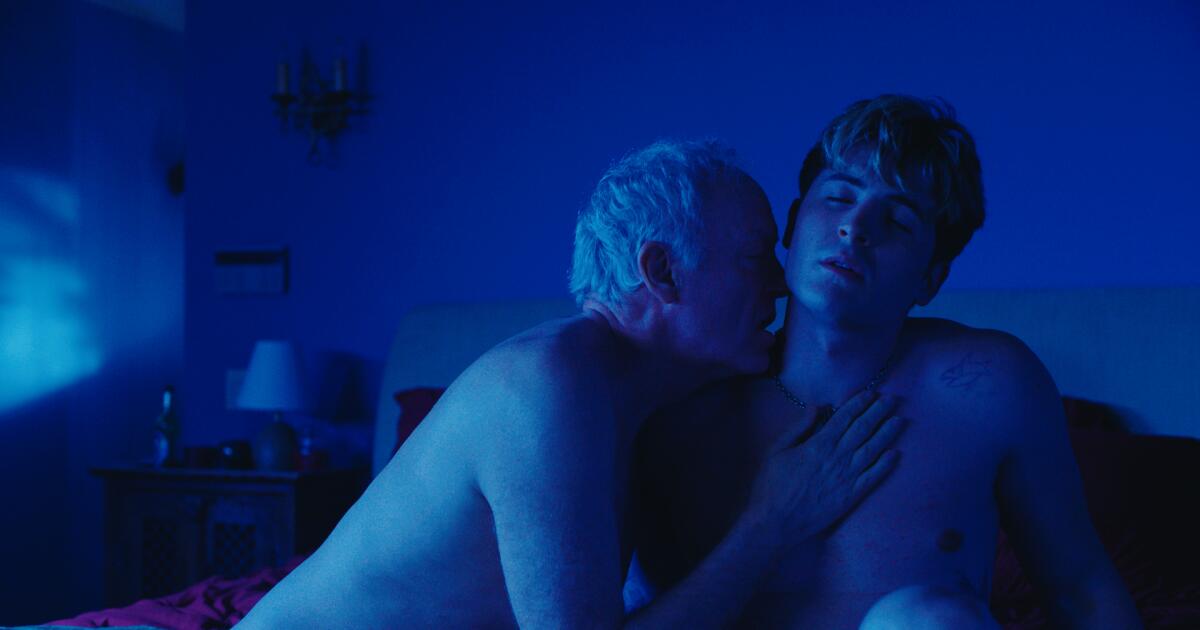
To describe a movie as including a ski mask, a camcorder and $50,000 in cash would certainly lead one to imagine a specific type of story. Add two men and sex work and the brain might roll around more pointed scenarios.
But none of that can prepare you for what micro-indie “Blue Film” has in store. The nexus of perversion, pain and sexual purpose driving writer-director Elliot Tuttle’s dark, discursive chamber drama is of a stripe rarely attempted in even the most self-consciously daring movies. Should you need a self-imposed break afterward from intimate two-handers, even Tuttle might understand, then wink in the general direction of his Pasolini posters. (I’m guessing at this provocateur’s wall art.)
Is it clear yet that “Blue Film,” set primarily in a house in Los Angeles over the course of a revelatory night, isn’t for everybody? Some of that “everybody,” incidentally, includes the festivals and distributors who rejected the queer filmmaker’s debut feature, despite having critical buzz, Tony-winning actor Reed Birney as one of its stars and indie guru Mark Duplass as a mentoring producer.
But certain subjects (spoilers ahead) are bound to trigger a different kind of scrutiny. Initially, our attention is on macho-posturing tattooed camboy Aaron (“Boots” star Kieron Moore), graphically boasting to his followers online of the big payday he’ll receive that evening from a submissive client. What he later encounters, however, at the door of a Craftsman on a quiet street is a masked, polite, older host (Birney) with a camera and, once it’s turned on, a lot of personal questions, the kind that begin to crack the facade of a young man used to being in control of his transactional life.
Then his client’s face is revealed and Aaron recognizes it’s his middle school teacher Hank, a convicted pedophile who once coveted him. Hank, who completed prison time for the attempted assault of a different boy, has made a cross-country trip to seek out the adult version of someone who could have been his first victim. He is still processing what he is, wondering if desire, even love, is available to him anymore.
The question is, will you care? Even viewed through Aaron’s cautious, clear-eyed empathy, it’s a steep ask. But you should. Tuttle’s fearless inquisition won’t insult your intelligence, ask your mercy or hogtie your feelings. Honestly, it’s refreshing to be repulsed and intrigued by a movie willing to plumb these psychological depths when Hollywood won’t. In its commitment to unvarnished talk — even if that leads to a clunky staginess — “Blue Film” has thoughts about identity, choice, sin and salvation. There’s a sincere engagement with humanity’s more difficult realities.
Needless to say, this type of graphically articulated exchange wouldn’t work if the performances didn’t land. Thankfully, Moore’s affecting portrayal of jumbled masculinity mixed with situational curiosity is well-calibrated, while Birney, a pro with a challenge, eases us into Hank’s weary self-possession (if not always the nauseating facts of it) before coloring outside the lines with a believably interesting philosophy about reckoning.
But “Blue Film” is tough, make no mistake. Awkward and searching, it exists in a filmic space that you could argue was opened up by last year’s courageous documentary “Predators.” And sometimes that gaze is just discomfiting, full stop. Tuttle wants that. He has room to improve but he’s someone to watch, plumbing the hard-to-fathom.
‘Blue Film’
Not rated
Running time: 1 hour, 22 minutes
Playing: Now playing at Landmark Theatres Sunset