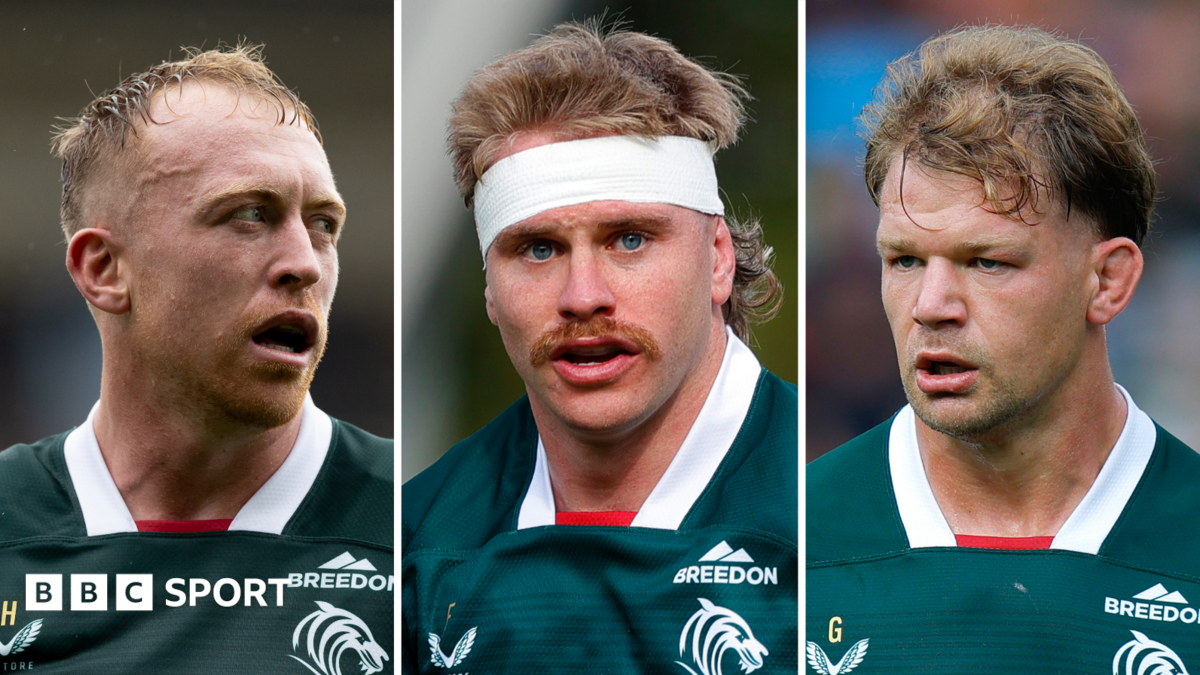
The three players have arrived at Welford Road at contrasting times during their careers.
Wainwright is the new kid on the block despite, having played 70 internationals in a nine-year Wales career that includes a Grand Slam title and two Six Nations triumphs. He has also played at two World Cups.
Wainwright moved to Leicester after almost a decade at Dragons to join a growing influx of Wales’ top players in England.
Wales captains Dewi Lake and Jac Morgan have joined Gloucester, with Louis Rees-Zammit, Dafydd Jenkins, Tomos Williams, Nicky Smith, Rhys Carre, Archie Griffin, Tomas Francis and Christ Tshiunza among those also playing in the Prem.
Wainwright is in a lift-share with Reffell and fly-half Billy Searle.
“Reff is keeping keeping me company in the morning, so he’s doing a good job of helping me settle in,” said Wainwright.
“He has helped introduce me to everyone and it felt a bit like it was a first day at school.
“I was nervous but everyone’s been welcoming and I feel I have settled in.”
Wainwright made an instant impression with his team-mates on his debut after setting up Wales wing Gabriel Hamer-Webb with a try-scoring pass against Saracens.
“He moves like a back and hits like a forward,” said Hamer-Webb.
“He has this engine on him that just does not stop and that’s part of the Leicester Tigers DNA.
“He’s also got that soft touch that you saw when he assisted me against Saracens with that great pass.
“I have seen him play before but to be on the same pitch as him and see how he moves, he is phenomenal.”
Wainwright has also become a firm fans’ favourite, as indicated by an incident after the away victory at Newcastle.
“I saw some of the fans and there’s a few that had the headbands and wigs on and I had a photo,” said Wainwright.
“One of them just snuck me a packet of Welsh cakes to take home on the bus. That was a nice touch.”
The 29-year-old still has a fondness for his home city having opened a cafe in Newport.
He has also taken on a director of coaching role at his boyhood club Whiteheads RFC, despite living in a Leicestershire village almost three hours away.
Wainwright deserved his move after being such a loyal servant, playing in a Dragons side that was not used to winning. There were 33 victories, 97 defeats and eight draws in his 138 matches.
Leicester are preparing for the start of the Champions Cup matches away in Pau on Sunday, with Wainwright having never played in the top-tier competition.
He missed the only two Champions Cup games that Dragons played while he was at Rodney Parade, which came back in 2020.
Now, one of Wales’ elite back rowers is finally set to grace Europe’s elite tournament.
AARON Paul has shared a gut-wrenching video of his Breaking Bad co-star, RJ Mitte, following his tragic death by suicide.
The actor best known for starring as Walter White Jr in the Emmy Award-winning show, died on Mondayin Brownsville, Texas, aged just 34.
Aaron Paul shared shared a video of Mitte talking about the importance of mental healthCredit: Instagram/@aaronpaulThe actor died in Texas aged 34, from suicideCredit: Getty
In an emotional tribute to his friend, Aaron said RJ’s strength and kindness was “blinding”.
Aaron shared a video of Mitte talking about the importance of taking care of one’s mental health.
Sign up for the Showbiz newsletter
Thank you!
The late actor lived with cerebral palsy and used his platform to raise awareness and champion people with disabilities.
RJ said in the video shared by Paul: “I hope y’all are doing well today in this time of uncertainty but I would like to talk to you a little about mental health.
Aaron Paul and RJ Mitte at the premiere of the third season of Breaking BadCredit: GettyRJ Mitte shot to fame in Breaking Bad but struggled to land roles after the iconic show finishedCredit: Getty
“Its very important to take care of ones physical health but its equally as important to take care of one’s mental health.”
RJ said that “more often than not” people hide how they truly feel by saying “I’m fine” and “I’m good.”
He continued: “But its ok to not always be good.
“But its not ok to harbour that feeling, harbour those emotions.
Most read in Entertainment
The actor made his final appearance at the screening of ‘Talking To Strangers’ on September 30Credit: GettyBryan Cranston, Anna Gunn and Betsy Brandt, writer-producer Vince Gilligan, R.J. Mitte and Aaron Paul, after winning Best Series at the Golden GlobesCredit: Getty
“So I am hoping to inspire each and everyone that sees this video today.”
Aaron apologized for not realizing the pain his friend was experiencing.
He wrote: “I am so sorry you were hurting my friend. I wish we knew.”
“You constantly had a smile on your face and you took every single challenge that was given to you with such confidence and grace.
“I met you when you were a little boy and watched you grow into a beautiful young man.”
“What an absolute tragic loss.”
Aaron finished his post by encouraging anyone who is feeling lost, sad or uncertain about the future, to reach out for help.
He said: “We must suffocate the noise and focus on each other.”
The tribute from the star, best known for portraying Jesse Pinkman, followed the heartbreaking news that RJ was found dead by suicide at his home on Monday, as confirmed by his publicist.
RJ said in his final interview that he wanted to “keep living the dream” but added that “every dream could be a nightmare … just keep living it, just keep pushing forward”.
Bryan said: “I met him when he was only 14 years old when he was cast as Walter White Jr., a part he played with such joy and enthusiasm.
“Born with Cerebral Palsy, he never – ever – allowed that challenge to be an excuse for anything. He met the demanding shooting schedule head on with great determination.”
The actor, like his character Walter Jr, had cerebral palsy and said his greatest achievement in life had been “giving back”.
He said: “That’s really the greatest thing that ‘Breaking Bad’ has given me, is to be able to lend my voice to causes that make a meaningful impact that changes people’s lives.
“I think that’s one of the greatest things that I have and it’s not the awards.
“It’s not all of these things people assume come with this. It’s literally being able to impact someone’s life in a meaningful way that without that, wouldn’t have it.”
If you or someone you know is affected by any of the issues raised in this story, call or text the 988 Suicide & Crisis Lifeline at 988, chat on 988lifeline.org, or text Crisis Text Line at 741741.
How to get help
EVERY 90 minutes in the UK a life is lost to suicide It doesn’t discriminate, touching the lives of people in every corner of society – from the homeless and unemployed to builders and doctors, reality stars and footballers. It’s the biggest killer of people under the age of 35, more deadly than cancer and car crashes. And men are three times more likely to take their own life than women. Yet it’s rarely spoken of, a taboo that threatens to continue its deadly rampage unless we all stop and take notice, now. If you, or anyone you know, needs help dealing with mental health problems, the following organisations provide support: CALM, www.thecalmzone.net, 0800 585 858 Heads Together,www.headstogether.org.uk HUMEN www.wearehumen.org Mind, www.mind.org.uk, 0300 123 3393 Papyrus,www.papyrus-uk.org, 0800 068 41 41
AARON Paul has paid tribute to RJ Mitte saying he has been left “heartbroken” after the Breaking Bad star died, aged 34.
Mitte, who famously played Walter White Jr in the Emmy Award-winning show, tragically died on Monday in Brownsville, Texas.
Aaron Paul has paid tribute to RJ Mitte after the Breaking Bad star died, aged 34Credit: AP:Associated PressMitte portrayed the son of Bryan Cranston’s Walter White during the hit series’ five-year runCredit: Alamy
Paul – Mitte’s Breaking Bad co-star who played Jesse Pinkman – told The Hollywood Reporter: “I am at a loss. I am heartbroken over this news.
“RJ, I love you my friend. You will be missed. And to whoever happens to be reading this, please know you are loved, and you are not alone. Always remember that.”
Sign up for the Showbiz newsletter
Thank you!
Dean Norris, who also played alongside Mitte as his on-screen uncle Hank Schrader also paid tribute, saying: “Though RJ didn’t play my TV son, I always looked out for him as a young kid on set.
“He was a sweetheart of a young man and will be greatly missed. This is so heartbreaking, I can’t believe it. Thinking of him and his family.”
Mitte’s representative confirmed to TMZ on Monday that Mitte had tragically passed away in Texas.
They said: “It is with profound sadness that we share the tragic passing of beloved actor, philanthropist, and passionate disability rights advocate RJ Mitte.
“RJ Mitte was best known for his role as Walter ‘Flynn’ White Jr on AMC’s critically acclaimed, award-winning series Breaking Bad.
“Drawing from his own experience living with cerebral palsy, Mitte brought authenticity to the role and built a platform on disability awareness and inclusion.”
Most read in Entertainment
Paul said he was ‘heartbroken’ in a tribute to the TV starCredit: GettyMitte, who had cerebral palsy, became a leading disability rights activistCredit: Alamy
His cause of death was not immediately disclosed, however, the outlet reported that he died by suicide.
Mitte was born on August 21, 1992, in Jackson, Mississippi, and was diagnosed with cerebral palsy at just three-years-old.
But he used his stardom as a Hollywood actor to become a leading disability rights advocate.
He spent most of his childhood using crutches, but improved his ability to walk over his teenage years through sports and exercise.
He told Future of Personal Health: “My hope is to inspire a ‘never give up’ mentality.
“If there is something you want in life, pursue it no matter how hard it may be. Keep your dreams alive. Don’t lose sight of who you want to become.”
Off the set, Mitte served as a celebrity ambassador for several organizations, including United Cerebral Palsy and Shriners Children’s.
Dean Norris, who played alongside Mitte in Breaking Bad, said he was a ‘sweetheart of a young man’Credit: GettyMitte was cast in the role, aged 15, and went on to star in 56 episodes of the hit crime dramaCredit: Alamy
He was also the president of his own charity – The Mitte Foundation – which supported philanthropic efforts and community initiatives, challenging stereotypes around people with disabilities.
Breaking Bad – often credited as one of the best TV series of all time – aired on AMC for five seasons between 2008 and 2013, earning a staggering 58 Primetime Emmy nominations.
Mitte was cast in the leading role of Walter “Flynn” White Jr in 2008 at the age of 15, going on to star in 56 episodes of the hit crime drama.
He played the son of Bryan Cranston and Anna Gunn’s characters – Walter and Skyler White – and his character also had cerebral palsy, as Mitte drew on his own experience for the part.
A week before his sudden death, Mitte appeared on the Joe Vulpis Podcast, where he spoke about his early days in acting and his time on the show.
He called auditioning for Walt Jr “one of the longest auditions of my life”, saying he was one of the last characters to be cast in an audition process that took six months.
A year before his death, Mitte got engaged to his longtime girlfriend, Kennedy SuarezCredit: GettyRJ Mitte pictured at the screening of Talking To Strangers at the Fine Arts Theatre on September 30 in Beverly HillsCredit: Getty
Mitte added: “It was me versus another individual at the time. An hour later, Vince called me and goes, ‘Hey, RJ, you got the part. Pack your bags. Go back to Los Angeles, and come back to set. You’re already late. We’re already filming. We need you here’.
“And that was history for me.”
Reacting to the news of Mitte’s death, Vulpis said on social media: “I had the honor of sitting down with RJ Mitte not too long ago and I can genuinely say he was such a kind, incredible, and gentle soul.
“My heart goes out to his family and loved ones, and I wish them peace and privacy during this difficult time.”
Mitte’s breakout role came after starting his career in entertainment as an extra in shows such as Everybody Hates Chris and Hannah Montana.
It opened up further opportunities with the TV star going on to feature in shows including Switched at Birth and Netflix’s animated series The Guardians of Justice.
He also appeared in several films including the drama “Triumph” from 2021, which he also executive produced.
Mitte’s final public appearance came just days before he tragically passed away as he smiled on the red carpet for the premier of his new movie – Talking to Strangers – on September 30 in California.
He was a Screen Actors Guild spokesman for actors with disabilities and in 2013, he received the SAG-AFTRA Harold Russell Award.
A year before his death, Mitte got engaged to his longtime girlfriend, Kennedy Suarez, in October 2025.
At the time, Mitte gushed about starting a life together with Suarez, telling People: “I’m thrilled to have found my person, my partner in life who makes me want to be better, no matter what we’re doing.
“Kennedy is my everything and I can’t wait to officially start our life together and see what adventures life takes us on next.”
If you or someone you know is affected by any of the issues raised in this story, call or text the 988 Suicide & Crisis Lifeline at 988, chat on 988lifeline.org, or text Crisis Text Line at 741741.
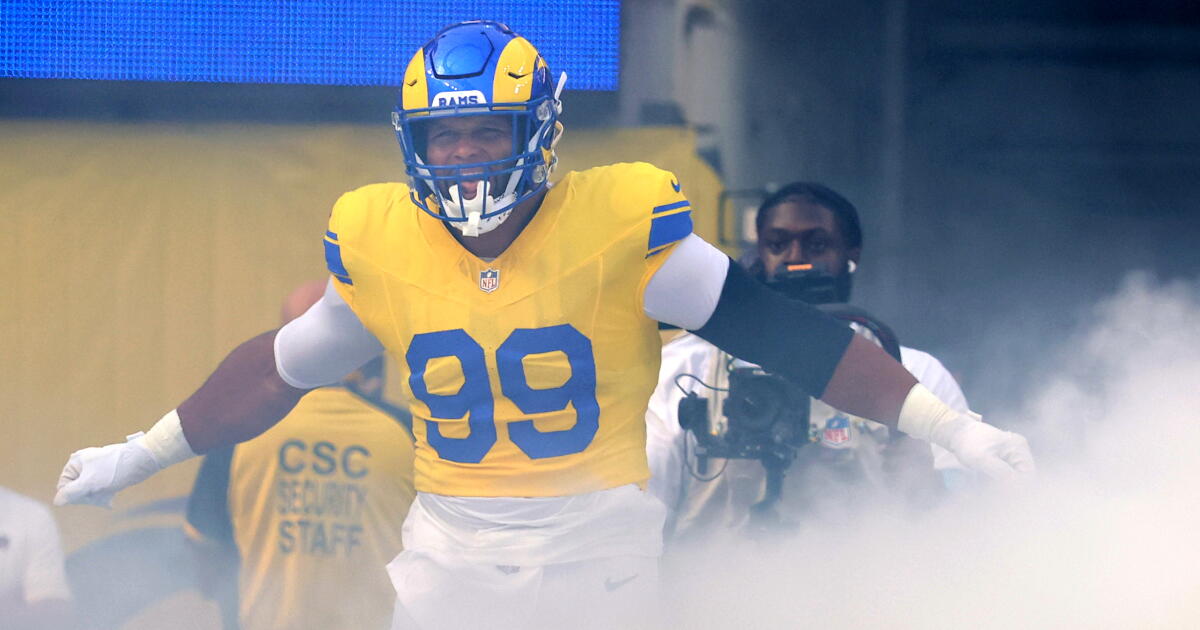
Star receiver Puka Nacua will play against the Philadelphia Eagles on Sunday in Philadelphia, but star defensive lineman Aaron Donald is out because of a back issue, Rams coach Sean McVay said Friday.
Donald, a three-time defensive player of the year, has not practiced this week following the Rams’ loss to the Denver Broncos on Sunday in Denver. McVay said Donald, 35, was experiencing back soreness.
“He’s as tough as it gets. Just not feeling good enough,” McVay said, adding, “He would do it and he could probably go be productive but part of our job is to protect these tough dudes like him from themselves.”
Donald has played in two games since ending a two-year retirement in late August. He did not make the trip to Australia for the season opener against the San Francisco 49ers, but made three tackles in the Rams’ 28-6 victory over the New York Giants at SoFi Stadium.
Donald had one tackle and one quarterback hit in the 30-26 loss to the Broncos.
“He’s working as hard as he can to get himself feeling as good as possible and we’re hopeful and optimistic that good days are ahead,” McVay said.
Nacua sat out the last two games because of a hip injury that caused hip, groin and abdominal soreness.
McVay said Nacua has been “strong, looks sturdy, looks explosive,” during practice this week.
“I think it will really just be a feel for the overall conditioning,” McVay said, adding that he hopes “the magic of the [game] jersey” will help Nacua have a productive game against the Eagles.
Tight end Terrance Ferguson (ankle) and cornerback Jaylen Watson (shoulder) will not play on Sunday, McVay said. Tight end Colby Parkinson (shoulder, knee) and edge rusher Josaiah Stewart (groin) are questionable.
Rams place Terrance Ferguson on injured reserve
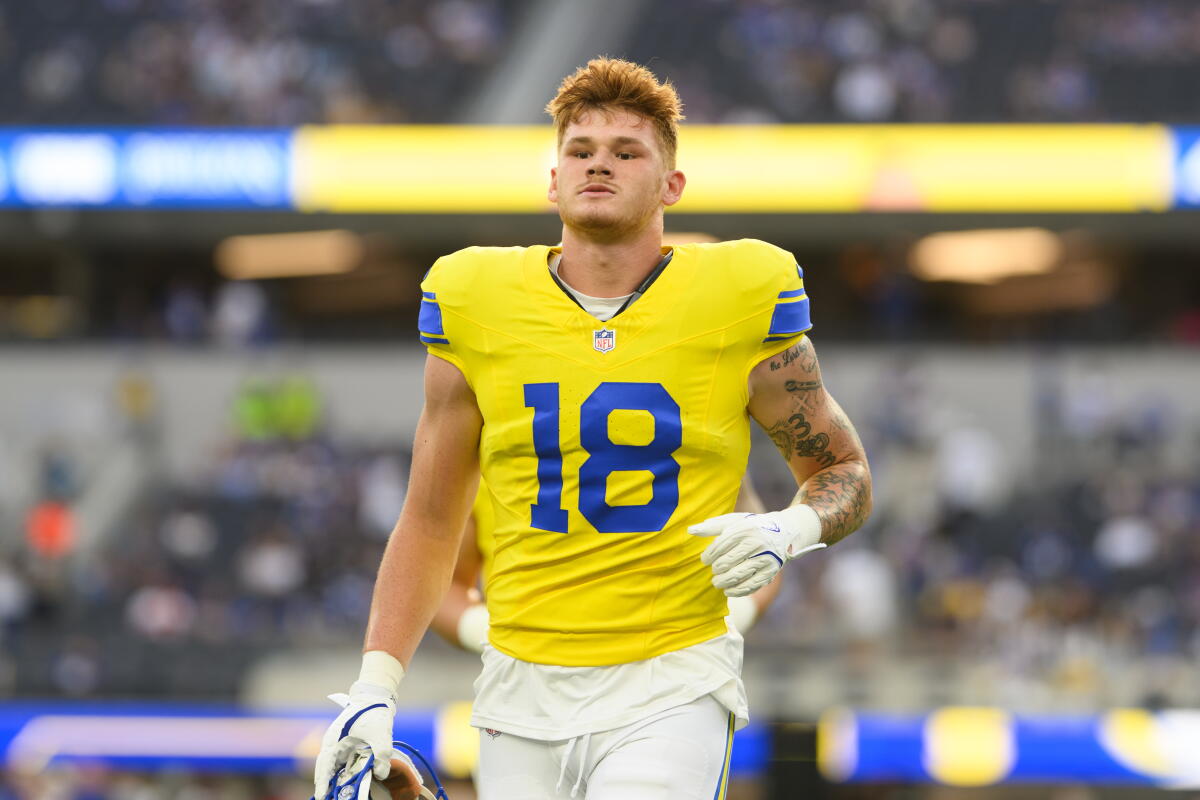
Rams tight end Terrance Ferguson jogs back to the locker room against the Giants on Sept. 21.
(Kyusung Gong / Associated Press)
The Rams opened the season with five tight ends on the roster, which some might have regarded as a surplus.
But the Rams need the depth.
On Friday, the team put Terrance Ferguson on injured reserve because of an ankle injury.
Ferguson, a 2025 second-round draft pick, was injured Sept. 21 against the Giants, but he played through it against the Broncos.
Ferguson has seven catches for 63 yards and a touchdown.
Ferguson must sit out at least the next four games against the Eagles, Buffalo Bills, Arizona Cardinals and Las Vegas Raiders. He is eligible to return for the Nov. 1 game against the Chargers.
The Rams began the season with five tight ends on the roster. Tyler Higbee and Davis Allen are at full strength. Max Klare, a second-round draft pick from Michigan, could get his first action on offense against the Eagles.
Rams release punt returner Xavier Smith
Rams wide receiver Xavier Smith runs the ball against the Kansas City Chiefs during a preseason game in August.
(Charlie Riedel / Associated Press)
What a difference a day makes.
Less than 24 hours after Rams special teams coordinator Bubba Ventrone said the team was not going to replace punt returner Xavier Smith, the team released him.
“We just need better production out of that position,” McVay said, adding that some of the “decisions” that Smith made in last Sunday’s loss to the Denver Broncos proved costly.
“We’ve got to make better decisions,” McVay said. “We’ve got to be able to field it.”
Receiver Alex Bachman is expected to be promoted from the practice squad to handle punt returns. McVay said he was “optimistic that I think we’re going to see some good stuff from Alex on Sunday.”
Smith, 29, is a third-year pro who signed with the Rams as an undrafted free agent and worked his way into a role as a kick returner and rotational receiver.
Smith appeared to be on his way to overcoming a major error in last season’s NFC championship game, when he lost a fumble in the 31-27 defeat by the Seattle Seahawks.
But through three games, Ventrone on Thursday described Smith’s performance as “inconsistent.”
“We need to do a better job of tracking the ball, judging the ball, fielding the ball when necessary, not fielding it in other situations,” Ventrone told reporters. “He knows that and hopefully we’ll get the improvements that we need in that area.”
Ventrone was asked if there was any thought about replacing Smith as the punt returner.
“No, we have a lot of trust in ‘X’, I really do,” Ventrone said. “He’s put in a lot of time and effort in training camp and obviously moving into the season. I think that he’ll do the necessary things to be able to sustain at that position for us.”
But on Friday morning, the Rams announced they had waived Smith.
McVay said the Rams “weren’t thinking” about making a change when Ventrone spoke to reporters Thursday.
“As you get a chance to kind of take a step back, evaluate the totality of our group, what’s the best way to try to be able to put together all three phases, did feel like that was in the best interest of the group,” McVay said, adding, “and that decision was made kind of later [Thursday night].”
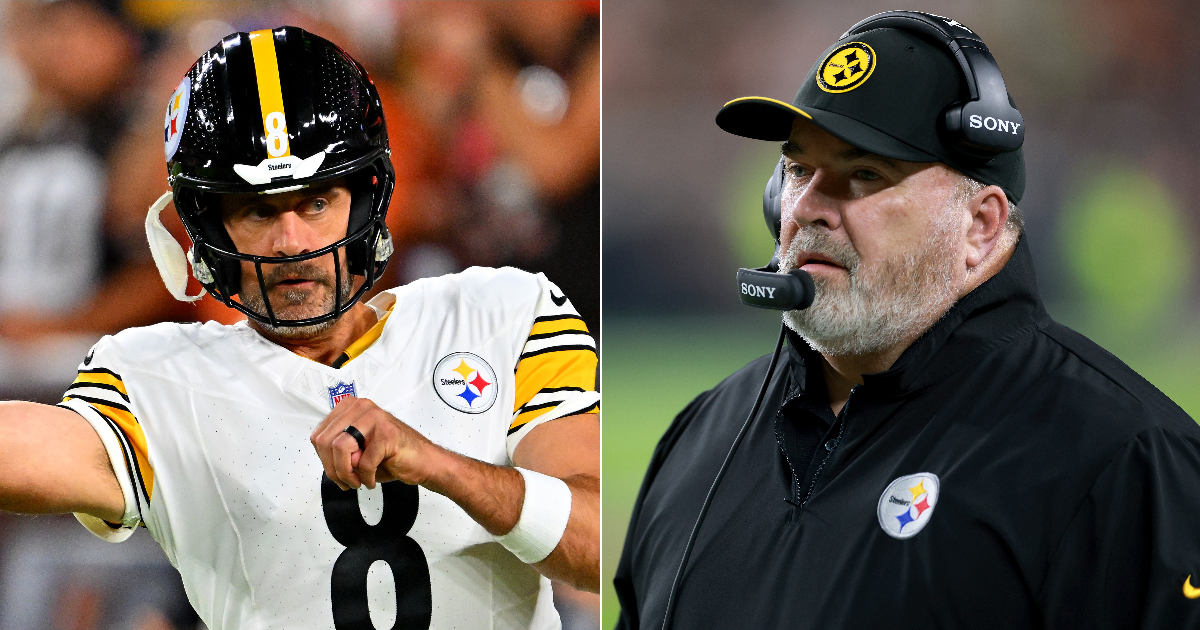
Both men used NSFW language toward each other that was picked up by Prime Video’s “Thursday Night Football” cameras and/or microphones.
The exchange took during the Steelers’ first drive in their eventual 27-24 road loss to the Cleveland Browns. Before a first down play from the Cleveland 20-yard line, Rodgers could be seen staring at the Pittsburgh sideline with his arms spread out, apparently waiting to receive the play from McCarthy.
Then the four-time league MVP exploded.
“What the f—?” Rodgers screamed toward the sideline. “Call it!”
The broadcast then cut to a shot of McCarthy, who could be seen saying the words, “f— a—hole,” in apparent reference to his quarterback.
Asked about that moment during his postgame news conference, McCarthy expressed regret for the language he used.
“I think what’s said on the field, the way I grew up in this game, usually stays on the field,” McCarthy said. “That’s not the case today, I understand that. But any negative communication on my part, I wish I wouldn’t use those words.”
Later in the same drive, Rodgers appeared to shake his head and roll his eyes while waiting for a play to be called. Speaking to reporters after the game, he indicated that the crowd noise affected the communication between the sideline and field.
“It was loud,” Rodgers said, “so some of the calls, it was hard to hear, for sure.”
The “TNF” cameras did catch a much more pleasant interaction between the two men, after the 42-year-old veteran kept the ball on a 1-yard sneak for a successful 2-point conversion to tie the game at 24-24 late in the fourth quarter.
McCarthy coached the Green Bay Packers from 2006 to 2018 and Rodgers was his starting quarterback for 11 of those seasons. During that stretch, they led the team to one Super Bowl victory (against the Steelers) and four NFC championship game appearances. Rodgers also earned two of his four NFL MVP awards during McCarthy’s tenure.
There was some well-documented tension between the two men during that time as well. But Rodgers has cited the Steelers’ hiring of McCarthy this offseason as a reason he decided to put off retirement for one more year.
“I’d gone into the offseason thinking it was probably going to be it, and I’d be totally fine with it — I feel good about my career,” Rodgers told The Athletic in August. “But once he got hired, then my mindset changed a little bit.”
He added: “Absence makes the heart grow much fonder, in this case.”
McCarthy said in the same article: “Just to be able to take this final lap with him, it’s awesome. You always want to do a great job, but now to do it with him in his last chapter, it’s special.”
During defensive line drills, the Future Hall of Famer continues to go third — even when groups are split — rather than lead.
“Earning my keep right now,” Donald said after Rams practice Thursday. “I’m a guy that likes to work and earn everything I get.”
Donald, 35, has one game under his belt after returning from a two-year retirement to rejoin the team that selected the three-time NFL defensive player of the year in the first round of the 2014 NFL draft.
Donald played 33 snaps in the Rams’ 28-6 victory over the New York Giants on Monday. He made three tackles, including one for a loss.
Donald said he watched tape of his performance six times — two times by himself, once with his brother and three more times on his own.
“Not as bad as I thought,” he said. “A lot of things to clean up but on the right track.”
Donald looked “excellent,” defensive coordinator Chris Shula said.
“He was awesome,” Shula said. “He put a lot of pressure on the quarterback, and then you see like some of the run plays … that group as a whole played really tough, played stout, played physical at the line of scrimmage and Aaron was a huge part of that.”
Now, one of the top interior pass rushers in NFL history is preparing for Sunday night’s game against the Denver Broncos in Denver.
Will Donald’s playing time increase?
“Every game is going to kind of tell its own story,” Shula said. “I think we have a general range of where he would be, but I think depending on how the game plays out, you never know how many snaps and the situations that you’re going to be in.
“You never want to put a full hard cap on it.”
Donald is happy with the way his return to game action is playing out.
“We’ve got a good rotation … keeping guys fresh and right now I’m liking it,” he said. “I think it’s at a great pace right now.
“I’m getting my feet wet, get going, get a feel for the game again and other guys are out there working and getting work too.”
Etc.
Rams receiver Puka Nacua (hip), who sat out against the Giants, did not practice for the second day in a row. On Wednesday, coach Sean McVay told reporters he was “not sure” if Nacua would play against the Broncos. Later in the day, he told ESPN radio that Nacua was “not making great progress.” … Tight end Colby Parkinson (knee) and safety Kam Kinchens (hamstring) also did not practice.