Tarik Skubal opens up on the pressure, pain and lessons of October
The Dodgers did not need Tarik Skubal to win the National League West. They traded for him to help them win a third consecutive World Series.
Their legacy is at stake. So is his.
That could be hyperbole. Skubal turns 30 next month, already the winner of two Cy Young awards, one of them unanimously. He could sign the largest contract of any pitcher in major league history this fall. His career might be only at its halfway point, and already we can say he’ll be remembered as a star.
So I asked him if his career would feel somehow empty if he did not win a World Series. No one in Anaheim thinks any less of Mike Trout, and no one in San Diego thinks any less of Tony Gwynn, because neither Hall of Famer won a World Series.
Skubal thought about it. Yes, he said, his career would feel diminished without a championship.
“I think winning is the most important thing, so I think that’s fair to say,” Skubal told me.
“If I retire and I don’t have one, that will definitely be something that I don’t know when I will live it down.”
The Dodgers imported him for five or six starts in October, the first of them this weekend. I wasn’t sure of the right noun to use to capture his feelings: Excitement? Pressure? Responsibility?
“I think all of those things,” he said.
How so?
“I’ve grown to appreciate expectations from teammates, from fans, from organizations,” he said. “I’ve come to appreciate pressure. Early on in my career, there wasn’t much of that. It was more just kind of finding my footing, which I’m grateful for. It helped me learn a lot about myself.
“Having the expectation of being a team that is going to win the World Series, and me being a part of that, is something that I’ve come to really appreciate. I’ve come to appreciate all that stuff. As much as they can be looked at as negative things, or stress-inducing things, I’ve come to really appreciate those things, because I haven’t had that for my entire career.”
As soon as the Dodgers traded for Skubal two months ago, he was delighted to receive a text message from a pitcher who wore the weight of expectations throughout his career.
When his Detroit Tigers opened last season at Dodger Stadium, Skubal asked teammate Jack Flaherty to arrange a meeting with Clayton Kershaw.
“Honestly,” Skubal said, “I wanted to get a jersey from him.”

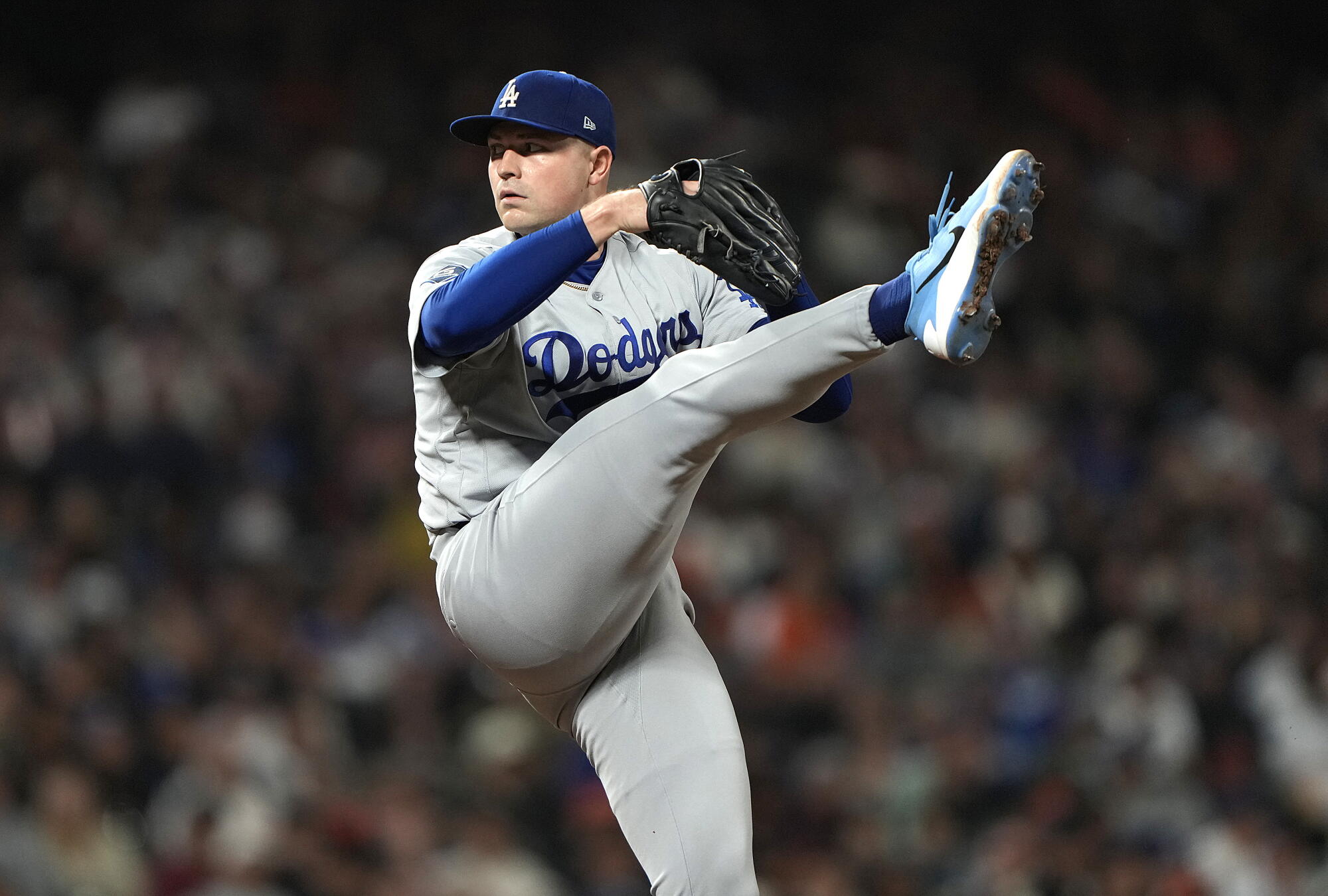
The Dodgers’ Tarik Skubal pitched seven scoreless innings in his final start of the regular season last week against the San Francisco Giants.
(Thearon W. Henderson / Getty Images)
They talked pitching too, of course, and stayed in touch. When the Dodgers landed Skubal, Kershaw’s welcome text led to him sharing advice not just about the team itself but about navigating the notorious L.A. roads to Dodger Stadium, and various neighborhoods that Skubal, his wife and two young boys might enjoy.
For Kershaw, the postseason was a widely publicized menace throughout the previous decade. In 2019, after he inherited a two-run lead in the deciding game of the division series, Kewshaw gave up home runs to Anthony Rendon and Juan Soto.
After the game, Kershaw said, “Everything people say is true right now about the postseason.”
In 2024, the Tigers were five innings from the American League Championship Series, leading 1-0 in the deciding game of the division series, with Skubal on the mound. Three singles, a hit batter and a grand slam later, the Tigers trailed for good.
“I felt pretty responsible for the season ending,” Skubal said.
Kershaw earned his redemption in 2020, winning both of his World Series starts as the Dodgers won their first championship since 1988. That title lifted the postseason burden off Kershaw, and I wondered whether Skubal might feel the same way if he leads these Dodgers to a parade.
Skubal rejected the premise.
“I don’t really buy into that narrative with Kersh, the postseason struggles,” Skubal said.
Kershaw’s 41 postseason appearances include four starts on short rest and nine relief outings. In 2013, he pitched a combined 259 innings between the regular season and playoffs. In 2015, that number was 246 innings.
“It takes a superhuman to be held to the standard he was being held to, in the biggest of moments,” Skubal said. “I think he was great. He did everything he could for his team. He wore it out there sometimes. Chasing box scores and stuff is kind of unfair to judge guys on, because I’m sure he was pitching through some stuff and grinding through some stuff.
“But he had to do it, because he was Clayton Kershaw.”
Kershaw’s postseason earned-run average: 4.62. For Skubal, in six postseason appearances, all of them starts: 2.04. In that one five-run inning, he gave up more runs than he has in the other 38-2/3 innings of his postseason career.
After he gave up those five runs, he returned for one more inning and retired the side in order.
“That moment solidified who I thought I am, in terms of how I responded to that failure, how I responded to that adversity,” he said. “It’s weird to say and it’s probably weird to portray, and I don’t know how many people it’s going to resonate with, but that’s what I feel.”
Right time, right place: If Skubal wants to win a World Series, where else would he rather be?
“For him?” pitcher Blake Snell said. “There’s no better time for anybody than right now.”
The Dodgers acquired infielder Tommy Edman from the St. Louis Cardinals at the 2024 trade deadline. For Edman, that’s two Octobers and two parades.
“In St. Louis, I think we were hovering around .500,” Edman said. “I found myself traded here and I was like, ‘OK, all of a sudden I’m on the team with the best record in baseball right now, going for a ring just about every single year.’
“That’s the expectation we have here. There’s definitely a level of excitement.”
Dave Roberts, the Dodgers’ manager, said he could see the joy in Skubal on the day the Dodgers celebrated the division title.
“There’s also a difference between being on a team like the Tigers — and nothing against that organization — where the goal really isn’t to win the World Series. It’s the hope,” Roberts said. “But being here and seeing the standard that we have and it’s like: ‘I’m here to win the World Series. This team has the best chance to win the World Series, and I get to be a part of it.’
“So I fully see him, now that he is completely immersed into our culture, where the first month was trying to feel his way: ‘Where do I fit in? I’m this hired gun.’ And now it’s like he’s one of the guys.”
Skubal insists that he has not really thought about his free agency, that his focus is on the here and now, and on each start as it comes. That means this month could be his last in Dodger blue, and that means this really might be his best chance to win a World Series.
“I don’t really know if I like the verbiage of that, thinking I must win this year,” he said. “I don’t think that’s fair.”
Fans of the other 29 teams didn’t necessarily think it was fair that the Dodgers got Skubal. Owners of the other 29 teams are trying to stop them, or at least slow them down, by demanding a salary cap. No matter. One of the co-owners of Skubal’s current employer has a saying about this here and now: It’s winnin’ time.