Ninety-five years ago next month, Aurelio Manrique Jr. landed a job as a mild-mannered L.A. Times columnist. But the resume this native of the central Mexico state of San Luis Potosí brought to the paper was that of a firebrand.
Medical student turned political prisoner. Fought in the Mexican Revolution. Governor of his home state. Trusted advisor of general-turned-president Álvaro Obregón. Founder of a left-wing political party. Mexican legislator. He even took to the floor of Mexico’s congress to denounce former president Plutarco Elías Calles as a farsante — a phony — and then pull a gun on a rival who took issue with his vitriol.
Tall, with round wire glasses and a shock of black hair that was the inverse of his Moses-like beard, Manrique cut an exciting figure in Latino L.A. when he arrived as a political exile in 1929 after the so-called Escobar rebellion, which was an attempt to overthrow the Mexican government. A Oct. 28, 1929 Times dispatch noted that “it is not uncommon to find among the shabby, shuffling street venders [sic] of Sonoratown” former Mexican bigwigs “offering sweetmeats and trinkets from trays” in an effort to survive.
Finding a home in L.A.
They, like so many other political refugees before and since, made L.A. a home but also a place to fight for the freedom of their homeland.
Manrique, on the other hand, was hailed as the “intellectual head” of his fellow Mexican refugee politicos and an “accomplished linguist” who spoke Spanish, English, French and German.
“He stands in my memory as a pillar of fire because, at all times, he has never been afraid to do or say what he considered to be right, regardless of his own personal or political fate,” an admirer would recall decades later in the Virginia Quarterly Review.
The revolutionary found welcome audiences across the Southland with lectures and Spanish-language radio show appearances to talk about what was going on in his home country. He participated in Mexican Independence Day and Cinco de Mayo festivities and even found work in Hollywood films as everything from a British lord to an Arab sheikh.
But reputation doesn’t pay the bills, so Manrique also offered translation and interpreter services from a small Bunker Hill office. He also held Spanish-language classes twice a week at the L.A. Central Library. Soon after, The Times — a paper that back then loathed leftists of all stripes — hired Manrique as a columnist in May 1931. He was to be in charge of its daily Spanish-language roundup of world and local events, which the paper had regularly published since 1922.
The revolutionary plays a more reserved role
I wish I could say that Manrique used his platform to inveigh against the mass roundups of Mexican Americans that kicked off that year and that would lead to the repatriation of hundreds of thousands of Mexican Americans, citizens and not, during the 1930s. Or that Manrique taught his Times bosses that Latinos were more than domestic help or a societal scourge. Or that he deserves a spot in the pantheon of legendary Times metro columnists like Jack Smith, Ruben Salazar and Steve Lopez.
Alas, it was not to be.
The daily columna was just a roundup of wire stories published in Spanish, part of The Times’ effort to teach the language of Cervantes to those interested. Every Monday, the 40-year-old Manrique also wrote Platicas de Los Lunes [Monday Lessons], a place for the professor to teach new words to readers via translations, poems and sample sentences.
Manrique’s last byline was April 25, 1932. In the hundreds of columnas he wrote for us, I found nothing even remotely hinting at the progressive lion that Mexicans in Southern California knew him as. But in an era in which Latino visibility in Anglo Southern California was nonexistent when it wasn’t heavily stereotyped, Manriquez’s brief tenure at The Times was an important step for future Latino writers at the paper, all of us whom owe a debt to the man.
He returned to Mexico in early 1933 after President Abelardo L. Rodríguez announced amnesty for him and other exiles. The former revolutionary spent the rest of his life working for the Mexican government, most notably as ambassador to Scandinavian countries from 1946 to 1956.
In 1962, the retired Manrique returned to his old L.A. stomping grounds one final time five years before his death for a lecture at the Alexandria Hotel.
“He finds Los Angeles completely changed,” La Opinión reported, “and told us, with a tone of barely concealed sadness, that many of those who knew him had disappeared.”
The fate of all Angelenos, alas.
Today’s top stories

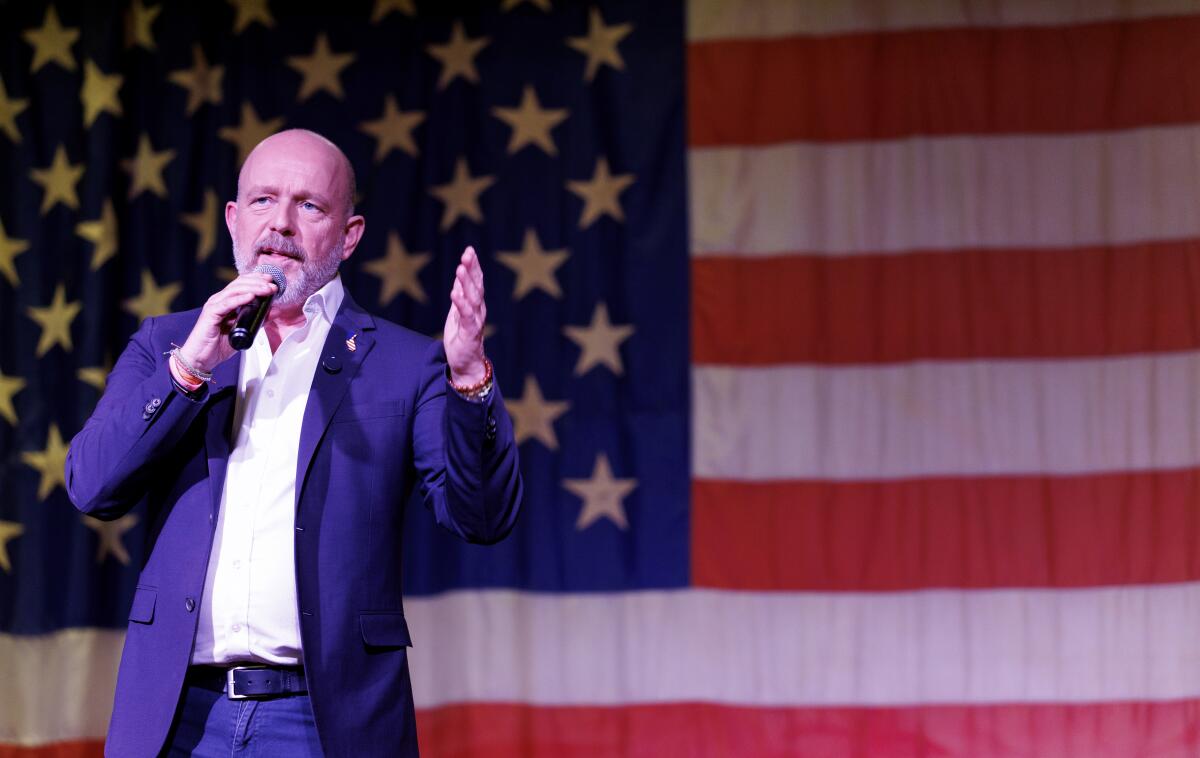
Republican gubernatorial candidate Steve Hilton speaks at a March 7 town hall in Mentone.
(Gina Ferazzi / Los Angeles Times)
A Trump-endorsed Republican could become California’s next governor
A second ticket drop for the Olympics
- A second ticket drop is set to open in August and will offer refreshed inventory across all sports at a range of prices.
- Those who registered but did not receive a slot in the first ticket drop or did not buy all 12 of their tickets will be enrolled in a lottery for a spot in the second ticket drop.
Court strikes down California mask law
California is getting 3 new state parks
- California will establish the new parks in the Central Valley, marking the state’s largest park expansion in decades and bringing the statewide total to 283 parks.
- The parks will serve historically underserved communities with recreation and historic preservation.
What else is going on
Commentary and opinions
This morning’s must-read
Other must-reads
For your downtime

The waffle with maple butter is the drive-across-town dish at celebrity-backed Max & Helen’s, the Larchmont diner opened by Phil Rosenthal and Nancy Silverton.
(Ron De Angelis / For The Times)
Going out
Staying in
A question for you: What’s your favorite California-themed book?
Marya says, “Hard Times in Paradise” by David and Micki Colfax.
Cristina says, “Grapes of Wrath” by John Steinbeck.
Email us at essentialcalifornia@latimes.com, and your response might appear in the newsletter this week.
And finally … from our archives

On this day 21 years ago, “Me at the zoo” was the first video uploaded to YouTube, opening the door to a new medium of television.
For the 20th anniversary last year, The Times’ Wendy Lee wrote about the video sharing platform and how it changed TV as we know it.
Have a great day, from the Essential California team
Jim Rainey, staff reporter
Hugo Martín, assistant editor, fast break desk
Kevinisha Walker, multiplatform editor
Andrew Campa, weekend writer
Karim Doumar, head of newsletters
How can we make this newsletter more useful? Send comments to essentialcalifornia@latimes.com. Check our top stories, topics and the latest articles on latimes.com.