state

Justice Department prosecutors resign amid turmoil over Minnesota ICE shooting investigation

Roughly half a dozen federal prosecutors in Minnesota have resigned and several supervisors in the criminal section of the Justice Department’s Civil Rights Division have given notice of their departures amid turmoil over the federal investigation into the killing of a woman by a U.S. Immigration and Customs Enforcement officer in Minneapolis, according to people familiar with the matter.

The resignations follow growing tensions over a decision by the Trump administration to block the state out of the investigation into the killing of Renee Good, who was shot in the head by an immigration agent last week. Lawyers in the Civil Rights Division, which generally investigates high-profile officer shootings, were also recently told that the division would not be involved at this stage in the investigation, two people familiar with the matter said.

Among the departures in Minnesota is First Asst. U.S. Atty. Joe Thompson, who had been leading the sprawling investigation and prosecution of fraud schemes in the state, two other people said. At least four other prosecutors in the Minnesota U.S. attorney’s office joined Thompson in resigning amid a period of tension in the office, the people said. The people spoke on condition of anonymity to discuss personnel matters.

They are the latest in an exodus of career Justice Department attorneys who have resigned or been forced out over concerns over political pressure or shifting priorities under the Trump administration. Hundreds of Justice Department lawyers have been fired or have left voluntarily over the last year.

Minnesota Democratic lawmakers criticized the departures, with Sen. Amy Klobuchar, a member of the Senate Judiciary Committee, calling the resignations “a loss for our state and for public safety” and warning that prosecutions should not be driven by politics. Gov. Tim Walz said the departures raised concerns about political pressure on career Justice Department officials.

The resignations of the lawyers in the Civil Rights Division’s criminal section, including its chief, were announced to staff on Monday. The Justice Department on Tuesday said those prosecutors had requested to participate in an early retirement program “well before the events in Minnesota,” and added that “any suggestion to the contrary is false.”

Founded nearly 70 years ago, the Civil Rights Division has a long history of investigating shootings of civilians by law enforcement officials even though prosecutors typically need to clear a high bar to mount a criminal prosecution.

In prior administrations, the division has moved quickly to open and publicly announce such investigations, not only to reflect federal jurisdiction over potential civil rights violations but also in hopes of soothing community angst that sometimes accompanies shootings involving law enforcement.

In Minneapolis, for instance, the Justice Department during the first Trump administration opened a civil rights investigation into the 2020 death of George Floyd at the hands of city police officers that resulted in criminal charges. The Minneapolis Police Department was separately scrutinized by the Biden administration for potential systemic civil rights violations through what’s known as a “pattern or practice” investigation, a type of police reform inquiry that is out of favor in the current Trump administration Justice Department.

Richer and Tucker write for the Associated Press.

Source link

Supreme Court likely to uphold state bans on trans athletes competing on girls’ sports teams

The Supreme Court justices sounded ready on Tuesday to uphold state laws that forbid transgender athletes from competing on school sports teams for girls.

Idaho, West Virginia and 25 other Republican-led states say a student’s biological sex at birth should determine who can play on the girls’ or boys’ teams.

They say it is unfair to girls to permit biological males to compete against them in sports like track and field or swimming. “Biological males are, on average, bigger, stronger and faster than biological females,” West Virginia’s state lawyers said.

While the court’s conservative majority court is likely to rule for these states, the justices said they prefer a narrow decision limited to these laws.

If so, such a ruling for the red states will not directly change the law in California and the more than a dozen other Democratic-led states that forbid discrimination based on gender identity. Those laws protect rights of transgender girls to compete on a girls’ team.

A similar dispute came before the court last year.

Then, the conservative justices ruled Tennessee and other red states may prohibit gender-affirming drugs and medical treatments for teenagers who suffer from gender dysphoria.

The 6-3 majority said this was not unconstitutional discrimination based on the teenagers’ transgender status. But that ruling did not strike down the conflicting law in California.

In recent months, the Trump administration joined the transgender sports cases on the side of West Virginia and Idaho.

But its lawyers argued only that the Constitution permits states to exclude transgender girls from girls’ teams. It does not require that they do so, their lawyers said.

Even a West Virginia lawyer agreed. “There is enough room for California to make a different interpretation,” state solicitor Michael R. Williams told the court.

Deputy Solicitor Gen. Hashim Mooppan said these Democratic states “are violating Title IX,” the education law that allows separate sports teams for girls and boys. But he said the court should not rule on that question now.

Last year, in response to the court’s ruling on gender-affirming care, President Trump cut off federal funds to hospitals and medical facilities that provided such care.

A ruling upholding restrictions on transgender athletes could spur the Trump administration to threaten Democratic states with a loss of federal education funds.

Becky Pepper-Jackson, now 15, has carried on a lonely legal fight to compete on her school’s track team in Bridgeport, W.Va.

Designated male at birth, she says she is the only transgender girl competing in her state and has been the target of complaints and protests.

In middle school, Becky participated in cross-country as a sixth-grader and described herself as slow. She “routinely placed near the back of the pack,” her attorneys told the court.

But upon reaching high school, she has been winning.

In 2024, she “placed in the top three in every track event in which B.P.J. competed, winning most,” the state’s attorneys said. Last spring “focusing on strength events, B.P.J. bumped female competitors out of the state tournament, then placed third in the state in discus and eighth in shot put while competing against much older female athletes,” they told the court.

Her attorney, Joshua Block of the American Civil Liberties Union, said she has been winning in the shot put and discus “through hard work and practice.”

He said she “received puberty-delaying medication and gender-affirming estrogen that allowed her to undergo a hormonal puberty typical of a girl.”

He urged the court to rule for Becky because she does not have a physical advantage due to her biology.

But the justices did not sound inclined to rule on the issue of puberty blockers.

Source link

Trump set to lead largest-ever U.S. delegation to World Economic Forum in Davos next week

President Trump will return to the World Economic Forum’s annual meeting of business, political and cultural elites in Davos, Switzerland, next week, leading a record-large U.S. delegation, organizers said Tuesday.

The Geneva-based think tank says Trump, whose assertive foreign policy on issues as diverse as Venezuela and Greenland in recent months has stirred concerns among U.S. friends and foes alike, will be accompanied by five Cabinet secretaries and other top officials for the event running from Monday through Jan. 23.

A total of 850 CEOs and chairs of the world’s top companies will be among the 3,000 participants from 130 countries expected in the Alpine resort this year, the forum says.

Forum President Borge Brende says six of the Group of Seven leaders — including Trump — will attend, as well as presidents Volodymyr Zelenskky of Ukraine, Ahmad al-Sharaa of Syria and others. A total of 64 heads of state or government are expected so far — also a record — though that number could increase before the start of the event, he said.

China’s delegation will be headed by Vice Premier He Lifeng, Beijing’s top trade official, Brende said.

Among the scores of other high-profile attendees expected are European Commission President Ursula von der Leyen, U.N. Secretary-General Antonio Guterres, World Trade Organization Director-General Ngozi Okonjo-Iweala as well as tech industry titans Jensen Huang, CEO of Nvidia, and Microsoft CEO Satya Nadella.

Brende said the U.S. delegation will include Secretary of State Marco Rubio, Treasury Secretary Scott Bessent, Commerce Secretary Howard Lutnick, and U.S. Trade Representative Jamieson Greer, along with Trump’s son-in-law Jared Kushner and special envoy Steve Witkoff.

The forum, which held its first annual meeting in 1971, has long been a hub of dialogue, debate and deal-making. Trump has already attended twice while president, and was beamed in by video last year just days after being inaugurated for his second term.

Critics call it a venue for the world’s elites to hobnob and do business that sometimes comes at the expense of workers, the impoverished or people on the margins of society. The forum counters that its stated goal is “improving the state of the world” and insists many advocacy groups, academics and cultural leaders have an important role too.

This year’s edition will be the first annual meeting not headed by forum founder Klaus Schwab, who resigned last year. He’s been succeeded by interim co-chairs Larry Fink, chairman and CEO of New York-based investment management company BlackRock, and Andre Hoffmann, the vice chairman of Swiss pharmaceuticals company Roche Holdings.

Source link

Tensions flare in Minnesota as protesters and federal agents repeatedly square off

Days of demonstrations against immigration agents left Minnesota tense on Tuesday, a day after federal authorities used tear gas to break up crowds of whistle-blowing activists and state and local leaders sued to fight the enforcement surge that led to the fatal shooting of a Minneapolis woman.

Confrontations between federal agents and protesters stretched throughout the day and across multiple cities on Monday. Agents fired tear gas in Minneapolis as a crowd gathered around immigration officers questioning a man, while to the northwest in St. Cloud hundreds of people protested outside a strip of Somali-run businesses after ICE officers arrived.

Later that night, confrontations erupted between protesters and officers guarding the federal building being used as a base for the Twin Cities crackdown.

With the Department of Homeland Security pledging to send more than 2,000 immigration officers into Minnesota in what Immigration and Customs Enforcement has called its largest enforcement operation ever, the state, joined by Minneapolis and St. Paul, sued the Trump administration Monday to try to halt or limit the surge.

The lawsuit says the Department of Homeland Security operation violates the First Amendment and other constitutional protections and accuses the Republican Trump administration of violating free speech rights by focusing on a progressive state that favors Democrats and welcomes immigrants.

“This is, in essence, a federal invasion of the Twin Cities in Minnesota, and it must stop,” state Attorney General Keith Ellison said at a news conference.

Homeland Security says it has made more than 2,000 arrests in the state since early December.

Dozens of protests or vigils have taken place across the U.S. to honor Renee Good since the 37-year-old mother of three was shot in the head by an ICE officer in Minneapolis.

In response to Monday’s lawsuit, Homeland Security spokesperson Tricia McLaughlin accused Minnesota officials of ignoring public safety.

“President Trump’s job is to protect the American people and enforce the law — no matter who your mayor, governor, or state attorney general is,” McLaughlin said.

The Trump administration has repeatedly defended the immigration agent who shot Good, saying she and her vehicle presented a threat. But that explanation has been widely panned by Minnesota Gov. Tim Walz, Minneapolis Mayor Jacob Frey and others based on videos of the confrontation.

The government also faces a new lawsuit over a similar immigration crackdown in Illinois. More than 4,300 people were arrested last year in “Operation Midway Blitz” as masked agents swept the Chicago area. The lawsuit by the city and state says the campaign had a chilling effect, making residents afraid to leave home.

The lawsuit seeks restrictions on certain tactics, among other remedies. McLaughlin called it “baseless.”

Meanwhile, in Portland, Ore., federal authorities filed charges against a Venezuelan national who was one of two people shot there by U.S. Border Patrol on Thursday. The U.S. Justice Department said the man used his pickup truck to strike a Border Patrol vehicle and escape the scene with a woman.

They were shot and eventually arrested. Their wounds were not life-threatening. The FBI said there was no video of the incident, unlike the Good shooting.

Santana, Vancleave and Karnowski write for the Associated Press. AP reporters Ed White in Detroit; Sarah Raza in Sioux Falls, S.D.; and Sophia Tareen in Chicago contributed to this report.

Source link

Lawsuits by Trump allies could shape how the 2030 census is done and who will be counted

The next U.S. census is four years away, but two lawsuits playing out this year could affect how it will be done and who will be counted.

Allies of President Trump are behind the federal lawsuits challenging various aspects of the once-a-decade count by the U.S. Census Bureau, which is used to determine congressional representation and how much federal aid flows to the states.

The challenges align with parts of Trump’s agenda even as the Republican administration must defend the agency in court.

A Democratic law firm is representing efforts to intervene in both cases because of concerns over whether the U.S. Justice Department will defend the bureau vigorously. There have been no indications so far that government attorneys are doing otherwise, and department lawyers have asked that one of the cases be dismissed.

As the challenges work their way through the courts, the Census Bureau is pushing ahead with its planning for the 2030 count and intends to conduct practice runs in six locations this year.

America First Legal, co-founded by Stephen Miller, Trump’s deputy chief of staff, is leading one of the lawsuits, filed in Florida. It contests methods the bureau has used to protect participants’ privacy and to ensure that people in group-living facilities such as dorms and nursing homes will be counted.

The lawsuit’s intent is to prevent those methods from being used in the 2030 census and to have 2020 figures revised.

“This case is about stopping illegal methods that undermine equal representation and ensuring the next census complies with the Constitution,” Gene Hamilton, president of America First Legal, said in a statement.

The other lawsuit was filed in federal court in Louisiana by four Republican state attorneys general and the Federation for American Immigration Reform, which opposes illegal immigration and supports reduced legal immigration. The lawsuit seeks to exclude people who are in the United States illegally from being counted in the numbers for redrawing congressional districts.

In both cases, outside groups represented by the Democratic-aligned Elias Law Group have sought to intervene over concerns that the Justice Department would reach friendly settlements with the challengers.

In the Florida case, a judge allowed a retirees’ association and two university students to join the defense as intervenors. Justice Department lawyers have asked that the case be dismissed.

In the Louisiana lawsuit, government lawyers said three League of Women Voters chapters and Santa Clara County in California had not shown any proof that department attorneys would do anything other than robustly defend the Census Bureau. A judge has yet to rule on their request to join the case.

A spokesman for the Elias Law Group, Blake McCarren, referred in an email to its motion to dismiss the Florida case, warning of “a needlessly chaotic and disruptive effect upon the electoral process” if the conservative legal group were to prevail and all 50 states had to redraw their political districts.

Aligning with Trump’s agenda

The goals of the lawsuits, particularly the Louisiana case, align with core parts of Trump’s agenda, although the 2030 census will be conducted under a different president because his second term will end in January 2029.

During his first term, for the 2020 census, Trump tried to prevent those who are in the U.S. illegally from being used in the apportionment numbers, which determine how many congressional representatives and Electoral College votes each state receives. He also sought to have citizenship data collected through administrative records.

A Republican redistricting expert had written that using only the citizen voting-age population, rather than the total population, for the purpose of redrawing congressional and state legislative districts could be advantageous to Republicans and non-Hispanic whites.

Both Trump orders were rescinded when Democratic President Biden arrived at the White House in January 2021, before the 2020 census figures were released by the Census Bureau. The first Trump administration also attempted to add a citizenship question to the 2020 census questionnaire, a move that was blocked by the U.S. Supreme Court.

In August, Trump instructed the U.S. Commerce Department to change the way the Census Bureau collects data, seeking to exclude immigrants who are in the U.S. illegally. Neither officials at the White House nor the Commerce Department, which oversees the Census Bureau, explained what actions were being taken in response to the president’s social media post.

Congressional Republicans have introduced legislation to exclude noncitizens from the apportionment process. That could shrink the head count in both red and blue states because the states with the most people in the U.S. illegally include California, Texas, Florida and New York, according to the Pew Research Center.

The Constitution’s 14th Amendment says “the whole number of persons in each state” should be counted for the numbers used for apportionment. The numbers also guide the distribution of $2.8 trillion in federal dollars to the states for roads, healthcare and other programs.

Defending the Census Bureau

The Louisiana lawsuit was filed at the end of the Biden administration and put on hold in March at the request of the Commerce Department. Justice Department lawyers representing the Cabinet agency said they needed time to consider the position of the new leadership in the second Trump administration. The state attorneys general in December asked for that hold to be lifted.

So far, in the court record, there is nothing to suggest that those government attorneys have done anything to undermine the Census Bureau’s defense in both cases, despite the intervenors’ concerns.

In the Louisiana case, Justice Department lawyers argued against lifting the hold, saying the Census Bureau was in the middle of planning for the 2030 census: “At this stage of such preparations, lifting the stay is not appropriate.”

Schneider writes for the Associated Press.

Source link

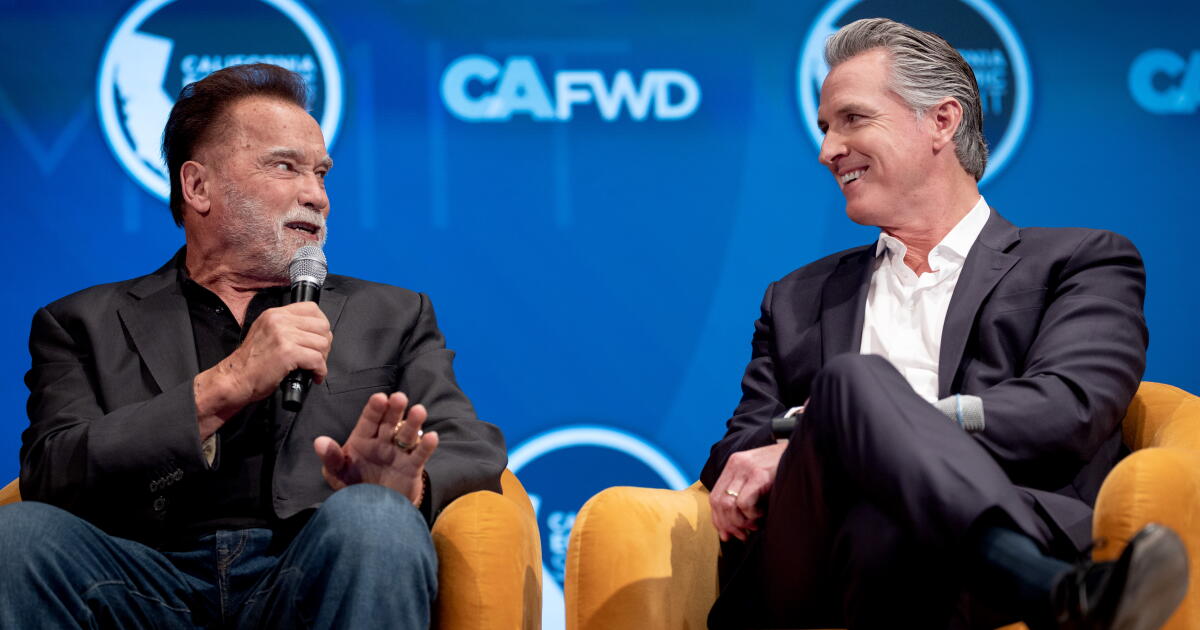
Newsom overcomes unease, dyslexia to deliver a sterling State of the State address

The most outstanding thing about Gov. Gavin Newsom’s final State of the State address last week was that he actually gave it.

Every California governor since Earl Warren back in World War II had annually paraded into the ornate 1800s-decor Assembly chamber to address a joint session of the Legislature in what was always the most festive occasion of the year in the state Capitol.

You’re reading the L.A. Times Politics newsletter

George Skelton and Michael Wilner cover the insights, legislation, players and politics you need to know in 2024. In your inbox Monday and Thursday mornings.

By continuing, you agree to our Terms of Service and our Privacy Policy.

The house was packed with giddy lawmakers on their best behavior, state elected officials, Supreme Court justices, reporters, movers and shakers.

Newsom reluctantly followed custom his first two years as governor, but then brushed it all off for five — mainly because of a lifelong struggle with dyslexia, which makes it very difficult for him to read a speech off teleprompters.

“He hates giving speeches,” a top aide once told me. “It’s anxiety-producing for him.”

The governor had a good excuse in 2021: Tight seating in the crowded Assembly chamber would have risked spreading the COVID-19 virus. Instead, he strangely opted for center field in empty Dodger Stadium.

The next year, he delivered his speech before lawmakers in a sterile state auditorium, where he could practice his delivery for days beforehand in private. The year after that, he skipped the address entirely. In 2024, he went on a four-city road trip to promote his legislative agenda. And late last year, he merely sent a written message to the Legislature.

The question arose whether Newson was capable of delivering a traditional State of the Union address to a joint session of Congress if he ever did achieve his presidential ambition.

He answered that a few days ago by flawlessly delivering an hour-long State of the State speech, displaying some wit and plenty of charisma and rhetorical skill while expressing passion for California and repulsion against President Trump.

The ceremony resembled a mini-State of the Union as the beaming governor was escorted down the Assembly’s center aisle to the Speaker’s rostrum, shaking hands with delighted legislators crowding into camera range.

Newsom returned to the customary State of the State format because he realized this was his last opportunity as a lame-duck governor who’s termed out after this year. He wanted to show some farewell respect for the legislative institution, a gubernatorial insider told me.

Of course, it also was a relatively high-profile gift speaking slot that could catch some national attention.

And he wanted to do it in early January — as all previous governors had — because, he believed, it would attract more attention now than later. Soon the race to replace him will shift into high gear, he theorized, and he could be crowded out of public focus by the gubernatorial candidates.

That theory doesn’t add up.

This is not an attention-grabbing field of gubernatorial wannabes, to put it politely. Conversely, Newsom is an early front-runner for the 2028 Democratic presidential nomination. Regardless, it’s Trump who will continue to draw most of the political attention, not the scarcely known group running for governor.

Whatever his purpose, the speech paid off for Newsom. It got lots of news media coverage. And he continually was interrupted with loud applause by Democrats — what you’d expect when they dominate the Legislature with a supermajority.

But it required a lot of pre-speech work. Newsom spent more than a week in practice, reading his script off teleprompters, off and on, and devouring its content, the insider says.

As he began the live address, Newsom ad-libbed a reference to his long absence from the State of the State ritual and struggles with dyslexia.

“I’m not shy or, you know, embarrassed about my [below average] 960 SAT score,” the governor said, grinning, “but I am a little bit about my inability to read the written text. And so it’s always been something that I have to work through and I’m confronting.”

His performance — the delivery, at least — matched, if not exceeded, all previous governors I’ve watched give State of the States.

Newsom used the speech to continue the anti-Trump barrage that has boosted his national standing among Democratic activists.

“The president believes that might makes right, that the courts are simply speed bumps, not stop signs,” Newsom asserted. “Secret police, businesses raided, windows smashed, citizens detained, citizens being shot, masked men snatching people in broad daylight….

“In California, we are not silent. We are not hunkering down. We are not retreating. We are a beacon.”

Newsom defended California against Republican attacks — and common mindsets throughout much of America — that the Golden State is a socialist hellhole of high taxes, unaffordable living and rampant crime. It’s an albatross he’ll need to fight off running for president.

“The declinists — you know who you are — the pundits and critics suffering from ‘California derangement syndrome,’ look at this state and try to tear down our progress,” he said,

“It’s time to update your talking points. California remains the most blessed and often the most cursed place on Earth — profound natural beauty and prosperity, profound natural disasters, testing our spirits and resources.”

Afterward, Newsom was criticized by Republicans and chided in the news media for not mentioning that the nonpartisan Legislative Analyst Office had forecast an $18-billion state budget deficit for the fiscal year beginning July 1.

Newsom brushed that off with a stroke of the pen the next day. He submitted a significantly lower deficit projection — just $3 billion — in a $349-billion budget proposal he sent the Legislature. He credited a revenue surge based on stock market profits, fueled largely by artificial intelligence investments.

Gee, what could go wrong?

Breaking with gubernatorial tradition, Newsom did not show up to personally brief reporters on his budget proposal, a task he has mastered in the past.

This time, Newsom had been too busy practicing his State of the State address to bone up on a budget presentation.

That’s OK. The State of the State was a needed feel-good tonic for both the Legislature and Newsom.

What else you should be reading

The must-read: Deadly ICE shooting in Minnesota, affordability stir up California gubernatorial forums
CA vs. Trump: Federal judge blocks Trump administration’s freeze of $10 billion in child-care funds
The L.A. Times Special: Citizens are finally getting it: No one’s safe from Trump’s deportation ambitions

Until next week,
George Skelton


Was this newsletter forwarded to you? Sign up here to get it in your inbox.

Source link

Rep. Paul Ryan to deliver GOP response to Obama’s State of the Union address

WASHINGTON – Republicans have tapped Wisconsin Rep. Paul Ryan to deliver the party’s response to President Obama’s State of the Union address on Tuesday, party officials said Friday.

The choice of Ryan, chairman of the House Budget Committee, is meant to signal the party’s commitment to deficit reduction, the officials said. Ryan will deliver the GOP response from the Budget Committee’s hearing room.

“Paul Ryan is uniquely qualified to address the state of our economy and the fiscal challenges that face our country,” Speaker of the House John Boehner said in a statement. “We’re broke, and decisive action is needed to help our economy get back to creating jobs and end the spending binge in Washington that threatens our children’s future. I’m pleased that Paul will be outlining a common-sense vision for moving our country forward.”

For Obama’s first two addresses to a joint session of Congress, Republicans chose governors to deliver the response – first Louisiana’s Bobby Jindal, and in 2010, Virginia’s Bob McDonnell. The tradition of the opposition party delivering a formal response dates back to 1966.

Ryan, 40, has represented Wisconsin’s 1st Congressional District since 1999. He was a member of Obama’s bipartisan fiscal commission, but voted against the panel’s final recommendations.

Obama is scheduled to travel to Wisconsin on Wednesday in a post-speech barnstorming trip.

mmemoli@tribune.com

Source link

California Atty. Gen. Rob Bonta opts against running for governor. Again

California Atty. Gen. Rob Bonta announced Sunday that he would not run for California governor, a decision grounded in his belief that his legal efforts combating the Trump administration as the state’s top prosecutor are paramount at this moment in history.

Bonta said that President Trump’s blocking of welfare funds to California and the fatal shooting of a Minnesota mother of three last week by a federal immigration agent cemented his decision to seek reelection to his current post, according to Politico, which first reported that Bonta would not run for governor.

“Watching this dystopian horror come to life has reaffirmed something I feel in every fiber of my being: in this moment, my place is here — shielding Californians from the most brazen attacks on our rights and our families,” Bonta said in a statement. “My vision for the California Department of Justice is that we remain the nation’s largest and most powerful check on power. We aren’t just defending the status quo; we are securing the California Dream for the next generation. Let’s finish what we started – together.”

Bonta, 53, a former state lawmaker and a close political ally to Gov. Gavin Newsom, has served as the state’s top law enforcement official since Newsom appointed him to the position in 2021. In the last year, his office has sued the Trump administration more than 50 times — a track record would likely have served him well had he decided to run in a state where President Trump has lost three times and has sky-high disapproval ratings.

Bonta in 2024 said that he was considering running. Then in February he announced he had ruled it out and was focused instead on doing the job of attorney general, which he considers especially important under the Trump administration. Then, both former Vice President Kamala Harris and Sen. Alex Padilla (D-Calif.) announced they are not running for governor, and Bonta began reconsidering a run, he said.

“I had two horses in the governor’s race already,” Bonta told The Times in November. “They decided not to get involved in the end. … The race is fundamentally different today, right?”

The race for California governor remains wide open. Newsom is serving the final year of his second term and is barred from running again due to term limits. Newsom has said he is considering a run for president in 2028.

Former Rep. Katie Porter — an early leader in polls — late last year faltered after videos emerged of her screaming at an aide and berating a reporter. The videos contributed to her dropping behind Riverside County Sheriff Chad Bianco, a Republican, in a November poll released by the UC Berkeley Institute of Governmental Studies and co-sponsored by The Times.

Porter rebounded a bit toward the end of the year, a poll by the Public Policy Institute of California showed, however none of the candidates has secured a majority of support and many voters remain undecided.

California hasn’t elected a Republican governor since 2006, Democrats heavily outnumber Republicans in the state, and many are seething with anger over Trump and looking for Democratic candidates willing to fight back against the current administration.

Bonta has faced questions in recent months about spending about $468,000 in campaign funds on legal advice last year as he spoke to federal investigators about alleged corruption involving former Oakland mayor Sheng Thao, who was charged in an alleged bribery scheme involving local businessmen David Trung Duong and Andy Hung Duong. All three have pleaded not guilty.

According to Bonta’s political consultant Dan Newman, Bonta — who had received campaign donations from the Duong family — was approached by investigators because he was initially viewed as a “possible victim” in the alleged scheme, though that was later ruled out. Bonta has since returned $155,000 in campaign contributions from the Duong family, according to news reports.

Bonta is the son of civil rights activists Warren Bonta, a white native Californian, and Cynthia Bonta, a native of the Philippines who immigrated to the U.S. on a scholarship in 1965. Bonta, a U.S. citizen, was born in Quezon City, Philippines in 1972, when his parents were working there as missionaries, and immigrated with his family to California as an infant.

In 2012, Bonta was elected to represent Oakland, Alameda and San Leandro as the first Filipino American to serve in California’s state legislature. In Sacramento, he pursued a string of criminal justice reforms and developed a record as one of the body’s most liberal members.

Bonta is married to Assemblywoman Mia Bonta (D-Alameda), who succeeded him in the State Assembly, and the couple have three children.

Los Angeles Times reporter Dakota Smith contributed to this article.

Source link

Will this mysterious California news site influence the 2026 election?

Recently, as the political battle over congressional redistricting brought California into the national spotlight, Facebook users were shown a curious series of ads.

The ads, from a straightforward-looking news site called the California Courier, often felt a lot like campaign commercials, linking to articles hammering Democrats in the state, including Gov. Gavin Newsom. Few punched in the other direction, toward Republicans. One said, “California Democrats just rewrote their gerrymandering plan so voters will see their partisan map on the ballot this November.” Another called Proposition 50, which passed in November, “a scheme critics say is meant to undermine voter-approved protections and entrench one party rule in California.”

A reader who clicked through to the Courier’s website would find stories that largely align with a conservative view of the news, like a video of a child “riding a scooter through San Fran’s drug-ravaged streets,” or an anonymous piece that cites “confidential sources” cautioning against a “left-wing educator” running for a position with an Orange County school district.

What a reader would not find is any disclosure of the Courier’s ownership or funding, including what appear to be ties to a network of conservative organizations in California that, according to one researcher, scaled up a series of right-leaning news sites in three other states just ahead of the 2024 election.

The Courier has money to spend. According to a review of the ad library maintained by Facebook’s owner, Meta, the outlet has spent more than $80,000 since 2021 promoting its stories on social issues and politics, potentially reaching tens of thousands of users on the platform each week.

Critics say the California outlet is part of a growing, nationwide ecosystem of innocuous-looking, cheaply produced news publications that publish and advertise biased articles in an attempt to surreptitiously influence elections. They worry the practice could mislead voters and corrode trust in nonpartisan news providers.

“I think we are in an era where people are consuming so much content online without knowing the source of it,” said Max Read, who has studied the network apparently behind the Courier at the Institute for Strategic Dialogue, a nonprofit that works to counter political polarization. “And for well-funded organizations to contribute to that by disguising what they’re doing online just helps exacerbate that problem of people not trusting what they come across.”

At a glance, the Courier does not necessarily look right-leaning. A handful of stories seem like straight news echoing press releases, such as one announcing new affordable housing units. But even those that seem relatively neutral may have a right-leaning spin, like one describing speeding fines tied to income as a potential “woke penalty loophole.”

The outlet also shares a name with a 67-year-old California-based publication serving the Armenian diaspora. One of that Courier’s founders won acclaim from his peers for his tenure as dean of the University of Maryland’s journalism school.

When the Markup and CalMatters contacted the publisher of the Armenian Courier, he said he was unaware of the other site. He told a reporter he was opening it for the first time.

“I’m definitely not conservative,” said Harut Sassounian, who owns the Courier, where his regular editorials appear online and formerly in print. “The two publications have nothing in common. Neither politically nor ethnically nor anything like that.”

Although it lacks the pedigree of the Armenian publication, the right-leaning Courier has shown it is well-immersed in today’s social media. A video it made suggesting Newsom flip-flopped in his view of President Biden’s mental acuity generated thousands of reactions.

The publication also shares some of the murky citation practices of contemporary social media. Almost all of the stories on the site are unattributed, or simply attributed to “the California Courier.”

A few, however, include author names. One of the named writers describes himself on social media as a “content creator” for the Lincoln Media Foundation, a conservative group, and links to Courier articles. Another shares a name with a Republican strategist based in Orange County, and a third lists a resume with conservative organizations in a short bio.

The Lincoln Media Foundation is tied to the Lincoln Club, a group based in Orange County that bills itself as “the oldest and largest conservative major donor organization in the state of California.” The club funnels anonymously donated money to conservative candidates and causes.

The Lincoln Media Foundation’s Facebook page recently said it was “proud to present” a new documentary purporting to reveal “the untold truth about the Pacific Palisades fire,” the natural disaster that tore through the state last year and increased political pressure on Newsom.

One hour later, the Courier’s Facebook page promoted it as well, not mentioning the Lincoln Media Foundation but describing the documentary as “much anticipated.”

Neither the Lincoln Club, Lincoln Media, the California Courier or the Courier writers responded to multiple requests for comment about the origins of the site, either through email phone, or social media messages.

That silence, and the lack of information about ownership on the Courier’s website, come despite the outlet’s chief goal, as outlined on its Facebook page.

“California Courier offers statewide and local news,” the page’s description reads. “Our mission is transparency.”

The Lincoln Club has previously been linked to “local” websites around the country, spreading stories with a distinctly conservative tint.

In 2024, Read’s Institute for Strategic Dialogue, which tracks disinformation and extremism online, found a handful of such sites that noted deep in their privacy policies that they were projects from Lincoln Media. Those outlets had names like the Angeleno and the Keystone Courier, and stretched from California to Pennsylvania, although a resulting report didn’t name the Courier.

Many of the sites used Facebook and other social media tools to press a conservative agenda, the report found. Meta has rules against “coordinated inauthentic behavior” but it’s not clear whether Lincoln Media’s websites would cross that line.

‘Pink slime’ news

Researchers have taken to calling sites like those operated by Lincoln Media “pink slime” news, a name coined after a meat-industry additive. These sites don’t produce outright false news, like others, but they do not meet basic journalistic standards. That often means low-quality content and failing to disclose associations with outside organizations.

The sites generally aren’t designed to generate revenue, but to sway public opinion. The majority, according to researchers, lean toward a conservative agenda, and if the site’s stories gain traction on social media, they can travel widely. “If they place an ad well or if they just get the right pickup from the right influencer, these things don’t really have a limit on how far they can go,” Read said.

While it’s not clear how many sites the Lincoln Club might fund, it isn’t the only group that has used the strategy.

In 2020, the New York Times reported on Metric Media, a group that created nearly 1,300 sites around the country with names like Maine Business Daily and the Ann Arbor Times. At a glance, these could pass for simple local news operations. But the Times report found they took money from public relations firms and Republican operatives to produce stories beneficial to those groups, a massive journalistic red flag.

Ethical or not, the strategy can be effective for lending credibility to a particular viewpoint. Kevin DeLuca, an assistant professor of political science at Yale University who has researched pink slime websites, conducted an experiment that showed subjects both real unbiased news sites and others produced by Metric Media.

Some subjects in the study were given a tip sheet that asked them to examine the sites closely, looking at whether they included information like credible mission pages and other details. But even with the tip sheet, the study subjects said in interviews that they didn’t strongly prefer the truly local over the manufactured sites.

DeLuca says these sites are now in place around the United States, and news consumers have little idea when they’re running into them. The problem may only get worse with the spread of generative AI, since that technology further reduces the cost of creating such sites.

Researchers who study these sites say it’s never been easier to produce them. Local news, for one, has faced a years-long financial crisis that’s wiped many once-robust operations off the map.

While it can’t be said whether any one publication uses AI-generated content, the wide availability of tools like ChatGPT, capable of producing at least a semblance of a passable news story, have also made it easier to build up such sites.

“It’s going to make these pink slime sites even harder for people to know that what they’re reading is not from a human source and not really local investigative journalism.” DeLuca said.

Sassounian, for his part, doesn’t think there’s any risk the two California Couriers would ever be confused with each other. He took over the paper in the 1980s, and his columns, which he describes as “hard-hitting editorials that defend the rights of the Armenian people worldwide,” have been translated into languages around the world.

“It’s not pleasant to have our name used by someone else,” Sassounian said. “I prefer that they don’t, but I don’t know what I can do about it.”

Colin Lecher writes for CalMatters.

Source link

Minnesota braces for what’s next after immigration arrests and the killing of Renee Good

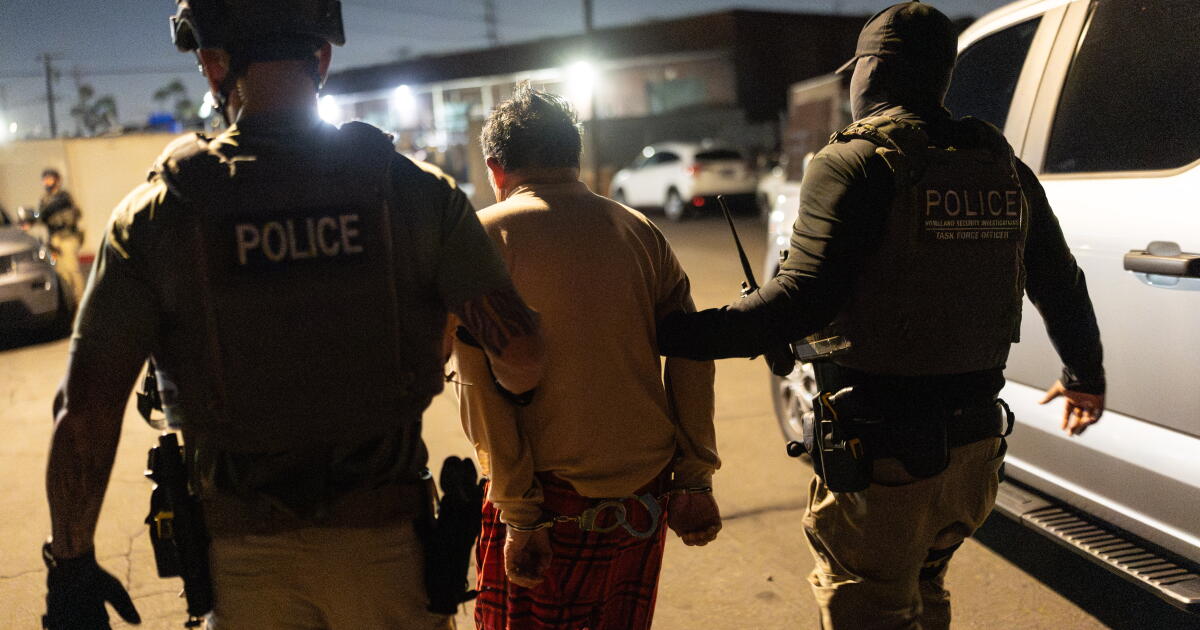
Already shaken by the fatal shooting of a woman by an immigration officer, Minnesota’s Twin Cities on Sunday braced for what many expect will be a new normal over the next few weeks as the Department of Homeland Security carries out what it called its largest enforcement operation ever.

In one Minneapolis neighborhood filled with single-family homes, protesters confronted federal agents and attempted to disrupt their operations by blowing car horns and whistles and banging on drums.

There was some pushing and several people were hit with chemical spray just before agents banged down the door of one home Sunday. They later took one person away in handcuffs.

“We’re seeing a lot of immigration enforcement across Minneapolis and across the state, federal agents just swarming around our neighborhoods,” said Jason Chavez, a Minneapolis City Council member. “They’ve definitely been out here.”

Chavez, the son of Mexican immigrants who represents an area with a growing immigrant population, said he is closely monitoring and gathering information from chat groups about where residents are seeing agents operating.

While the enforcement activity continues, two of the state’s leading Democrats said Sunday that the investigation into the shooting death of Renee Nicole Good shouldn’t be overseen solely by the federal government.

Minneapolis Mayor Jacob Frey and U.S. Sen. Tina Smith said in separate interviews that state authorities should be included in the investigation because the federal government has already made clear what it believes happened.

“How can we trust the federal government to do an objective, unbiased investigation, without prejudice, when at the beginning of that investigation they have already announced exactly what they saw — what they think happened,” Smith said on ABC’s “This Week.”

The Trump administration has defended the officer who shot Good in her car, saying he was protecting himself and fellow agents and that Good had “weaponized” her vehicle.

Homeland Security Secretary Kristi Noem during an interview with CNN dismissed complaints from Minnesota officials about local agencies being denied any participation in the investigation.

“We do work with locals when they work with us,” she said, criticizing the Minneapolis mayor and others for not assisting Immigration and Customs Enforcement operations.

Frey and Noem each pointed fingers at the other for their rhetoric after Good’s killing, and each pushed their own firm conclusions about what video of the incident shows. The mayor stood by his assertions that videos show “a federal agent recklessly abusing power that ended up in somebody dying.”

“Let’s have the investigation in the hands of someone that isn’t biased,” Frey said on NBC’s “Meet the Press.”

The killing of Good on Wednesday by an ICE officer and the shooting of two people by federal agents in Portland, Ore., led to dozens of protests across the country over the weekend, including thousands of people who rallied in Minneapolis.

Santana, Householder and Vancleave write for the Associated Press. AP journalists Thomas Strong in Washington, Bill Barrow in Atlanta and John Seewer in Toledo, Ohio, contributed to this report.

Source link

Gubernatorial candidates discuss immigration, homelessness and affordability

Just days after the fatal shooting of a Minnesota woman by a federal immigration agent, the Trump administration’s immigration policy was a top focus of California gubernatorial candidates at two forums Saturday in Southern California.

The death of Renee Nicole Good, a 37-year-old mother of three, inflamed the nation’s deep political divide and led to widespread protests in Los Angeles and across the country about President Trump’s combative immigration policies.

Former Assembly majority leader Ian Calderon, speaking at a labor forum featuring Democratic candidates in Los Angeles, said that federal agents aren’t above the law.

“You come into our state and you break one of our … laws, you’re going to be criminally charged. That’s it,” he said.

Federal officials said the deadly shooting was an act of self defense.

Rep. Eric Swalwell (D-Dublin) noted that the president of the labor union that organized the candidate forum, David Huerta, was injured and arrested during the Trump administration’s raids on undocumented people in Los Angeles in June.

“Ms. Good should be alive today. David, that could have been you, the way they’re conducting themselves,” he said to Huerta, who was moderating the event. “You’re now lucky if all they did was drag you by the hair or throw you in an unmarked van, or deport a 6-year-old U.S. citizen battling stage four cancer.”

Roughly 40 miles south at a separate candidate forum featuring the top two Republicans in the race, GOP candidate and Riverside County Sheriff Chad Bianco said politicians who support so-called “sanctuary state” policies should be voted out of office.

“I wish it was the 1960s, 70s, and 80s — we’d take them behind the shed and beat … them,” he said.

“We’re in a church!” an audience member was heard yelling during a livestream of the event.

California Democratic leaders in 2017 passed a landmark “sanctuary state” law that limits cooperation between local and federal immigration officers, a policy that was a reaction to the first Trump administration’s efforts to ramp up deportations.

After the campaign to replace termed-out Gov. Gavin Newsom was largely obscured last year by natural disasters, immigration raids and the special election to redraw California’s congressional districts, the 2026 governor’s race is now in the spotlight.

Eight Democratic candidates appeared at a forum sponsored by SEIU United Service Workers West, which represents more than 45,000 janitors, security officers, airport service employees and other workers in California.

Many of the union’s members are immigrants, and a number of the candidates referred to their familial roots as they addressed the audience of about 250 people — with an additional 8,000 watching online.

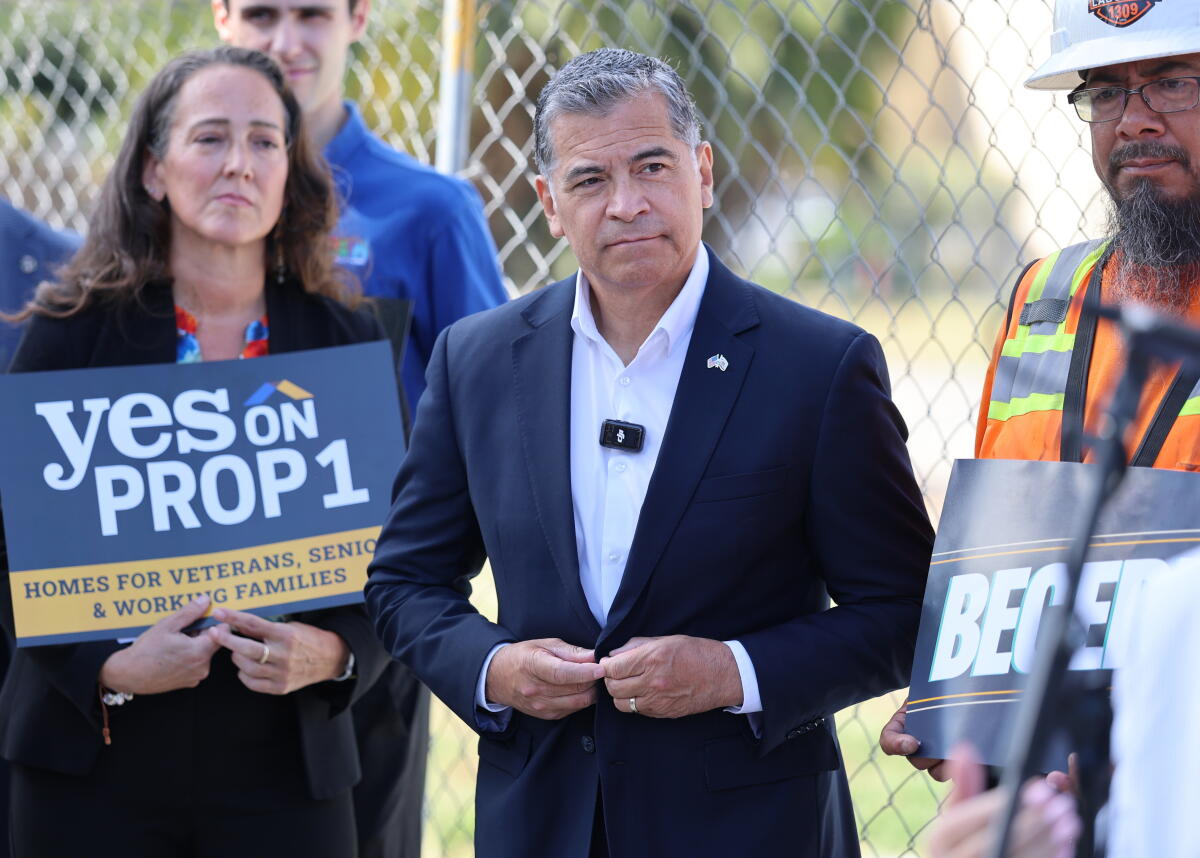
“As the son of immigrants, thank you for everything you did for your children, your grandchildren, to give them that chance,” former U.S. Health and Human Services Secretary Xavier Becerra told two airport workers who asked the candidates questions about cuts to state services for immigrants.

“I will make sure you have the right to access the doctor you and your family need. I will make sure you have a right to have a home that will keep you safe and off the streets. I will make sure that I treat you the way I would treat my parents, because you worked hard the way they did.”

The Democrats broadly agreed on most of the pressing issues facing California, so they tried to differentiate themselves based on their records and their priorities.

Candidates for California's next governor.

Candidates for California’s next governor including Tony Thurmond, speaking at left, participate in the 2026 Gubernatorial Candidate Forum in Los Angeles on Saturday.

(Christina House/Los Angeles Times)

“I firmly believe that your campaign says something about who you will be when you lead. The fact that I don’t take corporate contributions is a point of pride for me, but it’s also my chance to tell you something about who I am and who I will fight for,” said former Rep. Katie Porter.

“Look, we’ve had celebrity governors. We’ve had governors who are kids of other governors, and we’ve had governors who look hot with slicked back hair and barn jackets. You know what? We haven’t had a governor in a skirt. I think it’s just about … time.”

Former Los Angeles Mayor Antonio Villaraigosa, seated next to Porter, deadpanned, “If you vote for me, I’ll wear a skirt, I promise.”

Villaraigosa frequently spoke about his roots in the labor movement, including a farmworker boycott when he was 15 years old.

“I’ve been fighting for immigrants my entire life. I have fought for you the entire time I’ve been in public life,” he said. “I know [you] are doing the work, working in our buildings, working at the airport, working at the stadiums. I’ve talked to you. I’ve worked with you. I’ve fought for you my entire life. I’m not a Johnny-come-lately to this unit.”

The candidates were not asked about a proposed ballot measure to tax the assets of billionaires that one of SEIU-USWW’s sister unions is trying to put on the November ballot. The controversial proposal has divided Democrats and prompted some of the state’s wealthiest residents to move out of the state, or at least threaten to do so.

But several of the candidates talked about closing tax loopholes and making sure the wealthy and businesses pay their fair share of taxes.

“We’re going to hold corporations and billionaires accountable. We’re going to be sure that we are returning power to the workers who know how to grow this economy,” said former state Controller Betty Yee.

State Supt. of Public Instruction Tony Thurmond highlighted his proposal to tax billionaires to fund affordable housing, healthcare and education.

“And then I’m going to give you, everyone in this room and California working people, a tax credit so you have more money in your pocket, a couple hundred dollars a month, every month, for the rising cost of gas and groceries,” he said.

Billionaire hedge fund founder Tom Steyer said closing corporate tax loopholes would result in $15 billion to $20 billion in new annual state revenue that he would spend on education and healthcare programs.

“When we look at where we’re going, it’s not about caring, because everyone on this stage cares. It’s not about values. It’s about results,” he said, pointing to his backing of successful ballot measures to close a corporate tax loophole, raise tobacco taxes, and stop oil-industry-backed efforts to roll back environmental law.

“I have beaten these special interests, every single time with the SEIU,” he said. “We’ve done it. We’ve been winning. We need to keep fighting together. We need to keep winning together.”

Republican gubernatorial candidates were not invited to the labor gathering. But two of the state’s top GOP contenders were among the five candidates who appeared Saturday afternoon at a “Patriots for Freedom” gubernatorial forum at Calvary Chapel WestGrove in Orange County. Immigration, federal enforcement and homelessness were also among the hot topics there.

Days after Bianco met with unhoused people on Skid Row in downtown Los Angeles and Newsom touted a 9% decrease in the number of unsheltered homeless people during his final state of the state address, Bianco said that he would make it a “crime” for anyone to utter the word “homeless,” arguing that those on the street are suffering from drug- and alcohol-induced psychosis, not a lack of shelter.

Former Fox News commentator Steve Hilton criticized the “attacks on our law enforcement offices, on our ICE agents who are doing their job protecting our country.”

“We are sick of it,” he said at the Garden Grove church while he also questioned the state’s decision to spend billions of dollars for healthcare for low-income undocumented individuals. State Democrats voted last year to halt the enrollment of additional undocumented adults in the state’s Medi-Cal program starting this year.

Source link

Villaraigosa strikes gubernatorial tone in State of the City speech

Mayor Antonio Villaraigosa on Tuesday laid out a second-term agenda weighted heavily toward the creation of environmentally friendly jobs to rescue Los Angeles from its economic malaise but warned of serious pain ahead as the city digs out of a half-billion-dollar budget shortfall.

Delivering his fourth State of the City speech since taking office, Villaraigosa’s remarks struck the tone of a Democratic candidate for governor, with scorching critiques of both Sacramento lawmakers and Washington conservatives.

Villaraigosa denounced the “politics of no” as he called for a green technology hub along the west side of the Los Angeles River to attract new jobs and start-up companies.

“We need to build a future in which clean technology is as synonymous with Los Angeles as motion pictures or aerospace,” said the mayor, appearing at the Harbor City factory of Balqon Corp., which manufactures electric big-rigs for use at the city’s ports.

During his 33-minute address, Villaraigosa also promised to provide care for families decimated by job losses and foreclosures, to turn over failing L.A. schools to charter operators and to press ahead with his expansion of the Los Angeles Police Department. Portions of his ambitious agenda hinge on the city securing hundreds of millions of dollars from President Obama’s stimulus package.

By focusing so heavily on environmental themes, Villaraigosa delivered an upbeat message to accompany the dire scenario City Hall now faces: an estimated $530-million hole in its upcoming budget, two pension systems severely battered by investment losses and a city workforce that is being asked to choose between wage reductions or layoffs of thousands of employees.

“He found a way to give a realistic speech while still finding opportunities to be optimistic,” said Villaraigosa ally Richard Katz, who serves with the mayor on the board of the Metropolitan Transportation Authority.

Villaraigosa called on the city’s powerful public-employee unions to embrace wage and benefit concessions, saying it was the only path to prevent layoffs and protect city services. The mayor, who will release his 2009-10 budget Monday, called for immediate action and warned residents that the budget shortfall could grow to nearly $1 billion next year.

At least one union leader was cool to the mayor’s suggestion, saying that his members preferred early retirement packages and “no steps backwards” on existing contracts. “The mayor’s proposals are off base,” Bob Schoonover, president of the Service Employees International Union Local 721, said in a statement.

As a centerpiece of his speech, Villaraigosa reintroduced his plan for a “green” industry corridor just east of downtown that would serve as a spawning ground for environmentally conscious businesses. The speech echoed Villaraigosa’s message during his recent reelection campaign, when he promised to make Los Angeles “the greenest big city in America.”

Over the last four years, Villaraigosa has pushed the Port of Los Angeles to replace up to 17,000 diesel trucks with cleaner-burning models. And at the Department of Water and Power, he has pressed officials to expand the utility’s reliance on renewable sources of energy — primarily wind, solar and geothermal power.

Villaraigosa’s green agenda, combined with his emphasis on public safety and concessions from public employee unions, could broaden his appeal to moderates in California, some political experts said.

“If you’re going to pick a statewide theme that will afford you safe ground, there’s probably no better topic now than the green movement and the environment,” said San Jose State political scientist Larry Gerston, who is keeping a close watch on the early political maneuvering of potential contenders in the 2010 governor’s race.

Still, Villaraigosa’s drive to create green jobs has hit some roadblocks in recent months. Measure B, the solar initiative that he backed in the March 3 election, narrowly went down to defeat despite the use of television commercials that featured the mayor.

Meanwhile, the union leader who largely conceived of the energy plan has been highly critical of Villaraigosa’s other environmental initiatives at the DWP, including efforts to secure solar power sources in the Mojave Desert and geothermal power in Imperial County. Brian D’Arcy, who heads the union that represents DWP workers, has also criticized some of Villaraigosa’s environmental allies, saying that they are more interested in their clean energy benefactors than they are in the needs of Los Angeles.

Either way, Villaraigosa’s emphasis on job creation and the environment only fueled speculation that he would use similar themes next year in a run for statewide office. “It sounded gubernatorial,” said City Councilwoman Janice Hahn, who attended the speech.

phil.willon@latimes.com

david.zahniser@latimes.com

Times staff writer Maeve Reston contributed to this report.

Source link

Commentary: California made them rich. Now billionaires flee when the state asks for a little something back.

California helped make them the rich. Now a small proposed tax is spooking them out of the state.

California helped make them among the richest people in the world. Now they’re fleeing because California wants a little something back.

The proposed California Billionaire Tax Act has plutocrats saying they are considering deserting the Golden State for fear they’ll have to pay a one-time, 5% tax, on top of the other taxes they barely pay in comparison to the rest of us. Think of it as the Dust Bowl migration in reverse, with The Monied headed East to grow their fortunes.

The measure would apply to billionaires residing in California as of Jan. 1, 2026, meaning that 2025 was a big moving year month among the 200 wealthiest California households subject to the tax.

The recently departed reportedly include In-n-Out Burger owner and heiress Lynsi Snyder, PayPal co-founder and conservative donor Peter Thiel, Venture Capitalist David Sacks, co-founder of Craft Ventures, and Google co-founder Larry Page, who recently purchased $173 million worth of waterfront property in Miami’s Coconut Grove. Thank goodness he landed on his feet in these tough times.

The principal sponsor behind the Billionaire Tax Act is the Service Employees International Union-United Healthcare Workers West (SEIU-UHW), which contends that the tax could raise a $100 billion to offset severe federal cutbacks to California’s public education, food assistance and Medicaid programs.

The initiative is designed to offset some of the tax breaks that billionaires received from the One Big Beautiful Bill Act recently passed by the Republican-dominated Congress and signed by President Trump.

According to my colleague Michael Hiltzik, the bill “will funnel as much as $1 trillion in tax benefits to the wealthy over the next decade, while blowing a hole in state and local budgets for healthcare and other needs.”

The drafters of the Billionaire Tax Act still have to gather around 875,000 signatures from registered voters by June 24 for the measure to qualify on November’s ballot. But given the public ire toward the growing wealth of the 1%, and the affordability crisis engulfing much of the rest of the nation, it has a fair chance of making it onto the ballot.

If the tax should be voted into law, what would it mean for those poor tycoons who failed to pack up the Lamborghinis in time? For Thiel, whose net worth is around $27.5 billion, it would be around $1.2 billion, should he choose to stay, and he’d have up to five years to pay it.

Yes, it’s a lot … if you’re not a billionaire. It’s doubtful any of the potentially affected affluents would feel the pinch, but it could make a world of difference for kids depending on free school lunches, or folks who need medical care but can’t afford it because they’ve been squeezed by a system that places much of the tax burden on them.

According to the California Budget & Policy Center, the bottom fifth of California’s non-elderly families, with an average annual income of $13,900, spend an estimated 10.5% of their incomes on state and local taxes. In comparison, the wealthiest 1% of families, with an average annual income of $2.0 million, spend an estimated 8.7% of their incomes on state and local taxes.

“It’s a matter of values,” Rep. Ro Khanna (D-Fremont) posted on X. “We believe billionaires can pay a modest wealth tax so working-class Californians have Medicaid.”

Many have argued losing all that wealth to other states will hurt California in the long run.

Even Gov. Gavin Newsom has argued against the measure, citing that the wealthy can relocate anywhere else to evade the tax. During the New York Times DealBook Summit last month, Newsom said, “You can’t isolate yourself from the 49 others. We’re in a competitive environment.”

He has a point, as do others who contend that the proposed tax may hurt California rather then help.

Sacks signaled he was leaving California by posting an image of the Texas flag on Dec. 31 on X and writing: “God bless Texas.” He followed with a post that read, “As a response to socialism, Miami will replace NYC as the finance capital and Austin will replace SF as the tech capital.”

Arguments aside, it’s disturbing to think that some of the richest people in the nation would rather pick up and move than put a small fraction of their vast California-made — or in the case of the burger chain, inherited — fortunes toward helping others who need a financial boost.

Source link

State opens new prison psychiatric center

California prison officials have opened a new psychiatric center for inmates, contending the $24-million treatment facility is proof the state is ready to shed federal oversight of mental-health care for prisoners.

The new building at the California Medical Facility in Vacaville will provide outpatient treatment for mentally ill inmates who do not require 24-hour care. Its opening was accompanied by positioning for the courts.

“It’s time for the federal courts to recognize the progress the state has made and end costly and unnecessary federal oversight,” Jeffrey Beard, secretary of the Department of Corrections and Rehabilitation, said in prepared remarks.

The kind of care that California gives mentally ill inmates is the subject of fierce contention in U.S. District Court, where the state has filed a legal bid to end federal oversight as well as lift prison population caps that California concedes it cannot currently meet. A document filed Friday shows state’s prison population remains 49% above what the facilities were designed to hold, with Central California Women’s Facility at 82% above its design capacity.

In anticipation of also filing in court a request to end federal healthcare oversight, state officials have announced they intend this week to bring a group of Texas experts to inspect three prisons. Lawyers for inmates have asked a federal judge to allow them to accompany the state’s experts on their inspection tour. Lawyers for the state argue that doing so would be an “impermissible invasion into privileged communications.”

Judge Thelton Henderson in San Francisco has scheduled a hearing Tuesday morning to consider the dispute.

paige.stjohn@latimes.com

Source link

Federal judge blocks Trump administration’s freeze of $10 billion in child-care funds

A federal judge in New York has temporarily blocked the Trump administration’s move to freeze $10 billion in child-care funds in five Democrat-led states including California.

The ruling Friday afternoon capped a tumultuous stretch that began earlier this week when the U.S. Department of Health and Human Services told California officials and those in Colorado, Illinois, Minnesota and New York that it would freeze federal funding over fraud concerns.

On Thursday the states sued the administration in federal court in Manhattan. The states sought a temporary restraining order, asking the court to block the funding freeze and the administration’s demands for large volumes of administrative data.

An attorney for the states argued Friday morning that there was an immediate need for funding — and that withholding it would cause chaos by depriving families of their ability to pay for child care, and would harm child-care providers who would lose income.

In a brief ruling, Judge Arun Subramanian said that “good cause has been shown for the issuance of a temporary restraining order.”

The White House did not immediately respond to a request for comment.

The federal government’s effort has been viewed as a broad attack on social services in California, and jolted tens of thousands of working families and the state’s child-care industry. Providers told The Times that the funding freeze could imperil child-care centers, many of which operate on slim margins.

“The underscoring issue is that child care and these other federally funded social services programs are major family supports,” said Nina Buthee, executive director of EveryChild California. “They are essential infrastructure that our communities need and depend on, and should not be political tools. So the fact that this judge went in and blocked this very dramatic freeze, I think is only a good thing.”

In a trio of Jan. 6 letters addressed to Gov. Gavin Newsom, the U.S. Department of Health and Human Services said it was concerned there had been “potential for extensive and systemic fraud” in child care and other social services programs that rely on federal funding, and had “reason to believe” that the state was “illicitly providing illegal aliens” with benefits.

The letters did not provide evidence to support the claims. State officials have said the suggestions of fraud are unsubstantiated.

Newsom has said he welcomes any fraud investigations the federal government might conduct, but said cutting off funding hurts families who rely on the aid. According to the state Legislative Analyst’s Office, about $1.4 billion in federal child-care funding was frozen per the letters from Health and Human Services.

“You want to support families? You believe in families? Then you believe in supporting child care and child-care workers in the workforce,” Newsom told MS NOW.

After Subramanian issued the ruling, Newsom’s press office said on X that “the feds went ghost-hunting for widespread ‘fraud’ (with no evidence) — and ended up trying to rip child care and food from kids.”

“It took a federal judge less than 24 hours to shut down Trump’s politically motivated child care cuts in California,” the account posted.

In instituting the freeze, Health and Human Services had said it would review how the federal money had been used by the state, and was restricting access to additional money amid its inquiries. The federal government asked for various data, including attendance documentation for child care. It also demanded beefed-up fiscal accountability requirements.

“Again and again, President Trump has shown a willingness to throw vulnerable children, seniors, and families under the bus if he thinks it will advance his vendetta against Democratic-led states,” Bonta said in a statement following the ruling. “Cutting funding for childcare and other family assistance is cruel, reckless, and most importantly, illegal.”

For Laura Pryor, research director at the California Budget & Policy Center, it is “a sigh of relief.”

Source link

Josh Shapiro running for 2nd term as Pennsylvania governor, trailed by talk of 2028 White House bid

Pennsylvania Gov. Josh Shapiro is running for a second term in the pivotal battleground state after a first term that put him on the Democratic Party’s radar as a potential presidential contender in 2028.

He made the formal announcement Thursday at an event at a carpenters’ union hall in Pittsburgh and, later, at a similar event in Philadelphia. Shapiro’s announcement demonstrated a unified party behind him — including introductions by the state party chair, labor leaders and top local Democratic officials — as he ticked off his accomplishments during a nearly 30-minute speech.

Shapiro warned that his opponents promise “darkness and division and extremism,” and — without mentioning President Trump by name — he slammed the “chaos and toxicity” emanating from Washington, D.C., that he said threatened livelihoods, rights and freedoms.

“Every step of the way, I’ve stood up for my fellow Pennsylvanians, sometimes in a court of law and other times simply refusing to back down, refusing to cast certain Pennsylvanians aside and always by speaking truth to power,” Shapiro said.

He added, “I will not let anyone mess with Pennsylvania and I will always have your backs.”

Although Shapiro hasn’t disclosed any ambitions for higher office, his reelection effort will be closely watched as another test of whether he’s White House material.

Ever since he won the governor’s office in a near-landslide victory in 2022, Shapiro has been mentioned alongside Democratic contemporaries like California Gov. Gavin Newsom, Illinois Gov. JB Pritzker, Maryland Gov. Wes Moore and others as someone who could lead a national ticket.

Shapiro, 52, has already made rounds outside Pennsylvania. Last year, he campaigned for Democrats running for governor in New Jersey and Virginia, and he’s a frequent guest on Sunday talk shows that can shape the country’s political conversation.

He was also considered as a potential running mate for Kamala Harris in 2024. She chose Minnesota Gov. Tim Walz instead.

A pivotal first term as governor

Shapiro’s first term repeatedly put him in the spotlight.

He was governor when Pennsylvania was the site of the first attempted assassination of Trump; the capture of Luigi Mangione in the killing of United Healthcare Chief Executive Brian Thompson; and the murder of three police officers in the state’s deadliest day for law enforcement since 2009.

Last year, an arsonist tried to kill Shapiro by setting the governor’s official residence on fire in the middle of the night. Shapiro had to flee with his wife, children and members of his extended family, and the attack made him a sought-out voice on the nation’s recent spate of political violence.

As Shapiro settled into the governor’s office, he shed his buttoned-down public demeanor and became more plain-spoken.

He pushed to quickly reopen a collapsed section of Interstate 95 in Philadelphia, debuting his new and profane governing slogan — “get s— done” — at a ceremony for the completed project.

He crossed the partisan divide over school choice to support a Republican-backed voucher program, causing friction with Democratic lawmakers and allies in the state.

Shapiro regularly plays up the need for bipartisanship in a state with a politically divided Legislature, and positions himself as a moderate on energy issues in a state that produces the most natural gas after Texas.

He’s rubbed elbows with corporate executives who are interested in Pennsylvania as a data center destination and thrust Pennsylvania into competition for billions of dollars being spent on energy, manufacturing and artificial intelligence.

A repeat winner in competitive territory

Shapiro has enjoyed robust public approval ratings and carries a reputation as a disciplined messenger and powerhouse fundraiser. For 2026, Pennsylvania’s Republican Party endorsed Stacy Garrity, the twice-elected state treasurer, to challenge Shapiro.

Garrity has campaigned around Pennsylvania and spoken at numerous Trump rallies in the battleground state, but she is untested as a fundraiser and will have to contend with her relatively low profile as compared with Shapiro.

Shapiro, meanwhile, keeps a busy public schedule and has gone out of his way to appear at high-profile, nonpolitical events like football games, a NASCAR race and onstage at a Roots concert in Philadelphia.

He is a regular on TV political shows, podcasts and local sports radio shows, and became a leading pro-Israel voice among Democrats and Jewish politicians amid the Israel-Hamas war, confronting divisions within the Democratic Party over the war.

He has tempered it with calls for more aid for Gaza’s residents and criticism of Prime Minister Benjamin Netanyahu’s handling of the war, but some activists argued against him being the party’s nominee for vice president in 2024.

Harris, in her recent book, wrote that she passed on Shapiro after determining that he wouldn’t be a good fit for the role.

Shapiro, she wrote, “mused that he would want to be in the room for every decision,” and she “had a nagging concern that he would be unable to settle for a role as number two and that it would wear on our partnership.” Shapiro disputed the characterization.

An audition on the 2026 campaign trail

In a September appearance on NBC News’ “Meet the Press,” the host, Kristen Welker, asked him whether he’d commit to serving a full second term as governor and whether he’d rule out running for president in 2028.

“I’m focused on doing my work here,” he said, sidestepping the questions.

His supposed White House aspirations — which he’s never actually admitted to in public — are also mentioned frequently by Garrity.

“We need somebody that is more interested in Pennsylvania and not on Pennsylvania Avenue,” Garrity said recently on a radio show in Philadelphia. On Thursday, the Republican Governors Assocn. accused Shapiro of being “more focused on his political ambitions” than leading Pennsylvania.

For his part, Shapiro criticizes Garrity as too eager to get Trump’s endorsement to be an effective advocate for Pennsylvania.

In any case, the campaign trail could afford Shapiro an opportunity to audition for a White House run.

For one thing, Shapiro has been unafraid to criticize Trump, even in a swing state won by Trump in 2024. As governor, Shapiro has joined or filed more than a dozen lawsuits against Trump’s administration, primarily for holding up funding to states.

He has lambasted Trump’s tariffs as “reckless” and “dangerous,” Trump’s threats to revoke TV broadcast licenses as an “attempt to stifle dissent” and Trump’s equivocation on political violence as failing the “leadership test” and “making everyone less safe.”

Many of Shapiro’s would-be competitors in a Democratic primary won’t have to run for office before then.

Newsom is term-limited, for instance. Others — like ex-Transportation Secretary Pete Buttigieg — aren’t in public office. A couple of other governors in the 2028 conversation — Moore and Pritzker — are running for reelection this year.

Levy writes for the Associated Press.

Source link

Newsom moves to reshape who runs California’s schools under budget plan

Gov. Gavin Newsom on Thursday unveiled a sweeping proposal to overhaul how California’s education system is governed, calling for structural changes that he said would shift oversight of the Department of Education and redefine the role of the state’s elected schools chief.

The proposal, which is part of Newsom’s state budget plan that will be released Friday, would unify the policymaking State Board of Education with the department, which is responsible for carrying out those policies. The governor said the change would better align education efforts from early childhood through college.

“California can no longer postpone reforms that have been recommended regularly for a century,” Newsom said in a statement. “These critical reforms will bring greater accountability, clarity, and coherence to how we serve our students and schools.”

Few details were provided about how the role of the state superintendent of public instruction would change, beyond a greater focus on fostering coordination and aligning education policy.

The changes would require approval from state lawmakers, who will be in the state Capitol on Thursday for Newsom’s last State of the State speech in his final year as governor.

The proposal would implement recommendations from a 2002 report by the state Legislature, titled “California’s Master Plan for Education,” which described the state’s K-12 governance as fragmented and “with overlapping roles that sometimes operate in conflict with one another, to the detriment of the educational services offered to students.” Newsom’s office said similar concerns have been raised repeatedly since 1920 and were echoed again in a December 2025 report by research center Policy Analysis for California Education.

“The sobering reality of California’s education system is that too few schools can now provide the conditions in which the State can fairly ask students to learn to the highest standards, let alone prepare themselves to meet their future learning needs,” the Legislature’s 2002 report stated. Those most harmed are often low-income students and students of color, the report added.

“California’s education governance system is complex and too often creates challenges for school leaders,” Edgar Zazueta, executive director of the Assn. of California School Administrators, said in a statement provided by Newsom’s office. “As responsibilities and demands on schools continue to increase, educators need governance systems that are designed to better support positive student outcomes.”

The current budget allocated $137.6 billion for education from transitional kindergarten through the 12th grade — the highest per-pupil funding level in state history — and Newsom’s office said his proposal is intended to ensure those investments translate into more consistent support and improved outcomes statewide.

“For decades the fragmented and inefficient structure overseeing our public education system has hindered our students’ ability to succeed and thrive,” Ted Lempert, president of advocacy group Children Now, said in a statement provided by the governor’s office. “Major reform is essential, and we’re thrilled that the Governor is tackling this issue to improve our kids’ education.”

Source link

California sues Trump admin over $10-billion freeze in child-care funds

California is suing the Trump administration over its “baseless and cruel” decision to freeze $10 billion in federal funding for child care and family assistance allocated to California and four other Democratic-led states, Atty. Gen. Rob Bonta announced Thursday.

The lawsuit was filed jointly by the five states targeted by the freeze — California, New York, Minnesota, Illinois and Colorado — over the Trump administration’s allegations of widespread fraud within their welfare systems. California alone is facing a loss of about $5 billion in funding, including $1.4 billion for child-care programs.

The lawsuit alleges that the freeze is based on unfounded claims of fraud and infringes on Congress’ spending power as enshrined in the U.S. Constitution. The White House did not immediately respond to a request for comment.

“This is just the latest example of Trump’s willingness to throw vulnerable children, vulnerable families and seniors under the bus if he thinks it will advance his vendetta against California and Democratic-led states,” Bonta said at a Thursday evening news conference.

The $10-billion funding freeze follows the administration’s decision to freeze $185 million in child-care funds to Minnesota, where federal officials allege that as much as half of the roughly $18 billion paid to 14 state-run programs since 2018 may have been fraudulent. Amid the fallout, Gov. Tim Walz has ordered a third-party audit and announced that he will not seek a third term.

Bonta said that letters sent by the U.S. Department of Health and Human Services announcing the freeze Tuesday provided no evidence to back up claims of widespread fraud and misuse of taxpayer dollars in California. The freeze applies to the Temporary Assistance for Needy Families program, the Social Services Block Grant program and the Child Care and Development Fund.

“This is funding that California parents count on to get the safe and reliable child care they need so that they can go to work and provide for their families,” he said. “It’s funding that helps families on the brink of homelessness keep roofs over their heads.”

Bonta also raised concerns regarding Health and Human Services’ request that California turn over all documents associated with the state’s implementation of the three programs. This requires the state to share personally identifiable information about program participants, a move Bonta called “deeply concerning and also deeply questionable.”

“The administration doesn’t have the authority to override the established, lawful process our states have already gone through to submit plans and receive approval for these funds,” Bonta said. “It doesn’t have the authority to override the U.S. Constitution and trample Congress’ power of the purse.”

The lawsuit was filed in federal court in Manhattan and marked the 53rd suit California had filed against the Trump administration since the president’s inauguration last January. It asks the court to block the funding freeze and the administration’s sweeping demands for documents and data.

Source link

Newsom offers a sunny view of California to combat Trump’s darkness

In a State of the State speech that largely ignored any talk of the big, fat budget black hole that threatens to swallow the California dream, Gov. Gavin Newsom instead laid out a vision of the Golden State that centers on inclusivity and kindness to combat Trump’s reign of darkness and expulsion.

In a week dominated by news of immigration authorities killing a Minnesota mother; acknowledgment that “American First” really means running Venezuela for years to come; and the U.S. pulling even further out of global alliances, Newsom offered a soothing and unifying vision of what a Democratic America could look like.

Because, of course, far more than a tally of where we are as a state, the speech served as a likely road map of what a run for president would sound like if (or when) Newsom officially enters the race. In that vein, he drove home a commitment to both continuing to fight against the current administration, but also a promise to go beyond opposition with values and goals for a post-Trump world, if voters choose to manifest such a thing.

It was a clear volley against Republicans’ love of using California as the ultimate example of failed Democratic policies, and instead positioning it as a model.

“This state, this people, this experiment in democracy, belongs not to the past, but to the future,” Newsom told the packed Legislative chamber Thursday. “Expanding civil rights for all, opening doors for more people to pursue their dreams. A dream that’s not exclusive, not to any one race, not to any one religion, or class. Standing up for traditional virtues — compassion, courage, and commitment to something larger than our own self-interest — and asserting that no one, particularly the president of the United States, stands above the law.”

Perhaps the most interesting part of Thursday’s address was the beginning — when Newsom went entirely off script for the first few minutes, ribbing the Republican contingent for being forced to listen to nearly an hourlong speech, then seeming to sincerely thank even his detractors for their part in making California the state it is.

“I just want to express gratitude every single person in this chamber, every single person that shaped who we are today and what the state represents,” Newsom said, even calling out Assemblymember Carl DeMaio, one of his most vociferous foes, who released a questionable AI-generated “parody” video of Newsom in response to the speech.

It was in his off-the-cuff remarks where Newsom gave the clearest glimpse of what he might look like as a candidate — confident, at ease, speaking to both parties in a respectful way that the current president, who has labeled Democrats as enemies, refuses to do. Of course, he’d likely do all that during a campaign while continuing his lowbrow online jabbing, since the online world remains a parallel reality where anything goes.

But in person, at least, he was clearly going for classy over coarse. And gone is the jargon-heavy Newsom of past campaigns, or the guarded Newsom who tried to keep his personal life personal. His years of podcasts seem to have paid off, giving him a warmer, conversational persona that was noticeably absent in earlier years, and which is well-suited to a moment of national turmoil.

Don’t get me wrong — Newsom may or may not be the best pick for Democrats and voters in general. That’s up to you. I just showed up to this dog-and-pony show to get a close-up look at the horse’s teeth before he hits the track. And I’ve got to say, whether Newsom ends up successful or not in an Oval Office run, he’s a ready contender.

Beyond lofty sentiments, there was a sprinkling of actual facts and policies. Around AI, he hinted at greater regulation, especially around protecting children.

“Are we doing enough?” he asked, to a few shouts of “No,” from the crowd. This should be no surprise since his wife, Jennifer Siebel Newsom, has made oversight of artificial intelligence a priority in her own work.

Other concrete policy callouts included California’s commitment to increasing the number of people covered by health insurance, even as the federal government seeks to shove folks off Medicaid. In that same wellness bucket, he touted a commitment to getting processed foods out of school cafeterias and launching more medications under the state’s own generic drug label, including an $11 insulin pen launched last week.

On affordability, he found common ground with a proposal Trump put out this week as well — banning big investors from buying up single family homes. Although in California this is less of a problem than in some major housing markets, every house owned by a big investor is one not owned by a first-time buyer. Newsom called on the Legislature to work on a way to curtail those big buyers.

He also hit on our high minimum wage, especially for certain industries such as fast food ($20 an hour) and healthcare ($25 an hour), compared with states where the federal minimum wage still holds sway at just more than $7 an hour.

And on one of his most vulnerable points, homelessness, where Republicans and Trump in particular have attacked California, he announced that unsheltered homelessness decreased by 9% across the state in 2025 — though the data backing that was not immediately available. He also said that thousands of new mental health beds, through billions in funding from Proposition 1 in 2024, are beginning to come online and have the potential to fundamentally change access to mental health care in the state in coming years. This July, a second phase of Proposition 1 will bring in $1 billion annually to fund county mental health care.

Newsom will release his budget proposal on Friday, with much less fanfare. That’s because the state is facing a huge deficit, which will require tough conversations and likely cuts. Those are conversations about the hard work of governing, ones that Newsom likely doesn’t want to publicize. But Thursday was about positioning, not governing.

“In California, we are not silent,” Newsom said. “We are not hunkering down. We are not retreating. We are a beacon.”

It may not be a groundbreaking stand to have a candidate that understands politics isn’t always a battle of good and evil, but instead a negotiation of viewpoints. It’s surely a message other Democrats will embrace, one as basic as it is inspiring in these days of rage and pain.

But Newsom is staking that territory early, and did it with an assurance that he explained in a recent Atlantic profile.

He’d rather be strong and wrong than weak and right — but strong and righteous is as American as it gets.

Source link

Gov. Ron DeSantis calls for special session in April to redraw Florida’s congressional districts

Florida Gov. Ron DeSantis said Wednesday he plans to call a special session in April for the Republican-dominated Legislature to draw new congressional districts, joining a redistricting arms race among states that have redrawn districts mid-decade.

Even though Florida’s 2026 legislative session starts next week, DeSantis said he wanted to wait for a possible ruling from the U.S. Supreme Court on a key provision of the Voting Rights Act. The ruling in Louisiana vs. Callais could determine whether Section 2, a part of the Voting Rights Act that bars discrimination in voting systems, is constitutional. The governor said “at least one or two” districts in Florida could be affected by the high court’s ruling.

“I don’t think it’s a question of if they’re going to rule. It’s a question of what the scope is going to be,” DeSantis said at a news conference in Steinhatchee, Fla. “So, we’re getting out ahead of that.”

Currently, 20 of Florida’s 28 congressional seats are held by Republicans.

Congressional districts in Florida that are redrawn to favor Republicans could carry big consequences for President Trump’s plan to reshape congressional districts in GOP-led states, which could give Republicans a shot at winning additional seats in the midterm elections and retaining control of the closely divided U.S. House.

Nationwide, the unusual mid-decade redistricting battle has so far resulted in a total of nine more seats Republicans believe they can win in Texas, Missouri, North Carolina and Ohio — and a total of six more seats Democrats expect to win in California and Utah, putting Republicans up by three. But the redrawn districts are being litigated in some states, and if the maps hold for 2026, there is no guarantee the parties will win the seats.

In 2010, more than 60% of Florida voters approved a constitutional amendment prohibiting the drawing of district boundaries to unfairly favor one political party in a process known as gerrymandering. The Florida Supreme Court, however, last July upheld a congressional map pushed by DeSantis that critics said violated the “Fair Districts” amendment.

After that decision, Florida House Speaker Daniel Perez last August announced the creation of a select committee to examine the state’s congressional map.

Florida Senate Democratic Leader Lori Berman said in a statement that what DeSantis wants the Legislature to do is clearly illegal.

“Florida’s Fair Districts Amendment strictly prohibits any maps from being drawn for partisan reasons, and regardless of any bluster from the governor’s office, the only reason we’re having this unprecedented conversation about drawing new maps is because Donald Trump demanded it,” Berman said. “An overwhelming majority of Floridians voted in favor of the Fair Districts Amendment and their voices must be respected. The redistricting process is meant to serve the people, not the politicians.”

In a statement, the Florida Democratic Party called the move by DeSantis “reckless, partisan and opportunistic.”

“This is nothing more than a desperate attempt to rig the system and silence voters before the 2026 election,” the statement said. “Now, after gutting representation for Black Floridians just three years ago, Ron is hoping the decimation of the Voting Rights Act by Trump’s Supreme Court will allow him to further gerrymander and suppress the vote of millions of Floridians.”

Michael McDonald, a political science professor at the University of Florida, said the state already has a fairly strong Republican gerrymander, so it would be difficult for Republicans to pick up additional seats, unless they’re planning to draw “noncompact districts that squiggle all over the place” and then hold the election before a judge can throw out the map. McDonald said DeSantis also could be trying to shore up Republican strongholds to mitigate the losses generally experienced by the party in power during midterm elections.

“Trump’s approval ratings are pretty low,” McDonald said. “And so looking at what we would expect to happen in November, unless something fundamentally changes in the country between now and then, we expect the Democrats to have a very good year.”

Schneider and Fischer write for the Associated Press.

Source link

Newsom’s final State of the State speech steeped in rosy view of California, his record as governor

In his final State of the State address, Gov. Gavin Newsom will look to define his legacy by touting California’s economic and policy achievements while casting the state as a counterweight to dysfunction in Washington.

The speech, which he will deliver Thursday morning to lawmakers in the Capitol, highlights economic strength, falling homelessness and expanded education funding, while also offering a glimpse of how Newsom is positioning himself beyond his final year in office.

In a summary of the speech provided Thursday morning, Newsom portrayed California as a financial powerhouse that strives to help those in need and works diligently to address its own shortcomings, including high housing costs, unlike the chaotic Trump administration. Newsom, who has acknowleged that he is considered a 2028 bid for president, argues that the state is positioned not just to endure the moment but to help shape what comes next nationally.

Newsom is expected to announce an estimated 9% drop statewide in unsheltered homelessness last year, addressing a topic that has been a persistent political vulnerability for the two-term governor and former San Francisco mayor. Despite some improvements, California has been home to nearly a quarter of the nation’s homeless population, according to the Public Policy Institute of California.

Newsom also said two of his top priorities — the mental health program known as CARE Court and Proposition 1, the statewide bond measure he championed to provide funding for mental health and homelessness — are achieving results ahead of schedule, with counties now equipped with funding, authority and tools to combat the crisis.

Calling affordability a multi-layered crisis, Newsom is expected to signal a tougher stance toward the buying spree of homes by private equity and institutional investors in California. That message is a rare point of rhetorical overlap with Trump, who has said the United States should bar such practices because they push prices beyond the reach of many Americans.

Newsom offered a few previews of select budget priorities, with his office set to unveil the full proposed budget on Friday. The governor will announce that the state would set a record on per-student funding in public schools and fully fund universal transitional kindergarten under his budget proposal. He is also expected to announce a major shift in how the state oversees education, unifying the policymaking State Board of Education with the California Department of Education, which is responsible for carrying out those policies.

The address will mark the first time in five years that Newsom delivers a State of the State from the Assembly rostrum. His last in-person address came shortly before COVID-19 shut down the Capitol in early 2020.

Last year, he delivered his written remarks unusually late, in September, during which he said the state was under siege by the Trump administration — which he accused of dismantling public services, flouting the rule of law and using extortion to bully businesses and universities — all while California grappled with the aftermath of the devastating Los Angeles County fires, spiraling housing costs and an uneven economic recovery.

Like past speeches, Newsom will tout the successes of California, now the world’s fourth-largest economy.

Source link

Tim Walz isn’t the only governor plagued by fraud. Newsom may be targeted next

Former vice presidential contender and current aw-shucks Minnesota Gov. Tim Walz announced this week that he won’t run for a third term, dogged by a scandal over child care funds that may or may not be going to fraudsters.

It’s a politically driven mess that not coincidentally focuses on a Black immigrant community, tying the real problem of scammers stealing government funds to the growing MAGA frenzy around an imaginary version of America that thrives on whiteness and Christianity.

Despite the ugliness of current racial politics in America, the fraud remains real, and not just in Minnesota. California has lost billions to cheats in the last few years, leaving our own governor, who also harbors D.C. dreams, vulnerable to the same sort of attack that has taken down Walz.

As we edge closer to the 2028 presidential election, Republicans and Democrats alike will probably come at Gavin Newsom with critiques of the state’s handling of COVID-19 funds, unemployment insurance and community college financial aid to name a few of the honeypots that have been successfully swiped by thieves during his tenure.

In fact, President Trump said as much on his social media barf-fest this week.

“California, under Governor Gavin Newscum, is more corrupt than Minnesota, if that’s possible??? The Fraud Investigation of California has begun,” he wrote.

Right-wing commentator Benny Johnson also said he’s conducting his own “investigation.” And Republican gubernatorial candidate Steve Hilton is claiming his fraud tip line has turned up “(c)orruption, fraud and abuse on an epic scale.”

Just to bring home that this vulnerability is serious and bipartisan, Rep. Ro Khanna, the Silicon Valley congressman rumored to have his own interest in the Oval Office, is also circling the fraud feast like a vulture eyeing his next meal.

“I want to hear from residents in my district and across the state about waste, mismanagement, inefficiencies, or fraud that we must tackle,” Khanna wrote on social media.

Newsom’s spokesman Izzy Gardon questioned the validity of many fraud claims.

“In the actual world where adults govern,” Gardon said, “Gavin Newsom has been cleaning house. Since taking office, he’s blocked over $125 BILLION in fraud, arrested criminal parasites leaching off of taxpayers, and protected taxpayers from the exact kind of scam artists Trump celebrates, excuses, and pardons.”

What exactly are we talking about here? Well, it’s a pick-your-scandal type of thing. Even before the federal government dumped billions in aid into the states during the pandemic, California’s unemployment system was plagued by inefficiencies and yes, scammers. But when the world shut down and folks needed that government cash to survive, malfeasance skyrocketed.

Every thief with a half-baked plan — including CEOs, prisoners behind bars and overseas organized crime rackets — came for California’s cash, and seemingly got it. The sad part is these weren’t criminal geniuses. More often than not, they were low-level swindlers looking at a system full of holes because it was trying to do too much too fast.

In a matter of months, billions had been siphoned away. A state audit in 2021 found that at least $10 billion had been paid out on suspicious unemployment claims — never mind small business loans or other types of aid. An investigation by CalMatters in 2023 suggested the final figure may be up to triple that amount for unemployment. In truth, no one knows exactly how much was stolen — in California, or across the country.

It hasn’t entirely stopped. California is still paying out fraudulent unemployment claims at too high a rate, totaling up to $1.5 billion over the last few years — more than $500 million in 2024 alone, according to the state auditor.

But that’s not all. Enterprising thieves looked elsewhere when COVID-19 money largely dried up. Recently, that has been our community colleges, where millions in federal student aid has been lost to grifters who use bots to sign up for classes, receive government money to help with school, then disappear. Another CalMatters investigation using data obtained from a public records request found that up to 34% of community college applications in 2024 may have been false — though that number represents fraudulent admissions that were flagged and blocked, Gardon points out.

Still, community college fraud will probably be a bigger issue for Newsom because it’s fresher, and can be tied (albeit disingenuously) to immigrants and progressive policies.

California allows undocumented residents to enroll in community colleges, and it made those classes free — two terrific policies that have been exploited by the unscrupulous. For a while, community colleges didn’t do enough to ensure that students were real people, because they didn’t require enough proof of identity. This was in part to accommodate vulnerable students such as foster kids, homeless people and undocumented folks who lacked papers.

With no up-front costs for attempting to enroll, phonies threw thousands of identities at the system’s 116 schools, which were technologically unprepared for the assaults. These “ghost” students were often accepted and given grants and loans.

My former colleague Kaitlyn Huamani reported that in 2024, scammers stole roughly $8.4 million in federal financial aid and more than $2.7 million in state aid from our community colleges. That‘s a pittance compared with the tens of billions that was handed out in state and federal financial aid, but more than enough for a political fiasco.

As Walz would probably explain if nuanced policy conversations were still a thing, it’s both a fair and unfair criticism to blame these robberies on a governor alone — state government should be careful of its cash and aggressive in protecting it, and the buck stops with the governor, but crises and technology have collided to create opportunities for swindlers that frankly few governmental leaders, from the feds on down, have handled with any skill or luck.

The crooks have simply been smarter and faster than the rest of us to capitalize first on the pandemic, then on evolving technology including AI that makes scamming easier and scalable to levels our institutions were unprepared to handle.

Since being so roundly fleeced during the pandemic, multiple state and federal agencies have taken steps in combating fraud — including community colleges using their own AI tools to stop fake students before they get in.

And the state is holding thieves accountable. Newsom hired a former Trump-appointed federal prosecutor, McGregor Scott, to go after scam artists on unemployment. And other county, state and federal prosecutors have also dedicated resources to clawing back some of the lost money.

With the slow pace of our courts (burdened by their own aging technology), many of those cases are still ongoing or just winding up. For example, 24 L.A. County employees were charged in recent months with allegedly stealing more than $740,000 in unemployment benefits, which really is chump change in this whole mess.

Another California man recently pleaded guilty to allegedly cheating his way into $15.9 million in federal loans through the Paycheck Protection Program and Economic Injury Disaster Loan programs.

And in one of the most colorful schemes, four Californians with nicknames including “Red boy” and “Scooby” allegedly ran a scam that boosted nearly $250 million in federal tax refunds before three of them attempted to murder the fourth to keep him from ratting them out to the feds.

There are literally hundreds of cases across the country of pandemic fraud. And these schemes are just the tip of the cash-berg. Fraudsters are also targeting fire relief funds, food benefits — really, any pot of public money is fair game to them. And the truth is, the majority of that stolen money is gone for good.

So it’s hard to hear the numbers and not be shocked and angry, especially as the Golden State is faced with a budget shortfall that may be as much as $18 billion.

Whether you blame Newsom personally or not for all this fraud, it’s hard to be forgiving of so much public money being handed to scoundrels when our schools are in need, our healthcare in jeopardy and our bills on an upward trajectory.

The failure is going to stick to somebody, and it doesn’t take a criminal mastermind to figure out who it’s going to be.

Source link