state

More than half a million ballots seized by top GOP candidate in California governor’s race

Riverside County Sheriff Chad Bianco, who is a leading Republican candidate for governor, has seized more than 650,000 ballots from last November’s election and is investigating whether they were fraudulently counted.

“This investigation is simple: Physically count the ballots and compare that result with the total votes recorded,” Bianco said at a news conference Friday.

The unusual probe drew a sharp rebuke from California Atty. Gen. Rob Bonta, who said in a statement Friday that it is “unprecedented in both scope and scale” and appears “not to be based on facts or evidence.”

“There is no indication, anywhere in the United States, of widespread voter fraud,” Bonta said. “Counts, recounts, hand counts, audits, and court cases all support this.”

According to Bonta’s office, Bianco’s department on Feb. 26 seized about 1,000 boxes of ballot materials in Riverside County related to the November election for Proposition 50, which temporarily redrew the state’s congressional districts to favor Democrats in response to partisan redistricting in Republican states, including Texas.

The sheriff said his investigators are looking into allegations by a local citizens group that “did their own audit” and found that the county’s tally was falsely inflated by more than 45,000 votes — a claim that local election officials have rejected.

President Trump, who remains fixated on his 2020 election loss, continues to amplify election conspiracy theories and has repeatedly called for the federal government to “nationalize” state-run elections to counter what he says is widespread fraud.

Bonta and California Secretary of State Shirley Weber, both Democrats, have vowed to fight federal interference that could affect voting in California, including efforts to seize election records, as the FBI recently did in Georgia.

Bianco is an outspoken Trump supporter who said in an endorsement video in 2024 that, after 30 years of putting criminals in jail, he figured it was “time to put a felon in the White House — Trump 2024, baby” — referencing Trump’s conviction by a New York jury for falsifying business records while paying hush money to a porn actor.

Bianco’s investigation, which includes all the ballots cast in Riverside County in November, raises questions about how he would handle the election denialism movement if elected governor.

A poll released last week by UC Berkeley’s Institute of Governmental Studies and co-sponsored by The Times showed Bianco and conservative commentator Steve Hilton leading the crowded field of gubernatorial candidates by slim margins, in a left-leaning state.

Last fall, Proposition 50 passed in Riverside County with 56% of the vote — a margin of more than 82,000 ballots.

A citizens group called the Riverside Election Integrity Team has said it performed an audit finding that 45,896 more ballots were counted than were cast.

In a lengthy February presentation to the Riverside County Board of Supervisors, Registrar of Voters Art Tinoco disputed that figure, saying it was based on a misunderstanding of raw data that had not been fully processed.

The actual discrepancy, Tinoco said, was 103 votes, a variance of 0.016% that was far below what he said was the state’s preferred 2% margin of error for certifying results.

Bianco on Friday said that there “is no acceptable error, small or large, in our elections.”

The sheriff did not name the Riverside Election Integrity Team, but his description of the allegations brought to him by “a group of citizen volunteers” matched theirs.

Bianco said the investigation was “not a recount” for the Proposition 50 contest and was “just as much to prove the election is accurate as it is to show otherwise — we will not know until the count is complete.”

Bonta said his office has “attempted to work cooperatively” with the Sheriff’s Department to understand the basis for the probe. The sheriff, Bonta said, “has delayed, stonewalled, and otherwise refused to work with us in good faith” and failed to provide most of the requested documents.

“We’re concerned that there is not sufficient justification for seizing every ballot that was cast in this very largely populated county,” an official in Bonta’s office said in an interview Friday night.

In a March 4 letter to Bianco, the attorney general cited Bianco’s plan to use Sheriff’s Department staffers, “who are not trained and have no experience,” to count the ballots.

“Let me be clear: this is unacceptable,” Bonta wrote. “Your decision to seize ballots and begin counting them based on vague, unsubstantiated allegations about irregularities in the November special election results sets a dangerous precedent and will only sow distrust in our elections. You are also flagrantly violating my directives.”

At his news conference Friday, Bianco fired back by calling Bonta “an embarrassment to law enforcement.”

A Riverside County Superior Court judge, Bianco said, has ordered the appointment of a special master to oversee the ballot count.

In a statement Friday, Secretary of State Weber said “the Sheriff’s assertion that his deputies know how to count is admirable. The fact remains that he and his deputies are not elections officials and they do not have expertise in election administration.”


Source link

California lawmakers aim to apply a film and TV tax credit federally

California’s economy might see a boost from the state’s expanded film tax credits, but local lawmakers say it’s not enough.

Despite Gov. Gavin Newsom authorizing a $750-million film and TV tax credit program last summer, the impending merger between Paramount and Warner Bros., and the projected budget cuts that are expected to follow, has reignited fears about Hollywood jobs and U.S.-based productions.

“State programs cannot simply substitute for the kind of global, federal and competitive tax incentives that are needed to bring production back to American soil and stop its offshoring,” U.S. Sen. Adam Schiff (D-Calif.) said during a news conference Friday morning.

“We must act, and the urgency could not be greater,” he said. He revealed he is working on a bipartisan federal film incentive proposal that would be competitive with what other countries are offering for film productions.

He said the program isn’t about Hollywood’s stars; it’s about the jobs that productions create, including roles for set designers, carpenters and lighting crews.

“These are the people who make that magic happen. We want to keep those jobs here, and many of us are deeply concerned about what this potential merger will do to those jobs,” Schiff said.

Earlier this week, the California Film Commission revealed that 16 shows had recently received tax credits for filming in the state. The projects represent $871 million in qualified in-state spending and are expected to generate $1.3 billion in economic activity in California. Schiff said the state tax credit has generated more than $29.1 billion in motion picture production wages and supported more than 220,000 jobs.

Even as shows start to see gains in Southern California, Los Angeles film activity was still down 13.2% from July through September when compared with the same period in 2024. The downward trend extends the loss of 42,000 jobs in L.A. between 2022 and 2024, the continued suffering of local sound stages and the offshoring of productions internationally.

“Federal policymakers must act to level the playing field and make the U.S. film and television industry more competitive on the global stage,” said Matthew Loeb, the president of the International Alliance of Theatrical Stage Employees. “A globally competitive labor-based and tax incentive is. For us, production that supplements state incentives is essential to return and maintain film and television jobs in America.”

HBO Max’s medical drama “The Pitt” is filmed at one of Warner Bros. soundstages in Burbank and it’s one of the shows benefiting from California’s tax incentive.

Noah Wyle, the star and executive producer of the show, said during the news conference that “it’s really hard to shoot a TV show in Los Angeles, and it’s really expensive, prohibitively” — so adopting an economic model that allows productions to take full advantage of the California tax incentive was essential to “The Pitt” filming in L.A.

“As an Angeleno with generational roots to this city and as a seasoned member of its creative community, advocacy for Los Angeles-based production is something that is very close to my heart,” Wyle said.

“‘The Pitt’ has blessedly become proof of that speculative concept. I’m happy to report we’ll commence shooting season three this summer, and that a rising tide has indeed lifted all boats in season one under the 3.0 tax program,” he added.

The show received a 20% tax rebate on many above-the-line costs. The budget for one episode was approximately $6.6 million, so the show received a rebate of about $760,000 per episode. By the end of season one, the production was able to save over $11 million. Wyle estimated that the first season of “The Pitt” contributed around $125 million toward California’s gross domestic product.

Rep. Laura Friedman (D-Glendale), who is working with Schiff on production tax incentives, said that because California is already seeing benefits from the current program, there’s no reason it wouldn’t work nationally. Friedman added that tax incentives are a common practice among many industries in the U.S.

“Hollywood is not asking for special treatment. Whether it is computer chips, the energy sector or pharmaceuticals, this is something that is standard in the United States,” said Friedman. “In terms of our nation, Hollywood and its ability to tell the story of America, it is something worth saving.”

Source link

Newsom leads Harris for president among California Democrats, poll finds

Californians have never been forced to choose between Gavin Newsom and Kamala Harris, two homegrown political darlings, during any election.

But if the state’s registered Democrats picked now, Newsom would trounce Harris as their party’s next nominee for president and have the edge over other Democratic contenders, according to a poll released Friday by the UC Berkeley Institute of Governmental Studies and co-sponsored by The Times.

Twenty-eight percent of the California Democrats who were surveyed selected the governor as their top choice in the 2028 presidential election. U.S. Rep. Alexandria Ocasio-Cortez (D-New York) followed with 14% and former U.S. Transportation Secretary Pete Buttigieg received 11%. Harris came in fourth, with only 9% of voters in her own state naming her as their preferred Democratic nominee.

“It’s quite a positive result for Newsom,” said Mark DiCamillo, director of the Berkeley IGS Poll. “He’s separated himself from the rest of the pack, and especially when you compare him to the other major Californian in the considerations, he’s three times as much as Kamala. That’s quite impressive.”

The political careers of the governor and former vice president have orbited each other but never crossed since Newsom was sworn in as San Francisco’s mayor and Harris as the city’s district attorney on the same day in 2004. Now the two Bay Area natives are both flirting with the 2028 presidential contest as they travel the country promoting their life stories on respective book tours.

It’s early days and neither politician has said they will or won’t launch official campaigns for the Oval Office. The possibility remains that Californians might finally see a matchup that the two Democrats have long avoided.

Newsom set his sights on the governor’s office in 2010 before dropping out and running for lieutenant governor, a largely powerless post in which he served in the shadow of Gov. Jerry Brown for eight years. Harris won election that year as California attorney general.

Harris’ and Newsom’s paths diverged again when she chose to run for U.S. Senate in a 2016 contest to replace former Sen. Barbara Boxer and he announced his candidacy for governor in the 2018 election.

When Harris jumped into the 2020 and 2024 races for the White House, Newsom said he wouldn’t run against her. He’s discredited the idea that the two politicians have some kind of a sibling rivalry and noted that their trajectories ran adjacent and never collided.

Newsom was asked again last month whether he would vie against Harris in a presidential contest. The governor said he hasn’t “gotten in the way of her ambition ever,” and he doesn’t imagine that he would in the future. His answer changed when he was pressed to respond specifically to the potential for 2028.

“That’s fate. I don’t, I don’t know,” Newsom said to CNN’s Dana Bash, throwing up his hands. “You know, you can only control what you can control.”

Newsom and Harris had greater support from Black and Latino voters than white and Asian American Democrats in the new poll. She performed well among Democrats younger than 30 compared with other age groups, while Newsom fared better with older Democrats. More women selected Newsom as their first or second choice than they did Harris.

Neither California heavyweight performed particularly great among Democratic voters in the Bay Area, which DiCamillo called a curious finding for two politicians from the region. Support was higher for Harris and Newsom in almost every other region of the state.

DiCamillo believes the presence of Ocasio-Cortez on the list probably pulled some support from Harris. California voters in other recent polls were also sour on a third presidential run by Harris.

An Institute of Governmental Studies poll in August gauged interest in the potential candidacy of Newsom and Harris. About 45% of the state’s registered voters said they were enthusiastic about Newsom running, compared with 36% for Harris. Almost two-third of voters in that survey, and half of Democrats, said Harris should not run for president again.

Although Newsom clearly beat the field of candidates in the most recent poll, DiCamillo said receiving support from a little more than a quarter of those surveyed in his own backyard isn’t exactly wonderful. The governor’s approval rating is also down.

The poll found that 48% of California registered voters say they approve of the job Newsom is doing, with the same share disapproving of his performance. That marks a drop from 51% approval the last time DiCamillo asked in August. Disapproval also climbed, by 5 percentage points.

Voters held positive opinions about Newsom’s participation in international conferences, which was described in the poll as the governor “offering an alternative to the policies being promoted by President Trump on issues like climate change and the economy.” The poll found 59% of statewide registered voters approve and 37% disapprove.

Cristina G. Mora, co-director of the poll, said the results suggest Newsom’s more aggressive stance with Trump seems to resonate in his own state.

“Though Californians may hold mixed views on his gubernatorial tenure, they overwhelmingly see him as the strongest counter to Trump and MAGA candidates,” Mora said. “Harris’s earlier presidential defeat, compounded by persistent voter biases against women and candidates of color, may also be shaping these early numbers.”

The Berkeley IGS/Times poll surveyed 5,019 California registered voters online in English and Spanish from March 9 to 14. The results are estimated to have a margin of error of 2.5 percentage points in either direction in the overall sample, and larger numbers for subgroups.

Source link

Trump administration investigates states mandating abortion coverage

The Trump administration said Thursday that it has launched investigations into 13 states that require state-regulated health insurance plans to cover abortion.

The inquiries are the latest in a long-running dispute between the political parties on how to interpret a provision, known as the Weldon Amendment, that’s included in federal spending laws each year. It bars states from discriminating against health entities that don’t provide, cover or refer for abortion.

When Democrat Joe Biden was president, the U.S. Department of Health and Human Services’ civil rights office said the provision didn’t pertain to employers or other healthcare sponsors. The Trump administration said this year that it does.

The administration says that potentially puts states with abortion coverage requirements in violation of the law, because they may not allow employers or other healthcare issuers to opt out. It said it was sending out letters to gather more information from those states.

The Health and Human Services civil rights office launched the investigations “to address certain states’ alleged disregard of, or confusion about, compliance with the Weldon Amendment,” office Director Paula M. Stannard said in a statement.

“Under the Weldon Amendment, health care entities, such as health insurance issuers and health plans, are protected from state discrimination for not paying for, or providing coverage of, abortion contrary to conscience. Period,” Stannard said.

The states with the coverage requirements are California, Colorado, Delaware, Illinois, Maine, Maryland, Massachusetts, Minnesota, New Jersey, New York, Oregon, Vermont and Washington. All except Vermont have Democratic governors.

New Jersey Gov. Mikie Sherrill said in a statement Thursday that she’ll defend her state’s policies.

“New Jersey requires health insurance plans to follow all applicable laws, including protecting women’s reproductive freedom. So Donald Trump’s latest ‘investigation’ is nothing but a fishing expedition wasting taxpayers’ money,” she said.

The Weldon Amendment is one of a series of provisions known as conscience laws, which provide legal protections for individuals and healthcare entities that choose to not provide abortions or other types of care because of religious or moral objections.

In the years since it was enacted in 2005, there’s been a “partisan swing” in how broadly or narrowly it is interpreted depending on which party is in office, according to Mary Ziegler, a law professor at UC Davis.

Ziegler said the fact that employers and plan sponsors are not mentioned among healthcare entities in the text of the Weldon Amendment could give Democrats an edge with their interpretation, but the question has yet to be resolved in court.

Elizabeth Sepper, a law professor at the University of Texas at Austin, said the Heritage Foundation’s massive policy proposal known as Project 2025 called for an incoming Trump administration to withhold Medicaid funding for states found to violate the Weldon Amendment.

“What we’re seeing here is the fulfillment of a promise to the religious right,” she said.

President Trump’s first administration in 2020 moved to withhold federal healthcare funding from California over what it interpreted as a Weldon Amendment violation, but the Biden administration entered office the next year and reversed the decision.

Mulvihill and Swenson write for the Associated Press.

Source link

State Department has cut jobs with deep expertise in Middle East as Iran crisis escalates

In the escalating war in Iran, the State Department’s Bureau of Near Eastern Affairs would ordinarily be at the center of the geopolitical fray.

Typically led by a veteran diplomat, the bureau’s role would be to coordinate U.S. foreign policy across an 18-country region, much of which has become a chaotic battlefield scarred by drone and missile strikes as the U.S. and Israel remain locked in conflict with Iran.

The Trump administration for a time put Mora Namdar, a lawyer of Iranian descent with limited management experience, in charge before later moving her to a different post. One of her credentials was her contribution to Project 2025, a conservative think tank’s blueprint for the second Trump administration. Namdar’s last Senate-confirmed predecessor was a longtime Middle East expert who had been with the department since 1984 and had served as the U.S. ambassador to the United Arab Emirates.

Now that bureau is also working with far fewer resources. The administration’s most recent budget proposed a 40% cut to the bureau, though Congress eventually enacted less dramatic cuts. The administration also eliminated the dedicated Iran office, merging it with the Iraq office.

Staff reductions and management choices hamper emergency response

These kinds of personnel and management choices — coupled with President Trump’s moves to shrink government and confine decision-making to a tight circle — are limiting the ability of the United States to handle a global emergency, according to interviews with more than a dozen current and former U.S. officials, many of whom recently left government.

In divisions of the State Department that typically would handle the Iran response, numerous veteran diplomats with decades of collective experience were fired, retired or were reassigned — replaced by more junior officials or political appointees. The administration cut more than 80 staffers in Near Eastern Affairs, according to numbers compiled by a State Department employee who was terminated last year based on surveys of colleagues. (The department does not release official figures on Foreign Service officer staffing levels but did not dispute the number.)

The Trump administration has left the assistant secretary position in charge of Near Eastern Affairs vacant, along with key ambassadorships in the Middle East. Four of the five supervisors in the bureau have temporary titles.

The current and former officials, some of whom asked for anonymity to discuss sensitive internal matters during an active conflict, paint a portrait of an understaffed government workforce struggling to execute the president’s agenda. Those who remain tell colleagues that their analysis, recommendations and advice go unheeded.

The State Department vigorously disputed those assessments.

“As far as we can tell, AP’s entire ‘report’ on the evacuations does not include any conversations with people actually involved. Instead, it relies on ‘outside’ or ‘former official’ sources that have no idea what they are talking about. We walked AP through specific inaccuracy after specific inaccuracy — indeed how the whole premise was wrong,” State Department spokesman Tommy Pigott said.

More than 3,800 State Dept. employees departed since Trump took office

The State Department saw a departure of more than 3,800 employees since President Trump took office through a combination of reductions in force, staffers taking the Fork in the Road deferred resignation plan and ordinary retirements. According to estimates by the American Foreign Service Association, the labor union that represents foreign service officers, senior foreign service ranks were disproportionately represented in the layoffs compared to their share of the overall workforce.

“He’s making choices without the larger expertise of the United States government that would flag issues of consequence,” said Max Stier, CEO of the nonpartisan Partnership for Public Service, a nonprofit group that studies federal workforce issues. “Sometimes government is slow-moving because there are a lot of different factors that need to be balanced against each other.”

For instance, the administration appears to have been caught off guard by what would happen once the U.S. struck Iran — something Trump himself acknowledged this week when he expressed surprise that Tehran retaliated with strikes on American allies in the region. “Nobody expected that. We were shocked. They fought back,” Trump told reporters this week.

Pigott said staffing reductions “are not having any negative impact on our ability to respond to this operation, our ability to plan, and our ability to execute in service to Americans.” He added that the department “rejects the premise that key decisions were made without meaningful input from experienced professionals.”

But Iranian retaliation on U.S. allies was predictable, according to former officials, as well as previous war games and conflict models run by both the U.S. military and private organizations. The National Security Council, which Trump has pared, typically would have presented the president with analysis from experts within the bureaucracy.

Instead, decisions are made by a small group of officials close to the president without the planning or coordination of the larger machinery of government, including Secretary of State Marco Rubio, who also serves as the president’s national security adviser.

“In the Trump Administration, decisions are made by President Trump and senior administration officials and not by no-name bureaucrat leakers who whine to the press about not being consulted about highly classified operations,” White House spokesperson Dylan Johnson said.

Advice from career officials often went unheeded

“In the time that I was there, there was no policy process to speak of,” said Chris Backemeyer, who served in Near Eastern Affairs as a deputy assistant secretary of state before resigning last year. Backemeyer was a major proponent of the Iran deal that Trump abandoned. He recently left government to run for Congress as a Democrat in Nebraska.

“They did not want to hear any advice from career people,” said Backemeyer.

Namdar was later moved to be the head of Consular Affairs, the part of the department responsible for providing assistance to American citizens overseas and issuing visas to foreign visitors.

When the U.S. made the decision to strike Iran, Ambassador to Israel Mike Huckabee offered embassy staff in Jerusalem the opportunity to evacuate — a sign that he knew strikes were coming. But some other embassies in the region did not make similar arrangements — leaving nonessential personnel and their families stranded in a war zone.

The department said it has been issuing travel warnings since January and was fully staffed to handle the crisis the moment the strikes were launched.

Evacuation planning was chaotic

Still, little planning appears to have gone into how to evacuate the Americans who were living, working, visiting or studying in many of the countries that became engulfed in the conflict — in part because the White House seems to have underestimated the possibility of the strikes expanding into a prolonged multi-country war, as evidenced by Trump’s own remarks.

After Iranian attacks on allies like Saudi Arabia, Qatar and the United Arab Emirates, the State Department began calling for Americans to leave the region. But numerous former Consular Affairs staffers say such planning should have begun long before U.S. strikes started.

In a statement posted to social media, Namdar only told Americans to evacuate several days into the conflict, when airspace was largely closed and many commercial flights were unavailable.

“The messaging that went out to American citizens — after the U.S. struck Iran — was woefully late and, initially, confusing,” said Yael Lempert, who served as U.S. ambassador to Jordan until 2025. Lempert is one of five former ambassadors expected to speak about the department’s failures at an event Thursday at the American Academy of Diplomacy in Washington.

Other poorly executed evacuations, such the Biden administration’s withdrawal from Afghanistan, have drawn criticism.

But this time they’re compounded by the loss of experienced people, officials say. Consular Affairs has lost more than 150 jobs in the Trump administration due to a combination of reductions in force, dismissals of probationary employees and retirements, according to a U.S. official who asked for anonymity — though other parts of the department were hit much harder.

The department notes that it has offered assistance to nearly 50,000 Americans impacted by the conflict, with more than 60 flights evacuating citizens from the region. In total, the department says more than 70,000 Americans have been able to return home since the outbreak of hostilities on Feb. 28.

Democrat says personnel reduction imperiled safety

“The loss of experienced personnel through these RIFs has clearly undermined the Bureau of Consular Affairs’ ability to fulfill its most important mission, to protect Americans abroad,” Sen. Jeanne Shaheen, the top Democrat on the Senate Foreign Relations Committee, said in a statement.

Language skills at the department are also atrophying. Thirteen Arabic speakers and four Farsi speakers, all trained at taxpayer expense, were among employees let go, according to a draft letter being circulated by former foreign service officers.

It can cost $200,000 to train a foreign service officer in a language. The letter estimates that the total number of people fired by the State Department in the name of efficiency received more than $35 million in taxpayer-funded language training and more than $100 million in total training and other career development.

The State Department has set up two temporary task forces to deal with the crisis in the Middle East. One aims to bolster the capacities of Near East Affairs and another is aimed at helping Consular Affairs evacuate Americans.

A group of more than 250 Foreign Service officers were part of the administration’s reduction-in-force last year but still remain on the State Department’s payroll. Many have volunteered to return to the department to work on either a task force or do any other job that needs to be done with the outbreak of a global crisis.

“I haven’t been given any separation paperwork. I still have an active clearance. I could go back to the department tomorrow, either to backfill or staff a task force,” said one foreign service officer who asked for anonymity because they are still technically on the department’s payroll and are not authorized to speak to the press. “I will do the scutwork jobs.”

The department hasn’t responded to their offer but said in a statement that the task force is “fully staffed.”

Tau writes for the Associated Press.

Source link

Eight state attorneys general file suit to block TV station group merger

A group of attorneys general are taking legal action to block Nexstar Media Group’s proposed $6.2-billion acquisition of Tegna’s TV stations, calling the deal bad for consumer cable bills and local journalism.

A lawsuit filed Wednesday in U.S. District Court in Sacramento says the proposed deal by eight state law enforcers, including California Atty. Gen. Rob Bonta, claims the proposed deal will give Nexstar too much control of local TV stations, ultimately hurting consumers by diminishing the diversity of news sources in their markets.

Bonta said in a statement that the deal will cause “irreparable harm to local news and consumers who rely on their reporting as a critical source of information.” The plaintiffs also include state attorneys general in Colorado, Connecticut, Illinois, New York, North Carolina, Oregon and Virginia.

The Irving, Texas-based Nexstar is currently the largest station owner in the U.S., with 164 outlets including KTLA in Los Angeles. If the merger with Tegna succeeds, Nexstar would have 265 TV stations reaching 80% of the U.S. and multiple outlets in a number of markets.

The suit also claims that the merger would give Nexstar too much leverage in negotiating fees from pay-TV providers that carry their stations. Higher fees paid to Nexstar would be passed along to consumers in their cable and satellite bills, the lawsuit asserts.

Most of Nexstar’s stations are affiliates of ABC, CBS, NBC and Fox, all of which carry NFL football, the highest-rated programming on TV by a wide margin. Disputes over carriage fees between station owners and pay-TV providers often result in blackouts and service interruptions to consumers.

DirecTV, which serves around 11 million pay-TV subscribers in the U.S., filed a similar lawsuit in the same court on Thursday, claiming the Nexstar deal will “irreparably drive up consumer costs, reduce local competition, shutter local newsrooms, and increase both the frequency and duration of blackouts of key local teams and network programming.”

A Nexstar representative did not respond to a request to comment.

President Trump has said he favors Nexstar’s proposed deal. But every major TV station owner believes consolidation in the TV station business is necessary to thrive going forward as they battle to compete with streaming video platforms that have eaten away at their audience share.

The companies say they are at a disadvantage in competing with tech companies by being limited to owning stations in 39% of the U.S., a cap that was set in 2003.

Nexstar recently cut veteran anchors and on-air reporters from its stations in Los Angeles, Chicago and New York. Further reductions in local TV newsrooms would occur if Nexstar succeeds in acquiring Tegna, which would likely mean consolidation of local newsrooms in which it owns more than one station.

Source link

Schools left wondering how to proceed after ruling on transitioning students

The Supreme Court broke new ground this month when it ruled the Constitution forbids school policies in California that prevent parents from being told about their child’s gender transition at school.

But the reach of this new parental right remains unclear.

Does it mean all parents have a right to be informed if their child is using a new name and pronouns at school?

Or is the right limited to parents who inquire and object to being “shut out of participation in decisions involving their children’s mental health,” as the high court said in Mirabelli vs. Bonta.

Both sides in this legal battle accuse the other of creating confusion and uncertainty. And that dispute has not subsided.

UC Davis law professor Aaron Tang says understanding the Supreme Court’s order calls for a close reading of the statewide injunction handed down by U.S. District Judge Roger Benitez in San Diego.

That order prohibits school employees from “misleading” or “lying” to parents. It did not say school officials and teachers had a duty to contact parents whenever they saw that a student changed their appearance or used a new name, he said.

By clearing this order to take effect, the Supreme Court’s decision “means that schools must tell parents the truth about their child’s gender presentation at school if the parents request that information,” Tang said.

“But the initial burden is on the parents. This is not a rule that schools have an affirmative obligation to inform any and all parents if their child is presenting as a different gender,” he said.

The high court’s 6-3 order also indicated the reach of the judge’s injunction was limited.

It “does not provide relief for all the parents of California public school students, but only those parents who object to the challenged policies or seek religious injunctions.”

Religious conservatives who sued say they seek to end “secret transition” policies that encourage students to adopt a new gender identity without their parents knowing about the change.

The lawsuit challenging California’s “parental exclusion” policies was first filed by two teachers in Escondido.

Peter Breen, an attorney for the Thomas More Society, said many of the parents in Escondido “had no clue” their children were undergoing a gender transition at school.

“We need to activate parents,” he said.

Ruling for them, Benitez said the state’s “parental exclusion policies are designed to create a zone of secrecy around a school student who expresses gender incongruity.”

His injunction also said schools must notify their employees that “parents and guardians have a federal constitutional right to be informed if their public school child expresses gender incongruence.”

The Supreme Court’s order cited a dramatic example of nondisclosure.

Two parents who joined the suit had gone to parent-teacher meetings and learned only after their eighth-grade daughter attempted suicide that she had been presenting as a boy at school and suffered from gender dysphoria.

John Bursch, an attorney for Alliance Defending Freedom, argues the Supreme Court’s opinion goes further to empower parents.

“Fairly read, the Mirabelli opinion creates an affirmative obligation on school officials to disclose,” he said. “It’s consistent with the way [the court] describes the parental right: ‘the right not to be shut out of participation in decisions regarding their children’s mental health.’ School officials’ silence (rather than lying) is not notice to and is shutting out parents.”

“All that said, the California attorney general is obviously not getting that message,” Bursch said.

He said the Supreme Court needs to go beyond an emergency order and fully decide a case that squarely presents the issue of parents rights.

“School officials should not be socially transitioning children without parental notice and consent. Period,” he said.

He filed an appeal petition with the Supreme Court in a case from Massachusetts that dissenting Justice Elena Kagan described as a “carbon copy” of the California dispute.

It takes only four votes to grant review of a case, but since November, the justices have repeatedly considered the case of Foote vs. Ludlow and taken no action.

The case is set to be considered again on Friday in the court’s private conference.

Meanwhile, California Atty. Gen. Rob Bonta went back to the 9th Circuit Court of Appeals seeking a clarification to limit the potential sweep of Benitez’s order.

He objected to the part of the judge’s order that said schools must post a notice that “parents and guardians have a federal constitutional right to be informed if their public school student child expresses gender incongruence.”

Bonta said that goes beyond what the Supreme Court approved.

This “could be understood to suggest that public school officials have an affirmative constitutional duty to inform parents whenever they observe a student’s expression of ‘gender incongruence,’ effectively imposing a mandatory ‘see something, say something’ obligation in all circumstances,” he said.

But the 9th Circuit said it would not act until he first presented this request to Benitez.

Meanwhile, transgender rights advocates say the voices and the views of students have been ignored.

“This case has been about states’ and parents’ rights but students have been left out of the conversation. Their voices have not been heard at all,” said Andrew Ortiz, an attorney for the Transgender Law Center. “School should be a place where young people can feel safe and confident they can confide in a teacher.”

“We’re hearing about fear and anxiety,” said Jorge Reyes Salinas, communications director for Equality California, the nation’s largest statewide LGBTQ+ civil rights organization.

“There are students who are unable to speak with their parents. Teachers can encourage them to have a conversation with their parents. But this will weaken the trust they have in their teachers,” he said.

In the past, the court had been wary of reaching into the public schools to decide on education policies and the curriculum, but it took a significant step in that direction last year.

In a Maryland case, the court said religious parents had a right to “opt out” their young children from classes that read “LGBTQ+-inclusive” storybooks.

The 1st Amendment protects the “free exercise of religion” and “government schools … may not place unconstitutional burdens on religious exercise,” wrote Justice Samuel A. Alito, the lone conservative who attended public schools.

The same 6-3 majority cited that precedent to block California school policies that protect the privacy of students and “conceal” information from inquiring parents if the student does not consent.

But the California case went beyond the religious-rights issue in the Maryland “opt out” case because it included a “subclass of parents” who objected without citing religion as the reason.

The justices ruled for them as a matter of parents’ rights.

“Parents — not the state — have primary authority with respect to the upbringing and education of children,” the court said.

That simple assertion touches on a sensitive issue for both the conservative and liberal wings of the court. It rests on the 14th Amendment’s clause that says no state may “deprive any person of life, liberty or property without due process of law.”

In the past, a liberal majority held that the protection for “liberty” included rights to contraceptives, abortion and same-sex marriages.

Conservatives fiercely objected to what was dubbed “substantive due process.”

In the California case, Kagan, speaking for the liberals in dissent, tweaked the conservatives for recognizing a new constitutional right without saying where it came from.

“Anyone remotely familiar with recent debates in constitutional law will understand why: Substantive due process has not been of late in the good graces of this Court — and especially of the Members of today’s majority,” she wrote.

She noted that when the court struck down the right to abortion in the Dobbs case, Justice Clarence Thomas said he would go further and strike down all the rights that rest on “substantive due process.”

In response to Kagan, Justice Amy Coney Barrett filed a concurring opinion that staked out a moderate conservative position.

Since 1997, the court has said it would stand behind rights that were “deeply rooted in the nation’s history and tradition,” she wrote. That includes “a parent’s right to raise her child … and the right to participate in significant decisions about her child’s mental health.”

She said California’s “non-disclosure policy” is unconstitutional and violates the rights of parent because it applies “even if parents expressly ask for information about their child’s gender identification,” she wrote.

Chief Justice John G. Roberts and Justice Brett M. Kavanaugh signed on to her opinion.

While Kagan dissented on procedural grounds, she did not disagree with bottom-line outcome.

“California’s policy, in depriving all parents of information critical to their children’s health and well-being, could have crossed the constitutional line,” she said. “And that would entitle the parents, at the end of the day, to relief.”

Source link

California’s proposed billionaire tax gains majority support in new poll, with a partisan split on voter ID

A new poll shows California voters are sharply divided over two brewing statewide ballot measures stirring up the nation’s partisan and economic divides: a one-time tax on billionaires to pay for mostly healthcare and a voter ID mandate that includes citizenship verification.

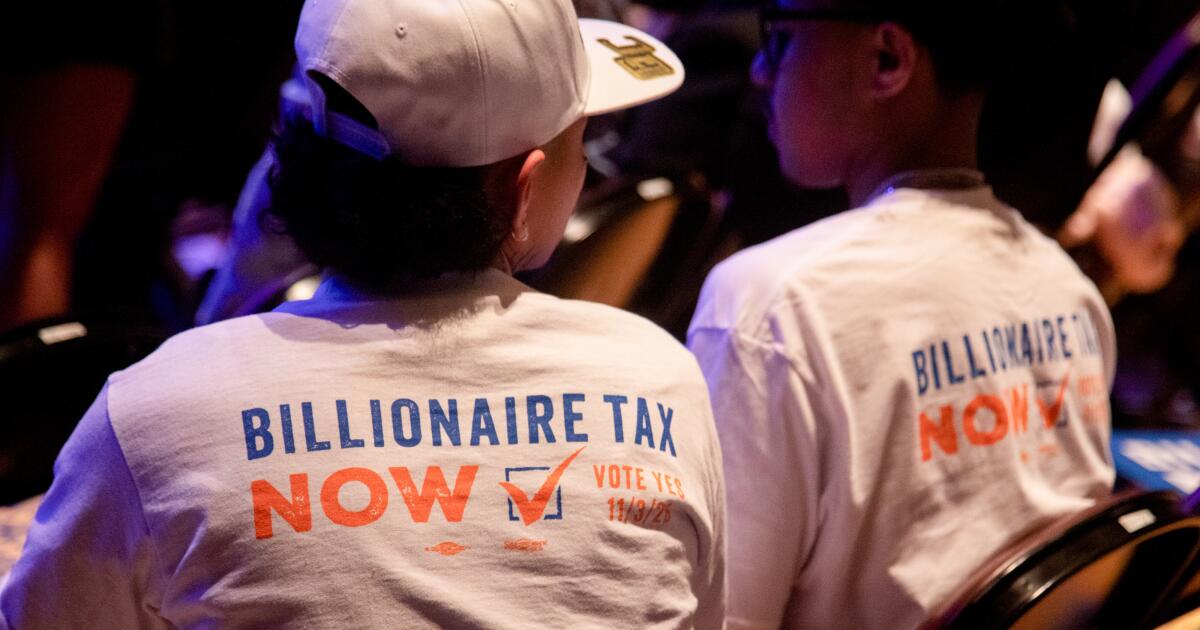
The survey conducted by UC Berkeley’s Institute of Governmental Studies and co-sponsored by The Times showed 52% of registered voters supported the billionaire’s tax, while 33% said they opposed it. Fifteen percent were undecided.

Support for the voter ID measure was more evenly split, with 44% of voters in support, 45% opposed and the remainder undecided.

The pair of statewide proposals, which have yet to qualify for California’s November ballot, emanated from opposite sides of California’s political spectrum. Organized labor and progressives are pushing hard for a new wealth tax in response to Republican cuts to federal healthcare programs, and the GOP-led call for additional voter restrictions comes in the wake of President Trump’s baseless claims that the 2020 election was stolen from him.

Poll director Mark DiCamillo said he “was a little surprised” by the results given how much attention each measure has already received.

“Just from reading the press accounts of these initiatives, I thought they would both be well ahead. There’s been a lot of discussion about them and advocates seem to be very confident in their chances of passage, but the polls seem to indicate otherwise,” he said.

The divisions over each measure fell largely along partisan and ideological lines.

On the billionaire’s tax initiative, 72% of Democratic voters said they would support the measure if the election were held today — and the same percentage of Republicans oppose it. A slim majority — 51% — of voters who are unaffiliated or registered with another party support the wealth tax, while 30% said they oppose it, with the remainder undecided.

Republican voters overwhelmingly support the voter ID initiative, with 91% saying they would vote for it. More than two-thirds of Democratic voters, 68%, said they would oppose the measure. No party preference voters appeared evenly split.

Neither ballot measure has officially qualified for the November ballot thus far, though proponents of the voter ID measure said this month that they turned in 1.3 million voter signatures to elections officials, well above the 875,000 required to qualify. Proponents of the new tax on billionaires have until June 24 to submit signatures to elections officials.

The billionaire tax has generated national news coverage and widespread debate over whether it would benefit low-income Californians or end up hurting the state’s tax base as billionaires move out of the state to avoid paying it.

The proposal is backed by the Service Employees International Union-United Healthcare Workers West, which represents 120,000 workers in California. Union leaders say that the tax would raise $100 billion to backfill steep cuts to federal healthcare programs under a sweeping tax and spending bill approved by the Republican-controlled Congress and signed in the summer by Trump.

The measure would impose a one-time 5% tax on the assets of California residents who are worth $1 billion or more, with options to pay it over multiple years.

According to SEIU-UHW, the new tax would apply to around 200 people in the state, though several wealthy tech leaders have made moves to change their residences and avoid paying the tax should it pass. In recent months, Meta Chief Executive Mark Zuckerberg, Google co-founders Larry Page and Sergey Brin and others have bought up lavish beachfront estates and new commercial office spaces in South Florida.

Some of those billionaires are also ponying up to defeat the measure. Brin, who according to Forbes is the world’s third-richest person, has contributed $45 million to a new ballot measure committee called Building a Better California, which is pushing an alternative statewide ballot measure that could scrap the billionaire’s tax.

Brandon Castillo, a veteran ballot measure campaign strategist who is not working on either of the two measures, said even though it’s currently polling above 50%, the billionaire’s tax is starting out “in a really shaky position.”

“This is not a very strong place to start,” he said. “That’s not to say they can’t keep this thing over 50%, but when you’re starting just barely above 50% and you have a tsunami of money and a huge campaign against you, it’s really hard to keep yourself at that level.”

Though previous public opinion polls at the state and national levels have shown broad support for requiring proof of citizenship to vote in elections, even among Democrats, the new Berkeley poll showed liberal voters are skeptical of the measure.

Proponents of voter ID contend that such laws prevent election fraud and, along with proof of citizenship mandates, prevent noncitizens from voting. Opponents say ID requirements threaten the fundamental constitutional rights of Americans who do not have the documentation readily available, and that the restrictions are unnecessary given that voting by noncitizens is rare and already outlawed in the U.S.

Under current law, Californians are not required to show or provide identification when casting a ballot in person or by mail. They are required to provide identification when registering to vote, and must swear under penalty of perjury, a felony, that they are eligible to vote and a U.S. citizen.

The poll showed that slim majorities of predominantly Spanish-speaking voters, voters who were born in another country and first-generation immigrants support the voter ID measure. A plurality of Latino voters also favor it, with 44% in support and 41% opposed.

But DiCamillo cautioned against reading too much into those numbers, noting that awareness of the measure is still relatively low.

“I’ve always seen in my history of measuring Latino voters’ support that they are relatively late deciders on most ballot measures,” he said. “How they break will be critical. I would say we’ll have to look at how they feel when we do our final preelection poll.”

Voter ID laws are also a top priority of Trump, who has pressured the Senate into taking up the SAVE Act, which would impose nationwide requirements for proof of citizenship to vote and already has passed the House of Representatives.

Castillo said Trump’s support could sway Democratic and liberal-leaning independents to vote against the measure.

Both DiCamillo and Castillo noted that with the November election still seven months away, voters are not paying much attention and those on either side of each ballot measure have not launched major campaigns yet.

“I suspect by the time election day comes around, these awareness numbers on the billionaire’s tax certainly are going to be much higher,” Castillo said. “You’re going to see 80-90% of voters familiar with it, just because they’re going to be inundated with advertising and earned media between now and November.”

The Berkeley IGS/Times poll surveyed 5,019 registered California voters online in English and Spanish from March 9 to 14. The results are estimated to have a margin of error of 2.5 percentage points in either direction in the overall sample, and larger numbers for subgroups.

Source link

Nigeria’s President Tinubu meets royals in UK state visit | US-Israel war on Iran News

With trade between the two countries at a record high, Charles is using the two-day visit to highlight the pair’s deep cultural and commercial links.

The UK’s King Charles III has welcomed Nigerian President Bola Tinubu at Windsor Castle in the first state visit by the leader of Africa’s most populous nation in nearly four decades.

More than 1,000 soldiers were out in force on Wednesday for the diplomatic show of soft power by the royal family.

Recommended Stories

list of 3 itemsend of list

With trade between the two countries at a record high, Charles is using the two-day visit to highlight the pair’s deep cultural and commercial links.

Tinubu has made less formal visits to the United Kingdom several times during his tenure, and the two countries remain major partners in trade, aid and defence. London is also home to a large Nigerian diaspora of about 300,000 people.

Nigeria’s presidency said the visit signalled a “renewed chapter” and reflected a shared commitment to “advancing trade and strengthening diplomatic ties”.

Calling the visit “historic”, London announced Nigerian companies, including banks, are expanding operations and creating hundreds of jobs in the UK, strengthening it as a global hub for African business.

Nigerian flags and Union Jacks

King Charles and Queen Camilla greeted the president and his wife in Windsor, west of London, as artillery fired salutes.

Both Nigerian flags and Union Jacks fluttered amid the procession.

The Nigerian president and his wife earlier chatted with heir-to-the-throne Prince William and his wife Catherine, at a hotel in the town.

The party then rode in carriages to the historic Windsor Castle.

Later, the king and queen showed the president and first lady items from the UK’s colonial rule of Nigeria, which existed until 1960.

Later on Wednesday evening, a lavish state banquet took place.

On Thursday, Tinubu is expected to meet British Prime Minister Keir Starmer, as well as members of the Nigerian community abroad, according to the official schedule.

Missing from the official schedule is the traditional meeting between the visiting head of state and the British opposition.

Conservative Party leader Kemi Badenoch, who is of Nigerian descent, has repeatedly publicly criticised the country she was raised in over corruption and violence.

The last Nigerian state visit to the UK took place in 1989, although Tinubu was received by Charles in September 2024.

Before the death of his mother, Queen Elizabeth II, in 2022, Charles also visited Nigeria four times as prince of Wales.

Tinubu’s visit went ahead, despite a deadly bombing in northeastern Nigeria’s Borno State on Monday, which killed 23 people and injured more than 100, with the president condemning the attacks and insisting “Nigeria will not succumb to fear.”

Source link

Montana senator pulls a fast one to boost preferred successor

For months, the senior U.S. senator from Montana pondered his political future.

Or so he said.

Wrapping up his second term and facing a glide path to a third, Steve Daines unexpectedly opted this month against seeking reelection, saying in an aw-shucksy video he planned to spend more time back home in Montana and enjoy more cherished moments with his seven grandkids.

Notably, after long “wrestling with this decision,” Daines announced his intent a scant two minutes after the deadline passed for candidates to put their names on the ballot. March 4 at 5:02 p.m local time, to be precise.

More notable still, Daines’ preferred successor, Republican former U.S. Atty. Kurt Alme, jumped into the race at 4:52 p.m. that very same day.

There are relay runners who might learn a thing or two from their timing and coordination.

As part of the seamless handoff, Alme was swiftly endorsed by President Trump, Montana’s Republican governor, Greg Gianforte, and its other Republican senator, Tim Sheehy, for all intents settling the GOP contest and, quite likely, choosing the state’s next member of the U.S. Senate.

Never mind what voters might have wished, or other prospective candidates might have had in mind.

“There are a lot of Republicans in the state, folks with political ambitions, who are extremely peeved right now,” said Kal Munis, a Montana native and political science professor at Auburn University, who closely tracks politics in his home state.

Moreover, Munis said, with enough notice a heavy-hitting Democrat might have entered the contest, instead of the lowly bunch now running hopeless campaigns.

Montana, which has a rich Democratic history, has become a solidly Republican state, though the makeover took some time to complete.

As recently as 2008, Barack Obama made a serious run there, losing to John McCain by less than 3 percentage points. Montana had a Democratic governor until Gianforte was elected in 2020 and a Democratic U.S. senator until Jon Tester was defeated in 2024.

Still, while Daines’ seat hardly appeared at great risk for the GOP, a fight for the party’s nomination might have been a costly distraction, diverting money and attention that could go elsewhere as Republican prospects for the midterm election grow increasingly dim. (An unpopular war and shaky economy that’s been knee-capped by a sudden spike in oil prices will do that.)

Of all people, Daines certainly appreciates the bigger political picture, having led Republicans’ Senate campaign committee during the 2024 cycle. So he and his allies short-circuited the election process by laying hands on Alme, who stepped down as U.S. attorney to sidle into the Senate.

Seth Bodnar was among those who quite rightly criticized Daines for, as Bodnar put it, having “so little respect for Montana Republicans that he withdrew at the last minute to coronate his handpicked successor instead of giving them a voice at the ballot box.”

It just goes to show, Bodnar suggested, “the disgusting arrogance of Washington politicians and their party bosses who trade power back and forth like candy.”

Bodnar, the former president of the University of Montana, is running for Senate as an independent, conspicuously steering clear of the toxic Democratic brand. There is speculation the high-handed behavior of Daines, Trump and other Republicans might be enough to give Bodnar’s steep-odds candidacy a decent shot in November.

Munis, for one, is doubtful.

“There are a number of activist types who are deeply angered by this,” he said. “But when it comes to tallying votes in an election, that’s just a drop in the bucket.”

Unfortunately, Daines’ scheming, stick-it-to-the-voters approach isn’t just a Montana Republican thing.

Democratic Rep. Chuy Garcia of Illinois announced in the fall that he would not seek a fifth term this year. The last-second move — which came after Garcia had earlier filed paperwork to run for reelection — made it so his chief of staff and preferred successor, Patty Garcia (no relation), was the only major Democrat to appear on the ballot, virtually guaranteeing her election in November.

The cynical maneuver so disgusted Rep. Marie Gluesenkamp Perez, a maverick Democrat from rural Washington state, that she defied party leaders and introduced a resolution rebuking Garcia.

His actions were “beneath the dignity of his office and incompatible with the spirit of the Constitution,” said Gluesenkamp Perez, who was jeered and booed by fellow Democrats during the floor debate for having the temerity — heavens to Betsy! — to put principle above knee-jerk partisanship. The measure passed the House, 236 to 183, with only 22 Democrats joining Gluesenkamp Perez in support.

In California, the law prevents incumbents from pulling off the kind of underhanded stunt that Garcia and Daines managed. That’s because the filing deadline is automatically extended for an extra five days whenever a sitting lawmaker opts against seeking another term.

So, for instance, when Rep. Darrell Issa suddenly announced this month he would not run for reelection, he endorsed his favored replacement, San Diego County Supervisor Jim Desmond, but couldn’t grease the process to see to it that Desmond takes his place.

Legislators in other states should pass a law like the one in California to prevent the undemocratic shenanigans that in effect neutered voters in Montana and the Chicago area.

That is, if they truly believe elections matter and voters should have a choice and not stand by powerless as their government representatives are anointed from on high.

Source link

‘The Pitt’ and a science show from Jimmy Kimmel get film tax credits

Even as California’s soundstages suffer from a slowdown in local production, the local economy may get a boost from the state’s expanded film tax credits.

Medical drama “The Pitt,” a “Family Guy” spin-off and a kids’ science competition show from late-night host Jimmy Kimmel are among the 16 shows that received tax credits for filming in the state, the California Film Commission said Wednesday.

In total, the projects represent $871 million in qualified in-state spending and are expected to generate $1.3 billion in economic activity in California. More than 4,500 cast and crew members will be employed across the 16 shows, along with more than 50,000 background actors, the film commission said.

New to this round of awardees are animated shows and competitions, which were added to the film and television tax credit program during its revamp last year. Under the program, producers can receive up to 25% of qualified production expenses back in the form of credits that they can apply toward tax bills they have in the state.

“California’s creative economy isn’t just part of who we are — it helps power this state forward,” Gov. Gavin Newsom said in a statement. “From the folks on the soundstage to the people designing the sets, these are jobs that anchor communities.”

HBO Max’s “The Pitt” received a credit of $24.2 million, while “Stewie,” a spin-off of Seth MacFarlane’s irreverent adult cartoon “Family Guy,” was awarded $6.4 million. Kimmel’s “Schooled!” competition show, which pits young scientists and their experiments against one another, secured $6.9 million.

Since the state’s production incentive program was bolstered last year, more than 100 films and TV projects have received tax credits.

But it has taken a while for those shows to jump-start local production, which has seen a sustained slump since the pandemic, the dual writers’ and actors’ strikes in 2023 and spending cutbacks at the studios.

That lag has affected the business of local soundstages.

For the first half of 2025, the average occupancy rate at Los Angeles County soundstages was 62%, slightly lower than the 63% average recorded in 2024, according to new data from the nonprofit FilmLA, which tracks local production.

Those figures mark a significant decline from the average occupancy rate of 90% seen from 2016 to 2022, according to FilmLA data.

That’s been a problem for local soundstage operators, which had aggressively funded development of new properties or acquired them only to see production slow.

Earlier this year, Hackman Capital Partners said it was turning over the historic Radford Studio Center in Studio City to Goldman Sachs.

Source link

Democrats face the possibility of a historic upset in California governor’s race, poll finds

Despite a long, entrenched Democratic reign over California politics, a new poll shows two Republicans leading by slim margins in the state’s 2026 race for governor as the June primary election fast approaches.

The confounding results appear to be mostly due to the state’s left-leaning electorate feeling uninspired by any single candidate in the crowded field of eight top Democrats. Because of California’s top-two primary rule, that lethargy could lead to Democrats being shut out of a November election that will determine the next leader of the largest state in the union, though that is still considered unlikely.

Conservative commentator Steve Hilton had the support of 17% of likely voters and Riverside County Sheriff Chad Bianco had the backing of 16%, according to a poll released Wednesday by UC Berkeley’s Institute of Governmental Studies and co-sponsored by The Times.

Following closely behind were Democrats Rep. Eric Swalwell of Northern California and former Orange County Rep. Katie Porter, both of whom had support from 13% of the likely voters surveyed. Aside from billionaire hedge fund founder and environmental activist Tom Steyer, who registered at 10% support after plowing tens of millions of dollars into his campaign, no other Democrat had won support from more than 5% of likely voters, the poll showed.

Mark DiCamillo, director of the poll, said he was stunned by how fractured voters are and how little knowledge they have about the candidates less than 60 days before ballots start arriving in Californians’ mailboxes.

“This is historic for me, and especially given that none of the candidates have really a positive image rating with voters, also startling. I mean, perhaps one of the reasons why voters are disengaged, they’re just not enthusiastic about any of the candidates,” he said. “They’re kind of sleepwalking to this election.”

Swalwell and Porter both hew toward the progressive wing of the party and rose to national prominence as frequent guests on cable news shows and as combative, at times theatrical, committee members during congressional oversight hearings. That notoriety prompted attacks from Republicans and the far right and increased their popularity among the Democratic base — both pivotal for voters seeking a strong candidate to challenge President Trump.

Porter slightly rebounded after a dip in polling in the fall after videos emerged of her berating an aide and a reporter. She also has the highest favorable rating of any candidate in the field at 34%.

According to the survey, Steyer’s support from likely voters increased to 10% from just 1% in Berkeley’s October poll. The momentum comes after Steyer spent about $50 million airing television ads since December, according to an analysis by data expert Paul Mitchell for Capitol Weekly.

Among the other top Democrats in the race: former U.S. Health and Human Services Secretary Xavier Becerra was backed by 5% of likely voters; former Los Angeles Mayor Antonio Villaraigosa and San José Mayor Matt Mahan by 4%, and former state Controller Betty Yee and state Supt. of Public Instruction Tony Thurmond by 1%.

The poll found that 16% of likely voters were either undecided or backed other, lesser-known candidates.

The splintered support for the Democrats hoping to become the state’s next governor has surfaced in other ways as well. On Monday, the powerful California Federation of Labor voted to endorse four gubernatorial candidates — half the Democratic field.

DiCamillo said he believes the poll’s inclusion of the candidates’ titles that voters will see on their ballots is crucial in a low-information contest.

“That really matters in a race where voters don’t have much information, or they say they don’t know much about the candidates,” he said, adding that it could particularly help Bianco, the Riverside County sheriff. “His job title is kind of impressive, and that voters think, well, that’s credible, so let me consider him.”

The fear of two Republicans winning the top two spots in the June 2 primary prompted California Democratic Party Chair Rusty Hicks to urge low-polling candidates to consider their viability and drop out if they didn’t see a path forward earlier this month.

Some candidates bristled, arguing that party leaders were in effect telling every candidate of color to leave the race. Aside from one candidate, all of the top Democrats in the race responded by quickly filing their campaign documents with the secretary of state’s office, meaning that their names will appear on the ballot.

The two candidates who receive the most votes in the primary are the only ones who advance to the November general election — regardless of their political party.

The odds that a Republican will become California’s next governor appear slim. No Republican has won a statewide election in California since 2006, the year Hollywood movie star Arnold Schwarzenegger was elected to a second term as governor. Democratic registered voters in the state outnumber Republicans by nearly 2 to 1.

Compared with prior gubernatorial races that had well-known Democratic front-runners, none of the candidates of either party are particularly well known by voters. Large numbers of voters have no opinion about any of the candidates — including roughly two-thirds of those asked about Mahan, Yee and Thurmond.

Voters were far more tuned in to the issues that they believe are most important for the state’s next governor to tackle.

Affordability was dominant among all voters, regardless of political ideology, the poll found. Four out of 10 voters said reducing the cost of living in California is among the top issues the next governor should prioritize, and smaller numbers also highlighted building affordable housing and lowering gas prices and utility rates.

Affordability “is the top issue for voters, both here in California and across the country. There’s no question,” DiCamillo said. “Perhaps it’s even of greater urgency here in California, just given our cost of living is higher than in most other places.”

Building new housing, paring back regulations to allow such construction quickly and to reduce the cost of buy a home, disincentivizing private firms from buying homes and reducing gas prices are among topics candidates frequently speak about on the campaign trail and in debates.

A notable split was evident among voters when asked about cutting waste, fraud and political corruption in state government, the poll found. Nearly 50% of Republicans said this was a top priority, compared with 10% of Democrats and a little over a quarter of voters who do not state a party preference.

DiCamillo said this sentiment aligns with President Trump’s messaging and what his administration has been pursuing in the federal government. Trump has repeatedly painted California as teeming with waste, fraud and abuse. On Monday, when he launched a task force to fight fraud that will be led by Vice President JD Vance, California was among the states he singled out as having insufficient oversight of federal funds.

GOP voters in California share similar sentiments, DiCamillo said.

In Washington, D.C., “they’re cutting back, trying to make government smaller, and … just cut the waste as well,” he said. California “Republicans, given the fact that Democrats have been controlling things for so long, they think … more of that is needed now here in California as well.”

The Berkeley IGS/Times poll surveyed 5,019 California registered voters online in English and Spanish from March 9 to 14. The results are estimated to have a margin of error of 2.5 percentage points in either direction in the overall sample, and larger numbers for subgroups.

Source link

Live Nation trial resumes, as 32 states proceed with trial

Live Nation, the ticketing giant that reached a tentative settlement with the Department of Justice last week, remains under fire.

A coalition of more than 30 states that had joined the original lawsuit filed in 2024 is refusing to accept the $200-million settlement, causing the trial to resume this week in Manhattan’s Federal Court.

The settlement with the Justice Department requires Beverly Hills-based Live Nation to open Ticketmaster to rival ticket sellers, force the company to open select venues to competing promoters and cap service fees at 15%. California is one of the key states still involved in the trial.

But those steps fall short, critics say.

“It’s clear that Live Nation has manipulated the market and made itself untouchable by competitors, hurting artists, hurting fans, hurting venues, all the while, raking in the cash,” said California Atty. Gen. Rob Bonta at the Capitol Forum conference last week. “Not because it’s a better service or product, because it acted illegally and created a monopoly.”

U.S. senators have also chimed in. Minnesota’s Amy Klobuchar recently introduced the Antitrust Accountability and Transparency Act to strengthen the review of antitrust settlements. Klobuchar said in a release that it’s “clear the American people got the raw end of the deal.”

And Connecticut’s Richard Blumenthal released a report that provides new details into the inner workings of Ticketmaster and urges attorneys general across the nation to reject the settlement.

Blumenthal said that the Trump administration’s settlement with Live Nation will keep consumers vulnerable to Ticketmaster’s “anticompetitive practices” and ultimately push “concert tickets farther out of reach for fans.”

The senator’s report, entitled “So Casually Cruel: How Ticketmaster’s Monopoly Supercharges Prices and Fees,” examined over 100,000 documents and Ticketmaster’s revenue data. The report argues that the company leveraged its market control to make tickets available on the resale market before they were available to the general public in an effort to hike prices and boost profits.

“The ticketing market is broken,” Blumenthal said in a statement.
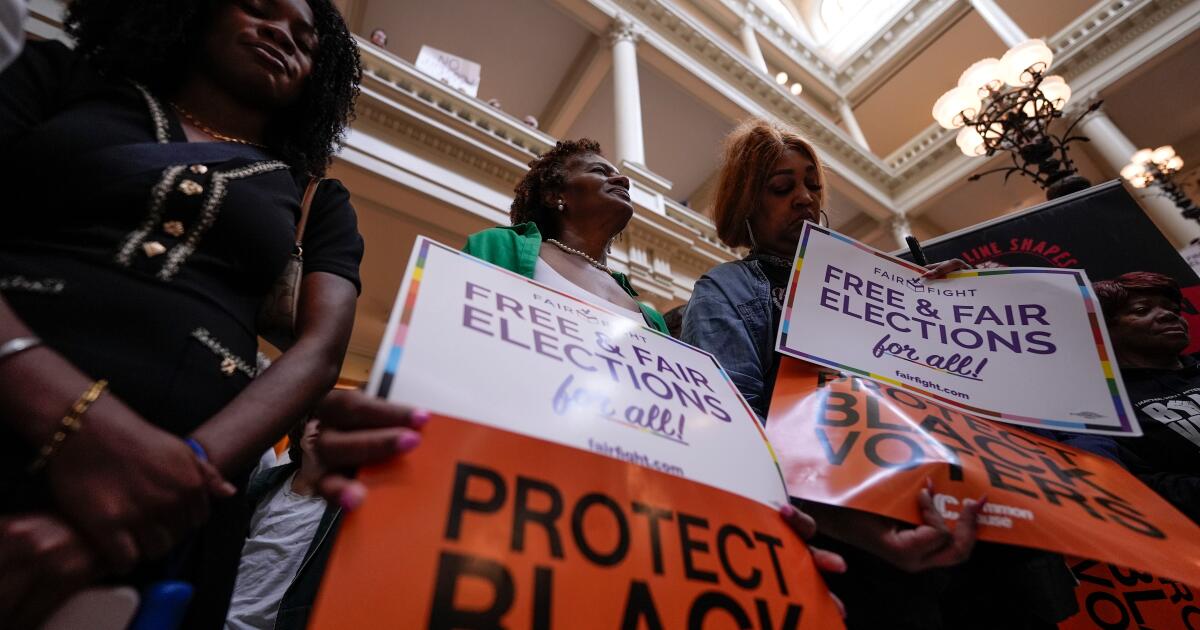
In its own statement, Ticketmaster said Blumenthal’s report “misrepresents how the live events industry works” and that the problem lies in the secondary ticketing industry.

“This is why we’ve long called for industry resale reform, including price caps, while also developing tools to empower artists and protect fans,” Ticketmaster said in a statement.
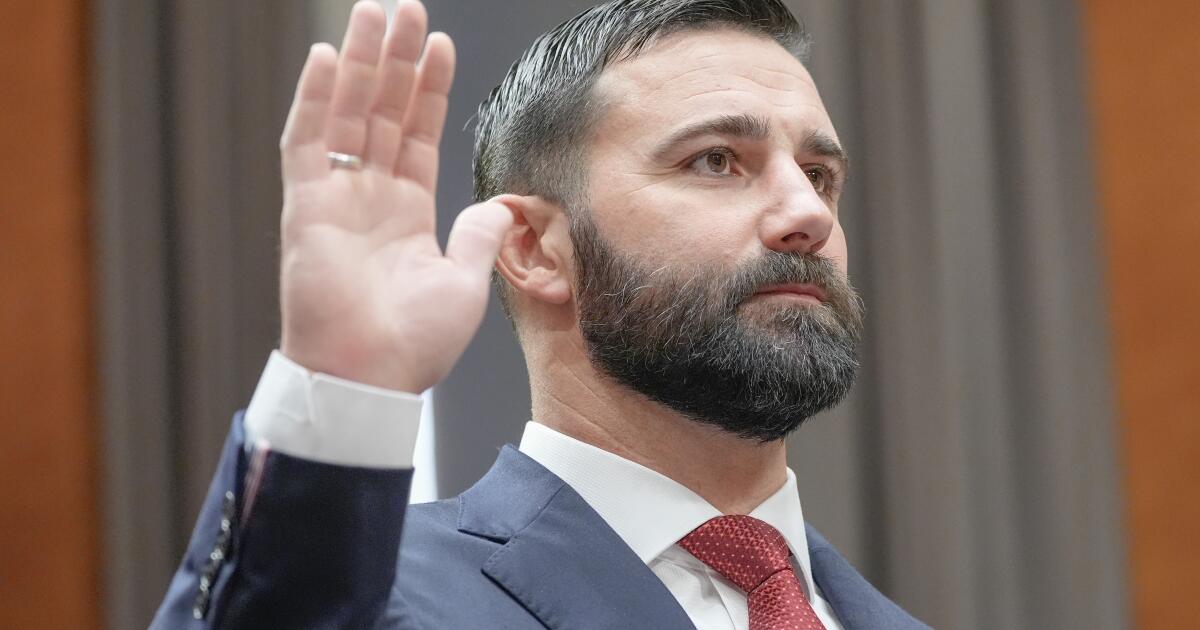
Recently, Ticketmaster has backed ticketing bills like AB-1349 and advocated to Congress for an industry-wide resale cap.

Sens. Blumenthal and Klobuchar are among many industry experts who say the settlement doesn’t adequately address anticompetitive practices and falls short of protecting consumers from high ticket prices.

Under Klobuchar’s new bill, courts could have 90 days to review public comments and government responses.

“When the government prosecutes antitrust violations, the goal should be to uphold the law, lower prices, and protect consumers and small businesses,” Klobuchar said in the statement.

Lindsay Owens, the executive director of the economic policy nonprofit Groundwork Collaborative, said the settlement will end up being “incredibly costly for concertgoers, performers, and independent venues.”

“California and 35 other states are standing up for Americans who are sick and tired of being ripped off and having to scrimp and save to enjoy a night out,” Owens said in a statement.
This ongoing trial is one of several major legal battles the ticketing giant is facing. The company is also being sued by the Federal Trade Commission and is dealing with a handful of class-action lawsuits from groups of concertgoers.

Times staff writer Meg James contributed to this report.

Source link

A $50-million push hopes to make child care a top issue in the midterm elections

An advocacy group hoping to expand support for child and elder care is planning to spend $50 million to back Democrats in congressional races, tying the costs of caregiving to the nation’s affordability debate.

The Campaign for a Family Friendly Economy, created a decade ago, aims to make caregiver issues more salient in elections. The announcement comes as the cost of child care continues to rise and as waiting lists for federal child-care subsidies, which support working families in poverty, continue to grow.

Sondra Goldschein, executive director of the campaign and its political action committee, said child care and elder care are important to the affordability conversation, especially as child-care costs exceed what families pay for housing. Then there is the pressure on the “sandwich generation,” composed of middle-aged people who are caring simultaneously for their own children and parents.

“When child care can cost more than your rent or a mortgage, or you have to sacrifice a paycheck in order to be able to take care of a loved one,” that can motivate how people vote, said Goldschein. “Each election cycle, we see candidates recognizing that more and more.”

She hopes the message will resonate as families face a slew of rising costs, including climbing gas prices driven by a war in Iran that is unpopular with many voters.

The campaign plans to pour support for Democrats into Senate races in North Carolina, Georgia, Michigan, Maine and Ohio and into House races in Iowa and Pennsylvania. It is also slated to dispatch volunteers to talk with voters about caregiving.

The National Republican Congressional Committee did not immediately respond to a request for comment.

Republicans have begun to back child care as an issue crucial to growing the workforce, but their proposals tend to be less dramatic than those offered by Democrats. Last year, through President Trump’s One Big Beautiful Bill, Republicans made an estimated 4 million more families eligible for a child-care tax credit. The law also increased child-care aid for military families and tax credits for employers who provide child care to their workers.

Before 2020, many candidates rarely spoke about child care. But the COVID-19 pandemic laid bare the child-care industry’s precarity and necessity. Preschools and child-care centers were pressed to stay open so parents in front-line jobs — such as those in healthcare — could return to work.

Then-President Biden successfully persuaded Congress in 2021 to pass $39 billion in aid for child care, allowing states to offer support to more families and subsidizing wages for child-care workers. Later that year, Biden sought to create nationwide universal pre-kindergarten and to vastly expand child-care subsidies for families so that none would pay more than 7% of their household income for care. But the proposal narrowly failed in Congress. Since then, the pandemic aid has dried up and families are feeling the pinch of rising costs.

Now, several candidates have centered their campaigns around child-care affordability. New York Mayor Zohran Mamdani, a democratic socialist who won election after pledging to make the city more affordable for middle-class residents, ran on universal child care. Democratic Gov. Mikie Sherrill of New Jersey and Gov. Abigail Spanberger of Virginia won elections after pledging to expand child-care subsidies.

Candidates this election cycle are running on universal child-care pledges. They include Democrats Janeese Lewis George, who is running for mayor in Washington, D.C., and Francesca Hong, a gubernatorial candidate in Wisconsin. New York Gov. Kathy Hochul, who is up for reelection this year, has pledged to support Mamdani’s ambitions and eventually to expand universal child care statewide.

Neither the White House nor the Department of Health and Human Services, which oversees federal child-care programs, responded to requests for comment. In his 2024 campaign, during an address to the Economic Club of New York, Trump said increasing foreign tariffs would “take care” of the expense of child care. That plan, thus far, has not materialized.

In Trump’s current term, the administration has largely focused on cracking down on fraud, after a viral video alleged Somali-run child-care centers in Minneapolis were billing the government for children they weren’t caring for.

While there have been prosecutions stemming from child-care subsidy fraud, the Minneapolis video’s central claims were disproven by state inspectors. Nonetheless, the Trump administration attempted to freeze child-care funding for Minnesota and five other Democratic-led states until a court ordered the funding to be released.

Balingit writes for the Associated Press.

Source link

Suspending gas tax, reducing refinery regulations pushed by two Democrats running for governor

As gas prices surge in California and nationally due to the war in Iran, two Democrats running for California governor are calling for the state to temporarily suspend its fuel tax or ease refinery regulations in an effort to lower costs.

Standing in front of a gas pump in a video posted to social media, San Jose Mayor Matt Mahan said the costs are “becoming an emergency for working families, and I think we ought to act like it.”

The moderate Democrat called on state lawmakers to suspend California’s gas tax, which at 61 cents per gallon is the highest in the nation.

Former Los Angeles Mayor Antonio Villaraigosa also called for an “immediate moratorium” on regulations that he blamed for “overburdening” California refineries and working families.

“These failed policies are not only hurting tens of millions of Californians, they are terrible for the environment because they have forced California to depend on imported foreign oil from the Middle East,” Villaraigosa said in a statement.

The cost of living in California, including the price at the pump, remains a pivotal issue for voters in the state, and has become central to the moderate-leaning campaigns of Mahan and Villaraigosa as they attempt to distinguish themselves in the tightly contested race for governor.

According to AAA, the average price for a gallon of regular gasoline in California on Monday was $5.52, the highest in the nation and more than 50 cents higher than any other state. The national average was $3.71, up from the previous month’s average of $2.92.

Gasoline prices in California are often among the highest in the country for a number of reasons, including environmental rules that require a unique blend of cleaner-burning fuel.

The state also relies mostly on crude oil imported from other countries including Brazil, Iraq and Guyana and processed at in-state refineries. In 2025, 61% of oil processed at California refineries was imported, compared with 23% that was produced in the state, according to data from the California Energy Commission.

A greater reliance on foreign oil has made California more susceptible to price spikes during global conflicts and other disruptions.

Republicans have long supported suspending the gas tax and cutting regulations in order to lower prices at the pump.

Steve Hilton, a GOP candidate for governor and former Fox News host, outlined a plan to lower California gas prices to $3 per gallon by slashing regulations including the low-carbon fuel standard, the rule that requires cleaner-burning gas in order to reduce tailpipe emissions.

The other major Republican in the race, Riverside Sheriff Chad Bianco, supports suspending the gas tax, according to his website.

The current price spike echoes 2022, when Russia invaded Ukraine and disrupted global oil markets.

As prices eventually fell around the rest of the country that year, they remained high for months in California, leading Gov. Gavin Newsom to wage war against oil and gas companies. He accused them of price-gouging drivers and backed laws requiring companies to report their profit margins and keep a supply of fuel on hand to prevent shortages and price spikes.

The governor backed off his battle with the oil companies last year after two refineries announced plans to close. In September, he signed legislation to permit 2,000 new oil wells in Kern County, reflecting an acknowledgement that his war on oil companies threatened to send California’s gas market spiraling.

Republican state lawmakers in 2022 pushed for a temporary suspension of California’s excise tax on gasoline, arguing that it would provide immediate relief to California drivers. That effort was rebuffed by Newsom and Democratic lawmakers, but they later approved $9.5 billion in tax refunds to Californians, providing as much as $1,050 to families as financial relief from record-high gasoline prices and other rising costs.

In 2017, the Democratic-controlled Legislature passed Senate Bill 1, which then-Gov. Jerry Brown signed into law, levying the state’s first gas tax increase in 23 years to fix California’s roads and bridges in disrepair. Under the law, the tax increases each year on July 1 based on the growth in the California Consumer Price Index.

California voters remain conflicted on the state’s regulation of the oil industry, according to an August survey by the Public Policy Institute of California. It found that more than 60% of adults support goals to reduce greenhouse gas emissions and generate electricity from renewable energy sources.

But majorities also said the costs of gasoline and utility bills is a major problem for them personally, according to the poll.

Mahan and Villaraigosa are the only two Democrats who have publicly called to roll back regulations on the state’s oil and gas market, illustrating the political murkiness at the nexus of California’s climate and affordability challenges.

Still, Democratic lawmakers – who hold supermajorities in the state Senate and Assembly – continue to shut down proposals to pause the gas tax, arguing that the state would lose out on much-needed money for roads.

“If anyone has a proposal about how to backfill (transportation) revenues, I’m up for that conversation, but so far, it’s just a bulls— political talking point,” said Assemblymember Cottie Petrie-Norris (D-Irvine).

Petrie-Norris chairs the Assembly Utilities and Energy Committee and has helped lead legislative efforts to stabilize California’s fuels market without retreating from goals to achieve carbon neutrality.

”When I ask people, ‘Do you want affordable gas, clean air or safe roads?’ they say yes. So they want us to do all three of these things,” she said. “We’ve got to be honest with Californians about trade-offs so that we can have real conversations.”

Mahan pushed back on the importance of collecting gas tax revenue.

“The truth is we have the highest taxes in the country and a $350-billion budget, and we ought to be able to pave our roads and enable working families to put food on the table,” he said in an interview. “I just reject the notion that the sky is going to fall if we provide temporary relief to working families who are being pushed to the brink by a war that they didn’t ask for.”

The San José mayor said the state should suspend the fuel tax “for the duration of the war” in Iran “or as long as gas prices are over $5 a gallon” in the state. He also called for “massive regulatory overhaul that brings down costs across the board,” including rules on refineries.

If elected governor, Villaraigosa said he would “reform and overhaul” the California Air Resources Board, which enacts many of the state’s environmental laws — including the low carbon fuel standard and cap-and-invest program.

“We can no longer allow bureaucrats who live in a bubble — with no accountability for the harm they are causing our economy and our people — to have so much power over the lives of every Californian,” Villaraigosa said in a statement.

Source link

Ending a corporate tax break pitched to offset federal healthcare cuts

A corporate tax policy that costs California billions in lost tax revenue each year could be coming to an end as the state struggles to backfill federal cuts and resolve a looming budget deficit.

The proposed legislation, Assembly Bill 1790, would repeal the so-called “water’s edge” tax break, a filing option that allows multinational corporations to exclude the income of their foreign subsidiaries from state taxation.

“The tax bills of the wealthiest, most powerful corporations in the world are at all-time lows,” Assemblymember Damon Connolly (D-San Rafael), one of the primary sponsors of the bill, told The Times. “Meanwhile, we’re struggling to fund programs that feed children — I think everyone understands that now is the time for long-term budget solutions.”

Republican Sen. Roger Niello, vice chair of the Senate Budget and Fiscal Review Committee, said the bill to repeal water’s edge won’t receive support from GOP lawmakers. He said the legislation would lead to double taxation, meaning the same income would be taxed twice by different countries, and compared taxing corporations’ foreign profits to enacting tariffs.

“California already has the reputation of being not particularly business friendly,” said Niello (R-Fair Oaks). “This would really just compound that.”

A spokesperson for Gov. Gavin Newsom did not respond to a request for comment about the governor’s views on the proposal. Newsom, however, has largely shunned new tax increase proposals.

Legislation to increase taxes requires a two-thirds approval vote instead of a simple majority. Democrats in California hold a supermajority in both the Assembly and Senate, meaning the bill could still pass without Republican support, but it would require backing from the progressive and moderate wings of the party.

Kayla Kitson, a senior analyst at the California Budget and Policy Center, said the measure has a decent chance of winning support among moderate Democrats due to the state’s budgetary woes.

“The stakes are really high this year,” she said. “With any tax policy, it’s certainly hard to get folks beyond the progressive community on board, but there are a lot of discussions happening behind closed doors given the challenges that the state knows it’s going to have to deal with in the next few years.”

When filing taxes, a multinational corporation in the United States can currently choose between two methods. Worldwide reporting takes into account all of the corporation’s global profits or losses, while the water’s edge option allows the U.S.-based parent company to exclude the income of foreign subsidiaries. This can help corporations that own profitable foreign companies pay less taxes in the United States.

California is scrambling for solutions as the state is facing an estimated $18-billion budget deficit and fallout from federal cuts that slashed healthcare. A Republican-backed tax and spending bill signed last year by President Trump shifted federal funding away from safety net programs and toward tax cuts and immigration enforcement.

Carl Davis, a research director for the Institute on Taxation and Economic Policy, said the idea is picking up momentum nationwide, with states like Maryland, Minnesota and New Hampshire also considering a repeal in recent years, due to a growing awareness about profit shifting — a loophole in the water’s edge tax break that some corporations use to reduce their tax burdens by shifting profits made in a high-tax country into tax havens.

“Folks are outraged when they hear that these companies are pretending that they are earning their profits in the Caymans or in Switzerland and are skipping out on paying U.S. taxes as a result,” he said. “That feels insulting to a lot of people who are paying the taxes they owe every day.”

During an informational hearing at the Legislature last month, Rowan Isaaks, an economist with the nonpartisan Legislative Analyst’s Office, said the state does not know the extent to which corporations use profit shifting, which makes it impossible to determine exactly how much revenue California would gain by eliminating the water’s edge tax exemption. But he estimated it would bring in “single digit billions” for the state each year.

“While there would be revenue gains, the Legislature also faces a trade-off between broadening the tax base but also managing additional uncertainty,” said Isaaks, explaining it could increase budget volatility because foreign income is more sensitive to global economic conditions.

Issaks added that the Legislative Analyst’s Office has found no strong evidence that companies would flee California if the water’s edge tax break was repealed.

Jennifer Barton, director of the legislative services bureau for the California Franchise Tax Board, told legislators that mandating worldwide reporting wouldn’t be difficult for the state from an administrative standpoint, only requiring some additional outreach or educational efforts.

California Tax Foundation visiting fellow Jared Walczak said that the water’s edge option exists for a reason and that it would be unfair to mandate worldwide reporting. “The vast majority of the activity abroad is true economic activity abroad,” he told lawmakers. “Companies don’t just exist in the United States; they have sales, they have manufacturing, they do things abroad.”

A survey last year from the nonpartisan Pew Research Center found 63% of adult Americans believe large corporations or businesses should pay more in taxes, while 19% want corporate taxes to be lower and 17% believe corporate tax policy should remain the same.

Tech companies appear to be particularly aggressive with profit shifting. Six U.S. multinational corporations — Apple, Cisco, EBay, Facebook, Google and Microsoft — may have underpaid their U.S. corporate income taxes by $277 billion over varying periods from 2009 through 2022, according to a report from the Center on Budget and Policy Priorities.

Repealing the water’s edge tax break isn’t the only tax-related proposal being considered as the state seeks to increase revenue. The Billionaire Tax Act is a controversial proposed state ballot initiative that would levy a one-time, 5% tax on the state’s billionaires to help offset federal cuts. Newsom is among its critics.

Davis believes it will continue to be a hot topic regardless of the bill’s outcome this year.

“There is very good reason to think this [repeal] is going to happen at some point,” he said. “This is a debate that is certainly not going away.”

Source link

Secretary of State Marco Rubio designates Iranian-American Kamran Hekmati wrongfully detained by Iran

March 17 (UPI) — U.S. Secretary of State Marco Rubio has designated a Jewish Iranian-American imprisoned for nearly a year in Iran as wrongfully detained, according to his family.

Kamran Hekmati, a jeweler and longtime resident of Great Neck, N.Y., was detained by Iranian authorities at Tehran’s Imam Khomeini International Airport on May 17, according to the Bring Kamran Home website.

He was in the country for a family matter, and was detained while attempting to return to the United States. The website states he was formally arrested on July 28, less than two weeks after the United States bombed Iran’s nuclear facilities.

His family told UPI in a statement that they were notified on Monday of Rubio’s designation, an official recognition that the United States believes Hekmati is being held in Iran on false charges.

“We are so grateful to President [Donald] Trump and Secretary Rubio for their designation of Kamran Hekmati as a wrongful detainee,” Shohreh Nowfar, Hekmati’s cousin, said in a statement provided to UPI by Global Reach, a U.S. nonprofit that advocates for Americans imprisoned abroad.

“It reassures us that our government has our back in the effort to get Kamran home safely.”

UPI has contacted the State Department for comment and confirmation. Its Office of the Special Presidential Envoy for Hostage Affairs becomes involved once an American citizen is determined to be wrongfully detained.

Hekmati emigrated to the United States following the 1979 revolution.

According to his website, Hekmati was charged with allegedly visiting Israel within the last 10 years based on photos found on his phone of a trip he took to the country for his son’s bar mitzvah. He was sentenced to two years in Iran’s notorious Evin Prison. Advocates said the trip took place 13 years ago.

Hekmati was detained amid growing tensions between the allies, the United States and Israel, and Iran. Iranian authorities formally charged him two weeks after the Trump administration bombed Iran’s nuclear facilities.

He was again charged by Iran in December as tensions rose in the Middle East. Tehran authorities accuse him of meeting with agents of Mossad, Israel’s intelligence agency.

He is reportedly a bladder cancer survivor but requires regular medical testing and preventive medical procedures to guard against its recurrence.

“Kamran appears to be caught up in Iran’s traditional approach of detaining Americans to obtain political concessions from the U.S.,” his advocacy website states.

The announcement comes months after Reps. Tom Suozzi, a Democrat, and Claudia Tenney, a Republican, both from New York, urged Rubio in an early December letter to secure Hekmati’s release and to designate him as wrongfully detained.

Rubio designated Iran a state sponsor of wrongful detention on Feb. 27, a day before the United States and Israel launched their ongoing war with Tehran.

Iranian-American journalist Reza Valizadeh — arrested by Iran’s elite Islamic Revolutionary Guard Corps in September 2024 and sentenced to 10 years in prison — was also officially designated as wrongfully detained in May.

Nowfar told UPI that the wrongfully detained designation made clear “that the senior-most people in the White House know that Kamran, Reza and the others are being held by the Iranians and conveyed to the Iranians that they will be held accountable for their safety.”

Source link

Schools rugby union: Northampton School for Boys – the state school at the top of English rugby

NSB are also an official partner school with Northampton Saints.

This year, they provided the most players from any school to Saints’ under-18s.

Four players will also be offered first-team academy contracts this year.

“The boys have to manage their time really well,” says assistant first team coach Adam Baker.

“When we get into sixth form and into that first-team setting, we will try and put them through a programme that matches up with an academy programme, so if they go into that pathway, they are fully aware and prepped as to what that day-to-day life looks like.”

However, NSB aren’t the only state school making an impact.

They beat Campion School from Essex in the Continental Tyres School Cup semi-finals.

It was a compelling contest which went down to the wire, with two state schools playing high-octane rugby in front of a passionate crowd of over a thousand people.

The Rugby Football Union has a network of rugby managers to try to embed the game in state schools.

Twenty-two of the best state schools compete in the ACE (Academy, Colleges and Education) League. England internationals George Martin, Joe Heyes and Harry Randall all came through that route.

The programme is designed to support players who may not attend traditional rugby-playing schools, providing daily coaching, competitive fixtures, and opportunities to train alongside academy players.

Northampton Saints have two state school partnerships which play in the ACE League: Moulton College in Northampton and Sigma Sixth Colchester, located at Philip Morant School and College.

“Growing state school rugby is a one step at a time process,” said Beaumont.

“This is over 10 years of hard work. But it can be done.

“My advice to other schools is find a way to get more numbers in training, organise a game.

“Put a tournament on, you don’t need posts. Make it a habit. Get kids playing.

“Rugby needs every state school to push and develop rugby. This is the perfect time. State school rugby could be really special.”

One of NSB’s biggest stars is their 18-year-old captain Jack Lewis, who plays in the back row.

He has been at NSB for the past two years and in the Saints academy since he was 14.

This year he made his debut for Northampton Saints. Now he’s preparing to lead his school for the final time in a Twickenham final.

“NSB taught me how to act, it’s the closest thing to a professional environment,” he said.

“A lot of people work hard behind the scenes, they sacrifice their time. It’s given me so much as a player and a student.

“I’ve never played at Twickenham, it would be a great achievement if we could lift the cup there. We want to show what NSB stands for.”

Source link

California, other states sue to block Trump effort to roll back fair housing protections

California and a coalition of other states sued the Trump administration Monday over its efforts to roll back fair housing rules that bar certain types of discrimination by landlords, including against LGBTQ+ people.

California Atty. Gen. Rob Bonta said a U.S. Department of Housing and Urban Development rule change threatening funding for states that offer housing protections for LGBTQ+ and other marginalized individuals who are not explicitly covered by federal law is illegal, undermines state efforts to combat discrimination and would push vulnerable people onto the streets.

“In effect, the Trump administration is attempting to roll back civil rights enforcement in housing at the federal level, and pressure states to weaken their own protections as well,” Bonta said during a news conference Monday. “That’s not just bad policy, it’s unlawful.”

Representatives from HUD and the White House did not immediately respond to a request for comment.
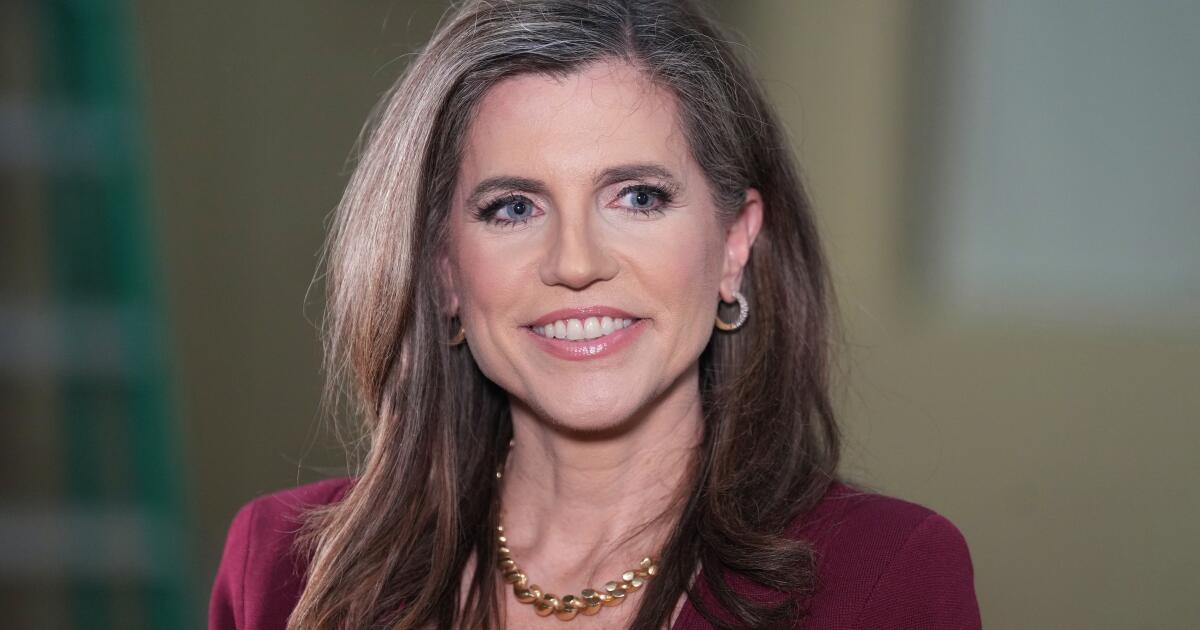
The federal Fair Housing Act explicitly bans discrimination based on seven traits: race, color, national origin, religion, sex, familial status and disability. Under rules set forth during the Obama administration, the U.S. Department of Housing and Urban Development has for years interpreted the law as banning discrimination based on sexual orientation and gender identity.

Many states, including California, also have adopted laws explicitly banning discrimination against LGBTQ+ people and other marginalized groups not mentioned in the federal law, with California also banning discrimination based on marital status, ancestry, source of income and veteran or military status.

In September, HUD issued new guidance threatening to decertify state housing agencies — stripping their federal funding and ability to investigate discrimination claims — if they provide anti-discrimination protections other than those spelled out in the Fair Housing Act. The guidance also barred state agencies from using federal funds to “promote gender ideology,” “fund or promote elective abortions” or promote illegal immigration, according to the lawsuit.

The guidance followed that of HUD Secretary Scott Turner, a former NFL player and Trump loyalist, who announced last year that HUD would no longer adhere to a 2016 Obama-era rule protecting transgender people from housing discrimination, which Turner said “tied housing programs, shelters and other facilities funded by HUD to far-left gender ideology.”

“We, at this agency, are carrying out the mission laid out by President Trump on January 20th [2025] when he signed an executive order to restore biological truth to the federal government,” Turner said in a statement, referring to Trump’s order calling on federal agencies across the government to rescind protections for transgender Americans.

“This means recognizing there are only two sexes: male and female,” Turner said. “It means getting government out of the way of what the Lord established from the beginning when he created man in His own image.”

Among other things, the administration said rules barring discrimination against transgender people allowed “biological men to enter shelters intended for women impacted by trauma, domestic abuse and violence.”

LGBTQ+ advocacy groups condemned the move, noting that transgender Americans face heightened discrimination in a slate of areas — including housing — and need protections. They also contended that HUD’s new policies violate a 2020 U.S. Supreme Court decision barring employment discrimination based on gender or gender identity.

Bonta said the Fair Housing Act “set a floor, not a ceiling, for protections against discrimination,” which means that states “have the authority to go further and protect more people,” as California has endeavored to do.

He said HUD has supported the state’s anti-discrimination work for decades through the Fair Housing Assistance Program, which provides funding to state and local agencies to investigate and enforce laws against housing discrimination. HUD’s new guidance “threatens to undermine that system” by demanding an end to state protections not just for LGBTQ+ people, but for military veterans, immigrants as well as women receiving abortions and other reproductive healthcare, he said.

“Families across California are already struggling to find homes they can afford, and the last thing they need is for the federal government to make it harder,” Bonta said. “At its core, this lawsuit is about protecting a fundamental civil right: the right to rent, buy, or live in housing without discrimination.”

Bonta said California interprets the Fair Housing Act’s ban on sex discrimination as protecting LGBTQ+ people, but the Trump administration doesn’t agree — making the state’s more explicit protections important.

He said about $3 million in federal funding is currently at stake for California, with millions more at stake in other states.

Illinois Atty. Gen. Kwame Raoul, who is helping lead the lawsuit and spoke alongside Bonta Monday, said states with robust antidiscrimination laws “will not go backwards and we will not give in to threats” from the Trump administration.

“These actions are part of a broader, ongoing pattern by this administration to subvert the legal protections our country has put in place to combat discrimination, and to tear down the hard fought progress we have made for civil rights,” Raoul said. “It is also just the latest page in the president’s illegal playbook to use funding and programs created by Congress to try to strong arm states into adopting Trump’s preferred policies.”

The states allege that HUD’s targeting of state antidiscrimination policies comes after it downsized its own workforce and significantly reduced its ability to investigate housing discrimination complaints and enforce fair housing laws. They say the new guidance violates multiple federal laws, including laws that govern federal spending and rule changes, and are asking the federal court to immediately invalidate the guidance as unlawful.

Bonta and Raoul are joined in the lawsuit by the attorneys general of Arizona, Colorado, Connecticut, Delaware, the District of Columbia, Hawaii, Maine, Maryland, Massachusetts, Michigan, New Jersey, Rhode Island, Vermont and Washington.

Source link

Prep Rally: Southern California dominates top divisions at state basketball finals

Hi, and welcome to another edition of Prep Rally. I’m Eric Sondheimer. The champions have been crowned in high school basketball and soccer. What a weekend it was in Sacramento.

Get our high school sports newsletter

Prep Rally is devoted to the SoCal high school sports experience, bringing you scores, stories and a behind-the-scenes look at what makes prep sports so popular.

By continuing, you agree to our Terms of Service and our Privacy Policy.

Champions

Damien players celebrate their state Division I boys' basketball title victory over Folsom.

Damien players celebrate their state Division I boys’ basketball title victory over Folsom at the Golden 1 Center in Sacramento on March 13, 2026.

(Greg Stein)

In the highest divisions at the CIF state championships at Golden 1 Center in Sacramento, Southern California basketball teams continue to dominate.

Sierra Canyon and Ontario Christian were crowned Open Division boys and girls champions, respectively. Sierra Canyon overcame the loss of Maxi Adams to an ankle injury in the first quarter to defeat Richmond Salesian 78-70. Here’s the report.

Kaleena Smith of Ontario Christian gets emotional in the first half at Golden 1 Center against Archbishop Mitty.

Kaleena Smith of Ontario Christian gets emotional in the first half at Golden 1 Center against Archbishop Mitty.

(Greg Stein)

Ontario Christian received another standout performance from junior guard Kaleena Smith to defeat Archbishop Mitty 56-49. Here’s the report.

Damien won Division I for coach Mike LeDuc. Here’s the report. Corona Centennial’s one-two punch of Sydney Douglas and Cyndee Bryant led the Huskies to the Division I girls title. Here’s the report.

Sylmar and Birmingham came up short trying to become the first City Section teams from the San Fernando Valley to win state titles. Sylmar was beaten in Division V. Here’s the report. Birmingham settled for runner-up in Division III. Here’s the report.

El Dorado’s girls’ team broke through in Division III. Here’s the report.

Soccer

Garfield goalkeeper Javier Zarate gets his photo taken with CIF executive director Ron Nocetti at state soccer finals.

Garfield goalkeeper Javier Zarate gets his photo taken with CIF executive director Ron Nocetti at state soccer finals. Garfield lost 2-0 in Division V.

(CIF)

Garfield was beaten in the Division V state boys final 2-0 by Branson. But sophomore goalie Javier Zarate continues to impress. Here’s a look at his impact.

Mater Dei deserves the name soccer school of the West. The Monarchs won boys and girls state titles in Division I. The boys defeated Salinas Everett Alvarez 2-1. The girls defeated unbeaten Bishop O’Dowd 2-0. Los Alamitos won Division III boys over Watsonville 1-0. Irvine University won Division IV 3-2.

Baseball

Freshman Louis Lappe of Harvard-Westlake receives congratulations after his first high school hit.

Freshman Louis Lappe of Harvard-Westlake receives congratulations after his first high school hit.

(Craig Weston)

Freshman Louis Lappe of Harvard-Westlake, the former El Segundo Little League star who gained national fame for his walk-off home run at the Little League World Series in 2023, hit his first high school home run on Wednesday.

Let’s just say he was a little excited.

Brody Schumaker of Santa Margarita had four hits, including a grand slam, and seven RBIs in a win over Los Osos. He has struck out once in 34 at-bats.

Landon Hovermale of Norco has allowed no runs in 18 2/3 innings this season.

Landon Hovermale of Norco has allowed no runs in 18 2/3 innings this season.

(Nick Koza)

Norco has one of the hottest pitchers around in Landon Hovermale, who has given up no runs in 18 2/3 innings. Here was his latest performance.

Foothill pitchers have thrown three consecutive shutouts.

There’s every indication that the Southern Section is going to introduce a new playoff format for Division 1 baseball only. It’s expected to be a 16-team tournament broken into four pools with double elimination leading to the quarterfinals with the top two teams in each pool advancing, followed by single elimination. The baseball advisory committee has been pushing for such a tournament in Division 1 for years.

Here’s this week’s top 25 rankings by The Times.

Softball

Emily Yoon of El Dorado threw a no-hitter in a win over Villa Park in a league opener.

Here’s last week’s top 20 softball rankings, with unbeaten Murrieta Mesa leading the way.

Track and field

Benjamin Harris of Servite turned on the speed at Redondo Union on Saturday, running a wind legal 10.27 seconds in the 100 meters.

One of the most versatile track and field athletes this season has to be junior Davis Benson of Moorpark. He’s putting up good marks in a variety of events. He’s already set school records in the 110 hurdles of 14.30 and the 300 hurdles in 38.82. And he’s gearing up for a high jump showdown later in the season with Sherman Oaks Notre Dame’s JJ Harel. Benson has gone 6-10.

Carson’s Jayden Rendon stamped himself as a state contender in the 110 hurdles with a time of 13.91 at Redondo Union.

Lawrence Kensinger of Venice, another pupil of Sherman Oaks Notre Dame throwing coach Nick Garcia, is closing in on 60 feet in the shotput. He recorded a career-best 59-8.

Jaslene Massey of Aliso Niguel, already No. 1 in the state in the discus, won the Nike Indoor Nationals in the shotput at 54-2.75, seventh-best mark in California history. She also got a mark of 188-7 in the discus, second-best all-time.

Loyola’s Ejam Yohannes ran 400 meters in a state-leading 46.24. It was a school record.

Bob Johnson dies

Former Mission Viejo coach Bob Johnson died last week. He was 80.

Former Mission Viejo coach Bob Johnson died last week. He was 80.

(Los Angeles Times)

High school football fans across Southern California were offering memories of Hall of Fame coach Bob Johnson after his passing Wednesay. He was 80.

Johnson won nine Southern Section titles coaching at Mission Viejo and El Toro.

Here’s the report.

Notes . . .

One of the best sporting events of the year happens Friday night when volleyball powers Mira Costa and Loyola face off at Mira Costa. . . .

Alfred Rowe has resigned after one season as football coach at Long Beach Jordan. . . .

Earl Sanchez has resigned as basketball coach at Sierra Vista. . . .

Former Gardena Serra and UCLA tight end Caleb Wilson has been hired as an assistant coach at Colorado State under former UCLA coach Jim Mora Jr. . . .

Luis Cruz Jr. is the new football coach at Sunny Hills. . . .

The top football player in the state for next season, Honor Fa’alave-Johnson of Cathedral Catholic, announced he has committed to USC.

From the archives: Mason Edwards

In 2023, Left-hander Mason Edwards of Palisades was one top pitchers in the City Section. Now he's the ace at USC.

In 2023, Left-hander Mason Edwards of Palisades was one top pitchers in the City Section. Now he’s the ace at USC.

(Steve Galluzzo)

Mason Edwards, a junior at USC from Palisades High, is off to one of the best starts by a pitcher in the nation. He entered last week having allowed no runs and only three hits in 24 innings while recording a 3-0 record. He gave up his first run of the season on Friday. He’s left-handed and has 42 strikeouts. He throws between 90 and 93 mph.

Edwards has continued to improve at USC since his arrive in the fall of 2023.

Recommendations

From the Players Tribune, former El Toro pitcher pitcher Paul Skenes offers advice to Little Leaguers.

From the Daily Bruin, a story on Brentwood basketball coach Ryan Bailey, a former UCLA basketball standout.

From the Los Angeles Times, a story on former Chatsworth guard Alijah Arenas keeping his NBA dreams alive.

Tweets you might have missed

Until next time….

Have a question, comment or something you’d like to see in a future Prep Rally newsletter? Email me at eric.sondheimer@latimes.com, and follow me on Twitter at @latsondheimer.

Did you get this newsletter forwarded to you? To sign up and get it in your inbox, click here.


Source link

Former Newsom advisor received $50,000 payout after leaving state job amid federal probe

Gov. Gavin Newsom’s former chief of staff, Dana Williamson, left state service with two things: a federal corruption investigation and more than $50,000 in pay for vacation time she accrued but never took.

State payroll records reviewed by The Times show Williamson used approximately $30,000 in unused vacation time to remain on California’s payroll through Jan. 31 — seven weeks after Newsom’s office indicated she had departed — before collecting an additional $22,000 lump-sum payout for the hours she had left.

Large cash-outs for departing state workers with hundreds of hours of time off on the books have been a recurring issue in California. The state’s unfunded liability for vacation and other leave owed to employees has ballooned in recent years to $5.6 billion, fueled by generous time-off provisions and a long-standing failure to enforce policies that cap most employees’ vacation balances at 640 hours.

Many state workers accumulate large balances of unused vacation after decades of being on the government payroll. The typical public employee retires with more than two decades in public service, according the California Public Employees’ Retirement System. Their unused time off is paid when they leave state employment at their final rate of pay.

Williamson, however, amassed 462 hours of unused leave in less than two years on the job. She earned $19,612 a month as the governor’s chief of staff.

John Moorlach, director at the conservative think tank the Center for Public Accountability at the California Policy Center, said that a job like Williamson had probably involved incredibly long workdays but that the pace in which employees accumulate days off is a major financial burden.

“A normal blue-collar worker would say, ‘Really? Really?“” said Moorlach, a former Republican state senator from Orange County. “You don’t find this perk in the private sector.”

Williamson notified Newsom in November 2024 that she was under federal investigation and was put on paid administrative leave through Dec. 16, the governor’s office said.

Federal charges against Williamson, which were filed in November 2025, allege she siphoned $225,000 out of a dormant state campaign account belonging to gubernatorial hopeful Xavier Becerra and illegally claimed $1 million in luxury handbags and travel as business expenses on her tax returns. She pleaded not guilty to the charges.

A status conference in Williamson’s case was moved to April 16 after she recently underwent a successful liver transplant and due to the large volume of discovery — more than 280,000 pages so far — according to court records filed last month.

Williamson’s attorney, McGregor Scott, did not respond to a request for comment.
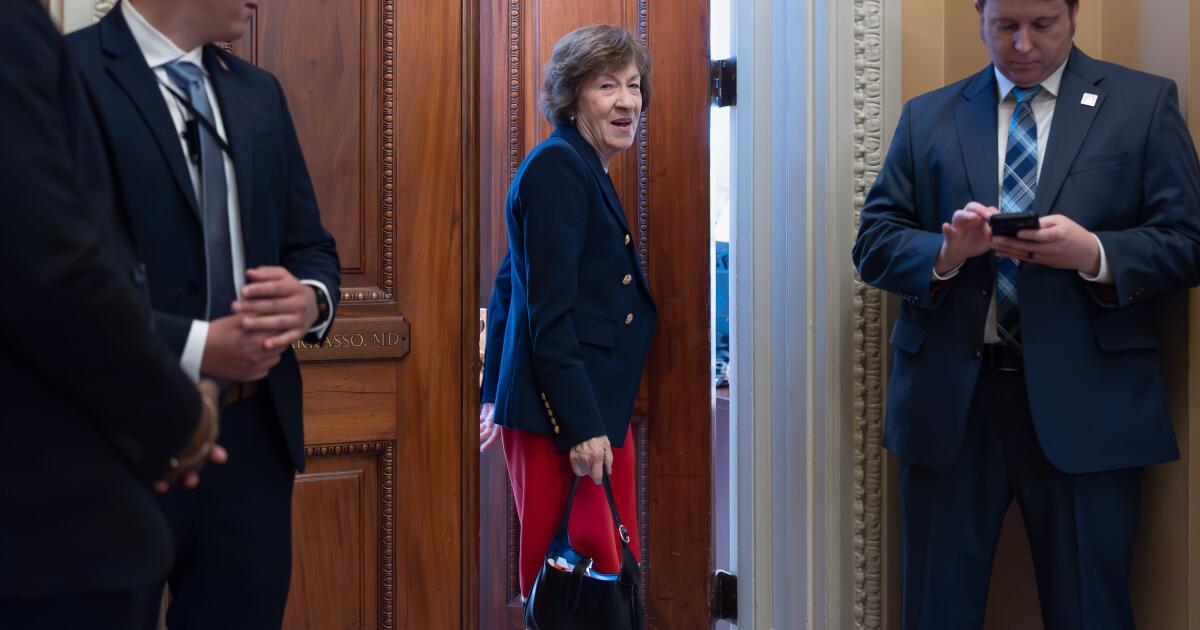
State payroll records show Williamson earned $40,000 in regular pay in 2025, which the state controller’s office said included her December 2024 and January 2025 paychecks. The governor’s office said Williamson’s December 2024 paycheck included 11 days of paid administrative leave, and the remainder of both paychecks was covered by her unused leave.

With her final cash-out of $22,000 in remaining time off, she made a total of $62,000 last year — all tied to administrative leave and unused vacation time rather than time worked.

“That’s shocking, honestly,” said Assemblyman Josh Hoover (R-Folsom), adding that stockpiled vacation time overall is something the state Legislature should look into.

The state paid $453 million in unused leave benefits to state workers in 2025. That was an average of more than $20,000 to the 21,000 employees who received a lump-sum check. The amount paid to departing or retiring state workers has steadily increased each year. In 2024, the state paid $413 million for unused time off.

“Obviously, employees are an important part of our state and they accrue vacation time,” Hoover said. “But, if this is something being used to pad people’s salaries … we need to look into that and possibly reform that.”

Last year, 80 state employees took home at least $250,000 in unused time off, and 1,081 employees were paid more than $100,000. Those numbers have been increasing each year. For example, the state paid 16 state workers more than $250,000 for unused time off in 2010, and 309 employees were paid more than $100,000.

In 2024, the state paid out a record $1.2 million to a prison supervising dentist for unused time off. Last year, the top amount paid for unused leave was about $650,000 to an assistant fire chief with the California Department of Forestry and Fire Protection.

The state owed nearly $5.6 billion to state workers for unused vacation and other leave benefits in 2024, according to the most recent financial accounting report issued by the state controller’s office. Although that unfunded liability held steady when compared with 2023, it has risen sharply from pre-pandemic amounts.

In 2019, the state owed $3.9 billion for employees’ unused time off before COVID-19 curtailed travel and work-from-home policies resulted in fewer workers taking time off. State employees have argued that under-staffing at state agencies can make it difficult to take vacations.

Nick Schroeder, a policy analyst at the nonpartisan California Legislative Analyst’s Office, said the state has plans to reduce unfunded liabilities for pensions and retiree healthcare, but that isn’t the case with unused time off.

“There isn’t a plan to address it,” Schroeder said.

When an employee retires with a large leave balance, the department where that person worked last is on the hook for the amount.

“It can be a big effect on that individual department’s budget,” Schroeder said.

During budget deficits — including in the current fiscal year — the state has cut employee pay or deferred annual raises in exchange for additional days off, a strategy that helps balance budgets but also adds to workers’ growing vacation balances.

In Newsom’s January budget proposal, which estimated a $3-billion deficit, the governor recommended providing $91 million in ongoing funding to the California Department of Corrections and Rehabilitation to help the prison system pay departing employees for their unused time off. The department said that from 2020 to 2025, it paid about $130 million annually on average to employees leaving state service, according to a Legislative Analyst’s Office report.

When employees cash out banked leave, the state pays them not only for the hours they have accumulated, but also for the additional vacation and holidays they would have earned had they taken that time off.

That means a person with 640 hours of vacation would also be paid for all of the vacation and holidays they would have earned had they taken those 80 days off. Each hour of leave is paid based on an employee’s final salary — not what they were earning when the time was accrued.

Most private-sector employers cap vacation accrual between 40 and 400 hours and stop employees from earning additional time once they reach those limits. Some companies have moved in the opposite direction, adopting “unlimited paid time off” policies. Under those systems, employees do not accumulate vacation days that can be banked or cashed out, but critics say the policies can lead to workers taking less time off because there is no guaranteed number of days and employees may feel pressure not to appear absent.

Jon Coupal, president of the Howard Jarvis Taxpayers Assn., said there appears to be little appetite in the state Capitol to address California’s burgeoning vacation liability.

“This problem is systemic within California government and no one seems willing to take it on,” Coupal said. “At the same time, they are clamoring that there is a budget crisis. I suspect they will continue to kick the can down the road.”

Source link

Captain of Iran’s women’s team withdraws Australia asylum bid: State media | Football News

The captain of the Iranian women’s football team has withdrawn her bid for asylum in Australia, Iran’s state media says, making her the fifth member of the delegation to change her mind after her team’s participation in the Asian Cup.

Zahra Ghanbari will fly from Malaysia and travel to Iran within the next few hours, the IRNA news agency said on Sunday.

Three players and one backroom staff member had already withdrawn their bids for asylum and travelled to Malaysia from Australia, where the team participated in the AFC Women’s Asian Cup.

Australia’s Home Affairs Minister Tony Burke said his country had offered asylum to all players and support staff members prior to their departure over fears they might be punished upon their return home after the team refused to sing Iran’s national anthem at the tournament.

Iranian state broadcaster IRIB reported on Saturday that the three had “given up on their asylum application in Australia and are currently heading to Malaysia”, posting a picture of the women allegedly boarding a plane.

The news was confirmed by Burke a few hours later.

“Overnight, three members of the Iranian women’s football team made the decision to join the rest of the team on their journey back to Iran,” Burke said.

“After telling Australian officials they had made this decision, the players were given repeated chances to talk about their options.”

Five players took up the offer and signed immigration papers last week, with one more player and a member of staff joining them a day later. It leaves two Iranian players in Australia, where they have been promised asylum and an opportunity to settle.

Iran played their three group games of the Asian Cup at the Gold Coast Stadium in Queensland on March 2, 5 and 8, after the United States and Israel launched their war on Iran on February 28.

The initial attacks killed Iran’s Supreme Leader Ayatollah Ali Khamenei and other leaders.

Overall, an estimated 1,444 Iranians have been killed since the war began, including more than 170 people, mostly schoolgirls, who were inside a primary school in the city of Minab.

After refusing to sing the Iranian national anthem at their first match, players on the Iranian women’s football team were branded “traitors” by an IRIB presenter.

When Iran played their second game of the tournament against Australia three days later, not only did the players sing the national anthem, but they also saluted it, prompting fears that they may have been forced to change their stance after receiving backlash in Iranian media.

While neither the players nor the team management explained why they refrained from singing before the first match, fans and rights activists speculated that it may have been an act of defiance against the Iranian government.

On the day of the team’s departure from Australia, Burke announced his government had offered all players and staff members the chance to stay back in the country.

On Tuesday, Burke told reporters that five Iranian players had decided to seek asylum in Australia and would be assisted by the government.

“They are welcome to stay in Australia, they are safe here, and they should feel at home here,” he said.

A day later, Burke confirmed that an additional player and a member of the team’s support staff had received humanitarian visas in the hours before their departure.

However, one player, who previously chose to stay behind, changed her mind and decided to return to Iran.

The player, who was later identified as Mohadese Zolfigol, changed her decision on the advice of her teammates, Burke told the Parliament of Australia.

“She had been advised by her teammates and encouraged to contact the Iranian embassy,” he said.

The players who managed to escape with the help of Iranian rights activists were taken away by Australian police officials to a safe house, where they met immigration officials and signed the paperwork.

“Our understanding is that every single member of the squad was interviewed independently by the Australian Federal Police,” Beau Busch, the Asia/Oceania president of players’ welfare body FIFPRO told Al Jazeera last week.

“[The players] were made aware of their rights and the support available to them. They certainly weren’t rushed through that process.”

Source link