After Arsenal‘s first league title for more than two decades was confirmed, tens of thousands of supporters rushed to Emirates Stadium to celebrate.
“I knew we were a sleeping giant that we needed to awaken in some way.” Kroenke said.
“We haven’t had a team, a squad like this in the social media age. Social media evolved and the Twittersphere and everything else around it.
“The instantaneous information, the ‘Banter Era’ – I’m aware of all this. I turned 46 last week.
“I’ve grown up around this and I’ve seen it all from my own perspective. I think that’s what I’m so proud to see. There was almost a time when you were a closeted Arsenal fan.”
But this success does not mean the end of the journey for Kroenke and his vision for the club, with the Gunners playing Paris-St Germain in the Champions League final on Saturday.
“I think I can think back and say that our stated goal was winning the Premier League, because if you can put yourself in contention for the Premier League, you’re in contention for everything else.” Kroenke said.
“Should we get a great result on Saturday, it’s not going to change or affect who we are. When you win something, the sun’s still going to come up the next day.
“You’ve got to get back to work and there are many teams trying to gain on you, including some historically great ones around the Premier League.
“So, we’re going to look to strengthen because we know that teams around us are going to get better. If you’re not trying to continually evolve and improve, you’re standing still.”
WHO director-general Tedros Adhanom Ghebreyesus told Tenerife residents that the docking of a cruise ship hit by a Hantavirus outbreak does not pose the risk of triggering a Covid-like pandemic.
A MAJOR airline boss has said that the ongoing fuel crisis is causing more problems than Covid did.
AirAsia chief executive Tony Fernandes said the quick increase in jet fuel overnight was “much worse”.
Sign up for the Travel newsletter
Thank you!
AirAsia’s Tony Fernandes said the increase of fuel was worst than CovidCredit: Shutterstock Editorial
He told the FT: “I thought I’d seen it all with Covid but having seen jet fuel go up almost three times – this is much worse.
“You wake up one day and your major cost has tripled – it was quite a new experience for me and I’ve been through a lot in my life.”
This was backed by the Chancellor of Germany earlier this year who said if it continues, it would affect the European economy as “heavy as we recently experienced during the Covid pandemic”.
The closure of the Strait of Hormuz since March has already caused problems for airlines, due to shortages of fuel.
American budget airline Spirit Airlines was even forced into administration, citing the higher jet fuel costs as a major cause.
Thankfully, UK airlines are yet to be massively affected, with most tour operators confirming that holidays are still going ahead as planned.
The only disruption is to the Middle East with destinations like Dubai still on the travel ban list.
On The Beach has even launched a new initiative for travellers this summer, where, if their flight is cancelled, they will get a refund on the same day.
Budget airline Spirit was forced to close, citing fuel costsCredit: EPA
However, Ryanair boss Michael O’Leary warned that unless fuel prices dropping, airlines are at risk of failing this summer.
According to Politico, he said: “If pricing stays higher for longer this summer, we think a number of our airline competitors in Europe are going to face real financial difficulties. I think there will be failures.”
To protect passengers from last minute travel chaos, the Department for Transport has also revealed new measures which will allow airlines to cancel flights up to two weeks in advance, without losing their airport slots.
Transport Secretary Heidi Alexander said it would “give families long-term certainty and avoid unnecessary disruption at the departure gate this summer.”
But Which? Travel Editor Rory Boland warned: “Many passengers will understand that disruptions can occur and may be happy to travel a few hours or a day later.
“But for those on short trips or connecting flights it could mean the trip is no longer worthwhile.”
Ninety-five years ago next month, Aurelio Manrique Jr. landed a job as a mild-mannered L.A. Times columnist. But the resume this native of the central Mexico state of San Luis Potosí brought to the paper was that of a firebrand.
You’re reading the Essential California newsletter
Sign up to start every day with California’s most important stories.
By continuing, you agree to our Terms of Service, which include arbitration and a class action waiver. You agree that we and our third-party vendors may collect and use your information, including through cookies, pixels and similar technologies, for the purposes set forth in our Privacy Policy such as personalizing your experience and ads.
Medical student turned political prisoner. Fought in the Mexican Revolution. Governor of his home state. Trusted advisor of general-turned-president Álvaro Obregón. Founder of a left-wing political party. Mexican legislator. He even took to the floor of Mexico’s congress to denounce former president Plutarco Elías Calles as a farsante — a phony — and then pull a gun on a rival who took issue with his vitriol.
Tall, with round wire glasses and a shock of black hair that was the inverse of his Moses-like beard, Manrique cut an exciting figure in Latino L.A. when he arrived as a political exile in 1929 after the so-called Escobar rebellion, which was an attempt to overthrow the Mexican government. A Oct. 28, 1929 Times dispatch noted that “it is not uncommon to find among the shabby, shuffling street venders [sic] of Sonoratown” former Mexican bigwigs “offering sweetmeats and trinkets from trays” in an effort to survive.
Finding a home in L.A.
They, like so many other political refugees before and since, made L.A. a home but also a place to fight for the freedom of their homeland.
Manrique, on the other hand, was hailed as the “intellectual head” of his fellow Mexican refugee politicos and an “accomplished linguist” who spoke Spanish, English, French and German.
“He stands in my memory as a pillar of fire because, at all times, he has never been afraid to do or say what he considered to be right, regardless of his own personal or political fate,” an admirer would recall decades later in the Virginia Quarterly Review.
The revolutionary found welcome audiences across the Southland with lectures and Spanish-language radio show appearances to talk about what was going on in his home country. He participated in Mexican Independence Day and Cinco de Mayo festivities and even found work in Hollywood films as everything from a British lord to an Arab sheikh.
But reputation doesn’t pay the bills, so Manrique also offered translation and interpreter services from a small Bunker Hill office. He also held Spanish-language classes twice a week at the L.A. Central Library. Soon after, The Times — a paper that back then loathed leftists of all stripes — hired Manrique as a columnist in May 1931. He was to be in charge of its daily Spanish-language roundup of world and local events, which the paper had regularly published since 1922.
The revolutionary plays a more reserved role
I wish I could say that Manrique used his platform to inveigh against the mass roundups of Mexican Americans that kicked off that year and that would lead to the repatriation of hundreds of thousands of Mexican Americans, citizens and not, during the 1930s. Or that Manrique taught his Times bosses that Latinos were more than domestic help or a societal scourge. Or that he deserves a spot in the pantheon of legendary Times metro columnists like Jack Smith, Ruben Salazar and Steve Lopez.
Alas, it was not to be.
The daily columna was just a roundup of wire stories published in Spanish, part of The Times’ effort to teach the language of Cervantes to those interested. Every Monday, the 40-year-old Manrique also wrote Platicas de Los Lunes [Monday Lessons], a place for the professor to teach new words to readers via translations, poems and sample sentences.
Manrique’s last byline was April 25, 1932. In the hundreds of columnas he wrote for us, I found nothing even remotely hinting at the progressive lion that Mexicans in Southern California knew him as. But in an era in which Latino visibility in Anglo Southern California was nonexistent when it wasn’t heavily stereotyped, Manriquez’s brief tenure at The Times was an important step for future Latino writers at the paper, all of us whom owe a debt to the man.
He returned to Mexico in early 1933 after President Abelardo L. Rodríguez announced amnesty for him and other exiles. The former revolutionary spent the rest of his life working for the Mexican government, most notably as ambassador to Scandinavian countries from 1946 to 1956.
In 1962, the retired Manrique returned to his old L.A. stomping grounds one final time five years before his death for a lecture at the Alexandria Hotel.
“He finds Los Angeles completely changed,” La Opinión reported, “and told us, with a tone of barely concealed sadness, that many of those who knew him had disappeared.”
The fate of all Angelenos, alas.
Today’s top stories
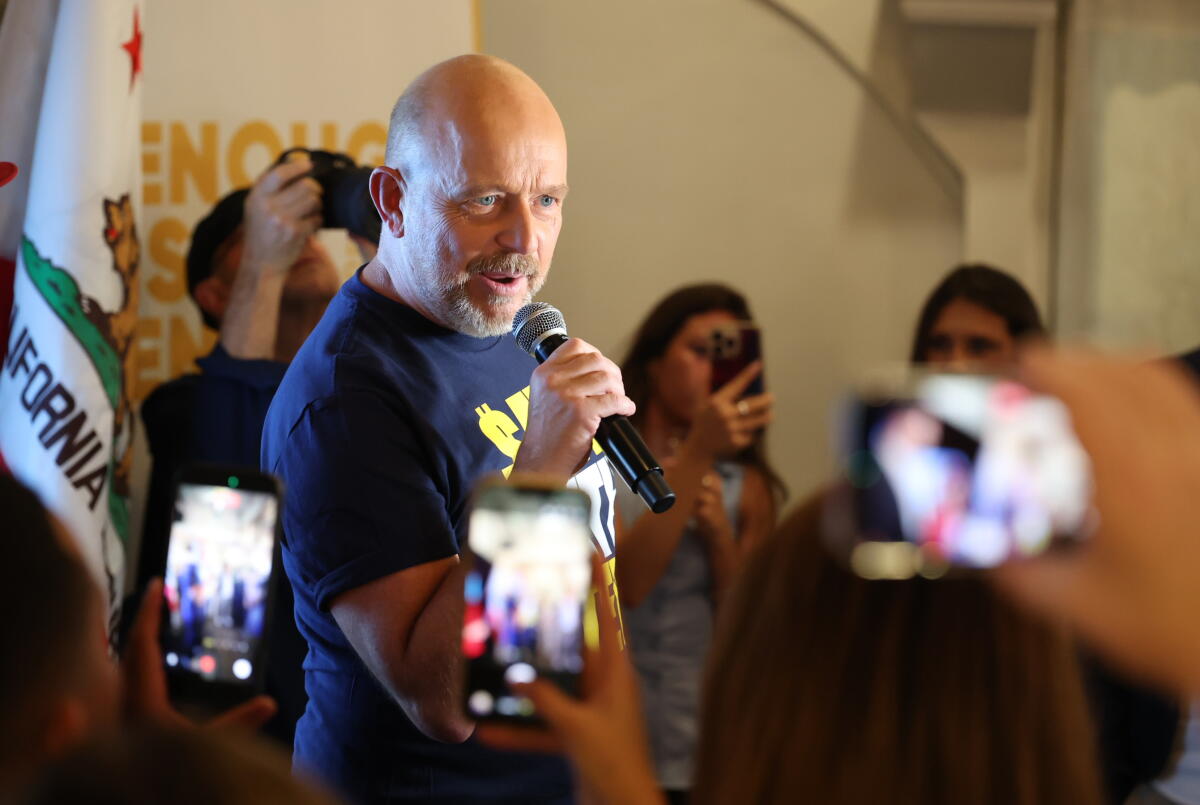
Republican gubernatorial candidate Steve Hilton speaks at a March 7 town hall in Mentone.
(Gina Ferazzi / Los Angeles Times)
A Trump-endorsed Republican could become California’s next governor
A second ticket drop for the Olympics
A second ticket drop is set to open in August and will offer refreshed inventory across all sports at a range of prices.
Those who registered but did not receive a slot in the first ticket drop or did not buy all 12 of their tickets will be enrolled in a lottery for a spot in the second ticket drop.
The parks will serve historically underserved communities with recreation and historic preservation.
What else is going on
Commentary and opinions
This morning’s must-read
Other must-reads
For your downtime
The waffle with maple butter is the drive-across-town dish at celebrity-backed Max & Helen’s, the Larchmont diner opened by Phil Rosenthal and Nancy Silverton.
(Ron De Angelis / For The Times)
Going out
Staying in
A question for you: What’s your favorite California-themed book?
Marya says, “Hard Times in Paradise” by David and Micki Colfax.
Cristina says, “Grapes of Wrath” by John Steinbeck.
On this day 21 years ago, “Me at the zoo” was the first video uploaded to YouTube, opening the door to a new medium of television.
For the 20th anniversary last year, The Times’ Wendy Lee wrote about the video sharing platform and how it changed TV as we know it.
Have a great day, from the Essential California team
Jim Rainey, staff reporter Hugo Martín, assistant editor, fast break desk Kevinisha Walker, multiplatform editor Andrew Campa, weekend writer Karim Doumar, head of newsletters
Much of the news dominating the local restaurant scene has focused on sadness.
Two Los Angeles icons, Cole’s French Dip and Echo Park’s Taix restaurant, closed after more than 215 combined years of service.
It’s easy to be down and not necessarily want to go out.
Fortunately, our Food team, led by senior editor Danielle Dorsey, has some amazing recommendations for new favorites and old haunts that will fill your stomach and lift your spirits.
This month’s highlighted selections include locales from Altadena and Echo Park to Malibu and Westwood that the team feels are all worth your time.
The iconic restaurant along PCH was on the heels of reopening after the Pacific Palisades fire last February when heavy rain caused mudslides that led to flooding and extensive damage.
Fourteen months later, Duke’s Malibu is open with significant renovations and limited lunch and dinner menus featuring Hawaiian-influenced seafood staples such as crispy coconut shrimp, Korean sticky ribs and hula pie.
As the restaurant celebrates 30 years in operation, plans are underway for an anniversary party this summer.
City officials have encouraged Golden Leaf restaurant to install an expensive filter to address the pungent smell, though owners insist that none of their immediate shopping center neighbors have complained about the odor.
Supporters launched a Change.org petition last summer backing the preparation of the dish.
From married couple Omar Limon and Blanca Flores Torres, with help from Omar’s brother Arnold Limon, Hoja Blanca offers a playful take on modern Mexican food with dishes such as quesabirria tacos, esquites with cauliflower and a tetela topped with pork belly, all served alongside Bryan Jimenez’s classic cocktails.
(Stella Kalinina/For The Times)
Meymuni Cafe (Rancho Park)
As war unfolds in Iran and neighboring countries, L.A.’s Persian community has found comfort and support at restaurants such as Meymuni, a modern Persian cafe that offers free tea and cookies to diners, many of whom stop by after related protests at the nearby Federal Building.
The cafe opened in 2025 with barbari bread and lavash wrap sandwiches, tahini-date shakes and chai lattes, plus a full slate of events aimed at uplifting the local Persian community.
(Stephanie Breijo / Los Angeles Times)
NADC Burger (Westwood)
The rapidly expanding smashburger chain from Pasta Bar and Sushi by Scratch Restaurants chef Phillip Frankland Lee has opened its first L.A. location in Westwood Village, with plans to open additional locations in the city.
The signature burger at NADC — an acronym for “not a damn chance” — features two Wagyu patties, American cheese, grilled onions, jalapeños, pickles and a house sauce, with beef tallow fries and brown butter chocolate chip cookies rounding out the short menu.
Roshona Bilash, which translates to “luxurious taste,” features Bengali classics such as bone marrow nihari, rice pilafs and meats and breads cooked in a clay oven, with plans to expand with regional specialties such as seafood dishes popular along the Bangladesh coast.
You’re reading the Essential California newsletter
Sign up to start every day with California’s most important stories.
By continuing, you agree to our Terms of Service, which include arbitration and a class action waiver. You agree that we and our third-party vendors may collect and use your information, including through cookies, pixels and similar technologies, for the purposes set forth in our Privacy Policy such as personalizing your experience and ads.
The week’s biggest stories
(Kyra Saldana/For De Los)
Los Angeles Times Festival of Books
California living
Crime, courts and policing
Entertainment and media news
What else is going on
Must reads
Other meaty reads
For your downtime
(Illustrations by Lindsey Made This; photograph by Frazer Harrison / Getty Images)
Going out
Staying in
L.A. Affairs
Get wrapped up in tantalizing stories about dating, relationships and marriage.
Have a great day, from the Essential California team
Jim Rainey, staff reporter Hugo Martín, assistant editor, fast break desk Kevinisha Walker, multiplatform editor Andrew J. Campa, weekend writer Karim Doumar, head of newsletters
When Joe Biden launched his campaign for the presidency in 2019, his economic proposals were relatively modest updates of the middle-class-oriented agenda he championed as vice president under Barack Obama. “It doesn’t require some fundamental shift,” he said, pushing against the sweeping proposals of rivals like Bernie Sanders and Elizabeth Warren.
Then came the pandemic.
Today, Biden’s economic message, retooled to address current needs, has real urgency.
“We can’t wait,” he said last week. “There’s a lot of people who are in real, real trouble — a lot of people going to bed at night, staring at the ceiling wondering … if they’re going to be evicted.”
And Americans seem ready to spend to make things better. The huge $1.9-trillion pandemic relief bill Biden has proposed is wildly popular. A CBS News poll last week found that 79% of Americans want Congress to pass a bill as big as the one Biden proposed, including 61% of Republicans.
Biden isn’t stopping at pandemic relief. He’s also using the emergency to build support for the far broader program of economic reform he adopted midway through his campaign last year, including massive investments in manufacturing, technology, education and child care.
“We’re in a position to think big and move big,” he said.
He’s following the advice that Rahm Emanuel, then a member of Congress, offered during the financial crash of 2008: “You never want a serious crisis to go to waste.”
For Biden, that begins with the pandemic relief plan, a package that includes a $1,400 check for most adults, increased unemployment insurance, a child tax credit of up to $3,600 a year, $440 billion for state and local governments and $130 billion to help reopen schools.
And once that proposal is enacted, White House officials say, the president will turn to the broader, long-term economic proposals of his campaign, including a $400-billion “Buy American” plan to support manufacturing, $300 billion for research and development, more spending on clean energy and — if it doesn’t pass as part of the pandemic package — a $15 minimum wage.
It’s an ambitious agenda: a dramatic expansion of federal government spending to create jobs, especially in manufacturing and strategic technologies.
Biden’s economic populism is aimed, in part, at the same voters Donald Trump appealed to when he called for revitalizing American manufacturing and bringing jobs back home — but only in the sense that Biden, too, has promised to repair some of the damage wrought by the long decline in manufacturing jobs.
“A lot of white working-class voters thought we forgot them,” he said last year during a campaign tour of faded industrial towns in Pennsylvania. “I get them. I get their sense of being left behind.”
He’s kept a few of Trump’s policies, most notably the tough stance on trade with China. But the difference in the two populisms is illustrated by the predecessor each president chose as a model.
In Trump’s Oval Office, he hung a portrait of Andrew Jackson, the 19th century nationalist who warred with bankers on behalf of working-class white Americans but also supported slavery and pushed tens of thousands of Native Americans off their ancestral lands.
Biden replaced Jackson’s portrait with one of Franklin D. Roosevelt, the Depression-era Democrat who enacted Social Security, vastly expanded the federal government and was reelected three times.
If Biden’s economic agenda were being proposed by full-throated progressives like Sanders or Warren, it might sound extreme to many voters. But his long record as a relatively centrist Democrat could insulate him from that hazard, much as FDR’s aristocratic background allowed him to tack left.
“Voters view him not as a radical, but as a get-things-done moderate,” Biden’s campaign pollster, John Anzalone, told me. “Voters are incredibly transactional right now. They want help and they want it quick.”
Republican opposition to both parts of Biden’s agenda — the short-term relief plan and the longer-term reforms — has been muted so far, mostly because GOP leaders have been too busy with family quarrels over Trump’s legacy to offer much of an alternative to the president’s plans.
That’s unlikely to last. There will be plenty for conservatives to oppose soon enough, beginning with the $15 minimum wage and those new big-government economic programs — not to mention the increase in corporate taxes Biden has proposed to help finance it all.
But as the president nears the end of his first month in office, it’s possible to imagine that by the end of 2021 he could be claiming credit for a rebounding economy and pressing ahead with his broader proposals. If he succeeds, the Biden presidency could be transformative in a way even his supporters didn’t expect.
Commenters who never have been — and never will go — complain about the cost, the influencers, the hype. Purists wax poetic about the days when they disappeared into three days of music and the field wasn’t overtaken by brands like Barbie and e.l.f. cosmetics. Defenders claim they can camp their way to an affordable weekend, and others spend the whole time posting. A select few even talk about great performances they saw — it’s still a music festival.
You’re reading the Essential California newsletter
Sign up to start every day with California’s most important stories.
By continuing, you agree to our Terms of Service, which include arbitration and a class action waiver. You agree that we and our third-party vendors may collect and use your information, including through cookies, pixels and similar technologies, for the purposes set forth in our Privacy Policy such as personalizing your experience and ads.
But one thing everybody can agree on: Coachella has changed. I should know. I’ve been covering it as a journalist since 2007.
Rapid advancements in technology and mass adoption of social media have brought out the best and worst of the festival — not just on screens thousands of miles away, but to those of us trying not to trip over the makeshift photoshoot you might have seen on Instagram.
In the early years, there were no brand activations on the field; nobody knew what an influencer was and the only corporate sign you saw was for Heineken in the beer gardens. (There was no Heineken House with its own stage, just signs advertising the beer.)
The grounds were also considerably smaller, making it easier to explore the different stages and discover new music. You didn’t have fancy food options, but a slice of Spicy Pie was less than $10. (Coachella upgraded its food options from festival staples to weekend outposts of L.A. restaurants in 2014.)
The music was the draw. The festival’s track record includes artists like the Killers, the Black Keys, Childish Gambino and Kendrick Lamar climbing up from small type to headliner on the lineup poster.
Livestreams and influencers made Coachella’s reach global
The vibes started to shift in 2010 as smartphones grew in popularity, although the service on the field was spotty. It was the first year Coachella offered a livestream — available via Facebook and MySpace. The next year, the stream moved to YouTube, where it remains and draws millions of viewers.
As Coachella expanded to twin weekends due to popular demand on the ground in 2012, it also had the first viral moment fans could enjoy from thousands of miles away: Dr. Dre and Snoop Dogg brought 2Pac back to life via a hologram.
Celebrities were always at Coachella (I spotted Ryan Seacrest, Corbin Bernsen, David Hasselhoff and Danny DeVito in my early years), but the rise of social media made celebrity culture a key part of the event. By 2011, TMZ was posting about stars like Lindsay Lohan. Clips from Coachella went viral and ended up on shows like “Tosh.0” and referenced in “Community.”
The art, which was always part of the festival, became bigger and more iconic. On the growing photo app Instagram, larger-than-life sculptures of astronauts started appearing in selfies.
Brands saw an opportunity. American Express, H&M and Samsung launched activations on-site in 2015. The party scene outside the festival, with non-affiliated events that were timed because everyone was in town for Coachella, became marketing vehicles. Brands are still cashing in more than a decade later.
The next watershed moment was Beyoncé in 2018. Today, most headlining sets at the fest feel as if they are designed for the viewing experience on the livestream rather than the fans on the field (ahem, Justin Bieber and his laptop). But Beyoncé’s spectacle was just as mind-blowing on-site as it was at home. A year later, the “Homecoming” special debuted on Netflix, widening the reach.
Coachella became a key part of the pop culture landscape, and then it became a cornerstone of the influencer economy.
Behind all the hype, there’s still a music festival hiding
I inadvertently photobombed approximately 500 people just trying to go to and from the press tent last weekend and my inbox is overflowing with requests for coverage of off-site events with brands, celebs and TikTok influencers, including social media clips.
Coachella is what you make of it. And besides, everyone knows there are fewer influencers on Weekend 2.
Today’s top stories
A health worker administers a measles test on Fernando Tarin, of Seagraves, Texas, at a mobile testing site outside Seminole Hospital District on Feb. 21, 2025.
The Automated People Mover system began construction in 2019 and was initially slated to open to the public in 2023.
Nationwide recall of a popular anxiety drug
Specific bottles of Xanax, one of the most widely prescribed medications to treat anxiety and panic disorders, has been recalled due to its failure to dissolve at a standard rate.
FDA officials are not warning against consuming the product at this time.
What else is going on
Commentary and opinions
This morning’s must-read
Another must-read
For your downtime
Reporter Deborah Vankin gets a massage by an “Aescape” robot at Pause Wellness Studio.
(Christina House / Los Angeles Times)
Going out
Staying in
A question for you: Are you planning on leaving California for another state? If so, tell us why.
Laura says, “I left California during the pandemic. Part of the push factor for me was politics, but not blue politics. I had been living in OC since 2018 and was surprised it was so Conservative (and conservative). That became a bigger source of discomfort for me as the vaccine question demonstrated how our neighbors’ decisions can impact us directly. Rather than moving elsewhere in California, which would have sorted out the political discomfort nicely, I moved to a much more affordable state where I had family.”
Have a great day, from the Essential California team
Jim Rainey, staff reporter Hugo Martín, assistant editor, fast break desk Kevinisha Walker, multiplatform editor Andrew Campa, weekend writer Karim Doumar, head of newsletters