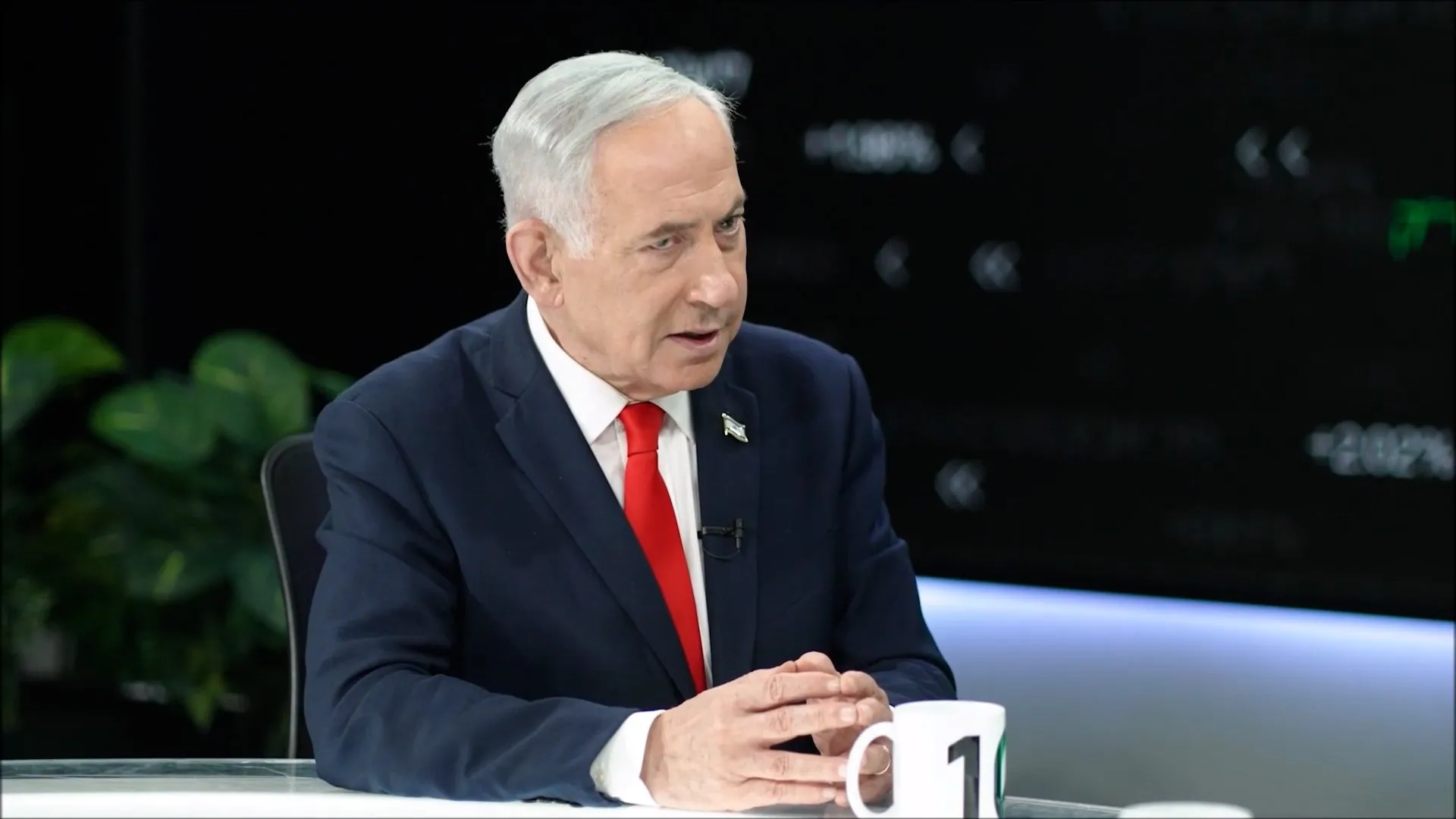
Netanyahu floats Crypto to bypass sanctions | News
Israeli Prime Minister Benjamin Netanyahu has suggested using cryptocurrencies and blockchain technology to help Israel operate under potential international sanctions.
Published On 24 Oct 2026
Israeli Prime Minister Benjamin Netanyahu has suggested using cryptocurrencies and blockchain technology to help Israel operate under potential international sanctions.
Published On 24 Oct 202624 Oct 2026
Share
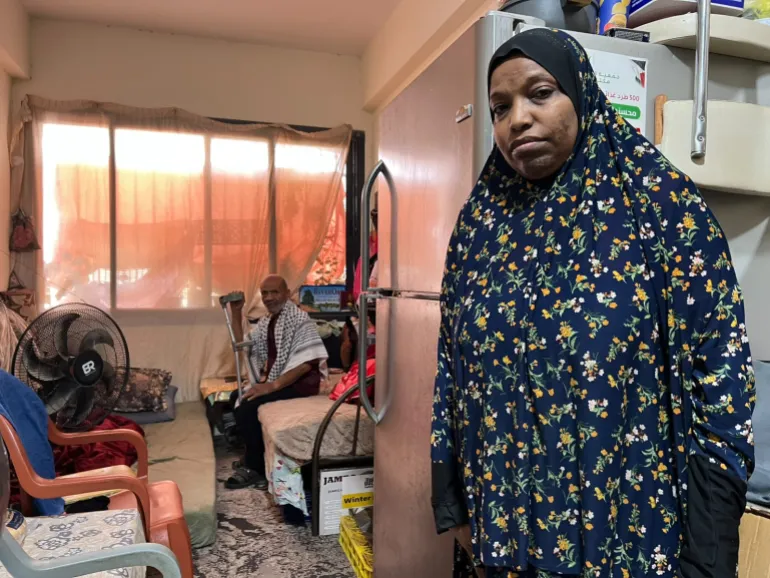
Tulkarem, occupied West Bank – Fawza Awad, a 75-year-old widow, couldn’t hold back her tears as she described the living conditions she has endured since being displaced from the Tulkarem refugee camp in January 2025 – a result of an Israeli military operation that targeted refugee camps in the northern West Bank, forcibly displacing tens of thousands of Palestinians from their homes.
With little money, Fawza and her family found shelter where they could: a small, unfinished house in Tulkarem belonging to her daughter. She currently lives in a portion of the structure alongside her son, his wife, and their child.
list of 3 itemsend of list
The family previously relied on limited financial and food assistance provided by the World Food Programme (WFP), but has not received aid in the past five months.
The UN agency officially announced a 50 percent reduction in the number of food aid recipients in the occupied West Bank in September, citing “critical funding constraints”, the result of reduced funding from international funders. Food needs, conversely, have more than doubled since 2023, when Israel began its genocidal war on Gaza, and increased attacks on Palestinians in the West Bank.
The WFP noted at the time that approximately 900,000 people in the West Bank are currently suffering from food insecurity.
In a statement given to Al Jazeera, the WFP confirmed that some families had stopped receiving aid before the official announcement in September.
Fawza and her family have been left to fend for themselves. There is no prospect of returning to her old home – she says that the Israeli army has completely demolished the structure, replacing it with a wide road to facilitate the movement of its military vehicles.
She added that one of her sons has been detained by Israel since 2024, while her other sons, who previously worked inside Israel, are now all unemployed.
“I suffer from asthma and high blood pressure, requiring monthly medication that costs at least 200 shekels ($64), an expense no one covers for me. We used to receive modest food aid barely enough for two or three people, but now that has stopped completely,” Fawza told Al Jazeera.

Not far away, in the al-Muwahhad School building in the Thannabeh suburb of Tulkarem, more than 1,000 Palestinians displaced from the Tulkarem and Nur Shams refugee camps are sheltering, having found nowhere else to go and unable to pay rent.
Among them are Rabab Qasim, 47, her husband Talib Abu Sarriya, 72, and their three children. For the second consecutive year, they have been living in a small, 30-square-metre (320sq-foot) room on the ground floor of the school, with no source of income and totally reliant on aid.
For the past three months, the family has received no aid whatsoever following the WFP food assistance cut.
“I suffer from a herniated disc in my back, requiring monthly treatment that costs 300 shekels ($96) – an amount I cannot afford,” Rabab said. “I also need physical therapy, which I have never been able to access because I cannot pay for it. I sleep on a worn-out mattress on the floor; all I wish for is to be able to buy a bed.”
Talib told Al Jazeera that the family are often unable to find bread or a meal, and frequently go to sleep hungry. It’s a far cry from their former life in the Tulkarem refugee camp, where he once owned a small vegetable stall. It was a modest livelihood, but one that gave them enough to get by.

The WFP has blamed increasing Israeli pogroms and forced displacements in the West Bank for devastating livelihoods, deepening hunger, and pushing families into even more severe crises. The latest quarterly food security analysis conducted by the WFP indicates that 76 percent of Palestinian households in the West Bank have experienced a significant decline in income.
According to the analysis, 12 percent of the population has poor food consumption, and one-third of households cannot afford a healthy diet due to rapidly deteriorating economic conditions. Rural areas and the governorates in the southern occupied West Bank have been the hardest hit.
Said al-Amour, 61, a resident of Khirbet al-Rakeez in Masafer Yatta, south of Hebron, told Al Jazeera that he and his 14-person family haven’t received any assistance from the WFP for the past seven months.
In April 2025, while confronting repeated attacks by settlers on the village, Said says he was shot by a settler. The injury resulted in the amputation of his leg and a permanent disability; he continues to face periodic assaults and beatings whenever he encounters the settlers – part of the ongoing pogrom against Palestinians in the West Bank.
“They are trying to steal our land. I refuse to let them take it, and I will continue to defend it, but I am paying a heavy price. Now, they have cut off the aid I used to receive that helped my family remain steadfast here,” he told Al Jazeera.
Due to the amputation of his leg, al-Amour requires monthly medical treatment costing at least 1,200 shekels ($385), an expense that he cannot afford. He has no source of income other than a few olive trees, which settlers frequently attempt to seize.
In cooperation with its partners, the WFP still provides assistance to 200,000 Palestinians in the West Bank through cash transfers, food vouchers, direct food supplies, livelihood programmes, and nutritional services.
However, the WFP told Al Jazeera that it simply does not have the resources to cover the needs of all the families in the West Bank requiring assistance.
“The cessation of aid does not imply that a beneficiary is ineligible; rather, it is a broad decision affecting all current beneficiaries, regardless of the outcome of their individual assessment,” the WFP said. “It is possible that changes may occur, and aid could be reinstated for some beneficiaries; in such cases, they would be contacted and notified via text message.”
Economist and human rights activist Ubai Aboudi told Al Jazeera that the West Bank is facing a humanitarian crisis exacerbated by the loss of the WFP food aid, as well as a financial crisis affecting the Palestinian Authority (PA). Israel has completely withheld the customs revenues it collects on behalf of the PA since May 2025, leaving the authority unable to pay public sector salaries.
Aboudi noted other factors, such as the tens of thousands of Palestinians previously employed in Israel and illegal settlements in the West Bank who have been out of work since October 2023, when Israel stopped giving them work permits.
He also added that Israeli restrictions on Palestinian and international NGOs, including the suspension of registration for 37 international organisations and the closure of some local groups, have further limited the ability to provide humanitarian assistance.
“Around half a million Palestinian families need food assistance, while the actual need may be greater,” Aboudi said. “With aid declining from the World Food Programme and other sources, many families are unable to secure food.”
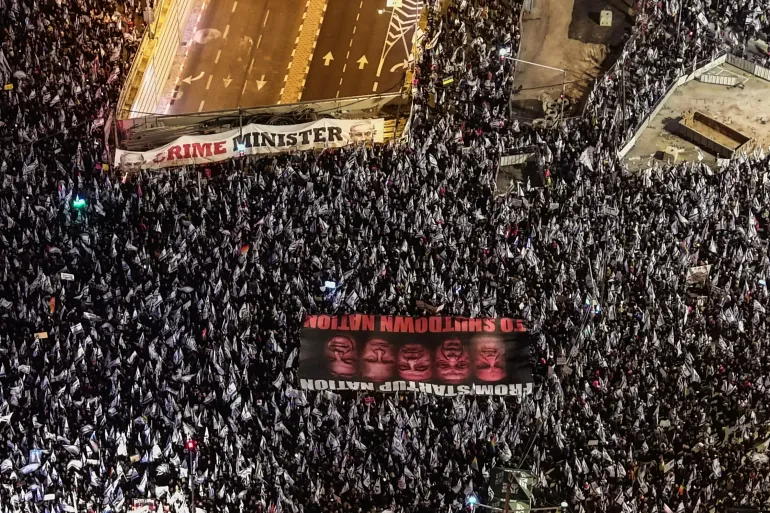
To his supporters, he is known as “King Bibi”; but to his opponents, he is the king of security failures and corruption.
Disputes over names aside, what is not in question is that Benjamin Netanyahu, Israel’s longest-serving prime minister, has left his mark on the country’s institutions, politics and social attitudes during a decades-long career that has been defined by Israel’s lurch to the right.
list of 3 itemsend of list
As he seeks re-election in Israel’s October 27 polls, analysts say his most enduring domestic legacy may be the right-wing, militaristic opposition that he has helped create and now faces.
Born in 1949, Netanyahu entered Israel’s central political stage in the early 1990s by fuelling anger at possible peace deals with the Palestinians and Syria.
Israeli political leaders have accused him of leading incitement that motivated the 1995 assassination of then-Prime Minister Yitzhak Rabin, who was leading negotiations with the Palestine Liberation Organization, by an ultranationalist Israeli. Netanyahu had led rallies in which participants depicted Rabin in a Nazi SS uniform and held signs of him in the crosshairs of a gun, while others shouted “traitor”.
The Likud Party leader denies any responsibility, but former security officials have said they warned Netanyahu before the assassination and asked him to dial down his rhetoric, only for him to refuse, according to Israeli media reports.
In 1996, Netanyahu’s populist tactics succeeded at the ballot box, making him Israel’s youngest prime minister. Netanyahu’s transactional leadership style gave prominence to extreme-right and religious parties that are now an indispensable part of his right-wing alliance.
Under him, religious courts have expanded powers, including over civil and business disputes. State institutions accommodate religious agendas and allocate record levels of funding to ultra-Orthodox schools and institutions.
Netanyahu inscribed his political ideology, especially on the identity of the state and the status of Palestinian citizens of Israel, into law. In 2018, the Knesset passed the so-called Nation-State Basic Law, which states – among other things – that Israel is the exclusive state of the Jewish people and also makes advancing illegal settlements a national priority.
Human rights organisations in Israel petitioned the High Court to stop the legislation from going into effect, but the petition was rejected. International experts and rights groups cite this law, among others, as evidence of Israel committing the crime of apartheid in its treatment of Palestinians.
Netanyahu also re-engineered state institutions, including Israel’s security structures, appointing loyalists and political allies to senior positions. He also clashed with security chiefs that he deemed antagonistic. And in the aftermath of the Hamas-led October 7, 2023 attack, which triggered Israel’s genocidal war against Palestinians in the Gaza Strip, Netanyahu deflected blame and responsibility on the security establishment, prompting Ronen Bar, who was the Shin Bet chief in 2023, to sue him for defamation.

A major change to Israeli institutions that was spearheaded by Netanyahu during his 19 on-and-off years in power affected the judiciary, which is examining lingering corruption charges that could see him serve time in prison if he is convicted. Netanyahu, who is up against three separate cases of corruption filed in 2019, denies any wrongdoing.
Under his leadership, the Knesset adopted legislation that changed the composition of the Judicial Selection Committee to ensure greater political influence for the governing coalition.
Netanyahu called it “judicial reform” to stop what he often calls a “judicial dictatorship” ruling over elected officials.
Opponents called it a “coup” that sparked wide-scale protests: a push to curtail the independence of the High Court and give politicians influence over the courts and ministerial legal advisers.
In line with his efforts to subvert independent oversight, Netanyahu tried repeatedly, but unsuccessfully, to fire the attorney general.
But he succeeded in dismissing the military’s advocate general for leaking a video of Israeli soldiers gang-raping a Palestinian detainee. The soldiers were also released and cleared of charges.
At the same time, Netanyahu is dogged by corruption cases dating back to 2019, which could see him serve time in prison if convicted
The prime minister, who is wanted by the International Criminal Court on charges of war crimes in Gaza, says his work is not over. He promises his supporters he will complete the overhaul of judicial review and press on with other highly controversial policies.
Netanyahu’s supporters and allies view him as a leader who delivers, and one who achieved what others could not. His opponents pledge to undo the damage Netanyahu caused over the past decades, pointing to corruption, social divisions and increasing international isolation as outcomes of his rule.
But undoing such formative changes, many of which are now law, may be easier said than done.
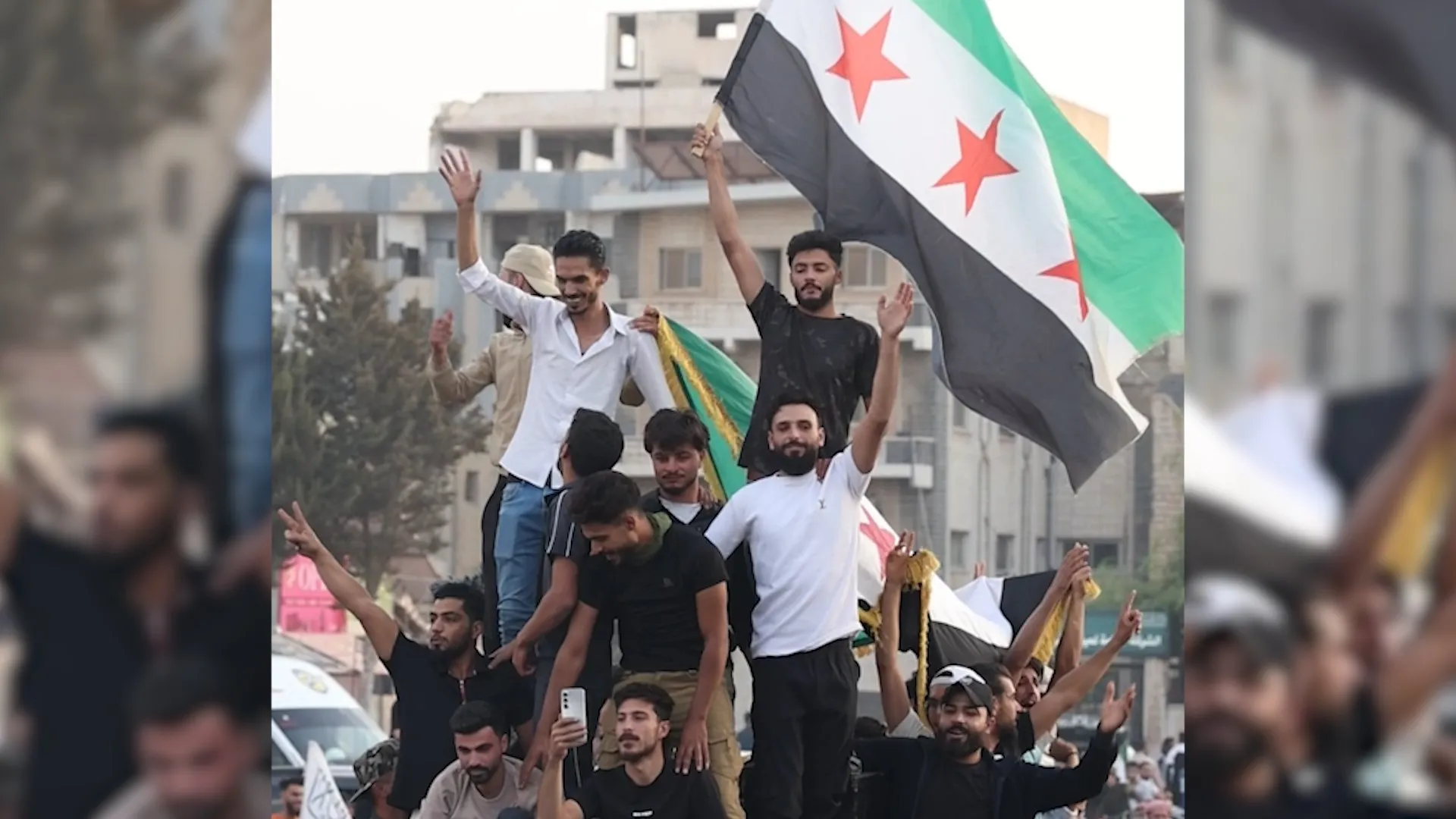
Syrians are protesting Israel’s occupation of parts of the country’s south, near the occupied Golan Heights. Israeli troops have bulldozed olive groves, set up checkpoints and detained residents. Al Jazeera’s Heidi Pett reports from the protests.
Published On 24 Oct 202624 Oct 2026
Share
Global crude prices continue to climb, with Brent benchmark hitting $117.30 a barrel to build on four-year highs as market fears grow over a potential resumption of the US-Israeli war on Iran.


Published On 24 Oct 202624 Oct 2026
Share
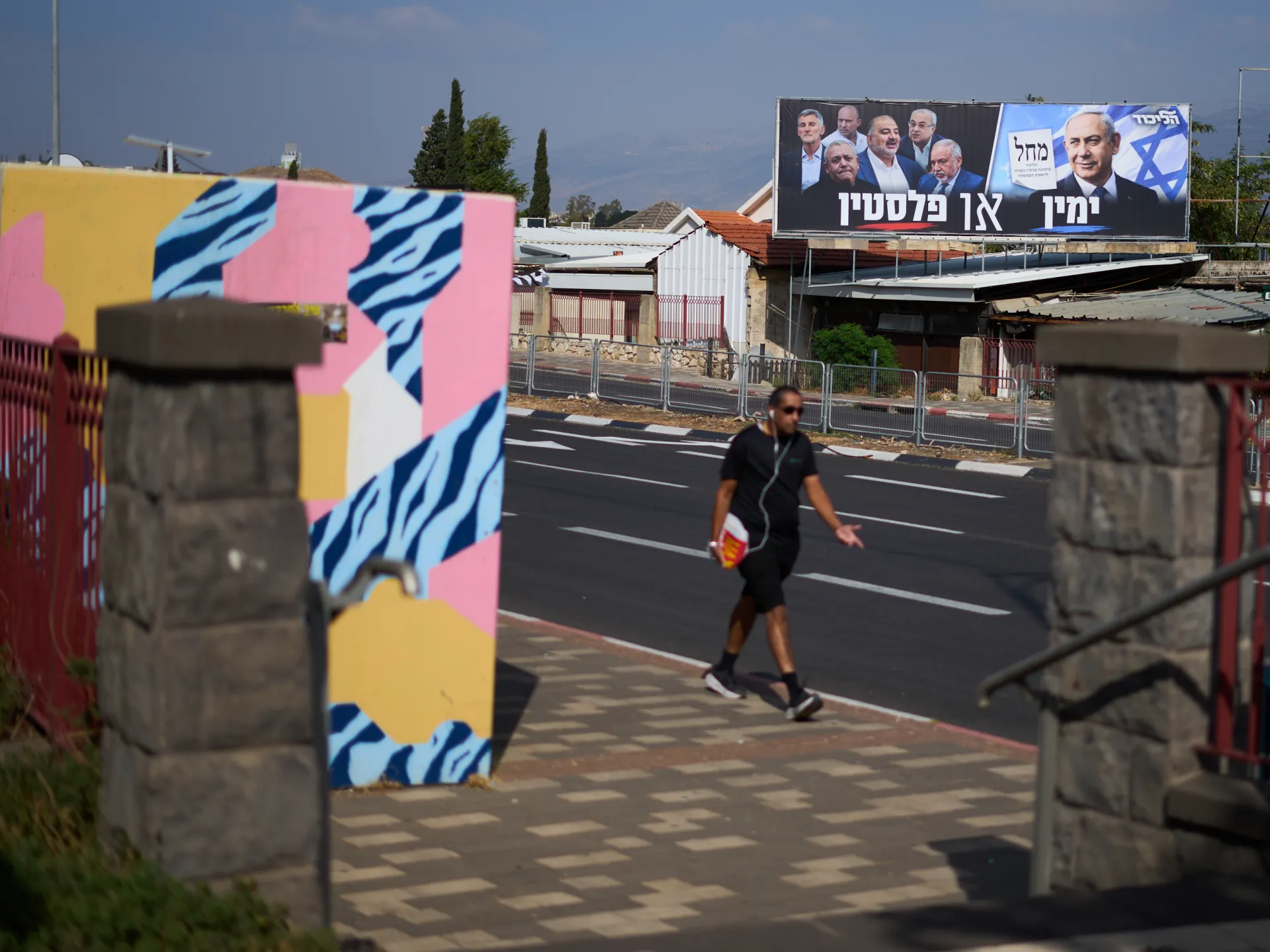
The first Israeli elections in four years have brought with them a record number of first-time voters – most of whom are keen to make their voices count.
But while youth around the world are leaning to the left, young adults in Israel are heading in the opposite direction, according to recent polls.
list of 3 itemsend of list
The Israeli Central Elections Committee says more than half a million voters were added to the roll since the last elections in 2022. They are aged between 18 and 22 and polls show that 80 percent of them plan to vote in the October 27 legislative election.
Although their political activism and engagement in the public sphere are limited, a survey by the think tank, Israel Democracy Institute (IDI), found that a majority of young Jewish Israelis feel that the ballot box can influence reality and shape their country’s future.
But what does the future they hope for look like?
Around three quarters of Jewish first-time voters polled identified as “right or centre-right”, according to a recent poll for Israel’s Channel 12. That’s significantly higher than the rest of the Israeli population, which has already been shifting to the right for years.
Now the title “Generation Right” is being used to reference Israel’s Jewish youth – though not the Palestinian citizens of Israel.
The first Israeli elections since the October 7, 2023 attack are contentious and polarising – and they will be decisive for Prime Minister Benjamin Netanyahu’s political survival and his right-wing approach.
Critics of the longest-serving PM in Israel’s history accuse him of supporting “far-right” politicians to stay in power. They say that his handing of key government positions to extreme politicians such as National Security Minister Itamar Ben-Gvir and Finance Minister Bezalel Smotrich helped empower those camps and make their policies mainstream.
In 2017, Smotrich laid out his position for the future of Israel where the Israelis are the only ones who will have self-determination, whereas Palestinians will have to emigrate, stay without political representation, or be treated as “terrorists” if they refuse either of the two options. In 2022 he secured a portfolio in the defence ministry where he facilitates land grabs and empowers the illegal settlement enterprise in the occupied West Bank.
Indeed, this incitement and view of Palestinians has become more prevalent.
A recent video published by the Israeli satirist Lior Schleien shows a young man saying he would kill Arabs in Israel.
Schleien, a left-wing activist, has been visiting schools and speaking with young people often before their army service. His videos are giving Israelis, and the world, a chance to understand the younger generation.
In the video, Schleien asks the student how he proposes to kill Arabs. The answer: “Give me a knife and I will do it.”
Schleien asks whether October 7 changed his views. “I’ve always been racist,” the young man answers, adding that Arabs shouldn’t be allowed to live in the state of Israel. Even though the young man’s face is slightly covered, shielding his identity, Schleien removed the video after a public backlash.
In another town hall meeting, Schleien addresses the question of whether there are innocent people in Gaza. When asked if Israel is committing a genocide in Gaza, Schleien denies it, only for a female student to ask, “Do you think it should be done?”
Schleien looks unimpressed, but the student assures him that she is asking a serious question. Her friend, next to her, chuckles.
At a recent meeting of young supporters of the left-leaning Democrats party in Tel Aviv, 18-year-old Gili told the AFP news agency that she believed Israeli society had abandoned the idea of peace.
She said the scars of October 7 instilled fear among people, making it hard for them to believe peace could ever be achievable.
While the October 7 attack may have accelerated the country’s push to the right and far-right, many say Israeli society has been heading this way for years.
A survey by the Israeli newspaper Yedioth Ahronoth shows more than 16 percent of new voters plan to cast their ballot for far-right parties.
From a large field in southern Israel, 18-year-old Amihai was wearing a shirt with far-right minister Ben-Gvir’s photo. The event he was attending called for the establishment of illegal Israeli settlements on Palestinian territory.
Talking to other young activists from a place overlooking the destroyed parts of the Gaza Strip, Amihai said he plans to vote for Otzma Yehudit, a party led by Ben-Gvir, who himself lives in an illegal settlement in the occupied West Bank.
Although Ben-Gvir did not pass the threshold of the 2020 elections, he was given a central position in the 2022 government of Netanyahu.
In the years since, the minister seems to have learned to speak the language of Israel’s youth. Despite having been convicted of supporting “terror” organisations as well as other criminal offences, Israeli surveys show that a chunk of his potential supporters in this election are first-time voters.
Ben-Gvir has also made sure to use his position to lobby for his “I am not mincing my words” policies.
As a minister, he often visits Israeli jails and detention centres to threaten Palestinian prisoners as well as international activists – all the while making sure that it is caught on camera.
His videos often go viral, a move that has earned him more youth support – and not just from his usual base of settlers, such as the violent “Hilltop Youth”, some of whose members have been sanctioned by the European Union and the United Kingdom.
The IDI survey found that social media and messaging apps such as WhatsApp and Telegram are key sources of information – often exposing young people to political content through their feeds rather than through active searching.
It is a language Ben-Gvir understands.

Across the Balkans, leaders are deepening ties with Israel through defence, surveillance, and political backing. But why?
Al Jazeera’s Aida Duratovic explains.
Published On 23 Oct 202623 Oct 2026
Share
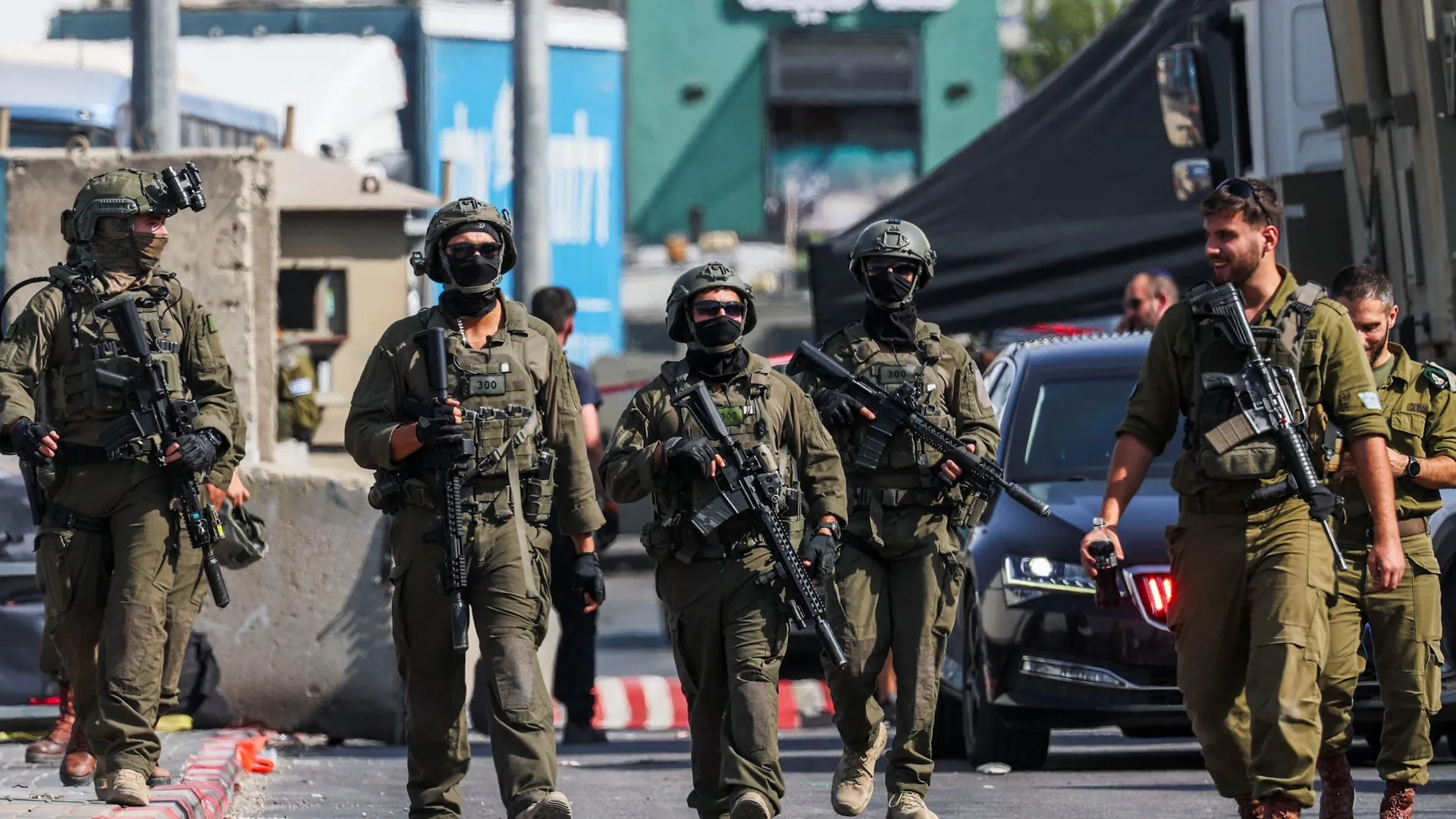
Israel has imposed a lockdown across the occupied West Bank after a shooting near Hebron killed two Israeli soldiers. Israeli forces raided Palestinian homes and arrested residents. Prime Minister Benjamin Netanyahu threatened a military operation on a scale unseen since 1967.
Published On 23 Oct 202623 Oct 2026
Share

Israeli Prime Minister Benjamin Netanyahu orders a “full lockdown” of the occupied West Bank following a shooting in Hebron, while National Security Minister Itamar Ben-Gvir expands settlers’ access to firearms. Meanwhile, questions emerge over the UN’s role at Gaza’s Rafah crossing.
Al Jazeera’s Marah Rayan brings us the latest from Palestine and Israel.
Published On 23 Oct 202623 Oct 2026
Share
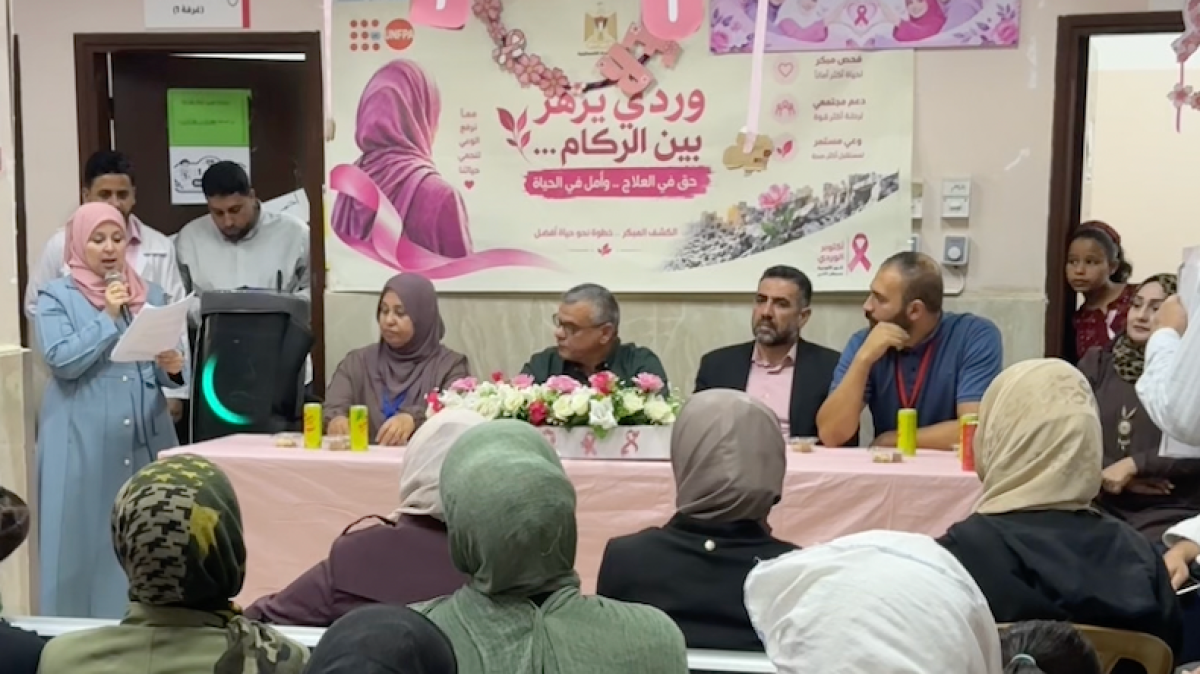
Health workers in Gaza are participating in a breast cancer campaign
called ‘pink blooms from among the rubble’ to educate and support women with the disease amid Israel’s genocidal war. Al Jazeera spoke to breast cancer patient Hiba Musbah about her painful journey.
Published On 23 Oct 202623 Oct 2026
Share
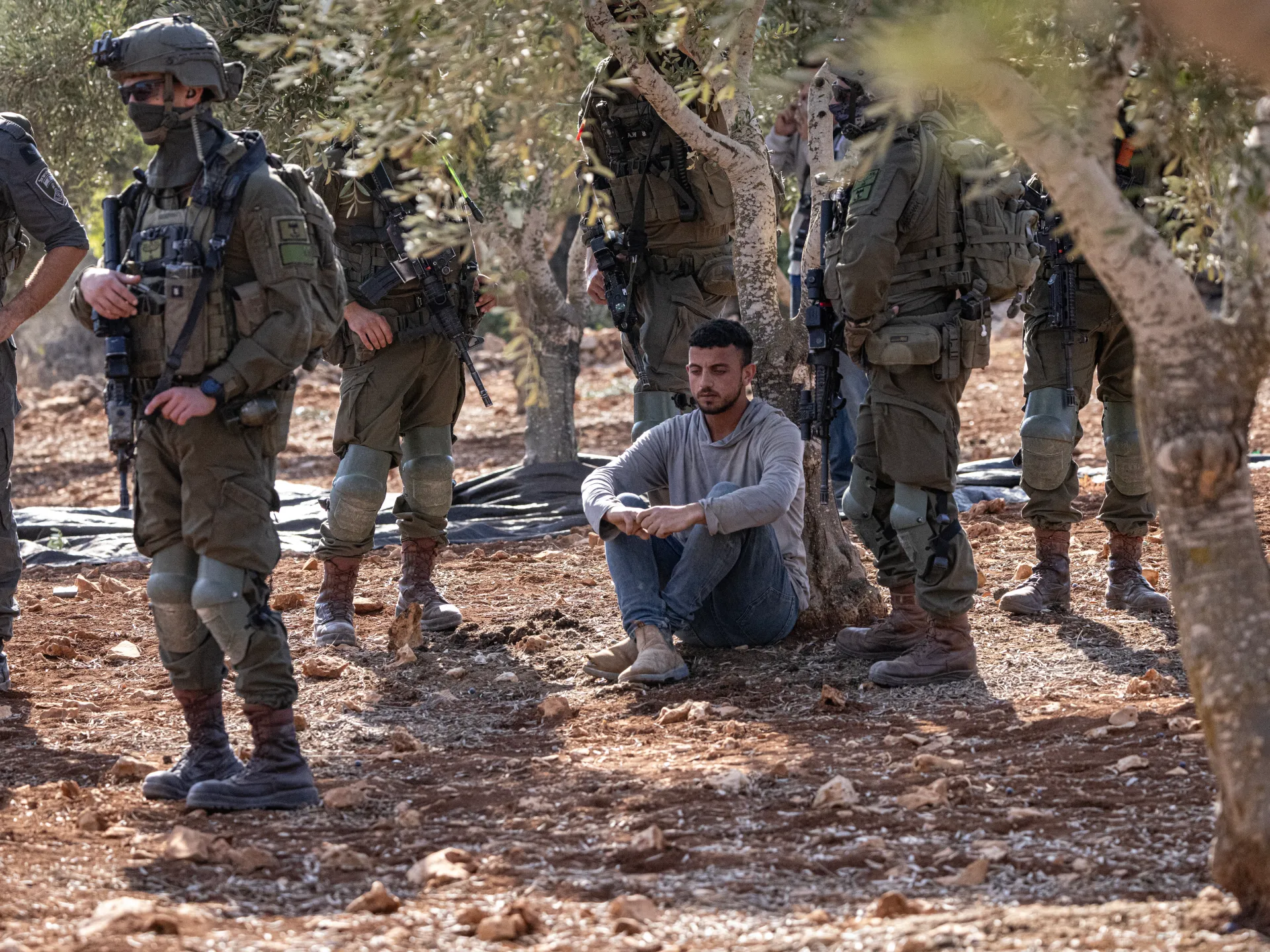
Israeli pogroms on Palestinian farmers and their lands during the olive harvest season intensify.
Published On 23 Oct 202623 Oct 2026
Israeli forces have arrested 36 Palestinians during raids across the occupied West Bank, as attacks on Palestinian farmers and their lands during the olive harvest season ramp up.
In Jenin governorate, Israeli forces raided towns and villages on Thursday, arresting 10 Palestinians, the Palestinian news agency Wafa reported, citing data from the Palestinian Prisoner’s Society.
list of 3 itemsend of list
Israeli forces also raided the town of Tuqu in the Hebron governorate on Thursday and arrested former prisoner Shorok al-Badan, along with five others from other parts of Hebron, according to Wafa.
The Colonization and Wall Resistance Commission said on Thursday that Israeli forces arrested 14 people in Khirbet Jawaya village of Masafer Yatta in Hebron, while Wafa reported that three other Palestinians were arrested across the Hebron governorate, citing a security source.
In Nablus and Jerusalem, three more Palestinians were arrested during Israeli raids in the village of Burin, the town of Awarta, and the Qalandiya refugee camp.
The Colonization and Wall Resistance Commission said it documented 17 pogroms by Israeli forces and settlers on Thursday against Palestinian farmers and their land during the olive harvest.
The incidents were recorded across occupied West Bank governorates, including Hebron, Qalqilya, Nablus, Ramallah and el-Bireh, Jenin and Salfit.
According to the Commission, the attacks included assaults on farmers, preventing them from reaching their land, theft of crops and agricultural equipment, damage and burning of olive trees, as well as arrests, threats at gunpoint and live fire.
The Commission says the pattern represents an escalation in attacks targeting the olive harvest and undermines Palestinians’ ability to access and cultivate their land and maintain their livelihoods.
Israeli attacks on Palestinian farmers garnered international attention and condemnation. US Democratic congressional candidate Brad Lander was briefly detained on Wednesday by the Israeli military with a warning while volunteering to help Palestinian farmers harvest olives in the occupied West Bank.
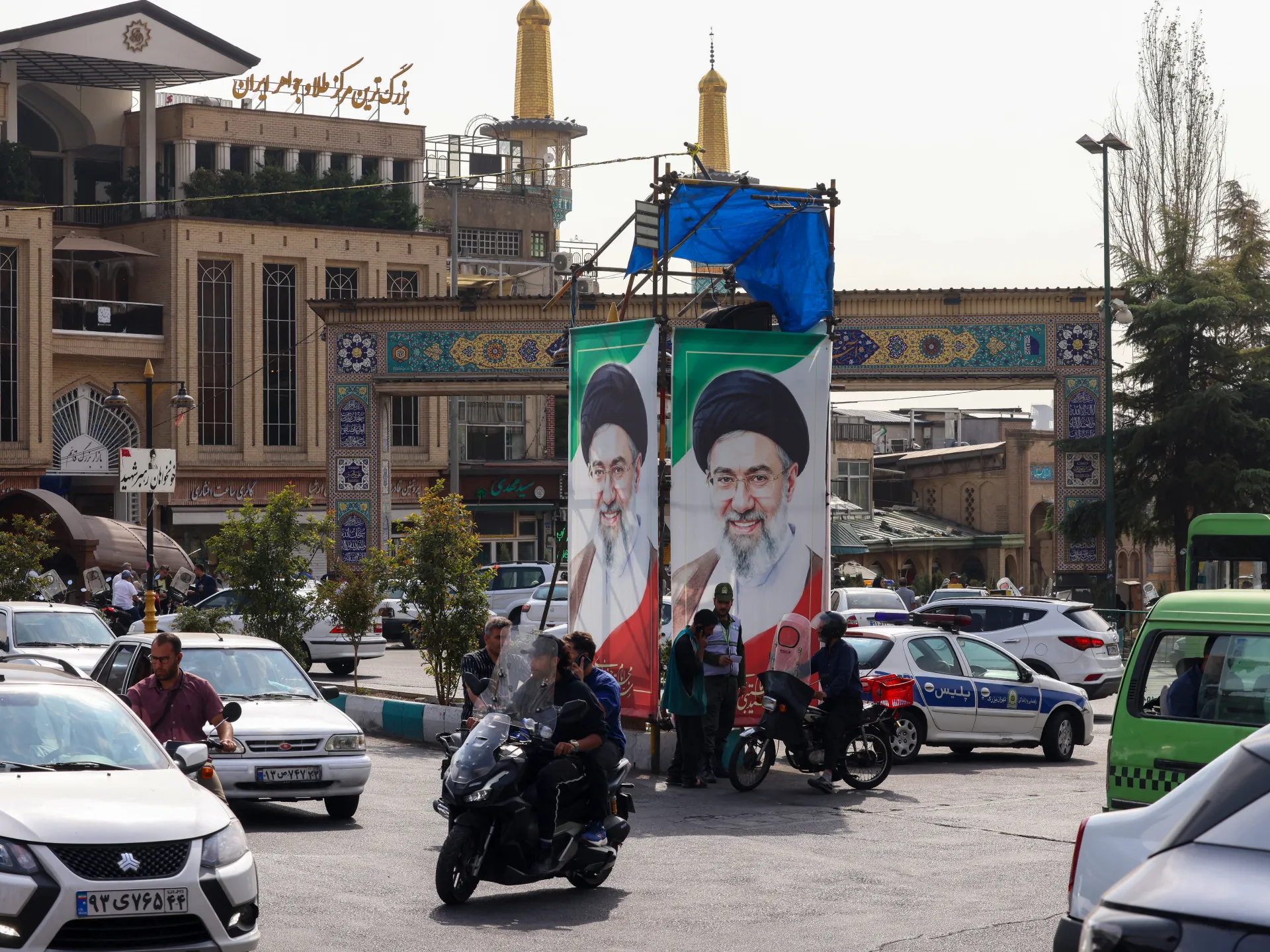
Trump indicates new strikes on Iran, saying the US has knocked the 'hell out' of the country.
Source link
Israeli court releases nine settler suspects over West Bank attacks as investigations into recent assaults continue.

Published On 22 Oct 202622 Oct 2026
Israel has released nine of the 10 Israeli settler suspects arrested over attacks on a US journalist and European diplomats in the occupied West Bank, placing them under house arrest.
An Israeli court in Jerusalem ordered the release late on Wednesday, according to Honenu, a law firm that represents Israeli settlers.
list of 3 itemsend of list
Israeli police said one suspect remained in custody and that the investigation into the violent incidents was continuing.
Masked settlers were filmed last week assaulting Heidi Levine, a Washington Post photojournalist covering a Palestinian olive harvest who was taken to hospital and underwent surgery on a finger.
In a separate attack earlier this week, masked settlers assaulted French, Belgian and Polish diplomats and a French mayor in another part of the West Bank.
The suspects had been detained after the United States called for a crackdown on settler violence. France, Belgium and Poland also urged Israel to act.
“In the vast majority of attacks against Palestinians, no arrests are made at all,” said Yonatan Kanonich, head of research at the Israeli rights group Yesh Din. “In cases that receive media coverage … the police arrest several settlers and release most of them shortly afterward.”
United Nations Secretary-General Antonio Guterres said in a post on X Thursday that the situation in the occupied Palestinian territory was “out of control”, with Palestinians continuing “to suffer daily attacks by Israeli settlers” and journalists and diplomats also being attacked.
Guterres called for “a credible political path towards lasting peace”.
Separately, the Palestinian Colonization and Wall Resistance Commission on Thursday said it documented 17 West Bank pogroms by Israeli forces and settlers against Palestinian farmers and their land during the olive harvest.
The commission recorded 409 attacks in October, 317 of which were by settlers and 92 by Israeli forces.
Nablus recorded the most attacks, 166, followed by Salfit with 91.
The commission said the attacks included assaults on farmers, preventing them from reaching their land, theft of crops and agricultural equipment, damage and burning of olive trees, as well as arrests, threats at gunpoint and live fire.
Ali Hassan Bazzari from Burqa died of wounds from settler gunfire while picking olives on October 7, the commission reported.
On Thursday, settlers set fire to olive trees near Imatin, east of Qalqilya, while Israeli forces forced farmers to leave and detained a farmer and several of his workers, the Palestinian news agency Wafa reported.
Near Yabad, west of Jenin, settlers stole 17 bags of harvested olives and equipment, local sources said.
Citing a local Palestinian official, Wafa reported that around Jenin, Israeli forces closed transport roads and most village gates, preventing farmers from reaching land in Barta’a.
Benjamin Netanyahu’s opponents are promising to shake up Israeli politics, but how different are their policies? Is Israel’s election simply a contest between right and right?
Al Jazeera’s Mohammad Saleh examines the candidates running in Israel’s 27 October elections.

Published On 22 Oct 202622 Oct 2026
Share

An Israeli settler was filmed shouting at and assaulting a Palestinian child during an attack on a family east of Yatta, in the occupied West Bank, where settler violence has surged in recent years. Rights groups say perpetrators are rarely held accountable.
Published On 21 Oct 202621 Oct 2026
Share
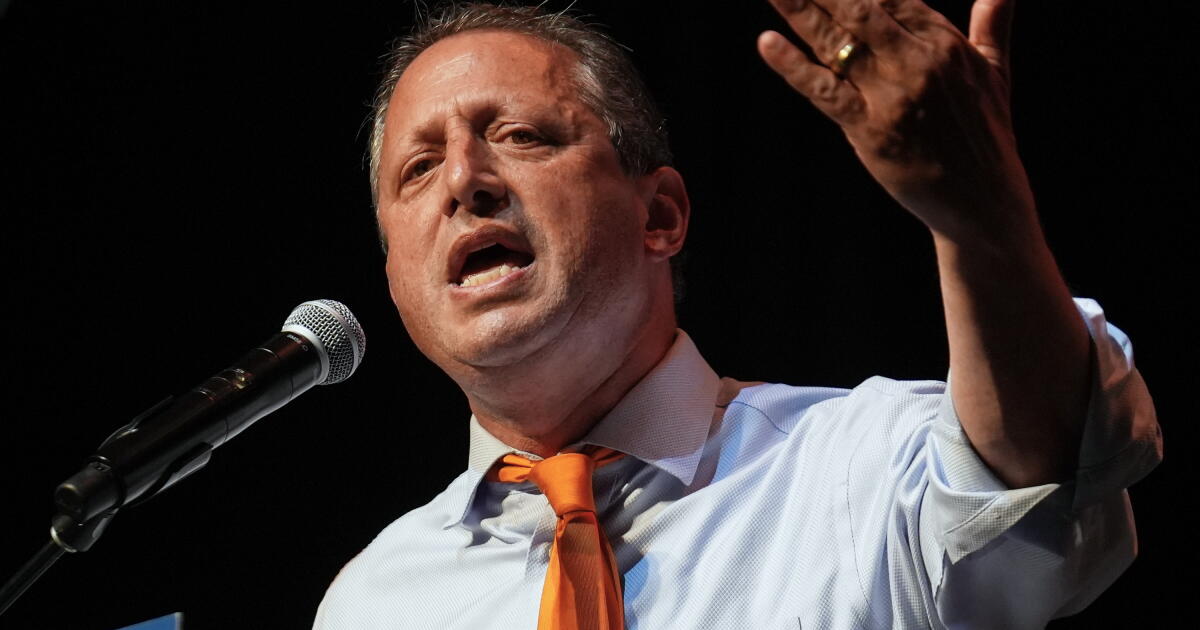
Israeli forces detained U.S. Democratic congressional candidate Brad Lander on Wednesday as he helped Palestinian farmers harvest olives in the occupied West Bank, releasing him hours later while dozens of other volunteers, including a group of American rabbis, remained in custody.
The incident was the latest in an annual olive harvest that has been marked by violence between Israeli settlers and Palestinian villagers attempting to gather their crops.
The Israeli military said the farmers and volunteers had failed to seek prior approval for the harvest and were detained “due to the security risk posed by conducting an uncoordinated harvest near an Israeli community.” It later added that it viewed “the arrival of dozens of activists as an act intended solely to provoke, which undermines the harvesting process.”
Lander is running in the U.S. elections on Nov. 3 to represent a heavily Democratic New York district in the U.S. House of Representatives.
“The occupation is a crime under international law,” Lander wrote on social media after he was detained. “Harvesting olives isn’t a crime under any law I know.”
“These detentions by the IDF are one more attempt to undermine Palestinians’ right to harvest their olive groves, travel on their roads, and live in their homes,” he added in a post after his release.
This year, Palestinians have been required to coordinate with the Israeli military to access more of their privately owned farmland than in previous years. The anti-settlement group Peace Now said last week that the army had expanded by nearly 30% the area of farmland that Palestinians cannot enter without prior approval, to 34 square miles. The Israeli military declined to comment on the exact figures but said Palestinian farmers must coordinate access to areas under Israeli security control.
The detained volunteers were taken to a police facility. Lander was among them but “released after it became known that he was a congressional candidate,” the Israeli police said in a statement.
Israeli rights group Yesh Din and the Palestinian Farmers’ Union have said the 2026 harvest has been the most violent in recent history, with hundreds of reported thefts, clashes and arson attacks.
Much of the violence has unfolded on land outside Palestinian villages, where Palestinians have historically harvested olives and Israeli settlers have increasingly erected outposts without authorization from Israel’s government.
But there were no clashes before Israeli forces arrived Wednesday, according to Beck Strober, a spokesperson for Protect the Harvest, the advocacy group that organized the volunteers at the grove.
Jill Jacobs, one of a dozen American rabbis detained, condemned the Israeli government restricting the ability of Palestinians to harvest freely.
“The Israeli government is actively advancing the forced displacement of Palestinian communities across the West Bank, using its military to deny Palestinians access to their land and intimidate those who stand alongside them,” Jacobs, chief executive of T’ruah: The Rabbinic Call for Human Rights, said in a statement.
Lander, who was endorsed by New York City Mayor Zohran Mamdani and U.S. Rep. Alexandria Ocasio-Cortez, defeated U.S. Rep. Dan Goldman in a primary for New York’s 10th congressional district. The race was viewed as a referendum on the Democratic party’s support for Israel. Both candidates are Jewish and have criticized Israel, but only Lander called the war in Gaza a genocide.
Lander was not the first U.S. politician detained in the West Bank this year. U.S. Rep. Ro Khanna, a California Democrat, said Israeli forces detained him during a visit in July.
Lander says dozens remain in Israeli custody after being detained while helping Palestinian farmers harvest olives.
Published On 21 Oct 202621 Oct 2026
United States Democratic congressional candidate Brad Lander says he has been released from Israeli military custody with a warning after being detained alongside dozens of volunteers helping Palestinian farmers harvest olives in the occupied West Bank on Wednesday.
But several dozen others, including rabbis and international volunteers, remain in detention, according to Lander, who called them to be released immediately.
“I’ve been released from IDF custody with a ‘warning,’ apparently because of my public profile,” Lander wrote on X. “I told them I wasn’t even a congressmember yet, just a nominee.”
Lander, a former New York City comptroller and mayoral candidate, was among approximately 80 volunteers detained by Israeli soldiers and police near the village of Nahalin, outside Bethlehem, according to the Israeli organisation Rabbis for Human Rights.
The group, which included American, Israeli, Palestinian, British and Canadian volunteers, had been accompanying Palestinian farmers for about two hours when Israeli forces arrived and informed them that they were in a closed military zone.
The volunteers were then taken to a police station, according to Rabbis for Human Rights.
The Israeli government has not responded to a request for comment.
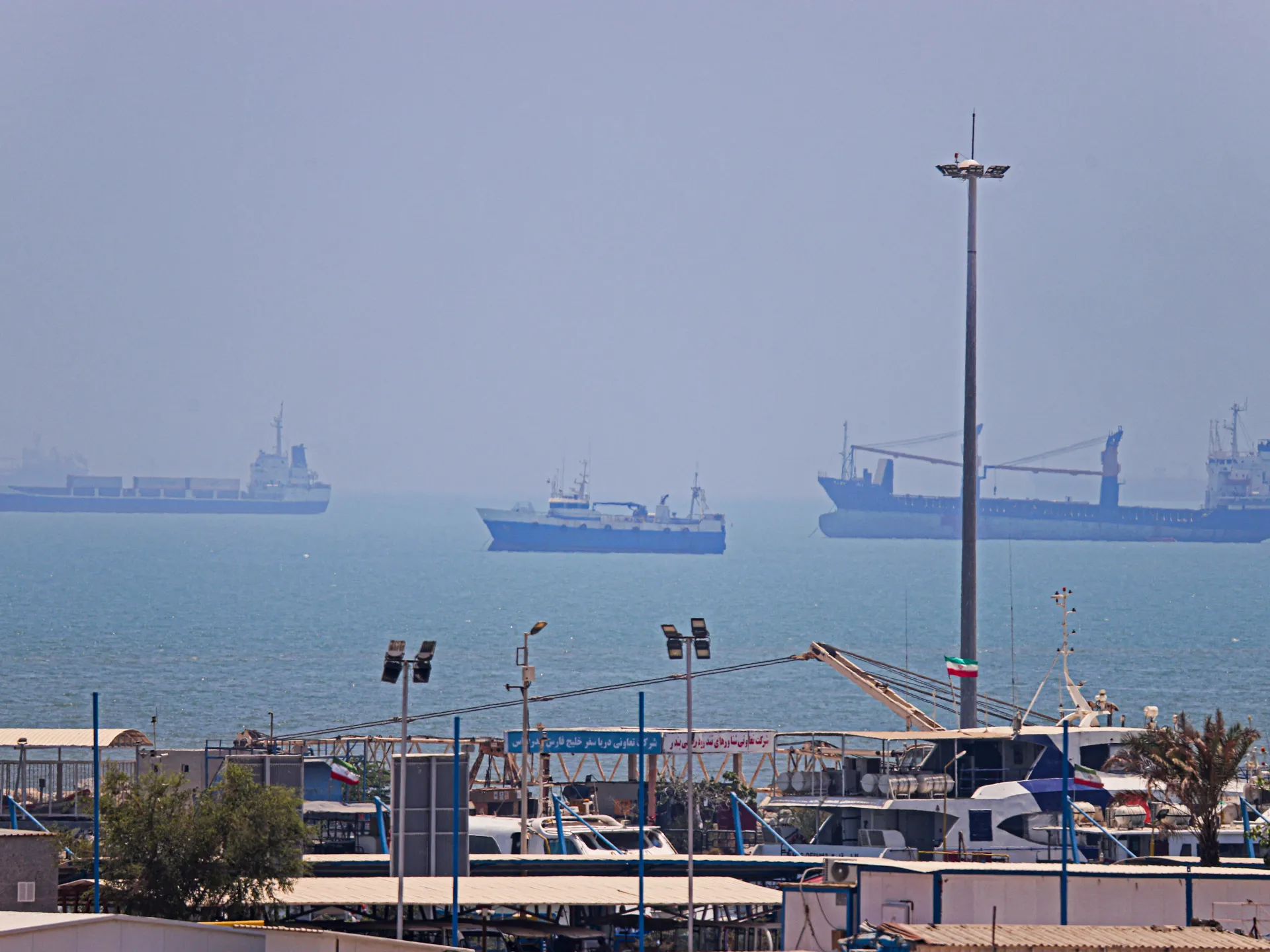
Rubio tells US media that reaching a peace deal with Tehran is extremely difficult while Hormuz attacks continue.
Source link
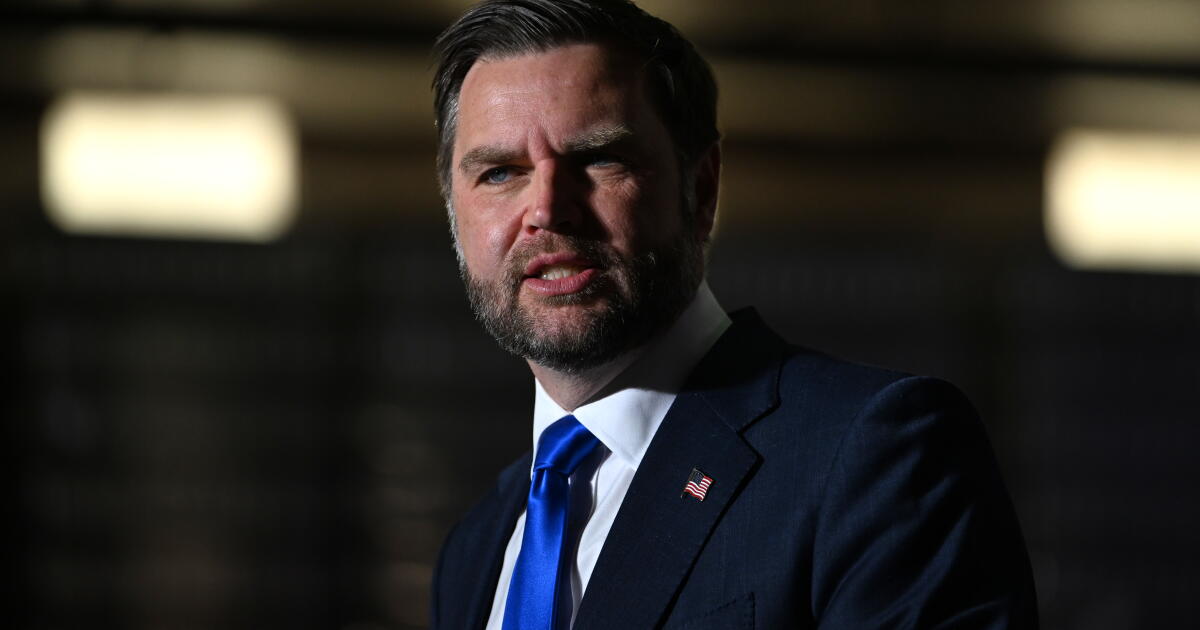
Vice President JD Vance declined Monday to endorse Israeli Prime Minister Benjamin Netanyahu for reelection a day after President Trump endorsed the embattled Israeli leader.
“The president has the most influential endorsement in American or international political history,” Vance said during an interview with journalist Mark Halperin.
“I endorse American candidates, and that’s where I’m focused on the midterms,” Vance said, while traveling Monday to campaign for Republican Senate nominee Michael Whatley of North Carolina. “So, I’m not getting involved in Israeli elections.”
Vance has campaigned for a foreign leader — then-Hungarian Prime Minister Viktor Orban, last spring before the right-wing leader’s party lost that country’s parliamentary election.
Vance’s deference to Trump on Netanyahu comes at an extraordinarily sensitive time for Jewish Americans and the U.S. alliance with Israel. Concerns about antisemitism have surged across the political spectrum ahead of the midterm elections.
Republicans have been eager to portray Democrats, notably Michigan Democratic Senate nominee Abdul El-Sayed, as hostile toward Jews and Israel, while they deal with their own internal schisms.
Vance has faced skepticism from Jewish Republicans about his commitment to Jewish Americans and the U.S. alliance with Israel.
Last month, Vance spoke privately in Las Vegas to the Republican Jewish Coalition, a leading GOP group committed to advocating for a strong U.S. relationship with Israel and against antisemitism.
Vance left a positive impression on his RJC audience while stopping short of disavowing influential conservative podcast host Tucker Carlson.
Vance has faced general questions about his association with Carlson, a former Fox News host who faced backlash last year for interviewing antisemite Nick Fuentes on his podcast.
In June, Vance sharply criticized members of Israel’s government for opposing Trump’s efforts to resolve the war with Iran.
In July, Vance said elements of the Israeli government had tried to influence American sentiment to derail negotiations.
“There are some people within their system that we know beyond a shadow of a doubt are manipulating and trying to change American public opinion to keep the war going on indefinitely,” Vance said during an appearance on Joe Rogan’s podcast.
Beaumont writes for the Associated Press.
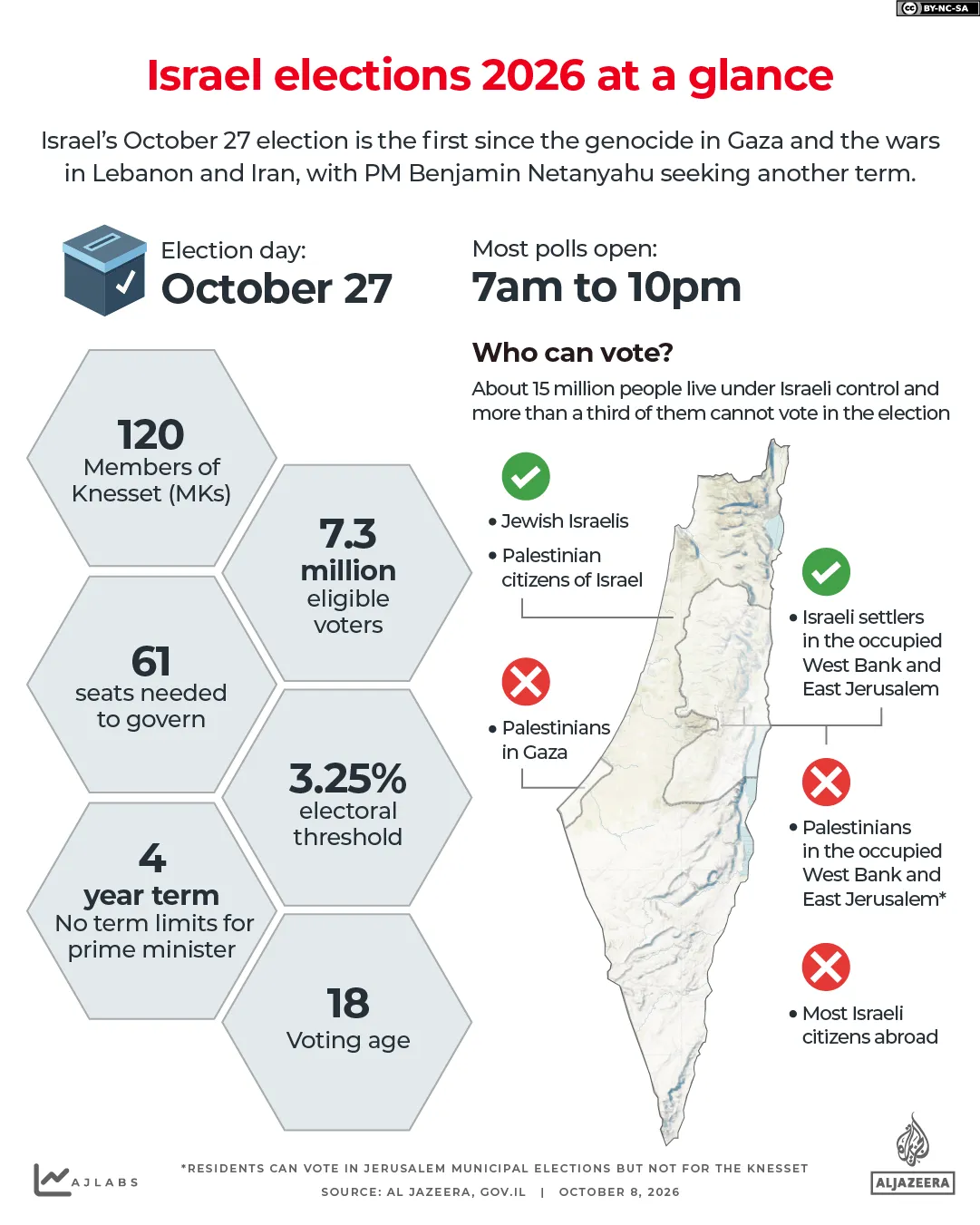
Israelis go to the polls on October 27 to elect the 26th Knesset, in the first general vote since the genocide against Palestinians in Gaza and the wars on Lebanon and Iran.
Benjamin Netanyahu, the longest-serving prime minister in Israel’s history, with 19 years in office, is seeking another term while standing trial on corruption charges. His Likud party and the far-right coalition it leads are locked in a close race with a Jewish-led opposition bloc, with neither side appearing on track to win an outright majority in the 120-seat Knesset, Israel’s parliament.
About 7.3 million people aged 18 and above are eligible to vote, according to Israel’s Central Elections Committee. Most polling stations open from 7am to 10pm, and anyone still queuing when they close is entitled to vote. Election day is a national holiday.
Any party clearing an electoral threshold of 3.25 percent enters parliament, which sits for a four-year term. There are no term limits for a prime minister.

Israelis vote for a party, not a candidate.
A majority requires 61 of the 120 seats and no party has ever won that outright. Finishing first does not guarantee power. Parties then have 28 days, with a possible extension of up to 14 days, to assemble a coalition reaching 61. If nobody manages it, the country votes again.
Seats are shared out in proportion to each party’s share of the national vote, so a party winning 30 percent of votes takes roughly 30 percent of seats. The votes for parties failing to secure 3.25 percent are discarded, which explains why small parties routinely merge before every election.

About 7.3 million Israeli citizens are eligible to vote in this election, but they are not the only adults living under the government they choose.
Roughly three million adult Palestinians in Gaza, the occupied West Bank and occupied East Jerusalem have no vote in the government that controls their borders, movement and legal status.
Jewish Israelis and Palestinian citizens of Israel, who number about 1.2 million, can vote. So can adult settlers among the more than 750,000 Israelis living in the occupied West Bank and occupied East Jerusalem, who help elect the parliament that legislates over the land they live on.
Most Palestinians in occupied East Jerusalem hold Israeli residency, not citizenship. They can vote for Jerusalem’s city council but not for the Knesset.
The result is a sharp anomaly in the occupied West Bank, where a settler votes and a Palestinian family living nearby, under the same military authority, does not.
Most Israeli citizens living abroad also cannot vote, because Israel has no general absentee ballot and requires voters to be physically in the country on election day. Diplomats and state emissaries are the exception, casting their ballots at Israeli missions on October 20.

Israelis are dealing with a series of domestic and international issues this election cycle, including:

Netanyahu’s coalition held 60 of the Knesset’s 120 seats when parliament dissolved in July. It comprised Likud with 32 seats, Shas with 11, Religious Zionism with seven, Itamar Ben-Gvir’s Otzma Yehudit with six, and New Hope with four. Shas left the government in July 2025 but remained in the coalition and New Hope will merge into Likud for this election.
The opposition held 59 seats: Yesh Atid with 24, Blue and White with eight, United Torah Judaism with seven, Yisrael Beiteinu with six, Hadash-Taal and Raam with five each and Labor with four. Noam’s single seat was unaffiliated.

Netanyahu is seeking re-election while facing a trial on corruption charges, which he denies.
His far-right coalition is up against a bloc comprising of four major Jewish-led opposition parties, whose leaders have signed a declaration promising not to attack each other ahead of the vote and to join forces in forming a government after the polls.

Former army chief Gadi Eisenkot is viewed as the opposition’s most likely candidate for prime minister, with his new Yashar party evenly matched with Likud in the opinion polls.

The opposition alliance includes the Together list, led by former Prime Ministers Naftali Bennett and Yair Lapid; Avigdor Liberman’s Yisrael Beiteinu and Yair Golan’s Democrats.
Other key players include far-right ministers Itamar Ben-Gvir and Bezalel Smotrich, the ultra-Orthodox parties, and the Arab-majority lists Ra’am and the Joint List.
Last month, Israel’s Central Elections Committee voted to bar Ra’am and the Joint List from the election, but the Supreme Court unanimously overturned the bans on October 2, ruling that the evidence did not meet the legal threshold for exclusion.
Sami Abu Shehadeh, a Palestinian citizen of Israel who leads Balad, one of the parties in the Joint List, withdrew from the race after the court signalled that a majority of its judges would uphold his disqualification.
The Arab-led parties could hold the balance of power after the vote, but most leaders of the Jewish-led opposition bloc have ruled out joining forces with them.
October 27 will be Israel’s sixth national vote since 2019, but the first in 38 years to arrive at the natural end of a full Knesset term.
The instability began in April 2019, when Netanyahu’s Likud party and Benny Gantz’s Blue and White party tied on 35 seats each. A second vote that September produced another deadlock, with Blue and White on 33 and Likud on 32, and neither round yielded a coalition able to reach a majority.
A third election in March 2020 gave Likud 36 seats to Blue and White’s 33, and produced a Netanyahu-Gantz unity government that collapsed within a year. In March 2021, Likud won 30 seats to Yesh Atid’s 17, but an eight-party coalition led by Naftali Bennett and Yair Lapid that also included Ra’am, an Arab party, ended Netanyahu’s 12-year run. It lasted a year.
Netanyahu returned in November 2022, with Likud on 32 and Yesh Atid on 24, at the head of what has been described as Israel’s most right-wing government. Polls now show neither bloc clearly reaching 61.

The state of Israel has had 14 prime ministers since its foundation in 1948. Netanyahu is by far the longest-serving, with 19 years in three separate stints: 1996 to 1999, 2009 to 2021 and from 2022 to now
Only David Ben-Gurion, who led the country from 1948 to 1954 and again from 1955 to 1963, comes close.
Whatever happens on October 27, Netanyahu stays on as caretaker prime minister until a new government is sworn in.

Hegseth has travelled to Israel to meet Netanyahu ahead of a closely contested election, Axios reported, citing sources.
Published On 20 Oct 202620 Oct 2026
US Defense Secretary Pete Hegseth has met with Israeli Prime Minister Benjamin Netanyahu during an undisclosed visit to Israel, according to Axios.
The meeting between the hawkish ally of US President Donald Trump and the veteran Israeli premier facing a knife-edge election occurred on Monday, Axios reported, citing two sources with knowledge of the matter.
list of 3 itemsend of list
The Reuters news agency could not immediately confirm the visit. The Pentagon and Israel’s embassy in Washington did not immediately respond to requests for comment, and there was no immediate indication of what they discussed.
President Trump took to his social media platform Truth Social on Sunday to endorse Netanyahu in next week’s parliamentary election, the first vote since the Hamas-led October 7 attacks in 2023 and Israel’s genocidal campaign in Gaza began.

Trump praised the prime minister for being an ally of the US in its war on Iran. He added that Netanyahu had his “Complete and Total Endorsement”.
“BIBI NETANYAHU WILL NEVER LET YOU DOWN!” Trump wrote.
Netanyahu’s religious-nationalist coalition is projected to lose its governing majority, although the opposition may also struggle to form a government, opinion polls suggest.
US Vice President JD Vance, however, declined to endorse Netanyahu in an interview earlier on Monday, saying he was not getting involved in Israeli elections.
“I endorse American candidates, and that’s where I’m focused on is the midterms,” Vance, who travelled to Budapest and endorsed Viktor Orban in Hungarian elections earlier this year, said in an interview with digital media outlet 2WAY.
“I’m not anti-endorsing him, but I’m not pro-endorsing him; I’m not getting involved in Israeli elections,” Vance said.
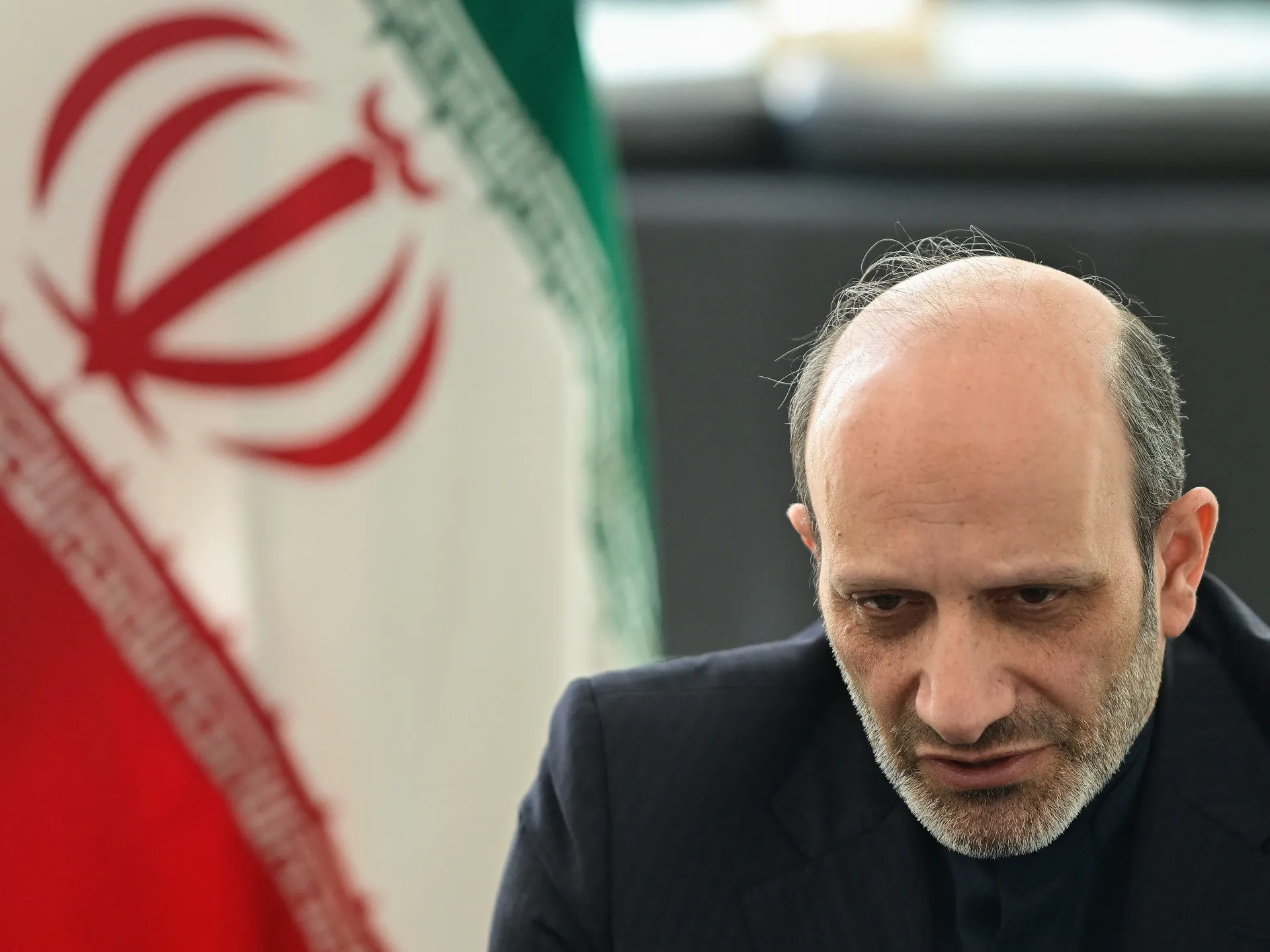
Tehran summons envoy in tit-for-tat move after Berlin summoned ambassador to Iran.
Published On 19 Oct 202619 Oct 2026
Iran’s Ministry of Foreign Affairs has summoned Germany’s ambassador after a court in Hamburg found two men guilty of plotting to kill two leaders of Jewish organisations at Tehran’s behest, accusing Berlin of leveling “baseless political allegations”.
The decision to summon envoy Axel Dittmann came after Germany summoned the Iranian ambassador, Majid Nili Ahmadabadi, on Monday over allegations that Tehran was behind the plot to assassinate the two pro-Israel public figures.
list of 3 itemsend of list
“Levelling security-related accusations against Iran has long been a tactic employed by the Zionist regime and certain Western nations,” Iran’s Foreign Ministry said in a statement broadcast by official news agency IRNA.
“Attempting to provide a judicial face to baseless political claims not only fails to lend any credibility to such allegations but also undermines the standing of the German judiciary itself,” the statement added.
Berlin’s allegations stem from a court case involving two men, a Danish national and an Afghan national, who were convicted in a Hamburg court on Thursday for planning to target the president of Germany’s main group representing the Jewish community and the head of the German-Israeli society.
The German Foreign Ministry said on X that the Iranian ambassador had been summoned, adding Tehran would not be allowed to “threaten our free society”.
“The malicious assassination attempts against Josef Schuster and Volker Beck will have legal consequences,” it added.
“We do not tolerate attacks on Jewish life and on those who defend it anywhere, and certainly not in Germany.”
The Dane, partially identified as Ali Hassan S, was jailed for eight-and-a-half years. The Afghan, who was recruited as his accomplice, was sentenced to four-and-a-half years.
Iran’s intelligence service steered the two men, the court said. The pair were arrested in Denmark last year and extradited.
In sentencing the men, the judge said they were guilty of “terrorist activities orchestrated by Iran”.
At the time they were charged, the Iranian embassy in Berlin released a statement rejecting what it called “unfounded allegations made at the behest of Iran’s enemies”.