The Mexican community of Cabo Corrientes faces the risk of a direct hit as the Category 4 storm churns off Jalisco.
By Reuters and The Associated Press
Published On 11 Oct 202611 Oct 2026
Mexican President Claudia Sheinbaum has urged residents along the Pacific Ocean to stay indoors as Hurricane Simon’s powerful winds and heavy rains pound coastal communities.
As of Sunday, the hurricane’s eye was moving offshore of Mexico’s Jalisco state, with winds of at least 240km/h (150mph).
Recommended Stories
list of 4 itemsend of list
Torrential rain has already battered residents living between the Sierra Madre mountain range and the ocean. Communities in hilly and mountainous areas have been warned to brace for mudslides.
Simon reached Category 4 strength, on a scale of five, on Saturday, as part of an unusually active Pacific hurricane season.
“With the approaching impact of Category 4 Hurricane Simon, we urge residents of coastal municipalities in Jalisco, Colima, Nayarit and Michoacan to remain sheltered until authorities officially declare that the danger has passed,” Sheinbaum wrote in a post on the social media platform X on Sunday.
In a midday advisory, the United States’ National Hurricane Center (NHC) warned that Simon could produce “additional rainfall totals of 8 to 16 inches (20 to 41 cm) over portions of southwestern Mexico”.
Precipitation totals as high as 76 cm (30 inches) were possible in areas of Michoacan, Colima, and Jalisco until Monday.
It’s not clear whether the storm will make landfall. But the greatest risk of a direct hit lies at the moment with Cabo Corrientes, a town that sits on a cape in Jalisco, jutting into the Pacific Ocean.
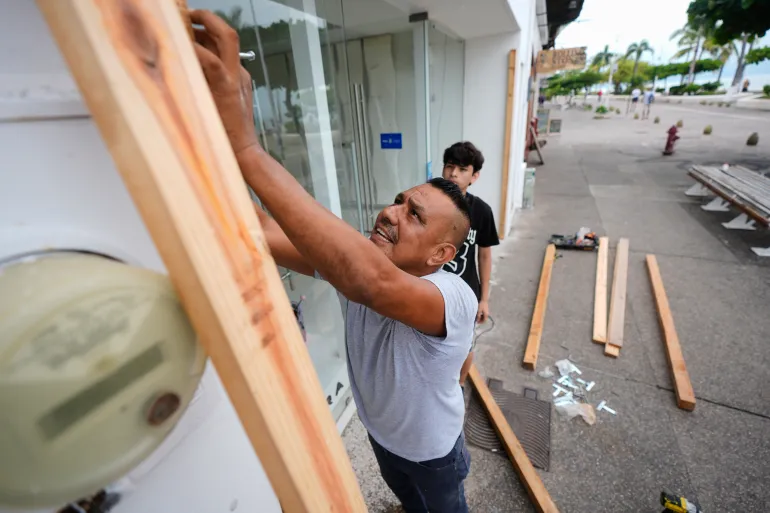
A man boards up a shop as Hurricane Simon approaches Puerto Vallarta, Mexico, on October 10 [Fernando Llano/AP]
Mexico’s National Civil Protection Coordination (CNPC) placed 28 municipalities in Jalisco and Colima under its highest cyclone alert level, while another 93 municipalities were under a high alert level, according to civil protection bulletins.
Classes were suspended in the affected areas, and efforts to evacuate residents were under way.
Businesses in popular tourist destinations like Puerto Vallarta boarded up windows and placed sandbags at entrances as the storm approached.
Jalisco’s Governor Pablo Navarro warned that the high-powered hurricane was creating “high-risk marine conditions” along the coast of his state, with waves reaching as high as eight metres (26 feet).
On Sunday, he also shared video on social media of the storm surge crashing onto sidewalks and flooding waterways.
“Here is the current state of Jalisco’s beaches this morning — from Barra de Navidad to Puerto Vallarta — as Hurricane Simon passes through,” he wrote in the video’s caption.
“I ask everyone to heed official instructions, take precautions and avoid putting themselves at risk. The safety of Jalisco’s families is the top priority.”
YOU SAY Oxford Circus, you think crowded streets and busy shops – but there is a whole other side to it you might not have known about.
So we’ve taken it on in two different way – as a busy mum looking to keep her kid busy, to a girly weekend in the city without going to the shops.
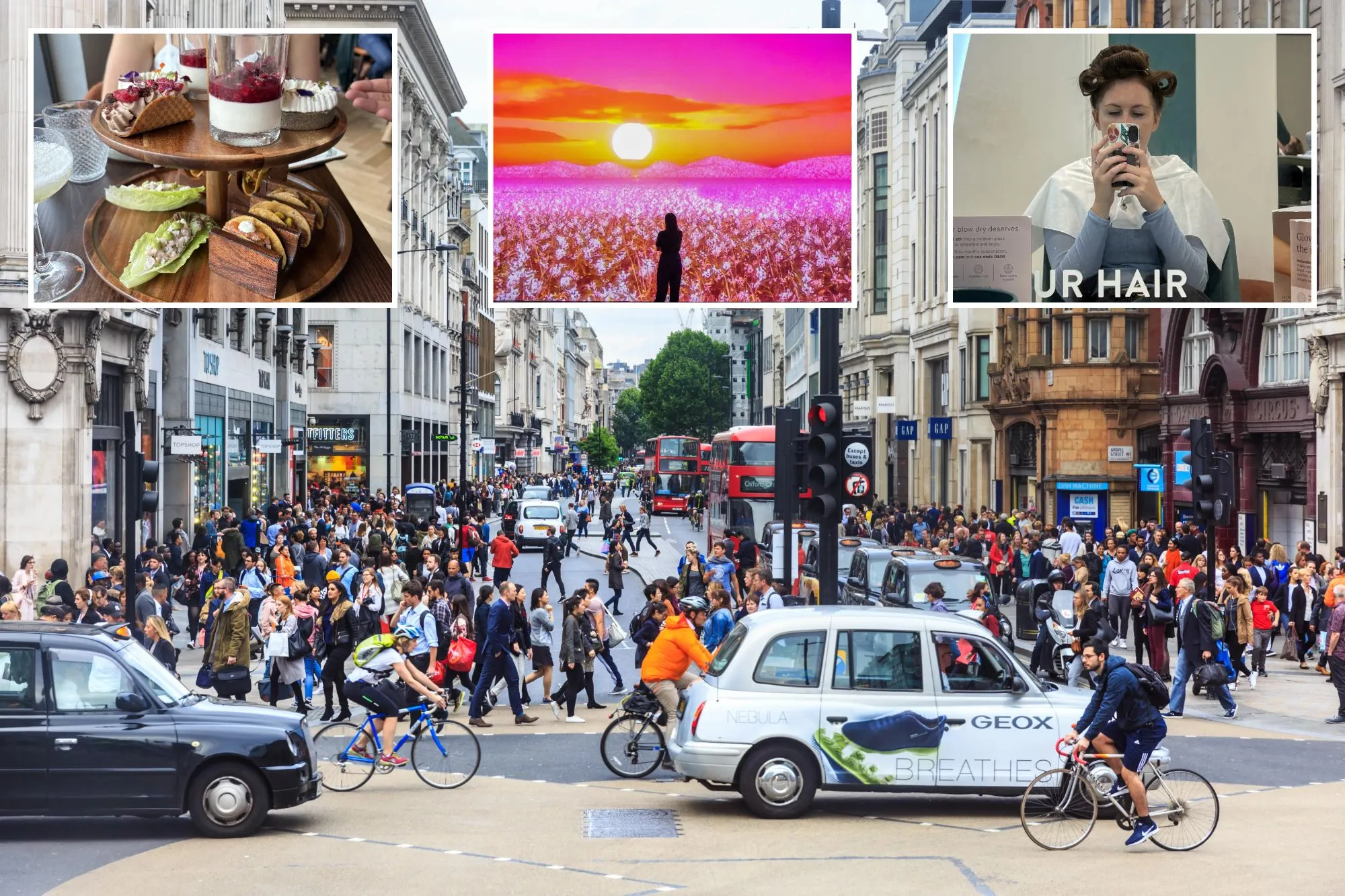
Soho might be famed for its shops but it has a whole other side to itCredit: AlamyAnd with the plans revealed for its pedestrianisation, here is how to do it as a mum, and a girly weekend without the shops.Credit: PA
Blow dry bars, Mexican afternoon teas and gorgeous Italian dinners
Kara Godfrey, Deputy Travel Editor, explores the busy centre on a girly weekend wanting some pampering.
Growing up in the countryside, my first impression of London was the hubbub of Soho, with bustling streets full of eager shoppers elbowing each other out of the way.
Sign up for the Travel newsletter
Thank you!
Yet 20 years later, having since moved to (and left) the crazy capital, I know there is more to the iconic city centre than its shops.
And with the announcement that it is about to become pedestrianized, it’s about to become an attraction in its own right.
If you want to explore the centre of London without actually dipping into the shops, it also makes for the perfect girly day out either with your best mate or your mum – if you know where to go as a local.
It is a fantastic destination for a pamper, with affordable nail salons and hairdressers – and did you know one of London’s most famed blow dry bars is found at the bottom of the John Lewis department store?
Having first launched in Chelsea back in 2014 (becoming a fave with the Made in Chelsea stars), Duck & Dry has become an institution for the place to go before a big event.
I sank into the plush chairs, laidback music overheard while I chatted to my hairdresser as my hair was massaged and washed.
As a woman in my mid-30s, I’ve realised that it’s the little luxuries that make life worth it and a person kneading all of my worries away is one of them.
Just 30 minutes later, I left a new woman with a fresh new do so gorgeous, I even bought a blow dry brush on my way out to try and replicate it at home.
What better way to start the day then with a blow dry?
(Don’t stop there though, one of my favourite nails bars, Cona, is just around the corner, with the hidden salon tucked behind the bold oranged painted cafe front).
Hair done, nailed fixed – we needed something to line our stomach and gone are the days of our 20s where we opted for a bottomless brunch.
Being more afternoon tea gals, one of the more unique ones is found in the Treehouse Hotel just off the main high street.
This isn’t your usual afternoon tea, however, (although you will still find a scone or two on top) – it’s called the Afternoon Te-Quila, so expect a Mexican fusion.
Starting with a freshly made margharita, we gorged on fresh fish tacos, pumpkin pies and even a unique chocolate taco, pumped full of decadent chocolate mousse.
The views are just as amazing, looking out over London from the top floor, but as I sat under a ceiling of green hanging plants, I was transported to somewhere much more tropical.
There is so much to do outside of this as well that doesn’t require you to lug shopping bags around town.
Or how about catching a West End show? The Palladium has some fantastic shows coming up including Delta Goodrem, Michael Ball and of course the Christmas panto.
Forget your usual afternoon teas – this is a Mexican inspired one with a viewI loved the free margherita alongside the fantastic views
(While I might have said there is so much to do along the high street without the shops, I would still recommend popping into the new M&S flagship, with four entire floors of homeware, clothes and a Food Hall. I may have left with both new linen trousers and some Percy Pigs…)
Don’t think I forgot about dinner, because London isn’t one of the world’s best food capitals for no reason.
And with more than 600 restaurants to choose from, according to OpenTable, where do you even start?
Well I’ve found just the place, if you want somewhere slightly quieter away from the crowds, but with fantastic service, a low-key atmosphere and hearty, Italian portions.
Enter Lavo at the BoTree.
Start at the bar for a cocktail – while the menu might sound confusing, it explains which cocktail they are similar to, so I had their version of a negroni.
On weekends there is also a live DJ who toes the line of great, lo-fi music without being so loud you can’t hear each other.
Slightly woozy at this point, my direction to my table was welcome before gorging on towering piles of tuna tartare and large bowls of penne a la vodka.
Our extremely funny server even tempted us into sharing what is now going down as one of the best tiramasus we’ve ever eaten.
The restaurant was low-key but so chicThe portion sizes were huge too
And when you need to rest your weary feet from a day of pounding the pavements, you can’t get much more central than the Radisson Blu Bond Street.
Currently undergoing a renovation, it is just steps from the main road, with some of the best views of the high street from my room overlooking the shops.
With Oxford Circus not having many late night openings, don’t worry about not getting any sleep, as it was super quiet once everything had closed.
The cosy restaurant – with that brand new smell – also had a fantastic breakfast spread to refuel, from pancakes and avocado toast to all of the pastries and trimming of a Full English.
So while Oxford Circus will always be known at the shopping high street, there is so much more to it to bring your out of town friend, siblings or parents to without having to step into a shop.
Unless you get a Percy Pig craving, that is.
Illusion museums, kid-friendly food halls and ‘treehouse’ hotels
Caroline McGuire, Head of Travel (Digital), explores as a mum with a seven-year-old to keep occupied
As a London mum, I regularly take my seven year old into the city centre for theatre, museums, parks and all the other awesome attractions it has to offer kids.
But Oxford Street? Are you mad? It’s somewhere I’d actively avoided, assuming it was the worst place for a very active kid who loves running around and touching everything in sight.
How wrong I was. Because we recently spent an overnight stay on Europe’s most famous high street… and it was one of our best 24 hours in the capital.
Oxford Street has changed a lot since I was a kid, coming up from the home counties to spend my Christmasmoney at Topshop.
In some ways for the bad (those many American candy stores), but in many other ways for the good.
As some of the big chain stores have departed, enterprising new ventures have opened up that are perfect for a family day out.
Take for instance, the Twist Museum. A brilliantly fun illusion museum – even though the grumpy middle aged woman in me still insists it’s not a museum.
We had such a great time exploring all of the mind-bending activities, our favourites being the 3D hologram creator, the mirror room and the ‘big and small room’.
Swingers surprised me with how great it was for kidsCredit: dot dash media
It was so cool that I now have three pictures from there alone on my fridge at home – high praise.
Equally fun was Swingers Golf and Carnival Games, which I’d always written off as an adults-only venue for big kids at heart to have fun with a beer.
Not so, as during the day in the school holidays it was packed with families enjoying easily the best crazy golf I’ve ever done in my life.
Then you get a half-hour pass to play as many games as you can in a retro-style arcade.
As a parent who’s forked out more pound coins than I care to remember at amusement arcades, it was a total joy to do it all for free… and with a time limit. Plus, I got to sip on an extremely good frozen marg while I did it.
If the kids are feeling hungry, their food offering is a godsend. Several high-end food trucks like Patty and Bun burgers and Breddos tacos mean you can all pick what you want to eat.
If you’re looking for something every so slightly more highbrow, we ended our day at Frameless – the very cool digital art experience where you’re put inside famous paintings, as they surround you on huge screens and come to life.
It was really surprising to see how much my son engaged with such old paintings, which he may have dismissed as stuffy in a gallery, by bringing them to life.
I was surprised how much my kid loved Frameless tooCredit: Alamy
Of course after pounding the streets for so long, we were in need of some refreshments, so we headed to Market Halls, which has every food any foodie or fussy kid would want.
I dined on Malaysian Nasi Goreng and Thai soup, while my son had savoury crepes for main… and Nutella crepes for pudding.
Thankfully, with our extremely full stomachs we didn’t have far to go to lay our heads, as we were booked into the Treehouse Hotel, an achingly cool and modern property on Langham Place, with some of the best views of London I’ve ever seen.
Our room was very Scandi-style, with a lovely window seat so we could look out over the city.
The next morning, we managed to find space in our stomachs for brekkie, at the Mexican inspired Madera restaurant, where I had a bagel topped with scramble tofu, vegan cheese and jalapeno pickled red onions, while my son opted for the waffles with whipped cream and berries.
We fell in love with the Treehouse hotel
We lingered far too long over breakfast, sad to tear ourselves away from the stunning views from our table.
All that fun of museums, art exhibitions, golf, arcades, and some fantastic food and drink, without stepping foot into a shop?
Teenage me would never believe it.
The New West End Company represents 100 streets in the district including Oxford Street, Regent Street and Bond Street.
They explain: “New West End Company is solely focused on representing and keeping the West End thriving. Established more than two decades ago, today our 800+ membership includes the most respected names in global retail, leisure, hospitality, real estate and business.
“We keep our West End streets clean and safe, promote world-class experiences, provide trusted data and insight, and make the case for policies that support growth. Between 2026-2031, we are investing £60 million to make the district stronger, safer and even more competitive.
“Together with our partners – including Westminster City Council, the Metropolitan Police, the Mayor of London – we are proud to shape the district our members thrive in.“
Every fall, I teach a Latino History of Orange County course at Chapman University — from the Portola expedition all the way to Huntington Beach’s MAGA Latina councilmember, Gracey Van Der Mark. The lecture last week focused on how anti-Mexican politics have always worked in Orange County and usually go on to be copied nationwide.
I usually, sadly, have to update this lecture every year because the lowlights just keep coming. That’s why this time around, one of my PowerPoint slides ended with “2026: Anaheim?”.
Haven’t you heard? A lawsuit accuses Anaheim mayor Ashleigh Aitken of calling her chief of staff a “dirty Mexican.”
Stay classy, O.C.!
You’re reading the Essential California newsletter
L.A. Times reporters guide you through the most important news, features and recommendations of the morning.
By continuing, you agree to our Terms of Service, which include arbitration and a class action waiver. You agree that we and our third-party vendors may collect and use your information, including through cookies, pixels and similar technologies, for the purposes set forth in our Privacy Policy such as personalizing your experience and ads.
TimesOC writer (and my fellow Anaheimer) Gabriel San Román first reported on the allegation last month. He revealed that a lawyer for Aitken’s chief of staff Berenice Ballinas was seeking mediation from the city after his client suffered a “sustained pattern of harassment, discriminatory treatment and, most recently, retaliation” while doing her job. A legal claim filed soon after offered pages of alleged incidents detailing what Ballinas claimed she had to deal with when her boss supposedly had too much to drink while on city business.
It’s an ugly read, with incidents at Disneyland’s Club 33, Angel Stadium and other Anaheim landmarks. Yet no passage is more damning — yet more Orange County — than when Ballinas claimed Aitken once called her a “dirty Mexican” in front of then-city attorney Jim Vanderpool and said another time that the mayor didn’t want “a Mexican” like Ballinas to drive her car while Aitken was supposedly what the British satirical magazine Private Eye would call “tired and emotional.”
The mayor, a Democrat who’s running for reelection, has denied the explosive charge in an official statement and during a recent council meeting. And yet the allegation against her now enters Orange County’s long, sad spectrum of anti-Mexican political history.
Just part of the list: Proposition 187. Poll guards. Trying to give local police immigration-enforcement powers. When then-Orange County supervisor Ronald Caspers called a group of Mexican American county employees who demanded promotions “bandidos” during a 1972 supervisors meeting, then suggested the supes move the county seat away from Santa Ana because the city “does not have a normal ethnic balance” — in other words, it was too Mexican.
Or how about when a Newport Beach council member, Dick Nichols, opined during a 2003 council meeting that he opposed expanding the grassy areas of Corona del Mar State Beach because Mexicans “claim it as theirs, and it becomes their personal, private ground all day”? (Asked to apologize, Nichols doubled down by saying, “Where the hell am I in any way discriminating or being a bigot by making a statement that is blatantly true?”)
My hometown is not exempt from this sad parade. Anaheim’s schools, parks and swimming pool were segregated until the 1950s. In 1999, the Anaheim Union High School District board of trustees voted to sue Mexico for $50 million for educating the children of undocumented immigrants (The Times’ write-up was the first time I appeared in the paper, although the writer misspelled my last name).
Why all the O.C. anti-Mexican hate? You’ll have to enroll in my Chapman class for the full explanation. But the main reason is that Mexicans have long functioned as O.C.’s demonized minority. When millions of O.C. residents have grown up believing the powers that be that all Mexicans do is work low-paying jobs and underachieve in life, no wonder politicians bash them again and again — and no wonder many Anaheim residents aren’t giving Aitken the benefit of the doubt.
On Friday, the Anaheim City Council announced after a closed session that it would launch an independent investigation into Ballinas’ allegations. Aitken had an eventful Friday of her own. She admitted on Instagram that she has an “unhealthy relationship” with alcohol and sighed to CBS Los Angeles that Ballinas was “somebody who I thought was my right-hand person.” And while local activists have demanded she resign, O.C.’s ascending liberal machine isn’t asking for her head the way they would’ve if it were a Republican official: Mayor Anaheim gave the opening remarks at the Orange County Labor Federation’s annual Solidarity Awards gala on Friday night to cheers.
Stay classy, O.C.!
The week’s biggest stories
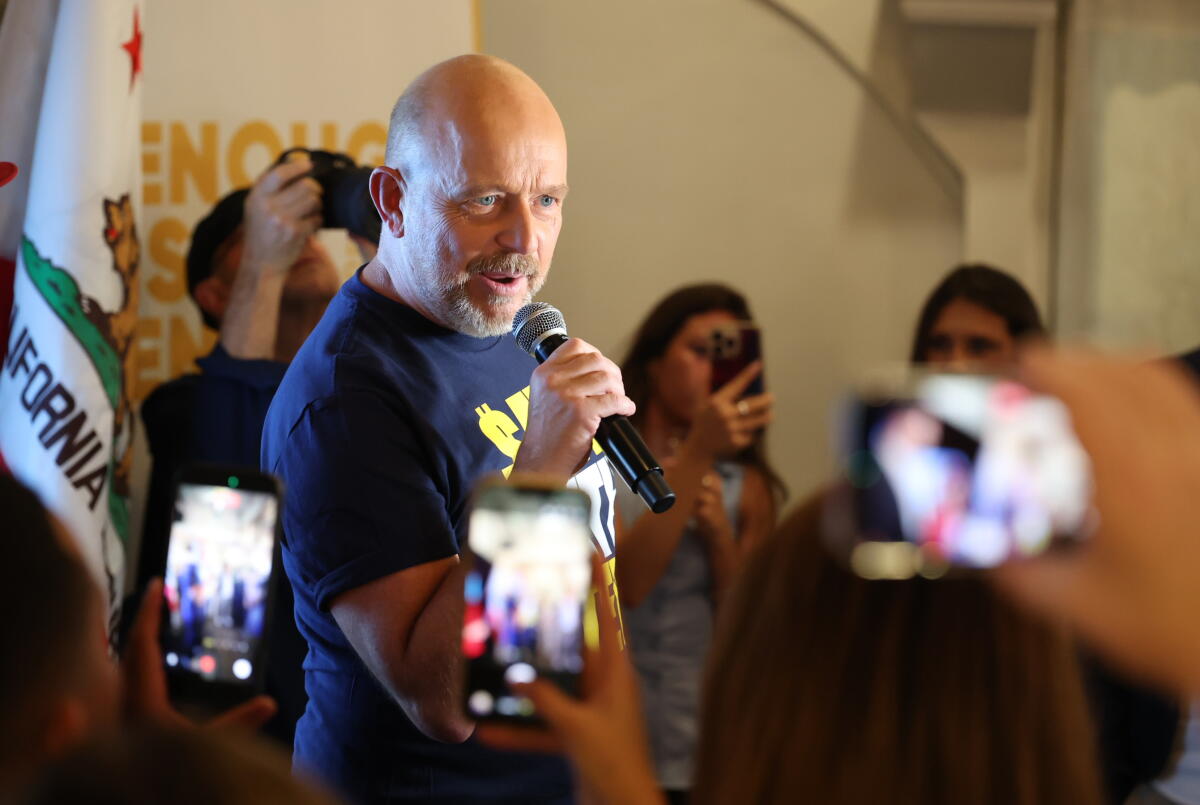
Republican gubernatorial candidate Steve Hilton visits patrons at Victorio’s Ristorante in North Hollywood, where a watch party was held for the CNN governor’s race debate Wednesday night.
(Jason Armond / Los Angeles Times)
California politics
A sexually suggestive ad from Republican gubernatorial candidate Steve Hilton has drawn millions of views — and condemnation from allies on the right and Democrats.
The poll’s findings contrast the results of the June 2 primary, in which Bass carried 35 Latino-majority neighborhoods compared with Raman’s seven.
Helicopter tragedy
Paramount-Warner Bros. merger
David Ellison said the merged Paramount and Warner Bros. Discovery will be called Skydance — the moniker he picked nearly two decades ago when he began building his Hollywood empire.
Although the name of the corporate parent will change, the two historic studios will continue to operate under their names.
As Ellison names his new empire, the message is clear: He owns Hollywood, writes news and culture critic Mary McNamara.
More news
Editor’s pick
More picks
Things to do
Retro candies, zombie-themed chips, ghost-branded coffee and large-scale movie characters can all be found at the Horror Boodega snack shop in Burbank.
(Stephanie Breijo / Los Angeles Times)
Today’s recipe
(Genaro Molina/Los Angeles Times)
For culinary content producer Owen Han, his nonna’s recipe for meatballs is as classic as they come. She does not brown the meatballs but instead poaches them in the copious tomato sauce (she called it salsa di pomodoro, or sugo, but you might know it as marinara) so they are extra tender.
Have a great day, from the Essential California team
Jack Dolan, investigative reporter Hugo Martín, assistant editor, fast break desk Kevinisha Walker, multiplatform editor Andrew Campa, weekend writer Karim Doumar, head of newsletters
Perhaps no one genre of music screams “Mexican” more than mariachi music.
Yet a close second is probably the melodic sound of British rock band the Smiths.
Many have pondered why Mexicans and Mexican Americans have such an affinity for those blokes from across the pond. Maybe it’s that lead singer Morrissey’s outsider mentality and melancholic words resonate with the demographic — or there’s something acutely relatable about the melodramatic musings of a romantic yearner.
He noted that Morrissey’s malaise mirrors the sentiment of many ranchera songs, also citing that his effeminate onstage persona is a perfect subversion of Mexican machismo. These elements make the singer an anglophone mash-up of Pedro Infante and Juan Gabriel, Arellano added.
Both the Smiths and mariachi music can drive even the most macho Mexican man to tears with their poetic lyrics and layered instrumentals.
To celebrate the special choke hold these musical stylings have on Mexican Americans in Southern California, the L.A.-based group Mariachi Tierra Mia is putting on a “Mariachi Meets the Smiths” show at the Ford amphitheater on Sunday. The show will merge not only the cultural resonance of the two in Mexican American culture, but also unite the sounds.
The idea to incorporate elements of mariachi music into a cover of a Smiths tune happened by happenstance in December 2024.
Members of Mariachi Tierra Mia were performing at a Christmas party when an attendee requested that the group perform the 1984 Smiths track “Heaven Knows I’m Miserable Now.”
Members of rock band The Last Line of Defense who will perform at The Ford as part of “Mariachi Meets The Smiths.”
(Mariachi Tierra Mia)
The ensemble’s leader, Maira Solis, didn’t know the song — but her husband and fellow bandmate Ivan Peña signaled that he did. Later on in the night, he performed the song alongside two dancing, masked luchadors.
The video of Peña belting out the song while outfitted in his mariachi regalia struck a chord with audiences online after the group posted it on social media.
“The relationship between Mexicanos and the Smiths needs to be studied,” Peña told The Times. “[The video] seemed like a very innocuous thing, but days later, it had 3 million views. That was the first time that ever happened to us, and to me, personally.”
The overwhelmingly positive response to Peña’s rendition of the Morrissey-penned tune let him know that people had an appetite to see the Smiths and mariachi blended together.
Born in 1991, Peña was born years after the Smiths broke up, but was introduced to the group’s catalog at age 5, while his uncle drove him around in a lowrider. The first tracks he heard from the band were “Heaven Knows I’m Miserable Now” and “Ask.”
“I don’t think the music has aged a wink. It’s just gotten better with time,” he said. “It’s clearly resonated across generations. Now you even see Gen Z getting in on it too and realizing music of the past is so substantial.”
But the fandom surrounding the Smiths, and more specifically Morrissey, has entered more complex territory in light of the Smiths frontman’s past political commentary.
“I get that he’s a polarizing guy. I know he’s notorious,” Peña said. “I [say], separate the art from the people behind it … because the piece itself is not at fault for the shortcomings or views of the people who made it.”
Sunday night’s concert will be split in two acts, with the first being a bilingual mariachi set by Mariachi Tierra Mia composed of genre standards and more modern covers. For the second act, Peña’s rock group the Last Line of Defense will perform songs by the Smiths and be joined by the mariachi group to merge the sounds.
Incorporating the mariachi to create straightforward covers of the Smiths’ material proved challenging as Peña did not want to put a spin on the songs’ composition — no added notes and no new harmonies were allowed.
“You could task a mariachi band with doing a one-for-one adaptation of the Smiths’ songs, [but] most of the tracks do not work on the mariachi setting,” he said. “Whereas the guitar is leading the charge in a rock band. The guitar and the vihuela are essentially the rhythm section, so you have to translate guitar riffs to the melody section of the mariachi, [which is the] trumpets and violins.”
According to the 34-year-old musician, very few of the English band’s song fit into that mold.
He knows that fans love the original material and he wants to respect the essence of the time-tested songs. Out of that reverence for the group’s music, Peña noted that all the Smiths covers will be performed only in English.
Peña’s final take on why Mexicans are so infatuated with the Smiths?
“Mexicans love catchy music,” he said. “It’s all of the feels. It’s the good, the bad, and a bit of longing. The lyrics aren’t lying to you. [We can all relate to] Morrissey’s angst, his rebellion, his malaise, and, on the other side of that, his optimism.”
Growing up, Alejandra Villarreal was accustomed to the dry Mexican heat, trapped inside the small historic venues where she and her sisters would perform as kids. But as temperatures hit 103 degrees outside the Fonda Theatre in Hollywood, she couldn’t help but shout.
“¡Ay, qué calor!” she said, swinging her bass guitar.
Inside the nearly 100-year-old theater, Alejandra was onstage for a sound check. She ran through distorted, metal-influenced riffs as her sisters — drummer Paulina Villarreal and lead vocalist-guitarist Daniela Villarreal — prepared for the second of three sold-out shows at the Fonda, as the rapidly rising rock band the Warning.
The Warning has been shaking the walls of L.A. theaters since the group first landed in the city eight years ago — but this year feels especially monumental for the sisters.
Released in August, the band’s most recent album, “Everything’s Falling,” is a snarling, noisy and melodic rock joyride that rarely, if ever, slows down.
Written between L.A. and their hometown of Monterrey, the straight-to-the point lyricism documents the Villarreal sisters’ frustrations, anger and failures — most fiercely on “Kerosene,” which lambasts a jealous critic who “falls asleep with me on your screen,” so sings Daniela.
“Kerosene” recently shot up to the No.1 spot on the Billboard Mainstream Rock Airplay chart, which made the Warning the first Mexican and first all-female band to make the spot. Another single, their Spanish-language anthem “Ego,” was nominated for rock song at the 2026 Latin Grammys.
Members of the Warning hold up Billboard No. 1 awards after performing at the Fonda Theatre.
(Kayla Bartkowski / Los Angeles Times)
The legend of the Warning began in 2014, when Alejandra was just 9 years old and Paulina and Daniela were 12 and 14, respectively. The sisters came home from a Sunday carne asada with their family — and recorded a righteous cover of Metallica’s “Enter Sandman.”
Dressed in floral blouses and white capris, the girls thundered through the song with a focus and technical ability that sparked the interest of audiences worldwide — earning them a current total of 27 million views, not to mention praise from Metallica guitarist Kirk Hammett.
“We were wearing our sandalias, our church clothes,” Paulina said. “It’s just pretty crazy to think that one random Sunday afternoon we recorded that and it jump-started our whole career.”
The idea for the group came from playing the video game “Rock Band,” which led the sisters to performing at local “Battle of the Bands” competitions and posting cover songs to YouTube.
But the success of the “Enter Sandman” cover changed the course of their lives, taking them from local venues like Cafe Iguana — or, as Paulina calls it, “Monterrey’s Whisky a Go Go” — to appearing on the Ellen DeGeneres Show and various international music festivals.
“We started having adult responsibilities way early in our lives,” Paulina said. “We didn’t have that [average] teenage experience at all.”
“We didn’t go to normal school, we didn’t go and hang out with other teenagers,” she continued. “We were mostly hanging out with adults like our parents, [or] on tour and working. So there was this huge disparity between what our friends were living through and what we were going through.”
Over the course of its 13-year career, the Warning has opened for acts ranging from the Foo Fighters to Yungblud, writing and recording tirelessly in between. Now that the bandmates are all in their 20s, they say they “wouldn’t change it for anything.”
“When I was 10, I was like, ‘This is what I’m going to do for the rest of my life,’” Alejandra said. “I guess I did miss out on high school and ‘the norm.’ But honestly, I’m very grateful that we did this.”
In “Everything’s Falling,” the Warning contends with self-imposed songwriting limits that boxed them in as children — and tear down old personas to reveal their continuous, however imperfect, process of growth.
“All of our lives, we felt like we needed to sound a certain way,” said Alejandra. “English is not our first language, so we always found ourselves using really complex words — so that people would say, ‘They know the language.’ The lyrics of this album are very straightforward. We don’t have anything to prove anymore. It was a very liberating album to make.”
1/4
(Kayla Bartkowski / Los Angeles Times)
2/4
(Kayla Bartkowski / Los Angeles Times)
3/4
(Kayla Bartkowski / Los Angeles Times)
4/4
(Kayla Bartkowski / Los Angeles Times)
The group’s highly technical progressive rock style, influenced early on by bands like Muse, Metallica and Paramore, brought it a legion of Gen X fans who admired the sisters’ dedication to shredding, mathematical guitar solos and classical training base.
On their latest album, the sisters introduce new levels of fuzz and overdrive that blur their usually crisp instrumentals, plus verses that “lean into femininity” and take inspiration from a source that may surprise some: K-pop.
The rising global genre, known for its catchy harmonies and bouncing performance style, inspired the sisters to bring pop elements to their recording sessions.
“We love getting inspired outside of our genre,” Paulina said. “I think what happens a lot in rock is that, it’s very purista [purist]. Especially as women, whatever you do is very scrutinized. So if you ever step out of those confines it’s like, ‘Well [if] you’re not rock, you shouldn’t even be participating.’”
The sisters’ desire to defy expectations is most apparent in their jam-packed touring schedule.
(Kayla Bartkowski / Los Angeles Times)
“I fainted onstage [in July], and it was very dramatic,” recalled Paulina. “More than it being scary, I think people for the first time realized how hard we work. People were like, ‘Oh, your team is pushing you too hard.’”
“Nobody’s forcing us to be here,” she added, resolutely. “We’re grown women. We know what we’re doing and we know how much we can take.”
Daniela, the lead vocalist, had come down with a cold during the group’s L.A. shows, which required her to step back from interviews to rest her voice. The first night, she sang through the entire setlist, screaming and all — but by the third, she could only perform a few songs. Rather than cancel the concert, the Warning insisted that the show go on.
A la Karen Carpenter, Paulina sang lead vocals from behind the drum kit, calling on the crowd to clap and sing along to the music. They also brought out fans and collaborators to help them perform, including songwriter Annie Schindel, as well as rock acts Holy Wars and Dead Poet Society.
“We push forward through a lot of bad experiences,” Alejandra said. “One time I felt like I was dying — and that was the one of the few times we canceled a show. We only do it in extreme measures, because we know how much planning a show takes.”
One could blame it on the “Mexican work ethic,” they said.
Before taking on Hollywood, the sisters joined regional Mexican artist Carín León on the first night of his sold-out weekend at the Sphere in Las Vegas: the first time a Latin artist had ever headlined the venue. The band released the bluesy rock single “Love to be Loved” earlier this year with the Sonora native, recalling the first time they played it together “a highlight of our lives.”
“[Even if] we do our own thing in a different genre, we still shared that pride because of where we come from,” Paulina said. “Everything about that show was so Mexican … The unity, the community that we have outside of our country. Hopefully the people that went there felt how special it was.”
“I cried,” Alejandra added. “[Watching Carín perform], it was emotional.”
(Kayla Bartkowski / Los Angeles Times)
A week later, at the Fonda, they smiled as fans launched into chants like “Olé, Olé, Olé” and “Viva Mexico.” The line had been forming since 3 p.m., and once the show had begun, the Warning transformed from jovial 20-somethings to well-seasoned professionals.
“I feel like there will be a very clear change in what we do, ‘Everything’s Falling’-forward,” Paulina said. “I feel like we really allowed ourselves to be more emotional in the music and these shows, and that feels really powerful.”