essential california

Meet the Mexican revolutionary turned L.A. Times columnist

Ninety-five years ago next month, Aurelio Manrique Jr. landed a job as a mild-mannered L.A. Times columnist. But the resume this native of the central Mexico state of San Luis Potosí brought to the paper was that of a firebrand.

You’re reading the Essential California newsletter

Sign up to start every day with California’s most important stories.

Medical student turned political prisoner. Fought in the Mexican Revolution. Governor of his home state. Trusted advisor of general-turned-president Álvaro Obregón. Founder of a left-wing political party. Mexican legislator. He even took to the floor of Mexico’s congress to denounce former president Plutarco Elías Calles as a farsante — a phony — and then pull a gun on a rival who took issue with his vitriol.

Tall, with round wire glasses and a shock of black hair that was the inverse of his Moses-like beard, Manrique cut an exciting figure in Latino L.A. when he arrived as a political exile in 1929 after the so-called Escobar rebellion, which was an attempt to overthrow the Mexican government. A Oct. 28, 1929 Times dispatch noted that “it is not uncommon to find among the shabby, shuffling street venders [sic] of Sonoratown” former Mexican bigwigs “offering sweetmeats and trinkets from trays” in an effort to survive.

Finding a home in L.A.

They, like so many other political refugees before and since, made L.A. a home but also a place to fight for the freedom of their homeland.

Manrique, on the other hand, was hailed as the “intellectual head” of his fellow Mexican refugee politicos and an “accomplished linguist” who spoke Spanish, English, French and German.

“He stands in my memory as a pillar of fire because, at all times, he has never been afraid to do or say what he considered to be right, regardless of his own personal or political fate,” an admirer would recall decades later in the Virginia Quarterly Review.

The revolutionary found welcome audiences across the Southland with lectures and Spanish-language radio show appearances to talk about what was going on in his home country. He participated in Mexican Independence Day and Cinco de Mayo festivities and even found work in Hollywood films as everything from a British lord to an Arab sheikh.

But reputation doesn’t pay the bills, so Manrique also offered translation and interpreter services from a small Bunker Hill office. He also held Spanish-language classes twice a week at the L.A. Central Library. Soon after, The Times — a paper that back then loathed leftists of all stripes — hired Manrique as a columnist in May 1931. He was to be in charge of its daily Spanish-language roundup of world and local events, which the paper had regularly published since 1922.

The revolutionary plays a more reserved role

I wish I could say that Manrique used his platform to inveigh against the mass roundups of Mexican Americans that kicked off that year and that would lead to the repatriation of hundreds of thousands of Mexican Americans, citizens and not, during the 1930s. Or that Manrique taught his Times bosses that Latinos were more than domestic help or a societal scourge. Or that he deserves a spot in the pantheon of legendary Times metro columnists like Jack Smith, Ruben Salazar and Steve Lopez.

Alas, it was not to be.

The daily columna was just a roundup of wire stories published in Spanish, part of The Times’ effort to teach the language of Cervantes to those interested. Every Monday, the 40-year-old Manrique also wrote Platicas de Los Lunes [Monday Lessons], a place for the professor to teach new words to readers via translations, poems and sample sentences.

Manrique’s last byline was April 25, 1932. In the hundreds of columnas he wrote for us, I found nothing even remotely hinting at the progressive lion that Mexicans in Southern California knew him as. But in an era in which Latino visibility in Anglo Southern California was nonexistent when it wasn’t heavily stereotyped, Manriquez’s brief tenure at The Times was an important step for future Latino writers at the paper, all of us whom owe a debt to the man.

He returned to Mexico in early 1933 after President Abelardo L. Rodríguez announced amnesty for him and other exiles. The former revolutionary spent the rest of his life working for the Mexican government, most notably as ambassador to Scandinavian countries from 1946 to 1956.

In 1962, the retired Manrique returned to his old L.A. stomping grounds one final time five years before his death for a lecture at the Alexandria Hotel.

“He finds Los Angeles completely changed,” La Opinión reported, “and told us, with a tone of barely concealed sadness, that many of those who knew him had disappeared.”

The fate of all Angelenos, alas.

Today’s top stories

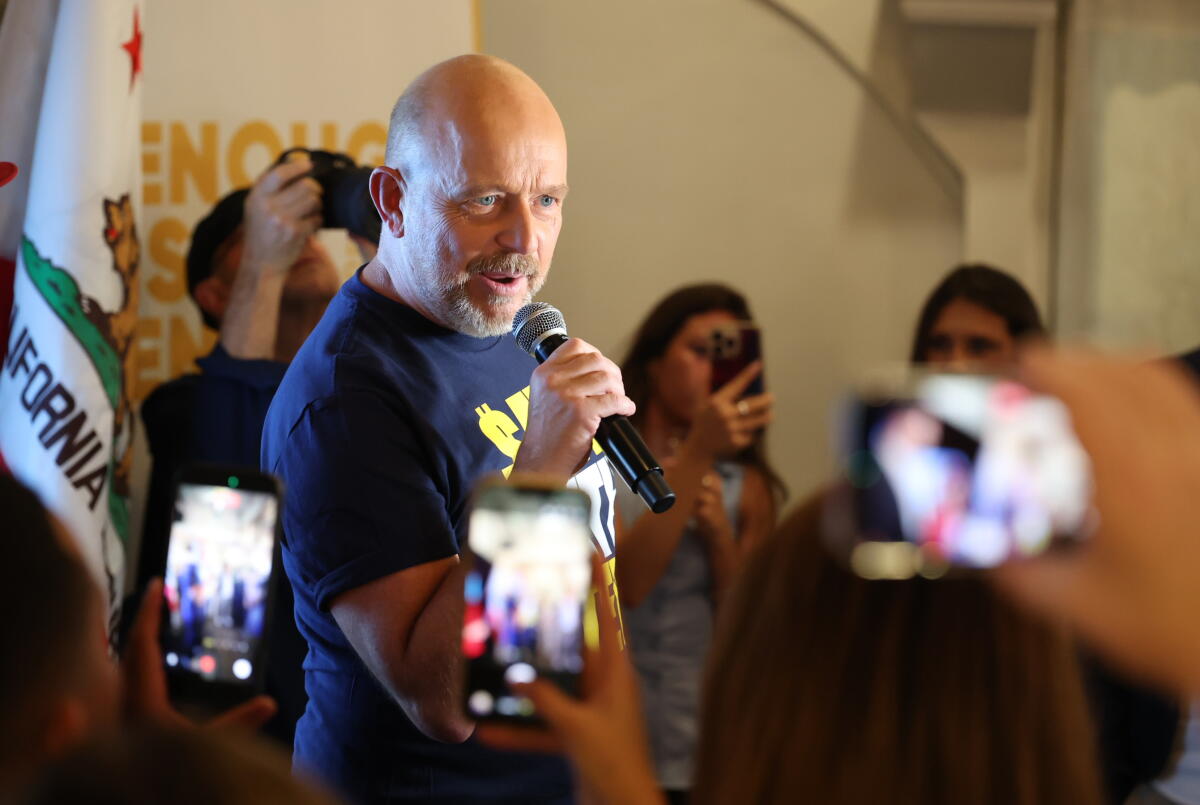
Republican candidate for governor Steve Hilton at a town hall

Republican gubernatorial candidate Steve Hilton speaks at a March 7 town hall in Mentone.

(Gina Ferazzi / Los Angeles Times)

A Trump-endorsed Republican could become California’s next governor

A second ticket drop for the Olympics

  • A second ticket drop is set to open in August and will offer refreshed inventory across all sports at a range of prices.
  • Those who registered but did not receive a slot in the first ticket drop or did not buy all 12 of their tickets will be enrolled in a lottery for a spot in the second ticket drop.

Court strikes down California mask law

California is getting 3 new state parks

  • California will establish the new parks in the Central Valley, marking the state’s largest park expansion in decades and bringing the statewide total to 283 parks.
  • The parks will serve historically underserved communities with recreation and historic preservation.

What else is going on

Commentary and opinions

This morning’s must-read

Other must-reads

For your downtime

Waffle with maple butter at Max & Helen's in Larchmont

The waffle with maple butter is the drive-across-town dish at celebrity-backed Max & Helen’s, the Larchmont diner opened by Phil Rosenthal and Nancy Silverton.

(Ron De Angelis / For The Times)

Going out

Staying in

A question for you: What’s your favorite California-themed book?

Marya says, “Hard Times in Paradise” by David and Micki Colfax.

Cristina says, “Grapes of Wrath” by John Steinbeck.

Email us at essentialcalifornia@latimes.com, and your response might appear in the newsletter this week.

And finally … from our archives

A white triangle inside of a red square inside of a white square inside of a black square that reads "YouTube"

On this day 21 years ago, “Me at the zoo” was the first video uploaded to YouTube, opening the door to a new medium of television.

For the 20th anniversary last year, The Times’ Wendy Lee wrote about the video sharing platform and how it changed TV as we know it.

Have a great day, from the Essential California team

Jim Rainey, staff reporter
Hugo Martín, assistant editor, fast break desk
Kevinisha Walker, multiplatform editor
Andrew Campa, weekend writer
Karim Doumar, head of newsletters

How can we make this newsletter more useful? Send comments to essentialcalifornia@latimes.com. Check our top stories, topics and the latest articles on latimes.com.
Source link

Here are some fresh and favorite food haunts to try

Much of the news dominating the local restaurant scene has focused on sadness.

Two Los Angeles icons, Cole’s French Dip and Echo Park’s Taix restaurant, closed after more than 215 combined years of service.

It’s easy to be down and not necessarily want to go out.

Fortunately, our Food team, led by senior editor Danielle Dorsey, has some amazing recommendations for new favorites and old haunts that will fill your stomach and lift your spirits.

This month’s highlighted selections include locales from Altadena and Echo Park to Malibu and Westwood that the team feels are all worth your time.

Let’s take a look at a few of their selections.

Duke’s (Malibu)

The iconic restaurant along PCH was on the heels of reopening after the Pacific Palisades fire last February when heavy rain caused mudslides that led to flooding and extensive damage.

Fourteen months later, Duke’s Malibu is open with significant renovations and limited lunch and dinner menus featuring Hawaiian-influenced seafood staples such as crispy coconut shrimp, Korean sticky ribs and hula pie.

As the restaurant celebrates 30 years in operation, plans are underway for an anniversary party this summer.

Traditional Taiwanese dishes at the Golden Leaf restaurant on Wednesday, March 18, 2026, in San Gabriel, CA.

(Kayla Bartkowski/Los Angeles Times)

Golden Leaf Restaurant (San Gabriel)

A Taiwanese restaurant in San Gabriel was forced to remove stinky tofu, a popular, culturally significant dish, from its menu after repeated complaints from residential neighbors and fines from the city.

City officials have encouraged Golden Leaf restaurant to install an expensive filter to address the pungent smell, though owners insist that none of their immediate shopping center neighbors have complained about the odor.

Supporters launched a Change.org petition last summer backing the preparation of the dish.

Ramen birria is a highlight at the Hoja Blanca popup hosted at Truss & Twine in Palm Springs.

(Bill Addison / Los Angeles Times )

Hoja Blanca (Palm Springs)

If you’re heading to Coachella today, it’s worth making a detour for this weekly pop-up at a sleek Palm Springs bar.

From married couple Omar Limon and Blanca Flores Torres, with help from Omar’s brother Arnold Limon, Hoja Blanca offers a playful take on modern Mexican food with dishes such as quesabirria tacos, esquites with cauliflower and a tetela topped with pork belly, all served alongside Bryan Jimenez’s classic cocktails.

People gather for dinner at Meymuni Cafe in Los Angeles, CA on Saturday, March 7, 2026.

(Stella Kalinina/For The Times)

Meymuni Cafe (Rancho Park)

As war unfolds in Iran and neighboring countries, L.A.’s Persian community has found comfort and support at restaurants such as Meymuni, a modern Persian cafe that offers free tea and cookies to diners, many of whom stop by after related protests at the nearby Federal Building.

The cafe opened in 2025 with barbari bread and lavash wrap sandwiches, tahini-date shakes and chai lattes, plus a full slate of events aimed at uplifting the local Persian community.

A double cheeseburger, cookie, fries and dipping sauces on a bright red plastic tray

(Stephanie Breijo / Los Angeles Times)

NADC Burger (Westwood)

The rapidly expanding smashburger chain from Pasta Bar and Sushi by Scratch Restaurants chef Phillip Frankland Lee has opened its first L.A. location in Westwood Village, with plans to open additional locations in the city.

The signature burger at NADC — an acronym for “not a damn chance” — features two Wagyu patties, American cheese, grilled onions, jalapeños, pickles and a house sauce, with beef tallow fries and brown butter chocolate chip cookies rounding out the short menu.

An exterior of the wood-accented Bengali restaurant Roshana Bilash in Melrose Hill.

(Stephanie Breijo / Los Angeles Times)

Roshona Bilash (Larchmont)

After stepping away from the kitchen for decades, Abul Ibrahim has opened a quick-service restaurant in Melrose Hill that celebrates the Bangladeshi flavors he grew up with.

Roshona Bilash, which translates to “luxurious taste,” features Bengali classics such as bone marrow nihari, rice pilafs and meats and breads cooked in a clay oven, with plans to expand with regional specialties such as seafood dishes popular along the Bangladesh coast.

Check out the full list here.

You’re reading the Essential California newsletter

Sign up to start every day with California’s most important stories.

The week’s biggest stories

The long line at the Los Angeles Times Festival of Books.

(Kyra Saldana/For De Los)

Los Angeles Times Festival of Books

California living

Crime, courts and policing

Entertainment and media news

What else is going on

Must reads

Other meaty reads

For your downtime

Photo of a person on a background of colorful illustrations like a book, dog, pizza, TV, shopping bag, and more

(Illustrations by Lindsey Made This; photograph by Frazer Harrison / Getty Images)

Going out

Staying in

L.A. Affairs

Get wrapped up in tantalizing stories about dating, relationships and marriage.

Have a great day, from the Essential California team

Jim Rainey, staff reporter
Hugo Martín, assistant editor, fast break desk
Kevinisha Walker, multiplatform editor
Andrew J. Campa, weekend writer
Karim Doumar, head of newsletters

How can we make this newsletter more useful? Send comments to essentialcalifornia@latimes.com. Check our top stories, topics and the latest articles on latimes.com.

Source link

How Coachella grew from a small desert festival into a global cultural behemoth

Commenters who never have been — and never will go — complain about the cost, the influencers, the hype. Purists wax poetic about the days when they disappeared into three days of music and the field wasn’t overtaken by brands like Barbie and e.l.f. cosmetics. Defenders claim they can camp their way to an affordable weekend, and others spend the whole time posting. A select few even talk about great performances they saw — it’s still a music festival.

You’re reading the Essential California newsletter

Sign up to start every day with California’s most important stories.

But one thing everybody can agree on: Coachella has changed. I should know. I’ve been covering it as a journalist since 2007.

Rapid advancements in technology and mass adoption of social media have brought out the best and worst of the festival — not just on screens thousands of miles away, but to those of us trying not to trip over the makeshift photoshoot you might have seen on Instagram.

Coachella pre-2010 was a purist’s paradise

Some of Coachella’s most iconic moments happened before smartphones: The Flaming Lips in a human hamster ball in 2004; Daft Punk’s 2006 pyramid set; Rage Against the Machine reuniting and calling for the George W. Bush administration to be tried for war crimes in 2007. If you even had a cellphone when Coachella started in 1999 it was probably a Nokia brick or a flip phone with an antenna that had limited talk and text options.

In the early years, there were no brand activations on the field; nobody knew what an influencer was and the only corporate sign you saw was for Heineken in the beer gardens. (There was no Heineken House with its own stage, just signs advertising the beer.)

The grounds were also considerably smaller, making it easier to explore the different stages and discover new music. You didn’t have fancy food options, but a slice of Spicy Pie was less than $10. (Coachella upgraded its food options from festival staples to weekend outposts of L.A. restaurants in 2014.)

The music was the draw. The festival’s track record includes artists like the Killers, the Black Keys, Childish Gambino and Kendrick Lamar climbing up from small type to headliner on the lineup poster.

Livestreams and influencers made Coachella’s reach global

The vibes started to shift in 2010 as smartphones grew in popularity, although the service on the field was spotty. It was the first year Coachella offered a livestream — available via Facebook and MySpace. The next year, the stream moved to YouTube, where it remains and draws millions of viewers.

As Coachella expanded to twin weekends due to popular demand on the ground in 2012, it also had the first viral moment fans could enjoy from thousands of miles away: Dr. Dre and Snoop Dogg brought 2Pac back to life via a hologram.

Celebrities were always at Coachella (I spotted Ryan Seacrest, Corbin Bernsen, David Hasselhoff and Danny DeVito in my early years), but the rise of social media made celebrity culture a key part of the event. By 2011, TMZ was posting about stars like Lindsay Lohan. Clips from Coachella went viral and ended up on shows like “Tosh.0” and referenced in “Community.”

The art, which was always part of the festival, became bigger and more iconic. On the growing photo app Instagram, larger-than-life sculptures of astronauts started appearing in selfies.

Brands saw an opportunity. American Express, H&M and Samsung launched activations on-site in 2015. The party scene outside the festival, with non-affiliated events that were timed because everyone was in town for Coachella, became marketing vehicles. Brands are still cashing in more than a decade later.

The next watershed moment was Beyoncé in 2018. Today, most headlining sets at the fest feel as if they are designed for the viewing experience on the livestream rather than the fans on the field (ahem, Justin Bieber and his laptop). But Beyoncé’s spectacle was just as mind-blowing on-site as it was at home. A year later, the “Homecoming” special debuted on Netflix, widening the reach.

Coachella became a key part of the pop culture landscape, and then it became a cornerstone of the influencer economy.

Behind all the hype, there’s still a music festival hiding

I inadvertently photobombed approximately 500 people just trying to go to and from the press tent last weekend and my inbox is overflowing with requests for coverage of off-site events with brands, celebs and TikTok influencers, including social media clips.

But at the end of the day, Coachella is still a music festival, and a really good one at that. The Strokes, David Byrne, Jack White, Iggy Pop, Turnstile, Wet Leg, Fujii Kaze and even Less Than Jake in the Heineken House were some of the best performances I had seen in years.

Coachella is what you make of it. And besides, everyone knows there are fewer influencers on Weekend 2.

Today’s top stories

A health worker administers a measles test.

A health worker administers a measles test on Fernando Tarin, of Seagraves, Texas, at a mobile testing site outside Seminole Hospital District on Feb. 21, 2025.

(Julio Cortez / Associated Press)

Increasing measles cases in California

  • California in 2026 has already seen its highest number of annual measles cases in seven years amid an ongoing resurgence of a disease once considered effectively eradicated in the U.S.
  • The re-emergence comes as vaccination rates have tumbled nationwide in recent years.

Testing LAX’s long-awaited train

  • LAX’s 2.25-mile electric train system will begin running without passengers next week as testing advances following a series of delays.
  • The Automated People Mover system began construction in 2019 and was initially slated to open to the public in 2023.
  • Specific bottles of Xanax, one of the most widely prescribed medications to treat anxiety and panic disorders, has been recalled due to its failure to dissolve at a standard rate.
  • FDA officials are not warning against consuming the product at this time.

What else is going on

Commentary and opinions

This morning’s must-read

Another must-read

For your downtime

A reporter lies on an AI massage table.

Reporter Deborah Vankin gets a massage by an “Aescape” robot at Pause Wellness Studio.

(Christina House / Los Angeles Times)

Going out

Staying in

A question for you: Are you planning on leaving California for another state? If so, tell us why.

Laura says, “I left California during the pandemic. Part of the push factor for me was politics, but not blue politics. I had been living in OC since 2018 and was surprised it was so Conservative (and conservative). That became a bigger source of discomfort for me as the vaccine question demonstrated how our neighbors’ decisions can impact us directly. Rather than moving elsewhere in California, which would have sorted out the political discomfort nicely, I moved to a much more affordable state where I had family.”

Email us at essentialcalifornia@latimes.com, and your response might appear in the newsletter this week.

And finally … from our archives

Kendrick Lamar rapping into a microphone on a dark smoky stage with a dark red backdrop

Kendrick Lamar performs at Coachella Music & Arts Festival at the Empire Polo Club on April 16, 2017.

(Amy Harris / Invision / AP)

On April 16, 2018, Compton’s own Kendrick Lamar became the first hip-hop artist to win the Pulitzer Prize for music.

He won for his album “Damn.,” which the Times’ Mikael Wood heralded as Lamar’s graduation to pop superstardom.

Have a great day, from the Essential California team

Jim Rainey, staff reporter
Hugo Martín, assistant editor, fast break desk
Kevinisha Walker, multiplatform editor
Andrew Campa, weekend writer
Karim Doumar, head of newsletters

How can we make this newsletter more useful? Send comments to essentialcalifornia@latimes.com. Check our top stories, topics and the latest articles on latimes.com.

Source link