california

California’s plastic bill faces challenges from federal court and GOP attorneys general

California’s landmark single-use plastic law is slowly being eroded by pressures within the state. Now legal attacks from outside threaten to kneecap it entirely.

Earlier this month, a federal district court judge in Oregon put parts of its single-use plastic law, which is similar to California’s, on hold while he decides whether it violates antitrust and consumer protection laws.

At the same time, 10 Republican attorneys general sent letters directly to companies that are taking part in plastic reduction campaigns, telling them to stop.

They threatened legal action against Costco, Unilever, Coca-Cola and 75 other companies for participating in the Plastic Pact, the Consumer Goods Forum and the Sustainable Packaging Coalition. These efforts all include industry as an active partner in reducing plastics, but the letters say the companies are colluding against consumers “to remove products from the market without considering consumer demand, product effectiveness, or the cost and impact on consumers of a replacement product.”

Charges of corporate collusion and conspiracy are central to both cases.

Anti-waste advocates and attorneys well versed in packaging say the lawsuit and the letters to Costco and the other companies highlight vulnerabilities in several of California’s waste laws, including the seminal Senate Bill 54 — the Plastic Pollution Prevention and Packaging Producer Responsibility Act. At issue are what are known as Extended Producer Responsibility laws.

These put the cost of cleanup and waste disposal on the companies that make materials — plastic, paint or carpet — rather than on consumers, cities and municipalities.

In 2024, a report from California Atty. Gen. Rob Bonta estimated that collectively, the state’s cities spend more than $1 billion each year on litter management. In 2023, 2.9 million tons of single-use plastic (or 171.4 billion pieces) were sold or distributed, according to one state analysis.

These producer responsibility laws emphasize the idea of “circular economy”: that the producer of a material must consider its fate — making sure it can be reused or recycled, or at least reduced.

The laws organize companies into entities, called Producer Responsibility Organizations (PROs), that generally oversee the management of the laws, set fees and collect them from members.

In the Oregon lawsuit, the National Assn. of Wholesaler-Distributors alleges a state-sanctioned product responsibility organization levied fees on trade group members that were onerous and opaque.

“Their fee structure was designed in secret by board members of the PRO,” said Eric Hoplin, president and chief executive of the group.

“Oregon is attempting to build a statewide recycling system by granting vast authority to a private entity to impose what amount to hidden taxes on businesses and consumers,” said Brian Wild, chief government relations officer for the wholesalers. “This law raises prices, shields decision-making from scrutiny, and advantages large, vertically integrated companies at the expense of smaller competitors.”

The group he references, the Circular Action Alliance, is the same one that oversees California’s single-use plastic law. Amazon, Colgate-Palmolive, General Mills and Procter & Gamble are part of it.

Others, however, say California’s laws are strong.

People shop at Costco in Glendale, Calif.

People shop at Costco in Glendale, Calif., on April 10.

(Damian Dovarganes / Associated Press)

“Extended Producer Responsibility laws are public policies passed by legislatures and implemented with government oversight,” said Heidi Sanborn, the executive director and CEO of the National Stewardship Action Council, which advocates for the laws and a more circular economy.

She helped craft many of California’s waste laws, including SB 54 and was also involved in Oregon’s law. “They create clear, consistent rules so all producers contribute fairly to the cost of recycling and waste management,” she said.

Sen. Benjamin Allen (D-Santa Monica), who wrote SB 54, said California’s plastic bill was designed to avoid violating antitrust laws.

CalRecycle declined to comment.

Some advocates actually hope the California laws fall. They include Jan Dell, of Last Beach Cleanup, an anti-plastic group based in Laguna Beach.

Extended Producer Responsibility “programs are based on the false premise that plastic is recyclable and are counterproductive because they green wash plastics and preempt proven solutions like strategic bans on the worst forms of plastic pollution (e.g. single use bags, six pack rings),” Dell wrote in an email.

Even those, however, can be problematic if they’re not enforced. Dell pointed to SB 54’s de facto ban on polystyrene, which went into effect on Jan. 1, 2025.

“There is still Styrofoam stuff sold in 250 Smart and Final stores across the state!” she said. “It is totally noncredible and outrageous to claim that CalRecycle will ever enforce regulations on thousands of types of packaging when they can’t enforce the regulations on JUST ONE!”

Source link

The Mt. Wilson Trail in Sierra Madre reopens after Eaton fire closure

Editor’s note: Although there will be references to the Eaton fire in this newsletter, there won’t be any images of active fire or burned buildings.

The Mt. Wilson Trail in Sierra Madre recently reopened after being damaged last January by the Eaton fire and subsequent flooding.

When the city of Sierra Madre announced the trail was fully open again, I was initially eager to return to this stunning trek in the San Gabriel Mountains.

But part of me felt anxious. What if the fire had killed everything I remembered so fondly from time spent on the trail?

You are reading The Wild newsletter

Sign up to get expert tips on the best of Southern California’s beaches, trails, parks, deserts, forests and mountains in your inbox every Thursday

By continuing, you agree to our Terms of Service and our Privacy Policy.

Shortly after the Eaton fire, I scoured maps to discern which trails likely burned in the blaze. I remember my heart sinking when I saw the fire had scorched the entire Mt. Wilson Trail. It’s an area of Angeles National Forest with a significant amount of local history.

The first known trail to Mt. Wilson was established by Indigenous people, a trail they used to carry wood down the mountains when Spanish missionaries forced them to build the San Gabriel Mission in 1771, according to the Mt. Wilson Trail Race.

Then, in 1864, Benjamin D. Wilson built the first version of the current Mt. Wilson Trail. He was “following an ancient Tongva footpath,” according to a sign near the trailhead. It is the oldest trail in the San Gabriel Mountains, according to former Times hiking columnist John McKinney.

A deep rocky canyon with clear blue water rushing through it and prickly yucca plants and other greenery growing.

Water rushes through Little Santa Anita Canyon near the Mt. Wilson Trail north of Sierra Madre.

(Jaclyn Cosgrove / Los Angeles Times)

The hike from Sierra Madre to Mt. Wilson is a suffer fest: It is a 14½-mile out-and-back journey where you climb just over 4,800 feet in elevation. It’s thrilling, though, once you’ve completed it, because you can look up at the towers at Mt. Wilson from L.A. and know you climbed that whole mountain.

It’s a hike that every L.A. hiker interested in upping their game should try at least once. Pro tip: I don’t consider it cheating if you hike from the trailhead in Sierra Madre to the top — and then get your nonhiker friend to pick you up where the trail ends in the Mt. Wilson Observatory parking lot. If it’s open, you could even treat them to a meal at the Cosmic Cafe!

On Saturday, I had planned to hike to Orchard Camp, a 7.2(ish)-mile journey that gains about 2,200 feet. It is one of my favorite places in the San Gabriel Mountains, and I was eager and anxious to see how it was doing.

Plants with blooms along the Mount Wilson Trail.

Plants with blooms along the Mt. Wilson Trail, including, from clockwise, Menzies’ baby blue eyes, a poppy, longleaf bush lupine, streambank spring beauty and western wallflower.

(Jaclyn Cosgrove / Los Angeles Times)

The site has a lengthy history. It was first home to Half-Way House, a repair station and rest stop built by the trail’s builder Don Benito Wilson in 1864. He named his establishment as such because Orchard Camp was the halfway point between Sierra Madre and Mt. Wilson.

The site was converted in the 1890s to Orchard Camp, “a resort named after the groves of apples, plums, cherries and chestnuts whose harvest was sold to travelers using the camp and trail,” according to a sign at the site.

In an advertisement published in The Times in 1908, Orchard Camp Resort told prospective guests it offered furnished tents and a “fine stream of water runs through camp.” By 1920, the accommodations had improved mightily, with the camp advertising “tennis, dancing, croquet and hiking,” and groceries, baked goods and meats at the camp store. (I can confirm the stream, hiking and, should you choose, dancing are all still available.)

To begin your hike, you’ll drive north through Sierra Madre. You’ll find the trailhead near the aptly named Mt. Wilson Trail Park, a small stretch of grass with a playground and, a rare luxury for hikers, a flush toilet. You will park on the street, close to the park if you arrive with the early birds.

Next to the park, you’ll find Lizzie’s Trail Inn and Richardson House, which the Sierra Madre Historical Preservation Society operates as living museums. Inside, you can learn more about the trail and other local history. They’re open most Saturdays from 10 a.m. to noon.

Two hikers in straw hats walk along a dirt path carved into the side of a mountain.

Two hikers head up the first mile of the Mt. Wilson Trail near Sierra Madre.

(Jaclyn Cosgrove / Los Angeles Times)

Head north onto Mt. Wilson Trail, a paved road, which will take you behind homes before reaching the large Mt. Wilson Trail entrance sign. It’s only up from here!

The first part of the trail is in direct sunlight until late afternoon and has minimal to no shade. The upside is that it offers incredible views of the San Gabriel Valley and beyond. I quickly spotted Santiago Peak, the highest point in Orange County, which was about 43 miles southeast from where I stood. The snow-covered Mt. San Jacinto, which was 82 miles away, came into clearer view as I gained elevation.

In the first two miles of the trail, I was delighted to discover several blue, purple and pink wildflowers blooming, including wild Canterbury bells, stinging lupine (don’t touch it!) and chia. These plants are known as “fire followers,” as they quickly sprout after an area burns. Later in my hike, I also noticed baby blue eyes, cardinal catchfly, lots of coast morning glory and exactly two poppies.

Two hikers stand near a clear creek with small boulders scattered in a line to make crossing easier.

Two hikers consider the best path across a water crossing along the Mt. Wilson Trail.

(Jaclyn Cosgrove / Los Angeles Times)

I was also surprised by just how many waterfalls I could see from the trail, including one just under a mile in that was gushing down the rocky canyon.

My first stop was First Water, which you’ll reach at just over 1½ miles in. You’ll find a short path at First Water that will take you off the main trail and next to the Little Santa Anita Creek.

If you’ve hiked this trail before, you will notice substantial differences in the trail to reach First Water. It is steeper and a bit more technical, but still an easy enough jaunt down to the creek.

A rocky canyon smoothed by hundreds or thousands of years of water with a creek running through.

The Little Santa Anita Creek at First Water.

(Jaclyn Cosgrove / Los Angeles Times)

One of the starkest differences, though, comes about half a mile north when Mt. Harvard comes into view. I was expecting more healthy green slopes, and instead, I spotted rows and rows of burnt, dried-out trees. As I neared Orchard Camp, I passed burned manzanita and other trees with blackened bark, but the majority of what I observed was nature in recovery.

One hiker had told me there wasn’t any shade at Orchard Camp, and while I was skeptical, I was prepared for the worst. Instead, I arrived just before 2 p.m. and found several oaks and other trees, still healthy and growing, and thick green grass and other plants. I laid down on a boulder near a wooden bench and basked in the sun like the happiest fence lizard in all of the forest — although there were plenty of shady spots where I could have laid down.

Old concrete steps and a short wall of possibly river rocks amid a grassy shady area with a wooden bench.

Orchard Camp, a shady stop along the Mt. Wilson Trail.

(Jaclyn Cosgrove / Los Angeles Times)

I didn’t go past Orchard Camp because I knew I’d hit snow. I don’t own crampons, which are needed to hike safely in the snow on any sort of incline. (That said, Luis De La Cruz, the Vamos Hiking Crew leader, whose group hiked to the top Saturday, told me that the trail is in good condition from Orchard Camp although there is some erosion.)

Leaving the trail just before 5 p.m., I felt immense gratitude for the hundreds of hours that volunteers with the Mt. Wilson Trail Race put into restoring the Mt. Wilson Trail to its current glory. I spoke to several folks along the path who felt similarly.

A dirt path with green plants like miner's lettuce growing with a canopy of trees above.

A trail recovering.

(Jaclyn Cosgrove / Los Angeles Times)

It’s a feeling this trail elicits. As a Times story noted in 1915 about this hike, “Once this trip is taken, a desire for a repetition clings to the lover of the outdoor life.” May we all be so lucky!

A wiggly line break

3 things to do

Several people stretch into a low-lunge position on blankets and and yoga mats in a park; two dogs run by.

Attendees of a full moon hike at Elysian Park hosted by We Explore Earth.

(Chiara Alexa / For The Times)

1. Marvel at the moon in Elysian Park
Outdoors nonprofit We Explore Earth will host a free sunset hike Tuesday from 5:30 to 8 p.m. in Elysian Park. After the hike, guests are invited to participate in yoga, a sound bath and music, all as the full moon rises over L.A. Register at eventbrite.com.

2. Connect with fellow humans in Ascot Hills Park
Intermission, a community-focused wellness company, will host a free sound bath at 11 a.m. Sunday in Ascot Hills Park. Guests will need to take a short hike to reach the hilltop where the sound bath will be offered. Learn more at Intermission’s Instagram page.

3. Crunch along the trail in Orange
Save Orange Hills, a local advocacy group, will host a bilingual 3-mile hike from 10 a.m. to noon Sunday through Irvine Regional Park in Orange. Barefoot Joel and Scott Keltic Knot will guide hikers along the Horseshoe Loop Trail, observing wildflowers and wildlife along the way. Guests might spot the locally rare Catalina mariposa lily. Tickets for participants 12 and older are $12.51 while children younger than 12 are free. Park entry is $5. Register at eventbrite.com.

A wiggly line break

The must-read

A researcher uses his iPhone's flashlight to look into a burrow to see whether a tortoise is home.

Ed LaRue, a longtime desert tortoise advocate and surveyor, looks for tortoise burrows in Johnson Valley.

(Ethan Swope / For The Times)

Desert tortoises are what scientists categorize as a “keystone species,” meaning other animals depend on them for their survival. In this case, it’s for the burrows that tortoises dig. Times staff writer Alex Wigglesworth wrote that that’s a key reason why U.S. District Judge Susan Illston recently ordered the federal Bureau of Land Management to shut down 2,000 miles of off-roading trails, saying the vehicles are “a significant ongoing cause of harm” to the tortoise population. And although climate change-supercharged droughts and large-scale solar development across the Mojave also threatened the tortoises and their habitat, off-roading trail use is different, biologist Ed LaRue said, because it’s “one of the threats that we could ostensibly control.”

I am not an off-roader, but I do want to acknowledge the outcome of this ruling: It is heartbreaking whenever you lose access to an outdoors space you love. “The vastness and the quiet and the peace you get here is unlike anywhere else you can find in California,” said Lorene Frankel, an off-roader who’d planned to launch an off-roading business with her husband. “It is devastating to realize a massive amount of land will be completely inaccessible.”

Even if you agree with the closure order’s purpose — protecting precious habitat for a critical species — it is important that we remain sympathetic to each other’s reasons for loving the outdoors.

Happy adventuring,

Jaclyn Cosgrove's signature

P.S.

Have you ever tried to reach Griffith Park without driving there? You probably discovered it wasn’t a straight-forward journey. Metro, our local transportation agency, is developing a plan to make it safer and easier to reach Griffith Park and the L.A. Zoo by transit, on foot and by bike. And you can give feedback on how to make that happen. Streets Are For Everyone will lead a workshop from 11 a.m. to 1 p.m. Saturday at the Autry Museum of the American West where the organization will gather feedback on these proposed improvements for reaching Griffith Park. Participants will discuss a proposed transit route to Griffith Park as well as pedestrian and biking connections between the Hollywood Bowl and the Ford. As a bonus, attendees will get free museum admission after the workshop. Register using this Google Form.

For more insider tips on Southern California’s beaches, trails and parks, check out past editions of The Wild. And to view this newsletter in your browser, click here.


Source link

The crisis on the Colorado River — six things to know

The latest news about the Colorado River is dire. Since 2000, the river’s flow has shrunk about 20%. An extremely warm winter has brought very little snow in the Rocky Mountains. Reservoirs are declining to critically low levels. And the leaders of seven states are still at loggerheads over the water cutbacks each should accept to prevent reservoirs from falling further.

Here are six things to know about the current crisis:

A short-term deal, at best: Negotiators for the seven states still are discussing ways they might reach a short-term deal as a “bridge into a longer-term agreement,” said Wade Crowfoot, California’s natural resources secretary. But after missing a Feb. 14 federal deadline, the states are running out of time. Gov. Gavin Newsom told governors in a letter that California would welcome joint investments in water recycling and desalination, and that he believes it’s still possible to agree on a plan “for the next several years.”

States drawing up Plan B: Officials are talking about what they will do if no deal is reached. Representatives of Arizona, Nevada and California already offered cuts of 27%, 17% and 10%, respectively. But that hasn’t been enough for negotiators representing Colorado, Wyoming, New Mexico and Utah. Crowfoot said the talks about a Plan B among California, Arizona and Nevada officials focus on what water agencies could do to stabilize the level of Lake Mead, the nation’s largest reservoir, which is 34% full and set to decline further.

You’re reading Boiling Point

The L.A. Times climate team gets you up to speed on climate change, energy and the environment. Sign up to get it in your inbox every week.

By continuing, you agree to our Terms of Service and our Privacy Policy.

A court battle looms: As the Trump administration considers ordering cuts, state officials are bracing for potential lawsuits. Utah and Arizona have begun setting aside money for legal bills. A fight could take years until there is a decision by the U.S. Supreme Court. Robert Glennon, a University of Arizona emeritus law professor, said no one knows what the court would do. “This is rolling the dice on something that is really quite profound,” he said. “I don’t know about you, but I don’t like to go to Vegas and play the craps.”

Arizona is most vulnerable: Arizona is preparing for the largest cutbacks. That’s because the Central Arizona Project, the series of canals that runs to the Phoenix and Tucson areas, isn’t nearly as old as other aqueducts, giving it low-priority water rights that put it among the first in line for cuts. Farmers who rely on the CAP already have been forced to leave many fields dry. The coming cuts likely will prompt Arizona cities to drill more wells and pump more groundwater, which is declining in many areas.

Less for farms: Nearly half the water that is taken from the river is used to grow hay for cattle. In all, agriculture consumes about three-fourths of the water. In the last few years, farmers have left some hay fields dry part of the year in exchange for federal funds. Glennon said agriculture needs to conserve more, and an agreement among the states could include a fund to help farmers switch to irrigation systems that use less.

Cutbacks carry costs: For cities, adapting will require more conservation and searching for alternative water sources, which will cost money and push up water bills, said Rhett Larson, an Arizona State University law professor. Some cities probably also will have to buy out farmers or pay them to leave fields fallow, which will push up urban water costs further, he said. And as farms produce less, he said, “eventually you’ll feel it in the grocery store.”

More water news

With very little snow in the Rocky Mountains, the U.S. Bureau of Reclamation now projects the runoff flowing into Lake Powell, the Colorado River’s second-largest reservoir, will decrease so much that by later this year the water level probably will drop too low to spin turbines and generate hydropower at Glen Canyon Dam. As Shannon Mullane reports for the Colorado Sun, that would remove a cheap, renewable and reliable power source for communities across the West.

Glen Canyon Dam also has design flaws that create problems at low reservoir levels. As I’ve reported, if the reservoir declines to a point that water can pass through only four 8-foot-wide bypass tubes, that would limit how much can reach California, Arizona and Nevada. Those states have urged the Trump administration to fix or overhaul the dam to address this problem.

Last week, Jonathan P. Thompson wrote in his newsletter The Land Desk that the impasse among the states is pushing Glen Canyon Dam closer to the brink. He said federal officials could decide to reengineer the dam to ensure water still can pass at low reservoir levels, but that would be only a temporary fix. As Thompson put it, “aridification is rendering the dam obsolete, at least as a water storage savings account.”

Heather Sackett of Aspen Journalism spoke with experts about why the worsening crisis still hasn’t forced a deal. Kathryn Sorensen, a researcher at the ASU Kyl Center for Water Policy, said: “There’s so little water to go around that positions have become hardened as a result. We’re not just talking about inconvenient cuts; we’re talking about severe pain to economies at this point.”

In Arizona, an advocacy group backed by the Central Arizona Project has begun rolling out TV ads and online videos saying the state is being singled out in the options the federal government has outlined. Brandon Loomis of the Arizona Republic reports that an ad aired by the coalition declares: “Arizona is being unfairly targeted for reductions of Colorado River water that would cripple our state.”

In California, Newsom launched a new plan this week that sets a goal of securing 9 million acre-feet of additional water, enough to fill two Shasta Reservoirs, by 2040 in an effort to offset expected losses caused by climate change. As Camille von Kaenel reports for E&E News by Politico, the 2028 water plan will be a blueprint for new reservoirs, conservation efforts and groundwater recharge projects. Department of Water Resources Director Karla Nemeth says the effort “will help us plan smarter to deal with the way climate change is testing our water systems.”

More climate and environment news

California is spearheading a lawsuit against the Trump administration for canceling billions of dollars in funding for clean energy projects awarded during the Biden administration. My colleague Hayley Smith reported the cuts included a $1.2-billion federal grant for California’s hydrogen hub. The hub was part of the Biden administration’s nationwide effort to develop hydrogen projects to replace planet-warming fossil fuels, particularly in hard-to-decarbonize sectors such as heavy-duty trucking.

Illegal cannabis farms are polluting national forests in California, leaving contamination that harms wildlife and watersheds. Reporter Rachel Becker of CalMatters visited an illicit cannabis grow that was raided by law enforcement in Shasta-Trinity National Forest, where a pile of pesticide sprayers was left behind. Researchers are sounding the alarm, she wrote, “that inadequate federal funding, disjointed communication, dangerous conditions and agencies stretched thin at both the state and federal level are leaving thousands of grow sites — and their trash, pesticides, fertilizers and more — to foul California’s forests.”

This is the latest edition of Boiling Point, a newsletter about climate change and the environment in the American West. Sign up here to get it in your inbox. And listen to our Boiling Point podcast here.

For more water and climate news, follow Ian James @ianjames.bsky.social on Bluesky and @ByIanJames on X.

Source link

Tight California governor’s race between five leading candidates

The race to replace termed-out California Gov. Gavin Newsom is a tight contest between five candidates, according to a new poll released Wednesday.
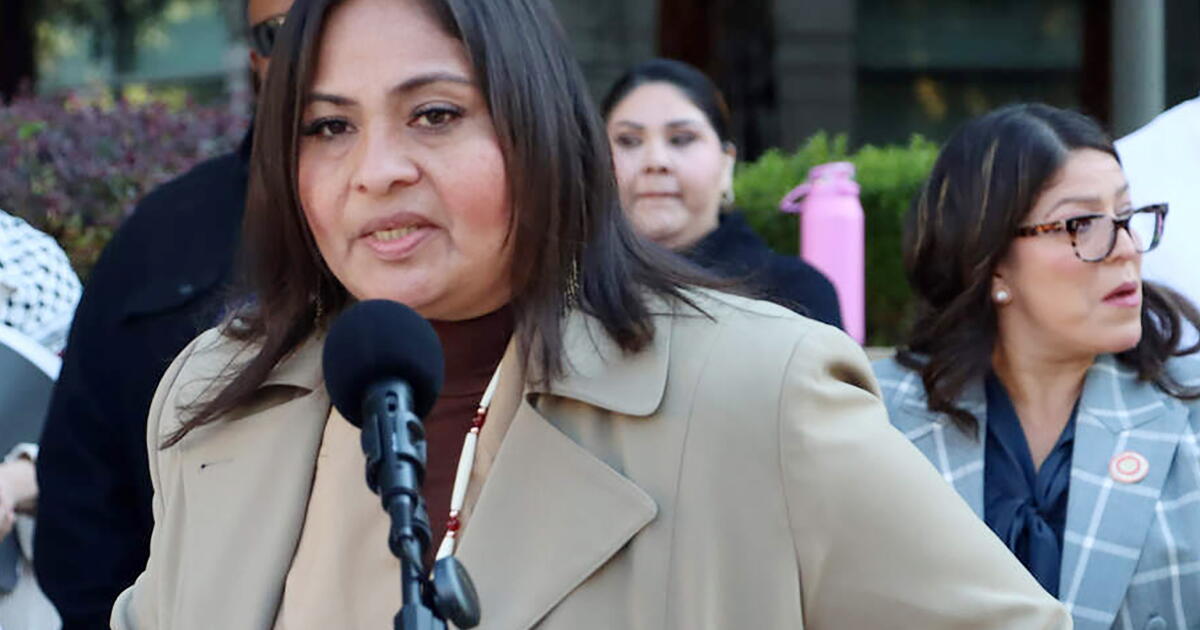
Three Democrats — former Rep. Katie Porter, Rep. Eric Swalwell and hedge fund founder Tom Steyer — and two Republicans — conservative commentator Steve Hilton and Riverside County Sheriff Chad Bianco — are within 4 percentage points of one another, according to the nonpartisan Public Policy Institute of California survey.

“Three months out from the June primary, the top two slots in the gubernatorial race are up for grabs,” Mark Baldassare, PPIC’s survey director, said in a statement. “Voters feel hammered by cost-of-living realities, so affordability will be a defining issue for them.”

In a crowded field of a dozen prominent candidates, Hilton had the support of 14% of likely voters, Porter 13%, Bianco 12%, Swalwell 11% and Steyer 10%, according to the poll. No other candidate received the support of more than 5% of respondents. One in 10 likely voters were undecided.

The two candidates who receive the most votes in the June primary will move on to the general election regardless of party identification. With nine prominent Democrats in the field, this has led to concerns among party leaders that the Democratic candidates may splinter the vote and the two Republicans could advance to the November ballot. No Republican has been elected to statewide office in California since 2006.

While support for Hilton and Bianco held steady since PPIC’s December poll, backing for Porter and former U.S. Health and Human Services Secretary Xavier Becerra significantly declined as more Democrats entered the contest and Porter dealt with the fallout from videos of her cursing at an aide and scolding a reporter. Porter expressed remorse for her behavior.

Several other races will appear on the November ballot, notably congressional contests that could determine which party controls the U.S. House of Representatives. The state’s 52 congressional districts were redrawn in a rare mid-decade redistricting after voters approved Proposition 50 last year in an effort to counter President Trump’s calls on Republican leaders in Texas and other GOP-led states to reshape their congressional lines.

Likely voters in California overwhelmingly prefer a Democratic congressional candidate over a Republican, 62% to 36%, according to the poll. A proposed 5% tax on the assets of billionaires that largely would be used to fund healthcare services in the state also was supported by 6 in 10 likely voters.

The PPIC poll surveyed 1,657 California adults online in English and Spanish from Feb. 3 to 11. The results are estimated to have a margin of error of 3.1 percentage points in either direction in the overall sample, and larger numbers for subgroups.

Source link

Handicapping a Gavin Newsom-Kamala Harris presidential fight

Gavin Newsom and Kamala Harris have long circled one another.

The two moved in the same political slipstream, wooed the same set of Democratic donors and, for a time, even shared the same group of campaign advisors.

Harris rose from San Francisco district attorney to elected positions in Sacramento and Washington before twice running unsuccessfully for president.

Newsom climbed from San Francisco mayor to lieutenant governor to California’s governorship, where he quietly stewed as Harris leapfrogged past him into the vice presidency. While she served in the White House, Newsom tried any number of ways to insinuate himself into the national spotlight.

Now both have at least one eye on the Oval Office, setting up a potential clash of egos and ambition that’s been decades in the making.

Newsom, whose term as governor expires in January, has been auditioning for president from practically the moment the polls closed in 2024 and horrified Democrats realized Harris had lost to Donald Trump.

Harris, who’s mostly focused on writing and promoting her campaign autobiography — while giving a political speech here and there — hasn’t publicly declared she’ll seek the White House a third time. But, notably, she has yet to rule out the possibility.

In a CNN interview aired Sunday, Newsom was asked about the prospect of facing his longtime frenemy in a fight for the Democratic nomination. (California’s gallivanting governor is embarked on his own national book tour, promoting both the “memoir of discovery” that was published Tuesday and his all-but-declared presidential bid.)

“Well, I’m San Francisco now, she’s L.A.,” Newsom joked, referring to Harris’ post-Washington residency in Brentwood. “So there’s a little distance between the two of us.”

He then turned zen-like, saying fate would determine if the two face off in the 2028 primary contest. “You can only control what you can control,” Newsom told CNN host Dana Bash.

A decade ago, Newsom and Harris swerved to keep their careers from colliding.

In 2015, Barbara Boxer said she would step down once she finished her fourth term in the U.S. Senate. The opening presented a rare opportunity for political advancement after years in which a clutch of aging incumbents held California’s top elected offices. Between Lt. Gov. Newsom and state Atty. Gen. Harris, there was no lack of pent-up ambition.

After a weekend of intensive deliberations, Newsom passed on the Senate race and Harris jumped in, establishing herself as the front-runner for Boxer’s seat, which she won in 2016. Newsom waited and was elected governor in 2018, succeeding Jerry Brown.

Once in their preferred roles, the two got along reasonably well. Each campaigned on the other’s behalf. But, privately, there has never been a great deal of mutual regard or affection.

Come 2028, there will doubtless be many Democrats seeking to replace President Trump. The party’s last wide-open contest, in 2020, drew more than two dozen major contestants. So it’s not as though Harris and Newsom would face each other in a one-on-one fight.

But dueling on the national stage, with the country’s top political prize at stake, is something that Hollywood might have scripted for Newsom and Harris as the way to settle, once and for all, their long-standing rivalry.

The two Californians would start out closely matched in good looks and charisma.

Those who know them well, having observed Newsom and Harris up close, cite other strengths and weaknesses.

Harris has thicker skin, they suggested, and is more disciplined. Her forte is set-piece events, like debates and big speeches.

Newsom is more of a policy wonk, a greater risk-taker and is more willing to venture into challenging and even hostile settings.

Newson is more fluent in the ecosphere of social media, podcasts and the like. Harris has the advantage of performing longer on the national stage and bears nothing like the personal scandals that have plagued Newsom.

But Harris’ problem, it was widely agreed, is that she has run twice before and, worse, lost the last time to Trump.

“To a lot of voters, she’s yesterday’s news,” said one campaign strategist.

“She had her shot,” said another, channeling the perceived way Democratic primary voters would react to another Harris run. “You didn’t make it, so why should we give you another shot?”

(Those half-dozen kibbitzers who agreed to candidly assess the prospects of Newsom and Harris asked not to be identified, so they could preserve their relationships with the two.)

Most of the handicappers gave the edge to Newsom in a prospective match-up; one political operative familiar with both would have placed their wager on Harris had she not run before.

“I think her demographic appeal to Black women and coming up the ranks as a Black woman working in criminal justice is a very strong card,” said the campaign strategist. “The white guy from California, the pretty boy, is not as much of a primary draw.”

That said, this strategist, too, suggested that “being tagged as someone who not only lost but lost in this situation that has set the world on fire … is too big a cross to bear.”

The consensus among these cognoscenti is that Harris will not run again and that Newsom — notwithstanding any demurrals — will.

Of course, the only two who know for sure are those principals, and it’s quite possible neither Harris nor Newsom have entirely made up their minds.

Those who enjoy their politics cut with a dash of soap opera will just have to wait.

Source link

Trump’s plan for rising energy costs: Pump oil, make data centers pay

Energy affordability was in the spotlight during President Trump’s lengthy and at times rambling State of the Union address Tuesday evening as the president promised to bring down electricity prices in an effort to assuage voter concerns about rising costs.

The president announced a new “ratepayer protection pledge” to shield residents from higher electricity costs in areas where energy-thirsty artificial intelligence data centers are being built. Trump said major tech companies will “have the obligation to provide for their own power needs” under the plan, though the details of what the pledge actually entails remain vague.

“We have an old grid — it could never handle the kind of numbers, the amount of electricity that’s needed, so I am telling them they can build their own plant,” the president said. “They’re going to produce their own electricity … while at the same time, lowering prices of electricity for you.”

The announcement comes as polling shows Americans are dissatisfied with the economy and concerned about the cost of living. Experts on both sides of the political spectrum have said the energy affordability issue could translate to poor outcomes for Republicans in the midterm elections this November, as it did in a few key races in New Jersey, Virginia and Georgia last year.

While Trump has focused on ramping up domestic production of oil, gas and coal, residential electric bills have been soaring — jumping from 15.9 cents per kilowatt-hour in January 2025 on average to 17.2 cents at the end of December, according to the U.S. Energy Information Administration.

Through one year into his second term as president, Trump has vastly changed the federal landscape when it comes to energy and the environment, reversing many of the efforts made by the Biden administration to prioritize electrification initiatives and investments in renewable energy via the Inflation Reduction Act and Bipartisan Infrastructure Law.

Among several changes, Trump’s administration has slashed funding for solar programs, ended federal tax credits for electric vehicles and canceled grants for offshore wind power — even going so far as to try to halt some such projects that were nearing completion along the East Coast.

Trump has also championed fossil fuel production and on Tuesday doubled down on his “drill baby drill” agenda, touting lower gasoline prices, increased production of American oil and new imports of oil from Venezuela.

Many of the president’s efforts are designed to loosen Biden-era regulations that he has said were burdensome, ideologically motivated and expensive for taxpayers.

Trump has taken direct aim at California, which has long been a leader on the environment. Last year, the president moved to block California’s long-held authority to set stricter tailpipe emission standards than the federal government — an ability that helped the state address historical air quality issues and also underpinned its ambitious ban on the sale of new gas-powered cars in 2035.

Trump also slashed $1.2 billion in federal funding for California’s effort to develop clean hydrogen energy while leaving intact funding for similar projects in states that voted for him. In November, his administration announced that it will open the Pacific Coast to oil drilling for the first time in nearly four decades, a move the state vowed to fight.

But perhaps no issue has come across voters’ kitchen tables more than energy affordability.

So far this term, Trump has canceled or delayed enough projects to power more than 14 million homes, according to a tracker from the nonprofit Climate Power. The group’s senior advisor, Jesse Lee, described the president’s data center announcement as a “toothless, empty promise based on backroom deals with his own billionaire donors.”

“Making it worse, Trump is continuing to block clean-energy production across the board — the only sources that can keep up with demand, ensure utility bills don’t keep skyrocketing, and prevent massive new amounts of pollution,” Lee said in a statement.

Earlier this month, Trump’s Environmental Protection Agency repealed the endangerment finding, the U.S. government’s 2009 affirmation that greenhouse gases are harmful to human health and the environment, in what officials described as the single largest act of deregulation in U.S. history. The finding formed the foundation for much of U.S. climate policy. The EPA also loosened guidelines around emissions from coal power plants, including mercury and other dangerous pollutants.

The president’s environmental record so far is “written in rollbacks that put the interests of some corporate polluters above the health of everyday Americans,” read a statement from Marc Boom, senior director of the Environmental Protection Network, a group composed of more than 750 former EPA staff members and appointees.

Further, Trump has worked to undermine climate science in general, often describing global warming as a “hoax” or a “scam.” During his first year in office, he fired hundreds of scientists working to prepare the National Climate Assessment, laid off staffers at the National Oceanic and Atmospheric Administration and dismantled the National Center for Atmospheric Research, one of the world’s leading climate and weather research institutions, among many other efforts.

In all, the administration has taken or proposed more than 430 actions that threaten the environment, public health and the ability to confront climate change, according to a tracker from the nonprofit Natural Resources Defense Council.

The opposition’s choice for a rebuttal speaker is indicative of how seriously it is taking the issue of energy affordability: Virginia Gov. Abigail Spanberger focused heavily on energy affordability during her campaign against Republican Lt. Gov. Winsome Earle-Sears last year, including vows to expand solar energy projects and technologies such as fusion, geothermal and hydrogen. Virginia is home to more than a third of all data centers worldwide.

Source link

California’s Congress members’ plans for Trump’s State of the Union address

Boycotts. Prebuttals. Rebuttals. Historic guests.

California members of the U.S. Senate and the House of Representatives’ approach to President Trump’s State of the Union address Tuesday night are as varied as their politics and their districts.

Before the speech, Sen. Adam Schiff described Trump as an out-of-control and corrupt president who has ignored pressing issues such as climate change in order to enrich himself and punish his political enemies, including by turning the U.S. Department of Justice and the rest of the federal government into a “personal fiefdom,” unbound by the law.

“From the birth of our nation, our founders were obsessed with preventing tyranny and the emergence of another king, another despot. They created checks and balances, separation of powers, an independent judiciary. They understood that the greatest threat to liberty wasn’t foreign invasion, it was the concentration of power in the hands of one person or faction,” Schiff said on the floor of the U.S. Senate. “This president has systematically dismantled these safeguards in his second term.”

Schiff is among the Democrats boycotting the speech. Other Californians include Reps. Robert Garcia (D-Long Beach), Sara Jacobs (D-San Diego), Sydney Kamlager-Dove (D-Los Angeles) and Julia Brownley (D-Westlake Village).

Sen. Alex Padilla, the son of immigrants who was tackled in Los Angeles last year when he attempted to ask Homeland Security Secretary Kristi Noem a question during the immigration raids, will deliver a Spanish-language response after Trump’s address on television and online.

California has the largest congressional delegation in the nation, so its elected officials frequently have an outsized presence in the nation’s capital. An especially memorable moment was when then-House Speaker Nancy Pelosi (D-San Francisco) ripped up a copy of Trump’s speech after the 2020 State of the Union address.

It’s unclear whether California elected officials plan anything as dramatic tonight. But their guests are notable.

Though Garcia is not attending the speech, his guest at the event is Annie Farmer, a woman who was abused at the age of 16 by sexual predators Jeffrey Epstein and Ghislaine Maxwell. Rep. Eric Swalwell (D-Dublin), who is attending, is bringing Teresa J. Helm — another Epstein abuse survivor.

Others plan to bring constituents from their districts — Rep. Ken Calvert (R-Corona) is bringing Ben Benoit, the Riverside County auditor-controller who is a longtime friend.

Pelosi’s guest is the Rev. Devon Jerome Crawford, senior pastor of historic Third Baptist Church of San Francisco. And some have surprise guests who will be unveiled later tonight.

Source link

At San Quentin, Newsom shows off the anti-Trump model of public safety

A strange quirk at San Quentin state prison is that most of those incarcerated behind its towering walls are unable to see the San Francisco Bay that literally laps at the shore a few yards away.

That changed recently with the completion of new buildings — holding among other accouterments a self-serve kitchen, a library, a cafe and a film studio — and third-floor classrooms that look out over that beautiful blue expanse, long a symbol of freedom and possibility.

In the new San Quentin Rehabilitation Center, along with learning job skills and earning degrees, incarcerated men can do their own laundry, make their own meals, and interact with guards as mentors and colleagues of sorts, once a taboo kind of relationship in the us-and-them world of incarceration.

“You want to clothes wash? You wash them,” said Gov. Gavin Newsom, debuting the new facilities, including laundry machines, for reporters last week. “You want to get something to eat. You can do it, whenever.”

“All of a sudden, it’s like you’re starting to make decisions for yourself,” he said. “It’s called life.”

Listen closely, and one can almost hear President Trump’s brain exploding with glee and outrage as his favorite Democratic foil seemingly coddles criminals. A cafe? C’mon. Bring on the midterms!

March 2024 of the East Block of San Quentin's former death row.

March 2024 of the East Block of San Quentin’s former death row.

(Robert Gauthier/Los Angeles Times)

But what Newsom has done inside California’s most notorious prison, once home to the largest death row in the Western Hemisphere, is nothing short of a remarkable shift of thinking, culture and implementation around what it means to take away someone’s freedom — and eventually give it back. Adapted from European models, it’s a vision of incarceration that is meant to deal with the reality that 95% of people who go to prison are eventually released. That’s more than 30,000 people each year in California alone.

“What kind of neighbors do you want them to be?” Newsom asked. “Are they coming back broken? Are they coming back better? Are they coming back more enlivened, more capable? Are they coming back into prison over and over?”

When it comes to reforming criminals, “success looks like more and more people gravitating to their own journey, their own personal reform,” Newsom said, sounding more like a lifestyle influencer than a presidential contender. “It’s not forced on you, because then it’s fake, man. If it’s coerced, I don’t buy it.”

Of course, coming back better should be the goal — because better people commit fewer crimes, and that benefits us all. But coming back over and over has become the norm.

Traditional incarceration, a lock-’em-up and watch-them-suffer approach, has dramatically failed not only our communities and public safety writ large, but also inmates and even those who guard them.

Incarcerated people come out of prison too often in California (and across the country) with addictions and emotional troubles still firmly in place, and no job or educational skills to help them muddle through a crime-free life. That means they often commit more crimes, create more victims and cycle back into this failed, expensive, tough-on-crime system.

Still, it’s a favorite trope of Trump, and the justification for both his immigration roundups and his deployment of National Guard troops in Democratic cities, that policies such as Newsom’s are weak on crime and have led to the decline of American society.

This narrative of fear and grievance goes back decades, recycled every election by the so-called law-and-order party because it’s effective — voters crave safety, especially in a chaotic world. And locking people up seems safe, at least until we let them go again.

But, as Chance Andes, the warden of San Quentin, pointed out last week, “Humanity is safety,” and treating incarcerated people like, well, people, actually makes them want to behave better.

Here’s where the tough-on-crime folks will begin composing their angry emails. Why are we paying for killers to have a view? Why should I care if a rapist has a good book to read? Our budget is bleeding red, why are tax dollars being used for prison lattes? (To be fair, I do not know whether they actually have lattes.)

But consider this: The prison guards back Newsom.

“Done right, it improves working conditions for our officers and strengthens public safety,” said Steve Adney, executive vice president of the California Correctional Peace Officers Assn., the union that represents guards, of the California model, as Newsom calls his vision.

Faced with high rates of suicide and other ills such as addiction, corrections officers have long been concerned about the stress and violence of their jobs. A few years ago, some union members traveled to Norway to see prisons there. I tagged along.

A correctional officer at Halden prison in Norway checks out the grocery store inside the facility.

A correctional officer at Halden prison in Norway checks out the ice cream freezer in the grocery store inside the facility.

(Javad Parsa/For The Times)

The American officers were shocked to see Norwegian prisoners access kitchen knives and power tools, but even more shocked that the guards had built relationships with these criminals that allowed them to do their jobs with far less fear.

Rather than jailers, these corrections officers were more like social workers or guides to a better way of living. Of course, the corrections officers aren’t dumb. That only works with vetted inmates, such as those at San Quentin, who have proved they want to change.

But when you have officers and incarcerated people who are able to coexist with respect and maybe a dash of kindness, you get a different outcome for both sides.

“If we are capable of building this at San Quentin, then we are capable of making the workplace safe for every officer who walks in the gates,” said CCPOA President Neil Flood, a startling statement in favor of radical reform from a law enforcement officer.

But in a moment when most Democrats with ambitions for national office (or even an eye on replacing Newsom) are backing away from criminal justice reform, it would be naive to think the California model won’t be used to bludgeon Newsom in a presidential race, and provide further fuel to the dumpster-fire narrative about the state.

Soon — before the midterms — many expect Congress to move forward on Trump’s expressed desire for a crime bill that would empower police with even greater immunity for wrongdoing, create longer sentences for crimes including those involving drugs and further erode criminal justice reform in the name of public safety.

Trump is going hard in the opposite direction, toward more punishment, always the easier and more understandable route for voters fed up with crime (even though crime rates have been declining since President Biden was in office).

The California model is “a political liability in this environment,” said Tinisch Hollins, a victims advocate who worked on the San Quentin transition and heads Californians for Safety and Justice.

But she retains faith that “the majority of people don’t believe that shoving everyone into prison is how we resolve the problem.”

Newsom deserves credit for standing by that position, when simply backing away and dropping the California model would have been the simpler and safer route — it’s complicated and messy and oh-so-easy to make it sound dumb.

I refer you back to the cafe. If construction had been cut at San Quentin, the budget cited as the reason, no one would have noticed and few would have complained.

Instead, sounding a bit like Trump, Newsom said he “threatened the hell out of them if they didn’t get it done before I was gone.”

“This is not left or right,” he said. “This is just being smart and pragmatic and you know, I just … I believe people are not the worst thing they’ve done.”

Politically at least, San Quentin is a legacy for Newsom now, the best or worst thing he’s done on crime, depending on your personal views of second chances.

But it is undeniably a vision of public safety starkly at odds with Trump, one Newsom will carry into his next political fight — where it is certain to cause him some pain.

Source link

Disney California Adventure turns 25. Will it ever not feel like a work in progress?

Disney California Adventure this month turns 25. Though Disneyland Park’s littler and much younger sibling, the park has grown into a respectable offering, one that ranks among my favorite Disney parks in North America. No small feat, considering its checkered, less-than-ambitious launch.

California Adventure is today emblematic of some of the best that Disney has to offer. And yet it remains a work in progress. The subject of constant tinkering, another reimagining is on the horizon.

With more Marvel, more “Avatar” and more Pixar due to be injected into the park, California Adventure stands at a crossroads. But also one with risks: Will it soon feel like a collection of brand deposits? This, of course, has appeared to be the vision of the company’s theme parks in the recent past. This doesn’t always have to be a negative. Consider it more a word of caution.

Guests on a boat in a Día de Muertos-inspired world.

A “Coco” boat ride is destined for Disney California Adventure. The ride is under construction.

(Pixar / Disneyland Resort)

Few Disney properties, for instance, seem more ripe for exploration in a California-focused theme park than “Coco.” Under construction where Paradise Gardens and Pixar Pier meet, a “Coco”-inspired boat ride will give the park at long last a permanent home to recognize our state’s Latin culture and heritage. While fans may long for the days of original attractions such as Pirates of the Caribbean and the Haunted Mansion, those based on intellectual property — IP in industry speak — aren’t evil, especially when used to heighten the overall themes of the park. California Adventure’s own Cars Land is a key example.

When it starts to feel like retail, however, parks can become exhausting. Looking at you, Avengers Campus, a half-finished land with a bombastic orchestral score and familiar, urban design that wouldn’t be out of place in downtown L.A. In its current state, the land works best as a backdrop for live entertainment as it lacks the welcoming feel of Disney’s top creations.

California Adventure, at its most idealized, stood for more than an assortment of film properties. Its pitch was to show the Golden State as a romanticized destination, one that in the post-Gold Rush era has often given America permission to dream. It would capture our people, our nature, our food and our glamour through a lighthearted, optimistic lens. When completed, the park had a mini Golden Gate Bridge and giant letters that spelled out the name of our state (which were removed about a decade later).

By the time California Adventure opened in February 2001, it had already been the subject of much revision. The Walt Disney Co. wanted it to be a West Coast answer to Walt Disney World’s Epcot. Its plans at the time were well-documented, with the Walt Disney Co. initially giving Westcot, as it was to be called, a spherical answer to the Florida park’s Spaceship Earth. In time, and in attempts to quell neighborhood concerns, the globe’s design would shift to become a large, futuristic needle.

A pink dinosaur in sunglasses in a theme park, with a Route 66-themed shop in the background.

California Adventure in 2001 was meant to depict a romanticized vision of California.

(Mark Boster / Los Angeles Times)

None of it was to be. Financial headaches, caused in part by the early-year struggles of Disneyland Paris, inspired Disney to change course. Disney California Adventure would open with few attractions that rose to the Disneyland level, and yet The Times was kind in its opening coverage, praising the park’s change of pace from its neighbor and admiring how its architecture blurred fiction and reality.

The hang-gliding simulation Soarin’ Over California was an instant hit, and Eureka! A California Parade was Disney theatricality at its weirdest, with floats that depicted Old Town San Diego, Watts and more. But California Adventure’s prevalence of dressed-up county fair-like rides failed to command crowds. Disney’s own documentary “The Imagineering Story” took a tough-love approach, comparing some of its initial designs to those of a local mall.

The grand opening of Disney's California Adventure

The grand opening of California Adventure in February 2001.

(Mark Boster / Los Angeles Times)

And yet today it’s home to one of the Walt Disney Co.’s most fully-realized areas in Cars Land, which opened in 2012. Flanked by sun-scarred, reddish rocks that look lifted from Arizona, Cars Land is a marvel, and on par with the best of Walt Disney Imagineering’s designs (see New Orleans Square, Star Wars: Galaxy’s Edge and Pandora — the World of Avatar). Nodding to our Route 66 history, the land is a neon-lit, ‘50s rock leaning hub of activity, complete with the showstopping Radiator Springs Racers.

Cars Land led a major makeover of the park that also included the nostalgic Buena Vista Street, a nod to the Los Feliz era of the 1920s. And by the mid-2010s, many of California Adventure’s most insufferable traits, such as its ghastly puns (San Andreas Shakes was bad, but the Philip A. Couch Casting Agency was cringe-inducing) as well as the short-lived disaster of a ride that was Superstar Limo, had begun to disappear.

Theme park rock work designed to look like the Southwest with two racing cars in the foreground.

Cars Land, added to California Adventure in 2012, is one of Walt Disney Imagineering’s grandest achievements.

(Mark Boster / Los Angeles Times)

With the nighttime show World of Color, and a bevy of in-park entertainment, California Adventure pre-pandemic began to feel like something akin to a full-day park. It wasn’t perfect, of course — no park is.

The Little Mermaid — Ariel’s Undersea Adventure, though lightly charming, suffers from being a hodgepodge of familiar scenes from the film rather than a narrative tableau that can stand on its own. Too many empty buildings clutter its Hollywood Land area, the makeover of Paradise Pier into Pixar Pier did little but add garish film-referencing art to the land and the crowd-pleasing transformation of the Twilight Zone Tower of Terror into Guardians of the Galaxy — Mission: Breakout! was completed at the expense of the park’s prime Southern California theming.

Paradise Pier at California Adventure in 2002.

Paradise Pier at California Adventure in 2002. The land has since been remade into Pixar Pier.

(Don Kelsen / Los Angeles Times)

But there is much about California Adventure to adore. It shines during holidays, whether that’s Lunar New Year at the top of the year or the back-to-back combo of Halloween and Christmas seasons near its end. Here is when California Adventure’s entertainment comes to the fore, bringing the park alive with cultural tales that at last reflect the diversity of the modern theme park audience.

How grand it would be, however, if California Adventure were blessed with this level of entertainment year-round. The Hyperion Theater, a 2,000-seat venue at the end of Hollywood Land, and once home to shows inspired by “Frozen,” “Aladdin” and “Captain America,” today sits empty. If the Walt Disney Co. can’t justify funding the theater, jettison it with the park’s upcoming makeover, as it stands as a reminder of how fickle the corporation can be when it comes to live performance (also gone, the great newsboy-inspired street show).

A Disney cast member polishing a giant letter.

Staff at California Adventure put the final bit of polish on the letters that spell out “California” ahead of the park’s 2001 opening. The letters once stood at the entrance of the park.

(Mark Boster / Los Angeles Times)

Looking ahead, I expect Disney to deliver a powerful “Avatar” ride, and early concept art has shown a thrilling boat attraction that appears to use a similar ride system to Shanghai’s Pirates of the Caribbean: Battle for the Sunken Treasure, which is hailed by many as one of the company’s strongest modern additions. Worthy of debate, however, is how the pure fantasy landscape of “Avatar” fits in a park that still nominally tries to reflect California and our diversity.

And does it matter?

The company would likely argue that if the ride wows guests and extends the “Avatar” brand into another generation, that it does not. But Disneyland next door isn’t timeless because it has “Peter Pan” and “Star Wars.” It has endured for 70 years because its attractions, by and large, reflect cultural myths. And it’s a park we want to spend days in, thanks to its gorgeous landscaping, calming Rivers of America, and human tales of avarice, unity and romance spread throughout its attractions.

For theme parks, after all, can jump the shark, so to speak. Spend some time, for instance, sitting in California Adventure’s San Fransokyo Square. It’s a needless, post-pandemic makeover. What was once a simple food court has been transformed into a loud nook stuffed with a “Big Hero 6” meet-and-greet and gift shop. You’ll be transported, but to a place more akin to a marketing event.

So happy 25, California Adventure. We love you, and you’re a park worth celebrating, but like most post-collegiate kids, there’s still some room to learn.

Source link

Monday Southern California high school baseball and softball scores

HIGH SCHOOL SCORES

Monday’s Results

BASEBALL

CITY SECTION

Fairfax 14, VAAS 4

Fremont 16, Los Angeles 0

Grant 4, Canoga Park 1

Huntington Park 21, Collins Family 0

Marquez 10, Gardena 4

North Hollywood 7, Taft 6

San Pedro 4, South East 3

SOCES 10, King/Drew 7

South Gate 8, Port of LA 1

SOUTHERN SECTION

Adelanto 13, Riverside Notre Dame 1

Agoura 4, Mira Costa 3

Alemany 1, Culver City 0

Alhambra 1, Bosco Tech 0

Alta Loma 16, Baldwin Park 2

Anaheim 7, Godinez 2

Apple Valley 5, Knight 4

Arcadia 6, San Dimas 2

Bellflower 10, Eastvale Roosevelt 3

Bishop Amat 5, Redlands East Valley 2

Bonita 4, Damien 4

Burbank Providence 11, YULA 1

Cajon 5, Arlington 4

Calabasas 5, Rio Mesa 4

California 10, Don Lugo 4

Calvary Baptist 15, Rio Hondo Prep 2

Canyon Country Canyon 8, Glendale 0

Capistrano Valley Christian 7, Colony 5

Cerritos 13, Cerritos Valley Christian 4

Chaparral 11, Chino 5

Corona Santiago 1, San Juan Hills 0

El Modena 11, Patriot 2

El Monte 4, San Gabriel 0

El Segundo 5, West Torrance 1

Esperanza 5, Century 3

Gladstone 8, Immanuel Christian 4

Glendora 14, Littlerock 0

Golden Valley 3, Santa Clarita Christian 0

Hesperia 16, Eisenhower 4

HMSA 6, Lynwood 2

Hoover 11, Salesian 1

Indio 8, Nuview Bridge 4

La Quinta 7, Oak Hills 0

La Salle 13, West Covina 2

Los Amigos 8, Bolsa Grande 7

Magnolia 12, Whitney 7

Mark Keppel 2, Pomona 2

Millikan 6, Citrus Valley 5

Monrovia 19, Burbank 4

Moreno Valley 12, San Jacinto Valley Academy 2

Newport Harbor 8, Woodcrest Christian 7

Ontario Christian 10, Paloma Valley 5

Paraclete 4, Buena 0

Riverside King 10, Rancho Christian 3

Riverside Prep 25, Carter 1

Rosamond 15, Antelope Valley 0

Rosemead 6, Whittier 5

Rubidoux 4, Big Bear 2

Sage Hill 6, Pasadena Poly 3

San Bernardino 9, Vista del Lago 8

Santa Ana 12, Santa Ana Valley 3

Santa Ana Foothill 7, Crean Lutheran 3

Santa Monica Pacifica Christian 6, Shalhevet 3

Segerstrom 6, Portola 3

Silverado 25, CIMSA 0

Sonora 9, Orange 1

South Hills 2, Northview 0

Temple City 13, South El Monte 3

Thousand Oaks 11, Saugus 5

Torrance 12, Brea Olinda 0

Valencia 2, Oxnard Pacifica

Valley View 5, Shadow Hills 4

Villa Park 12, Downey 3

Walnut 2, South Pasadena 2

Western Christian 8, Los Alto 6

Westminster 10, Western 6

West Valley 14, Perris 1

Wiseburn Da Vinci 17, Animo leadership 0

INTERSECTIONAL

Bellflower 10, LA Roosevelt 3

Birmingham 7, Ventura 4

Buckley 17, Sun Valley Magnet 1

Castaic 4, Hueneme 0

Chaminade 9, Santa Paula 1

Cleveland 6, Camarillo 4

Compton 2, Rancho Dominguez 0

Dos Pueblos 9, Granada Hills 3

Gardena Serra 12, LA Hamilton 4

Inglewood 19, Locke 3

Newbury Park 2, El Camino Real 1

Riverside Poly 3, Upland 2

Simi Valley 6, Highland 4

South Torrance 4, Carson 1

Sun Valley Poly 2, Quartz Hill 0

Viewpoint 14, Northridge Academy 0

Westlake 9, Chatsworth 1

Yorba Linda 5, Yucaipa 4

SOFTBALL

CITY SECTION

Carson 12, Wiseburn Da Vinci 0

Chatsworth 4, Sylmar 0

Marquez 10, LA Marshall 4

Narbonne 20, Maywood Academy 9

Orthopaedic 26, Contreras 3

Rancho Dominguez 16, Santee 5

Verdugo Hills 19, LA Hamilton 0

Wilmington Banning 9, Garfield 7

SOUTHERN SECTION

ACE 11, Barstow 5

Ayala 14, Cajon 1

Baldwin Park 17, Pomona 5

Burbank Providence 10, St. Pius X-St. Matthias 0

Castaic 10, Arleta 0

Corona 10, Heritage 1

Crean Lutheran 6, Santa Ana Calvary Chapel 3

Eastvale Roosevelt 5, Alta Loma 4

Eisenhower 23, Loma Linda Academy 5

Esperanza 15, Sonora 14

Etiwanda 17, Ramona 0

Faith Baptist 9, Golden Valley 5

Glendora 10, Villa Park 4

Hesperia 5, Hesperia Christian 1

Jurupa Valley 15, San Jacinto 12

Jurupa Valley 6, Miller 1

La Canada 9, Burbank 0

Lancaster 12, Serrano 6

Linfield Christian 16, Santa Rosa Academy 0

Los Amigos 11, Samueli Academy 1

Los Osos 8, Victor Valley 2

Newport Harbor 19, Laguna Hills 5

Oak Hills 16, Summit 4

Rancho Cucamonga 9, Kaiser 1

Redlands 5, San Bernardino 4

Redondo Union 12, Bishop Montgomery 0

Riverside North 10, Citrus Hill 0

Riverside Prep 5, Sultana 0

Rosamond 13, Antelope Valley 3

Santa Ana 14, Westminster La Quinta 1

Santa Ana Valley 24, Estancia 4

Santa Fe 1, Paramount 1

Santa Margarita 1, El Toro 0

Shadow Hills 15, Palm Springs 0

Silverado 7, Ridgecrest Burroughs 4

St. Bonaventure 5, Simi Valley 4

St. Paul 6, Whittier 1

Upland 7, Northview 2

Valley View 7, Chino 1

Ventura 5, Grace 4

Westlake 7, Oak Park 1

Whittier Christian 12, La Serna 5

Yucaipa 13, Rancho Verde 0

INTERSECTIONAL

Burbank Burroughs 13, Cleveland 0

Carson 12, Wiseburn Da-Vinci 0

Castaic 10, Arleta 0

Heritage Christian 13, Monroe 0

Pasadena Marshall 18, Canoga Park 5

Port of Los Angeles 16, Mary Star of the Sea 4

San Pedro 5, South Torrance 4

Venice 12, Culver City 1

Source link

Column: Some Democratic candidates for California governor need to drop out

Every farmer knows there comes a time to thin the crop to allow the most promising plants to grow bigger and reach their potential.

The same is true in politics. And it‘s now time to cull some Democrats from the dense field of candidates for governor.

Put another way, it’s time for some lagging Democrats to step aside and provide more running room for swifter teammates in the race to replace Gov. Gavin Newsom.

You’re reading the L.A. Times Politics newsletter

George Skelton and Michael Wilner cover the insights, legislation, players and politics you need to know in 2024. In your inbox Monday and Thursday mornings.

By continuing, you agree to our Terms of Service and our Privacy Policy.

Sure, they’ve all got a constitutional right to run. But too many Democrats on the June 2 primary ballot could flip the California governor’s office to a Republican.

You’d think that Democratic candidates now plodding behind in the race — with little realistic hope of catching up — would want to avoid having that on their conscience. Party leaders, too.

Until recently, this nightmarish scenario for Democrats seemed inconceivable. After all, California hasn’t elected a Republican to statewide office for 20 years. Roughly 45% of registered voters are Democrats. Only 25% are Republicans. About 23% are independents who lean left.

But do the math. There are nine Democrats running for governor with various degrees of seriousness. There are only two major Republican contenders, plus a third lagging practically out of sight.

Remember, California has a “top two” open primary. The top two vote-getters, regardless of their party, advance to the November election. And only the top two. Write-in candidates aren’t allowed.

It’s a matter of arithmetic.

In the primary, about 60% of voters will choose a Democrat, political data expert Paul Mitchell figures. That number of voters split among nine Democratic candidates could result in all sharing smaller pieces of the pie than what the top two Republicans receive. Mitchell estimates nearly 40% of voters will side with a Republican, with just two candidates splitting most of the smaller GOP pie.

Recent polls have shown three candidates — two Republicans and one Democrat — bunched closely near the top. They’re Republican former Fox News commentator Steve Hilton, Democratic U.S. Rep. Eric Swalwell from the San Francisco Bay Area, and Republican Sheriff Chad Bianco of Riverside County.

Another Democrat, former Rep. Katie Porter of Orange County, has been running close to the top three, followed by Democrat Tom Steyer, a billionaire former hedge fund investor.

It’s not likely that two Republicans will survive the primary and block a Democrat from reaching the general election. But it’s a legitimate possibility — and not worth the risk for the Democratic Party.

“How unlikely does it have to be for Democrats not to be worried?” asks Mitchell, who works primarily for Democrats. “Even if the chances are very small, the consequences could be catastrophic.”

He is constantly running primary election simulations. And last week he calculated the chances of two Republicans gaining the top slots at 18%. Most of his calculations have come out at around 10% to 12%, he says.

“I’m not trying to yell fire in a crowded theater,” Mitchell says. “But I’m trying to install a thermostat.”

He adds: “If there was ever a perfect storm when this could happen, we’re experiencing it now.”

The absence of a gubernatorial candidate heading the Democratic ticket in November, Mitchell says, would result in party damage far beyond the governor’s office.

It would lower Democratic voter turnout and probably cost the party congressional and legislative seats, and also affect ballot measures, Mitchell says.

In fact, it could jeopardize the Democrats’ chances of ousting Republicans and capturing control of the U.S. House.

So which candidates should drop out, not only to avoid embarrassment on election night but to save the party from possible disaster?

Four clearly should stay.

Swalwell has some momentum and is the leading Democrat in most polls, although his numbers are only in the teens. He’s relatively young at 45 and many voters are looking for generational change.

Porter is the leading female — with a chance to become the first woman elected California governor — and has been holding up in the polls despite showing a bad temper in a damaging TV interview last year.

Steyer has loads of his own money to spend on TV ads. But he needs a more coherent, simple message in the spots.

San Jose Mayor Matt Mahan just entered the race, but shows some promise. He’s a moderate with strong Silicon Valley tech support. And he also has youth at 43.

Five others should consider bowing out.

Xavier Becerra has a great resume: Former U.S. health secretary, former California attorney general and longtime congressman. But he hasn’t shown much fire. And his message is muted.

Antonio Villaraigosa also has an impressive resume: Former Los Angeles mayor and state Assembly speaker. He’s running with a strong centrist message. But at 73, voters seem to feel his time is past.

Former state Controller Betty Yee knows every inch of state government, but lacks voter appeal.

State Supt. of Public Instruction Tony Thurmond hasn’t shined in his current job and has no traction in the governor’s race.

Former legislator Ian Calderon isn’t even a blip.

What causes some candidates to stay in a race against long, even impossible odds?

“Hope springs eternal,” says longtime Democratic strategist Darry Sragow. “History is replete with races that turned around on a dime.”

And many feel obligated to their donors and endorsers, he adds.

Also, consultants often “have a vested interest” financially in keeping their clients in the game, he acknowledges.

But currently, Sragow adds, “it’s time for the Democratic Party to get its act together and weed out the field.”

“Party leaders should start cracking the whip. There’s something to be said for decisions being made behind closed doors in a ‘smoke filled room.’ The difference today is that it’s in a smoke-free room.”

The filing deadline for officially becoming a candidate is March 6. After that, a name cannot be removed from the ballot. It’s stuck there — possibly drawing just enough votes to rob another Democrat of the chance to be elected governor in November.

What else you should be reading

The must-read: Bernie Sanders kicks off billionaires tax campaign with choice words for the ‘oligarchs’
What the … : Bondi claims win in ICE mask ban fight — but court ruled on different California case
The L.A. Times Special: Billionaires Spielberg, Zuckerberg eyeing East Coast, stirring concerns about California’s wealth-tax proposal

Until next week,
George Skelton


Was this newsletter forwarded to you? Sign up here to get it in your inbox.

Source link

California Democrats unite against Trump, differ on vision for state’s future

While united against a common political enemy in the White House, the California Democratic Party remains deeply divided over how to address the state’s affordability crisis and who is best suited to lead the state in this turbulent era of President Trump.

Those fractures revealed themselves during the party’s annual convention in California’s liberal epicenter, San Francisco, where a slate of Democrats running to succeed Gov. Gavin Newsom pitched very different visions for the state.

Former Orange County Rep. Katie Porter and wealthy financier Tom Steyer were among the top candidates who swung left, with Porter vowing to enact free childcare and tuition-free college and Steyer backing a proposed new tax on billionaires. Both candidates also support universal healthcare.

San Jose Mayor Matt Mahan, the newest major candidate to enter the race, hewed toward partisan middle ground, chastising leaders in Sacramento for allowing the state budget to balloon without tangible improvements to housing affordability, homelessness and public schools.

Rep. Eric Swalwell (D-Dublin), a vociferous critic and constant target of the Trump administration, emerged from the convention with the greatest momentum after receiving the most votes for the California Democratic Party’s endorsement, with 24% of delegates backing him.

“The next governor has two jobs: one, to keep Donald Trump and ICE out of our streets and out of our lives, and two, to lower your costs on healthcare, on housing, on utilities,” Swalwell said. “Californians need a fighter and protector, and for the last 10 years, I’ve gone on offense against the worst president ever.”

Still, none of the top Democrats running for governor received the 60% vote needed to capture the endorsement, indicating just how uncertain the race remains just months away from the June primary.

Betty Yee, a former state controller and party vice chair, placed second in the endorsement vote with 17%; former U.S. Health and Human Services Sec. Xavier Becerra had 14%; and Steyer had 13%. The remaining candidates had single-digit levels of support from among the more than 2,300 delegates who cast endorsement votes.

Speaker Emerita Nancy Pelosi (D-CA) takes a selfie with supporters.

Speaker Emerita Nancy Pelosi (D-San Francisco) takes a selfie with supporters during the California Democratic Party’s annual convention at the Moscone Center in San Francisco on Saturday.

(Christina House / Los Angeles Times)

Despite anxiety and infighting over the governor’s race, many in the party agreed that the most effective way to fight Trump is to win back control of the House in November’s midterm elections.

“We’re going to win the House. There’s absolutely no question we will win the House,” said former House Speaker Nancy Pelosi (D-San Francisco) at a Young Dems event on Friday evening. “We’re going to protect the election, we’re going to win the election, and we’re going to tell people the difference that we will make.”

Thousands of delegates, party allies and guests attended the weekend California Democratic Party convention at Moscone Center in the South of Market neighborhood. The gathering included a tribute to Pelosi as she serves her final term.

Party leaders did coalesce behind one of the Democrats running to replace Pelosi, Scott Wiener, a liberal state senator who is vying be the first openly gay person to represent San Francisco in Congress.

The convention comes as party members and leaders continue to soul search after Trump’s second election. California remains a stronghold of opposition to the president, but its next governor will also have to face a growing cost-of-living crisis in a state where utility costs keep climbing and the median single-family home price is more than double what it is nationally.

Under growing pressure, the candidates for governor went on the offensive at the party gathering. Candidates sniped at each other — though rarely by name — for being too rich, too beholden to special interests or for voting in the past in support of ICE and border wall funding.

While largely panned by delegates who tend to lean further left than the typical California Democratic voter, Mahan has jolted the race by quickly raising millions from tech industry leaders and targeting moderate voters with a message of getting the state “back to basics.”

“We are at risk of losing the trust of the people of California if we don’t hold ourselves accountable for delivering better results on public education, home building, public safety,” Mahan said. “We’re not getting the outcomes we need for the dollars we’re spending.”

Mahan has raised more than $7.3 million since entering the contest in late January, according to campaign finance disclosures of large contributions. Many of the donors are tied to the tech industry, such as Y Combinator, Doordash, Amazon and Thumbtack. Billionaire Los Angeles developer Rick Caruso has also contributed the maximum allowed to Mahan’s campaign.

Technology businessman Dennis Bress, from Newport Beach, wears a pin supporting Planned Parenthood

Technology businessman Dennis Bress, from Newport Beach, wears a pin supporting Planned Parenthood and a Yes on Proposition 50 shirt at the California Democratic Party convention at the Moscone Center on Friday in San Francisco.

(Christina House / Los Angeles Times)

Other candidates have raised concerns about the cash infusion, particularly Steyer, who has already dropped more than $37 million into his self-funded campaign and is pitching himself as a “billionaire who will take on the billionaires.”

“Here’s the thing about big donors: If you take their money, you have to take their calls,” Steyer said during his floor speech.

Delegates and party leaders said California’s next governor will have to continue leading the state’s aggressive opposition to Trump while dealing with the issues at home.

“I think people want a fighter,” said Rep. Dave Min (D-Irvine), who represents Porter’s former congressional district and has endorsed her in the governor’s race. “They want someone who’s going to stand up to Donald Trump but also fight to help average people who feel like they’re getting a raw deal in today’s America.”

Several of the candidates made the case that they could do both.

During her speech, Porter held up a whiteboard — her signature prop when grilling CEOs and Trump administration officials while she served in Congress — with “F— Trump” written on it.

“I’ll stand up to Trump and his cronies just like I did in Congress,” she said. “But this election for governor is about far more than defeating Trump.”

Porter, a law professor at UC Irvine, called on Democrats to “send a message about democracy by rejecting billionaires and corporate-backed candidates.” She also rolled out a long list of “true affordability measures” including free child care, free tuition at public universities, and single-payer healthcare, though she did not specify how she would pay for them.

Fighting back against Trump is “the floor,” said 29-year-old Gregory Hutchins, an academic labor researcher from Riverside. “We need to go higher than the floor — what can you do for the people of California? We all recognize that this is a beautiful and wonderful state, but it is very difficult to afford living here.”

Even some delegates — often the most politically active members of a party — have yet to make up their minds in the governor’s race. Nearly 9% opted not to endorse a particular candidate at the convention.

“You want that perfect candidate. You want that like, yes, this is the person,” said Sean Frame, a school labor organizer from Sacramento who is running for state Senate. “And I don’t feel like there is one candidate for me that fits all that.”

For all the focus on affordability, there were undertones of growing frustration from even reliable Democratic allies over a lack of tangible results in a state where the median home price is more than $823,000. SEIU California president David Huerta said workers have “been deferring our power to elected leadership” for too long.

“I think we need to be the ones who set the agenda and hold them accountable to that agenda,” Huerta said. “And they need to be leading from the direction of working people.”

It’s a constant battle with Democrats at state and local levels to get fair pay, said Mary Grace Barrios, who left a career in insurance to take care of her disabled adult daughter.

Barrios makes $19 an hour as an in-home caregiver to other clients in Los Angeles County. When Newsom signed a law to raise wages for most healthcare workers to $25 an hour by 2030, in-home support staff like Barrios were not included.

“It’s so important that we be given the respect and pay we need to live because we can’t live on that amount,” she said, adding that it feels like a “constant attack by people in our own party that we supported, that forgot us.”

“As citizens, you get what you vote for, right? So we have to do it. We have to make the change.”

Source link

California Elections : Boatwright Roils Waters in State Senate Race

New bumper stickers reading “Jesse Jackson/Dan Boatwright” appeared recently in this heavily black and economically struggling industrial city across the bay from San Francisco.

“Can you believe that?” state Senate candidate Sunne McPeak grumbled. “It makes it appear that Jesse Jackson has endorsed Dan Boatwright. He hasn’t. And Boatwright hasn’t endorsed Jackson. It’s misleading.”

McPeak, for 10 years a Contra Costa County supervisor, is challenging Sen. Daniel E. Boatwright, a white, 16-year veteran of the Legislature, in the hottest state Senate contest in the June 7 primary election.

On the same day the Jackson/Boatwright bumper stickers showed up, McPeak, who also is white, trumpeted the endorsement of her candidacy by Los Angeles Mayor Tom Bradley as she walked black precincts in the 7th Senate District, which includes most of Contra Costa County.

Boatwright, widely regarded as a conservative Democrat who said he has not endorsed any candidate for President but will support the party’s nominee, denies that the bumper stickers are misleading. He asserts, while denying any contradiction, that they merely are intended “to get Jesse Jackson and me elected.”

In a tight election, the black vote–which Boatwright said makes up 15% of the Democratic registration–could be pivotal.

McPeak and Boatwright seem to share the same conservative political philosophy on many issues. Both fiercely oppose export of additional water from Northern to Southern California without ironclad guarantees that water supplies in their home base of Contra Costa County will not be degraded or diminished.

McPeak gained statewide attention in 1982 when she spearheaded a successful referendum that overturned a law that would have built the controversial Peripheral Canal, a project strongly supported by Southern California water interests and opposed by Northerners.

McPeak, 39, a former health care consultant, is the mother of two school-age children. An attorney, Boatwright, 58, is the father of three grown sons.

The Democratic winner in June will face Republican William Pollacek, a Martinez city councilman who is unopposed in the GOP primary. Although declining in numbers, Democrats still hold a big registration advantage in the district, 53.7% to 35.1% over Republicans. So the Democratic primary winner is a heavy favorite to emerge victorious in November.

The fast-growing region is a bedroom for San Francisco and includes some of the wealthiest neighborhoods in the Bay Area, as well as some of the poorest. Ethnically diverse, Anglos account for roughly 71% of the district’s population, blacks 10%, Latinos 9%, Asians 5% and others 5%. But since blacks register heavily in the Democratic Party, they represent a much larger voter bloc in Democratic primaries than they do in general elections.

Boatwright’s casual manner masks an explosive temper and the tenacity of a pit bull. He delights in characterizing himself as “tough as a cob” and still speaks in a slight drawl that lingers from his boyhood in Arkansas

In legislative skirmishes, he has been known to invoke his experience as a combat infantryman in Korea and once told a reporter: “I’ve never seen anybody around that I couldn’t lick. And if I can’t do it with my fist, I’ll still do it.”

But the tough-talking Boatwright also writes poetry. In a sentimental poem printed in a campaign brochure, Boatwright talks of soaring “like a magic machine” with Jonathan Livingston Seagull.

Boatwright unabashedly boasts of his fondness for dipping into the “pork barrel” of public projects and delivering them to his constituents, including the expansion of Mt. Diablo State Park and authorization for a new state university campus at Concord.

“See that ridge up there?” he said, pointing to an undeveloped saddle of land as he wheeled his sedan through a scenic valley en route to a meeting with constituents to discuss creating a new bay-side park. “We saved that for open space.”

Last year, Boatwright carried a major bill for his district that proposed massive rehabilitation of deteriorating levees in the Sacramento-San Joaquin Delta. But he got into a feud with fellow Democratic Sen. Ruben S. Ayala of Chino, chairman of the Senate Water Committee, and Ayala sent the bill back to his committee, never to re-emerge.

This left Boatwright open to political attack that he had failed his constituents. But pressure continued for a levee repair bill and in December, environmentalists, farmers, Southern California water interests, Deukmejian Adminstration water officials, Ayala and Boatwright agreed to a virtually identical measure.

Boatwright’s name was attached to the new bill as its author and it became law in March.

“Boatwright needed a substantial bill to run with in his district,” observed a Senate Democratic staff source.

McPeak, still active in water affairs, contends that the compromise would never have occurred without “pressure” from herself and others.

Now, Boatwright has proposed drought-spawned legislation that would require the installation of water meters in Sacramento, one of the few major population centers in California where water rates are not tied to water usage. Boatwright maintains that 25% of water used in Sacramento is wasted and if metering forced water conservation, his downstream district would benefit. Similar measures have failed in the past.

In her quest to unseat Boatwright, who concedes that this reelection race is his toughest, McPeak goes from door to door telling voters that “the incumbent has been in the Legislature for 16 years. I think it’s time for a change. Don’t you?”

For Boatwright, it is the first time since his election to the Senate in 1980 that he is spending his Saturdays walking precincts and knocking on doors in search of votes. His support includes Senate staff employees from Sacramento who “volunteer” to walk.

McPeak decided to take on Boatwright against the advice of the Democratic Establishment, including Senate leader David A. Roberti of Los Angeles, who last year perceived Boatwright as conspiring to topple him as president pro tem of the Senate.

As a result, Roberti fired Boatwright as chairman of the Appropriations Committee, one of the Senate’s most prestigious posts. Later, Roberti softened the punishment and appointed Boatwright as a member of the committee.

Lukewarm to Candidacy

Some Senate sources have suggested that Roberti is privately only lukewarm to Boatwright’s candidacy. But in keeping with Senate’s clubby tradition of standing by their own, Roberti has publicly pledged to provide “whatever is necessary” in campaign contributions to secure Boatwright’s renomination. Although he may be a rebel at times, Boatwright still is a member of the Senate Democratic fraternity.

Boatwright, who coasted to victory in previous reelection campaigns, estimated his primary election budget at $500,000, a substantial sum for an established incumbent. McPeak estimated her spending at $300,000, with most contributions coming from residents and organizations within the county, many of them developers.

McPeak, endorsed by some labor unions who had been urged by Roberti to remain neutral in the primary, portrays herself as an outsider, striking out against the “power brokers, the bosses, the political dictators” in Sacramento who counseled her not to run.

However, delegates to a recent convention of the California Democratic Party endorsed her over Boatwright, who became the only incumbent Democrat to not receive the endorsement of his party.

Although Boatwright did not seek the endorsement, giving it to McPeak rankled him. “I resent the state Democratic Party injecting itself into my race,” he said. “They don’t know how I vote in the Senate, and they shouldn’t be telling people in my district how they should vote.”

Stirs Controversy

Virtually from his first election to the Assembly in 1972, Boatwright has stirred controversy. He has been the subject of investigations by a local district attorney, state attorney general, Fair Political Practices Commission and the FBI. In each case, no charges were filed.

Additionally, he was sued by a citizen watchdog organization for allegedly failing to accurately disclose the value of two shares of stock he owned in a Walnut Creek shopping center. He purchased them for $24,000 in 1973 but the lawsuit charged their actual value exceeded $300,000. Boatwright won in court.

Later, the Internal Revenue Service claimed that Boatwright and his former wife owed $112,800 in back taxes and penalties on income from that stock allegedly not reported in 1976. Boatwright sued the IRS and the agency dropped the action, a Boatwright aide said.

McPeak said she does not intend to hit Boatwright about the investigations but will concentrate on his legislative record.

“We won’t get into that,” she said. “We are focusing on issues that affect the future. We are talking about his voting record. . . . We think that is sufficient.”

But Boatwright is skeptical. “She can’t get me on my record,” he asserted. “She is going to have to start attacking me personally. She is going to get down and dirty. She has to.”

Source link

Trans athletes face intense efforts to sideline them. These California teens are resisting

At a recent meeting of California’s high school sports governing board, two seniors from Arroyo Grande High School spoke out against a transgender peer competing on their track and field team and allegedly “watching” them in the girls’ locker room.

One of the Central Coast students said she is “more comfortable” changing in her car now. The other cited a Bible verse about God creating men and women separately, and accused the California Interscholastic Federation of subjecting girls to “exploitative and intrusive behavior that is disguised through transgender ideology.”

“Our privacy is being compromised and our sports are being taken over,” she said.

During the same meeting, Trevor Norcross, the father of 17-year-old transgender junior Lily Norcross, offered a starkly different perspective.

“Bathrooms and locker rooms are the most dangerous place for trans students, and when they are at their most vulnerable,” he said. “Our daughter goes to extreme lengths to avoid them. Unfortunately, sometimes you can’t.”

Lily Norcross with her parents, Trevor and Hilary Norcross.

Lily Norcross with her parents, Trevor and Hilary Norcross.

(Owen Main / For The Times)

Norcross said Lily’s teammates had for months been misrepresenting a single moment from the year prior, when Lily had to use the restroom after a full day of avoiding it, chose to use the one in the locker room because it is monitored by an adult and safer for her than others, and briefly stopped to chat with a friend on her way out.

“There’s always more to the story,” he said.

The conflicting testimony reflected an increasingly charged debate over transgender athletes participating in youth sports nationwide. Churches, anti-LGBTQ+ advocacy groups, cisgender athletes and their conservative families are organizing to topple trans-inclusive policies, while liberal state officials, queer advocacy groups, transgender kids and their families are trying to preserve policies that allow transgender kids to compete.

The battle has been particularly pitched in California, which has some of the nation’s most progressive statewide athletic policies and liberal leaders willing to defend them — including from the Trump administration, which has attacked transgender rights and is suing the California Department of Education and the CIF, alleging their trans-inclusive sports policies violate the civil rights of cisgender athletes.

Along with a pending U.S. Supreme Court decision on the legality of policies banning transgender athletes from competing in states such as Idaho and West Virginia, the Trump administration’s lawsuit against California could have sweeping implications for transgender athletes — with a state loss potentially contributing to their being sidelined not just in conservative states, but nationwide.

For the handful of transgender California teens caught in the middle of the fight, it has all been deeply unnerving — if strangely motivating.

“I have to keep doing it, because if I stop doing sports, they won,” Lily Norcross said. “They got what they wanted.”

A coordinated effort

The movement to overturn California’s trans-inclusive policies is being coordinated at the local, state and national levels, and has gained serious momentum since several of its leaders joined the Trump administration.

At the local level, cisgender athletes, their families and other conservative and religious allies have expressed anger over transgender athletes using girls’ facilities and resentment over their allegedly stealing victories and the spotlight from cisgender girls.

In 2024, two girls at Martin Luther King High School in Riverside filed a lawsuit challenging the participation of their transgender track and field teammate Abigail Jones, arguing her participation limited their own in violation of Title IX protections for female athletes. A judge found insufficient evidence of that, and recently dismissed the case.

Last year, Jurupa Valley High School track star AB Hernandez won several medals at the CIF State Track and Field Championships despite President Trump personally demanding she be barred from competing. Critics argued Hernandez’s wins were unfair, despite CIF having changed its rules so that her cisgender competitors received the medals they would have received had she not competed.

AB Hernandez competed for Jurupa Valley High in the long jump at the 2025 CIF state championships

AB Hernandez competed for Jurupa Valley High School in the long jump at the 2025 CIF State Track and Field Championships.

(Tomas Ovalle / For The Times)

The challenges to Abigail, AB and Lily competing have all been driven in part by a network of conservative organizations working across California and beyond to oust transgender girls from sports, including by coordinating with evangelical churches, pushing social media campaigns, lining up speakers for school board meetings and working with cisgender athletes to hone their messages of opposition.

Shannon Kessler, a former PTA president and church leader who is now running for state Assembly, has worked within the wider network. In March 2025, Kessler founded the group Save Girls’ Sports Central Coast, and the next month distributed fliers at Harvest Church in Arroyo Grande that called on parishioners to challenge Lily’s participation on the track and field team.

Kessler said the two seniors on Lily’s team, who did not respond to a request for comment, had initially asked if she would “speak on their behalf,” so she did, but she has since let the girls “take the lead.”

“They took the initiative to speak and wrote their own speeches,” Kessler said, of their remarks at the recent CIF meeting.

Norcross said the effort to sideline his daughter has clearly been coordinated by outsiders from the start. He blames Kessler, Harvest Church and the state’s wider network of conservative activists for stirring up baseless fears about transgender athletes, exposing his family to danger and leaving them no choice but to defend themselves publicly.

“It’s not a fair position to be in,” he said.

Tied up in court

Within months of Trump issuing his February 2025 executive order calling for transgender athletes to be barred from competition nationwide, two leaders within the California conservative network turned Trump administration officials — Harmeet Dhillon, who is now assistant attorney general for civil rights, and former state Assemblyman Bill Essayli, who is now in charge of the U.S. attorney’s office in Los Angeles — quickly moved to bring the state to heel.

They launched an investigation into California’s trans-inclusive sports policies, ordered its school districts to comply with Trump’s order in defiance of state law, and then sued the Department of Education and the CIF when they refused — alleging the state’s policies illegally discriminate against cisgender girls under Title IX by ignoring “undeniable biological differences between boys and girls, in favor of an amorphous ‘gender identity.’”

Neither Dhillon nor the Justice Department responded to a request for comment. Essayli’s office declined to comment.

Assistant Attorney General for Civil Rights Harmeet Dhillon in September.

Assistant Atty. Gen. for Civil Rights Harmeet Dhillon arrives for a news conference at the Justice Department in September.

(Andrew Harnik / Getty Images)

The Department of Education and the CIF have called for the lawsuit to be dismissed, arguing that Title IX regulations “do not require the exclusion of transgender girls” and that the Justice Department had provided no evidence that the state’s policies left cisgender girls unable to compete.

The CIF said in a statement that it “provides students with the opportunity to belong, connect, and compete in education-based experiences in compliance with California law,” but it and the Department of Education said they do not comment on pending litigation. California Atty. Gen. Rob Bonta’s office has slammed the Trump administration’s efforts, and filed its own lawsuit to block them.

Separate from the California litigation, there is a major case on transgender youth athletes before the U.S. Supreme Court.

After athletes successfully challenged West Virginia and Idaho bans on transgender competition in lower federal courts, the states appealed. During arguments last month, the high court’s conservative majority sounded ready to uphold the state bans — but not necessarily in a way that would topple liberal state laws allowing such athletes to compete.

Pressure and resolve

Lily, AB and Abigail — all of whom are referenced anonymously in the federal lawsuit against California — agreed, with their parents, to be identified by The Times in order to share how it has felt to be targeted.

Abigail, 17, graduated early and is preparing to start college but hasn’t stopped being an advocate for transgender high school athletes, continuing to show up to CIF and school board meetings to support their right to compete.

“This is a part of my life now, whether I like it or not,” she said.

Speaking can be intimidating, Abigail said, but it has also become familiar — as has the cast of anti-transgender activists who routinely show up to speak as well. “It’s always the same people,” she said.

Abigail Jones participates in a protest against President Trump and his attacks on transgender people in April in Riverside.

Abigail Jones participates in a protest against President Trump and his attacks on transgender people in April in Riverside.

(Gina Ferazzi / Los Angeles Times)

AB, also 17, said last year — when everyone, including Trump, seemed to be talking about her — was “just so much — too much.”

She felt she had to constantly “maintain an image,” including among her peers, that she was “not bothered by anything and just confident,” which was exhausting, she said. “There were a lot of times I just didn’t go to school, because I felt like I couldn’t keep up that image and I didn’t want them to see me down.”

It still can be overwhelming if she looks at all the vitriol aimed her way online, she said, but “off the internet, it’s a completely different story.”

AB was nervous headed into last year’s championships, but a couple of other competitors reached out with their support and the meet ended up being “a blast,” she said. At track practice this year, she’s surrounded by friends — one of her favorite things about being on the team.

For Lily, the last year has been “different and interesting, in not really a good way.”

She has had slurs lobbed at her and been physically threatened. She sometimes waits all day to use the toilet, nearly bursting by the time she gets home. When she has to use a school restroom, she times herself to be in and out in under three minutes. She took P.E. courses over the summer in part because she felt there would be fewer students around, but faced harassment anyway. Like AB, she feels as though she’s under a constant spotlight.

And yet, Lily said she is also “a lot happier with who I am” than she ever was before transitioning a couple of years ago. She said she’s enjoying her classes and her school’s Gender and Sexuality Alliance, where LGBTQ+ kids gather at lunch to swap stories, and is optimistic about the future — even if things aren’t great right now.

Her dad said watching her come out and transition has been gratifying, because “the smile came back, the light in her eyes came back.” Watching her navigate the current campaign against her, he said, has been “really hard,” because “she has been forced to grow up too quickly — she has been forced to defend herself in a way that most kids don’t.”

Mostly, though, he’s just proud of his kid.

“We had our fears as parents, as any parent would, that, OK, this is a different path than we thought our kid was going to be on, and we are worried about her safety and her future in this world,” he said. “But she is amazingly strong — amazingly courageous.”

Source link

California governor candidates pitch Democrats at convention

It was speed dating: Eight suitors with less than four minutes each, pitching the woo to thousands of Democratic Party faithful.

The race for California governor has been a low-boil, late-developing affair, noteworthy mostly for its lack of a whole lot that has been noteworthy.

That changed a bit on a sunny Saturday in San Francisco, the contest assuming a smidgen of campaign heat — chanting crowds, sign-waving supporters, call-and-response from the audience — as the state party held its annual convention in this bluest of cities.

Delegates had the chance to officially endorse a party favorite, providing a major lift in a contest with the distinct lack of any obvious front-runner. But with an overstuffed field of nine major Democratic contenders — San José Mayor Matt Mahan was said to have entered the contest too late for consideration — the vote proved to be a mere formality.

No candidate came remotely close to winning the required 60% support.

That left the contestants, sans Mahan, to offer their best distillation of the whys and wherefore of their campaigns, before one of the most important and influential audiences they will face between now and the June 2 primary.

There was, unsurprisingly, a great deal of Trump-bashing and much talk of affordability, or rather, the excruciating lack of it in this priciest of states.

The candidates vied to establish their relatability, that most valuable of campaign currencies, by describing their own hardscrabble experiences.

Former Los Angeles Mayor Antonio Villaraigosa — the first speaker, as drawn by lot — spoke of his upbringing in a home riven by alcoholism and domestic violence. State Supt. of Public Instruction Tony Thurmond described his childhood subsistence on food stamps, free school lunches and surplus government cheese.

Former state Controller Betty Yee told how she shared a bedroom with four siblings. Katie Porter, the single mom of three kids, said she knows what it’s like to push a grocery cart and fuel her minivan and watch helplessly as prices “go up and up” while dollars don’t stretch far enough.

A woman enthusiastically cheers at state Democratic Party convention

Michele Reed of Los Angeles cheers at the state Democratic Party convention.

(Christina House/Los Angeles Times)

When it came to lambasting Trump, the competition was equally fierce.

“His attacks on our schools, our healthcare and his politics of fear and bullying has to stop now,” Villaraigosa said.

Rep. Eric Swalwell (D-Dublin) called him “the worst president ever” and boasted of the anti-Trump battles he’s fought in Congress and the courts. Xavier Becerra, a former California attorney general, spoke of his success suing the Trump administration.

Porter may have outdone them all, at least in the use of profanity and props, by holding up one of her famous whiteboards and urging the crowd to join her in a chant of its inscription: “F—- Trump.”

“Together,” the former Orange County congresswoman declared, “we’re going to kick Trump’s ass in November.”

Porter was also the most extravagant in her promises, pledging to deliver universal healthcare to California — a years-old Democratic ambition — free childcare, zero tuition at the state’s public universities and elimination of the state income tax for those earning less than $100,000.

Unstated was how, precisely, the cash-strapped state would pay for such a bounty.

Former Assemblyman Ian Calderon offered a more modest promise to provide free child care to families earning less than $100,000 annually and to break up PG&E, California’s largest utility, “and literally take California’s power back.” (Another improbability.)

Becerra, in short order, said he was “not running on inflated promises” but rather his record as a congressman, former attorney general and health secretary in President Biden’s cabinet.

Two women wear pins supporting Democratic causes

Rachel Pickering, right, vice chair of the San Luis Obispo County Democratic Party, stands with others wearing pins supporting Democratic causes at the party’s state convention.

(Christina House/Los Angeles Times)

It was one of several jabs that could be heard if one listened closely enough. (No candidate called out any other by name.) “You’re not going to vote for a Democrat who voted for the border wall, are you?” Thurmond demanded, a jab at Porter who supported a major funding bill that included money for Trump’s pet project.

“You’re not going to vote for a Democrat who praises ICE, are you?” Thurmond asked, a poke at Swalwell, who thanked the department for its work last year in a case of domestic terrorism.

“You’re not going to vote for a Democrat who made money off ICE detention centers,” Thurmond went on, targeting Tom Steyer and his former investment firm, which had holdings in the private prison industry.

Yee seemed to take aim at Mahan and his rich Silicon Valley backers, suggesting grassroots Democrats “will not be pushed aside by the billionaire boys club that wants to rule California.”

The barb was part of a full-on assault on the state’s monied class, which includes Steyer, who made his fortune as a hedge fund manager.

In a bit of billionaire jujitsu, he sought to turn the attack around by saying his vast wealth — which has allowed him to richly fund his political endeavors — made him immune to the blandishments of plutocrats and corporate interests.

“Here’s the thing about big donors,” Steyer said. “If you take their money, you have to take their calls. And I don’t owe them a thing. In a world where politicians serve special interests, I can’t be bought.”

There were no breakout moments Saturday. Nothing was said or done in the roughly 35 minutes the candidates devoted to themselves that seemed likely to change the dynamic or trajectory of a race that remains stubbornly ill-defined and, to an unprecedented degree in modern times, wide open.

And there was certainly no sign any of the gubernatorial candidates plan to give up, bowing to concerns their large number could divide the Democratic vote and allow a pair of Republicans to slip through and emerge from California’s top-two primary.

But for at least a little while, within the confines of San Francisco’s Moscone Center, there was a glimmer of a life in a contest that has seemed largely inert. That seemed a portent of more to come as the June primary inches ever closer.

Source link

Frustrated by chronic homelessness, they found an answer hiding in plain sight

Light rain slicked the pavement in San Diego’s East Village neighborhood on a recent morning, forcing some homeless people to scatter while others huddled under tents or slept through the drizzle.

I was on foot with Dr. Aaron Meyer, a psychiatrist frustrated by California’s most visible crisis: The failure to provide help for many of the people who need it most, despite all the programs rolled out over the years, and all the billions of dollars spent.

We see them in parks, on sidewalks and in other public spaces in obvious distress, and we’ve heard the never-ending conversations and political promises of better days. The problem goes well beyond homelessness: Thousands of severely ill people live with exasperated family members who wear themselves out trying to get help for loved ones.

“We have a history of services that have ended up prioritizing less severe people rather than the most severe,” said Meyer, a UC San Diego associate clinical professor of psychiatry who was speaking on his own behalf, as a university rep.

In searching for answers, Meyer teamed with lawyer Ann Marie Council, a former San Diego deputy city attorney who once worked in drug court. She was struck by the number of clients spun through the system countless times without getting treatment for addiction or mental illness.

“I was really sick and tired of watching people go to jail when they weren’t getting the help they needed,” said Council, who retired from public service and started Quarter Turn Strategies, a nonprofit focused on practical solutions to fractured public services.

It turns out the doctor and the lawyer make a pretty good team. In their research, they came upon a tool that could address chronic severe mental illness and addiction, and it was hiding in plain sight: in a book of California statutes, namely Section 5200 of the California Welfare and Institutions Code.

The state law governing involuntary commitments and conservatorships for people with severe mental illness is known as the Lanterman-Petris-Short Act, and it includes the commonly used Section 5150 for those deemed “gravely disabled.” The process begins with a 72-hour hold that can lead to a longer commitment, but often does not.

Section 5200 outlines a far more thorough evaluation and care plan than 5150. The 5200 process can be initiated by anybody concerned about someone who is gravely disabled or a danger to themselves or others (with misdemeanor penalties for abuse of the reporting privilege).

Dr. Susan Partovi, who has practiced street medicine in Los Angeles for many years, has a term for the 72-hour hold under 5150:

“We call it the 72-second hold,” she said.

I’ve written previously about Partovi’s moral outrage over the number of severely ill people who either are not deemed “gravely disabled” or who spin repeatedly through three-day holds and return to the same self-destructive routines. I’ve also heard her talk about who among her clients is likely to die next.

Partovi is a member of Grave Disability Workgroup of California, which has endorsed a research paper on 5200, “The Lost Legal Pathway to Mental Health Care,” co-written by Meyer and Council and released a few weeks ago by Quarter Turn. It detailed the frustrations of families, outreach workers and first responders and concluded that 5200 could help break down some of the bureaucratic barriers to life-changing mental health care.

In San Diego, as Meyer and I passed a woman trying to erect a tent in the rain and a person asleep on a littered patch of weeds, I asked him to explain the difference between 5150 and 5200.

Under a 5150 commitment, he said, a person is often brought to an emergency room for an assessment by someone who is not necessarily a behavioral health specialist. A decision is then made about whether the person meets the legal criteria for an involuntary hold.

“If they don’t, then they’re released, and there’s no requirement for any care coordination,” Meyer said. Under 5200, a full medical evaluation is required with a multidisciplinary team, “and it also requires a coordinated care plan on discharge,” raising “the hope of leading to something substantive.”

In their research, Meyer and Council found that 5200 is not known to be in use in any of the state’s 58 counties, with public officials either unaware of it or under the impression that it’s an unnecessary tool given other initiatives over the decades, and cost of implementation could be a problem.

Meyer argues that the state spends billions without addressing glaring needs, and 5200 could cost less than roller-coastering people through hospitals, courts, jails and prisons without putting them on a healthier track.

Meyer said he’s gotten pushback from civil libertarians and disability rights groups, both of which have long opposed coerced treatment and argued instead for a host of greater resources in housing and preventive healthcare, and for more outreach that can lead to voluntary treatment.

I understand the pitfalls of forced treatment, having been on a 20-year journey with someone who initially resisted help and objected to medication. It’s true that forced treatment doesn’t always get the desired outcome, and can backfire if it makes the person more resistant to treatment.

But some people can become too sick to make a decision in their own best interest, which is why we’ve seen so many of them at death’s door, living in squalor and desperation, tortured by psychosis or chewed up by killer drugs.

Care Courts, which were meant to help address this, have not yet had the anticipated impact, and some families have felt let down. Meyer and Council say that although those courts can implement 5200, that isn’t happening yet.

The fact that 5200 is little known and never used “is another example of systems failure,” said former state senator and Sacramento Mayor Darrell Steinberg.

Steinberg said although 5200 isn’t a one-step answer to homelessness or untreated severe mental and addiction illness, it’s worth implementing given the existing “set of systems that are not responsive to people who are the sickest of the sick.”

Jon Sherin, former head of L.A. County’s mental health department, called 5200 “one of the most powerful tools” available and said he tried to implement it several years ago but faced some of the same resistance described by Meyer.

“If you used it thoughtfully and had capacity, you could actually have a massive impact,” said Sherin, who urged those running for governor to “bring 5200 into the limelight and guarantee resources to counties.”

The same can be said about the race for Los Angeles mayor. Despite some progress, homelessness is still a public catastrophe, and gravely ill people are a haunting representation of policy failures.

Supporters of 5200 include Bay Area resident Teresa Pasquini, a mental health reform advocate whose brother and son have both dealt with severe mental illness. Pasquini, whose causes include “Moms on a Mission” and “Housing that Heals,” told me her son, now in his 40s, has been through the 5150 turnstile 40 times.

Pasquini said people in her circumstances have been accused of wanting to shed their troubles by having their kids locked away. All she really wants, she said, is for him to be housed and safe and given proper care.

“We need all the tools we can get … and we need 5200,” Pasquini said. “I’ve watched my son walk out the front door in handcuffs over 40 times. Treatment is not a bad word.”

steve.lopez@latimes.com

Source link

Bondi claims win in ICE mask ban fight; court ruled on different case

U.S. Atty. Gen. Pam Bondi declared a triumph against California on Friday, touting an appellate court ruling that she said blocked a state ban on immigration agents and other law enforcement officers wearing masks.

“The 9th Circuit has now issued a FULL stay blocking California’s ban on masks for federal law enforcement agents,” Bondi posted on the social media site X, calling the Feb. 19 decision a “key victory.”

Bondi, however, appeared confused about which case the court was ruling on this week.

A federal judge in Los Angeles blocked California’s first-in-the-nation mask ban 10 days earlier, on Feb. 9.

At the time, U.S. District Judge Christina A. Snyder said she was “constrained” to block the law because it included only local and federal officers, while exempting state law enforcement.

The state did not appeal that decision.

Instead, on Wednesday, the law’s author Sen. Scott Wiener (D-San Francisco) introduced a new mask bill without the problematic carve-out for state officers.

With the initial legal challenge already decided and the new bill still pending in the legislature, the 9th Circuit Court of Appeals has no reason to revisit the mask ban.

The ruling that Bondi appeared to reference involves a separate California law requiring law enforcement officers to display identification while on duty.

Snyder had previously ruled the “No Vigilantes Act” could take effect because it did not exempt state police, a decision the Justice Department appealed to the 9th Circuit.

The appellate court is set to review the matter early next month. Until then, the court issued an injunction that pauses the state law from taking effect.

Issuing a temporary administrative injunction is a common procedural move, allowing judges to freeze things in the status quo until the court has a chance to weigh the law and come to a decision.

Thursday’s order set a hearing in the Richard H. Chambers U.S. Court of Appeals in Pasadena for March 3, indicating the case is far from over.

Bill Essayli, who leads the U.S. attorney’s office in Los Angeles, also celebrated with a post on X, calling Thursday’s order “another key win for the Justice Department.” He too suggested the injunction somehow involved the mask case.

A spokesperson for the U.S. Justice Department did not immediately respond to a request for comment.

The law requiring officers to show ID is less controversial than the mask ban. But it may still face an uphill battle in the appellate court. A three-judge panel is set to hear the case, comprising two judges nominated to the bench by President Trump and one by President Obama. One of the Trump appointees, Judge Mark Bennett of Hawaii, has previously signaled skepticism over the administration’s immigration enforcement policies.

At issue in the ID case is whether California’s law interferes with or controls the operations of the federal government, actions prohibited by the supremacy clause of the U.S. Constitution. Snyder ruled that the identification law was more akin to speed limits on the highway, which apply equally to everyone, a decision the appellate court could reject.

A ruling is not expected before mid-March, and would not directly affect the push by state lawmakers to pass a revised mask ban.

Recent polls show more than 60% of Americans want U.S. Immigration and Customs Enforcement officers and other federal agents unmasked. More than a dozen states are pursuing laws similar to California’s.

In Washington, congressional Democrats have made a mask ban for ICE a key issue in the ongoing partial government shutdown, vowing not to fund the Department of Homeland Security until one is enacted.

Legal experts have said the issue likely will not be resolved until it reaches the Supreme Court.

Source link

Looking for a great picnic spot in Los Angeles? Try one of these hikes

My friend Andrea and I had hiked about 3½ miles before we perched ourselves atop boulders near the Brown Mountain Dam waterfall. We eagerly pulled out our sandwiches, jalapeño pimento cheese, and chips and queso we’d carried in our backpacks.

Nearby, a small group of hikers glowered at us, eating jerky and protein bars, commenting on the resplendent meal before us (which we’d purchased from local deli Maciel’s). It seemed they were rethinking their food choices. 💅

I love spending time in nature, regardless of whether I’m lounging on a blanket with a friend at a park or hauling my body up a steep fire road to summit a local peak. But the uniting factor of many of the best experiences I’ve had outdoors is great food.

You are reading The Wild newsletter

Sign up to get expert tips on the best of Southern California’s beaches, trails, parks, deserts, forests and mountains in your inbox every Thursday

By continuing, you agree to our Terms of Service and our Privacy Policy.

Below you’ll find three hikes that will lead you to great picnic spots around L.A. You’ll see that I’m defining “picnic spots” as a place that offers enough open space to take a seat, including on park benches, picnic tables and flat ground.

Before we dive in, I’d like to remind you of something I frequently scream on trails: Orange peels are trash! Please don’t leave any food out in nature that you bring with you.

“There is a common misconception that ‘natural trash’ such as orange peels, banana peels, apple cores, and shells from nuts and seeds are OK to leave behind on the trail, in campgrounds, or in other outdoor spaces,” Leave No Trace’s Erin Collier and Brice Esplin wrote in this article. “While these things are natural, they are not natural to the places they are being left. These types of trash attract wildlife to areas with human activity, affecting their health and habits.”

Now that you’ve vowed to pack out what you pack in, let’s dive into this week’s hikes.

Tree covered trail with rails on the edges of the path.

Oak woodlands and riparian habitats are among several plant communities in the mountains around L.A., including along the Gabrielino Trail near Pasadena.

(Jaclyn Cosgrove / Los Angeles Times)

1. Gabrielino Trail to Gould Mesa campground

Distance: 3.6 miles out and back
Elevation gained: About 300 feet
Difficulty: Moderate
Dogs allowed? Yes
Accessible alternative: The first mile of this trail is paved!

The Gabrielino National Recreation Trail is a 28.8-mile long journey from Chantry Flat Recreation Area north of Sierra Madre all the way to Ventura Street & Windsor Avenue trailhead near the Hahamongna Watershed Park in La Cañada Flintridge. It is a multi-use trail for hikers, mountain bikers and horse riders.

The trail has several beautiful sections, including from its western entrance in Hahamongna to the Gould Mesa Trail Camp.

To begin your hike, you’ll park at a large free dirt lot near the backside of NASA’s Jet Propulsion Lab. If hiking in a wheelchair or seeking a paved path, I recommend parking at this smaller paved lot.

You can either take the paved trail or an unofficial dirt trail that follows the Arroyo Seco before leading you to the official trail. Either way, it’s a fairly easy stroll along the Arroyo Seco, shaded by coast live oaks, bay laurels and sycamore trees. After hiking about two miles, you’ll reach the Gould Mesa Trail Camp, where you can set up your picnic at one of the campground’s tables, or nearby along the creek.

And if you’d like to go a bit farther, you can continue onward to the Paul Little Picnic Site or the Brown Mountain Dam waterfall that I mentioned above. Regardless of where you stop, I promise you’ll be treated to a stunning landscape and likely hear the chirp and squawk of scrub jays, California quail and more.

A hiker walks up a hilly dirt trail toward a large white domed structure.

Hikers make their way up a trail to the Griffith Observatory.

(Carlin Stiehl / For The Times)

2. Griffith Observatory via Fern Dell/Four Loops (Griffith Park Explorer Segment 6)

Distance: 4.1 miles
Elevation gained: 750 feet
Difficulty: Moderate
Dogs allowed? Yes
Accessible alternative: Griffith Park Explorer Segment 4 — Anza, Autry and Main

How often do you act like a tourist in your own city? Well, now’s the time!

The Fern Dell/Four Loops trail is a 4.1-mile figure-eight-shaped looping path through Griffith Park’s southern end. Although it doesn’t officially include a stop at the Griffith Observatory, that’s what I’d recommend, as it is such a serene place to share a meal with family and friends.

To begin, you’ll park in an O-shaped lot north of the Trails Cafe, where you could grab a meal to-go before heading out. You’ll head north from the lot, following the West Trail in a loop back south to the aptly named Loop Trail. After completing the Loop Trail’s loop, you’ll head south before taking the Observatory Trail on your next loop. If following the Griffith Park Explorer map, you’ll want to take note of when to turn to head to the Griffith Observatory.

If the Observatory area is busy, consider going just a little farther north to the Berlin Forest to have your picnic. Just make sure to link back up with the Fern Dell/Four Loops trail so you can not only enjoy the lush greenery in the Fern Dell area, but also make it back to where you parked.

A concrete and rock bench with hiking poles leaning against it with mountain peaks in the distance.

One of many benches on the way to Mt. Thom and Tongva Peak in Verdugo Mountains.

(Jaclyn Cosgrove / Los Angeles Times)

3. Mt. Thom and Tongva Peak via Brand Park

Distance: About 3 miles
Elevation gained: 1,950 feet
Difficulty: Hard
Dogs allowed? Yes
Accessible alternative: Crescenta Valley Community Regional Park loop

If you’ve ever looked out your plane’s window as you flew out of Hollywood Burbank Airport, and thought, “My, that trail looks hard,” you would have been correct.

The trail from Brand Park in Glendale to Mt. Thom is a grueling dirt trail, but its payoff includes stunning views of the San Fernando and San Gabriel valleys and San Gabriel Mountains. And along the way, you’ll find benches and other lookout spots that would make for epic picnic spots. (Plus, if you do it, you could brag from your plane window, “I hiked up there and had these great tacos from that very peak!”)

To begin your hike, you’ll park near the Miss American Green Cross statue before heading northeast up the trail. Please note that there isn’t any water access on the trail, and it has limited shade outside of its lookout points with benches, which you’ll reach just under a mile in.

You’ll reach Mt. Thom about half a mile farther, but it will be a steep half mile. Keep going for about three-quarters of a mile, and you will find a quick offshoot that’ll take you to Tongva Peak. This is a fabulous place to relax, take in the views and, most importantly, eat.

If you’d like to skip the steep section, I’d recommend parking near the Sunshine Preserve, a critical wildlife passageway managed by the Arroyos & Foothills Conservancy. From here, you’ll take Sunshine Drive up to Las Flores Motorway, which offers an easier incline to reach Mt. Thom and Tongva Peak.

Either way, you should spot some benches and flat areas to take a seat or lay out a blanket and enjoy the expansive views of Glendale, Burbank and the cities beyond there. I promise: Your meal will taste even better after the climb to Mt. Thom — especially since it won’t be just jerky or a protein bar!

A wiggly line break

3 things to do

A runner smiles as they travel along a dirt trail

Runners participate in a previous 4 Mile Hill Challenge run.

(Aztlan Athletics LLC)

1. Frolic for feathered friends in L.A.
Athletes from beginner to elite have until Friday to sign up for Saturday’s 4 Mile Hill Challenge, a trail run and walk in Ernest E. Debs Regional Park. Proceeds from the race benefit the Audubon Center at Debs Park. Race onlookers can partake in bird-themed activities as they cheer on their athletes. Register at 4milehillchallenge.com.

2. Get moving in Montebello
Montebello Outdoor Adventures will host a hiking trip from 9 a.m. to 3 p.m. Saturday in the Puente Hills Preserve. Guests will meet at the Cathy Hensel Youth Center (236 S. Taylor Ave. in Montebello) before being taken by free transportation on the day trip. Registration is required. Register at montebellorecreation.com via the Trips and Tours page.

3. Foster the forest in Sunland-Tujunga
The Sierra Club Angeles Chapter will host a volunteer workday from 8 to 10 a.m. Saturday in Sunland-Tujunga. Volunteers will water and mulch four or more trees, helping them stave off disease or death, especially in hotter months. Participants should bring gloves and sun protection. Tools provided. Location released upon registration. Register at act.sierraclub.org.

A wiggly line break

The must-read

A motion-sensor camera captures an adult female mountain lion in the Verdugo Mountains in 2016.

A motion-sensor camera captures an adult female mountain lion in the Verdugo Mountains in 2016.

(U.S. National Park Service via Associated Press)

I continue to be amazed by the ongoing legacy of P-22, L.A.’s dearly departed lion king. On Thursday, the California Fish and Game Commission unanimously voted to list six specific mountain lion populations — more than 1,400 pumas — in Southern California and the Central Coast as threatened under state law. “Hemmed in by freeways and housing, cougar clans in the Santa Monica and Santa Ana mountains — both included in the listing — have a 16% to 28% chance of extinction in 50 years if they aren’t able to reach lions to mate with in other areas, providing genetic diversity,” wrote Times staff writer Lila Seidman. It’s hard to imagine this happening without the advocacy for mountain lions stimulated by P-22, whose memorial in 2023 lasted more than three hours and drew thousands of guests.

Happy adventuring,

Jaclyn Cosgrove's signature

P.S.

Do you have a story of love on the hiking trail? Did someone break up with you atop a mountain? Or perhaps it was a marriage proposal on a peak! On April 3, The Times will host L.A. Affairs Live, a competition show featuring real dating stories from people living in the Greater Los Angeles area. The event is a spin-off of our popular dating and romance column of the same name. Seven to 10 storytellers will be selected to perform 5- to 7-minute relationship stories related to the theme of “Starting Fresh.” A live audience will choose the winner. The winner will get a written version of their story published as an L.A. Affairs column and receive a $400 payment. So, do any of our Wild readers have a lowercase-wild story to tell? Learn more about how to audition here. The deadline to submit is midnight Sunday!

For more insider tips on Southern California’s beaches, trails and parks, check out past editions of The Wild. And to view this newsletter in your browser, click here.


Source link

The Palisades fire discourse is stuck in January 2025

There are two, seemingly irreconcilable, stories of how the Palisades fire became a deadly and destructive behemoth dominating post-fire discourse. One is told by the residents who lived through it, and the other by the government officials who responded to it.

Government officials have routinely argued they had little agency to change the outcome of a colossal fire fanned by intense winds. Palisadians point to a string of government missteps they say clearly led to and exacerbated the disaster.

Officials’ unwillingness to acknowledge any mistakes has only sharpened residents’ focus on them, functionally bringing to a grinding halt any discourse around how the two groups can work to prevent the next disaster.

Instead, residents have been left feeling gaslighted by their own government, while fire officials struggle to navigate the backlash to new fire safety measures.

When officials and residents do talk solutions, the former tend to emphasize personal responsibility — most prominently, Zone Zero, which will require residents to remove flammable materials and plants near their homes — while the latter often push for greater government responsibility: a bolstered fire service and a beefed-up water system.

You’re reading Boiling Point

The L.A. Times climate team gets you up to speed on climate change, energy and the environment. Sign up to get it in your inbox every week.

By continuing, you agree to our Terms of Service and our Privacy Policy.

The residents’ account goes like this:

The Fire Department failed to put out the Lachman fire a week prior. Mayor Karen Bass then left the country during dangerous weather while the deputy mayor for public safety position was vacant after Brian K. Williams, who formerly held the role, was put on leave after allegedly making a bomb threat against City Hall. L.A.’s city Fire Department officials failed to deploy 1,000 firefighters in advance of the fire and did not call for firefighters to work extended hours, while dozens of fire engines were out of commission at the time, waiting for repairs.

An aircraft drops fire retardant on the Palisades fire on Jan. 8, 2025.

An aircraft drops fire retardant on the Palisades fire on Jan. 8, 2025.

(Allen J. Schaben / Los Angeles Times)

Meanwhile the L.A. Department of Water and Power left a water reservoir designed for firefighting empty and the city failed to analyze how it would evacuate the community.

However, when government officials — be it the mayor, the fire chief or the governor — describe the fire, they tell a different story:

The day after the fire erupted, Bass placed some of the blame on climate change, which some scientists argue has exacerbated fires in the area by increasing the frequency and intensity of hot, dry and windy conditions. Fire officials stressed that the winds during the first few days of the fires were so strong that there was little even the best-equipped fire service could do and that the fire grew so large that there wasn’t a single fire hydrant system in the world that could handle the demand.

Many residents don’t deny that, under such extreme conditions and after the fire reached a certain scale and ferocity, the destruction became inevitable — and there are many who would just like to move on from January 2025.

However, others remain frustrated that these official versions of the story do not acknowledge the government’s failure to prepare for such conditions and its failure to stop the fire before it passed the threshold of inevitability. Indeed, at times, officials have shied away from these uncomfortable discussions to shield themselves from potential liability.

One telling example: On the one-year anniversary of the fire, residents gathered to voice these frustrations at a protest in the heart of the neighborhood. But when Bass was asked to comment on the event, she dismissed it as an unfit way to commemorate the anniversary and accused organizers of profiting off the disaster.

Survivors gathered in Palisades Village to commemorate the one year anniversary of the Palisades fire.

Survivors gathered in Palisades Village to commemorate the one-year anniversary of the Palisades fire on Jan. 7, 2026.

(Genaro Molina / Los Angeles Times)

This sort of dismissal has essentially forestalled any constructive discussions of climate change, the limits of the fire service and water systems and proposals like Zone Zero, since so many Palisadians now feel like any of that is just a fig leaf for the government’s agency and responsibility, and not a good faith discussion of how to solve the wildfire problem.

The reality is, how climate change is influencing wildfires in Southern California is still a subject of debate among scientists. That doesn’t mean that local leaders need to sit on their hands and wait for consensus. Experts can easily point to a litany of steps that can be taken to better protect residents, regardless of how profound the impact is of global warming on fire risk in the region.

Fire scientists and fire service veterans (who have the pleasure of speaking freely in retirement) argue both personal responsibility and government responsibility play key roles in preventing disasters:

Home hardening and defensible space slow down the dangerous chain reaction in which a wildfire jumps into an urban area and spreads from house to house. It is then the responsibility of a prepared and capable fire service to use that extra time to stop the destruction in its tracks.

The bottom line is that neither the government’s story nor the residents’ story of the Palisades fire is fundamentally wrong. And neither is fully complete.

The conversations around fire preparedness that need to happen next will require both homeowners and government officials to acknowledge they both have real agency and responsibility to shape the outcome of the next fire.

More recent wildfire news

Mayor Karen Bass personally directed the watering down of the city Fire Department’s after-action report on the Palisades fire in an attempt to limit the city’s legal liability, my colleague Alene Tchekmedyian reports. The revelations come after Bass repeatedly denied any involvement in the editing of the report to downplay failures.

Last Thursday, California Atty. Gen. Rob Bonta announced his office had opened a civil rights investigation into the fire preparations and response for the Eaton fire, looking for any potential disparities in the historically Black west Altadena, my colleague Grace Toohey reports. West Altadena received late evacuation alerts, and officials allocated limited firefighting resources to the neighborhood.

Meanwhile, the federal government is hard at work attempting to unify federal firefighting resources within the Department of the Interior — including from the Bureau of Land Management and National Park Service — into one U.S. Wildland Fire Service by the end of the year. The effort does not yet include the federal government’s largest firefighting team in the U.S. Forest Service. Because it is housed under the Department of Agriculture, not the Department of the Interior, merging it into the U.S. Wildland Fire Service would probably require congressional approval.

A few last things in climate news

An investigation from my colleague Hayley Smith found that, as Southern California’s top air pollution authority weighed a proposal to phase out gas-powered appliances, it was inundated with at least 20,000 AI-generated emails opposing the measure. When staff reached out to a subset of people listed as submitters of the comments, only five responded, with three saying they had no knowledge of the letters. The authority ultimately scrapped the proposal.

The National Science Foundation announced last week that a supercomputer in Wyoming used by thousands of scientists to simulate and research the climate would be transferred from a federally funded research institute to an unnamed “third-party operator.” It left scientists shocked and concerned.

The Department of Energy has made new nuclear energy a priority; however, no new commercial-scale nuclear facilities are currently under construction, and it’s unclear how the U.S., which imports most of the uranium used by its current reactors, would fuel any new nuclear power plants. These sorts of technical challenges have vexed nuclear advocates who are fighting against a decades-long stagnation in nuclear development, triggered primarily by safety concerns.

This is the latest edition of Boiling Point, a newsletter about climate change and the environment in the American West. Sign up here to get it in your inbox. And listen to our Boiling Point podcast here.

For more wildfire news, follow @nohaggerty on X and @nohaggerty.bsky.social on Bluesky.

Source link

Bernie Sanders formally kicks off California wealth tax campaign

Populist Sen. Bernie Sanders on Wednesday formally kicked off the campaign to place a billionaires tax on the November ballot, framing the proposal as something larger than a debate about economic and tax policy as he appeared at a storied Los Angeles venue.

“The billionaire class no longer sees itself as part of American society. They see themselves as something separate and apart, like the oligarchs,” he told about 2,000 people at the Wiltern. The independent senator from Vermont compared them to kings, queens and czars of yore who believed they had a divine right to rule.

These billionaires “have created huge businesses with revolutionary technologies like AI and robotics that are literally transforming the face of the Earth,” he said, “and they are saying to you and to everybody in America, who the hell do you think you are telling us what we — the ruling elite, the millionaires, the billionaires, the richest people on Earth — who do you think you are telling us what we can do or not?”

California voters can show the billionaires “that we are still living in a democratic society where the people have some power,” Sanders said.

The senator is promoting a labor union’s proposal to impose a one-time 5% tax on the assets of California billionaires and trusts to backfill federal healthcare funding cuts by the Trump administration. Supporters of the contentious effort began gathering voter signatures to place the measure on the November ballot earlier this year. Sanders previously endorsed the proposal on social media and in public statements, and said he would seek to create a national version of the wealth tax.

But Wednesday’s event, a rally that lasted more than two hours and featured a lengthy performance by Rage Against the Machine guitarist Tom Morello, was framed as the formal launch of the campaign.

“Some people are free to choose between five-star restaurants, while others choose which dumpster will provide their next meal,” Morello said. “Some are free to choose between penthouse suites, while others are free to choose in which gutter to lay their heads.”

The guitarist’s comments came amid a set that included Rage’s protest song “Killing in the Name” and Bruce Springsteen’s social justice ballad “The Ghost of Tom Joad.”

“The people who’ve changed the world in progressive, radical or even revolutionary ways,” Morello said, “did not have any more money, power, courage, intelligence or creativity than anyone here tonight.”

Milling about outside the Wiltern, a historic Art Deco venue, were workers being paid $10 per signature they gathered to help qualify the proposal for the November ballot. Inside, attendees heard from labor leaders, healthcare workers and others whose lives are being affected by federal funding cuts to healthcare.

Lisandro Preza said he was speaking not only only as a leader of Unite Here Local 11, which represents more than 32,000 hospitality workers, but also as someone who has AIDS and recently lost his medical coverage.

“For me, this fight is very personal. Without my health coverage, the thought of going to the emergency room is terrifying,” he said. “That injection I rely on costs nearly $10,000 a month. That shot keeps my disease under control. Without it, my health, my life, are at risk, and I’m not alone. Millions of Americans are facing the same after massive federal healthcare cuts are putting our hospitals on the brink of collapse.”

Sanders, who punctuated his remarks with historic statistics about wealth in the United States and anecdotes about billionaires’ purchases of multiple yachts and planes, tied the impending healthcare cuts to broader problems of growing income and wealth inequality; the consolidation of corporate ownership, including over media outlets; the decline in workers’ wages despite increased productivity; and the threats to the job market of artificial intelligence and automation. He said all these issues were grounded in the greed of the nation’s wealthiest residents.

“For these people, enough is never enough,” he said. “They are dedicated to accumulating more and more wealth and power … no matter how many low-income and working-class people will die because they no longer have health insurance.”

“Shame! Shame!” the audience screamed.

In addition to the wealth tax event, Sanders also plans to use his time in California to meet with tech leaders and speak on Friday at Stanford University about the effects of artificial intelligence and automation on American workers alongside Rep. Ro Khanna (D-Fremont).

Millions of California voters deeply support the Vermont senator, who won the state’s 2020 Democratic presidential primary over Joe Biden by eight points, and narrowly lost the 2016 Democratic primary to Hillary Clinton.

Sanders were the first presidential candidate Elle Parker, 30, ever cast a ballot for in a presidential election.

“He’s inspired me,” said the podcaster, who lives in East Hollywood. “I just love the way he uses his words to inspire us all.”

Supporters proposed the wealth tax to make up for the massive federal funding cuts to healthcare that Trump signed last year. The California Budget & Policy Center estimates that as many as 3.4 million Californians could lose Medi-Cal coverage, rural hospitals could shutter, and other healthcare services would be slashed unless a new funding source is found.

But the tax proposal is controversial, creating a notable schism among the state’s Democrats because of concerns that it will prompt an exodus of the state’s wealthy, who are the major source of revenue that buttresses California’s volatile budget.

Gov. Gavin Newsom is among the Democrats who oppose it, as is San Jose Mayor Matt Mahan, who is among the dozen candidates running to replace the termed-out governor.

Mahan argued that the proposal had already hurt the state’s finances by driving economic investment and tax revenue out of California to tax-friendly environs.

“We need ideas that are sound, not just political proposals that sound good,” he said. “The answer is to close the federal tax loopholes the ultra-wealthy use to escape paying their fair share and invest those funds in paying down our debt, rebuilding our infrastructure, and protecting our most vulnerable families from skyrocketing healthcare premiums. The only winners in this proposal are the workers and taxpayers of Florida and Texas, who will take our jobs and benefit from the capital and tax revenue California is losing.”

A group affiliated with the governor plans to run digital ads opposing the proposal featuring Newsom along with other politicians on both sides of the aisle, as first reported by the New York Times.

The proposal has received more expected and unified backlash from the state’s conservatives and business leaders, who have launched ballot measures that could nullify part if not all of the proposed wealth tax. This is dependent on which, if any, of the measures qualify for the ballot — the number of votes each receives in November compared to the labor effort.

Silicon Valley billionaires, notably PayPal co-founder Peter Thiel and venture capitalist David Sacks — both major Trump supporters — announced they had already decamped California because of the effort.

Rob Lapsley, president of California Business Round Table, added that if the wealth tax is approved, it would destroy the state’s innovation economy, destabilize tax revenue and ultimately result in all Californians paying higher taxes.

“Let’s be clear — this $100-billion tax increase isn’t just a swipe at California’s most successful entrepreneurs; it’s a tax no one can afford because it weakens the entire economic ecosystem that supports jobs, investment, wages, and public services for everyday Californians,” he said. “When high earners leave, the cost doesn’t vanish — it lands on everyone through fewer jobs, less investment, and a weaker tax base — a recipe for new and higher taxes for everyone.”

Source link

Billionaires Spielberg, Zuckerberg look outside of California amid wealth-tax proposal

California may be losing two of the state’s most famed residents and generous political donors.

Filmmaker Steven Spielberg recently moved to New York and Facebook co-founder Mark Zuckerberg is eyeing purchasing a new property in Florida, stirring speculation about whether their decisions are tied to a proposed new tax on California billionaires to fund healthcare for the state’s most vulnerable residents.

Although a handful of prominent conservatives who bolted out of California noisily blamed their departure on the controversial wealth tax measure, as well as the state’s liberal ways and what they describe as cumbersome business regulations, neither Zuckerberg nor Spielberg has given any indication that the tax proposal is the reason for their moves.

A spokesperson for Spielberg, who has owned homes on both the East and West coasts since at least the mid-1990s, said the sole motivation for Spielberg and his wife, actor Kate Capshaw, decamping to Manhattan was to be near family.

“Steven’s move to the East Coast is both long-planned and driven purely by his and Kate Capshaw’s desire to be closer to their New York based children and grandchildren,” said Terry Press, a spokesperson for the prodigious filmmaker. She declined to answer questions about his position on the proposed ballot measure.

Director Steven Spielberg presents former president Bill Clinton with the Ambassadors Humanity award

Director Steven Spielberg presents president Bill Clinton with the Ambassadors Humanity award at the 5th Annual Ambassadors for Humanity Dinner Honoring former President Bill Clinton to support the Survivors of the Shoah Visual History Foundation held at the Amblin theatre Universal Studios on February 17, 2005 in Los Angeles, California.

(Frazer Harrison / Getty Images)

On Jan. 1, Spielberg and Capshaw officially became residents of New York City, settling in the historic San Remo co-op in Central Park West. The storied building is among the most exclusive in Manhattan, having been home to Bono, Mick Jagger, Warren Beatty, Tiger Woods and many other celebrities. On the same day, Spielberg’s Amblin Entertainment opened an office in New York City.

Zuckerberg and his wife, pediatrician Priscilla Chan, are considering buying a $200-million waterfront mansion in South Florida, the Wall Street Journal first reported this month. The property is located in Miami’s Indian Creek, a gated barrier island that is an alcove of the wealthy and the influential, including Amazon founder Jeff Bezos and Trump’s daughter Ivanka and her husband, Jared Kushner.

Representatives for Zuckerberg declined to comment.

The billionaires’ moves raised eyebrows because they take place as supporters of the proposed 5% one-time tax on the assets of California billionaires and trusts are gathering signatures to qualify the initiative for the November ballot. Led by the Service Employees International Union-United Healthcare Workers West, they must gather the signatures of nearly 875,000 registered voters and submit them to county elections officials by June 24.

If approved, the tax would raise roughly $100 billion that would largely pay for healthcare services, as well as some education programs. Critics say it would drive the wealthy and their companies out of the state. On Dec. 31, venture capitalist David Sacks announced that he was opening an office in Austin, Texas, the same day PayPal co-founder Peter Thiel publicized that his firm had opened a new office in Miami.

The proposed ballot measure, if it qualifies for the ballot and is approved by voters, would apply to Californians who are residents of the state as of 2026. But residency requirements are murky. Among the factors considered by the state’s Franchise Tax Board are where someone is registered to vote, the location of their principle residence, how much time they spend in California, where their driver’s license was issued and their cars registered, where their spouse and children live, the location of their doctors, dentists, accountants and attorneys, and their “social ties,” such as the site of their house of worship or county club.

It’s unclear whether the proposal will qualify for the November ballot, and if it does, whether voters will approve it. However, a mass exodus of a number of the state’s billionaires — more than 200 people — would have a notable effect on state revenue, regardless. The state’s budget volatility is caused by its heavy reliance on taxes paid by the state’s wealthiest residents, including from levies on capital gains and stock-based compensation.

“The highest-income Californians pay the largest share of the state’s personal income tax,” according to Gov. Gavin Newsom’s 2026-27 budget summary that was published in January. “The significant share of personal income taxes — by far the state’s largest General Fund revenue source — paid by a small percentage of taxpayers increases the difficulty of forecasting personal income tax revenue.”

This reliance on wealthy Californians is among the reasons the proposed billionaires tax has created a schism among Democrats and is a source of discord in the 2026 governor’s race to replace Newsom, who cannot seek another term and is weighing a presidential bid. He opposes the proposal; Sen. Bernie Sanders (I-VT.) campaigned for it Wednesday evening at the Wiltern in Los Angeles.

“I am not only supportive of what they’re trying to do in California, but we’re going to introduce a wealth tax for the whole country. We have got to deal with the greed, the extraordinary greed, of the billionaire class,” Sanders told reporters Feb. 11.

Zuckerberg and Spielberg are both prolific political donors, though it is difficult to fully account for their contributions to candidates, campaigns and other entities because of how they or their affiliates donate to them as well as the intricacies of campaign finance reporting.

Spielberg, 79, a Hollywood legend, is worth more than $7 billion, according to Forbes. He and his wife have donated almost universally to Democratic candidates and causes, according to Open Secrets, a nonprofit, nonpartisan tracker of federal campaign contributions, and the California secretary of state’s office.

The prolific filmmaker, who won acclaim for movies such as “Schindler’s List,” “Jaws,” “Jurassic Park” and the “Indiana Jones” trilogy, was born in Ohio and lived with his family in several states before moving to California. He attended Cal State Long Beach but dropped out after Universal Studios gave him a contract to direct television shows.

Zuckerberg, 41, launched Facebook while in college and is worth more than $219 billion, making him among the world’s richest people, according to Forbes.

His largest personal federal political donation appears to be $1 million to FWD.us, a group focused on criminal justice and immigration reform nationwide, according to Open Secrets.

Zuckerberg, who is currently a registered Democrat in Santa Clara County, has donated to politicians across the partisan spectrum, including Democrats such as former House Speaker Nancy Pelosi and current Senate Minority Leader Chuck Schumer to Republicans such as President Trump’s Secretary of State Marco Rubio when he ran for the White House and Chris Christie during his New Jersey gubernatorial campaign.

Both men’s personal donations don’t include their other effects on campaign finances — Spielberg has helped countless Democratic politicians raise money in Hollywood; Zuckerberg’s company has made other contributions. Meta — the parent company of Facebook, Instagram and WhatsApp — donated $1 million to Trump’s inauguration committee in December 2024. Zuckerberg later attended the president’s swearing in at the U.S. Capitol Rotunda.

Zuckerberg, born in White Plains, N.Y., created an early prototype of Facebook while at Harvard University and dropped out to move to Silicon Valley to complete the social media platform, as depicted in the award-winning film “The Social Network.”

He still owns multiple properties in California and elsewhere, including a controversial, massive compound on Kauai that includes two mansions, dozens of bedrooms, multiple other buildings and recreational spaces — and an underground bunker that features a metal door filled with concrete, according to a 2023 investigation by Wired. The cost of land acquisition and construction reportedly has topped $300 million.

Meta is based in Menlo Park, Calif., though it has been incorporated in Delaware since Facebook’s founding in 2004.

Times staff writer Queenie Wong contributed to this report.

Source link

Rep. Kevin Kiley measure would block key element of proposed California wealth tax

As progressives seek to place a new tax on billionaires on California’s November ballot, a Republican congressman is moving in the opposite direction — proposing federal legislation that would block states from taxing the assets of former residents.

Rep. Kevin Kiley (R-Rocklin), who faces a tough re-election challenge under California’s redrawn congressional maps, says he will introduce the “Keep Jobs in California Act of 2026” on Friday. The measure would prohibit any state from levying taxes retroactively on individuals who no longer live there.

The proposed legislation adds another layer to what has already been a fiery debate over California’s approach to taxing the ultra-wealthy. It has created divisions among Democrats and has placed Los Angeles at the center of a broader political fight, with Bernie Sanders set to hold a rally on Wednesday night in support of the wealth tax.

Kiley said he drafted the bill in reaction to reports that several of California’s most prominent billionaires — including Meta Chief Executive Mark Zuckerberg and Google co-founders Larry Page and Sergey Brin — are planning to leave the state in anticipation of the wealth tax being enacted.

“California’s proposed wealth tax is an unprecedented attempt to chase down people who have already left as a result of the state’s poor policies,” Kiley said in a statement Wednesday. “Many of our state’s leading job creators are leaving preemptively.”
Kiley said it would be “fundamentally unfair” to retroactively impose taxes on former residents.

“California already has the highest income tax of any state in the country, the highest gas tax, the highest overall tax burden,” Kiley said in a House floor speech earlier this month. “But a wealth tax is something unique because a wealth tax is not merely the taxation of earned income, it is the confiscation of assets.”

The fate of Kiley’s proposal is just as uncertain as his future in Congress. His 5th Congressional District, which hugs the Nevada border, has been sliced up into six districts under California’s voter-approved Proposition 50, and he has not yet picked one to run in for re-election.

The Billionaire Tax Act, which backers are pushing to get on the November ballot, would charge California’s 200-plus billionaires a onetime 5% tax on their net worth in order to backfill billions of dollars in Republican-led cuts to federal healthcare funding for middle-class and low-income residents. It is being proposed by the Service Employees International Union-United Healthcare Workers West.

In his floor speech, Kiley worried that the tax, if approved, could cause the state’s economy to collapse.

“What’s especially threatening about this is that our state’s tax structure is essentially a house of cards,” Kiley said. “You have a system that is incredibly volatile, where top 1% of earners account for 50% of the tax revenue.”

But supporters of the wealth tax argue the measure is one of the few ways that can help the state seek new revenue as it faces economic uncertainty.

Sanders, an independent from Vermont who caucuses with the Democrats, is urging Californians to back the measure, which he says would “provide the necessary funding to prevent more than 3 million working-class Californians from losing the healthcare they currently have — and would help prevent the closures of California hospitals and emergency rooms.”

“It should be common sense that the billionaires pay just slightly more so that entire communities can preserve access to life-saving medical care,” Sanders said in a statement earlier this month. “Our country needs access to hospitals and emergency rooms, not more tax breaks for billionaires.”

Other Democrats are not so sure.

Gov. Gavin Newsom, who is eyeing a presidential bid in 2028, has opposed the measure. He has warned a state-by-state approach to taxing the wealthy could stifle innovation and entrepreneurship.

Some of he wealthiest people in the world are also taking steps to defeat the measure.

Brin is donating $20 million to a California political drive to prevent the wealth tax from becoming law, according to a disclosure reviewed by the New York Times. Peter Thiel, the co-founder of PayPal and the chairman of Palantir, has also donated millions to a committee working to defeat the proposed measure, the New York Times reported.

Source link