As the intro of his song “Girls, Girls, Girls” poured over the crowd at SoFi Stadium late Friday night, Jay-Z locked eyes (from behind his ever-present shades) with a guy near the stage whose excitement had bubbled over at last.
“Oh, this yo s—,” the rapper observed with a knowing little laugh. “You was waiting for this s— all night long.”
Dude was lucky not to wait even longer: The first of two SoFi gigs, Friday’s show was an almost comically overstuffed display of hits by an aging cultural giant in the middle of a legend-reclamation project; Jay-Z performed parts of three dozen songs over two hours, which was still only a fraction of the 152 entries he’s notched on Billboard’s Hot R&B/Hip-Hop Songs chart since 1996.
“We got a million of these,” he said after doling out a few verses of “On to the Next One” — not bragging so much as explaining.
Having earlier visited stadiums in London, Paris and his hometown of New York, the 56-year-old is in Inglewood this weekend as part of what he’s calling JAŸ-Z30: a yearlong celebration of himself timed to the 30th anniversary of his debut album, “Reasonable Doubt,” and the 25th anniversary of his commercial high point, “The Blueprint.” Last month, HBO premiered an 8-part docuseries in which Jay-Z combs through the minutiae of his songwriting with the producer Rick Rubin; any day now, the rapper is expected to announce that he’ll return to SoFi in February to headline the halftime show at Super Bowl LXI.
That’s a lot of action for an artist who’s spent much of the last decade in éminence-grise mode — Jay-Z’s most recent solo album, “4:44,” came out in 2017 — but he seemed in fighting trim Friday, moving nimbly through the songs that made him a superstar and helped put hip-hop at the center of pop music. He was backed by a muscular live band (complete with horn players and a string section) that could push the music toward plush soul, sticky funk or crunching hard rock; “99 Problems,” in particular, made you think about how funny it’ll be, if indeed Jay-Z ends up at the Super Bowl, to see a rapper bring big guitars back to an event that rock fans love these days to lament.
Jay-Z’s daughter Blue Ivy joined him to play piano during “The Story of OJ” and “Dead Presidents II”; he beamed as she walked offstage afterward — a moving vision of fatherly pride. He also brought out Scarface, the veteran Houston MC, to do “This Can’t Be Life” and Scarface’s Geto Boys classic “Mind Playing Tricks on Me.” A pair of OGs still competing in a young man’s game, the two traded compliments before parting: “Jay-Z is a killer,” said Scarface, whom Jay-Z hailed as “one of the best writers of any genre.”
With a set list that jumped freely among albums and eras, the concert felt a little scattershot; it wasn’t always clear what story Jay-Z was trying to tell about his life and career beyond the glorification of his success. And you have to wonder how a man who’s found work as an event planner — booking the halftime show falls under the purview of his Roc Nation company — could end the night so anticlimactically with an appearance by a past-his-prime DJ Khaled. (It didn’t help that many in the audience were anxiously awaiting Jay-Z’s wife, Beyoncé, who performed with him at Yankee Stadium but didn’t show on Friday.)
The evening’s emotional peak came maybe two-thirds of the way through in “Never Change” and “Song Cry,” two tracks from “The Blueprint” written by a guy in his early 30s struggling with how — or whether — to hold onto his complicated past. That he performed them here as a middle-aged billionaire proved he figured it out; that they were so lush with the pain of nostalgia proved he remains an artist.
EDINBURG, Texas — Clad in pressed jeans and cowboy hats, dozens of riders on horseback and drivers in pickups kicked up dust along a dirt road in Edinburg, near the southern tip of Texas. They were there for a cabalgata, a traditional horse procession, with a political message: Send Tejano singer Bobby Pulido to Congress.
Some were lifelong Democrats. Others had voted for President Trump two years ago. But on this Saturday, they all rode for Pulido, a Democrat trying to flip a House seat Trump carried by 18 percentage points in 2024.
Among them was David Lopez, 54, astride his brown horse, Black Jack. He voted for Trump because he saw him as a good businessman. But now, Lopez says the president’s tariffs have hurt his truck and trailer repair shop in nearby McAllen, and business is down about 20% from last year.
“I am voting Democrats all the way. Trump is no longer doing a good job,” Lopez said. “We need to find a way to make it out of this together.”
Lopez is part of a shift rippling through Latino communities across the country. Two years after helping return Trump to the White House with a Republican-controlled Congress, Latino voters are souring on the party in power, fueled by frustration over rising costs and the administration’s aggressive approach to immigration enforcement.
People cheer while listening to congressional candidate Bobby Pulido at an Oct. 16, 2026, rally in Mercedes, Texas.
In 2024, Trump won the support of 48% of Latino voters, expanding Republican gains with a group that has long leaned Democratic. Now, that support is cratering. The president’s approval rating among Latino registered voters has fallen to 24% from 38% at the start of his second term, polls show.
Among Latinos who voted for Trump, 65% say they plan to back Republicans on Nov. 3, while more than a third said they were ready to vote for a Democrat or were undecided, according to a Pew Research Center poll released this month.
More broadly, Latino voters favor Democrats in House races 51% to 24%, and those who sat out the 2024 election are leaning toward Democrats. Those shifts could help decide control of the House, in part because Republicans in Texas and Florida redrew their congressional maps betting that their 2024 gains among Latino voters would last through the midterms.
Bobby Pulido, a Latin Grammy winner and Democrat running for Texas’ 15th Congressional District, sings at the Bert Ogden Arena on Oct. 17, 2026, in Edinburg, Texas.
Nowhere is that test sharper than in the borderlands of the Rio Grande Valley, where voters say that Trump has failed to deliver on his economic promises and that his administration has gone too far on immigration enforcement, an issue they wanted addressed, but humanely.
In more than two dozen interviews in the Latino-majority region, voters say they are driven less by party loyalty and more by frustrations that they have been taken for granted, and want to elect politicians who take their votes seriously.
They say it has become harder to keep up with rising costs, including for the diesel that fuels their trucks and their weekly grocery runs. Builders say construction projects have ground to a halt as workers are detained or deported. And small-business owners say sales have dropped, either because customers are afraid to leave their homes or because tariffs have driven up their costs.
1
2
1.Sebastian Guevara, 65, poses for a photo at a political rally on Oct. 16, 2026, in Mercedes, Texas. “Trump forgot about Latinos as soon as he won,” he said.2.Luis Sustaita, 49, a mariachi musician who had voted Republican in previous years, says he will be voting for Bobby Pulido.
Nidia Olivarez, 48, and her husband, Arnulfo, 55, voted for Trump in 2024 but have grown frustrated with how he has handled the economy and immigration raids in their community. This year, they’re backing Pulido over GOP Rep. Monica De La Cruz in Texas’ 15th Congressional District. But not because they’ve had a change of heart about the Democratic Party.
“We are only voting for Pulido, not other Democrats,” Olivarez said. The couple are still unsure whether they’ll support any Republicans.
For them, the vote is personal. They’ve long loved Pulido’s Tejano music and like that he’s a familiar figure in their community. They trust him, she said. They’re less sure about the Republicans at the top of the ticket: Ken Paxton, the Senate nominee running against Democrat James Talarico, and Gov. Greg Abbott, who is seeking reelection.
“We want to see who continues to show up in the area,” Olivarez said. “That matters to us.”
People cheer during Tejano singer Bobby Pulido’s last song “Desvelado” during a concert in October in Edinburg, Texas.
Latino voters in Texas are increasingly willing to consider candidate over party, said Brandon Rottinghaus, a professor of political science at the University of Houston.
“They are not just looking for what party to align with. They want to know that they can trust the person they’re voting for,” Rottinghaus said.
That dynamic will play a role in the competitive races for Texas’ 15th, 28th and 34th congressional districts and in the Senate seat, which has proved to be one of the most expensive and high-profile contests this year. In a sign of GOP concerns, Trump and Vice President JD Vance have repeatedly traveled to Texas this month to rally voters.
In recent weeks, Trump has brushed off polls that show him losing ground with Latino voters.
“I think we are doing great, I won Hispanics,” Trump told reporters on Monday. “I’ve done more than any other Republican in history, I got tremendous Hispanics.”
In early October, Trump was asked about Latino voters who say they feel betrayed by his administration’s immigration and economic policies. His message to them was that “we have to do what we have to do,” in reference to his immigration crackdown.
1
2
3
1.People dance during Bobby Pulido’s concert. 2.A man rides his horse before a parade in support of Bobby Pulido on Oct. 17, 2026, in Edinburg, Texas.3.Bobby Pulido, in brown vest and white cowboy hat, upper left, takes a photo with rallygoers after speaking on Oct. 16, 2026, in Mercedes, Texas.
Gloria Rodriguez, a social worker in Edinburg, has seen the impact the immigration raids have had on children. Since Trump returned to the White House, she has helped coordinate services for hundreds of kids whose parents or caregivers have been detained or deported. She worries many of them will develop post-traumatic stress disorders.
“Everything they are doing with immigration is too much,” said Rodriguez, 50, who is voting for Democrats down the ballot. Her 15-year-old daughter, Angelina, says she told her mother to vote for Democrats, in part because she is scared her friends will be deported.
Luis Sustaita, 49, a mariachi who owns a music store that sells instruments to school districts, is voting Democrat this year because he says he is disheartened by the values of the modern-day Republican Party.
“There are no old-school Republicans anymore. It is all MAGA,” said Sustaita, who lives in Weslaco. “They used to be about the people. Trump is all about himself and making himself rich.”
In South Texas, Republicans and Democrats alike are trying to court voters on a more personal level. It is about identity more than political affiliation in many ways.
In the majority-Latino 15th Congressional District, Pulido’s campaign slogan is “Not team red, not team blue — South Texas I am team you.” In an interview, Pulido added that his message to Latino voters is: “I hear you loud and clear, and I believe I share values with you.”
Rodrigo Pulido, 6, with his mother, Mariana Morales, cheers as his father, Bobby Pulido, sings the last song, “Desvelado,” during his concert at the Bert Ogden Arena on Oct. 17, 2026, in Edinburg, Texas.
De La Cruz, a former insurance agent and a staunch Trump ally, said Latinos are “tired of being taken for granted” and said Pulido “has some nice records, but he’s a product of the same corrupt system that got rich and made us poorer.”
“I grew up in South Texas watching the compadre system steal from us while our families struggled to get by,” De La Cruz said in a statement. “You work hard and want a little more for your family and safe communities. I cut your taxes, protected Social Security and Medicare, stood with Border Patrol agents, and I’m fighting every day to bring down gas and grocery prices.”
Whether that message will resonate with voters will be seen on Nov. 3.
Tina Treviño, 61, said she hopes “la raza” — a term used in the Mexican American community that is widely understood as “the people” — will deliver political change to Texas. She says the system is not working for Latinos, and believes Democrats will be able to bring that change.
“It’s about Chicano power,” Treviño said. “We need that more than ever.”
In February, after getting served with subpoenas in a federal criminal investigation, the billionaire sports mogul Mark Walter’s insurance companies abruptly stopped lending to him.
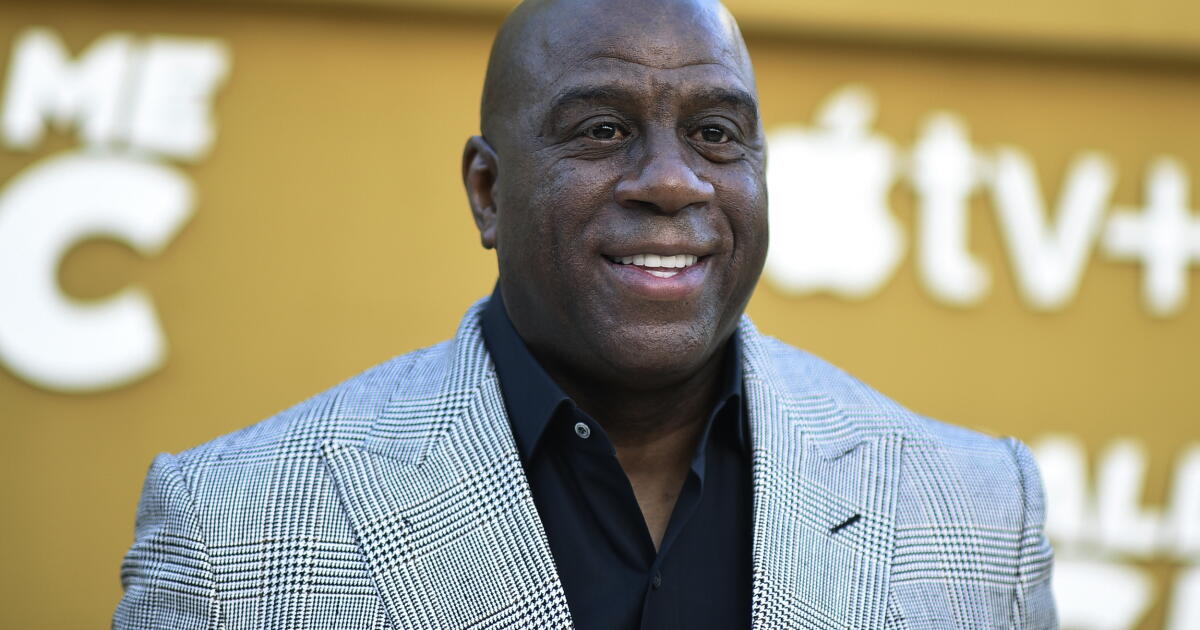
But within weeks, new loans started rolling in from a different source: a financial firm whose owners include his business protege, basketball legend Earvin “Magic” Johnson.
Amistad Financial Group, a holding company that counts Johnson as a board member and minority shareholder, loaned about $1.26 billion to Walter’s companies between March and June of this year, according to a Bloomberg News review of business records and a person with knowledge of the activity who asked not to be identified discussing sensitive matters. Another $1.06 billion went to intermediaries that routinely serve as conduits for loans to Walter.
The combined $2.31 billion of lending, which hasn’t been reported previously, highlights the way Walter relies on debt to fund his business empire, and Amistad’s role. Even before this year, the firm’s insurance units had provided billions of dollars of loans to Walter affiliates, filings show. It also acted as an intermediary to help him tap loans from his own insurers, Bloomberg reported previously – transactions that are now part of the federal investigation.
Walter himself owns a single-digit voting stake in Amistad but doesn’t control it, participate in its management or sit on its board, according to a person familiar with its operations.
Representatives for Walter’s TWG Global holding company and for Johnson did not respond to messages seeking comment.
A former point guard who led the Los Angeles Lakers to five National Basketball Association championships, Johnson has described Walter as a business mentor. They have done deals with each other for more than a decade, including Johnson’s participation in the Walter-led purchase of the Los Angeles Dodgers baseball team. Johnson doesn’t serve on Amistad’s three-person executive committee, and it’s unclear whether he was involved in or aware of the lending decisions. Some of Amistad’s insurance units are led by Eric Holoman, Johnson’s former business manager.
The federal investigation, being pursued in parallel by the U.S. Department of Justice and the Securities and Exchange Commission, focuses on Walter’s insurance companies’ failure to disclose that more than $20 billion of loans on their books went to his other businesses.
The recent lending came from two Amistad subsidiaries, Equitrust Life Insurance Co. and Heritage Life Insurance Co. It’s unclear whether Amistad executives were aware of the investigation when the loans were made. Walter’s insurers disclosed the subpoena in a regulatory filing on June 26, but the filing did not get much attention until Bloomberg News reported on it in July. Information about lending activity after June 30 won’t be disclosed until next month.
Walter is now scrambling to reduce debts to his own insurance companies, Delaware Life Insurance Co. and Clear Spring Life and Annuity Co., in part to assuage concerns from ratings agencies about the scale of affiliated lending. He has agreed to sell the Lakers at a $12.5 billion valuation to free up cash and proposed a $6.5 billion debt swap with Delaware Life. This week, the insurer said it had regulatory approval to proceed with part of that, swapping $3.8 billion.
Because he doesn’t legally control Amistad, Walter is under no such pressure to reduce his reliance on its money.
His ties to Amistad are deep. Its official corporate address is the Chicago office suite that houses Walter’s family office. Walter’s financial firm, Guggenheim Partners, serves as an investment manager for both Equitrust and Heritage Life.
Walter’s brother-in-law serves as president of Heritage Life. Walter used to control Equitrust when it was owned by Guggenheim. He sold it to Johnson in 2015, and Johnson sold it to Amistad last year.
Recipients of the new Amistad loans include a company through which Walter holds his stake in used-car seller Carvana Co., and another containing his interest in the Billie Jean King Cup, the women’s tennis competition that he has backed since 2023. The destination for most of the money wasn’t clear from regulatory filings.
New LLCs
The federal investigations revolve around how Walter’s insurers came to lend so much money to his other businesses without disclosing the arrangement to their regulator, the Delaware Department of Insurance, as required. As of the end of last year, the amount of money they had invested in affiliates was $24 billion, or about 45% of the companies’ total invested assets.
Much of the money was routed to loans for newly created limited liability companies with no public profile. These LLCs were created by Amistad and other intermediaries, which in turn sent the money back to Walter.
In January and early February of this year, that lending arrangement continued, with Delaware Life loaning $730 million to newly formed LLCs that then sent the money to Walter’s other businesses, regulatory filings show. That stopped after the U.S. Attorney’s Office in Manhattan sent the grand jury subpoenas.
But in March, Amistad’s Equitrust sent $500 million to 10 LLCs. These borrowers had been formed days earlier by Federico Hermida, a Miami-based executive at ABS Capital Co., a longtime business partner of Walter’s that has often served as an intermediary in deals between Walter and his insurers. In June, Amistad’s Heritage Life sent $303 million to a subset of the Hermida borrowers. A representative of ABS declined to comment.
Heritage Life also sent about $253 million to LLCs set up by two other intermediaries that Walter has used for loans in the past: the real estate firm Bradford Allen and Hudson Trading, both based in Chicago. Representatives of Bradford Allen didn’t respond to requests for comment, and Hudson Trading declined to comment.
The remaining $1.3 billion of loans were made to companies that are known to be part of Walter’s business empire, or that were formed by a Walter employee, or were confirmed by the person with knowledge of the matter.
Most of the loans carried interest rates of 8 percent or more, and were due to mature in September or earlier. The insurers won’t have to disclose whether those loans were repaid, extended or replaced with new debt until they file their next quarterly financial reports next month.
Despite the borrowing from Amistad, Walter had not significantly reduced his debt to his own insurance companies by June 30, the date of the most recent regulatory filings. After climbing from $24 billion to $25 billion through March, the amount of affiliated investments dropped to about $24 billion as of June.
The New York Knicks celebrated their NBA championship Tuesday night at Madison Square Garden, yet hardly anything went according to plan. And LeBron James found himself smack dab in the swirl of the fierce and funny festivities.
James made his Philadelphia 76ers debut memorable, helping his new team defeat the Knicks, 106-100. Asked by NBC sideline reporter Zora Stephenson if he was enjoying spoiling the Knicks’ ring night, James grinned and said, “Yeah, I do. It’s pretty special.”
Last seen in Los Angeles bidding a hasty farewell after eight seasons with the Lakers — Times columnist Bill Plaschke wrote that “He left before the door could hit him in the butt” — James, 41, began his 24th NBA season by contributing 14 points, nine rebounds and seven assists in the 76ers’ victory.
LeBron James of the 76ers exchanges words with fans during a regular-season opener against the Knicks at Madison Square Garden.
(Sarah Stier / Getty Images)
And James did so even while jawing with courtside Knicks fans about using a helicopter to commute from his new home in New York to Philadelphia. Of course, famed director and Knicks fan fixture Spike Lee couldn’t stay out of it.
“Hey, LeBron, just because you have a helicopter and you live in New York doesn’t mean we’re gonna cheer for you,” one fan yelled, according to NBC broadcaster Mike Tirico. Another fan dinged James for being soft simply because he lived in L.A. for so long.
James couldn’t let that one go, yelling back, “Ain’t nothing soft in the Midwest. I don’t know what the f—- you talking about. I’m not from the West Coast, I’m from Ohio, baby.”
Lee, resplendent in a bright orange and blue pinstriped suit with matching hat, stood from his front-row seat, seemingly serving as conciliator. Much of the exchange was caught on camera by NBC, with Tirico and fellow broadcaster Reggie Miller providing commentary.
“[James] said hello to somebody over here,” Tirico said. “Spike Lee is over for a look and a chat. … LeBron is taking the helicopter rides back and forth from Philadelphia to New York and engaged here in some front-row convo.”
Miller chimed in, “That’s the last thing you wanna do is get LeBron going here in this building…. And guess who’s playing peacemaker? Spike Lee! He’s over here playing peacemaker. Boy, I have seen everything.”
Fanatics is supplying James with the helicopter as part of a multiyear, exclusive trading card and collectibles contract signed in 2024. Although the deal raised the antenna of investigative reporter Pablo Torre — who won a Pulitzer Prize for uncovering the Clippers’ salary-cap circumvention with Kawhi Leonard — NBA commissioner Adam Silver called the helicopter arrangement “perfectly appropriate.”
LeBron James performs a pregame ritual before the game against the New York Knicks at Madison Square Garden.
(Caleb Bowlin / Getty Images)
Silver was at Madison Square Garden on Tuesday night. The Knicks celebrated their first NBA championship in 53 years with a ring ceremony and raising a banner to the rafters. They did their best to laugh off a typo on the T-shirts fans received that proclaimed the team as the 2026-2027 champions.
Despite the testy exchange with fans and enduring their “We don’t want you” chant while he shot free throws, James softened what he had said to Stephenson, sidestepping a suggestion by a reporter that the 76ers ruined the Knicks’ celebration.
“I wouldn’t say that,” James said. “It was a great night for New York fans. Fifty-plus years. I was a part of that at one point where we hadn’t won a major championship in Cleveland in over 50 years. The fans will never forget this moment.”
WASHINGTON — Xavier Becerra was dubbed a “rising star” before he even entered the halls of Congress.
His June 1992 Democratic primary victory over Los Angeles school board member Leticia Quezada in California’s 30th Congressional District earned the 34-year-old candidate that description in The Times.
When the boyish, affable congressman became the first Latino lawmaker appointed to the powerful House Ways and Means Committee in his second term, national outlets took notice.
Thirty years later, in the final weeks of his gubernatorial race with Republican Steve Hilton, Becerra now finds himself poised to lead the most populous state in the country.
An examination of Becerra’s more than 25 years in Washington shows a politician who was skilled at building important alliances and amassing power on Capitol Hill, but had some stumbles along the way and faced criticism for his performance in his highest profile role.
Becerra built his reputation as a diligent consensus-builder — a workhorse rather than a show horse, to use an analogy favored by political scientists — but also revealed himself to be an ambitious political operator in key moments.
“He’s an affable person who’s not afraid to pull out a knife in politics while smiling,” said Christian Grose, a political science professor at USC.
Becerra’s campaign declined to comment on his time in Washington.
Becerra’s origin story traces back to his youth in Sacramento, and a moment when a high school friend was about to throw out a blank, unused application to Stanford University. The elite university was only 125 miles away, but it might as well have been across the ocean from the working-class world Becerra was raised in. Still, he applied.
He earned a law degree there four years later, and it was at Stanford that he met his wife, Carolyn Reyes, who became a physician.
After living in Boston while Reyes attended Harvard Medical School, Becerra moved to Los Angeles to work for state Sen. Art Torres. Within a few years he was tapped by Henry Lozano, then chief of staff to trailblazing Latino Rep. Edward Roybal, to run for state Assembly in 1990; and then, two years later, to succeed Roybal, who was retiring after 30 years in Congress.
Roybal endorsed Becerra, whose victory in the heavily Latino district that included Central and Eastside Los Angeles communities, was seen as a passing of the torch to the next generation.
Frank Villalobos, the founder and president of Barrio Architects, was among the leaders in East L.A. who encouraged Becerra to run for political office, and he said he was impressed early on by Becerra’s genuine commitment to the community and his ability to unite the area’s sometimes divided political factions.
“I thought if we kept this going, someday he’ll become the governor,” Villalobos said.
Becerra was part of a wave of young Latino lawmakers entering Congress, and his growing power within Democratic ranks helped him escape Roybal’s long shadow. Soon after Becerra’s barrier-breaking appointment to the Ways and Means Committee — which writes tax legislation — Becerra became chair of the Congressional Hispanic Caucus, a position he held from 1997 to 1999.
An early test
He put his growing stature to the test a few years later when he decided to enter the L.A. mayor’s race in 2001.
It didn’t go well.
Former state Assembly Speaker Antonio Villaraigosa was also running, and Becerra — who had slept on Villaraigosa’s couch when he first ran for Congress — faced criticism for potentially splitting the Latino vote.
Becerra performed poorly, winning only 6% of the vote in the Democratic primary. His nice-guy reputation took a hit when his campaign was found to have been behind automated phone calls attacking Villaraigosa by a woman who falsely gave the impression that she was county Supervisor Gloria Molina, whose endorsement had been crucial in Becerra’s first run for Congress.
Becerra also faced criticism for his role in contacting White House staffers as part of an effort to push for the release of convicted L.A. cocaine dealer Carlos Vignali, whose father was a political contributor to Becerra. Vignali’s sentence was commuted by President Clinton on his last day in office; Becerra acknowledged calling the White House several times to discuss the possibility of Vignali’s release. Villaraigosa also wrote a letter on Vignali’s behalf.
Becerra told The Times in 2001 that he wasn’t lobbying for Vignali’s release, but merely asking White House officials to review the details of the conviction on behalf of the family.
“If I was going to try to put pressure on, I would have tried to call the president,” Becerra said at the time.
Villaraigosa fared better than Becerra but ultimately lost the 2001 election to City Atty. James Hahn, then rebounded to win the first of two terms as mayor in 2005.
Becerra got the better of Villaraigosa in their rematch this year in the Democratic gubernatorial primary, and won Villaraigosa’s support after.
“We’ve been friends a long time and, yes, we’ve been adversaries as well, but most of the time we’ve been friends,” Villaraigosa told The Times. “He’s got the experience and the wherewithal to lead this state.”
As for Becerra as a house guest during his first run for Congress?
“He makes his bed. He was neat,” said Villaraigosa. “He was pretty inconspicuous.”
Capitol Hill climbing
After his mayoral defeat, Becerra’s focus returned to Washington, where an alliance with another powerful Californian was a boon to his career on Capitol Hill.
Becerra was a close ally of former House Speaker Nancy Pelosi (D-San Francisco), serving as assistant to the speaker from 2007 to 2009.
John Lawrence, Pelosi’s former chief of staff, said that Becerra’s standing within the California delegation and particularly among Latino lawmakers was a big part of his appeal.
“Speaker Pelosi had set a goal of elevating minorities and women who had historically been excluded from leadership,” he said.
Their relationship took a hit after Becerra told progressive lawmakers in 2009 that he believed party leadership gave up too easily on including a public option in the Affordable Care Act, which was signed into law the following year.
“I understand I have tire tracks on my back because Xavier threw me under the bus,” Pelosi said during a Democratic Party leadership meeting in 2009, Politico reported.
And Pelosi would later question Becerra’s appointment in 2021 to be secretary of Health and Human Services. She has not endorsed Becerra in the gubernatorial race.
But any bad blood between the two didn’t stop Becerra from continuing to advance within the party ranks.
He became chair of the House Democratic Caucus in 2012, leading weekly meetings of all Democrats in the House and uniting the party’s members.
Former Wisconsin Democratic Rep. Ron Kind said Becerra was an excellent listener and skilled at building consensus.
“He could get in the room with anyone and find common ground,” Kind said.
Becerra joined several high-stakes negotiations, notably a 2013 bipartisan effort to pass comprehensive immigration reform, in the wake of the “Gang of Eight” deal struck in the Senate.
John Yarmuth, a Democratic congressman from Kentucky who was also part of the House negotiation, said Becerra was “an amazing positive force” in the process.
“I think he, more than anyone else, was focused on fixing the problem,” Yarmuth said.
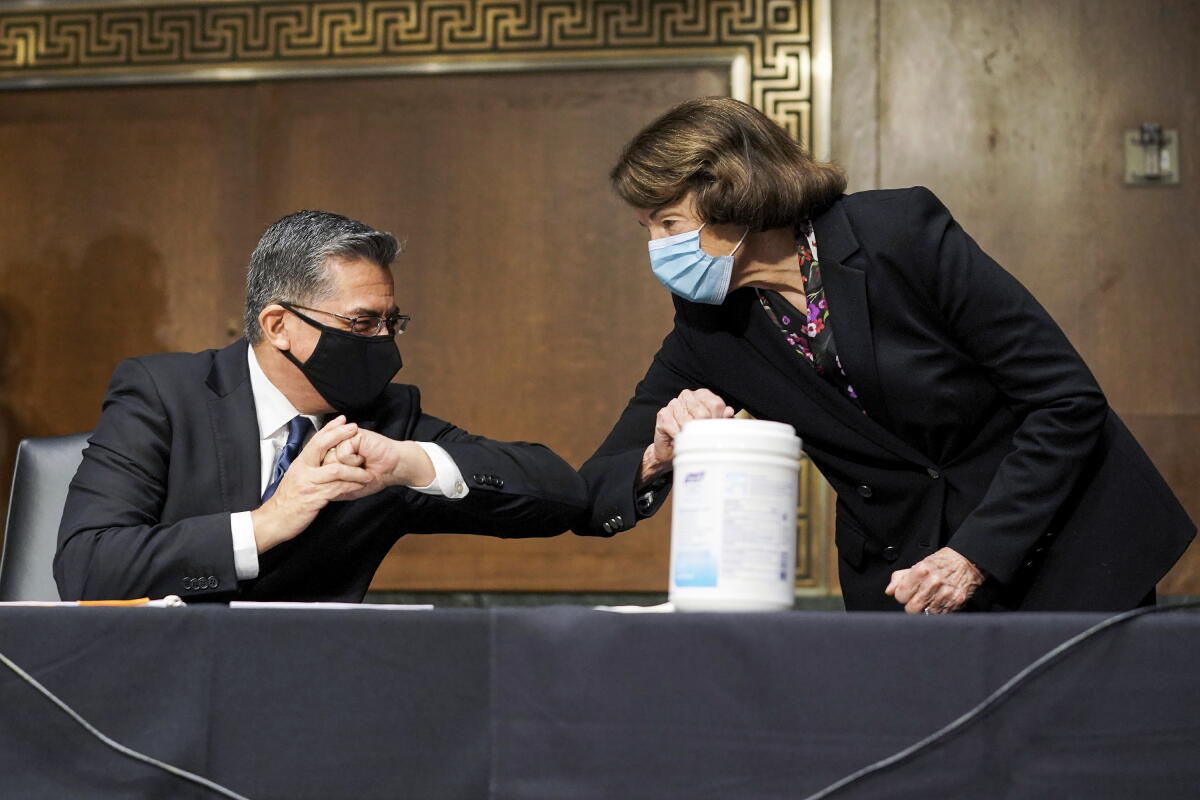
Xavier Becerra bumps elbows with U.S. Sen. Dianne Feinstein (D-Calif.) before his Senate committee confirmation hearing for Health and Human Services secretary in 2021.
(Greg Nash / Associated Press)
The group was able to achieve a compromise, but it never saw the light of day.
Then-House Speaker John Boehner, an Ohio Republican, later blamed then-President Obama, whom he accused of “poisoning the well” on an immigration compromise. Yarmuth said Republicans were spooked about potential blowback.
Several potential off-ramps appeared during Becerra’s time in Washington. He was considered by Obama for U.S. trade representative in 2008, but Becerra declined the offer. After flirting with the idea of running for outgoing U.S. Sen. Barbara Boxer’s seat, Becerra declined to enter the race, ultimately won by then-California Atty. Gen. Kamala Harris. He was briefly floated as a potential running mate for Hillary Clinton in the 2016 presidential election, but that didn’t materialize either.
In late 2016, Becerra found himself at a crossroads.
After more than a decade on the Ways and Means Committee, he faced the possibility of becoming the top Democrat on the committee and had the endorsement of the outgoing top Democrat, Rep. Sander Levin of Michigan.
But Harris’ victory in the 2016 Senate race created a vacancy for state attorney general.
Becerra decided to return home to Sacramento to take the role and spent the next four years as the state’s top law enforcement official, serving as “defender-in-chief” of the state, as USC’s Grose put it, against the Trump administration.
Fraught second act in D.C.
Becerra returned to Washington in 2021 for a second act that would prove to be far more controversial than his first.
Despite having no background in healthcare, Becerra was nominated to be the secretary of Health and Human Services and confirmed, over significant opposition by Republicans.
He took the reins of the healthcare agency as the country was still grappling with the COVID-19 pandemic and struggled to establish a clear role for himself in a response effort that was centered in the White House.
In his first year in office, he was called out by reporters for failing to hold regular press briefings.
And he faced criticism when health officials under his purview offered contradictory information in late 2021 about reduced quarantine requirements for people testing positive for COVID-19.
And Becerra’s chief of staff at Health and Human Services and longtime advisor, Sean McCluskie, pleaded guilty last year to participating in a scheme to use campaign funds from a dormant Becerra state political committee to pay for McCluskie’s frequent travel between Washington and California.
Dana Williamson, a longtime political consultant for Becerra and former chief of staff to Gov. Gavin Newsom, pleaded guilty earlier this year for her role in the scheme. McCluskie and Williamson are scheduled to be sentenced in December. Neither Becerra nor Newsom were accused of wrongdoing.
Democratic operative Xochitl Hinojosa, who served as the spokesperson for the Department of Justice in the Biden administration, earlier this year offered a blunt assessment of Becerra’s performance.
“He was not effective in government, and I think that a lot of people in the Biden administration are talking about this because they realize that he was not an effective HHS secretary,” Hinojosa said on CNN in May.
While other members of the Biden administration have defended Becerra’s performance, his time at the helm highlighted an issue that even allies concede has bedeviled Becerra in the past, his tendency to sometimes recede into the background.
Loretta Sanchez, a former Democratic congresswoman from Orange County who credits Becerra with encouraging her to run for Congress, put it simply.
“Will Xavier be bold?” she said. “I hope he takes those bold moves, because California needs it.”
The Clippers will have their hands full when the season opens trying to contend in the always tough Western Conference after being slapped with the harshest penalties in league history for violating salary cap circumvention rules.
With Kawhi Leonard, James Harden and Ivica Zubac gone from last season’s team, they’ll focus on developing a new core of stars, including rookie Keaton Wagler, when they open play Wednesday by hosing the Sacramento Kings at Intuit Dome.
Another positive for the team: Tyronn Lue is a proven asset as coach and he’ll be tasked with developing and blending in the younger players. Wagler spent the summer building up his body and has potential to be a strong defender.
The league’s year-long investigation is over and the Clippers have a clear path, albeit rocky, to move on and again become competitive in the West. They finished ninth in the conference last season and were eliminated by the Warriors in a play-in game.
Now fully recovered from a foot injury, two-time All-Star guard Darius Garland will be counted on to provide floor leadership. Also returning are former All-Star guard Bradley Beal, guard Kris Dunn, forward Derrick Jones Jr. and center Brook Lopez.
“I think we can surprise a lot of people,” Garland said.
Garland is fully recovered from toe and foot ligament injuries. In 19 games last season, he averaged 19.9 points with 6.4 assists. With a full offseason and training camp, Garland is expected to be one of the team’s top players.
Other young players to watch are guard Kobe Sanders, who had a productive rookie season when averaging 7.3 points and nearly 20 minutes a game as part of the rotation, and center Yanic Konan Niederhauser, who had his rookie season end early because of a foot injury but he showed promise over 41 games.
Forward Brandon Ingram, driving against Clippers forward Derrick Jones Jr. last season, is now a teammate after the Kawhi Leonard trade was completed following the salary cap circumvention investigation.
(Ronald Martinez / Getty Images)
Additions include All-Star forward Brandon Ingram and guard Gradey Dick, who were part of the Leonard trade to Toronto, wing Max Strus, guard Jalen Pickett, forward Baba Miller, forward Isaiah Jackson and forward Nick Martinelli.
“I know [there are] little to no expectations for us this year,” said Ingram, who will miss the start of the season while recovering from May surgery for a partially torn Achilles. “We have enough in the building to compete. This is what we love to do. So, we’ll go out and compete every single night, learn, go on to the next game and get better and better.”
Strus also will be out for a while after injuring his right foot during training camp.
Departed from the team are forward John Collins, guard Bogdan Bogdanovic, forward Nicolas Batum and wing Bennedict Mathurin.
Also noteworthy: owner Steve Ballmer won’t be sitting courtside after being banned by the NBA for a year as part of the team’s steep punishment for circumventing salary-cap rules. Top basketball executive Lawrence Frank has been banned for six months. The penalties included the loss of five first-round draft picks.
“I give our players a lot of credit … the leadership is great [and] the morale is great, even in these tough situations,” Lue said at the start of training camp. “That’s good to see, when you have your players coming in every day, giving everything they have; a lot of teams don’t have that.”
Nvidia is stepping up its investment in Europe’s AI sector, announcing plans to back four German startups: Agile Robots, Avelios Medical, Mirelo, and Reflex Aerospace. The company did not say how much it will invest in each. The announcement came as German Chancellor Friedrich Merz urged businesses, especially
Ben Simmons’ comeback attempt with the Sacramento Kings generated more than one blip on the basketball radar during the preseason before it came to an abrupt end Sunday when he suffered a torn Achilles tendon during practice.
Injuries had restricted the former No. 1 overall draft pick to appearing in only 107 games the last five seasons, but his return on a one-year $3.5 million, non-guaranteed contract had gone well enough that he was set to start in the regular-season opener Wednesday against the Clippers.
Simmons, considered the greatest player to come out of Australia, made news in August by taking part in the national team’s player-driven minicamp in Melbourne, a precursor to the 2027 FIBA World Cup and 2028 Olympics. Simmons, 30, has never played in a major tournament for his home country.
He also became an unwitting part of an embarrassing episode three weeks ago at Kings media day when open microphones captured an off-air conversation between female reporters discussing the physical appearance and personalities of Simmons and teammates.
A woman’s voice said, “That’s what comes with being Ben Simmons. He is cringe, cringe,” and another woman added that he is “lucky he’s so fine.” The first media member agrees, saying, “He’s a good-looking dude. His skin is, like, so smooth, I was like, damn, no tattoos?” The media members have yet to be identified.
He refrained from commenting on the exchange except to back teammate Zach LaVine, whose personality also was criticized by the reporters. But Simmons will be in street clothes from now on. The Kings said he will undergo surgery to repair the tear, which normally requires a recovery period of six to 12 months.
“I’ve faced challenges before that tested me mentally, physically, and emotionally, and I’ve found a way through every single one of them,” Simmons said in a statement posted to his Instagram Stories.
Being sidelined is nothing new for Simmons. He missed his entire first NBA season with the Philadelphia 76ers in 2016-2017 with a foot injury, missed the entire 2021-2022 season with a back injury and the entire 2025-2026 season to focus on his physical recovery from back and leg issues as well as his mental well-being. He last played for the Clippers in the spring of 2025, averaging 16.4 minutes and 2.9 points over 18 games.
That production was a far cry from the promise he displayed coming out of LSU, where in his one season was a consensus All-American after averaging 19.2 points, 11.8 rebounds and 4.8 assists a game. A 6-foot-10 point guard, Simmons was NBA Rookie of the Year in 2017-2018, joining Hall of Famers Oscar Robertson and Magic Johnson as the only rookies to reach 1,000 points, 500 rebounds and 500 assists. And Simmons was an All-Star the next three seasons before injuries began mounting.
His return this preseason was intentionally low key, sliding onto the roster of the lowly Kings (22-60 last season) without much fanfare. Simmons was quietly repairing a reputation marred by his succession of injuries and the performance anxiety and emotional burnout he has openly discussed.
He also seemed keen on representing Australia for the first time. Simmons was forced to miss the 2024 Paris Olympics with a back injury after passing on the Rio 2016 and Tokyo 2021 Games even when relatively healthy. Now any sort of return is again in jeopardy.
“For me, performance can’t be everything,” Miley Cyrus declared on Friday night, and you had to admire her choice of setting: onstage at the Hollywood Bowl in front of approximately 18,000 people who’d turned up precisely to see her perform.
A star since her teenage days on the Disney Channel’s “Hannah Montana,” the 33-year-old musician and actor was maybe half an hour into the first of two sold-out concerts at the iconic hillside amphitheater — a place close to Cyrus’ heart, as she explained in a videotaped intro recalling a gig she and her fiancé, Maxx Morando, caught last year by the French band Air.
“I step into wine, which soaks onto my boots,” she said in the dramatic black-and-white clip. “I don’t mind stained leather — it only adds to their character.”
Cyrus’ shows were billed as part of the rollout of her latest album, “Bass Persuades,” which came out in September (and which found her dropping her last name to go simply by Miley). Yet the two-night engagement is really meant to mark her grand return to the stage after she said a few years ago that she’d sworn off touring because it was too harmful to her mental health.
Is “grand” the right word for a comeback as equivocal as this one? Despite all the hype surrounding this weekend’s concerts, Cyrus spoke again and again Friday about how much less space for performance she has in her life these days than she used to; she talked repeatedly about her quest to balance her fans’ emotional needs with her own.
At one point, after singing a couple of numbers on a small B-stage about halfway up the bowl, she walked through the crowd back to the main stage, gripping and grinning the entire way. Then she described the toll her trip had just taken: “I appreciate each of you guys reaching out and touching me, and me getting to feel you. But I do want to say — it is a lot for me,” she said. “It is a little bit overwhelming.”
In an era of parasocial pop stardom, the radical honesty of Cyrus’ approach — her clear-eyed appraisal of the relationship that binds an idol and her audience — was kind of a thrill to behold. The problem was that her singing for the most part wasn’t.
As she described being overwhelmed, her band slowly revved up her song “Wrecking Ball.” It’s one of the great power ballads of the last 25 years, with a chorus as cathartic as any in modern pop; Cyrus, the showbiz lifer, surely understood the payoff she was building toward. Except when the moment arrived, she inexplicably dodged it, skipping the song’s first chorus and soft-pedaling the second — an anticlimax for the ages.
Indeed, Cyrus let the audience and her backup singers handle vocals for many of her biggest hits, among them “The Climb,” “Party in the U.S.A.” and “We Can’t Stop”; during that last one, she twerked for a second, evoking memories of the infamous 2013 MTV performance that briefly scandalized a nation.
She sang more heartily in songs from “Bass Persuades,” which would’ve been better news if that tuneless mishmash of bleary synths and dated club beats weren’t one of the year’s least likable pop records. (This month Variety reported that, after debuting at No. 1 on the Billboard 200, the album took the biggest fall in chart history in its second week of release.)
The paradox of Cyrus’ career at this stage is that she wants to do the thing that nobody wants her to do — “Bass Persuades” is just the latest in a string of crummy LPs — and doesn’t want to do the thing that everybody wants her to do. Truly, her bad taste should be studied: On Friday, she welcomed Wayne Coyne of the Flaming Lips to the B-stage for a duet on “Karen Don’t Be Sad,” from the miserable psych-rock record they made together in 2015. Naturally, Cyrus said it was her favorite of her albums.
One highlight of the show was Cyrus’ tribute to her late godmother, Dolly Parton, whom she memorialized with a rendition of “Jolene” and with a funny and touching account of the time Parton tried unsuccessfully to get Cyrus to sing with her at the Bowl.
I also found myself moved near the end of the night by Cyrus’ performance of the only keeper on “Bass Persuades” — a dreamy little love song called “Let’s Get Married” for which Morando joined her onstage. As he played drums, she ran her hand tenderly over his chest before laying her head on his shoulder; the moment reminded me of that goofy intro video about the Air concert, which she likened to a bubble containing only the two of them.
“That’s how it feels when we’re together,” she said. “I think I’d live in that bubble.”
A spectacular run that included back-to-back World Series championships and delivered unforgettable memories ended with a whimper for the Los Angeles Dodgers on Thursday.
The Milwaukee Brewers, humiliated by the Dodgers last year in a four-game sweep, returned the favor at Chavez Ravine, defeating L.A., 6-4, in the National League Championship Series. The loss eliminated the Dodgers and ended their run at a vaunted three-peat, or three consecutive titles.
No North American sports franchise can claim such an accomplishment since the Shaq- and Kobe Bryant-led Lakers from 2000 to 2002.
How did a team of All-Stars fall short? Our sports team delivered tremendous coverage that answers that question and many more.
You’re reading the Essential California newsletter
L.A. Times reporters guide you through the most important news, features and recommendations of the morning.
By continuing, you agree to our Terms of Service, which include arbitration and a class action waiver. You agree that we and our third-party vendors may collect and use your information, including through cookies, pixels and similar technologies, for the purposes set forth in our Privacy Policy such as personalizing your experience and ads.
Shohei Ohtani’s declining health was too much to overcome
Plaschke wrote that the single biggest reason the Dodgers didn’t three-peat centered on the health of designated hitter and pitcher Shohei Ohtani.
The owner of four MVP trophies, Ohtani began the season with a goal of also winning the Cy Young Award. So he focused on pitching, and he pitched well, going 8-2 with a 1.79 ERA in 14 starts.
Then he injured his knee, but he still pitched, long past when he should have been pitching, said Plaschke. He was finally pulled off the mound in early July, but by then he had also injured his elbow and his offense suffered because he was so worried about the pitching. It was at this point the Dodgers should have shut him down entirely, given him a month off to ensure he would be ready for October, according to Plaschke.
But no. Ohtani insisted he was fine even though his plummeting batting numbers said otherwise. When he was finally placed on the injured list in early September, Plaschke said it was too late, and he entered the playoffs as a shell of his former great self.
An autopsy reveals much
Lee agreed with third baseman Max Muncy when he said, “The train finally ran out of steam, I guess.”
A major aspect of the challenge of winning three straight is simply workload. The Dodgers not only have played more games than any other team the last two years, but their schedule has included grueling travel.
The Dodgers started both the 2024 and 2025 seasons early and overseas, playing in the Seoul Series and Tokyo Series in consecutive years. And both years ended with coast-to-coast travel for the World Series, as the Dodgers won titles over the New York Yankees and Toronto Blue Jays.
The team’s collective age — the oldest lineup in the majors this year, according to Baseball Reference, weighted by at-bats and games played — may not have helped.
Cap concerns
Shaikin wrote about a lockout expected this winter as Major League Baseball owners attempt to implement a salary cap, which limits the amount of money a team can spend on player salaries.
The owners initially proposed a salary cap of $245 million for next year. The Dodgers already have $347 million committed to 14 players next year, according to Cot’s Baseball Contracts.
Under a cap, the owners have promised a transition period to account for existing commitments, and an actual negotiated cap could be higher, said Shaikin.
Even if the players do not agree to a cap — and they insist they won’t — whatever economic system emerges from collective bargaining would likely make it painful for the Dodgers to spend so freely, according to Shaikin.
What some Dodgers fans are saying
Most baseball teams create a now well-anticipated “thank you fans” social media post after the conclusion of a season.
Passionate fans use the post as a sounding board for everything that ails them about their favorite teams. Just look at the “thank you fans” X posts from the New York Yankees and Philadelphia Phillies laced with profanities and vitriol fiercer than any East Coast nor’easter.
🍽️ For many, like the preservationists pushing to save Santa Monica’s Mel’s Drive-In, the mere thought of demolishing the iconic restaurant is offensive. Eating there was certainly on the bingo card for columnist LZ Granderson when he and his son first drove across the Southwest decades ago, and it continues to be a favorite breakfast spot of theirs.
Today’s recipe
(Stephanie Breijo / Los Angeles Times)
Many meatballs are made with a panade, often a mixture of white bread soaked in milk, which lends moisture to the final meatballs. For these lamb meatballs, cooking editor Cody Reiss decided to make his panade out of ingredients that felt more in-line with the mutabbal he was serving them with. He ended up using a mixture of leftover pita bread and labneh (drained yogurt). The resulting meatballs were moist, herby, spiced, seasoned, spicy and just a joy to eat.
Photo of the day
Volunteers led by guerrilla activist Jonathan Hale paint over the faded crosswalks of an intersection near USC on Sept. 19.
Have a great day, from the Essential California team
Jack Dolan, investigative reporter Hugo Martín, assistant editor, Fast Break desk Kevinisha Walker, multiplatform editor Andrew J. Campa, weekend writer Karim Doumar, head of newsletters
Merida, May 10th 2013 (Venezuelanalysis.com) – Venezuela’s new Labour Law for Workers (Lottt) came into effect this week, guaranteeing shorter working hours, longer maternity leave and pensions for all Venezuelans.
Described by the Venezuelan government as the “most advanced labour law in the world”, the Lottt reduces the working week from 44 hours to 40, and requires that employers provide two consecutive days a week off.
When the law came into effect on Tuesday, labour minister Maria Iglesias stated that the new working hours are part of the process towards a “just distribution of wealth”.
The following day, Carabobo state labour affairs committee president Jose Joaquin Vargas hailed the law as an important part of the transition from “capitalism to socialism”, while last week vice president of the National Federation of Public Sector Workers Franklin Rondon described it as “historic”.
“We are in a historic moment, in 14 years the achievements we have obtained for workers are numerous; we have achieved much more than in the last forty years,” Rondon told VTV on 5 May.
Vargas also urged workers to ensure their employers and unions act in accordance with the Lottt.
For the next six weeks, the government will be inspecting workplaces to ensure employers adhere to the new requirements. Although employers were informed earlier in the year that they would need to make any necessary changes prior to 7 May, on Tuesday Iglesias stated that inspections over the next six weeks will be “corrective in nature”. The minister warned that penalties will be imposed on employers who fail to adhere to the Lottt after 15 June.
However, workers are already reporting breaches of the new laws. In Miranda state, employees of processed meat manufacturer Industrias Alimenticias de Corralito (Inacor) have denounced their employer. A worker spokesperson, Peggy Serrano, alleged that management made a series of surprise changes to the timetable that could result in employees being forced to work overtime.
A Decade in the Making
Along with establishing new working hours, the Lottt prohibits unfair dismissal, outsourcing, guarantees the right to work for both women and people with disabilities and increases maternity leave.
Under the Lottt, Venezuela now has the world’s third longest maternity leave. Mothers are entitled to six weeks pre-natal leave, and twenty post-natal. Fathers are also entitled to two weeks paternal leave. Under the law, the same conditions apply to parents who adopt a child under three years of age.
All workers are also now entitled to retirement pensions, including full time mothers and the self employed.
The Lottt is the result of nearly a decade of discussions in both the national assembly and the labour movement.
When he approved the law last April, former president Hugo Chavez stated that, “In more than 200 years of republican history I am absolutely positive that there has never been a work law….that has been debated so much as this one.”
Mackie, known widely as the King of Camp, who adorned superstars including Diana Ross, Dolly Parton, Beyoncé and Miley Cyrus with fringe and sparkles, died on Sept. 14 in Palm Springs. He was 87. His publicist initially told the Associated Press that the renowned designer died of pneumonia, but a death certificate obtained by Us Weekly paints a different picture.
The certificate lists Mackie’s cause of death as a subarachnoid hemorrhage and blunt head trauma. The Mayo Clinic says a subarachnoid hemorrhage is a type of stroke that involves bleeding in the space between the brain and the tissues that cover the brain.
On Sept. 11, the designer fell at the home of his longtime design director Joseph McFate, according to the outlet, and he died days later at Desert Regional Medical Center in Palm Springs. The designer’s rep further shared that Mackie was staying at McFate’s house at the time of his fall, and that he was battling pneumonia at the time. “A healthcare professional was with him when he fell,” the rep said.
According to the death certificate, Mackie was cremated on Sept. 17, and his ashes were scattered off San Diego.
“Costume designers have long been overlooked for the importance of their work in creating and influencing mainstream contemporary fashion,” fellow fashion designer Tom Ford told The Times in a 2019 email. “Bob Mackie’s work has influenced fashion in a dramatic way, in that many of the body fitting, seemingly transparent and heavily beaded gowns that are worn on red carpets today are derivative of his work for stars like Diana Ross and Cher. The images of his costumes and gowns for these women have become a part of the landscape of fashion from the ’60s, ’70s, and ’80s and in my case become part of my hard-drive of references.
“His famous quote that his clothes are ‘for the woman who is not afraid to be noticed,’ ” Ford added, “is one of my mantras.”
Stars dressed by Mackie posted tributes to the designer after his death. Elton John said he was saddened by the news of Mackie’s death, writing, “Every time I put something on that Bob made, I felt very, very special. His costumes were works of art, and he will go down as one of the most legendary designers ever in Hollywood.”
Cher also weighed in, posting a tribute to Mackie on X that read, “Bob has gone up to heaven. Knowing him, he’s bringing Sequins, Beads, & his sketch pad. Good nite sweet Prince.”
The 71-year-old is recovering in Rome’s Gemelli hospital after surgery to remove a cancerous growth on his lung.
Published On 13 Oct 202613 Oct 2026
Pope Leo XIV has been diagnosed with cancer after an operation to remove the lower lobe of his right lung, according to a medical bulletin published by the Vatican.
Tests confirmed a diagnosis of lung adenocarcinoma, the Vatican added, noting the diagnosis had been suspected by preoperative tests. It did not provide details on the recovery outlook or course of treatment.
Recommended Stories
list of 3 itemsend of list
In a statement released Tuesday, the Vatican said the procedure lasted 90 minutes and that the surgery “was successful, and there were no complications”.
The 71-year-old has returned to his room at Rome’s Gemelli hospital, where he is expected to recover for a week, with all his audiences through October 20 cancelled.
The Vatican said doctors are not currently discussing chemotherapy or other therapies pending the results of other tests.
The Holy See’s press office noted the medical statement spoke of the “radical” removal of the lobe as an indication that doctors removed all suspect tissue in the hope of eliminating any lingering traces of the cancer.
Before the procedure, Leo waved to dozens of well-wishers gathered at the hospital’s main entrance.
In an unusually transparent update on papal health, Leo first revealed that doctors found a small nodule during his Sunday noon prayer in St Peter’s Square.
“The doctors believe it’s best to take action, so, following their advice, I’ve decided to have surgery to remove it,” he said during remarks delivered in Italian.
Latin American tour
The pope has no reported history of serious illness and is considered physically active, routinely swimming and playing tennis.
The surgery comes ahead of an official Latin America tour scheduled for November 6-17, with stops planned across Uruguay, Argentina and Peru.
It is unclear whether his recovery will affect the ambitious itinerary, which includes a dozen flights, two helicopter rides and significant altitude changes in Peru.
The pope told reporters on Sunday that he intends to make the journey.
WASHINGTON — Federal agents on Monday searched the home of Democratic U.S. Rep. Ilhan Omar, a startling escalation in a criminal investigation that brings renewed scrutiny to the frequent target of Trump administration derision in the final weeks of her reelection bid.
Omar said she will “not be silenced” and called the search of her home the “latest escalation” in President Trump’s ‘‘intimidation” campaign.
The search of the Minnesota congresswoman’s home so close to next month’s midterm contests that will determine control of the House and the Senate was swiftly condemned by top Democrats in Congress and raised questions about the timing given longstanding Justice Department protocol to avoid overt investigative steps involving political candidates in the direct run-up to an election.
The Justice Department confirmed in a statement that Homeland Security Investigations agents executed a judicially authorized search warrant in the Washington, D.C., area in connection with an ongoing federal criminal investigation but provided no other details.
The nature and scope of the investigation were unclear, though officials in Trump’s administration have repeatedly hinted at the existence of an inquiry targeting Omar, a Somali-born Democrat whose status as an immigrant to the U.S. and left-wing views have repeatedly drawn criticism from Republicans and senior Trump officials.
Homeland Security Secretary Markwayne Mullin said last month that there was an “ongoing investigation” related in part to whether Omar lied on her immigration forms and that “something’s going to happen.”
Though the Republican focus on Omar’s background dates back years, the search of her home took place three weeks before the November midterms, in which Omar is on the ballot for reelection. The Justice Department has historically sought to avoid public investigative actions involving a candidate within 60 days of a primary or general election.
“For years, Donald Trump and far-right extremists have relentlessly targeted Congresswoman Omar with vile personal attacks and baseless accusations,” top House Democratic leaders said in a statement. “Now, less than 30 days until the midterm election, his violent mass deportation machine has descended upon the home of a duly elected Member of Congress and her family.”
A Homeland Security officer walks out of the Washington residence of Rep. Ilhan Omar, D-Minn., during a search, Monday.
(J. Scott Applewhite / Associated Press)
Trump has frequently targeted Omar
Trump as recently as this past weekend brought up Omar at a rally in Tennessee, where he attacked her upbringing and suggested that Vice President JD Vance “and our people” were investigating her.
Vance has in the past accused Omar of committing immigration fraud — an allegation she has denied — and has said he and a top White House official were trying to figure out how to investigate her.
On Monday morning, the street in Washington where Omar lives was blocked off as HSI agents remained near the home.
“This enforcement action is part of an ongoing federal criminal investigation,” the department said.
A spokesperson for the Department of Homeland Security, of which Homeland Security Investigations is part, referred questions about the search to the Justice Department.
Omar has long been a target for Republicans
Omar, who was first elected to the House in 2018, represents Minnesota’s 5th District, including Minneapolis. She is part of “The Squad,” progressive lawmakers who are a vibrant political force on the left wing of Congress but have also endured repeated attacks from Trump, dating to his first term. She was one of the first two Muslim American women in the House and the first African refugee to be elected to Congress.
When Republicans swept control of the House in 2023, they voted to oust Omar from the Foreign Affairs Committee, citing her anti-Israel remarks.
In January, Trump lashed out at Omar during a rally in Iowa hours before an assailant sprayed the congresswoman during a town hall meeting in Minneapolis with a substance that turned out to be vinegar. The attacker was sentenced to 14 months in prison.
Republicans have raised questions about Omar’s past since before she was elected, including asserting that she had married her brother and committed immigration fraud. Omar has broadly denied the allegations as “disgusting lies.”
“It certainly seems like something fishy is there, but everybody’s entitled to equal justice under the laws,” Vance told reporters in May. “So we’re going to investigate it. We’re going to take a look at it. If we think there’s a crime, we’re going to prosecute that crime.”
In a separate interview with conservative podcaster Benny Johnson, Vance said without offering evidence that “we actually think that Ilhan Omar definitely committed immigration fraud against the United States of America.”
He said that he and deputy White House chief of staff Stephen Miller had been discussing it.
“That’s the thing that we’re trying to figure out,” he said. “What are the legal remedies now that we know that she’s committed immigration fraud? … How do you build the case necessary to get some, some, some justice for the American people?”
Omar’s office has defended her against past allegations
Omar’s office in March dismissed Vance’s claims as fabricated and defamatory.
“This is rich coming from someone who literally said they were willing to ‘create stories’ to redirect the media,” Omar’s chief of staff, Connor McNutt, said in a statement.
“This is a ridiculous lie and desperate attempt to distract from the pedophile protection party’s unpopular war of choice, increasing gas prices, and rapidly dropping polling numbers,” McNutt said.
Tucker and Richer write for the Associated Press. AP writers Lisa Mascaro, Michelle L. Price and River Zhang in Washington, Kathy McCormack in Concord, N.H., Mike Catalini in Morrisville, Pa., and Meg Kinnard in Columbia, S.C., contributed to this report.
One word that could describe Aria Vega’s whirlwind 2026? Chévere.
The Colombian expression for “awesome” is also the name of the fast-rising star’s global smash hit. Released in January, the breezy tropical swing of “Chévere” — and the rest of her sun-kissed singles — embodies the spirit of Colombia’s Caribbean coast where she hails from.
Ahead of the Latin Grammys on Nov. 12, where Vega will be in the running for the best new artist award, Vega is taking what she calls her “Costeñita Core” pop movement on the road, with her first-ever U.S. tour.
“Looking back at all the dreams I’ve accomplished and made come true, it’s all blessings,” a wide-grinning Vega says over Zoom from Miami.
“I’ve been crying tears of joy with my family, my friends and my combo chévere, as I like to call my fandom. Every artist wishes and dreams of a Latin Grammy, and for me, just to be one of the nominees is like, ‘Yo, I’m a winner!’”
Vega was born Mariana Padilla Pérez in Barranquilla, where she lived the lifestyle of the costeños — or the people of Colombia’s Caribbean coastal region. She has been steadily chasing her dreams of superstardom since competing on “Idol Colombia” in 2014; but Vega finally started making waves last year when she integrated more costeño culture, rhythms and slang into her mellowed, Spanglish pop flow.
“Chévere” exploded in popularity after fellow Colombian singer Ryan Castro jumped on the remix in February. Since then, Vega has pushed “Costeñita Core” further into the mainstream with songs like the alluring “Cule Poco (Sirena_Besarico_Costeña),” and the sultry “Compa Coleto (Uy_Como),” offering unhurried takes on champeta and other Afro-Caribbean rhythms.
Vega just kicked off her U.S. Cariavales Tour, which includes a stop at the Roxy in Los Angeles on Oct. 13. Just a week before, she was handpicked by her pop foremother and icon from Barranquilla — Shakira — to perform as part of her 12-show residency in Madrid.
In an interview with The Times, Aria Vega opened up about her Latin Grammy nomination, representing costeños and getting a co-sign from Shakira.
How did the success of the song “Chévere” change your life? I didn’t expect to be on [so many] airplanes and flights. Right now, I’m starting to feel the weight of that. I’ve seen what it’s like to live on the road. The remix happened after Ryan [Castro] sent me a DM on Instagram saying, “‘Chévere’ is a banger!’” I was really excited to even get that message from him, because I’m a fan of his music. That was a really cool moment.
What can you tell us about your upcoming debut album? It’s Afro-Caribbean-inspired music. Right now, the album is really long. I have recorded more than 30 songs for it. I’m working on cutting it down to hopefully 15 songs that will touch your heart and soul … I want to make people vibe with my songs, feel cool, and feel chévere. That’s my goal with this album [I call] “Costeñita Core.”
What does “Costeñita Core” mean to you? It’s an energy that you either vibe with or you don’t. It’s like our food, our slang and experimental fashion. Caribbean maximalism and shifting [mainstream] culture. Overall, it’s about making bold choices and being rebellious.
How do you feel about representing costeño culture through your music and visuals? It’s a big responsibility. I feel really happy and excited when I see comments that say things like, “It’s an honor for you to represent us, and we love what you’re doing.” I get emotional because I don’t always get that response … There’s also people that say, “I feel that I’m not represented by her in any way.” It’s a mixture of feelings. What can I say? I’m doing this with a lot of love for Barranquilla, Colombia and Colombia’s Caribbean coast. I want to be a voice of the Caribbean coast.
What did it mean for you when Shakira selected you to perform for her residency in Madrid? As soon as my team told me about this opportunity with Shakira, I was going crazy because she’s so inspiring. She’s also from Barranquilla. Her music has been a part of [my] life. It has been like a companion for me. Since I was like 5 years old, there’s always been a Shakira song that I was vibing with. I’m really excited even about the possibility of meeting her.
How do you feel about performing in L.A. for the first time on your U.S. tour? I’ve been to Los Angeles before in meetings with my agents and stuff like that, and it felt like a movie. It’s Hollywood vibes and I’ve never felt that energy in my life. It’s really special getting to perform all my songs that are not just in Spanish, but in Costeñol [the costeño dialect of Spanish] at the Roxy. I’m going to wear outfits with cultural designs and perform traditional dances that have been part of my life, ever since I was literally in my mom’s belly. Los Angeles is a coastal city too, so there’s something that connects us.
What are your thoughts about being nominated in the category of best new artist at this year’s Latin Grammys? Everyone says it’s a really important category, because you can’t be nominated twice. You can only be nominated once in your career. Hopefully I’ll go to Las Vegas for that Latin Grammy and I’ll take it over to la costa.
What will you do if you win the award? Maybe I’ll do a concert at home. I want to do something that feels honest and authentic, because that’s what led me to being nominated. I dream of becoming a bearer of my culture. What better way to do it than being recognized in the eyes of the Latin Recording Academy?
What was the inspiration for your latest single “Compa Coleto (Uy_Como)”? My muse is always my tiburón, my shark. It’s no secret that I’m in love. It just makes sense to talk about him in these really loving and cool songs. It’s a song with flirtatious vibes. When you understand the song’s lyrics, it just makes sense to flirt that way and have fun with it.
Who do you want to collaborate with in the future? I would love to collaborate with Shakira and Beéle. I feel they do a lot for Barranquilla as well. I would love to collaborate with Bomba Estéreo from Santa Marta. Maybe I’ll do vallenato music with Silvestre Dangond. That would be really cool. Felipe Peláez has an amazing voice. It would be cool to bring these sounds of our own to the world.
Morgan Stanley recommends sticking with quality stocks, expanding into higher-quality cyclicals such as capital goods, favoring equal-weight S&P 500 or S&P 600 indices over the lower-quality Russell 2000, and monitoring financials and bond volatility for market stability signals.
New restrictions have stripped Medicaid coverage from certain legal immigrants, including refugees and victims of human trafficking, as part of broader federal changes to the health insurance program that are expected to force millions off their coverage.
The change effective Oct. 1 cut from Medicaid what is estimated to be hundreds of thousands of people who legally immigrated to the United States, many of whom work and pay taxes, in the latest Trump administration policy to target foreigners.
The move is part of sweeping changes to Medicaid under President Donald Trump’s 2025 tax cut and policy law, with many set to take effect early next year. The Medicaid changes are projected to result in 7.5 million fewer people with health insurance, according to the Congressional Budget Office’s 2025 estimate.
Advocates say that without Medicaid, people will not be able to afford private insurance and will either delay care or end up in emergency rooms, adding pressure to a strained health system. For immigrants, the cuts could be felt more acutely, compounding the effects of other administration efforts to restrict their access to public assistance as part of a broader immigration crackdown.
“This is about telling every immigrant in the United States that they are not welcome here and that they should leave,” said Ben D’Avanzo, a senior strategist at the National Immigration Law Center, which has pursued litigation against the Republican administration over its immigration agenda.
Refugees, asylum seekers, victims of human trafficking and domestic violence are among those who have lost coverage. Green-card holders were not impacted.
Lauren Bis, a White House spokesperson, said in a statement that “immigrants must be able to support themselves without taking from overburdened benefits programs paid for by hard-working American taxpayers.”
D’Avanzo said many people who have lost coverage will likely only realize when they need medical care. But for some, the change has been felt immediately.
Dwindling supplies of lifesaving medication
In Tucson, Arizona, María Chacon has been caring for her son Jesus for almost five years since a car accident at 17 left him unable to breathe on his own. He requires a ventilator, a feeding tube and daily medication, and must be turned once every two hours to stop sores from forming. Chacon said he sometimes opens his eyes.
The family is originally from Mexico and entered the U.S. on a T visa, offered to victims of human trafficking, in 2018.
Chacon said Medicaid has helped cover almost $25,000 per month of care for her son, which includes a small stipend for her and her husband as compensation for being long-term caregivers. She said doctors have explained that even if they both worked 24 hours a day, they would not be able to cover the cost of his care.
“Since that day I haven’t been able to sleep. We haven’t been able to eat or anything. We’re wondering what we’re going to do?” Chacon said.
Jesus takes medication that Chacon estimates costs $7,000 a month. The supply runs out in mid-October. Without coverage, she does not know how her son is going to survive.
Chacon found out just days before the cuts that she was losing care. She called the state’s Medicaid offices to appeal. Although she is in the process of obtaining a green card, Medicaid coverage would only kick in five years after she is approved.
Steven Camarota, research director for the Center for Immigration Studies, a right-leaning think tank that seeks less immigration, said the administration “is trying to nibble around the edges” with the Oct. 1 cuts, finding piecemeal ways to curb immigration into the U.S.
Camarota believes the government should screen legal immigrants for income potential and education, reducing the number who might rely on public benefits once they cross the border.
“You need immigrants who are unlikely to need welfare,” he said, or those with high educational attainment.
The administration recently revived a federal rule that could deny green cards to immigrants who use public benefits that could include food stamps, Medicaid, housing vouchers and others.
Chacon believes the cuts to Medicaid coverage are part of the administration’s clampdown on immigrants. She said her son is in no condition to travel.
“I know that’s what he’s doing, but, as my son is, I couldn’t go to Mexico,” Chacon said.
Millions more will be dropped from Medicaid
Medicaid, jointly funded by states and the federal government, has become a political focal point during Trump’s second term. The president has pushed to root out what he describes as fraud in the program. In July, the administration deferred over $1 billion in Medicaid payments to California and Minnesota, claiming there was suspected fraud; critics argued the move targeted Democratic-led states.
As more people are cut from Medicaid, the federal government is predicted to reduce program spending by $911 billion, according to healthcare research nonprofit KFF.
In Arizona, officials said 29,000 legal immigrants were cut from Medicaid rolls on Oct. 1. In Florida, estimates are closer to 177,000. Overall, more than 281,000 immigrants from nine states and the District of Columbia are estimated to lose Medicaid coverage, according to KFF.
As more states implement various restrictions to coverage, 7.5 million people are expected to lose coverage by 2034, according to analysis by the Congressional Budget Office.
Without coverage, people will turn to emergency rooms for care. When people delay seeing a doctor, conditions can worsen and become even more expensive to treat.
“At the end of the day, it does raise the cost for the states because once you get these people in for something that could have been prevented, they could not go to the doctor because they were uninsured; they most likely will end up at a hospital in an emergency room,” said Carmen Feliciano, the vice president of policy and advocacy at UnidosUS, a Latino civil rights organization.
UnidosUS partners with community organizations to help provide medical care, but Feliciano said they already are overwhelmed and would not be able to support the number of people who are going to lose medical coverage in the coming months.
“We are not going to have the capacity to serve all the people who need it,” Feliciano said.
Schuettler and Hussein write for the Associated Press.
It seems Chet Hanks, son of Tom Hanks and Rita Wilson, is still in his feels over Eric André’s recollection of his zany and “dangerous” appearance on “The Eric Andre Show.”
Hanks, who became an internet personality in recent years for boasting his Jamaican accent at the 2020 Golden Globes red carpet and unironically coining the phrase “White Boy Summer,” seemingly reignited his feud with André when he confronted the Emmy winner during ComplexCon in Los Angeles over the weekend. On Tuesday, Hanks posted video of himself approaching André and his security team at the event and exchanging some words with the comedian.
It’s unclear what the two men say to each other but Hanks appears to bring up an issue to André who seemingly shrugs it off at first. The conversation seems to turn tense when Hanks speaks face-to-face with André and security personnel block the view. The video concludes with André and his securtiy walking away from Hanks and his posse. In the caption to his video, Hanks said André “had NO MEMORY WHATSOEVER of trashing me to the media after I outshined him on his own show!!”
Representatives for André did not immediately respond on Wednesday to a request for comment.
“He stole a motorcycle and rode it around. He almost knocked a bunch of grips and gaffers off their ladders,” André recalled in 2023. “It was very dangerous. He tried to prank us back, but we edited out all his b—! He’s not well. How did Colin Hanks come out so good and Chet Hanks come out so bad?”
In 2023, Hanks called André a “straight b—.” The comedian swiftly fired back, calling Hanks a “f— liar” and dared Hanks to take a “DNA test and prove that Tom Hanks is his f— father.”
After the weekend confrontation, Hanks said that André ultimately “admitted” the feud began “because he had a problem with me ‘mocking Caribbean culture’ when I did my Jamaican accent all those years ago.” Hanks, who is white and was born in Los Angeles, resurfaced to public consciousness in 2020 when he — unprompted — introduced himself at the Golden Globes red carpet with his impression of Jamaican Patois. His father, the prolific actor beloved for roles in “Saving Private Ryan,” “Forrest Gump” and “Toy Story,” received the Globes’ Cecil B. Demille award later that evening.
“WHO KNEW that in addition to the brain rot and poop joke humor he is known for, Eric is also such a passionate cultural activist!!! Great running into you Eric!!!!,” Hanks, who has repeatedly used and defended the N-word on social media, sarcastically ended his caption.
André, who is Black, has long been a vocal social and cultural activist. The “Street Fighter” actor over the years has spoken out against Israel’s war in Gaza and has used his platform to address racism and police brutality.
This summer André, alongside fellow comedian Clayton English, settled a racial profiling suit against Clayton County police in Georgia. The comics were both allegedly racially profiled and subject to “unconstitutional” stops by Clayton County police at Hartsfield-Jackson International Airport in 2021. The stops were part of a police program intended to combat drug trafficking. The Associated Press reported that the settlement “does not include an admission of fault or liability on the county’s part but says the county has ended the program at issue and has no intention of reactivating it.”
You’re reading the Essential California newsletter
L.A. Times reporters guide you through the most important news, features and recommendations of the morning.
By continuing, you agree to our Terms of Service, which include arbitration and a class action waiver. You agree that we and our third-party vendors may collect and use your information, including through cookies, pixels and similar technologies, for the purposes set forth in our Privacy Policy such as personalizing your experience and ads.
Sunday morning, Oct. 9, 2022, around 8 a.m., I was about to take a shower when I decided to check my cellphone one more time. Thank God I did: If I hadn’t, I would’ve been half an hour late on assisting in one of the most explosive stories ever to hit L.A. politics.
Via Slack, Times assistant managing editor Steve Clow asked if I could serve as a second set of ears on audio that my colleagues had unearthed involving four of the most powerful L.A. políticos at the time: City Council President Nury Martinez, Councilmembers Gil Cedillo and Kevin de León, and L.A. County Federation of Labor President Ron Herrera. I was still in my birthday suit (sorry for the visual, gentle readers, but I’m sworn to report the facts on this job) when I played the snippet Clow shared: Martinez describing the Black son of then-Councilmember Mike Bonin as “su negrito” — his darky.
I put on my shorts and told my wife I wouldn’t be helping at her restaurant that day.
Clow sent me more clips over the next hour, each crasser than the other — I remember gasping audibly at the part when the four were laughing as Martinez referred to Oaxacans as “ugly.” That morning, my colleagues Benjamin Oreskes, Dakota Smith, Julia Wick and David Zahniser published their first story on the fiasco, which turned out to be a secretly recorded conversation from a year earlier that someone had posted on Reddit just the day before.
The scandal quickly became a national sensation, with even then-President Joe Biden weighing in. L.A. wretched in collective disgust and demanded action, which definitely came: Martinez and Herrera quickly resigned, while Cedillo — who had already lost his reelection bid — would stay on until his bitter end, and De León wouldn’t leave until challenger Ysabel Jurado destroyed him in his 2024 reelection bid. The electoral repercussions of the audio leak can still be felt four years later in this election, as Nithya Raman stages a strong challenge against incumbent Karen Bass — a sentence no one would’ve believed in the fall of 2022, when Bass was on the cusp of winning her first term, and Raman was the lone democratic socialist on the council.
I would’ve figured the anniversary of something as titanic as all of the above would’ve sparked more commemorations than just my columna this week. Nope! L.A. has moved on to the point that Cedillo wasn’t booted from a group photo that included current District 9 council candidate Jose Ugarte, former Assemblymember Wendy Carrillo, former Mayor Antonio Villaraigosa and current Assemblymember Mark Gonzalez — because even Chicanosauruses can survive a political asteroid, I guess?
Having political leaders spew racist, homophobic nonsense now seems like the good ol’ days in an era where infernos destroy or stink up swaths of L.A., immigration agents terrorize immigrants from Westwood to the Eastside, and a spokesperson for a sitting American president denies that the commander in chief suggested Iran bomb the City of Angels, even though he said it during a campaign rally.
I shouldn’t really be surprised, I guess: L.A. infamously loves to forget its own history. But I would urge all you readers to read the great, Pulitzer Prize-winning coverage my colleagues did in the aftermath of the audio leak scandal, because it captured the city at its worst — but also its finest as residents fought back and demanded politicians do better.
Four years later, we can only hope this upcoming election shows more of the same.
The week’s biggest stories
Domenic Hix looks back as a large wave crashes on the shoreline in Laguna Beach on Friday.
(Allen J. Schaben / Los Angeles Times)
Tropical Storm Rachel in SoCal
California real estate
California crime
In memoriam
More news
Editor’s pick
More picks
Things to do
(Illustrations by Lindsey Made This; photograph by Charles Phoenix)
Today’s recipe
(Rebecca Peloquin / For The Times)
This recipe makes apple butter that is less sweet than most; use more sugar if you like, but don’t use less or there won’t be enough to properly preserve the pureed apples.
Have a great day, from the Essential California team
Jack Dolan, investigative reporter Hugo Martín, assistant editor, fast break desk Kevinisha Walker, multiplatform editor Andrew Campa, weekend writer Karim Doumar, head of newsletters
“We need people in Congress who have the background, the training, the knowledge to basically hold this administration accountable,” Pan said last week on a baking 100-degree day in the Sacramento suburbs.
“I know what it’s like to be on the front lines,” said Pan, who spent a dozen years teaching and practicing pediatrics before being elected to the Assembly in 2010. “I’ve seen measles, right?”
The political organization 3.14 Action — its name a decimal approximation of pi — has recruited and helped elect hundreds of candidates from STEM backgrounds (science, technology, engineering and mathematics) and endorsed more than 500 of those running this year, including Pan in his race in Sacramento and in neighboring Placer and Yolo counties.
Dr. Richard Pan meets Dr. Teah Harris-Johnson and her daughter before participating in a roundtable discussion at Liberty Towers Church in Sacramento.
(Jose Luis Villegas / For The Times)
Shaughnessy Naughton, a chemist who worked on drug discovery and breast cancer research, founded 3.14 Action in 2016 after two unsuccessful tries for a congressional seat in the Philadelphia suburbs. When she started the organization, Naughton noted, there were more talk radio hosts on Capitol Hill than scientists and engineers. (Nearly two dozen doctors and nurses currently serve in Congress. More than 30 have run this election cycle.)
“There isn’t an issue that doesn’t benefit by having fact-based decision-makers, people that will go into office as problem-solvers,” Naughton said from Pennsylvania, which is in the throes of the nation’s worst measles outbreak in more than three decades. Health and Human Services Secretary Kennedy has downplayed the severity, even as the incidence of other vaccine-preventable diseases is rising.
“That’s essentially what scientists and physicians are,” Naughton said. “They are problem-solvers. and clearly our country is facing a lot of problems.”
Among those she cited was “the arsonist in charge of HHS.”
Like his jury-rigged political persona, Kiley seems to want it both ways on vaccines.
Before going to Congress, while serving in the Assembly, Kiley voted against Pan’s legislation cracking down on fraudulent vaccine exemptions. He’s described vaccines as a vital public health tool, but condemned government mandates and suggested vaccination should be a matter of parental choice. He claims Pan has eroded public trust by politicizing the issue.
As for Kennedy, Kiley told the San Francisco Chronicle a lot of things “that I don’t agree with,” though he’s never called out the secretary for his cuckoo-land theories — vaccines cause autism, the fluoride in public water supplies is making Americans “stupider,” and many more — or denounced his destructive policies.
That passivity, Pan said, amounts to complicity.
“It’s not just simply a talking point,” Pan said of public health policy. “It’s reality and we need to have policy based on what’s really happening, not on some ideological conspiracy theory.”
Dr. Richard Pan participates in a discussion during a Black maternal health roundtable last week at Liberty Towers Church in Sacramento.
Like most Democrats, he’s made affordability a key part of his candidacy, citing higher gas and grocery prices and, inevitably, the rising cost of healthcare and the roughly $1-trillion cut from Medicaid under last year’s Big Sop To Billionaires Bill.
The super-wealthy got tax cuts, Pan told a silver-haired audience at a 55-and-older community in Roseville, while the bill will make healthcare less accessible for millions and undermine both Medicare and Social Security. Kiley supported the legislation, the centerpiece of Trump’s second term. As a doctor and state lawmaker, Pan said, he worked to expand healthcare and address the needs of his community.
“We don’t pass laws to make lives harder,” Pan said. “That’s what he’s done.”
Later, at a forum on Black maternal health, Pan said Trump’s attacks on diversity, equity and inclusion programs and the so-called war on woke ignores glaring disparities in the treatment of Black women versus other patients. “The data is there,” said Pan, speaking before a banner decorated with purple butterflies and the proclamation, “Black Mothers Matter.”
“The facts are there,” Pan went on. “It’s a very, very real problem and it needs to be addressed and it needs to be solved.”
He brought up, somewhat sheepishly, his campaign.
“That’s why I’m running,” Pan said, to “have another person in Congress … who’s going to tell the administration we are not going to bury DEI. We’re not going to bury disparities. These are real problems.”
WASHINGTON — The Trump administration has imposed sweeping new sanctions on the International Criminal Court as part of its campaign to dismantle the tribunal over investigations into the United States and its allies, including Israel.
Secretary of State Marco Rubio announced the sanctions Friday, after the Nobel Peace Prize was awarded to South African jurist Navi Pillay, a former judge at the ICC and other international courts whose selection was condemned by Israel. President Trump has coveted that prize for himself.
“We will ban transactions with this rogue court, cutting off their resources and crippling its ability to operate against us,” Rubio said in a video address posted to social media. “The United States and the American people are not subject to the jurisdiction of this fake ICC.”
The sanctions cut the court off from U.S.-based financial services, technology companies and even using U.S. dollars. They set a six-month timeline for U.S. companies and individuals that have business with the court to wind that business down.
U.S. Secretary of State Marco Rubio speaks at the Pnyx hill, where ancient Athenians held democratic assemblies, with the ancient Parthenon temple atop the Acropolis in the background, in Athens,Wednesday, Oct. 7, 2026.
(Mark Schiefelbein / Associated Press)
The ICC denounced the step as an attack on the rule of law and the foundations of international order, themes that Rubio had appeared to embrace only two days ago in a speech in front of the Acropolis in Athens.
“It is an attempt to obstruct the course of justice and to prevent the court from doing what it was created to do,” the court said in a statement. “It is an assault on the rule of law and on the very foundations of the international legal order which strikes at the simple principle that no one stands above the law.”
ICC President Tomoko Akane, a citizen of U.S. ally Japan, said the court would “continue to fully discharge its mandate, with independence and impartiality, acting only on the basis of the law and the evidence, for the sake of the countless victims of grave crimes.”
She also appealed to other ICC members for support. “This is not just about defending a single institution, but about safeguarding the international order grounded upon the rule of law.”
Rights groups also denounced the sanctions.
“This existential attack must fail,” said Erika Guevara Rosas, an Amnesty International senior director. “States must take concrete action to resist the imposition of these measures and actively protect the Court.”
A view of the International Criminal Court in The Hague, Netherlands, on August 22, 2026.
(Karolina Janik/NurPhoto via Associated Press)
The court’s host country of the Netherlands has been preparing for weeks for the move. One possible measure to mitigate sanctions is the EU “blocking statute,” which could be used to protect European court staff by preventing European companies from complying with the U.S. measures. Dutch Foreign Minister Tom Berendsen has called the blocking statute the “nuclear option” in countering possible sanctions, but said the Netherlands has been in talks with the European Commission to ensure that if it is necessary it can be quickly enacted.
In a joint statement, Canada, Denmark, Germany, France, Italy, Japan, the Netherlands and the United Kingdom expressed strong disagreement with the U.S. sanctions.
“We will continue to work together to support the court’s vital work, uphold the rules-based international system, and advance accountability,” the statement said.
“If put into effect, these sanctions will have a significant impact on the court’s work, its dedicated staff and their families. They work every day to bring those accused of the most serious international crimes to justice and to support their victims.”
Rubio said U.S. allies should join in the U.S. actions. “If they do not, the United States will continue its campaign to dismantle the ICC, piece by piece, until Americans are threatened no longer,” he said.
A number of countries have withdrawn from the court this year, including Venezuela and Chad. The South Pacific island nation of Naoero was the most recent to announce it would quit.
Lee and Quell write for the Associated Press. Quell reported from The Hague, Netherlands. AP writer Mike Corder contributed to this report from The Hague.
The NFL Referees Assn. says the suspensions handed out by the league to two game officials this week went too far and that it will attempt to get them reduced.
On Monday, the NFL issued a two-game suspension for line judge Jeff Seeman and a one-game suspension for referee Adrian Hill for separate instances of “unprofessional conduct toward a player” during games they were working the previous day.
The NFLRA said in a news release Tuesday that it “believes the suspensions imposed by the NFL on two officials following incidents this past weekend were excessive and inconsistent with past precedent.”
“Given these concerns, the NFLRA will challenge the severity of those suspensions and meet with the NFL Officiating Department to discuss the League’s disciplinary standards,” the NFLRA said. “The association also plans to meet with NFL Players Association leadership to address on-field conduct and the growing levels of confrontation between players and officials.”
Late in the Arizona Cardinals’ 36-24 loss to the New York Giants, Cardinals tight end Trey McBride argued a non-call with Seeman. A video of part of the interaction between McBride and Seeman, posted on X by ESPN’s Adam Schefter, appears to show the line judge shouting profane language at McBride.
“This kind of behavior from an official towards a player is unacceptable,” NFL Players Assn. executive director JC Tretter wrote with a repost of the footage. “Players are consistently held accountable when the roles are reversed. We expect the NFL to hold officials to the same standard.”
Early in the Minnesota Vikings’ 15-10 victory over the Miami Dolphins, Vikings linebacker Eric Wilson appeared to be shoved into Hill, who was knocked to the ground. When Wilson attempted to help Hill to his feet, the official jumped up and appeared to yell at the player and point for him to move away.
“I ended up apologizing to him and explained the situation,” Wilson told reporters after the game. “He was cool about it. He understood what was happening. He just said he was trying to get me — he didn’t want us fighting apparently, me and the Dolphins guy. So he was just trying to break us up.”
NFLRA executive director Scott Green acknowledged that both officials “fell short” in conducting themselves professionally on the field, but he also suggested that players often do the same.
“Officials are routinely subjected to highly charged interactions and, at times, verbal abuse from players and coaches,” Green said in the association’s news release. “While that never excuses misconduct by an official, it shouldn’t be dismissed as simply part of the game. The League expects the highest level of professionalism from its officials, and it should demand the same from everyone on the field.
“We will defend the principle that discipline must be fair, consistent and proportionate,” Green continued. “Holding officials accountable while ignoring or minimizing the conduct directed at them is neither fair nor an effective way to address this issue. We look forward to working with the League and NFLPA toward that shared goal.”