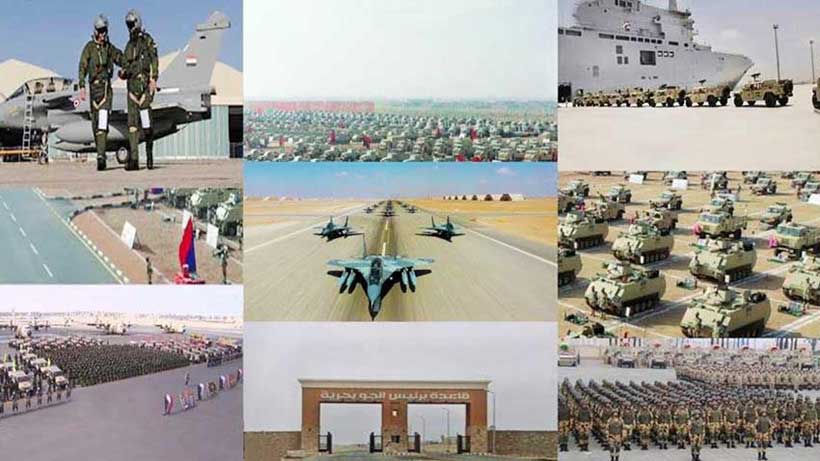
Chinese military and intelligence analyses for 2025 and 2026 indicate that China views the expansion of the Egyptian Armed Forces in establishing numerous naval and air bases, such as the Bernice and Gargoub bases, with strategic interest. Beijing considers this trend, spearheaded by the Egyptian political leadership under President El-Sisi and the Egyptian Ministry of Defense, a vital component of a comprehensive strategic partnership between Egypt and China, aimed at securing shared interests in strategically vital regions. Chinese intelligence and military agencies view the Egyptian expansion in establishing military bases, such as the Mohamed Naguib base, the July 3 base, and bases east and west of the Suez Canal, as part of a comprehensive Chinese strategy to develop the Egyptian Armed Forces and enhance their deterrent capabilities against Beijing’s adversaries in the region. This perspective aligns with Beijing’s view of Egypt as a key strategic partner in Africa and the Middle East. The Chinese military establishment’s vision for this Egyptian military development of air and naval bases up to 2026 can be detailed, as follows: Supporting the Egyptian political leadership’s vision, from a Chinese perspective, of Egyptian military development under President Abdel Fattah al-Sisi, is seen as a serious attempt to modernize the army and transform it into a smart deterrent force capable of protecting national security and the country’s economic interests. This aligns with China’s +1 strategy (localization), as China seeks to leverage the development of Egyptian bases to become centers for localizing Chinese military technology in Egypt, particularly in the areas of unmanned aerial vehicles (UAVs), such as the Wing Loong and advanced air defense systems, such as the HQ-9B.
In this context, China views Egypt’s expansion in establishing military bases, such as the Mohamed Naguib Base, the July 3 Base, and the bases east and west of the Suez Canal, with strategic interest as a crucial element in strengthening the comprehensive strategic partnership between Cairo and Beijing. China considers these Egyptian military bases, especially those located on the Mediterranean Sea and near the Suez Canal. Bases like the July 3rd Air Base serve as vital support points for protecting China’s commercial interests and the routes of its Belt and Road Initiative, which passes through the Egyptian Suez Canal. Egypt represents a cornerstone in China’s 21st-century strategy. Therefore, China aims to bolster Egypt’s deterrent capabilities (a defense partnership). Chinese military officials believe that modernizing the Egyptian armed forces through these naval and air bases and localizing Chinese defense industries in Cairo, in accordance with President Sisi’s vision, enhances the independence of Egyptian military decision-making, paves the way for multipolarity, supports developing countries in the Global South, and contributes to regional stability. Relations between Egypt and China have moved beyond mere arms deals to the localization of Chinese technology within Egypt, enabling Egypt to confront regional challenges more effectively and creating a kind of regional balance of power. Here, Beijing, by supporting Egyptian military expansion through these bases, aims to create a strategic balance in the region amidst a growing Egyptian-Chinese rapprochement seen as an alternative to or complement to traditional partnerships with the West. This can be inferred from the military exercises. The air capabilities and joint military exercises between Egypt and China are reflected here. Joint air exercises, such as Eagles of Civilization 2025, and cooperation at Wadi Abu Rish Air Base are Egyptian-Chinese joint training exercises aimed at exchanging expertise in air combat and protecting maritime routes. This coincides with Egypt’s interest in military and arms deals with China, such as the J-10C. Other Egyptian military negotiations with China regarding the purchase of advanced submarines, known as the Yuan class, are also underway. This reduces Egypt’s military dependence on Washington and the West and strengthens the Chinese presence in the Egyptian military arsenal. This reflects a convergence of military visions between the two countries, with China supporting Egypt’s efforts to modernize its military infrastructure. The new bases are considered a cornerstone for securing shared interests in the Eastern Mediterranean and the Red Sea.
Beijing also aims to strengthen the comprehensive strategic partnership. Here, the Chinese vision extends beyond mere arms deals; it views this as a core partnership aimed at establishing a broad military alliance with Egypt to develop the Chinese military Silk Road. This includes joint operational planning and training exercises, as demonstrated in the Civilization Eagles 2025 maneuvers. China seeks to effect a comprehensive shift in the regional balance of power. Chinese intelligence believes that establishing bases and developing naval and air forces will grant Egypt strategic independence and reduce its dependence on the West. This, in turn, opens the door for China to enhance its influence in the region through defense cooperation, thereby securing shared Chinese and Egyptian military interests. Beijing considers securing Egyptian bases for maritime routes (the Suez Canal) and the Red Sea to be in line with Chinese economic and security interests within the framework of the Belt and Road Initiative. In general, the Chinese military establishment views Cairo as working to build a strong regional pivot point, and Beijing sees this expansion as an opportunity to deepen defense and technological ties with Cairo, paving the way for the formal declaration of a Chinese-Egyptian military Silk Road partnership.
China views the new Egyptian military bases as a means of protecting its strategic interests within the framework of the Belt and Road Initiative. These bases, particularly those located on the Red Sea, the Mediterranean Sea, and the Suez Canal, occupy vital maritime chokepoints, and China considers them a guarantee for the security of its international trade routes. The relationship between Egypt and China has evolved from mere arms purchases to the localization of defense industries, such as the production of unmanned aerial vehicles (UAVs) and electronic warfare systems, increasing Egypt’s military reliance on Chinese technology. These Egyptian military bases, which enhance Egypt’s rapid deployment capabilities, align with China’s interests in establishing a multipolar regional order that reduces American influence in the Middle East. Chinese intelligence, military, defense, and security reports indicate a qualitative shift in Egyptian military doctrine. Chinese military institutions affiliated with the People’s Liberation Army analyze that Egyptian military bases, such as the July 3rd base, provide strategic depth and protection for economic assets (gas fields and the Dabaa nuclear power plant), thus contributing to the economic stability in which China participates. For this reason, the Chinese People’s Liberation Army (PLA) is seeking to train and qualify the Egyptian military elite through the Military Academy for Advanced Studies as an alternative to Western and American training.
The Chinese intelligence and military establishments view the Egyptian army’s expansionist vision in establishing naval and air bases within Egypt as part of the development strategy adopted by the Egyptian Armed Forces and the political leadership of President El-Sisi. This strategy aims to complete the modernization of the Egyptian Armed Forces and advance the Chinese military Silk Road with Egypt’s assistance. China supports the Egyptian Armed Forces’ efforts to modernize Egyptian military infrastructure, considering the new Egyptian military bases a cornerstone for securing China’s shared interests in the Eastern Mediterranean and the Red Sea. China views these new Egyptian military bases, particularly on the Red Sea, as essential for securing Chinese trade routes (the military/maritime Silk Road) and mitigating risks. In addition to the significant role Egypt plays for China as a regional power center and a key player in the balance of power, relevant military circles in Beijing analyze the modernization of the Egyptian army as a center of gravity for stability in the Middle East and Africa. A strong and stable army serves China’s interests in the Eastern Mediterranean. Therefore, China translates its vision into tangible support, including modernizing Egypt’s military infrastructure to align with the Chinese Belt and Road Initiative in its maritime, air, and naval components and equipping it with advanced weapons systems.
Based on the preceding understanding and analysis, we conclude that the new Egyptian military bases (naval and air) are considered, according to the Chinese military and strategic vision, strategic strengths. Their benefits extend beyond Egypt, securing China’s commercial and military interests in the Mediterranean and Red Seas. They also provide a Chinese technological alternative in a region previously dominated by Western and American platforms, paving the way for China’s gradual expansion of its military Silk Road initiative.