Special interests spend millions boosting Becerra in governor’s race
Companies and special interest groups with some of the diciest issues expected to land on California’s next governor’s desk are among the top financial backers of Democrat Xavier Becerra, the gubernatorial front runner.
Money from Big Tech, the healthcare industry, labor unions and tribes helped propel Becerra’s bid for governor, which languished at the outset then took off just months before the June primary. All are major players in national and state politics and have a major financial stake on the policies of California’s next governor.
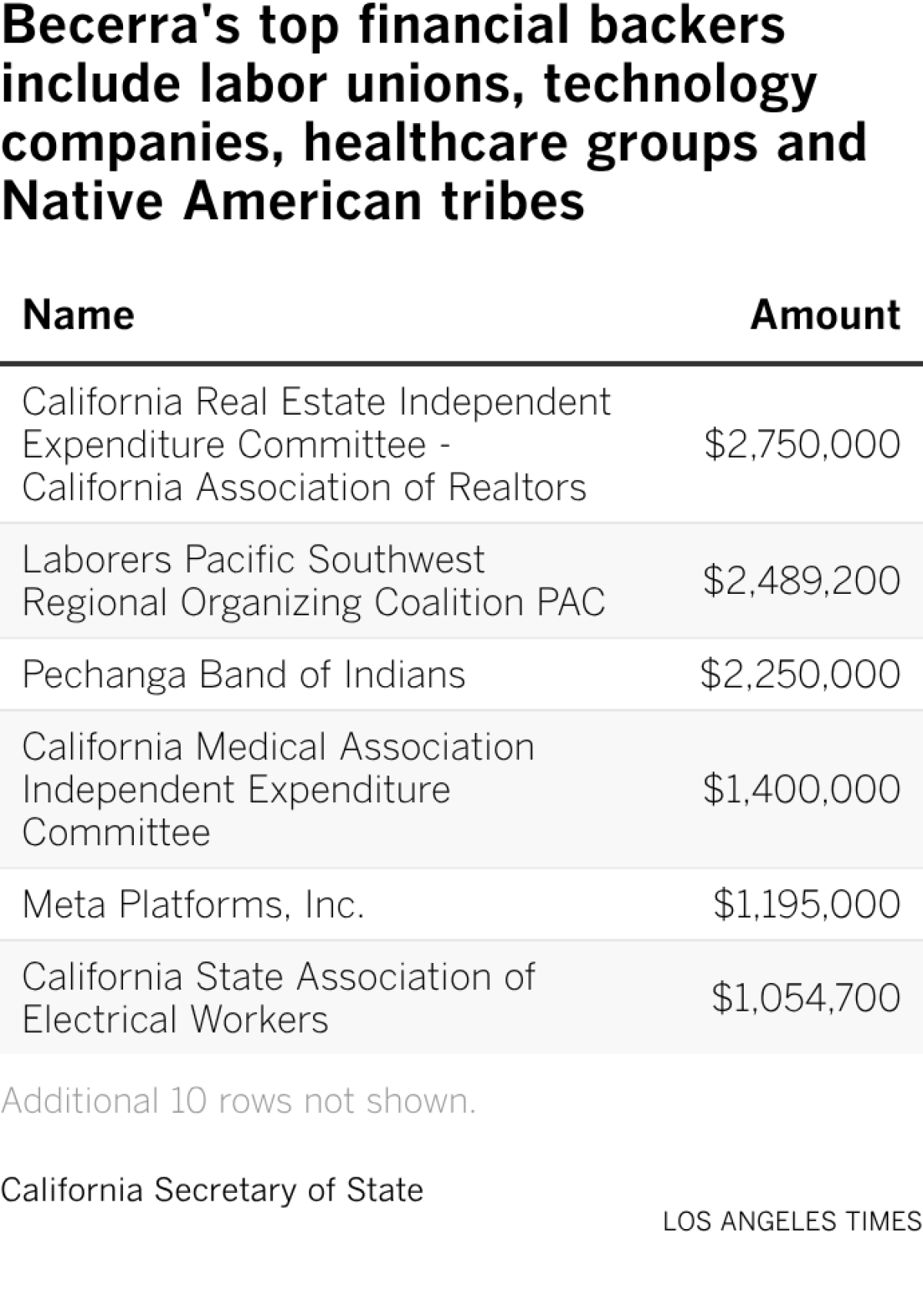
Meta, which has contributed nearly $1.2 million to groups backing Becerra’s campagin, has faced mounting scrutiny by lawmakers and the courts. The Menlo Park-based company, which operates social media and communication platforms such as Facebook, Instagram and WhatsApp, just agreed to a landmark $17.1 billion settlement to resolve multi-state claims that its apps endanger children.
The state Legislature in August also passed a measure to bar social media platforms from providing an “addictive feature” to lure children, as well as bills to shield Californians from threats posed by the boom in artificial intelligence and data centers. The fate of these measures is now in the hands of Gov. Gavin Newsom, and the next governor likely will have to decide whether approve even stricter controls on Big Tech.
Meta is among eight donors that wrote seven-figure checks supporting Becerra’s gubernatrial campaign, with most of he money funneled to independent committees backing the Democrat that are not allowed to legally coordinate with the candidate. Campaigns often find back doors to do so.
Former state Sen. Steve Glazer, a Democrat who ran Jerry Brown’s successful 2010 gubernatorial campaign, said such spending is not surprising.
“Look, millions and billions of dollars are at stake, and the governor is the central point for all of that in California,” Glazer said. “It’s not a gamble anymore. You’re not picking a winner or a loser, right? So the floodgates open up for a runaway winner like Xavier Becerra.”

Becerra, the former secretary of the U.S. Department of Health and Human Services and a longtime congressman, won one of the top two spots in the chaotic June primary. Republican Steve Hilton, a conservative media commentator and strategist who was endorsed by President Trump, won the other slot to advance to the Nov. 3 election. Becerra is considered a heavy favorite to win, given that Democratic voters in California outnumber Republicans nearly 2 to 1.
Becerra has the financial edge in the race, raising at least $30 million while also receiving significant support from the independent committees. Donors have contributed $48.8 million to Becerra’s campaign committee as well as outside efforts supporting his bid, according to a Times analysis of contributions through Sept. 3.

A Becerra spokesman said that although the campaign welcomed support from any donor, he would not weigh their contributions as he makes policy decisions if elected
“Xavier Becerra is laser-focused on making California work for working people — lowering costs, building housing, and making this state affordable again,” said Jonathan Underland, a spokesman for the Democrat. “Anyone willing to stand with us in that fight is welcome to join it, and we won’t hesitate to challenge anyone who gets in the way of that goal.”
His GOP rival raked in $18.8 million, including a $90,100 contribution from the candidate himself. Hilton’s top donors are billionaires and business executives including manufacturer Donald Friese and his wife Andrea, Silicon Valley billionaire Tim Draper, former Fox Corp. Chairman Rupert Murdoch, Google co-founder Sergey Brin, Los Angeles real estate magnate Geoffrey Palmer and the founder of defense contractor Anduril Industries, Palmer Luckey.
Executives and employees at Lighthouse Worldwide Solutions Inc., a company that makes contamination monitoring systems, contributed more than $474,000 to Hilton’s campaign.
A small handful of donors gave to both candidates. Uber and its employees gave nearly $42,000 to Hilton, while the company and an affiliated political action committee spent $1,039,200 supporting Becerra. Vlad Tenev, founder of the financial trading platform Robinhood, gave $289,000 to Becerra and $15,000 to Hilton.
A committee ostensibly established to oppose Hilton, an effort that effectively propped him up among Republican voters before the June primary, raised $2.5 million through large donations from the California Nurses Assn., the Service Employees International Union, the Democratic Governors Assn. and wealthy businessman Bill Bloomfield, an unsuccessful congressional candidate and Republican-turned-Democrat.
Hilton said Becerra’s financial backers are unsurprising and illustrate the “corruption” created by one-party rule in Sacramento.
“All these businesses and organizations assume he’s going to be the next governor, so they’re trying to bribe him,” Hilton said in an interview. “You can call it donations if you want, but it’s actually legalized bribery. … Big business and special interests are shoveling cash into his mouth in the hope that they can bribe him to do their bidding.”
Becerra, who served in public office for nearly 35 years, has a long history of support from powerful industries, labor unions and others with business before the government. During his 24 years in Congress, donors spent roughly $11 million supporting Becerra, according to the Times analysis and Open Secrets, a nonprofit, nonpartisan tracker of campaign fundraising. While he served as California attorney general for four years, contributors spent nearly $9.4 million backing him.
Among the former Biden Cabinet secretary’s top financial backers in the governor’s race are labor unions, healthcare groups, tech companies and Native American tribes that own some of the state’s splashiest casinos. All will probably be affected by decisions made by the next governor.
The Laborers’ International Union of North America and local affiliates and political arms, focused on infrastructure projects and the creation of union jobs, has contributed nearly $3.2 million. A committee associated with the California Assn. of Realtors that is focused on housing, real estate policy and property rights has spent nearly $2.8 million backing Becerra.
The Pechanga Band of Indians chipped in more than $2.3 million to efforts supporting Becerra at a time that gaming issues continue to be scrutinized.
A Pechanga representative said the tribe’s leader was unavailable due to travel but pointed to a statement he made before the primary.
“Secretary Becerra has stood with Indian Country for decades and understands Tribal sovereignty. When tribal healthcare was on the line, he was there,” said Tribal Chairman Mark Macarro. “This experience comes from a lifetime of public service, not a checkbook.”
The California Medical Assn. has spent nearly $1.5 million backing Becerra at a time of deep impending federal healthcare funding cuts and efforts by the state to backfill that lost financial support.
Dr. René Bravo, president of the California Medical Assn., which represents more than 50,000 physicians, said their spending was spurred by the their belief that Becerra is the best candidate to take on impending federal healthcare funding cuts that will harm millions of Californians access to care.
“Xavier Becerra understands healthcare and the challenges facing patients and physicians. The next governor will make critical decisions on MediCal, the physician workforce, affordability and access to care,” Bravo said. “We’re investing in this race because those decisions will directly affect California patients and physicians.”
Meta declined to comment on its contributions, and the Realtors and the Laborers did not respond to requests for comment.
Becerra, asked about the Realtors’ large donations supporting his campaign, noted that most of the money was contributed to committees outside his control. But he argued that his policy priorities have long been clear, including when he was an afterthought in the gubernatorial race.
“I was pretty clear in the primary, where I wasn’t getting as much support from a lot of different folks,” Becerra said Fridayat a news conference in north Long Beach supporting Proposition 1, a proposed $11.25-billion bond measure on the November ballot to boost affordable housing construction around the state.
“What I will tell you is this: Take a look at my record. Take a look at what I’ve said, and rather than look to inflated promises, look at what I’ve done in my record,” Becerra said, standing in front of Laborers’ International Union of North America members clad in orange safety vests. “And I will tell you, I have built, not just as a public servant, but when I was wearing myself that orange vest as a construction worker, as a laborer for Local 185, in my younger years, I was out there helping build. And so what we’re going to do is we’re going to do what we need to do, regardless what the voices say. We’re doing it because the people demand it.”
Fossil fuel and renewable energy firms have also supported Becerra, notably Chevron and affiliated groups and employees, spent more than $1.1 million boosting his bid — money that his Democratic rivals in the governor’s race and other critics, including climate activist Jane Fonda, pounced upon before the primary.
Billionaire hedge fund founder Tom Steyer deployed mobile billboards touting Becerra saying “You need Chevron, I need Chevron,” a clip from a longer comment about how every Californian doesn’t drive an electric car.
Chevron did not respond to a request for comment.
Earlier this year, Becerra was a single-digit polling afterthought in the crowded race to replace Newsom, who is termed-out. But after a dizzying primary that included a potential front-runner, then-Rep. Eric Swalwell (D-Dublin), dropping out amid allegations of rape and sexual assault, Becerra took the lead in the Democratic field and placed first in the June election.
Becerra, 68, has a long career in elected office, serving two years in the state Assembly, 24 years in Congress, four years as California’s attorney general, and four years in the Biden administration.
While he was in Congress, donations to his federal campaign committee grew dramatically, according to an analysis of Federal Election Commission documents provided by Open Secrets.
In the early 1990s, Becerra was receiving donations in the low six figures, but by the end of his time in Congress, he was receiving well over $1 million during each two-year electoral cycle.
Finance, insurance and real estate firms and trade groups, such as Charles Schwab, the National Assn. of Insurance and Financial Advisors, the New York Life Insurance Co., Merrill Lynch and Pacific Life Insurance, were major supporters of Becerra, who served on the powerful House Ways and Means Committee, which regulates taxation. Such donors contributed more than $2.6 million to his congressional bids, according to Open Secrets.
Healthcare interests came in a close second, contributing more than $2.4 million to his congressional campaigns in the years before he was nominated and confirmed as Biden’s secretary of Health and Human Services, according to Open Secrets. Among the groups that supported Becerra’s federal campaigns included organizations representing physical therapists, anesthesiologists, podiatrists, assisted living and long term care facilities, and dietitians. While in Congress, Becerra was a strong advocate and supporter of the Affordable Care Act, a landmark healthcare overhaul championed by former President Obama.
Labor donated more than $1.7 million to Becerra’s congressional bids, a trend that continued when he ran for attorney general. Unions representing laborers, electrical workers, pipe fitters and firefighters donated $1 million, according to the Times analysis. The number has spiked to $6.3 million for Becerra’s gubernatorial bid.
Lorena Gonzalez Fletcher, president of the powerful California Labor Federation, said Becerra’s personal and political resume are significant at a time when the next governor will need to tackle artificial intelligence and the potential resulting job losses, the state’s volatile budget and federal funding cuts to MediCal and Medicare.
“He comes from a union family,” she said. “He has a long history of being on the right side of working people in a lot of different roles — in Congress, as attorney general and as secretary of Health and Human Services.”