strategic

Armed Forces Retake Strategic DR Congo Town After M23 Withdrawal 

The armed forces of the Democratic Republic of Congo (DRC) have taken over the town of Luvungi in the Rusizi Plain of Uvira territory in South Kivu after M23 fighters vacated the area. Following the fierce battle for control among the warring parties, the Rwandan troops and their M23 allies retreated, succumbing to military and diplomatic pressure.

The Congolese army officially retook control of the town on Monday, May 12, restoring the blurry hope of civilians trapped under the violent rule of the rebels.

“We do not know yet whether this withdrawal by the Rwandan army and their M23 surrogates is in respect of various UN resolutions and international demands for the Rwandan army to withdraw from zones they occupy in the DR Congo, or it is just a tactical military withdrawal,” a senior official of the armed forces declared in Kinshasa, the country’s capital city.

Some members of the M23 group and Rwandan fighters are reportedly still present in Katogota, a neighbouring town to Luvungi. The Congolese army has stated that rebel reinforcements have arrived in Kamanyola, which is a strategic border town in South Kivu.

Reagan Mbuyi Kalonji, the spokesperson for Operations Sukola 2, a military campaign aimed at neutralising rebel groups in South Kivu, has revealed that Rwandan forces have deployed heavy weapons on the Bugarama hills. This positioning is intended to maintain their military and strategic control over Kamanyola and its surrounding areas.

The entry of Congolese troops into Luvungi signifies the culmination of troop movements observed in the Rusizi Plain and the upper plateau of South Kivu. Since Saturday, May 9, the Congolese army has been systematically occupying positions left vacant by the M23 fighters, moving from Sange to Mutarule and finally to Luvungi.

The army attributes the withdrawal of Rwandan troops and their M23 allies to “intense military and diplomatic pressure,” while the M23/AFC describes their withdrawal as a “repositioning and a gesture of goodwill” towards the peace process. 

The armed forces of the Democratic Republic of Congo (DRC) have regained control of the town of Luvungi in South Kivu from M23 fighters after a prolonged battle, resulting in the retreat of Rwandan troops and their allies.

This takeover on May 12 brings hope to civilians who were previously under the rebels’ rule. However, there is uncertainty over whether the retreat aligns with UN resolutions for troop withdrawal or if it is a tactical move.

Despite this victory, M23 and Rwandan fighters remain in nearby Katogota, with reinforcements reportedly reaching the strategic border town of Kamanyola. The spokesperson for Operations Sukola 2 reported that Rwandan forces have stationed heavy weaponry on the Bugarama hills to maintain their strategic hold.

The Congolese army’s advance into Luvungi marks a systematic occupation of areas vacated by M23, attributed to intense military and diplomatic pressure, while M23 claims it as goodwill for peace efforts.

Source link

Missiles Clobber Target Ship In Highly Strategic Luzon Strait

A former Philippine Navy warship was sent to the bottom today by the combined effects of maritime strike drills launched by Japanese, Philippine, and U.S. forces in the Luzon Strait, one of the world’s most strategic and tense bodies of water. The maneuvers, which reportedly involved a variety of anti-ship missiles and rocket artillery, were part of the broader Balikatan exercise, which is especially important in the context of rising tensions in the Indo-Pacific.

多国間共同訓練 バリカタン 26 (Balikatan 2026) において、88式地対艦誘導弾の射撃を行う、陸上自衛隊 第1特科団 第1地対艦ミサイル連隊。88式地対艦誘導弾の直撃を受けた標的艦はその後沈没した。 pic.twitter.com/V1Y4OCb4rU

— The Military Archives of Japan (@Archives_Japan) May 6, 2026

Located roughly 50 miles offshore, the target vessel for a live-fire sinking exercise (SINKEX) campaign was the decommissioned Philippine Navy Rizal class patrol corvette, the former BRP Quezon. The ship was originally completed for the U.S. Navy as an Auk class minesweeper during World War II, serving as the USS Vigilance before being transferred to the Philippines and serving in a new role in the late 1960s. The BRP Quezon, which had a standard displacement of 890 tons, was decommissioned in 2021.

日本陸上自衛隊在菲律賓「肩並肩」演習科目,實彈發射兩枚88式反艦飛彈,成功命中靶船 pic.twitter.com/ZooDgOxM5b

— 新‧二七部隊 軍事雜談 (New 27 Brigade)🇹🇼🇺🇦🇮🇱 (@new27brigade) May 6, 2026

The maritime strike (MARSTRIKE) drills were conducted on the island of Luzon, which sits at the northern end of the Philippines, and is the country’s largest and most populous island. Specifically, the live-fire drills took place around the Paoay Sand Dunes, in the coastal region of Ilocos Norte.

The drills began around 10:00 a.m. local time with a U.S. Army M30/31 Guided Multiple-Launch Rocket System (GMLRS) fired as a “probing round,” with the location of the target vessel being confirmed around 10:15 a.m.

U.S. Airmen assigned to the 317th Airlift Wing and 21st Air Task Force and U.S. Soldiers assigned to U.S. Army Pacific prepare a U.S. Army Guided Multiple Launch Rocket System pod for transport in support of Exercise Balikatan 2026 at Puerto Princesa, Palawan, Philippines, April 29, 2026. Balikatan is a longstanding annual exercise between the Armed Forces of the Philippines and U.S. military that represents the strength of our alliance, improves our capable combined force, and demonstrates our commitment to regional peace and prosperity. (U.S. Air Force photo by Senior Airman Jade M. Caldwell)
U.S. soldiers prepare a U.S. Army Guided Multiple Launch Rocket System pod for transport in support of Exercise Balikatan 2026 at Puerto Princesa, Palawan, Philippines, April 29, 2026. U.S. Air Force photo by Senior Airman Jade M. Caldwell

The GMLRS artillery rocket is a highly precise, rapid-strike weapon that can attack targets to a distance of around 50 miles, which would put it right at the limit of its range. It is fired from the M142 High Mobility Artillery Rocket System (HIMARS) that can launch six guided or unguided 227mm artillery rockets or a single Army Tactical Missile System (ATACMS) missile without reloading. GMLRS is not capable of engaging moving targets, so it has limited application in the traditional anti-ship mission set.

In a combined strike, anti-ship missiles were reportedly then launched from a U.S. Marine Corps Navy-Marine Expeditionary Ship Interdiction System (NMESIS) and from a Philippine Navy C-Star system.

Of these, NMESIS employs an uncrewed variant of the 4×4 Joint Light Tactical Vehicle (JLTV), also known as the Remotely Operated Ground Unit Expeditionary-Fires (ROGUE-Fires), on which is mounted a launcher with two ready-to-fire Naval Strike Missiles (NSM). These have a range of around 130 miles and have low-observable features, making them harder for enemy air defenses to detect and engage.

U.S. Marine Corps Lance Cpl. Bryzden Michener, a field artillery cannoneer assigned to 3rd Littoral Combat Team, 3rd Marine Littoral Regiment, 3rd Marine Division, operates a Navy-Marine Expeditionary Ship Interdiction System on to a U.S. Army Landing Craft Utility during Exercise Balikatan 2026 at Calayan, Cagayan, Philippines, May 2, 2026. Balikatan is a longstanding annual exercise between the Armed Forces of the Philippines and U.S. military that represents the strength of our alliance, improves our capable combined force, and demonstrates our commitment to regional peace and prosperity. Michener is a native of California. (U.S. Marine Corps photo by Cpl. Ernesto Lagunes)
A U.S. Marine Corps Navy-Marine Expeditionary Ship Interdiction System is loaded onto a U.S. Army Landing Craft Utility during Exercise Balikatan 2026 at Calayan, Cagayan, Philippines, May 2, 2026. U.S. Marine Corps photo by Cpl. Ernesto Lagunes

NMESIS is meant to be rapidly deployable and capable of highly dispersed operations in austere areas. As an uncrewed vehicle-launcher combo, small teams of Marines monitor multiple launchers dispersed around an area and move them regularly to keep them from being targeted by the enemy. The system was first deployed in a Balikatan exercise last year, as you can read about here.

While Philippine media reports that the NMESIS, operated by the Hawaii-based 3rd Marine Littoral Regiment, fired a missile during today’s drill, this is refuted by a report from Stars and Stripes. The 3rd MLR is notable in itself, being expressly designed to fight within an enemy’s own littorals, with all the challenges that brings.

Meanwhile, the C-Star is the Philippine Navy’s primary anti-ship missile. Produced by South Korea’s LIG Nex1, a version of this missile is used by the Republic of Korea Navy as the Haeseong. The Philippines uses the C-Star to arm its two Miguel Malvar class and two Jose Rizal class frigates, which are also made in South Korea. Similar to the U.S.-made Harpoon, the C-Star is a turbojet-powered, sea-skimming missile with a range of around 90 miles.

Philippine Navy Jose Rizal-class guided-missile frigate BRP Antonio Luna (FFG 15), left, Royal Australian Navy Anzac-class frigate HMAS Toowoomba (FFH 156), center, and Japan Maritime Self-Defense Force Murasame-class destroyer JS Ikazuchi (DD107) transit in formation during the group sail exercise for Exercise Balikatan 2026 in the South China Sea, April 24, 2026. Balikatan is a longstanding annual exercise between the Armed Forces of the Philippines and U.S. military that represents the strength of our alliance, improves our capable combined force, and demonstrates our commitment to regional peace and prosperity. (U.S. Marine Corps photo by Cpl. Kenneth Twaddell)
The Philippine Navy Jose Rizal class guided-missile frigate BRP Antonio Luna, left, transits in formation with other warships for Exercise Balikatan 2026 in the South China Sea, April 24, 2026. U.S. Marine Corps photo by Cpl. Kenneth Twaddell

In the drill, the C-Star was likely fired from the Philippine Navy frigates BRP Miguel Malvar and Antonio Luna, both of which are known to be taking part in Balikatan.

These were followed by two rounds fired from a Japanese land-based Type 88 anti-ship missile system, fired for the first time during a Balikatan exercise, and for the first time anywhere outside Japan. The Japanese missiles reportedly struck the hull of the target ship around 10:30 a.m.

JSDF Type 88 missiles fire for the first time in Balikatan 2026 | GMA News thumbnail

JSDF Type 88 missiles fire for the first time in Balikatan 2026 | GMA News


Developed by Mitsubishi Heavy Industries in the 1980s, the Type 88 (also known as the SSM-1) is the primary coastal anti-ship missile system of the Japan Self-Defense Forces, with a range of around 100 miles, although more capable and further-reaching weapons are now in development, as you can read about here.

Interestingly, in a video released of the live-fire event in Ilocos Norte, close protection was being provided to the truck-mounted Type 88 launcher by a Marine Air Defense Integrated System (MADIS), also from the 3rd Marine Littoral Regiment. MADIS utilizes the JTLV and distributes different sensors and effectors between individual JLTVs, as you can read more about here. In this kind of scenario, it would be tasked with protecting the coastal missile battery against kamikaze drones and other aerial threats at short ranges.

A U.S. Marine Air Defense Integrated System with 3rd Littoral Anti-Air Battalion, 3rd Marine Littoral Regiment, 3rd Marine Division, fires an XM950 training practice round at a moving target during an integrated air and missile defense event as part of Exercise Balikatan 2026 at Naval Station Leovigildo Gantioqu, Philippines, April 28, 2026. Balikatan is a longstanding annual exercise between the Armed Forces of the Philippines and U.S. military that represents the strength of our alliance, improves our capable combined force, and demonstrates our commitment to regional peace and prosperity. (U.S. Marine Corps photo by Sgt. Atticus Martinez)
A U.S. Marine Air Defense Integrated System with 3rd Littoral Anti-Air Battalion, 3rd Marine Littoral Regiment, 3rd Marine Division, fires an XM950 training practice round at a moving target during an integrated air and missile defense event as part of Exercise Balikatan 2026 at Naval Station Leovigildo Gantioqu, Philippines, April 28, 2026. U.S. Marine Corps photo by Sgt. Atticus Martinez

The vessel sank rapidly, meaning that the Philippine Air Force wasn’t able to deliver more munitions onto the target. FA-50 light combat aircraft and A-29 Super Tucano turboprop close support aircraft had both been prepared to strike the same ship, but were stood down.

Philippine Air Force Pilots with the 15th Strike Wing, conduct pre-flight checks on an A-29B Super Tucano during Exercise Balikatan 2026 at Laoag International Airport, Laoag City, Philippines, April 28, 2026. Balikatan is a longstanding annual exercise between the Armed Forces of the Philippines and U.S. military that represents the strength of our alliance, improves our capable combined force, and demonstrates our commitment to regional peace and prosperity. (U.S. Army photo by Sgt. Duke Edwards)
Philippine Air Force Pilots with the 15th Strike Wing conduct pre-flight checks on an A-29B Super Tucano during Exercise Balikatan 2026 at Laoag International Airport, Laoag City, Philippines, April 28, 2026. U.S. Army photo by Sgt. Duke Edwards

Other air assets taking part included a U.S. Navy P-8 Poseidon maritime patrol aircraft and an MQ-9 drone.

With the ship sunk or sinking, a coup de grace was provided by a U.S. HIMARS, which fired onto the same coordinates.

Also involved in Balikatan is the Royal Canadian Navy frigate HMCS Charlottetown, although it appears that it didn’t take part in the live-fire event.

According to a Philippine military spokesperson, another round of live-fire drills will take place tomorrow as part of Balikatan, utilizing a stand-by target vessel. This will also allow Philippine Air Force aircraft to take part.

The live-fire drills, conducted under the Balikatan exercise, signaled a notable expansion of Japan’s military role in the region as Tokyo strengthens security partnerships with its allies amid growing tensions with Beijing.

A Japan Maritime Self-Defense Force ShinMaywa US-2 aircraft assigned to Air Rescue Squadron 71 (ARS-71), Fleet Air Wing 31 lands during a casualty evacuation exercise as part of Exercise Balikatan 2026 in the South China Sea, April 27, 2026. Balikatan is a longstanding annual exercise between the Armed Forces of the Philippines and U.S. military that represents the strength of our alliance, improves our capable combined force, and demonstrates our commitment to regional peace and prosperity. (U.S. Marine Corps photo by Cpl. Kenneth Twaddell)
A Japan Maritime Self-Defense Force ShinMaywa US-2 amphibious aircraft lands during a casualty evacuation exercise as part of Exercise Balikatan 2026 in the South China Sea, April 27, 2026. U.S. Marine Corps photo by Cpl. Kenneth Twaddell

Overall, the live-fire exercise is highly significant due to its proximity to the Chinese mainland and the long range of some of the missiles that have been employed.

The Luzon Strait, into which the various missiles and rockets were fired, sits between Taiwan and the Philippines, spanning about 220 miles at its narrowest point. It serves as a vital shipping route and a highly strategic military corridor, particularly for China’s rapidly expanding naval forces. From this passage, assets stationed in the South China Sea can move into the Philippine Sea and the wider Pacific, and back again. This includes China’s growing fleet of nuclear-powered submarines, some of which underpin its second-strike nuclear deterrent.

A U.S. Army AH-64 Apache helicopter assigned to Task Force Saber, 25th Combat Aviation Brigade, flies over open water during a counter landing live-fire exercise as part of Exercise Balikatan 2026 over the Luzon Strait, Philippines, May 4, 2026. Balikatan is a longstanding annual exercise between the Armed Forces of the Philippines and U.S. military that represents the strength of our alliance, improves our capable combined force, and demonstrates our commitment to regional peace and prosperity. (U.S. Army photo by Sgt. Olivia Cowart)
A U.S. Army AH-64 Apache helicopter assigned to Task Force Saber, 25th Combat Aviation Brigade, flies over open water during a counter-landing live-fire exercise as part of Exercise Balikatan 2026 over the Luzon Strait, Philippines, May 4, 2026. U.S. Army photo by Sgt. Olivia Cowart

The strait is also a crucial gateway for the U.S. Navy entering the South China Sea and would likely be a central battleground in any major conflict over Taiwan. Because of its importance, the area is closely monitored for activity both above and below the surface. In the event of war, it would quickly turn into a dense anti-ship missile engagement zone (SMEZ). The live-fire campaign today gave just a small taster of that kind of contingency.

Earlier this week, the U.S. Army test-fired a Tomahawk cruise missile from a Typhon launcher in the central Philippines, successfully hitting a target around 370 miles away in Nueva Ecija.

On this occasion, the Tomahawk missile was supporting ground troops in a night land maneuver exercise led by the 25th Infantry Division in Fort Magsaysay, part of the Balikatan exercise.

US Army Soldiers assigned to Charlie Battery (MRC), 5th Battalion, 3rd Field Artillery (Long Range Fire Battalion), 1st Multi-Domain Task Force, position training canisters during Mid-Range Capability (MRC) certification training as part of Exercise Balikatan 24 in Northern Luzon, Philippines, April 30, 2024. This was the first time certification was completed on the MRC in a deployed environment, a milestone for the unit. BK 24 is an annual exercise between the Armed Forces of the Philippines and the US military designed to strengthen bilateral interoperability, capabilities, trust, and cooperation built over decades of shared experiences. (US Army photo by Captain Ryan DeBooy)
U.S. Army soldiers position training canisters during Typhon Mid-Range Capability (MRC) certification training as part of an earlier edition of Exercise Balikatan in Northern Luzon, Philippines, April 30, 2024. U.S.Army photo by Captain Ryan DeBooy

The Typhon ground-based missile system can also fire SM-6 multi-purpose missiles, which are used in this application in a quasi-ballistic missile land-attack mode. As for the Tomahawk cruise missile, this provided land attack and anti-ship capabilities

As we have discussed before, Typhon’s arrival in the Philippines in 2025 sent a clear signal to Beijing and throughout the region. It is a glimpse of what’s to come as the service works through plans to permanently base these systems in China’s backyard.

U.S. Indo-Pacific Command (USINDOPACOM) J7 Pacific Multi-Domain Training and Experimentation Capability (PMTEC) offloads a maritime drone target from U.S. Army ocean-contracted vessel MB480 in Palawan, Philippines, prior to the counter-landing live-fire exercise during Exercise Balikatan 2026 on April 27, 2026. The advanced unmanned maritime drone simulates an adversarial amphibious fighting vehicle. PMTEC provided maneuverable maritime and aerial targets to enable Philippine, Australian, New Zealand and U.S. forces to rehearse the full spectrum of detection, tracking, and engagement in a dynamic, contested environment. Balikatan is a longstanding annual exercise between the Armed Forces of the Philippines and U.S. military that represents the strength of our alliance, improves our capable combined force, and demonstrates our commitment to regional peace and prosperity. (Courtesy photo by Torch Technologies Inc., Philip Neveu)
A maritime drone target — clearly replicating a Chinese Type 05 amphibious armored vehicle — after disembarking from U.S. Army ocean-contracted vessel MB480 in Palawan, Philippines, ahead of a counter-landing live-fire exercise during Exercise Balikatan on April 27, 2026. Courtesy photo by Torch Technologies Inc., Philip Neveu

Compared to the longer-range Typhon, which is deployed further from the Luzon Strait, for the Balikatan exercise, the shorter-range NMESIS and Type 88 anti-ship missiles are pushed much closer to the zone in which their likely wartime targets would be found. As we have explored in the past, anti-ship missiles of this kind, and especially NMESIS, can also be deployed deeper into the strait, making use of smaller Philippine islands, like the Batanes island chain, although that ratchets up their exposure to counterstrikes considerably.

LOOK: The Japan Self-Defense Forces (JSDF) on Wednesday fired their Type 88 surface-to-ship missile during the maritime strike, part of Balikatan Exercise 2026.

The Armed Forces of the Philippines confirmed that the missiles launched hit the target—decommissioned Philippine Navy… pic.twitter.com/7QkzlB4qvW

— Bianca Dava-Lee 🐱 (@biancadava) May 6, 2026

For both these kinds of missiles, their survival would rely upon the dispersal of launchers and other vehicles, as well as regularly moving them around to help prevent them from being targeted by the enemy. Of course, with the uncrewed NMESIS, this is designed from the ground up to not put personnel in harm’s way. All of this kind of doctrine is central to the Marines’ Expeditionary Advanced Base Operations (EABO) strategy, which is now a core tenet of how it would fight in the Pacific.

U.S. Marines with 3rd Littoral Combat Team, 3rd Marine Littoral Regiment, 3rd Marine Division, and U.S. Army Soldiers with 7th Infantry Division, Multi-Domain Command - Pacific, guide an M142 High Mobility Artillery Rocket System off a U.S. Army Landing Craft Utility during a ship-to-shore movement for Exercise Balikatan 2026 at Calayan, Cagayan, Philippines, April 28, 2026. Balikatan is a longstanding annual exercise between the Armed Forces of the Philippines and U.S. military that represents the strength of our alliance, improves our capable combined force, and demonstrates our commitment to regional peace and prosperity. (U.S. Marine Corps photo by Cpl. Ernesto Lagunes)
U.S. Marines with 3rd Littoral Combat Team, 3rd Marine Littoral Regiment, 3rd Marine Division, and U.S. Army soldiers with 7th Infantry Division, Multi-Domain Command — Pacific, guide an M142 High Mobility Artillery Rocket System off a U.S. Army Landing Craft Utility during a ship-to-shore movement for Exercise Balikatan 2026 at Calayan, Cagayan, Philippines, April 28, 2026. U.S. Marine Corps photo by Cpl. Ernesto Lagunes

Already, China has voiced its displeasure at the deployment of the U.S. Army’s Typhon system to the Philippines. What is now becoming a regular appearance of NMESIS, backed up by other highly mobile strike systems, including allied anti-ship missiles, within reach of the Luzon Strait, will undoubtedly trigger similar concerns in Beijing. However, the live-fire sinking exercise today underscores how critical this waterway is to the U.S. military and its allies in the region, just as it is to China. Having more varied and more mobile anti-shipping assets in the northern Philippines complicates targeting for China, while extending the capabilities of the anti-access strategy of the U.S. military and its allies in the Luzon Strait, should a conflict break out.

Contact the author: thomas@thewarzone.com

Thomas is a defense writer and editor with over 20 years of experience covering military aerospace topics and conflicts. He’s written a number of books, edited many more, and has contributed to many of the world’s leading aviation publications. Before joining The War Zone in 2020, he was the editor of AirForces Monthly.


Source link

U.S.-Vietnam trade talks risk strategic misstep in Indo-Pacific balance

A series of meetings will help determine whether the United States and Vietnam can preserve a trade relationship that has become central to supply chain resilience, U.S. business interests and Vietnam’s continued economic ascent. File Photo by Luong Thailinh/EPA

May 7 (UPI) — As Washington and Hanoi enter a dense stretch of trade diplomacy, the coming weeks will test whether one of the Indo-Pacific’s most pragmatic economic partnerships can sustain its momentum or become entangled in the very frictions it has worked to avoid.

A series of meetings — including Section 301 hearings on industrial capacity from Tuesday to Friday this week, forced labor discussions April 28 to May 1 and bilateral consultations next Monday and Tuesday, arrives at a pivotal juncture.

They will help determine whether the United States and Vietnam can preserve a trade relationship that has become central to supply chain resilience, U.S. business interests and Vietnam’s continued economic ascent.

At its core, the U.S.-Vietnam Comprehensive Strategic Partnership is grounded not in diplomacy alone, but also in economic logic.

Partnership built on complementarity

Over the past decade, Vietnam has emerged as one of the fastest-growing U.S. trading partners, driven by a convergence of structural interests. As American firms diversify production beyond China, Vietnam has become a preferred destination, offering cost competitiveness, political stability and deepening integration into global value chains.

U.S. data show Vietnam ran a $123.5 billion trade surplus with the United States last year — the fourth-largest imbalance after China, the European Union and Mexico. It is a figure that has drawn increasing scrutiny in Washington even as it reflects the depth of bilateral trade integration.

From electronics to apparel and consumer goods, Vietnam-based production is often embedded within supply chains designed and financed by U.S. and allied firms. American companies benefit from lower production costs and diversified risk, while Vietnamese exports sustain growth and employment at home.

Disrupting this ecosystem through blunt trade measures risks undermining the very businesses Washington seeks to protect.

Hanoi has consistently signaled a willingness to engage. It has approached trade tensions not with confrontation, but with negotiation — a posture that stands in contrast to more adversarial economic relationships. The upcoming consultations should reinforce that cooperative trajectory, not derail it.

Rethinking “overcapacity”

The debate over “overcapacity” has become a central issue in U.S. trade discussions, with concerns that the term is being applied broadly across different economic models.

In Vietnam’s case, officials and industry observers note that production growth is largely driven by market-based investment and global supply chain shifts rather than state-directed industrial surpluses.

“Vietnam’s overcapacity is much different from China’s,” said Murray Hiebert, head of research for Bower Group Asia. “China’s factories are producing huge surpluses that it dumps onto the world’s markets below market prices. Instead, Vietnam relies on foreign investment companies to produce for export.”

He noted that Vietnam’s export engine is overwhelmingly foreign-driven, with multinational firms, particularly from the United States and South Korea, accounting for roughly 80% of outbound shipments, while domestic producers contribute only about one-fifth.

“Vietnam’s economy is largely a manufacturing platform for foreign companies,” Hiebert said. “U.S. policymakers need to understand Vietnam did not create overcapacity by subsidizing manufacturing, but by courting foreign investors who used Vietnam as a low-cost base to serve global markets.”

Vietnam’s manufacturing expansion has been shaped by global supply chain realignment, accelerated by U.S.-China trade tensions and pandemic-era disruptions, rather than by state-led efforts to flood international markets. Many of the factories operating in Vietnam were relocated or expanded by multinational firms seeking to maintain access to U.S. consumers.

To conflate this model with subsidy-driven overproduction risks misdiagnosing the issue and penalizing a partner that has facilitated, rather than distorted, market outcomes.

Labor reforms and supply chain progress

Concerns over labor practices and supply chain integrity remain part of the policy conversation, particularly in the context of ongoing forced labor discussions. But these concerns should be weighed against Vietnam’s steady, if incremental, progress.

In recent years, Hanoi has undertaken significant labor reforms aligned with the International Labor Organization, including updates to its labor code, expanded worker representation rights and enhanced compliance mechanisms.

Vietnam has also prioritized traceability and transparency across key export sectors. From fisheries to manufacturing, authorities have invested in monitoring systems, strengthened inspections and improved regulatory oversight — steps aimed at meeting the expectations of international partners and markets.

This is an evolving process, not a completed one. But the trajectory is clear: Vietnam is moving toward higher standards, not retreating from them.

The case for market economy recognition

Another unresolved issue, Vietnam’s designation as a non-market economy under U.S. trade law, has become increasingly difficult to justify.

Vietnam operates within the framework of the World Trade Organization and has been recognized as a market economy by more than 70 countries. Its private sector has expanded rapidly, its regulatory environment continues to evolve and its integration into global markets is deepening.

Maintaining Vietnam’s current non-market economy designation under U.S. trade law has raised concerns among policymakers and business groups, who say it could affect the application of trade remedies and investor confidence. The issue comes as Washington seeks to expand economic partnerships across the Indo-Pacific.

Avoiding unintended consequences

Intellectual property has emerged as a new point of tension in U.S.-Vietnam trade relations. Ambassador Jamieson Greer, the U.S. trade representative, has designated Vietnam as a “Priority Foreign Country” — its most serious classification — in its latest intellectual property rights report, opening the door to a potential Section 301 investigation within 30 days.

The designation, the first of its kind in more than a decade, reflects ongoing U.S. concerns over Vietnam’s intellectual property protections and could affect the trajectory of current trade negotiations.

Sweeping trade measures designed to address structural concerns could disrupt supply chains, raise costs for American businesses and consumers, and weaken a partnership that has delivered measurable benefits. In an already fragile global economy, such outcomes would be counterproductive.

Vietnam’s own incentives align with stability. Its growth depends on open markets, foreign investment and compliance with international standards. That alignment should be viewed as a strategic asset.

Washington should avoid applying a China-centric lens to Vietnam’s trade profile, said Dan Harris, a partner at the law firm Harris Sliwoski. Treating Vietnam as an “overcapacity” case without clear evidence risks penalizing U.S. firms that relocated production there in line with Washington’s own push to reduce reliance on China and strengthen supply chain resilience.

“We will end up punishing the companies that did what we asked,” Harris warned.

He added that the broader strategic context matters: Vietnam’s long history of conflict and mistrust with China sets it apart from Beijing, even as it emerges as an increasingly important U.S. partner in the Indo-Pacific.

But the implications of Washington’s trade posture toward Hanoi extend far beyond economics. Vietnam’s export-driven growth, fueled primarily by multinational investment rather than state subsidies, has quietly elevated the country into a strategic linchpin in the Indo-Pacific.

A stable and prosperous Vietnam not only supports supply chain diversification, but also reinforces the rules-based order in the South China Sea.

Economic resilience in Vietnam is not peripheral to U.S. strategy. It is foundational to maintaining balance in contested Indo-Pacific waters. Trade policy cannot be divorced from strategic reality: A weakened Vietnamese economy would do more than disrupt production flows. It could undercut one of the region’s most important counterweights to China’s expanding maritime presence.

Balancing trade and security alignments

Rising risks of policy missteps could carry strategic costs. Analysts warn that overly punitive U.S. trade measures, particularly those misreading Vietnam’s market-driven model, may push Hanoi toward alternative economic alignments, reshaping regional supply chains and weakening U.S. influence in an increasingly competitive Indo-Pacific.

U.S. policymakers are weighing more targeted, cooperative measures in managing trade concerns with Vietnam, including a bilateral supply chain monitoring mechanism, expanded data-sharing on industrial capacity and the potential creation of a standing U.S.-Vietnam trade and standards working group.

The approach aims to address regulatory and transparency issues while maintaining stability in the broader economic partnership.

The challenge for Washington is alignment – translating economic logic into strategic necessity. That means recognizing Vietnam not as a trade problem to be managed, but rather as a partner whose economic trajectory is increasingly central to the region’s stability and security.

Beyond trade flows and investment figures, the U.S.-Vietnam economic relationship carries broader strategic significance. It reinforces a rules-based framework in the Indo-Pacific and supports cooperation across sectors ranging from technology to maritime security.

Any escalation in trade tensions between the United States and Vietnam could disrupt commercial ties and place broader strategic cooperation at risk, as both sides seek to sustain recent gains in economic and security engagement.

James Borton is a non-resident senior fellow at Johns Hopkins SAIS Foreign Policy Institute and the author of Harvesting the Waves: How Blue Parks Shape Policy, Politics, and Peacebuilding in the South China Sea. Borton is the editor-in-chief of the South China Sea NewsWire. The views and opinions expressed in this commentary are solely those of the author.

Source link

Egyptian military bases: a strategic linchpin for China’s interests in the Eastern Med and Red Sea

Chinese military and intelligence analyses for 2025 and 2026 indicate that China views the expansion of the Egyptian Armed Forces in establishing numerous naval and air bases, such as the Bernice and Gargoub bases, with strategic interest. Beijing considers this trend, spearheaded by the Egyptian political leadership under President El-Sisi and the Egyptian Ministry of Defense, a vital component of a comprehensive strategic partnership between Egypt and China, aimed at securing shared interests in strategically vital regions. Chinese intelligence and military agencies view the Egyptian expansion in establishing military bases, such as the Mohamed Naguib base, the July 3 base, and bases east and west of the Suez Canal, as part of a comprehensive Chinese strategy to develop the Egyptian Armed Forces and enhance their deterrent capabilities against Beijing’s adversaries in the region. This perspective aligns with Beijing’s view of Egypt as a key strategic partner in Africa and the Middle East. The Chinese military establishment’s vision for this Egyptian military development of air and naval bases up to 2026 can be detailed, as follows: Supporting the Egyptian political leadership’s vision, from a Chinese perspective, of Egyptian military development under President Abdel Fattah al-Sisi, is seen as a serious attempt to modernize the army and transform it into a smart deterrent force capable of protecting national security and the country’s economic interests. This aligns with China’s +1 strategy (localization), as China seeks to leverage the development of Egyptian bases to become centers for localizing Chinese military technology in Egypt, particularly in the areas of unmanned aerial vehicles (UAVs), such as the Wing Loong and advanced air defense systems, such as the HQ-9B.

In this context, China views Egypt’s expansion in establishing military bases, such as the Mohamed Naguib Base, the July 3 Base, and the bases east and west of the Suez Canal, with strategic interest as a crucial element in strengthening the comprehensive strategic partnership between Cairo and Beijing. China considers these Egyptian military bases, especially those located on the Mediterranean Sea and near the Suez Canal. Bases like the July 3rd Air Base serve as vital support points for protecting China’s commercial interests and the routes of its Belt and Road Initiative, which passes through the Egyptian Suez Canal. Egypt represents a cornerstone in China’s 21st-century strategy. Therefore, China aims to bolster Egypt’s deterrent capabilities (a defense partnership). Chinese military officials believe that modernizing the Egyptian armed forces through these naval and air bases and localizing Chinese defense industries in Cairo, in accordance with President Sisi’s vision, enhances the independence of Egyptian military decision-making, paves the way for multipolarity, supports developing countries in the Global South, and contributes to regional stability. Relations between Egypt and China have moved beyond mere arms deals to the localization of Chinese technology within Egypt, enabling Egypt to confront regional challenges more effectively and creating a kind of regional balance of power. Here, Beijing, by supporting Egyptian military expansion through these bases, aims to create a strategic balance in the region amidst a growing Egyptian-Chinese rapprochement seen as an alternative to or complement to traditional partnerships with the West. This can be inferred from the military exercises. The air capabilities and joint military exercises between Egypt and China are reflected here. Joint air exercises, such as Eagles of Civilization 2025, and cooperation at Wadi Abu Rish Air Base are Egyptian-Chinese joint training exercises aimed at exchanging expertise in air combat and protecting maritime routes. This coincides with Egypt’s interest in military and arms deals with China, such as the J-10C. Other Egyptian military negotiations with China regarding the purchase of advanced submarines, known as the Yuan class, are also underway. This reduces Egypt’s military dependence on Washington and the West and strengthens the Chinese presence in the Egyptian military arsenal. This reflects a convergence of military visions between the two countries, with China supporting Egypt’s efforts to modernize its military infrastructure. The new bases are considered a cornerstone for securing shared interests in the Eastern Mediterranean and the Red Sea.

Beijing also aims to strengthen the comprehensive strategic partnership. Here, the Chinese vision extends beyond mere arms deals; it views this as a core partnership aimed at establishing a broad military alliance with Egypt to develop the Chinese military Silk Road. This includes joint operational planning and training exercises, as demonstrated in the Civilization Eagles 2025 maneuvers. China seeks to effect a comprehensive shift in the regional balance of power. Chinese intelligence believes that establishing bases and developing naval and air forces will grant Egypt strategic independence and reduce its dependence on the West. This, in turn, opens the door for China to enhance its influence in the region through defense cooperation, thereby securing shared Chinese and Egyptian military interests. Beijing considers securing Egyptian bases for maritime routes (the Suez Canal) and the Red Sea to be in line with Chinese economic and security interests within the framework of the Belt and Road Initiative. In general, the Chinese military establishment views Cairo as working to build a strong regional pivot point, and Beijing sees this expansion as an opportunity to deepen defense and technological ties with Cairo, paving the way for the formal declaration of a Chinese-Egyptian military Silk Road partnership.

China views the new Egyptian military bases as a means of protecting its strategic interests within the framework of the Belt and Road Initiative. These bases, particularly those located on the Red Sea, the Mediterranean Sea, and the Suez Canal, occupy vital maritime chokepoints, and China considers them a guarantee for the security of its international trade routes. The relationship between Egypt and China has evolved from mere arms purchases to the localization of defense industries, such as the production of unmanned aerial vehicles (UAVs) and electronic warfare systems, increasing Egypt’s military reliance on Chinese technology. These Egyptian military bases, which enhance Egypt’s rapid deployment capabilities, align with China’s interests in establishing a multipolar regional order that reduces American influence in the Middle East. Chinese intelligence, military, defense, and security reports indicate a qualitative shift in Egyptian military doctrine. Chinese military institutions affiliated with the People’s Liberation Army analyze that Egyptian military bases, such as the July 3rd base, provide strategic depth and protection for economic assets (gas fields and the Dabaa nuclear power plant), thus contributing to the economic stability in which China participates. For this reason, the Chinese People’s Liberation Army (PLA) is seeking to train and qualify the Egyptian military elite through the Military Academy for Advanced Studies as an alternative to Western and American training.

The Chinese intelligence and military establishments view the Egyptian army’s expansionist vision in establishing naval and air bases within Egypt as part of the development strategy adopted by the Egyptian Armed Forces and the political leadership of President El-Sisi. This strategy aims to complete the modernization of the Egyptian Armed Forces and advance the Chinese military Silk Road with Egypt’s assistance. China supports the Egyptian Armed Forces’ efforts to modernize Egyptian military infrastructure, considering the new Egyptian military bases a cornerstone for securing China’s shared interests in the Eastern Mediterranean and the Red Sea. China views these new Egyptian military bases, particularly on the Red Sea, as essential for securing Chinese trade routes (the military/maritime Silk Road) and mitigating risks. In addition to the significant role Egypt plays for China as a regional power center and a key player in the balance of power, relevant military circles in Beijing analyze the modernization of the Egyptian army as a center of gravity for stability in the Middle East and Africa. A strong and stable army serves China’s interests in the Eastern Mediterranean. Therefore, China translates its vision into tangible support, including modernizing Egypt’s military infrastructure to align with the Chinese Belt and Road Initiative in its maritime, air, and naval components and equipping it with advanced weapons systems.

Based on the preceding understanding and analysis, we conclude that the new Egyptian military bases (naval and air) are considered, according to the Chinese military and strategic vision, strategic strengths. Their benefits extend beyond Egypt, securing China’s commercial and military interests in the Mediterranean and Red Seas. They also provide a Chinese technological alternative in a region previously dominated by Western and American platforms, paving the way for China’s gradual expansion of its military Silk Road initiative.

Source link

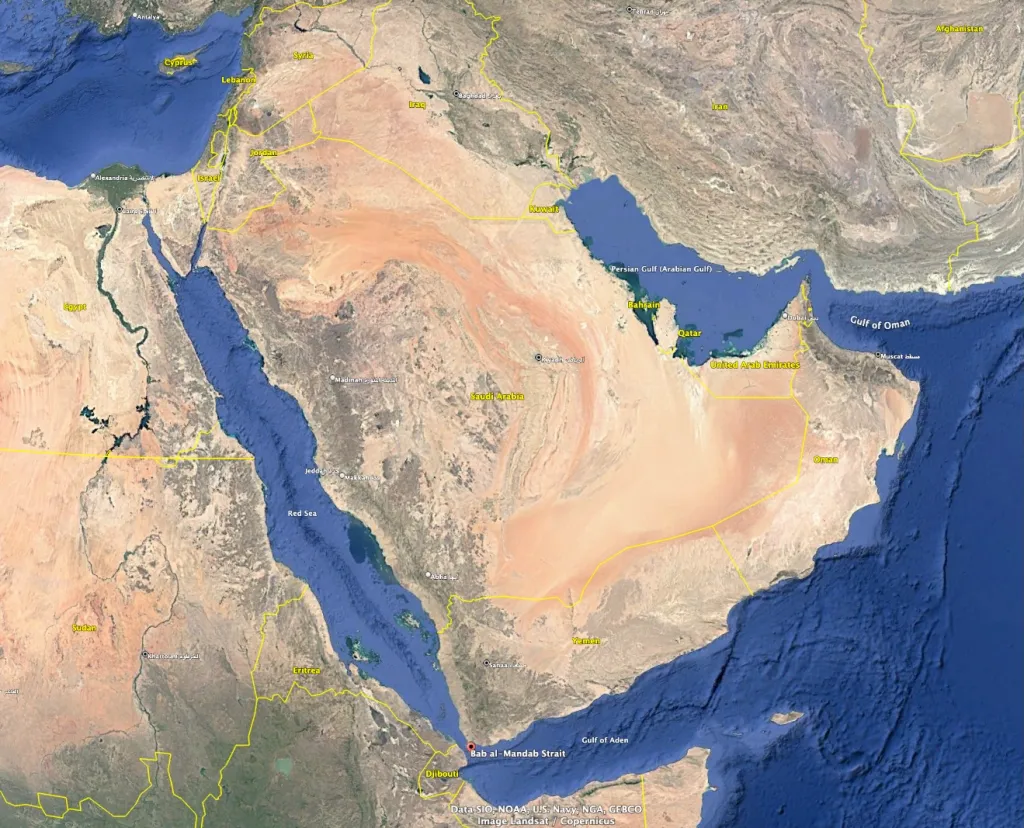
U.S. Moves Warships Into Gulf, Sends Two Destroyers Through Strategic Strait

The U. S. military announced that two Navy guided-missile destroyers entered the Gulf to counter an Iranian blockade, while two U. S. ships passed through the Strait of Hormuz. This follows Iran’s claim of preventing a U. S. warship from entering the Gulf. U. S. Central Command (CENTCOM) stated that forces are supporting President Trump’s “Project Freedom,” aimed at helping commercial ships stranded due to the U. S.-Israeli conflict with Iran, and are enforcing a blockade on Iranian ports.

The U. S. intervention increases the possibility of direct confrontation with Iran in a crucial waterway that carries a significant portion of the world’s oil and gas, which has been blocked for two months because of the war. CENTCOM reported that two U. S.-flagged vessels successfully transited the strait while destroyers worked in the Gulf. Iran claimed it made a U. S. warship turn back, but CENTCOM denied reports of any missile strikes on the ship. An Iranian official mentioned a warning shot was fired, with uncertainty about any resulting damage to the warship.

Trump detailed a plan to assist ships running low on supplies in the Gulf, stating, “We will guide their Ships safely out of these restricted Waterways. ” In response, Iran warned oil tankers and commercial ships to coordinate movements with its military, asserting that it controls security in the Strait of Hormuz and would attack any foreign armed forces, particularly the U. S. military, attempting to enter. Since the war began, Iran has largely blocked shipping movements, causing oil prices to surge significantly.

CENTCOM plans to support “Project Freedom” with 15,000 troops, over 100 aircraft, warships, and drones, asserting that this mission is vital for regional security and the global economy.

With information from Reuters

Source link

Navy Still Pushing To Field New AARGM-ER Radar-Busting Missile This Year Despite “Strategic Pause”

The U.S. Navy says it is still aiming to see the AGM-88G Advanced Anti-Radiation Guided Missile-Extended Range (AARGM-ER) enter operational service this year. This is despite the announcement of a planned “strategic pause” in purchases of the missiles in the 2027 Fiscal Year. AARGM-ER is set to give Navy carrier air wings a critical boost in their ability to neutralize ever-more capable hostile integrated defense networks.

AARGM-ER has been in the works since the late 2010s. Northrop Grumman is the current prime contractor, through its previous acquisition of Orbital ATK. The Navy has ordered dozens of the missiles already. Hence, it was very surprising when the service’s latest proposed budget for the 2027 Fiscal Year, rolled out in full last week, included no request for funding to buy more AGM-88Gs due to the aforementioned pause. All of this, coupled with previous delays and technical issues encountered in testing, had prompted new questions about the future of the program.

An AARGM-ER seen under the wing of an F/A-18 Super Hornet during a test. USN

“U.S. procurements for the AARGM-ER program are planned to resume once the system has successfully completed all necessary testing and software updates. Our immediate priority is ensuring the weapon passes these rigorous testing milestones to achieve Initial Operational Capability (IOC) in September 2026,” a Navy spokesperson told TWZ. “After validating the software and testing, the plan would be to ramp up production to clear a backlog of over 150 missiles, with U.S. procurements officially restarting in FY28 [Fiscal year 2028]. In the interim, FY27 production will be allocated to Foreign Military Sales to fulfill our commitments to five signed international cases.”

The spokesperson did not name the foreign customers in question. However, Italy is a full partner in the development of the AGM-88G. The U.S. government has also previously approved sales of the missiles to Australia, Finland, and the Netherlands. Norway has publicly announced its intention to purchase AARGM-ERs, as well. The U.S. Air Force is also set to acquire these missiles. We will come back to this later on.

The AGM-88 family, also known as the High-speed Anti-Radiation Missile (HARM), traces its roots back to the 1970s. The AARGM-ER is a major redesign of the preceding AARGM variant, also designated the AGM-88E. The AGM-88G features a completely redesigned body optimized for high speed and range, as well as a new, more powerful rocket motor and control actuation system.

A graphic the Navy has previously released offering a general breakdown of the components of the AGM-88G AARGM-ER, including what it carries over from the preceding AGM-88E AARGM. USN
An earlier generation AGM-88 missile seen under the wing of a Navy F/A-18E Super Hornet. USN

Inside, the AGM-88G reuses the guidance and control systems from the AGM-88E. By extension, this means the AGM-88G retains the same multi-mode guidance capability of its predecessor, which includes a GPS-assisted inertial navigation system and a millimeter-wave radar seeker. The AARGM-ER’s primary target set is hostile emitters, especially air defense radars, but the guidance package is designed to allow it to find its mark even if they shut down and stop sending out signals to home in on. The AGM-88E also has a more general, secondary ability to strike targets on land or at sea, including by just being directed to hit a specified set of coordinates.

AARGM F-18 thumbnail

AARGM F-18


The Navy sees the AGM-88G entering service first integrated with its F/A-18E/F Super Hornet fighters and EA-18G Growler electronic warfare jets, both of which can already employ the AGM-88E. AARGM-ER’s boosts in speed and range are seen as critical to ensuring the survivability and effectiveness of those non-stealthy aircraft in the face of an ever more capable air defense threat ecosystem.

AARGM-ER is also sized to allow for internal carriage on F-35A and C variants. There are plans to eventually integrate it for external carriage on all three F-35 variants, as well as legacy F/A-18C/D Hornets, as well.

A picture showing a fit check to demonstrate the ability of the AARGM-ER test article to fit inside F-35A/C internal bays. Orbital ATK www.twz.com

As noted, the development of the AARGM-ER has had to contend with technical issues and delays over the years. Originally, the goal was to reach IOC on F/A-18E/F and EA-18G in Fiscal Year 2023.

“The AARGM-ER experienced significant delays as a result of rocket motor, structural, and software problems discovered during testing,” the Government Accountability Office (GAO) said in a report published in June 2025. “Contracting officials noted that the program worked with the prime contractor to investigate the root causes of the identified deficiencies and implement corrective actions, including changes in the production process.”

“The program is still experiencing production delays as well. Since our last assessment, program officials stated that testing issues, supply chain challenges, and construction delays for a new production facility slowed completion of the first two production contracts by 1 year,” GAO’s report added. “We have found that starting production before demonstrating a system will work as intended – which the Navy did – increases the risk of discovering deficiencies that require costly, time-intensive rework.”

“In FY25 [Fiscal Year 2025], the [AARGM-ER] program attempted three IT [integrated test] weapon employment tests using F/A-18F aircraft against a threat-representative integrated air defense land target at the China Lake Range in California,” according to a separate report from the Pentagon’s Office of the Director of Test and Evaluation (DOT&E), released in March of this year. “AARGM-ER successfully completed one of the three weapon events but exhibited performance discrepancies during the other two, to include one event during which range safety terminated the weapon after release. No further weapons employment testing was accomplished in FY25 pending implementation of updates required to address the problems that were identified.”

DOT&E warned in that report that the IOC schedule for AGM-88G could slip further to the first quarter of Fiscal Year 2027, which starts on October 1 of this year.

A US Navy F/A-18F Super Hornet fires an AGM-88G AARGM-ER over the Point Mugu Sea Range during a test. Northrop Grumman

Earlier this year, the Navy somewhat urgently put out a contracting notice saying it was exploring options for a new long-range anti-radiation missile. The stated requirements for this Advanced Emission Suppression Missile (AESM) were very much in line with how the AARGM-ER has been discussed in the past, with one notable exception: a new demand for the ability to engage targets in the air, as well as on the surface. You can read more about why that is significant here. With the Navy confirming that it is still pushing ahead on AARGM-ER, it remains unclear how exactly the service sees ASEM fitting into its broader plans. There does not appear to be any explicit mention of ASEM in the Navy’s latest budget request.

As noted, the U.S. Air Force is also in line to acquire AGM-88Gs. An AARGM-ER subvariant with “improved warhead/fuze” is set to serve as a bridge to the Stand-in Attack Weapon (SiAW), as well. Reportedly now designated the AGM-88J, SiAW is a derivative of the AARGM-ER being developed to provide a broader high-speed strike capability. The Air Force expects to primarily employ SiAW against time-sensitive and/or high-value assets on the ground, especially ballistic and cruise missile launchers, air and missile defense nodes, electronic warfare systems, and even anti-satellite weapons.

A SiAW test article. Northrop Grumman

Despite the Navy’s “strategic pause” with AARGM-ER, the Air Force is asking for more funds to purchase additional SiAWs in Fiscal Year 2027. The Air Force has said in the past that it has been targeting 2026 for reaching IOC with SiAW on the F-35A. SiAW flight testing to date, at least that has been disclosed, has involved carriage by F-16 fighters, and it is possible the missile could be integrated operationally onto that aircraft and others, as well. As an aside, Northrop Grumman has also been pitching a ground-launched member of the AARGM-ER/SiAW family, called the Advanced Reactive Strike Missile (AReS).

A SiAW test article is released from an F-16 fighter during a test. USAF

As mentioned, the Navy has made clear that procurement of AARGM-ERs for foreign customers through the FMS program is also continuing.

Time will tell whether or not the Navy can meet its IOC target for AARGM-ER by September, or the timeline slips into the next fiscal year. Still, the service looks to remain committed to the program, at least for the time being, regardless of its intent to put a year-long pause on buying more AGM-88G.

Contact the author: joe@twz.com

Joseph has been a member of The War Zone team since early 2017. Prior to that, he was an Associate Editor at War Is Boring, and his byline has appeared in other publications, including Small Arms Review, Small Arms Defense Journal, Reuters, We Are the Mighty, and Task & Purpose.


Source link

India Must Leverage Indian Ocean Security Mechanisms to Protect Its Strategic Interests

Authors: Rahul Mishra & Harshit Prajapati

The US-Israel conflict with Iran dragged almost every country into a phase of energy insecurity. While Iran’s neighboring countries are directly affected by the armed conflict, immediate regions too have not remained insulated from the ongoing conflict. For India, the conflict has demonstrated the implications of getting caught in the crossfire of a conflict in its vicinity. Two particular incidents—the US sinking of the Iranian warship IRIS Dena in the waters off the coast of Sri Lanka (just 40 nautical miles away) and the reported firing of two ballistic missiles towards the joint UK-US base at Diego Garcia in the Indian Ocean—serve as a grim reminder about a conflict spiraling in India’s maritime backyard in the Indian Ocean Region (IOR).

For decades, the Indian Ocean region has remained largely peaceful, away from any direct impact of a conflict in a neighboring region or any major power conflict with a regional impact. The two above-mentioned incidents highlight the need for littoral states of the IOR to have a regional security mechanism to deal with any crisis in the region in a more cohesive and coordinated fashion. Being one of the major stakeholders in the region, it is incumbent upon India to foster meaningful and substantial cooperation with IOR littoral states through regional mechanisms such as the Colombo Security Conclave (CSC) and the Indian Ocean Naval Symposium (IONS). It would be a timely exercise to strive to move beyond non-traditional security cooperation mechanisms to protect the shared maritime space, especially during such conflicts.

The sinking of IRIS Dena in the IOR when it was returning to its home after participating in the International Fleet Review and multinational exercise MILAN, hosted by India, serves as a major strategic lesson to countries of the region. Since the International Fleet Reviews are an acknowledgement by the regional and global peers of the host country’s sovereignty and maritime supremacy in its neighborhood, the sinking of an Iranian warship does not augur well for India’s claim as a net security provider or preferred security partner in the IOR.

Additionally, Iran’s launch of two ballistic missiles, which failed to strike the designated target, towards the Diego Garcia base, reflects the risk of a distant war reaching India’s maritime backyard. The 2025 decolonization agreement between the UK and Mauritius enabled the transfer of the Chagos archipelago, including Diego Garcia Island, to Mauritius; however, the UK retained access to the Diego Garcia military base for 99 years. Thus, in the event of a conflict, Diego Garcia, as the joint UK-US base, may become a target, thereby drawing the war into the Indian maritime backyard. With the escalating conflict with Iran, Hezbollah, and the Houthi rebels, the possibility of repetition of such an incident cannot be ruled out.

During the Cold War, India and the IOR countries endeavored to halt the foreign military presence in the IOR, as illustrated by the UNGA Resolution 2832 of 1971, which sought to establish the Indian Ocean Zone of Peace (IOZOP). However, the regional countries failed to implement the declaration because of resistance from the major powers. In 2016, India attempted to revive implementation of the 1971 resolution but failed to garner significant attention from the IOR countries, putting aside any major power.

Rather than seeking IOZOP through restrictions on foreign military presence, India should strengthen its naval capabilities, especially its intelligence, surveillance, and reconnaissance (ISR) platforms. Earlier, in 2018, India envisioned a 200-ship fleet by 2027; however, in 2026, the goal was revised to a 200-plus-ship fleet by 2035. Despite the induction of new platforms, this goal seems ambitious, as older platforms retire faster than new ones are inducted, especially given the constrained budget allocation to the Indian Navy.

A sizable portion of India’s submarine fleet is aging. The current force comprising Russian-origin Kilo-class submarines and German-origin Type 209 submarines has been in service for decades and is set to retire soon. Although the induction of nuclear-powered ballistic missile submarine Aridhaman in April 2026 and Arighaat in August 2024 strengthened India’s nuclear triad, the pace of induction of conventional submarines remains lagging. Project 75I, aimed at developing advanced diesel-electric submarines, was originally set in motion in 2007; however, its deal with the manufacturer—a German firm—has yet to be signed.

Earlier, it was planned that India would expand its fleet of long-range maritime reconnaissance Boeing P-8I aircraft from 12 to 28. But then the plan to expand the fleet to 28 P-8I aircraft was reduced to 20-22 due to constrained spending. Additionally, the Indian Navy only possesses 15 MQ-9B high-altitude, long-endurance (HALE) drones.

Therefore, if India needs to entrench its position as a preferred security partner in the IOR and realize its vision of Security and Growth for all in the Region (SAGAR)—upgraded to Mutual and Holistic Advancement for Security and Growth Across Regions (MAHASAGAR) in 2025—in the IOR, then it needs to support its normative framework with military capabilities.

Given India’s lack of naval capabilities—across all three mediums (air, surface, and undersea)—to conduct persistent surveillance of the enormous IOR (spanning more than 70 million square kilometers), India should collaborate with littoral countries to conduct surveillance in the IOR through regional mechanisms such as the CSC and the IONS. Presently, cooperation in these forums is largely limited to countering non-traditional security threats, such as piracy, trafficking, maritime disasters, etc. Challenges such as differing threat perceptions, disparity in naval capabilities, and a lack of regional consciousness hinder meaningful and substantial cooperation.

However, if the littoral countries of the IOR seek to avoid getting caught in the crossfire of a distant conflict, such as the present one, they need to move beyond non-traditional security cooperation to develop a common understanding of how to protect the shared maritime space in the IOR, especially during such conflicts. India, being the most militarily equipped country in the IOR, should take the lead in forging the collaborative efforts to conduct persistent surveillance in the IOR, as maritime wars do not respect geographical boundaries.

Source link